
ANCIENT EGYPT Chapter 5 Lesson 1: The Nile River
PC
Published · 23 slides · 0 views

1 / 1



Description
ANCIENT EGYPT Chapter 5 Lesson 1: The Nile River THE NILE RIVER VALLEY (pgs. 100-103) The Nile River is the worlds longest river. When Mesopotamia fell, the civilizations of Egypt and Kush began to develop along the Nile River. The early
Related Topics
Share
Embed code
Download this presentation From Below
"ANCIENT EGYPT Chapter 5 Lesson 1: The Nile River" is the property of its rightful owner. Permission is granted to download and print the materials on this website for personal, non-commercial use only, and to display it on your personal computer provided you do not modify the materials and that you retain all copyright notices contained in the materials. By downloading content from our website, you accept the terms of this agreement.
Presentation Transcript
01
ANCIENT EGYPT Chapter 5<br>
02
Lesson 1: The Nile River<br>
03
THE NILE RIVER VALLEY
(pgs. 100-103) The Nile River is the world’s longest river.
When Mesopotamia fell, the civilizations of Egypt and Kush began to develop along the Nile River.
The early Egyptians in the northern region of the Nile River Valley called their land Kemet which means “black land” because of the dark, rich soil.
So many of ancient Egypt’s structures survived over time because of the hot, dry climate.
The Nile River flows about 4,000 miles.
The Nile River has been called the lifeblood of Egypt.<br>
When Mesopotamia fell, the civilizations of Egypt and Kush began to develop along the Nile River.
The early Egyptians in the northern region of the Nile River Valley called their land Kemet which means “black land” because of the dark, rich soil.
So many of ancient Egypt’s structures survived over time because of the hot, dry climate.
The Nile River flows about 4,000 miles.
The Nile River has been called the lifeblood of Egypt.<br>
04
THE NILE RIVER VALLEY
(pgs. 100-103) The Nile River was useful for the following:
Drinking water
Bathing
Farming/Irrigation
Travel/Trade
Growing papyrus<br>
Drinking water
Bathing
Farming/Irrigation
Travel/Trade
Growing papyrus<br>
05
THE NILE RIVER VALLEY
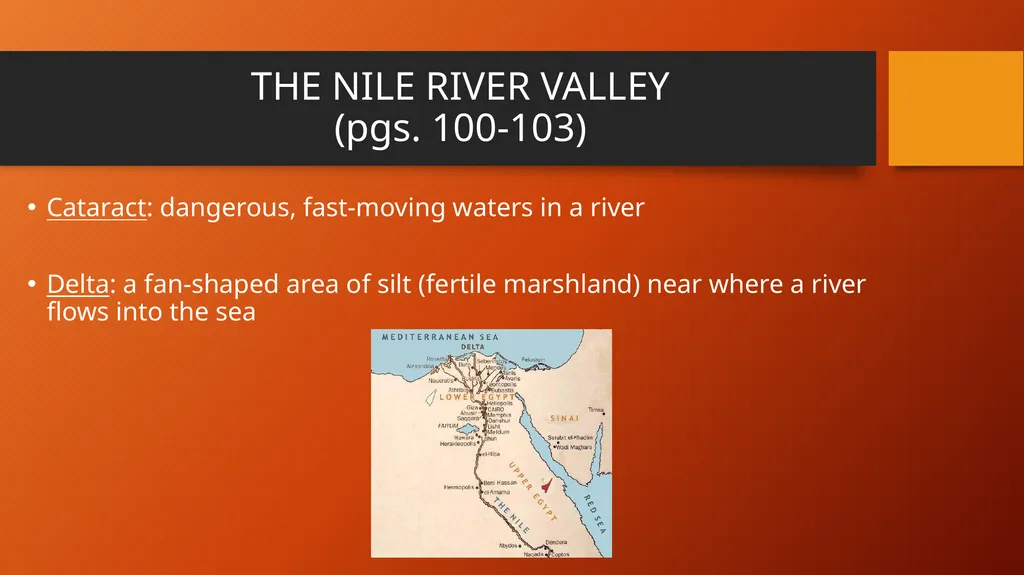
(pgs. 100-103) Cataract: dangerous, fast-moving waters in a river
Delta: a fan-shaped area of silt (fertile marshland) near where a river flows into the sea<br>
Delta: a fan-shaped area of silt (fertile marshland) near where a river flows into the sea<br>
06
THE NILE RIVER VALLEY
(pgs. 100-103) Egypt was protected by its physical environment:
Deserts: isolated from outside invaders
Cataracts in the south: keep out enemy ships
Marshes in the north: prevent invaders who sailed from Mediterranean Sea<br>
Deserts: isolated from outside invaders
Cataracts in the south: keep out enemy ships
Marshes in the north: prevent invaders who sailed from Mediterranean Sea<br>
07
PEOPLE OF THE RIVER
(pgs. 103-105) The Nile flooding was more predictable and less destructive than that of the Tigris and Euphrates Rivers
Egyptian farmers used geometry to measure their fields
Silt was left behind after the flooding just like in Mesopotamia<br>
Egyptian farmers used geometry to measure their fields
Silt was left behind after the flooding just like in Mesopotamia<br>
08
PEOPLE OF THE RIVER
(pgs. 103-105) Basin: bowl-shaped holes
Shadoof: a bucket attached to a long pole that lifts water from the Nile and empties it into basins
Papyrus: a reed plant that grew wild along the Nile / used to make paper
Hieroglyphics: a writing system made up of a combination of pictures and sound symbols<br>
Shadoof: a bucket attached to a long pole that lifts water from the Nile and empties it into basins
Papyrus: a reed plant that grew wild along the Nile / used to make paper
Hieroglyphics: a writing system made up of a combination of pictures and sound symbols<br>
09
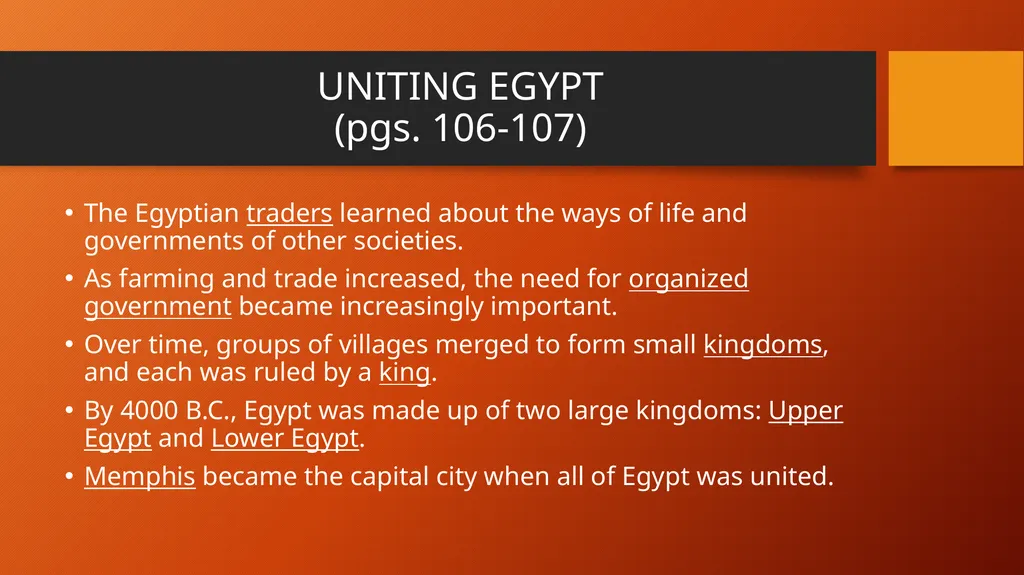
UNITING EGYPT
(pgs. 106-107) The Egyptian traders learned about the ways of life and governments of other societies.
As farming and trade increased, the need for organized government became increasingly important.
Over time, groups of villages merged to form small kingdoms, and each was ruled by a king.
By 4000 B.C., Egypt was made up of two large kingdoms: Upper Egypt and Lower Egypt.
Memphis became the capital city when all of Egypt was united.<br>
As farming and trade increased, the need for organized government became increasingly important.
Over time, groups of villages merged to form small kingdoms, and each was ruled by a king.
By 4000 B.C., Egypt was made up of two large kingdoms: Upper Egypt and Lower Egypt.
Memphis became the capital city when all of Egypt was united.<br>
10
UNITING EGYPT
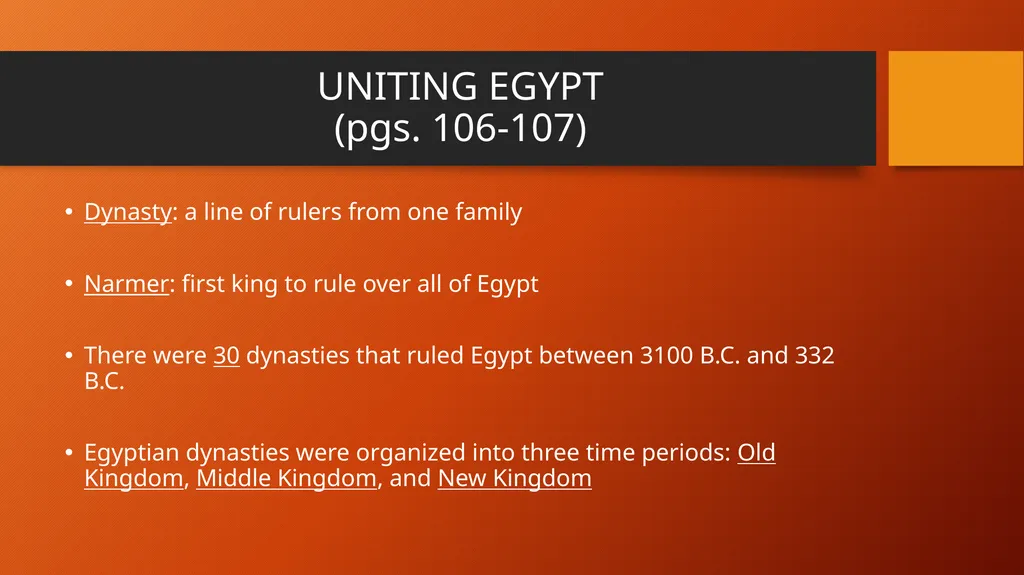
(pgs. 106-107) Dynasty: a line of rulers from one family
Narmer: first king to rule over all of Egypt
There were 30 dynasties that ruled Egypt between 3100 B.C. and 332 B.C.
Egyptian dynasties were organized into three time periods: Old Kingdom, Middle Kingdom, and New Kingdom<br>
Narmer: first king to rule over all of Egypt
There were 30 dynasties that ruled Egypt between 3100 B.C. and 332 B.C.
Egyptian dynasties were organized into three time periods: Old Kingdom, Middle Kingdom, and New Kingdom<br>
11
UNITING EGYPT
(pgs. 106-107) Facts about Narmer:
King of Upper Egypt
Conquered Lower Egypt
Married one of Lower Egypt’s princesses
Established the new capital city at Memphis, a city on the border of Upper Egypt and Lower Egypt
His kingdom lasted long after his death, establishing the first dynasty<br>
King of Upper Egypt
Conquered Lower Egypt
Married one of Lower Egypt’s princesses
Established the new capital city at Memphis, a city on the border of Upper Egypt and Lower Egypt
His kingdom lasted long after his death, establishing the first dynasty<br>
12
Lesson 2: Life in Ancient Egypt<br>
13
Egypt’s Early Rulers
(pgs. 108-110) The Old Kingdom lasted from around 2600 B.C. to 2200 B.C.
Characteristics of the Old Kingdom:
Built magnificent cities
Increased trade
Unified government (they valued unity!)
Theocracy: a government in which the same person is both the political leader and religious leader
Pharaoh: ruler (king) of ancient Egypt<br>
Characteristics of the Old Kingdom:
Built magnificent cities
Increased trade
Unified government (they valued unity!)
Theocracy: a government in which the same person is both the political leader and religious leader
Pharaoh: ruler (king) of ancient Egypt<br>
14
Egypt’s Early Rulers
(pgs. 108-110) Pharaoh as a political leader:
Held total power
People were very loyal
Was considered wise and far-reaching
Would protect kingdom from war and famine
Appointed government officials to carry out his orders
Owned all of the land in Egypt and could use it as he pleased
Distributed land to officials, priests, and wealthy Egyptians whom he favored
Bureaucrats: government officials appointed by the king
They supervised construction and repair of dams, irrigation canals, and brick granaries (places to store grain), and they collected tax payments of grain from farmers<br>
Held total power
People were very loyal
Was considered wise and far-reaching
Would protect kingdom from war and famine
Appointed government officials to carry out his orders
Owned all of the land in Egypt and could use it as he pleased
Distributed land to officials, priests, and wealthy Egyptians whom he favored
Bureaucrats: government officials appointed by the king
They supervised construction and repair of dams, irrigation canals, and brick granaries (places to store grain), and they collected tax payments of grain from farmers<br>
15
Egypt’s Early Rulers
(pgs. 108-110) Pharaoh as a religious leader:
Thought to be the son of Re, the Egyptian sun god
Believed to be a god on earth who protected Egypt
People would play music and bow their heads when he appeared in public
Participated in ceremonies to help the kingdom thrive
Riding a bull around Memphis to keep the soil fertile
First person to cut the ripened grain at harvest time to bring abundant crops<br>
Thought to be the son of Re, the Egyptian sun god
Believed to be a god on earth who protected Egypt
People would play music and bow their heads when he appeared in public
Participated in ceremonies to help the kingdom thrive
Riding a bull around Memphis to keep the soil fertile
First person to cut the ripened grain at harvest time to bring abundant crops<br>
16
Religion in Egypt
(pgs. 110-112) Religion influenced every aspect of Egyptian life
Egyptians were polytheistic
Farming was very important to the Egyptians, so their two most important gods were:
Re- the sun god
Hapi- the river god
Other important gods:
Osiris and Isis- ruled over the world of the dead
Thoth- god of learning<br>
Egyptians were polytheistic
Farming was very important to the Egyptians, so their two most important gods were:
Re- the sun god
Hapi- the river god
Other important gods:
Osiris and Isis- ruled over the world of the dead
Thoth- god of learning<br>
17
Religion in Egypt
(pgs. 110-112) The Afterlife:
Much of Egyptian life revolved around preparing for the afterlife
The Book of the Dead- one of the important writings of ancient Egypt / full of prayers and magic spells to prepare for the afterlife
They originally thought the afterlife was only for pharaohs
The body had to be protected so it could give the soul a place to live
Embalming: the process of treating a body to keep it from decaying
Process of Embalming:
Organs removed and stored in jars to bury with the body
Body covered in a salt called natron to dry up the body
Dried body was filled with burial spices and wrapped in long strips of linen
Mummy: the wrapped body after it went through the embalming process<br>
Much of Egyptian life revolved around preparing for the afterlife
The Book of the Dead- one of the important writings of ancient Egypt / full of prayers and magic spells to prepare for the afterlife
They originally thought the afterlife was only for pharaohs
The body had to be protected so it could give the soul a place to live
Embalming: the process of treating a body to keep it from decaying
Process of Embalming:
Organs removed and stored in jars to bury with the body
Body covered in a salt called natron to dry up the body
Dried body was filled with burial spices and wrapped in long strips of linen
Mummy: the wrapped body after it went through the embalming process<br>
18
Religion in Egypt
(pgs. 110-112) Wealthy people had their mummies placed in coffins and buried in decorated tombs
Poor people had their mummies buried in caves or in the sand
Animals were embalmed too because Egyptians viewed them not only as pets, but as sacred creatures—many would be buried at temples to honor the gods and goddesses
The Egyptians developed a lot of medical skills as they studied the human body in the embalming process
First to give stitches, set broken bones, and use splints, bandages, and compresses
They wrote down medical information on papyrus scrolls—these records were the world’s first medical books!<br>
Poor people had their mummies buried in caves or in the sand
Animals were embalmed too because Egyptians viewed them not only as pets, but as sacred creatures—many would be buried at temples to honor the gods and goddesses
The Egyptians developed a lot of medical skills as they studied the human body in the embalming process
First to give stitches, set broken bones, and use splints, bandages, and compresses
They wrote down medical information on papyrus scrolls—these records were the world’s first medical books!<br>
19
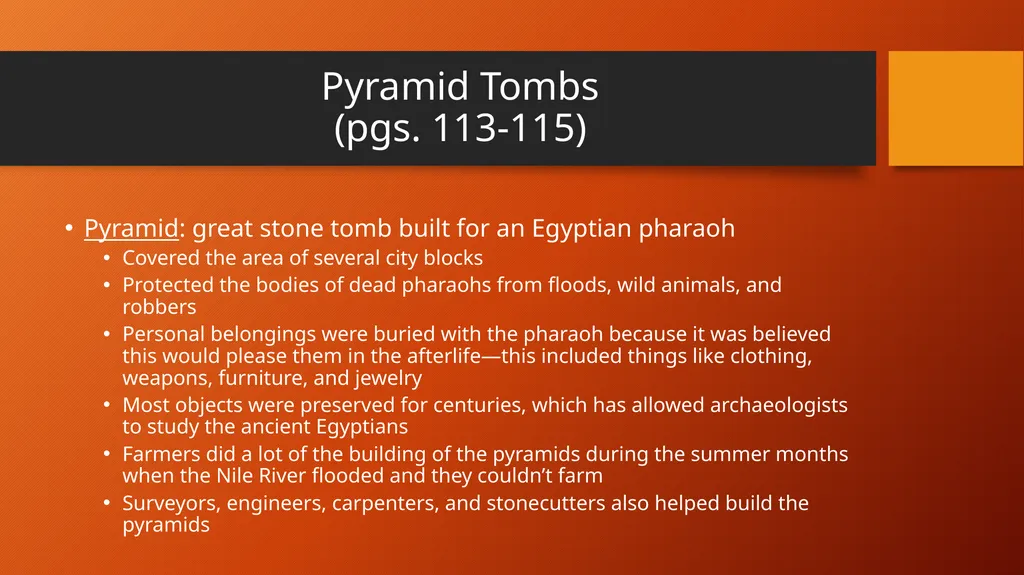
Pyramid Tombs
(pgs. 113-115) Pyramid: great stone tomb built for an Egyptian pharaoh
Covered the area of several city blocks
Protected the bodies of dead pharaohs from floods, wild animals, and robbers
Personal belongings were buried with the pharaoh because it was believed this would please them in the afterlife—this included things like clothing, weapons, furniture, and jewelry
Most objects were preserved for centuries, which has allowed archaeologists to study the ancient Egyptians
Farmers did a lot of the building of the pyramids during the summer months when the Nile River flooded and they couldn’t farm
Surveyors, engineers, carpenters, and stonecutters also helped build the pyramids<br>
Covered the area of several city blocks
Protected the bodies of dead pharaohs from floods, wild animals, and robbers
Personal belongings were buried with the pharaoh because it was believed this would please them in the afterlife—this included things like clothing, weapons, furniture, and jewelry
Most objects were preserved for centuries, which has allowed archaeologists to study the ancient Egyptians
Farmers did a lot of the building of the pyramids during the summer months when the Nile River flooded and they couldn’t farm
Surveyors, engineers, carpenters, and stonecutters also helped build the pyramids<br>
20
Pyramid Tombs
(pgs. 113-115) Imhotep: the first great engineer who built pyramids / he served as an official for the pharaoh
(Read pg. 114 for specifics on how they transported stone to the pyramids for building)
Entrance to the pyramid always faced north—in order to learn which way was north, they had to study the skies and develop an understanding of astronomy.
This led to the invention of the 365 day calendar with 12 months divided into three seasons—the basis for our modern calendar.
Pyramid building also led to advancements in mathematics—number system based on 10 and the creation of fractions<br>
(Read pg. 114 for specifics on how they transported stone to the pyramids for building)
Entrance to the pyramid always faced north—in order to learn which way was north, they had to study the skies and develop an understanding of astronomy.
This led to the invention of the 365 day calendar with 12 months divided into three seasons—the basis for our modern calendar.
Pyramid building also led to advancements in mathematics—number system based on 10 and the creation of fractions<br>
21
Pyramid Tombs
(pgs. 113-115) Great Pyramid:
Biggest and grandest pyramid built
Built for King Khufu—one of three still standing at Giza on the Nile River bank
About 10 miles from the modern city of Cairo
About the height of a 48 story building, towering nearly 500 feet tall
Extends over an area equal in size to 9 football fields
More than 2 million stone blocks were used—each block weighing an average of 2.5 tons (about 5,000 pounds per block!!!)
For more than 4,000 years, the Great Pyramid stood as the tallest structure in the world<br>
Biggest and grandest pyramid built
Built for King Khufu—one of three still standing at Giza on the Nile River bank
About 10 miles from the modern city of Cairo
About the height of a 48 story building, towering nearly 500 feet tall
Extends over an area equal in size to 9 football fields
More than 2 million stone blocks were used—each block weighing an average of 2.5 tons (about 5,000 pounds per block!!!)
For more than 4,000 years, the Great Pyramid stood as the tallest structure in the world<br>
22
Daily Life
(pgs. 116-119) At its peak, Egypt was home to about 5 million people, which is about equal to the number of people today living in the state of Colorado.
The Nile River valley and delta is where most people lived. Today that area makes up only 3% of Egypt’s land.
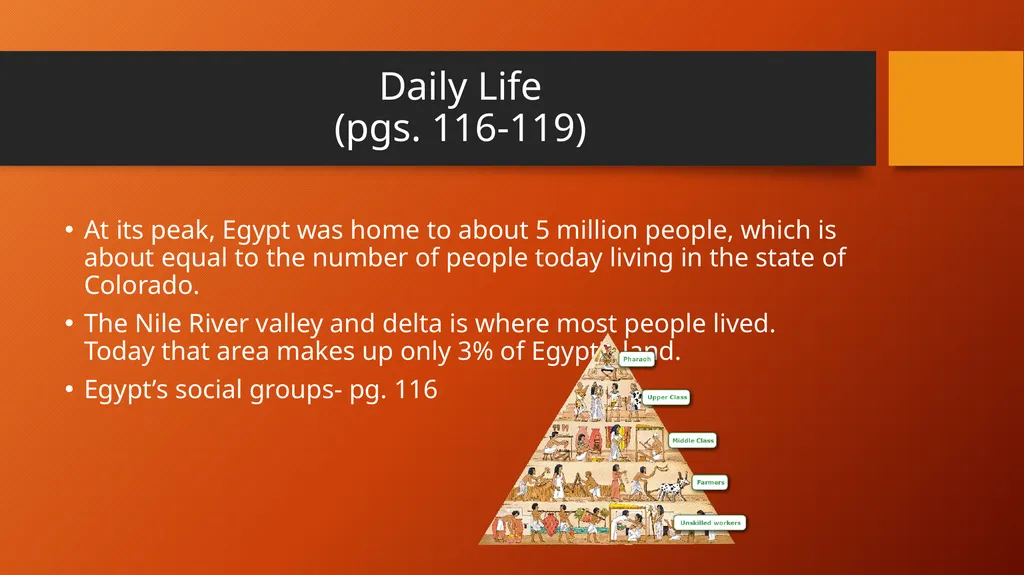
Egypt’s social groups- pg. 116<br>
The Nile River valley and delta is where most people lived. Today that area makes up only 3% of Egypt’s land.
Egypt’s social groups- pg. 116<br>
23
Daily Life
(pgs. 116-119) Largest groups of people was farmers and unskilled workers
Read together: “How People Lived” (pg. 117-118)
The family was the most important group in ancient Egyptian society:
Father was head of household
Women had more rights than in most other early civilizations—they could own property, buy and sell goods, and obtain divorces
Wealthy women could even serve as priests
Children played and learned from their parents
Married as teenagers
Many farm families lived with their extended families<br>
Read together: “How People Lived” (pg. 117-118)
The family was the most important group in ancient Egyptian society:
Father was head of household
Women had more rights than in most other early civilizations—they could own property, buy and sell goods, and obtain divorces
Wealthy women could even serve as priests
Children played and learned from their parents
Married as teenagers
Many farm families lived with their extended families<br>