
Ancient Greek for Everyone: A New Digital Resource
DP
Published · 27 slides · 0 views

1 / 1

Description
Ancient Greek for Everyone: A New Digital Resource for Beginning Greek Unit 5: Introduction to Pronouns Classical Reading 2015 edition Wilfred E. Major wmajorlsu.edu Ancient Greek for Everyone Unit 5 Classical reading Be able to: read the
Related Topics
Share
Embed code
Download this presentation From Below
"Ancient Greek for Everyone: A New Digital Resource" is the property of its rightful owner. Permission is granted to download and print the materials on this website for personal, non-commercial use only, and to display it on your personal computer provided you do not modify the materials and that you retain all copyright notices contained in the materials. By downloading content from our website, you accept the terms of this agreement.
Presentation Transcript
01
Ancient Greek for Everyone:
A New Digital Resource for Beginning Greek
Unit 5: Introduction to Pronouns
Classical Reading 2015 edition
Wilfred E. Major
wmajor@lsu.edu<br>
Wilfred E. Major
wmajor@lsu.edu<br>
02
Ancient Greek for Everyone Unit 5 Classical reading
Be able to:
read the sentences aloud
parse each verb and noun (with article where it appears)
translate the sentences into English.<br>
Be able to:
read the sentences aloud
parse each verb and noun (with article where it appears)
translate the sentences into English.<br>
03
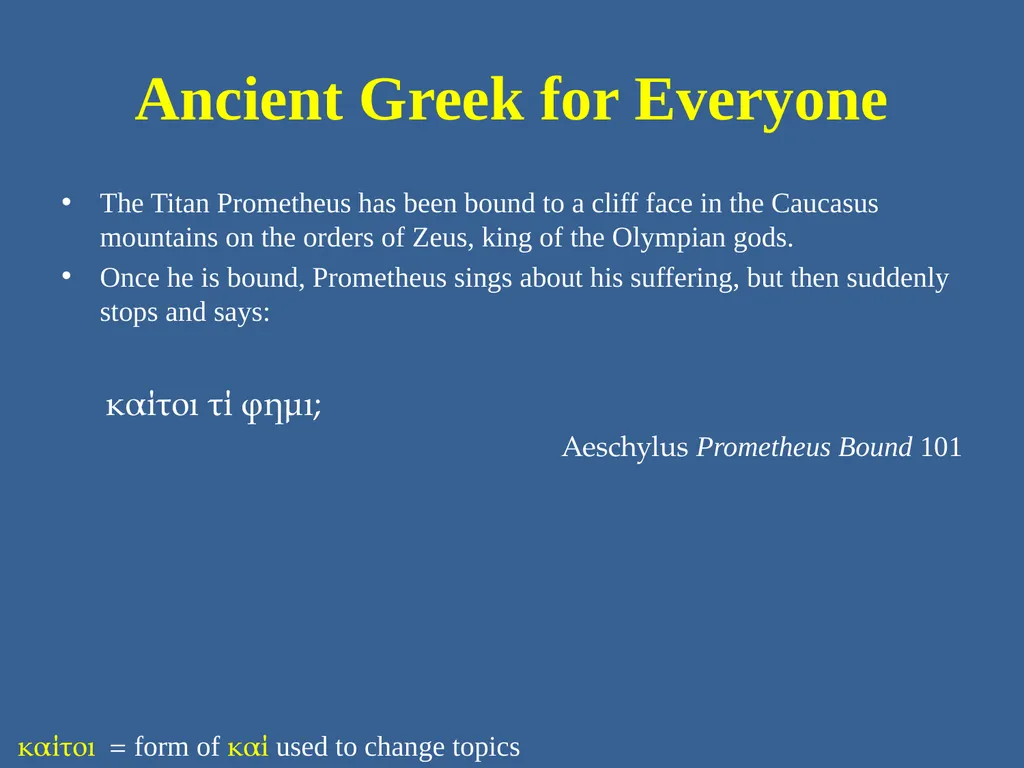
Ancient Greek for Everyone The Titan Prometheus has been bound to a cliff face in the Caucasus mountains on the orders of Zeus, king of the Olympian gods.
Once he is bound, Prometheus sings about his suffering, but then suddenly stops and says:
καίτοι τί φημι;
Aeschylus Prometheus Bound 101 καίτοι = form of καί used to change topics<br>
Once he is bound, Prometheus sings about his suffering, but then suddenly stops and says:
καίτοι τί φημι;
Aeschylus Prometheus Bound 101 καίτοι = form of καί used to change topics<br>
04
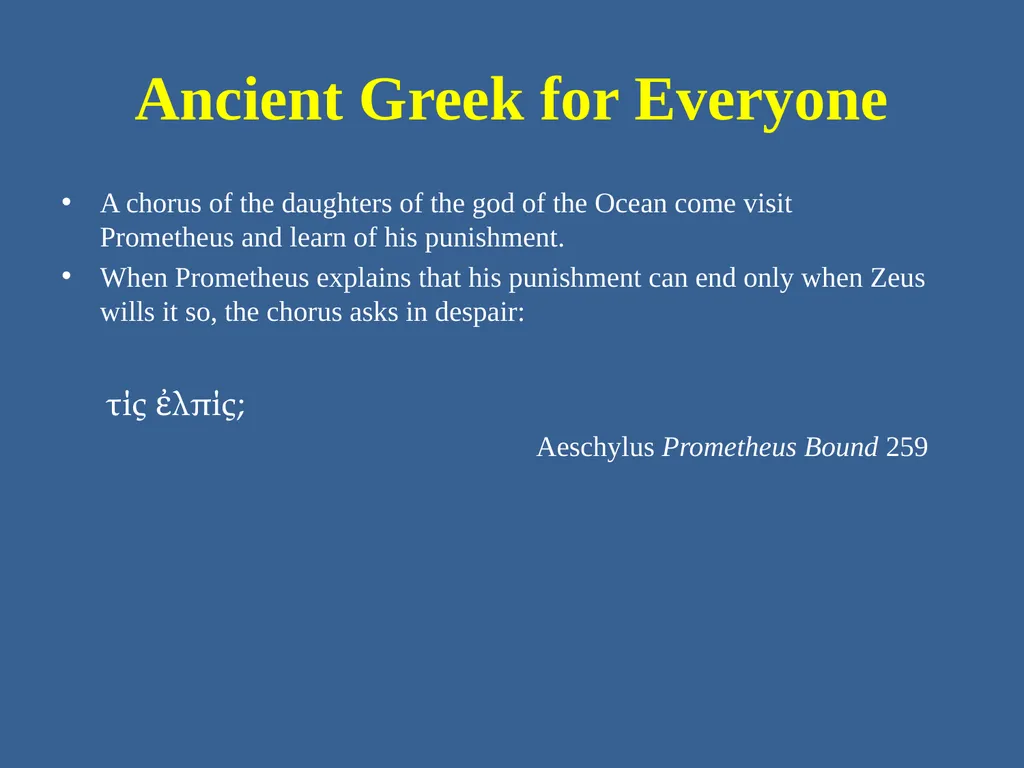
Ancient Greek for Everyone A chorus of the daughters of the god of the Ocean come visit Prometheus and learn of his punishment.
When Prometheus explains that his punishment can end only when Zeus wills it so, the chorus asks in despair:
τίς ἐλπίς;
Aeschylus Prometheus Bound 259<br>
When Prometheus explains that his punishment can end only when Zeus wills it so, the chorus asks in despair:
τίς ἐλπίς;
Aeschylus Prometheus Bound 259<br>
05
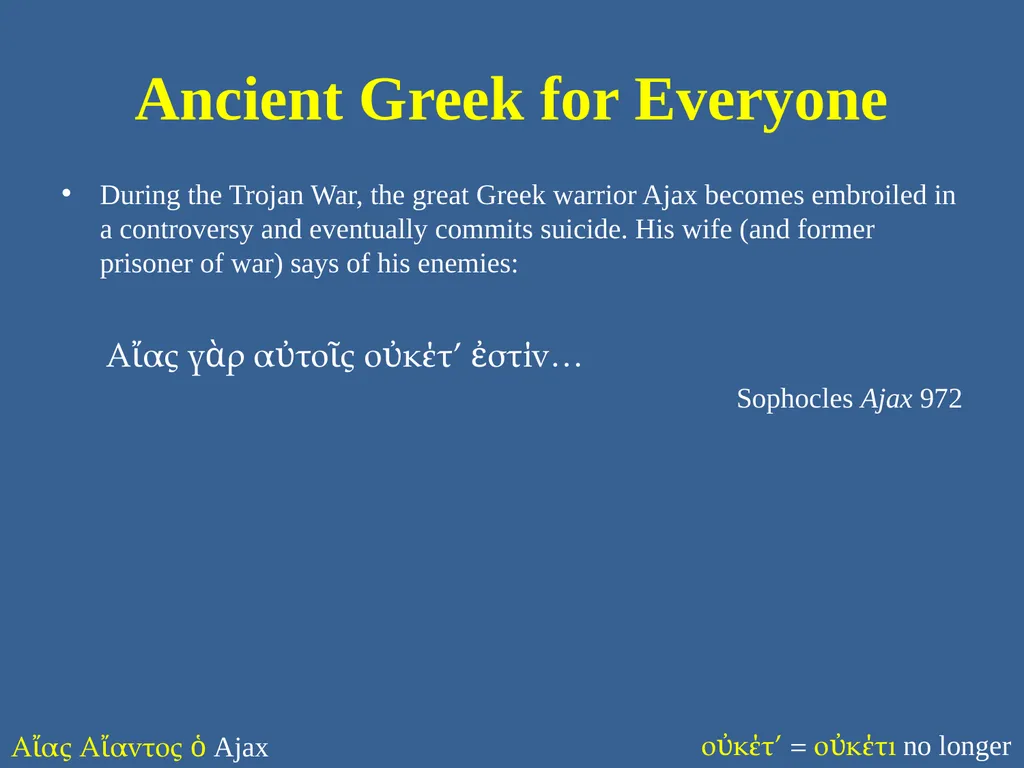
Ancient Greek for Everyone During the Trojan War, the great Greek warrior Ajax becomes embroiled in a controversy and eventually commits suicide. His wife (and former prisoner of war) says of his enemies:
Αἴας γὰρ αὐτοῖς οὐκέτ’ ἐστίν…
Sophocles Ajax 972 Αἴας Αἴαντος ὁ Ajax οὐκέτ’ = οὐκέτι no longer<br>
Αἴας γὰρ αὐτοῖς οὐκέτ’ ἐστίν…
Sophocles Ajax 972 Αἴας Αἴαντος ὁ Ajax οὐκέτ’ = οὐκέτι no longer<br>
06
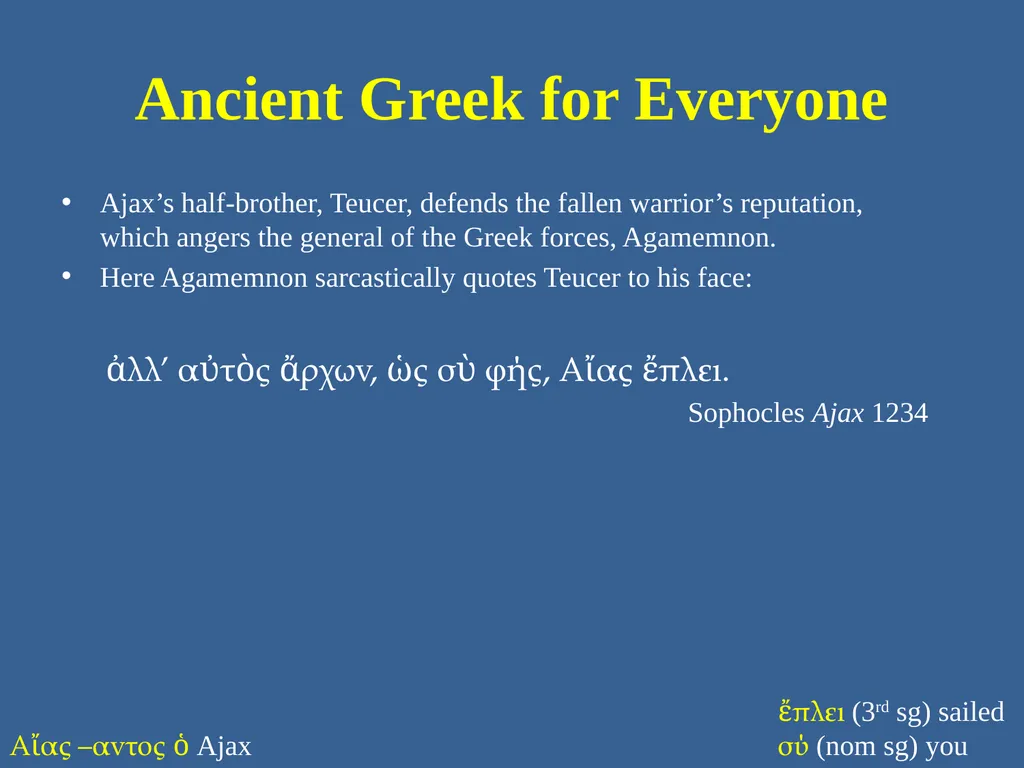
Ancient Greek for Everyone Ajax’s half-brother, Teucer, defends the fallen warrior’s reputation, which angers the general of the Greek forces, Agamemnon.
Here Agamemnon sarcastically quotes Teucer to his face:
ἀλλ’ αὐτὸς ἄρχων, ὡς σὺ φής, Αἴας ἔπλει.
Sophocles Ajax 1234 ἔπλει (3rd sg) sailed
σύ (nom sg) you Αἴας –αντος ὁ Ajax<br>
Here Agamemnon sarcastically quotes Teucer to his face:
ἀλλ’ αὐτὸς ἄρχων, ὡς σὺ φής, Αἴας ἔπλει.
Sophocles Ajax 1234 ἔπλει (3rd sg) sailed
σύ (nom sg) you Αἴας –αντος ὁ Ajax<br>
07
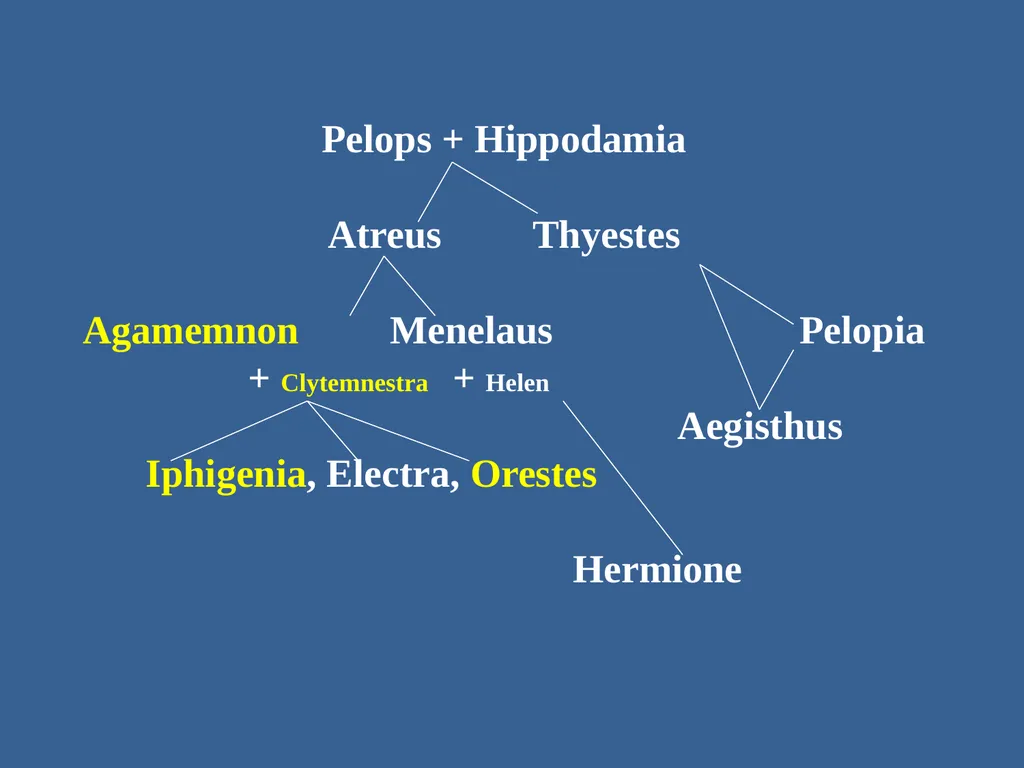
Pelops + Hippodamia
Atreus Thyestes
Agamemnon Menelaus Pelopia
+ Clytemnestra + Helen
Aegisthus
Iphigenia, Electra, Orestes
Hermione<br>
Atreus Thyestes
Agamemnon Menelaus Pelopia
+ Clytemnestra + Helen
Aegisthus
Iphigenia, Electra, Orestes
Hermione<br>
08
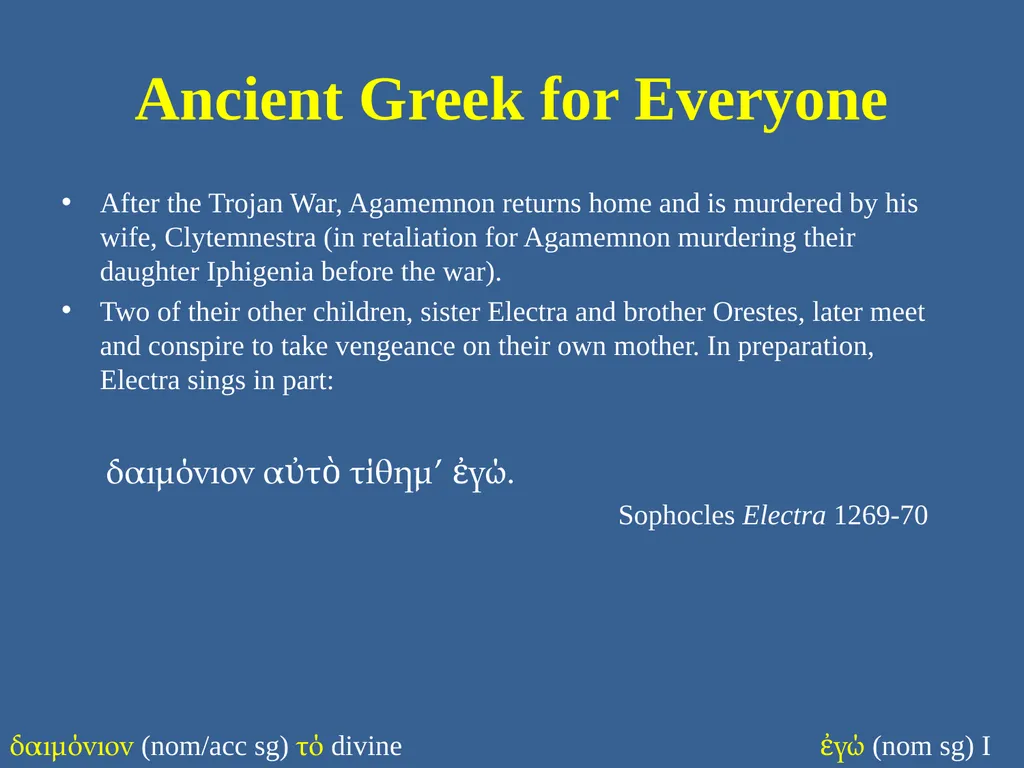
Ancient Greek for Everyone After the Trojan War, Agamemnon returns home and is murdered by his wife, Clytemnestra (in retaliation for Agamemnon murdering their daughter Iphigenia before the war).
Two of their other children, sister Electra and brother Orestes, later meet and conspire to take vengeance on their own mother. In preparation, Electra sings in part:
δαιμόνιον αὐτὸ τίθημ’ ἐγώ.
Sophocles Electra 1269-70 ἐγώ (nom sg) I δαιμόνιον (nom/acc sg) τό divine<br>
Two of their other children, sister Electra and brother Orestes, later meet and conspire to take vengeance on their own mother. In preparation, Electra sings in part:
δαιμόνιον αὐτὸ τίθημ’ ἐγώ.
Sophocles Electra 1269-70 ἐγώ (nom sg) I δαιμόνιον (nom/acc sg) τό divine<br>
09
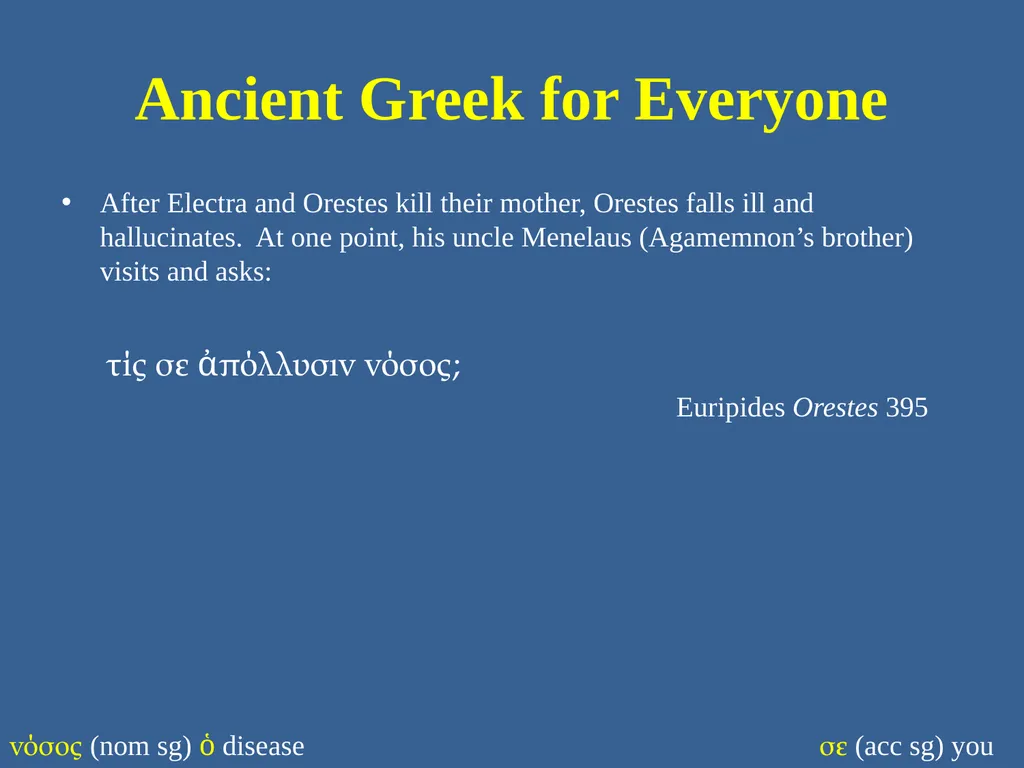
Ancient Greek for Everyone After Electra and Orestes kill their mother, Orestes falls ill and hallucinates. At one point, his uncle Menelaus (Agamemnon’s brother) visits and asks:
τίς σε ἀπόλλυσιν νόσος;
Euripides Orestes 395 σε (acc sg) you νόσος (nom sg) ὁ disease<br>
τίς σε ἀπόλλυσιν νόσος;
Euripides Orestes 395 σε (acc sg) you νόσος (nom sg) ὁ disease<br>
10
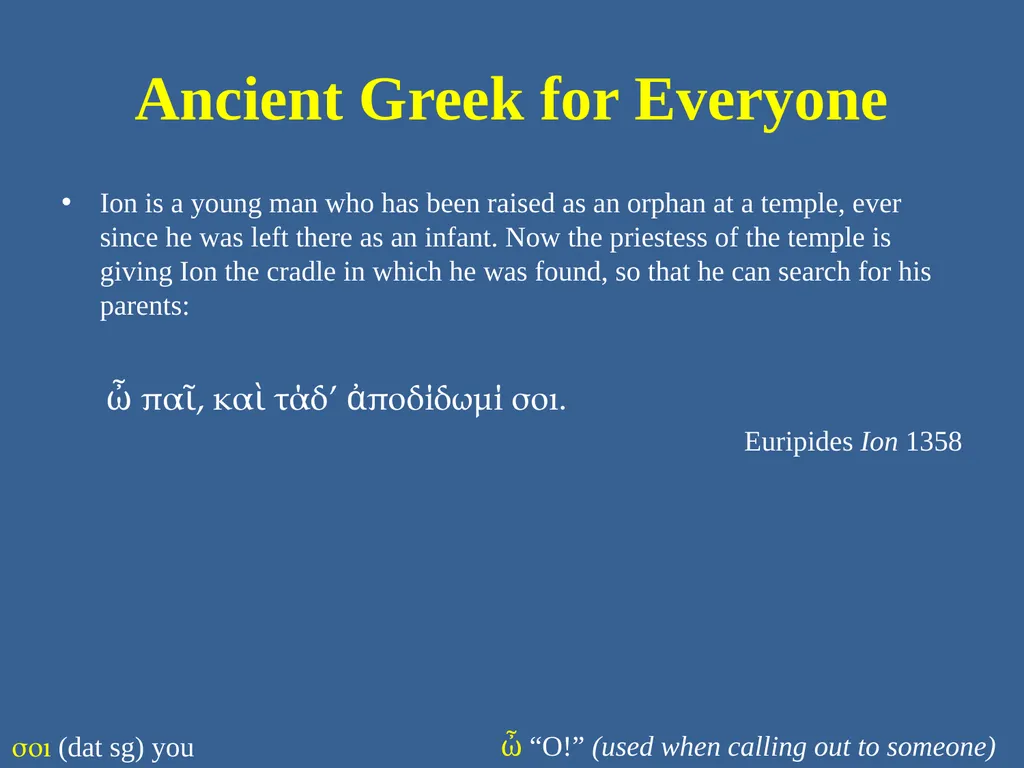
Ancient Greek for Everyone Ion is a young man who has been raised as an orphan at a temple, ever since he was left there as an infant. Now the priestess of the temple is giving Ion the cradle in which he was found, so that he can search for his parents:
ὦ παῖ, καὶ τάδ’ ἀποδίδωμί σοι.
Euripides Ion 1358 σοι (dat sg) you ὦ “O!” (used when calling out to someone)<br>
ὦ παῖ, καὶ τάδ’ ἀποδίδωμί σοι.
Euripides Ion 1358 σοι (dat sg) you ὦ “O!” (used when calling out to someone)<br>
11
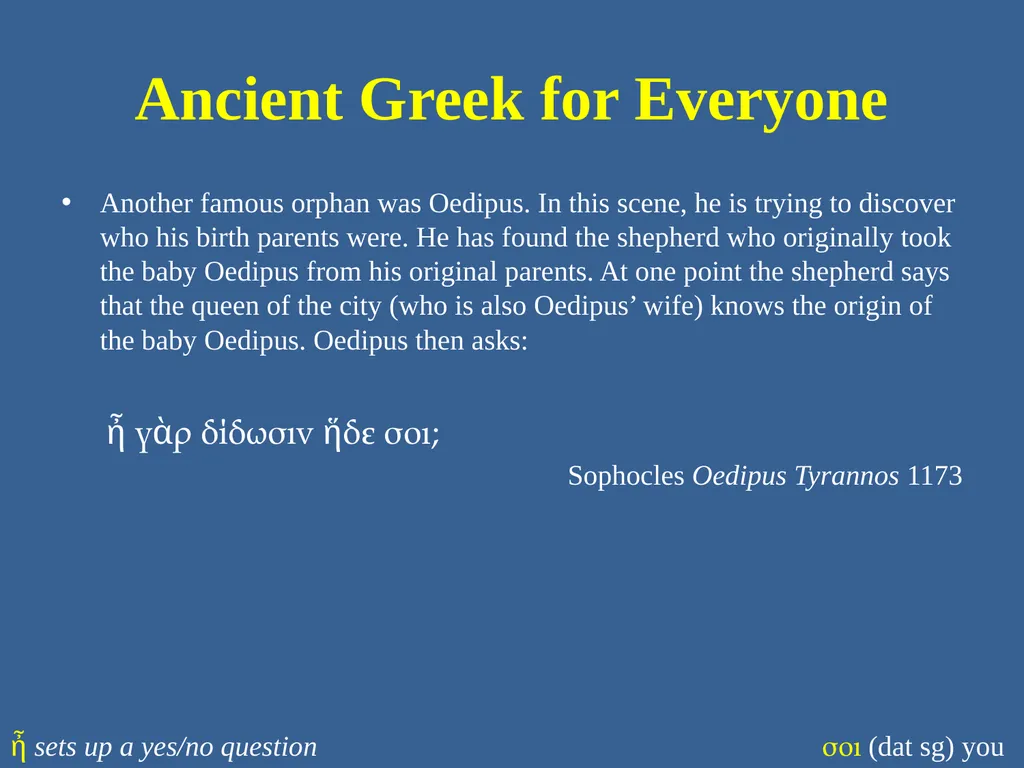
Ancient Greek for Everyone Another famous orphan was Oedipus. In this scene, he is trying to discover who his birth parents were. He has found the shepherd who originally took the baby Oedipus from his original parents. At one point the shepherd says that the queen of the city (who is also Oedipus’ wife) knows the origin of the baby Oedipus. Oedipus then asks:
ἦ γὰρ δίδωσιν ἥδε σοι;
Sophocles Oedipus Tyrannos 1173 σοι (dat sg) you ἦ sets up a yes/no question<br>
ἦ γὰρ δίδωσιν ἥδε σοι;
Sophocles Oedipus Tyrannos 1173 σοι (dat sg) you ἦ sets up a yes/no question<br>
12
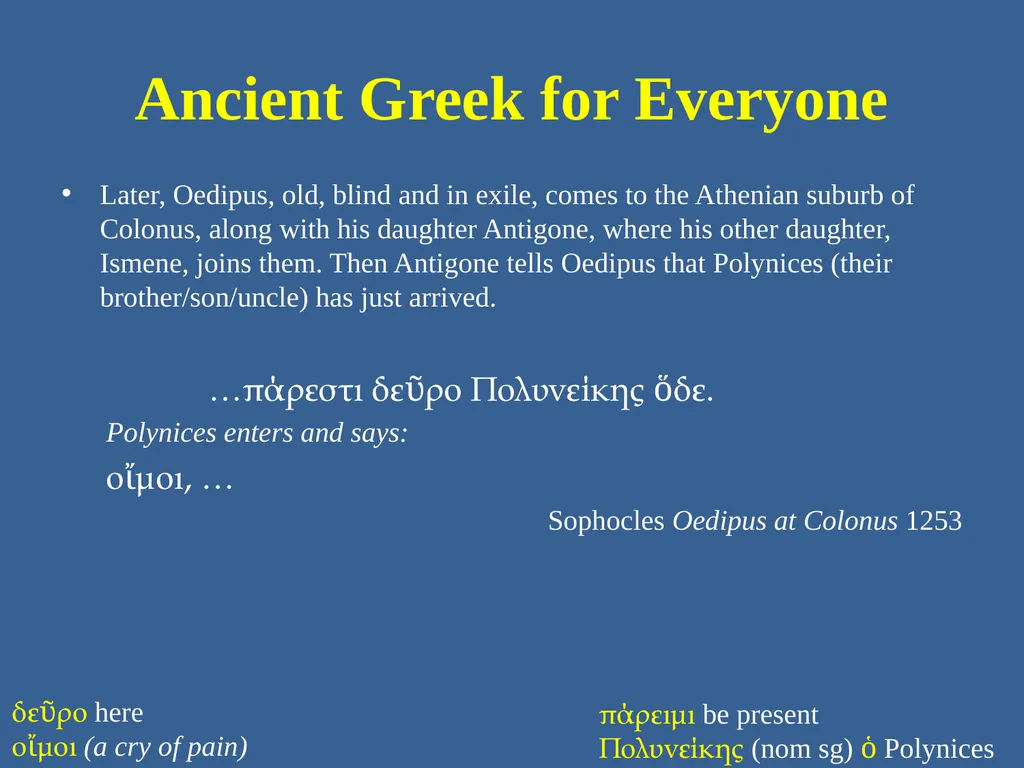
Ancient Greek for Everyone Later, Oedipus, old, blind and in exile, comes to the Athenian suburb of Colonus, along with his daughter Antigone, where his other daughter, Ismene, joins them. Then Antigone tells Oedipus that Polynices (their brother/son/uncle) has just arrived.
…πάρεστι δεῦρο Πολυνείκης ὅδε.
Polynices enters and says:
οἴμοι, …
Sophocles Oedipus at Colonus 1253 δεῦρο here
οἴμοι (a cry of pain) πάρειμι be present
Πολυνείκης (nom sg) ὁ Polynices<br>
…πάρεστι δεῦρο Πολυνείκης ὅδε.
Polynices enters and says:
οἴμοι, …
Sophocles Oedipus at Colonus 1253 δεῦρο here
οἴμοι (a cry of pain) πάρειμι be present
Πολυνείκης (nom sg) ὁ Polynices<br>
13
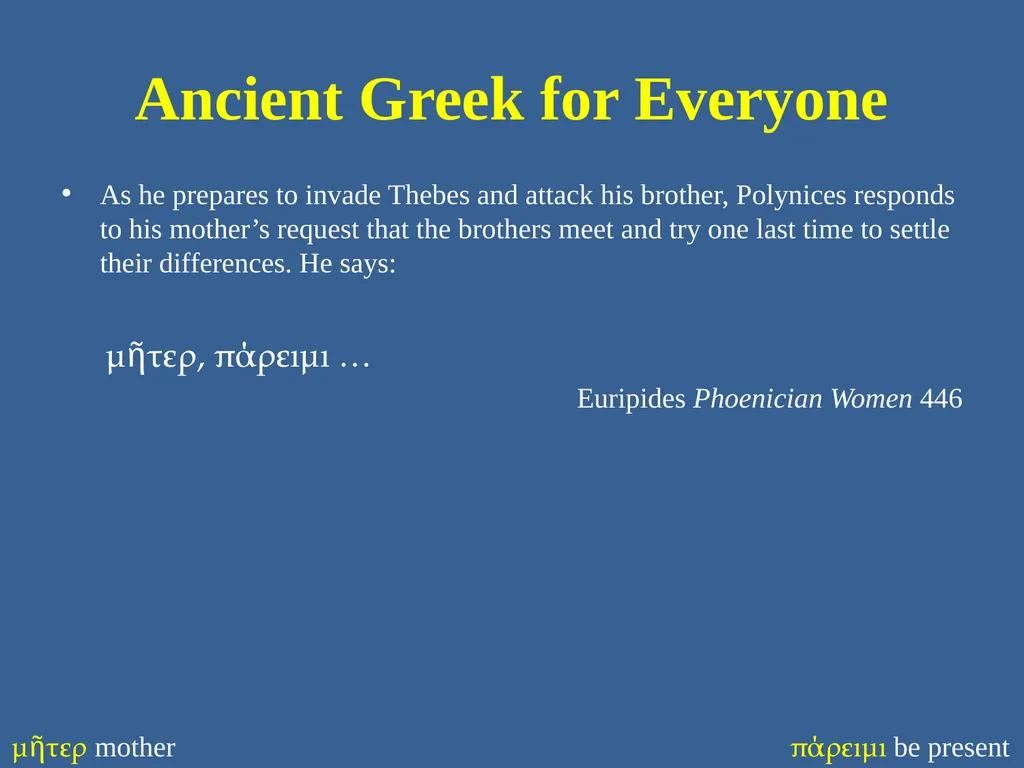
Ancient Greek for Everyone As he prepares to invade Thebes and attack his brother, Polynices responds to his mother’s request that the brothers meet and try one last time to settle their differences. He says:
μῆτερ, πάρειμι …
Euripides Phoenician Women 446 μῆτερ mother πάρειμι be present<br>
μῆτερ, πάρειμι …
Euripides Phoenician Women 446 μῆτερ mother πάρειμι be present<br>
14
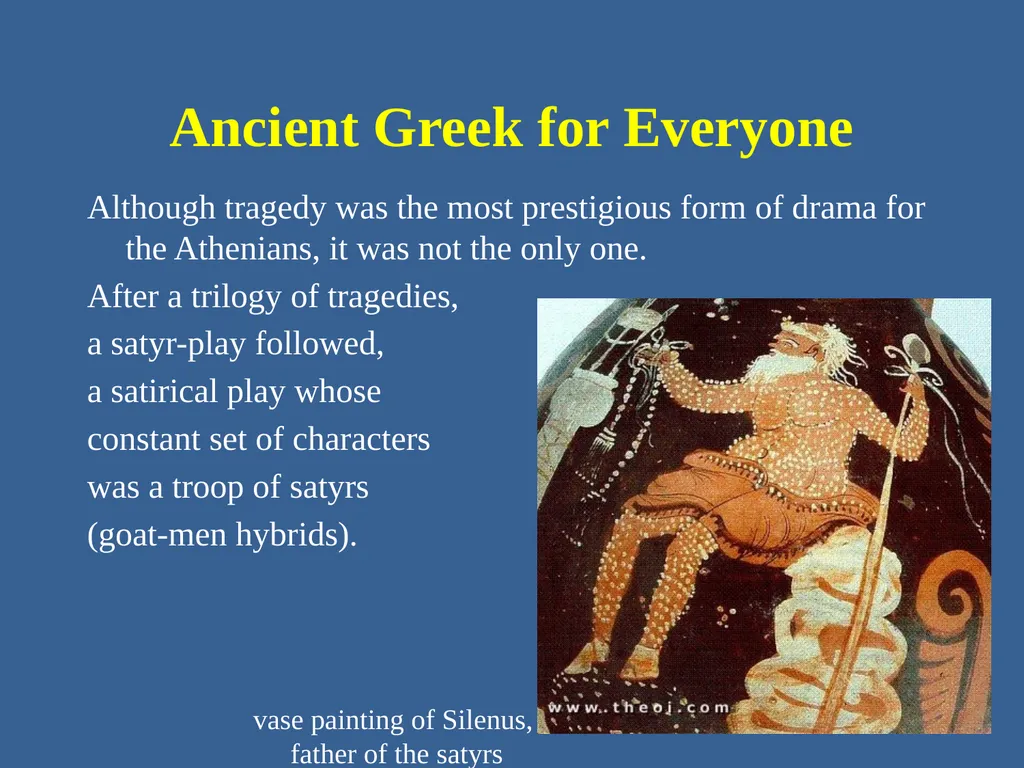
Although tragedy was the most prestigious form of drama for the Athenians, it was not the only one.
After a trilogy of tragedies,
a satyr-play followed,
a satirical play whose
constant set of characters
was a troop of satyrs
(goat-men hybrids). Ancient Greek for Everyone vase painting of Silenus,
father of the satyrs<br>
After a trilogy of tragedies,
a satyr-play followed,
a satirical play whose
constant set of characters
was a troop of satyrs
(goat-men hybrids). Ancient Greek for Everyone vase painting of Silenus,
father of the satyrs<br>
15
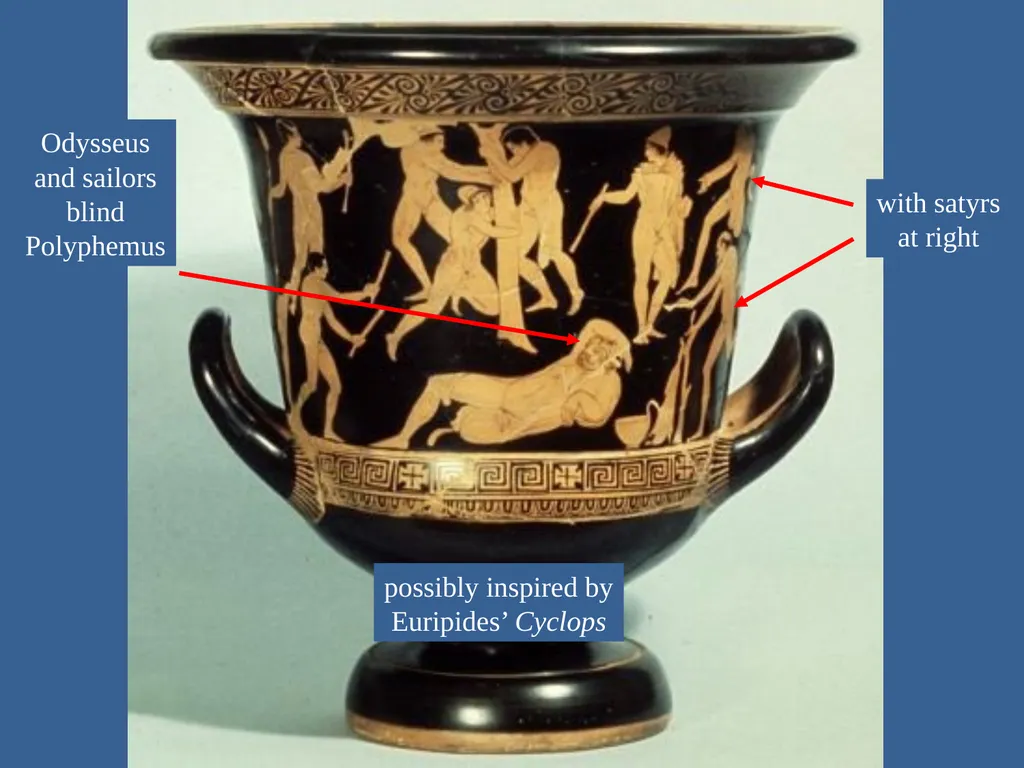
with satyrs
at right Odysseus
and sailors
blind
Polyphemus possibly inspired by
Euripides’ Cyclops<br>
at right Odysseus
and sailors
blind
Polyphemus possibly inspired by
Euripides’ Cyclops<br>
16
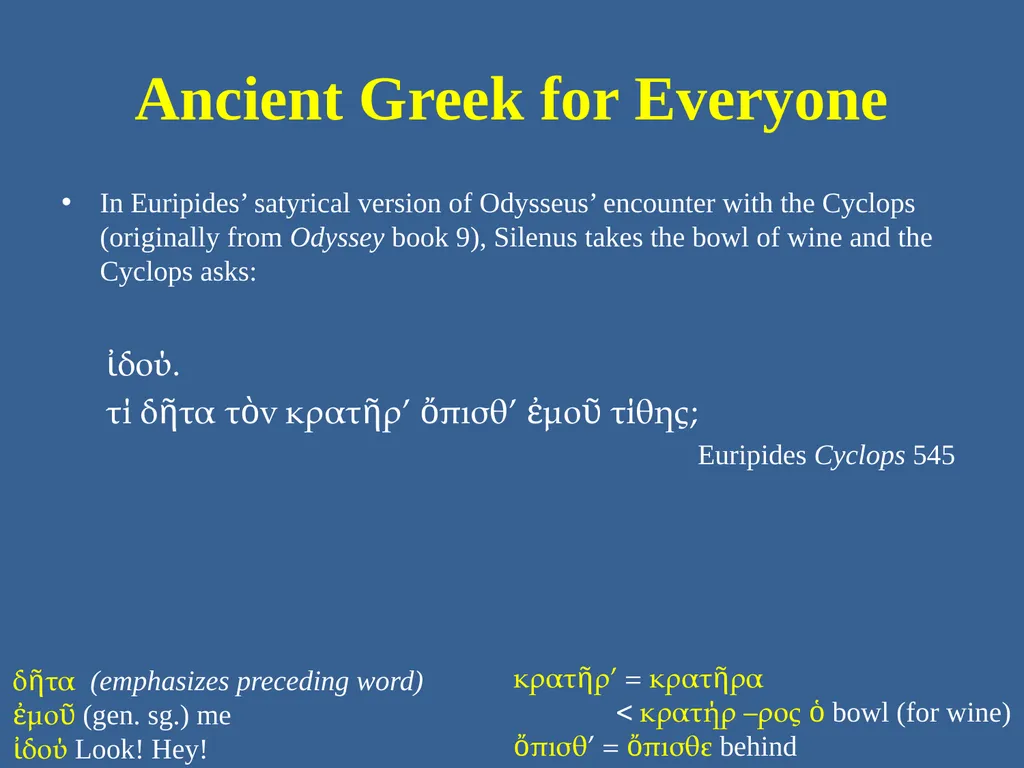
Ancient Greek for Everyone In Euripides’ satyrical version of Odysseus’ encounter with the Cyclops (originally from Odyssey book 9), Silenus takes the bowl of wine and the Cyclops asks:
ἰδού.
τί δῆτα τὸν κρατῆρ’ ὄπισθ’ ἐμοῦ τίθης;
Euripides Cyclops 545 δῆτα (emphasizes preceding word)
ἐμοῦ (gen. sg.) me
ἰδού Look! Hey! κρατῆρ’ = κρατῆρα
< κρατήρ –ρος ὁ bowl (for wine)
ὄπισθ’ = ὄπισθε behind<br>
ἰδού.
τί δῆτα τὸν κρατῆρ’ ὄπισθ’ ἐμοῦ τίθης;
Euripides Cyclops 545 δῆτα (emphasizes preceding word)
ἐμοῦ (gen. sg.) me
ἰδού Look! Hey! κρατῆρ’ = κρατῆρα
< κρατήρ –ρος ὁ bowl (for wine)
ὄπισθ’ = ὄπισθε behind<br>
17
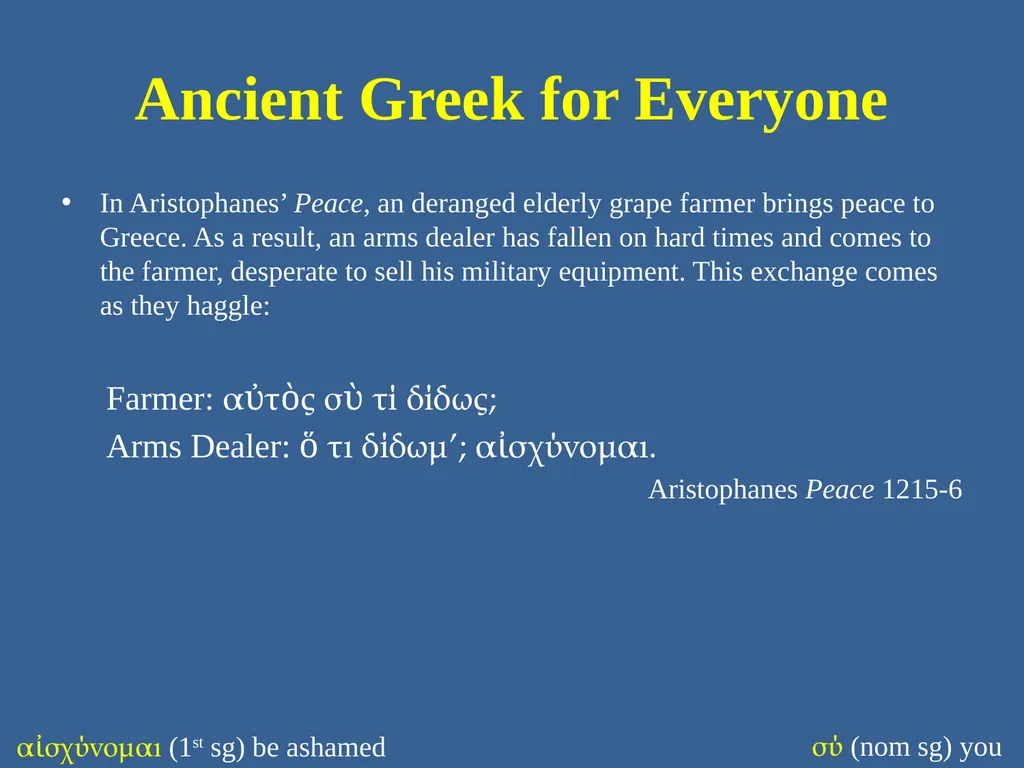
Ancient Greek for Everyone In Aristophanes’ Peace, an deranged elderly grape farmer brings peace to Greece. As a result, an arms dealer has fallen on hard times and comes to the farmer, desperate to sell his military equipment. This exchange comes as they haggle:
Farmer: αὐτὸς σὺ τί δίδως;
Arms Dealer: ὅ τι δίδωμ’; αἰσχύνομαι.
Aristophanes Peace 1215-6 αἰσχύνομαι (1st sg) be ashamed σύ (nom sg) you<br>
Farmer: αὐτὸς σὺ τί δίδως;
Arms Dealer: ὅ τι δίδωμ’; αἰσχύνομαι.
Aristophanes Peace 1215-6 αἰσχύνομαι (1st sg) be ashamed σύ (nom sg) you<br>
18
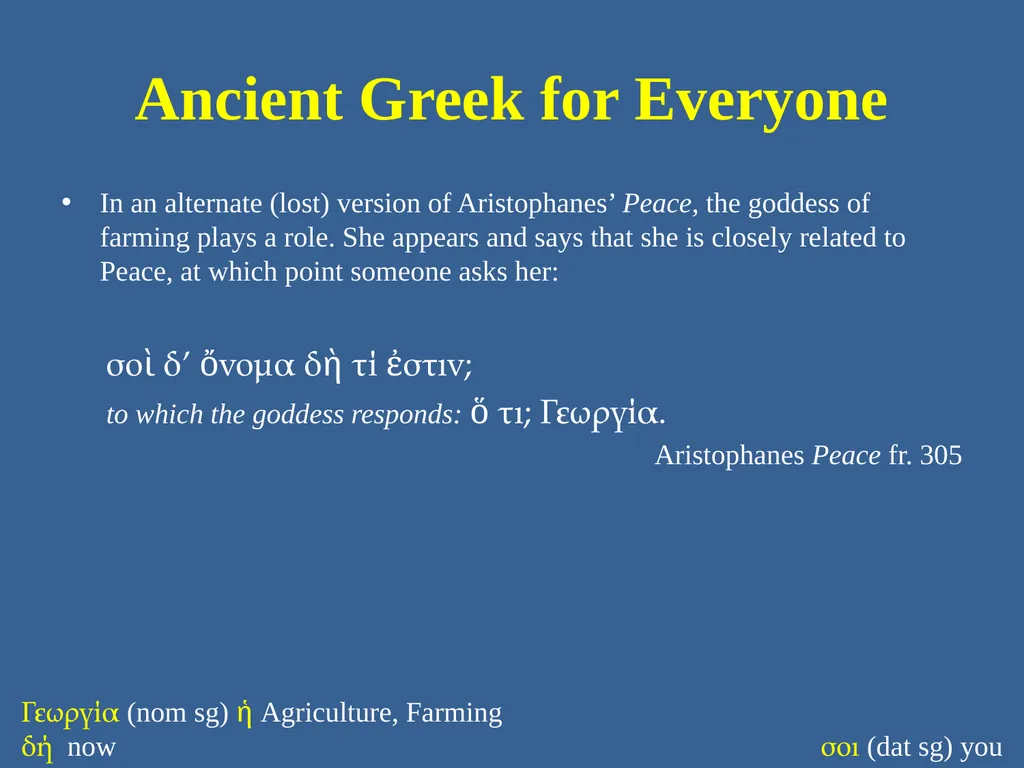
Ancient Greek for Everyone In an alternate (lost) version of Aristophanes’ Peace, the goddess of farming plays a role. She appears and says that she is closely related to Peace, at which point someone asks her:
σοὶ δ’ ὄνομα δὴ τί ἐστιν;
to which the goddess responds: ὅ τι; Γεωργία.
Aristophanes Peace fr. 305 Γεωργία (nom sg) ἡ Agriculture, Farming
δή now σοι (dat sg) you<br>
σοὶ δ’ ὄνομα δὴ τί ἐστιν;
to which the goddess responds: ὅ τι; Γεωργία.
Aristophanes Peace fr. 305 Γεωργία (nom sg) ἡ Agriculture, Farming
δή now σοι (dat sg) you<br>
19
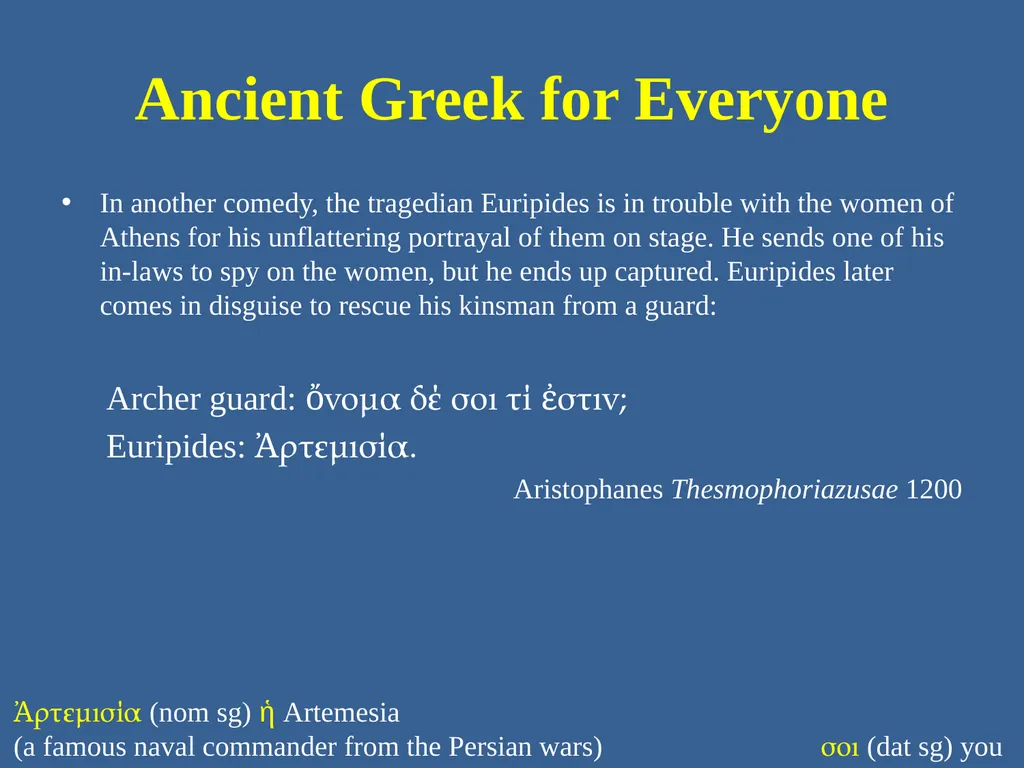
Ancient Greek for Everyone In another comedy, the tragedian Euripides is in trouble with the women of Athens for his unflattering portrayal of them on stage. He sends one of his in-laws to spy on the women, but he ends up captured. Euripides later comes in disguise to rescue his kinsman from a guard:
Archer guard: ὄνομα δέ σοι τί ἐστιν;
Euripides: Ἀρτεμισία.
Aristophanes Thesmophoriazusae 1200 Ἀρτεμισία (nom sg) ἡ Artemesia
(a famous naval commander from the Persian wars) σοι (dat sg) you<br>
Archer guard: ὄνομα δέ σοι τί ἐστιν;
Euripides: Ἀρτεμισία.
Aristophanes Thesmophoriazusae 1200 Ἀρτεμισία (nom sg) ἡ Artemesia
(a famous naval commander from the Persian wars) σοι (dat sg) you<br>
20
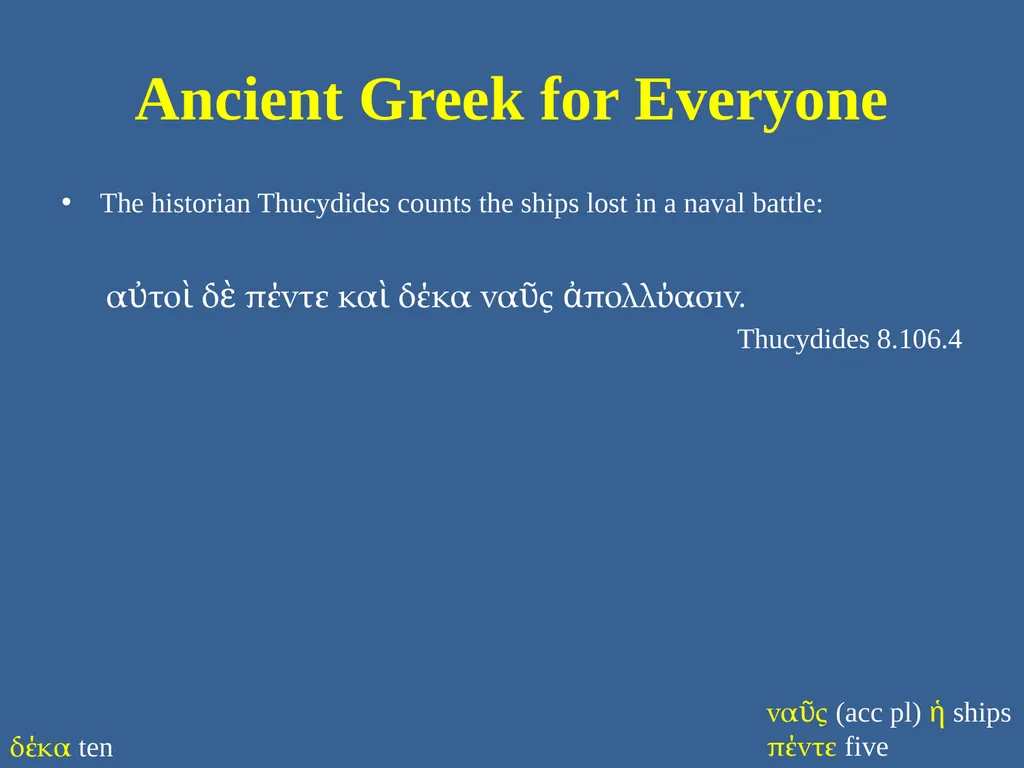
Ancient Greek for Everyone The historian Thucydides counts the ships lost in a naval battle:
αὐτοὶ δὲ πέντε καὶ δέκα ναῦς ἀπολλύασιν.
Thucydides 8.106.4 δέκα ten ναῦς (acc pl) ἡ ships
πέντε five<br>
αὐτοὶ δὲ πέντε καὶ δέκα ναῦς ἀπολλύασιν.
Thucydides 8.106.4 δέκα ten ναῦς (acc pl) ἡ ships
πέντε five<br>
21
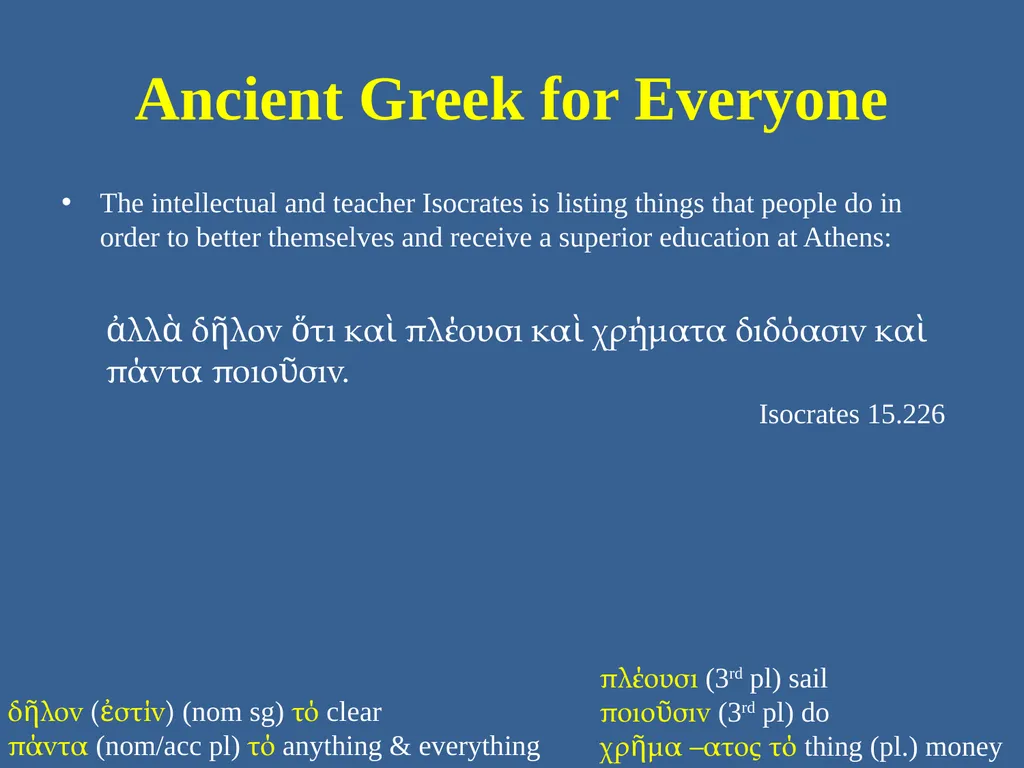
Ancient Greek for Everyone The intellectual and teacher Isocrates is listing things that people do in order to better themselves and receive a superior education at Athens:
ἀλλὰ δῆλον ὅτι καὶ πλέουσι καὶ χρήματα διδόασιν καὶ πάντα ποιοῦσιν.
Isocrates 15.226 πλέουσι (3rd pl) sail
ποιοῦσιν (3rd pl) do
χρῆμα –ατος τό thing (pl.) money δῆλον (ἐστίν) (nom sg) τό clear
πάντα (nom/acc pl) τό anything & everything<br>
ἀλλὰ δῆλον ὅτι καὶ πλέουσι καὶ χρήματα διδόασιν καὶ πάντα ποιοῦσιν.
Isocrates 15.226 πλέουσι (3rd pl) sail
ποιοῦσιν (3rd pl) do
χρῆμα –ατος τό thing (pl.) money δῆλον (ἐστίν) (nom sg) τό clear
πάντα (nom/acc pl) τό anything & everything<br>
22
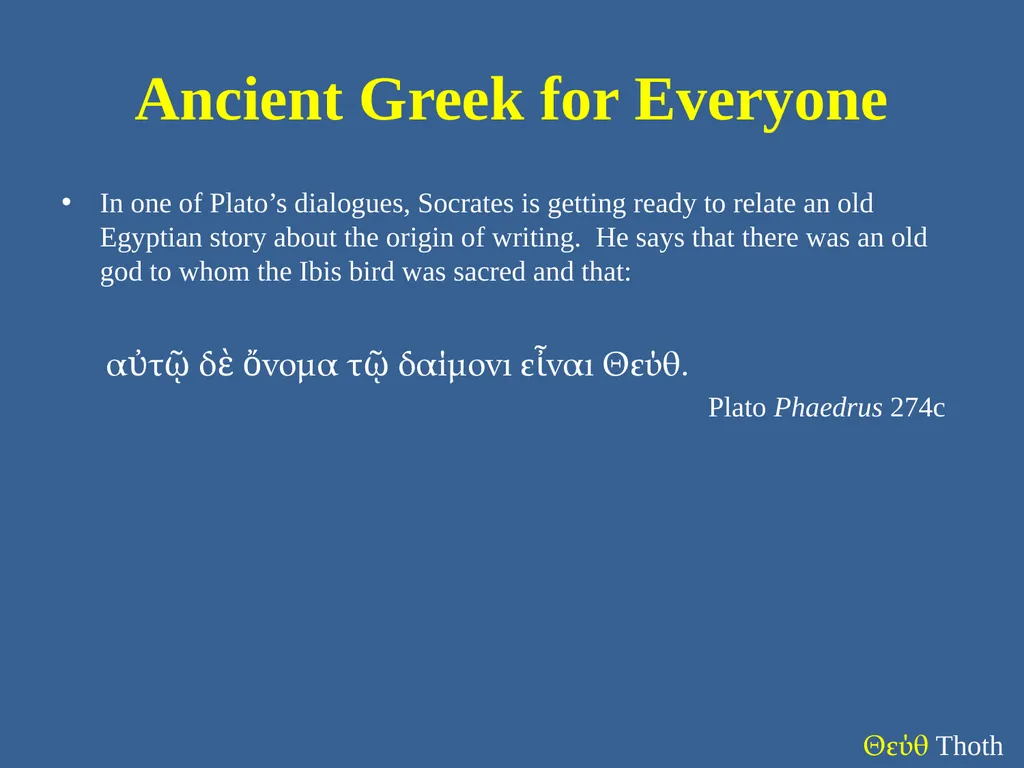
Ancient Greek for Everyone In one of Plato’s dialogues, Socrates is getting ready to relate an old Egyptian story about the origin of writing. He says that there was an old god to whom the Ibis bird was sacred and that:
αὐτῷ δὲ ὄνομα τῷ δαίμονι εἶναι Θεύθ.
Plato Phaedrus 274c Θεύθ Thoth<br>
αὐτῷ δὲ ὄνομα τῷ δαίμονι εἶναι Θεύθ.
Plato Phaedrus 274c Θεύθ Thoth<br>
23
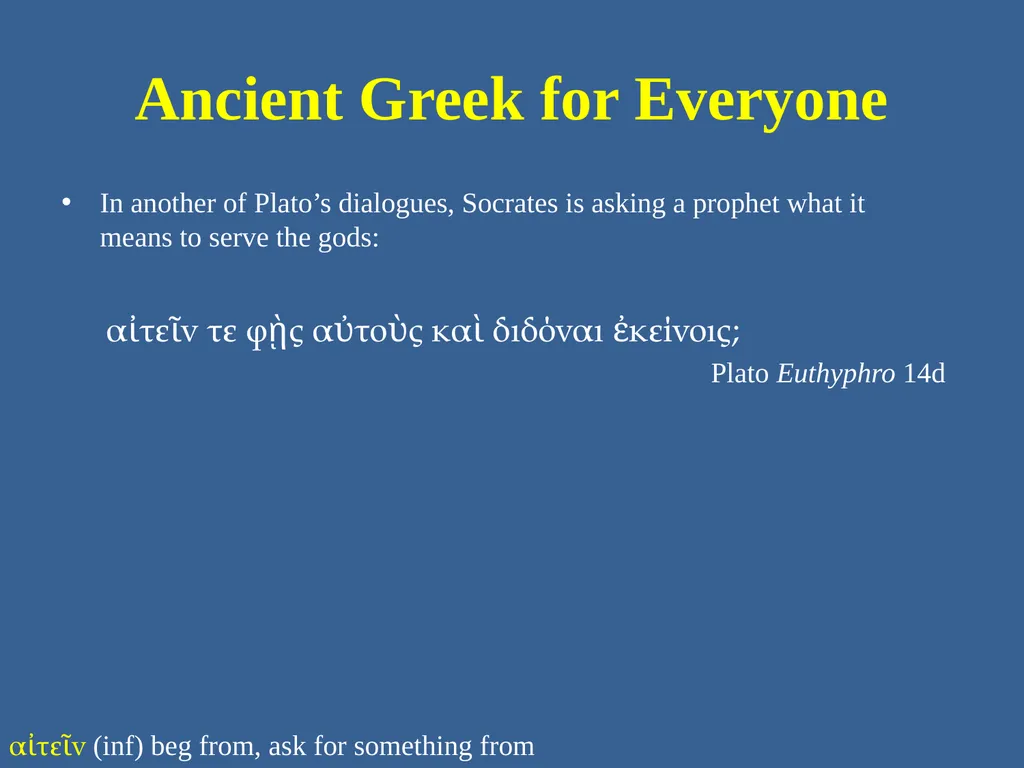
Ancient Greek for Everyone In another of Plato’s dialogues, Socrates is asking a prophet what it means to serve the gods:
αἰτεῖν τε φῂς αὐτοὺς καὶ διδόναι ἐκείνοις;
Plato Euthyphro 14d αἰτεῖν (inf) beg from, ask for something from<br>
αἰτεῖν τε φῂς αὐτοὺς καὶ διδόναι ἐκείνοις;
Plato Euthyphro 14d αἰτεῖν (inf) beg from, ask for something from<br>
24
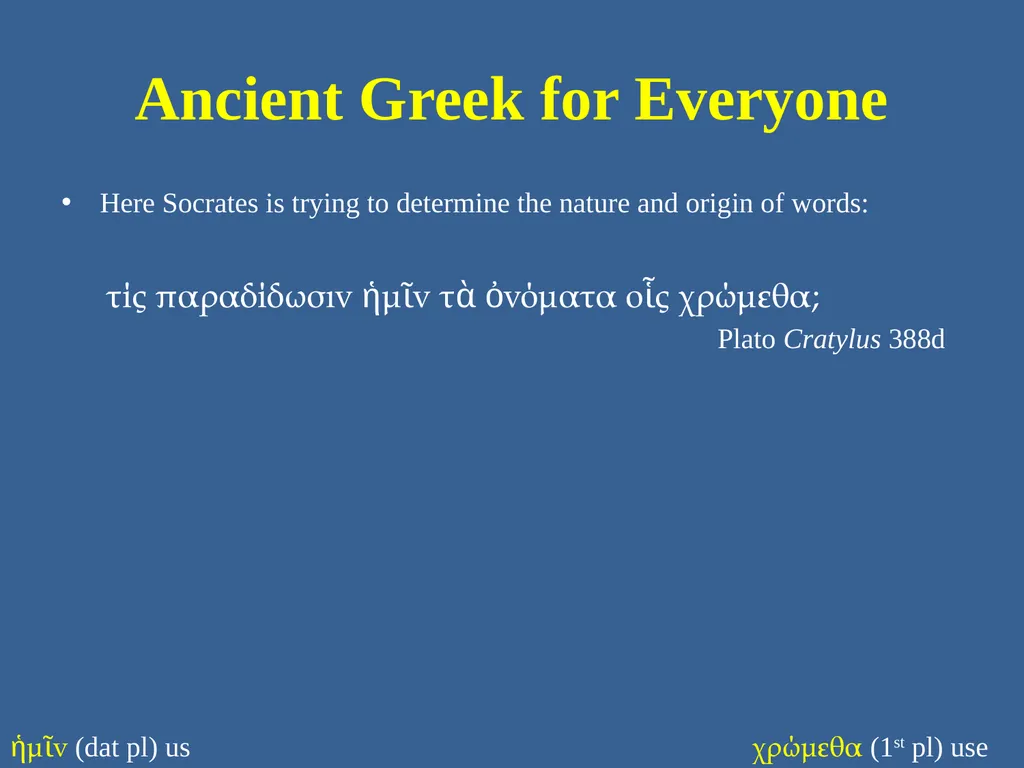
Ancient Greek for Everyone Here Socrates is trying to determine the nature and origin of words:
τίς παραδίδωσιν ἡμῖν τὰ ὀνόματα οἷς χρώμεθα;
Plato Cratylus 388d ἡμῖν (dat pl) us χρώμεθα (1st pl) use<br>
τίς παραδίδωσιν ἡμῖν τὰ ὀνόματα οἷς χρώμεθα;
Plato Cratylus 388d ἡμῖν (dat pl) us χρώμεθα (1st pl) use<br>
25
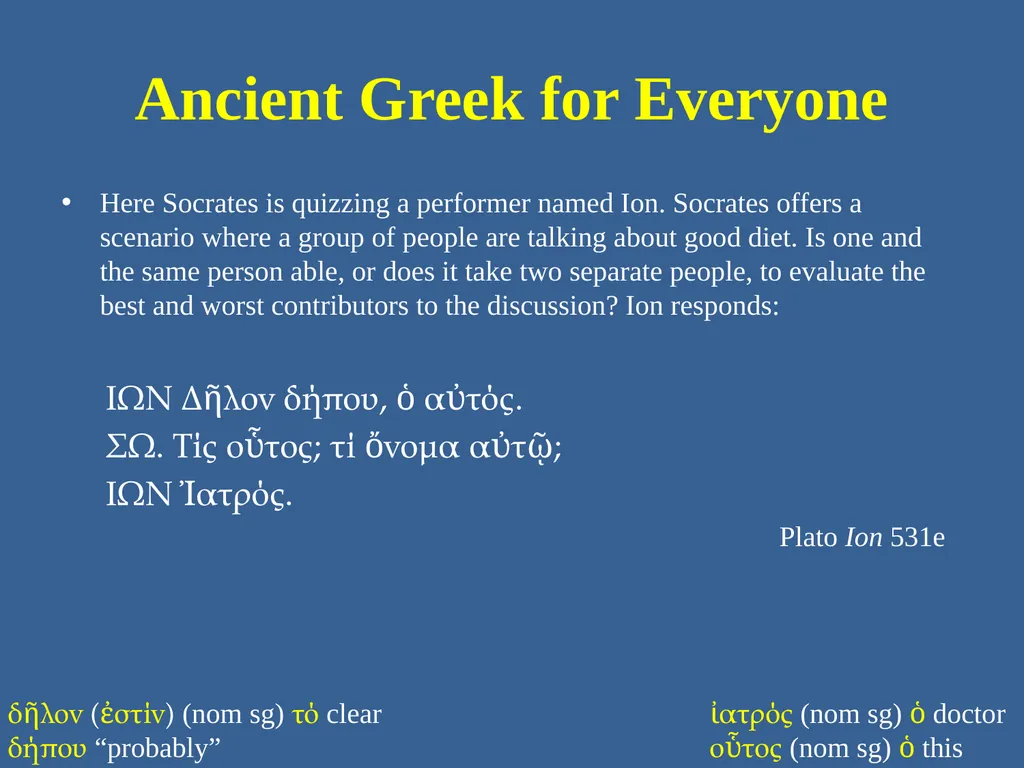
Ancient Greek for Everyone Here Socrates is quizzing a performer named Ion. Socrates offers a scenario where a group of people are talking about good diet. Is one and the same person able, or does it take two separate people, to evaluate the best and worst contributors to the discussion? Ion responds:
ΙΩΝ Δῆλον δήπου, ὁ αὐτός.
ΣΩ. Τίς οὗτος; τί ὄνομα αὐτῷ;
ΙΩΝ Ἰατρός.
Plato Ion 531e δῆλον (ἐστίν) (nom sg) τό clear
δήπου “probably” ἰατρός (nom sg) ὁ doctor
οὗτος (nom sg) ὁ this<br>
ΙΩΝ Δῆλον δήπου, ὁ αὐτός.
ΣΩ. Τίς οὗτος; τί ὄνομα αὐτῷ;
ΙΩΝ Ἰατρός.
Plato Ion 531e δῆλον (ἐστίν) (nom sg) τό clear
δήπου “probably” ἰατρός (nom sg) ὁ doctor
οὗτος (nom sg) ὁ this<br>
26
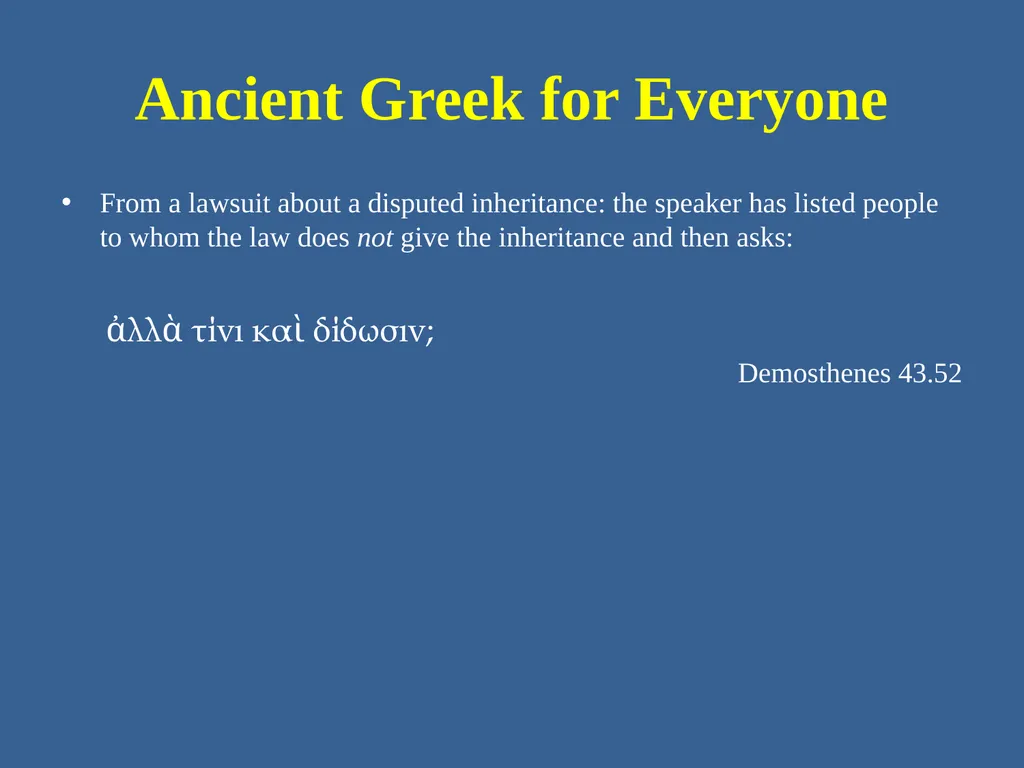
Ancient Greek for Everyone From a lawsuit about a disputed inheritance: the speaker has listed people to whom the law does not give the inheritance and then asks:
ἀλλὰ τίνι καὶ δίδωσιν;
Demosthenes 43.52<br>
ἀλλὰ τίνι καὶ δίδωσιν;
Demosthenes 43.52<br>
27
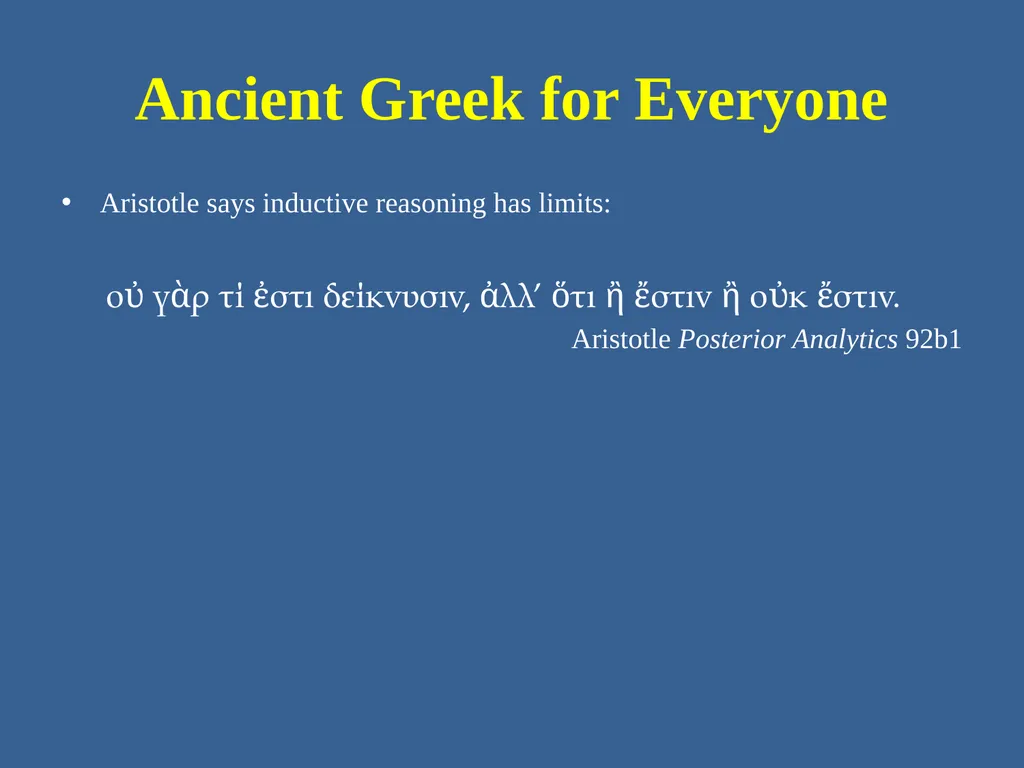
Ancient Greek for Everyone Aristotle says inductive reasoning has limits:
οὐ γὰρ τί ἐστι δείκνυσιν, ἀλλ’ ὅτι ἢ ἔστιν ἢ οὐκ ἔστιν.
Aristotle Posterior Analytics 92b1<br>
οὐ γὰρ τί ἐστι δείκνυσιν, ἀλλ’ ὅτι ἢ ἔστιν ἢ οὐκ ἔστιν.
Aristotle Posterior Analytics 92b1<br>