
ANIMAL GENETICS & BREEDING UNIT – III Principles
CS
Published · 32 slides · 0 views
1 / 1


Description
ANIMAL GENETICS BREEDING UNIT III Principles of Animal Breeding Theory Outbreeding its classification Dr K G Mandal Department of Animal Genetics Breeding Bihar Veterinary College, Patna Bihar Animal Sciences University, Patna
Related Topics
Share
Embed code
Download this presentation From Below
"ANIMAL GENETICS & BREEDING UNIT – III Principles" is the property of its rightful owner. Permission is granted to download and print the materials on this website for personal, non-commercial use only, and to display it on your personal computer provided you do not modify the materials and that you retain all copyright notices contained in the materials. By downloading content from our website, you accept the terms of this agreement.
Presentation Transcript
01
ANIMAL GENETICS & BREEDING
UNIT – III
Principles of Animal Breeding Theory
Outbreeding & its classification
Dr K G Mandal Department of Animal Genetics & Breeding Bihar Veterinary College, Patna Bihar Animal Sciences University, Patna<br>
UNIT – III
Principles of Animal Breeding Theory
Outbreeding & its classification
Dr K G Mandal Department of Animal Genetics & Breeding Bihar Veterinary College, Patna Bihar Animal Sciences University, Patna<br>
02
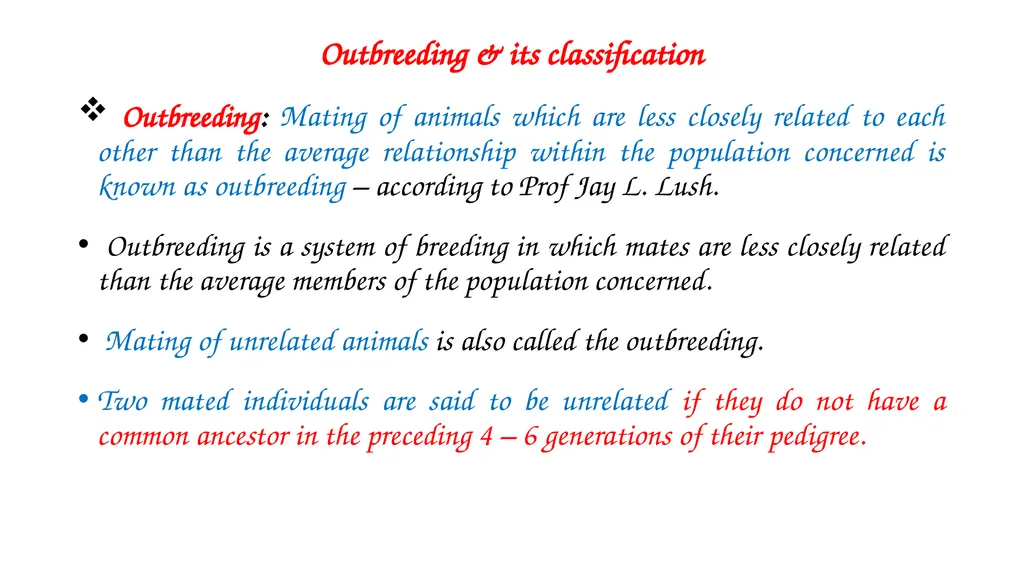
Outbreeding & its classification Outbreeding: Mating of animals which are less closely related to each other than the average relationship within the population concerned is known as outbreeding – according to Prof Jay L. Lush.
Outbreeding is a system of breeding in which mates are less closely related than the average members of the population concerned.
Mating of unrelated animals is also called the outbreeding.
Two mated individuals are said to be unrelated if they do not have a common ancestor in the preceding 4 – 6 generations of their pedigree.<br>
Outbreeding is a system of breeding in which mates are less closely related than the average members of the population concerned.
Mating of unrelated animals is also called the outbreeding.
Two mated individuals are said to be unrelated if they do not have a common ancestor in the preceding 4 – 6 generations of their pedigree.<br>
03
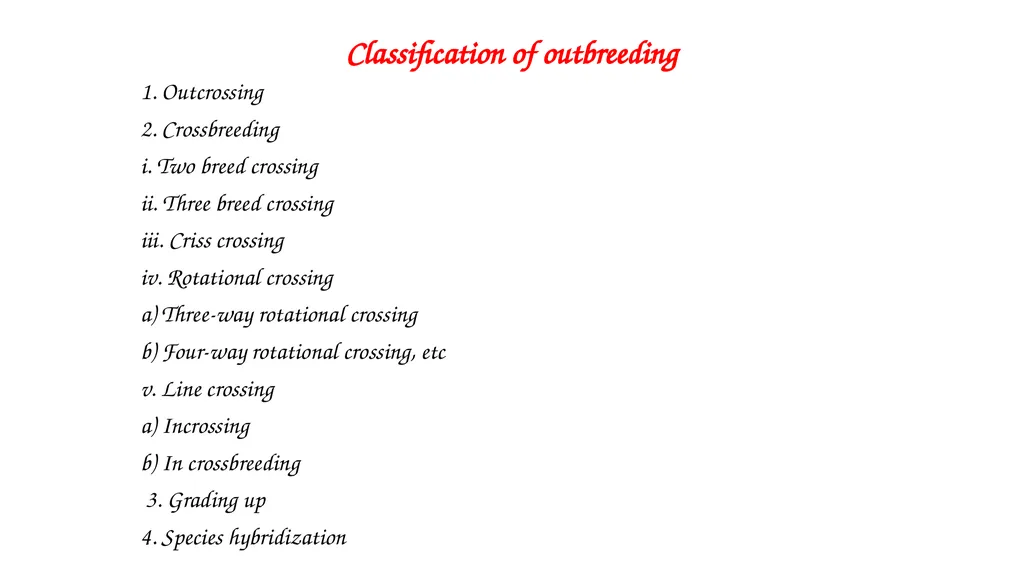
Classification of outbreeding 1. Outcrossing
2. Crossbreeding
i. Two breed crossing
ii. Three breed crossing
iii. Criss crossing
iv. Rotational crossing
a) Three-way rotational crossing
b) Four-way rotational crossing, etc
v. Line crossing
a) Incrossing
b) In crossbreeding
3. Grading up
4. Species hybridization<br>
2. Crossbreeding
i. Two breed crossing
ii. Three breed crossing
iii. Criss crossing
iv. Rotational crossing
a) Three-way rotational crossing
b) Four-way rotational crossing, etc
v. Line crossing
a) Incrossing
b) In crossbreeding
3. Grading up
4. Species hybridization<br>
04
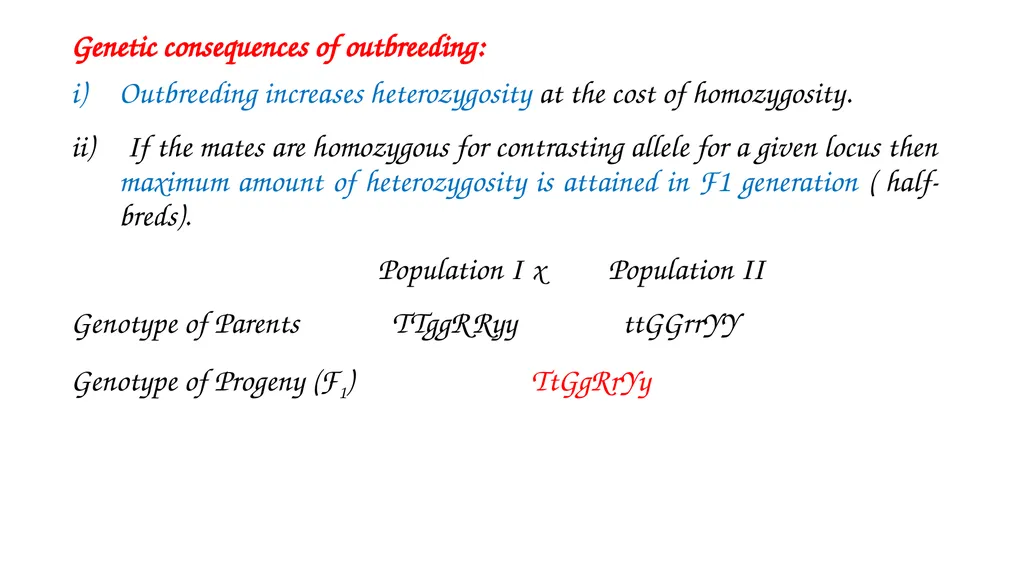
Genetic consequences of outbreeding:
Outbreeding increases heterozygosity at the cost of homozygosity.
If the mates are homozygous for contrasting allele for a given locus then maximum amount of heterozygosity is attained in F1 generation ( half-breds).
Population I x Population II
Genotype of Parents TTggRRyy ttGGrrYY
Genotype of Progeny (F1) TtGgRrYy<br>
Outbreeding increases heterozygosity at the cost of homozygosity.
If the mates are homozygous for contrasting allele for a given locus then maximum amount of heterozygosity is attained in F1 generation ( half-breds).
Population I x Population II
Genotype of Parents TTggRRyy ttGGrrYY
Genotype of Progeny (F1) TtGgRrYy<br>
05
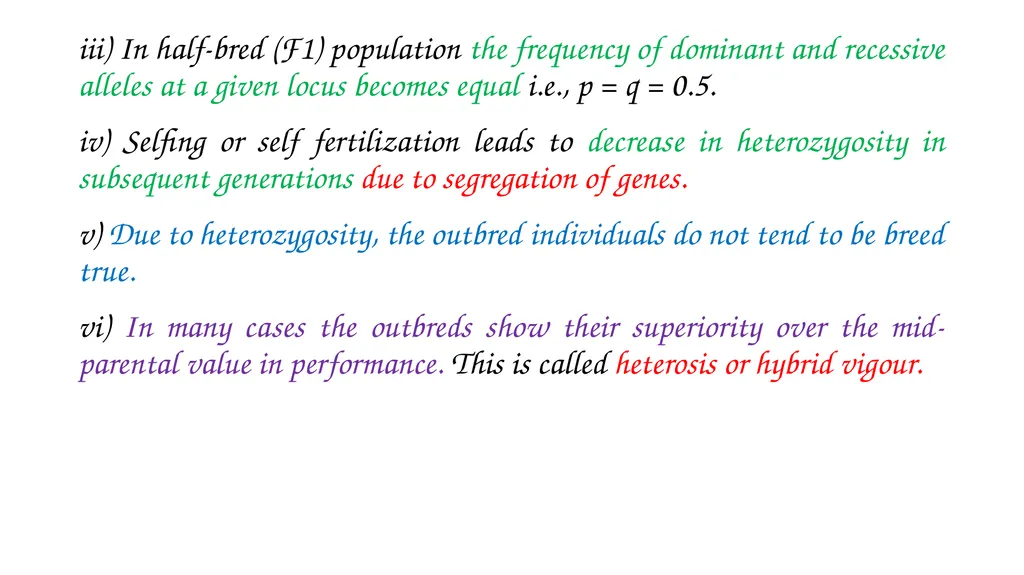
iii) In half-bred (F1) population the frequency of dominant and recessive alleles at a given locus becomes equal i.e., p = q = 0.5.
iv) Selfing or self fertilization leads to decrease in heterozygosity in subsequent generations due to segregation of genes.
v) Due to heterozygosity, the outbred individuals do not tend to be breed true.
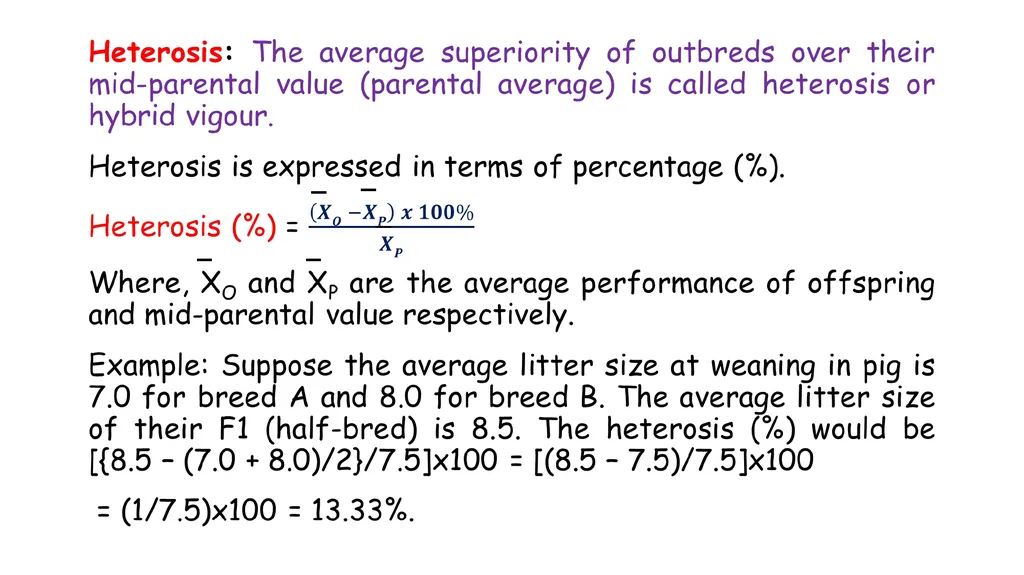
vi) In many cases the outbreds show their superiority over the mid-parental value in performance. This is called heterosis or hybrid vigour.<br>
iv) Selfing or self fertilization leads to decrease in heterozygosity in subsequent generations due to segregation of genes.
v) Due to heterozygosity, the outbred individuals do not tend to be breed true.
vi) In many cases the outbreds show their superiority over the mid-parental value in performance. This is called heterosis or hybrid vigour.<br>
06
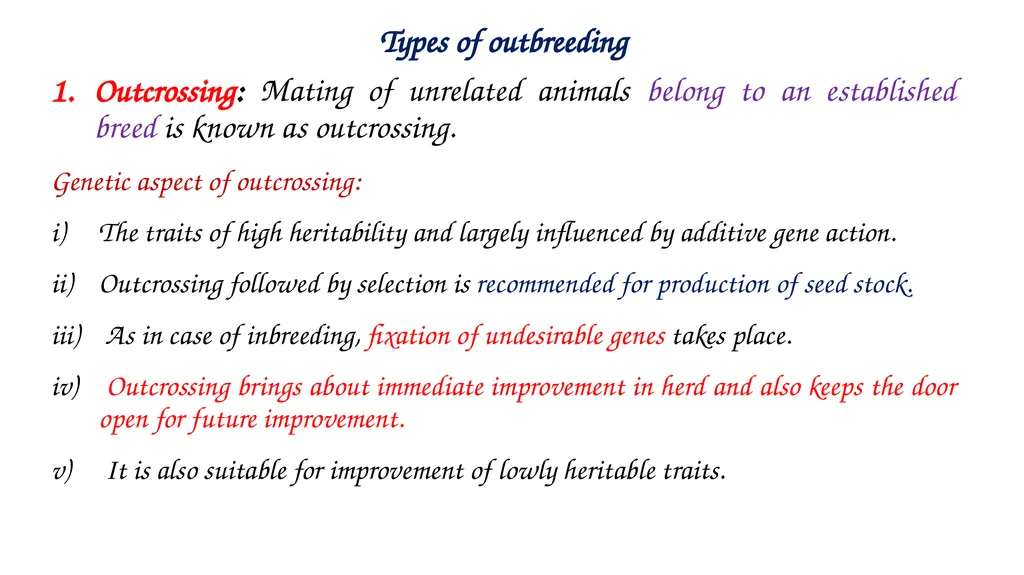
Types of outbreeding
Outcrossing: Mating of unrelated animals belong to an established breed is known as outcrossing.
Genetic aspect of outcrossing:
The traits of high heritability and largely influenced by additive gene action.
Outcrossing followed by selection is recommended for production of seed stock.
As in case of inbreeding, fixation of undesirable genes takes place.
Outcrossing brings about immediate improvement in herd and also keeps the door open for future improvement.
It is also suitable for improvement of lowly heritable traits.<br>
Outcrossing: Mating of unrelated animals belong to an established breed is known as outcrossing.
Genetic aspect of outcrossing:
The traits of high heritability and largely influenced by additive gene action.
Outcrossing followed by selection is recommended for production of seed stock.
As in case of inbreeding, fixation of undesirable genes takes place.
Outcrossing brings about immediate improvement in herd and also keeps the door open for future improvement.
It is also suitable for improvement of lowly heritable traits.<br>
07
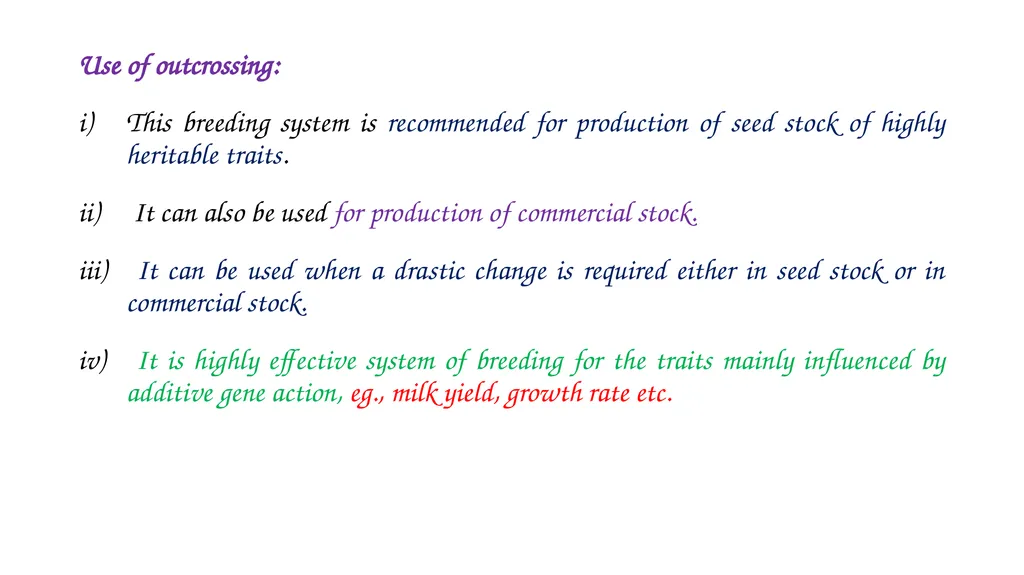
Use of outcrossing:
This breeding system is recommended for production of seed stock of highly heritable traits.
It can also be used for production of commercial stock.
It can be used when a drastic change is required either in seed stock or in commercial stock.
It is highly effective system of breeding for the traits mainly influenced by additive gene action, eg., milk yield, growth rate etc.<br>
This breeding system is recommended for production of seed stock of highly heritable traits.
It can also be used for production of commercial stock.
It can be used when a drastic change is required either in seed stock or in commercial stock.
It is highly effective system of breeding for the traits mainly influenced by additive gene action, eg., milk yield, growth rate etc.<br>
08
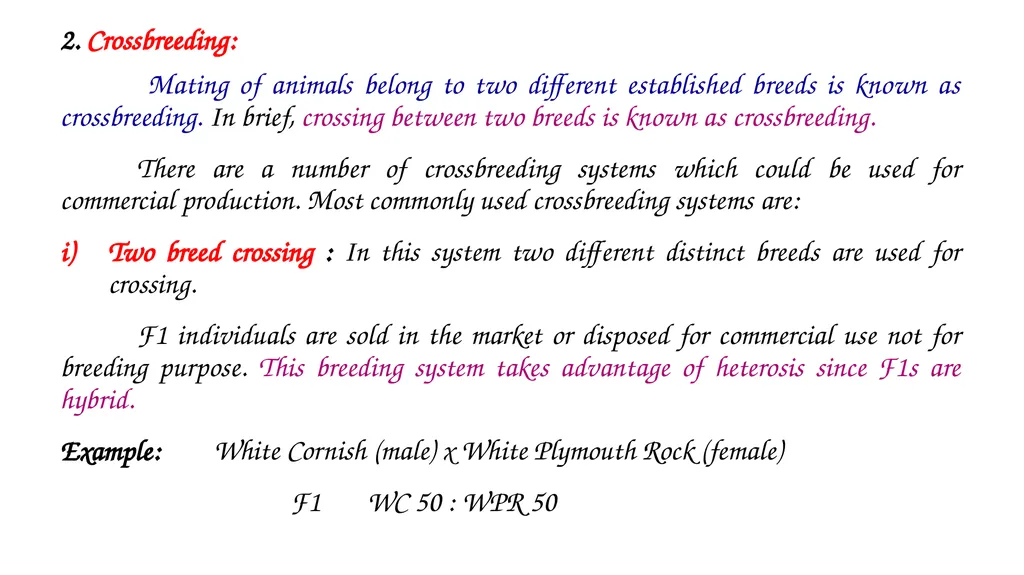
2. Crossbreeding:
Mating of animals belong to two different established breeds is known as crossbreeding. In brief, crossing between two breeds is known as crossbreeding.
There are a number of crossbreeding systems which could be used for commercial production. Most commonly used crossbreeding systems are:
Two breed crossing : In this system two different distinct breeds are used for crossing.
F1 individuals are sold in the market or disposed for commercial use not for breeding purpose. This breeding system takes advantage of heterosis since F1s are hybrid.
Example: White Cornish (male) x White Plymouth Rock (female)
F1 WC 50 : WPR 50<br>
Mating of animals belong to two different established breeds is known as crossbreeding. In brief, crossing between two breeds is known as crossbreeding.
There are a number of crossbreeding systems which could be used for commercial production. Most commonly used crossbreeding systems are:
Two breed crossing : In this system two different distinct breeds are used for crossing.
F1 individuals are sold in the market or disposed for commercial use not for breeding purpose. This breeding system takes advantage of heterosis since F1s are hybrid.
Example: White Cornish (male) x White Plymouth Rock (female)
F1 WC 50 : WPR 50<br>
09
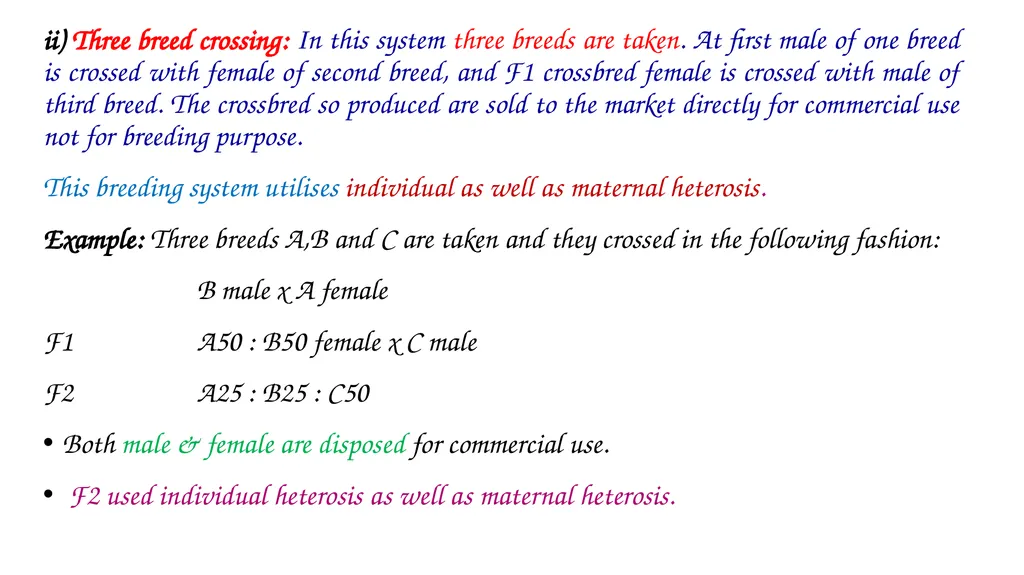
ii) Three breed crossing: In this system three breeds are taken. At first male of one breed is crossed with female of second breed, and F1 crossbred female is crossed with male of third breed. The crossbred so produced are sold to the market directly for commercial use not for breeding purpose.
This breeding system utilises individual as well as maternal heterosis.
Example: Three breeds A,B and C are taken and they crossed in the following fashion:
B male x A female
F1 A50 : B50 female x C male
F2 A25 : B25 : C50
Both male & female are disposed for commercial use.
F2 used individual heterosis as well as maternal heterosis.<br>
This breeding system utilises individual as well as maternal heterosis.
Example: Three breeds A,B and C are taken and they crossed in the following fashion:
B male x A female
F1 A50 : B50 female x C male
F2 A25 : B25 : C50
Both male & female are disposed for commercial use.
F2 used individual heterosis as well as maternal heterosis.<br>
10
iii) Criss-crossing:
Only two breeds are involved.
The males of two breeds are used for crossing over their crossbred females in alternate fashion.
After completion of one cycle, the crossbreds will have 62.5% genetic inheritance of breed of immediate sire.
To maintain 62.5% genetic inheritance in subsequent generations the male and female crossbred progenies are used crossing continuously.
This system is used to maintain 62.5% genetic inheritance of a particular breed.<br>
Only two breeds are involved.
The males of two breeds are used for crossing over their crossbred females in alternate fashion.
After completion of one cycle, the crossbreds will have 62.5% genetic inheritance of breed of immediate sire.
To maintain 62.5% genetic inheritance in subsequent generations the male and female crossbred progenies are used crossing continuously.
This system is used to maintain 62.5% genetic inheritance of a particular breed.<br>
11
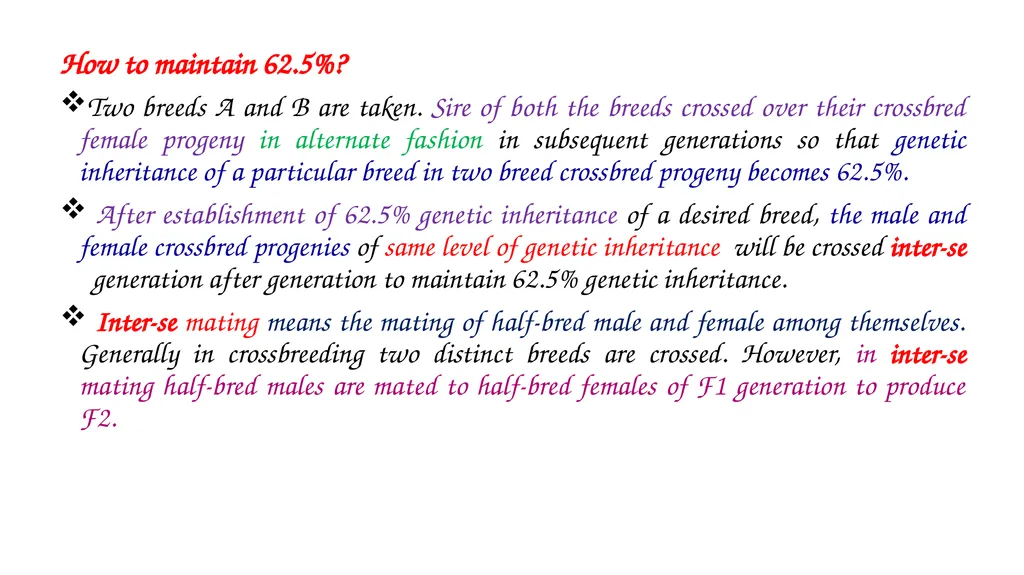
How to maintain 62.5%?
Two breeds A and B are taken. Sire of both the breeds crossed over their crossbred female progeny in alternate fashion in subsequent generations so that genetic inheritance of a particular breed in two breed crossbred progeny becomes 62.5%.
After establishment of 62.5% genetic inheritance of a desired breed, the male and female crossbred progenies of same level of genetic inheritance will be crossed inter-se generation after generation to maintain 62.5% genetic inheritance.
Inter-se mating means the mating of half-bred male and female among themselves. Generally in crossbreeding two distinct breeds are crossed. However, in inter-se mating half-bred males are mated to half-bred females of F1 generation to produce F2.<br>
Two breeds A and B are taken. Sire of both the breeds crossed over their crossbred female progeny in alternate fashion in subsequent generations so that genetic inheritance of a particular breed in two breed crossbred progeny becomes 62.5%.
After establishment of 62.5% genetic inheritance of a desired breed, the male and female crossbred progenies of same level of genetic inheritance will be crossed inter-se generation after generation to maintain 62.5% genetic inheritance.
Inter-se mating means the mating of half-bred male and female among themselves. Generally in crossbreeding two distinct breeds are crossed. However, in inter-se mating half-bred males are mated to half-bred females of F1 generation to produce F2.<br>
12
Schematic diagram of criss-crossing:
Parent A male(100) x B female(100)
F1 A50 : B50 female x B male
F2 A25 : B75 female x A male
F3 A62.5 : B37.5 F
Inter-se mating starts
F3 A62.5 : B37.5 F x A62.5 : B37.5 M
F4 A62.5(HF) : B37.5(Indigenous)
M = Male & F = Female<br>
Parent A male(100) x B female(100)
F1 A50 : B50 female x B male
F2 A25 : B75 female x A male
F3 A62.5 : B37.5 F
Inter-se mating starts
F3 A62.5 : B37.5 F x A62.5 : B37.5 M
F4 A62.5(HF) : B37.5(Indigenous)
M = Male & F = Female<br>
13
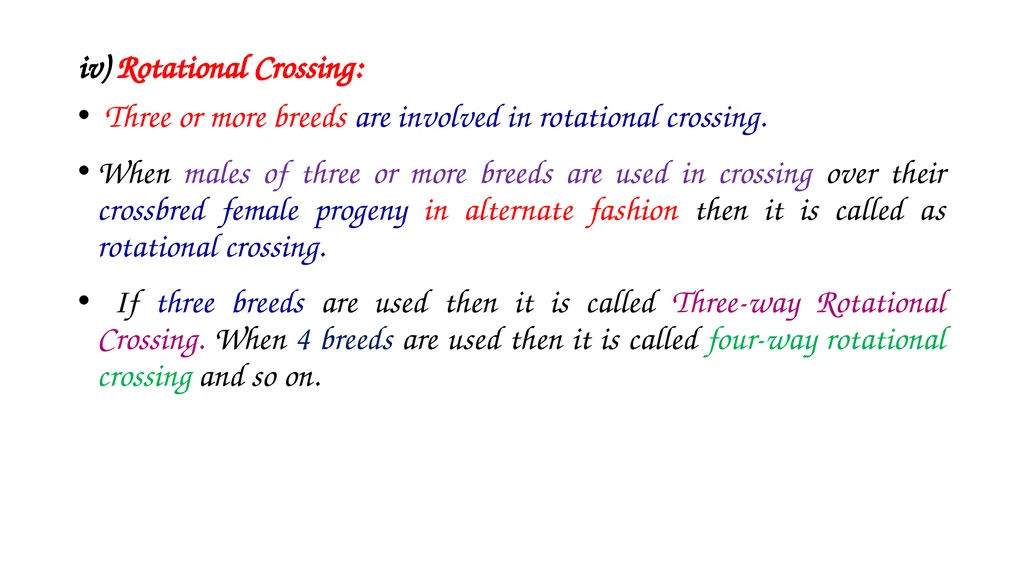
iv) Rotational Crossing:
Three or more breeds are involved in rotational crossing.
When males of three or more breeds are used in crossing over their crossbred female progeny in alternate fashion then it is called as rotational crossing.
If three breeds are used then it is called Three-way Rotational Crossing. When 4 breeds are used then it is called four-way rotational crossing and so on.<br>
Three or more breeds are involved in rotational crossing.
When males of three or more breeds are used in crossing over their crossbred female progeny in alternate fashion then it is called as rotational crossing.
If three breeds are used then it is called Three-way Rotational Crossing. When 4 breeds are used then it is called four-way rotational crossing and so on.<br>
14
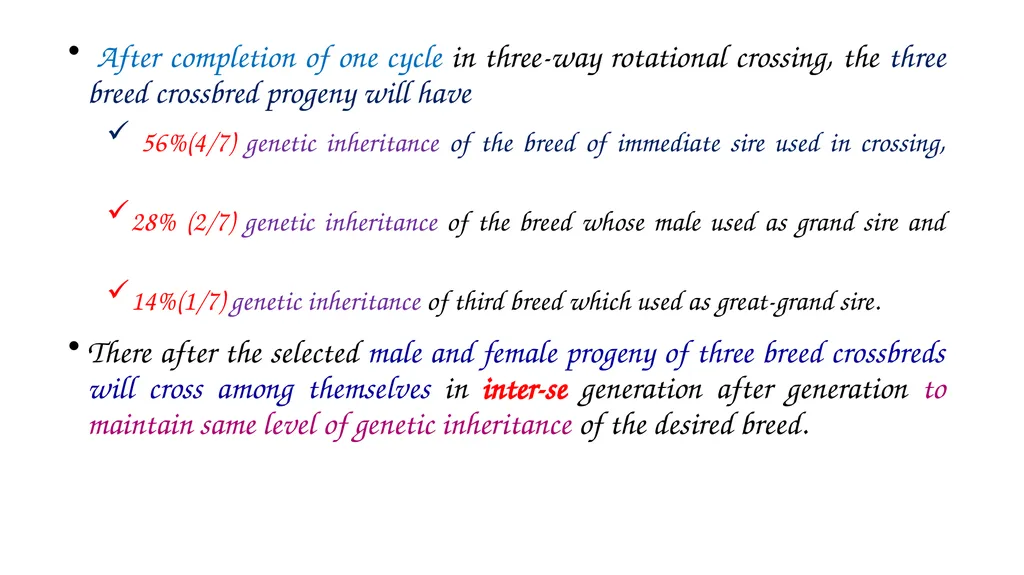
After completion of one cycle in three-way rotational crossing, the three breed crossbred progeny will have
56%(4/7) genetic inheritance of the breed of immediate sire used in crossing,
28% (2/7) genetic inheritance of the breed whose male used as grand sire and
14%(1/7) genetic inheritance of third breed which used as great-grand sire.
There after the selected male and female progeny of three breed crossbreds will cross among themselves in inter-se generation after generation to maintain same level of genetic inheritance of the desired breed.<br>
56%(4/7) genetic inheritance of the breed of immediate sire used in crossing,
28% (2/7) genetic inheritance of the breed whose male used as grand sire and
14%(1/7) genetic inheritance of third breed which used as great-grand sire.
There after the selected male and female progeny of three breed crossbreds will cross among themselves in inter-se generation after generation to maintain same level of genetic inheritance of the desired breed.<br>
15
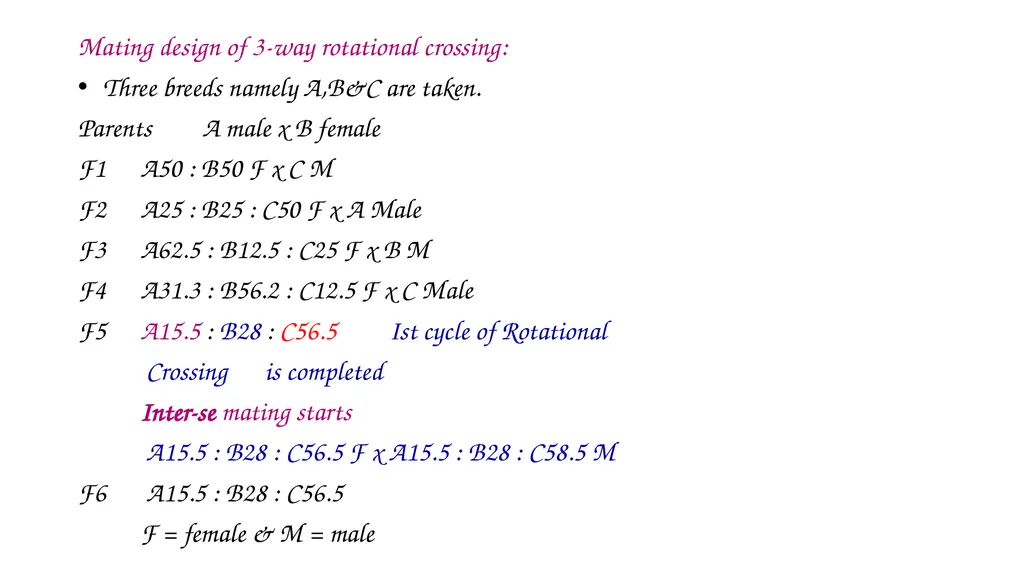
Mating design of 3-way rotational crossing:
Three breeds namely A,B&C are taken.
Parents A male x B female
F1 A50 : B50 F x C M
F2 A25 : B25 : C50 F x A Male
F3 A62.5 : B12.5 : C25 F x B M
F4 A31.3 : B56.2 : C12.5 F x C Male
F5 A15.5 : B28 : C56.5 Ist cycle of Rotational
Crossing is completed
Inter-se mating starts
A15.5 : B28 : C56.5 F x A15.5 : B28 : C58.5 M
F6 A15.5 : B28 : C56.5
F = female & M = male<br>
Three breeds namely A,B&C are taken.
Parents A male x B female
F1 A50 : B50 F x C M
F2 A25 : B25 : C50 F x A Male
F3 A62.5 : B12.5 : C25 F x B M
F4 A31.3 : B56.2 : C12.5 F x C Male
F5 A15.5 : B28 : C56.5 Ist cycle of Rotational
Crossing is completed
Inter-se mating starts
A15.5 : B28 : C56.5 F x A15.5 : B28 : C58.5 M
F6 A15.5 : B28 : C56.5
F = female & M = male<br>
16
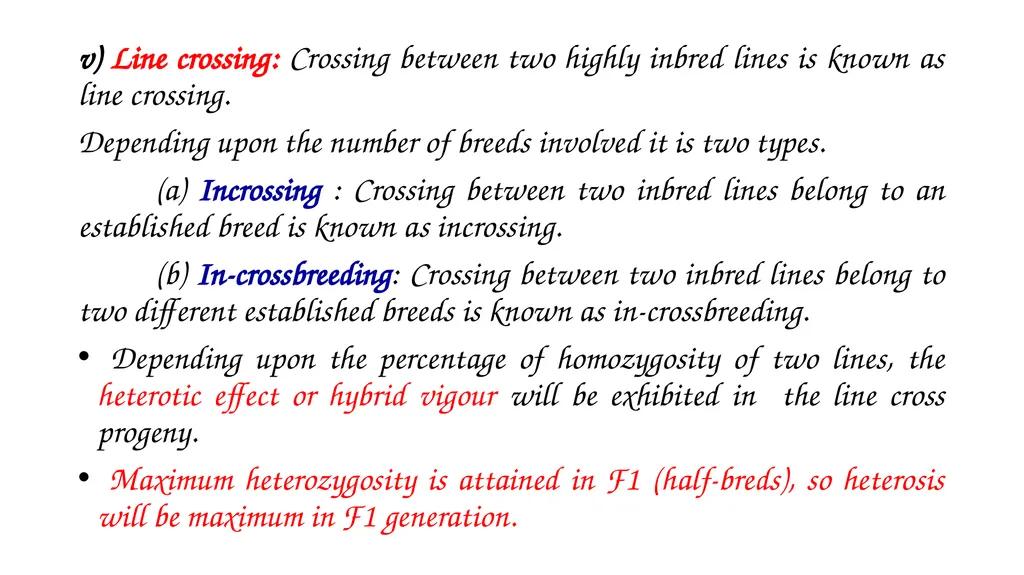
v) Line crossing: Crossing between two highly inbred lines is known as line crossing.
Depending upon the number of breeds involved it is two types.
(a) Incrossing : Crossing between two inbred lines belong to an established breed is known as incrossing.
(b) In-crossbreeding: Crossing between two inbred lines belong to two different established breeds is known as in-crossbreeding.
Depending upon the percentage of homozygosity of two lines, the heterotic effect or hybrid vigour will be exhibited in the line cross progeny.
Maximum heterozygosity is attained in F1 (half-breds), so heterosis will be maximum in F1 generation.<br>
Depending upon the number of breeds involved it is two types.
(a) Incrossing : Crossing between two inbred lines belong to an established breed is known as incrossing.
(b) In-crossbreeding: Crossing between two inbred lines belong to two different established breeds is known as in-crossbreeding.
Depending upon the percentage of homozygosity of two lines, the heterotic effect or hybrid vigour will be exhibited in the line cross progeny.
Maximum heterozygosity is attained in F1 (half-breds), so heterosis will be maximum in F1 generation.<br>
17
Features of line crossing:
Superiority of line crosses is mainly attributed due to heterosis.
Superiority is also due to successful choice of inbred lines which bring together the desirable gene combinations in the hybrids.
Higher yield in hybrid population is largely due to uniform production from nearly all individuals rather than extraordinary yield by some individuals.
Line crossing is successfully used in poultry, pigs and laboratory animals which have shorter generation intervals.<br>
Superiority of line crosses is mainly attributed due to heterosis.
Superiority is also due to successful choice of inbred lines which bring together the desirable gene combinations in the hybrids.
Higher yield in hybrid population is largely due to uniform production from nearly all individuals rather than extraordinary yield by some individuals.
Line crossing is successfully used in poultry, pigs and laboratory animals which have shorter generation intervals.<br>
18
Advantages of crossbreeding:
It utilizes heterosis, both individual and maternal, so used for production of commercial stock.
It helps in incorporation of desirable characters into a population through introduction of new genes from different breeds or populations.
It increases frequency of desirable genes in the population.
Crossbreeding makes the foundation for evolving of new breeds.
It increases productivity of farm animals and poultry.<br>
It utilizes heterosis, both individual and maternal, so used for production of commercial stock.
It helps in incorporation of desirable characters into a population through introduction of new genes from different breeds or populations.
It increases frequency of desirable genes in the population.
Crossbreeding makes the foundation for evolving of new breeds.
It increases productivity of farm animals and poultry.<br>
19
3. Grading up: Progressive improvement of non-descript females by use of descript sires for several generations is known as Grading up.
Grading up is the practice of mating purebred sires of a given breed to non-descript females and their female progeny in subsequent generations.
The first generation offspring carry 50 percent inheritance of the pure breed.
The next generation offspring results with 75% hereditary material of the purebred.
The proportion of the inheritance from non-descript females is halved with each cross in subsequent generations.<br>
Grading up is the practice of mating purebred sires of a given breed to non-descript females and their female progeny in subsequent generations.
The first generation offspring carry 50 percent inheritance of the pure breed.
The next generation offspring results with 75% hereditary material of the purebred.
The proportion of the inheritance from non-descript females is halved with each cross in subsequent generations.<br>
20
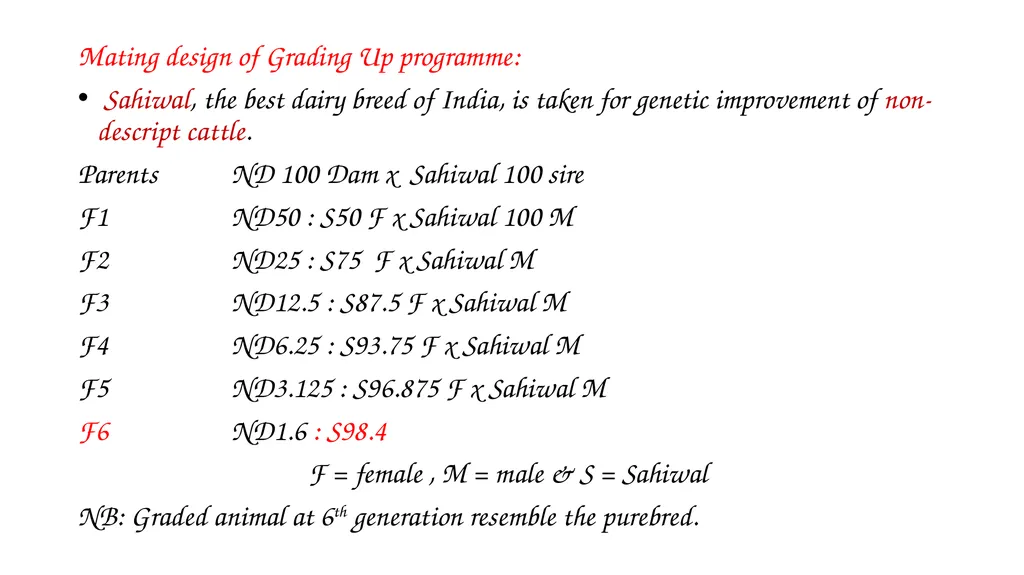
Mating design of Grading Up programme:
Sahiwal, the best dairy breed of India, is taken for genetic improvement of non-descript cattle.
Parents ND 100 Dam x Sahiwal 100 sire
F1 ND50 : S50 F x Sahiwal 100 M
F2 ND25 : S75 F x Sahiwal M
F3 ND12.5 : S87.5 F x Sahiwal M
F4 ND6.25 : S93.75 F x Sahiwal M
F5 ND3.125 : S96.875 F x Sahiwal M
F6 ND1.6 : S98.4
F = female , M = male & S = Sahiwal
NB: Graded animal at 6th generation resemble the purebred.<br>
Sahiwal, the best dairy breed of India, is taken for genetic improvement of non-descript cattle.
Parents ND 100 Dam x Sahiwal 100 sire
F1 ND50 : S50 F x Sahiwal 100 M
F2 ND25 : S75 F x Sahiwal M
F3 ND12.5 : S87.5 F x Sahiwal M
F4 ND6.25 : S93.75 F x Sahiwal M
F5 ND3.125 : S96.875 F x Sahiwal M
F6 ND1.6 : S98.4
F = female , M = male & S = Sahiwal
NB: Graded animal at 6th generation resemble the purebred.<br>
21
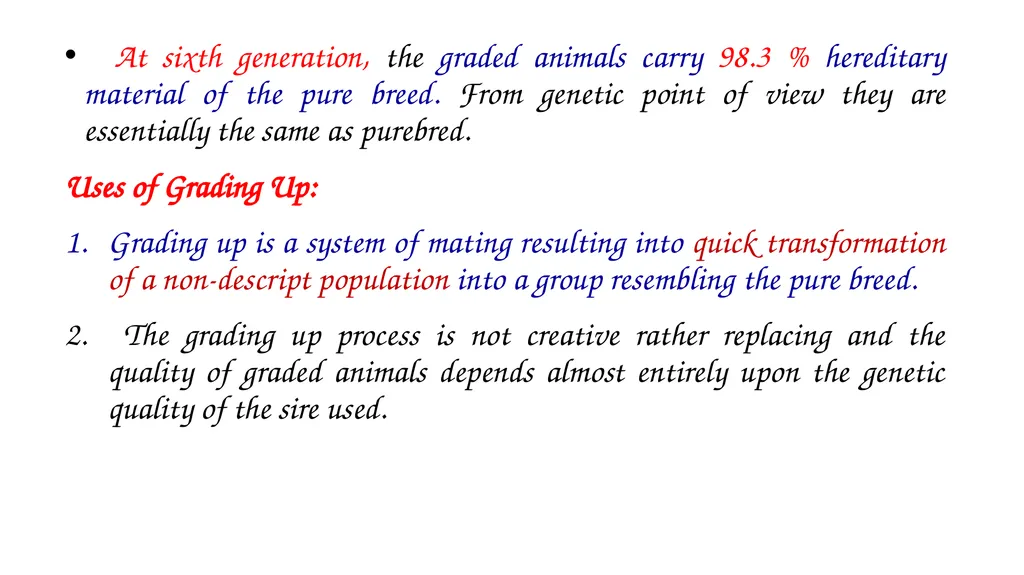
At sixth generation, the graded animals carry 98.3 % hereditary material of the pure breed. From genetic point of view they are essentially the same as purebred.
Uses of Grading Up:
Grading up is a system of mating resulting into quick transformation of a non-descript population into a group resembling the pure breed.
The grading up process is not creative rather replacing and the quality of graded animals depends almost entirely upon the genetic quality of the sire used.<br>
Uses of Grading Up:
Grading up is a system of mating resulting into quick transformation of a non-descript population into a group resembling the pure breed.
The grading up process is not creative rather replacing and the quality of graded animals depends almost entirely upon the genetic quality of the sire used.<br>
22
Limitation of grading up programme:
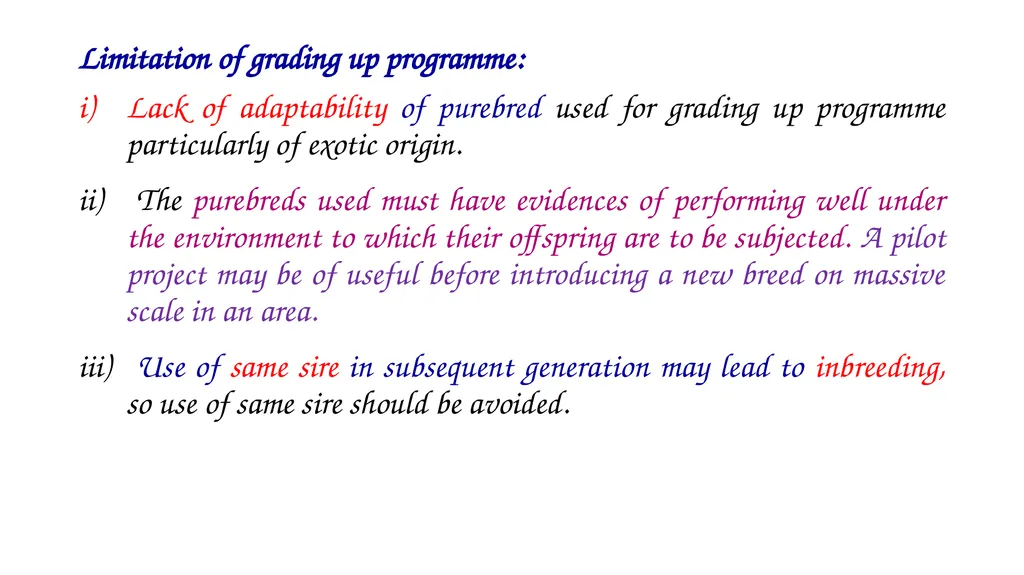
Lack of adaptability of purebred used for grading up programme particularly of exotic origin.
The purebreds used must have evidences of performing well under the environment to which their offspring are to be subjected. A pilot project may be of useful before introducing a new breed on massive scale in an area.
Use of same sire in subsequent generation may lead to inbreeding, so use of same sire should be avoided.<br>
Lack of adaptability of purebred used for grading up programme particularly of exotic origin.
The purebreds used must have evidences of performing well under the environment to which their offspring are to be subjected. A pilot project may be of useful before introducing a new breed on massive scale in an area.
Use of same sire in subsequent generation may lead to inbreeding, so use of same sire should be avoided.<br>
23
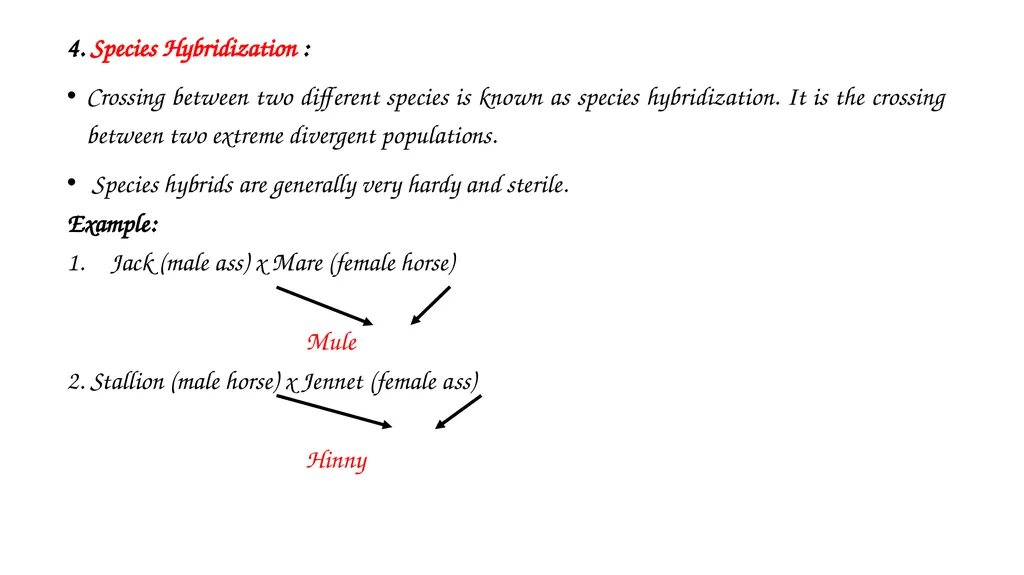
4. Species Hybridization :
Crossing between two different species is known as species hybridization. It is the crossing between two extreme divergent populations.
Species hybrids are generally very hardy and sterile.
Example:
Jack (male ass) x Mare (female horse)
Mule
2. Stallion (male horse) x Jennet (female ass)
Hinny<br>
Crossing between two different species is known as species hybridization. It is the crossing between two extreme divergent populations.
Species hybrids are generally very hardy and sterile.
Example:
Jack (male ass) x Mare (female horse)
Mule
2. Stallion (male horse) x Jennet (female ass)
Hinny<br>
24
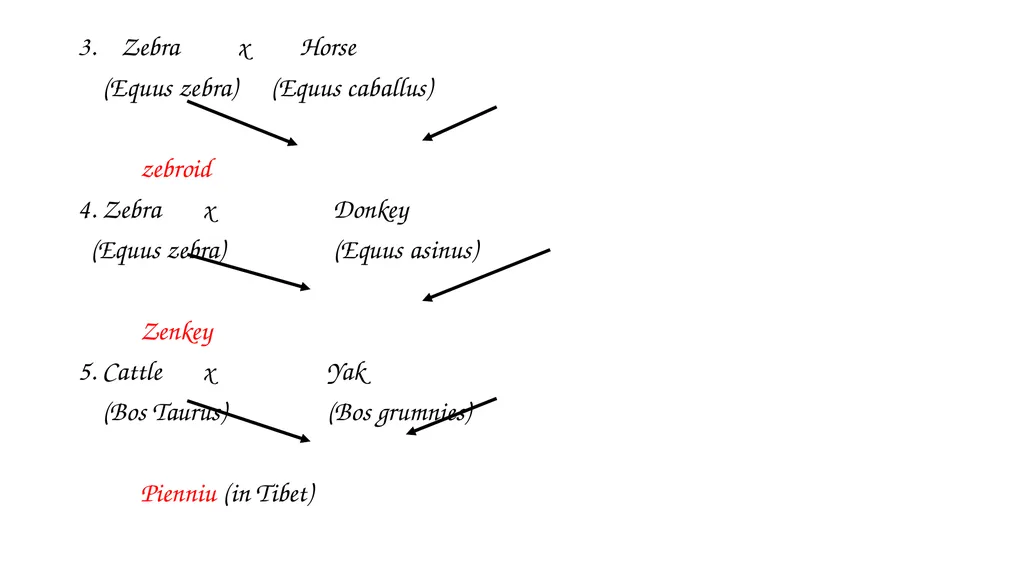
Zebra x Horse
(Equus zebra) (Equus caballus)
zebroid
4. Zebra x Donkey
(Equus zebra) (Equus asinus)
Zenkey
5. Cattle x Yak
(Bos Taurus) (Bos grumnies)
Pienniu (in Tibet)<br>
(Equus zebra) (Equus caballus)
zebroid
4. Zebra x Donkey
(Equus zebra) (Equus asinus)
Zenkey
5. Cattle x Yak
(Bos Taurus) (Bos grumnies)
Pienniu (in Tibet)<br>
25
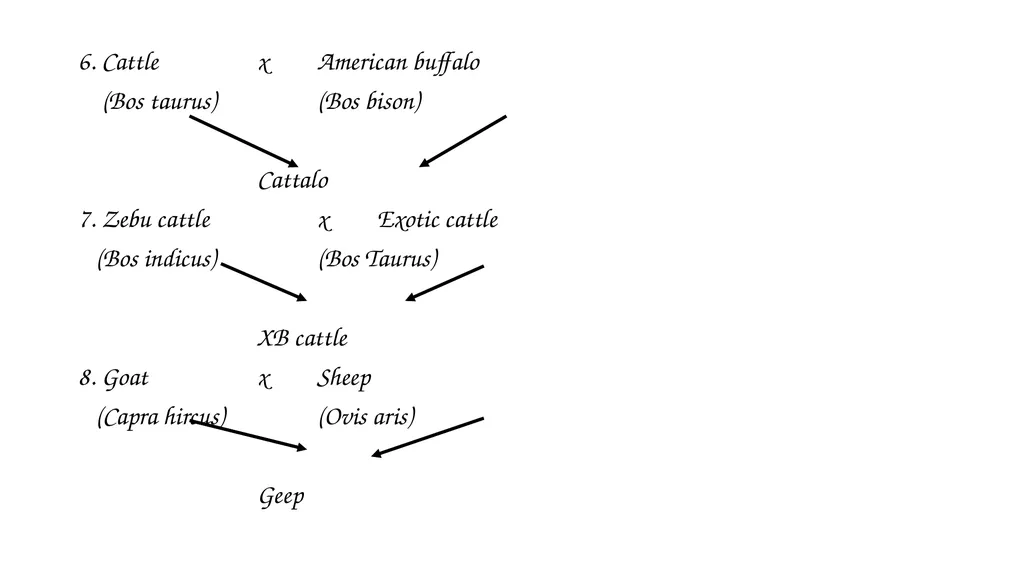
6. Cattle x American buffalo
(Bos taurus) (Bos bison)
Cattalo
7. Zebu cattle x Exotic cattle
(Bos indicus) (Bos Taurus)
XB cattle
8. Goat x Sheep
(Capra hircus) (Ovis aris)
Geep<br>
(Bos taurus) (Bos bison)
Cattalo
7. Zebu cattle x Exotic cattle
(Bos indicus) (Bos Taurus)
XB cattle
8. Goat x Sheep
(Capra hircus) (Ovis aris)
Geep<br>
26
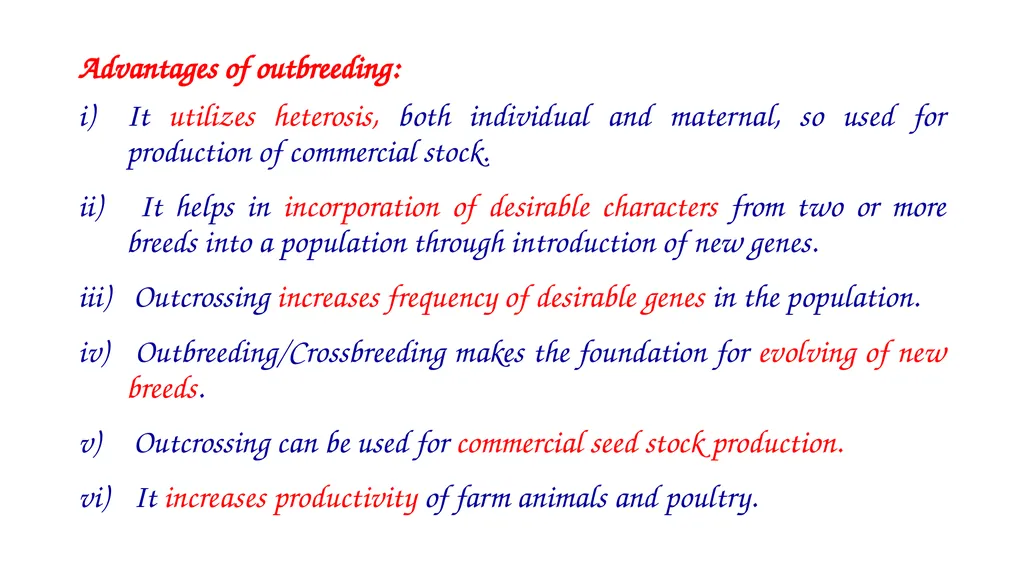
Advantages of outbreeding:
It utilizes heterosis, both individual and maternal, so used for production of commercial stock.
It helps in incorporation of desirable characters from two or more breeds into a population through introduction of new genes.
Outcrossing increases frequency of desirable genes in the population.
Outbreeding/Crossbreeding makes the foundation for evolving of new breeds.
Outcrossing can be used for commercial seed stock production.
It increases productivity of farm animals and poultry.<br>
It utilizes heterosis, both individual and maternal, so used for production of commercial stock.
It helps in incorporation of desirable characters from two or more breeds into a population through introduction of new genes.
Outcrossing increases frequency of desirable genes in the population.
Outbreeding/Crossbreeding makes the foundation for evolving of new breeds.
Outcrossing can be used for commercial seed stock production.
It increases productivity of farm animals and poultry.<br>
27
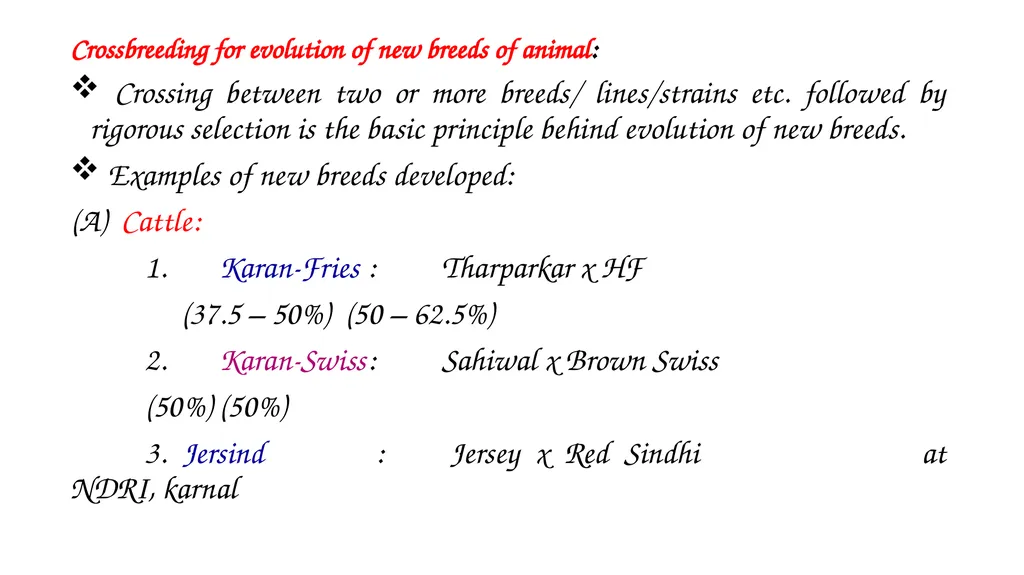
Crossbreeding for evolution of new breeds of animal:
Crossing between two or more breeds/ lines/strains etc. followed by rigorous selection is the basic principle behind evolution of new breeds.
Examples of new breeds developed:
Cattle:
1. Karan-Fries : Tharparkar x HF
(37.5 – 50%) (50 – 62.5%)
2. Karan-Swiss : Sahiwal x Brown Swiss
(50%) (50%)
3. Jersind : Jersey x Red Sindhi at NDRI, karnal<br>
Crossing between two or more breeds/ lines/strains etc. followed by rigorous selection is the basic principle behind evolution of new breeds.
Examples of new breeds developed:
Cattle:
1. Karan-Fries : Tharparkar x HF
(37.5 – 50%) (50 – 62.5%)
2. Karan-Swiss : Sahiwal x Brown Swiss
(50%) (50%)
3. Jersind : Jersey x Red Sindhi at NDRI, karnal<br>
28
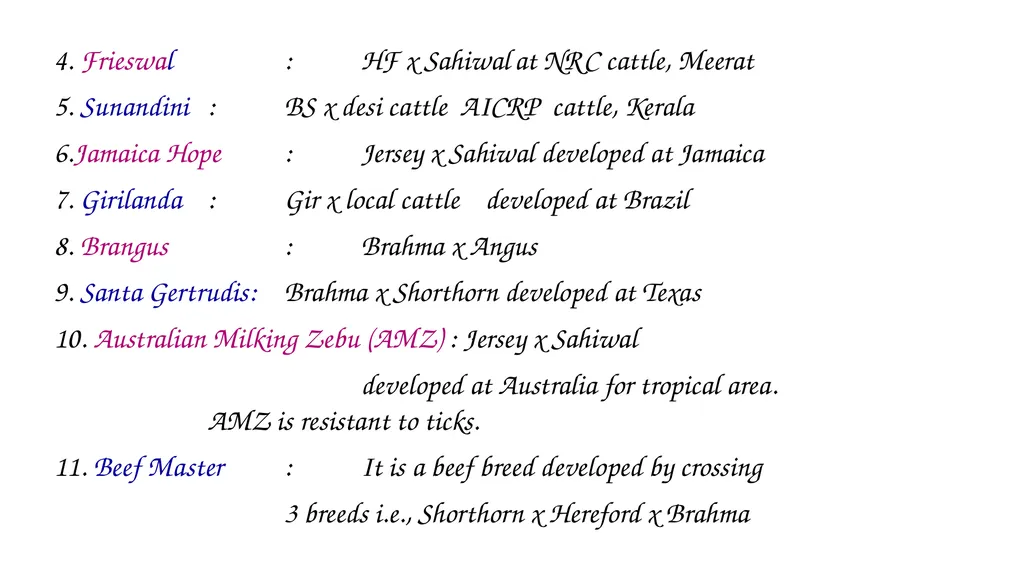
4. Frieswal : HF x Sahiwal at NRC cattle, Meerat
5. Sunandini : BS x desi cattle AICRP cattle, Kerala
6.Jamaica Hope : Jersey x Sahiwal developed at Jamaica
7. Girilanda : Gir x local cattle developed at Brazil
8. Brangus : Brahma x Angus
9. Santa Gertrudis: Brahma x Shorthorn developed at Texas
10. Australian Milking Zebu (AMZ) : Jersey x Sahiwal
developed at Australia for tropical area. AMZ is resistant to ticks.
11. Beef Master : It is a beef breed developed by crossing
3 breeds i.e., Shorthorn x Hereford x Brahma<br>
5. Sunandini : BS x desi cattle AICRP cattle, Kerala
6.Jamaica Hope : Jersey x Sahiwal developed at Jamaica
7. Girilanda : Gir x local cattle developed at Brazil
8. Brangus : Brahma x Angus
9. Santa Gertrudis: Brahma x Shorthorn developed at Texas
10. Australian Milking Zebu (AMZ) : Jersey x Sahiwal
developed at Australia for tropical area. AMZ is resistant to ticks.
11. Beef Master : It is a beef breed developed by crossing
3 breeds i.e., Shorthorn x Hereford x Brahma<br>
29
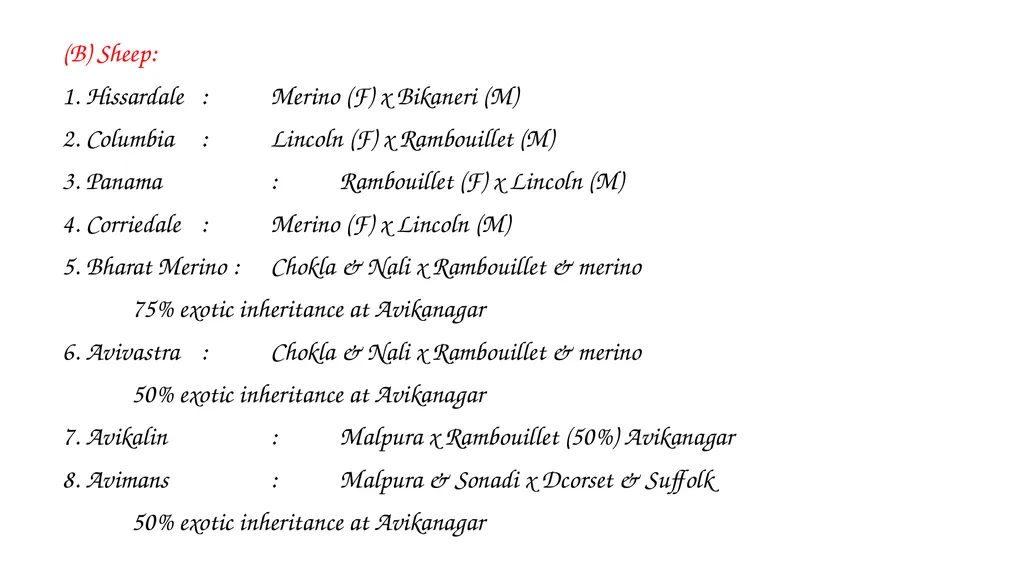
(B) Sheep:
1. Hissardale : Merino (F) x Bikaneri (M)
2. Columbia : Lincoln (F) x Rambouillet (M)
3. Panama : Rambouillet (F) x Lincoln (M)
4. Corriedale : Merino (F) x Lincoln (M)
5. Bharat Merino : Chokla & Nali x Rambouillet & merino
75% exotic inheritance at Avikanagar
6. Avivastra : Chokla & Nali x Rambouillet & merino
50% exotic inheritance at Avikanagar
7. Avikalin : Malpura x Rambouillet (50%) Avikanagar
8. Avimans : Malpura & Sonadi x Dcorset & Suffolk
50% exotic inheritance at Avikanagar<br>
1. Hissardale : Merino (F) x Bikaneri (M)
2. Columbia : Lincoln (F) x Rambouillet (M)
3. Panama : Rambouillet (F) x Lincoln (M)
4. Corriedale : Merino (F) x Lincoln (M)
5. Bharat Merino : Chokla & Nali x Rambouillet & merino
75% exotic inheritance at Avikanagar
6. Avivastra : Chokla & Nali x Rambouillet & merino
50% exotic inheritance at Avikanagar
7. Avikalin : Malpura x Rambouillet (50%) Avikanagar
8. Avimans : Malpura & Sonadi x Dcorset & Suffolk
50% exotic inheritance at Avikanagar<br>
30
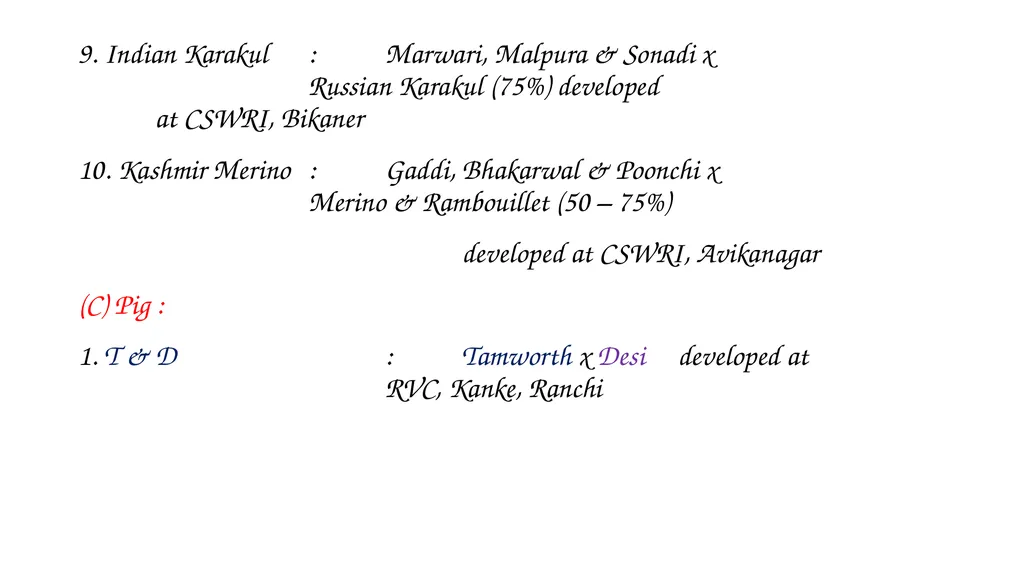
9. Indian Karakul : Marwari, Malpura & Sonadi x Russian Karakul (75%) developed at CSWRI, Bikaner
10. Kashmir Merino : Gaddi, Bhakarwal & Poonchi x Merino & Rambouillet (50 – 75%)
developed at CSWRI, Avikanagar
(C) Pig :
1. T & D : Tamworth x Desi developed at RVC, Kanke, Ranchi<br>
10. Kashmir Merino : Gaddi, Bhakarwal & Poonchi x Merino & Rambouillet (50 – 75%)
developed at CSWRI, Avikanagar
(C) Pig :
1. T & D : Tamworth x Desi developed at RVC, Kanke, Ranchi<br>
31
Thank You<br>