
ANIMAL NUTRITION (Mammals) TOPIC: PROCESS OF
PC
Published · 28 slides · 0 views

1 / 1


Description
ANIMAL NUTRITION (Mammals) TOPIC: PROCESS OF DIGESTION AND ABSORPTION PRESENTER: MS A. MADIKANE BUFFALO CITY MUNICIPALITY DISTRICT CAPS guidelines pg. 43 Introduction The digestive system is responsible for breaking down complex molecules
Related Topics
Share
Embed code
Download this presentation From Below
"ANIMAL NUTRITION (Mammals) TOPIC: PROCESS OF" is the property of its rightful owner. Permission is granted to download and print the materials on this website for personal, non-commercial use only, and to display it on your personal computer provided you do not modify the materials and that you retain all copyright notices contained in the materials. By downloading content from our website, you accept the terms of this agreement.
Presentation Transcript
01
ANIMAL NUTRITION
(Mammals) TOPIC: PROCESS OF DIGESTION AND ABSORPTION
PRESENTER: MS A. MADIKANE
BUFFALO CITY MUNICIPALITY DISTRICT<br>
PRESENTER: MS A. MADIKANE
BUFFALO CITY MUNICIPALITY DISTRICT<br>
02
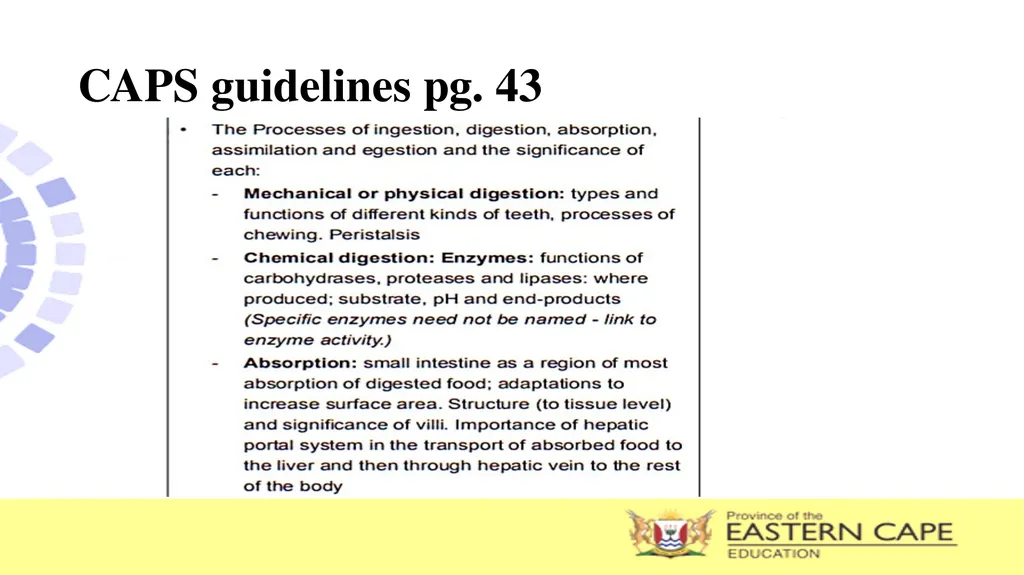
CAPS guidelines pg. 43<br>
03
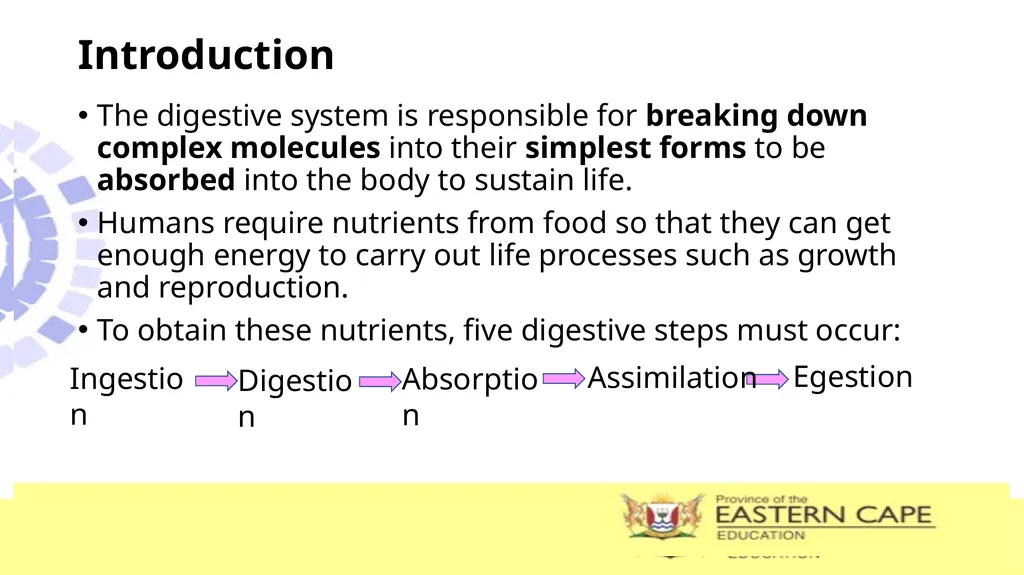
Introduction The digestive system is responsible for breaking down complex molecules into their simplest forms to be absorbed into the body to sustain life.
Humans require nutrients from food so that they can get enough energy to carry out life processes such as growth and reproduction.
To obtain these nutrients, five digestive steps must occur: Digestion Ingestion Absorption Assimilation Egestion<br>
Humans require nutrients from food so that they can get enough energy to carry out life processes such as growth and reproduction.
To obtain these nutrients, five digestive steps must occur: Digestion Ingestion Absorption Assimilation Egestion<br>
04
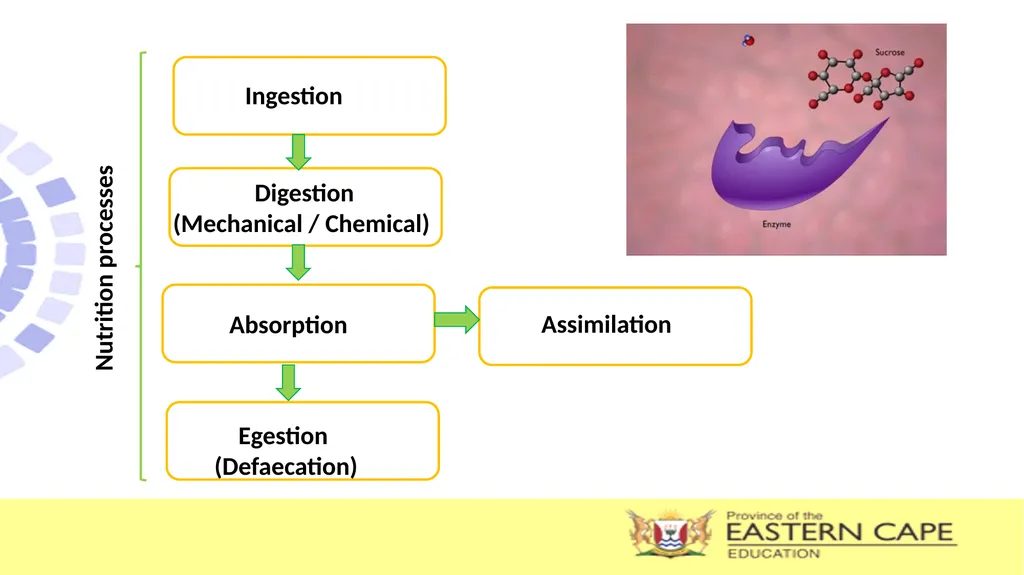
Nutrition processes<br>
05
Digestive processes Ingestion -Taking food into the body through the mouth.
Humans achieve this through the help of the lips, tongue and teeth.
Digestion – breakdown of food into simpler molecules by the mechanical and chemical actions of the mouth, stomach and intestines.<br>
Humans achieve this through the help of the lips, tongue and teeth.
Digestion – breakdown of food into simpler molecules by the mechanical and chemical actions of the mouth, stomach and intestines.<br>
06
Mechanical digestion – refers to the breakdown of food by a physical process involving the action of muscles.
This helps break the food down into smaller pieces to increase the surface area for the action of enzymes
This process starts in the mouth when chewing food. The biological term for chewing is mastication.
Mastication is defined as biting and grinding of food by teeth to make it easier to swallow.<br>
This helps break the food down into smaller pieces to increase the surface area for the action of enzymes
This process starts in the mouth when chewing food. The biological term for chewing is mastication.
Mastication is defined as biting and grinding of food by teeth to make it easier to swallow.<br>
07
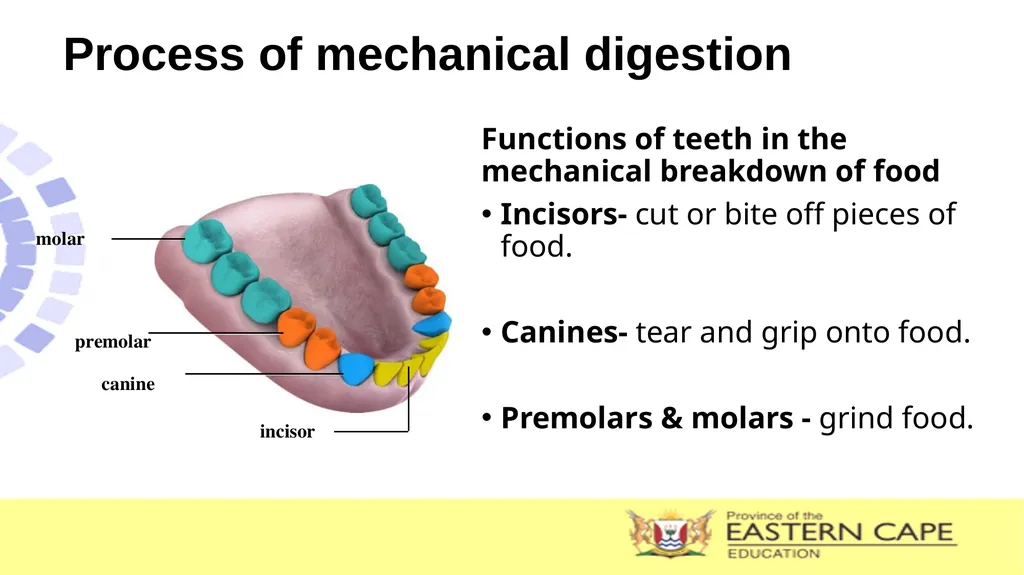
Process of mechanical digestion Functions of teeth in the mechanical breakdown of food
Incisors- cut or bite off pieces of food.
Canines- tear and grip onto food.
Premolars & molars - grind food. molar premolar canine incisor<br>
Incisors- cut or bite off pieces of food.
Canines- tear and grip onto food.
Premolars & molars - grind food. molar premolar canine incisor<br>
08
Chewing - The tongue and teeth work the food in the mouth into a ball called bolus.
Food is thoroughly mixed with slimy saliva, enabling easy swallowing and passage through the oesophagus
Saliva contains water that softens the food and facilitates chewing
Saliva contains mucous which lubricates the food and facilitates chewing<br>
Food is thoroughly mixed with slimy saliva, enabling easy swallowing and passage through the oesophagus
Saliva contains water that softens the food and facilitates chewing
Saliva contains mucous which lubricates the food and facilitates chewing<br>
09
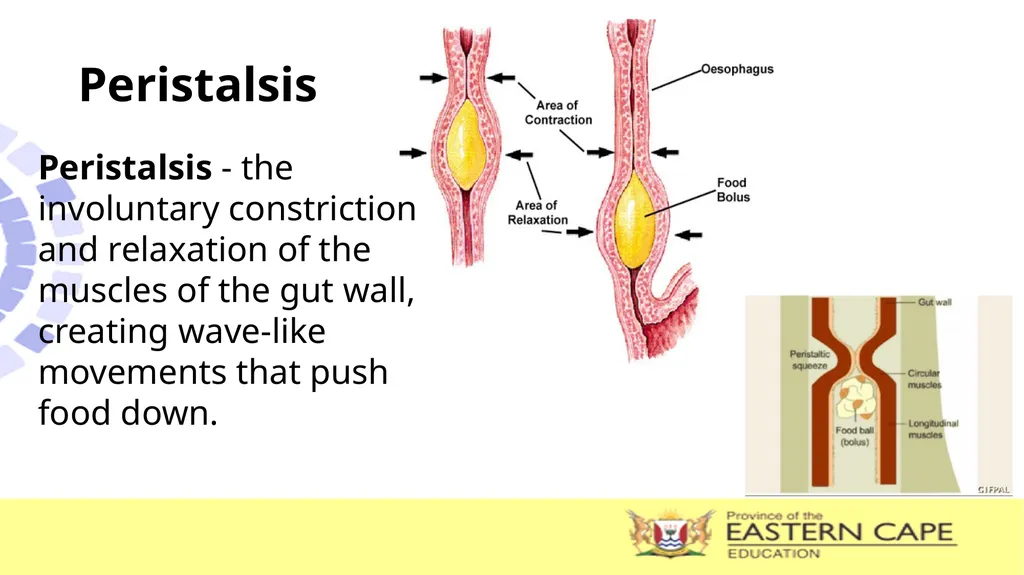
Peristalsis Peristalsis - the involuntary constriction and relaxation of the muscles of the gut wall, creating wave-like movements that push food down.<br>
10
Peristalsis occurs in oesophagus, small intestine and large intestine.
Peristalsis will still transport food and water to your stomach even if you stand on your head.
Once the bolus reaches the stomach, it is physically broken down further by the strong contractions of the stomach muscles.
The bolus is also mixed with stomach acid and digestive enzymes which forms a creamy mixture called chyme.
Lipids are broken down by bile into tiny droplets which provide a larger surface area on which enzymes can act to break them down.
The breaking down of lipids into tiny droplets is called emulsification and is a type of physical digestion.<br>
Peristalsis will still transport food and water to your stomach even if you stand on your head.
Once the bolus reaches the stomach, it is physically broken down further by the strong contractions of the stomach muscles.
The bolus is also mixed with stomach acid and digestive enzymes which forms a creamy mixture called chyme.
Lipids are broken down by bile into tiny droplets which provide a larger surface area on which enzymes can act to break them down.
The breaking down of lipids into tiny droplets is called emulsification and is a type of physical digestion.<br>
11
Role of Water in Movement of Food along the Alimentary Canal Water facilitates the movement of food along the alimentary canal by:
Increasing the liquidity of the food, thus enabling it to move freely through the alimentary canal
Keeping the surrounding tissues soft and pliable, allowing free movement of its contents
Water comes from the following sources:
Taken in as liquids with food
Is added as a component of bile, gastric juice, intestinal juice, pancreatic juice and saliva<br>
Increasing the liquidity of the food, thus enabling it to move freely through the alimentary canal
Keeping the surrounding tissues soft and pliable, allowing free movement of its contents
Water comes from the following sources:
Taken in as liquids with food
Is added as a component of bile, gastric juice, intestinal juice, pancreatic juice and saliva<br>
12
Chemical digestion Chemical digestion is the breaking down of large food compounds into smaller food compounds using digestive enzymes. Most food particles are too large to be absorbed from the alimentary canal into the blood and therefore chemical digestion is necessary.
Enzymes are very sensitive to changes in temperature and pH and only work in optimal temperatures and pH ranges.
Digestive enzymes function best at 37° C and at different pH levels.<br>
Enzymes are very sensitive to changes in temperature and pH and only work in optimal temperatures and pH ranges.
Digestive enzymes function best at 37° C and at different pH levels.<br>
13
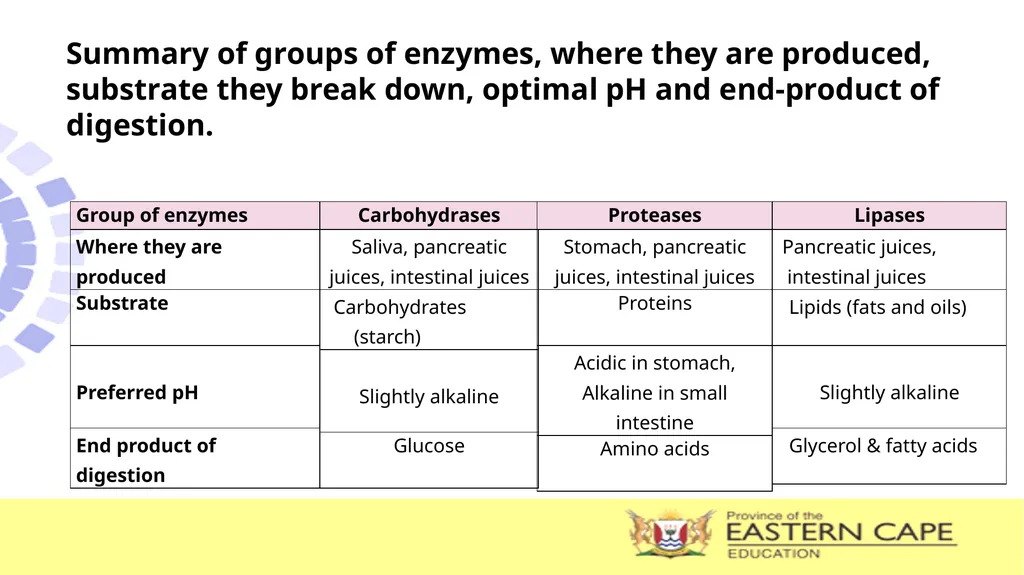
Summary of groups of enzymes, where they are produced, substrate they break down, optimal pH and end-product of digestion.<br>
14
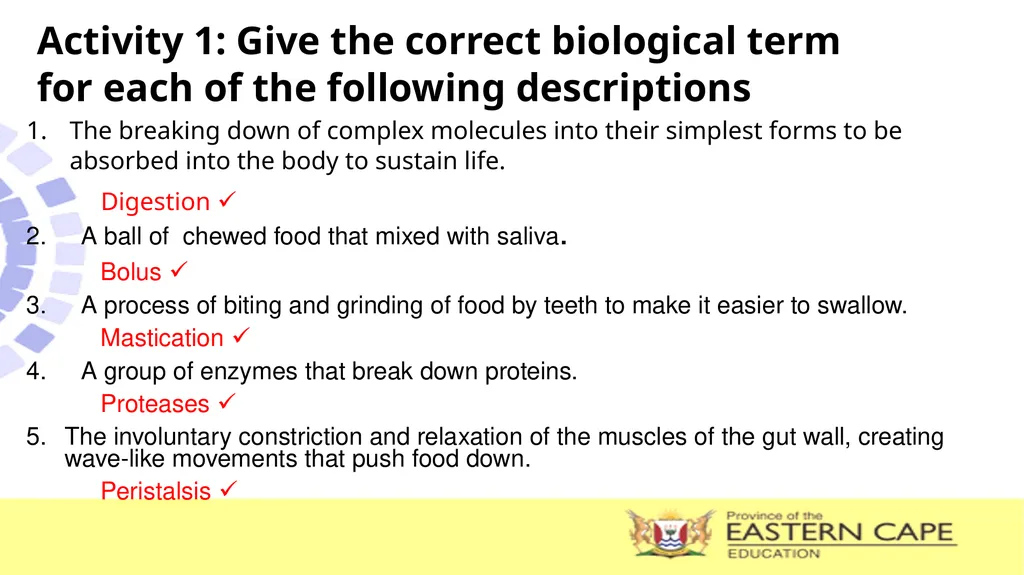
Activity 1: Give the correct biological term for each of the following descriptions The breaking down of complex molecules into their simplest forms to be absorbed into the body to sustain life.
Digestion
2. A ball of chewed food that mixed with saliva.
Bolus
3. A process of biting and grinding of food by teeth to make it easier to swallow.
Mastication
4. A group of enzymes that break down proteins.
Proteases
The involuntary constriction and relaxation of the muscles of the gut wall, creating wave-like movements that push food down.
Peristalsis <br>
Digestion
2. A ball of chewed food that mixed with saliva.
Bolus
3. A process of biting and grinding of food by teeth to make it easier to swallow.
Mastication
4. A group of enzymes that break down proteins.
Proteases
The involuntary constriction and relaxation of the muscles of the gut wall, creating wave-like movements that push food down.
Peristalsis <br>
15
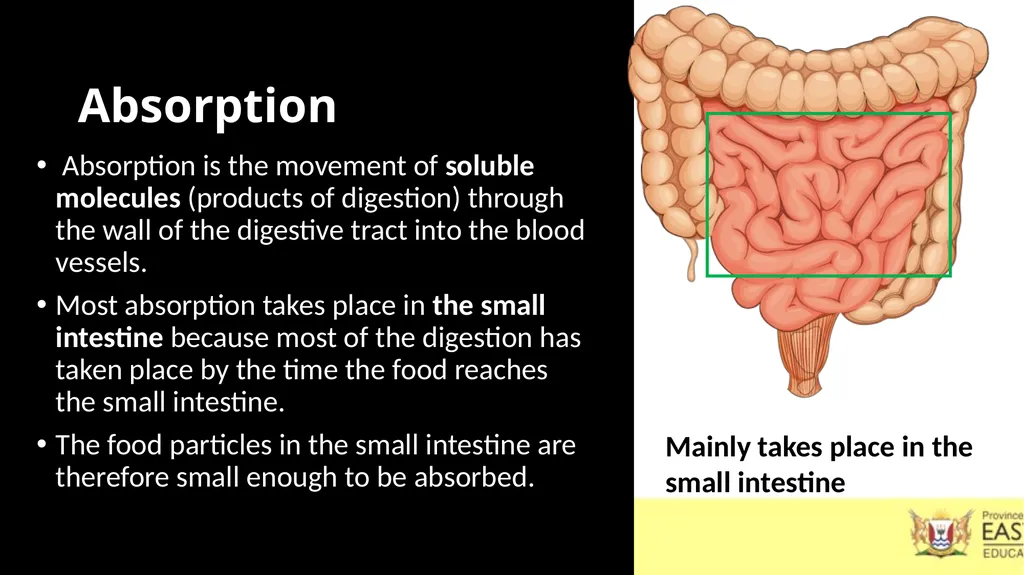
Absorption Absorption is the movement of soluble molecules (products of digestion) through the wall of the digestive tract into the blood vessels.
Most absorption takes place in the small intestine because most of the digestion has taken place by the time the food reaches the small intestine.
The food particles in the small intestine are therefore small enough to be absorbed. Mainly takes place in the small intestine<br>
Most absorption takes place in the small intestine because most of the digestion has taken place by the time the food reaches the small intestine.
The food particles in the small intestine are therefore small enough to be absorbed. Mainly takes place in the small intestine<br>
16
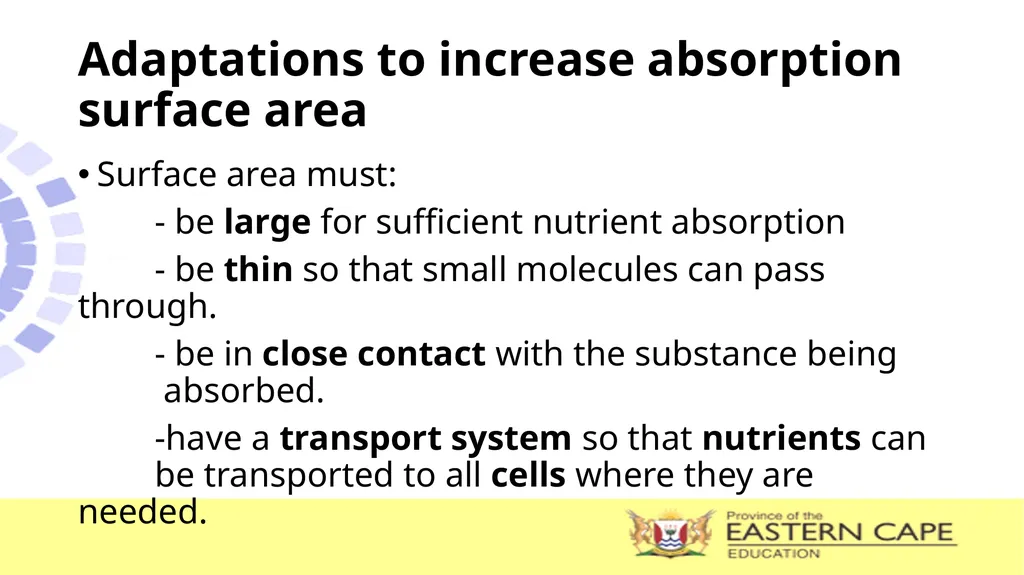
Adaptations to increase absorption surface area Surface area must:
- be large for sufficient nutrient absorption
- be thin so that small molecules can pass through.
- be in close contact with the substance being absorbed.
-have a transport system so that nutrients can be transported to all cells where they are needed.<br>
- be large for sufficient nutrient absorption
- be thin so that small molecules can pass through.
- be in close contact with the substance being absorbed.
-have a transport system so that nutrients can be transported to all cells where they are needed.<br>
17
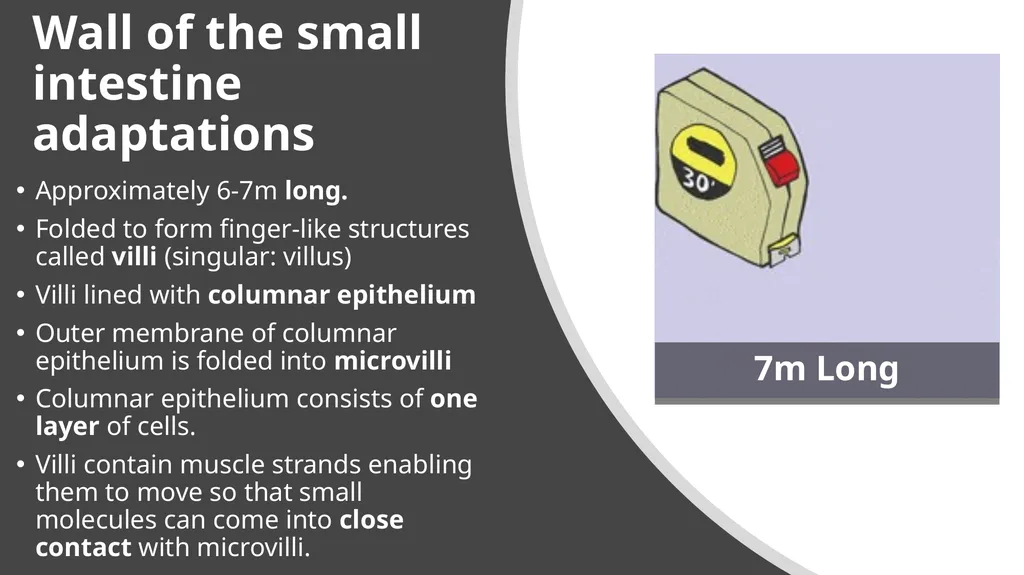
Wall of the small intestine adaptations Approximately 6-7m long.
Folded to form finger-like structures called villi (singular: villus)
Villi lined with columnar epithelium
Outer membrane of columnar epithelium is folded into microvilli
Columnar epithelium consists of one layer of cells.
Villi contain muscle strands enabling them to move so that small molecules can come into close contact with microvilli. 7m Long<br>
Folded to form finger-like structures called villi (singular: villus)
Villi lined with columnar epithelium
Outer membrane of columnar epithelium is folded into microvilli
Columnar epithelium consists of one layer of cells.
Villi contain muscle strands enabling them to move so that small molecules can come into close contact with microvilli. 7m Long<br>
18
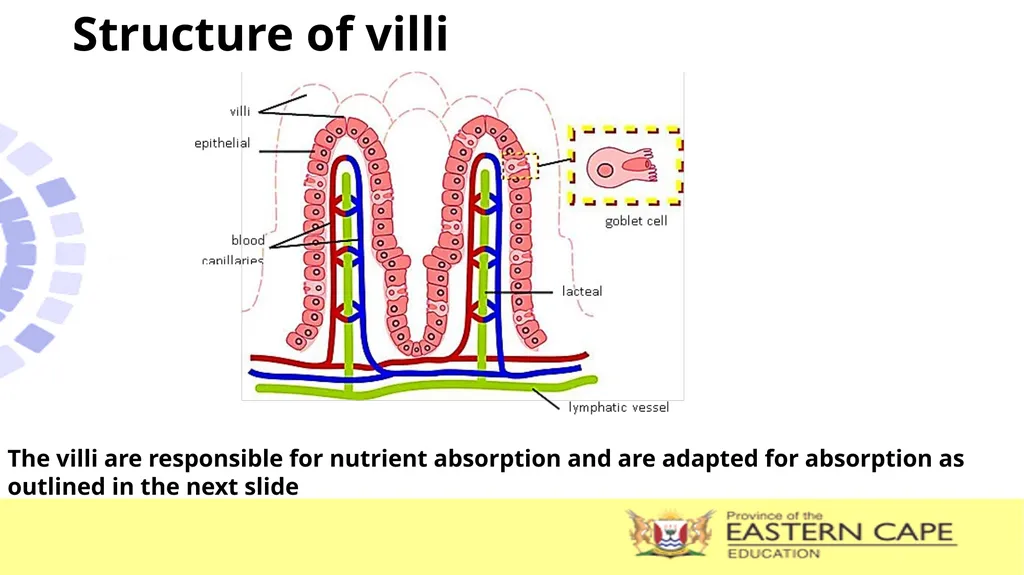
Structure of villi The villi are responsible for nutrient absorption and are adapted for absorption as outlined in the next slide<br>
19
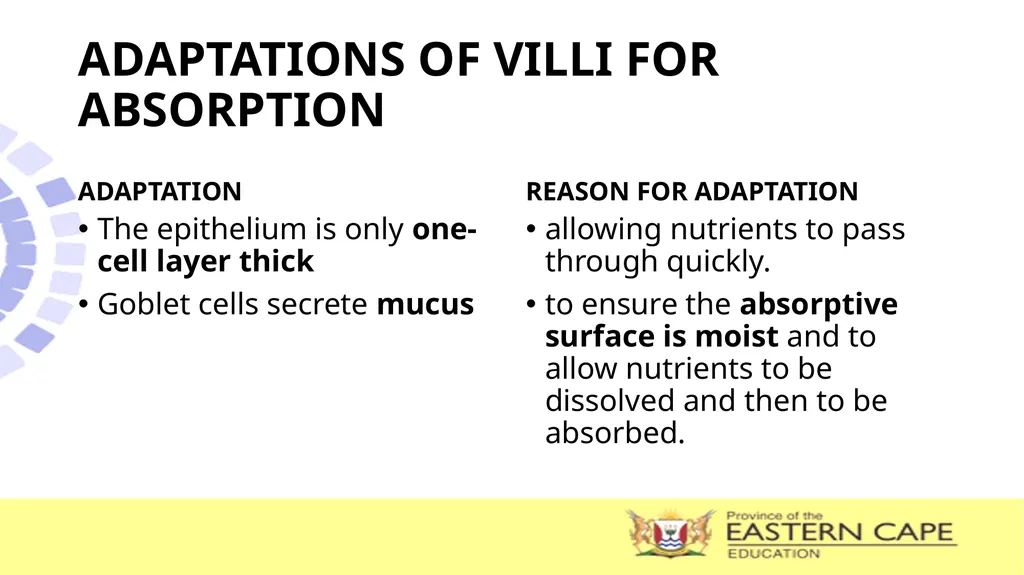
ADAPTATION The epithelium is only one-cell layer thick
Goblet cells secrete mucus REASON FOR ADAPTATION allowing nutrients to pass through quickly.
to ensure the absorptive surface is moist and to allow nutrients to be dissolved and then to be absorbed. ADAPTATIONS OF VILLI FOR ABSORPTION<br>
Goblet cells secrete mucus REASON FOR ADAPTATION allowing nutrients to pass through quickly.
to ensure the absorptive surface is moist and to allow nutrients to be dissolved and then to be absorbed. ADAPTATIONS OF VILLI FOR ABSORPTION<br>
20
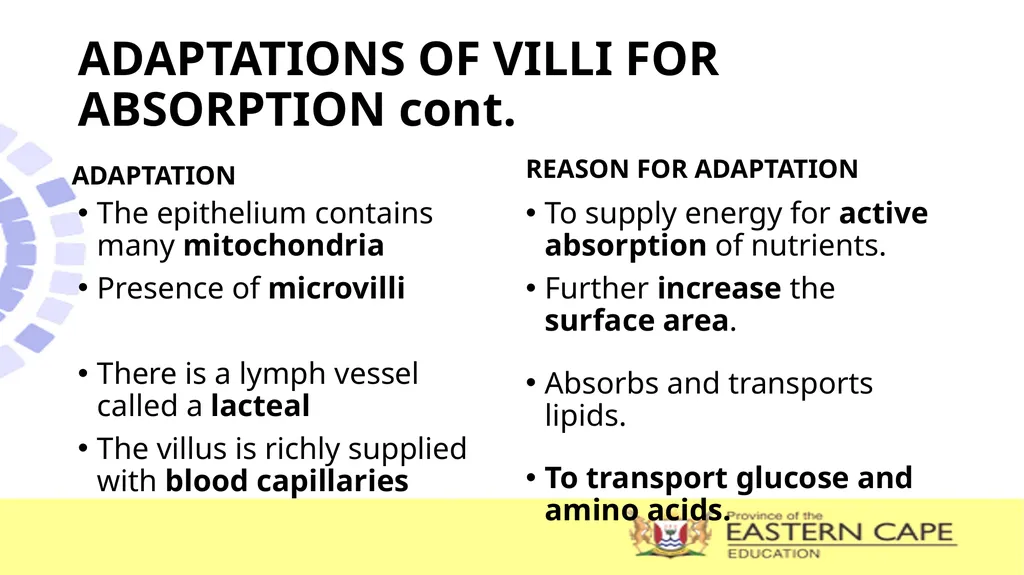
ADAPTATIONS OF VILLI FOR ABSORPTION cont. ADAPTATION The epithelium contains many mitochondria
Presence of microvilli
There is a lymph vessel called a lacteal
The villus is richly supplied with blood capillaries REASON FOR ADAPTATION To supply energy for active absorption of nutrients.
Further increase the surface area.
Absorbs and transports lipids.
To transport glucose and amino acids.<br>
Presence of microvilli
There is a lymph vessel called a lacteal
The villus is richly supplied with blood capillaries REASON FOR ADAPTATION To supply energy for active absorption of nutrients.
Further increase the surface area.
Absorbs and transports lipids.
To transport glucose and amino acids.<br>
21
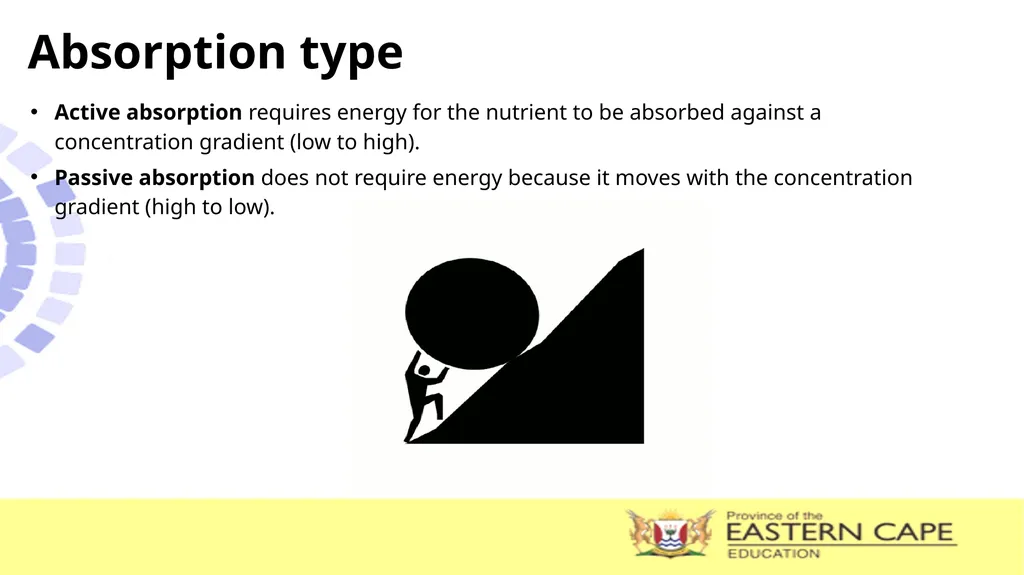
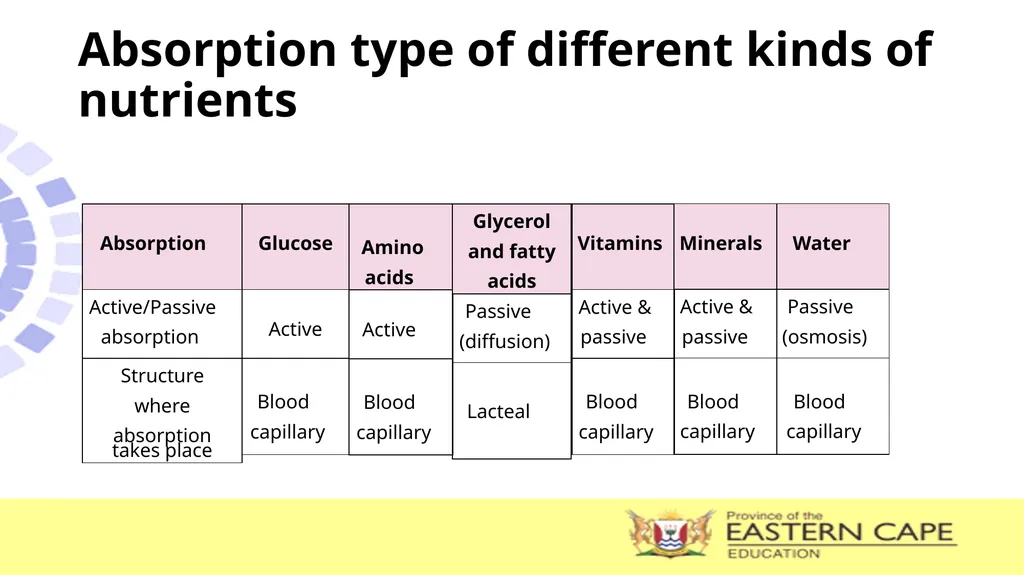
Absorption type Active absorption requires energy for the nutrient to be absorbed against a concentration gradient (low to high).
Passive absorption does not require energy because it moves with the concentration gradient (high to low).<br>
Passive absorption does not require energy because it moves with the concentration gradient (high to low).<br>
22
Absorption type of different kinds of nutrients<br>
23
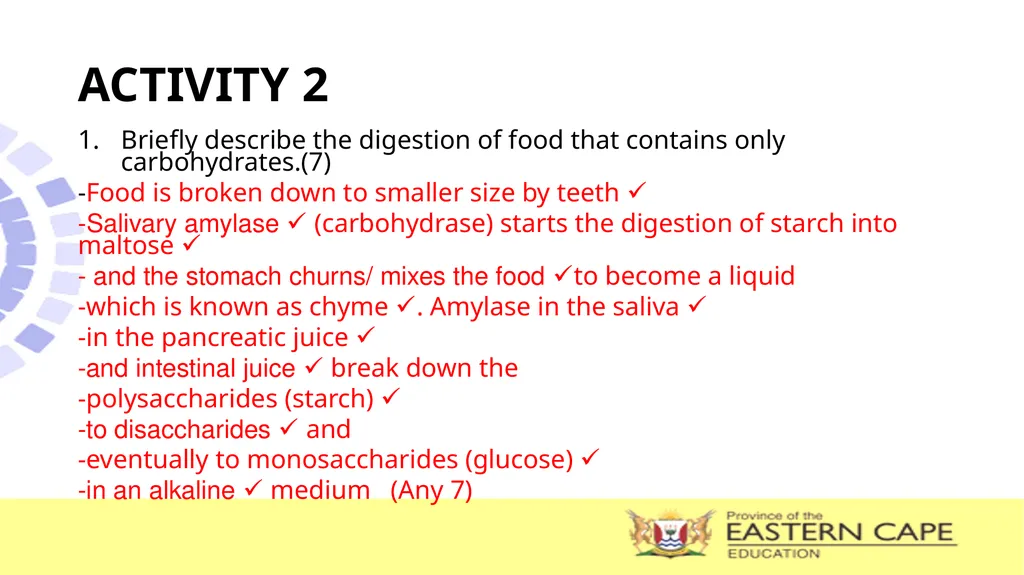
ACTIVITY 2 Briefly describe the digestion of food that contains only carbohydrates.(7)
-Food is broken down to smaller size by teeth
-Salivary amylase (carbohydrase) starts the digestion of starch into maltose
- and the stomach churns/ mixes the food to become a liquid
-which is known as chyme . Amylase in the saliva
-in the pancreatic juice
-and intestinal juice break down the
-polysaccharides (starch)
-to disaccharides and
-eventually to monosaccharides (glucose)
-in an alkaline medium (Any 7)<br>
-Food is broken down to smaller size by teeth
-Salivary amylase (carbohydrase) starts the digestion of starch into maltose
- and the stomach churns/ mixes the food to become a liquid
-which is known as chyme . Amylase in the saliva
-in the pancreatic juice
-and intestinal juice break down the
-polysaccharides (starch)
-to disaccharides and
-eventually to monosaccharides (glucose)
-in an alkaline medium (Any 7)<br>
24
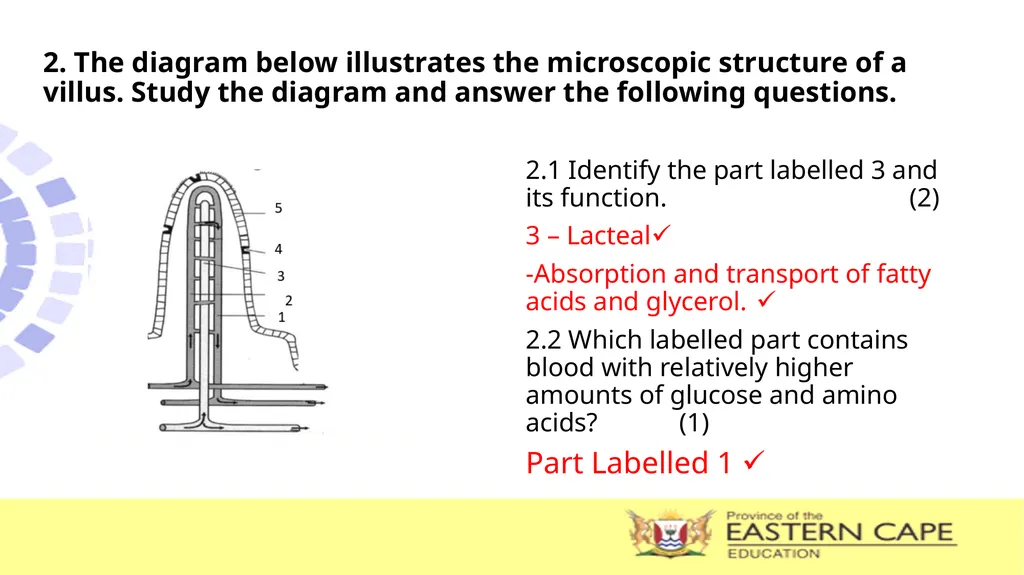
2. The diagram below illustrates the microscopic structure of a villus. Study the diagram and answer the following questions. 2.1 Identify the part labelled 3 and its function. (2)
3 – Lacteal
-Absorption and transport of fatty acids and glycerol.
2.2 Which labelled part contains blood with relatively higher amounts of glucose and amino acids? (1)
Part Labelled 1 <br>
3 – Lacteal
-Absorption and transport of fatty acids and glycerol.
2.2 Which labelled part contains blood with relatively higher amounts of glucose and amino acids? (1)
Part Labelled 1 <br>
25
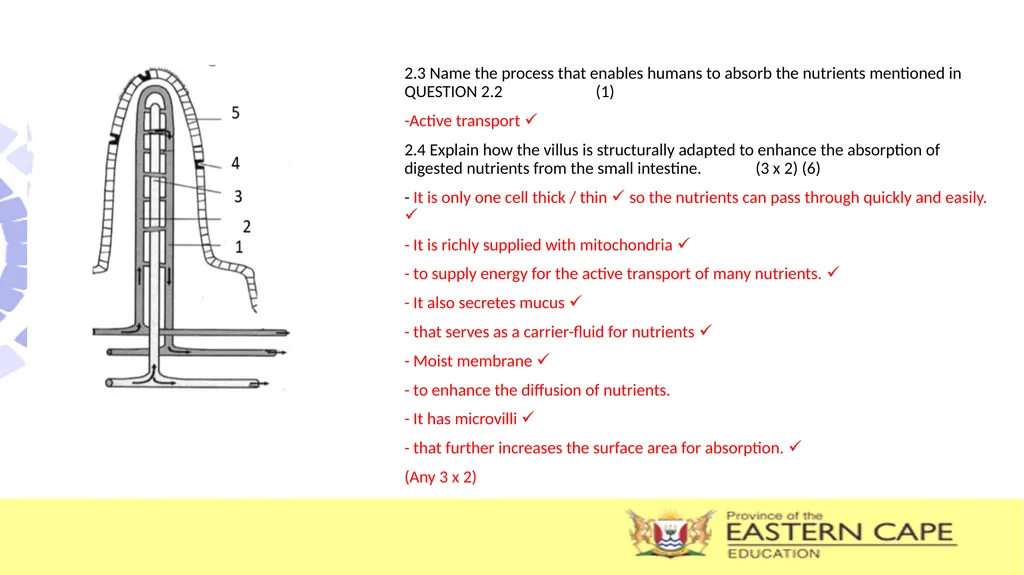
2.3 Name the process that enables humans to absorb the nutrients mentioned in QUESTION 2.2 (1)
-Active transport
2.4 Explain how the villus is structurally adapted to enhance the absorption of digested nutrients from the small intestine. (3 x 2) (6)
- It is only one cell thick / thin so the nutrients can pass through quickly and easily.
- It is richly supplied with mitochondria
- to supply energy for the active transport of many nutrients.
- It also secretes mucus
- that serves as a carrier-fluid for nutrients
- Moist membrane
- to enhance the diffusion of nutrients.
- It has microvilli
- that further increases the surface area for absorption.
(Any 3 x 2)<br>
-Active transport
2.4 Explain how the villus is structurally adapted to enhance the absorption of digested nutrients from the small intestine. (3 x 2) (6)
- It is only one cell thick / thin so the nutrients can pass through quickly and easily.
- It is richly supplied with mitochondria
- to supply energy for the active transport of many nutrients.
- It also secretes mucus
- that serves as a carrier-fluid for nutrients
- Moist membrane
- to enhance the diffusion of nutrients.
- It has microvilli
- that further increases the surface area for absorption.
(Any 3 x 2)<br>
26
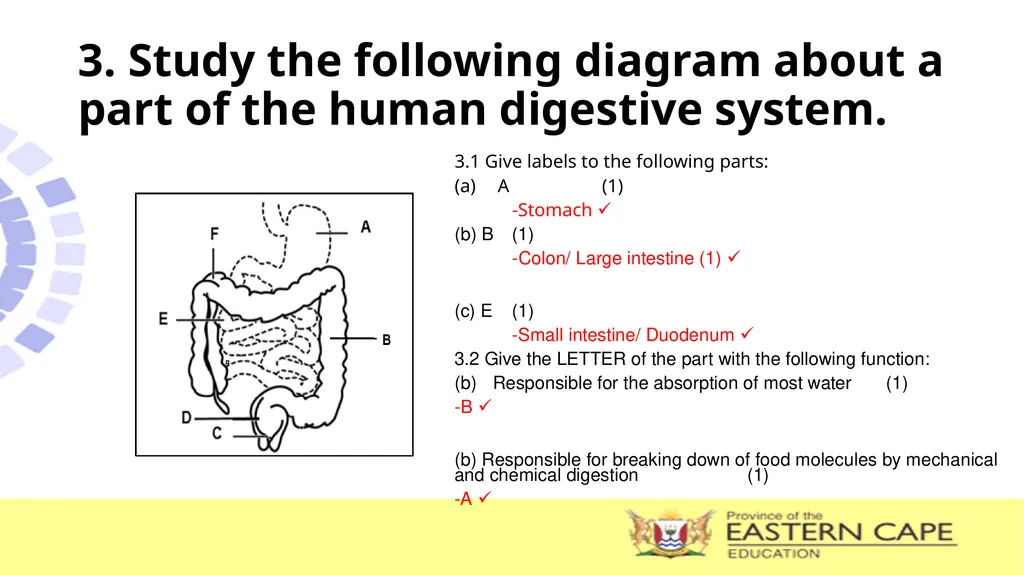
3. Study the following diagram about a part of the human digestive system. 3.1 Give labels to the following parts:
A (1)
-Stomach
(b) B (1)
-Colon/ Large intestine (1)
(c) E (1)
-Small intestine/ Duodenum
3.2 Give the LETTER of the part with the following function:
Responsible for the absorption of most water (1)
-B
(b) Responsible for breaking down of food molecules by mechanical and chemical digestion (1)
-A <br>
A (1)
-Stomach
(b) B (1)
-Colon/ Large intestine (1)
(c) E (1)
-Small intestine/ Duodenum
3.2 Give the LETTER of the part with the following function:
Responsible for the absorption of most water (1)
-B
(b) Responsible for breaking down of food molecules by mechanical and chemical digestion (1)
-A <br>
27
Transport of amino acids and glucose Glucose and amino acids are absorbed from the small intestine and transported in the blood circulatory system as shown in the flow diagram.
Amino acids & glucose are absorbed into blood capillaries
of the villi in the small intestine
Capillaries join together to form large venules to form the hepatic portal vein transports amino acids and glucose to the liver
Glucose and amino acids flow through hepatic vein to the heart
The liver converts excess glucose to glycogen and stores it
Excess amino acids are deaminated by the liver to form urea (waste product) and are removed from the body<br>
Amino acids & glucose are absorbed into blood capillaries
of the villi in the small intestine
Capillaries join together to form large venules to form the hepatic portal vein transports amino acids and glucose to the liver
Glucose and amino acids flow through hepatic vein to the heart
The liver converts excess glucose to glycogen and stores it
Excess amino acids are deaminated by the liver to form urea (waste product) and are removed from the body<br>
28
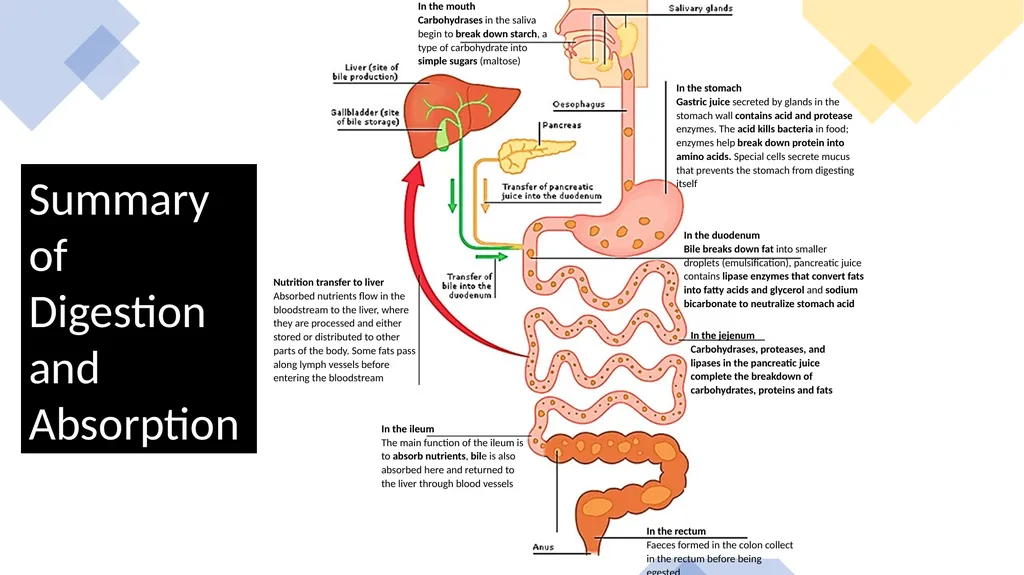
Summary of Digestion and Absorption<br>