Animated demo: http:ats.oka.nub-treeb-tree.html https:www.youtube.comwatch?vcoRJrcIYbF4 B- Trees Slide Credit : Yael Moses, IDC Herzliya COL 106 Shweta Agrawal, Amit Kumar Motivation Large differences between time access to disk,
"Animated demo:" is the property of its rightful owner. Permission is granted to
download and print the materials on this website for personal, non-commercial use only, and to display it
on your personal computer provided you do not modify the materials and that you retain all copyright
notices contained in the materials. By downloading content from our website, you accept the terms of this
agreement.
Presentation Transcript
01
Animated demo: http://ats.oka.nu/b-tree/b-tree.html
https://www.youtube.com/watch?v=coRJrcIYbF4 B- Trees Slide Credit : Yael Moses, IDC Herzliya COL 106
Shweta Agrawal, Amit Kumar<br>
02
Motivation Large differences between time access to disk, cash memory and core memory
Minimize expensive access (e.g., disk access)
B-tree: Dynamic sets that is optimized for disks<br>
03
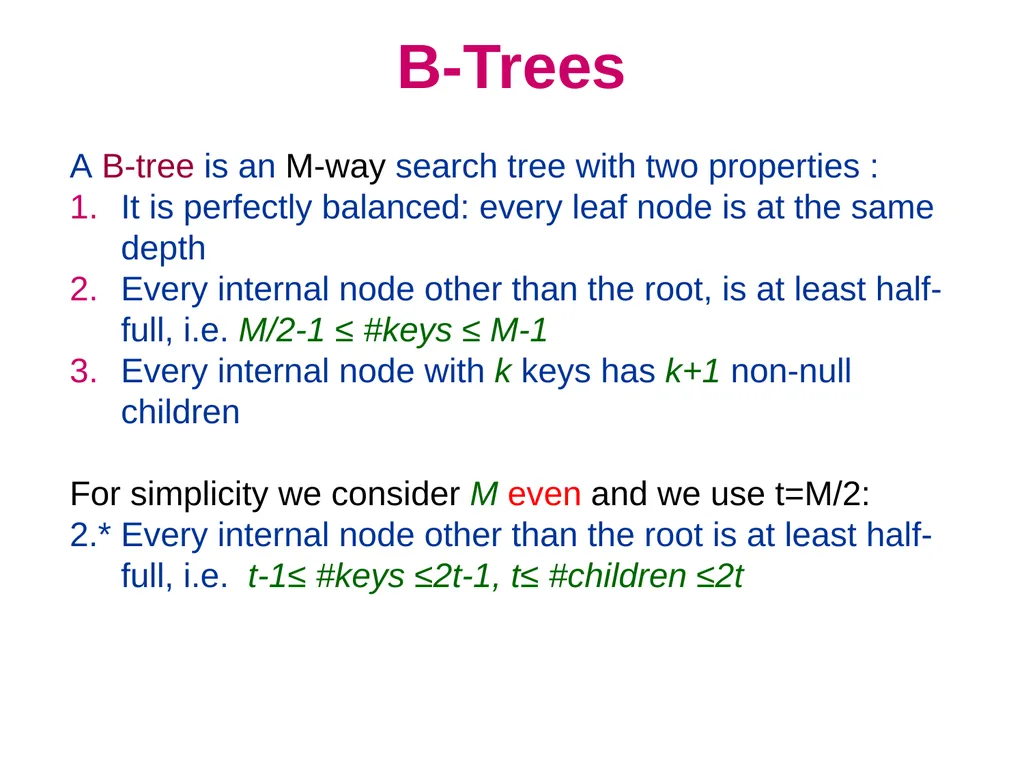
A B-tree is an M-way search tree with two properties :
It is perfectly balanced: every leaf node is at the same depth
Every internal node other than the root, is at least half-full, i.e. M/2-1 ≤ #keys ≤ M-1
Every internal node with k keys has k+1 non-null children
For simplicity we consider M even and we use t=M/2:
2.* Every internal node other than the root is at least half-full, i.e. t-1≤ #keys ≤2t-1, t≤ #children ≤2t B-Trees<br>
04
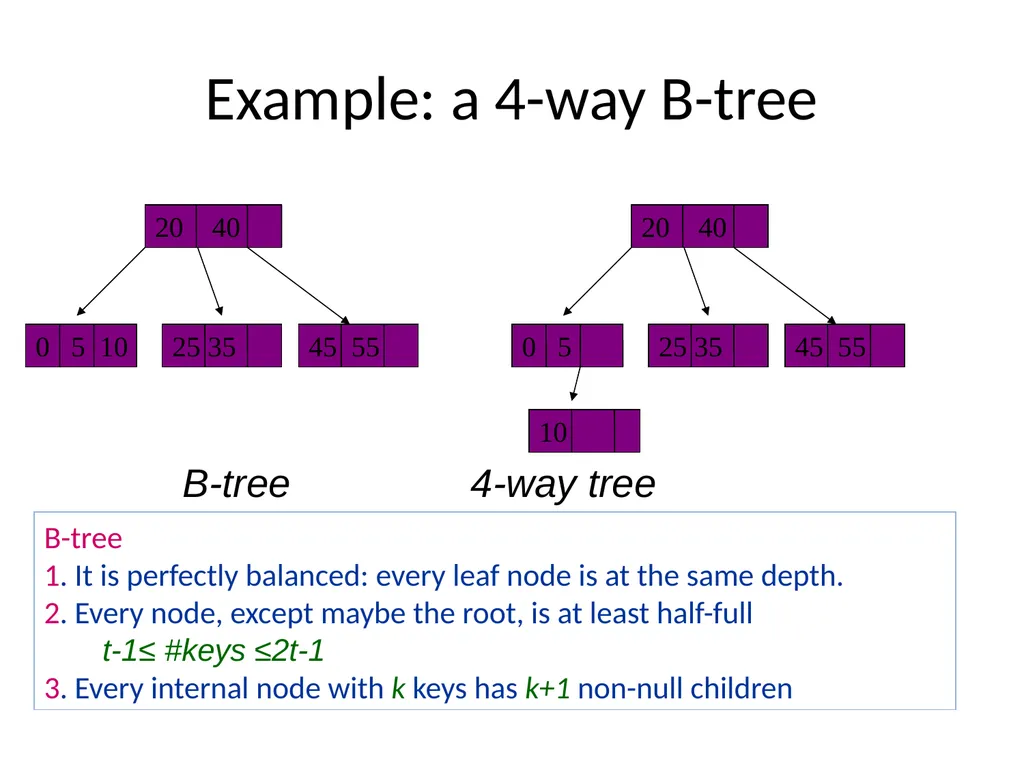
Example: a 4-way B-tree B-tree 4-way tree B-tree
1. It is perfectly balanced: every leaf node is at the same depth.
2. Every node, except maybe the root, is at least half-full t-1≤ #keys ≤2t-1
3. Every internal node with k keys has k+1 non-null children 20 40 0 5 10 25 35 45 55 20 40 0 5 25 35 45 55 10<br>
05
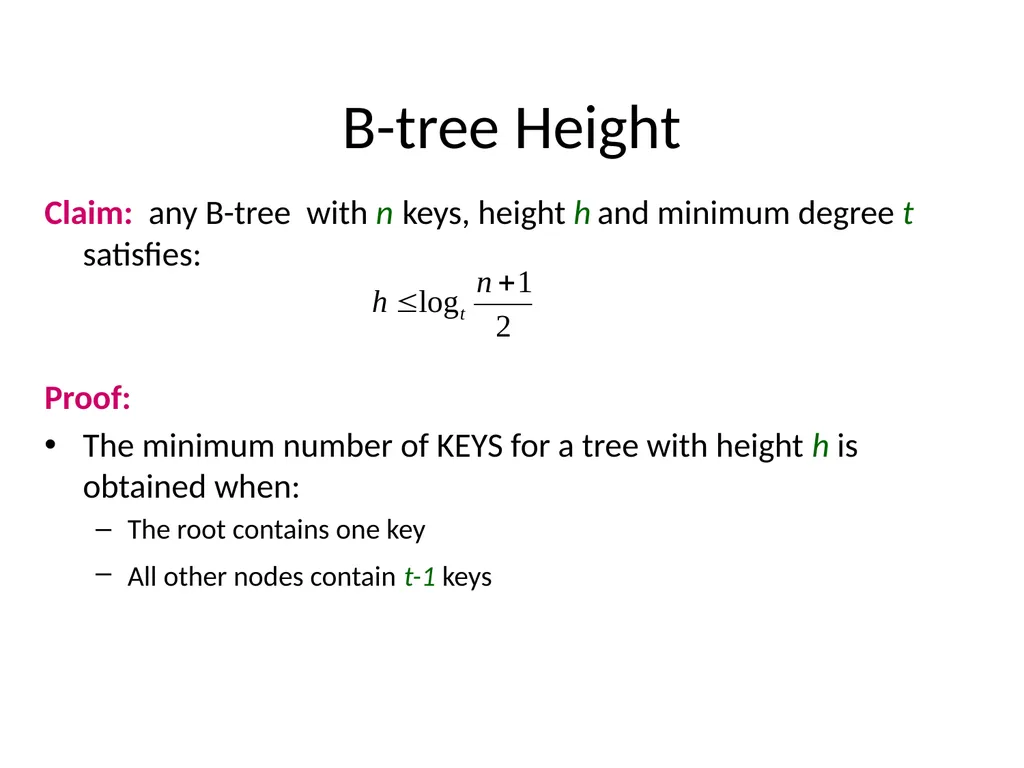
B-tree Height Claim: any B-tree with n keys, height h and minimum degree t satisfies:
Proof:
The minimum number of KEYS for a tree with height h is obtained when:
The root contains one key
All other nodes contain t-1 keys<br>
06
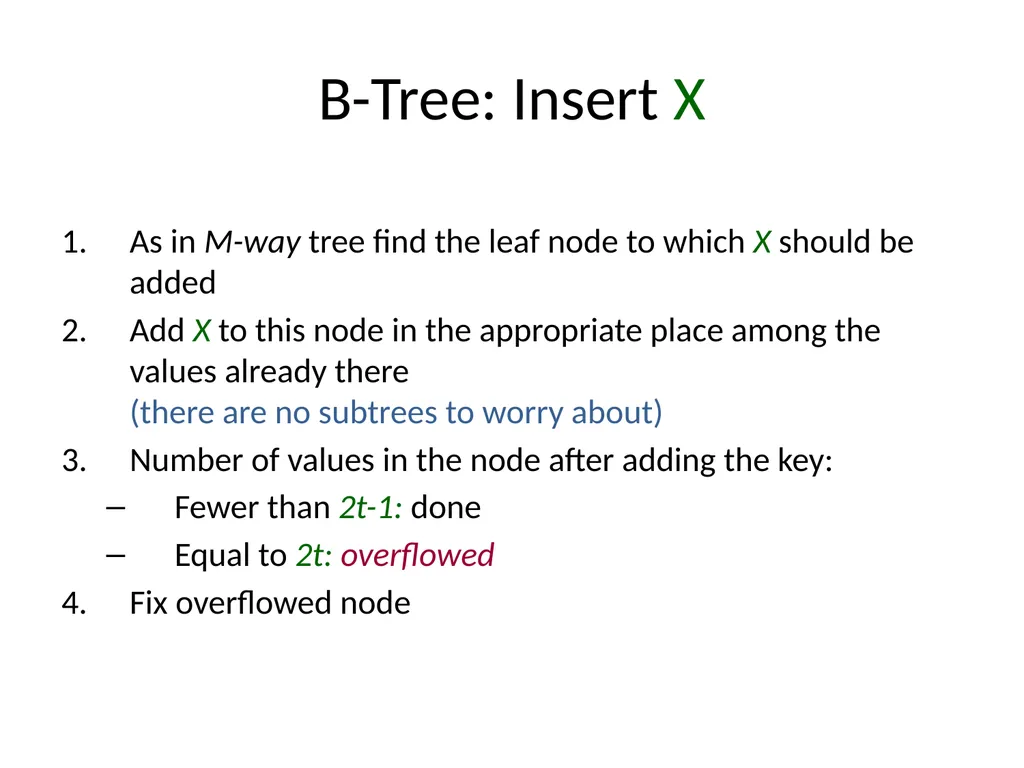
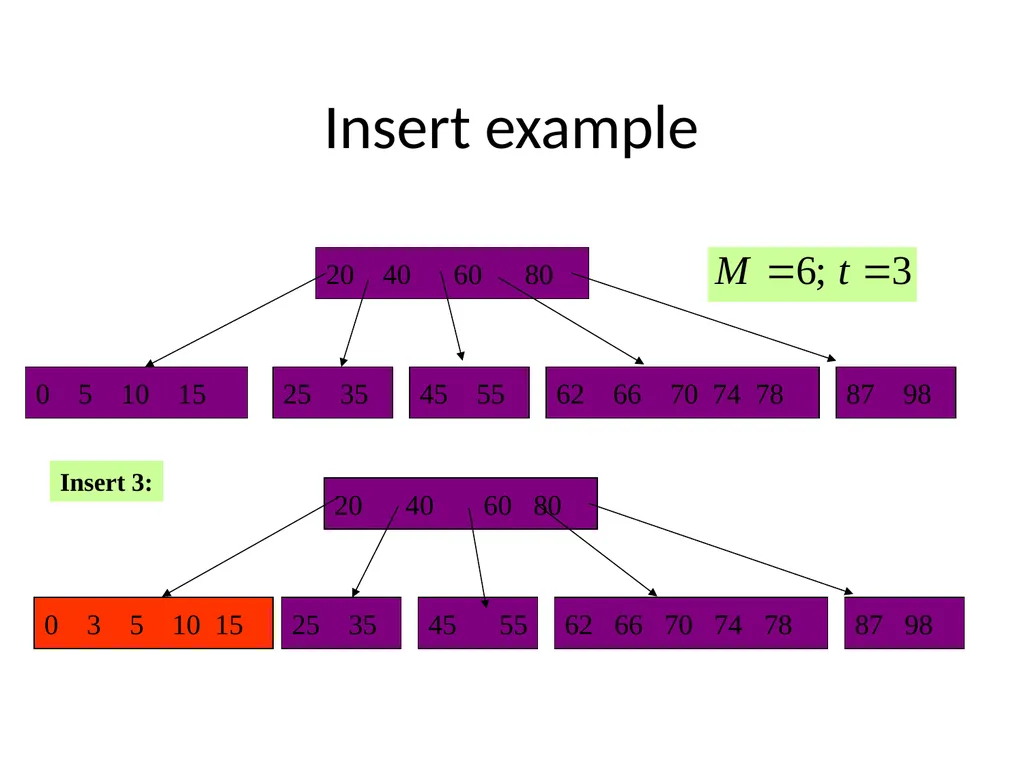
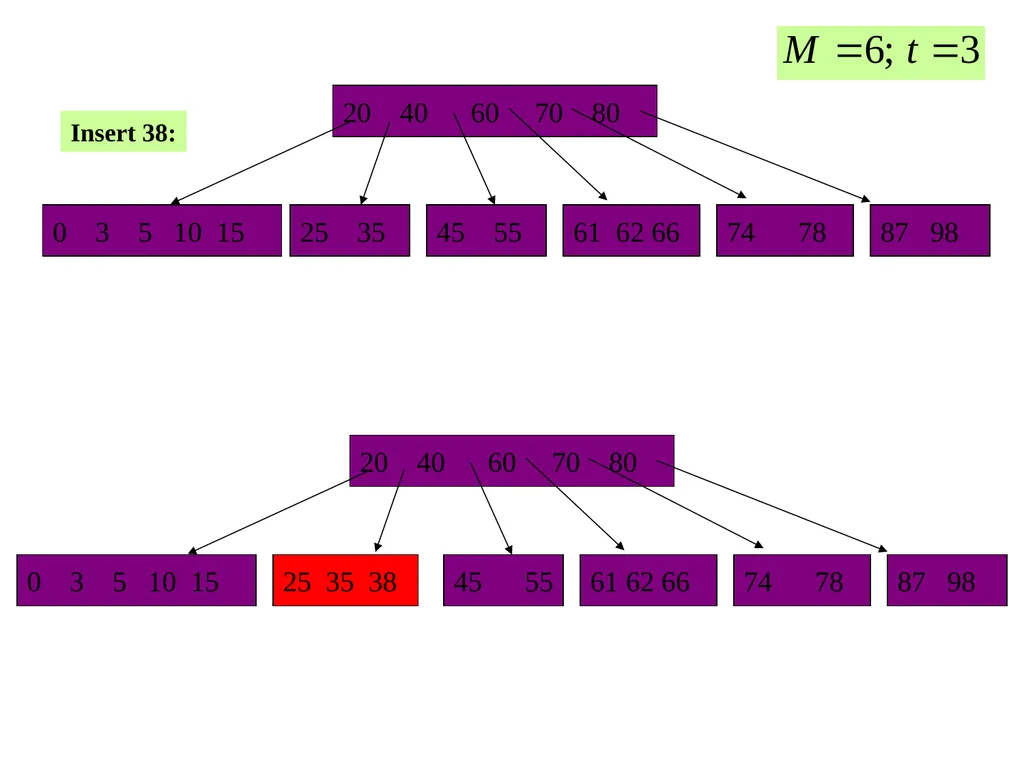
B-Tree: Insert X As in M-way tree find the leaf node to which X should be added
Add X to this node in the appropriate place among the values already there (there are no subtrees to worry about)
Number of values in the node after adding the key:
Fewer than 2t-1: done
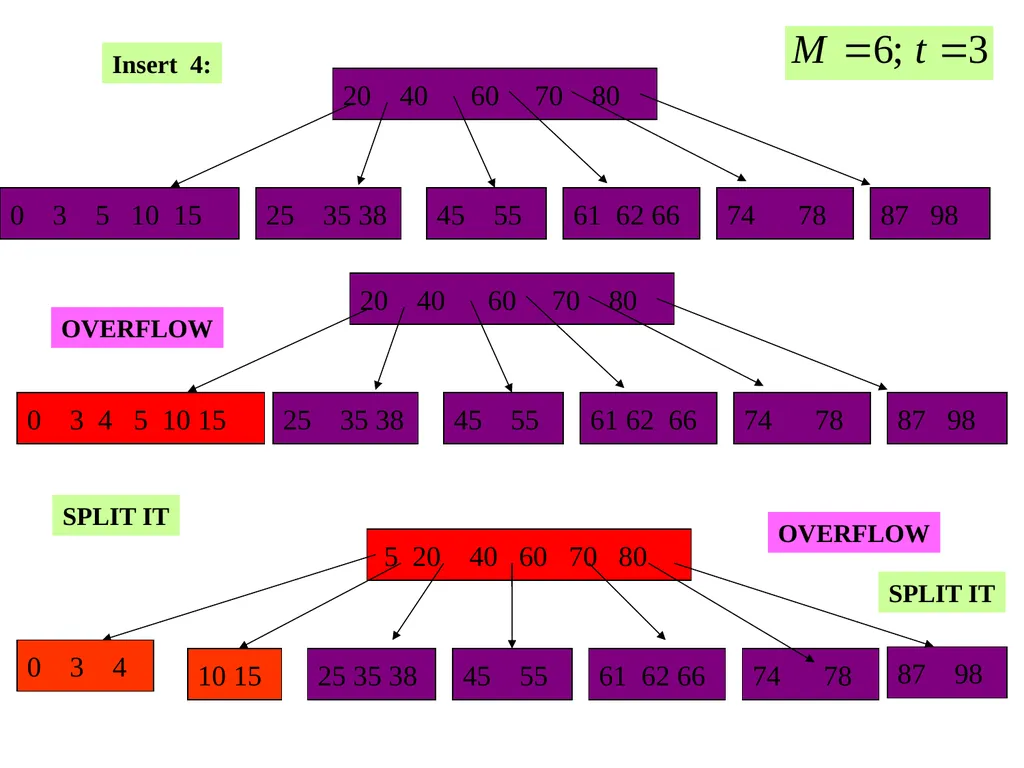
Equal to 2t: overflowed
Fix overflowed node<br>
07
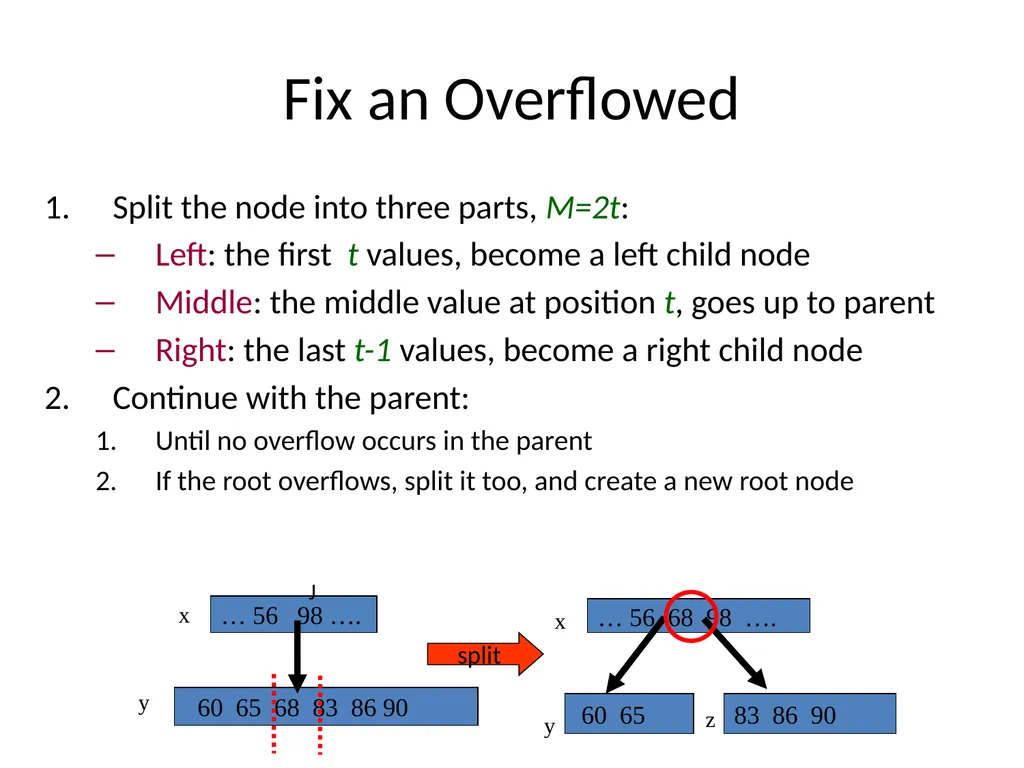
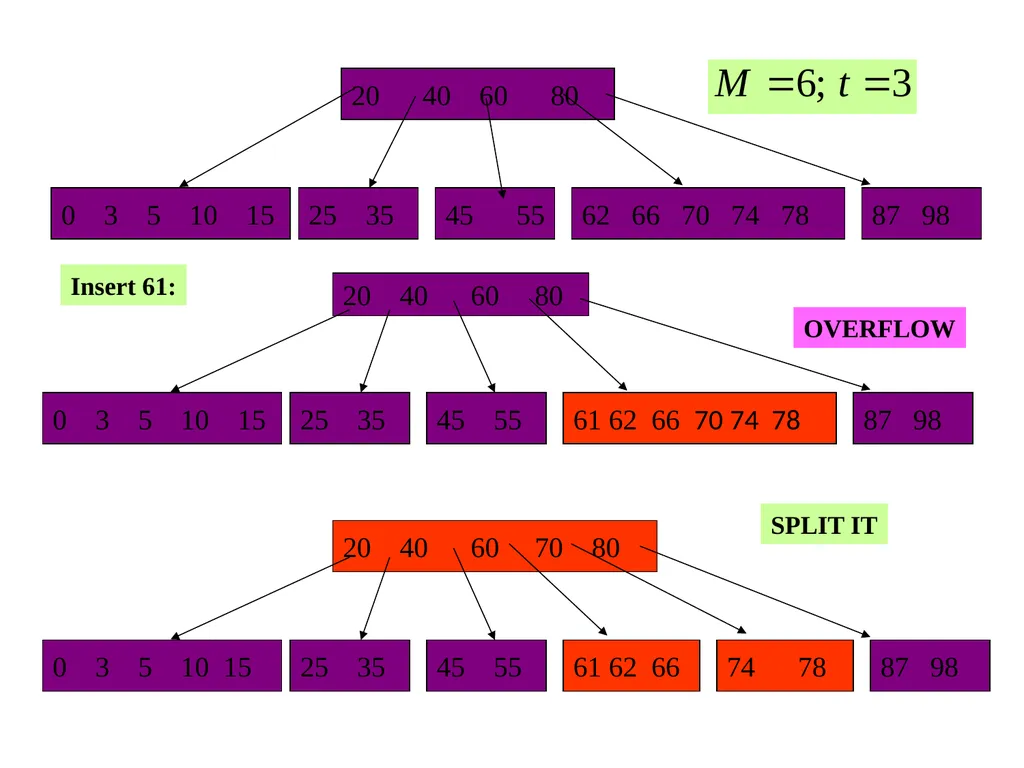
Fix an Overflowed Split the node into three parts, M=2t:
Left: the first t values, become a left child node
Middle: the middle value at position t, goes up to parent
Right: the last t-1 values, become a right child node
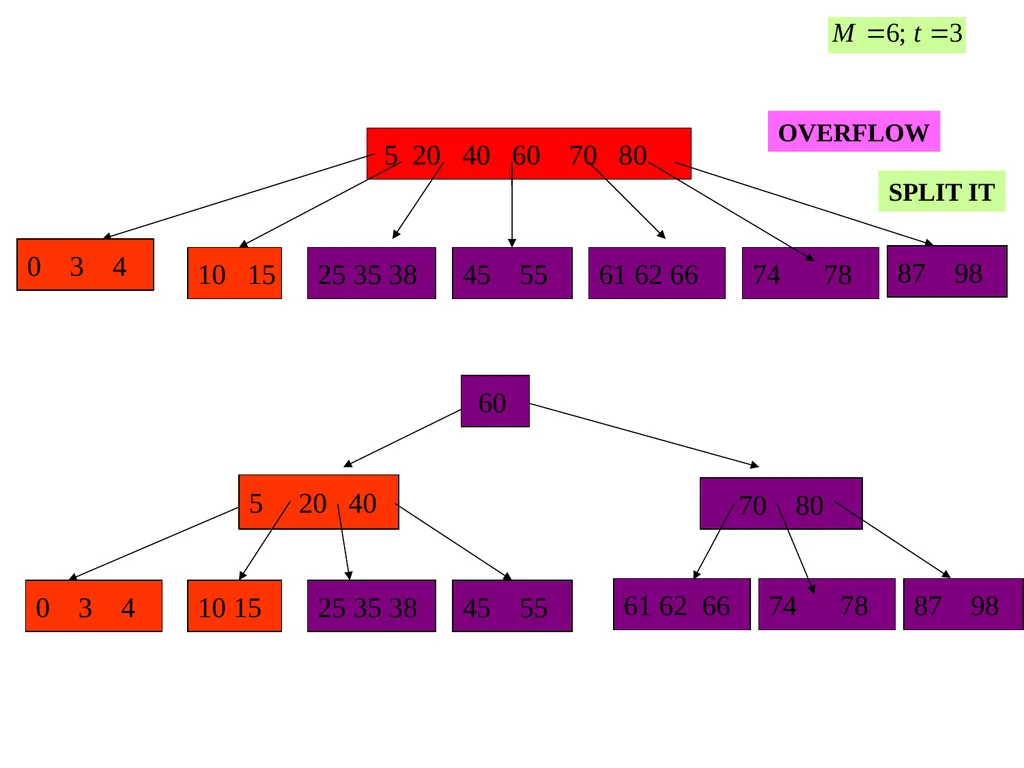
Continue with the parent:
Until no overflow occurs in the parent
If the root overflows, split it too, and create a new root node y<br>
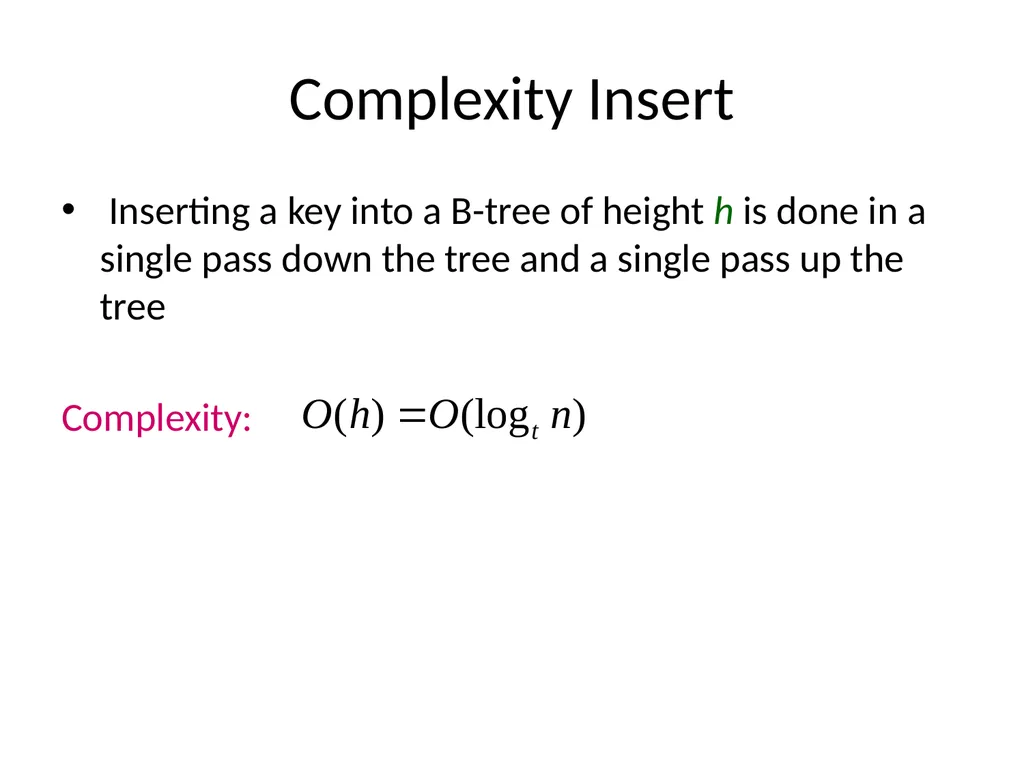
Complexity Insert Inserting a key into a B-tree of height h is done in a single pass down the tree and a single pass up the tree
Complexity:<br>
14
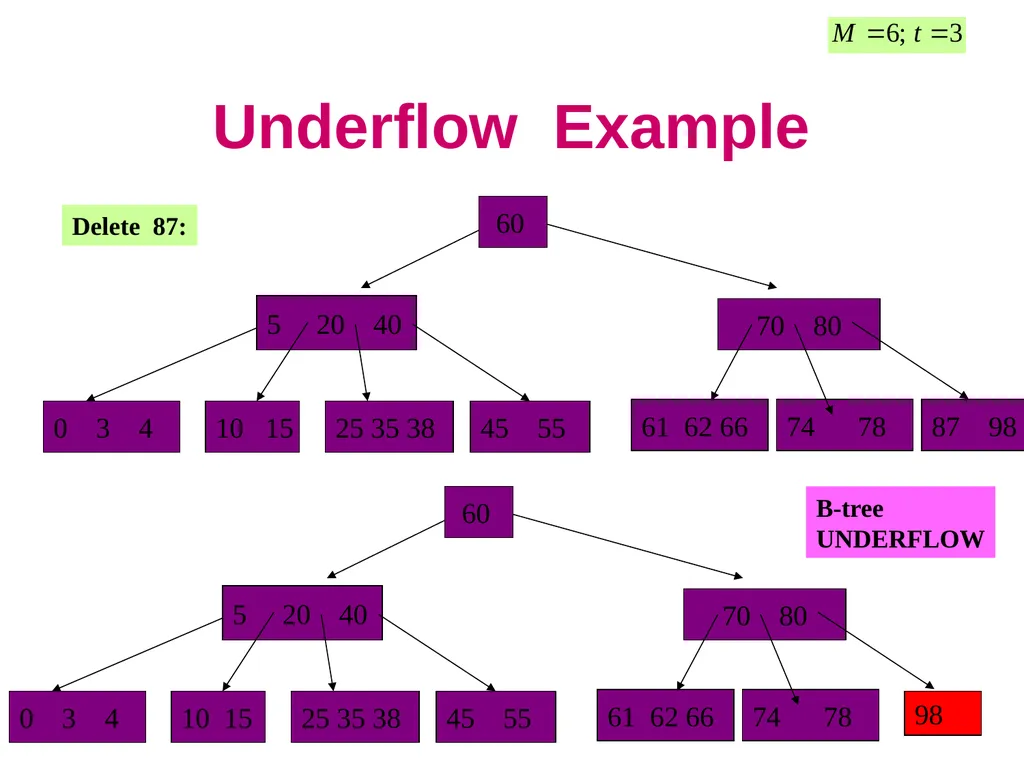
B-Tree: Delete X Delete as in M-way tree
A problem:
might cause underflow: the number of keys remain in a node < t-1 Recall: The root should have at least 1 value in it, and all other nodes should have at least t-1 values in them<br>
B-Tree: Delete X Delete as in M-way tree
A problem:
might cause underflow: the number of keys remain in a node < t-1
Solution:
make sure a node that is visited has at least t instead of t-1 keys Recall: The root should have at least 1 value in it, and all other nodes should have at least t-1 (at most 2t-1) values in them<br>
17
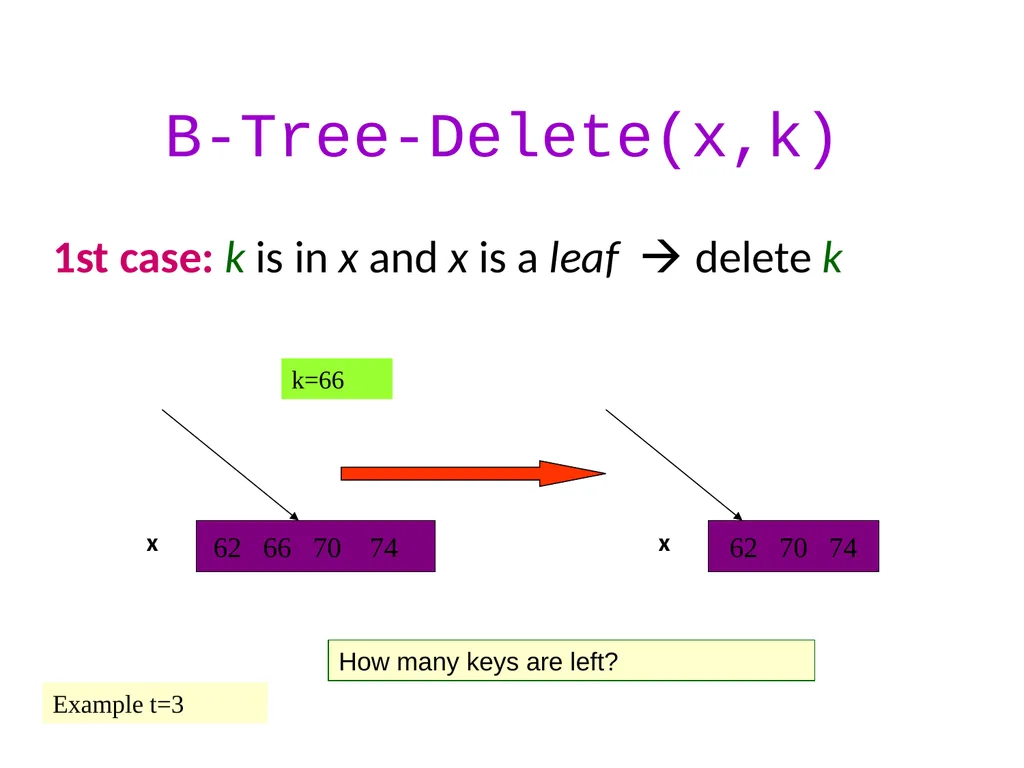
62 66 70 74 62 70 74 B-Tree-Delete(x,k) 1st case: k is in x and x is a leaf delete k How many keys are left? k=66 Example t=3 x x<br>
18
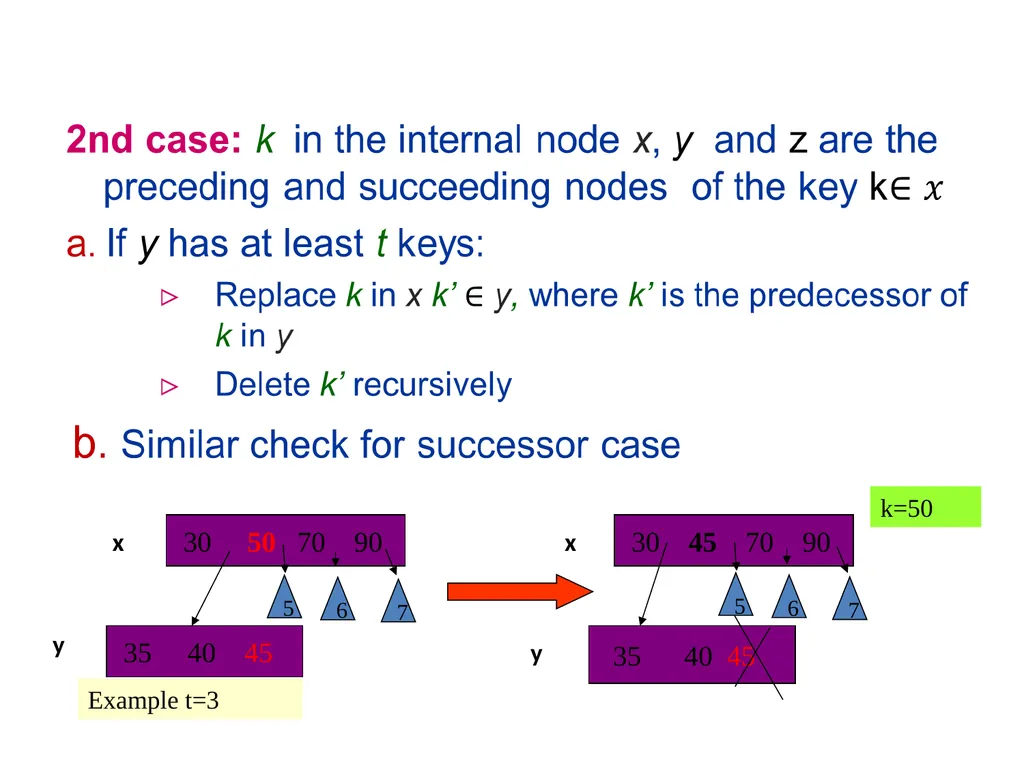
30 50 70 90 35 40 45 30 45 70 90 35 40 45 5 6 7 5 6 7 Example t=3 k=50 x x y y<br>
19
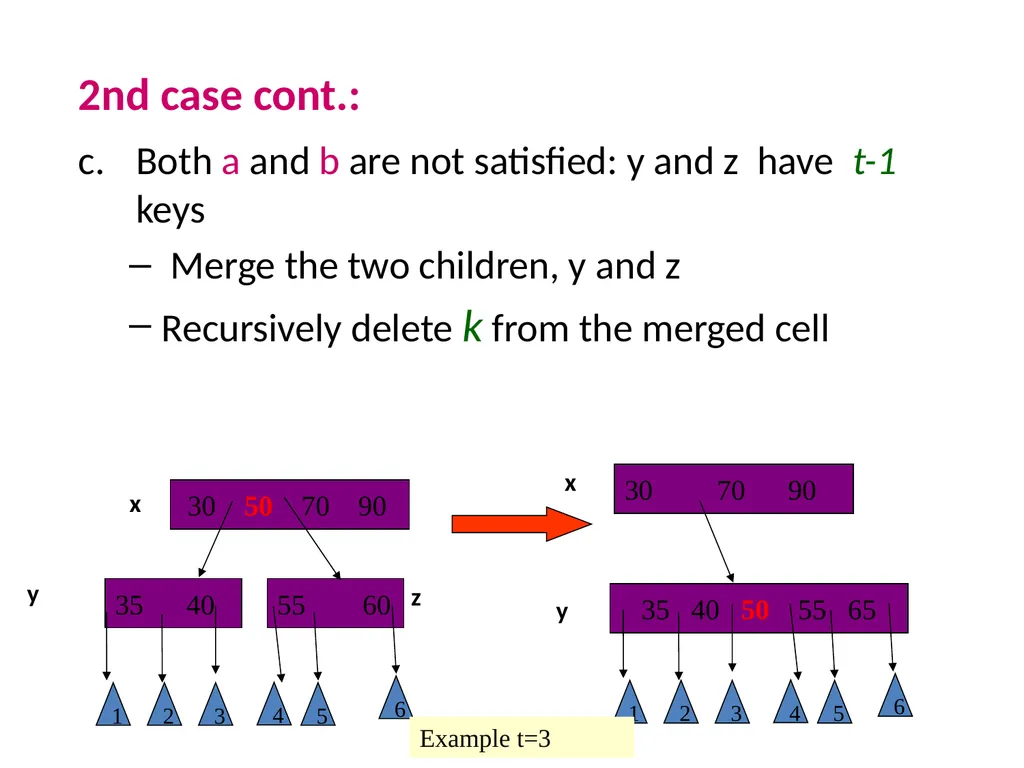
35 40 55 60 35 40 50 55 65 2nd case cont.:
Both a and b are not satisfied: y and z have t-1 keys
Merge the two children, y and z
Recursively delete k from the merged cell 30 50 70 90 30 70 90 1 2 3 5 4 6 1 2 3 5 4 6 Example t=3 x y z x y<br>
20
Questions When does the height of the tree shrink?
Why do we need the number of keys to be at least t and not t-1 when we proceed down in the tree?<br>
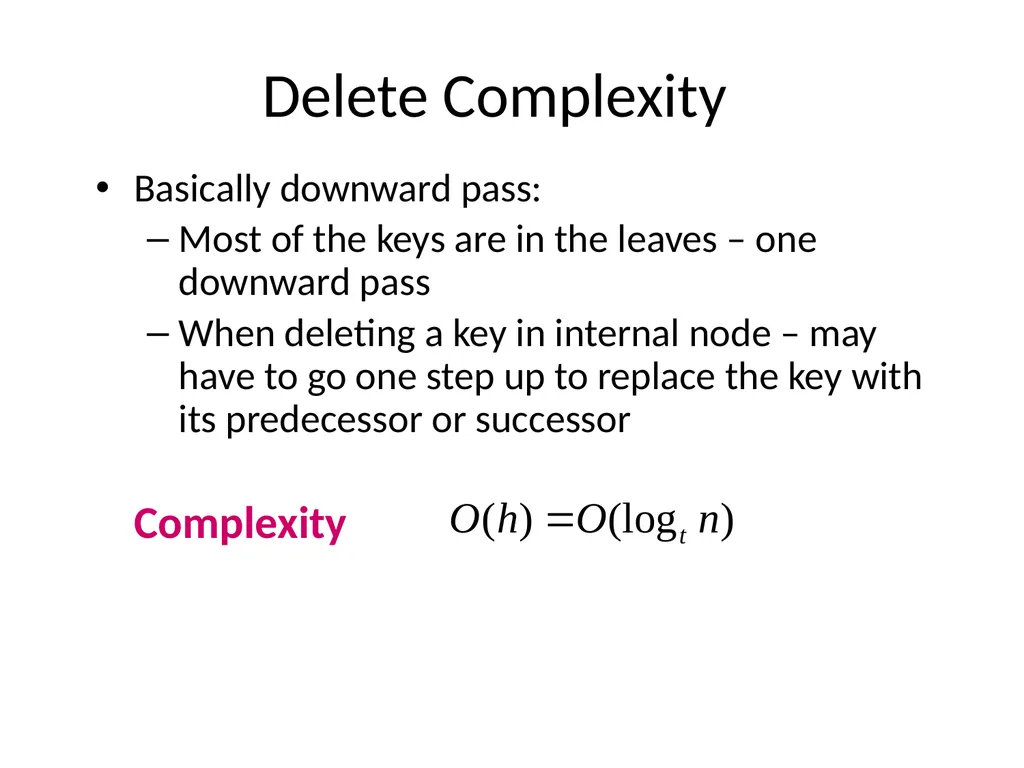
Delete Complexity Basically downward pass:
Most of the keys are in the leaves – one downward pass
When deleting a key in internal node – may have to go one step up to replace the key with its predecessor or successor
Complexity<br>
23
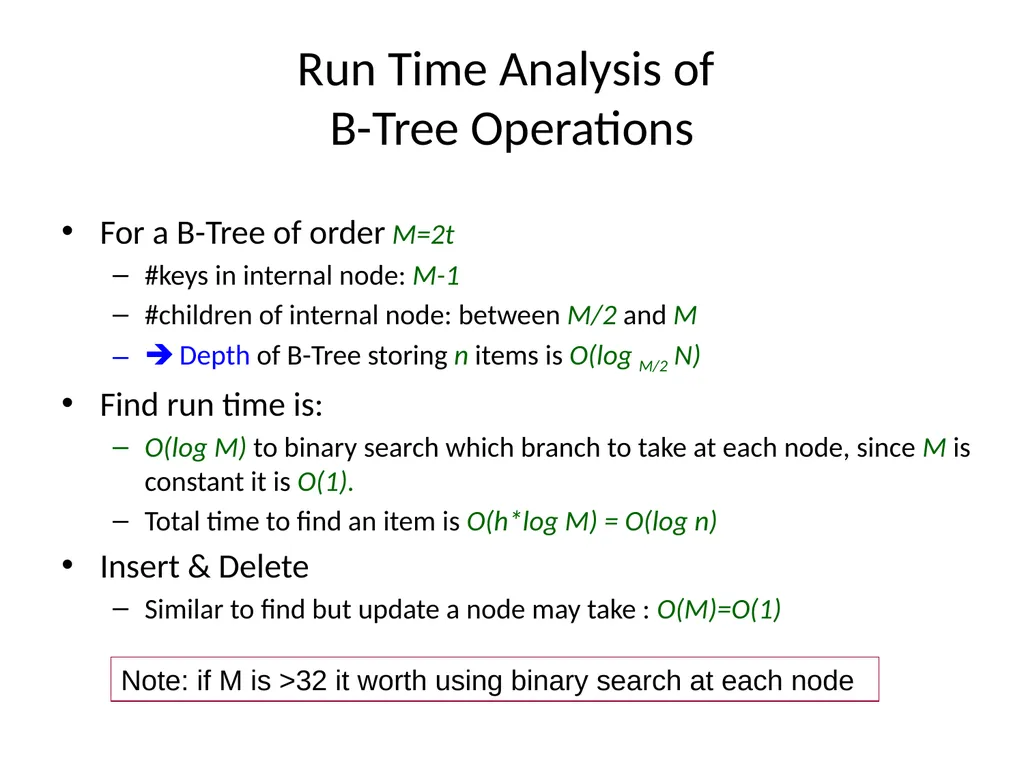
Run Time Analysis of B-Tree Operations For a B-Tree of order M=2t
#keys in internal node: M-1
#children of internal node: between M/2 and M
Depth of B-Tree storing n items is O(log M/2 N)
Find run time is:
O(log M) to binary search which branch to take at each node, since M is constant it is O(1).
Total time to find an item is O(h*log M) = O(log n)
Insert & Delete
Similar to find but update a node may take : O(M)=O(1) Note: if M is >32 it worth using binary search at each node<br>
B-Trees and RB-Trees Nice Observation: B-trees of degree 4 are equivalent to RB-trees Sketch of Proof: The following structures are equivalent.
Need to verify:
If a node is red, then both its children are black
Every simple path from a node to a descendant leaf contains the same number of black nodes.<br>
26
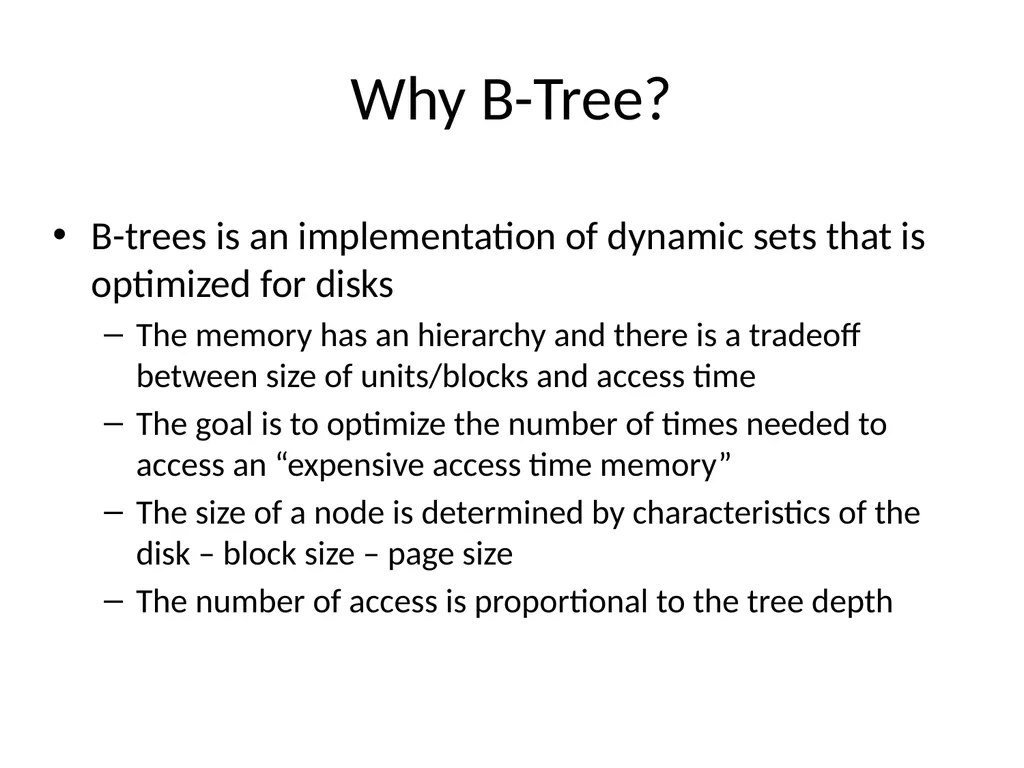
Why B-Tree? B-trees is an implementation of dynamic sets that is optimized for disks
The memory has an hierarchy and there is a tradeoff between size of units/blocks and access time
The goal is to optimize the number of times needed to access an “expensive access time memory”
The size of a node is determined by characteristics of the disk – block size – page size
The number of access is proportional to the tree depth<br>