
Annihilation vs. Eternal Torment ANNIHILATION VS.
TA
Published · 44 slides · 0 views

1 / 1








Description
Annihilation vs. Eternal Torment ANNIHILATION VS. ETERNAL CONSCIOUS TORMENT Introduction to the Controversy Biblical Arguments Against Annihilation Theological Arguments Against Annihilation Answering Annihilationist Biblical Arguments
Related Topics
Share
Embed code
Download this presentation From Below
"Annihilation vs. Eternal Torment ANNIHILATION VS." is the property of its rightful owner. Permission is granted to download and print the materials on this website for personal, non-commercial use only, and to display it on your personal computer provided you do not modify the materials and that you retain all copyright notices contained in the materials. By downloading content from our website, you accept the terms of this agreement.
Presentation Transcript
01
Annihilation
vs.
Eternal Torment<br>
vs.
Eternal Torment<br>
02
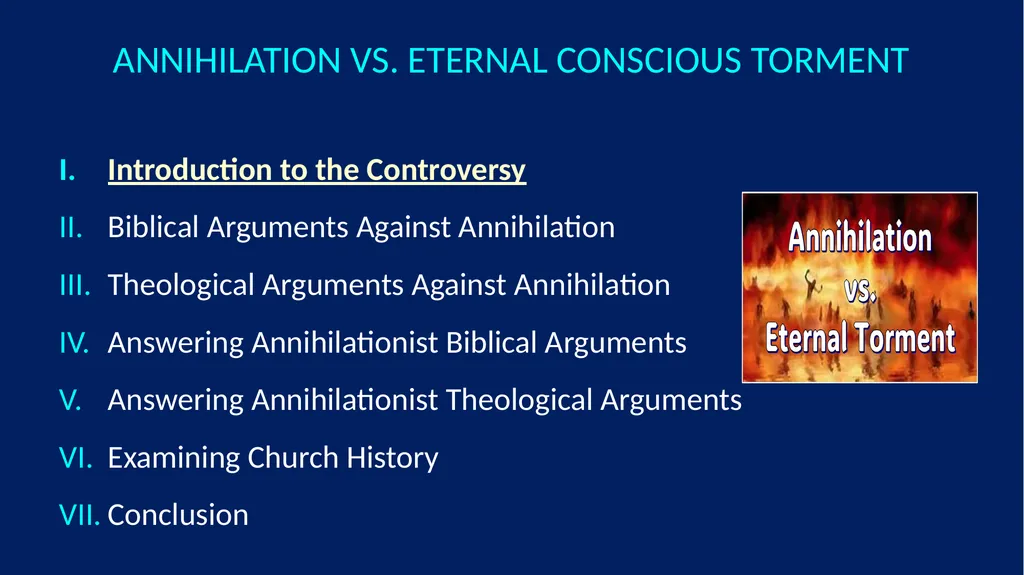
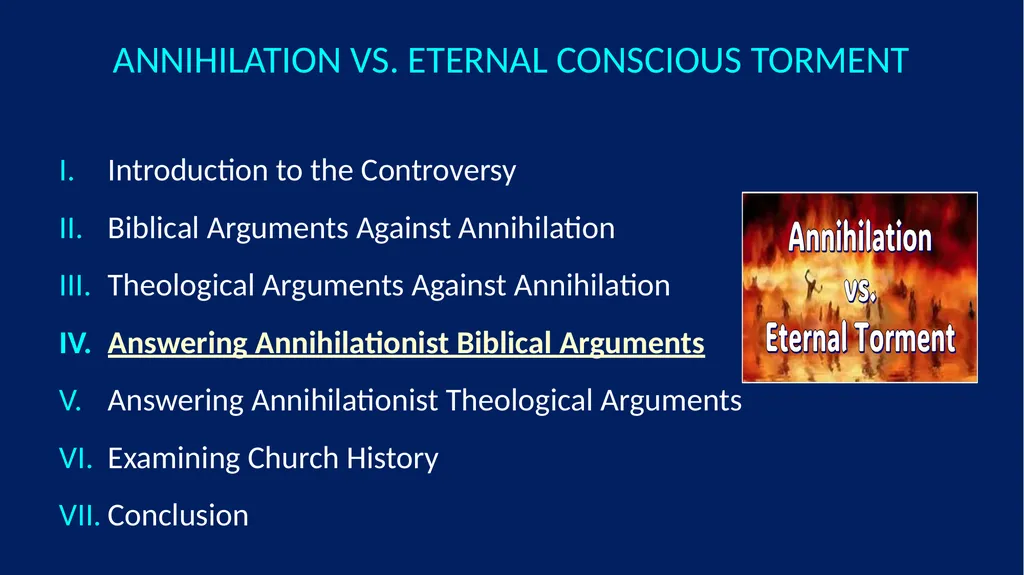
ANNIHILATION VS. ETERNAL CONSCIOUS TORMENT Introduction to the Controversy
Biblical Arguments Against Annihilation
Theological Arguments Against Annihilation
Answering Annihilationist Biblical Arguments
Answering Annihilationist Theological Arguments
Examining Church History
Conclusion<br>
Biblical Arguments Against Annihilation
Theological Arguments Against Annihilation
Answering Annihilationist Biblical Arguments
Answering Annihilationist Theological Arguments
Examining Church History
Conclusion<br>
03
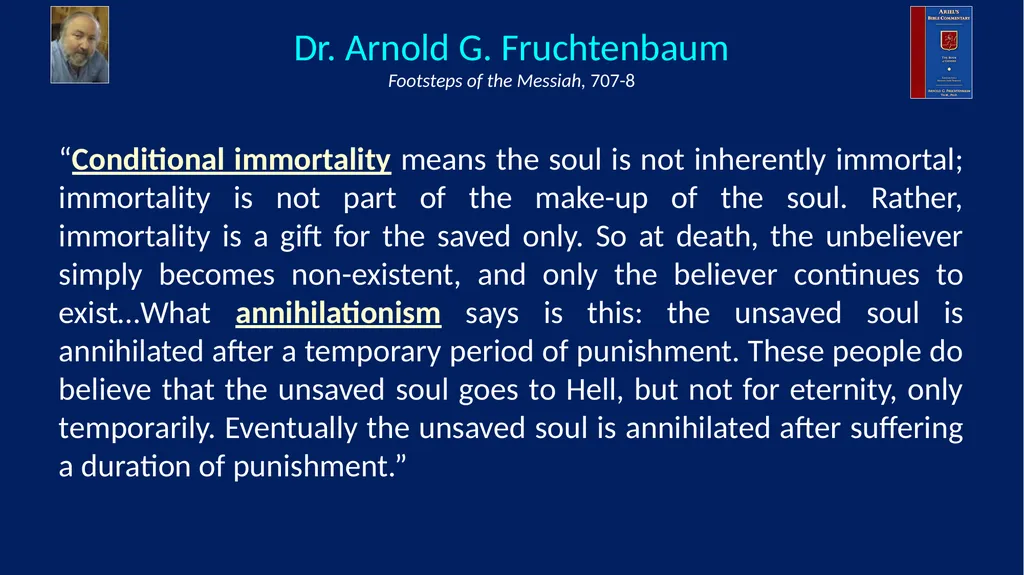
“Conditional immortality means the soul is not inherently immortal; immortality is not part of the make-up of the soul. Rather, immortality is a gift for the saved only. So at death, the unbeliever simply becomes non-existent, and only the believer continues to exist…What annihilationism says is this: the unsaved soul is annihilated after a temporary period of punishment. These people do believe that the unsaved soul goes to Hell, but not for eternity, only temporarily. Eventually the unsaved soul is annihilated after suffering a duration of punishment.” Dr. Arnold G. Fruchtenbaum
Footsteps of the Messiah, 707-8<br>
Footsteps of the Messiah, 707-8<br>
04
ANNIHILATION VS. ETERNAL CONSCIOUS TORMENT Introduction to the Controversy
Biblical Arguments Against Annihilation
Theological Arguments Against Annihilation
Answering Annihilationist Biblical Arguments
Answering Annihilationist Theological Arguments
Examining Church History
Conclusion<br>
Biblical Arguments Against Annihilation
Theological Arguments Against Annihilation
Answering Annihilationist Biblical Arguments
Answering Annihilationist Theological Arguments
Examining Church History
Conclusion<br>
05
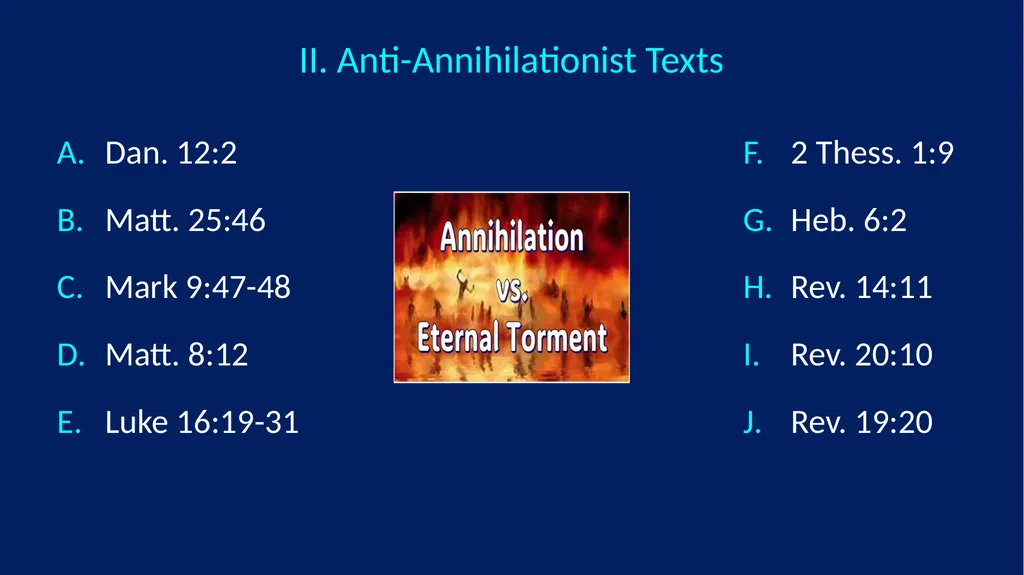
II. Anti-Annihilationist Texts<br>
06
ANNIHILATION VS. ETERNAL CONSCIOUS TORMENT Introduction to the Controversy
Biblical Arguments Against Annihilation
Theological Arguments Against Annihilation
Answering Annihilationist Biblical Arguments
Answering Annihilationist Theological Arguments
Examining Church History
Conclusion<br>
Biblical Arguments Against Annihilation
Theological Arguments Against Annihilation
Answering Annihilationist Biblical Arguments
Answering Annihilationist Theological Arguments
Examining Church History
Conclusion<br>
07
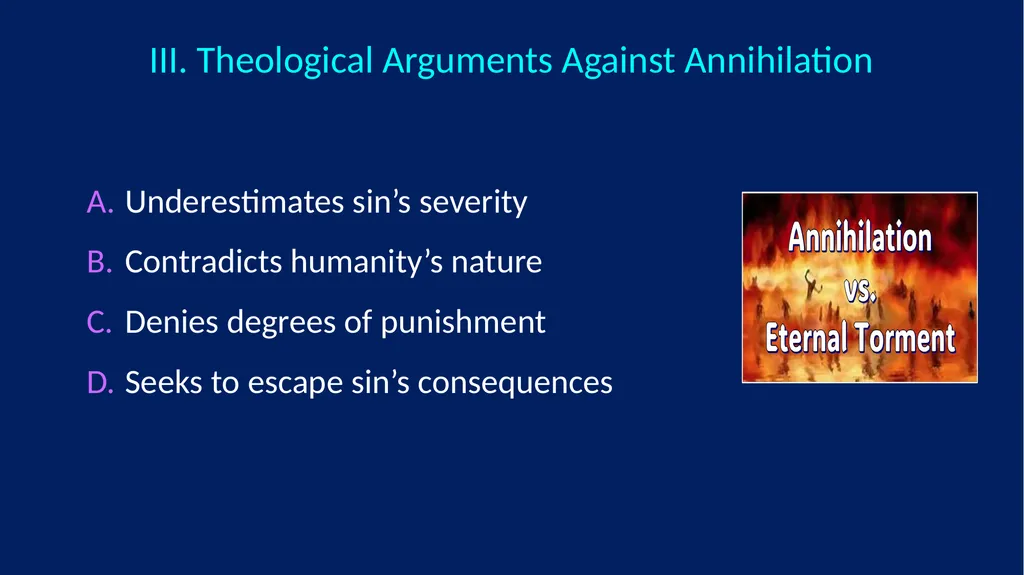
III. Theological Arguments Against Annihilation Underestimates sin’s severity
Contradicts humanity’s nature
Denies degrees of punishment
Seeks to escape sin’s consequences<br>
Contradicts humanity’s nature
Denies degrees of punishment
Seeks to escape sin’s consequences<br>
08
ANNIHILATION VS. ETERNAL CONSCIOUS TORMENT Introduction to the Controversy
Biblical Arguments Against Annihilation
Theological Arguments Against Annihilation
Answering Annihilationist Biblical Arguments
Answering Annihilationist Theological Arguments
Examining Church History
Conclusion<br>
Biblical Arguments Against Annihilation
Theological Arguments Against Annihilation
Answering Annihilationist Biblical Arguments
Answering Annihilationist Theological Arguments
Examining Church History
Conclusion<br>
09
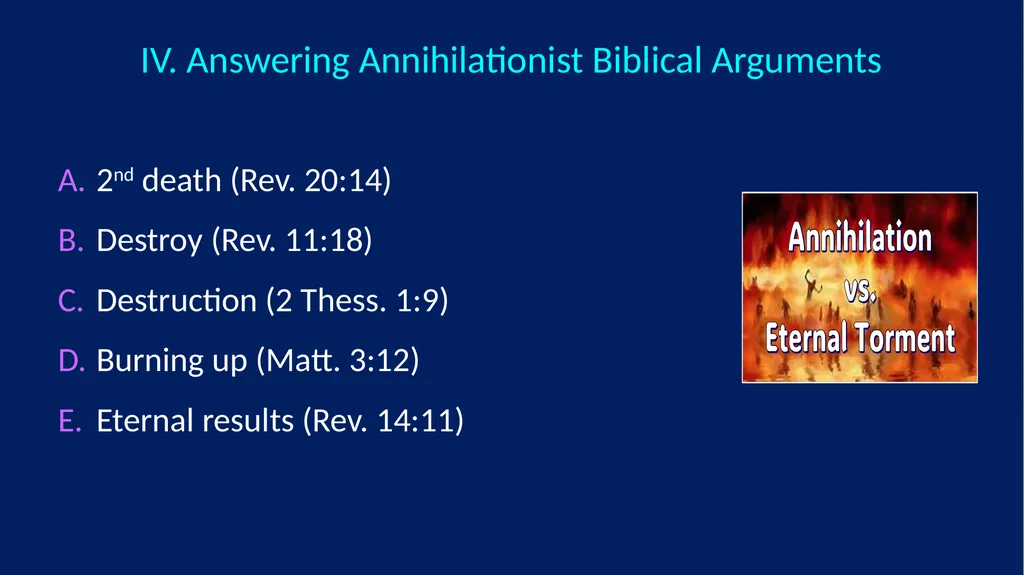
IV. Answering Annihilationist Biblical Arguments 2nd death (Rev. 20:14)
Destroy (Rev. 11:18)
Destruction (2 Thess. 1:9)
Burning up (Matt. 3:12)
Eternal results (Rev. 14:11)<br>
Destroy (Rev. 11:18)
Destruction (2 Thess. 1:9)
Burning up (Matt. 3:12)
Eternal results (Rev. 14:11)<br>
10
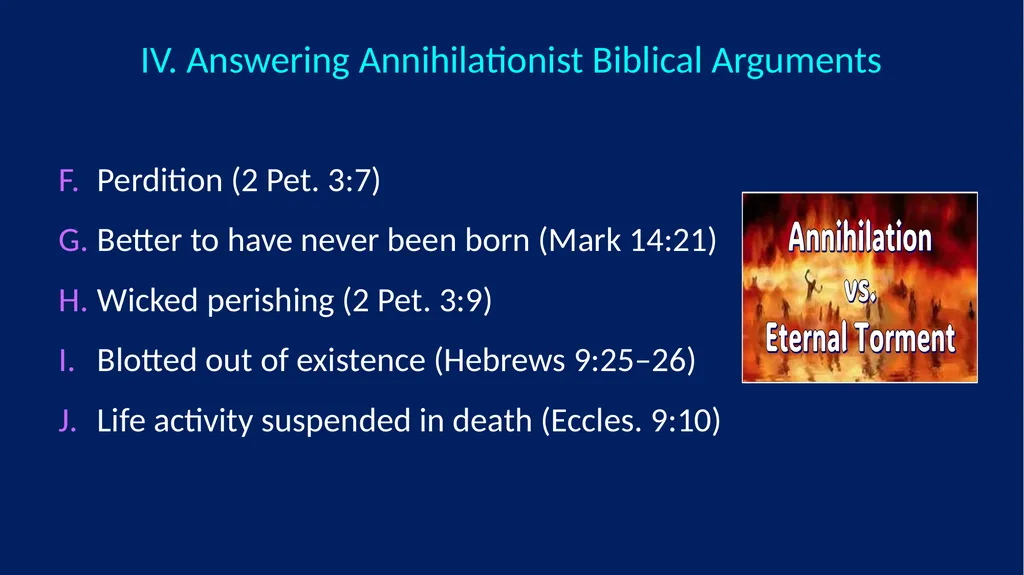
IV. Answering Annihilationist Biblical Arguments Perdition (2 Pet. 3:7)
Better to have never been born (Mark 14:21)
Wicked perishing (2 Pet. 3:9)
Blotted out of existence (Hebrews 9:25–26)
Life activity suspended in death (Eccles. 9:10)<br>
Better to have never been born (Mark 14:21)
Wicked perishing (2 Pet. 3:9)
Blotted out of existence (Hebrews 9:25–26)
Life activity suspended in death (Eccles. 9:10)<br>
11
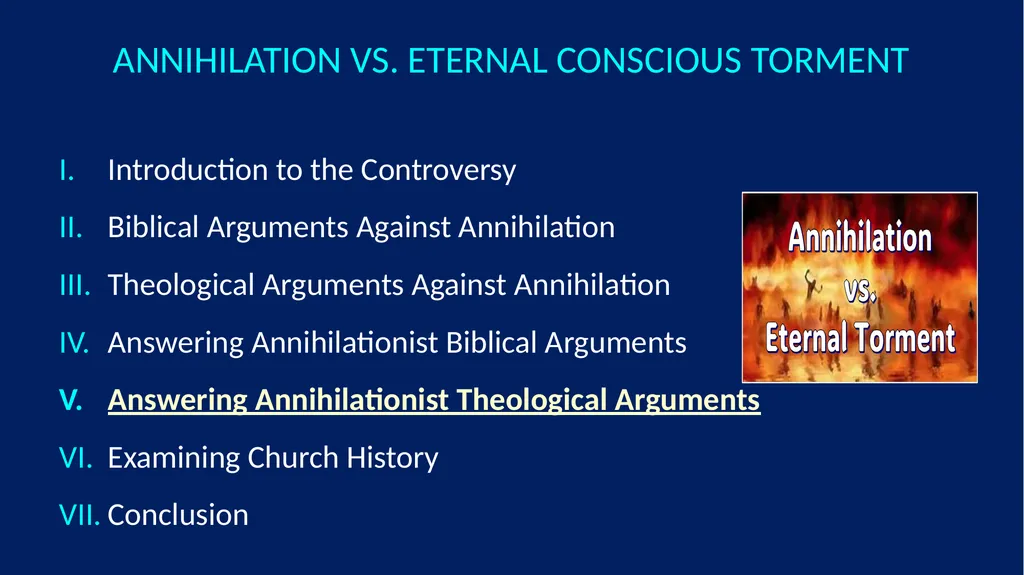
ANNIHILATION VS. ETERNAL CONSCIOUS TORMENT Introduction to the Controversy
Biblical Arguments Against Annihilation
Theological Arguments Against Annihilation
Answering Annihilationist Biblical Arguments
Answering Annihilationist Theological Arguments
Examining Church History
Conclusion<br>
Biblical Arguments Against Annihilation
Theological Arguments Against Annihilation
Answering Annihilationist Biblical Arguments
Answering Annihilationist Theological Arguments
Examining Church History
Conclusion<br>
12
V. Answering Annihilationist Theological Arguments Immortality: a gift only for the believer (1 Tim. 6:16)
Temporal nature of the soul (Gen. 3:22)
Finite nature of Christ’s death (John 19:30)
God’s justice (Ps. 90:2)
God’s mercy (1 John 4:8)
All things reconciled to God (Col. 1:20)
Universal nature of God’s victory (Philip. 2:10)
Burden of heaven’s citizens (Rev. 21:4)<br>
Temporal nature of the soul (Gen. 3:22)
Finite nature of Christ’s death (John 19:30)
God’s justice (Ps. 90:2)
God’s mercy (1 John 4:8)
All things reconciled to God (Col. 1:20)
Universal nature of God’s victory (Philip. 2:10)
Burden of heaven’s citizens (Rev. 21:4)<br>
13
ANNIHILATION VS. ETERNAL CONSCIOUS TORMENT Introduction to the Controversy
Biblical Arguments Against Annihilation
Theological Arguments Against Annihilation
Answering Annihilationist Biblical Arguments
Answering Annihilationist Theological Arguments
Examining Church History
Conclusion<br>
Biblical Arguments Against Annihilation
Theological Arguments Against Annihilation
Answering Annihilationist Biblical Arguments
Answering Annihilationist Theological Arguments
Examining Church History
Conclusion<br>
14
VI. Examining Church History General overview
Early fathers
Medieval fathers
Reformation leaders
Post reformation teachers<br>
Early fathers
Medieval fathers
Reformation leaders
Post reformation teachers<br>
15
VI. Examining Church History General overview
Early fathers
Medieval fathers
Reformation leaders
Post reformation teachers<br>
Early fathers
Medieval fathers
Reformation leaders
Post reformation teachers<br>
16
“After already having been earlier condemned by the Second Council of Constantinople (553), the denial of hell was condemned by the Fifth Lateran Council in 1513 (see Cross, ODCC, 328). The last of the nine anathemas (543) of Emperor Justinian (c. 483–565) against Origen (c. 185–c. 254) reads: ‘If anyone says or thinks that the punishment of demons and of impious men is only temporary and will one day have an end … let him be anathema’ (in Roberts and Donaldson, ANF, Vol. 14).” Dr. Norman Geisler
Geisler, N. L. (2005). Systematic theology, volume four: church, last things (p. 351). Bethany House Publishers.<br>
Geisler, N. L. (2005). Systematic theology, volume four: church, last things (p. 351). Bethany House Publishers.<br>
17
“As stated previously, annihilationism was condemned as heretical by a Constantinople synod in 543, by the Second Council of Constantinople in 553, and by the Fifth Lateran Council in 1513 (see Wenham, GG, 28, and Cross, ODCC, 328). The traditional orthodox doctrine of hell as the eternal conscious punishment of the wicked has been upheld by most of the church’s great fathers and theologians, including Tertullian (c. 155–c. 225),... Dr. Norman Geisler
Geisler, N. L. (2005). Systematic theology, volume four: church, last things (p. 391). Bethany House Publishers.<br>
Geisler, N. L. (2005). Systematic theology, volume four: church, last things (p. 391). Bethany House Publishers.<br>
18
“…Augustine (354–430), Anselm (1033–1109), Thomas Aquinas (1225–1274), Martin Luther (1483–1546), John Calvin (1509–1564), Jonathan Edwards (1703–1758), Charles Hodge (1797–1878), William G. T. Shedd (1820–1894), and B. B. Warfield (1851–1921). One of the orthodox position’s best recent defenses is Hell on Trial by Robert A. Peterson (b. 1948), and there is no more magnificent literary expression of the doctrine than The Great Divorce by C.S. Lewis (1898–1963).” Dr. Norman Geisler
Geisler, N. L. (2005). Systematic theology, volume four: church, last things (p. 391). Bethany House Publishers.<br>
Geisler, N. L. (2005). Systematic theology, volume four: church, last things (p. 391). Bethany House Publishers.<br>
19
“The historical evidence against annihilationism is the same as the historical argument for eternal conscious punishment—that is, the historical evidence against annihilationism is identical to the evidence for hell, already summarized; annihilationism is opposed by most orthodox teachers in church history, from the beginning to the present. We saw earlier that annihilationism was roundly condemned by the early church.” Dr. Norman Geisler
Geisler, N. L. (2005). Systematic theology, volume four: church, last things (p. 411). Bethany House Publishers.<br>
Geisler, N. L. (2005). Systematic theology, volume four: church, last things (p. 411). Bethany House Publishers.<br>
20
“In one example, the last of the nine anathemas of Emperor Justinian (c. 483–565) against Origen (c. 185–c. 254) reads: ‘If anyone says … that the punishment of demons and of impious men is only temporary and will one day have an end … let him be anathema’ (in Roberts and Donaldson, ANF, Vol. 14). Before the Reformation, the Fifth Lateran Council (1513) also condemned the denial of hell (see Cross, ODCC, 328).” Dr. Norman Geisler
Geisler, N. L. (2005). Systematic theology, volume four: church, last things (p. 411). Bethany House Publishers.<br>
Geisler, N. L. (2005). Systematic theology, volume four: church, last things (p. 411). Bethany House Publishers.<br>
21
VI. Examining Church History General overview
Early fathers
Medieval fathers
Reformation leaders
Post reformation teachers<br>
Early fathers
Medieval fathers
Reformation leaders
Post reformation teachers<br>
22
“Thou threatenest me with fire which burneth for an hour, and after a little is extinguished, but art ignorant of the fire of the coming judgment and of eternal punishment, reserved for the ungodly. (EECS, 11).” Polycarp (2nd Century)
Geisler, N. L. (2005). Systematic theology, volume four: church, last things (p. 348). Bethany House Publishers.<br>
Geisler, N. L. (2005). Systematic theology, volume four: church, last things (p. 348). Bethany House Publishers.<br>
23
“Admitting, therefore, the proof which events happening as predicted afford, I do not disbelieve, but I believe, obedient to God, whom, if you please, do you also submit to, believing Him, lest if now you continue unbelieving, you be convinced hereafter, when you are tormented with eternal punishments; which punishments, when they had been foretold by the prophets, the later-born poets and philosophers stole from the holy Scriptures, to make their doctrines worthy of credit. (TA, 1.14).” Theophilus (A.D. 130–190)
Geisler, N. L. (2005). Systematic theology, volume four: church, last things (p. 349). Bethany House Publishers.<br>
Geisler, N. L. (2005). Systematic theology, volume four: church, last things (p. 349). Bethany House Publishers.<br>
24
“O ye heathen; who have and deserve our pity, behold, we set before you the promise which our sacred system offers. It guarantees eternal life to such as follow and observe it; on the other hand, it threatens with the eternal punishment of an unending fire those who are profane and hostile; while to both classes alike is preached a resurrection from the dead. (AN, 1.1.7).” Tertullian (A.D. 155–225)
Geisler, N. L. (2005). Systematic theology, volume four: church, last things (p. 349-50). Bethany House Publishers.<br>
Geisler, N. L. (2005). Systematic theology, volume four: church, last things (p. 349-50). Bethany House Publishers.<br>
25
“…since God in the beginning made the race of angels and men with free-will, they will justly suffer in eternal fire the punishment of whatever sins they have committed.” Justin Martyr (A.D. 100–165)
Geisler, N. L. (2005). Systematic theology, volume four: church, last things (p. 351). Bethany House Publishers.<br>
Geisler, N. L. (2005). Systematic theology, volume four: church, last things (p. 351). Bethany House Publishers.<br>
26
VI. Examining Church History General overview
Early fathers
Medieval fathers
Reformation leaders
Post reformation teachers<br>
Early fathers
Medieval fathers
Reformation leaders
Post reformation teachers<br>
27
“If the soul live in eternal punishments, by which also those unclean spirits shall be tormented, that is rather eternal death than eternal life. For there is no greater or worse death than when death never dies. But because the soul from its very nature, being created immortal, cannot be without some kind of life, its utmost death is alienation from the life of God in an eternity of punishment. (CG 6.12).” Augustine (A.D. 354–430)
Geisler, N. L. (2005). Systematic theology, volume four: church, last things (p. 352). Bethany House Publishers.<br>
Geisler, N. L. (2005). Systematic theology, volume four: church, last things (p. 352). Bethany House Publishers.<br>
28
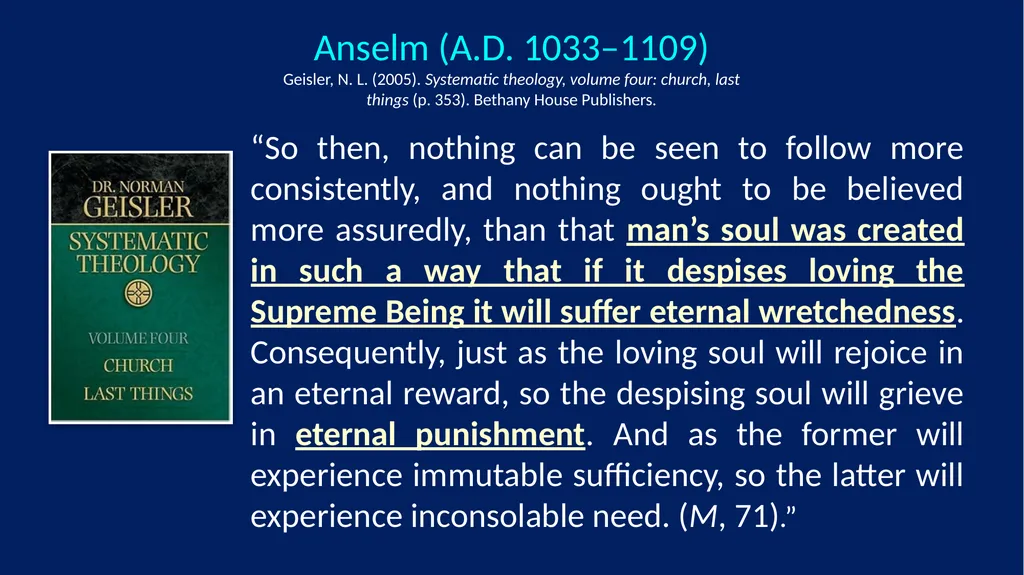
“So then, nothing can be seen to follow more consistently, and nothing ought to be believed more assuredly, than that man’s soul was created in such a way that if it despises loving the Supreme Being it will suffer eternal wretchedness. Consequently, just as the loving soul will rejoice in an eternal reward, so the despising soul will grieve in eternal punishment. And as the former will experience immutable sufficiency, so the latter will experience inconsolable need. (M, 71).” Anselm (A.D. 1033–1109)
Geisler, N. L. (2005). Systematic theology, volume four: church, last things (p. 353). Bethany House Publishers.<br>
Geisler, N. L. (2005). Systematic theology, volume four: church, last things (p. 353). Bethany House Publishers.<br>
29
“The suffering of eternal punishment is in no way opposed to divine justice. Even in the laws men make, punishment need not correspond to the offense in point of time. [For example, one may commit murder in a minute but deserve a lifetime in jail]. (CT, 183).” Thomas Aquinas (A.D. 1225–1274)
Geisler, N. L. (2005). Systematic theology, volume four: church, last things (p. 354). Bethany House Publishers.<br>
Geisler, N. L. (2005). Systematic theology, volume four: church, last things (p. 354). Bethany House Publishers.<br>
30
VI. Examining Church History General overview
Early fathers
Medieval fathers
Reformation leaders
Post reformation teachers<br>
Early fathers
Medieval fathers
Reformation leaders
Post reformation teachers<br>
31
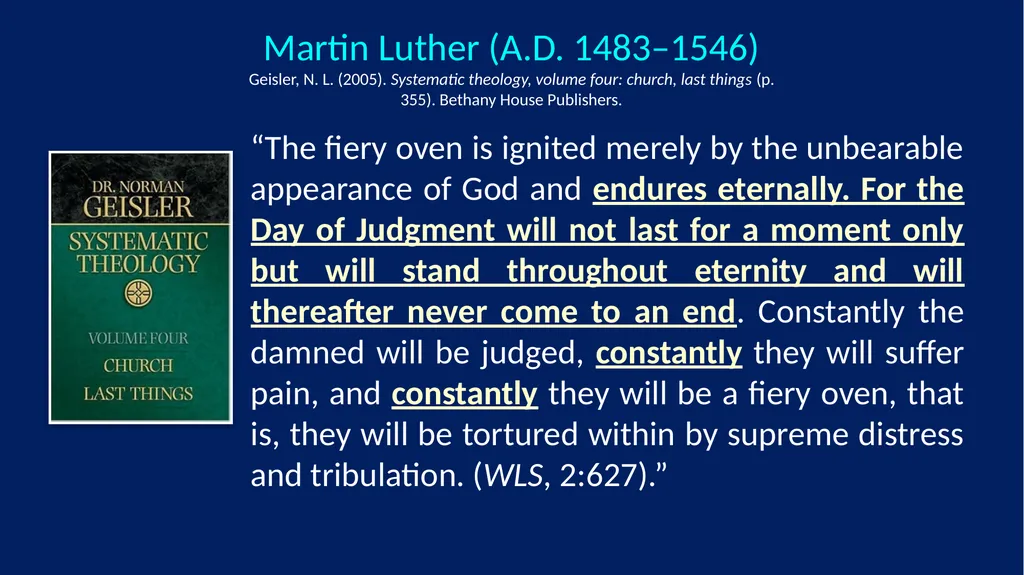
“The fiery oven is ignited merely by the unbearable appearance of God and endures eternally. For the Day of Judgment will not last for a moment only but will stand throughout eternity and will thereafter never come to an end. Constantly the damned will be judged, constantly they will suffer pain, and constantly they will be a fiery oven, that is, they will be tortured within by supreme distress and tribulation. (WLS, 2:627).” Martin Luther (A.D. 1483–1546)
Geisler, N. L. (2005). Systematic theology, volume four: church, last things (p. 355). Bethany House Publishers.<br>
Geisler, N. L. (2005). Systematic theology, volume four: church, last things (p. 355). Bethany House Publishers.<br>
32
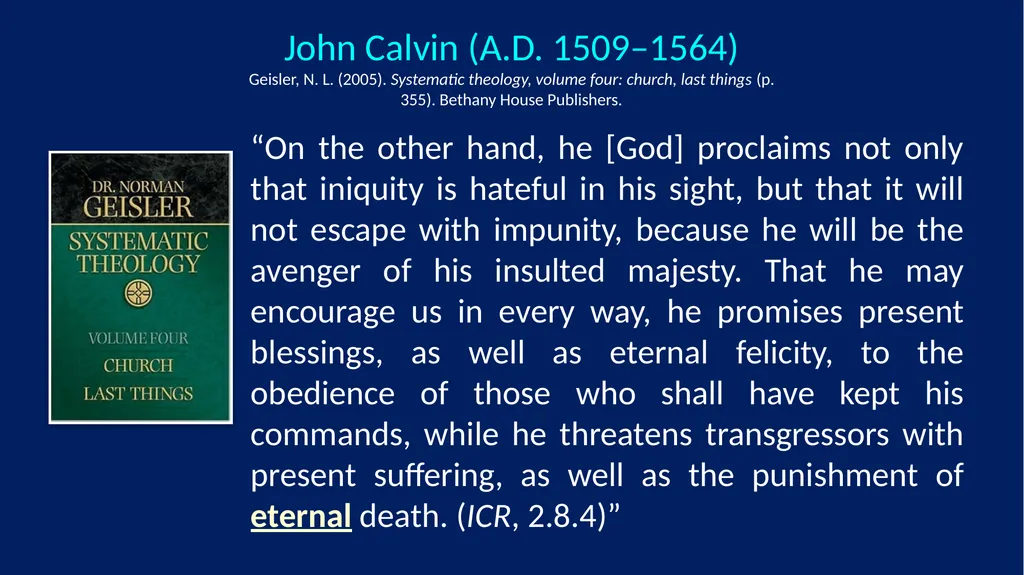
“On the other hand, he [God] proclaims not only that iniquity is hateful in his sight, but that it will not escape with impunity, because he will be the avenger of his insulted majesty. That he may encourage us in every way, he promises present blessings, as well as eternal felicity, to the obedience of those who shall have kept his commands, while he threatens transgressors with present suffering, as well as the punishment of eternal death. (ICR, 2.8.4)” John Calvin (A.D. 1509–1564)
Geisler, N. L. (2005). Systematic theology, volume four: church, last things (p. 355). Bethany House Publishers.<br>
Geisler, N. L. (2005). Systematic theology, volume four: church, last things (p. 355). Bethany House Publishers.<br>
33
VI. Examining Church History General overview
Early fathers
Medieval fathers
Reformation leaders
Post reformation teachers<br>
Early fathers
Medieval fathers
Reformation leaders
Post reformation teachers<br>
34
“Consider a few of the circumstances which will follow the general judgment. And the first is the execution of the sentence pronounced on the evil and on the good: “These shall go away into eternal punishment, and the righteous into life eternal.” It should be observed, it is the very same word which is used, both in the former and the latter clause: It follows, that either the punishment lasts for ever, or the reward too will come to an end: No, never, unless God could come to an end, or his mercy and truth could fail. “Then shall the righteous shine forth as the sun in the kingdom of their Father, and shall drink of those rivers of pleasure which are at God’s right hand for evermore. (WJW, 5.15.3.1)” John Wesley (A.D. 1703–1791)
Geisler, N. L. (2005). Systematic theology, volume four: church, last things (p. 356). Bethany House Publishers.<br>
Geisler, N. L. (2005). Systematic theology, volume four: church, last things (p. 356). Bethany House Publishers.<br>
35
Matthew 25:46
“These will go away into eternal (aiōnios) punishment, but the righteous into eternal (aiōnios) life.”<br>
“These will go away into eternal (aiōnios) punishment, but the righteous into eternal (aiōnios) life.”<br>
36
Romans 16:26
“but now is manifested, and by the Scriptures of the prophets, according to the commandment of the eternal (aiōnios) God, has been made known to all the nations, leading to obedience of faith.”<br>
“but now is manifested, and by the Scriptures of the prophets, according to the commandment of the eternal (aiōnios) God, has been made known to all the nations, leading to obedience of faith.”<br>
37
“It hopeth not; it knoweth no escape; it guesseth not of deliverance; it pants for death, but death is too much its foe to be there; it longs that non-existence would swallow it up, but this eternal death is worse than annihilation. It pants for extermination as the laborer for his Sabbath; it longs that it might be swallowed up in nothingness just as would the galley slave long for freedom, but it cometh not—it is eternally dead.” (SSC, 1.52) Charles Spurgeon (A.D. 1834–1892)
Geisler, N. L. (2005). Systematic theology, volume four: church, last things (p. 357). Bethany House Publishers.<br>
Geisler, N. L. (2005). Systematic theology, volume four: church, last things (p. 357). Bethany House Publishers.<br>
38
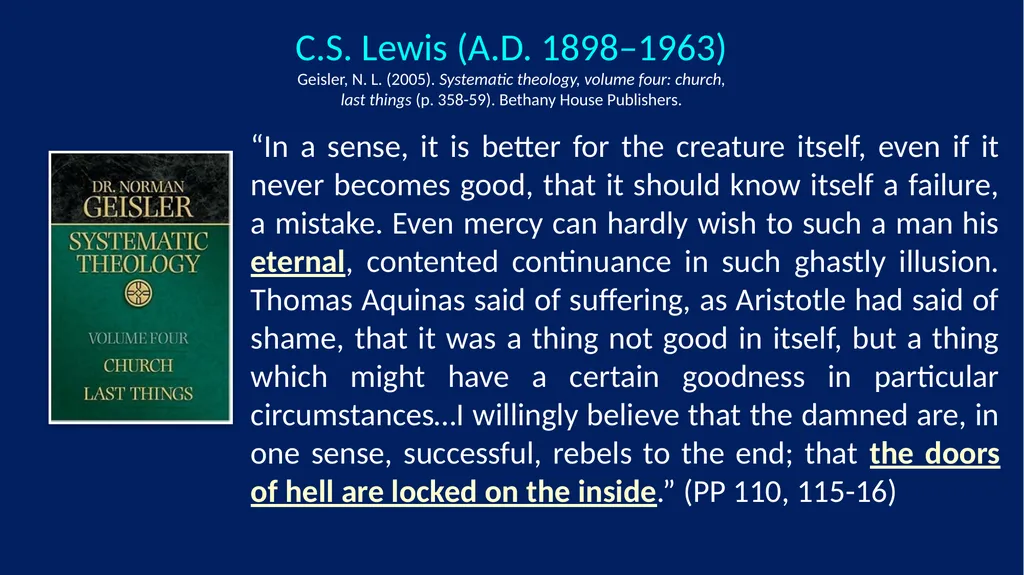
“In a sense, it is better for the creature itself, even if it never becomes good, that it should know itself a failure, a mistake. Even mercy can hardly wish to such a man his eternal, contented continuance in such ghastly illusion. Thomas Aquinas said of suffering, as Aristotle had said of shame, that it was a thing not good in itself, but a thing which might have a certain goodness in particular circumstances…I willingly believe that the damned are, in one sense, successful, rebels to the end; that the doors of hell are locked on the inside.” (PP 110, 115-16) C.S. Lewis (A.D. 1898–1963)
Geisler, N. L. (2005). Systematic theology, volume four: church, last things (p. 358-59). Bethany House Publishers.<br>
Geisler, N. L. (2005). Systematic theology, volume four: church, last things (p. 358-59). Bethany House Publishers.<br>
39
VI. Examining Church History General overview
Early fathers
Medieval fathers
Reformation leaders
Post reformation teachers<br>
Early fathers
Medieval fathers
Reformation leaders
Post reformation teachers<br>
40
ANNIHILATION VS. ETERNAL CONSCIOUS TORMENT Introduction to the Controversy
Biblical Arguments Against Annihilation
Theological Arguments Against Annihilation
Answering Annihilationist Biblical Arguments
Answering Annihilationist Theological Arguments
Examining Church History
Conclusion<br>
Biblical Arguments Against Annihilation
Theological Arguments Against Annihilation
Answering Annihilationist Biblical Arguments
Answering Annihilationist Theological Arguments
Examining Church History
Conclusion<br>
41
Dominoes in a Row<br>
42
ANNIHILATION VS. ETERNAL CONSCIOUS TORMENT Introduction to the Controversy
Biblical Arguments Against Annihilation
Theological Arguments Against Annihilation
Answering Annihilationist Biblical Arguments
Answering Annihilationist Theological Arguments
Examining Church History
Conclusion<br>
Biblical Arguments Against Annihilation
Theological Arguments Against Annihilation
Answering Annihilationist Biblical Arguments
Answering Annihilationist Theological Arguments
Examining Church History
Conclusion<br>