
ANNUAL REPORT PRESENTATION TO THE PORTFOLIO


Description: ANNUAL REPORT PRESENTATION TO THE PORTFOLIO COMMITTEE ON HIGHER EDUCATION,SCIENCE AND INNOVATION AND THE SELECT COMMITTEE ON EDUCATION AND TECHNOLOGY, SPORTS, ARTS AND CULTURE 202021 FY 10 NOVEMBER 2021 CONTENT Overview Audit Opinion
Related Topics
Download Presentation
"ANNUAL REPORT PRESENTATION TO THE PORTFOLIO" is the property of its rightful owner. Permission is granted to download and print the materials on this website for personal, non-commercial use only, and to display it on your personal computer provided you do not modify the materials and that you retain all copyright notices contained in the materials. By downloading content from our website, you accept the terms of this agreement.
Presentation Transcript
slide1. ANNUAL REPORT PRESENTATION TO THE PORTFOLIO COMMITTEE ON HIGHER EDUCATION,SCIENCE AND INNOVATION
AND
THE SELECT COMMITTEE ON EDUCATION AND TECHNOLOGY, SPORTS, ARTS AND CULTURE
2020/21 FY
10 NOVEMBER 2021<br>
slide2. CONTENT Overview
Audit Opinion
Annual Performance Report
Annual Financial Statements
Irregular Expenditure
Risk Management
Human Resource Management<br>
slide3. 1. OVERVIEW<br>
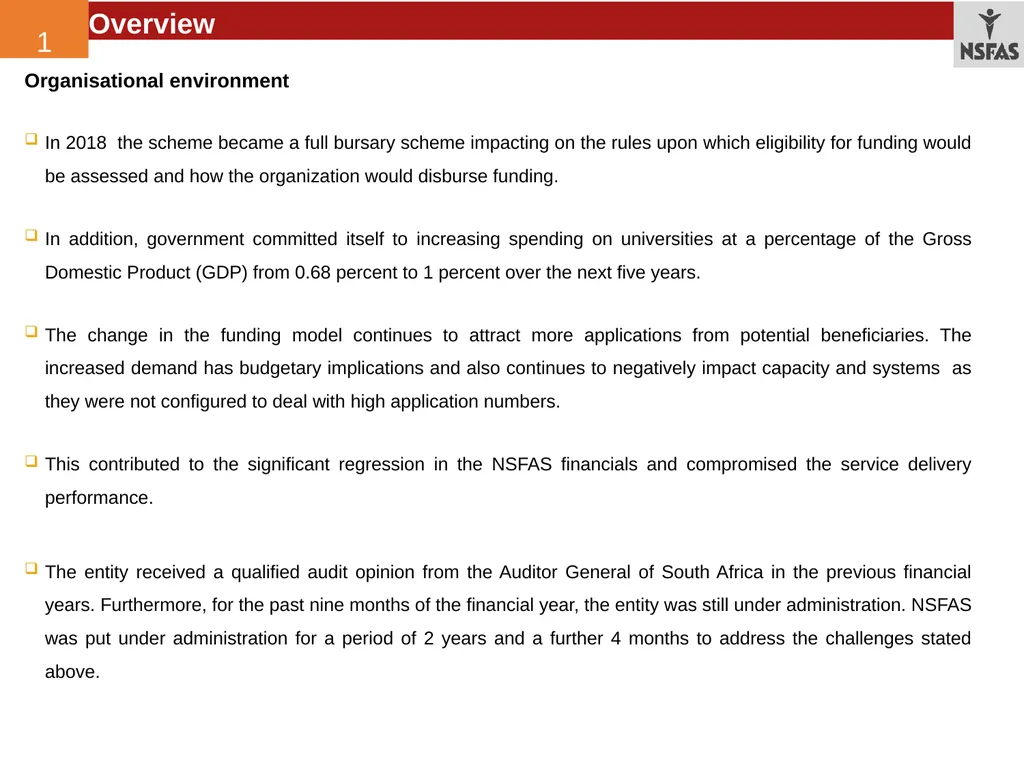
slide4. Organisational environment
In 2018 the scheme became a full bursary scheme impacting on the rules upon which eligibility for funding would be assessed and how the organization would disburse funding.
In addition, government committed itself to increasing spending on universities at a percentage of the Gross Domestic Product (GDP) from 0.68 percent to 1 percent over the next five years.
The change in the funding model continues to attract more applications from potential beneficiaries. The increased demand has budgetary implications and also continues to negatively impact capacity and systems as they were not configured to deal with high application numbers.
This contributed to the significant regression in the NSFAS financials and compromised the service delivery performance.
The entity received a qualified audit opinion from the Auditor General of South Africa in the previous financial years. Furthermore, for the past nine months of the financial year, the entity was still under administration. NSFAS was put under administration for a period of 2 years and a further 4 months to address the challenges stated above. 4 1 Overview<br>
slide5. Organisational environment
The Board and the Executive Officer were appointed during the last quarter of the financial year in order to strengthen governance structures and stabilize the environment and improve stakeholder relations and dealing with issues at first hand.
The impact of COVID-19 has resulted in the extension of the academic year and negatively impacted the system’s ability to perform as required.
The Ministerial Task Team was also considered important in making long-term recommendations on the future models, structures, systems and business processes necessary for an effective NSFAS. The purpose of this initiative was to create a fit for purpose organization by aligning the environment with its resources. 5 2 Overview
Cont…<br>
slide6. 2. AUDIT OPINION<br>
slide7. 2018/19
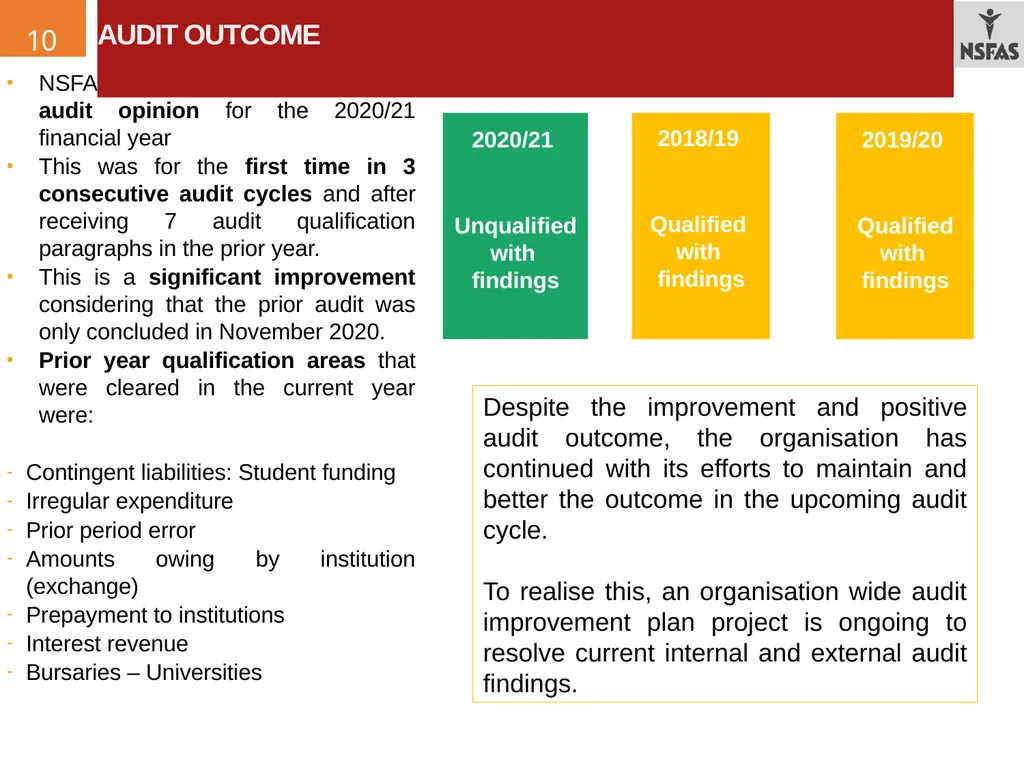
Qualified with findings NSFAS received an unqualified audit opinion for the 2020/21 financial year
This was for the first time in 3 consecutive audit cycles and after receiving 7 audit qualification paragraphs in the prior year.
This is a significant improvement considering that the prior audit was only concluded in November 2020.
Prior year qualification areas that were cleared in the current year were:
Contingent liabilities: Student funding
Irregular expenditure
Prior period error
Amounts owing by institution (exchange)
Prepayment to institutions
Interest revenue
Bursaries – Universities AUDIT OUTCOME 10 2019/20
Qualified with findings 2020/21
Unqualified with findings Despite the improvement and positive audit outcome, the organisation has continued with its efforts to maintain and better the outcome in the upcoming audit cycle.
To realise this, an organisation wide audit improvement plan project is ongoing to resolve current internal and external audit findings.<br>
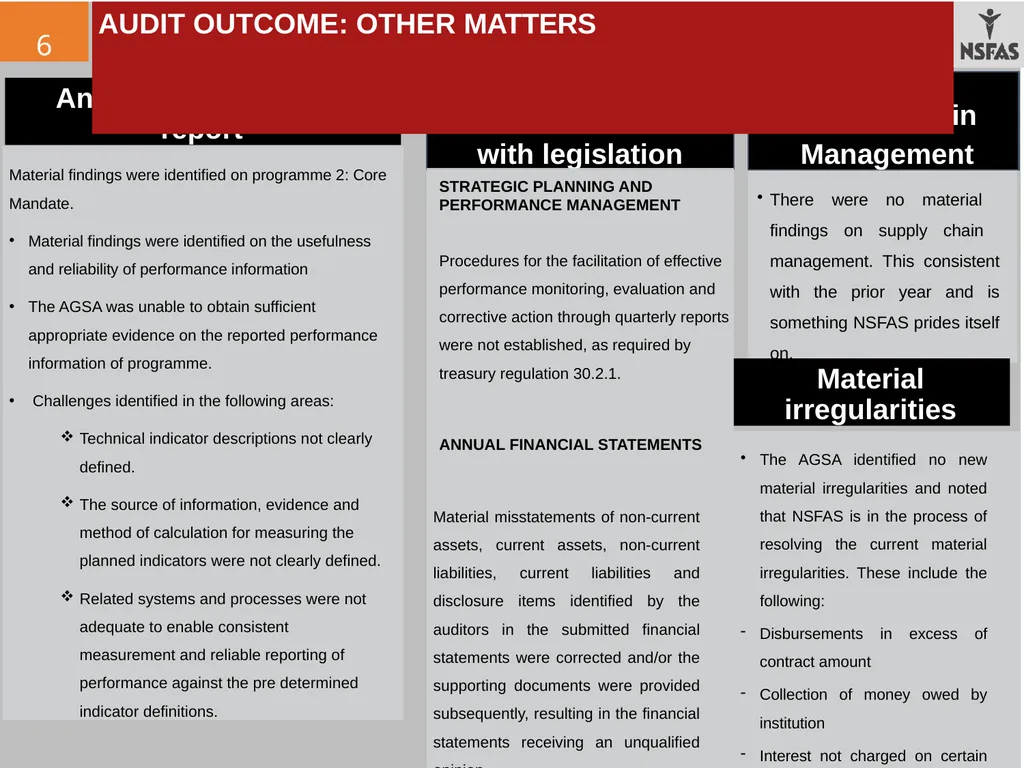
slide8. Annual performance report Material findings were identified on programme 2: Core Mandate.
Material findings were identified on the usefulness and reliability of performance information
The AGSA was unable to obtain sufficient appropriate evidence on the reported performance information of programme.
Challenges identified in the following areas:
Technical indicator descriptions not clearly defined.
The source of information, evidence and method of calculation for measuring the planned indicators were not clearly defined.
Related systems and processes were not adequate to enable consistent measurement and reliable reporting of performance against the pre determined indicator definitions. Audit of compliance with legislation STRATEGIC PLANNING AND PERFORMANCE MANAGEMENT
Procedures for the facilitation of effective performance monitoring, evaluation and corrective action through quarterly reports were not established, as required by treasury regulation 30.2.1.
ANNUAL FINANCIAL STATEMENTS
Material misstatements of non-current assets, current assets, non-current liabilities, current liabilities and disclosure items identified by the auditors in the submitted financial statements were corrected and/or the supporting documents were provided subsequently, resulting in the financial statements receiving an unqualified opinion. Supply Chain
Management There were no material findings on supply chain management. This consistent with the prior year and is something NSFAS prides itself on. AUDIT OUTCOME: OTHER MATTERS 6 Material irregularities The AGSA identified no new material irregularities and noted that NSFAS is in the process of resolving the current material irregularities. These include the following:
Disbursements in excess of contract amount
Collection of money owed by institution
Interest not charged on certain loans.<br>
slide9. 3. ANNUAL PERFORMANCE REPORT<br>
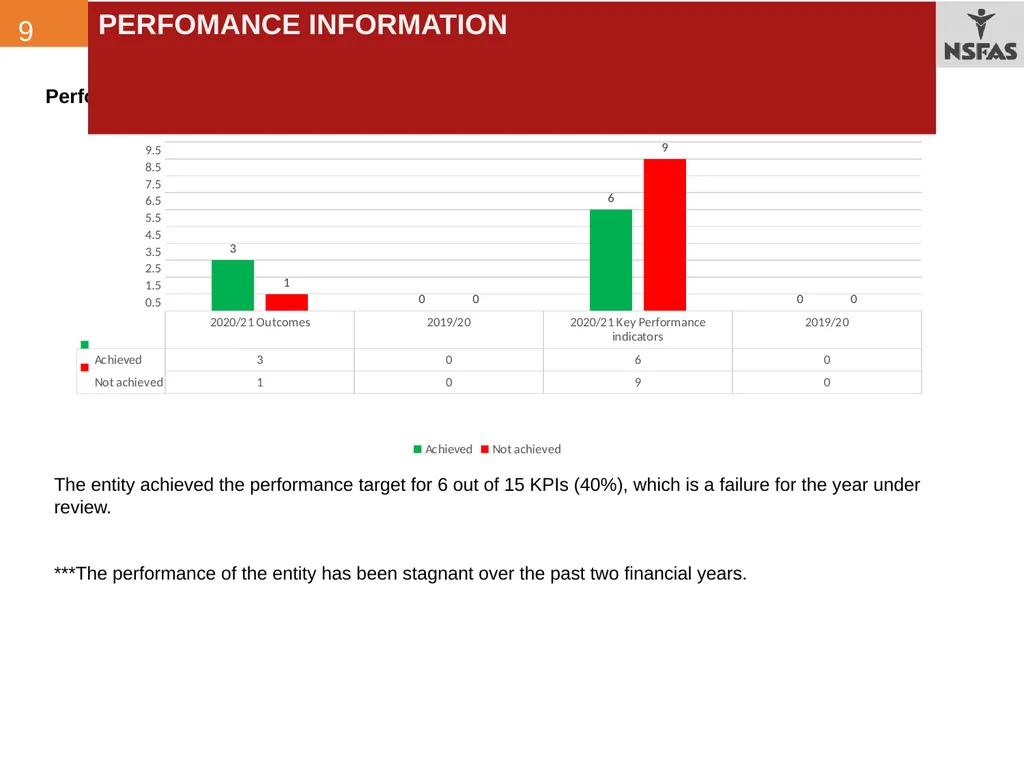
slide10. Performance Summary PERFOMANCE INFORMATION 9 The entity achieved the performance target for 6 out of 15 KPIs (40%), which is a failure for the year under
review.
***The performance of the entity has been stagnant over the past two financial years.<br>
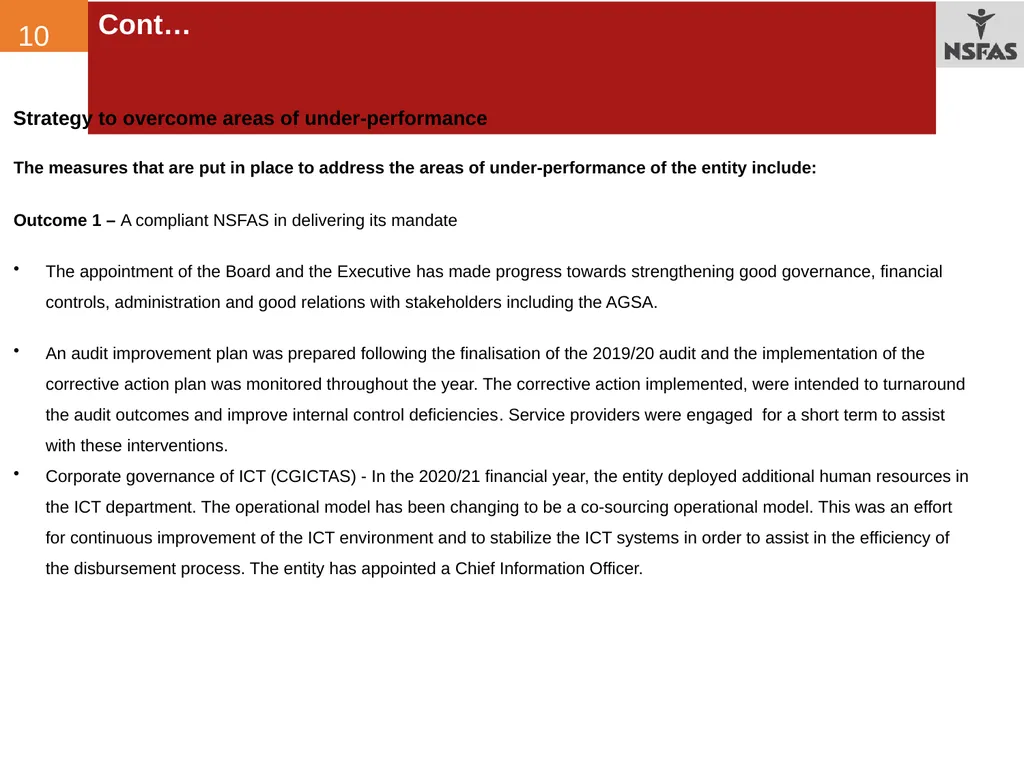
slide11. The measures that are put in place to address the areas of under-performance of the entity include:
Outcome 1 – A compliant NSFAS in delivering its mandate
The appointment of the Board and the Executive has made progress towards strengthening good governance, financial controls, administration and good relations with stakeholders including the AGSA.
An audit improvement plan was prepared following the finalisation of the 2019/20 audit and the implementation of the corrective action plan was monitored throughout the year. The corrective action implemented, were intended to turnaround the audit outcomes and improve internal control deficiencies. Service providers were engaged for a short term to assist with these interventions.
Corporate governance of ICT (CGICTAS) - In the 2020/21 financial year, the entity deployed additional human resources in the ICT department. The operational model has been changing to be a co-sourcing operational model. This was an effort for continuous improvement of the ICT environment and to stabilize the ICT systems in order to assist in the efficiency of the disbursement process. The entity has appointed a Chief Information Officer. Cont… 10 Strategy to overcome areas of under-performance<br>
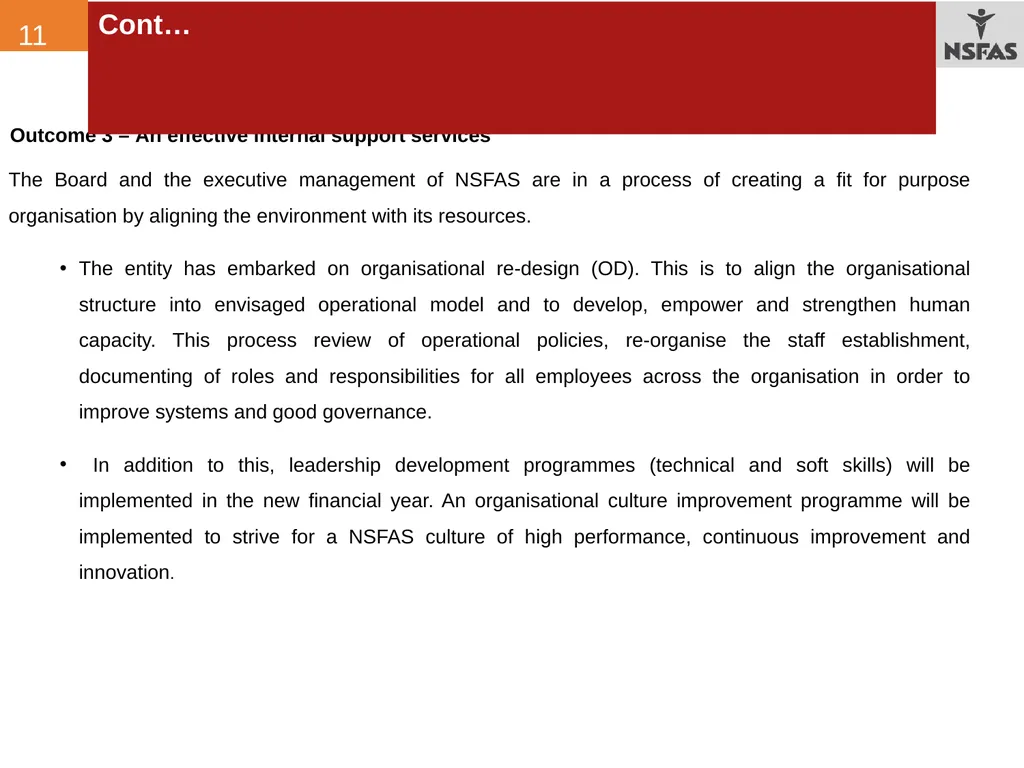
slide12. Outcome 3 – An effective internal support services
The Board and the executive management of NSFAS are in a process of creating a fit for purpose organisation by aligning the environment with its resources.
The entity has embarked on organisational re-design (OD). This is to align the organisational structure into envisaged operational model and to develop, empower and strengthen human capacity. This process review of operational policies, re-organise the staff establishment, documenting of roles and responsibilities for all employees across the organisation in order to improve systems and good governance.
In addition to this, leadership development programmes (technical and soft skills) will be implemented in the new financial year. An organisational culture improvement programme will be implemented to strive for a NSFAS culture of high performance, continuous improvement and innovation. Cont… 11<br>
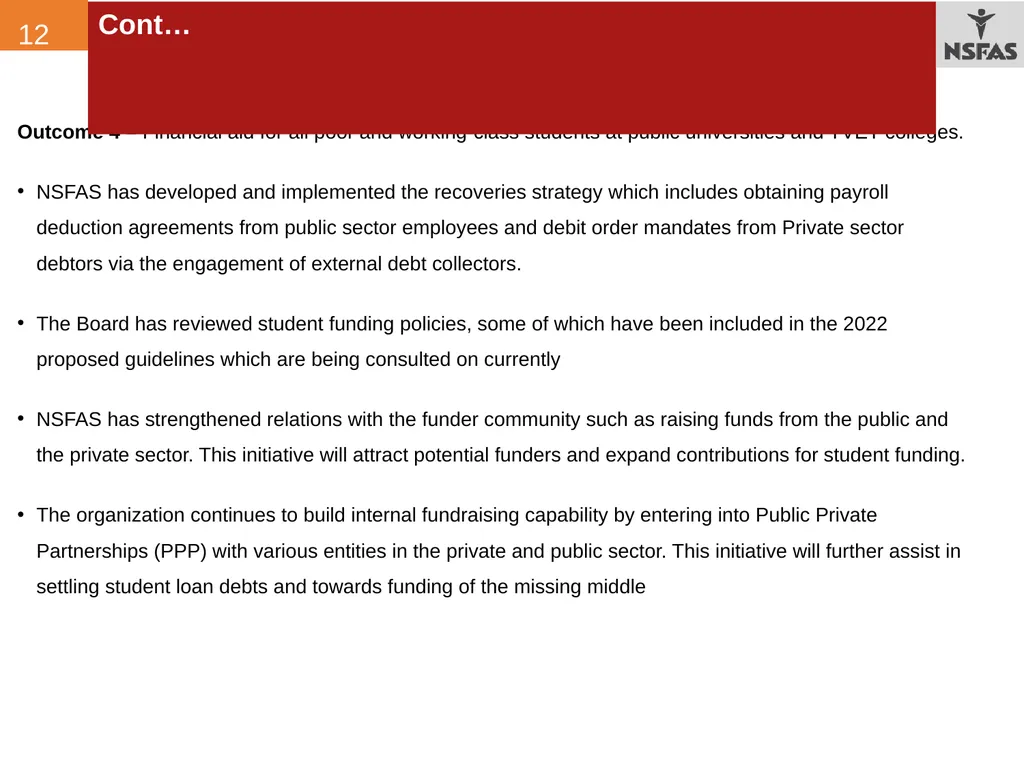
slide13. Outcome 4 – Financial aid for all poor and working-class students at public universities and TVET colleges.
NSFAS has developed and implemented the recoveries strategy which includes obtaining payroll deduction agreements from public sector employees and debit order mandates from Private sector debtors via the engagement of external debt collectors.
The Board has reviewed student funding policies, some of which have been included in the 2022 proposed guidelines which are being consulted on currently
NSFAS has strengthened relations with the funder community such as raising funds from the public and the private sector. This initiative will attract potential funders and expand contributions for student funding.
The organization continues to build internal fundraising capability by entering into Public Private Partnerships (PPP) with various entities in the private and public sector. This initiative will further assist in settling student loan debts and towards funding of the missing middle Cont… 12<br>
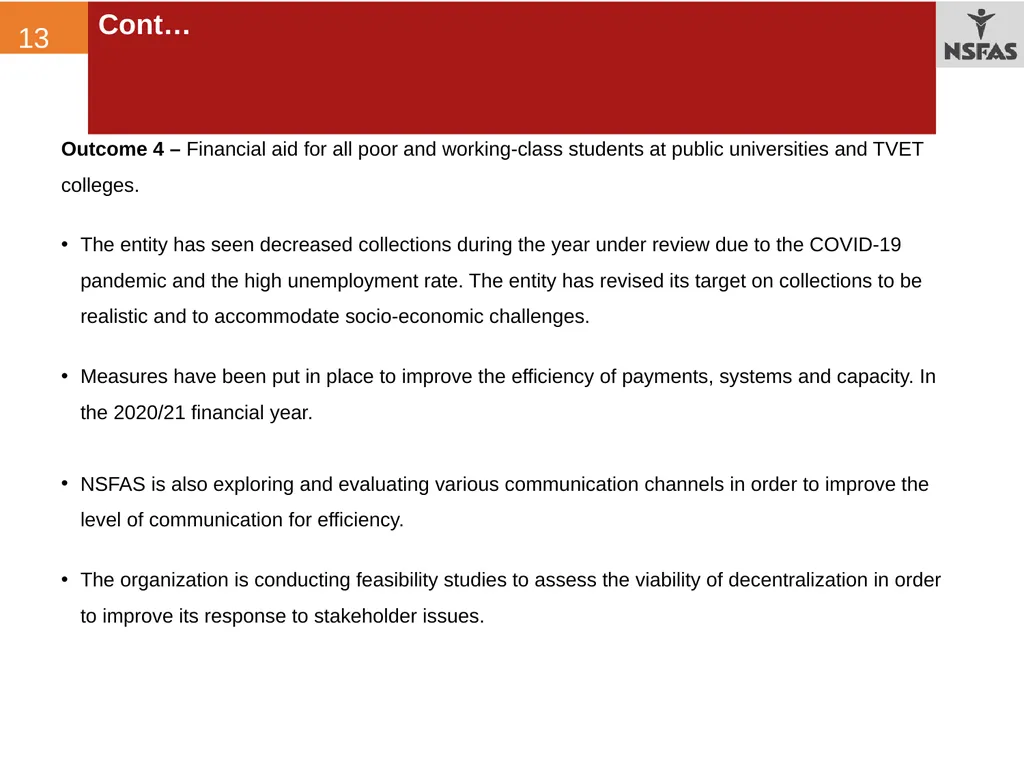
slide14. Outcome 4 – Financial aid for all poor and working-class students at public universities and TVET colleges.
The entity has seen decreased collections during the year under review due to the COVID-19 pandemic and the high unemployment rate. The entity has revised its target on collections to be realistic and to accommodate socio-economic challenges.
Measures have been put in place to improve the efficiency of payments, systems and capacity. In the 2020/21 financial year.
NSFAS is also exploring and evaluating various communication channels in order to improve the level of communication for efficiency.
The organization is conducting feasibility studies to assess the viability of decentralization in order to improve its response to stakeholder issues. Cont… 13<br>
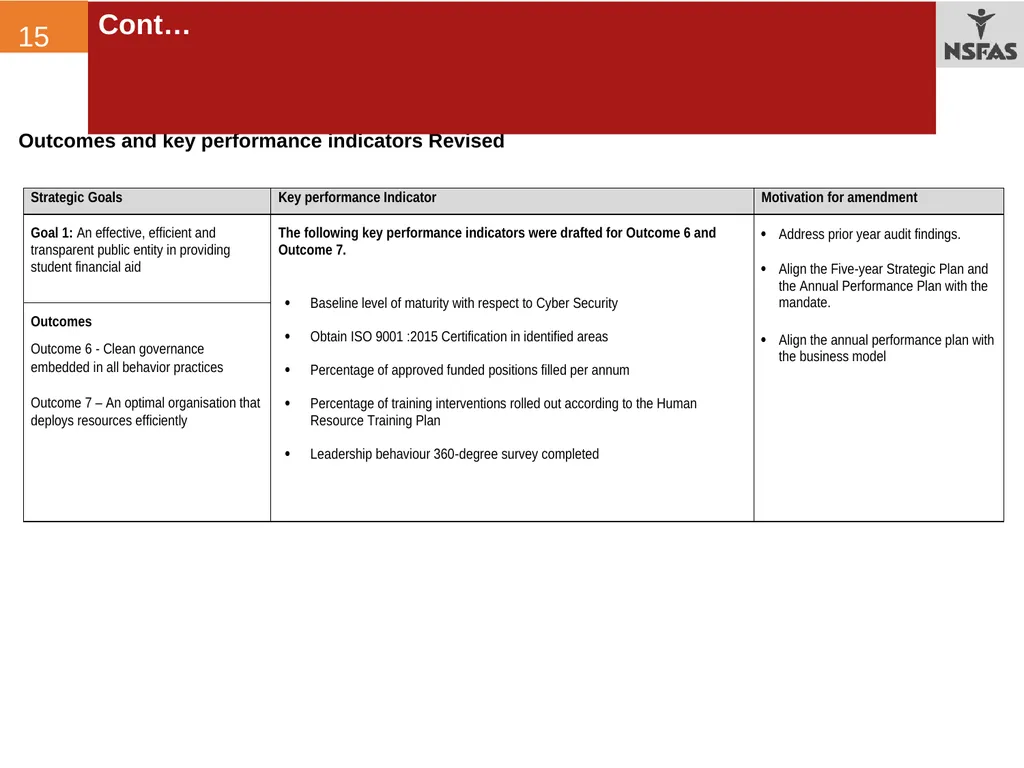
slide15. Outcomes and key performance indicators Revised Cont… 15<br>
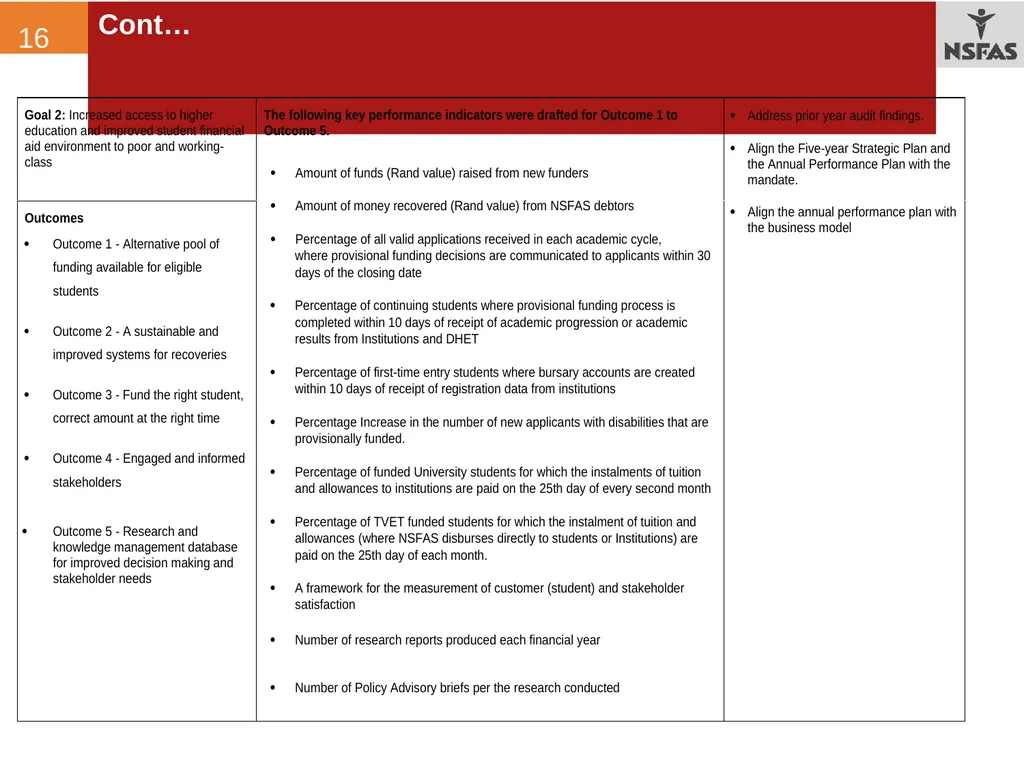
slide16. Cont… 16<br>
slide17. 4. ANNUAL FINANCIAL STATEMENTS<br>
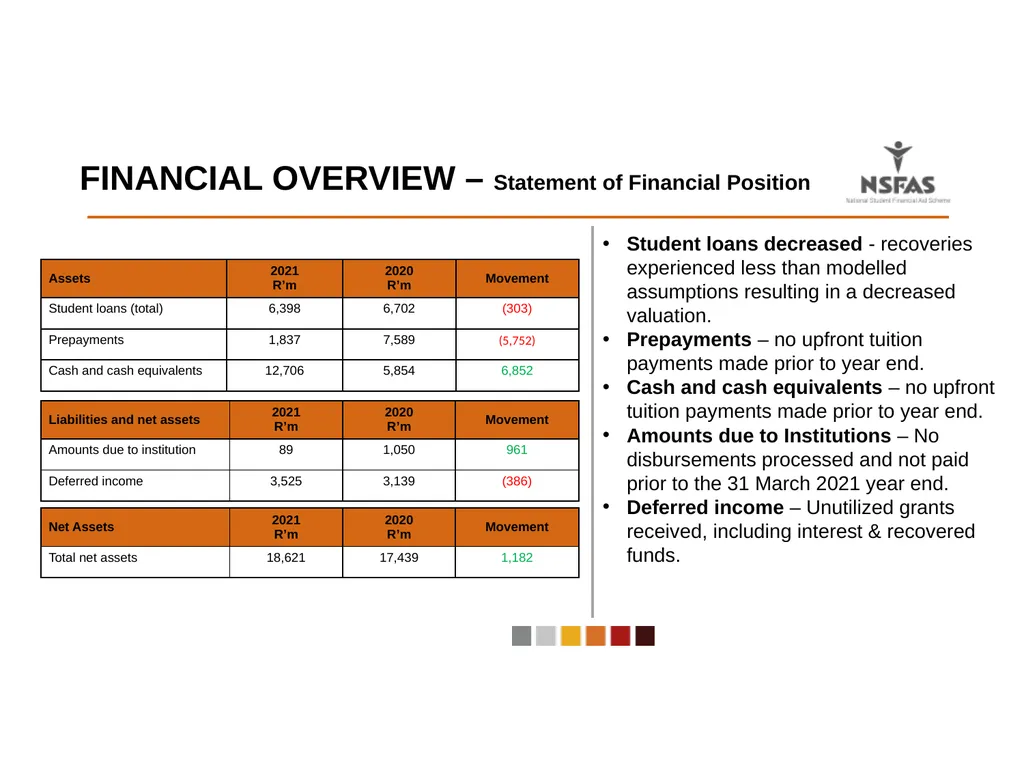
slide18. FINANCIAL OVERVIEW – Statement of Financial Position Student loans decreased - recoveries experienced less than modelled assumptions resulting in a decreased valuation.
Prepayments – no upfront tuition payments made prior to year end.
Cash and cash equivalents – no upfront tuition payments made prior to year end.
Amounts due to Institutions – No disbursements processed and not paid prior to the 31 March 2021 year end.
Deferred income – Unutilized grants received, including interest & recovered funds.<br>
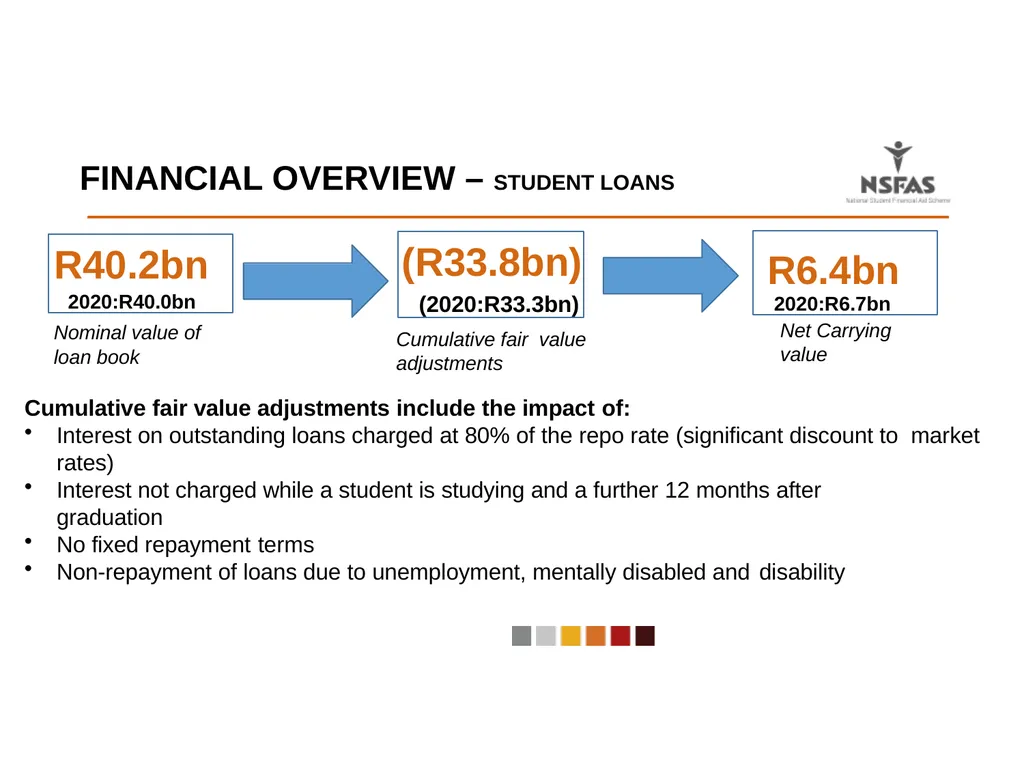
slide19. FINANCIAL OVERVIEW – STUDENT LOANS Cumulative fair value adjustments include the impact of:
Interest on outstanding loans charged at 80% of the repo rate (significant discount to market rates)
Interest not charged while a student is studying and a further 12 months after graduation
No fixed repayment terms
Non-repayment of loans due to unemployment, mentally disabled and disability Nominal value of
loan book R40.2bn
2020:R40.0bn (R33.8bn)
(2020:R33.3bn) Cumulative fair value adjustments R6.4bn
2020:R6.7bn Net Carrying value<br>
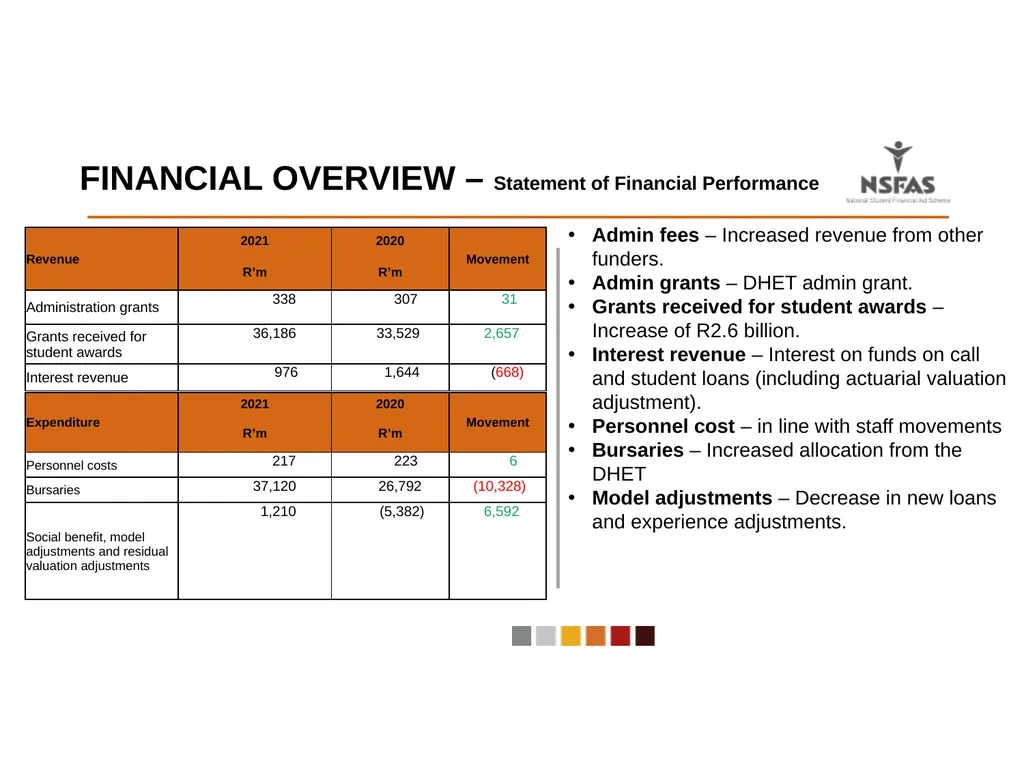
slide20. FINANCIAL OVERVIEW – Statement of Financial Performance Admin fees – Increased revenue from other funders.
Admin grants – DHET admin grant.
Grants received for student awards – Increase of R2.6 billion.
Interest revenue – Interest on funds on call and student loans (including actuarial valuation adjustment).
Personnel cost – in line with staff movements
Bursaries – Increased allocation from the DHET
Model adjustments – Decrease in new loans and experience adjustments.<br>
slide21. 5. IRREGULAR EXPENDITURE<br>
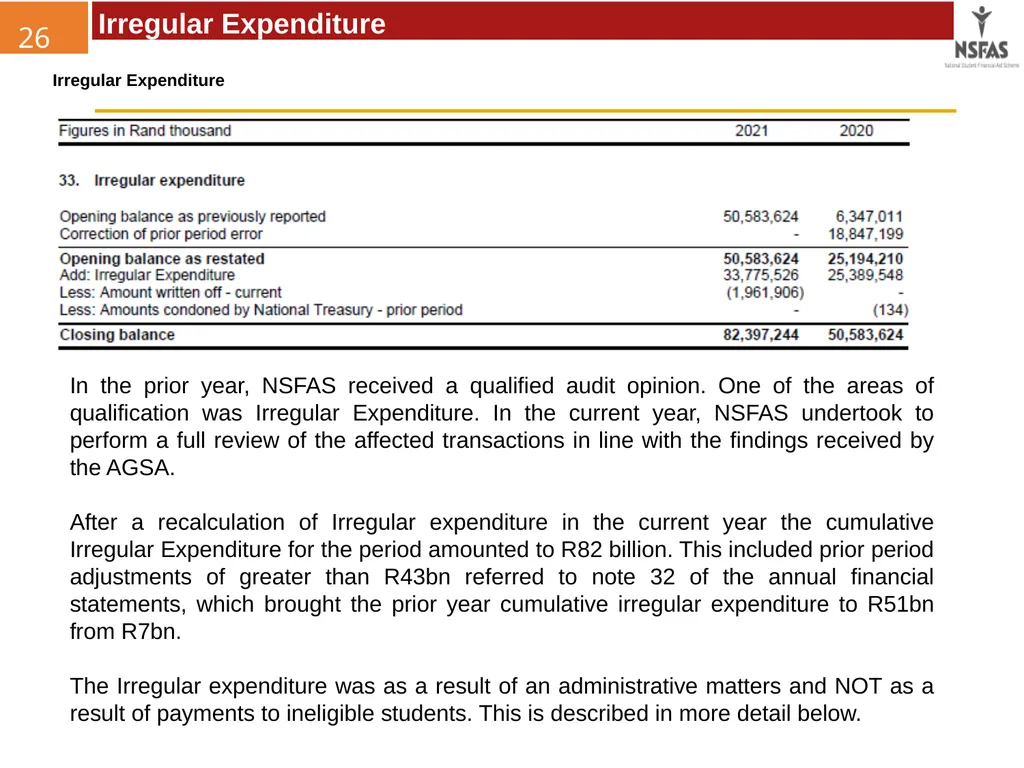
slide22. In the prior year, NSFAS received a qualified audit opinion. One of the areas of qualification was Irregular Expenditure. In the current year, NSFAS undertook to perform a full review of the affected transactions in line with the findings received by the AGSA.
After a recalculation of Irregular expenditure in the current year the cumulative Irregular Expenditure for the period amounted to R82 billion. This included prior period adjustments of greater than R43bn referred to note 32 of the annual financial statements, which brought the prior year cumulative irregular expenditure to R51bn from R7bn.
The Irregular expenditure was as a result of an administrative matters and NOT as a result of payments to ineligible students. This is described in more detail below. 26 Irregular Expenditure Irregular Expenditure<br>
slide23. Irregular expenditure incurred was mainly due to the fact that eligibility criteria, even though it was applied correctly, was not gazetted as was previously needed in terms of regulations to the NSFAS Act. This resulted is all bursary payments to DHET funded students for the 2018, 2019 and 2020 students to be regarded as being irregular. A retrospective adjustment was made to restate the prior year. These funds were however paid to eligible students and were paid at the correct amounts. This regulation has since been repealed.
Irregular expenditure was further categorised as follows:
Administrative matters: Lack of publishing criteria as per regulations.
Institutional matters: Where irregular expenditure is incurred as a result of information received from institutions e.g. incorrect funding decisions.
Internal control matters: System failures leading to irregular expenditure being incurred. 26 Irregular Expenditure cont…<br>
slide24. 5. RISK MANAGEMENT<br>
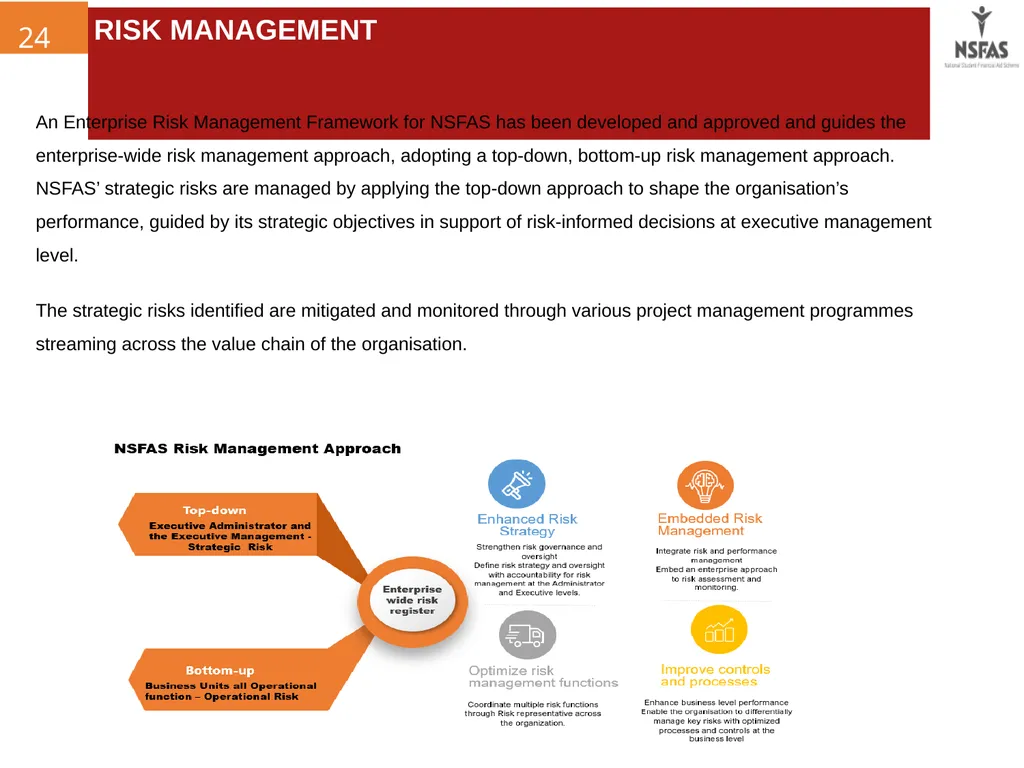
slide25. 24 RISK MANAGEMENT An Enterprise Risk Management Framework for NSFAS has been developed and approved and guides the enterprise-wide risk management approach, adopting a top-down, bottom-up risk management approach. NSFAS’ strategic risks are managed by applying the top-down approach to shape the organisation’s performance, guided by its strategic objectives in support of risk-informed decisions at executive management level.
The strategic risks identified are mitigated and monitored through various project management programmes streaming across the value chain of the organisation.<br>
slide26. 7. HUMAN RESOURCE MANAGEMENT<br>
slide27. Overview
The year under review (2020/21) is divided into two (2) phases; phase one encompasses the first nine (9) months where the organisation was under Administration; and phase two which is the last quarter of the financial year which saw the appointment of the Board members and Chief Executive Officer.
Activities during the 2020/21 financial year:
The human resources unit spent time supporting the recruitment of the executive team that will ensure a smooth transition at the end of the Administration to the period directed by the new Board and the CEO.
The challenges of the lockdown levels forced the organisation to respond to the forced change from physical contact working to remote working. To ensure continuous productivity during the lockdown period, human resources working with other departments conducted a feasibility study of relocating employees from desktops to laptops operations to enable remote working. 26 HUMAN RESOURCE<br>
slide28. Overview cont..
One of the entity’s key focus for the year was targeted at improving relationships with the recognised trade unions; National Education, Health and Allied Workers' Union (NEHAWU) which has bargaining rights with the NSFAS and Public Service Association (PSA).
The organisation experienced four (4) days of strike as a result of a deadlock in the wage negotiations with NEHAWU during the period under review. However, this did not adversely affect the operations of the organisation because staff were already working remotely at the time. This has been avoided in 2021.
Amongst the areas needing improvements were the strengthening of a functional bargaining forum, development of recognition agreements, consultative forum and frequent bilateral meetings. Some of these elements have already been put in place and such the relationships with the labour stakeholders can be categorised as work in progress and the entity believes that there are opportunities for all parties to mature these relationships
Finally, in terms of the entity’s social responsibility projects in the financial year under review the organisation continued partnership with the Unemployment Insurance Fund (UIF) which seeks to provide work experience to graduates, however this project could not continue due to COVID-19 pandemic. 27 HUMAN RESOURCE<br>
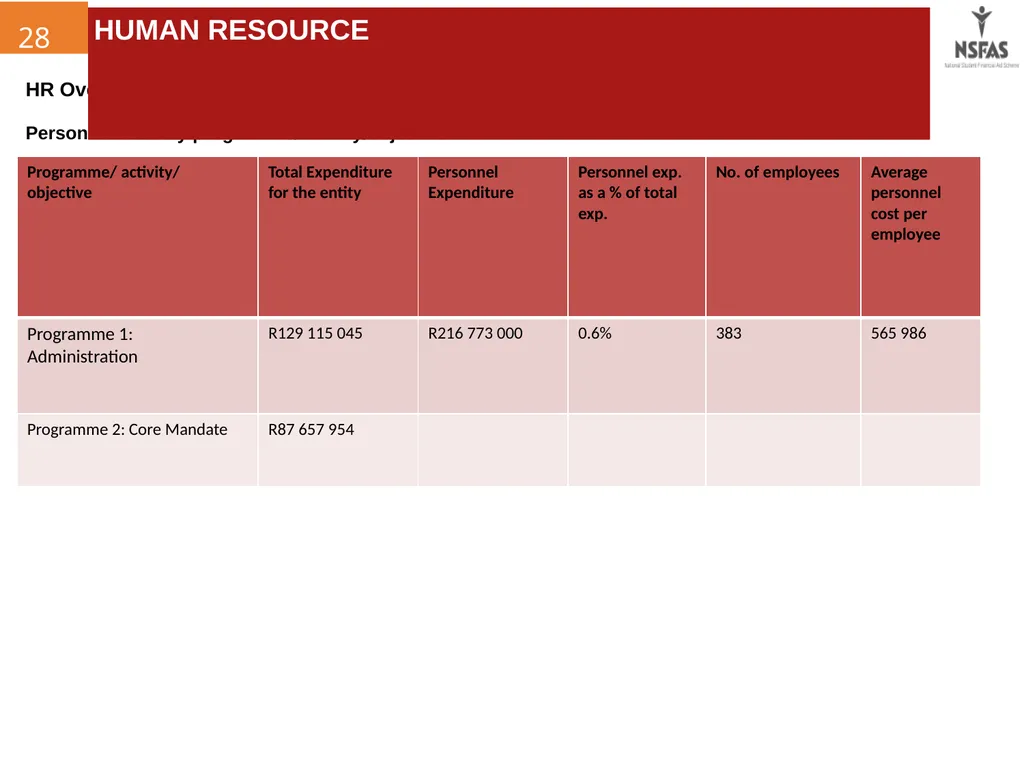
slide29. HR Oversight Statistics
Personnel Cost by programme/activity/objective 28 HUMAN RESOURCE<br>
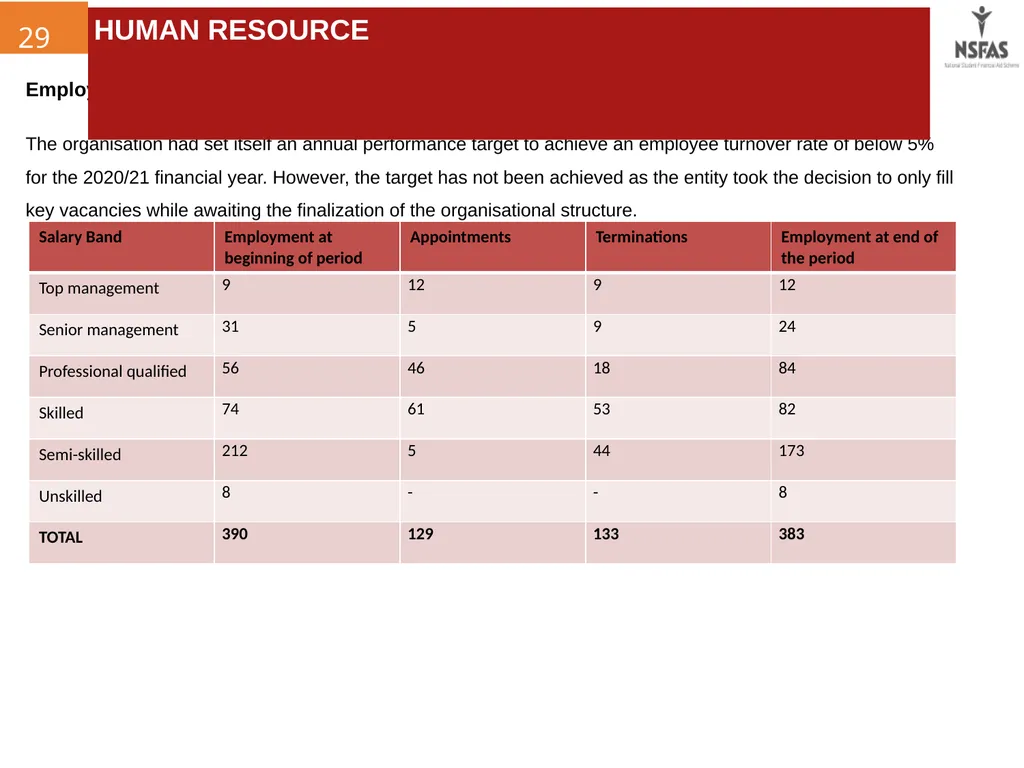
slide30. Employment changes
The organisation had set itself an annual performance target to achieve an employee turnover rate of below 5% for the 2020/21 financial year. However, the target has not been achieved as the entity took the decision to only fill key vacancies while awaiting the finalization of the organisational structure. 29 HUMAN RESOURCE<br>
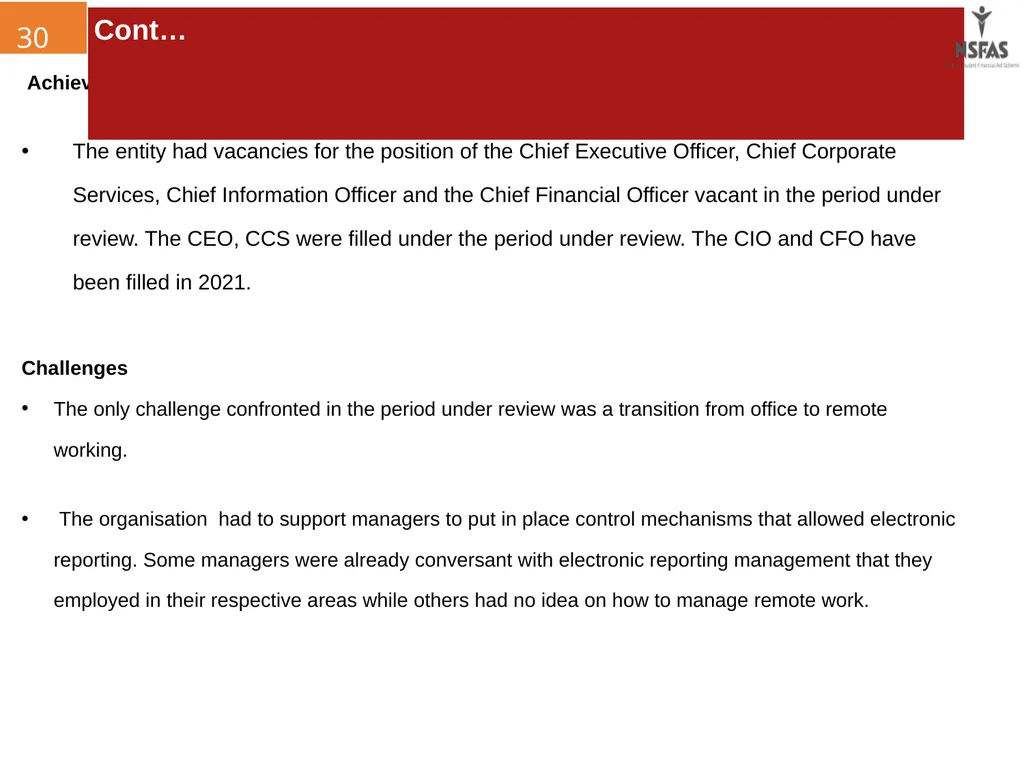
slide31. The entity had vacancies for the position of the Chief Executive Officer, Chief Corporate Services, Chief Information Officer and the Chief Financial Officer vacant in the period under review. The CEO, CCS were filled under the period under review. The CIO and CFO have been filled in 2021.
Challenges
The only challenge confronted in the period under review was a transition from office to remote working.
The organisation had to support managers to put in place control mechanisms that allowed electronic reporting. Some managers were already conversant with electronic reporting management that they employed in their respective areas while others had no idea on how to manage remote work. 30 Achievements Cont…<br>
slide32. THANK YOU<br>
AND
THE SELECT COMMITTEE ON EDUCATION AND TECHNOLOGY, SPORTS, ARTS AND CULTURE
2020/21 FY
10 NOVEMBER 2021<br>
slide2. CONTENT Overview
Audit Opinion
Annual Performance Report
Annual Financial Statements
Irregular Expenditure
Risk Management
Human Resource Management<br>
slide3. 1. OVERVIEW<br>
slide4. Organisational environment
In 2018 the scheme became a full bursary scheme impacting on the rules upon which eligibility for funding would be assessed and how the organization would disburse funding.
In addition, government committed itself to increasing spending on universities at a percentage of the Gross Domestic Product (GDP) from 0.68 percent to 1 percent over the next five years.
The change in the funding model continues to attract more applications from potential beneficiaries. The increased demand has budgetary implications and also continues to negatively impact capacity and systems as they were not configured to deal with high application numbers.
This contributed to the significant regression in the NSFAS financials and compromised the service delivery performance.
The entity received a qualified audit opinion from the Auditor General of South Africa in the previous financial years. Furthermore, for the past nine months of the financial year, the entity was still under administration. NSFAS was put under administration for a period of 2 years and a further 4 months to address the challenges stated above. 4 1 Overview<br>
slide5. Organisational environment
The Board and the Executive Officer were appointed during the last quarter of the financial year in order to strengthen governance structures and stabilize the environment and improve stakeholder relations and dealing with issues at first hand.
The impact of COVID-19 has resulted in the extension of the academic year and negatively impacted the system’s ability to perform as required.
The Ministerial Task Team was also considered important in making long-term recommendations on the future models, structures, systems and business processes necessary for an effective NSFAS. The purpose of this initiative was to create a fit for purpose organization by aligning the environment with its resources. 5 2 Overview
Cont…<br>
slide6. 2. AUDIT OPINION<br>
slide7. 2018/19
Qualified with findings NSFAS received an unqualified audit opinion for the 2020/21 financial year
This was for the first time in 3 consecutive audit cycles and after receiving 7 audit qualification paragraphs in the prior year.
This is a significant improvement considering that the prior audit was only concluded in November 2020.
Prior year qualification areas that were cleared in the current year were:
Contingent liabilities: Student funding
Irregular expenditure
Prior period error
Amounts owing by institution (exchange)
Prepayment to institutions
Interest revenue
Bursaries – Universities AUDIT OUTCOME 10 2019/20
Qualified with findings 2020/21
Unqualified with findings Despite the improvement and positive audit outcome, the organisation has continued with its efforts to maintain and better the outcome in the upcoming audit cycle.
To realise this, an organisation wide audit improvement plan project is ongoing to resolve current internal and external audit findings.<br>
slide8. Annual performance report Material findings were identified on programme 2: Core Mandate.
Material findings were identified on the usefulness and reliability of performance information
The AGSA was unable to obtain sufficient appropriate evidence on the reported performance information of programme.
Challenges identified in the following areas:
Technical indicator descriptions not clearly defined.
The source of information, evidence and method of calculation for measuring the planned indicators were not clearly defined.
Related systems and processes were not adequate to enable consistent measurement and reliable reporting of performance against the pre determined indicator definitions. Audit of compliance with legislation STRATEGIC PLANNING AND PERFORMANCE MANAGEMENT
Procedures for the facilitation of effective performance monitoring, evaluation and corrective action through quarterly reports were not established, as required by treasury regulation 30.2.1.
ANNUAL FINANCIAL STATEMENTS
Material misstatements of non-current assets, current assets, non-current liabilities, current liabilities and disclosure items identified by the auditors in the submitted financial statements were corrected and/or the supporting documents were provided subsequently, resulting in the financial statements receiving an unqualified opinion. Supply Chain
Management There were no material findings on supply chain management. This consistent with the prior year and is something NSFAS prides itself on. AUDIT OUTCOME: OTHER MATTERS 6 Material irregularities The AGSA identified no new material irregularities and noted that NSFAS is in the process of resolving the current material irregularities. These include the following:
Disbursements in excess of contract amount
Collection of money owed by institution
Interest not charged on certain loans.<br>
slide9. 3. ANNUAL PERFORMANCE REPORT<br>
slide10. Performance Summary PERFOMANCE INFORMATION 9 The entity achieved the performance target for 6 out of 15 KPIs (40%), which is a failure for the year under
review.
***The performance of the entity has been stagnant over the past two financial years.<br>
slide11. The measures that are put in place to address the areas of under-performance of the entity include:
Outcome 1 – A compliant NSFAS in delivering its mandate
The appointment of the Board and the Executive has made progress towards strengthening good governance, financial controls, administration and good relations with stakeholders including the AGSA.
An audit improvement plan was prepared following the finalisation of the 2019/20 audit and the implementation of the corrective action plan was monitored throughout the year. The corrective action implemented, were intended to turnaround the audit outcomes and improve internal control deficiencies. Service providers were engaged for a short term to assist with these interventions.
Corporate governance of ICT (CGICTAS) - In the 2020/21 financial year, the entity deployed additional human resources in the ICT department. The operational model has been changing to be a co-sourcing operational model. This was an effort for continuous improvement of the ICT environment and to stabilize the ICT systems in order to assist in the efficiency of the disbursement process. The entity has appointed a Chief Information Officer. Cont… 10 Strategy to overcome areas of under-performance<br>
slide12. Outcome 3 – An effective internal support services
The Board and the executive management of NSFAS are in a process of creating a fit for purpose organisation by aligning the environment with its resources.
The entity has embarked on organisational re-design (OD). This is to align the organisational structure into envisaged operational model and to develop, empower and strengthen human capacity. This process review of operational policies, re-organise the staff establishment, documenting of roles and responsibilities for all employees across the organisation in order to improve systems and good governance.
In addition to this, leadership development programmes (technical and soft skills) will be implemented in the new financial year. An organisational culture improvement programme will be implemented to strive for a NSFAS culture of high performance, continuous improvement and innovation. Cont… 11<br>
slide13. Outcome 4 – Financial aid for all poor and working-class students at public universities and TVET colleges.
NSFAS has developed and implemented the recoveries strategy which includes obtaining payroll deduction agreements from public sector employees and debit order mandates from Private sector debtors via the engagement of external debt collectors.
The Board has reviewed student funding policies, some of which have been included in the 2022 proposed guidelines which are being consulted on currently
NSFAS has strengthened relations with the funder community such as raising funds from the public and the private sector. This initiative will attract potential funders and expand contributions for student funding.
The organization continues to build internal fundraising capability by entering into Public Private Partnerships (PPP) with various entities in the private and public sector. This initiative will further assist in settling student loan debts and towards funding of the missing middle Cont… 12<br>
slide14. Outcome 4 – Financial aid for all poor and working-class students at public universities and TVET colleges.
The entity has seen decreased collections during the year under review due to the COVID-19 pandemic and the high unemployment rate. The entity has revised its target on collections to be realistic and to accommodate socio-economic challenges.
Measures have been put in place to improve the efficiency of payments, systems and capacity. In the 2020/21 financial year.
NSFAS is also exploring and evaluating various communication channels in order to improve the level of communication for efficiency.
The organization is conducting feasibility studies to assess the viability of decentralization in order to improve its response to stakeholder issues. Cont… 13<br>
slide15. Outcomes and key performance indicators Revised Cont… 15<br>
slide16. Cont… 16<br>
slide17. 4. ANNUAL FINANCIAL STATEMENTS<br>
slide18. FINANCIAL OVERVIEW – Statement of Financial Position Student loans decreased - recoveries experienced less than modelled assumptions resulting in a decreased valuation.
Prepayments – no upfront tuition payments made prior to year end.
Cash and cash equivalents – no upfront tuition payments made prior to year end.
Amounts due to Institutions – No disbursements processed and not paid prior to the 31 March 2021 year end.
Deferred income – Unutilized grants received, including interest & recovered funds.<br>
slide19. FINANCIAL OVERVIEW – STUDENT LOANS Cumulative fair value adjustments include the impact of:
Interest on outstanding loans charged at 80% of the repo rate (significant discount to market rates)
Interest not charged while a student is studying and a further 12 months after graduation
No fixed repayment terms
Non-repayment of loans due to unemployment, mentally disabled and disability Nominal value of
loan book R40.2bn
2020:R40.0bn (R33.8bn)
(2020:R33.3bn) Cumulative fair value adjustments R6.4bn
2020:R6.7bn Net Carrying value<br>
slide20. FINANCIAL OVERVIEW – Statement of Financial Performance Admin fees – Increased revenue from other funders.
Admin grants – DHET admin grant.
Grants received for student awards – Increase of R2.6 billion.
Interest revenue – Interest on funds on call and student loans (including actuarial valuation adjustment).
Personnel cost – in line with staff movements
Bursaries – Increased allocation from the DHET
Model adjustments – Decrease in new loans and experience adjustments.<br>
slide21. 5. IRREGULAR EXPENDITURE<br>
slide22. In the prior year, NSFAS received a qualified audit opinion. One of the areas of qualification was Irregular Expenditure. In the current year, NSFAS undertook to perform a full review of the affected transactions in line with the findings received by the AGSA.
After a recalculation of Irregular expenditure in the current year the cumulative Irregular Expenditure for the period amounted to R82 billion. This included prior period adjustments of greater than R43bn referred to note 32 of the annual financial statements, which brought the prior year cumulative irregular expenditure to R51bn from R7bn.
The Irregular expenditure was as a result of an administrative matters and NOT as a result of payments to ineligible students. This is described in more detail below. 26 Irregular Expenditure Irregular Expenditure<br>
slide23. Irregular expenditure incurred was mainly due to the fact that eligibility criteria, even though it was applied correctly, was not gazetted as was previously needed in terms of regulations to the NSFAS Act. This resulted is all bursary payments to DHET funded students for the 2018, 2019 and 2020 students to be regarded as being irregular. A retrospective adjustment was made to restate the prior year. These funds were however paid to eligible students and were paid at the correct amounts. This regulation has since been repealed.
Irregular expenditure was further categorised as follows:
Administrative matters: Lack of publishing criteria as per regulations.
Institutional matters: Where irregular expenditure is incurred as a result of information received from institutions e.g. incorrect funding decisions.
Internal control matters: System failures leading to irregular expenditure being incurred. 26 Irregular Expenditure cont…<br>
slide24. 5. RISK MANAGEMENT<br>
slide25. 24 RISK MANAGEMENT An Enterprise Risk Management Framework for NSFAS has been developed and approved and guides the enterprise-wide risk management approach, adopting a top-down, bottom-up risk management approach. NSFAS’ strategic risks are managed by applying the top-down approach to shape the organisation’s performance, guided by its strategic objectives in support of risk-informed decisions at executive management level.
The strategic risks identified are mitigated and monitored through various project management programmes streaming across the value chain of the organisation.<br>
slide26. 7. HUMAN RESOURCE MANAGEMENT<br>
slide27. Overview
The year under review (2020/21) is divided into two (2) phases; phase one encompasses the first nine (9) months where the organisation was under Administration; and phase two which is the last quarter of the financial year which saw the appointment of the Board members and Chief Executive Officer.
Activities during the 2020/21 financial year:
The human resources unit spent time supporting the recruitment of the executive team that will ensure a smooth transition at the end of the Administration to the period directed by the new Board and the CEO.
The challenges of the lockdown levels forced the organisation to respond to the forced change from physical contact working to remote working. To ensure continuous productivity during the lockdown period, human resources working with other departments conducted a feasibility study of relocating employees from desktops to laptops operations to enable remote working. 26 HUMAN RESOURCE<br>
slide28. Overview cont..
One of the entity’s key focus for the year was targeted at improving relationships with the recognised trade unions; National Education, Health and Allied Workers' Union (NEHAWU) which has bargaining rights with the NSFAS and Public Service Association (PSA).
The organisation experienced four (4) days of strike as a result of a deadlock in the wage negotiations with NEHAWU during the period under review. However, this did not adversely affect the operations of the organisation because staff were already working remotely at the time. This has been avoided in 2021.
Amongst the areas needing improvements were the strengthening of a functional bargaining forum, development of recognition agreements, consultative forum and frequent bilateral meetings. Some of these elements have already been put in place and such the relationships with the labour stakeholders can be categorised as work in progress and the entity believes that there are opportunities for all parties to mature these relationships
Finally, in terms of the entity’s social responsibility projects in the financial year under review the organisation continued partnership with the Unemployment Insurance Fund (UIF) which seeks to provide work experience to graduates, however this project could not continue due to COVID-19 pandemic. 27 HUMAN RESOURCE<br>
slide29. HR Oversight Statistics
Personnel Cost by programme/activity/objective 28 HUMAN RESOURCE<br>
slide30. Employment changes
The organisation had set itself an annual performance target to achieve an employee turnover rate of below 5% for the 2020/21 financial year. However, the target has not been achieved as the entity took the decision to only fill key vacancies while awaiting the finalization of the organisational structure. 29 HUMAN RESOURCE<br>
slide31. The entity had vacancies for the position of the Chief Executive Officer, Chief Corporate Services, Chief Information Officer and the Chief Financial Officer vacant in the period under review. The CEO, CCS were filled under the period under review. The CIO and CFO have been filled in 2021.
Challenges
The only challenge confronted in the period under review was a transition from office to remote working.
The organisation had to support managers to put in place control mechanisms that allowed electronic reporting. Some managers were already conversant with electronic reporting management that they employed in their respective areas while others had no idea on how to manage remote work. 30 Achievements Cont…<br>
slide32. THANK YOU<br>