
Annual Report Process and Guidelines Budget
NS
Published · 54 slides · 0 views
1 / 1








Description
Annual Report Process and Guidelines Budget Committee 5th November 2021 Provincial Treasury Outline Introduction Part A: General Information Part B: Performance Information Part C: Governance Part D: Human Resource Management Part E:
Related Topics
Share
Embed code
Download this presentation From Below
"Annual Report Process and Guidelines Budget" is the property of its rightful owner. Permission is granted to download and print the materials on this website for personal, non-commercial use only, and to display it on your personal computer provided you do not modify the materials and that you retain all copyright notices contained in the materials. By downloading content from our website, you accept the terms of this agreement.
Presentation Transcript
01
Annual Report Process and Guidelines
Budget Committee 5th November 2021 Provincial Treasury<br>
Budget Committee 5th November 2021 Provincial Treasury<br>
02
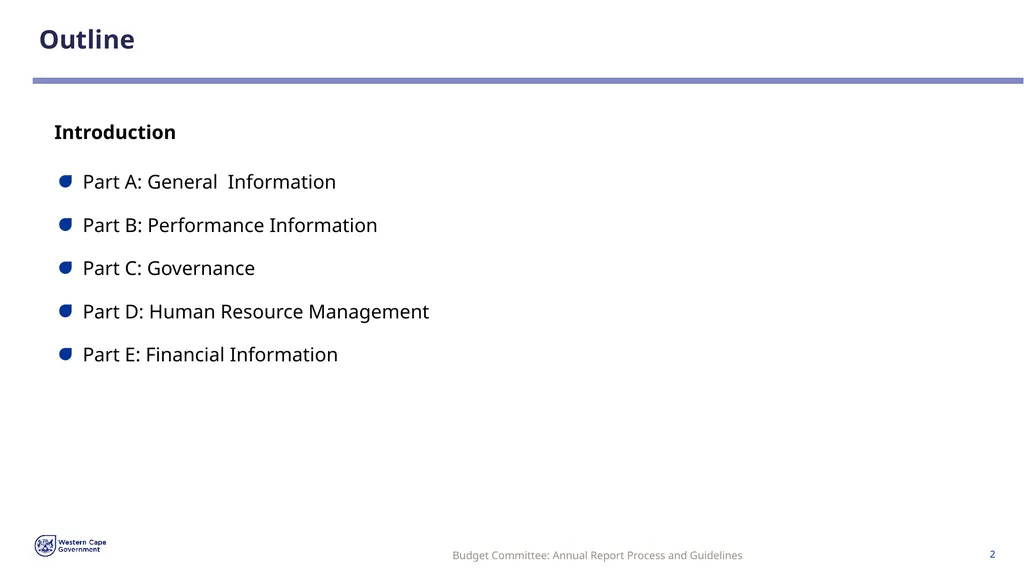
Outline Introduction
Part A: General Information
Part B: Performance Information
Part C: Governance
Part D: Human Resource Management
Part E: Financial Information Budget Committee: Annual Report Process and Guidelines 2<br>
Part A: General Information
Part B: Performance Information
Part C: Governance
Part D: Human Resource Management
Part E: Financial Information Budget Committee: Annual Report Process and Guidelines 2<br>
03
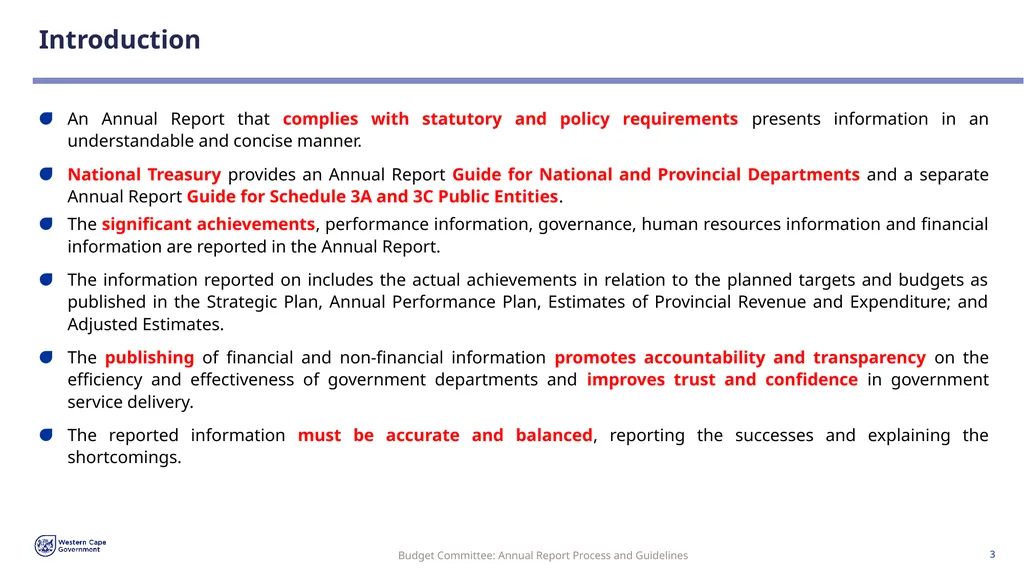
Introduction An Annual Report that complies with statutory and policy requirements presents information in an understandable and concise manner.
National Treasury provides an Annual Report Guide for National and Provincial Departments and a separate Annual Report Guide for Schedule 3A and 3C Public Entities.
The significant achievements, performance information, governance, human resources information and financial information are reported in the Annual Report.
The information reported on includes the actual achievements in relation to the planned targets and budgets as published in the Strategic Plan, Annual Performance Plan, Estimates of Provincial Revenue and Expenditure; and Adjusted Estimates.
The publishing of financial and non-financial information promotes accountability and transparency on the efficiency and effectiveness of government departments and improves trust and confidence in government service delivery.
The reported information must be accurate and balanced, reporting the successes and explaining the shortcomings. Budget Committee: Annual Report Process and Guidelines 3<br>
National Treasury provides an Annual Report Guide for National and Provincial Departments and a separate Annual Report Guide for Schedule 3A and 3C Public Entities.
The significant achievements, performance information, governance, human resources information and financial information are reported in the Annual Report.
The information reported on includes the actual achievements in relation to the planned targets and budgets as published in the Strategic Plan, Annual Performance Plan, Estimates of Provincial Revenue and Expenditure; and Adjusted Estimates.
The publishing of financial and non-financial information promotes accountability and transparency on the efficiency and effectiveness of government departments and improves trust and confidence in government service delivery.
The reported information must be accurate and balanced, reporting the successes and explaining the shortcomings. Budget Committee: Annual Report Process and Guidelines 3<br>
04
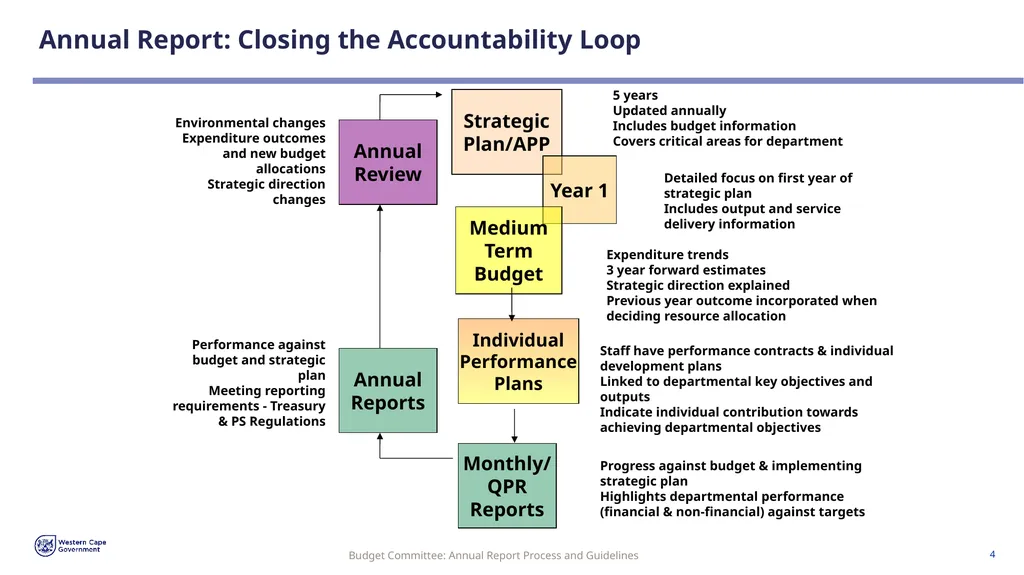
Annual Report: Closing the Accountability Loop Budget Committee: Annual Report Process and Guidelines 4<br>
05
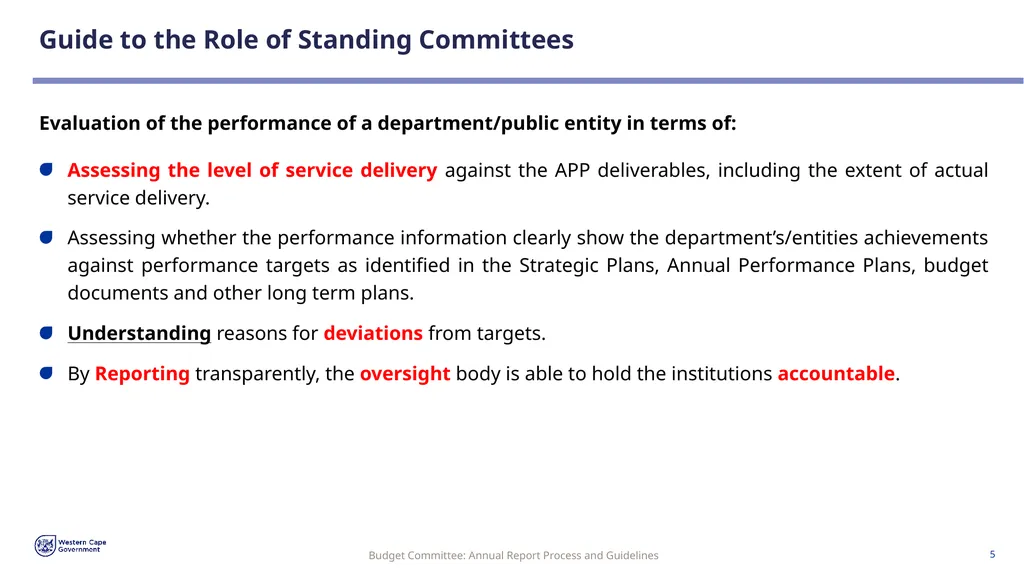
Guide to the Role of Standing Committees Evaluation of the performance of a department/public entity in terms of:
Assessing the level of service delivery against the APP deliverables, including the extent of actual service delivery.
Assessing whether the performance information clearly show the department’s/entities achievements against performance targets as identified in the Strategic Plans, Annual Performance Plans, budget documents and other long term plans.
Understanding reasons for deviations from targets.
By Reporting transparently, the oversight body is able to hold the institutions accountable. Budget Committee: Annual Report Process and Guidelines 5<br>
Assessing the level of service delivery against the APP deliverables, including the extent of actual service delivery.
Assessing whether the performance information clearly show the department’s/entities achievements against performance targets as identified in the Strategic Plans, Annual Performance Plans, budget documents and other long term plans.
Understanding reasons for deviations from targets.
By Reporting transparently, the oversight body is able to hold the institutions accountable. Budget Committee: Annual Report Process and Guidelines 5<br>
06
Part A: General Information<br>
07
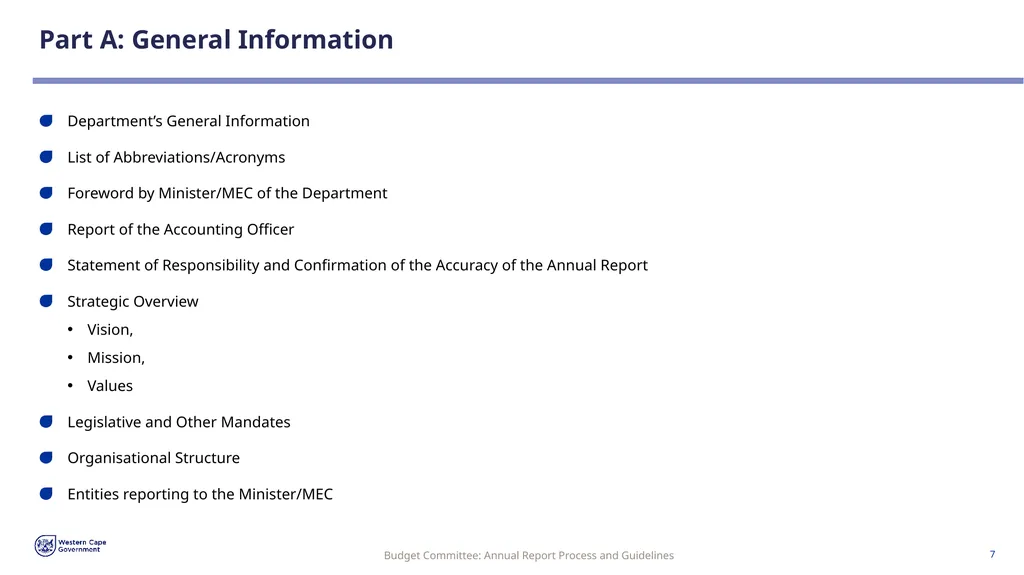
Part A: General Information Department’s General Information
List of Abbreviations/Acronyms
Foreword by Minister/MEC of the Department
Report of the Accounting Officer
Statement of Responsibility and Confirmation of the Accuracy of the Annual Report
Strategic Overview
Vision,
Mission,
Values
Legislative and Other Mandates
Organisational Structure
Entities reporting to the Minister/MEC Budget Committee: Annual Report Process and Guidelines 7<br>
List of Abbreviations/Acronyms
Foreword by Minister/MEC of the Department
Report of the Accounting Officer
Statement of Responsibility and Confirmation of the Accuracy of the Annual Report
Strategic Overview
Vision,
Mission,
Values
Legislative and Other Mandates
Organisational Structure
Entities reporting to the Minister/MEC Budget Committee: Annual Report Process and Guidelines 7<br>
08
Part B: Performance Information<br>
09
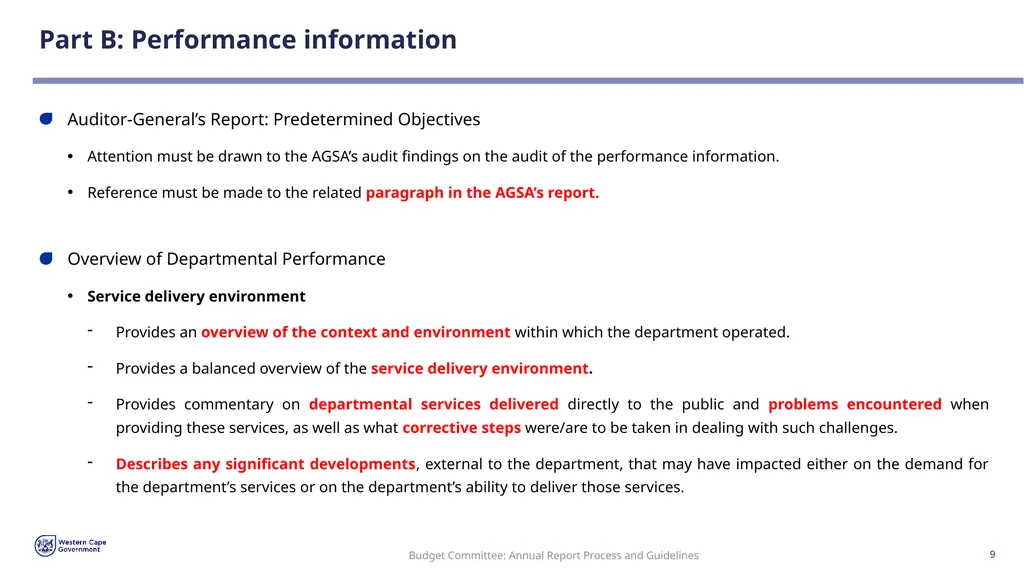
Part B: Performance information Auditor-General’s Report: Predetermined Objectives
Attention must be drawn to the AGSA’s audit findings on the audit of the performance information.
Reference must be made to the related paragraph in the AGSA’s report.
Overview of Departmental Performance
Service delivery environment
Provides an overview of the context and environment within which the department operated.
Provides a balanced overview of the service delivery environment.
Provides commentary on departmental services delivered directly to the public and problems encountered when providing these services, as well as what corrective steps were/are to be taken in dealing with such challenges.
Describes any significant developments, external to the department, that may have impacted either on the demand for the department’s services or on the department’s ability to deliver those services. Budget Committee: Annual Report Process and Guidelines 9<br>
Attention must be drawn to the AGSA’s audit findings on the audit of the performance information.
Reference must be made to the related paragraph in the AGSA’s report.
Overview of Departmental Performance
Service delivery environment
Provides an overview of the context and environment within which the department operated.
Provides a balanced overview of the service delivery environment.
Provides commentary on departmental services delivered directly to the public and problems encountered when providing these services, as well as what corrective steps were/are to be taken in dealing with such challenges.
Describes any significant developments, external to the department, that may have impacted either on the demand for the department’s services or on the department’s ability to deliver those services. Budget Committee: Annual Report Process and Guidelines 9<br>
10
Part B: Performance Information The Service Delivery Improvement Plan outline the:
Department’s main services and standards
Batho Pele arrangements with beneficiaries
Service delivery information tool
Complaint's mechanism
Progress regarding the Service Delivery Improvement Plan is provided on an annual basis within the Annual Report.
Organisational environment
Provides an understanding of organizational challenges and successes experienced.
Aims to provide a description of any internal significant developments that may have impacted the department’s ability to deliver on its Strategic Plan and APP.
As these factors are internal, it is expected that some indication be given on measure adopted to mitigate the impact of these events. Budget Committee: Annual Report Process and Guidelines 10<br>
Department’s main services and standards
Batho Pele arrangements with beneficiaries
Service delivery information tool
Complaint's mechanism
Progress regarding the Service Delivery Improvement Plan is provided on an annual basis within the Annual Report.
Organisational environment
Provides an understanding of organizational challenges and successes experienced.
Aims to provide a description of any internal significant developments that may have impacted the department’s ability to deliver on its Strategic Plan and APP.
As these factors are internal, it is expected that some indication be given on measure adopted to mitigate the impact of these events. Budget Committee: Annual Report Process and Guidelines 10<br>
11
Part B: Performance Information Key policy developments and legislative changes
Provide a description of any major changes to relevant policies or legislation that affected the operations.
Progress towards Achievement of Institutional Impacts and Outcomes
States the impact and outcomes as per the Strategic Plan and the progress made towards the achievement of the 5-year targets.
Highlights significant achievements with regard to the contribution towards the 2019 - 2024 Medium Term Strategic Framework and Provincial Growth and Development Strategy.
Institutional Programme Performance Information
Assesses the efficiency and effectiveness in implementing the Annual Performance Plan
The information reported on in the Annual Report must align to the Annual Performance Plan
Informs programme planning and improvement for the next financial year and encourages programmes to develop strategies.
Description of each programme, including the purpose, list of sub-programmes and list of the institutional outcomes that each programme contributes towards.
Outcomes, outputs, output indicators, targets and actual achievements.
This section provides a narrative on the significant achievements of targets for outputs and output indicators per programme.
It must comment per programme on its response to prioritising women, youth and persons with disabilities in its service delivery environment, challenges encountered by the department when prioritising delivery for these designated groups, and the corrective steps to be taken in dealing with such challenges (where applicable). Budget Committee: Annual Report Process and Guidelines 11<br>
Provide a description of any major changes to relevant policies or legislation that affected the operations.
Progress towards Achievement of Institutional Impacts and Outcomes
States the impact and outcomes as per the Strategic Plan and the progress made towards the achievement of the 5-year targets.
Highlights significant achievements with regard to the contribution towards the 2019 - 2024 Medium Term Strategic Framework and Provincial Growth and Development Strategy.
Institutional Programme Performance Information
Assesses the efficiency and effectiveness in implementing the Annual Performance Plan
The information reported on in the Annual Report must align to the Annual Performance Plan
Informs programme planning and improvement for the next financial year and encourages programmes to develop strategies.
Description of each programme, including the purpose, list of sub-programmes and list of the institutional outcomes that each programme contributes towards.
Outcomes, outputs, output indicators, targets and actual achievements.
This section provides a narrative on the significant achievements of targets for outputs and output indicators per programme.
It must comment per programme on its response to prioritising women, youth and persons with disabilities in its service delivery environment, challenges encountered by the department when prioritising delivery for these designated groups, and the corrective steps to be taken in dealing with such challenges (where applicable). Budget Committee: Annual Report Process and Guidelines 11<br>
12
Part B: Performance Information In tabular format, the following must be included:
List the outcomes that the programme contributes towards.
List the programme/sub-programme outputs that contribute towards the outcomes.
List programme/sub-programme output indicators.
Provide the audited actual achievement in the previous financial year, which must be consistent with the previous annual reports.
Provide the planned annual targets for the period under review as per the Annual Performance Plan.
Provide the actual achievement for the period under review.
Provide the variance between the targets and actual achievements for the period under review.
Provide reasons for all deviations.
Provide reasons for the instances where outputs, output indicators and targets were removed or amended in the revised and re-tabled Annual Performance Plan. Budget Committee: Annual Report Process and Guidelines 12<br>
List the outcomes that the programme contributes towards.
List the programme/sub-programme outputs that contribute towards the outcomes.
List programme/sub-programme output indicators.
Provide the audited actual achievement in the previous financial year, which must be consistent with the previous annual reports.
Provide the planned annual targets for the period under review as per the Annual Performance Plan.
Provide the actual achievement for the period under review.
Provide the variance between the targets and actual achievements for the period under review.
Provide reasons for all deviations.
Provide reasons for the instances where outputs, output indicators and targets were removed or amended in the revised and re-tabled Annual Performance Plan. Budget Committee: Annual Report Process and Guidelines 12<br>
13
Part B: Performance Information Strategy to overcome areas of under performance
Provide the strategies to address under performance.
Performance in relation to Standardised outputs and output indicators for sectors
Certain sectors with concurrent functions have approved standardised or non standardised outputs and output indicators that must be reflected in the Annual Performance Plan and reported on in the annual report.
Provide the reasons where standardised outputs and indicators are not incorporated in the Annual Performance Plan and therefore not implemented and reported in the Annual Report.
Reporting on the institutional response to the COVID-19 Pandemic
report on the external and internal interventions that were implemented in response to the COVID-19 pandemic.
This section should reflect performance of COVID-19 interventions and highlight achievements of interventions funded through the various relief packages (where applicable).
Linking performance with budgets
Provides a summary of the actual expenditure in comparison to the adjusted appropriation for both the current year and previous year.
The information is to reflect the sub-programme level and must agree to the appropriation statement of the audited financial statements.
The reasons for variations should be linked to the information discussed in the organisational environment and the service delivery environment.
Departments are required to report on how expenditure contributed to achievement of outputs. Budget Committee: Annual Report Process and Guidelines 13<br>
Provide the strategies to address under performance.
Performance in relation to Standardised outputs and output indicators for sectors
Certain sectors with concurrent functions have approved standardised or non standardised outputs and output indicators that must be reflected in the Annual Performance Plan and reported on in the annual report.
Provide the reasons where standardised outputs and indicators are not incorporated in the Annual Performance Plan and therefore not implemented and reported in the Annual Report.
Reporting on the institutional response to the COVID-19 Pandemic
report on the external and internal interventions that were implemented in response to the COVID-19 pandemic.
This section should reflect performance of COVID-19 interventions and highlight achievements of interventions funded through the various relief packages (where applicable).
Linking performance with budgets
Provides a summary of the actual expenditure in comparison to the adjusted appropriation for both the current year and previous year.
The information is to reflect the sub-programme level and must agree to the appropriation statement of the audited financial statements.
The reasons for variations should be linked to the information discussed in the organisational environment and the service delivery environment.
Departments are required to report on how expenditure contributed to achievement of outputs. Budget Committee: Annual Report Process and Guidelines 13<br>
14
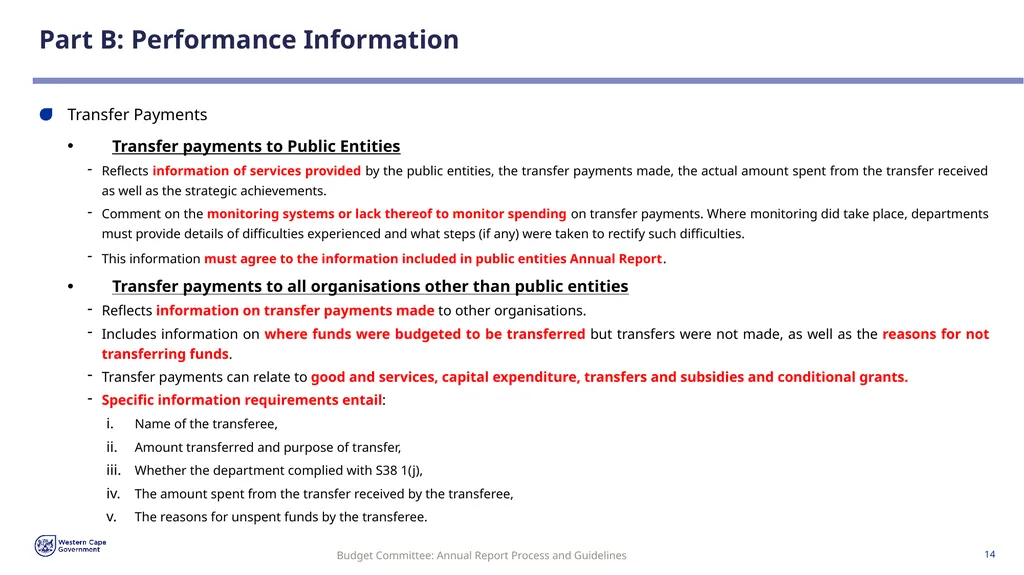
Part B: Performance Information Transfer Payments
Transfer payments to Public Entities
Reflects information of services provided by the public entities, the transfer payments made, the actual amount spent from the transfer received as well as the strategic achievements.
Comment on the monitoring systems or lack thereof to monitor spending on transfer payments. Where monitoring did take place, departments must provide details of difficulties experienced and what steps (if any) were taken to rectify such difficulties.
This information must agree to the information included in public entities Annual Report.
Transfer payments to all organisations other than public entities
Reflects information on transfer payments made to other organisations.
Includes information on where funds were budgeted to be transferred but transfers were not made, as well as the reasons for not transferring funds.
Transfer payments can relate to good and services, capital expenditure, transfers and subsidies and conditional grants.
Specific information requirements entail:
Name of the transferee,
Amount transferred and purpose of transfer,
Whether the department complied with S38 1(j),
The amount spent from the transfer received by the transferee,
The reasons for unspent funds by the transferee. Budget Committee: Annual Report Process and Guidelines 14<br>
Transfer payments to Public Entities
Reflects information of services provided by the public entities, the transfer payments made, the actual amount spent from the transfer received as well as the strategic achievements.
Comment on the monitoring systems or lack thereof to monitor spending on transfer payments. Where monitoring did take place, departments must provide details of difficulties experienced and what steps (if any) were taken to rectify such difficulties.
This information must agree to the information included in public entities Annual Report.
Transfer payments to all organisations other than public entities
Reflects information on transfer payments made to other organisations.
Includes information on where funds were budgeted to be transferred but transfers were not made, as well as the reasons for not transferring funds.
Transfer payments can relate to good and services, capital expenditure, transfers and subsidies and conditional grants.
Specific information requirements entail:
Name of the transferee,
Amount transferred and purpose of transfer,
Whether the department complied with S38 1(j),
The amount spent from the transfer received by the transferee,
The reasons for unspent funds by the transferee. Budget Committee: Annual Report Process and Guidelines 14<br>
15
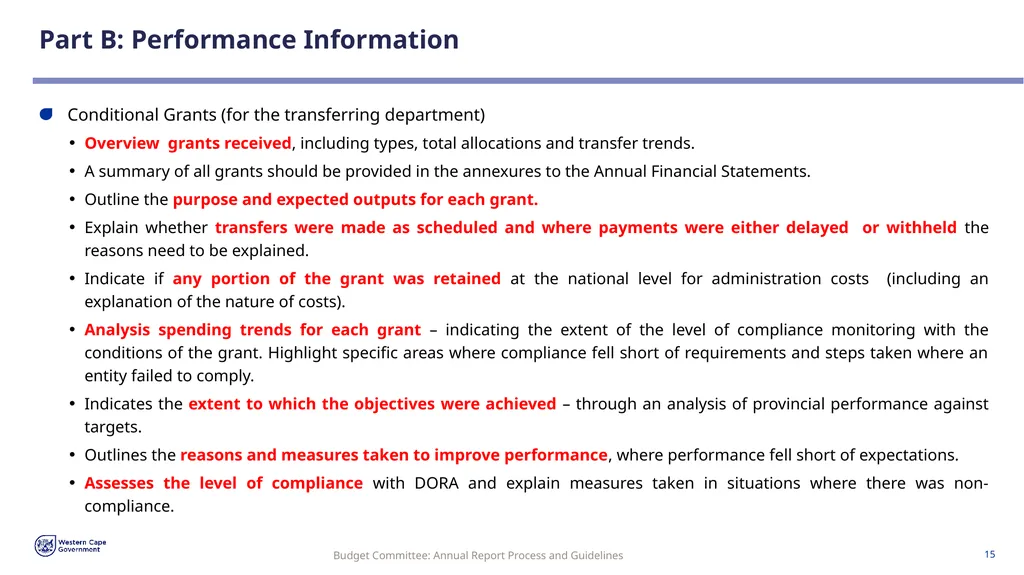
Part B: Performance Information Conditional Grants (for the transferring department)
Overview grants received, including types, total allocations and transfer trends.
A summary of all grants should be provided in the annexures to the Annual Financial Statements.
Outline the purpose and expected outputs for each grant.
Explain whether transfers were made as scheduled and where payments were either delayed or withheld the reasons need to be explained.
Indicate if any portion of the grant was retained at the national level for administration costs (including an explanation of the nature of costs).
Analysis spending trends for each grant – indicating the extent of the level of compliance monitoring with the conditions of the grant. Highlight specific areas where compliance fell short of requirements and steps taken where an entity failed to comply.
Indicates the extent to which the objectives were achieved – through an analysis of provincial performance against targets.
Outlines the reasons and measures taken to improve performance, where performance fell short of expectations.
Assesses the level of compliance with DORA and explain measures taken in situations where there was non-compliance. Budget Committee: Annual Report Process and Guidelines 15<br>
Overview grants received, including types, total allocations and transfer trends.
A summary of all grants should be provided in the annexures to the Annual Financial Statements.
Outline the purpose and expected outputs for each grant.
Explain whether transfers were made as scheduled and where payments were either delayed or withheld the reasons need to be explained.
Indicate if any portion of the grant was retained at the national level for administration costs (including an explanation of the nature of costs).
Analysis spending trends for each grant – indicating the extent of the level of compliance monitoring with the conditions of the grant. Highlight specific areas where compliance fell short of requirements and steps taken where an entity failed to comply.
Indicates the extent to which the objectives were achieved – through an analysis of provincial performance against targets.
Outlines the reasons and measures taken to improve performance, where performance fell short of expectations.
Assesses the level of compliance with DORA and explain measures taken in situations where there was non-compliance. Budget Committee: Annual Report Process and Guidelines 15<br>
16
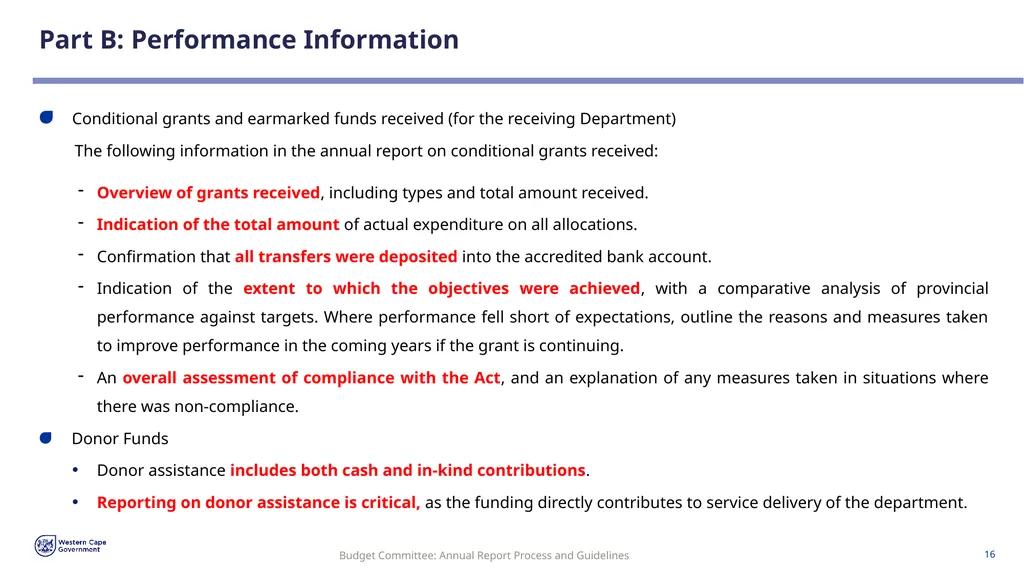
Part B: Performance Information Conditional grants and earmarked funds received (for the receiving Department)
The following information in the annual report on conditional grants received:
Overview of grants received, including types and total amount received.
Indication of the total amount of actual expenditure on all allocations.
Confirmation that all transfers were deposited into the accredited bank account.
Indication of the extent to which the objectives were achieved, with a comparative analysis of provincial performance against targets. Where performance fell short of expectations, outline the reasons and measures taken to improve performance in the coming years if the grant is continuing.
An overall assessment of compliance with the Act, and an explanation of any measures taken in situations where there was non-compliance.
Donor Funds
Donor assistance includes both cash and in-kind contributions.
Reporting on donor assistance is critical, as the funding directly contributes to service delivery of the department. Budget Committee: Annual Report Process and Guidelines 16<br>
The following information in the annual report on conditional grants received:
Overview of grants received, including types and total amount received.
Indication of the total amount of actual expenditure on all allocations.
Confirmation that all transfers were deposited into the accredited bank account.
Indication of the extent to which the objectives were achieved, with a comparative analysis of provincial performance against targets. Where performance fell short of expectations, outline the reasons and measures taken to improve performance in the coming years if the grant is continuing.
An overall assessment of compliance with the Act, and an explanation of any measures taken in situations where there was non-compliance.
Donor Funds
Donor assistance includes both cash and in-kind contributions.
Reporting on donor assistance is critical, as the funding directly contributes to service delivery of the department. Budget Committee: Annual Report Process and Guidelines 16<br>
17
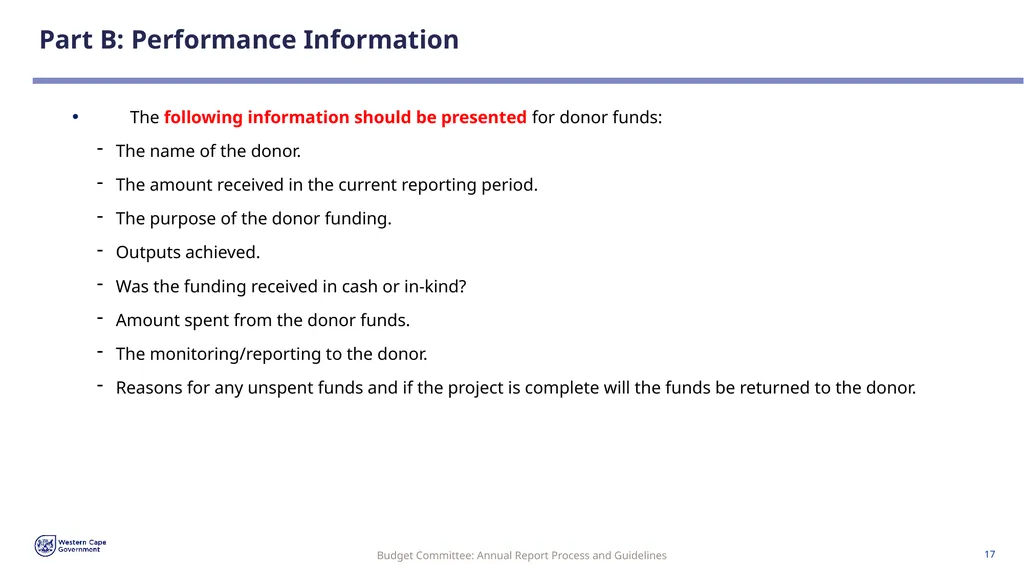
Part B: Performance Information The following information should be presented for donor funds:
The name of the donor.
The amount received in the current reporting period.
The purpose of the donor funding.
Outputs achieved.
Was the funding received in cash or in-kind?
Amount spent from the donor funds.
The monitoring/reporting to the donor.
Reasons for any unspent funds and if the project is complete will the funds be returned to the donor. Budget Committee: Annual Report Process and Guidelines 17<br>
The name of the donor.
The amount received in the current reporting period.
The purpose of the donor funding.
Outputs achieved.
Was the funding received in cash or in-kind?
Amount spent from the donor funds.
The monitoring/reporting to the donor.
Reasons for any unspent funds and if the project is complete will the funds be returned to the donor. Budget Committee: Annual Report Process and Guidelines 17<br>
18
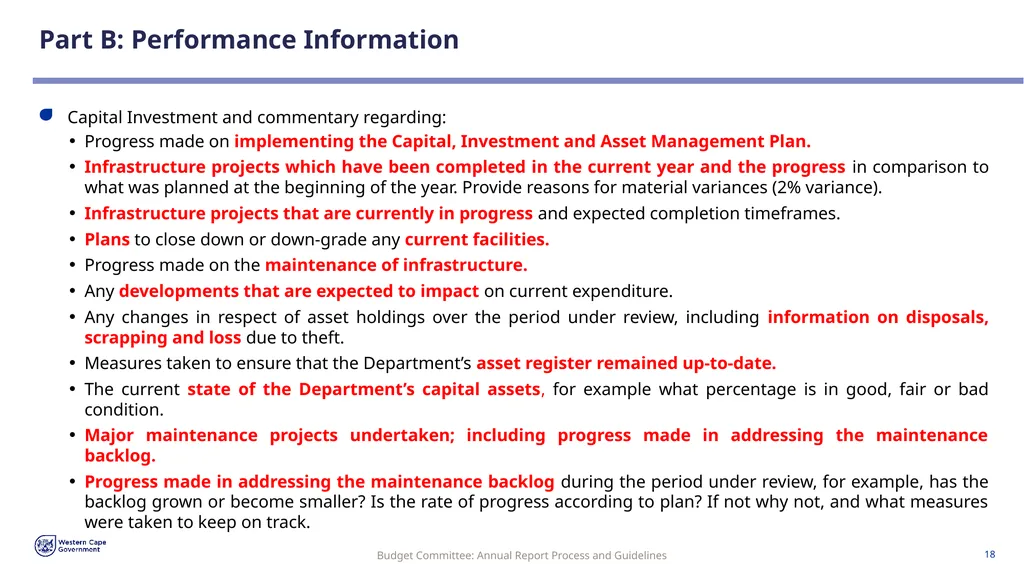
Part B: Performance Information Capital Investment and commentary regarding:
Progress made on implementing the Capital, Investment and Asset Management Plan.
Infrastructure projects which have been completed in the current year and the progress in comparison to what was planned at the beginning of the year. Provide reasons for material variances (2% variance).
Infrastructure projects that are currently in progress and expected completion timeframes.
Plans to close down or down-grade any current facilities.
Progress made on the maintenance of infrastructure.
Any developments that are expected to impact on current expenditure.
Any changes in respect of asset holdings over the period under review, including information on disposals, scrapping and loss due to theft.
Measures taken to ensure that the Department’s asset register remained up-to-date.
The current state of the Department’s capital assets, for example what percentage is in good, fair or bad condition.
Major maintenance projects undertaken; including progress made in addressing the maintenance backlog.
Progress made in addressing the maintenance backlog during the period under review, for example, has the backlog grown or become smaller? Is the rate of progress according to plan? If not why not, and what measures were taken to keep on track. Budget Committee: Annual Report Process and Guidelines 18<br>
Progress made on implementing the Capital, Investment and Asset Management Plan.
Infrastructure projects which have been completed in the current year and the progress in comparison to what was planned at the beginning of the year. Provide reasons for material variances (2% variance).
Infrastructure projects that are currently in progress and expected completion timeframes.
Plans to close down or down-grade any current facilities.
Progress made on the maintenance of infrastructure.
Any developments that are expected to impact on current expenditure.
Any changes in respect of asset holdings over the period under review, including information on disposals, scrapping and loss due to theft.
Measures taken to ensure that the Department’s asset register remained up-to-date.
The current state of the Department’s capital assets, for example what percentage is in good, fair or bad condition.
Major maintenance projects undertaken; including progress made in addressing the maintenance backlog.
Progress made in addressing the maintenance backlog during the period under review, for example, has the backlog grown or become smaller? Is the rate of progress according to plan? If not why not, and what measures were taken to keep on track. Budget Committee: Annual Report Process and Guidelines 18<br>
19
Part C: Governance Information<br>
20
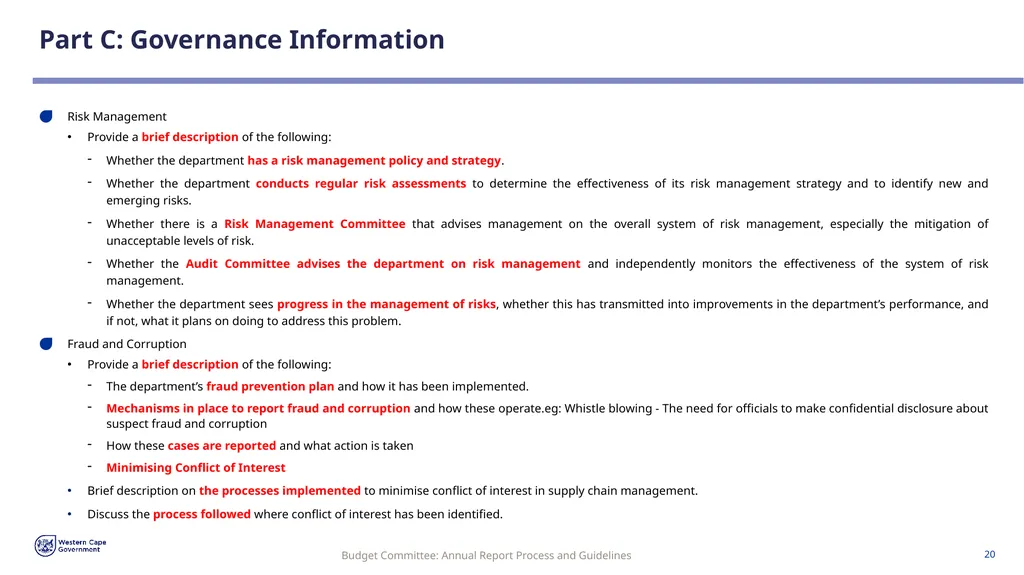
Part C: Governance Information Risk Management
Provide a brief description of the following:
Whether the department has a risk management policy and strategy.
Whether the department conducts regular risk assessments to determine the effectiveness of its risk management strategy and to identify new and emerging risks.
Whether there is a Risk Management Committee that advises management on the overall system of risk management, especially the mitigation of unacceptable levels of risk.
Whether the Audit Committee advises the department on risk management and independently monitors the effectiveness of the system of risk management.
Whether the department sees progress in the management of risks, whether this has transmitted into improvements in the department’s performance, and if not, what it plans on doing to address this problem.
Fraud and Corruption
Provide a brief description of the following:
The department’s fraud prevention plan and how it has been implemented.
Mechanisms in place to report fraud and corruption and how these operate.eg: Whistle blowing - The need for officials to make confidential disclosure about suspect fraud and corruption
How these cases are reported and what action is taken
Minimising Conflict of Interest
Brief description on the processes implemented to minimise conflict of interest in supply chain management.
Discuss the process followed where conflict of interest has been identified. Budget Committee: Annual Report Process and Guidelines 20<br>
Provide a brief description of the following:
Whether the department has a risk management policy and strategy.
Whether the department conducts regular risk assessments to determine the effectiveness of its risk management strategy and to identify new and emerging risks.
Whether there is a Risk Management Committee that advises management on the overall system of risk management, especially the mitigation of unacceptable levels of risk.
Whether the Audit Committee advises the department on risk management and independently monitors the effectiveness of the system of risk management.
Whether the department sees progress in the management of risks, whether this has transmitted into improvements in the department’s performance, and if not, what it plans on doing to address this problem.
Fraud and Corruption
Provide a brief description of the following:
The department’s fraud prevention plan and how it has been implemented.
Mechanisms in place to report fraud and corruption and how these operate.eg: Whistle blowing - The need for officials to make confidential disclosure about suspect fraud and corruption
How these cases are reported and what action is taken
Minimising Conflict of Interest
Brief description on the processes implemented to minimise conflict of interest in supply chain management.
Discuss the process followed where conflict of interest has been identified. Budget Committee: Annual Report Process and Guidelines 20<br>
21
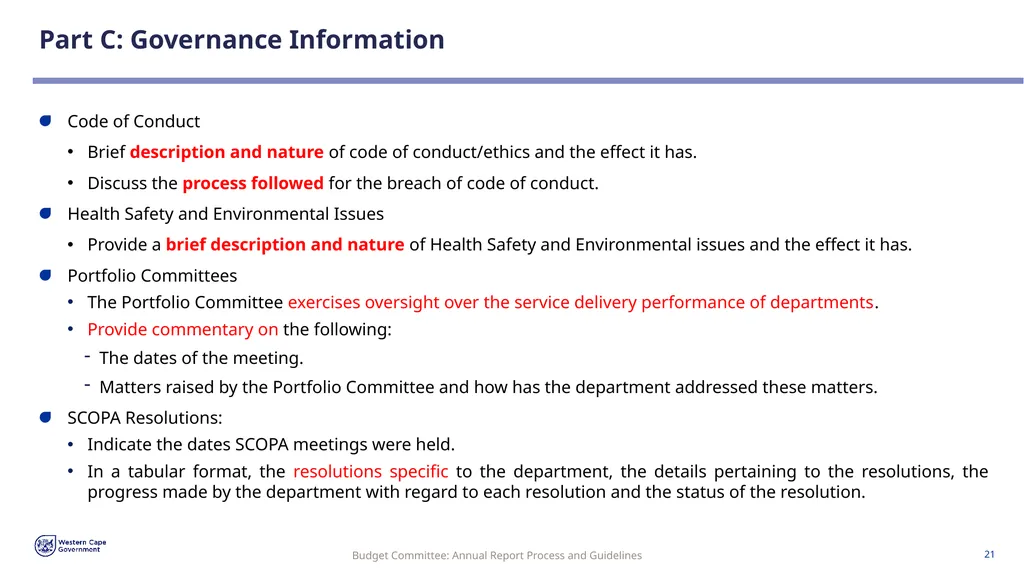
Part C: Governance Information Code of Conduct
Brief description and nature of code of conduct/ethics and the effect it has.
Discuss the process followed for the breach of code of conduct.
Health Safety and Environmental Issues
Provide a brief description and nature of Health Safety and Environmental issues and the effect it has.
Portfolio Committees
The Portfolio Committee exercises oversight over the service delivery performance of departments.
Provide commentary on the following:
The dates of the meeting.
Matters raised by the Portfolio Committee and how has the department addressed these matters.
SCOPA Resolutions:
Indicate the dates SCOPA meetings were held.
In a tabular format, the resolutions specific to the department, the details pertaining to the resolutions, the progress made by the department with regard to each resolution and the status of the resolution. Budget Committee: Annual Report Process and Guidelines 21<br>
Brief description and nature of code of conduct/ethics and the effect it has.
Discuss the process followed for the breach of code of conduct.
Health Safety and Environmental Issues
Provide a brief description and nature of Health Safety and Environmental issues and the effect it has.
Portfolio Committees
The Portfolio Committee exercises oversight over the service delivery performance of departments.
Provide commentary on the following:
The dates of the meeting.
Matters raised by the Portfolio Committee and how has the department addressed these matters.
SCOPA Resolutions:
Indicate the dates SCOPA meetings were held.
In a tabular format, the resolutions specific to the department, the details pertaining to the resolutions, the progress made by the department with regard to each resolution and the status of the resolution. Budget Committee: Annual Report Process and Guidelines 21<br>
22
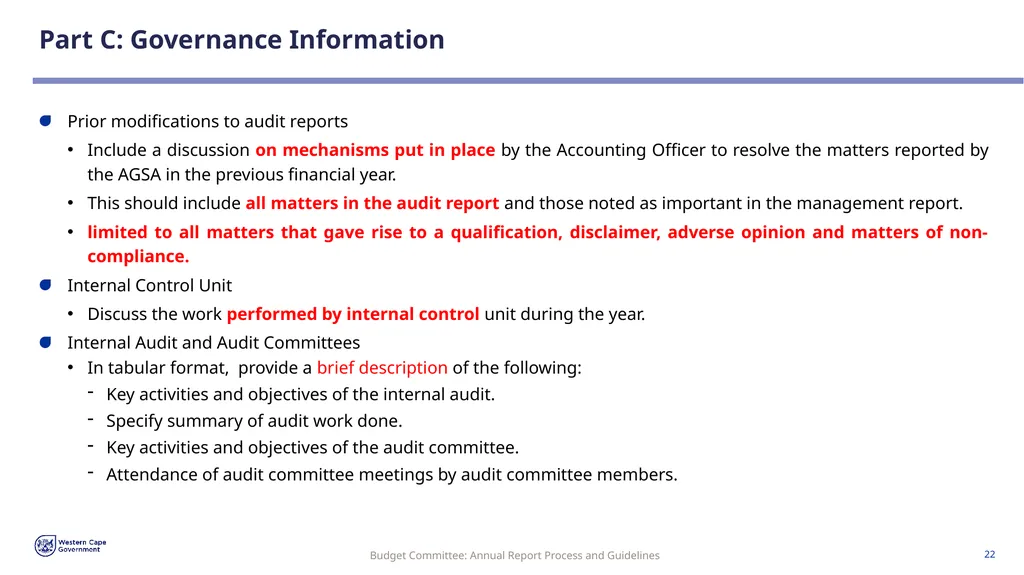
Part C: Governance Information Prior modifications to audit reports
Include a discussion on mechanisms put in place by the Accounting Officer to resolve the matters reported by the AGSA in the previous financial year.
This should include all matters in the audit report and those noted as important in the management report.
limited to all matters that gave rise to a qualification, disclaimer, adverse opinion and matters of non-compliance.
Internal Control Unit
Discuss the work performed by internal control unit during the year.
Internal Audit and Audit Committees
In tabular format, provide a brief description of the following:
Key activities and objectives of the internal audit.
Specify summary of audit work done.
Key activities and objectives of the audit committee.
Attendance of audit committee meetings by audit committee members. Budget Committee: Annual Report Process and Guidelines 22<br>
Include a discussion on mechanisms put in place by the Accounting Officer to resolve the matters reported by the AGSA in the previous financial year.
This should include all matters in the audit report and those noted as important in the management report.
limited to all matters that gave rise to a qualification, disclaimer, adverse opinion and matters of non-compliance.
Internal Control Unit
Discuss the work performed by internal control unit during the year.
Internal Audit and Audit Committees
In tabular format, provide a brief description of the following:
Key activities and objectives of the internal audit.
Specify summary of audit work done.
Key activities and objectives of the audit committee.
Attendance of audit committee meetings by audit committee members. Budget Committee: Annual Report Process and Guidelines 22<br>
23
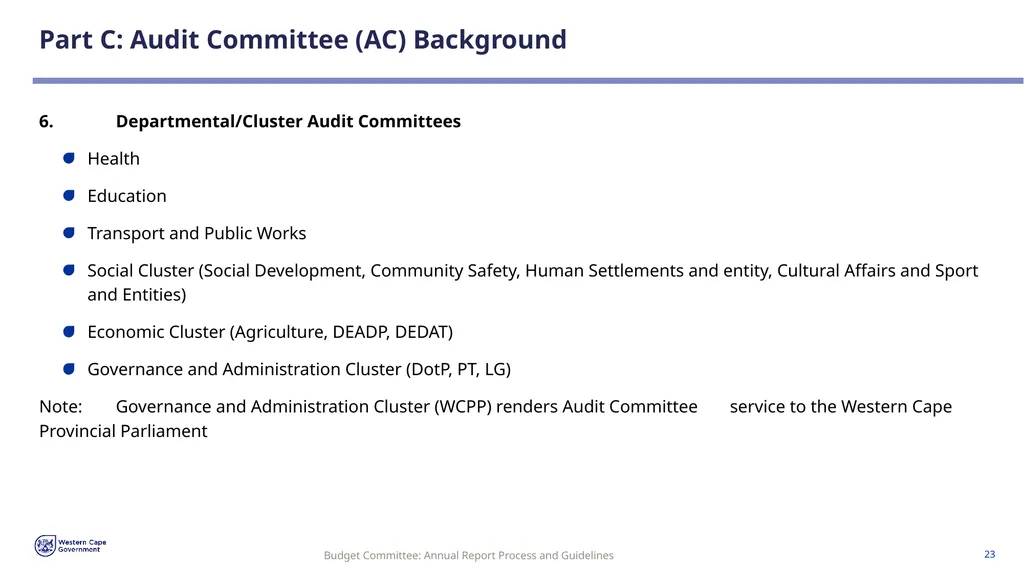
Part C: Audit Committee (AC) Background 6. Departmental/Cluster Audit Committees
Health
Education
Transport and Public Works
Social Cluster (Social Development, Community Safety, Human Settlements and entity, Cultural Affairs and Sport and Entities)
Economic Cluster (Agriculture, DEADP, DEDAT)
Governance and Administration Cluster (DotP, PT, LG)
Note: Governance and Administration Cluster (WCPP) renders Audit Committee service to the Western Cape Provincial Parliament Budget Committee: Annual Report Process and Guidelines 23<br>
Health
Education
Transport and Public Works
Social Cluster (Social Development, Community Safety, Human Settlements and entity, Cultural Affairs and Sport and Entities)
Economic Cluster (Agriculture, DEADP, DEDAT)
Governance and Administration Cluster (DotP, PT, LG)
Note: Governance and Administration Cluster (WCPP) renders Audit Committee service to the Western Cape Provincial Parliament Budget Committee: Annual Report Process and Guidelines 23<br>
24
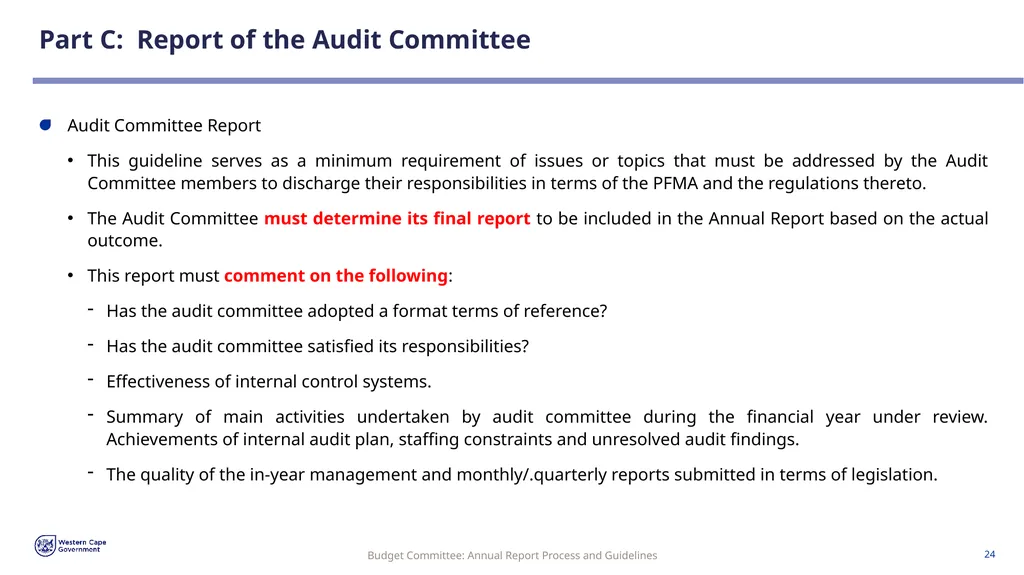
Part C: Report of the Audit Committee Audit Committee Report
This guideline serves as a minimum requirement of issues or topics that must be addressed by the Audit Committee members to discharge their responsibilities in terms of the PFMA and the regulations thereto.
The Audit Committee must determine its final report to be included in the Annual Report based on the actual outcome.
This report must comment on the following:
Has the audit committee adopted a format terms of reference?
Has the audit committee satisfied its responsibilities?
Effectiveness of internal control systems.
Summary of main activities undertaken by audit committee during the financial year under review. Achievements of internal audit plan, staffing constraints and unresolved audit findings.
The quality of the in-year management and monthly/.quarterly reports submitted in terms of legislation. Budget Committee: Annual Report Process and Guidelines 24<br>
This guideline serves as a minimum requirement of issues or topics that must be addressed by the Audit Committee members to discharge their responsibilities in terms of the PFMA and the regulations thereto.
The Audit Committee must determine its final report to be included in the Annual Report based on the actual outcome.
This report must comment on the following:
Has the audit committee adopted a format terms of reference?
Has the audit committee satisfied its responsibilities?
Effectiveness of internal control systems.
Summary of main activities undertaken by audit committee during the financial year under review. Achievements of internal audit plan, staffing constraints and unresolved audit findings.
The quality of the in-year management and monthly/.quarterly reports submitted in terms of legislation. Budget Committee: Annual Report Process and Guidelines 24<br>
25
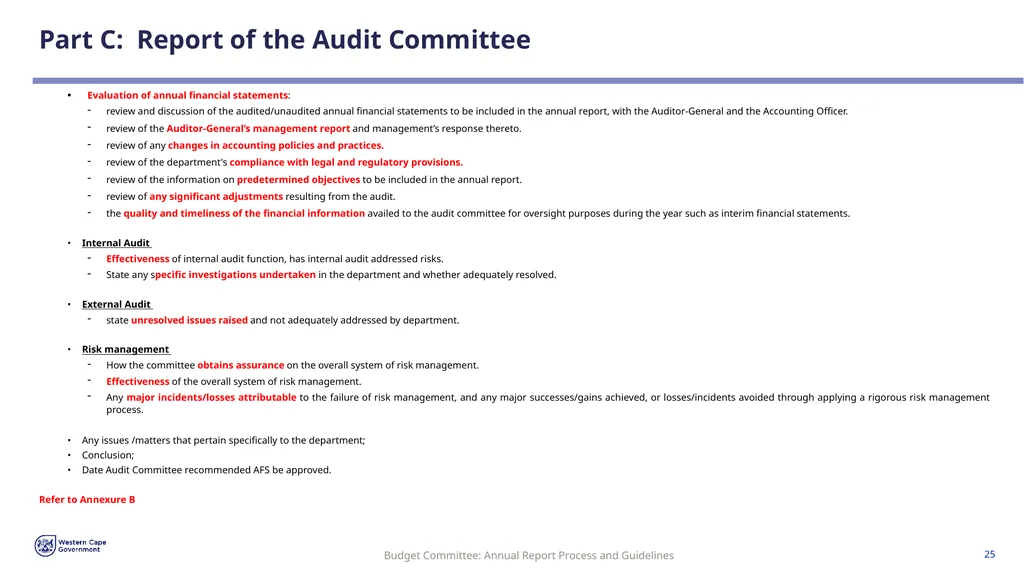
Part C: Report of the Audit Committee Evaluation of annual financial statements:
review and discussion of the audited/unaudited annual financial statements to be included in the annual report, with the Auditor-General and the Accounting Officer.
review of the Auditor-General’s management report and management’s response thereto.
review of any changes in accounting policies and practices.
review of the department's compliance with legal and regulatory provisions.
review of the information on predetermined objectives to be included in the annual report.
review of any significant adjustments resulting from the audit.
the quality and timeliness of the financial information availed to the audit committee for oversight purposes during the year such as interim financial statements.
• Internal Audit
Effectiveness of internal audit function, has internal audit addressed risks.
State any specific investigations undertaken in the department and whether adequately resolved.
• External Audit
state unresolved issues raised and not adequately addressed by department.
• Risk management
How the committee obtains assurance on the overall system of risk management.
Effectiveness of the overall system of risk management.
Any major incidents/losses attributable to the failure of risk management, and any major successes/gains achieved, or losses/incidents avoided through applying a rigorous risk management process.
• Any issues /matters that pertain specifically to the department;
• Conclusion;
• Date Audit Committee recommended AFS be approved.
Refer to Annexure B Budget Committee: Annual Report Process and Guidelines 25<br>
review and discussion of the audited/unaudited annual financial statements to be included in the annual report, with the Auditor-General and the Accounting Officer.
review of the Auditor-General’s management report and management’s response thereto.
review of any changes in accounting policies and practices.
review of the department's compliance with legal and regulatory provisions.
review of the information on predetermined objectives to be included in the annual report.
review of any significant adjustments resulting from the audit.
the quality and timeliness of the financial information availed to the audit committee for oversight purposes during the year such as interim financial statements.
• Internal Audit
Effectiveness of internal audit function, has internal audit addressed risks.
State any specific investigations undertaken in the department and whether adequately resolved.
• External Audit
state unresolved issues raised and not adequately addressed by department.
• Risk management
How the committee obtains assurance on the overall system of risk management.
Effectiveness of the overall system of risk management.
Any major incidents/losses attributable to the failure of risk management, and any major successes/gains achieved, or losses/incidents avoided through applying a rigorous risk management process.
• Any issues /matters that pertain specifically to the department;
• Conclusion;
• Date Audit Committee recommended AFS be approved.
Refer to Annexure B Budget Committee: Annual Report Process and Guidelines 25<br>
26
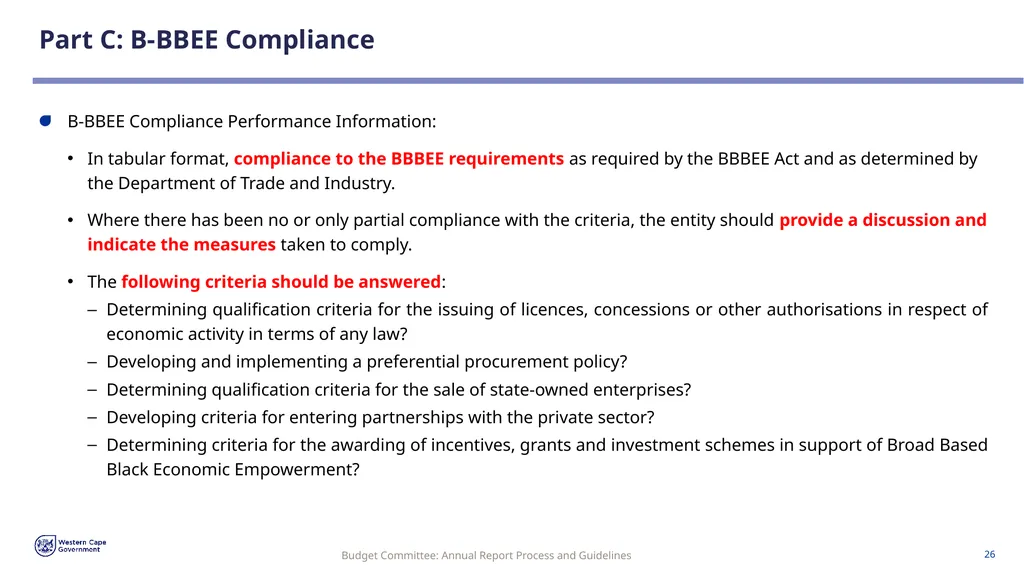
Part C: B-BBEE Compliance B-BBEE Compliance Performance Information:
In tabular format, compliance to the BBBEE requirements as required by the BBBEE Act and as determined by the Department of Trade and Industry.
Where there has been no or only partial compliance with the criteria, the entity should provide a discussion and indicate the measures taken to comply.
The following criteria should be answered:
Determining qualification criteria for the issuing of licences, concessions or other authorisations in respect of economic activity in terms of any law?
Developing and implementing a preferential procurement policy?
Determining qualification criteria for the sale of state-owned enterprises?
Developing criteria for entering partnerships with the private sector?
Determining criteria for the awarding of incentives, grants and investment schemes in support of Broad Based Black Economic Empowerment? Budget Committee: Annual Report Process and Guidelines 26<br>
In tabular format, compliance to the BBBEE requirements as required by the BBBEE Act and as determined by the Department of Trade and Industry.
Where there has been no or only partial compliance with the criteria, the entity should provide a discussion and indicate the measures taken to comply.
The following criteria should be answered:
Determining qualification criteria for the issuing of licences, concessions or other authorisations in respect of economic activity in terms of any law?
Developing and implementing a preferential procurement policy?
Determining qualification criteria for the sale of state-owned enterprises?
Developing criteria for entering partnerships with the private sector?
Determining criteria for the awarding of incentives, grants and investment schemes in support of Broad Based Black Economic Empowerment? Budget Committee: Annual Report Process and Guidelines 26<br>
27
Part D: Human Resource Management<br>
28
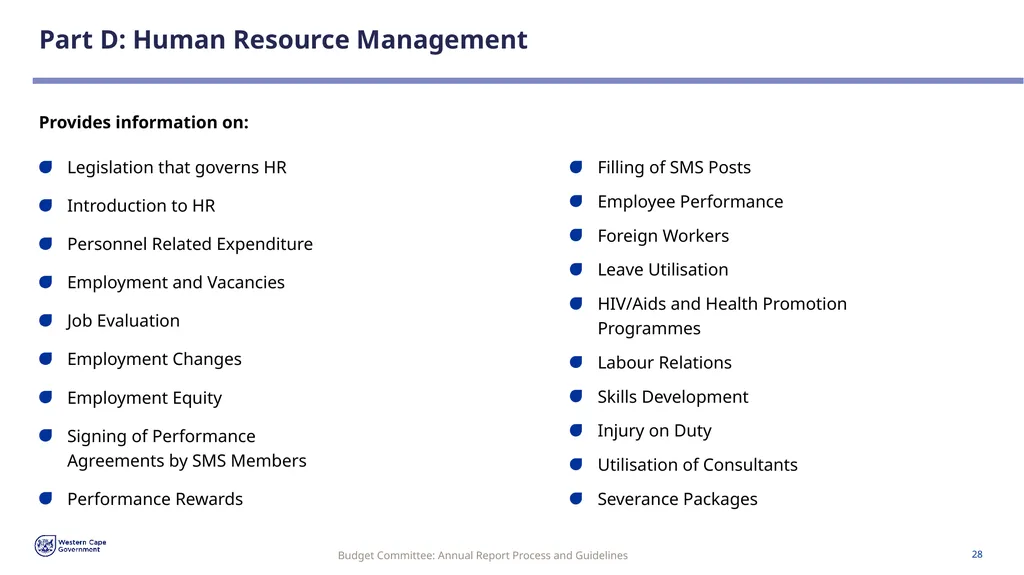
Part D: Human Resource Management Legislation that governs HR
Introduction to HR
Personnel Related Expenditure
Employment and Vacancies
Job Evaluation
Employment Changes
Employment Equity
Signing of Performance Agreements by SMS Members
Performance Rewards Filling of SMS Posts
Employee Performance
Foreign Workers
Leave Utilisation
HIV/Aids and Health Promotion Programmes
Labour Relations
Skills Development
Injury on Duty
Utilisation of Consultants
Severance Packages Provides information on: 28 Budget Committee: Annual Report Process and Guidelines<br>
Introduction to HR
Personnel Related Expenditure
Employment and Vacancies
Job Evaluation
Employment Changes
Employment Equity
Signing of Performance Agreements by SMS Members
Performance Rewards Filling of SMS Posts
Employee Performance
Foreign Workers
Leave Utilisation
HIV/Aids and Health Promotion Programmes
Labour Relations
Skills Development
Injury on Duty
Utilisation of Consultants
Severance Packages Provides information on: 28 Budget Committee: Annual Report Process and Guidelines<br>
29
Part D: Introduction to Human Resources This section provides commentary on the following:
The status of human resources in the department.
Human resource priorities for the year under review and the impact of these.
Workforce planning and key strategies to attract and recruit a skilled and capable workforce.
Employee performance management.
Employee wellness programmes.
Highlight achievements and challenges faced by the department, as well as future human resource plans/goals. Budget Committee: Annual Report Process and Guidelines 29<br>
The status of human resources in the department.
Human resource priorities for the year under review and the impact of these.
Workforce planning and key strategies to attract and recruit a skilled and capable workforce.
Employee performance management.
Employee wellness programmes.
Highlight achievements and challenges faced by the department, as well as future human resource plans/goals. Budget Committee: Annual Report Process and Guidelines 29<br>
30
Part D: Personnel Related Expenditure This section summarise final audited expenditure by programme (Table 3.1.1) and by salary bands (Table 3.1.2). In particular, it provides an indication of the following:
amount spent on personnel;
amount spent on salaries, overtime, homeowner’s allowances and medical aid.
The figures in Table 3.1.1 are drawn from the basic accounting system (BAS) and the figures in Table 3.1.2 are drawn from the PERSAL system. The two systems are not synchronised for salary refunds. This means there may be a difference in total expenditure reflected on these systems.
The number of employees in this section refer to all employees that have been remunerated during the period under review, including those who have left the employ of the department. Budget Committee: Annual Report Process and Guidelines 30<br>
amount spent on personnel;
amount spent on salaries, overtime, homeowner’s allowances and medical aid.
The figures in Table 3.1.1 are drawn from the basic accounting system (BAS) and the figures in Table 3.1.2 are drawn from the PERSAL system. The two systems are not synchronised for salary refunds. This means there may be a difference in total expenditure reflected on these systems.
The number of employees in this section refer to all employees that have been remunerated during the period under review, including those who have left the employ of the department. Budget Committee: Annual Report Process and Guidelines 30<br>
31
Part D: Employment, Vacancies & Job Evaluations Employment and Vacancies
Provides a summary of:
the number of posts on the establishment,
the number of employees,
the vacancy rate, and
whether there are any staff that are additional to the establishment.
This information is presented in terms of three key variables:
programme
salary band
critical occupations (needs to be monitored)
Job Evaluation
Determines the grading and salary level of a post.
Provides summaries on the number of jobs evaluated. Budget Committee: Annual Report Process and Guidelines 31<br>
Provides a summary of:
the number of posts on the establishment,
the number of employees,
the vacancy rate, and
whether there are any staff that are additional to the establishment.
This information is presented in terms of three key variables:
programme
salary band
critical occupations (needs to be monitored)
Job Evaluation
Determines the grading and salary level of a post.
Provides summaries on the number of jobs evaluated. Budget Committee: Annual Report Process and Guidelines 31<br>
32
Part D: Employment Changes Turnover rates provide an indication of trends in the employment profile of the department during the year under review.
Turnover rates must be read in conjunction with Table 3.4.3 (reasons why staff are leaving). Budget Committee: Annual Report Process and Guidelines 32<br>
Turnover rates must be read in conjunction with Table 3.4.3 (reasons why staff are leaving). Budget Committee: Annual Report Process and Guidelines 32<br>
33
Part D: Employment Equity This section reflects the employment equity profile of employees in the following categories:
Overall Headcount
Employees with Disabilities
Recruitment
Promotions
Termination
Disciplinary Actions
Skills Development
This section includes the number of posts filled plus the number of persons additional to the establishment (as reflected in Table 3.2.1).
This must be read in conjunction with an approved EE Plan. Budget Committee: Annual Report Process and Guidelines 33<br>
Overall Headcount
Employees with Disabilities
Recruitment
Promotions
Termination
Disciplinary Actions
Skills Development
This section includes the number of posts filled plus the number of persons additional to the establishment (as reflected in Table 3.2.1).
This must be read in conjunction with an approved EE Plan. Budget Committee: Annual Report Process and Guidelines 33<br>
34
Part D: Senior Management Services (SMS) Performance Management
SMS Performance Agreements must be signed annually by 31 May (with the exception within an election year may sign within 3 months following the month in which elections took place).
Reasons and Disciplinary steps for not concluding Performance agreements for SMS members by the required date.
Filling of SMS posts
SMS posts must be advertised within 6 months and filled within 12 months of becoming vacant.
The number of SMS posts, filled and vacant is reviewed midway through the financial year (30 September) and the end of the financial year (31 March).
Reasons for complying with the prescribed timeframes for filling SMS posts. Budget Committee: Annual Report Process and Guidelines 34<br>
SMS Performance Agreements must be signed annually by 31 May (with the exception within an election year may sign within 3 months following the month in which elections took place).
Reasons and Disciplinary steps for not concluding Performance agreements for SMS members by the required date.
Filling of SMS posts
SMS posts must be advertised within 6 months and filled within 12 months of becoming vacant.
The number of SMS posts, filled and vacant is reviewed midway through the financial year (30 September) and the end of the financial year (31 March).
Reasons for complying with the prescribed timeframes for filling SMS posts. Budget Committee: Annual Report Process and Guidelines 34<br>
35
Part D: Employee Performance & Foreign Workers Employee Performance
Indicates distribution of performance rewards per race, gender and salary levels.
Information in respect of performance rewards for Non-SMS, SMS and critical occupations.
The value of performance rewards must not exceed 1.5% of the total personnel expenditure.
Performance rewards paid out in the period under review is for employee performance in the previous financial year as the performance cycle runs concurrent with the financial year.
Foreign Workers
Summarise the employment of foreign nationals in the Department in terms of salary bands and by major occupation.
Foreign nationals with permanent residency are included in this section. Budget Committee: Annual Report Process and Guidelines 35<br>
Indicates distribution of performance rewards per race, gender and salary levels.
Information in respect of performance rewards for Non-SMS, SMS and critical occupations.
The value of performance rewards must not exceed 1.5% of the total personnel expenditure.
Performance rewards paid out in the period under review is for employee performance in the previous financial year as the performance cycle runs concurrent with the financial year.
Foreign Workers
Summarise the employment of foreign nationals in the Department in terms of salary bands and by major occupation.
Foreign nationals with permanent residency are included in this section. Budget Committee: Annual Report Process and Guidelines 35<br>
36
Part D: Leave Utilisation Tables reflect number of staff who have used:
Sick Leave
Disability (temporary and permanent) Leave
Annual Leave
Capped Leave
This section also summarises payments made to employees as a result of leave that was not taken.
All leave runs over a calendar year (1 Jan – 31 Dec) and is therefore not synchronized with the financial year (1 Apr – 31 Mar) Budget Committee: Annual Report Process and Guidelines 36<br>
Sick Leave
Disability (temporary and permanent) Leave
Annual Leave
Capped Leave
This section also summarises payments made to employees as a result of leave that was not taken.
All leave runs over a calendar year (1 Jan – 31 Dec) and is therefore not synchronized with the financial year (1 Apr – 31 Mar) Budget Committee: Annual Report Process and Guidelines 36<br>
37
Part D: HIV and AIDS & Health Promotion Programmes Responds to specific questions relating to compliance issues in respect of HIV and AIDS and Health Promotion Programmes. Budget Committee: Annual Report Process and Guidelines 37<br>
38
Part D: Labour Relations & Skills Development Collective agreements with unions
Information on:
Misconduct and disciplinary hearing finalized.
Grievances lodged.
Disputes lodged with Councils.
Strike action.
Precautionary suspensions.
Skills Development
Indicates the training needs of the departments as extracted from the Workplace Skills Plan.
Details the number of persons within the various occupational categories who have attended training interventions. Budget Committee: Annual Report Process and Guidelines 38<br>
Information on:
Misconduct and disciplinary hearing finalized.
Grievances lodged.
Disputes lodged with Councils.
Strike action.
Precautionary suspensions.
Skills Development
Indicates the training needs of the departments as extracted from the Workplace Skills Plan.
Details the number of persons within the various occupational categories who have attended training interventions. Budget Committee: Annual Report Process and Guidelines 38<br>
39
Part D: Injury on Duty Indicates the following:
The nature of the injury
Degree of disablement
Workplace Fatalities (if any) Budget Committee: Annual Report Process and Guidelines 39<br>
The nature of the injury
Degree of disablement
Workplace Fatalities (if any) Budget Committee: Annual Report Process and Guidelines 39<br>
40
Part D: Use of Consultants Indicates the use of consultants using appropriated funds/donor funds:
The projects on which consultants were used
The number of consultants utilised per project
Number of days worked by the consultant/s
The contract value Budget Committee: Annual Report Process and Guidelines 40<br>
The projects on which consultants were used
The number of consultants utilised per project
Number of days worked by the consultant/s
The contract value Budget Committee: Annual Report Process and Guidelines 40<br>
41
Part D: Severance Packages Indicates the following:
Granting of employee initiated severance packages. Budget Committee: Annual Report Process and Guidelines 41<br>
Granting of employee initiated severance packages. Budget Committee: Annual Report Process and Guidelines 41<br>
42
Part E: Financial Information<br>
43
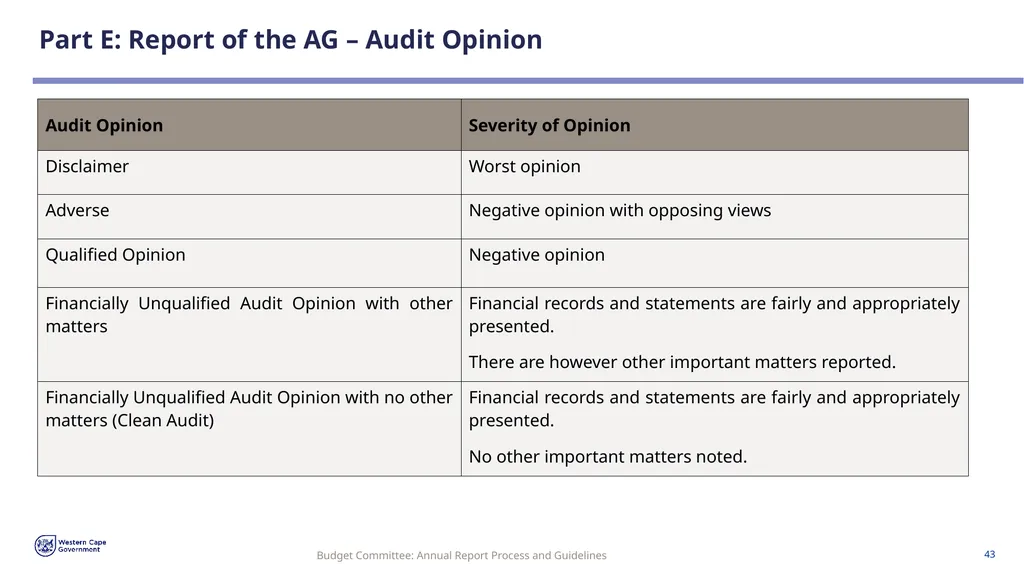
Part E: Report of the AG – Audit Opinion Budget Committee: Annual Report Process and Guidelines 43<br>
44
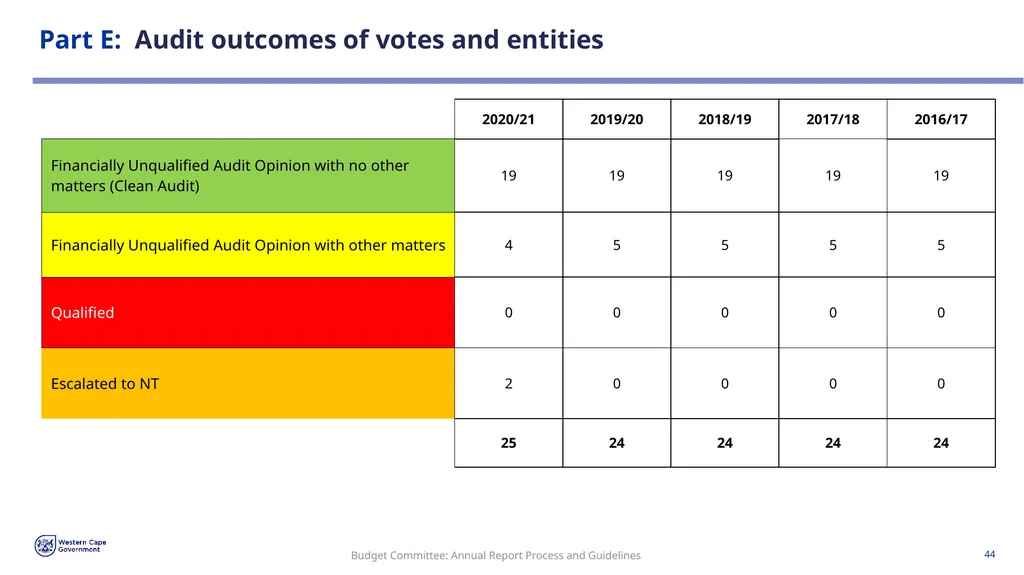
Part E: Audit outcomes of votes and entities Budget Committee: Annual Report Process and Guidelines 44<br>
45
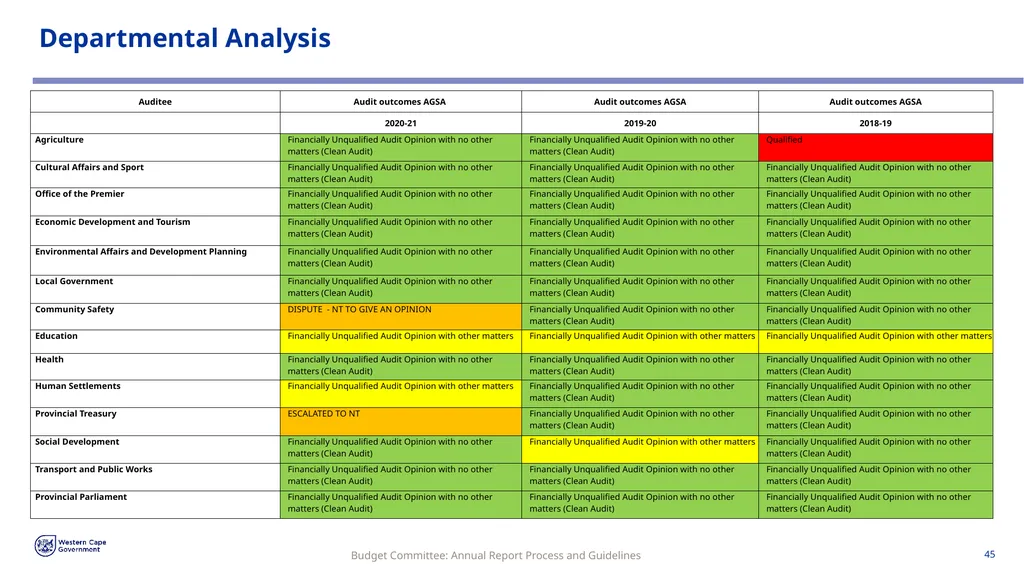
Departmental Analysis Budget Committee: Annual Report Process and Guidelines 45<br>
46
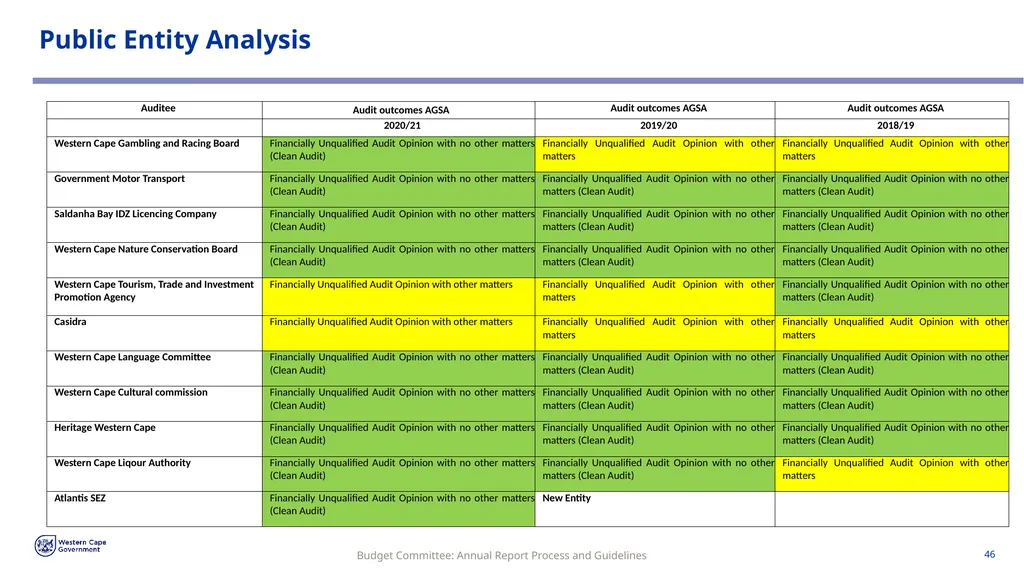
Public Entity Analysis Budget Committee: Annual Report Process and Guidelines 46<br>
47
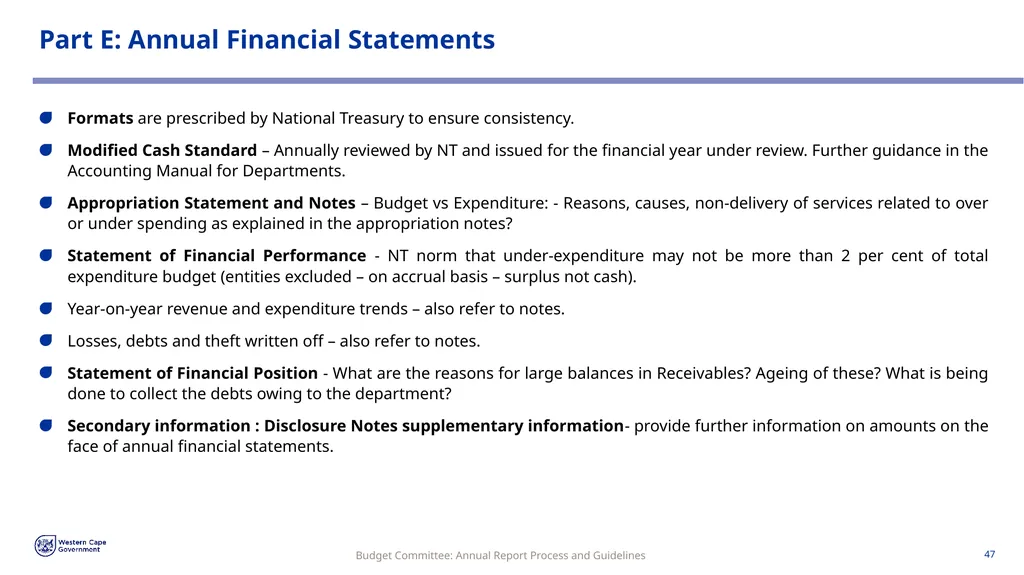
Part E: Annual Financial Statements Formats are prescribed by National Treasury to ensure consistency.
Modified Cash Standard – Annually reviewed by NT and issued for the financial year under review. Further guidance in the Accounting Manual for Departments.
Appropriation Statement and Notes – Budget vs Expenditure: - Reasons, causes, non-delivery of services related to over or under spending as explained in the appropriation notes?
Statement of Financial Performance - NT norm that under-expenditure may not be more than 2 per cent of total expenditure budget (entities excluded – on accrual basis – surplus not cash).
Year-on-year revenue and expenditure trends – also refer to notes.
Losses, debts and theft written off – also refer to notes.
Statement of Financial Position - What are the reasons for large balances in Receivables? Ageing of these? What is being done to collect the debts owing to the department?
Secondary information : Disclosure Notes supplementary information- provide further information on amounts on the face of annual financial statements. Budget Committee: Annual Report Process and Guidelines 47<br>
Modified Cash Standard – Annually reviewed by NT and issued for the financial year under review. Further guidance in the Accounting Manual for Departments.
Appropriation Statement and Notes – Budget vs Expenditure: - Reasons, causes, non-delivery of services related to over or under spending as explained in the appropriation notes?
Statement of Financial Performance - NT norm that under-expenditure may not be more than 2 per cent of total expenditure budget (entities excluded – on accrual basis – surplus not cash).
Year-on-year revenue and expenditure trends – also refer to notes.
Losses, debts and theft written off – also refer to notes.
Statement of Financial Position - What are the reasons for large balances in Receivables? Ageing of these? What is being done to collect the debts owing to the department?
Secondary information : Disclosure Notes supplementary information- provide further information on amounts on the face of annual financial statements. Budget Committee: Annual Report Process and Guidelines 47<br>
48
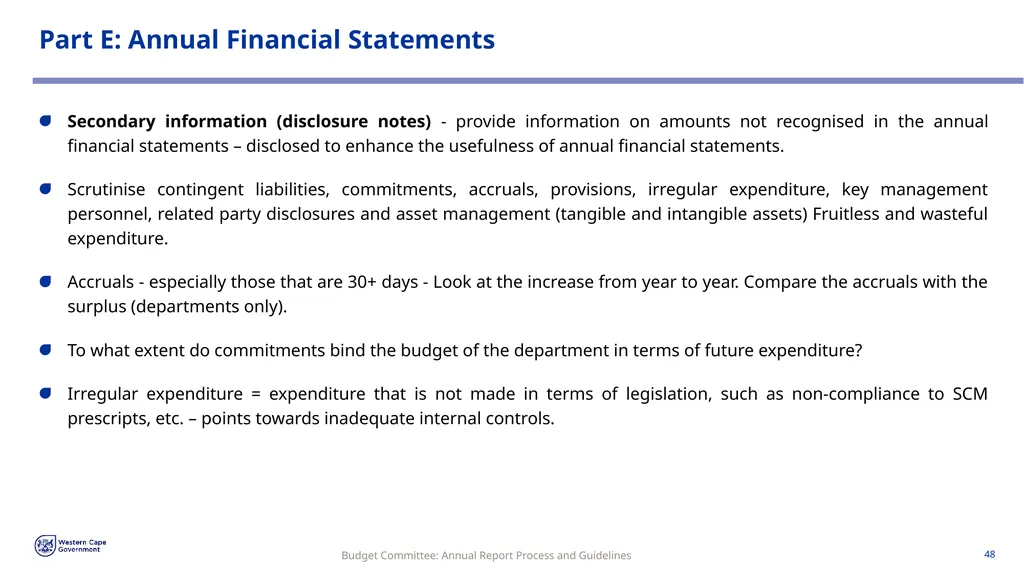
Part E: Annual Financial Statements Secondary information (disclosure notes) - provide information on amounts not recognised in the annual financial statements – disclosed to enhance the usefulness of annual financial statements.
Scrutinise contingent liabilities, commitments, accruals, provisions, irregular expenditure, key management personnel, related party disclosures and asset management (tangible and intangible assets) Fruitless and wasteful expenditure.
Accruals - especially those that are 30+ days - Look at the increase from year to year. Compare the accruals with the surplus (departments only).
To what extent do commitments bind the budget of the department in terms of future expenditure?
Irregular expenditure = expenditure that is not made in terms of legislation, such as non-compliance to SCM prescripts, etc. – points towards inadequate internal controls. Budget Committee: Annual Report Process and Guidelines 48<br>
Scrutinise contingent liabilities, commitments, accruals, provisions, irregular expenditure, key management personnel, related party disclosures and asset management (tangible and intangible assets) Fruitless and wasteful expenditure.
Accruals - especially those that are 30+ days - Look at the increase from year to year. Compare the accruals with the surplus (departments only).
To what extent do commitments bind the budget of the department in terms of future expenditure?
Irregular expenditure = expenditure that is not made in terms of legislation, such as non-compliance to SCM prescripts, etc. – points towards inadequate internal controls. Budget Committee: Annual Report Process and Guidelines 48<br>
49
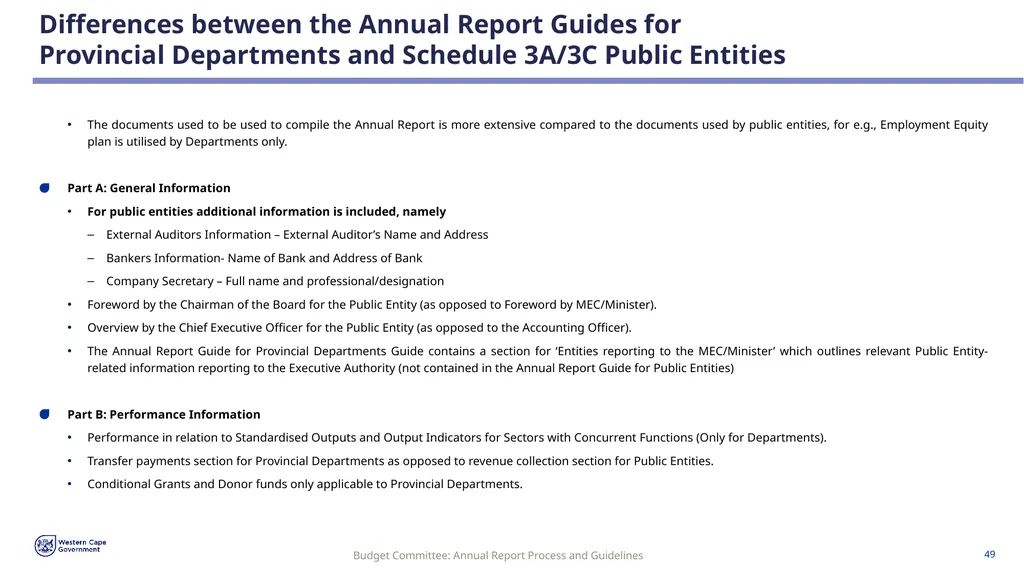
Differences between the Annual Report Guides for
Provincial Departments and Schedule 3A/3C Public Entities The documents used to be used to compile the Annual Report is more extensive compared to the documents used by public entities, for e.g., Employment Equity plan is utilised by Departments only.
Part A: General Information
For public entities additional information is included, namely
External Auditors Information – External Auditor’s Name and Address
Bankers Information- Name of Bank and Address of Bank
Company Secretary – Full name and professional/designation
Foreword by the Chairman of the Board for the Public Entity (as opposed to Foreword by MEC/Minister).
Overview by the Chief Executive Officer for the Public Entity (as opposed to the Accounting Officer).
The Annual Report Guide for Provincial Departments Guide contains a section for ‘Entities reporting to the MEC/Minister’ which outlines relevant Public Entity-related information reporting to the Executive Authority (not contained in the Annual Report Guide for Public Entities)
Part B: Performance Information
Performance in relation to Standardised Outputs and Output Indicators for Sectors with Concurrent Functions (Only for Departments).
Transfer payments section for Provincial Departments as opposed to revenue collection section for Public Entities.
Conditional Grants and Donor funds only applicable to Provincial Departments. Budget Committee: Annual Report Process and Guidelines 49<br>
Part A: General Information
For public entities additional information is included, namely
External Auditors Information – External Auditor’s Name and Address
Bankers Information- Name of Bank and Address of Bank
Company Secretary – Full name and professional/designation
Foreword by the Chairman of the Board for the Public Entity (as opposed to Foreword by MEC/Minister).
Overview by the Chief Executive Officer for the Public Entity (as opposed to the Accounting Officer).
The Annual Report Guide for Provincial Departments Guide contains a section for ‘Entities reporting to the MEC/Minister’ which outlines relevant Public Entity-related information reporting to the Executive Authority (not contained in the Annual Report Guide for Public Entities)
Part B: Performance Information
Performance in relation to Standardised Outputs and Output Indicators for Sectors with Concurrent Functions (Only for Departments).
Transfer payments section for Provincial Departments as opposed to revenue collection section for Public Entities.
Conditional Grants and Donor funds only applicable to Provincial Departments. Budget Committee: Annual Report Process and Guidelines 49<br>
50
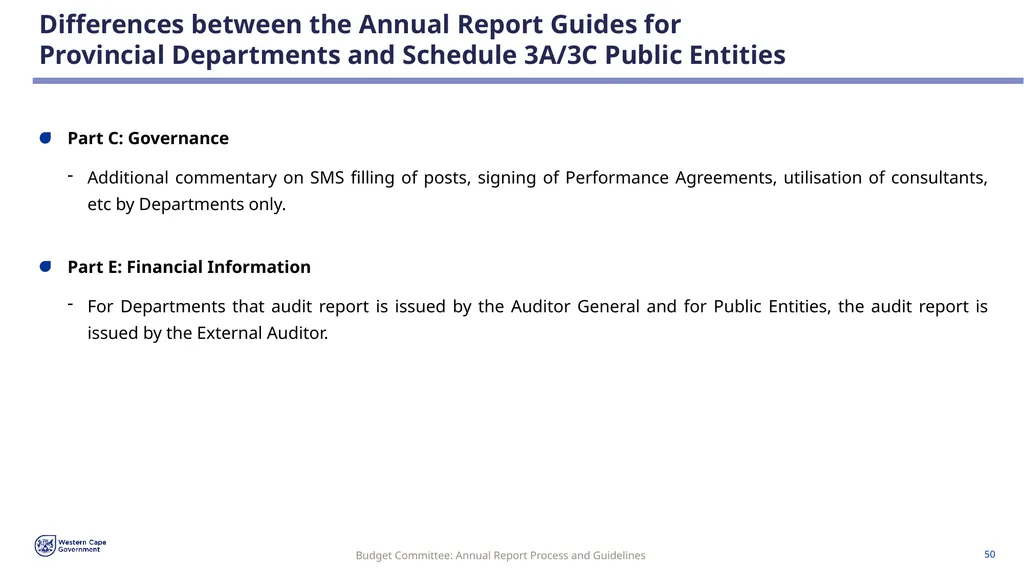
Differences between the Annual Report Guides for
Provincial Departments and Schedule 3A/3C Public Entities Part C: Governance
Additional commentary on SMS filling of posts, signing of Performance Agreements, utilisation of consultants, etc by Departments only.
Part E: Financial Information
For Departments that audit report is issued by the Auditor General and for Public Entities, the audit report is issued by the External Auditor. Budget Committee: Annual Report Process and Guidelines 50<br>
Additional commentary on SMS filling of posts, signing of Performance Agreements, utilisation of consultants, etc by Departments only.
Part E: Financial Information
For Departments that audit report is issued by the Auditor General and for Public Entities, the audit report is issued by the External Auditor. Budget Committee: Annual Report Process and Guidelines 50<br>
51
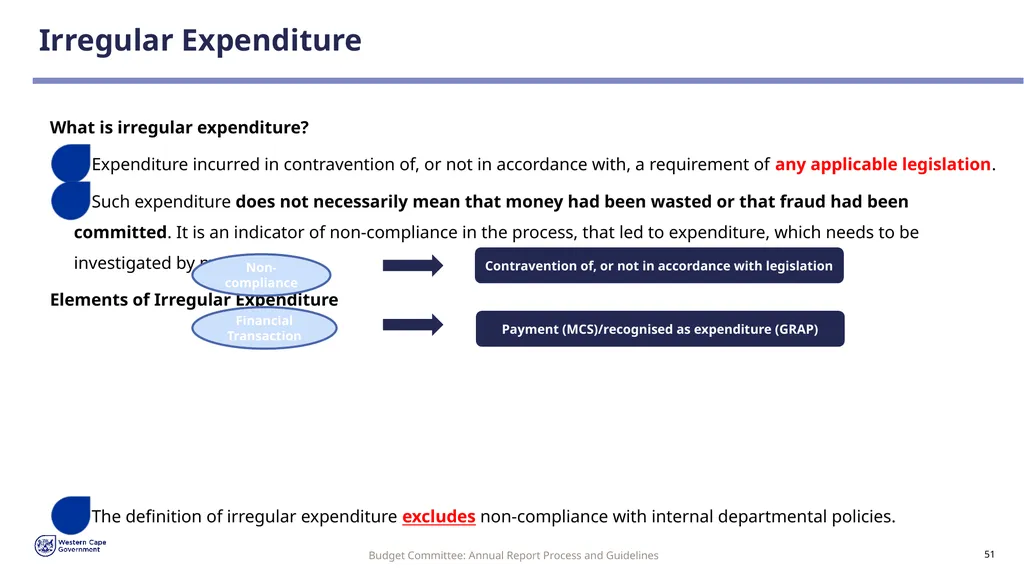
Irregular Expenditure 51 What is irregular expenditure?
Expenditure incurred in contravention of, or not in accordance with, a requirement of any applicable legislation.
Such expenditure does not necessarily mean that money had been wasted or that fraud had been committed. It is an indicator of non-compliance in the process, that led to expenditure, which needs to be investigated by management.
Elements of Irregular Expenditure
The definition of irregular expenditure excludes non-compliance with internal departmental policies. Contravention of, or not in accordance with legislation Payment (MCS)/recognised as expenditure (GRAP) Non-compliance Financial Transaction Budget Committee: Annual Report Process and Guidelines<br>
Expenditure incurred in contravention of, or not in accordance with, a requirement of any applicable legislation.
Such expenditure does not necessarily mean that money had been wasted or that fraud had been committed. It is an indicator of non-compliance in the process, that led to expenditure, which needs to be investigated by management.
Elements of Irregular Expenditure
The definition of irregular expenditure excludes non-compliance with internal departmental policies. Contravention of, or not in accordance with legislation Payment (MCS)/recognised as expenditure (GRAP) Non-compliance Financial Transaction Budget Committee: Annual Report Process and Guidelines<br>
52
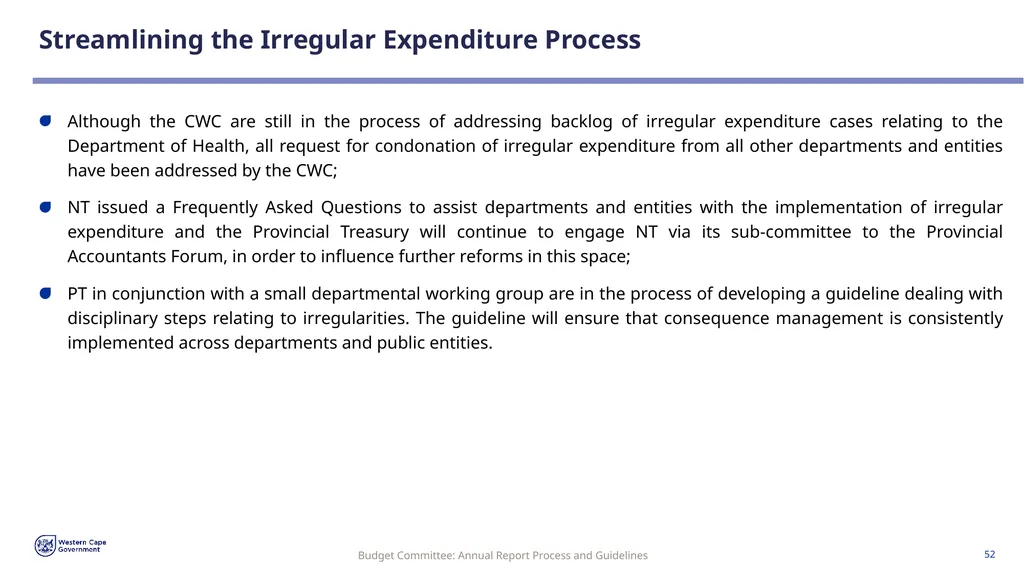
Streamlining the Irregular Expenditure Process Although the CWC are still in the process of addressing backlog of irregular expenditure cases relating to the Department of Health, all request for condonation of irregular expenditure from all other departments and entities have been addressed by the CWC;
NT issued a Frequently Asked Questions to assist departments and entities with the implementation of irregular expenditure and the Provincial Treasury will continue to engage NT via its sub-committee to the Provincial Accountants Forum, in order to influence further reforms in this space;
PT in conjunction with a small departmental working group are in the process of developing a guideline dealing with disciplinary steps relating to irregularities. The guideline will ensure that consequence management is consistently implemented across departments and public entities. Budget Committee: Annual Report Process and Guidelines 52<br>
NT issued a Frequently Asked Questions to assist departments and entities with the implementation of irregular expenditure and the Provincial Treasury will continue to engage NT via its sub-committee to the Provincial Accountants Forum, in order to influence further reforms in this space;
PT in conjunction with a small departmental working group are in the process of developing a guideline dealing with disciplinary steps relating to irregularities. The guideline will ensure that consequence management is consistently implemented across departments and public entities. Budget Committee: Annual Report Process and Guidelines 52<br>
53
Changes to the 2021/22 Annual Report Guide The guideline was updated during August 2021.
Beside minor wording changes, the following changes are noted: Budget Committee: Annual Report Process and Guidelines 53<br>
Beside minor wording changes, the following changes are noted: Budget Committee: Annual Report Process and Guidelines 53<br>
54
Aziz Hardien<br>