
Anti-Racist Report Update March 2025 Context Since


Description: Anti-Racist Report Update March 2025 Context Since 2022, SSE has been reporting on an annual basis on our anti-racism progress. This report tracks progress and learnings across SSEs own anti-racism journey, but it is also important to
Related Topics
Download Presentation
"Anti-Racist Report Update March 2025 Context Since" is the property of its rightful owner. Permission is granted to download and print the materials on this website for personal, non-commercial use only, and to display it on your personal computer provided you do not modify the materials and that you retain all copyright notices contained in the materials. By downloading content from our website, you accept the terms of this agreement.
Presentation Transcript
slide1. Anti-Racist Report Update March 2025<br>
slide2. Context Since 2022, SSE has been reporting on an annual basis on our anti-racism progress.
This report tracks progress and learnings across SSE's own anti-racism journey, but it is also important to acknowledge the global instability and division around Equity, Diversity and Inclusion during this time period (March 2025). In this climate, it is even more important we remain committed in our journey to become an anti-racist organisation.
As a result, we are deepening our approach. To make meaningful progress, we are shifting to also measuring outcomes—ensuring our programmes truly drive equity. This aligns with our wider strategy and has led us to improve how we collect, analyse, and act on data.
Therefore, we have also refreshed our indicators to reflect this change grouping our work across four areas (workplace practices and diversity, inclusive delivery, equitable outcomes and sector-wide advocacy).
Previous anti-racist reports:
Spring 2024 | June 2023 | December 2022 | January 2021<br>
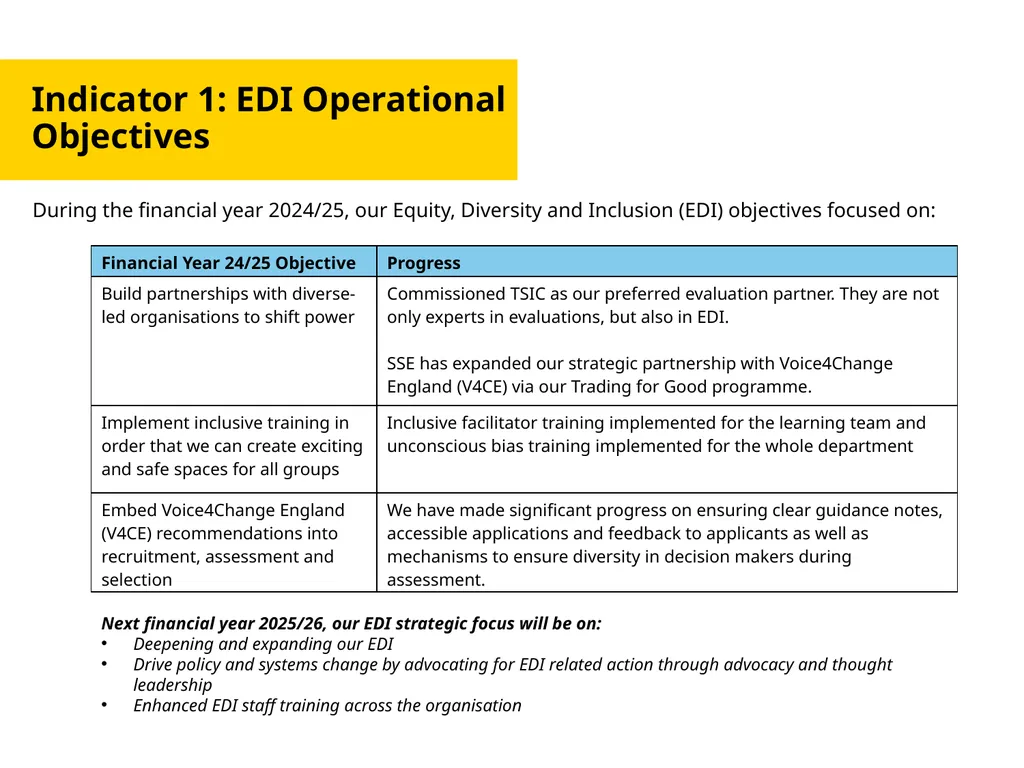
slide3. Indicator 1: EDI Operational Objectives During the financial year 2024/25, our Equity, Diversity and Inclusion (EDI) objectives focused on: Next financial year 2025/26, our EDI strategic focus will be on:
Deepening and expanding our EDI
Drive policy and systems change by advocating for EDI related action through advocacy and thought leadership
Enhanced EDI staff training across the organisation<br>
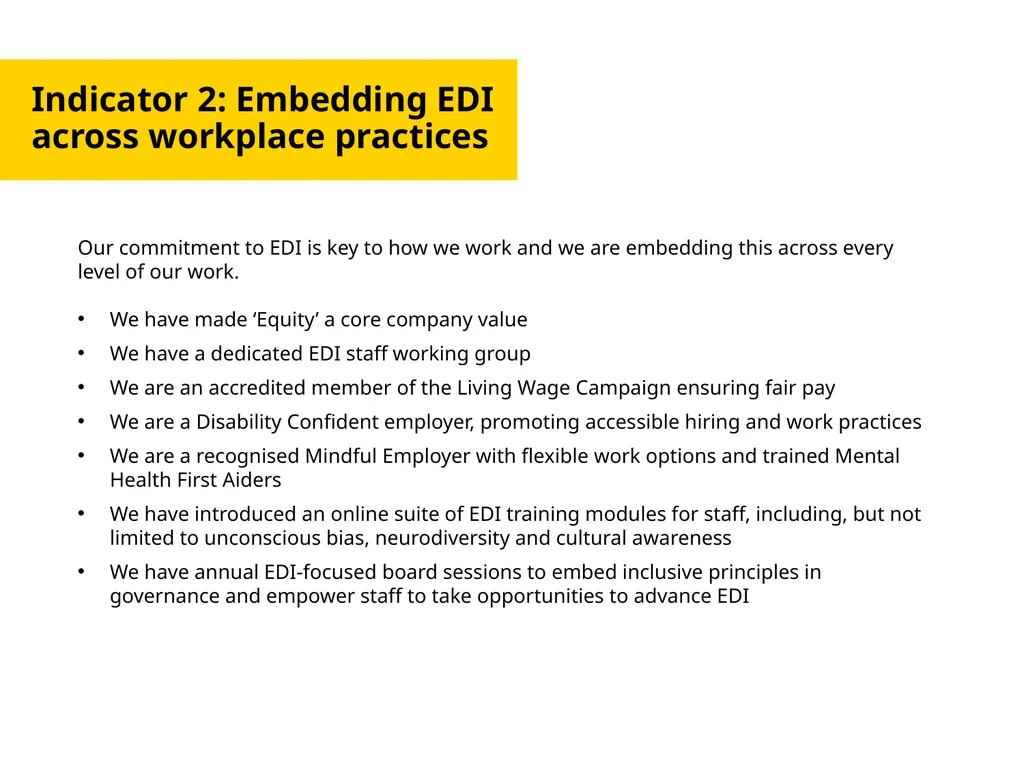
slide4. Indicator 2: Embedding EDI across workplace practices Our commitment to EDI is key to how we work and we are embedding this across every level of our work.
We have made ‘Equity’ a core company value
We have a dedicated EDI staff working group
We are an accredited member of the Living Wage Campaign ensuring fair pay
We are a Disability Confident employer, promoting accessible hiring and work practices
We are a recognised Mindful Employer with flexible work options and trained Mental Health First Aiders
We have introduced an online suite of EDI training modules for staff, including, but not limited to unconscious bias, neurodiversity and cultural awareness
We have annual EDI-focused board sessions to embed inclusive principles in governance and empower staff to take opportunities to advance EDI<br>
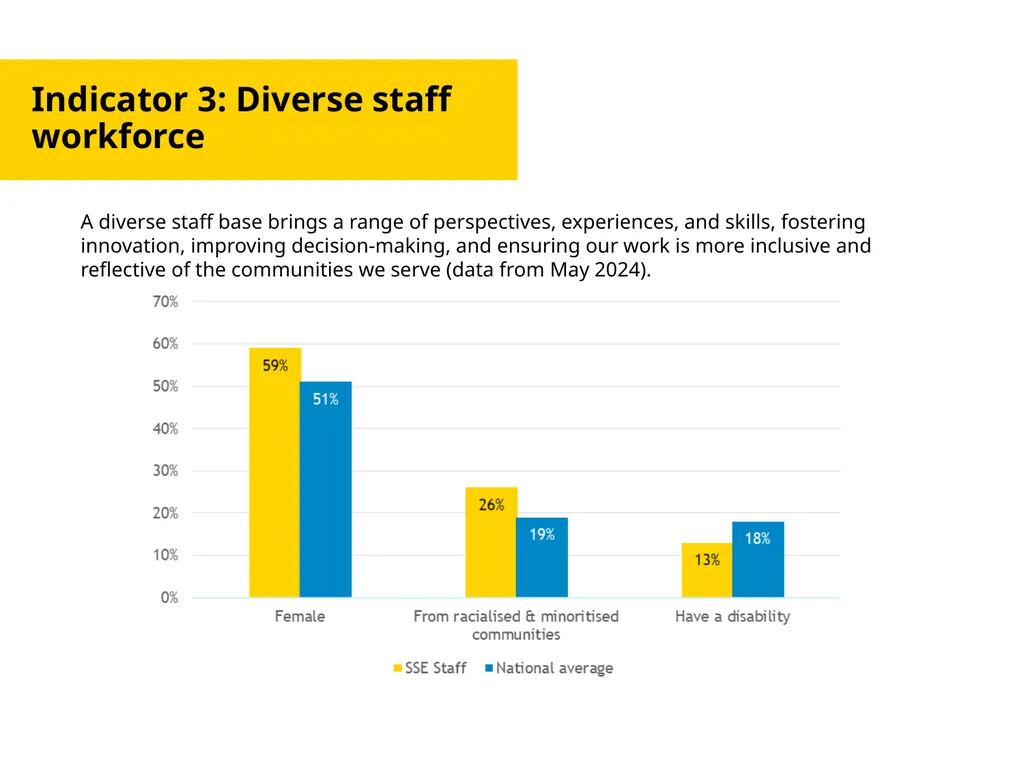
slide5. Indicator 3: Diverse staff workforce A diverse staff base brings a range of perspectives, experiences, and skills, fostering innovation, improving decision-making, and ensuring our work is more inclusive and reflective of the communities we serve (data from May 2024).<br>
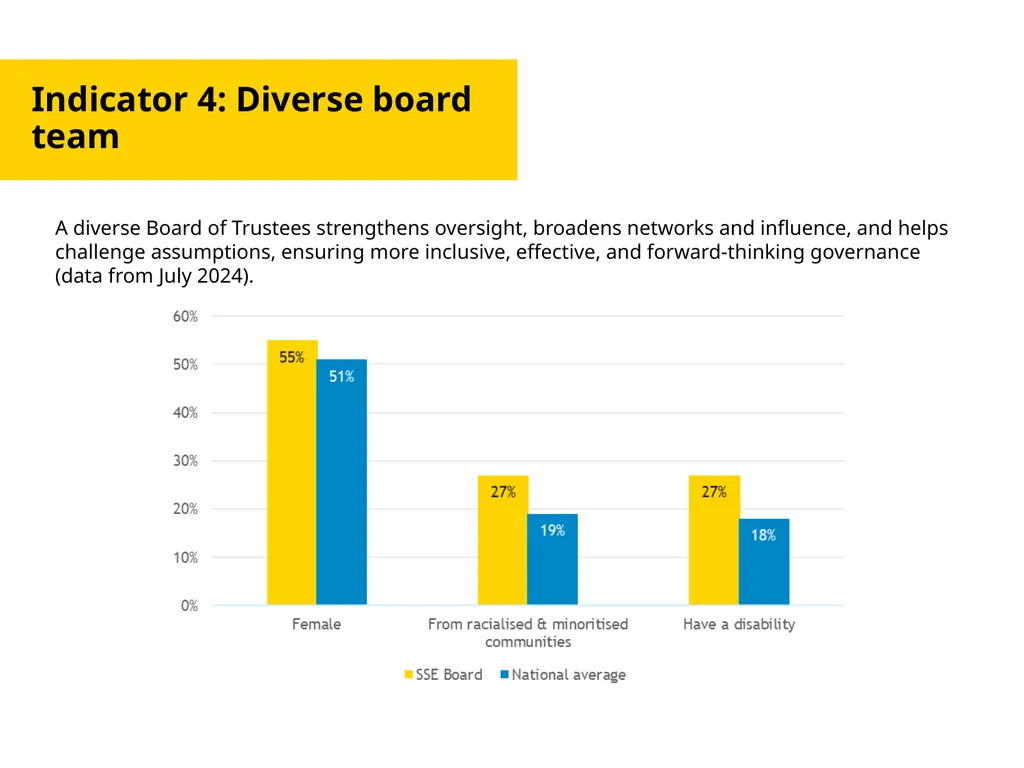
slide6. Indicator 4: Diverse board team A diverse Board of Trustees strengthens oversight, broadens networks and influence, and helps challenge assumptions, ensuring more inclusive, effective, and forward-thinking governance (data from July 2024).<br>
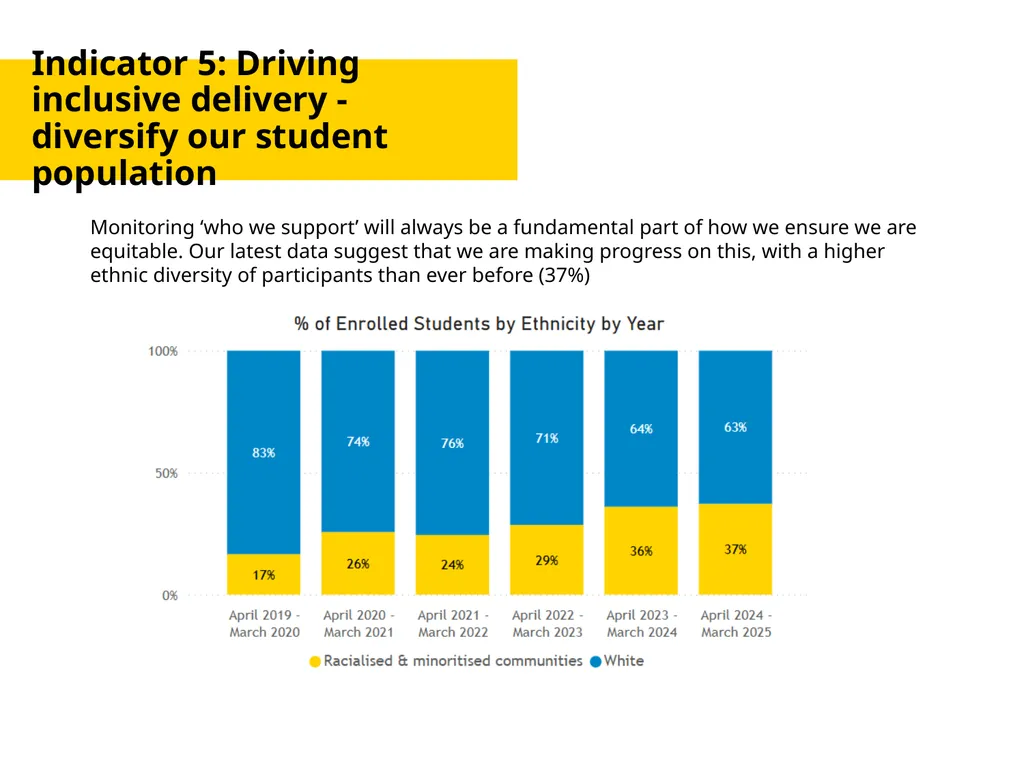
slide7. Indicator 5: Driving inclusive delivery - diversify our student population Monitoring ‘who we support’ will always be a fundamental part of how we ensure we are equitable. Our latest data suggest that we are making progress on this, with a higher ethnic diversity of participants than ever before (37%)<br>
slide8. Indicator 6: Driving inclusive delivery - diversify our contributor list We are committed to embedding anti-racist practice across all aspects of our programmes. Ensuring that our programme contributors represent the diversity of our participants is a critical part of ensuring inclusive delivery.
During 25/26 we will be embedding EDI data monitoring into our systems to track and increase the diversity of contributors on our programmes. This will include tracking all contributors (facilitators, witnesses, experts and consultants).<br>
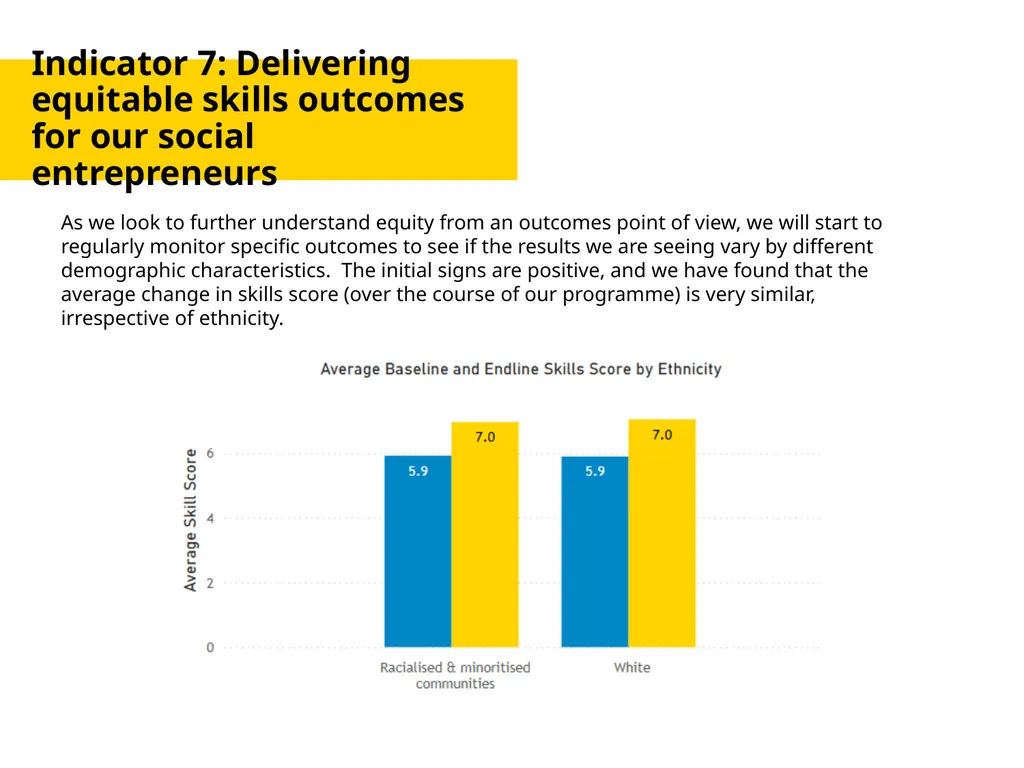
slide9. Indicator 7: Delivering equitable skills outcomes for our social entrepreneurs As we look to further understand equity from an outcomes point of view, we will start to regularly monitor specific outcomes to see if the results we are seeing vary by different demographic characteristics. The initial signs are positive, and we have found that the average change in skills score (over the course of our programme) is very similar, irrespective of ethnicity.<br>
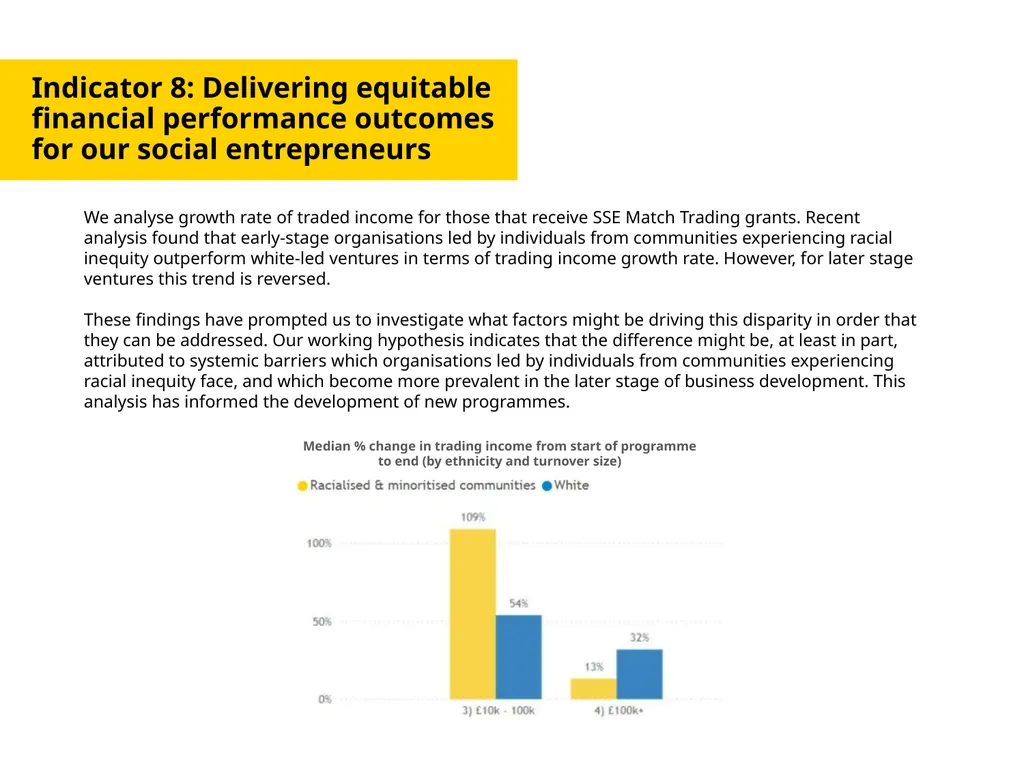
slide10. Indicator 8: Delivering equitable financial performance outcomes for our social entrepreneurs We analyse growth rate of traded income for those that receive SSE Match Trading grants. Recent analysis found that early-stage organisations led by individuals from communities experiencing racial inequity outperform white-led ventures in terms of trading income growth rate. However, for later stage ventures this trend is reversed.
These findings have prompted us to investigate what factors might be driving this disparity in order that they can be addressed. Our working hypothesis indicates that the difference might be, at least in part, attributed to systemic barriers which organisations led by individuals from communities experiencing racial inequity face, and which become more prevalent in the later stage of business development. This analysis has informed the development of new programmes. Median % change in trading income from start of programme to end (by ethnicity and turnover size)<br>
slide11. Indicator 9: Advocacy for EDI and Collaboration across the sector Trading for Good
SSE and V4CE have a longstanding strategic partnership. We are expanding this via our Trading for Good programme, on which V4CE will act as a dedicated outreach and Match Trading grants partner. The partnership is designed to be mutually beneficial. SSE will benefit from V4CE’s reach and expertise on the needs of leaders from communities experiencing racial inequity, whilst V4CE will cultivate a Match Trading grant practice within their own grants team via a skills transfer process (led by SSE). This will help position V4CE as a leading provider of innovative forms of finance (Match Trading).
Department for Work & Pensions Roundtable around employing people with disabilities
For the first time ever, DWP with SSE's support hosted a roundtable for disability-led social enterprises. Alongside the disability minister Sir Stephen Timms, the group which included Evenbreak, Send it to Alex, and Ability Consultancy discussed barriers to employment for people with disabilities including the long wait-times for Access to Work, induction training and accessibility. SSE seeks to go beyond, and advocates for EDI wherever possible using our networks, power and influence. Notable highlights this year include:
Enterprise Grants Task Force (EGTF)
As steering group members of the EGTF (a collection of funders seeking to support the development of earned income across the sector), we have advocated for considering EDI when designing this new form of grantmaking. This has led to:
Inclusive practices being embedded into the enterprise grantmaking principles of best practice
Moonshot goal for enterprise grantmaking to include targets to reach underrepresented communities.<br>
slide2. Context Since 2022, SSE has been reporting on an annual basis on our anti-racism progress.
This report tracks progress and learnings across SSE's own anti-racism journey, but it is also important to acknowledge the global instability and division around Equity, Diversity and Inclusion during this time period (March 2025). In this climate, it is even more important we remain committed in our journey to become an anti-racist organisation.
As a result, we are deepening our approach. To make meaningful progress, we are shifting to also measuring outcomes—ensuring our programmes truly drive equity. This aligns with our wider strategy and has led us to improve how we collect, analyse, and act on data.
Therefore, we have also refreshed our indicators to reflect this change grouping our work across four areas (workplace practices and diversity, inclusive delivery, equitable outcomes and sector-wide advocacy).
Previous anti-racist reports:
Spring 2024 | June 2023 | December 2022 | January 2021<br>
slide3. Indicator 1: EDI Operational Objectives During the financial year 2024/25, our Equity, Diversity and Inclusion (EDI) objectives focused on: Next financial year 2025/26, our EDI strategic focus will be on:
Deepening and expanding our EDI
Drive policy and systems change by advocating for EDI related action through advocacy and thought leadership
Enhanced EDI staff training across the organisation<br>
slide4. Indicator 2: Embedding EDI across workplace practices Our commitment to EDI is key to how we work and we are embedding this across every level of our work.
We have made ‘Equity’ a core company value
We have a dedicated EDI staff working group
We are an accredited member of the Living Wage Campaign ensuring fair pay
We are a Disability Confident employer, promoting accessible hiring and work practices
We are a recognised Mindful Employer with flexible work options and trained Mental Health First Aiders
We have introduced an online suite of EDI training modules for staff, including, but not limited to unconscious bias, neurodiversity and cultural awareness
We have annual EDI-focused board sessions to embed inclusive principles in governance and empower staff to take opportunities to advance EDI<br>
slide5. Indicator 3: Diverse staff workforce A diverse staff base brings a range of perspectives, experiences, and skills, fostering innovation, improving decision-making, and ensuring our work is more inclusive and reflective of the communities we serve (data from May 2024).<br>
slide6. Indicator 4: Diverse board team A diverse Board of Trustees strengthens oversight, broadens networks and influence, and helps challenge assumptions, ensuring more inclusive, effective, and forward-thinking governance (data from July 2024).<br>
slide7. Indicator 5: Driving inclusive delivery - diversify our student population Monitoring ‘who we support’ will always be a fundamental part of how we ensure we are equitable. Our latest data suggest that we are making progress on this, with a higher ethnic diversity of participants than ever before (37%)<br>
slide8. Indicator 6: Driving inclusive delivery - diversify our contributor list We are committed to embedding anti-racist practice across all aspects of our programmes. Ensuring that our programme contributors represent the diversity of our participants is a critical part of ensuring inclusive delivery.
During 25/26 we will be embedding EDI data monitoring into our systems to track and increase the diversity of contributors on our programmes. This will include tracking all contributors (facilitators, witnesses, experts and consultants).<br>
slide9. Indicator 7: Delivering equitable skills outcomes for our social entrepreneurs As we look to further understand equity from an outcomes point of view, we will start to regularly monitor specific outcomes to see if the results we are seeing vary by different demographic characteristics. The initial signs are positive, and we have found that the average change in skills score (over the course of our programme) is very similar, irrespective of ethnicity.<br>
slide10. Indicator 8: Delivering equitable financial performance outcomes for our social entrepreneurs We analyse growth rate of traded income for those that receive SSE Match Trading grants. Recent analysis found that early-stage organisations led by individuals from communities experiencing racial inequity outperform white-led ventures in terms of trading income growth rate. However, for later stage ventures this trend is reversed.
These findings have prompted us to investigate what factors might be driving this disparity in order that they can be addressed. Our working hypothesis indicates that the difference might be, at least in part, attributed to systemic barriers which organisations led by individuals from communities experiencing racial inequity face, and which become more prevalent in the later stage of business development. This analysis has informed the development of new programmes. Median % change in trading income from start of programme to end (by ethnicity and turnover size)<br>
slide11. Indicator 9: Advocacy for EDI and Collaboration across the sector Trading for Good
SSE and V4CE have a longstanding strategic partnership. We are expanding this via our Trading for Good programme, on which V4CE will act as a dedicated outreach and Match Trading grants partner. The partnership is designed to be mutually beneficial. SSE will benefit from V4CE’s reach and expertise on the needs of leaders from communities experiencing racial inequity, whilst V4CE will cultivate a Match Trading grant practice within their own grants team via a skills transfer process (led by SSE). This will help position V4CE as a leading provider of innovative forms of finance (Match Trading).
Department for Work & Pensions Roundtable around employing people with disabilities
For the first time ever, DWP with SSE's support hosted a roundtable for disability-led social enterprises. Alongside the disability minister Sir Stephen Timms, the group which included Evenbreak, Send it to Alex, and Ability Consultancy discussed barriers to employment for people with disabilities including the long wait-times for Access to Work, induction training and accessibility. SSE seeks to go beyond, and advocates for EDI wherever possible using our networks, power and influence. Notable highlights this year include:
Enterprise Grants Task Force (EGTF)
As steering group members of the EGTF (a collection of funders seeking to support the development of earned income across the sector), we have advocated for considering EDI when designing this new form of grantmaking. This has led to:
Inclusive practices being embedded into the enterprise grantmaking principles of best practice
Moonshot goal for enterprise grantmaking to include targets to reach underrepresented communities.<br>