Antigen antibody reaction (Agglutination) Lec. 6 Dr. Mustafa Jawad Definition of agglutination Agglutination: a reaction between particulate Ag (agglutinogen) such as bacteria, RBC with its Ab (agglutinin) in the presence of electrolyte
"Antigen antibody reaction (Agglutination) Lec. 6" is the property of its rightful owner. Permission is granted to
download and print the materials on this website for personal, non-commercial use only, and to display it
on your personal computer provided you do not modify the materials and that you retain all copyright
notices contained in the materials. By downloading content from our website, you accept the terms of this
agreement.
Presentation Transcript
01
Antigen antibody reaction (Agglutination) Lec. 6
Dr. Mustafa Jawad<br>
02
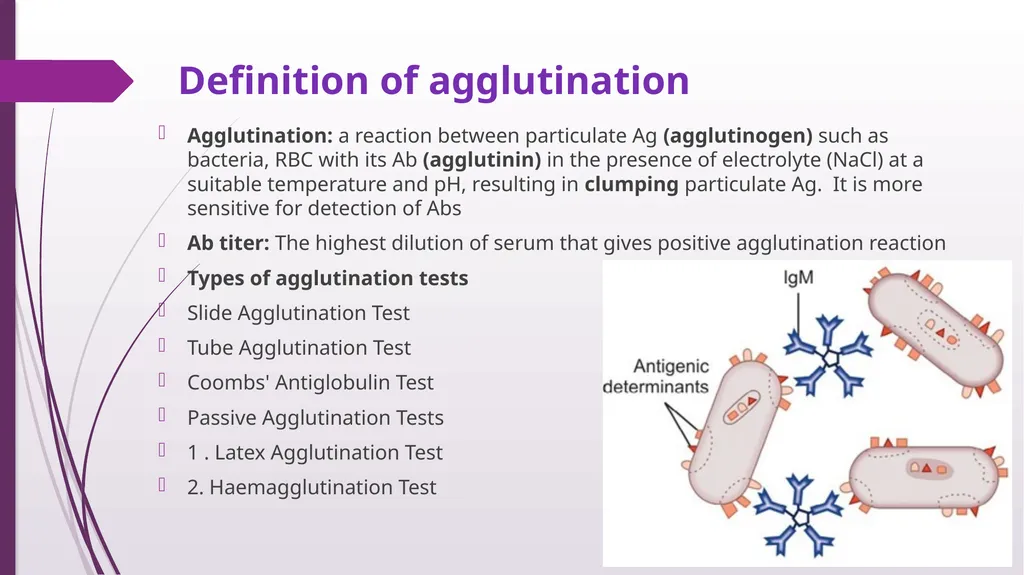
Definition of agglutination Agglutination: a reaction between particulate Ag (agglutinogen) such as bacteria, RBC with its Ab (agglutinin) in the presence of electrolyte (NaCl) at a suitable temperature and pH, resulting in clumping particulate Ag. It is more sensitive for detection of Abs
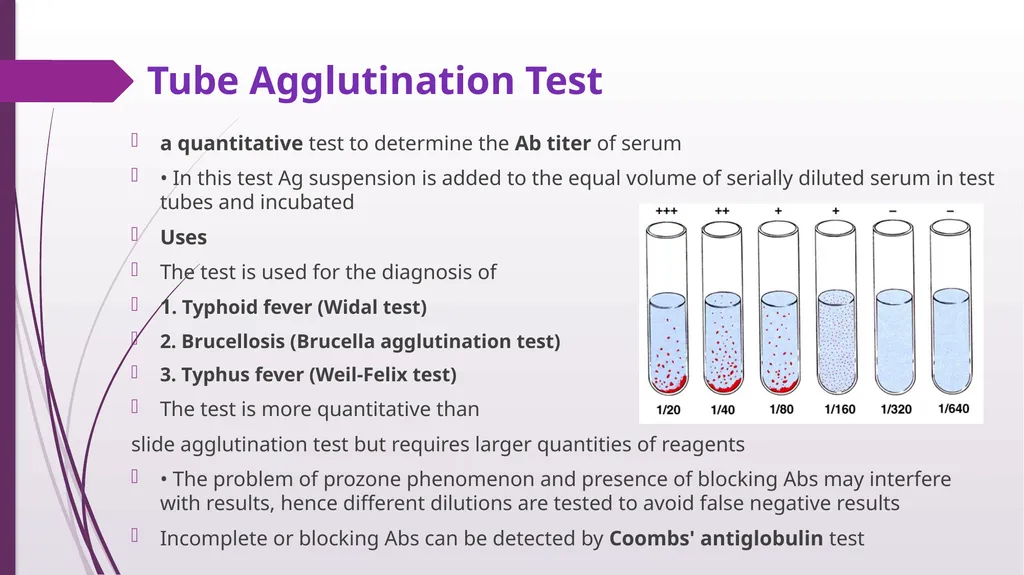
Ab titer: The highest dilution of serum that gives positive agglutination reaction
Types of agglutination tests
Slide Agglutination Test
Tube Agglutination Test
Coombs' Antiglobulin Test
Passive Agglutination Tests
1 . Latex Agglutination Test
2. Haemagglutination Test<br>
03
Slide Agglutination Test • In this test, agglutination results when to a smooth and uniform suspension of particulate Ag in a drop of saline on a glass slide or a tile, a drop of appropriate antiserum is added and mixed with a wire loop
• The clumping together of the particles and clearing of drop in a few seconds indicates positive result. Clumping is visible to the naked eye but sometimes requires confirmation under the microscope
• It is necessary to have negative control on the same slide; for this, Ag suspension is taken in a drop of saline without antiserum. If no clumping occurs, it rules out that antigen is not autoagglutinable
Uses
1 . Identification of bacterial isolates from clinical specimens
2. Blood grouping and cross-matching
• The test is rapid and requires smaller quantities of reagents but less quantitative than tube agglutination<br>
04
Tube Agglutination Test a quantitative test to determine the Ab titer of serum
• In this test Ag suspension is added to the equal volume of serially diluted serum in test tubes and incubated
Uses
The test is used for the diagnosis of
1. Typhoid fever (Widal test)
2. Brucellosis (Brucella agglutination test)
3. Typhus fever (Weil-Felix test)
The test is more quantitative than
slide agglutination test but requires larger quantities of reagents
• The problem of prozone phenomenon and presence of blocking Abs may interfere with results, hence different dilutions are tested to avoid false negative results
Incomplete or blocking Abs can be detected by Coombs' antiglobulin test<br>
05
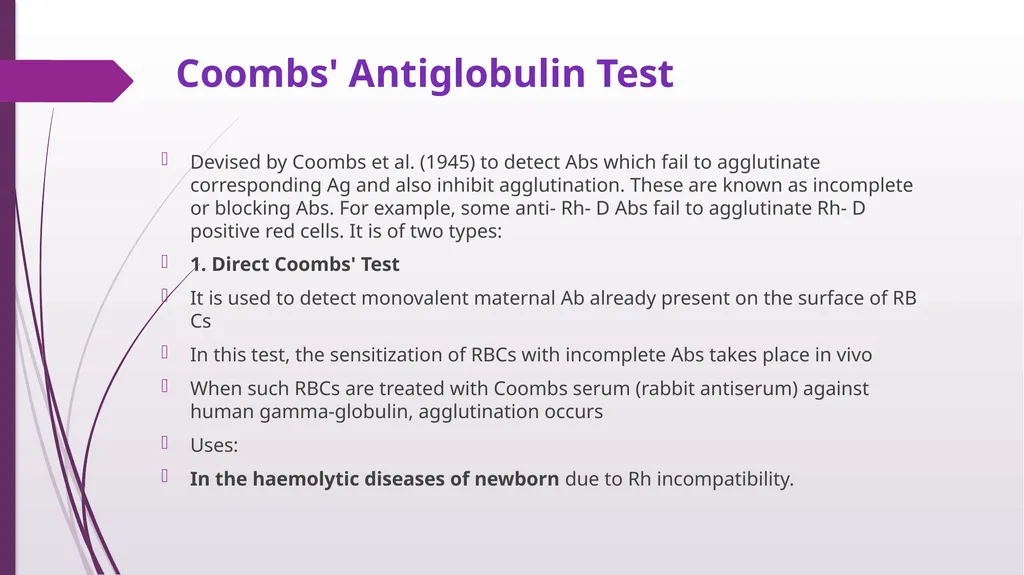
Coombs' Antiglobulin Test Devised by Coombs et al. (1945) to detect Abs which fail to agglutinate corresponding Ag and also inhibit agglutination. These are known as incomplete or blocking Abs. For example, some anti- Rh- D Abs fail to agglutinate Rh- D positive red cells. It is of two types:
1. Direct Coombs' Test
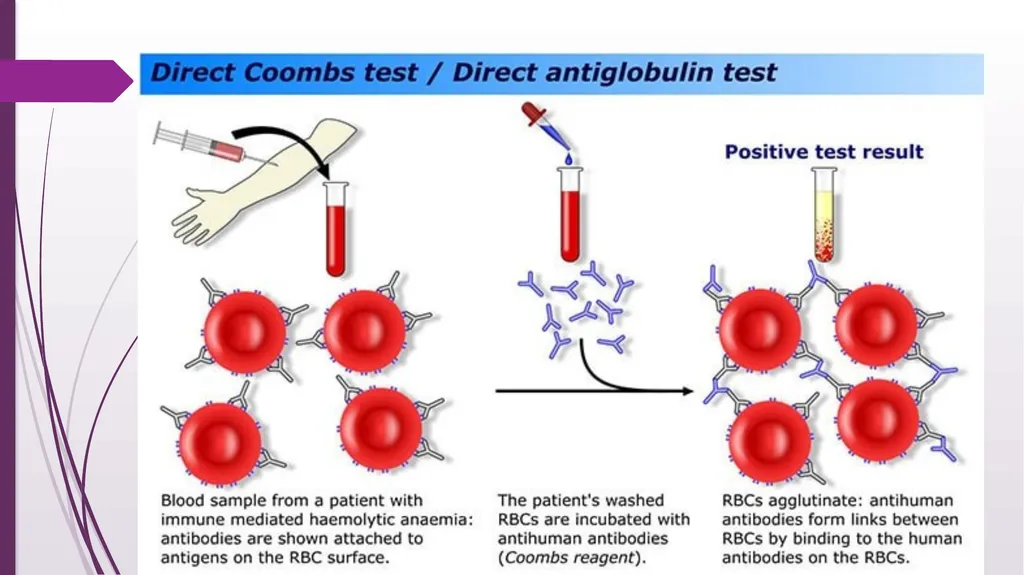
It is used to detect monovalent maternal Ab already present on the surface of RB Cs
In this test, the sensitization of RBCs with incomplete Abs takes place in vivo
When such RBCs are treated with Coombs serum (rabbit antiserum) against human gamma-globulin, agglutination occurs
Uses:
In the haemolytic diseases of newborn due to Rh incompatibility.<br>
06
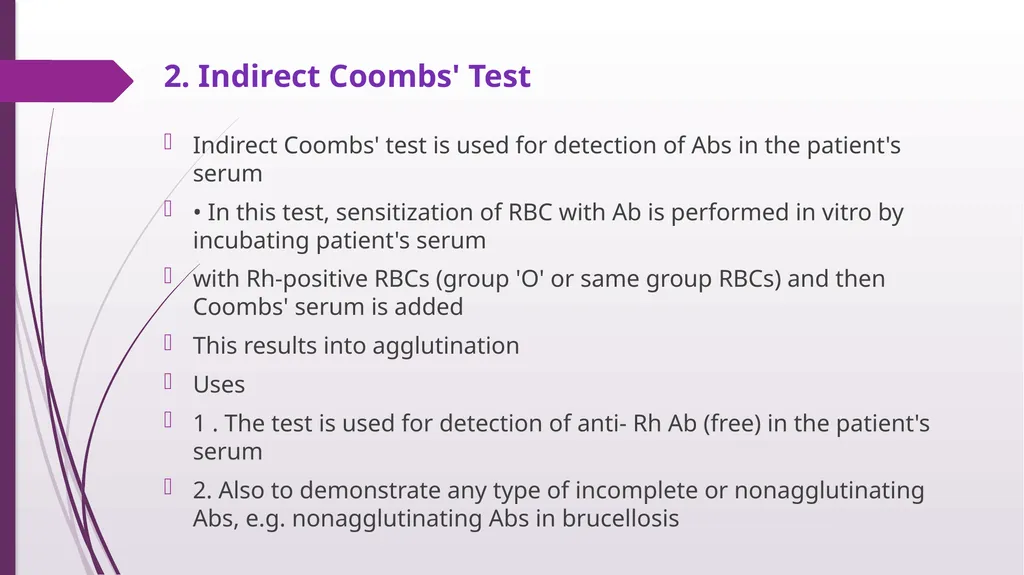
2. Indirect Coombs' Test Indirect Coombs' test is used for detection of Abs in the patient's serum
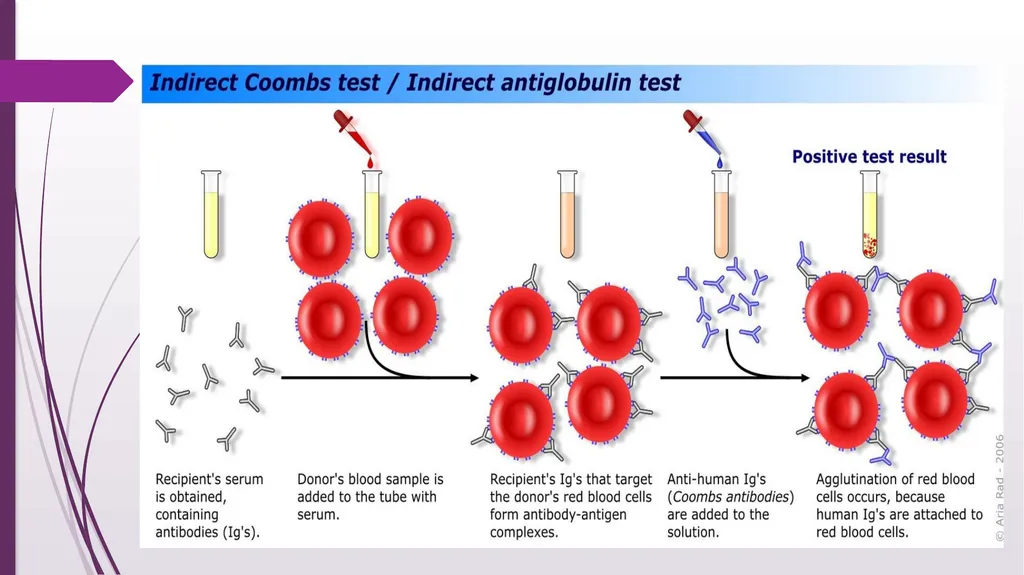
• In this test, sensitization of RBC with Ab is performed in vitro by incubating patient's serum
with Rh-positive RBCs (group 'O' or same group RBCs) and then Coombs' serum is added
This results into agglutination
Uses
1 . The test is used for detection of anti- Rh Ab (free) in the patient's serum
2. Also to demonstrate any type of incomplete or nonagglutinating Abs, e.g. nonagglutinating Abs in brucellosis<br>
07
Passive Agglutination Tests A precipitation reaction can be converted into agglutination by coating the soluble Ag onto the surface of a carrier molecule such as latex, bentonite or RBCs.
Such tests are called passive agglutination tests. When instead of Ag, Ab is absorbed on the carrier molecules for detection of Ags, the test is known as reverse passive agglutination. Passive agglutination tests include:<br>
08
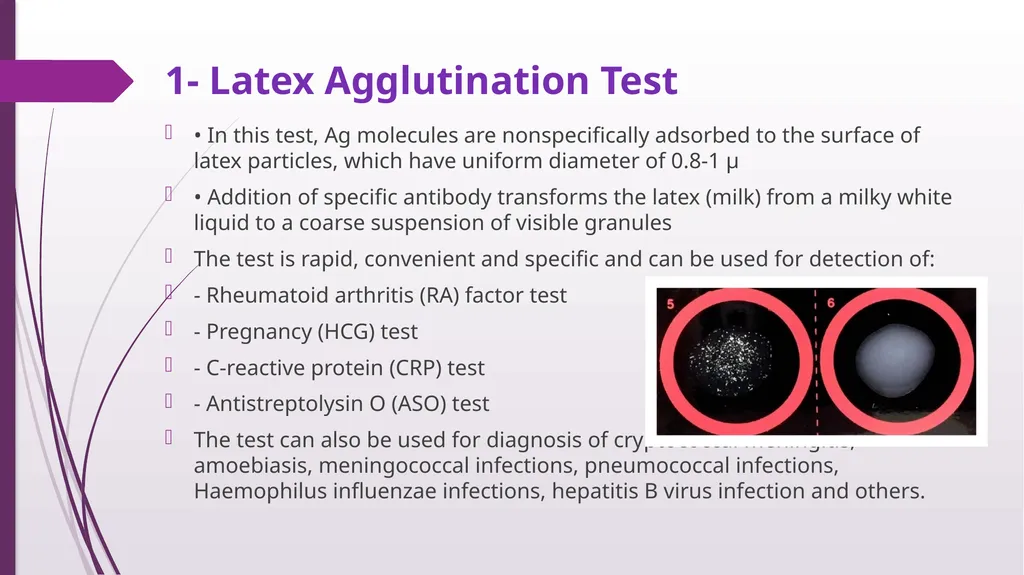
1- Latex Agglutination Test • In this test, Ag molecules are nonspecifically adsorbed to the surface of latex particles, which have uniform diameter of 0.8-1 μ
• Addition of specific antibody transforms the latex (milk) from a milky white liquid to a coarse suspension of visible granules
The test is rapid, convenient and specific and can be used for detection of:
- Rheumatoid arthritis (RA) factor test
- Pregnancy (HCG) test
- C-reactive protein (CRP) test
- Antistreptolysin O (ASO) test
The test can also be used for diagnosis of cryptococcal meningitis, amoebiasis, meningococcal infections, pneumococcal infections, Haemophilus influenzae infections, hepatitis B virus infection and others.<br>
09
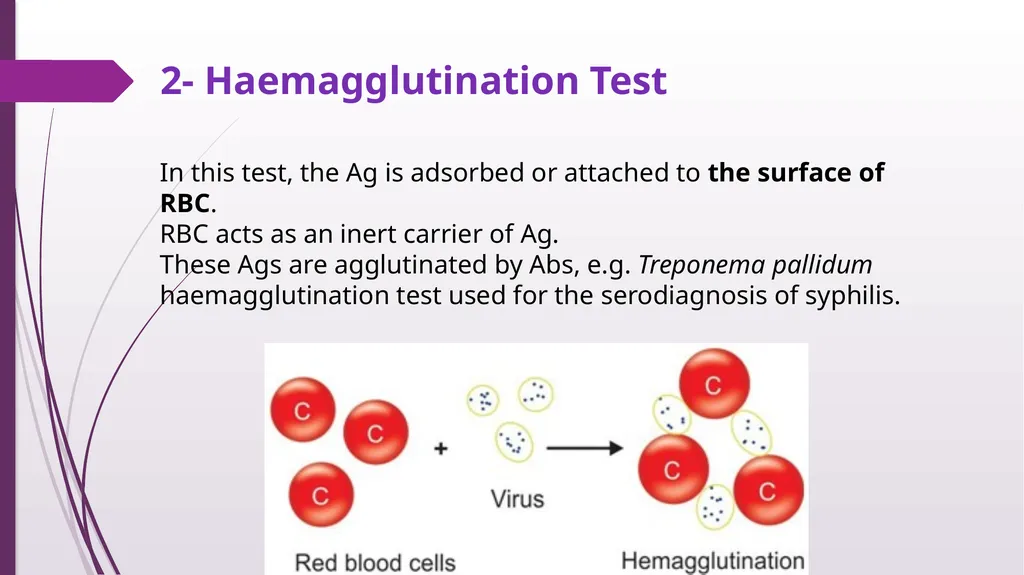
2- Haemagglutination Test In this test, the Ag is adsorbed or attached to the surface of RBC.
RBC acts as an inert carrier of Ag.
These Ags are agglutinated by Abs, e.g. Treponema pallidum haemagglutination test used for the serodiagnosis of syphilis.<br>
10
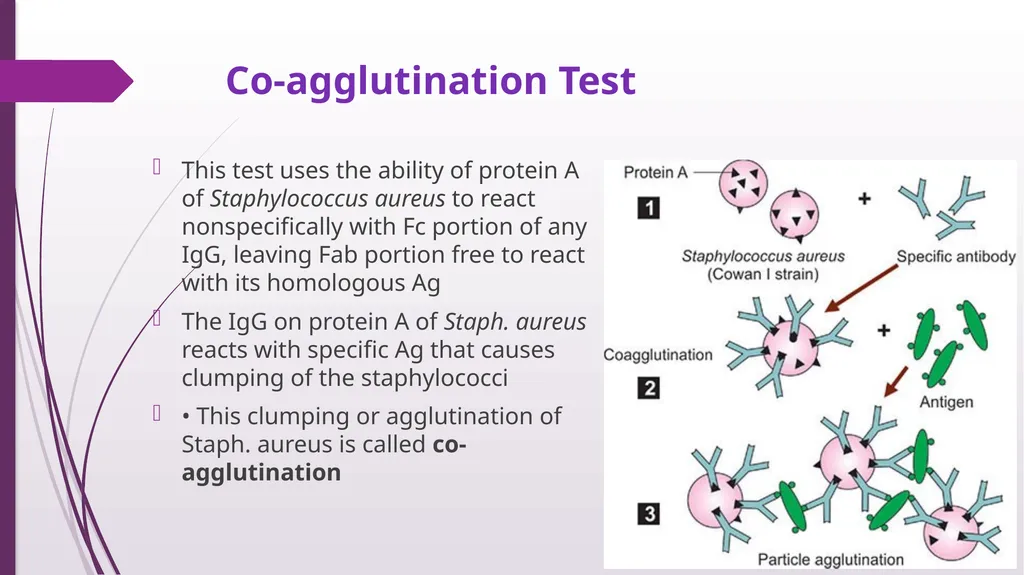
Co-agglutination Test This test uses the ability of protein A of Staphylococcus aureus to react nonspecifically with Fc portion of any IgG, leaving Fab portion free to react with its homologous Ag
The IgG on protein A of Staph. aureus reacts with specific Ag that causes clumping of the staphylococci
• This clumping or agglutination of Staph. aureus is called co-agglutination<br>