
Antiracist Pedagogy: Teaching, Learning,
A
Published · 26 slides · 0 views
1 / 1




Description
Antiracist Pedagogy: Teaching, Learning, Assessment Columbia University, School of Nursing June 2nd, 2021 Stephen Brookfield Distinguished Scholar, Antioch University http:www.stephenbrookfield.com The (White) Elephant in the Room At the
Related Topics
Share
Embed code
Download this presentation From Below
"Antiracist Pedagogy: Teaching, Learning," is the property of its rightful owner. Permission is granted to download and print the materials on this website for personal, non-commercial use only, and to display it on your personal computer provided you do not modify the materials and that you retain all copyright notices contained in the materials. By downloading content from our website, you accept the terms of this agreement.
Presentation Transcript
01
Antiracist Pedagogy:
Teaching, Learning, Assessment
Columbia University, School of Nursing
June 2nd, 2021 Stephen Brookfield
Distinguished Scholar, Antioch University
http://www.stephenbrookfield.com/<br>
Distinguished Scholar, Antioch University
http://www.stephenbrookfield.com/<br>
02
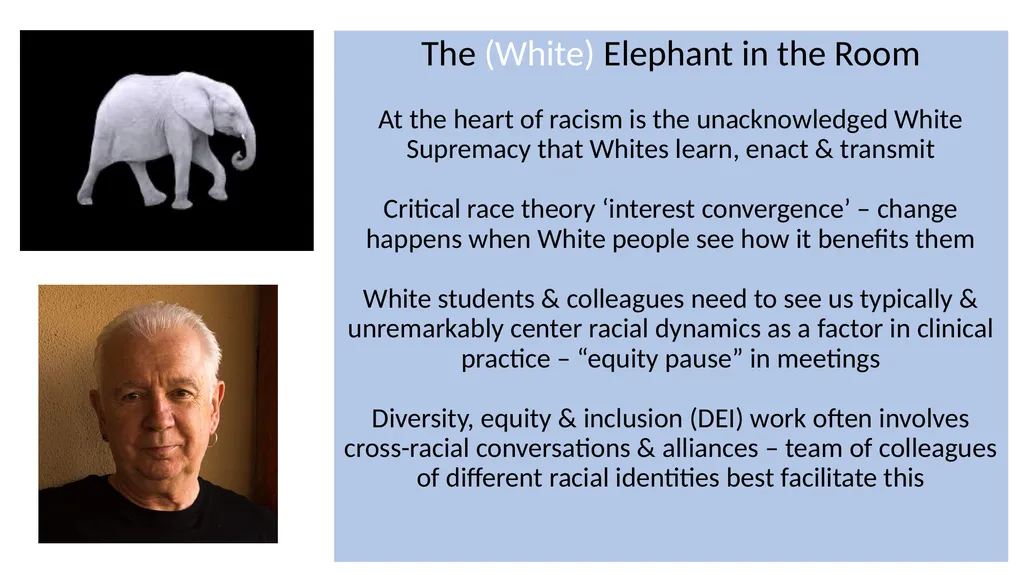
The (White) Elephant in the Room
At the heart of racism is the unacknowledged White Supremacy that Whites learn, enact & transmit
Critical race theory ‘interest convergence’ – change happens when White people see how it benefits them
White students & colleagues need to see us typically & unremarkably center racial dynamics as a factor in clinical practice – “equity pause” in meetings
Diversity, equity & inclusion (DEI) work often involves cross-racial conversations & alliances – team of colleagues of different racial identities best facilitate this<br>
03
HOME PAGE - www.stephenbrookfield.com My home page is open access so if you want to find out more about any of the exercises or activities I mention go to the page and click on the ‘Resources’ link.
Scroll down & you will find multiple PDF files of workshop packets stuffed with activities or power point files.
You do not need to ask my permission to use any of these resources. If they’re useful then please try them out and adapt them to your context.
To follow along today or retrieve these slides later click on the ‘Resources’ link at the top right of page. This presentation is the 1st power point listed.
www.stephenbrookfield.com<br>
Scroll down & you will find multiple PDF files of workshop packets stuffed with activities or power point files.
You do not need to ask my permission to use any of these resources. If they’re useful then please try them out and adapt them to your context.
To follow along today or retrieve these slides later click on the ‘Resources’ link at the top right of page. This presentation is the 1st power point listed.
www.stephenbrookfield.com<br>
04
I am from…*
the sound of seagulls crying over the north sea and mersey beat blasting at the Cavern club,
the smell of fish & chips, factory waste and coal burning fires,
the taste of grease, sour milk tea and dust at the back of my throat
the idea of community pride & the triumph of humor over pretentiousness
*Adapted from the poem Where I’m From by George Ella Lyon<br>
the sound of seagulls crying over the north sea and mersey beat blasting at the Cavern club,
the smell of fish & chips, factory waste and coal burning fires,
the taste of grease, sour milk tea and dust at the back of my throat
the idea of community pride & the triumph of humor over pretentiousness
*Adapted from the poem Where I’m From by George Ella Lyon<br>
05
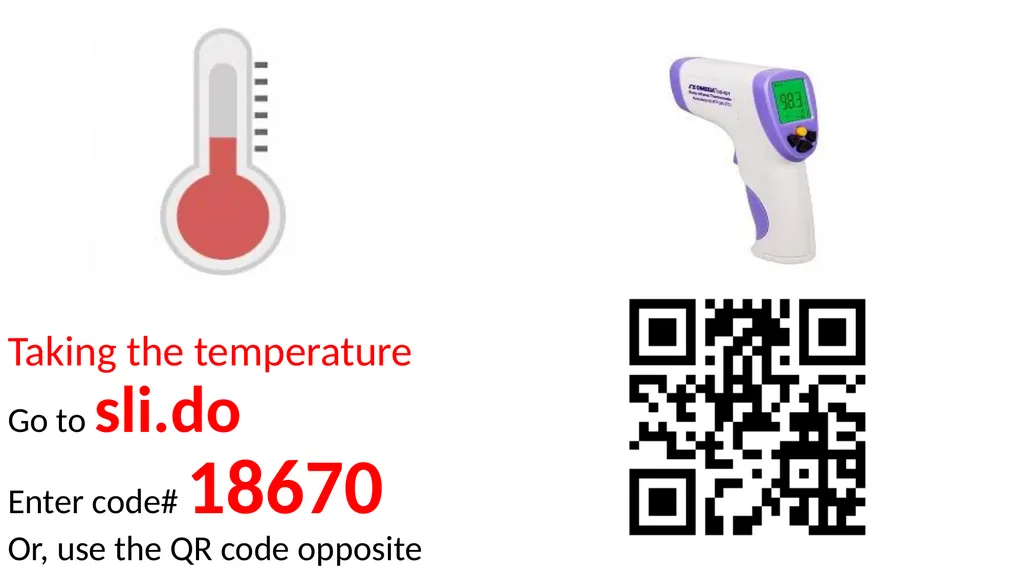
Taking the temperature
Go to sli.do
Enter code# 18670
Or, use the QR code opposite<br>
06
When you see antiracist teaching, learning & assessment in place, what does it LOOK, SOUND, or FEEL like? Go to sli.do
Enter code# 415510
Or, use the QR code opposite<br>
Or, use the QR code opposite<br>
07
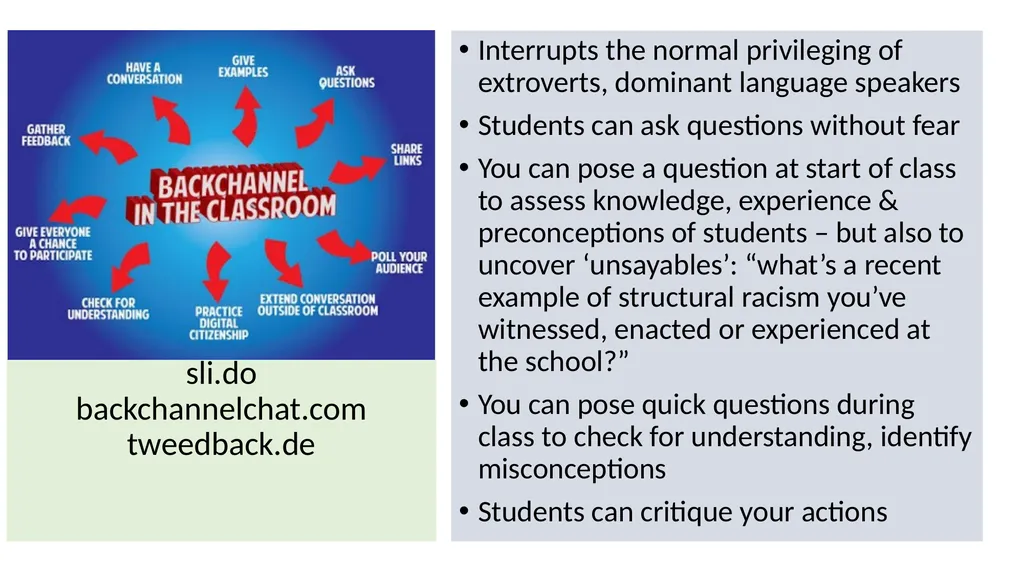
sli.do
backchannelchat.com
tweedback.de Interrupts the normal privileging of extroverts, dominant language speakers
Students can ask questions without fear
You can pose a question at start of class to assess knowledge, experience & preconceptions of students – but also to uncover ‘unsayables’: “what’s a recent example of structural racism you’ve witnessed, enacted or experienced at the school?”
You can pose quick questions during class to check for understanding, identify misconceptions
Students can critique your actions<br>
Students can ask questions without fear
You can pose a question at start of class to assess knowledge, experience & preconceptions of students – but also to uncover ‘unsayables’: “what’s a recent example of structural racism you’ve witnessed, enacted or experienced at the school?”
You can pose quick questions during class to check for understanding, identify misconceptions
Students can critique your actions<br>
08
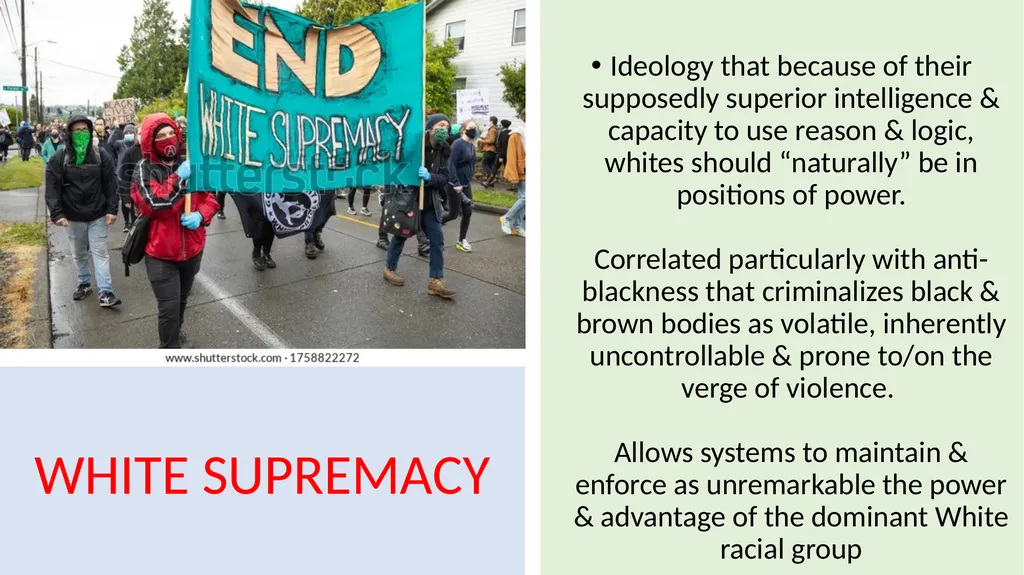
WHITE SUPREMACY Ideology that because of their supposedly superior intelligence & capacity to use reason & logic, whites should “naturally” be in positions of power.
Correlated particularly with anti-blackness that criminalizes black & brown bodies as volatile, inherently uncontrollable & prone to/on the verge of violence.
Allows systems to maintain & enforce as unremarkable the power & advantage of the dominant White racial group<br>
09
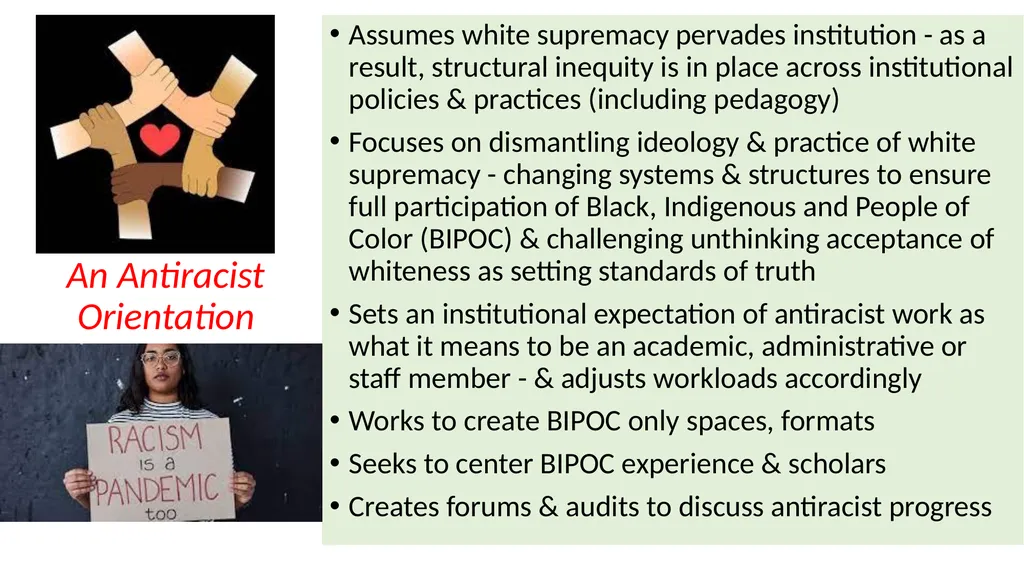
An Antiracist Orientation Assumes white supremacy pervades institution - as a result, structural inequity is in place across institutional policies & practices (including pedagogy)
Focuses on dismantling ideology & practice of white supremacy - changing systems & structures to ensure full participation of Black, Indigenous and People of Color (BIPOC) & challenging unthinking acceptance of whiteness as setting standards of truth
Sets an institutional expectation of antiracist work as what it means to be an academic, administrative or staff member - & adjusts workloads accordingly
Works to create BIPOC only spaces, formats
Seeks to center BIPOC experience & scholars
Creates forums & audits to discuss antiracist progress<br>
Focuses on dismantling ideology & practice of white supremacy - changing systems & structures to ensure full participation of Black, Indigenous and People of Color (BIPOC) & challenging unthinking acceptance of whiteness as setting standards of truth
Sets an institutional expectation of antiracist work as what it means to be an academic, administrative or staff member - & adjusts workloads accordingly
Works to create BIPOC only spaces, formats
Seeks to center BIPOC experience & scholars
Creates forums & audits to discuss antiracist progress<br>
10
Antiracist Practice Identifies the content & epistemological grammar in our field that constitutes its ‘canon’ – foundational building blocks of knowledge, procedures for establishing truth & validity: who has created, built & maintains this canon?
Draws attention to the racial identity of the scholarly and practical gatekeepers in our field over time (founders, textbook authors, encyclopedia & handbook editors, conference submission & journal editorial boards)
Examines how disciplinary knowledge is applied in the world outside – which racial groups benefit disproportionately from research, practices?
BIPOC scholarship and practice centered<br>
Draws attention to the racial identity of the scholarly and practical gatekeepers in our field over time (founders, textbook authors, encyclopedia & handbook editors, conference submission & journal editorial boards)
Examines how disciplinary knowledge is applied in the world outside – which racial groups benefit disproportionately from research, practices?
BIPOC scholarship and practice centered<br>
11
Antiracist Practice Racial identities in case studies of clinical practices
Curricula draw from multiple racialized paradigms – Afrocentric, Indigenous, Latinx, Asian diaspora
BIPOC are fully present in curricular design, choice of instructional materials, modes of assessment
Multiple modes of pedagogy, communication, assessment & evaluation – visual, oral, narrative, musical, dramatic, poetic, kinetic
Race prioritized as a factor in construction, dissemination & application of knowledge
Focus on systemic, structural health disparities<br>
Curricula draw from multiple racialized paradigms – Afrocentric, Indigenous, Latinx, Asian diaspora
BIPOC are fully present in curricular design, choice of instructional materials, modes of assessment
Multiple modes of pedagogy, communication, assessment & evaluation – visual, oral, narrative, musical, dramatic, poetic, kinetic
Race prioritized as a factor in construction, dissemination & application of knowledge
Focus on systemic, structural health disparities<br>
12
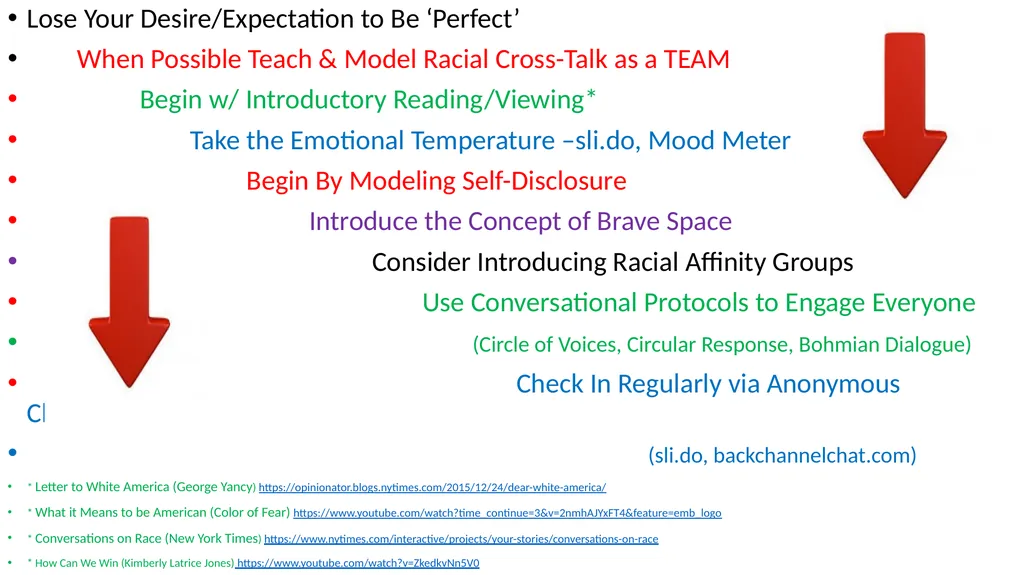
Lose Your Desire/Expectation to Be ‘Perfect’
When Possible Teach & Model Racial Cross-Talk as a TEAM
Begin w/ Introductory Reading/Viewing*
Take the Emotional Temperature –sli.do, Mood Meter
Begin By Modeling Self-Disclosure
Introduce the Concept of Brave Space
Consider Introducing Racial Affinity Groups
Use Conversational Protocols to Engage Everyone
(Circle of Voices, Circular Response, Bohmian Dialogue)
Check In Regularly via Anonymous Channels
(sli.do, backchannelchat.com)
* Letter to White America (George Yancy) https://opinionator.blogs.nytimes.com/2015/12/24/dear-white-america/
* What it Means to be American (Color of Fear) https://www.youtube.com/watch?time_continue=3&v=2nmhAJYxFT4&feature=emb_logo
* Conversations on Race (New York Times) https://www.nytimes.com/interactive/projects/your-stories/conversations-on-race
* How Can We Win (Kimberly Latrice Jones) https://www.youtube.com/watch?v=ZkedkvNn5V0<br>
When Possible Teach & Model Racial Cross-Talk as a TEAM
Begin w/ Introductory Reading/Viewing*
Take the Emotional Temperature –sli.do, Mood Meter
Begin By Modeling Self-Disclosure
Introduce the Concept of Brave Space
Consider Introducing Racial Affinity Groups
Use Conversational Protocols to Engage Everyone
(Circle of Voices, Circular Response, Bohmian Dialogue)
Check In Regularly via Anonymous Channels
(sli.do, backchannelchat.com)
* Letter to White America (George Yancy) https://opinionator.blogs.nytimes.com/2015/12/24/dear-white-america/
* What it Means to be American (Color of Fear) https://www.youtube.com/watch?time_continue=3&v=2nmhAJYxFT4&feature=emb_logo
* Conversations on Race (New York Times) https://www.nytimes.com/interactive/projects/your-stories/conversations-on-race
* How Can We Win (Kimberly Latrice Jones) https://www.youtube.com/watch?v=ZkedkvNn5V0<br>
13
Two Kinds of Preparation for Teaching that Incorporates Race Technical (Content) – reading, viewing, thinking, reflecting on nature of racism, white identity, white supremacy, anti-blackness etc.
Technical (Process) – how to model disclosure, choose good narratives, build trust, scaffold learning from simple to complex, use protocols
Emotional (EQ) – this is inherently emotional work in which people are laying bare their identities, experiences, convictions and feelings. It will sometimes be raw & contentious and people will become distressed, angry, and uncomfortable
Emotional (Mistakes) – this is inherently unpredictable work & you’ll constantly feel like you’ve screwed up, made mistakes, said or done the wrong thing, and mishandled situations
Two ways do do anti-racist work – IMPERFECTLY or NOT AT ALL!<br>
Technical (Process) – how to model disclosure, choose good narratives, build trust, scaffold learning from simple to complex, use protocols
Emotional (EQ) – this is inherently emotional work in which people are laying bare their identities, experiences, convictions and feelings. It will sometimes be raw & contentious and people will become distressed, angry, and uncomfortable
Emotional (Mistakes) – this is inherently unpredictable work & you’ll constantly feel like you’ve screwed up, made mistakes, said or done the wrong thing, and mishandled situations
Two ways do do anti-racist work – IMPERFECTLY or NOT AT ALL!<br>
14
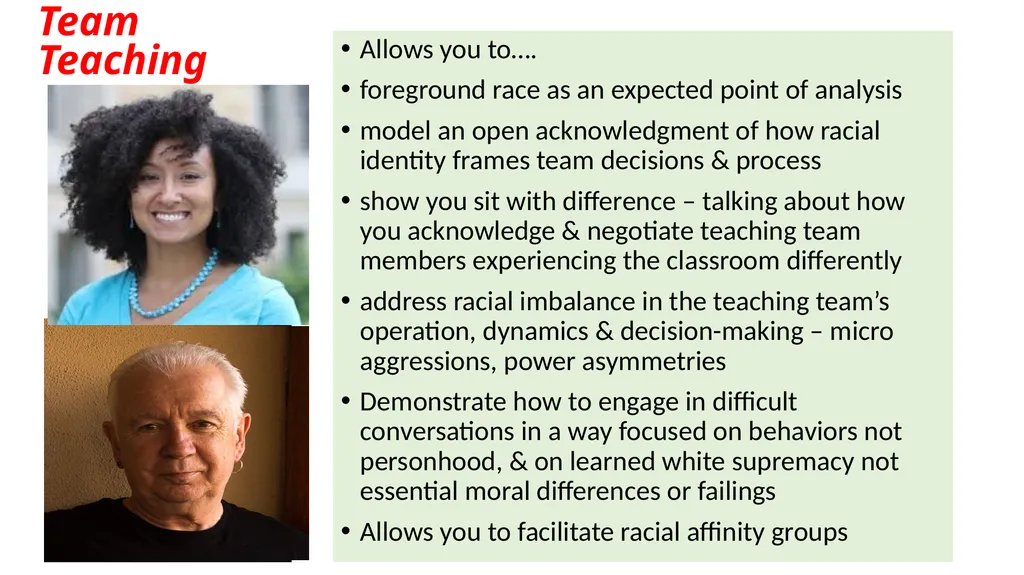
Team Teaching Allows you to….
foreground race as an expected point of analysis
model an open acknowledgment of how racial identity frames team decisions & process
show you sit with difference – talking about how you acknowledge & negotiate teaching team members experiencing the classroom differently
address racial imbalance in the teaching team’s operation, dynamics & decision-making – micro aggressions, power asymmetries
Demonstrate how to engage in difficult conversations in a way focused on behaviors not personhood, & on learned white supremacy not essential moral differences or failings
Allows you to facilitate racial affinity groups<br>
foreground race as an expected point of analysis
model an open acknowledgment of how racial identity frames team decisions & process
show you sit with difference – talking about how you acknowledge & negotiate teaching team members experiencing the classroom differently
address racial imbalance in the teaching team’s operation, dynamics & decision-making – micro aggressions, power asymmetries
Demonstrate how to engage in difficult conversations in a way focused on behaviors not personhood, & on learned white supremacy not essential moral differences or failings
Allows you to facilitate racial affinity groups<br>
15
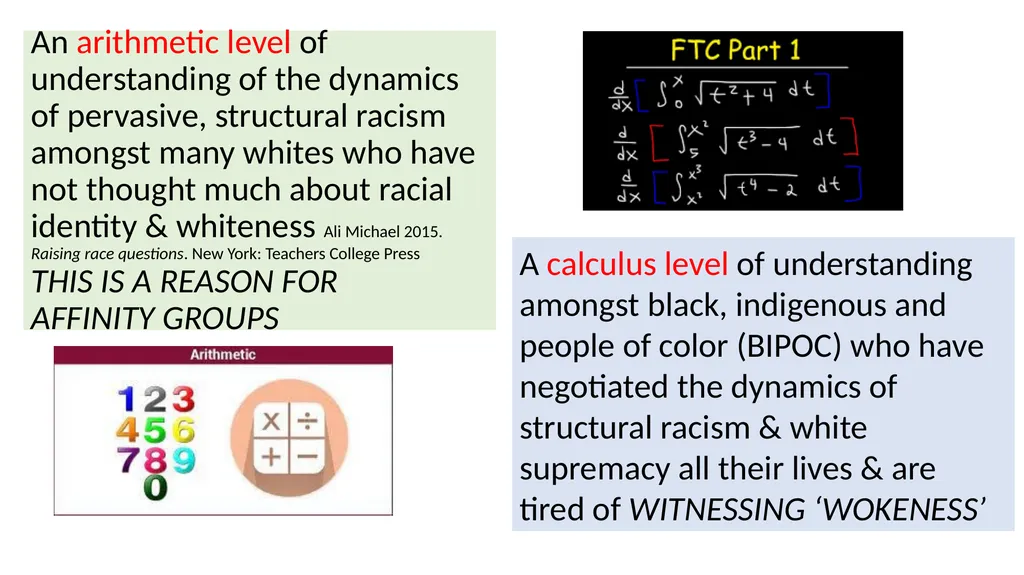
An arithmetic level of understanding of the dynamics of pervasive, structural racism amongst many whites who have not thought much about racial identity & whiteness Ali Michael 2015. Raising race questions. New York: Teachers College Press
THIS IS A REASON FOR
AFFINITY GROUPS A calculus level of understanding amongst black, indigenous and people of color (BIPOC) who have negotiated the dynamics of structural racism & white supremacy all their lives & are tired of WITNESSING ‘WOKENESS’<br>
16
The Fatigue of Witnessing Woke-ness “I honestly have been having a hard time being in predominately white classes lately as people in this country realize, again, the issues that exist in America for Black people.
While she was giving her long spiel on her good work, I couldn't figure out where to place my feelings. I could see it from a mile away; I even prepped myself for it before the class.
I prepared for THIS, but I still wasn’t ready. Her actions were soooo predictable, well, to me. It was something I knew was bound to happen in a class placed right in the heart of the world grappling with whether or not Black lives matter. But still I felt completely uncomfortable, sick.
Now, I am not one to dim anyone's light, but all I felt like saying was, "oh, okay. That's cute. You want a cookie?"
I couldn't help but think, "this is not something new, why is it new to you? Why are you just now having these conversations?"
I do not know this woman and may never have a class with her again; however, I will always remember what she did and how it made me feel.”
Carmina Maye 2020 I Really Wanted this to Be a Poem. (Dept. of Art & Art Education, Teachers College)<br>
While she was giving her long spiel on her good work, I couldn't figure out where to place my feelings. I could see it from a mile away; I even prepped myself for it before the class.
I prepared for THIS, but I still wasn’t ready. Her actions were soooo predictable, well, to me. It was something I knew was bound to happen in a class placed right in the heart of the world grappling with whether or not Black lives matter. But still I felt completely uncomfortable, sick.
Now, I am not one to dim anyone's light, but all I felt like saying was, "oh, okay. That's cute. You want a cookie?"
I couldn't help but think, "this is not something new, why is it new to you? Why are you just now having these conversations?"
I do not know this woman and may never have a class with her again; however, I will always remember what she did and how it made me feel.”
Carmina Maye 2020 I Really Wanted this to Be a Poem. (Dept. of Art & Art Education, Teachers College)<br>
17
No need to prove oneself as a “good, woke White person” – or to declare allyship
No opportunity to ask BIPOC to educate White people on race
Lessens fear of saying the ‘wrong’ thing in front of BIPOC peers
Removes temptation to ‘confess’ to racism & ask absolution from BIPOC No need to ‘take care’ of sensitivities of White egos
Chance to relax in real talk around experiences of racism
Can develop support networks & provide emotional sustenance
Share knowledge of negotiating the White power structure
No requests to ‘teach’ Whites about race<br>
Chance to relax in real talk around experiences of racism
Can develop support networks & provide emotional sustenance
Share knowledge of negotiating the White power structure
No requests to ‘teach’ Whites about race<br>
18
MODELING
how our racial identity frames our life
the structural blindnesses we carry
how Whiteness carries embedded advantage
how addressing racial issues is part of good clinical practice
how we struggle to understand & negotiate racism
how we notice elements of our learned white supremacy
how we experience structural racism & racial microaggressions
how we practice self-care in the face of battle fatigue
how we build communities of support How we practice self-care in the face of battle fatigue<br>
how our racial identity frames our life
the structural blindnesses we carry
how Whiteness carries embedded advantage
how addressing racial issues is part of good clinical practice
how we struggle to understand & negotiate racism
how we notice elements of our learned white supremacy
how we experience structural racism & racial microaggressions
how we practice self-care in the face of battle fatigue
how we build communities of support How we practice self-care in the face of battle fatigue<br>
19
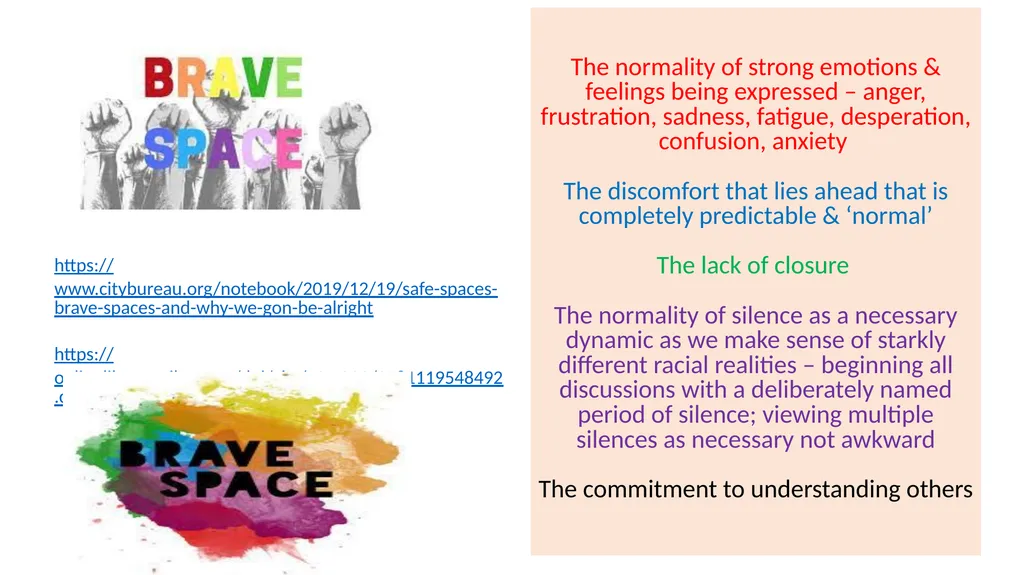
The normality of strong emotions & feelings being expressed – anger, frustration, sadness, fatigue, desperation, confusion, anxiety
The discomfort that lies ahead that is completely predictable & ‘normal’
The lack of closure
The normality of silence as a necessary dynamic as we make sense of starkly different racial realities – beginning all discussions with a deliberately named period of silence; viewing multiple silences as necessary not awkward
The commitment to understanding others https://www.citybureau.org/notebook/2019/12/19/safe-spaces-brave-spaces-and-why-we-gon-be-alright
https://onlinelibrary.wiley.com/doi/abs/10.1002/9781119548492.ch4<br>
https://onlinelibrary.wiley.com/doi/abs/10.1002/9781119548492.ch4<br>
20
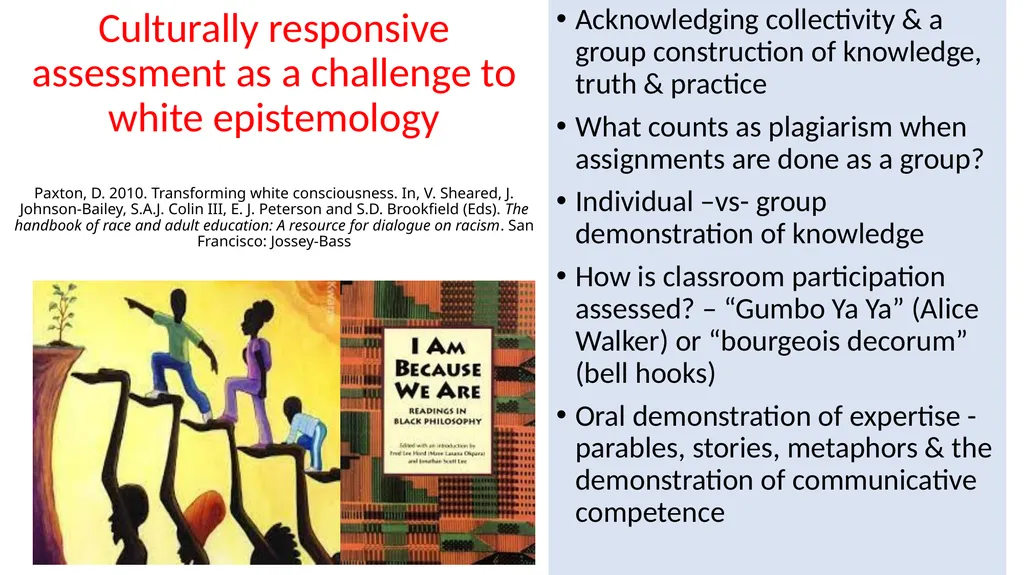
Culturally responsive assessment as a challenge to
white epistemology
Paxton, D. 2010. Transforming white consciousness. In, V. Sheared, J. Johnson-Bailey, S.A.J. Colin III, E. J. Peterson and S.D. Brookfield (Eds). The handbook of race and adult education: A resource for dialogue on racism. San Francisco: Jossey-Bass Acknowledging collectivity & a group construction of knowledge, truth & practice
What counts as plagiarism when assignments are done as a group?
Individual –vs- group demonstration of knowledge
How is classroom participation assessed? – “Gumbo Ya Ya” (Alice Walker) or “bourgeois decorum” (bell hooks)
Oral demonstration of expertise - parables, stories, metaphors & the demonstration of communicative competence<br>
What counts as plagiarism when assignments are done as a group?
Individual –vs- group demonstration of knowledge
How is classroom participation assessed? – “Gumbo Ya Ya” (Alice Walker) or “bourgeois decorum” (bell hooks)
Oral demonstration of expertise - parables, stories, metaphors & the demonstration of communicative competence<br>
21
Hard Truths I’ve Learned as a White Instructor I MUST call out racist behavior (including in myself) as soon as I see it. If I don’t I will have no credibility in eyes of BIPOC students & colleagues
I MUST assume that for students and colleagues of color EVERYTHING is seen through the lens of race. For them, NOTHING is “race free”.
I MUST acknowledge my own racist behavior when it’s pointed out to me – not try to ‘explain’ it away, not protest my innocence
I MUST watch out for the dangers of preaching, disdaining & withholding*
* European American Collaborative Challenging Whiteness. 2010. White on white: Developing capacity to communicate about race with critical humility” In, V. Sheared, J. Johnson-Bailey, S.A.J. Colin III, E. Peterson and S. Brookfield (Eds.). The handbook of race and adult education: A resource for dialogue on racism. San Francisco: Jossey-Bass.<br>
I MUST assume that for students and colleagues of color EVERYTHING is seen through the lens of race. For them, NOTHING is “race free”.
I MUST acknowledge my own racist behavior when it’s pointed out to me – not try to ‘explain’ it away, not protest my innocence
I MUST watch out for the dangers of preaching, disdaining & withholding*
* European American Collaborative Challenging Whiteness. 2010. White on white: Developing capacity to communicate about race with critical humility” In, V. Sheared, J. Johnson-Bailey, S.A.J. Colin III, E. Peterson and S. Brookfield (Eds.). The handbook of race and adult education: A resource for dialogue on racism. San Francisco: Jossey-Bass.<br>
22
Hard Truths I’ve Learned as a White Instructor I MUST NEVER invoke “being respectful” as a way to avoid difficult conversations around racism.
I MUST NEVER claim to be an “ally”, “accomplice” “co-conspirator”– but must act in those ways
I MUST NEVER ask people of color to teach me about racism – figuring out what whites should do is MY responsibility.
I MUST NEVER ask a BIPOC student or colleague to speak for their race
I MUST NEVER “confess” my racism so as to seek “absolution” from BIPOC students & colleagues<br>
I MUST NEVER claim to be an “ally”, “accomplice” “co-conspirator”– but must act in those ways
I MUST NEVER ask people of color to teach me about racism – figuring out what whites should do is MY responsibility.
I MUST NEVER ask a BIPOC student or colleague to speak for their race
I MUST NEVER “confess” my racism so as to seek “absolution” from BIPOC students & colleagues<br>
23
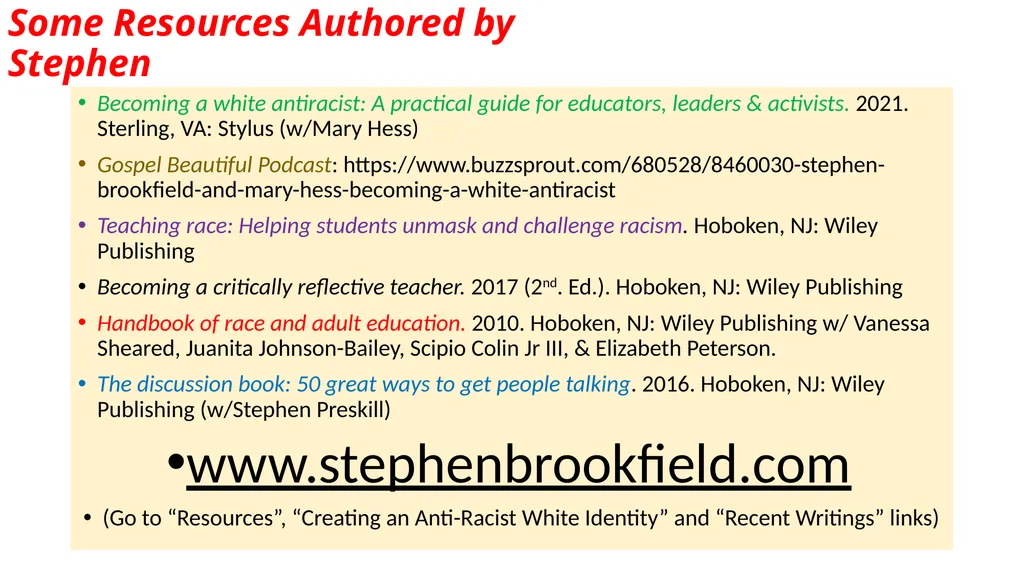
Some Resources Authored by Stephen Becoming a white antiracist: A practical guide for educators, leaders & activists. 2021. Sterling, VA: Stylus (w/Mary Hess)
Gospel Beautiful Podcast: https://www.buzzsprout.com/680528/8460030-stephen-brookfield-and-mary-hess-becoming-a-white-antiracist
Teaching race: Helping students unmask and challenge racism. Hoboken, NJ: Wiley Publishing
Becoming a critically reflective teacher. 2017 (2nd. Ed.). Hoboken, NJ: Wiley Publishing
Handbook of race and adult education. 2010. Hoboken, NJ: Wiley Publishing w/ Vanessa Sheared, Juanita Johnson-Bailey, Scipio Colin Jr III, & Elizabeth Peterson.
The discussion book: 50 great ways to get people talking. 2016. Hoboken, NJ: Wiley Publishing (w/Stephen Preskill)
www.stephenbrookfield.com
(Go to “Resources”, “Creating an Anti-Racist White Identity” and “Recent Writings” links)<br>
Gospel Beautiful Podcast: https://www.buzzsprout.com/680528/8460030-stephen-brookfield-and-mary-hess-becoming-a-white-antiracist
Teaching race: Helping students unmask and challenge racism. Hoboken, NJ: Wiley Publishing
Becoming a critically reflective teacher. 2017 (2nd. Ed.). Hoboken, NJ: Wiley Publishing
Handbook of race and adult education. 2010. Hoboken, NJ: Wiley Publishing w/ Vanessa Sheared, Juanita Johnson-Bailey, Scipio Colin Jr III, & Elizabeth Peterson.
The discussion book: 50 great ways to get people talking. 2016. Hoboken, NJ: Wiley Publishing (w/Stephen Preskill)
www.stephenbrookfield.com
(Go to “Resources”, “Creating an Anti-Racist White Identity” and “Recent Writings” links)<br>
24
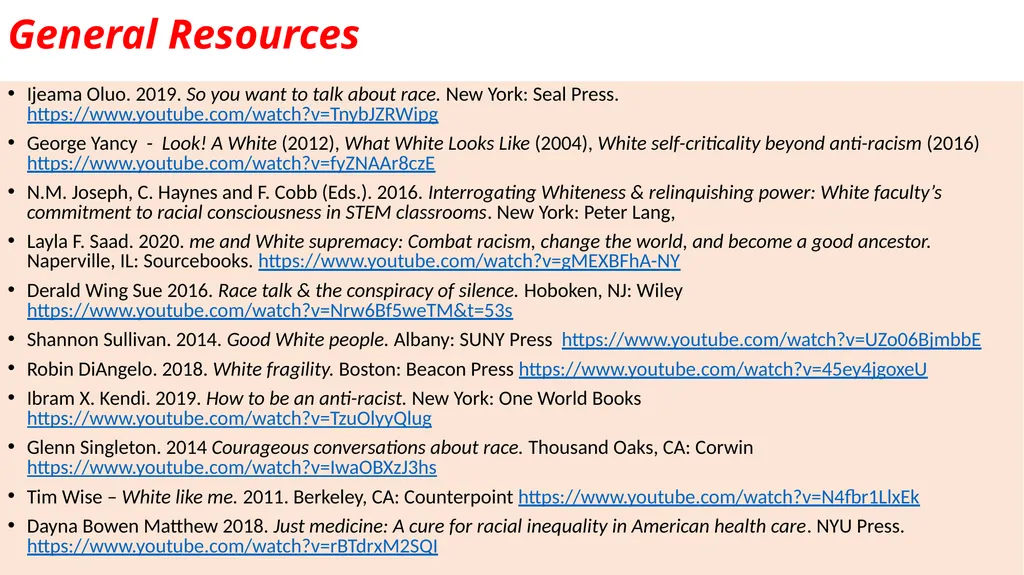
General Resources Ijeama Oluo. 2019. So you want to talk about race. New York: Seal Press. https://www.youtube.com/watch?v=TnybJZRWipg
George Yancy - Look! A White (2012), What White Looks Like (2004), White self-criticality beyond anti-racism (2016) https://www.youtube.com/watch?v=fyZNAAr8czE
N.M. Joseph, C. Haynes and F. Cobb (Eds.). 2016. Interrogating Whiteness & relinquishing power: White faculty’s commitment to racial consciousness in STEM classrooms. New York: Peter Lang,
Layla F. Saad. 2020. me and White supremacy: Combat racism, change the world, and become a good ancestor. Naperville, IL: Sourcebooks. https://www.youtube.com/watch?v=gMEXBFhA-NY
Derald Wing Sue 2016. Race talk & the conspiracy of silence. Hoboken, NJ: Wiley https://www.youtube.com/watch?v=Nrw6Bf5weTM&t=53s
Shannon Sullivan. 2014. Good White people. Albany: SUNY Press https://www.youtube.com/watch?v=UZo06BjmbbE
Robin DiAngelo. 2018. White fragility. Boston: Beacon Press https://www.youtube.com/watch?v=45ey4jgoxeU
Ibram X. Kendi. 2019. How to be an anti-racist. New York: One World Books https://www.youtube.com/watch?v=TzuOlyyQlug
Glenn Singleton. 2014 Courageous conversations about race. Thousand Oaks, CA: Corwin https://www.youtube.com/watch?v=IwaOBXzJ3hs
Tim Wise – White like me. 2011. Berkeley, CA: Counterpoint https://www.youtube.com/watch?v=N4fbr1LlxEk
Dayna Bowen Matthew 2018. Just medicine: A cure for racial inequality in American health care. NYU Press. https://www.youtube.com/watch?v=rBTdrxM2SQI<br>
George Yancy - Look! A White (2012), What White Looks Like (2004), White self-criticality beyond anti-racism (2016) https://www.youtube.com/watch?v=fyZNAAr8czE
N.M. Joseph, C. Haynes and F. Cobb (Eds.). 2016. Interrogating Whiteness & relinquishing power: White faculty’s commitment to racial consciousness in STEM classrooms. New York: Peter Lang,
Layla F. Saad. 2020. me and White supremacy: Combat racism, change the world, and become a good ancestor. Naperville, IL: Sourcebooks. https://www.youtube.com/watch?v=gMEXBFhA-NY
Derald Wing Sue 2016. Race talk & the conspiracy of silence. Hoboken, NJ: Wiley https://www.youtube.com/watch?v=Nrw6Bf5weTM&t=53s
Shannon Sullivan. 2014. Good White people. Albany: SUNY Press https://www.youtube.com/watch?v=UZo06BjmbbE
Robin DiAngelo. 2018. White fragility. Boston: Beacon Press https://www.youtube.com/watch?v=45ey4jgoxeU
Ibram X. Kendi. 2019. How to be an anti-racist. New York: One World Books https://www.youtube.com/watch?v=TzuOlyyQlug
Glenn Singleton. 2014 Courageous conversations about race. Thousand Oaks, CA: Corwin https://www.youtube.com/watch?v=IwaOBXzJ3hs
Tim Wise – White like me. 2011. Berkeley, CA: Counterpoint https://www.youtube.com/watch?v=N4fbr1LlxEk
Dayna Bowen Matthew 2018. Just medicine: A cure for racial inequality in American health care. NYU Press. https://www.youtube.com/watch?v=rBTdrxM2SQI<br>
25
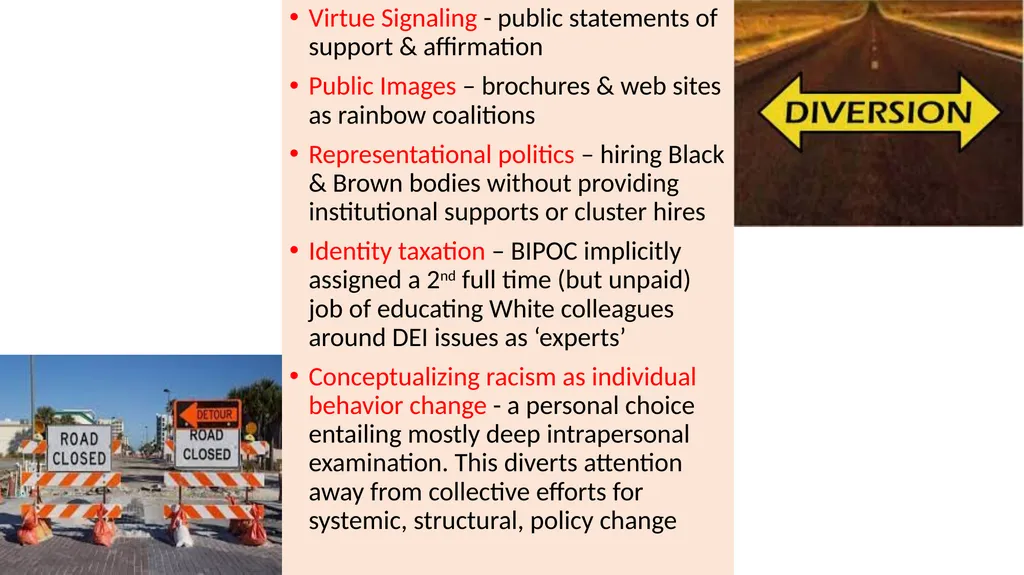
Virtue Signaling - public statements of support & affirmation
Public Images – brochures & web sites as rainbow coalitions
Representational politics – hiring Black & Brown bodies without providing institutional supports or cluster hires
Identity taxation – BIPOC implicitly assigned a 2nd full time (but unpaid) job of educating White colleagues around DEI issues as ‘experts’
Conceptualizing racism as individual behavior change - a personal choice entailing mostly deep intrapersonal examination. This diverts attention away from collective efforts for systemic, structural, policy change<br>
Public Images – brochures & web sites as rainbow coalitions
Representational politics – hiring Black & Brown bodies without providing institutional supports or cluster hires
Identity taxation – BIPOC implicitly assigned a 2nd full time (but unpaid) job of educating White colleagues around DEI issues as ‘experts’
Conceptualizing racism as individual behavior change - a personal choice entailing mostly deep intrapersonal examination. This diverts attention away from collective efforts for systemic, structural, policy change<br>