Anurag Vijay EUCLIDS GEOMETRY GEOMETRY GEO METREIN Earth To measure Geometry originated in Egypt as an art of Earth measurement Euclid (325 BCE-265 BCE): The Father of Geometry The first Egyptian mathematician who initiated a new way of
"Anurag Vijay EUCLID’S GEOMETRY GEOMETRY GEO" is the property of its rightful owner. Permission is granted to
download and print the materials on this website for personal, non-commercial use only, and to display it
on your personal computer provided you do not modify the materials and that you retain all copyright
notices contained in the materials. By downloading content from our website, you accept the terms of this
agreement.
Presentation Transcript
01
Anurag Vijay<br>
02
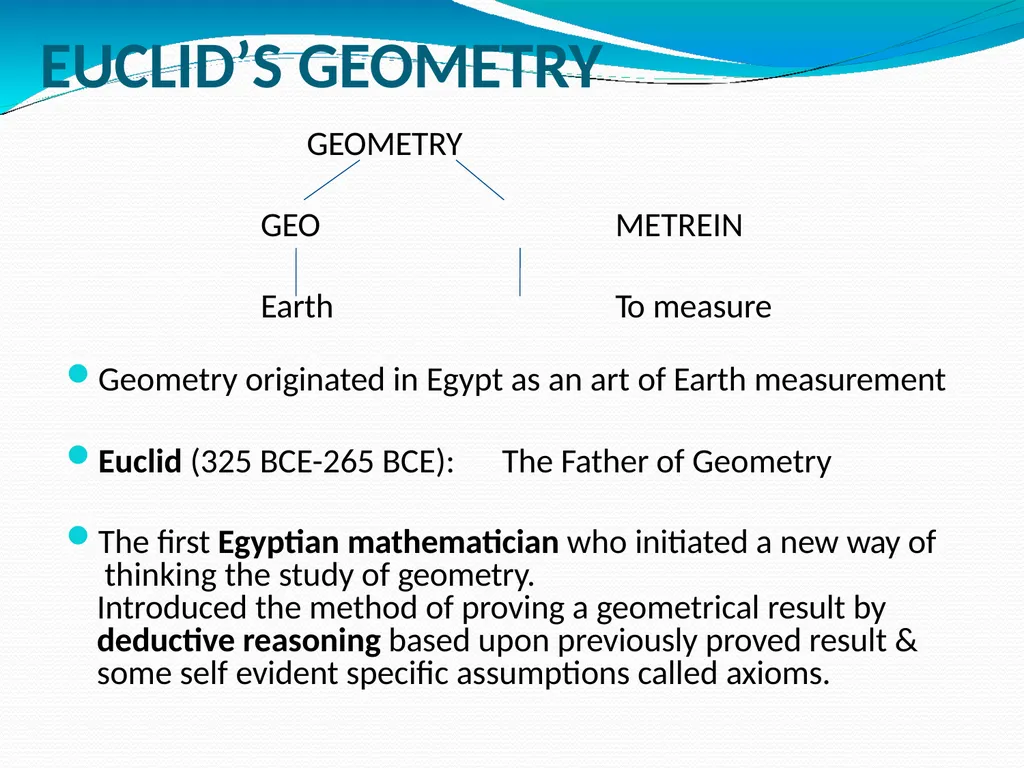
EUCLID’S GEOMETRY GEOMETRY
GEO METREIN
Earth To measure
Geometry originated in Egypt as an art of Earth measurement
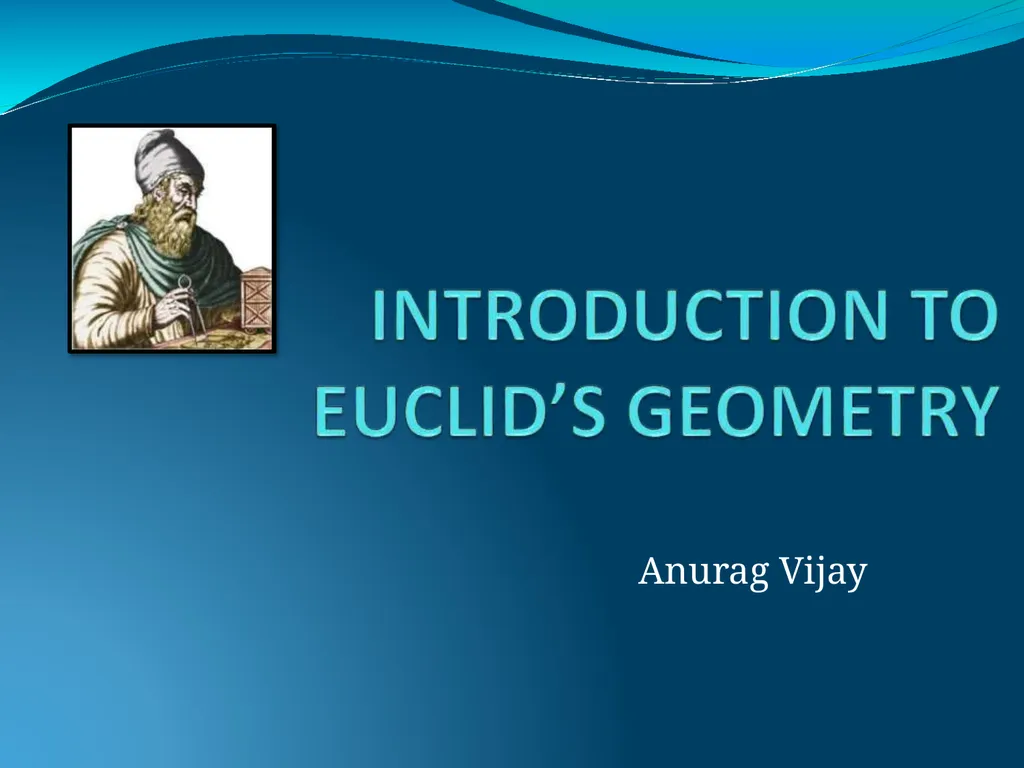
Euclid (325 BCE-265 BCE): The Father of Geometry
The first Egyptian mathematician who initiated a new way of thinking the study of geometry.
Introduced the method of proving a geometrical result by deductive reasoning based upon previously proved result & some self evident specific assumptions called axioms.<br>
03
Euclid’s Definitions Euclid has listed 23 definitions in Book-1 of the ‘Elements’; a few are :
A point is that which has no part.
A line is breadth less length.
The ends of a line are points.
A straight line is a line which lies evenly with the points on itself.
A surface is that which has length & breadth only.
The edges of a surface are lines.
A plane surface is a surface which lies evenly with the straight lines on itself.<br>
04
Euclid’s Axioms & Postulates Euclid assumed certain properties which are actually obvious universal truths & divided them into two types:
Postulates – the assumptions specific to geometry.
Axioms - the assumptions used throughout mathematics & not specifically linked to geometry.<br>
05
Euclid’s Axioms Things which are equal to the same thing are equal to one another.
i.e. If A = C & B = C, then A = B.
Here A, B & C are same kind of things.
If equals are added to equals, the whole are equal
i.e. If A = B & C = D, then A + C = B + D
Also A = B then this implies that A + C = B + C.
If equals are subtracted from equals, the remainders are equal.
Things which coinside with one another are equal to one another.<br>
06
The whole is greater than the part.
i.e. If A > B then there exists C such that A = B + C.
Here B is a part of A & therefore A is greater than B.
Things which are double of the same things are equal to one another.
The things are halves of the same things are equal to one another.<br>
07
Euclid’s Five Postulates Postulate 1: A straight line may be drawn from any one point to any other point.
Axiom: given two distinct points, there is a unique line that passes through them.
Postulate 2: A terminated line can be produced indefinitely.
Postulate 3: A circle can be drawn with any centre and any radius.
Postulate 4: All right angles are equal to one another.<br>
08
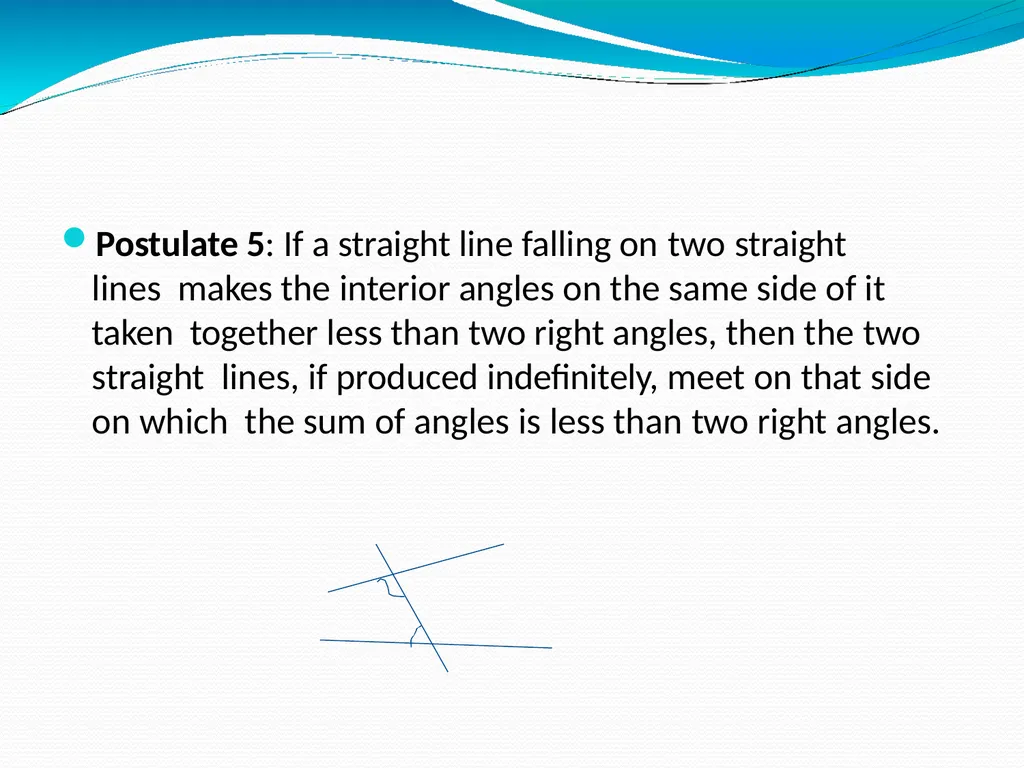
Postulate 5: If a straight line falling on two straight lines makes the interior angles on the same side of it taken together less than two right angles, then the two straight lines, if produced indefinitely, meet on that side on which the sum of angles is less than two right angles.<br>
09
Euclid’s Theorems Theorems - proved statements,
465 theorems in a logical chain using his axioms, postulates & definitions.
Theorem 1: Two distinct lines cannot have more than one point in common.<br>
10
Equivalent version of Euclid’s fifth postulate There are several equivalent versions of fifth postulate; one of them is ‘Playfair’s axiom’(a Scottish mathematician in 1729) as stated below:
For every line l and for every point p not lying on l, there exists a unique line m passing through p & parallel to l.<br>
11
Conclusion Euclid did not require his fifth postulate to prove his first 28 theorems but he himself including many mathematicians were convinced that the fifth postulate is actually a theorem that can be proved using just the four postulates and other axioms.
However all attempts to prove the fifth postulate as a theorem have failed & this led to a great achievement
– the creation of several other geometries , quite different from Euclidean geometries called as non- Euclidean geometries.
Example, Spherical geometry, the geometry of the universe we live in.<br>