
Anxiety is normal – learn how to control it.
Description: Anxiety is normal learn how to control it. School Resource Pack Fife Council Educational Psychology Service 2020 Guidance for Named PersonSchool Staff What is anxiety? Anxiety is an unpleasant feeling of worry or nervousness that we all
Related Topics
Download Presentation
"Anxiety is normal – learn how to control it." is the property of its rightful owner. Permission is granted to download and print the materials on this website for personal, non-commercial use only, and to display it on your personal computer provided you do not modify the materials and that you retain all copyright notices contained in the materials. By downloading content from our website, you accept the terms of this agreement.
Presentation Transcript
slide1. Anxiety is normal – learn how to control it.
School Resource Pack Fife Council Educational Psychology Service 2020<br>
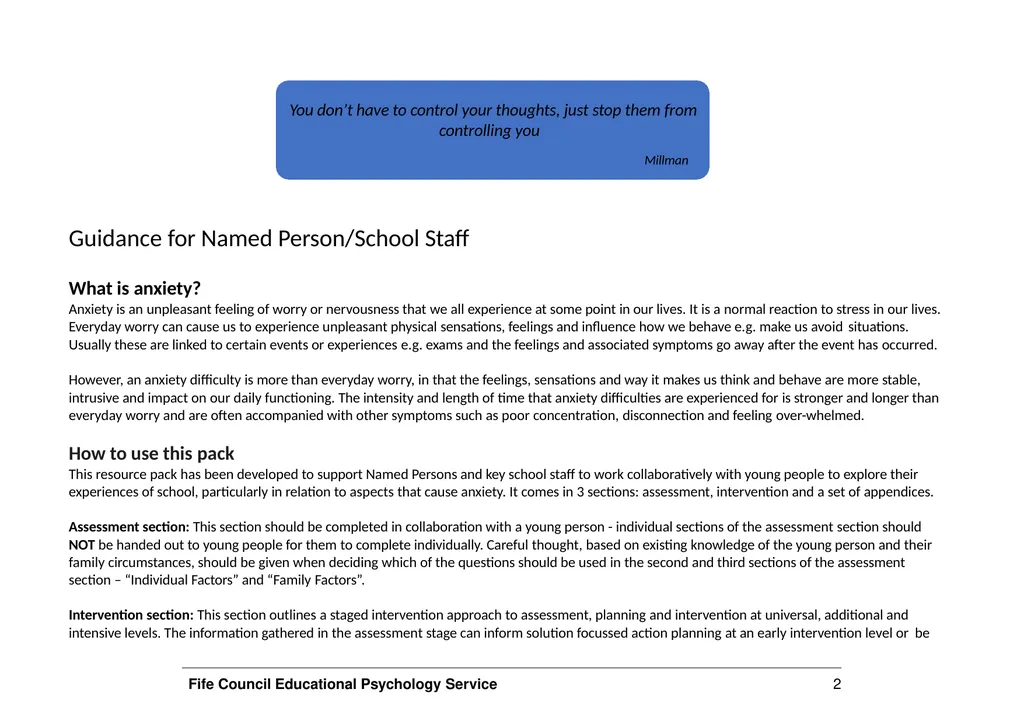
slide2. Guidance for Named Person/School Staff What is anxiety?
Anxiety is an unpleasant feeling of worry or nervousness that we all experience at some point in our lives. It is a normal reaction to stress in our lives. Everyday worry can cause us to experience unpleasant physical sensations, feelings and influence how we behave e.g. make us avoid situations.
Usually these are linked to certain events or experiences e.g. exams and the feelings and associated symptoms go away after the event has occurred.
However, an anxiety difficulty is more than everyday worry, in that the feelings, sensations and way it makes us think and behave are more stable, intrusive and impact on our daily functioning. The intensity and length of time that anxiety difficulties are experienced for is stronger and longer than everyday worry and are often accompanied with other symptoms such as poor concentration, disconnection and feeling over-whelmed.
How to use this pack
This resource pack has been developed to support Named Persons and key school staff to work collaboratively with young people to explore their experiences of school, particularly in relation to aspects that cause anxiety. It comes in 3 sections: assessment, intervention and a set of appendices.
Assessment section: This section should be completed in collaboration with a young person - individual sections of the assessment section should NOT be handed out to young people for them to complete individually. Careful thought, based on existing knowledge of the young person and their family circumstances, should be given when deciding which of the questions should be used in the second and third sections of the assessment section – “Individual Factors” and “Family Factors”.
Intervention section: This section outlines a staged intervention approach to assessment, planning and intervention at universal, additional and intensive levels. The information gathered in the assessment stage can inform solution focussed action planning at an early intervention level or be You don’t have to control your thoughts, just stop them from controlling you
Millman Fife Council Educational Psychology Service 7<br>
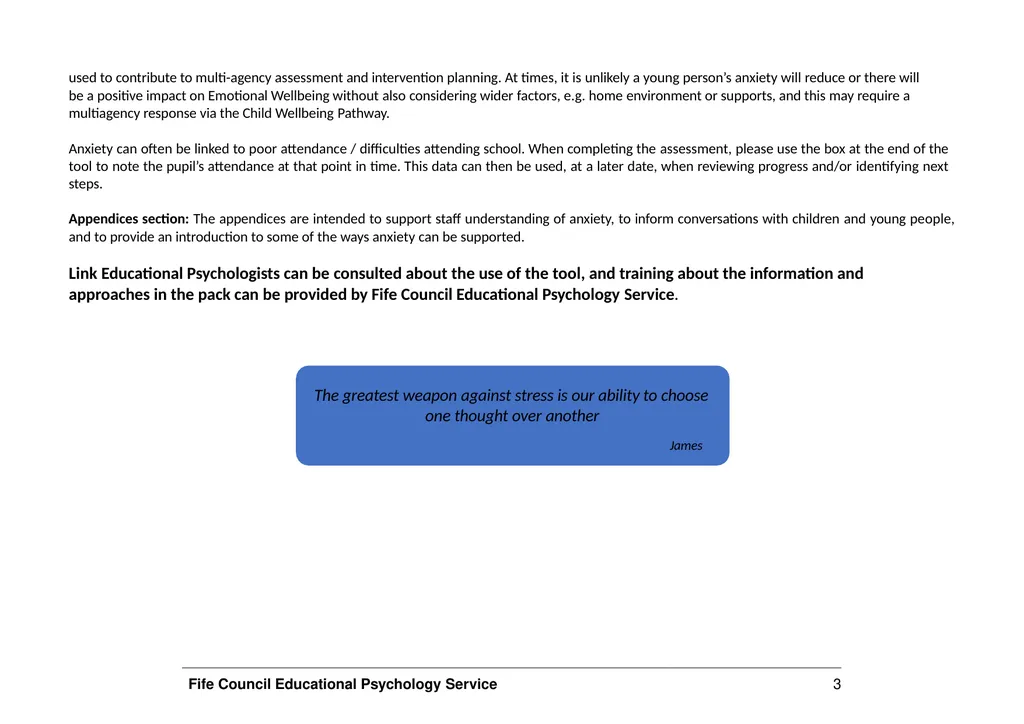
slide3. used to contribute to multi-agency assessment and intervention planning. At times, it is unlikely a young person’s anxiety will reduce or there will be a positive impact on Emotional Wellbeing without also considering wider factors, e.g. home environment or supports, and this may require a multiagency response via the Child Wellbeing Pathway.
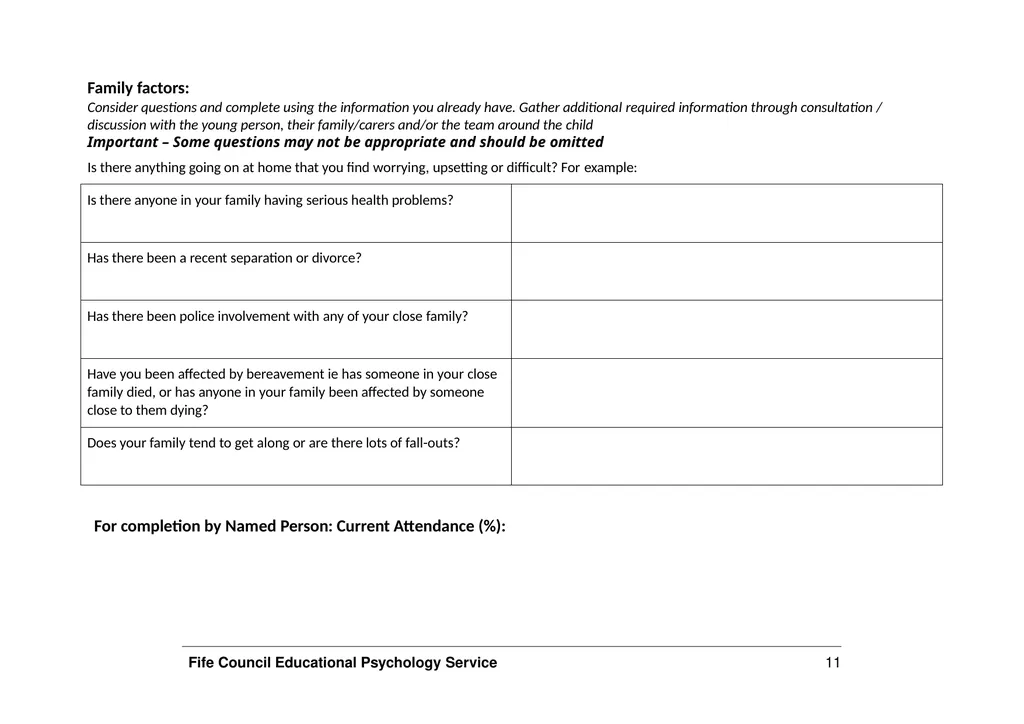
Anxiety can often be linked to poor attendance / difficulties attending school. When completing the assessment, please use the box at the end of the tool to note the pupil’s attendance at that point in time. This data can then be used, at a later date, when reviewing progress and/or identifying next steps.
Appendices section: The appendices are intended to support staff understanding of anxiety, to inform conversations with children and young people, and to provide an introduction to some of the ways anxiety can be supported.
Link Educational Psychologists can be consulted about the use of the tool, and training about the information and approaches in the pack can be provided by Fife Council Educational Psychology Service. The greatest weapon against stress is our ability to choose one thought over another
James Fife Council Educational Psychology Service 7<br>
slide4. Assessment – recognising physical reactions, and exploring school, individual and family factors. Fife Council Educational Psychology Service 7<br>
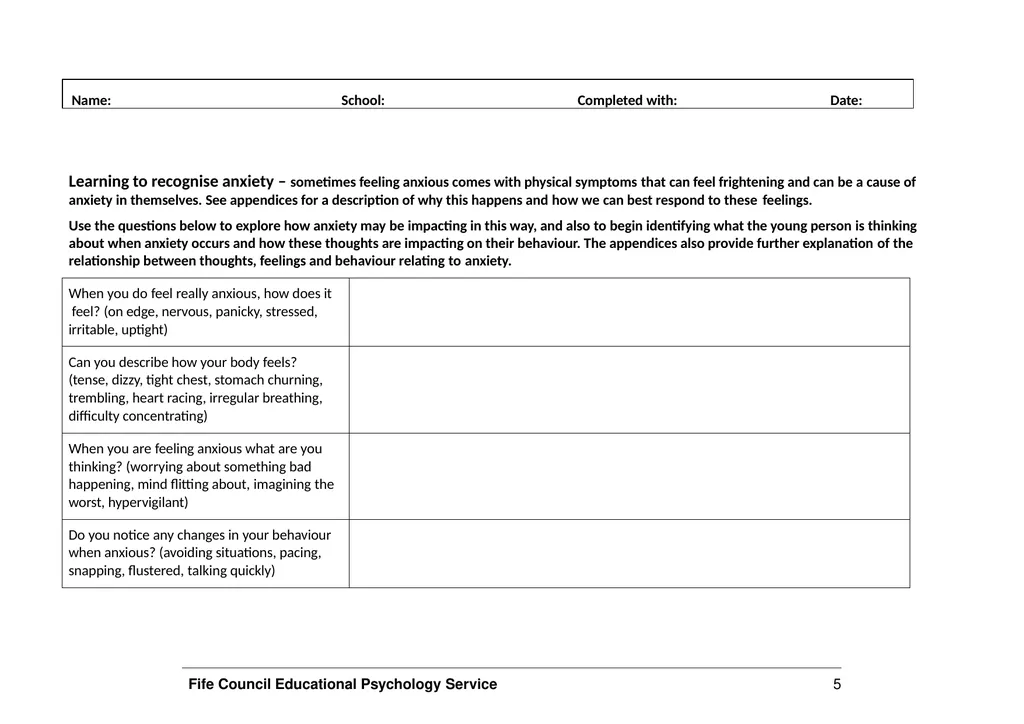
slide5. Learning to recognise anxiety – sometimes feeling anxious comes with physical symptoms that can feel frightening and can be a cause of anxiety in themselves. See appendices for a description of why this happens and how we can best respond to these feelings.
Use the questions below to explore how anxiety may be impacting in this way, and also to begin identifying what the young person is thinking about when anxiety occurs and how these thoughts are impacting on their behaviour. The appendices also provide further explanation of the relationship between thoughts, feelings and behaviour relating to anxiety. Fife Council Educational Psychology Service 7 Name: School: Completed with: Date:<br>
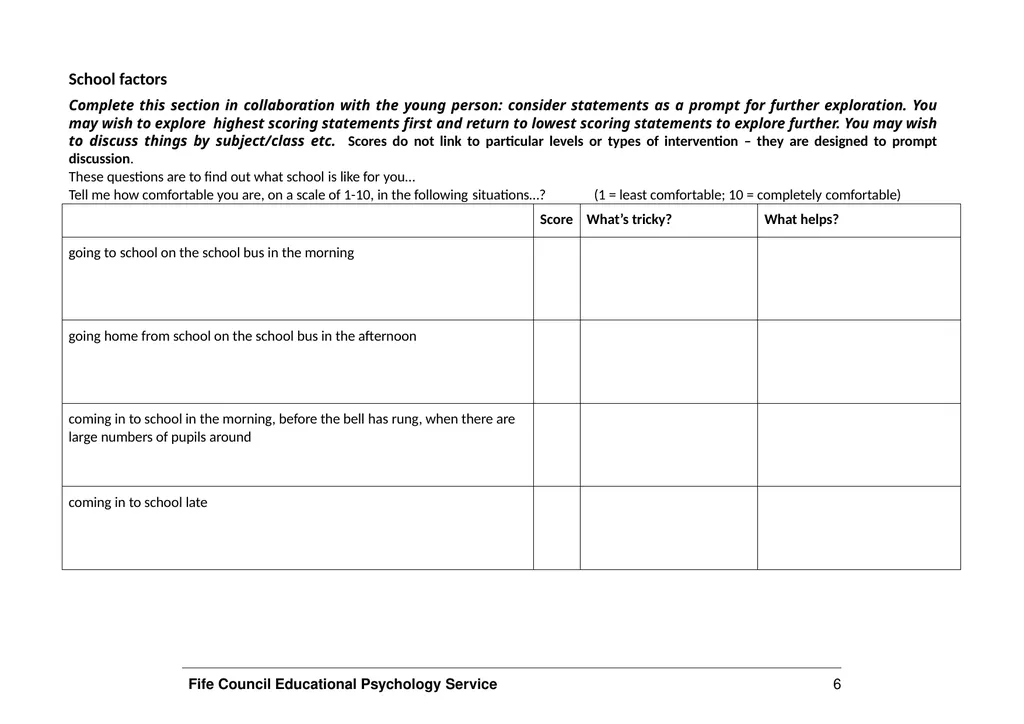
slide6. School factors
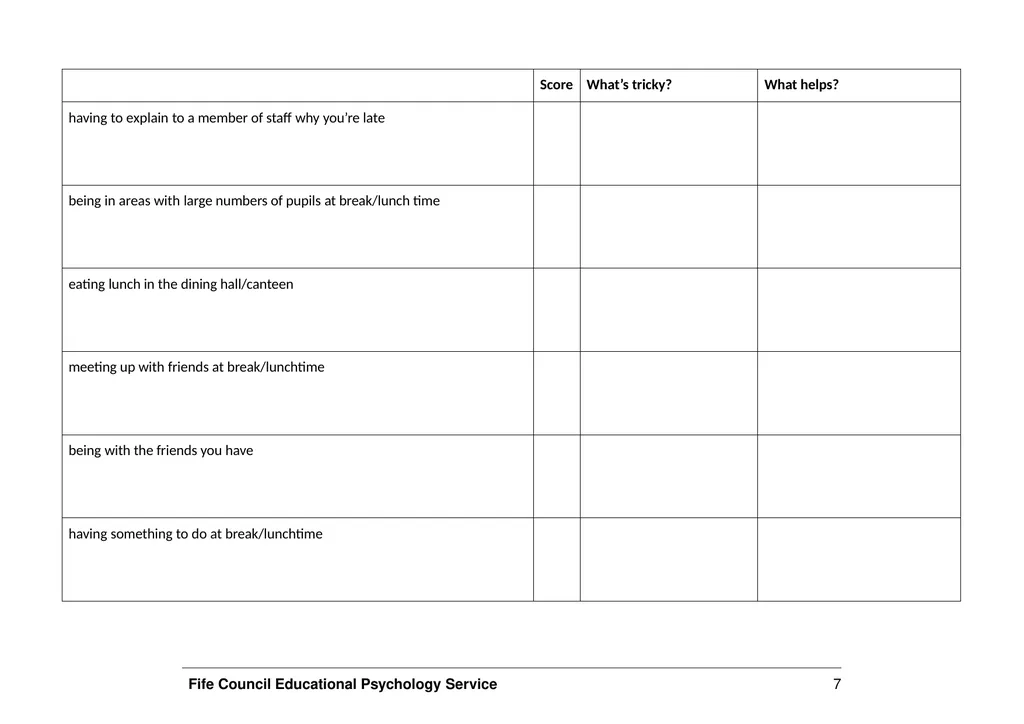
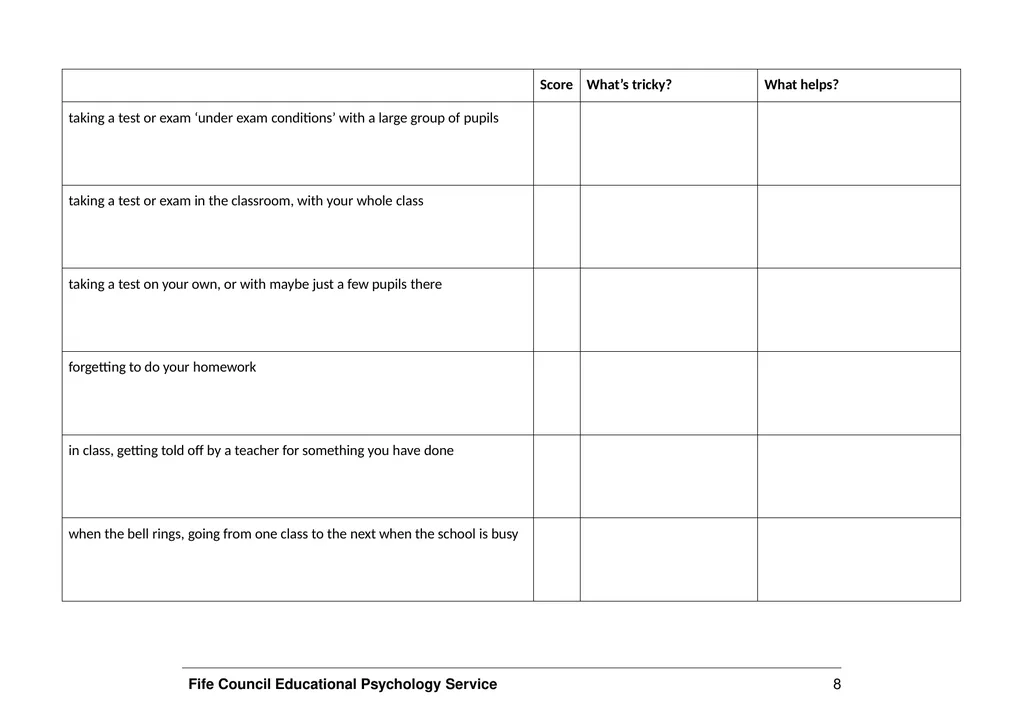
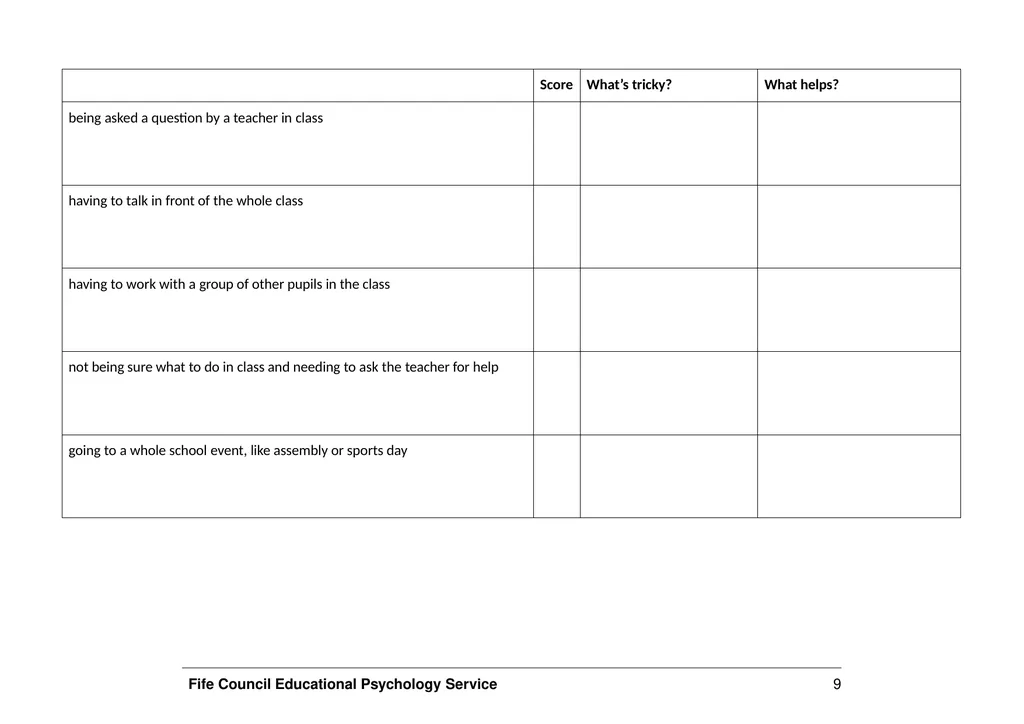
Complete this section in collaboration with the young person: consider statements as a prompt for further exploration. You may wish to explore highest scoring statements first and return to lowest scoring statements to explore further. You may wish to discuss things by subject/class etc. Scores do not link to particular levels or types of intervention – they are designed to prompt discussion. Fife Council Educational Psychology Service 7 These questions are to find out what school is like for you…
Tell me how comfortable you are, on a scale of 1-10, in the following situations…? (1 = least comfortable; 10 = completely comfortable)<br>
slide7. Fife Council Educational Psychology Service 7<br>
slide8. Fife Council Educational Psychology Service 7<br>
slide9. Fife Council Educational Psychology Service 7<br>
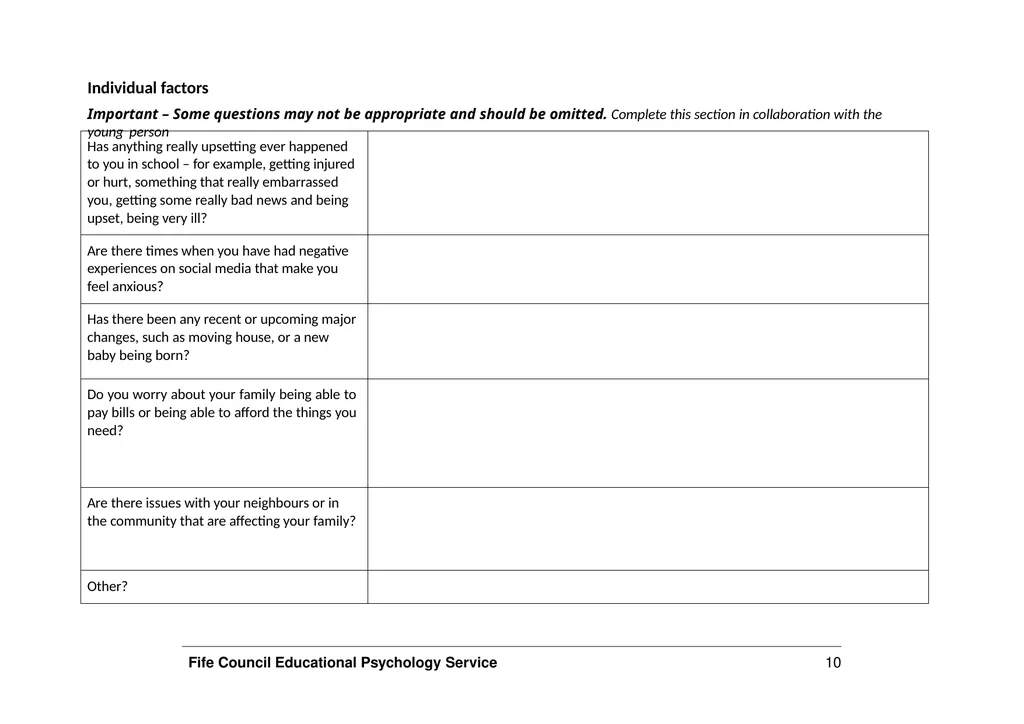
slide10. Individual factors
Important – Some questions may not be appropriate and should be omitted. Complete this section in collaboration with the young person Fife Council Educational Psychology Service 14<br>
slide11. Family factors:
Consider questions and complete using the information you already have. Gather additional required information through consultation / discussion with the young person, their family/carers and/or the team around the child
Important – Some questions may not be appropriate and should be omitted
Is there anything going on at home that you find worrying, upsetting or difficult? For example: Fife Council Educational Psychology Service 14<br>
slide12. Interventions, approaches and supports Fife Council Educational Psychology Service 14<br>
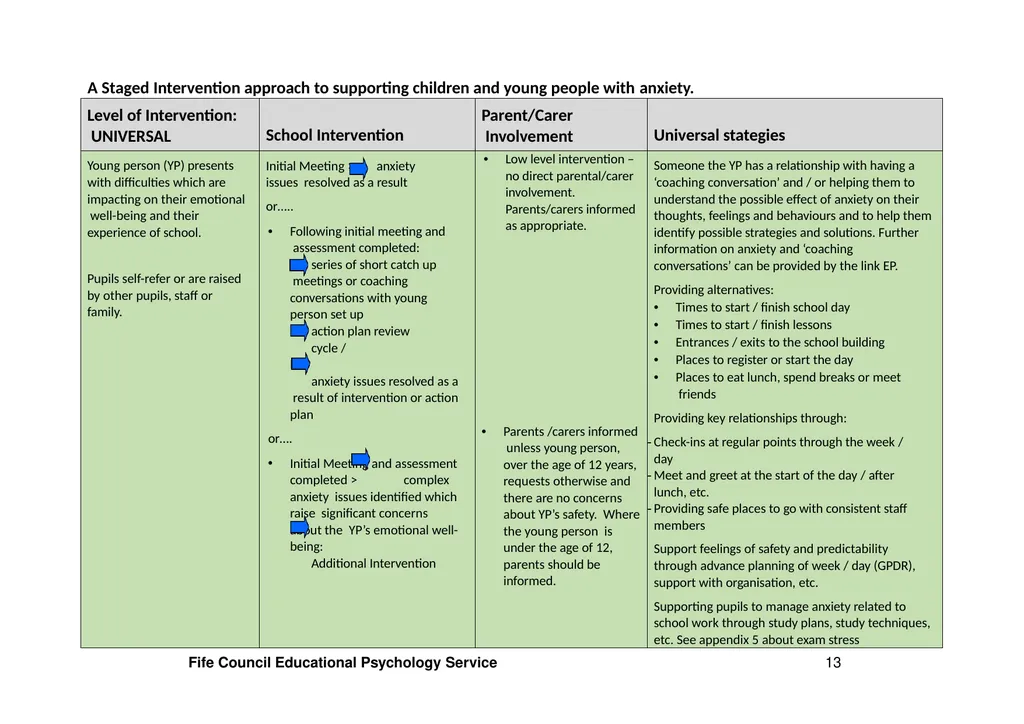
slide13. A Staged Intervention approach to supporting children and young people with anxiety. Fife Council Educational Psychology Service 14<br>
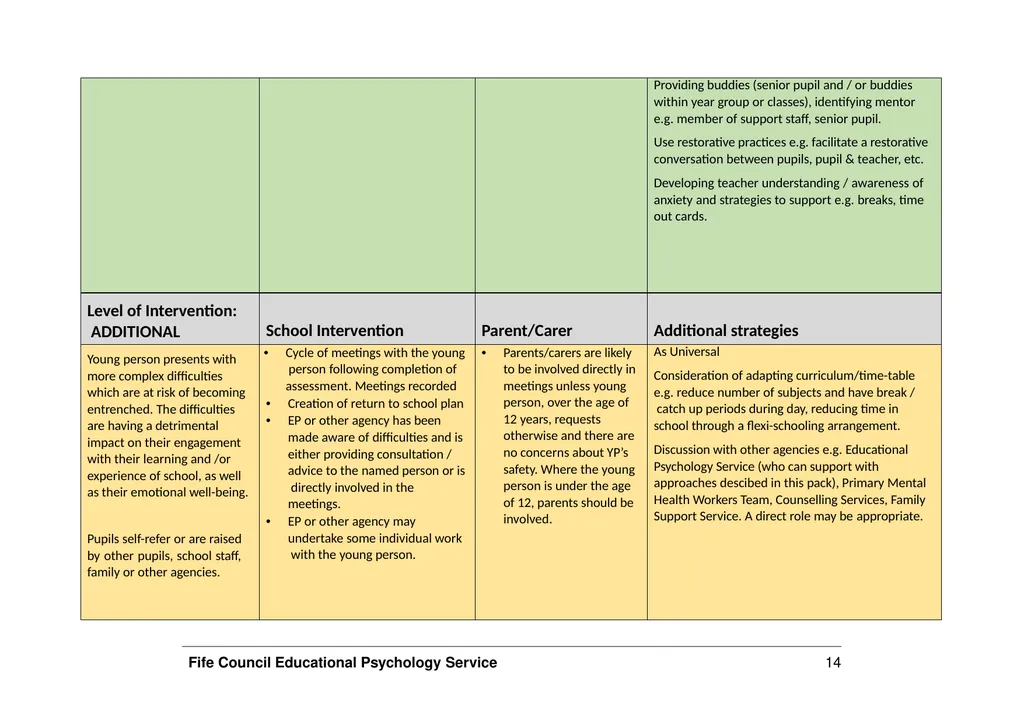
slide14. Fife Council Educational Psychology Service 14<br>
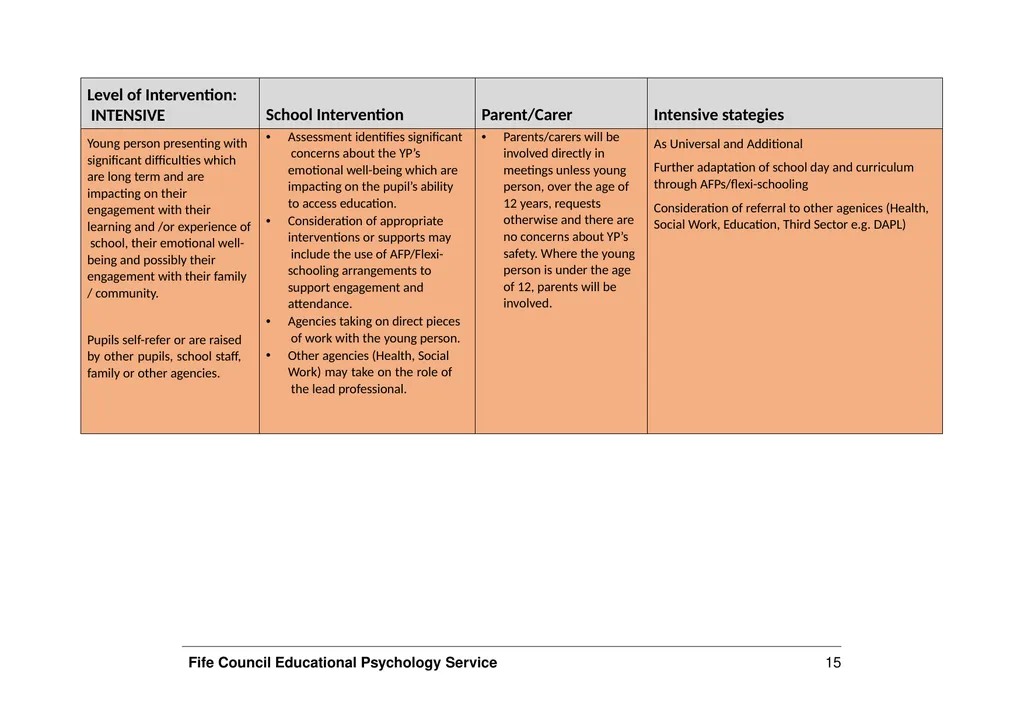
slide15. Fife Council Educational Psychology Service 14<br>
slide16. Plans and protocols
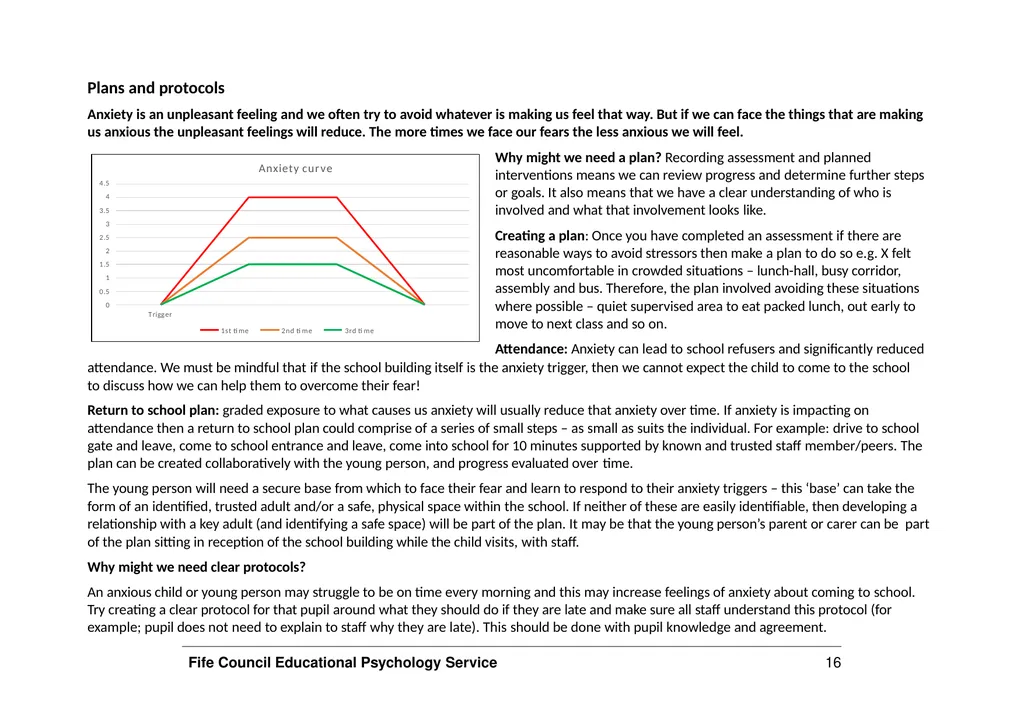
Anxiety is an unpleasant feeling and we often try to avoid whatever is making us feel that way. But if we can face the things that are making us anxious the unpleasant feelings will reduce. The more times we face our fears the less anxious we will feel. Why might we need a plan? Recording assessment and planned interventions means we can review progress and determine further steps or goals. It also means that we have a clear understanding of who is involved and what that involvement looks like.
Creating a plan: Once you have completed an assessment if there are reasonable ways to avoid stressors then make a plan to do so e.g. X felt most uncomfortable in crowded situations – lunch-hall, busy corridor, assembly and bus. Therefore, the plan involved avoiding these situations where possible – quiet supervised area to eat packed lunch, out early to move to next class and so on.
Attendance: Anxiety can lead to school refusers and significantly reduced attendance. We must be mindful that if the school building itself is the anxiety trigger, then we cannot expect the child to come to the school to discuss how we can help them to overcome their fear!
Return to school plan: graded exposure to what causes us anxiety will usually reduce that anxiety over time. If anxiety is impacting on attendance then a return to school plan could comprise of a series of small steps – as small as suits the individual. For example: drive to school gate and leave, come to school entrance and leave, come into school for 10 minutes supported by known and trusted staff member/peers. The plan can be created collaboratively with the young person, and progress evaluated over time.
The young person will need a secure base from which to face their fear and learn to respond to their anxiety triggers – this ‘base’ can take the form of an identified, trusted adult and/or a safe, physical space within the school. If neither of these are easily identifiable, then developing a relationship with a key adult (and identifying a safe space) will be part of the plan. It may be that the young person’s parent or carer can be part of the plan sitting in reception of the school building while the child visits, with staff.
Why might we need clear protocols?
An anxious child or young person may struggle to be on time every morning and this may increase feelings of anxiety about coming to school. Try creating a clear protocol for that pupil around what they should do if they are late and make sure all staff understand this protocol (for example; pupil does not need to explain to staff why they are late). This should be done with pupil knowledge and agreement. 4.5
4
3.5
3
2.5
2
1.5
1
0.5
0 Trigger Anxiety curve 1st time 2nd time 3rd time Fife Council Educational Psychology Service 14<br>
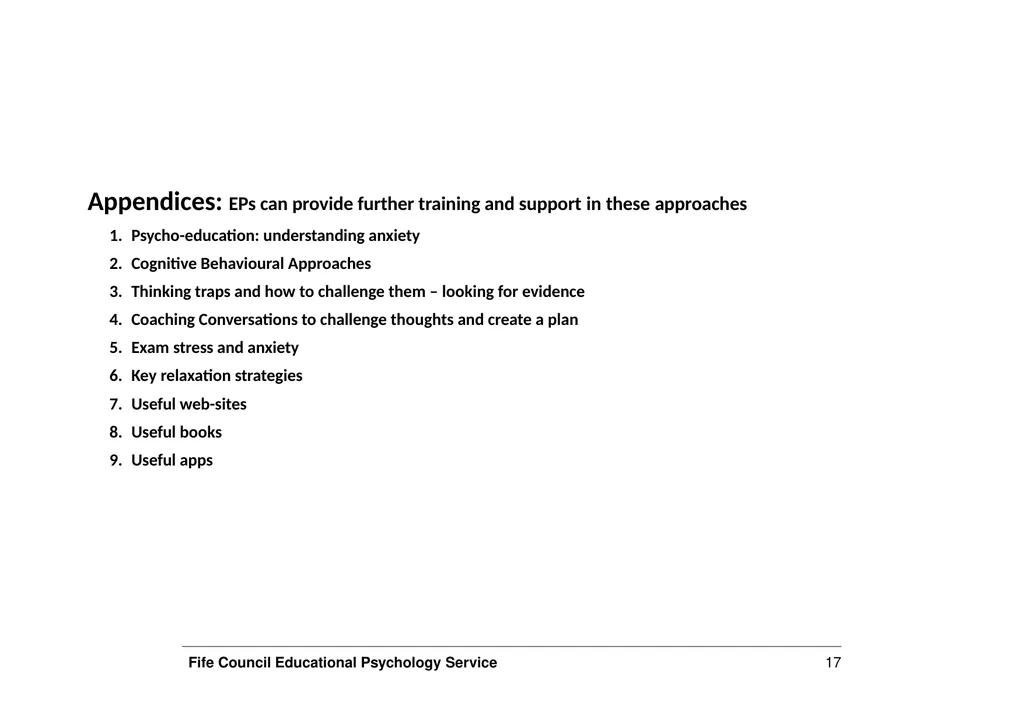
slide17. Appendices: EPs can provide further training and support in these approaches Fife Council Educational Psychology Service 14 Psycho-education: understanding anxiety
Cognitive Behavioural Approaches
Thinking traps and how to challenge them – looking for evidence
Coaching Conversations to challenge thoughts and create a plan
Exam stress and anxiety
Key relaxation strategies
Useful web-sites
Useful books
Useful apps<br>
slide18. 1 Psycho-education
Understanding anxiety
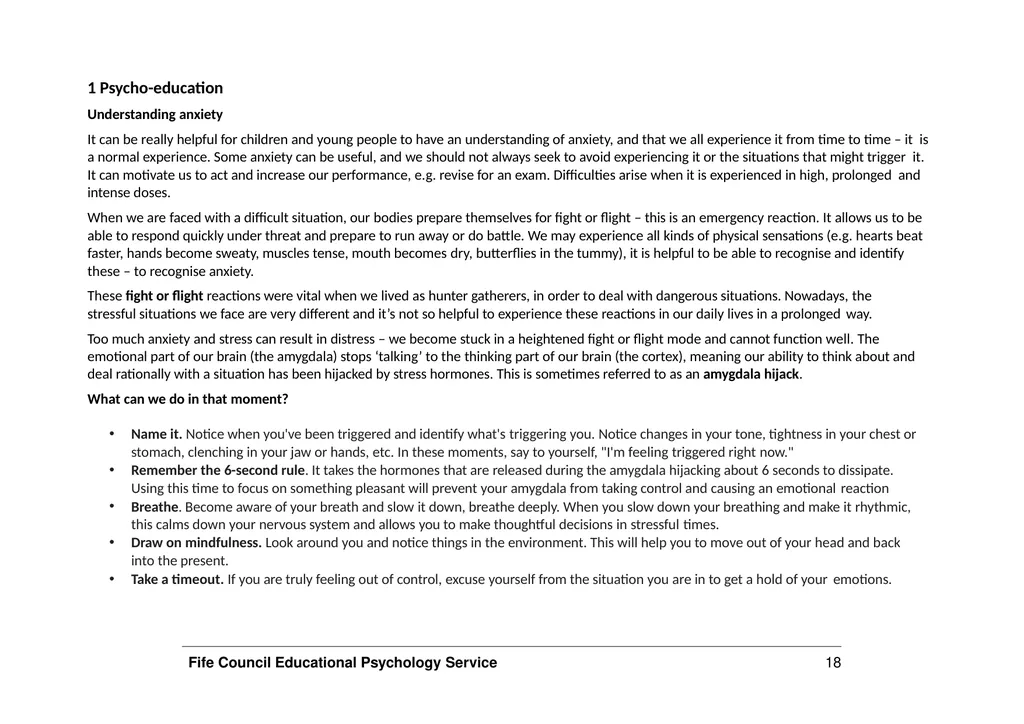
It can be really helpful for children and young people to have an understanding of anxiety, and that we all experience it from time to time – it is a normal experience. Some anxiety can be useful, and we should not always seek to avoid experiencing it or the situations that might trigger it. It can motivate us to act and increase our performance, e.g. revise for an exam. Difficulties arise when it is experienced in high, prolonged and intense doses.
When we are faced with a difficult situation, our bodies prepare themselves for fight or flight – this is an emergency reaction. It allows us to be able to respond quickly under threat and prepare to run away or do battle. We may experience all kinds of physical sensations (e.g. hearts beat faster, hands become sweaty, muscles tense, mouth becomes dry, butterflies in the tummy), it is helpful to be able to recognise and identify these – to recognise anxiety.
These fight or flight reactions were vital when we lived as hunter gatherers, in order to deal with dangerous situations. Nowadays, the stressful situations we face are very different and it’s not so helpful to experience these reactions in our daily lives in a prolonged way.
Too much anxiety and stress can result in distress – we become stuck in a heightened fight or flight mode and cannot function well. The emotional part of our brain (the amygdala) stops ‘talking’ to the thinking part of our brain (the cortex), meaning our ability to think about and deal rationally with a situation has been hijacked by stress hormones. This is sometimes referred to as an amygdala hijack.
What can we do in that moment?
Name it. Notice when you've been triggered and identify what's triggering you. Notice changes in your tone, tightness in your chest or stomach, clenching in your jaw or hands, etc. In these moments, say to yourself, "I'm feeling triggered right now."
Remember the 6-second rule. It takes the hormones that are released during the amygdala hijacking about 6 seconds to dissipate. Using this time to focus on something pleasant will prevent your amygdala from taking control and causing an emotional reaction
Breathe. Become aware of your breath and slow it down, breathe deeply. When you slow down your breathing and make it rhythmic, this calms down your nervous system and allows you to make thoughtful decisions in stressful times.
Draw on mindfulness. Look around you and notice things in the environment. This will help you to move out of your head and back into the present.
Take a timeout. If you are truly feeling out of control, excuse yourself from the situation you are in to get a hold of your emotions. Fife Council Educational Psychology Service 14<br>
slide19. Sometimes our responses to dealing with anxiety can be the very things that serve to maintain it – for example: avoiding the stressful situation, worrying about feeling anxious and presuming the worst. It may be better to:
Stop avoiding situations that cause anxiety – in most cases, practice will reduce the levels of anxiety experienced
Talk about and challenge the way we are thinking about situations, and change the way we feel and behave
2. Cognitive Behavioural Approaches (CBA) – understanding the thinking/feeling/doing cycle
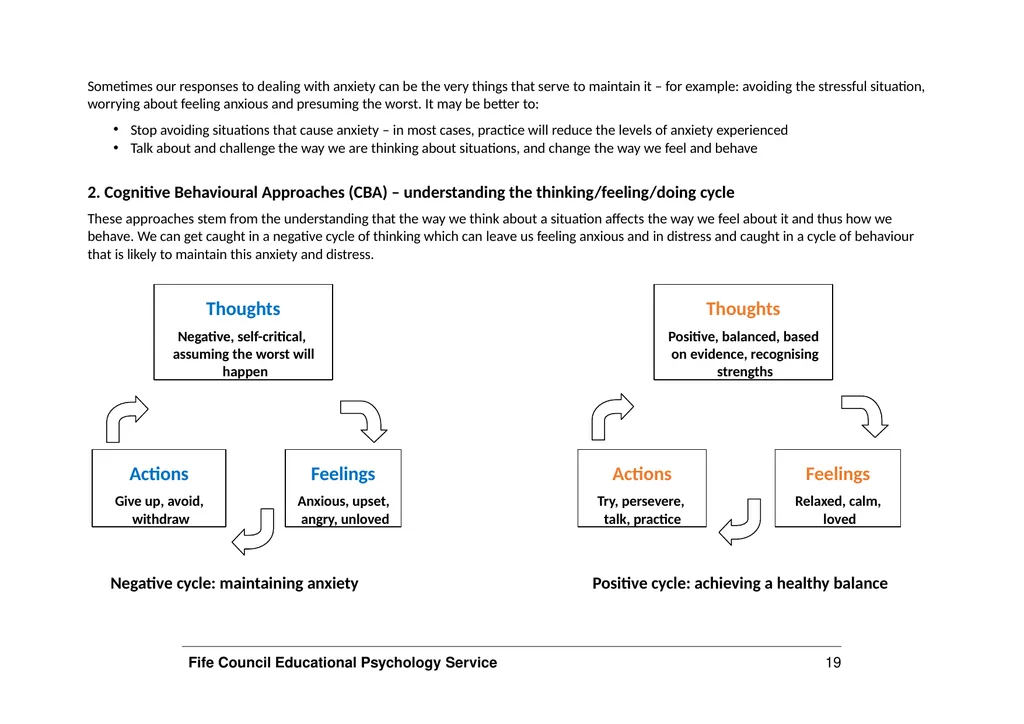
These approaches stem from the understanding that the way we think about a situation affects the way we feel about it and thus how we behave. We can get caught in a negative cycle of thinking which can leave us feeling anxious and in distress and caught in a cycle of behaviour that is likely to maintain this anxiety and distress. Negative cycle: maintaining anxiety Positive cycle: achieving a healthy balance Thoughts
Negative, self-critical, assuming the worst will happen Feelings
Anxious, upset, angry, unloved Actions
Give up, avoid, withdraw Actions
Try, persevere, talk, practice Feelings
Relaxed, calm, loved Thoughts
Positive, balanced, based on evidence, recognising strengths Fife Council Educational Psychology Service 14<br>
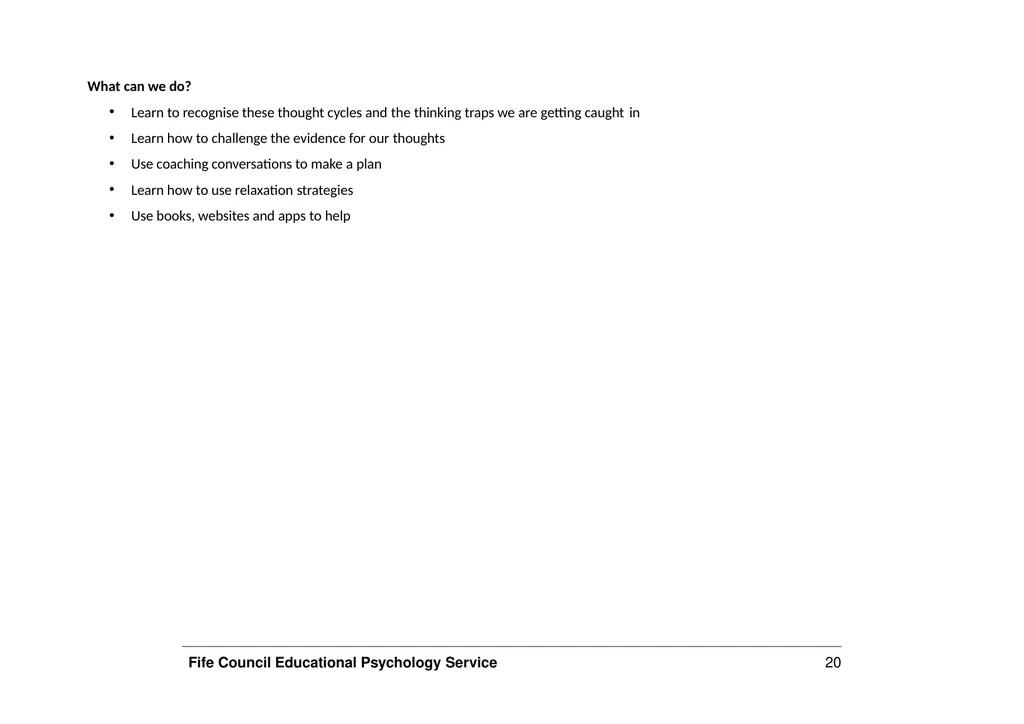
slide20. What can we do?
Learn to recognise these thought cycles and the thinking traps we are getting caught in
Learn how to challenge the evidence for our thoughts
Use coaching conversations to make a plan
Learn how to use relaxation strategies
Use books, websites and apps to help Fife Council Educational Psychology Service 14<br>
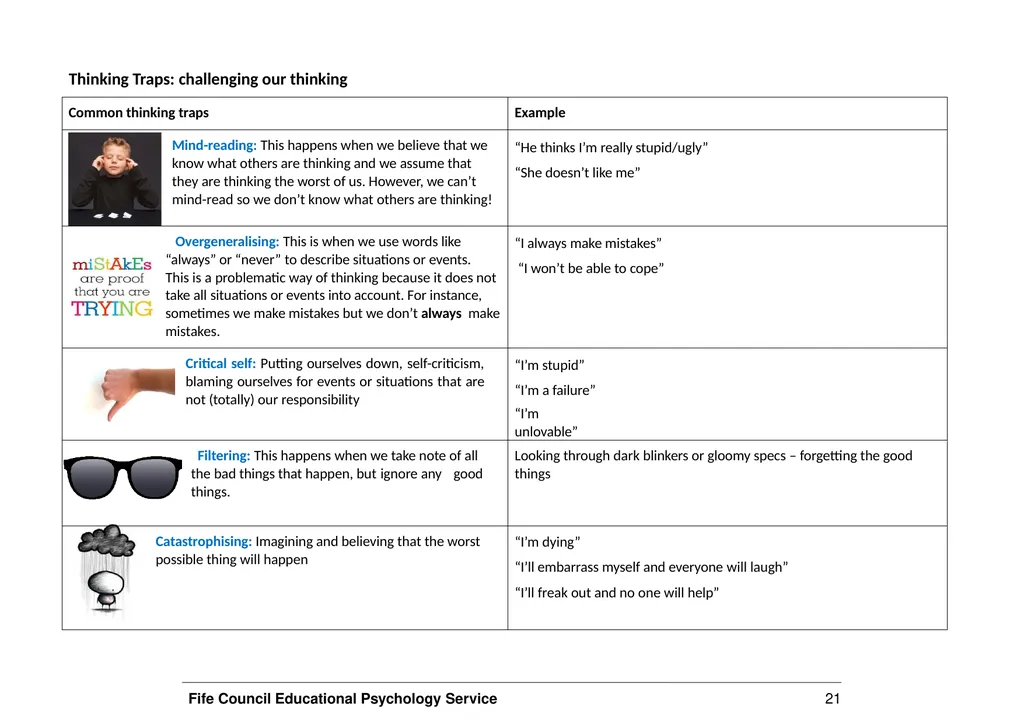
slide21. Fife Council Educational Psychology Service 21 Thinking Traps: challenging our thinking<br>
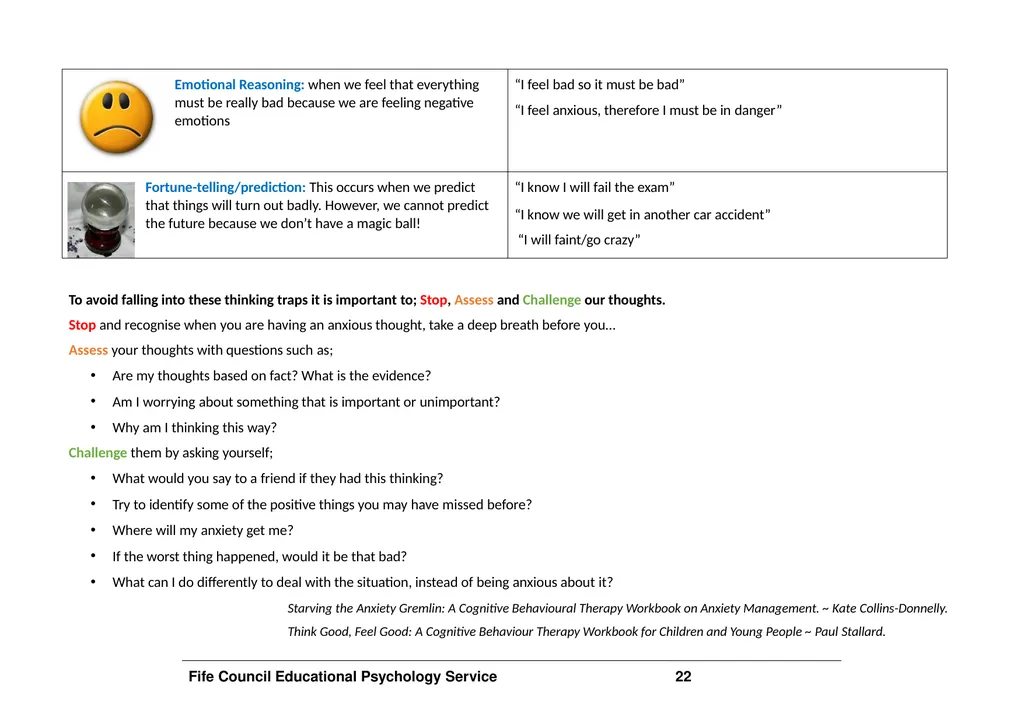
slide22. Fife Council Educational Psychology Service 29 To avoid falling into these thinking traps it is important to; Stop, Assess and Challenge our thoughts. Stop and recognise when you are having an anxious thought, take a deep breath before you…
Assess your thoughts with questions such as;
Are my thoughts based on fact? What is the evidence?
Am I worrying about something that is important or unimportant?
Why am I thinking this way?
Challenge them by asking yourself;
What would you say to a friend if they had this thinking?
Try to identify some of the positive things you may have missed before?
Where will my anxiety get me?
If the worst thing happened, would it be that bad?
What can I do differently to deal with the situation, instead of being anxious about it?
Starving the Anxiety Gremlin: A Cognitive Behavioural Therapy Workbook on Anxiety Management. ~ Kate Collins-Donnelly. Think Good, Feel Good: A Cognitive Behaviour Therapy Workbook for Children and Young People ~ Paul Stallard.<br>
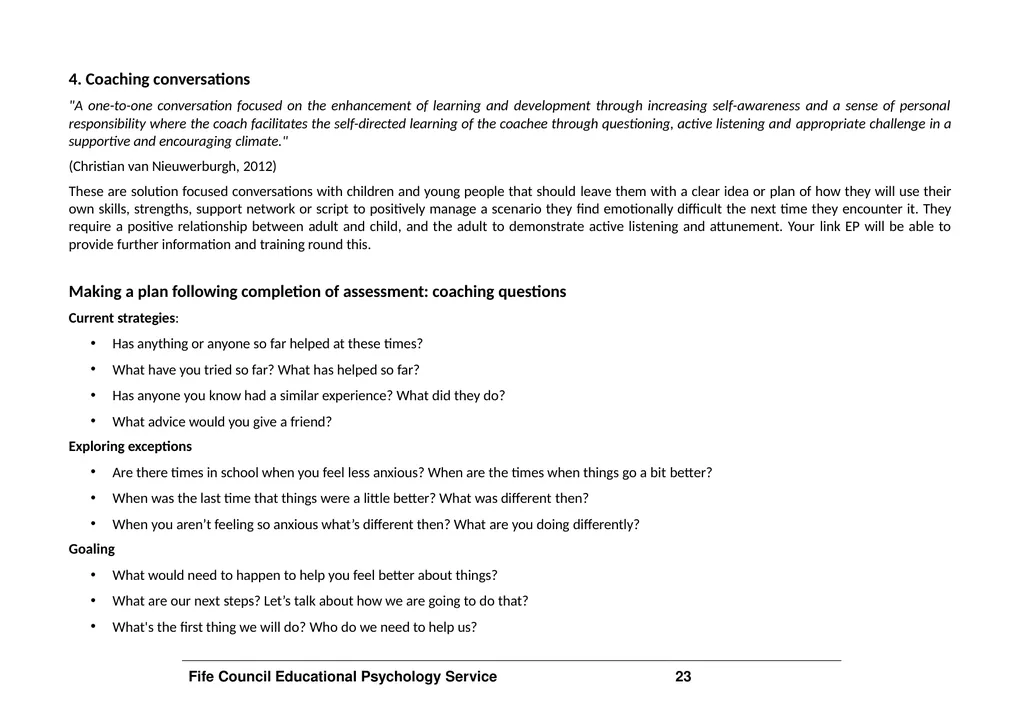
slide23. Coaching conversations
"A one-to-one conversation focused on the enhancement of learning and development through increasing self-awareness and a sense of personal responsibility where the coach facilitates the self-directed learning of the coachee through questioning, active listening and appropriate challenge in a supportive and encouraging climate."
(Christian van Nieuwerburgh, 2012)
These are solution focused conversations with children and young people that should leave them with a clear idea or plan of how they will use their own skills, strengths, support network or script to positively manage a scenario they find emotionally difficult the next time they encounter it. They require a positive relationship between adult and child, and the adult to demonstrate active listening and attunement. Your link EP will be able to provide further information and training round this.
Making a plan following completion of assessment: coaching questions
Current strategies:
Has anything or anyone so far helped at these times?
What have you tried so far? What has helped so far?
Has anyone you know had a similar experience? What did they do?
What advice would you give a friend?
Exploring exceptions
Are there times in school when you feel less anxious? When are the times when things go a bit better?
When was the last time that things were a little better? What was different then?
When you aren’t feeling so anxious what’s different then? What are you doing differently?
Goaling
What would need to happen to help you feel better about things?
What are our next steps? Let’s talk about how we are going to do that?
What's the first thing we will do? Who do we need to help us? Fife Council Educational Psychology Service 29<br>
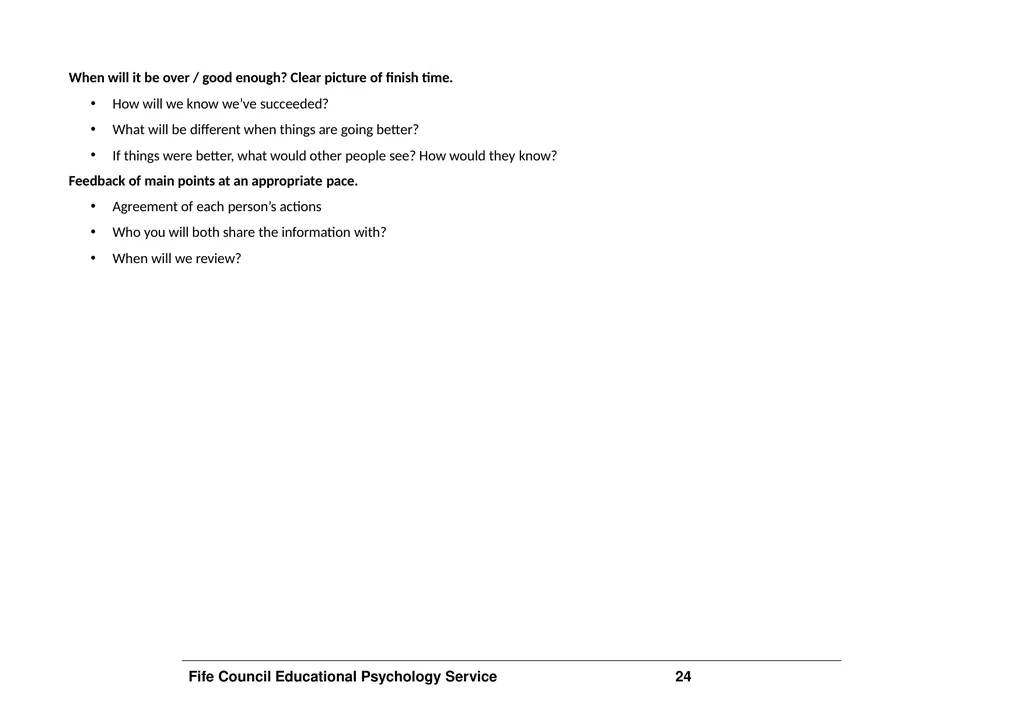
slide24. When will it be over / good enough? Clear picture of finish time.
How will we know we’ve succeeded?
What will be different when things are going better?
If things were better, what would other people see? How would they know?
Feedback of main points at an appropriate pace.
Agreement of each person’s actions
Who you will both share the information with?
When will we review? Fife Council Educational Psychology Service 29<br>
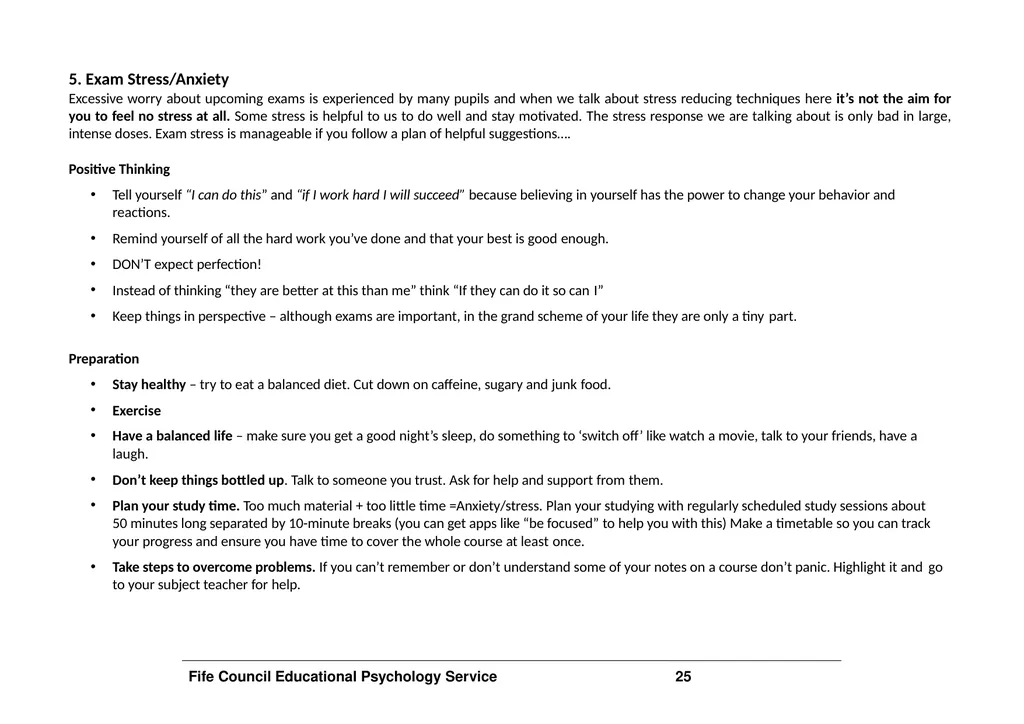
slide25. Exam Stress/Anxiety
Excessive worry about upcoming exams is experienced by many pupils and when we talk about stress reducing techniques here it’s not the aim for you to feel no stress at all. Some stress is helpful to us to do well and stay motivated. The stress response we are talking about is only bad in large, intense doses. Exam stress is manageable if you follow a plan of helpful suggestions….
Positive Thinking
Tell yourself “I can do this” and “if I work hard I will succeed” because believing in yourself has the power to change your behavior and reactions.
Remind yourself of all the hard work you’ve done and that your best is good enough.
DON’T expect perfection!
Instead of thinking “they are better at this than me” think “If they can do it so can I”
Keep things in perspective – although exams are important, in the grand scheme of your life they are only a tiny part.
Preparation
Stay healthy – try to eat a balanced diet. Cut down on caffeine, sugary and junk food.
Exercise
Have a balanced life – make sure you get a good night’s sleep, do something to ‘switch off’ like watch a movie, talk to your friends, have a laugh.
Don’t keep things bottled up. Talk to someone you trust. Ask for help and support from them.
Plan your study time. Too much material + too little time =Anxiety/stress. Plan your studying with regularly scheduled study sessions about 50 minutes long separated by 10-minute breaks (you can get apps like “be focused” to help you with this) Make a timetable so you can track your progress and ensure you have time to cover the whole course at least once.
Take steps to overcome problems. If you can’t remember or don’t understand some of your notes on a course don’t panic. Highlight it and go
to your subject teacher for help. Fife Council Educational Psychology Service 29<br>
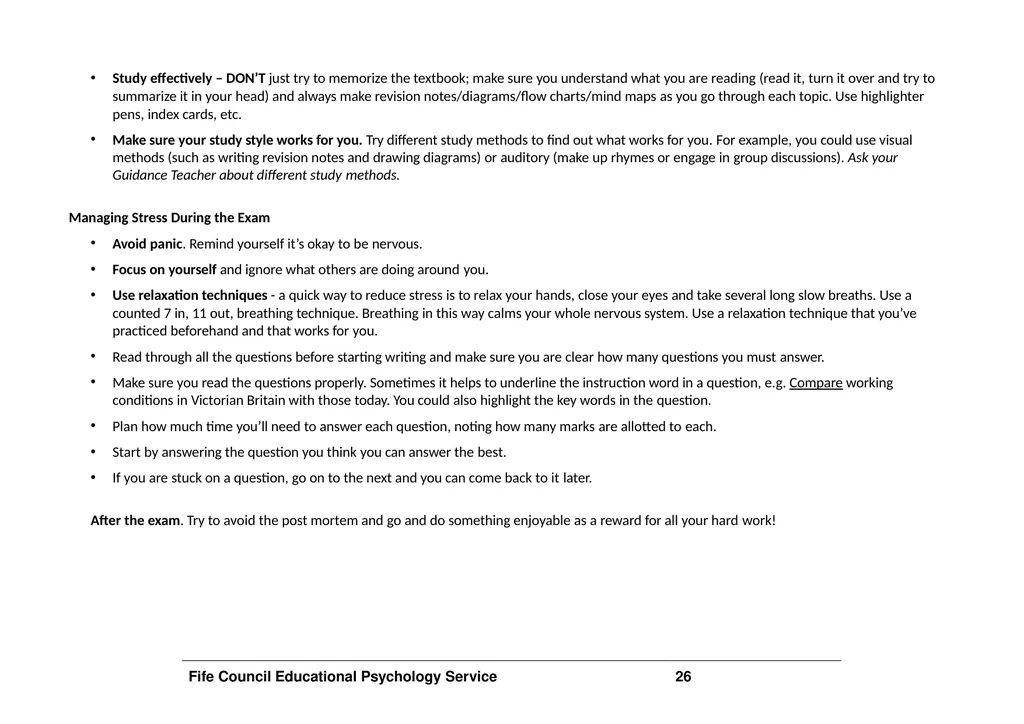
slide26. Study effectively – DON’T just try to memorize the textbook; make sure you understand what you are reading (read it, turn it over and try to summarize it in your head) and always make revision notes/diagrams/flow charts/mind maps as you go through each topic. Use highlighter pens, index cards, etc.
Make sure your study style works for you. Try different study methods to find out what works for you. For example, you could use visual methods (such as writing revision notes and drawing diagrams) or auditory (make up rhymes or engage in group discussions). Ask your Guidance Teacher about different study methods.
Managing Stress During the Exam
Avoid panic. Remind yourself it’s okay to be nervous.
Focus on yourself and ignore what others are doing around you.
Use relaxation techniques - a quick way to reduce stress is to relax your hands, close your eyes and take several long slow breaths. Use a counted 7 in, 11 out, breathing technique. Breathing in this way calms your whole nervous system. Use a relaxation technique that you’ve practiced beforehand and that works for you.
Read through all the questions before starting writing and make sure you are clear how many questions you must answer.
Make sure you read the questions properly. Sometimes it helps to underline the instruction word in a question, e.g. Compare working conditions in Victorian Britain with those today. You could also highlight the key words in the question.
Plan how much time you’ll need to answer each question, noting how many marks are allotted to each.
Start by answering the question you think you can answer the best.
If you are stuck on a question, go on to the next and you can come back to it later.
After the exam. Try to avoid the post mortem and go and do something enjoyable as a reward for all your hard work! Fife Council Educational Psychology Service 29<br>
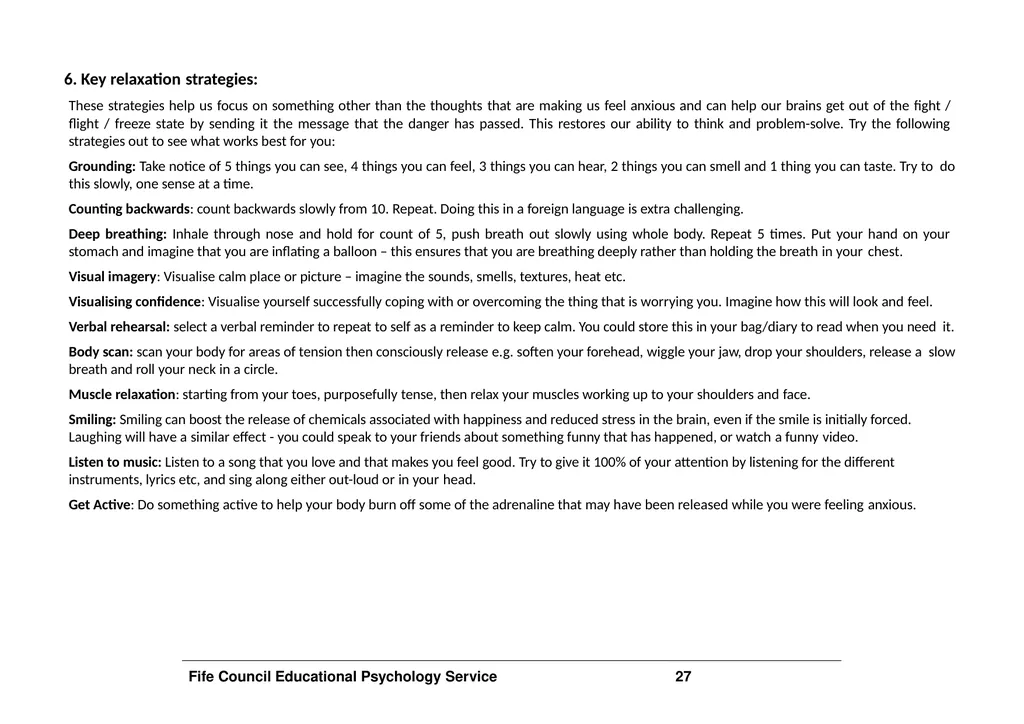
slide27. 6. Key relaxation strategies:
These strategies help us focus on something other than the thoughts that are making us feel anxious and can help our brains get out of the fight / flight / freeze state by sending it the message that the danger has passed. This restores our ability to think and problem-solve. Try the following strategies out to see what works best for you:
Grounding: Take notice of 5 things you can see, 4 things you can feel, 3 things you can hear, 2 things you can smell and 1 thing you can taste. Try to do this slowly, one sense at a time.
Counting backwards: count backwards slowly from 10. Repeat. Doing this in a foreign language is extra challenging.
Deep breathing: Inhale through nose and hold for count of 5, push breath out slowly using whole body. Repeat 5 times. Put your hand on your stomach and imagine that you are inflating a balloon – this ensures that you are breathing deeply rather than holding the breath in your chest.
Visual imagery: Visualise calm place or picture – imagine the sounds, smells, textures, heat etc.
Visualising confidence: Visualise yourself successfully coping with or overcoming the thing that is worrying you. Imagine how this will look and feel.
Verbal rehearsal: select a verbal reminder to repeat to self as a reminder to keep calm. You could store this in your bag/diary to read when you need it.
Body scan: scan your body for areas of tension then consciously release e.g. soften your forehead, wiggle your jaw, drop your shoulders, release a slow breath and roll your neck in a circle.
Muscle relaxation: starting from your toes, purposefully tense, then relax your muscles working up to your shoulders and face.
Smiling: Smiling can boost the release of chemicals associated with happiness and reduced stress in the brain, even if the smile is initially forced. Laughing will have a similar effect - you could speak to your friends about something funny that has happened, or watch a funny video.
Listen to music: Listen to a song that you love and that makes you feel good. Try to give it 100% of your attention by listening for the different instruments, lyrics etc, and sing along either out-loud or in your head.
Get Active: Do something active to help your body burn off some of the adrenaline that may have been released while you were feeling anxious. Fife Council Educational Psychology Service 29<br>
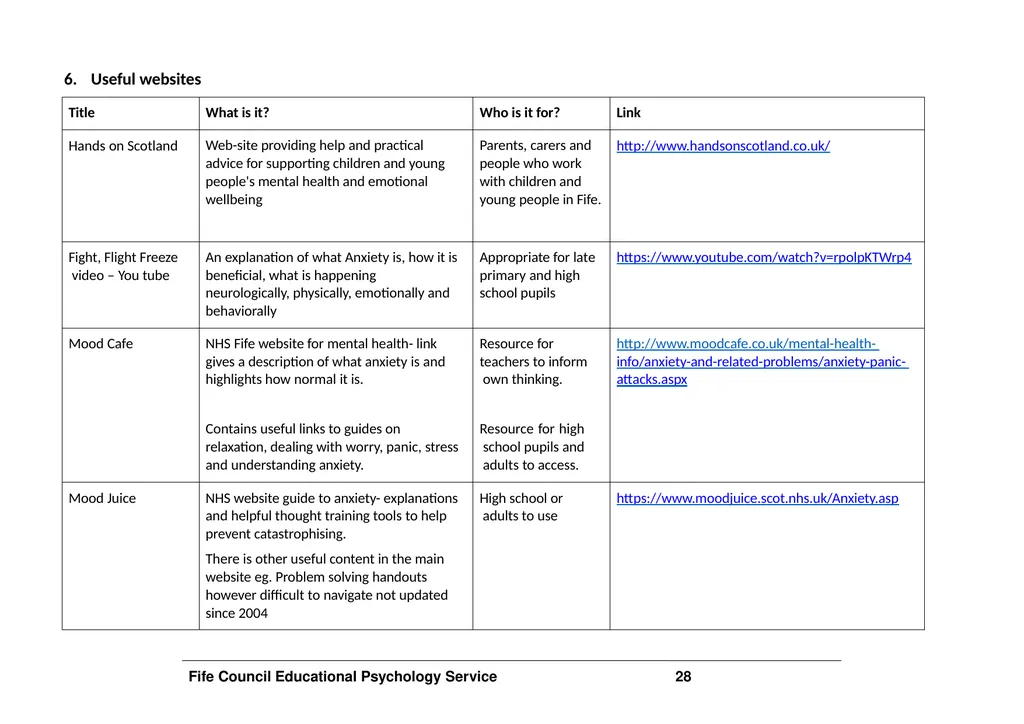
slide28. 6. Useful websites Fife Council Educational Psychology Service 29<br>
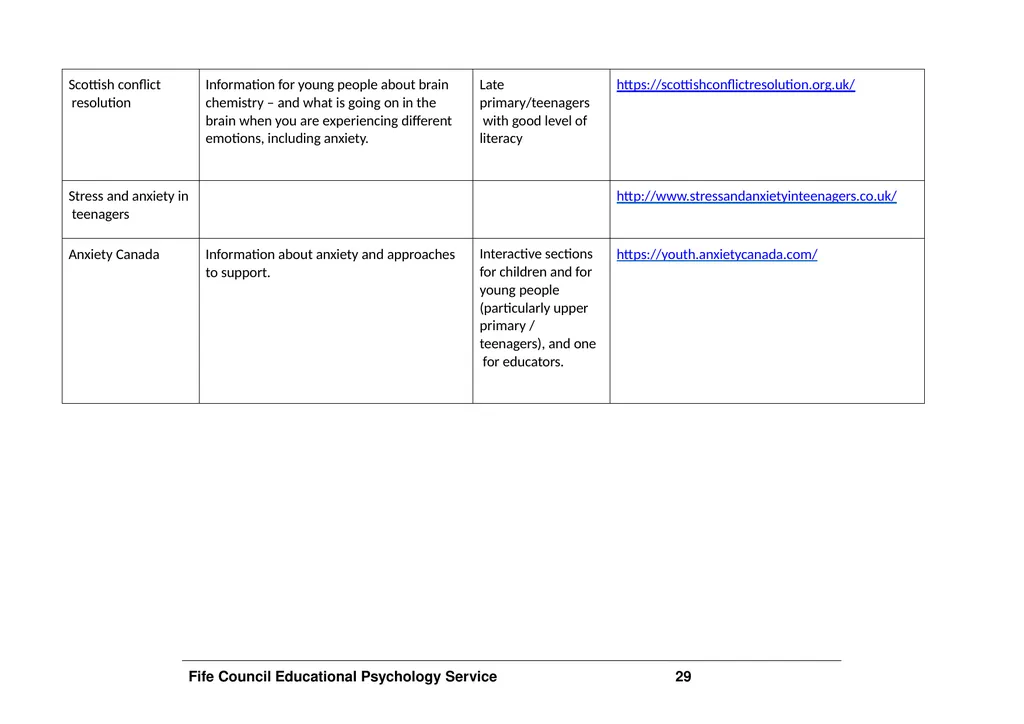
slide29. Fife Council Educational Psychology Service 29<br>
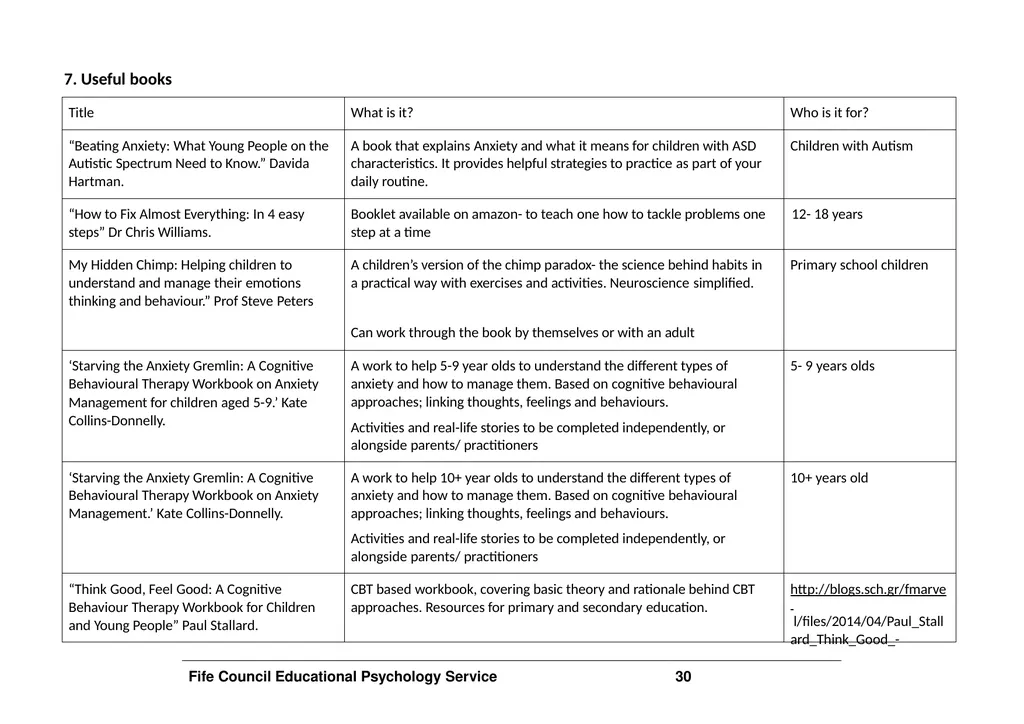
slide30. 7. Useful books Fife Council Educational Psychology Service 29<br>
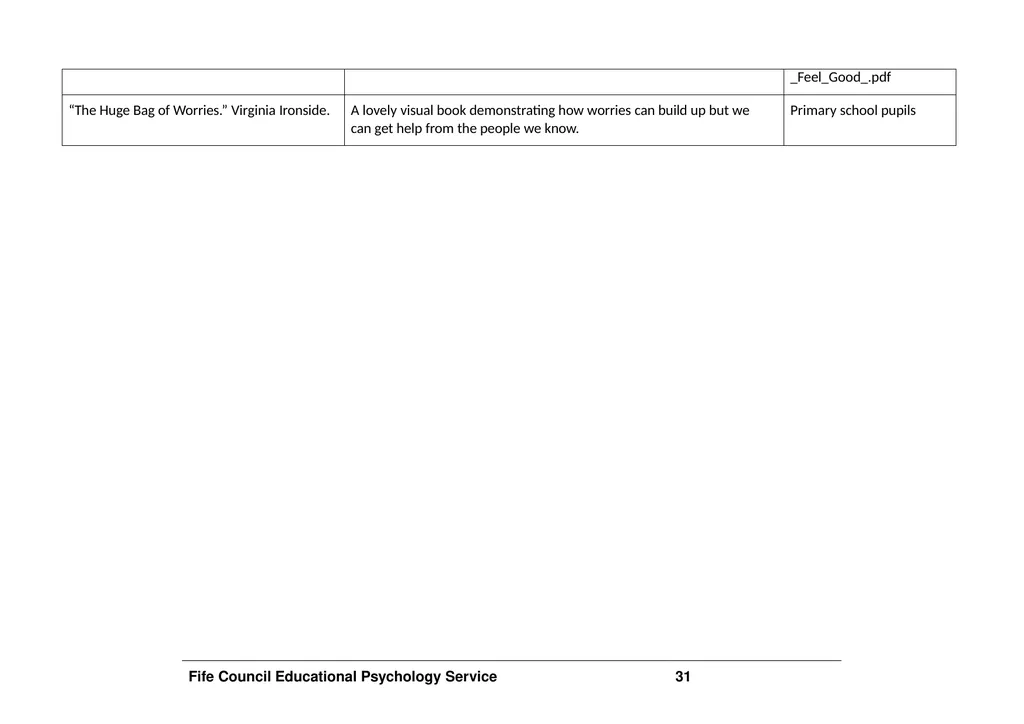
slide31. Fife Council Educational Psychology Service 29<br>
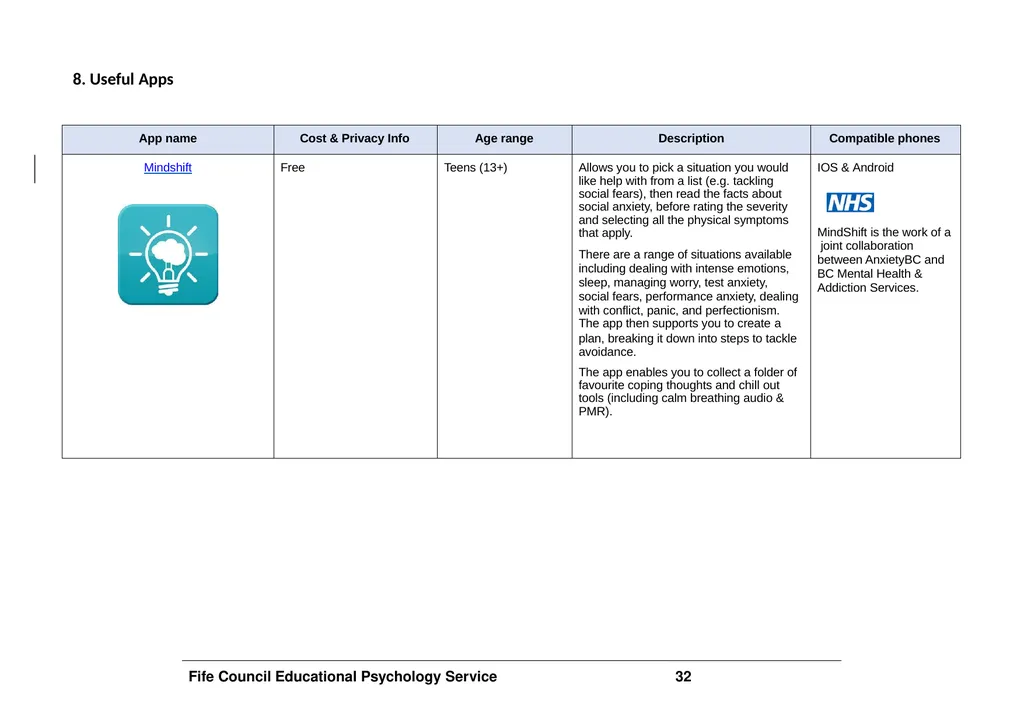
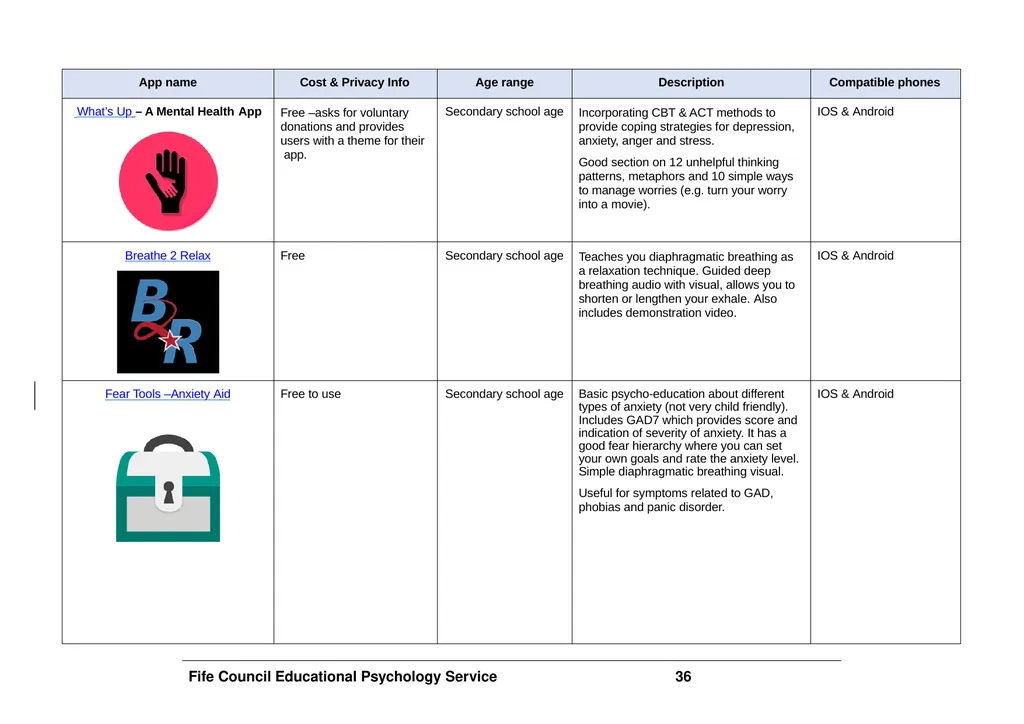
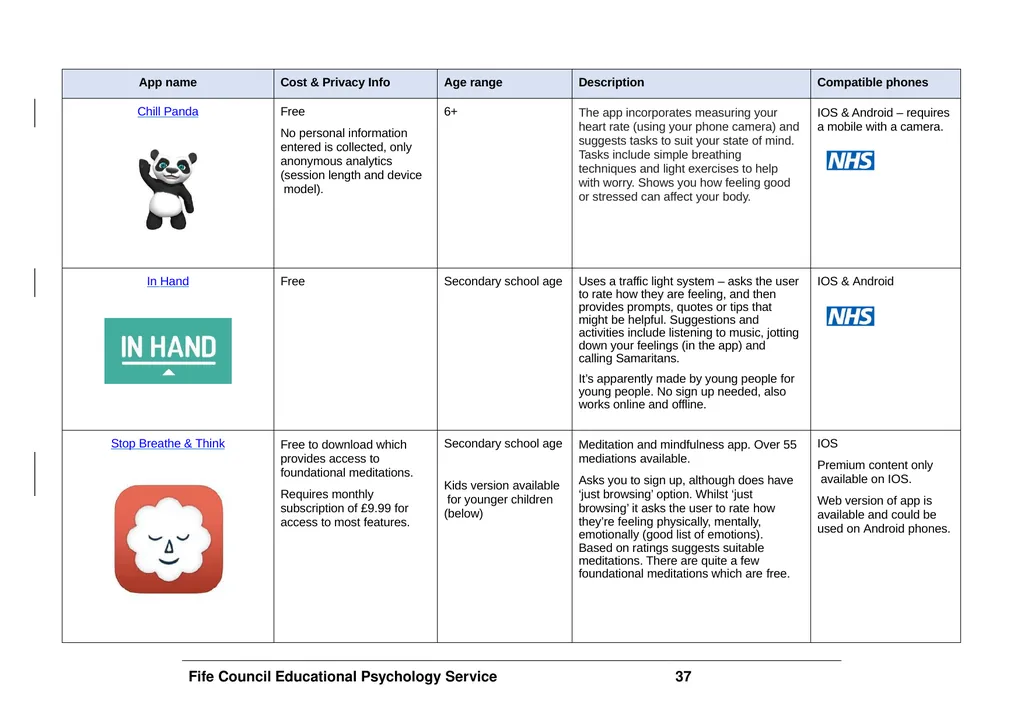
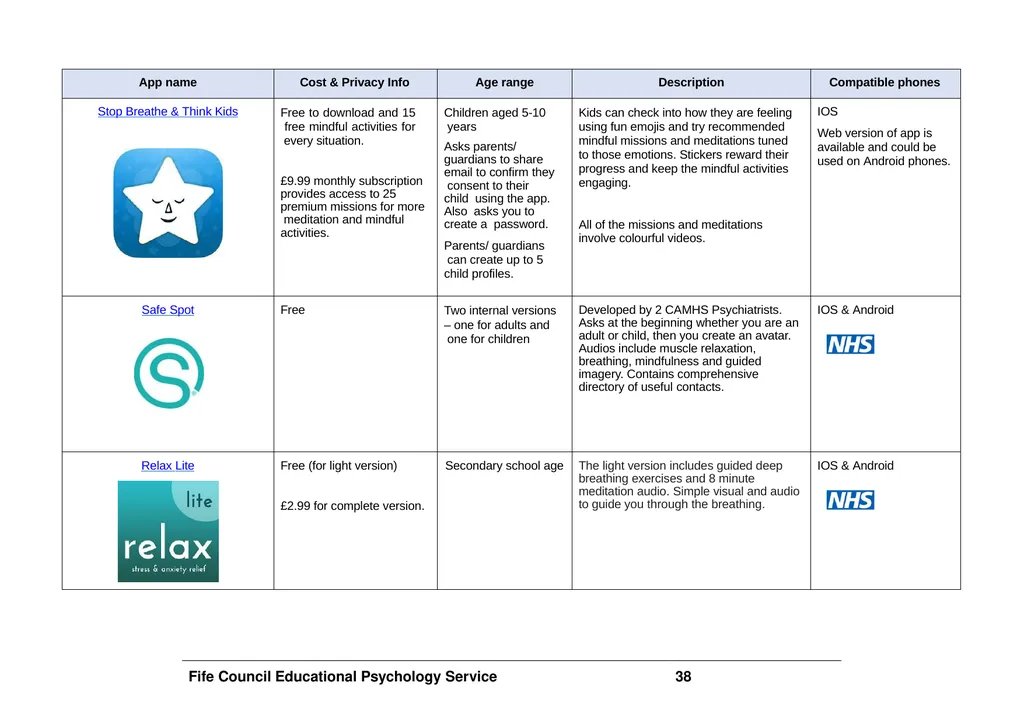
slide32. 8. Useful Apps Fife Council Educational Psychology Service 29<br>
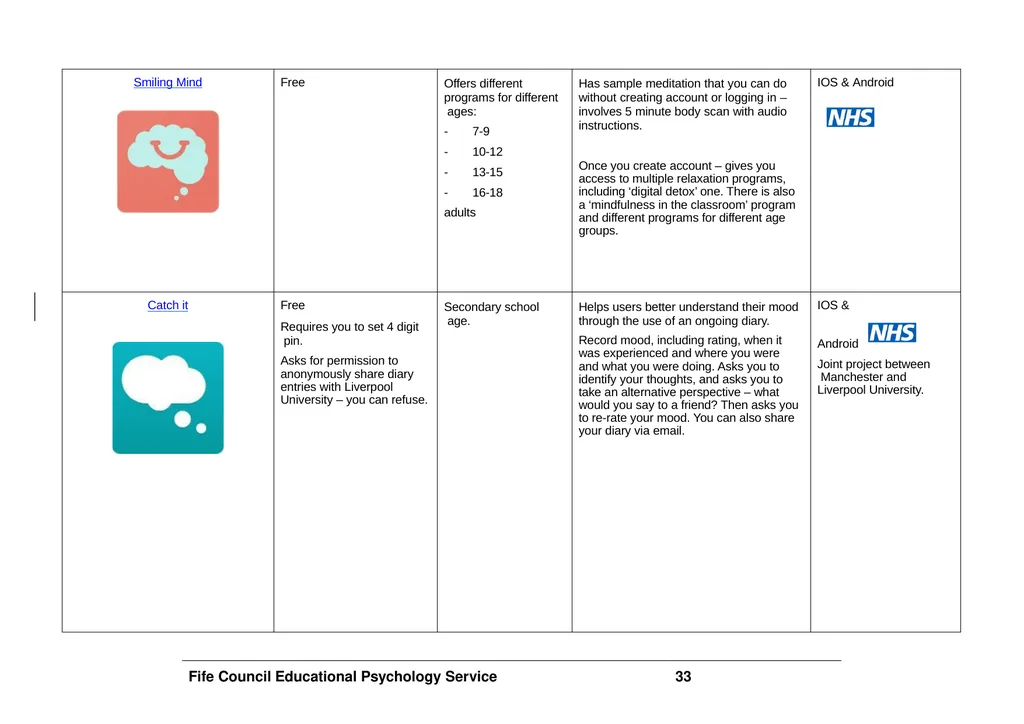
slide33. Fife Council Educational Psychology Service 29<br>
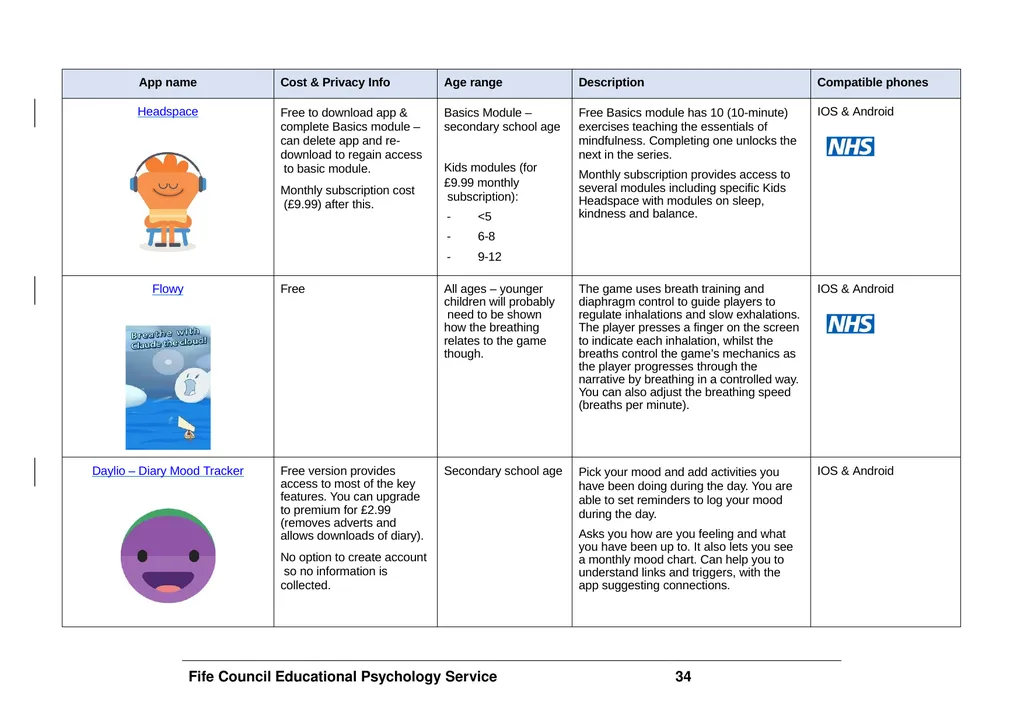
slide34. Fife Council Educational Psychology Service 29<br>
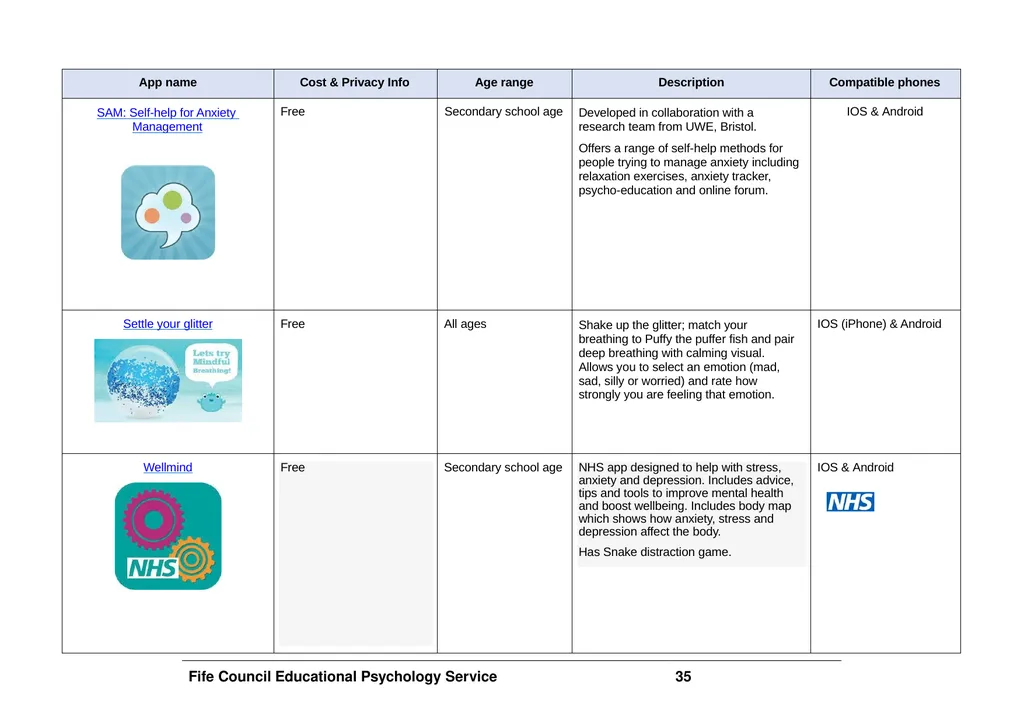
slide35. Fife Council Educational Psychology Service 29<br>
slide36. Fife Council Educational Psychology Service 29<br>
slide37. Fife Council Educational Psychology Service 29<br>
slide38. Fife Council Educational Psychology Service 29<br>
School Resource Pack Fife Council Educational Psychology Service 2020<br>
slide2. Guidance for Named Person/School Staff What is anxiety?
Anxiety is an unpleasant feeling of worry or nervousness that we all experience at some point in our lives. It is a normal reaction to stress in our lives. Everyday worry can cause us to experience unpleasant physical sensations, feelings and influence how we behave e.g. make us avoid situations.
Usually these are linked to certain events or experiences e.g. exams and the feelings and associated symptoms go away after the event has occurred.
However, an anxiety difficulty is more than everyday worry, in that the feelings, sensations and way it makes us think and behave are more stable, intrusive and impact on our daily functioning. The intensity and length of time that anxiety difficulties are experienced for is stronger and longer than everyday worry and are often accompanied with other symptoms such as poor concentration, disconnection and feeling over-whelmed.
How to use this pack
This resource pack has been developed to support Named Persons and key school staff to work collaboratively with young people to explore their experiences of school, particularly in relation to aspects that cause anxiety. It comes in 3 sections: assessment, intervention and a set of appendices.
Assessment section: This section should be completed in collaboration with a young person - individual sections of the assessment section should NOT be handed out to young people for them to complete individually. Careful thought, based on existing knowledge of the young person and their family circumstances, should be given when deciding which of the questions should be used in the second and third sections of the assessment section – “Individual Factors” and “Family Factors”.
Intervention section: This section outlines a staged intervention approach to assessment, planning and intervention at universal, additional and intensive levels. The information gathered in the assessment stage can inform solution focussed action planning at an early intervention level or be You don’t have to control your thoughts, just stop them from controlling you
Millman Fife Council Educational Psychology Service 7<br>
slide3. used to contribute to multi-agency assessment and intervention planning. At times, it is unlikely a young person’s anxiety will reduce or there will be a positive impact on Emotional Wellbeing without also considering wider factors, e.g. home environment or supports, and this may require a multiagency response via the Child Wellbeing Pathway.
Anxiety can often be linked to poor attendance / difficulties attending school. When completing the assessment, please use the box at the end of the tool to note the pupil’s attendance at that point in time. This data can then be used, at a later date, when reviewing progress and/or identifying next steps.
Appendices section: The appendices are intended to support staff understanding of anxiety, to inform conversations with children and young people, and to provide an introduction to some of the ways anxiety can be supported.
Link Educational Psychologists can be consulted about the use of the tool, and training about the information and approaches in the pack can be provided by Fife Council Educational Psychology Service. The greatest weapon against stress is our ability to choose one thought over another
James Fife Council Educational Psychology Service 7<br>
slide4. Assessment – recognising physical reactions, and exploring school, individual and family factors. Fife Council Educational Psychology Service 7<br>
slide5. Learning to recognise anxiety – sometimes feeling anxious comes with physical symptoms that can feel frightening and can be a cause of anxiety in themselves. See appendices for a description of why this happens and how we can best respond to these feelings.
Use the questions below to explore how anxiety may be impacting in this way, and also to begin identifying what the young person is thinking about when anxiety occurs and how these thoughts are impacting on their behaviour. The appendices also provide further explanation of the relationship between thoughts, feelings and behaviour relating to anxiety. Fife Council Educational Psychology Service 7 Name: School: Completed with: Date:<br>
slide6. School factors
Complete this section in collaboration with the young person: consider statements as a prompt for further exploration. You may wish to explore highest scoring statements first and return to lowest scoring statements to explore further. You may wish to discuss things by subject/class etc. Scores do not link to particular levels or types of intervention – they are designed to prompt discussion. Fife Council Educational Psychology Service 7 These questions are to find out what school is like for you…
Tell me how comfortable you are, on a scale of 1-10, in the following situations…? (1 = least comfortable; 10 = completely comfortable)<br>
slide7. Fife Council Educational Psychology Service 7<br>
slide8. Fife Council Educational Psychology Service 7<br>
slide9. Fife Council Educational Psychology Service 7<br>
slide10. Individual factors
Important – Some questions may not be appropriate and should be omitted. Complete this section in collaboration with the young person Fife Council Educational Psychology Service 14<br>
slide11. Family factors:
Consider questions and complete using the information you already have. Gather additional required information through consultation / discussion with the young person, their family/carers and/or the team around the child
Important – Some questions may not be appropriate and should be omitted
Is there anything going on at home that you find worrying, upsetting or difficult? For example: Fife Council Educational Psychology Service 14<br>
slide12. Interventions, approaches and supports Fife Council Educational Psychology Service 14<br>
slide13. A Staged Intervention approach to supporting children and young people with anxiety. Fife Council Educational Psychology Service 14<br>
slide14. Fife Council Educational Psychology Service 14<br>
slide15. Fife Council Educational Psychology Service 14<br>
slide16. Plans and protocols
Anxiety is an unpleasant feeling and we often try to avoid whatever is making us feel that way. But if we can face the things that are making us anxious the unpleasant feelings will reduce. The more times we face our fears the less anxious we will feel. Why might we need a plan? Recording assessment and planned interventions means we can review progress and determine further steps or goals. It also means that we have a clear understanding of who is involved and what that involvement looks like.
Creating a plan: Once you have completed an assessment if there are reasonable ways to avoid stressors then make a plan to do so e.g. X felt most uncomfortable in crowded situations – lunch-hall, busy corridor, assembly and bus. Therefore, the plan involved avoiding these situations where possible – quiet supervised area to eat packed lunch, out early to move to next class and so on.
Attendance: Anxiety can lead to school refusers and significantly reduced attendance. We must be mindful that if the school building itself is the anxiety trigger, then we cannot expect the child to come to the school to discuss how we can help them to overcome their fear!
Return to school plan: graded exposure to what causes us anxiety will usually reduce that anxiety over time. If anxiety is impacting on attendance then a return to school plan could comprise of a series of small steps – as small as suits the individual. For example: drive to school gate and leave, come to school entrance and leave, come into school for 10 minutes supported by known and trusted staff member/peers. The plan can be created collaboratively with the young person, and progress evaluated over time.
The young person will need a secure base from which to face their fear and learn to respond to their anxiety triggers – this ‘base’ can take the form of an identified, trusted adult and/or a safe, physical space within the school. If neither of these are easily identifiable, then developing a relationship with a key adult (and identifying a safe space) will be part of the plan. It may be that the young person’s parent or carer can be part of the plan sitting in reception of the school building while the child visits, with staff.
Why might we need clear protocols?
An anxious child or young person may struggle to be on time every morning and this may increase feelings of anxiety about coming to school. Try creating a clear protocol for that pupil around what they should do if they are late and make sure all staff understand this protocol (for example; pupil does not need to explain to staff why they are late). This should be done with pupil knowledge and agreement. 4.5
4
3.5
3
2.5
2
1.5
1
0.5
0 Trigger Anxiety curve 1st time 2nd time 3rd time Fife Council Educational Psychology Service 14<br>
slide17. Appendices: EPs can provide further training and support in these approaches Fife Council Educational Psychology Service 14 Psycho-education: understanding anxiety
Cognitive Behavioural Approaches
Thinking traps and how to challenge them – looking for evidence
Coaching Conversations to challenge thoughts and create a plan
Exam stress and anxiety
Key relaxation strategies
Useful web-sites
Useful books
Useful apps<br>
slide18. 1 Psycho-education
Understanding anxiety
It can be really helpful for children and young people to have an understanding of anxiety, and that we all experience it from time to time – it is a normal experience. Some anxiety can be useful, and we should not always seek to avoid experiencing it or the situations that might trigger it. It can motivate us to act and increase our performance, e.g. revise for an exam. Difficulties arise when it is experienced in high, prolonged and intense doses.
When we are faced with a difficult situation, our bodies prepare themselves for fight or flight – this is an emergency reaction. It allows us to be able to respond quickly under threat and prepare to run away or do battle. We may experience all kinds of physical sensations (e.g. hearts beat faster, hands become sweaty, muscles tense, mouth becomes dry, butterflies in the tummy), it is helpful to be able to recognise and identify these – to recognise anxiety.
These fight or flight reactions were vital when we lived as hunter gatherers, in order to deal with dangerous situations. Nowadays, the stressful situations we face are very different and it’s not so helpful to experience these reactions in our daily lives in a prolonged way.
Too much anxiety and stress can result in distress – we become stuck in a heightened fight or flight mode and cannot function well. The emotional part of our brain (the amygdala) stops ‘talking’ to the thinking part of our brain (the cortex), meaning our ability to think about and deal rationally with a situation has been hijacked by stress hormones. This is sometimes referred to as an amygdala hijack.
What can we do in that moment?
Name it. Notice when you've been triggered and identify what's triggering you. Notice changes in your tone, tightness in your chest or stomach, clenching in your jaw or hands, etc. In these moments, say to yourself, "I'm feeling triggered right now."
Remember the 6-second rule. It takes the hormones that are released during the amygdala hijacking about 6 seconds to dissipate. Using this time to focus on something pleasant will prevent your amygdala from taking control and causing an emotional reaction
Breathe. Become aware of your breath and slow it down, breathe deeply. When you slow down your breathing and make it rhythmic, this calms down your nervous system and allows you to make thoughtful decisions in stressful times.
Draw on mindfulness. Look around you and notice things in the environment. This will help you to move out of your head and back into the present.
Take a timeout. If you are truly feeling out of control, excuse yourself from the situation you are in to get a hold of your emotions. Fife Council Educational Psychology Service 14<br>
slide19. Sometimes our responses to dealing with anxiety can be the very things that serve to maintain it – for example: avoiding the stressful situation, worrying about feeling anxious and presuming the worst. It may be better to:
Stop avoiding situations that cause anxiety – in most cases, practice will reduce the levels of anxiety experienced
Talk about and challenge the way we are thinking about situations, and change the way we feel and behave
2. Cognitive Behavioural Approaches (CBA) – understanding the thinking/feeling/doing cycle
These approaches stem from the understanding that the way we think about a situation affects the way we feel about it and thus how we behave. We can get caught in a negative cycle of thinking which can leave us feeling anxious and in distress and caught in a cycle of behaviour that is likely to maintain this anxiety and distress. Negative cycle: maintaining anxiety Positive cycle: achieving a healthy balance Thoughts
Negative, self-critical, assuming the worst will happen Feelings
Anxious, upset, angry, unloved Actions
Give up, avoid, withdraw Actions
Try, persevere, talk, practice Feelings
Relaxed, calm, loved Thoughts
Positive, balanced, based on evidence, recognising strengths Fife Council Educational Psychology Service 14<br>
slide20. What can we do?
Learn to recognise these thought cycles and the thinking traps we are getting caught in
Learn how to challenge the evidence for our thoughts
Use coaching conversations to make a plan
Learn how to use relaxation strategies
Use books, websites and apps to help Fife Council Educational Psychology Service 14<br>
slide21. Fife Council Educational Psychology Service 21 Thinking Traps: challenging our thinking<br>
slide22. Fife Council Educational Psychology Service 29 To avoid falling into these thinking traps it is important to; Stop, Assess and Challenge our thoughts. Stop and recognise when you are having an anxious thought, take a deep breath before you…
Assess your thoughts with questions such as;
Are my thoughts based on fact? What is the evidence?
Am I worrying about something that is important or unimportant?
Why am I thinking this way?
Challenge them by asking yourself;
What would you say to a friend if they had this thinking?
Try to identify some of the positive things you may have missed before?
Where will my anxiety get me?
If the worst thing happened, would it be that bad?
What can I do differently to deal with the situation, instead of being anxious about it?
Starving the Anxiety Gremlin: A Cognitive Behavioural Therapy Workbook on Anxiety Management. ~ Kate Collins-Donnelly. Think Good, Feel Good: A Cognitive Behaviour Therapy Workbook for Children and Young People ~ Paul Stallard.<br>
slide23. Coaching conversations
"A one-to-one conversation focused on the enhancement of learning and development through increasing self-awareness and a sense of personal responsibility where the coach facilitates the self-directed learning of the coachee through questioning, active listening and appropriate challenge in a supportive and encouraging climate."
(Christian van Nieuwerburgh, 2012)
These are solution focused conversations with children and young people that should leave them with a clear idea or plan of how they will use their own skills, strengths, support network or script to positively manage a scenario they find emotionally difficult the next time they encounter it. They require a positive relationship between adult and child, and the adult to demonstrate active listening and attunement. Your link EP will be able to provide further information and training round this.
Making a plan following completion of assessment: coaching questions
Current strategies:
Has anything or anyone so far helped at these times?
What have you tried so far? What has helped so far?
Has anyone you know had a similar experience? What did they do?
What advice would you give a friend?
Exploring exceptions
Are there times in school when you feel less anxious? When are the times when things go a bit better?
When was the last time that things were a little better? What was different then?
When you aren’t feeling so anxious what’s different then? What are you doing differently?
Goaling
What would need to happen to help you feel better about things?
What are our next steps? Let’s talk about how we are going to do that?
What's the first thing we will do? Who do we need to help us? Fife Council Educational Psychology Service 29<br>
slide24. When will it be over / good enough? Clear picture of finish time.
How will we know we’ve succeeded?
What will be different when things are going better?
If things were better, what would other people see? How would they know?
Feedback of main points at an appropriate pace.
Agreement of each person’s actions
Who you will both share the information with?
When will we review? Fife Council Educational Psychology Service 29<br>
slide25. Exam Stress/Anxiety
Excessive worry about upcoming exams is experienced by many pupils and when we talk about stress reducing techniques here it’s not the aim for you to feel no stress at all. Some stress is helpful to us to do well and stay motivated. The stress response we are talking about is only bad in large, intense doses. Exam stress is manageable if you follow a plan of helpful suggestions….
Positive Thinking
Tell yourself “I can do this” and “if I work hard I will succeed” because believing in yourself has the power to change your behavior and reactions.
Remind yourself of all the hard work you’ve done and that your best is good enough.
DON’T expect perfection!
Instead of thinking “they are better at this than me” think “If they can do it so can I”
Keep things in perspective – although exams are important, in the grand scheme of your life they are only a tiny part.
Preparation
Stay healthy – try to eat a balanced diet. Cut down on caffeine, sugary and junk food.
Exercise
Have a balanced life – make sure you get a good night’s sleep, do something to ‘switch off’ like watch a movie, talk to your friends, have a laugh.
Don’t keep things bottled up. Talk to someone you trust. Ask for help and support from them.
Plan your study time. Too much material + too little time =Anxiety/stress. Plan your studying with regularly scheduled study sessions about 50 minutes long separated by 10-minute breaks (you can get apps like “be focused” to help you with this) Make a timetable so you can track your progress and ensure you have time to cover the whole course at least once.
Take steps to overcome problems. If you can’t remember or don’t understand some of your notes on a course don’t panic. Highlight it and go
to your subject teacher for help. Fife Council Educational Psychology Service 29<br>
slide26. Study effectively – DON’T just try to memorize the textbook; make sure you understand what you are reading (read it, turn it over and try to summarize it in your head) and always make revision notes/diagrams/flow charts/mind maps as you go through each topic. Use highlighter pens, index cards, etc.
Make sure your study style works for you. Try different study methods to find out what works for you. For example, you could use visual methods (such as writing revision notes and drawing diagrams) or auditory (make up rhymes or engage in group discussions). Ask your Guidance Teacher about different study methods.
Managing Stress During the Exam
Avoid panic. Remind yourself it’s okay to be nervous.
Focus on yourself and ignore what others are doing around you.
Use relaxation techniques - a quick way to reduce stress is to relax your hands, close your eyes and take several long slow breaths. Use a counted 7 in, 11 out, breathing technique. Breathing in this way calms your whole nervous system. Use a relaxation technique that you’ve practiced beforehand and that works for you.
Read through all the questions before starting writing and make sure you are clear how many questions you must answer.
Make sure you read the questions properly. Sometimes it helps to underline the instruction word in a question, e.g. Compare working conditions in Victorian Britain with those today. You could also highlight the key words in the question.
Plan how much time you’ll need to answer each question, noting how many marks are allotted to each.
Start by answering the question you think you can answer the best.
If you are stuck on a question, go on to the next and you can come back to it later.
After the exam. Try to avoid the post mortem and go and do something enjoyable as a reward for all your hard work! Fife Council Educational Psychology Service 29<br>
slide27. 6. Key relaxation strategies:
These strategies help us focus on something other than the thoughts that are making us feel anxious and can help our brains get out of the fight / flight / freeze state by sending it the message that the danger has passed. This restores our ability to think and problem-solve. Try the following strategies out to see what works best for you:
Grounding: Take notice of 5 things you can see, 4 things you can feel, 3 things you can hear, 2 things you can smell and 1 thing you can taste. Try to do this slowly, one sense at a time.
Counting backwards: count backwards slowly from 10. Repeat. Doing this in a foreign language is extra challenging.
Deep breathing: Inhale through nose and hold for count of 5, push breath out slowly using whole body. Repeat 5 times. Put your hand on your stomach and imagine that you are inflating a balloon – this ensures that you are breathing deeply rather than holding the breath in your chest.
Visual imagery: Visualise calm place or picture – imagine the sounds, smells, textures, heat etc.
Visualising confidence: Visualise yourself successfully coping with or overcoming the thing that is worrying you. Imagine how this will look and feel.
Verbal rehearsal: select a verbal reminder to repeat to self as a reminder to keep calm. You could store this in your bag/diary to read when you need it.
Body scan: scan your body for areas of tension then consciously release e.g. soften your forehead, wiggle your jaw, drop your shoulders, release a slow breath and roll your neck in a circle.
Muscle relaxation: starting from your toes, purposefully tense, then relax your muscles working up to your shoulders and face.
Smiling: Smiling can boost the release of chemicals associated with happiness and reduced stress in the brain, even if the smile is initially forced. Laughing will have a similar effect - you could speak to your friends about something funny that has happened, or watch a funny video.
Listen to music: Listen to a song that you love and that makes you feel good. Try to give it 100% of your attention by listening for the different instruments, lyrics etc, and sing along either out-loud or in your head.
Get Active: Do something active to help your body burn off some of the adrenaline that may have been released while you were feeling anxious. Fife Council Educational Psychology Service 29<br>
slide28. 6. Useful websites Fife Council Educational Psychology Service 29<br>
slide29. Fife Council Educational Psychology Service 29<br>
slide30. 7. Useful books Fife Council Educational Psychology Service 29<br>
slide31. Fife Council Educational Psychology Service 29<br>
slide32. 8. Useful Apps Fife Council Educational Psychology Service 29<br>
slide33. Fife Council Educational Psychology Service 29<br>
slide34. Fife Council Educational Psychology Service 29<br>
slide35. Fife Council Educational Psychology Service 29<br>
slide36. Fife Council Educational Psychology Service 29<br>
slide37. Fife Council Educational Psychology Service 29<br>
slide38. Fife Council Educational Psychology Service 29<br>