Apoptosis: Intrinsic and Extrinsic Apoptosis (Greek falling off) is a process of programmed cell death that occurs in multicellular organisms. Biochemical changes lead to characteristic cell changes and death. These changes include
"Apoptosis: Intrinsic and Extrinsic Apoptosis" is the property of its rightful owner. Permission is granted to
download and print the materials on this website for personal, non-commercial use only, and to display it
on your personal computer provided you do not modify the materials and that you retain all copyright
notices contained in the materials. By downloading content from our website, you accept the terms of this
agreement.
Presentation Transcript
01
Apoptosis: Intrinsic and Extrinsic<br>
02
Apoptosis (Greek "falling off") is a process of programmed cell death that occurs in multicellular organisms. Biochemical changes lead to characteristic cell changes and death. These changes include blebbing (protrusion of the plasma membrane of a cell, characterized by a spherical, bulky morphology, decoupling of the cytoskeleton, degrading internal structure of the cell etc), cell shrinkage, nuclear fragmentation, chromatin condensation, chromosomal DNA fragmentation, and global mRNA decay.<br>
03
Between 50 and 70 billion cells die each day due to apoptosis in the average human adult. For an average child between the ages of 8 and 14, approximately 20 billion to 30 billion cells die a day.
In contrast to necrosis, which is a form of traumatic cell death that results from acute cellular injury, apoptosis is a highly regulated and controlled process that confers advantages during an organism's lifecycle. For example, the separation of fingers and toes in a developing human embryo occurs because cells between the digits undergo apoptosis.<br>
04
Unlike necrosis, apoptosis produces cell fragments called apoptotic bodies that phagocytic bodies are able to engulf and quickly remove before the contents of the cell can spill out onto surrounding cells and cause damage to the neighboring cells. Because apoptosis cannot stop once it has begun, it is a highly regulated process.<br>
05
Pathways of apoptosis Apoptosis can be initiated through one of two pathways.
1. In the intrinsic pathway the cell kills itself because it senses cell stress
2. In extrinsic pathway the cell kills itself because of signals from other cells.
Both pathways induce cell death by activating caspases, which are proteases, or enzymes that degrade proteins. The two pathways both activate initiator caspases, which then activate executioner caspases, which then kill the cell by degrading proteins indiscriminately.<br>
06
Research on apoptosis has increased substantially since the early 1990s. In addition to its importance as a biological phenomenon, defective apoptotic processes have been implicated in a wide variety of diseases. Excessive apoptosis causes atrophy (partial or complete wasting away of a part of the body), whereas an insufficient amount results in uncontrolled cell proliferation, such as cancer. Some factors like Fas receptors and caspases promote apoptosis, while some members of the Bcl-2 family of proteins inhibit apoptosis.<br>
07
Intrinsic pathway It is also known as mitochondrial pathway
The intrinsic pathway is activated by intracellular signals generated when cells are stressed for example double strand DNA break, which is nor repairable, heat, radiation, nutrient deprivation, viral infection, and increased intracellular calcium concentration, and depends on the release of proteins from the intermembrane space of mitochondria.<br>
08
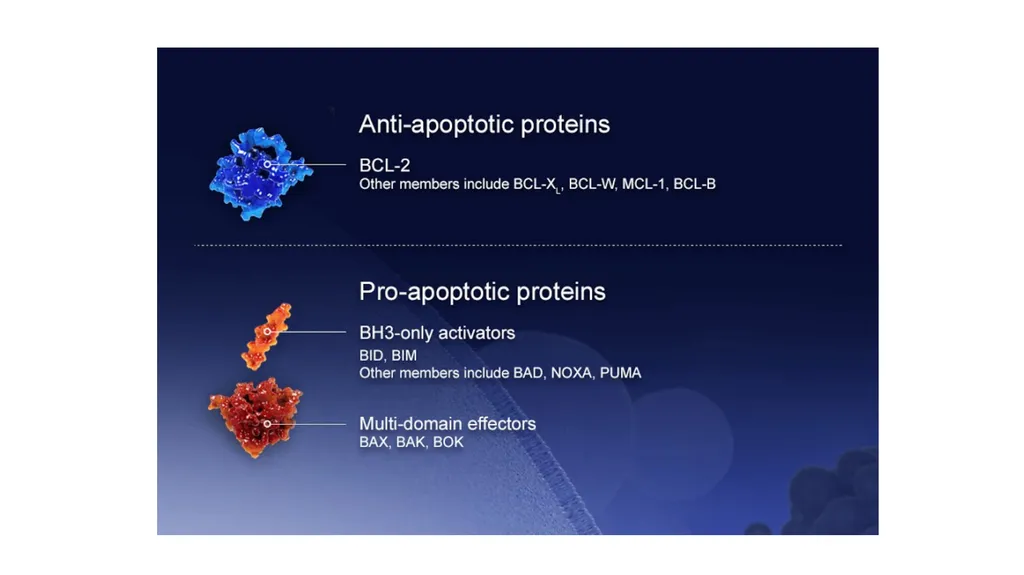
Bcl-2 family The Bcl-2 Family consists of a number of evolutionary conserved proteins that share Bcl-2 homology (BH) domains. The Bcl-2 family is most notable for their regulation of apoptosis, at the mitochondrion. The Bcl-2 family proteins consists of members that either promote or inhibit apoptosis, and control apoptosis by governing Miotchondrial Outer Membrane Permeabilization (MOMP), which is a key step in the intrinsic pathway of apoptosis.<br>
09
The Bcl-2 family have four domains:
BH1, BH2, BH3, BH4
This family has been divided into three sub families
Bcl-2 family : It contains all the 4 domains mentioned above
Antiapoptotic BH123 family: It contains all the domains mentioned above except BH4
Antiapoptotic BH3 only family: It only contains the BH3 domain, hence its name is BH3 only<br>
10
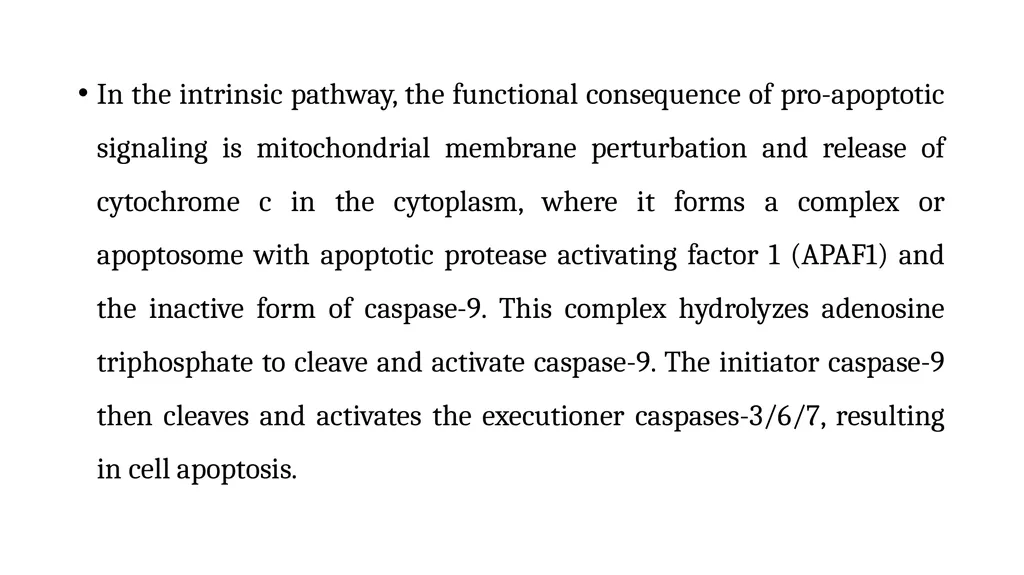
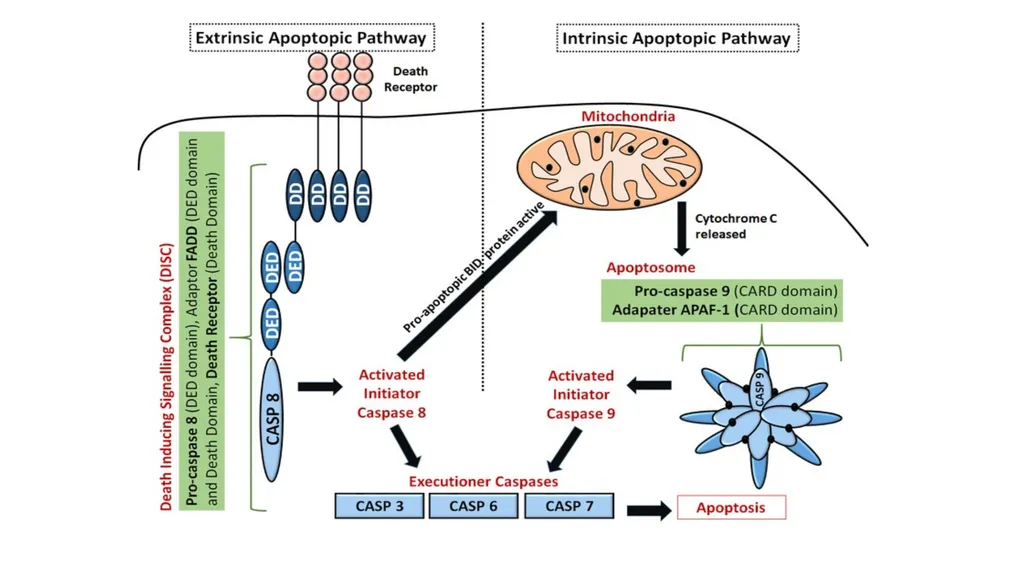
In the intrinsic pathway, the functional consequence of pro-apoptotic signaling is mitochondrial membrane perturbation and release of cytochrome c in the cytoplasm, where it forms a complex or apoptosome with apoptotic protease activating factor 1 (APAF1) and the inactive form of caspase-9. This complex hydrolyzes adenosine triphosphate to cleave and activate caspase-9. The initiator caspase-9 then cleaves and activates the executioner caspases-3/6/7, resulting in cell apoptosis.<br>
11
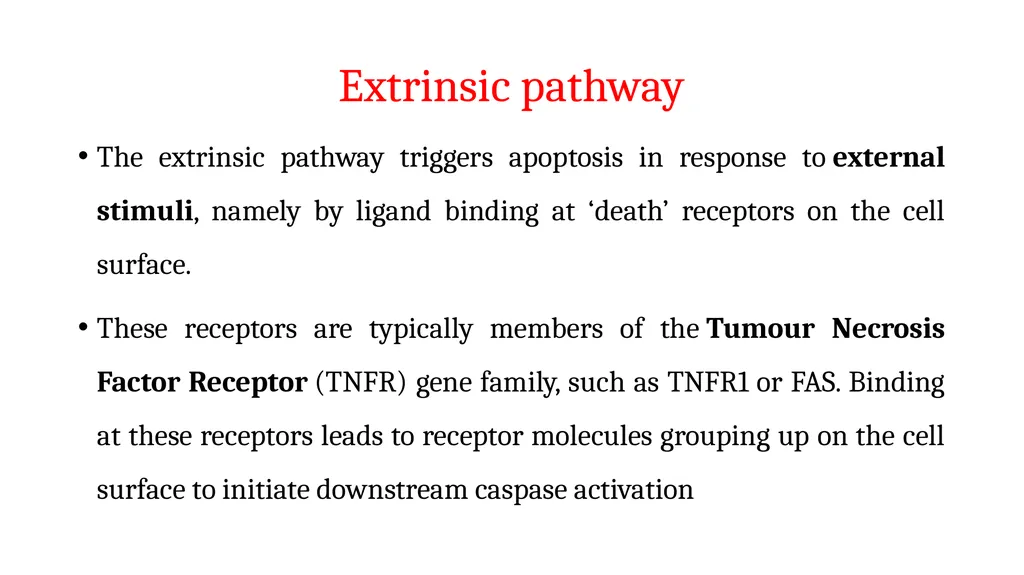
Extrinsic pathway The extrinsic pathway triggers apoptosis in response to external stimuli, namely by ligand binding at ‘death’ receptors on the cell surface.
These receptors are typically members of the Tumour Necrosis Factor Receptor (TNFR) gene family, such as TNFR1 or FAS. Binding at these receptors leads to receptor molecules grouping up on the cell surface to initiate downstream caspase activation<br>
12
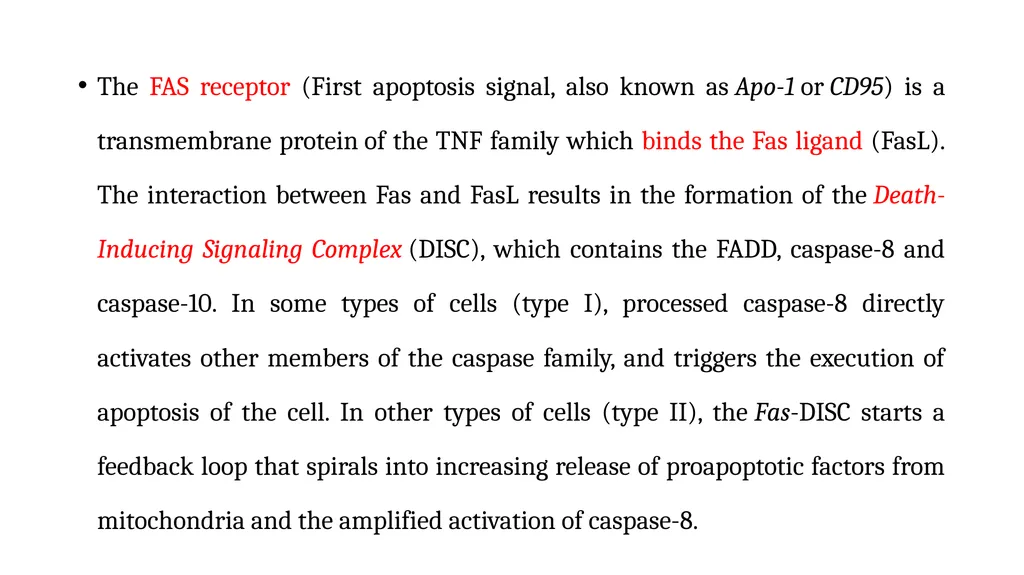
The FAS receptor (First apoptosis signal, also known as Apo-1 or CD95) is a transmembrane protein of the TNF family which binds the Fas ligand (FasL). The interaction between Fas and FasL results in the formation of the Death-Inducing Signaling Complex (DISC), which contains the FADD, caspase-8 and caspase-10. In some types of cells (type I), processed caspase-8 directly activates other members of the caspase family, and triggers the execution of apoptosis of the cell. In other types of cells (type II), the Fas-DISC starts a feedback loop that spirals into increasing release of proapoptotic factors from mitochondria and the amplified activation of caspase-8.<br>
13
Caspases Caspases (cysteine-dependent aspartate-directed proteases) are a family of protease enzymes playing essential roles in apoptosis. They are named caspases due to their specific cysteine protease activity; a cysteine in its active site attacks and cleaves a target protein only after an aspartic acid residue. As of 2009, there are 11 or 12 confirmed caspases in humans and 10 in mice, carrying out a variety of cellular functions.<br>
14
Activation of caspases Caspases are synthesised as inactive (pro-caspases) that are only activated following an appropriate stimulus. This post-translational level of control allows rapid and tight regulation of the enzyme.
Activation involves dimerization and often oligomerisation of pro-caspases, followed by cleavage into a small subunit and large subunit. The large and small subunit associate with each other to form an active heterodimer caspase. The active enzyme often exists as a heterotetramer in the biological environment, where a pro-caspase dimer is cleaved together to form a heterotetramer<br>
15
Types of Caspases Apoptotic caspases are subcategorized as:
Initiator Caspases (Caspases 2, Caspases 9 and 10)
Executioner Caspases (Caspases 3, Caspases 6 and Caspases 7)
Once initiator caspases are activated, they produce a chain reaction, activating several other executioner caspases. Executioner caspases degrade over 600 cellular components in order to induce the morphological changes for apoptosis.<br>
16
One of the key target of the executioner caspases is an inhibitor of the DNase, which when activated is responsible for fragmentation of nuclear DNA
Caspases cleaves nuclear lamins leading to fragmentation of nucleus
They cleave cytoskeletal proteins (Actin, myosin, tubulin etc) leading to disruption of cytoskeleton, membrane blebbing and cell fragmentation
They also cleaves Golgi matrix proteins leading to fragmentation of Golgi apparatus<br>