
Approaches to Component 1 Devising Theatre Tips
AM
Published · 32 slides · 0 views
1 / 1
Description
Approaches to Component 1 Devising Theatre Tips and Good Practice Step 1: Devising - Choosing a genrepractitioner Ensure that each group chooses only one practitionergenre. Do not allow them to mix and match a variety of
Related Topics
Share
Embed code
Download this presentation From Below
"Approaches to Component 1 Devising Theatre Tips" is the property of its rightful owner. Permission is granted to download and print the materials on this website for personal, non-commercial use only, and to display it on your personal computer provided you do not modify the materials and that you retain all copyright notices contained in the materials. By downloading content from our website, you accept the terms of this agreement.
Presentation Transcript
01
Approaches to Component 1
Devising Theatre<br>
Devising Theatre<br>
02
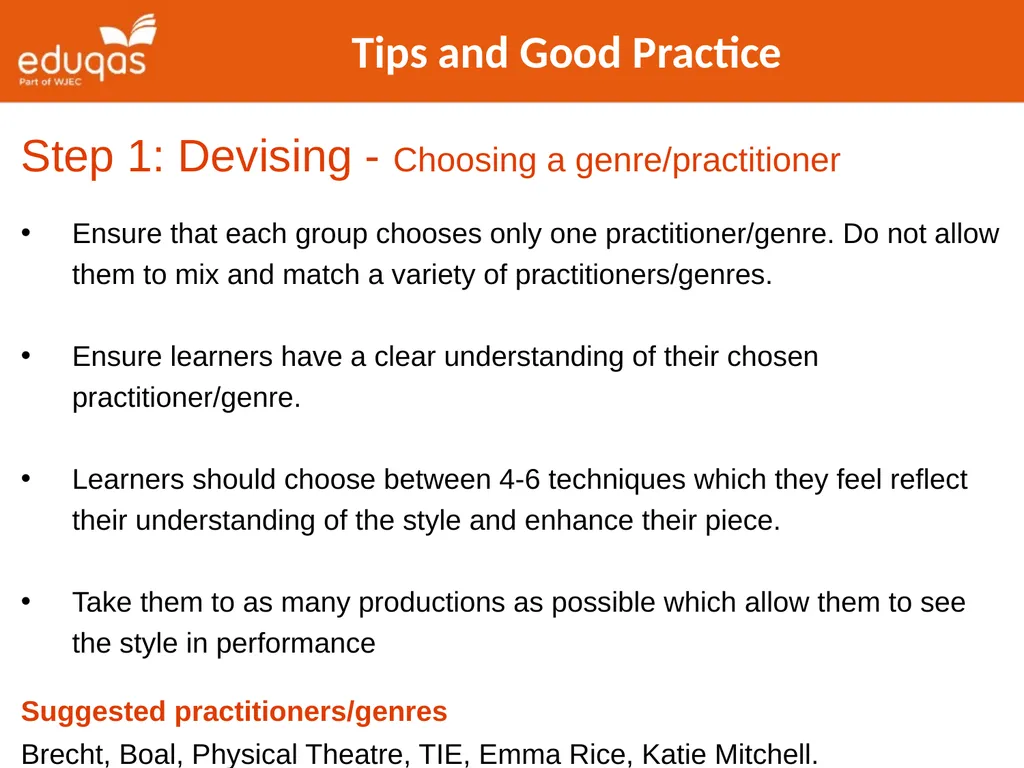
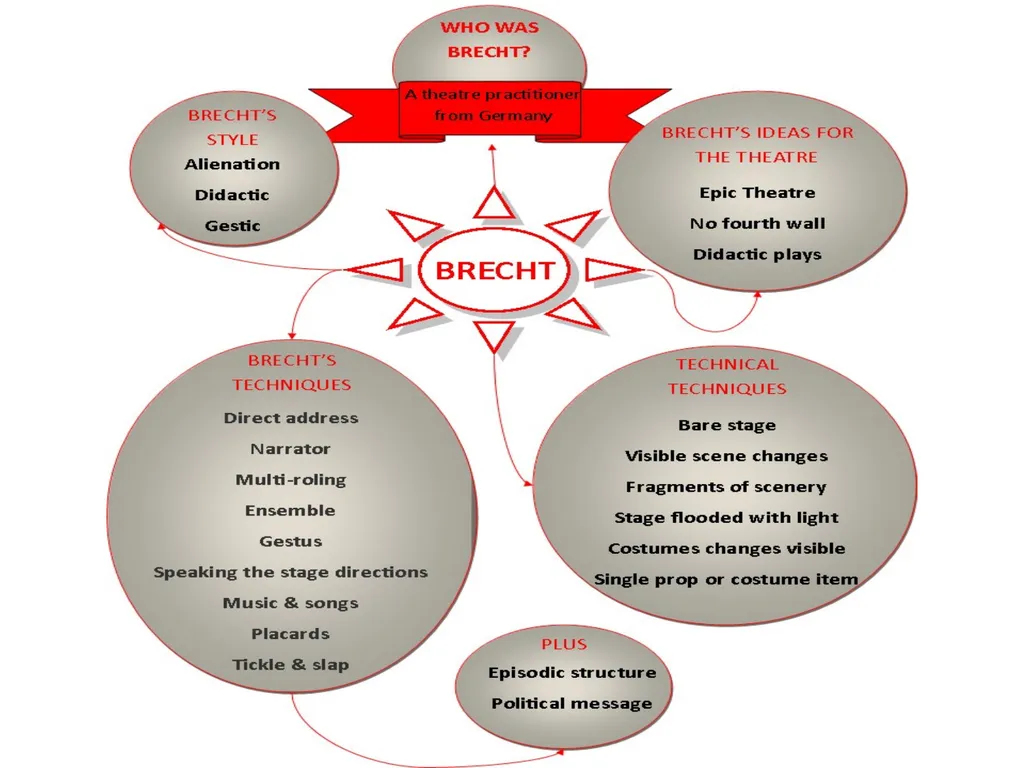
Tips and Good Practice Step 1: Devising - Choosing a genre/practitioner
Ensure that each group chooses only one practitioner/genre. Do not allow them to mix and match a variety of practitioners/genres.
Ensure learners have a clear understanding of their chosen practitioner/genre.
Learners should choose between 4-6 techniques which they feel reflect their understanding of the style and enhance their piece.
Take them to as many productions as possible which allow them to see the style in performance
Suggested practitioners/genres
Brecht, Boal, Physical Theatre, TIE, Emma Rice, Katie Mitchell.<br>
03
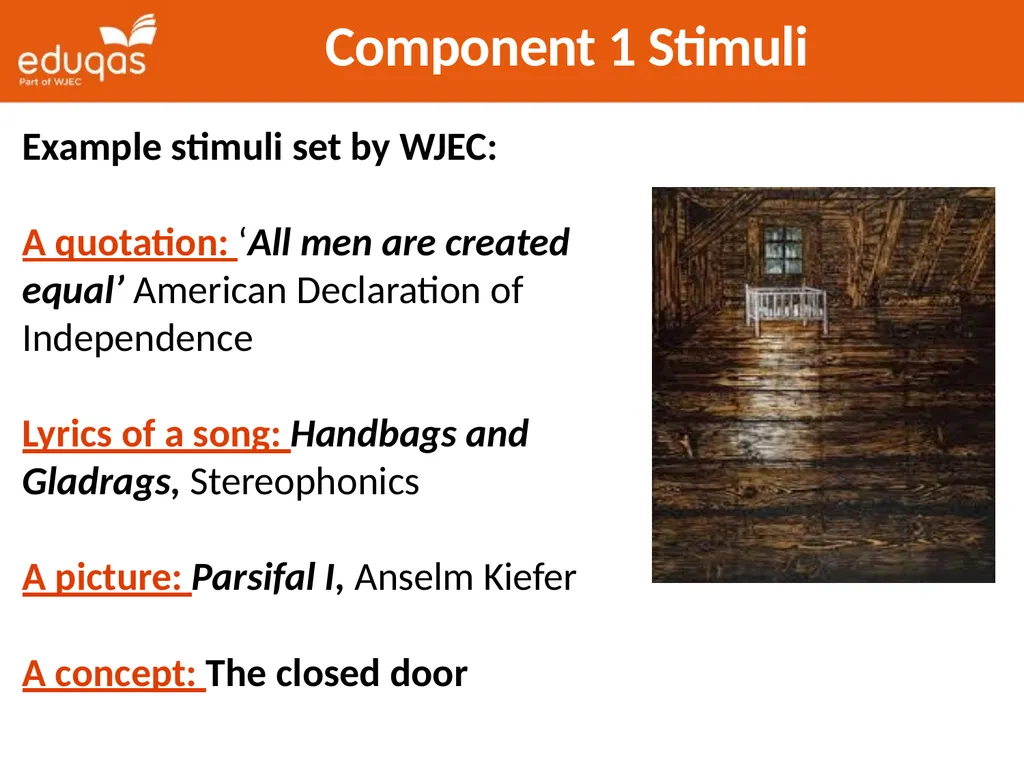
Component 1 Stimuli Example stimuli set by WJEC:
A quotation: ‘All men are created equal’ American Declaration of Independence
Lyrics of a song: Handbags and Gladrags, Stereophonics
A picture: Parsifal I, Anselm Kiefer
A concept: The closed door<br>
A quotation: ‘All men are created equal’ American Declaration of Independence
Lyrics of a song: Handbags and Gladrags, Stereophonics
A picture: Parsifal I, Anselm Kiefer
A concept: The closed door<br>
04
Practical Approaches to Component 1 How do I devise?
From the beginning of year ten give learners multiple opportunities to experiment and develop their understanding of devising using a range of styles and stimuli
After each unit of work, learners undertake a “mini devising project”. These are assessed using unit one criteria for performance.
Encourage learners to note key moments in the process<br>
05
Practical Approaches to Component 1 The ‘Pick and Mix” approach
Introduce learners to a range of dramatic devices which they can use in their work.
Flashbacks, cross cutting, mime, monologues, multi-role, thought-tracking, slow-motion, narrator, direct-address, choral speaking.
Encourage learners to choose devices which are best suited to their chosen practitioner/genre.<br>
06
Practical Approaches to Component 1 Include a range of practical exercises that improve and refine performance skills e.g. learners write and perform own monologue to the class. This exercise helps to highlight vocal work and how gesture can be used effectively.
Use short extracts of scripts e.g. opening scene of Betrayal by Pinter to highlight how pauses and subtext are used effectively.<br>
Use short extracts of scripts e.g. opening scene of Betrayal by Pinter to highlight how pauses and subtext are used effectively.<br>
07
Practical Approaches to Component 1 Choosing a stimulus
Introduce them to the stimuli they will base their work on towards the end of year 10.
Learners spend one lesson devising a short performance on each of the stimuli to familiarise themselves with them and to begin thinking of how they could be developed.
Develop individual ideas over the summer holidays ready to share and brainstorm with group in September of year 11<br>
08
Interpretation of Stimuli Familiarise learners with the assessment criteria. Band 5:
Highly imaginative ideas are created and developed in response to the chosen stimulus to communicate meaning
In order to access marks within the 25-30 mark boundary the interpretation of stimuli must be very imaginative. If this is the case within the process, the learners should be able to document it within the portfolio.
Encourage learners to “think outside the box” they can take the theme in whichever direction they choose as long as they are clear what the link is.
Learners must keep records (notes, photos, spider-grams, sketches, etc) of these initial exploration stages, including avenues of research<br>
09
To Script or Not to Script? The final performance needs to be polished and a “highly effective application of performance/design skills” are required to achieve top band marks.
Therefore scripting the work is essential and should be a group effort.
This will help both performers and designers as the script becomes a good starting point for the initial rehearsals
E.g. Each member of the group (including any technical candidates) is responsible for writing one scene. Through group discussions they should know exactly who and what should be in their scene. They are given one week to write the scene. As a group they make changes, top and tail beginning and ends of scenes. The script then evolves in subsequent rehearsals.<br>
10
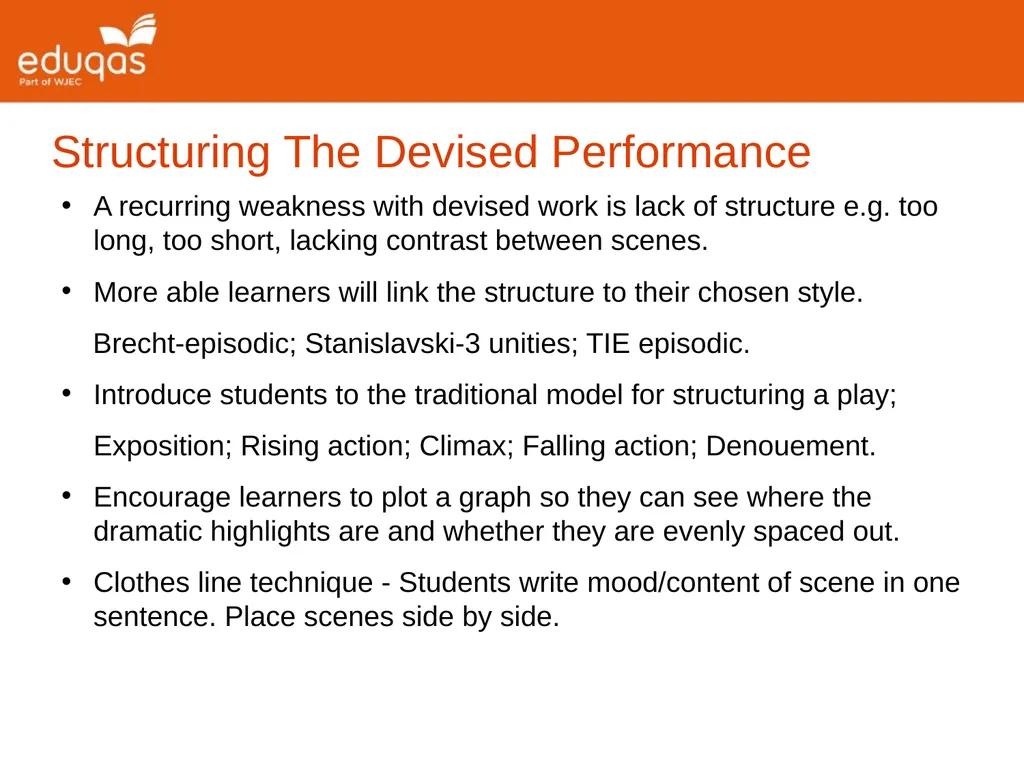
Structuring The Devised Performance A recurring weakness with devised work is lack of structure e.g. too long, too short, lacking contrast between scenes.
More able learners will link the structure to their chosen style.
Brecht-episodic; Stanislavski-3 unities; TIE episodic.
Introduce students to the traditional model for structuring a play;
Exposition; Rising action; Climax; Falling action; Denouement.
Encourage learners to plot a graph so they can see where the dramatic highlights are and whether they are evenly spaced out.
Clothes line technique - Students write mood/content of scene in one sentence. Place scenes side by side.<br>
11
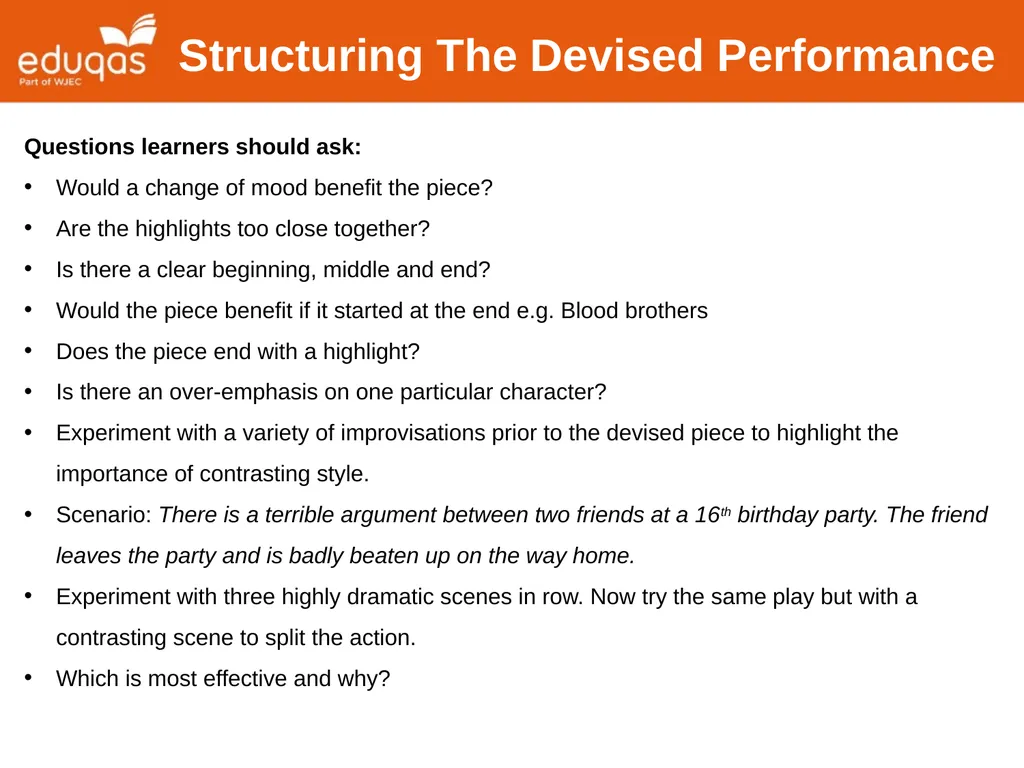
Structuring The Devised Performance Questions learners should ask:
Would a change of mood benefit the piece?
Are the highlights too close together?
Is there a clear beginning, middle and end?
Would the piece benefit if it started at the end e.g. Blood brothers
Does the piece end with a highlight?
Is there an over-emphasis on one particular character?
Experiment with a variety of improvisations prior to the devised piece to highlight the importance of contrasting style.
Scenario: There is a terrible argument between two friends at a 16th birthday party. The friend leaves the party and is badly beaten up on the way home.
Experiment with three highly dramatic scenes in row. Now try the same play but with a contrasting scene to split the action.
Which is most effective and why?<br>
12
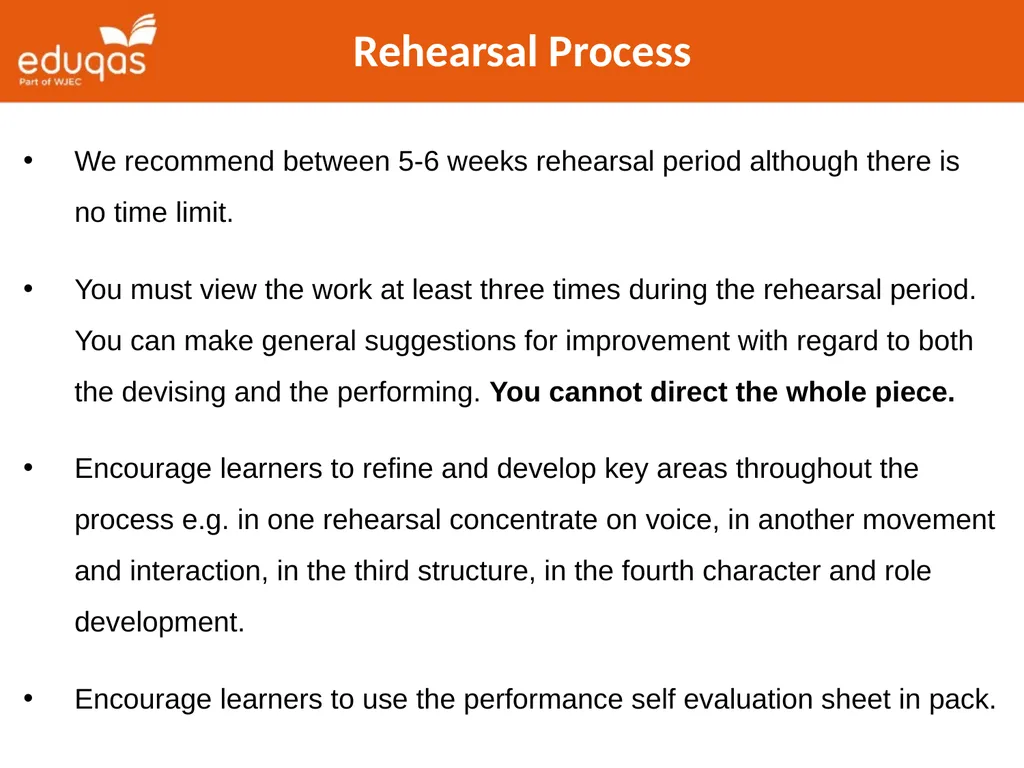
Rehearsal Process We recommend between 5-6 weeks rehearsal period although there is no time limit.
You must view the work at least three times during the rehearsal period. You can make general suggestions for improvement with regard to both the devising and the performing. You cannot direct the whole piece.
Encourage learners to refine and develop key areas throughout the process e.g. in one rehearsal concentrate on voice, in another movement and interaction, in the third structure, in the fourth character and role development.
Encourage learners to use the performance self evaluation sheet in pack.<br>
13
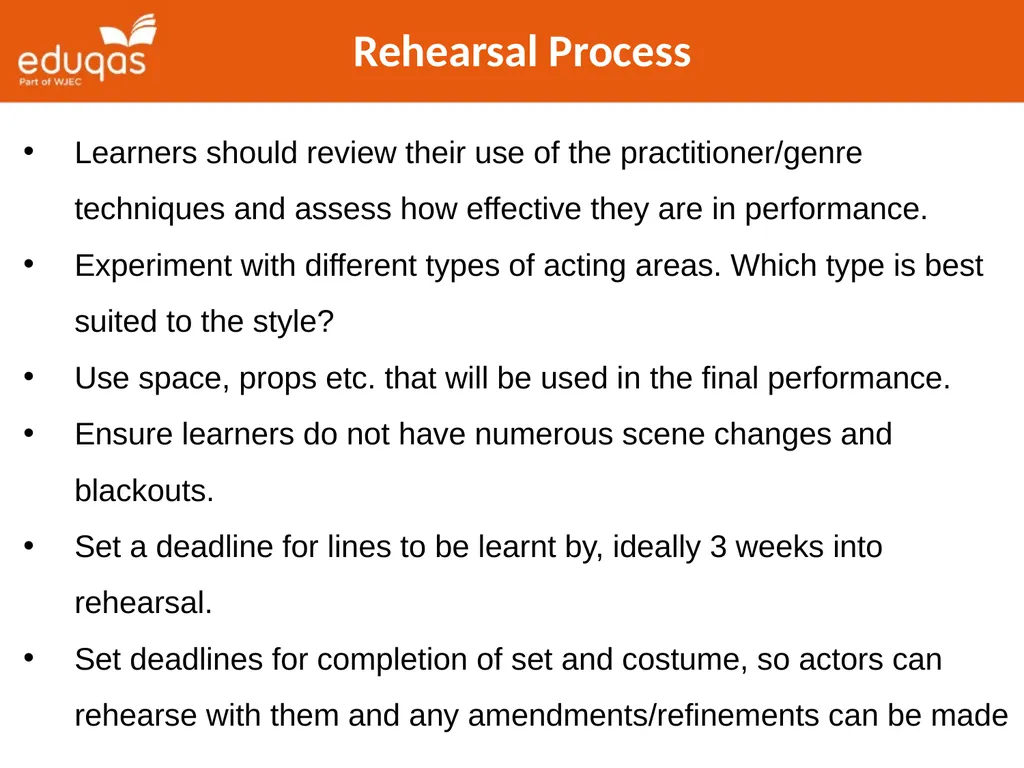
Rehearsal Process Learners should review their use of the practitioner/genre techniques and assess how effective they are in performance.
Experiment with different types of acting areas. Which type is best suited to the style?
Use space, props etc. that will be used in the final performance.
Ensure learners do not have numerous scene changes and blackouts.
Set a deadline for lines to be learnt by, ideally 3 weeks into rehearsal.
Set deadlines for completion of set and costume, so actors can rehearse with them and any amendments/refinements can be made<br>
14
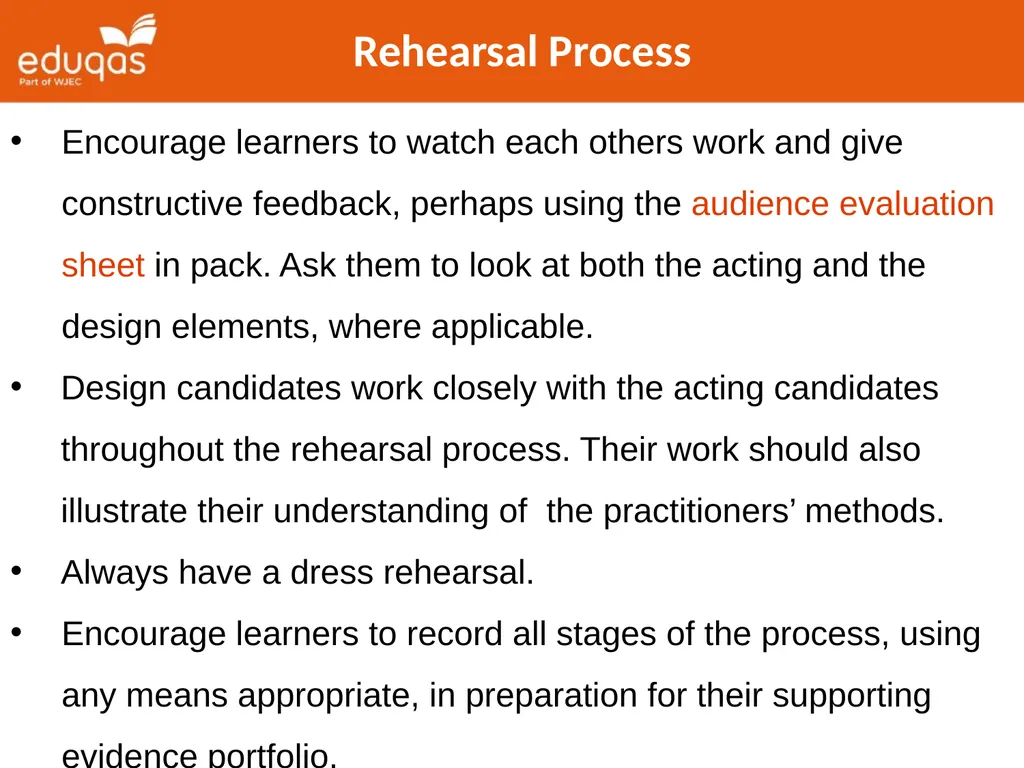
Rehearsal Process Encourage learners to watch each others work and give constructive feedback, perhaps using the audience evaluation sheet in pack. Ask them to look at both the acting and the design elements, where applicable.
Design candidates work closely with the acting candidates throughout the rehearsal process. Their work should also illustrate their understanding of the practitioners’ methods.
Always have a dress rehearsal.
Encourage learners to record all stages of the process, using any means appropriate, in preparation for their supporting evidence portfolio.<br>
15
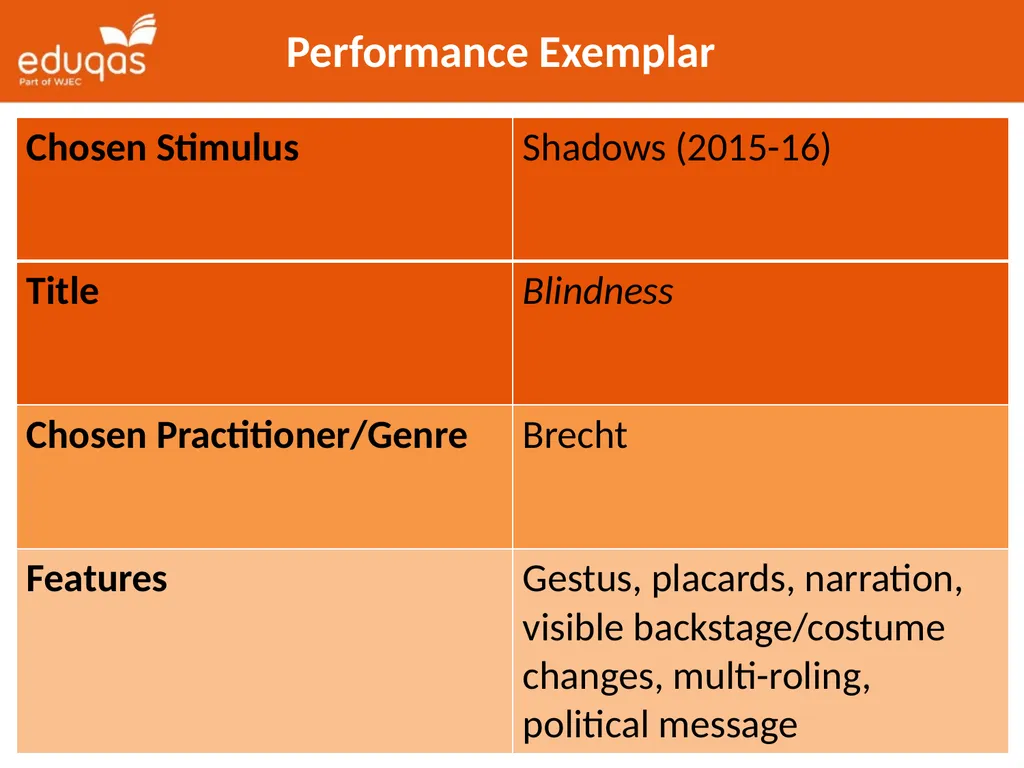
Performance Exemplar<br>
16
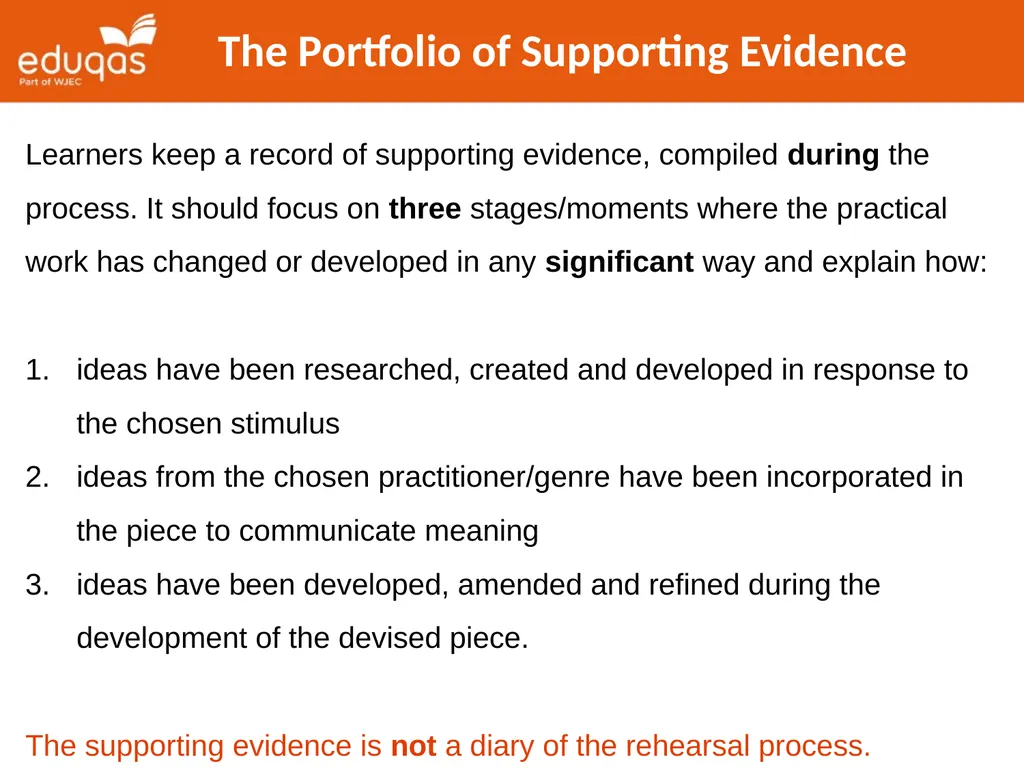
The Portfolio of Supporting Evidence Learners keep a record of supporting evidence, compiled during the process. It should focus on three stages/moments where the practical work has changed or developed in any significant way and explain how:
ideas have been researched, created and developed in response to the chosen stimulus
ideas from the chosen practitioner/genre have been incorporated in the piece to communicate meaning
ideas have been developed, amended and refined during the development of the devised piece.
The supporting evidence is not a diary of the rehearsal process.<br>
17
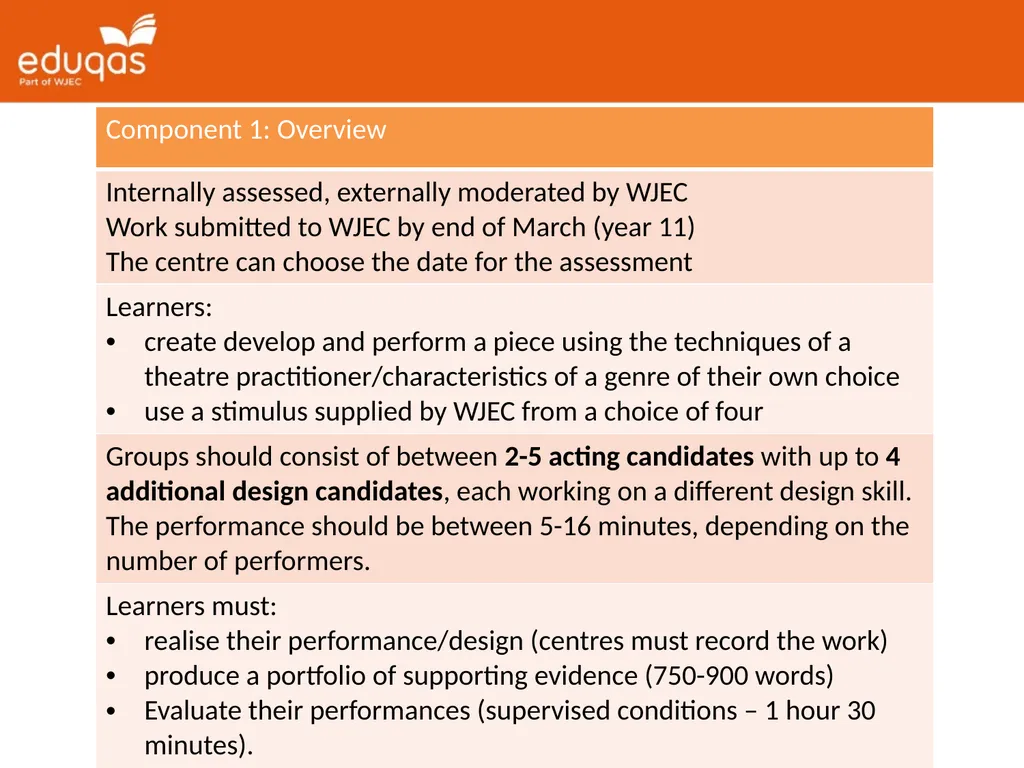
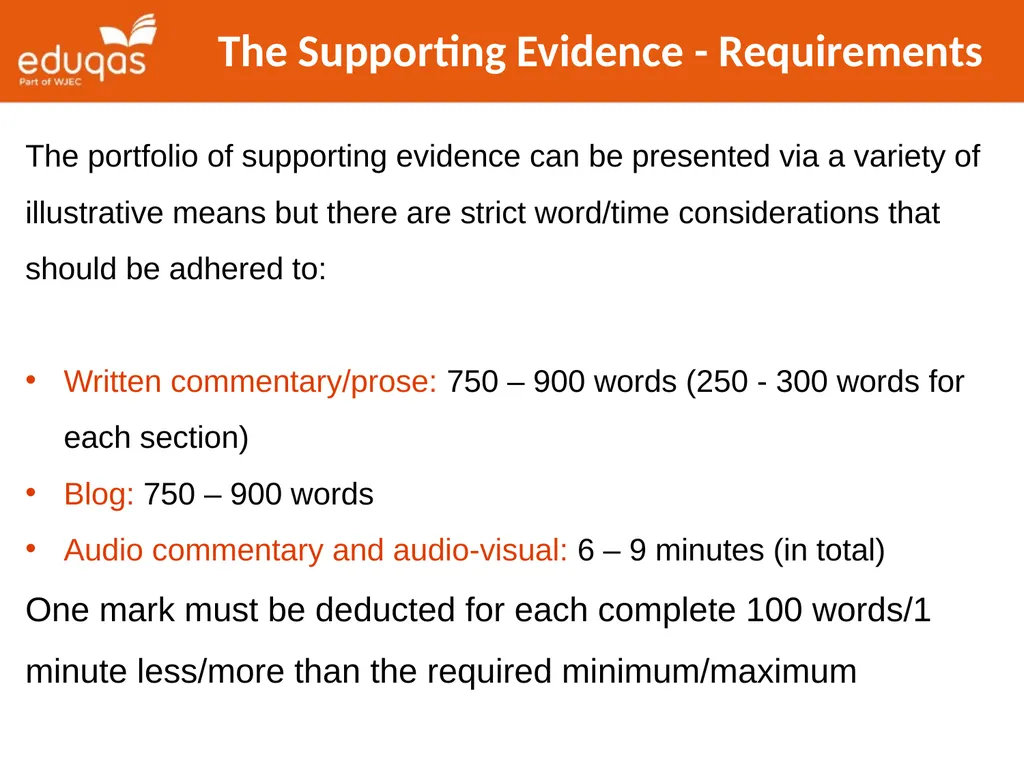
The Supporting Evidence - Requirements The portfolio of supporting evidence can be presented via a variety of illustrative means but there are strict word/time considerations that should be adhered to:
Written commentary/prose: 750 – 900 words (250 - 300 words for each section)
Blog: 750 – 900 words
Audio commentary and audio-visual: 6 – 9 minutes (in total)
One mark must be deducted for each complete 100 words/1 minute less/more than the required minimum/maximum<br>
Written commentary/prose: 750 – 900 words (250 - 300 words for each section)
Blog: 750 – 900 words
Audio commentary and audio-visual: 6 – 9 minutes (in total)
One mark must be deducted for each complete 100 words/1 minute less/more than the required minimum/maximum<br>
18
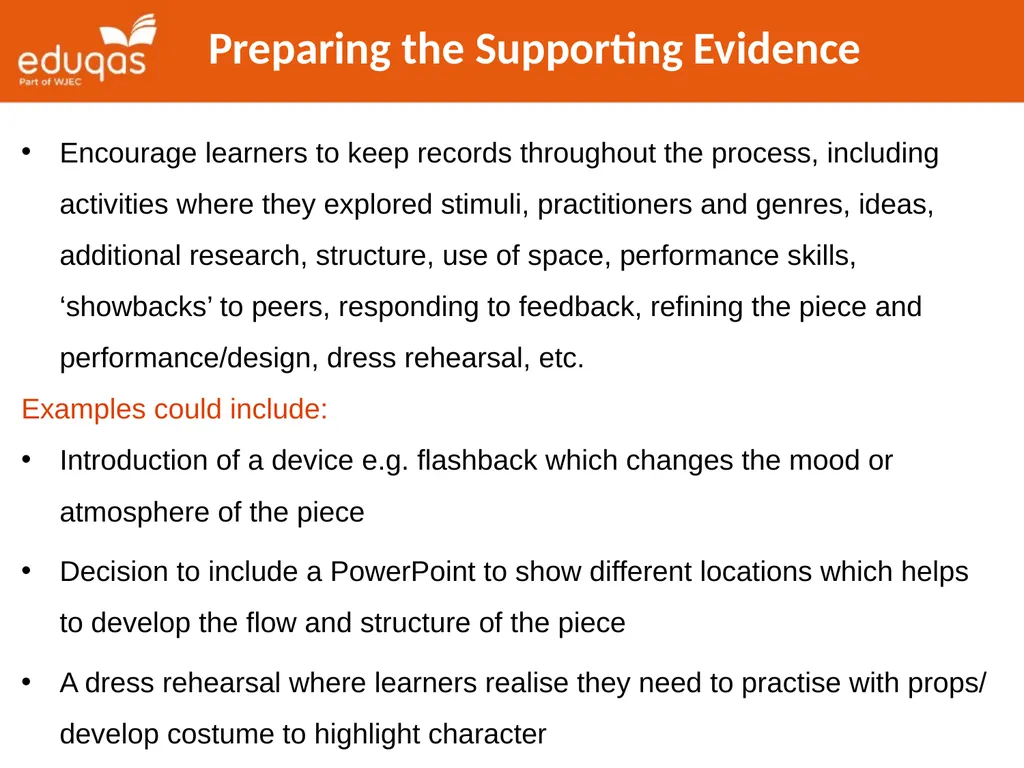
Preparing the Supporting Evidence Encourage learners to keep records throughout the process, including activities where they explored stimuli, practitioners and genres, ideas, additional research, structure, use of space, performance skills, ‘showbacks’ to peers, responding to feedback, refining the piece and performance/design, dress rehearsal, etc.
Examples could include:
Introduction of a device e.g. flashback which changes the mood or atmosphere of the piece
Decision to include a PowerPoint to show different locations which helps to develop the flow and structure of the piece
A dress rehearsal where learners realise they need to practise with props/ develop costume to highlight character<br>
19
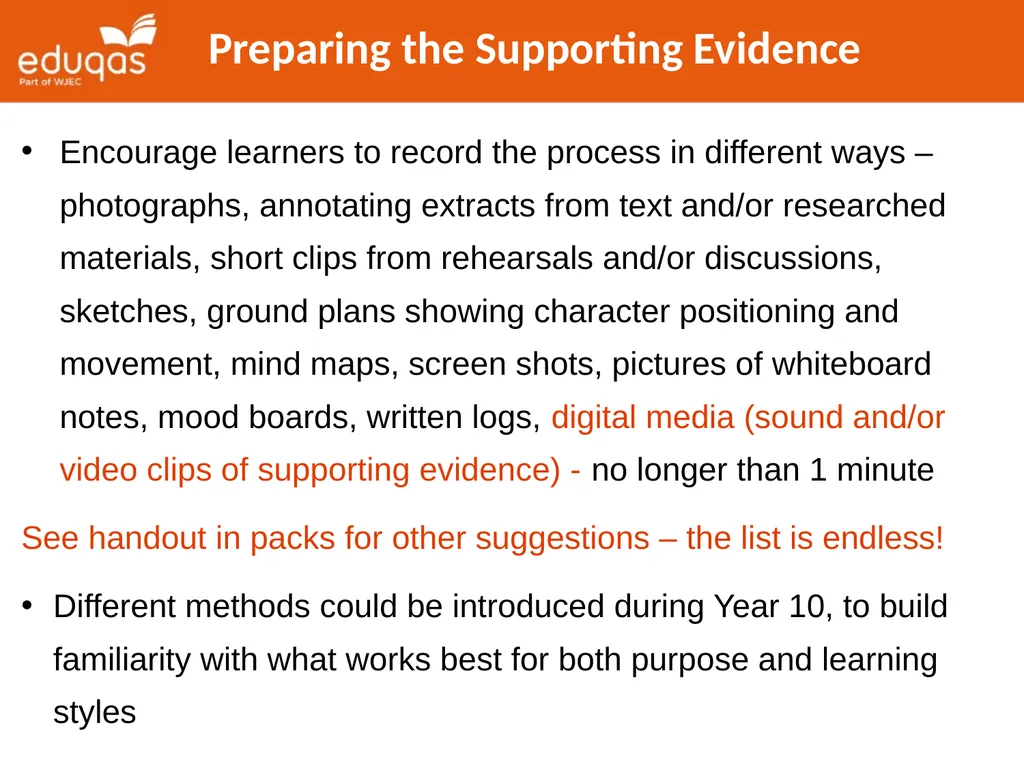
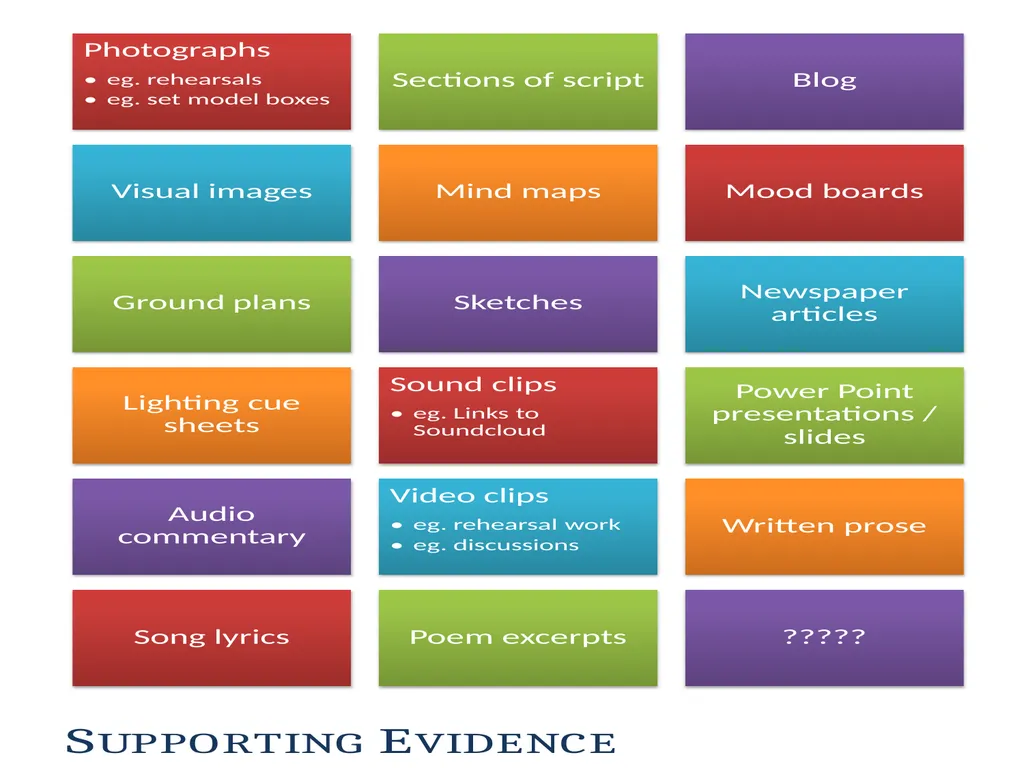
Preparing the Supporting Evidence Encourage learners to record the process in different ways – photographs, annotating extracts from text and/or researched materials, short clips from rehearsals and/or discussions, sketches, ground plans showing character positioning and movement, mind maps, screen shots, pictures of whiteboard notes, mood boards, written logs, digital media (sound and/or video clips of supporting evidence) - no longer than 1 minute
See handout in packs for other suggestions – the list is endless!
Different methods could be introduced during Year 10, to build familiarity with what works best for both purpose and learning styles<br>
See handout in packs for other suggestions – the list is endless!
Different methods could be introduced during Year 10, to build familiarity with what works best for both purpose and learning styles<br>
20
Preparing the Supporting Evidence Rather than just being a ‘diary’ of the process, encourage learners to pick out and analyse key moments that had a significant impact upon the development of their piece
These moments could be finalised after the performance of the piece to ensure that the ‘best’ significant moments are chosen and reflected upon<br>
These moments could be finalised after the performance of the piece to ensure that the ‘best’ significant moments are chosen and reflected upon<br>
21
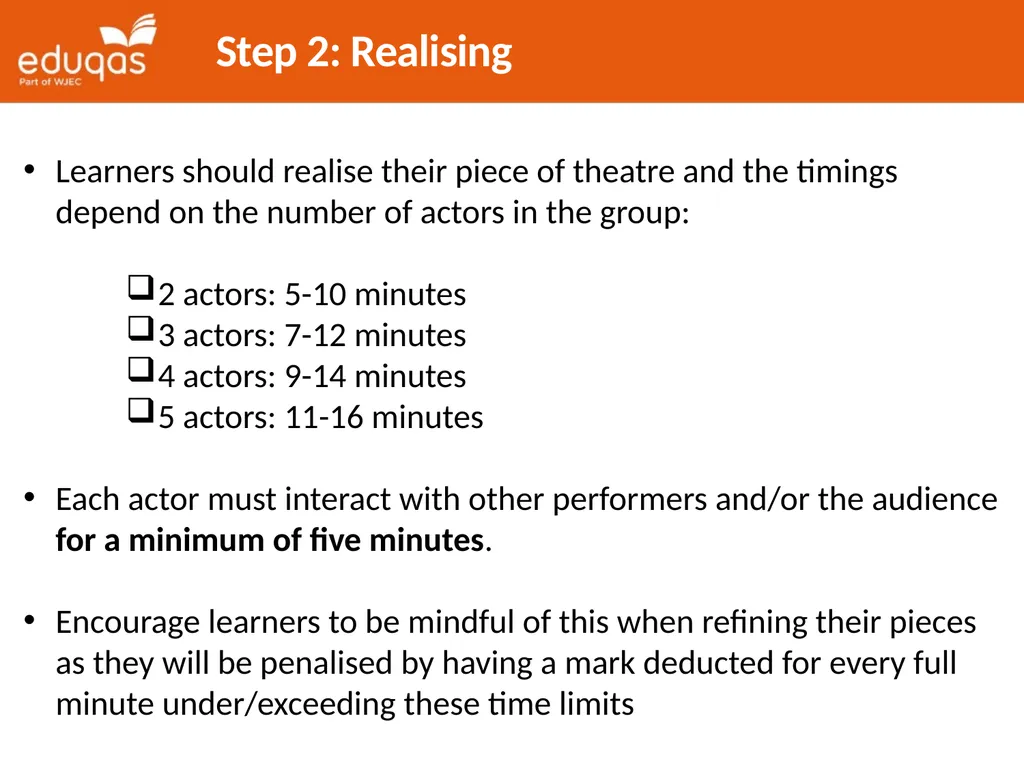
Step 2: Realising Learners should realise their piece of theatre and the timings depend on the number of actors in the group:
2 actors: 5-10 minutes
3 actors: 7-12 minutes
4 actors: 9-14 minutes
5 actors: 11-16 minutes
Each actor must interact with other performers and/or the audience for a minimum of five minutes.
Encourage learners to be mindful of this when refining their pieces as they will be penalised by having a mark deducted for every full minute under/exceeding these time limits<br>
22
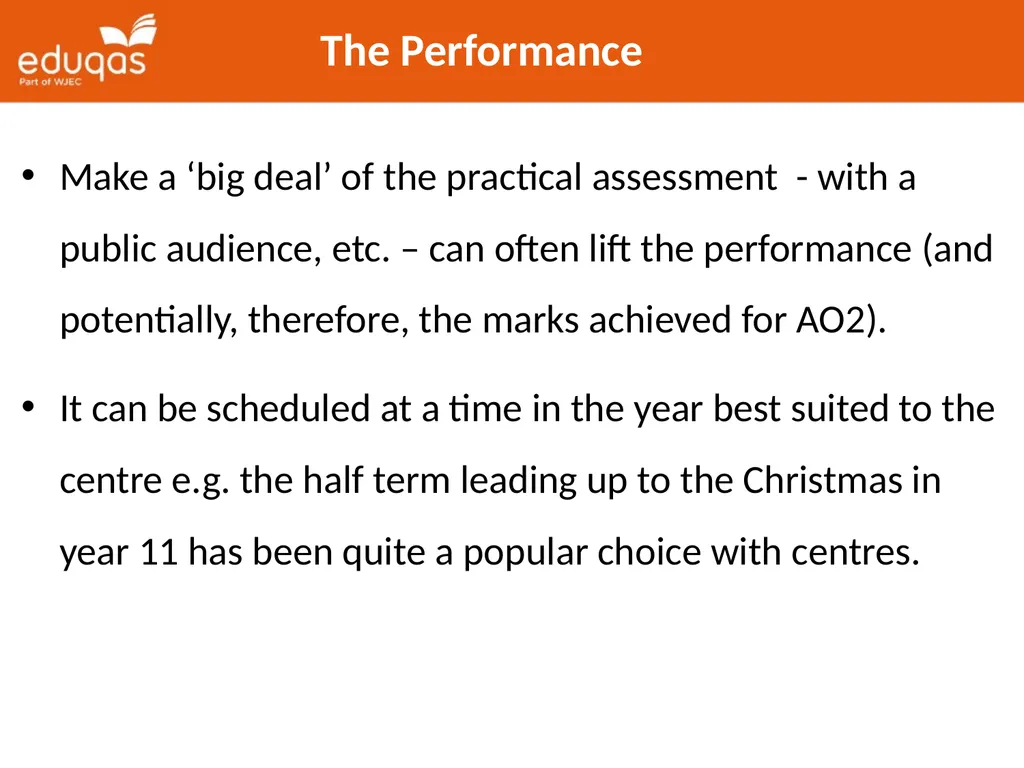
The Performance Make a ‘big deal’ of the practical assessment - with a public audience, etc. – can often lift the performance (and potentially, therefore, the marks achieved for AO2).
It can be scheduled at a time in the year best suited to the centre e.g. the half term leading up to the Christmas in year 11 has been quite a popular choice with centres.<br>
It can be scheduled at a time in the year best suited to the centre e.g. the half term leading up to the Christmas in year 11 has been quite a popular choice with centres.<br>
23
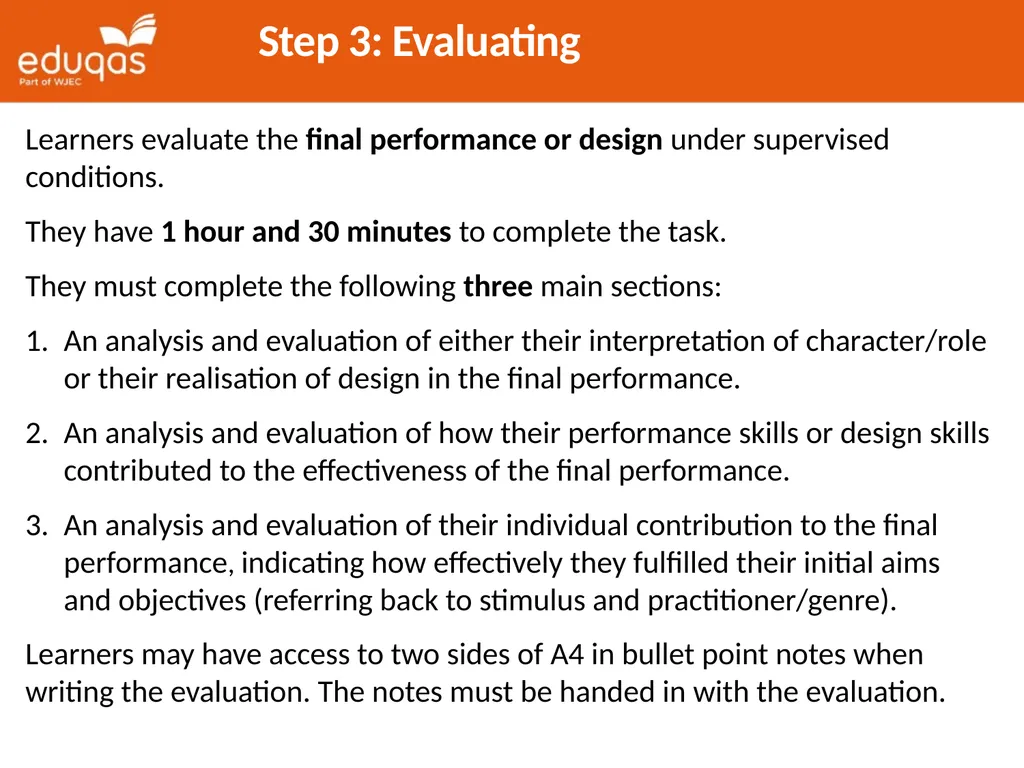
Step 3: Evaluating Learners evaluate the final performance or design under supervised conditions.
They have 1 hour and 30 minutes to complete the task.
They must complete the following three main sections:
An analysis and evaluation of either their interpretation of character/role or their realisation of design in the final performance.
An analysis and evaluation of how their performance skills or design skills contributed to the effectiveness of the final performance.
An analysis and evaluation of their individual contribution to the final performance, indicating how effectively they fulfilled their initial aims and objectives (referring back to stimulus and practitioner/genre).
Learners may have access to two sides of A4 in bullet point notes when writing the evaluation. The notes must be handed in with the evaluation.<br>
24
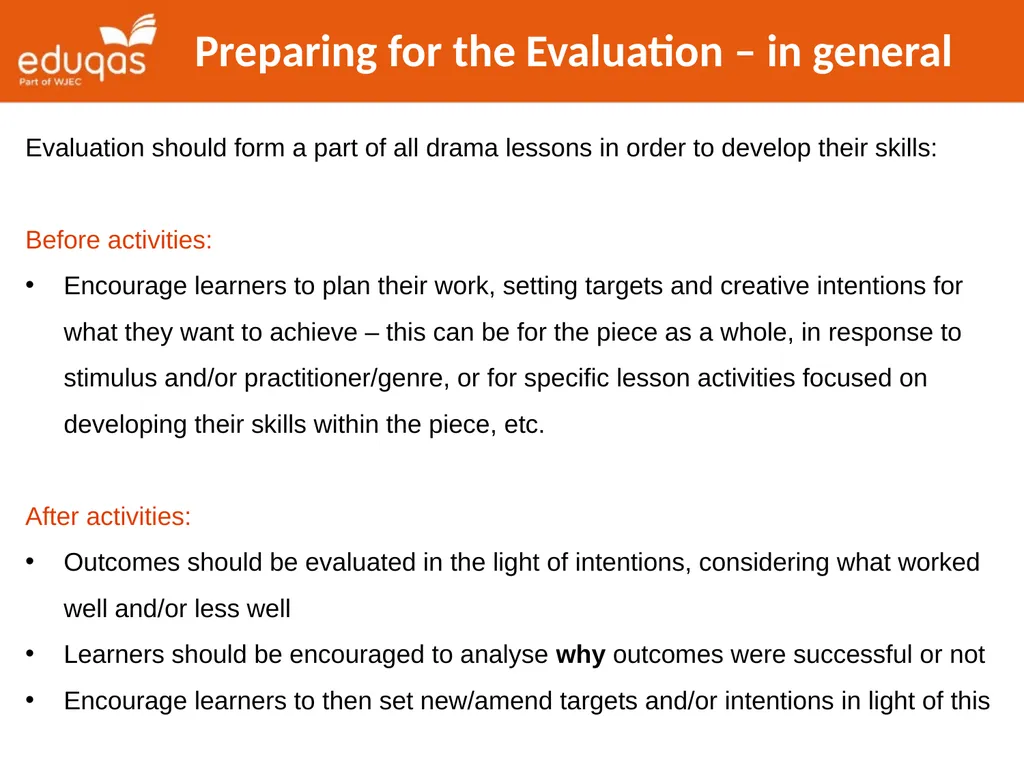
Preparing for the Evaluation – in general Evaluation should form a part of all drama lessons in order to develop their skills:
Before activities:
Encourage learners to plan their work, setting targets and creative intentions for what they want to achieve – this can be for the piece as a whole, in response to stimulus and/or practitioner/genre, or for specific lesson activities focused on developing their skills within the piece, etc.
After activities:
Outcomes should be evaluated in the light of intentions, considering what worked well and/or less well
Learners should be encouraged to analyse why outcomes were successful or not
Encourage learners to then set new/amend targets and/or intentions in light of this<br>
25
Preparing for the Evaluation
After the Final Performance Learners should watch the recordings of the final performance
Learners could evaluate each others’ performances and designs, as well as their own, discussing the outcomes
Learners should be encouraged to write notes under defined sub-headings, linked to requirements<br>
After the Final Performance Learners should watch the recordings of the final performance
Learners could evaluate each others’ performances and designs, as well as their own, discussing the outcomes
Learners should be encouraged to write notes under defined sub-headings, linked to requirements<br>
26
Assessment of Work Familiarise yourself with the assessment criteria before the exam for both the acting and technical candidates.
Familiarise yourself with the standard of the various mark boundaries through viewing work on the secure website.
Be aware of key words within the assessment criteria, e.g. highly imaginative/effective, excellent range, highly sensitive, etc.
Accept that you might not have top mark candidates within your group.
Be conscious that a candidate may achieve marks across different bands for the Supporting Evidence and for the Performance/Design<br>
27
Component 1: Assessment (AO1 20%, 30 marks) AO1 create and develop ideas to communicate meaning for performance.
This is assessed through the portfolio of supporting evidence.
There are separate assessment grids for performing and design. Learners are assessed on:
ideas created in response to the stimulus
use of practitioner/genre techniques
their individual contribution to the process
development of character/mood and atmosphere
selection of performance/design conventions/techniques
use of space/design cues.<br>
28
Component 1: Assessment (AO2 10%, 15 marks) AO2 apply theatrical skills to realise artistic intentions in live performance
This is assessed through the final performance/design.
There are separate assessment grids for performing and design candidates. Learners are assessed on how well they realise their artistic intentions through:
application of design/performance skills
interpretation of character/scene
individual contribution to the final performance.<br>
29
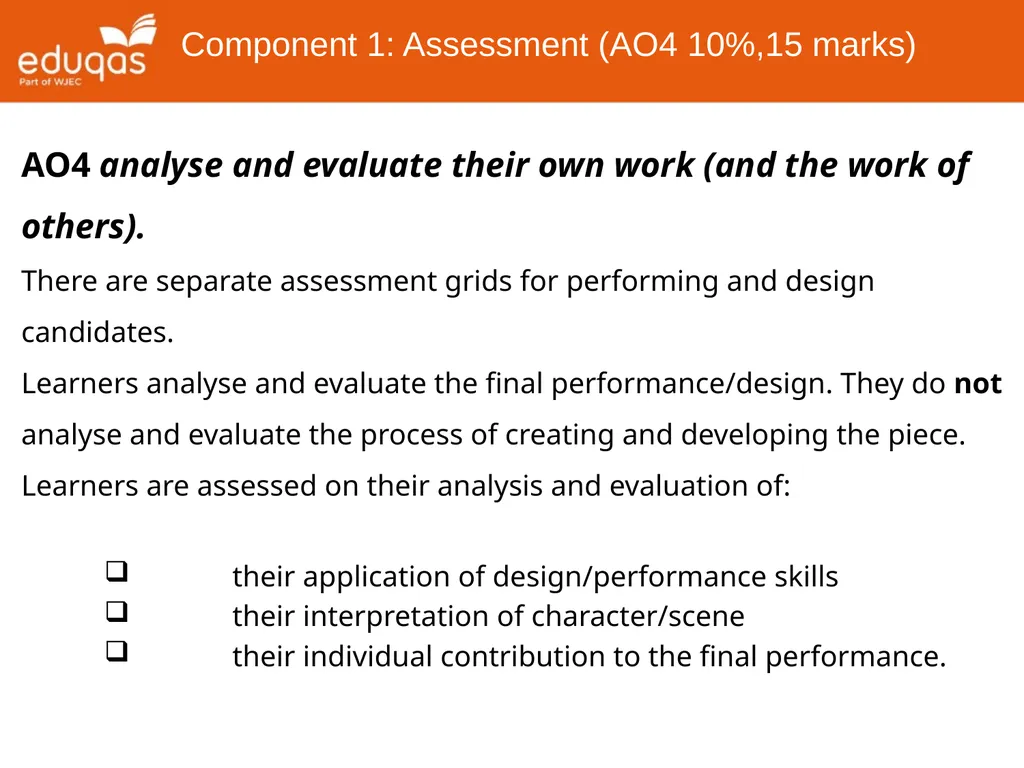
Component 1: Assessment (AO4 10%,15 marks) AO4 analyse and evaluate their own work (and the work of others).
There are separate assessment grids for performing and design candidates.
Learners analyse and evaluate the final performance/design. They do not analyse and evaluate the process of creating and developing the piece.
Learners are assessed on their analysis and evaluation of:
their application of design/performance skills
their interpretation of character/scene
their individual contribution to the final performance.<br>