
AQA A Level History 7042, Paper 3 Historical
LD
Published · 29 slides · 0 views

1 / 1




Description
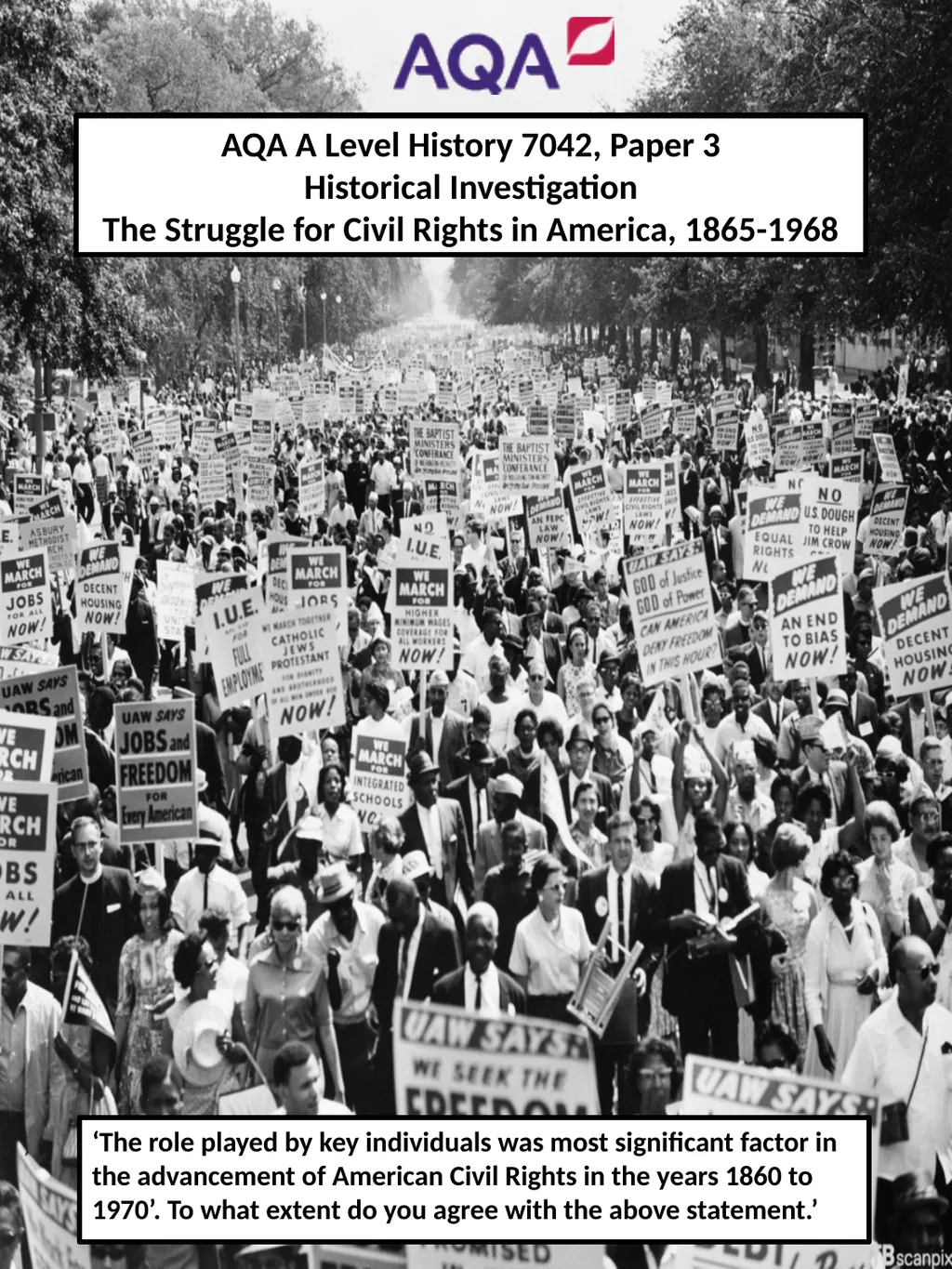
AQA A Level History 7042, Paper 3 Historical Investigation The Struggle for Civil Rights in America, 1865-1968 The role played by key individuals was most significant factor in the advancement of American Civil Rights in the years 1860 to
Related Topics
Share
Embed code
Download this presentation From Below
"AQA A Level History 7042, Paper 3 Historical" is the property of its rightful owner. Permission is granted to download and print the materials on this website for personal, non-commercial use only, and to display it on your personal computer provided you do not modify the materials and that you retain all copyright notices contained in the materials. By downloading content from our website, you accept the terms of this agreement.
Presentation Transcript
01
AQA A Level History 7042, Paper 3
Historical Investigation
The Struggle for Civil Rights in America, 1865-1968 ‘The role played by key individuals was most significant factor in the advancement of American Civil Rights in the years 1860 to 1970’. To what extent do you agree with the above statement.’<br>
Historical Investigation
The Struggle for Civil Rights in America, 1865-1968 ‘The role played by key individuals was most significant factor in the advancement of American Civil Rights in the years 1860 to 1970’. To what extent do you agree with the above statement.’<br>
02
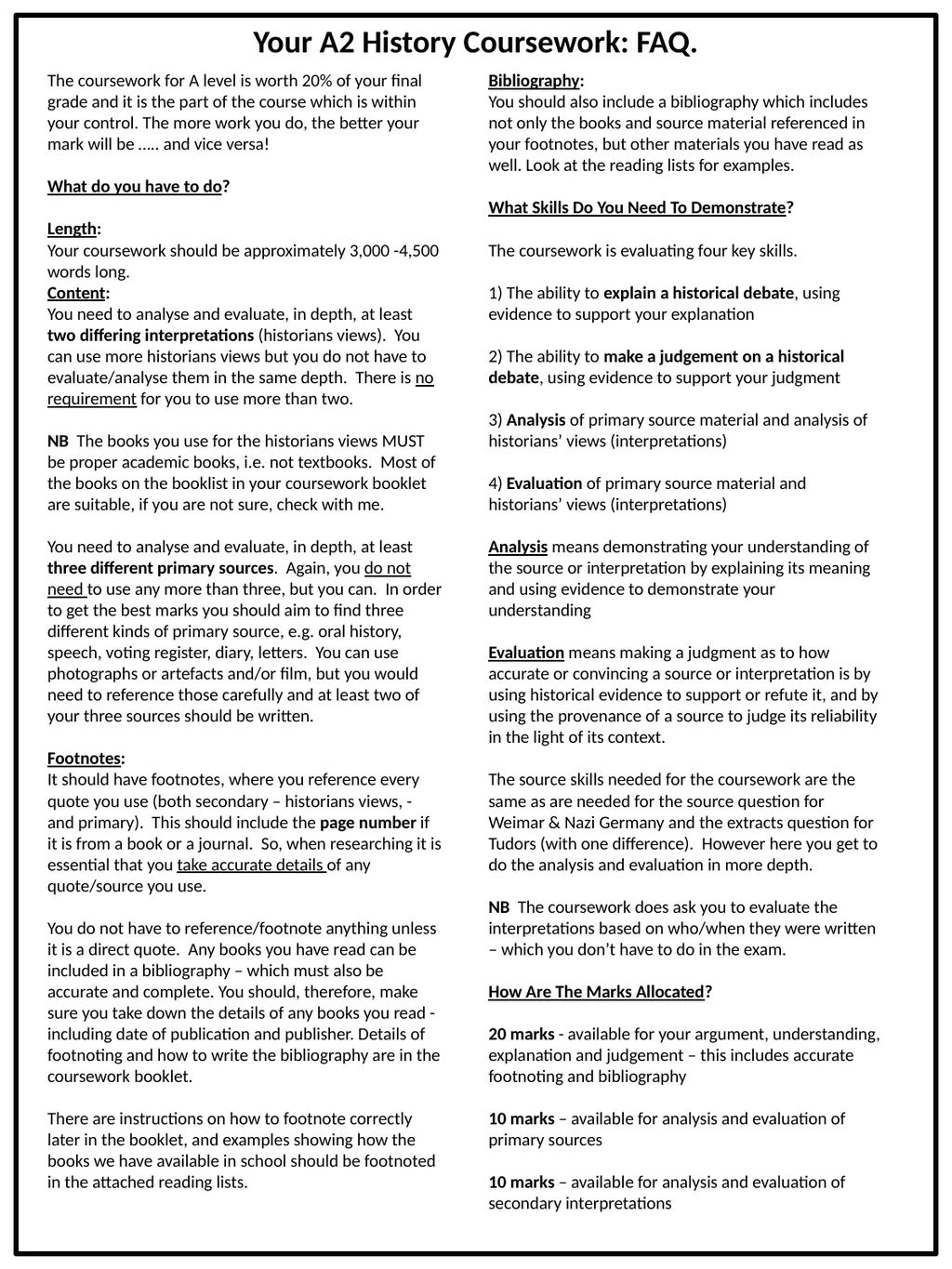
Your A2 History Coursework: FAQ. The coursework for A level is worth 20% of your final grade and it is the part of the course which is within your control. The more work you do, the better your mark will be ….. and vice versa!
What do you have to do?
Length:
Your coursework should be approximately 3,000 -4,500 words long.
Content:
You need to analyse and evaluate, in depth, at least two differing interpretations (historians views). You can use more historians views but you do not have to evaluate/analyse them in the same depth. There is no requirement for you to use more than two.
NB The books you use for the historians views MUST be proper academic books, i.e. not textbooks. Most of the books on the booklist in your coursework booklet are suitable, if you are not sure, check with me.
You need to analyse and evaluate, in depth, at least three different primary sources. Again, you do not need to use any more than three, but you can. In order to get the best marks you should aim to find three different kinds of primary source, e.g. oral history, speech, voting register, diary, letters. You can use photographs or artefacts and/or film, but you would need to reference those carefully and at least two of your three sources should be written.
Footnotes:
It should have footnotes, where you reference every quote you use (both secondary – historians views, - and primary). This should include the page number if it is from a book or a journal. So, when researching it is essential that you take accurate details of any quote/source you use.
You do not have to reference/footnote anything unless it is a direct quote. Any books you have read can be included in a bibliography – which must also be accurate and complete. You should, therefore, make sure you take down the details of any books you read - including date of publication and publisher. Details of footnoting and how to write the bibliography are in the coursework booklet.
There are instructions on how to footnote correctly later in the booklet, and examples showing how the books we have available in school should be footnoted in the attached reading lists. Bibliography:
You should also include a bibliography which includes not only the books and source material referenced in your footnotes, but other materials you have read as well. Look at the reading lists for examples.
What Skills Do You Need To Demonstrate?
The coursework is evaluating four key skills.
1) The ability to explain a historical debate, using evidence to support your explanation
2) The ability to make a judgement on a historical debate, using evidence to support your judgment
3) Analysis of primary source material and analysis of historians’ views (interpretations)
4) Evaluation of primary source material and historians’ views (interpretations)
Analysis means demonstrating your understanding of the source or interpretation by explaining its meaning and using evidence to demonstrate your understanding.
Evaluation means making a judgment as to how accurate or convincing a source or interpretation is by using historical evidence to support or refute it, and by using the provenance of a source to judge its reliability in the light of its context.
The source skills needed for the coursework are the same as are needed for the source question for Weimar & Nazi Germany and the extracts question for Tudors (with one difference). However here you get to do the analysis and evaluation in more depth.
NB The coursework does ask you to evaluate the interpretations based on who/when they were written – which you don’t have to do in the exam.
How Are The Marks Allocated?
20 marks - available for your argument, understanding, explanation and judgement – this includes accurate footnoting and bibliography
10 marks – available for analysis and evaluation of primary sources
10 marks – available for analysis and evaluation of secondary interpretations<br>
03
How should I Structure My Answer?
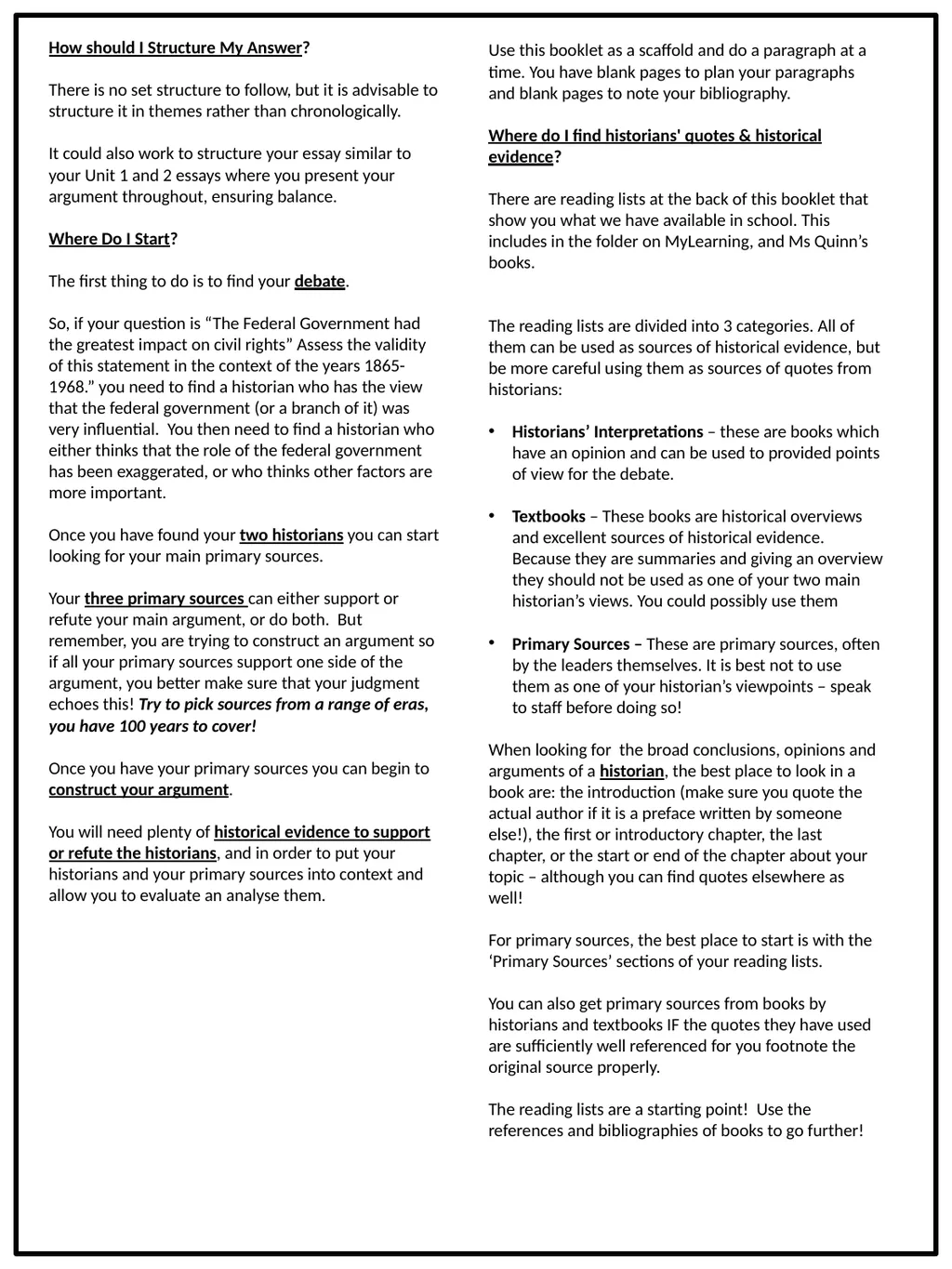
There is no set structure to follow, but it is advisable to structure it in themes rather than chronologically.
It could also work to structure your essay similar to your Unit 1 and 2 essays where you present your argument throughout, ensuring balance.
Where Do I Start?
The first thing to do is to find your debate.
So, if your question is “The Federal Government had the greatest impact on civil rights” Assess the validity of this statement in the context of the years 1865-1968.” you need to find a historian who has the view that the federal government (or a branch of it) was very influential. You then need to find a historian who either thinks that the role of the federal government has been exaggerated, or who thinks other factors are more important.
Once you have found your two historians you can start looking for your main primary sources.
Your three primary sources can either support or refute your main argument, or do both. But remember, you are trying to construct an argument so if all your primary sources support one side of the argument, you better make sure that your judgment echoes this! Try to pick sources from a range of eras, you have 100 years to cover!
Once you have your primary sources you can begin to construct your argument.
You will need plenty of historical evidence to support or refute the historians, and in order to put your historians and your primary sources into context and allow you to evaluate an analyse them. Use this booklet as a scaffold and do a paragraph at a time. You have blank pages to plan your paragraphs and blank pages to note your bibliography.
Where do I find historians' quotes & historical evidence?
There are reading lists at the back of this booklet that show you what we have available in school. This includes in the folder on MyLearning, and Ms Quinn’s books.
The reading lists are divided into 3 categories. All of them can be used as sources of historical evidence, but be more careful using them as sources of quotes from historians:
Historians’ Interpretations – these are books which have an opinion and can be used to provided points of view for the debate.
Textbooks – These books are historical overviews and excellent sources of historical evidence. Because they are summaries and giving an overview they should not be used as one of your two main historian’s views. You could possibly use them
Primary Sources – These are primary sources, often by the leaders themselves. It is best not to use them as one of your historian’s viewpoints – speak to staff before doing so!
When looking for the broad conclusions, opinions and arguments of a historian, the best place to look in a book are: the introduction (make sure you quote the actual author if it is a preface written by someone else!), the first or introductory chapter, the last chapter, or the start or end of the chapter about your topic – although you can find quotes elsewhere as well!
For primary sources, the best place to start is with the ‘Primary Sources’ sections of your reading lists.
You can also get primary sources from books by historians and textbooks IF the quotes they have used are sufficiently well referenced for you footnote the original source properly.
The reading lists are a starting point! Use the references and bibliographies of books to go further!<br>
04
Initial planning What are your ideas for your question?
How would you approach this question?
What are your key ideas about the argument in this question?<br>
How would you approach this question?
What are your key ideas about the argument in this question?<br>
05
Initial planning What events will you reference in your essay from each decade?
1860s:
1870s:
1880s:
1890s:<br>
1860s:
1870s:
1880s:
1890s:<br>
06
Initial planning 1900s:
1910s:
1920s:
1930s:<br>
1910s:
1920s:
1930s:<br>
07
Initial planning 1940s:
1950s:
1960s:<br>
1950s:
1960s:<br>
08
Primary source 1 Checklist
What era is this source from?
How valuable is this source to your area of study/argument?
What issues with provenance can you see with this source?
Is anyone else in the class using this source?<br>
What era is this source from?
How valuable is this source to your area of study/argument?
What issues with provenance can you see with this source?
Is anyone else in the class using this source?<br>
09
Primary source 2 Checklist
What era is this source from?
How valuable is this source to your area of study/argument?
What issues with provenance can you see with this source?
Is anyone else in the class using this source?<br>
What era is this source from?
How valuable is this source to your area of study/argument?
What issues with provenance can you see with this source?
Is anyone else in the class using this source?<br>
10
Primary source 3 Checklist
What era is this source from?
How valuable is this source to your area of study/argument?
What issues with provenance can you see with this source?
Is anyone else in the class using this source?<br>
What era is this source from?
How valuable is this source to your area of study/argument?
What issues with provenance can you see with this source?
Is anyone else in the class using this source?<br>
11
Historiography Checklist
What historians do you plan on using?
Do you have clear arguments between historians?
Are you aware of changing historical interpretation over time?
Which historians do you agree with more?
Is anyone else in the class using the same historians/historians arguments?<br>
What historians do you plan on using?
Do you have clear arguments between historians?
Are you aware of changing historical interpretation over time?
Which historians do you agree with more?
Is anyone else in the class using the same historians/historians arguments?<br>
12
Introduction Checklist
Have you given a quote clearly illustrating the view of a historian who agrees?
Have you given a quote clearly showing the view of a historian who disagrees?
Have you made it clear whether your argument will agree or disagree?<br>
Have you given a quote clearly illustrating the view of a historian who agrees?
Have you given a quote clearly showing the view of a historian who disagrees?
Have you made it clear whether your argument will agree or disagree?<br>
13
Paragraph 1 Checklist
Have you got a quote clearly illustrating the historian’s view?
Have you explained why the historian takes this view, considering the provenance?
Have you included a primary source which supports or opposes the historian’s view?
Have you explained why the provenance of this primary source makes it a strong and useful piece of evidence?
Have you used some evidence from your own historical knowledge in order to support or refute the historian’s view?
Have you come to a judgement about the historian's view in this area and how far it supports your overall argument?<br>
14
Paragraph 2 Checklist
Have you got a quote clearly illustrating the historian’s view?
Have you explained why the historian takes this view, considering the provenance?
Have you included a primary source which supports or opposes the historian’s view?
Have you explained why the provenance of this primary source makes it a strong and useful piece of evidence?
Have you used some evidence from your own historical knowledge in order to support or refute the historian’s view?
Have you come to a judgement about the historian's view in this area and how far it supports your overall argument?<br>
15
Paragraph 3 Checklist
Have you got a quote clearly illustrating the historian’s view?
Have you explained why the historian takes this view, considering the provenance?
Have you included a primary source which supports or opposes the historian’s view?
Have you explained why the provenance of this primary source makes it a strong and useful piece of evidence?
Have you used some evidence from your own historical knowledge in order to support or refute the historian’s view?
Have you come to a judgement about the historian's view in this area and how far it supports your overall argument?<br>
16
Paragraph 4 Checklist
Have you got a quote clearly illustrating the historian’s view?
Have you explained why the historian takes this view, considering the provenance?
Have you included a primary source which supports or opposes the historian’s view?
Have you explained why the provenance of this primary source makes it a strong and useful piece of evidence?
Have you used some evidence from your own historical knowledge in order to support or refute the historian’s view?
Have you come to a judgement about the historian's view in this area and how far it supports your overall argument?<br>
17
Paragraph 5 Checklist
Have you got a quote clearly illustrating the historian’s view?
Have you explained why the historian takes this view, considering the provenance?
Have you included a primary source which supports or opposes the historian’s view?
Have you explained why the provenance of this primary source makes it a strong and useful piece of evidence?
Have you used some evidence from your own historical knowledge in order to support or refute the historian’s view?
Have you come to a judgement about the historian's view in this area and how far it supports your overall argument?<br>
18
Paragraph 6 Checklist
Have you got a quote clearly illustrating the historian’s view?
Have you explained why the historian takes this view, considering the provenance?
Have you included a primary source which supports or opposes the historian’s view?
Have you explained why the provenance of this primary source makes it a strong and useful piece of evidence?
Have you used some evidence from your own historical knowledge in order to support or refute the historian’s view?
Have you come to a judgement about the historian's view in this area and how far it supports your overall argument?<br>
19
Conclusion: Checklist
Have you explained why you disagree with the historian who supports the other side of the argument?
Have you explained why you agree with the historian on your side of the argument?
Have you used a reliable primary source to support your side of the argument?
Have you finished by clearly answering the question and justifying that answer?<br>
20
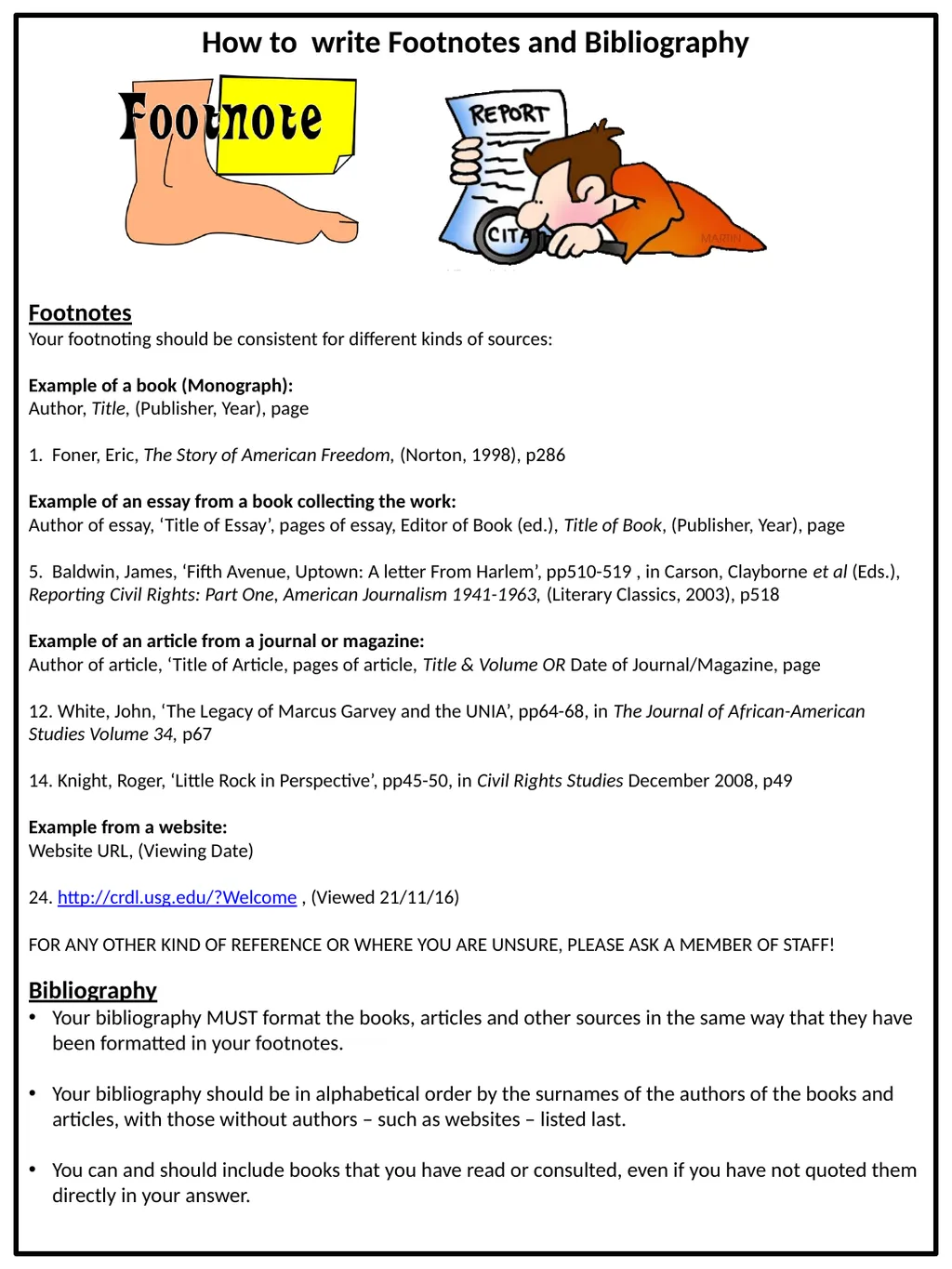
How to write Footnotes and Bibliography
Footnotes
Your footnoting should be consistent for different kinds of sources:
Example of a book (Monograph):
Author, Title, (Publisher, Year), page
1. Foner, Eric, The Story of American Freedom, (Norton, 1998), p286
Example of an essay from a book collecting the work:
Author of essay, ‘Title of Essay’, pages of essay, Editor of Book (ed.), Title of Book, (Publisher, Year), page
5. Baldwin, James, ‘Fifth Avenue, Uptown: A letter From Harlem’, pp510-519 , in Carson, Clayborne et al (Eds.), Reporting Civil Rights: Part One, American Journalism 1941-1963, (Literary Classics, 2003), p518
Example of an article from a journal or magazine:
Author of article, ‘Title of Article, pages of article, Title & Volume OR Date of Journal/Magazine, page
12. White, John, ‘The Legacy of Marcus Garvey and the UNIA’, pp64-68, in The Journal of African-American Studies Volume 34, p67
14. Knight, Roger, ‘Little Rock in Perspective’, pp45-50, in Civil Rights Studies December 2008, p49
Example from a website:
Website URL, (Viewing Date)
24. http://crdl.usg.edu/?Welcome , (Viewed 21/11/16)
FOR ANY OTHER KIND OF REFERENCE OR WHERE YOU ARE UNSURE, PLEASE ASK A MEMBER OF STAFF!
Bibliography
Your bibliography MUST format the books, articles and other sources in the same way that they have been formatted in your footnotes.
Your bibliography should be in alphabetical order by the surnames of the authors of the books and articles, with those without authors – such as websites – listed last.
You can and should include books that you have read or consulted, even if you have not quoted them directly in your answer.<br>
21
Rough Bibliography<br>
22
Rough Bibliography<br>
23
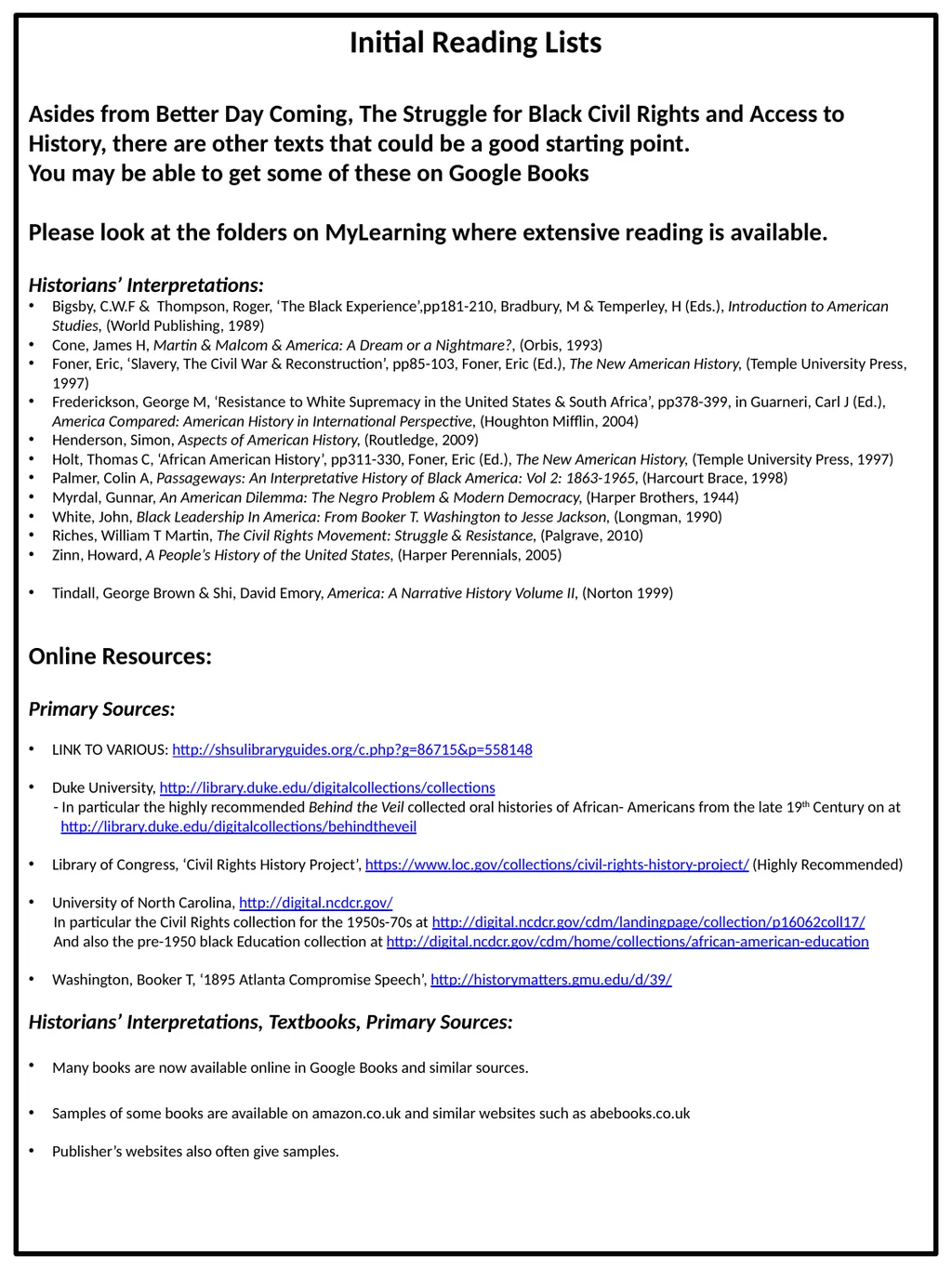
Initial Reading Lists
Asides from Better Day Coming, The Struggle for Black Civil Rights and Access to History, there are other texts that could be a good starting point.
You may be able to get some of these on Google Books
Please look at the folders on MyLearning where extensive reading is available.
Historians’ Interpretations:
Bigsby, C.W.F & Thompson, Roger, ‘The Black Experience’,pp181-210, Bradbury, M & Temperley, H (Eds.), Introduction to American Studies, (World Publishing, 1989)
Cone, James H, Martin & Malcom & America: A Dream or a Nightmare?, (Orbis, 1993)
Foner, Eric, ‘Slavery, The Civil War & Reconstruction’, pp85-103, Foner, Eric (Ed.), The New American History, (Temple University Press, 1997)
Frederickson, George M, ‘Resistance to White Supremacy in the United States & South Africa’, pp378-399, in Guarneri, Carl J (Ed.), America Compared: American History in International Perspective, (Houghton Mifflin, 2004)
Henderson, Simon, Aspects of American History, (Routledge, 2009)
Holt, Thomas C, ‘African American History’, pp311-330, Foner, Eric (Ed.), The New American History, (Temple University Press, 1997)
Palmer, Colin A, Passageways: An Interpretative History of Black America: Vol 2: 1863-1965, (Harcourt Brace, 1998)
Myrdal, Gunnar, An American Dilemma: The Negro Problem & Modern Democracy, (Harper Brothers, 1944)
White, John, Black Leadership In America: From Booker T. Washington to Jesse Jackson, (Longman, 1990)
Riches, William T Martin, The Civil Rights Movement: Struggle & Resistance, (Palgrave, 2010)
Zinn, Howard, A People’s History of the United States, (Harper Perennials, 2005)
Tindall, George Brown & Shi, David Emory, America: A Narrative History Volume II, (Norton 1999)
Online Resources:
Primary Sources:
LINK TO VARIOUS: http://shsulibraryguides.org/c.php?g=86715&p=558148
Duke University, http://library.duke.edu/digitalcollections/collections
- In particular the highly recommended Behind the Veil collected oral histories of African- Americans from the late 19th Century on at
http://library.duke.edu/digitalcollections/behindtheveil
Library of Congress, ‘Civil Rights History Project’, https://www.loc.gov/collections/civil-rights-history-project/ (Highly Recommended)
University of North Carolina, http://digital.ncdcr.gov/
In particular the Civil Rights collection for the 1950s-70s at http://digital.ncdcr.gov/cdm/landingpage/collection/p16062coll17/
And also the pre-1950 black Education collection at http://digital.ncdcr.gov/cdm/home/collections/african-american-education
Washington, Booker T, ‘1895 Atlanta Compromise Speech’, http://historymatters.gmu.edu/d/39/
Historians’ Interpretations, Textbooks, Primary Sources:
Many books are now available online in Google Books and similar sources.
Samples of some books are available on amazon.co.uk and similar websites such as abebooks.co.uk
Publisher’s websites also often give samples.<br>
24
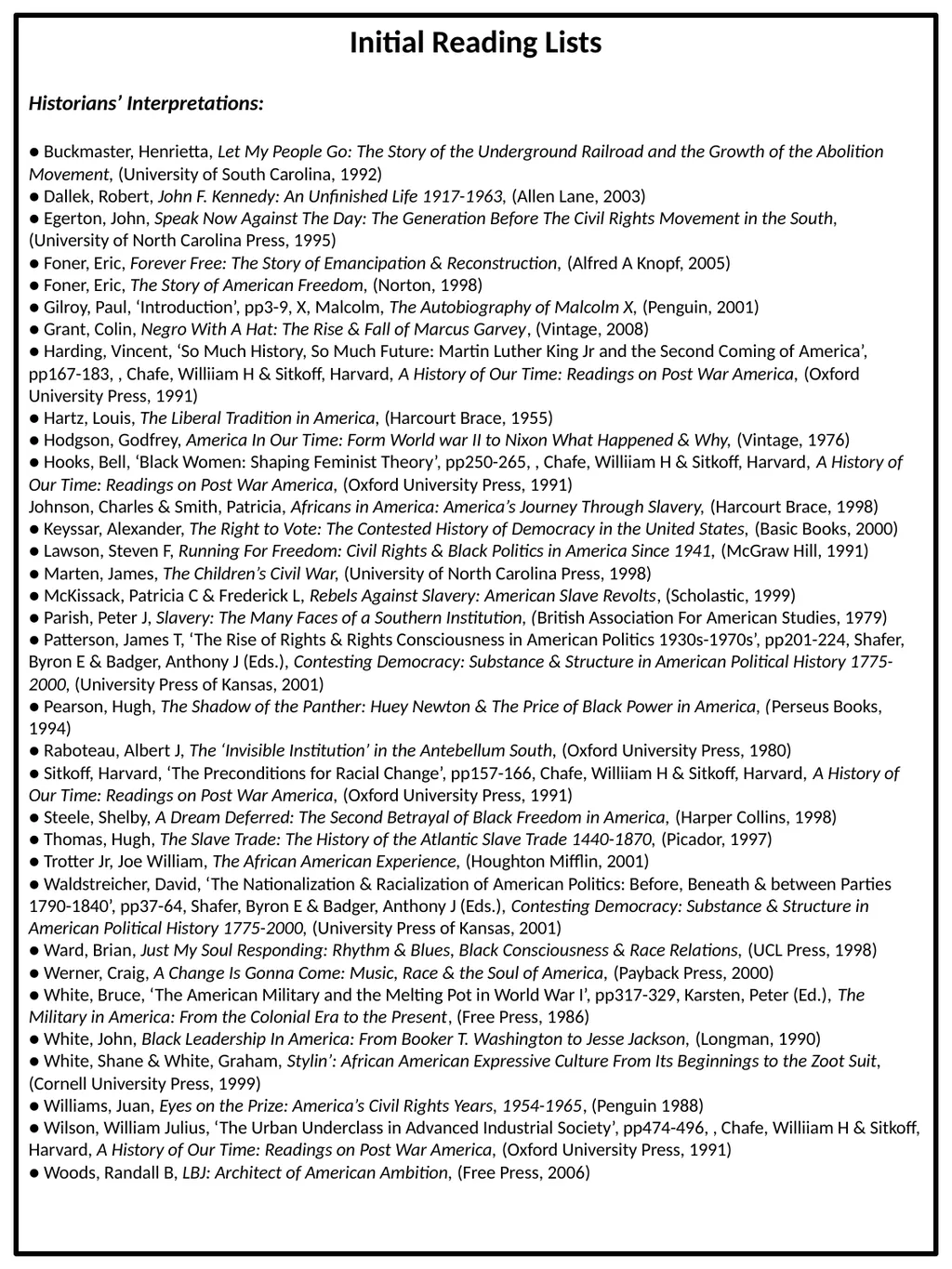
Initial Reading Lists
Historians’ Interpretations:
● Buckmaster, Henrietta, Let My People Go: The Story of the Underground Railroad and the Growth of the Abolition Movement, (University of South Carolina, 1992)
● Dallek, Robert, John F. Kennedy: An Unfinished Life 1917-1963, (Allen Lane, 2003)
● Egerton, John, Speak Now Against The Day: The Generation Before The Civil Rights Movement in the South, (University of North Carolina Press, 1995)
● Foner, Eric, Forever Free: The Story of Emancipation & Reconstruction, (Alfred A Knopf, 2005)
● Foner, Eric, The Story of American Freedom, (Norton, 1998)
● Gilroy, Paul, ‘Introduction’, pp3-9, X, Malcolm, The Autobiography of Malcolm X, (Penguin, 2001)
● Grant, Colin, Negro With A Hat: The Rise & Fall of Marcus Garvey, (Vintage, 2008)
● Harding, Vincent, ‘So Much History, So Much Future: Martin Luther King Jr and the Second Coming of America’, pp167-183, , Chafe, Williiam H & Sitkoff, Harvard, A History of Our Time: Readings on Post War America, (Oxford University Press, 1991)
● Hartz, Louis, The Liberal Tradition in America, (Harcourt Brace, 1955)
● Hodgson, Godfrey, America In Our Time: Form World war II to Nixon What Happened & Why, (Vintage, 1976)
● Hooks, Bell, ‘Black Women: Shaping Feminist Theory’, pp250-265, , Chafe, Williiam H & Sitkoff, Harvard, A History of Our Time: Readings on Post War America, (Oxford University Press, 1991)
Johnson, Charles & Smith, Patricia, Africans in America: America’s Journey Through Slavery, (Harcourt Brace, 1998)
● Keyssar, Alexander, The Right to Vote: The Contested History of Democracy in the United States, (Basic Books, 2000)
● Lawson, Steven F, Running For Freedom: Civil Rights & Black Politics in America Since 1941, (McGraw Hill, 1991)
● Marten, James, The Children’s Civil War, (University of North Carolina Press, 1998)
● McKissack, Patricia C & Frederick L, Rebels Against Slavery: American Slave Revolts, (Scholastic, 1999)
● Parish, Peter J, Slavery: The Many Faces of a Southern Institution, (British Association For American Studies, 1979)
● Patterson, James T, ‘The Rise of Rights & Rights Consciousness in American Politics 1930s-1970s’, pp201-224, Shafer, Byron E & Badger, Anthony J (Eds.), Contesting Democracy: Substance & Structure in American Political History 1775-2000, (University Press of Kansas, 2001)
● Pearson, Hugh, The Shadow of the Panther: Huey Newton & The Price of Black Power in America, (Perseus Books, 1994)
● Raboteau, Albert J, The ‘Invisible Institution’ in the Antebellum South, (Oxford University Press, 1980)
● Sitkoff, Harvard, ‘The Preconditions for Racial Change’, pp157-166, Chafe, Williiam H & Sitkoff, Harvard, A History of Our Time: Readings on Post War America, (Oxford University Press, 1991)
● Steele, Shelby, A Dream Deferred: The Second Betrayal of Black Freedom in America, (Harper Collins, 1998)
● Thomas, Hugh, The Slave Trade: The History of the Atlantic Slave Trade 1440-1870, (Picador, 1997)
● Trotter Jr, Joe William, The African American Experience, (Houghton Mifflin, 2001)
● Waldstreicher, David, ‘The Nationalization & Racialization of American Politics: Before, Beneath & between Parties 1790-1840’, pp37-64, Shafer, Byron E & Badger, Anthony J (Eds.), Contesting Democracy: Substance & Structure in American Political History 1775-2000, (University Press of Kansas, 2001)
● Ward, Brian, Just My Soul Responding: Rhythm & Blues, Black Consciousness & Race Relations, (UCL Press, 1998)
● Werner, Craig, A Change Is Gonna Come: Music, Race & the Soul of America, (Payback Press, 2000)
● White, Bruce, ‘The American Military and the Melting Pot in World War I’, pp317-329, Karsten, Peter (Ed.), The Military in America: From the Colonial Era to the Present, (Free Press, 1986)
● White, John, Black Leadership In America: From Booker T. Washington to Jesse Jackson, (Longman, 1990)
● White, Shane & White, Graham, Stylin’: African American Expressive Culture From Its Beginnings to the Zoot Suit, (Cornell University Press, 1999)
● Williams, Juan, Eyes on the Prize: America’s Civil Rights Years, 1954-1965, (Penguin 1988)
● Wilson, William Julius, ‘The Urban Underclass in Advanced Industrial Society’, pp474-496, , Chafe, Williiam H & Sitkoff, Harvard, A History of Our Time: Readings on Post War America, (Oxford University Press, 1991)
● Woods, Randall B, LBJ: Architect of American Ambition, (Free Press, 2006)<br>
25
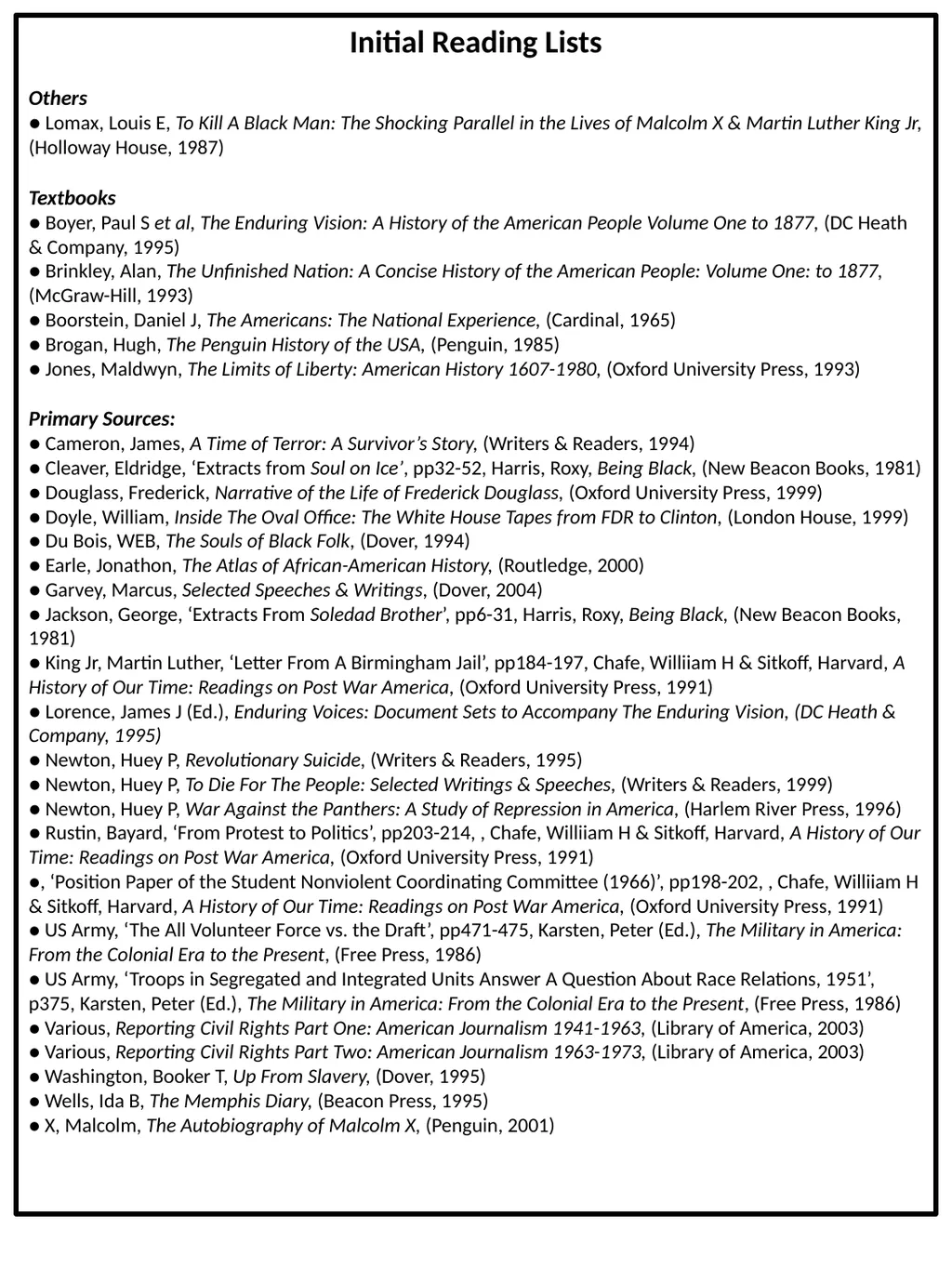
Initial Reading Lists
Others
● Lomax, Louis E, To Kill A Black Man: The Shocking Parallel in the Lives of Malcolm X & Martin Luther King Jr, (Holloway House, 1987)
Textbooks
● Boyer, Paul S et al, The Enduring Vision: A History of the American People Volume One to 1877, (DC Heath & Company, 1995)
● Brinkley, Alan, The Unfinished Nation: A Concise History of the American People: Volume One: to 1877, (McGraw-Hill, 1993)
● Boorstein, Daniel J, The Americans: The National Experience, (Cardinal, 1965)
● Brogan, Hugh, The Penguin History of the USA, (Penguin, 1985)
● Jones, Maldwyn, The Limits of Liberty: American History 1607-1980, (Oxford University Press, 1993)
Primary Sources:
● Cameron, James, A Time of Terror: A Survivor’s Story, (Writers & Readers, 1994)
● Cleaver, Eldridge, ‘Extracts from Soul on Ice’, pp32-52, Harris, Roxy, Being Black, (New Beacon Books, 1981)
● Douglass, Frederick, Narrative of the Life of Frederick Douglass, (Oxford University Press, 1999)
● Doyle, William, Inside The Oval Office: The White House Tapes from FDR to Clinton, (London House, 1999)
● Du Bois, WEB, The Souls of Black Folk, (Dover, 1994)
● Earle, Jonathon, The Atlas of African-American History, (Routledge, 2000)
● Garvey, Marcus, Selected Speeches & Writings, (Dover, 2004)
● Jackson, George, ‘Extracts From Soledad Brother’, pp6-31, Harris, Roxy, Being Black, (New Beacon Books, 1981)
● King Jr, Martin Luther, ‘Letter From A Birmingham Jail’, pp184-197, Chafe, Williiam H & Sitkoff, Harvard, A History of Our Time: Readings on Post War America, (Oxford University Press, 1991)
● Lorence, James J (Ed.), Enduring Voices: Document Sets to Accompany The Enduring Vision, (DC Heath & Company, 1995)
● Newton, Huey P, Revolutionary Suicide, (Writers & Readers, 1995)
● Newton, Huey P, To Die For The People: Selected Writings & Speeches, (Writers & Readers, 1999)
● Newton, Huey P, War Against the Panthers: A Study of Repression in America, (Harlem River Press, 1996)
● Rustin, Bayard, ‘From Protest to Politics’, pp203-214, , Chafe, Williiam H & Sitkoff, Harvard, A History of Our Time: Readings on Post War America, (Oxford University Press, 1991)
●, ‘Position Paper of the Student Nonviolent Coordinating Committee (1966)’, pp198-202, , Chafe, Williiam H & Sitkoff, Harvard, A History of Our Time: Readings on Post War America, (Oxford University Press, 1991)
● US Army, ‘The All Volunteer Force vs. the Draft’, pp471-475, Karsten, Peter (Ed.), The Military in America: From the Colonial Era to the Present, (Free Press, 1986)
● US Army, ‘Troops in Segregated and Integrated Units Answer A Question About Race Relations, 1951’, p375, Karsten, Peter (Ed.), The Military in America: From the Colonial Era to the Present, (Free Press, 1986)
● Various, Reporting Civil Rights Part One: American Journalism 1941-1963, (Library of America, 2003)
● Various, Reporting Civil Rights Part Two: American Journalism 1963-1973, (Library of America, 2003)
● Washington, Booker T, Up From Slavery, (Dover, 1995)
● Wells, Ida B, The Memphis Diary, (Beacon Press, 1995)
● X, Malcolm, The Autobiography of Malcolm X, (Penguin, 2001)<br>
26
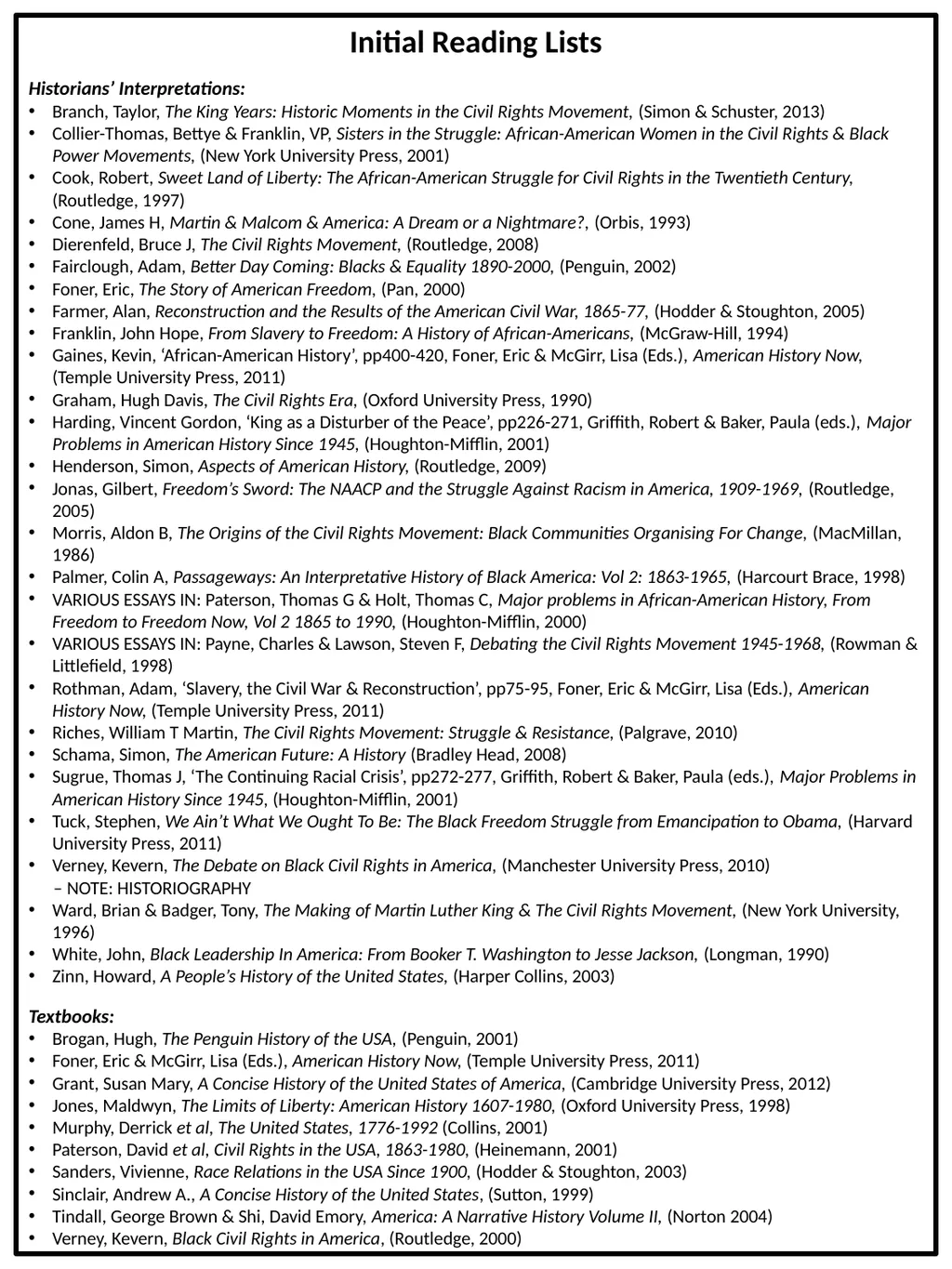
Initial Reading Lists
Historians’ Interpretations:
Branch, Taylor, The King Years: Historic Moments in the Civil Rights Movement, (Simon & Schuster, 2013)
Collier-Thomas, Bettye & Franklin, VP, Sisters in the Struggle: African-American Women in the Civil Rights & Black Power Movements, (New York University Press, 2001)
Cook, Robert, Sweet Land of Liberty: The African-American Struggle for Civil Rights in the Twentieth Century, (Routledge, 1997)
Cone, James H, Martin & Malcom & America: A Dream or a Nightmare?, (Orbis, 1993)
Dierenfeld, Bruce J, The Civil Rights Movement, (Routledge, 2008)
Fairclough, Adam, Better Day Coming: Blacks & Equality 1890-2000, (Penguin, 2002)
Foner, Eric, The Story of American Freedom, (Pan, 2000)
Farmer, Alan, Reconstruction and the Results of the American Civil War, 1865-77, (Hodder & Stoughton, 2005)
Franklin, John Hope, From Slavery to Freedom: A History of African-Americans, (McGraw-Hill, 1994)
Gaines, Kevin, ‘African-American History’, pp400-420, Foner, Eric & McGirr, Lisa (Eds.), American History Now, (Temple University Press, 2011)
Graham, Hugh Davis, The Civil Rights Era, (Oxford University Press, 1990)
Harding, Vincent Gordon, ‘King as a Disturber of the Peace’, pp226-271, Griffith, Robert & Baker, Paula (eds.), Major Problems in American History Since 1945, (Houghton-Mifflin, 2001)
Henderson, Simon, Aspects of American History, (Routledge, 2009)
Jonas, Gilbert, Freedom’s Sword: The NAACP and the Struggle Against Racism in America, 1909-1969, (Routledge, 2005)
Morris, Aldon B, The Origins of the Civil Rights Movement: Black Communities Organising For Change, (MacMillan, 1986)
Palmer, Colin A, Passageways: An Interpretative History of Black America: Vol 2: 1863-1965, (Harcourt Brace, 1998)
VARIOUS ESSAYS IN: Paterson, Thomas G & Holt, Thomas C, Major problems in African-American History, From Freedom to Freedom Now, Vol 2 1865 to 1990, (Houghton-Mifflin, 2000)
VARIOUS ESSAYS IN: Payne, Charles & Lawson, Steven F, Debating the Civil Rights Movement 1945-1968, (Rowman & Littlefield, 1998)
Rothman, Adam, ‘Slavery, the Civil War & Reconstruction’, pp75-95, Foner, Eric & McGirr, Lisa (Eds.), American History Now, (Temple University Press, 2011)
Riches, William T Martin, The Civil Rights Movement: Struggle & Resistance, (Palgrave, 2010)
Schama, Simon, The American Future: A History (Bradley Head, 2008)
Sugrue, Thomas J, ‘The Continuing Racial Crisis’, pp272-277, Griffith, Robert & Baker, Paula (eds.), Major Problems in American History Since 1945, (Houghton-Mifflin, 2001)
Tuck, Stephen, We Ain’t What We Ought To Be: The Black Freedom Struggle from Emancipation to Obama, (Harvard University Press, 2011)
Verney, Kevern, The Debate on Black Civil Rights in America, (Manchester University Press, 2010)
– NOTE: HISTORIOGRAPHY
Ward, Brian & Badger, Tony, The Making of Martin Luther King & The Civil Rights Movement, (New York University, 1996)
White, John, Black Leadership In America: From Booker T. Washington to Jesse Jackson, (Longman, 1990)
Zinn, Howard, A People’s History of the United States, (Harper Collins, 2003)
Textbooks:
Brogan, Hugh, The Penguin History of the USA, (Penguin, 2001)
Foner, Eric & McGirr, Lisa (Eds.), American History Now, (Temple University Press, 2011)
Grant, Susan Mary, A Concise History of the United States of America, (Cambridge University Press, 2012)
Jones, Maldwyn, The Limits of Liberty: American History 1607-1980, (Oxford University Press, 1998)
Murphy, Derrick et al, The United States, 1776-1992 (Collins, 2001)
Paterson, David et al, Civil Rights in the USA, 1863-1980, (Heinemann, 2001)
Sanders, Vivienne, Race Relations in the USA Since 1900, (Hodder & Stoughton, 2003)
Sinclair, Andrew A., A Concise History of the United States, (Sutton, 1999)
Tindall, George Brown & Shi, David Emory, America: A Narrative History Volume II, (Norton 2004)
Verney, Kevern, Black Civil Rights in America, (Routledge, 2000)<br>
27
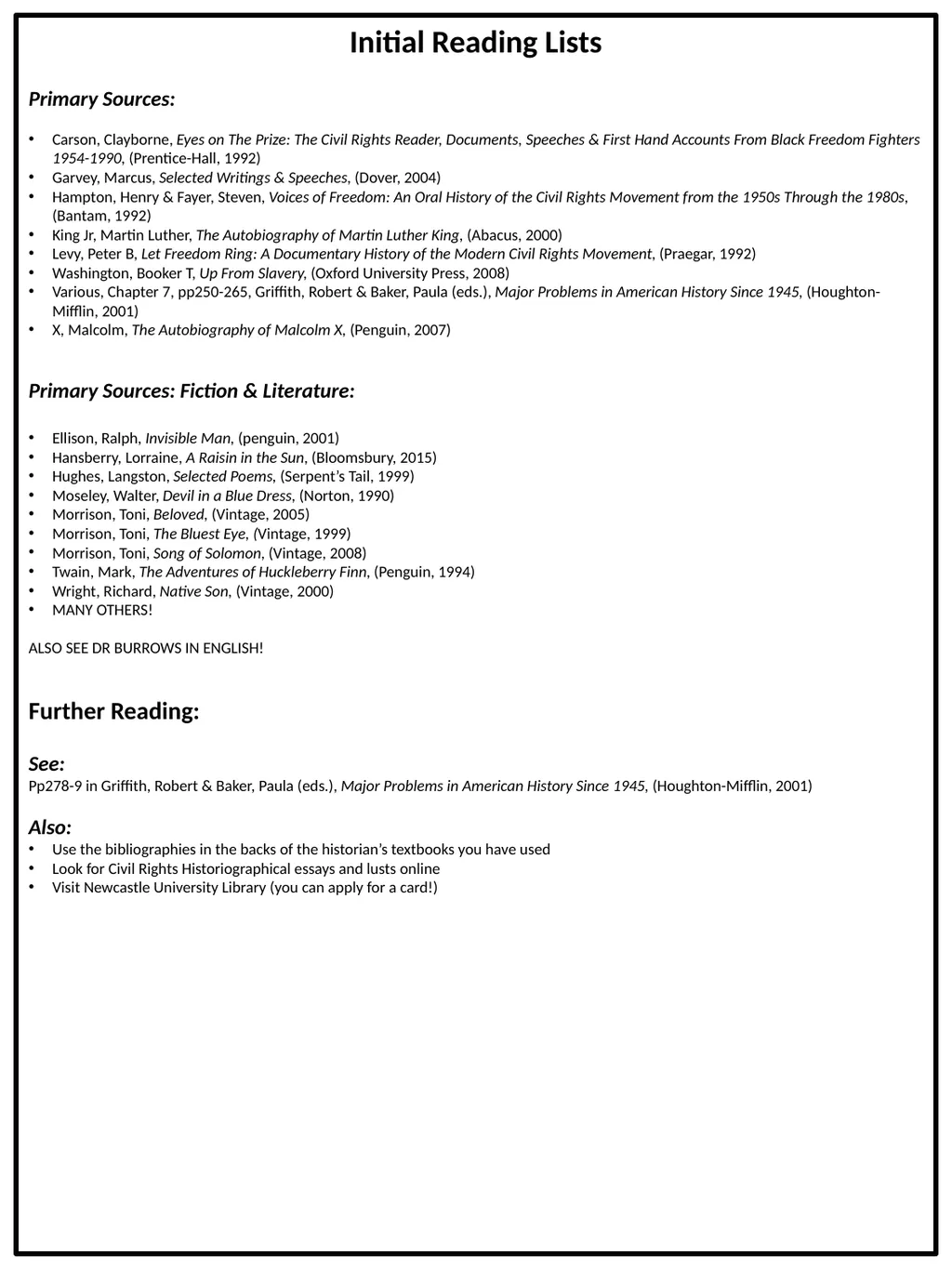
Initial Reading Lists
Primary Sources:
Carson, Clayborne, Eyes on The Prize: The Civil Rights Reader, Documents, Speeches & First Hand Accounts From Black Freedom Fighters 1954-1990, (Prentice-Hall, 1992)
Garvey, Marcus, Selected Writings & Speeches, (Dover, 2004)
Hampton, Henry & Fayer, Steven, Voices of Freedom: An Oral History of the Civil Rights Movement from the 1950s Through the 1980s, (Bantam, 1992)
King Jr, Martin Luther, The Autobiography of Martin Luther King, (Abacus, 2000)
Levy, Peter B, Let Freedom Ring: A Documentary History of the Modern Civil Rights Movement, (Praegar, 1992)
Washington, Booker T, Up From Slavery, (Oxford University Press, 2008)
Various, Chapter 7, pp250-265, Griffith, Robert & Baker, Paula (eds.), Major Problems in American History Since 1945, (Houghton-Mifflin, 2001)
X, Malcolm, The Autobiography of Malcolm X, (Penguin, 2007)
Primary Sources: Fiction & Literature:
Ellison, Ralph, Invisible Man, (penguin, 2001)
Hansberry, Lorraine, A Raisin in the Sun, (Bloomsbury, 2015)
Hughes, Langston, Selected Poems, (Serpent’s Tail, 1999)
Moseley, Walter, Devil in a Blue Dress, (Norton, 1990)
Morrison, Toni, Beloved, (Vintage, 2005)
Morrison, Toni, The Bluest Eye, (Vintage, 1999)
Morrison, Toni, Song of Solomon, (Vintage, 2008)
Twain, Mark, The Adventures of Huckleberry Finn, (Penguin, 1994)
Wright, Richard, Native Son, (Vintage, 2000)
MANY OTHERS!
ALSO SEE DR BURROWS IN ENGLISH!
Further Reading:
See:
Pp278-9 in Griffith, Robert & Baker, Paula (eds.), Major Problems in American History Since 1945, (Houghton-Mifflin, 2001)
Also:
Use the bibliographies in the backs of the historian’s textbooks you have used
Look for Civil Rights Historiographical essays and lusts online
Visit Newcastle University Library (you can apply for a card!)<br>
28
Additional Notes<br>
29
Additional Notes<br>