Arithmetic expressions An arithmetic expression is a combination of variables, constant, and operators arranged as per the sytax of the language Mr.M.Sulthan Ibrahim Associate Professor of Computer Science Hajee Karutha Rowther Howdia
"Arithmetic expressions An arithmetic expression is" is the property of its rightful owner. Permission is granted to
download and print the materials on this website for personal, non-commercial use only, and to display it
on your personal computer provided you do not modify the materials and that you retain all copyright
notices contained in the materials. By downloading content from our website, you accept the terms of this
agreement.
Presentation Transcript
01
Arithmetic expressions An arithmetic expression is a combination of variables, constant, and operators arranged as per the sytax of the language Mr.M.Sulthan Ibrahim Associate Professor of Computer Science Hajee Karutha Rowther Howdia College(Autonomous)<br>
02
Evaluation of Expressions Expressions are evaluated using an assignment statement of the form
Variable = expression;<br>
03
Precedence in Arithmetic Operators An arithmetic expression without parenthesis will be evaluated from left to right using the rules of precedence of operators. There are two distinct priority levels of arithmetic operators in C.
High priority * / %
Low priority + -<br>
04
Consider the following arithmetic expression
x=a – b / 3 + c * 2 - 1 When a =9, b =12 and c =3 the statement becomes
x= 9 – 12 / 3 + 3 * 2 - 1 First pass
step 1: x = 9 – 4 + 3 * 2 -1 step 2: x = 9 – 4 + 6 - 1<br>
05
Second pass
step 3: x = 5 + 6 - 1 step 4: x = 11 - 1 step 5: x = 10<br>
06
Consider the following arithmetic expression with parentheses
x= 9 – 12 / (3 + 3) * (2 – 1) Whenever parentheses are used, the expressions within parentheses assume highest priority. If two or more sets of parentheses appear one after another, the expression contained in the left-most set is evaluated first and the right-most in the last<br>
07
x= 9 – 12 / (3 + 3) * (2 – 1) First pass
setp 1: x = 9 -12 / 6 * (2 – 1) setp 2: x = 9 -12 / 6 * 1 Second pass
setp 3: x = 9 – 2 * 1 setp 4: x = 9 – 2 Thrid pass
setp 5: x = 7<br>
08
Parentheses may be nested, in such cases, evaluation of the expression will proceed outward from the innermost set of parentheses. 9 – (12 / (3 + 3) * 2) - 1 9 – ((12 / 3) + 3 * 2) - 1<br>
09
Rules for evaluation of expression • First parenthesized sub expression left to right are evaluated.
• If parenthesis are nested, the evaluation begins with the innermost sub expression.
• The precedence rule is applied in determining the order of application of operators in evaluating sub expressions.
• The associability rule is applied when two or more operators of the same precedence level appear in the sub expression.
• Arithmetic expressions are evaluated from left to right using the rules of precedence.
• When Parenthesis are used, the expressions within parenthesis assume highest priority.<br>
10
Type conversion in expressions (type casting) What is Typecasting in C?
Typecasting is converting one data type into another one. It is also called as data conversion or type conversion. It is one of the important concepts introduced in 'C' programming. 'C' programming provides two types of type casting operations:
Implicit type casting
Explicit type casting<br>
11
Implicit type conversion Suppose an expression contains different types of constants and variables, C automatically converts any intermediate values to the proper type so that the expression can be evaluated with loosing any significance. This automatic conversion is known as implicit type conversion If the operands are of different types, the ‘lower’ type is automatically converted to the ‘higher’ type before the operation proceeds. The result is the higher type.<br>
12
int i, x;
float f;
double d;
long int l x = l / i + i * f - d long long float float float float double double int<br>
13
Explicit conversion Explicit conversion is done with helf of the cast operator. The
cast operator is a unary operator used to temporarily convert constant, variable or expression to a particular type. The syntax of cast operator is:
Syntax: (datatype)expression
where datatype refers to the type you want the expression to convert to.<br>
14
float f;
int a = 20, b = 3;
f = a/b The value of f will be 6.000000 instead of 6.666666 because operation between two integers yields an integer value. if we write the above statement as: f = (float)a/b;
Then we will get the correct answer i.e 6.666666.<br>
15
First, it converts the variable a which of type int to type float temporarily. We already know that the operation between a float and int operand yields a float result, that's why answer comes out to be 6.666666 instead of 6.000000.
Note that in the above statement the cast operator only applies to the variable a, not to b or a/b.
Another important point to note is that data type of variable a is float till the execution of the statement only. After that, it will be treated as int.<br>
16
Operator precedence and associativity Operator precedence determines which operator is performed first in an expression with more than one operators with different precedence. For example: Solve
10 + 20 * 30.<br>
17
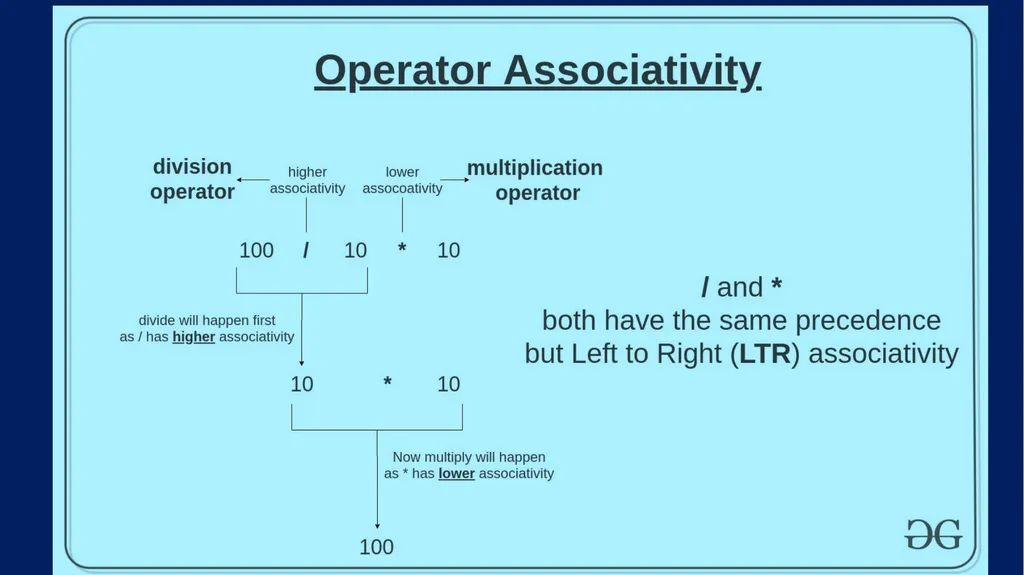
Operators Associativity is used when two operators of same precedence appear in an expression. Associativity can be either Left to Right or Right to Left.
For example: ‘*’ and ‘/’ have same precedence and their associativity is Left to Right, so the expression “100 / 10 * 10” is treated as “(100 / 10) * 10”. Operators Associativity<br>