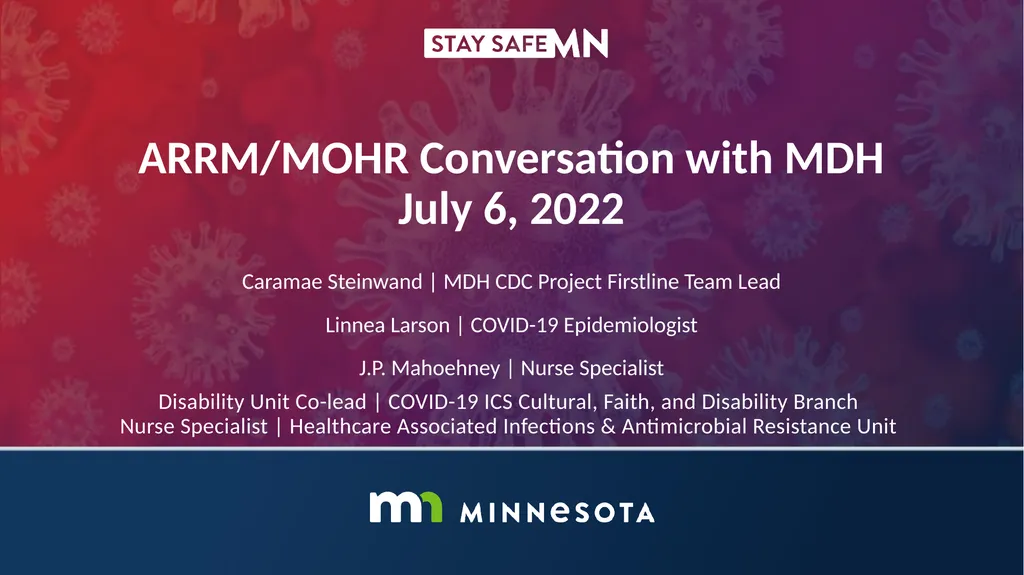
ARRM/MOHR Conversation with MDH July 6, 2022

Published  . 0 views
↓ Download
ARRM/MOHR Conversation with MDH July 6, 2022
1 / 1
ARRM/MOHR Conversation with MDH July 6, 2022 - slide 1 of 26 ARRM/MOHR Conversation with MDH July 6, 2022 - slide 2 of 26 ARRM/MOHR Conversation with MDH July 6, 2022 - slide 3 of 26 ARRM/MOHR Conversation with MDH July 6, 2022 - slide 4 of 26 ARRM/MOHR Conversation with MDH July 6, 2022 - slide 5 of 26 ARRM/MOHR Conversation with MDH July 6, 2022 - slide 6 of 26 ARRM/MOHR Conversation with MDH July 6, 2022 - slide 7 of 26 ARRM/MOHR Conversation with MDH July 6, 2022 - slide 8 of 26 ARRM/MOHR Conversation with MDH July 6, 2022 - slide 9 of 26 ARRM/MOHR Conversation with MDH July 6, 2022 - slide 10 of 26 ARRM/MOHR Conversation with MDH July 6, 2022 - slide 11 of 26 ARRM/MOHR Conversation with MDH July 6, 2022 - slide 12 of 26 ARRM/MOHR Conversation with MDH July 6, 2022 - slide 13 of 26 ARRM/MOHR Conversation with MDH July 6, 2022 - slide 14 of 26 ARRM/MOHR Conversation with MDH July 6, 2022 - slide 15 of 26 ARRM/MOHR Conversation with MDH July 6, 2022 - slide 16 of 26 ARRM/MOHR Conversation with MDH July 6, 2022 - slide 17 of 26 ARRM/MOHR Conversation with MDH July 6, 2022 - slide 18 of 26 ARRM/MOHR Conversation with MDH July 6, 2022 - slide 19 of 26 ARRM/MOHR Conversation with MDH July 6, 2022 - slide 20 of 26 ARRM/MOHR Conversation with MDH July 6, 2022 - slide 21 of 26 ARRM/MOHR Conversation with MDH July 6, 2022 - slide 22 of 26 ARRM/MOHR Conversation with MDH July 6, 2022 - slide 23 of 26 ARRM/MOHR Conversation with MDH July 6, 2022 - slide 24 of 26 ARRM/MOHR Conversation with MDH July 6, 2022 - slide 25 of 26 ARRM/MOHR Conversation with MDH July 6, 2022 - slide 26 of 26
Description: ARRMMOHR Conversation with MDH July 6, 2022 Caramae Steinwand MDH CDC Project Firstline Team Lead Linnea Larson COVID-19 Epidemiologist J.P. Mahoehney Nurse Specialist Disability Unit Co-lead COVID-19 ICS Cultural, Faith, and

Related Topics

Download Presentation

"ARRM/MOHR Conversation with MDH July 6, 2022" is the property of its rightful owner. Permission is granted to download and print the materials on this website for personal, non-commercial use only, and to display it on your personal computer provided you do not modify the materials and that you retain all copyright notices contained in the materials. By downloading content from our website, you accept the terms of this agreement.

Presentation Transcript

slide1. ARRM/MOHR Conversation with MDH July 6, 2022 Caramae Steinwand | MDH CDC Project Firstline Team Lead
Linnea Larson | COVID-19 Epidemiologist
J.P. Mahoehney | Nurse Specialist
Disability Unit Co-lead | COVID-19 ICS Cultural, Faith, and Disability Branch
Nurse Specialist | Healthcare Associated Infections & Antimicrobial Resistance Unit<br>
slide2. Project Firstline – Caramae Steinwand Project Firstline is a partnership between CDC and MDH that aims to provide engaging and effective infection prevention and control training to frontline workers, staff, and members of the public health workforce.
Trainings are 30 minutes or less! 
Designed to ​benefit those that interact with patients, residents, ​and clients and/or their environment​. ​
Topics include COVID-19, basic infection prevention and control principals, and science of viruses. 
New Sessions coming FALL 2022!!

Website: Project Firstline  
​Email questions to:  Project.Firstline.MDH@state.mn.us​ 6/29/2022 2<br>
slide3. 6/29/2022 3 Project Firstline – Caramae Steinwand May 2022 Monthly Data
Training: Basic science of viruses and Virus strains (two days of training with time for Q & A directly following the sessions) 
Number of visits to website: 472
Total number of registered trainings: 61
#1: How viruses spread from surfaces to people  
#2: How respiratory droplets spread COVID-19 and Source Control
 
RN was to most common role for the live trainings.  
Direct Support Professional was to most common role for the recorded trainings.  
Skilled nursing facility was the most common setting type for the live trainings. 
Day and Employment Program serving individuals with disabilities was the most common setting type for the recorded trainings. Participant Feedback
When asked which part of the training session was most informative or enjoyable, participants responded with: 

 “We do use this program for monthly education. Thank you for all the extra leg work you do for us. It is very much appreciated!” 

 “Good simple way to explain”   
                                                    
 “easy to understand and relate”<br>
slide5. ARRM/MOHR Conversation with MDH July 2022 J.P. Mahoehney | Nurse Specialist
Disability Unit Co-lead | COVID-19 ICS Cultural, Faith, and Disability Branch
Nurse Specialist | Healthcare Associated Infections & Antimicrobial Resistance Unit April 6, 2022<br>
slide6. Data 7/6/2022 6<br>
slide7. MDH Data: HCBS-CRS or ICF with a case in the past 28 days 7/6/2022 7<br>
slide8. CDC Data: Community Transmission 7/6/2022 8 Last Month This Month<br>
slide9. CDC Data: Community Levels 7/6/2022 9 Last Month This Month<br>
slide10. Reporting Requirements 7/6/2022 10<br>
slide11. MDH reporting requirements for residential settings Effective July 13th at the close of business.
Settings will only need to report aggregate staff and resident cases
No longer need to report individual cases to MDH
DHS-only licensed residential settings: Report total resident case counts and total staff case counts ONLY when there are new cases (no previous positive tests in past 90 days)
ICFs and other MDH license facilities: Report total resident case counts and total staff case counts once a week (includes cases of repeat detection in the past 90 days)
HCBS-CRS and ICFs can continue to use the REDCap reporting tool:
https://redcap-c19.web.health.state.mn.us/redcap/surveys/?s=H8MT9TTNCD 7/6/2022 11<br>
slide12. DSF reporting requirement changes DSFs no longer are required to report cases (except when using professional POC tests that are being used under CLIA waiver—this is a rare occurrence in DSF settings)
For information on steps to submit COVID-19 POC test results that are being performed under a CLIA certificate of waiver see instructions at: https://www.health.state.mn.us/diseases/coronavirus/hcp/reportlab.html
Settings can contact MDH if they feel they are experiencing an unusual outbreak or need assistance but do not need to report cases. Laboratory cases will still be reported. Contacts: jp.mahoehney@state.mn.us 7/6/2022 12<br>
slide13. Additional information on reporting changes Presentation with new COVID-19 reporting instructions will be posted on the MDH website within the next week.
Email notification will be sent when posted to MDH website.
Special LTC call on Wednesday, July 13 at 3:30 to go through changes and answer questions.
Invite: https://minnesotaevents.webex.com/minnesotaevents/j.php?RGID=r30cc7d1c6f3efd090f64cfbaf6b89da9
Changes to reporting will be live at COB on Wednesday, July 13.
Questions throughout the transition can be sent to Health.LTC.COVID19.MDH@state.mn.us, however resources above will help to answer many of your questions. 7/6/2022 13<br>
slide14. Vaccine Updates 7/6/2022 14<br>
slide15. FDA Recommendations and what they mean 7/6/2022 15 The FDA just released a recommendation for a bivalent vaccine that includes Omicron component for booster doses:
Coronavirus (COVID-19) Update: FDA Recommends Inclusion of Omicron BA.4/5 Component for COVID-19 Vaccine Booster Doses | FDA
 
FDA said this vaccine can potentially be used starting in early to mid-fall.

From past experience with other COVID-19 vaccines that it’s hard to predict when it will actually be available at the state/local level to administer. 

At this point in time, MDH would encourage all people to get their COVID-19 boosters as recommended and plan for flu immunization as usual.<br>
slide16. Frontline Worker Pay 7/6/2022 16<br>
slide17. Frontline Pay (Application Deadline is July 22nd) People who provided direct support services to older adults, people with disabilities and people with mental health care needs in Minnesota during the COVID-19 pandemic may be eligible for frontline worker pay. To determine your eligibility for the bonus, go to the Minnesota Frontline Worker Pay site (expand the “guidelines” section for detailed information on eligibility) (https://frontlinepay.mn.gov/submit).
Frontline Sectors Include:
Long-term care and home care Examples of employers in this sector include: nursing homes; group homes; hospices; home health care; residential drug and alcohol facilities; and assisted living facilities.
Vocational rehabilitation This sector includes vocational rehabilitations services.
Frontline Worker Pay Outreach Toolkit (https://www.dli.mn.gov/toolkit) 7/6/2022 17<br>
slide18. Recent Questions 7/6/2022 18<br>
slide19. When should healthcare facilities make changes to interventions based on changes in community transmission levels? In general, healthcare facilities should consider checking their local Community Transmission level weekly.
When a healthcare facility’s Community Transmission level increases and the increase results in a change in the recommended interventions, the new interventions should be implemented as soon as possible.
When a healthcare facility’s Community Transmission levels decrease into a category that corresponds with relaxation of an intervention, facilities should consider confirming the reduction is sustained, by monitoring for at least two weeks, before relaxing the intervention.
(https://www.cdc.gov/coronavirus/2019-ncov/hcp/faq.html) Updated: 6/7/22 7/6/2022 19<br>
slide20. What if a staff person takes an at home test (not PCR) and is still getting a positive result after 10 days? A generally healthy staff in either a HCBS-CRS, ICF, or DSF setting should isolate for 10 days if they don't have a negative test that allows them to return after 7 (or in crisis staffing situations, 5 days).
If a person takes a at home test after day 10 of isolation and is still positive:
Recommend either: follow the CDC test-based strategy to determine this person’s return to work date, or,
Have the staff person consult with their healthcare provider if a longer isolation period is warranted. 

The following is the CDC’s test-based strategy for direct care staff who are symptomatic:
Resolution of fever without the use of fever-reducing medications, and
Improvement in symptoms (e.g., cough, shortness of breath), and
Results are negative from at least two consecutive respiratory specimens collected ≥24 hours apart (total of two negative specimens) tested using an antigen test or NAAT.
(https://www.cdc.gov/coronavirus/2019-ncov/hcp/guidance-risk-assesment-hcp.html) 7/6/2022 20<br>
slide21. Will there be a change soon in the recommendation for the isolation period for long term care/CRS waiver homes when a person we serve is positive for Covid-19, so that they isolate for 5 days instead of 10 days? There has been no indication that the isolation period will change for ICF/healthcare settings.
For updated guidance for ICF settings: https://www.cdc.gov/coronavirus/2019-ncov/hcp/infection-control-recommendations.html
If any person who lives, receives services, visits, or volunteers in DHS-licensed settings has screening results that indicate a COVID-19 risk, they should follow testing, quarantine, and isolation guidance in CDC: COVID-19 Quarantine and Isolation (www.cdc.gov/coronavirus/2019-ncov/your-health/quarantine-isolation.html) which instructs people to isolate for 5 days after testing positive and then wear a mask when around others inside your home or in public for 10 days.
If you are unable to wear a mask when around others, you should continue to isolate for a full 10 days. Avoid people who have weakened immune systems or are more likely to get very sick from COVID-19, and nursing homes and other high-risk settings, until after at least 10 days. 7/6/2022 21<br>
slide22. Is there any discussion about ending the mask wearing requirement in long term care/CRS waiver homes in the near future?  If so, what are the criteria that MDH is looking at to be able to make this recommendation? MDH guidance for CRS settings is strictly recommendations (not requirements) and it follows the similar logic to that of the LTC/healthcare settings.
The rationale is to scale infection control measures (e.g. masking and eye protection recommendations) based on the community transmission or community levels (depending on the metric that you are choosing to use for your CRS settings---ICFs are still required per the healthcare guidance to use the community transmission metric). 
The rationale is that intervention recommendations will ease as community transmission eases. 7/6/2022 22<br>
slide23. Questions? 7/6/2022 23<br>
slide24. What do we need to know about Monkeypox? Monkeypox is a viral disease that can spread from person to person. It can spread through:
direct contact with the infectious rash, scabs, or body fluids
respiratory secretions during prolonged, face-to-face contact, or during intimate physical contact, such as kissing, cuddling, or sex
touching items (such as clothing or linens) that previously touched the infectious rash or body fluids
pregnant people can spread the virus to their fetus through the placenta
Symptoms include: flu-like illness with fever and a few days later a characteristic rash (some have only had a localized rash in their genital or perianal area).
Incubation is 1-2 weeks and illness last 2-4 weeks and usually resolves without treatment
Monkeypox can spread from the time symptoms start until the rash has fully healed and a fresh layer of skin has formed.
As of 6/30/22, 6 cases of Monkeypox have been found in Minnesota; 560 in US; 6924 globally

Anyone, regardless of gender or sexual orientation can develop and spread Monkeypox. 7/6/2022 24<br>
slide25. I have a client that has received the diagnosis of having CRE / CPO (carbapenemase producing organism). Can this person still participate in activities? A person with CRE/CPO can and should be allowed to participate in activities, and should be supported by implementation of infection prevention and control measures by the staff who provided direct care or support to them.

CRE and carbapenemase-producing organisms (CPO) These organisms are typically found in the GI tract and we frequently see infections or colonization of the urinary tract so special consideration should be taken for folks who have difficulty containing stool or urine.

These organisms are typically spread via hands of healthcare providers, medical equipment, and environmental surfaces. Infection prevention basics like hand hygiene, cleaning environmental surfaces and shared equipment—dedicating equipment when possible—and taking precautions when provided cares especially related to indwelling devices, wounds, etc. will go a long way to preventing transmission. 7/6/2022 25<br>
slide26. Contact Information J.P. Mahoehney, RN MPH
W: 651-201-5276 | jp.mahoehney@state.mn.us
Infection Control Assessment and Response (ICAR) Team
health.icar@state.mn.us 7/6/2022 26<br>