ARTHROLOGY Definition: Study of joints is called as Arthrology or Syndesmology. The sites where two skeletal elements come together are termed as joint. Joint is a junction between two or more bones or cartilages. It is a device to permit
"ARTHROLOGY Definition: Study of joints is called" is the property of its rightful owner. Permission is granted to
download and print the materials on this website for personal, non-commercial use only, and to display it
on your personal computer provided you do not modify the materials and that you retain all copyright
notices contained in the materials. By downloading content from our website, you accept the terms of this
agreement.
Presentation Transcript
01
ARTHROLOGY<br>
02
Definition:
Study of joints is called as Arthrology or Syndesmology.
The sites where two skeletal elements come together are termed as joint.
Joint is a junction between two or more bones or cartilages. It is a device to permit movements.<br>
03
Joints help to form cavities like cranial, thoracic, abdominal and pelvic cavities where the respective organs are safely kept.
Joints of thoracic cage help in increasing transverse and vertical diameters of the cage, helping in respiration.
However, immovable joints are primarily meant for growth.
Primary cartilaginous joints of long bones increase length of bone.
A newborn baby is about 15 inches long and length increases to 60-70 inches in an adult due to growth at these joints.<br>
04
There are more joints in a child than in an adult because as growth proceeds some of the bones fuse together, e.g. the ilium, ischium and pubis fuse to form the pelvic bone.
The two halves of the infant frontal bone and of the infant mandible also fuse to form single frontal and mandible bone respectively.
The five sacral vertebrae fuse to form sacrum and the four coccygeal vertebrae join to form coccyx.<br>
05
Synonyms of joint:
Arthron (Greek- a joint)
Articulation (Latin- a joint)
Juncture (Latin - joint)<br>
06
CLASSIFICATION OF JOINTS:
Structural Classification
Functional Classification
According to Number of Articulating Bones<br>
B. Functional Classification (According to the Degree of Mobility)
1. Synarthrosis (immovable), like sutures of the fibrous joints
2. Amphiarthrosis (slightly movable), like secondary cartilaginous joints
3. Diarthrosis (freely movable), like synovial joints<br>
09
C. According to Number of Articulating Bones
1. Simple joint: When only two bones articulate,
e.g. Inter-phalangeal joints.
2. Compound joint: More than two bones articulate within one capsule,
e.g. Elbow joint, Wrist joint.
3. Complex joint: When joint cavity is divided by an intra-articular disc,
e.g. Temporomandibular joint , Sternoclavicular joint.<br>
10
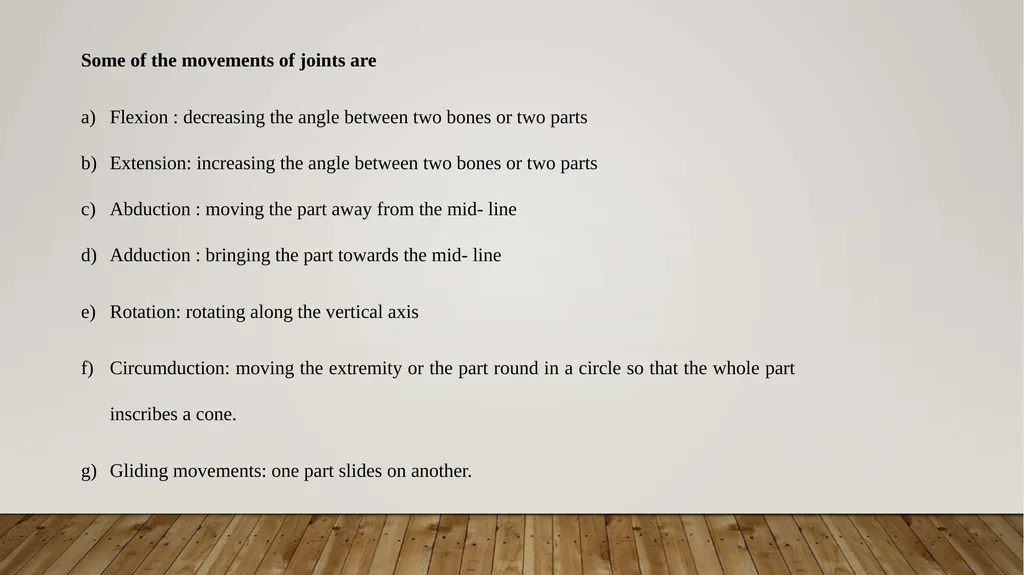
Some of the movements of joints are
Flexion : decreasing the angle between two bones or two parts
Extension: increasing the angle between two bones or two parts
Abduction : moving the part away from the mid- line
Adduction : bringing the part towards the mid- line
Rotation: rotating along the vertical axis
Circumduction: moving the extremity or the part round in a circle so that the whole part inscribes a cone.
Gliding movements: one part slides on another.<br>