
Article II, US Constitution No person except a
TF
Published · 40 slides · 0 views
1 / 1

Description
Article II, US Constitution No person except a natural born citizen, or a citizen of the United States, at the time of the adoption of this Constitution, shall be eligible to the office of President; neither shall any person be eligible to
Related Topics
Share
Embed code
Download this presentation From Below
"Article II, US Constitution No person except a" is the property of its rightful owner. Permission is granted to download and print the materials on this website for personal, non-commercial use only, and to display it on your personal computer provided you do not modify the materials and that you retain all copyright notices contained in the materials. By downloading content from our website, you accept the terms of this agreement.
Presentation Transcript
01
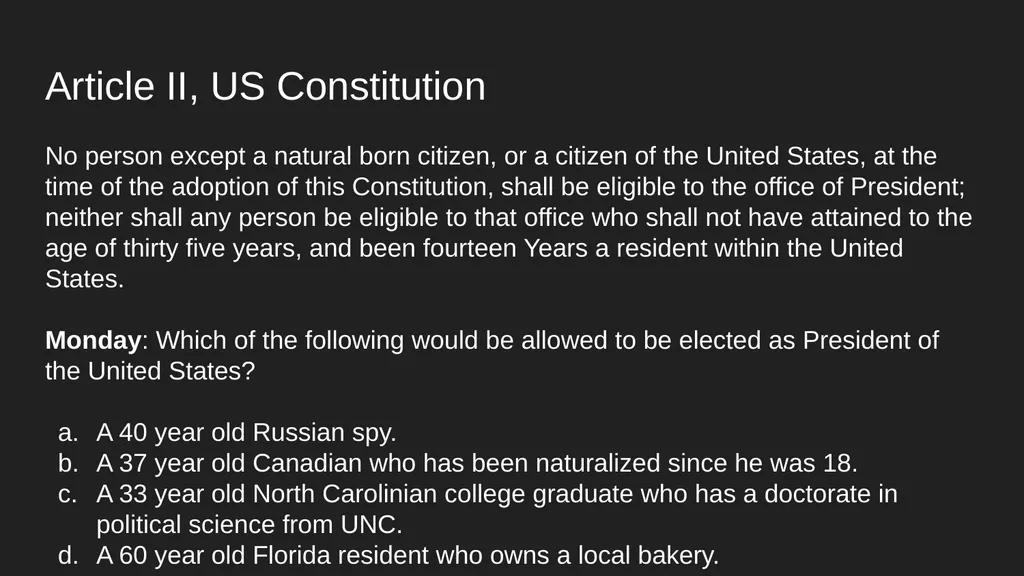
Article II, US Constitution No person except a natural born citizen, or a citizen of the United States, at the time of the adoption of this Constitution, shall be eligible to the office of President; neither shall any person be eligible to that office who shall not have attained to the age of thirty five years, and been fourteen Years a resident within the United States.
Monday: Which of the following would be allowed to be elected as President of the United States?
A 40 year old Russian spy.
A 37 year old Canadian who has been naturalized since he was 18.
A 33 year old North Carolinian college graduate who has a doctorate in political science from UNC.
A 60 year old Florida resident who owns a local bakery.<br>
Monday: Which of the following would be allowed to be elected as President of the United States?
A 40 year old Russian spy.
A 37 year old Canadian who has been naturalized since he was 18.
A 33 year old North Carolinian college graduate who has a doctorate in political science from UNC.
A 60 year old Florida resident who owns a local bakery.<br>
02
The Executive Branch Unit 5
Unit 5 Essential Question: Is the Executive Branch of the U.S. government too powerful, not powerful enough, or just right? Support your argument with at least 3 sources.<br>
Unit 5 Essential Question: Is the Executive Branch of the U.S. government too powerful, not powerful enough, or just right? Support your argument with at least 3 sources.<br>
03
Unit 5.1 Essential Question: Explain why someone would want to be president of the United States. President
Governor
Sheriff
Mayor
Police Chief
White House
Air Force One
Secret Service<br>
Governor
Sheriff
Mayor
Police Chief
White House
Air Force One
Secret Service<br>
04
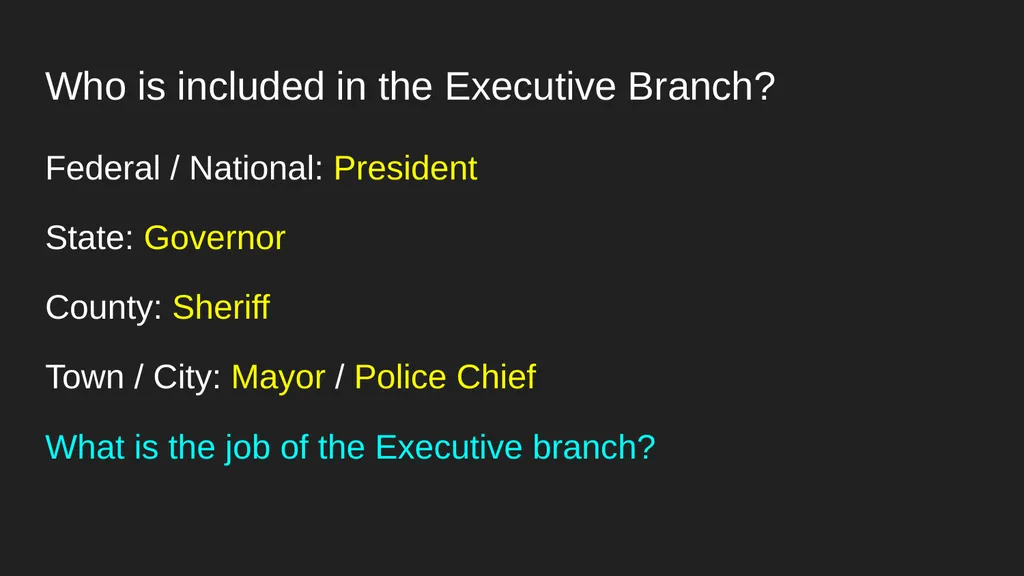
Who is included in the Executive Branch? Federal / National: President
State: Governor
County: Sheriff
Town / City: Mayor / Police Chief
What is the job of the Executive branch?<br>
State: Governor
County: Sheriff
Town / City: Mayor / Police Chief
What is the job of the Executive branch?<br>
05
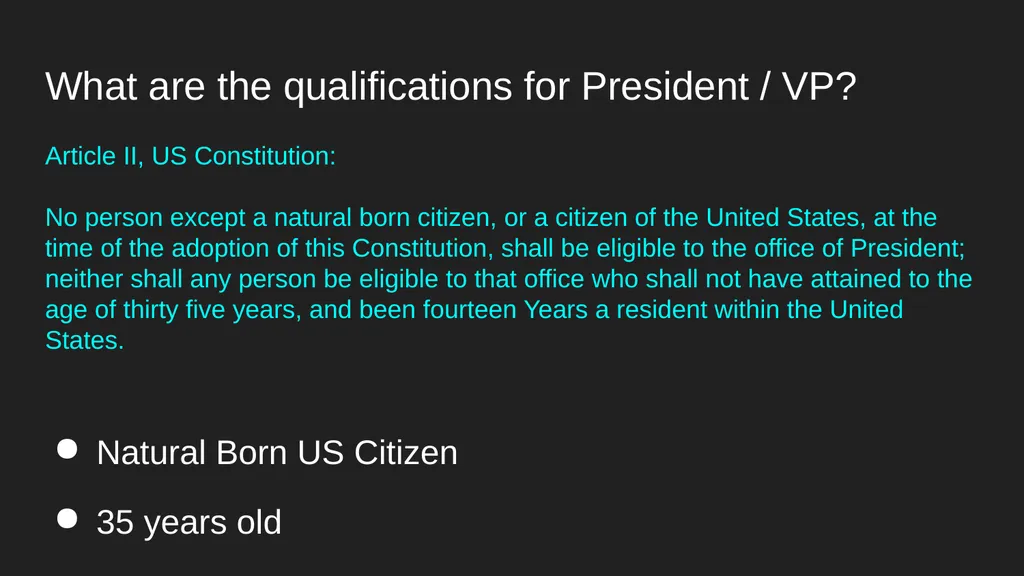
What are the qualifications for President / VP? Article II, US Constitution:
No person except a natural born citizen, or a citizen of the United States, at the time of the adoption of this Constitution, shall be eligible to the office of President; neither shall any person be eligible to that office who shall not have attained to the age of thirty five years, and been fourteen Years a resident within the United States.
Natural Born US Citizen
35 years old
US Resident for 14 years<br>
No person except a natural born citizen, or a citizen of the United States, at the time of the adoption of this Constitution, shall be eligible to the office of President; neither shall any person be eligible to that office who shall not have attained to the age of thirty five years, and been fourteen Years a resident within the United States.
Natural Born US Citizen
35 years old
US Resident for 14 years<br>
06
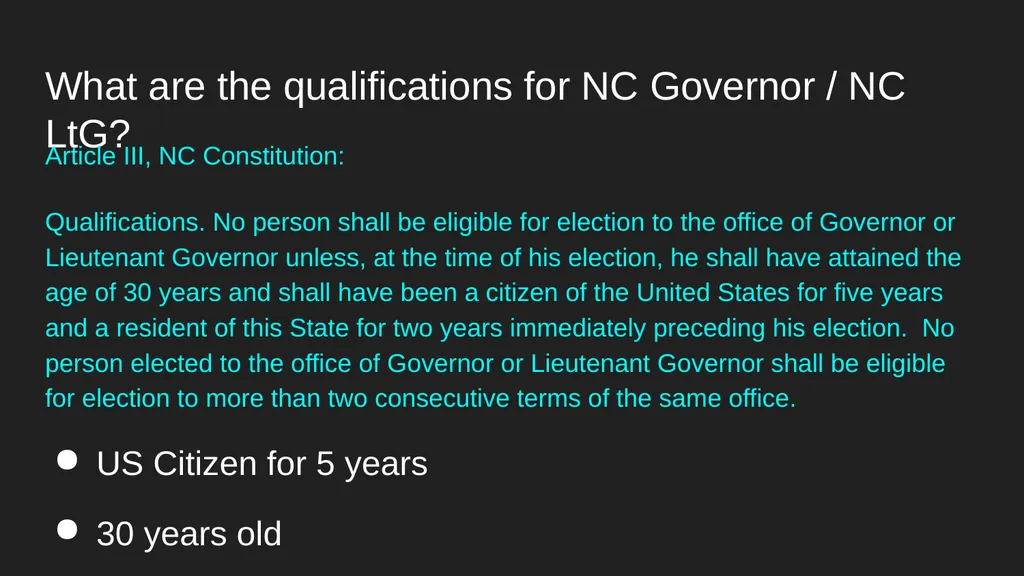
What are the qualifications for NC Governor / NC LtG? Article III, NC Constitution:
Qualifications. No person shall be eligible for election to the office of Governor or Lieutenant Governor unless, at the time of his election, he shall have attained the age of 30 years and shall have been a citizen of the United States for five years and a resident of this State for two years immediately preceding his election. No person elected to the office of Governor or Lieutenant Governor shall be eligible for election to more than two consecutive terms of the same office.
US Citizen for 5 years
30 years old
NC Resident for previous 2 years<br>
Qualifications. No person shall be eligible for election to the office of Governor or Lieutenant Governor unless, at the time of his election, he shall have attained the age of 30 years and shall have been a citizen of the United States for five years and a resident of this State for two years immediately preceding his election. No person elected to the office of Governor or Lieutenant Governor shall be eligible for election to more than two consecutive terms of the same office.
US Citizen for 5 years
30 years old
NC Resident for previous 2 years<br>
07
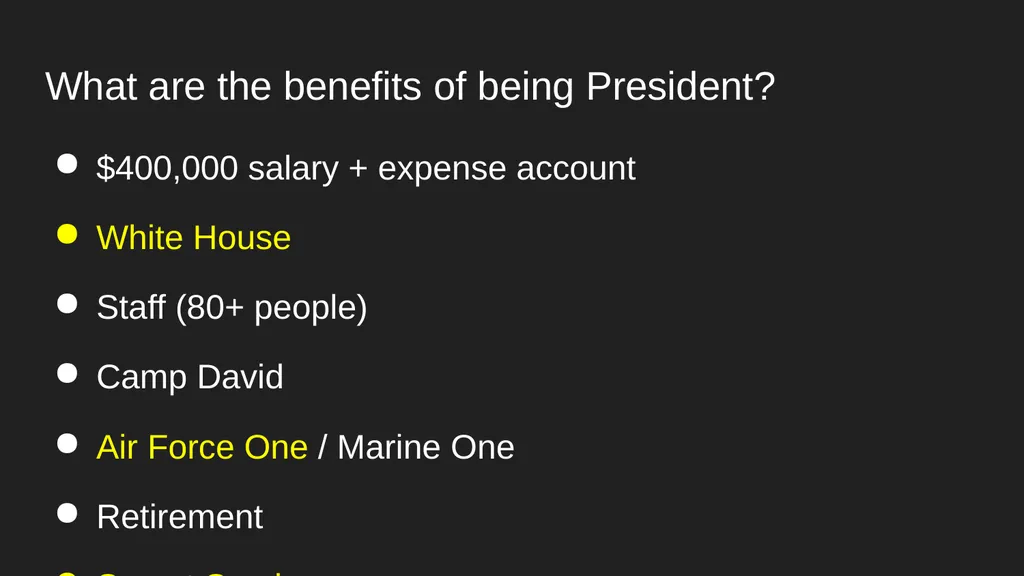
What are the benefits of being President? $400,000 salary + expense account
White House
Staff (80+ people)
Camp David
Air Force One / Marine One
Retirement
Secret Service
Is being President worth the responsibility?<br>
White House
Staff (80+ people)
Camp David
Air Force One / Marine One
Retirement
Secret Service
Is being President worth the responsibility?<br>
08
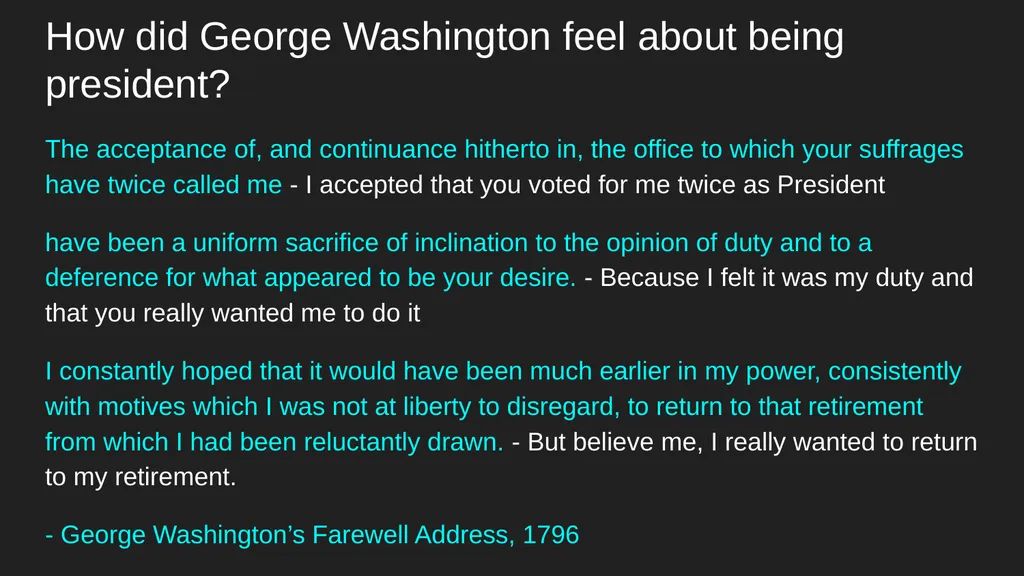
How did George Washington feel about being president? The acceptance of, and continuance hitherto in, the office to which your suffrages have twice called me - I accepted that you voted for me twice as President
have been a uniform sacrifice of inclination to the opinion of duty and to a deference for what appeared to be your desire. - Because I felt it was my duty and that you really wanted me to do it
I constantly hoped that it would have been much earlier in my power, consistently with motives which I was not at liberty to disregard, to return to that retirement from which I had been reluctantly drawn. - But believe me, I really wanted to return to my retirement.
- George Washington’s Farewell Address, 1796<br>
have been a uniform sacrifice of inclination to the opinion of duty and to a deference for what appeared to be your desire. - Because I felt it was my duty and that you really wanted me to do it
I constantly hoped that it would have been much earlier in my power, consistently with motives which I was not at liberty to disregard, to return to that retirement from which I had been reluctantly drawn. - But believe me, I really wanted to return to my retirement.
- George Washington’s Farewell Address, 1796<br>
09
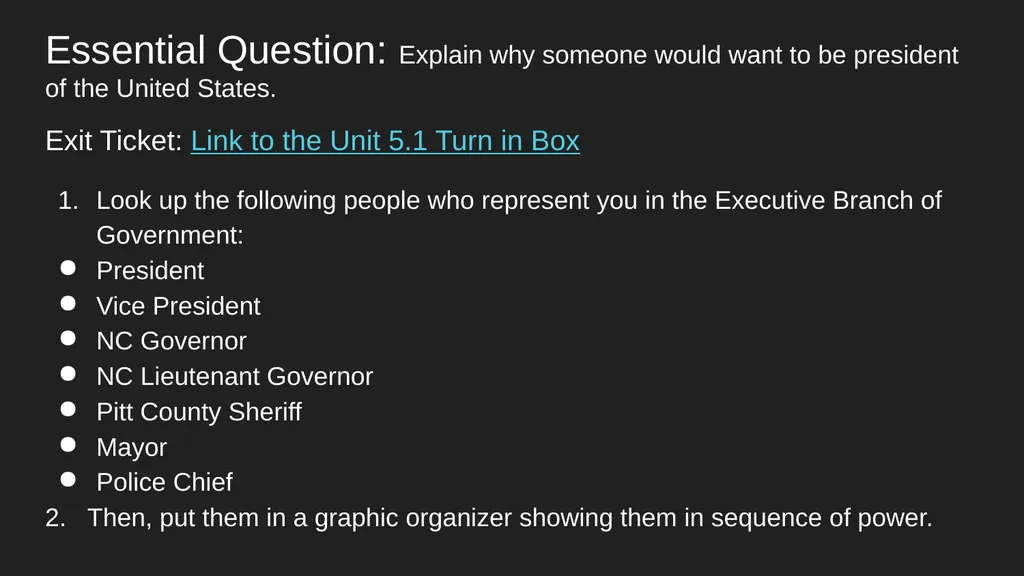
Essential Question: Explain why someone would want to be president of the United States. Exit Ticket: Link to the Unit 5.1 Turn in Box
Look up the following people who represent you in the Executive Branch of Government:
President
Vice President
NC Governor
NC Lieutenant Governor
Pitt County Sheriff
Mayor
Police Chief
2. Then, put them in a graphic organizer showing them in sequence of power.<br>
Look up the following people who represent you in the Executive Branch of Government:
President
Vice President
NC Governor
NC Lieutenant Governor
Pitt County Sheriff
Mayor
Police Chief
2. Then, put them in a graphic organizer showing them in sequence of power.<br>
10
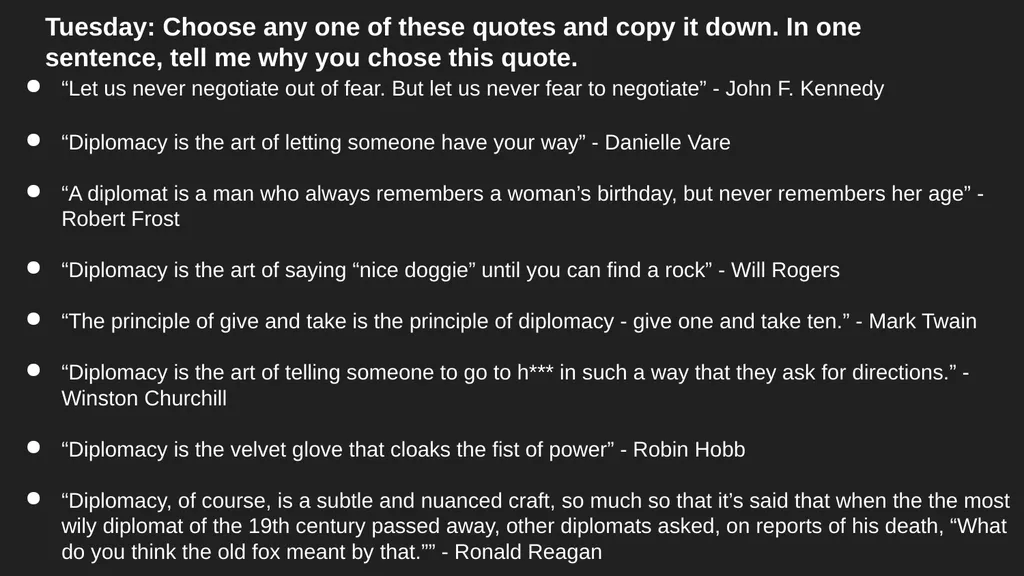
Tuesday: Choose any one of these quotes and copy it down. In one sentence, tell me why you chose this quote. “Let us never negotiate out of fear. But let us never fear to negotiate” - John F. Kennedy
“Diplomacy is the art of letting someone have your way” - Danielle Vare
“A diplomat is a man who always remembers a woman’s birthday, but never remembers her age” - Robert Frost
“Diplomacy is the art of saying “nice doggie” until you can find a rock” - Will Rogers
“The principle of give and take is the principle of diplomacy - give one and take ten.” - Mark Twain
“Diplomacy is the art of telling someone to go to h*** in such a way that they ask for directions.” - Winston Churchill
“Diplomacy is the velvet glove that cloaks the fist of power” - Robin Hobb
“Diplomacy, of course, is a subtle and nuanced craft, so much so that it’s said that when the the most wily diplomat of the 19th century passed away, other diplomats asked, on reports of his death, “What do you think the old fox meant by that.”” - Ronald Reagan<br>
“Diplomacy is the art of letting someone have your way” - Danielle Vare
“A diplomat is a man who always remembers a woman’s birthday, but never remembers her age” - Robert Frost
“Diplomacy is the art of saying “nice doggie” until you can find a rock” - Will Rogers
“The principle of give and take is the principle of diplomacy - give one and take ten.” - Mark Twain
“Diplomacy is the art of telling someone to go to h*** in such a way that they ask for directions.” - Winston Churchill
“Diplomacy is the velvet glove that cloaks the fist of power” - Robin Hobb
“Diplomacy, of course, is a subtle and nuanced craft, so much so that it’s said that when the the most wily diplomat of the 19th century passed away, other diplomats asked, on reports of his death, “What do you think the old fox meant by that.”” - Ronald Reagan<br>
11
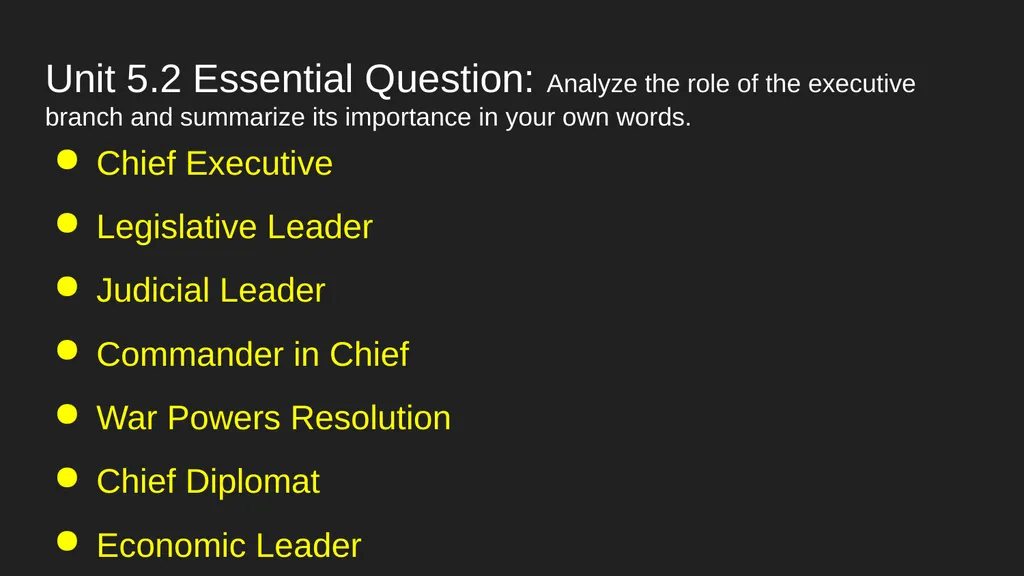
Unit 5.2 Essential Question: Analyze the role of the executive branch and summarize its importance in your own words. Chief Executive
Legislative Leader
Judicial Leader
Commander in Chief
War Powers Resolution
Chief Diplomat
Economic Leader
Party Leader
Head of State<br>
Legislative Leader
Judicial Leader
Commander in Chief
War Powers Resolution
Chief Diplomat
Economic Leader
Party Leader
Head of State<br>
12
What are the responsibilities of the Executive Branch? Chief Executive - President / Governor:
Enforce the law
Manage the bureaucracy
Appoint officials
What part of the government approves the officials that the President appoints?<br>
Enforce the law
Manage the bureaucracy
Appoint officials
What part of the government approves the officials that the President appoints?<br>
13
What are the responsibilities of the Executive Branch? Legislative Leader - President / Governor:
Propose bills
Sign / Veto bills
What special veto does the governor have?<br>
Propose bills
Sign / Veto bills
What special veto does the governor have?<br>
14
What are the responsibilities of the Executive Branch? Judicial Leader
President only:
Appoints judges
President & Governor:
Pardons, grants amnesty, commutes, and reprieves
How are judges appointed in NC?<br>
President only:
Appoints judges
President & Governor:
Pardons, grants amnesty, commutes, and reprieves
How are judges appointed in NC?<br>
15
What are the responsibilities of the Executive Branch? Commander in Chief
President only:
Leads the military (but Congress declares war)
Governor only:
Leads NC National Guard
What is the NC National Guard used for?<br>
President only:
Leads the military (but Congress declares war)
Governor only:
Leads NC National Guard
What is the NC National Guard used for?<br>
16
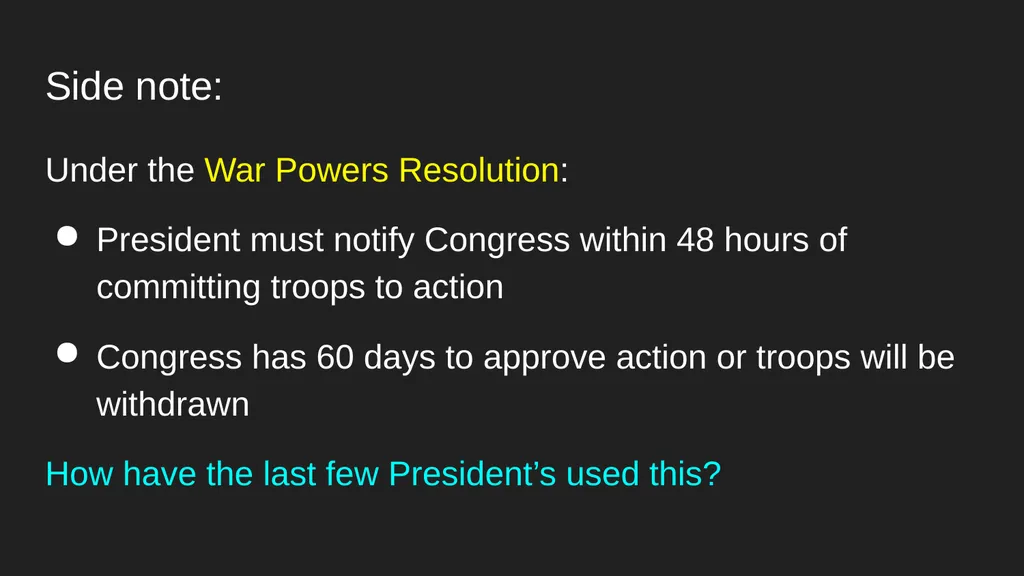
Side note: Under the War Powers Resolution:
President must notify Congress within 48 hours of committing troops to action
Congress has 60 days to approve action or troops will be withdrawn
How have the last few President’s used this?<br>
President must notify Congress within 48 hours of committing troops to action
Congress has 60 days to approve action or troops will be withdrawn
How have the last few President’s used this?<br>
17
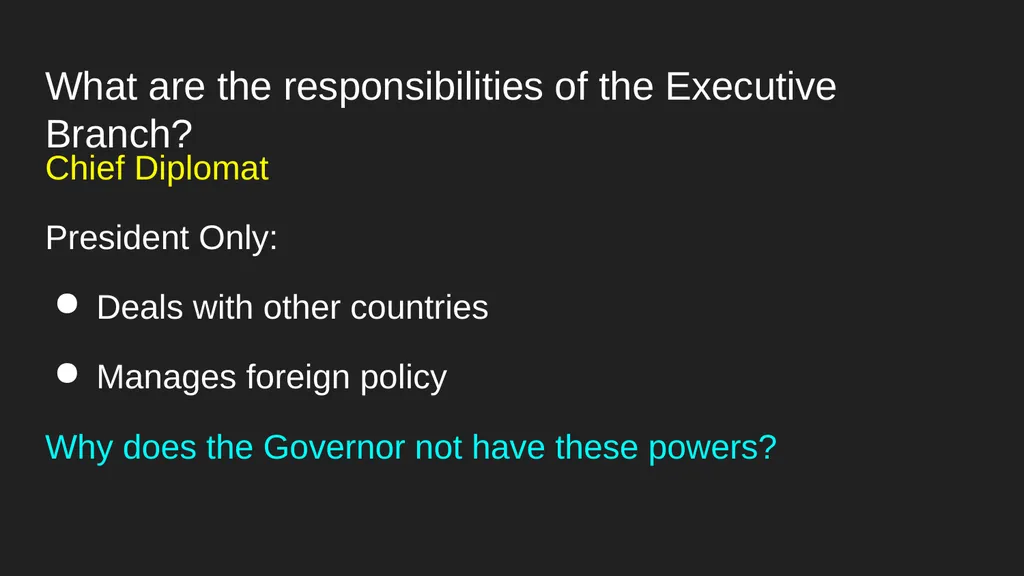
What are the responsibilities of the Executive Branch? Chief Diplomat
President Only:
Deals with other countries
Manages foreign policy
Why does the Governor not have these powers?<br>
President Only:
Deals with other countries
Manages foreign policy
Why does the Governor not have these powers?<br>
18
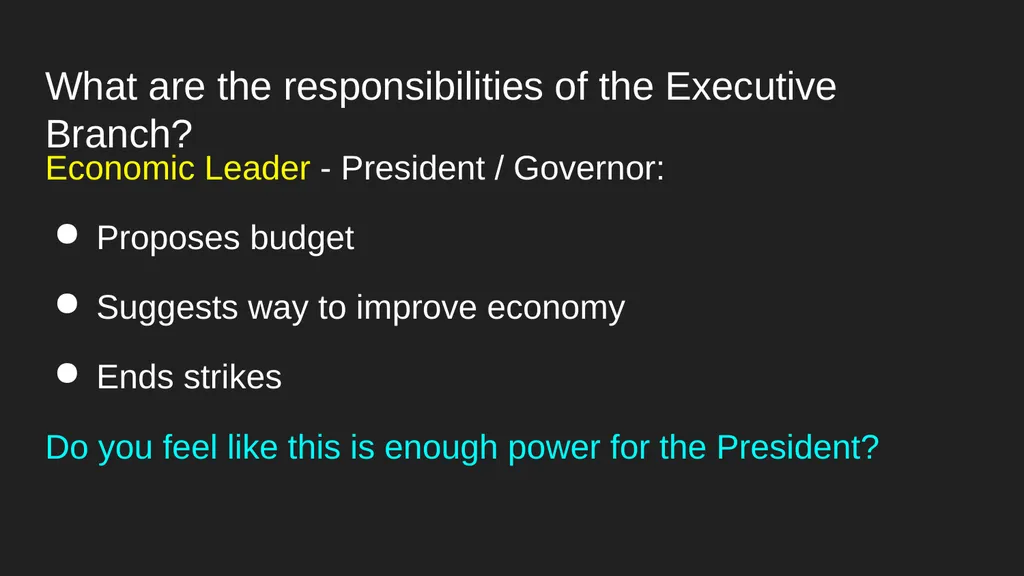
What are the responsibilities of the Executive Branch? Economic Leader - President / Governor:
Proposes budget
Suggests way to improve economy
Ends strikes
Do you feel like this is enough power for the President?<br>
Proposes budget
Suggests way to improve economy
Ends strikes
Do you feel like this is enough power for the President?<br>
19
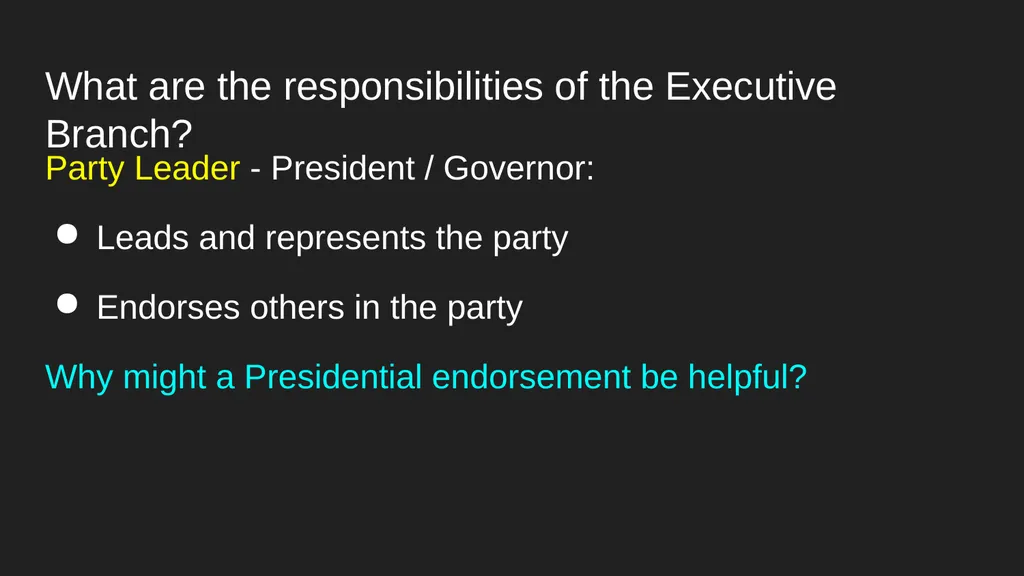
What are the responsibilities of the Executive Branch? Party Leader - President / Governor:
Leads and represents the party
Endorses others in the party
Why might a Presidential endorsement be helpful?<br>
Leads and represents the party
Endorses others in the party
Why might a Presidential endorsement be helpful?<br>
20
What are the responsibilities of the Executive Branch? Head of State - President / Governor:
Symbol of the country
Exhibits patriotism
Continues traditions
What traditions does the President have to continue?<br>
Symbol of the country
Exhibits patriotism
Continues traditions
What traditions does the President have to continue?<br>
21
Essential Question: Analyze the role of the executive branch and summarize its importance in your own words. Exit Ticket: Unit 5.2 Exit Ticket Turn in Box
Find an example of any US President fulfilling each of the following roles and put them into a Google Slides presentation:
Chief Executive
Judicial Leader
Chief Diplomat
Legislative Leader
Commander in Chief
Economic Leader
Party Leader
Head of State
2. US Presidents Sporcle Quiz<br>
Find an example of any US President fulfilling each of the following roles and put them into a Google Slides presentation:
Chief Executive
Judicial Leader
Chief Diplomat
Legislative Leader
Commander in Chief
Economic Leader
Party Leader
Head of State
2. US Presidents Sporcle Quiz<br>
22
Barack Obama, 2016 State of the Union Address “People of the world do not look to Beijing or Moscow to lead - they call us.”
Wednesday: Which Presidential Role is Obama filling when delivering this quote?
Legislative Leader
Executive Leader
Commander in Chief
Head of State<br>
Wednesday: Which Presidential Role is Obama filling when delivering this quote?
Legislative Leader
Executive Leader
Commander in Chief
Head of State<br>
23
Unit 5.3 Essential Question: What tools does the U.S. President have at his disposal to achieve his goals? Bureaucracy
Attorney General
Departments
Department of State
Department of the Treasury
Department of Defense
Department of Justice Department of the Interior
Agencies
Federal Bureau of Investigation (FBI)
Drug Enforcement Agency (DEA)
Central Intelligence Agency (CIA)<br>
Attorney General
Departments
Department of State
Department of the Treasury
Department of Defense
Department of Justice Department of the Interior
Agencies
Federal Bureau of Investigation (FBI)
Drug Enforcement Agency (DEA)
Central Intelligence Agency (CIA)<br>
24
What is the bureaucracy? A system of non-elected officials that work to implement rules and policies<br>
25
What is the bureaucracy? There are 15 departments under the president
Each department is led by a secretary (except Department of Justice, he is called the Attorney General)<br>
Each department is led by a secretary (except Department of Justice, he is called the Attorney General)<br>
26
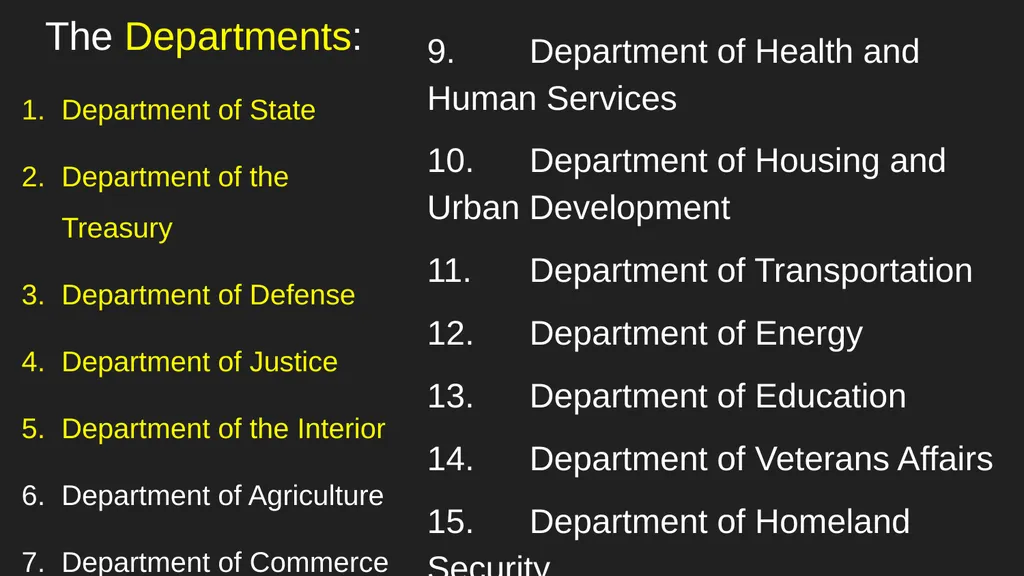
The Departments: Department of State
Department of the Treasury
Department of Defense
Department of Justice
Department of the Interior
Department of Agriculture
Department of Commerce
Department of Labor 9. Department of Health and Human Services
10. Department of Housing and Urban Development
11. Department of Transportation
12. Department of Energy
13. Department of Education
14. Department of Veterans Affairs
15. Department of Homeland Security<br>
Department of the Treasury
Department of Defense
Department of Justice
Department of the Interior
Department of Agriculture
Department of Commerce
Department of Labor 9. Department of Health and Human Services
10. Department of Housing and Urban Development
11. Department of Transportation
12. Department of Energy
13. Department of Education
14. Department of Veterans Affairs
15. Department of Homeland Security<br>
27
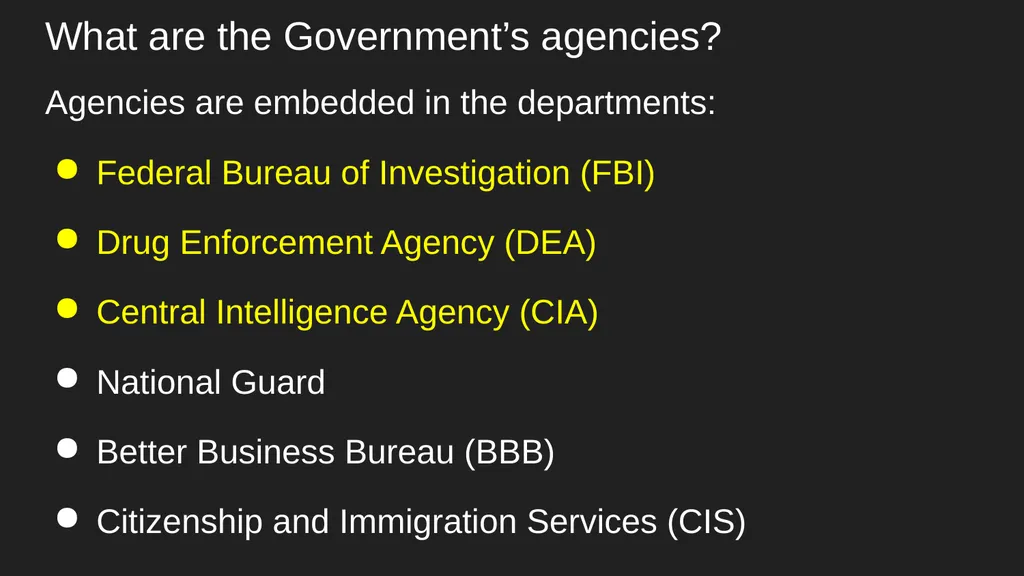
What are the Government’s agencies? Agencies are embedded in the departments:
Federal Bureau of Investigation (FBI)
Drug Enforcement Agency (DEA)
Central Intelligence Agency (CIA)
National Guard
Better Business Bureau (BBB)
Citizenship and Immigration Services (CIS)
Federal Emergency Management Agency (FEMA)
Alcohol, Tobacco, and Firearms (ATF)
Internal Revenue Service (IRS)<br>
Federal Bureau of Investigation (FBI)
Drug Enforcement Agency (DEA)
Central Intelligence Agency (CIA)
National Guard
Better Business Bureau (BBB)
Citizenship and Immigration Services (CIS)
Federal Emergency Management Agency (FEMA)
Alcohol, Tobacco, and Firearms (ATF)
Internal Revenue Service (IRS)<br>
28
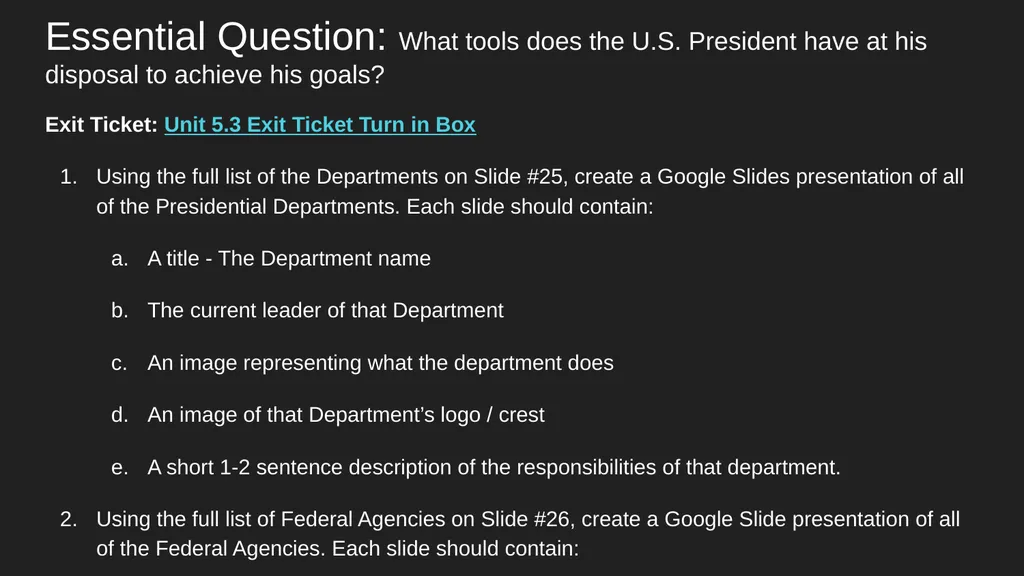
Essential Question: What tools does the U.S. President have at his disposal to achieve his goals? Exit Ticket: Unit 5.3 Exit Ticket Turn in Box
Using the full list of the Departments on Slide #25, create a Google Slides presentation of all of the Presidential Departments. Each slide should contain:
A title - The Department name
The current leader of that Department
An image representing what the department does
An image of that Department’s logo / crest
A short 1-2 sentence description of the responsibilities of that department.
Using the full list of Federal Agencies on Slide #26, create a Google Slide presentation of all of the Federal Agencies. Each slide should contain:
A title - The Department name
The current leader of that Agency
An image representing what the Agency does
An image of that Agency’s logo / crest
A short 1-2 sentence description of the responsibilities of that Agency.<br>
Using the full list of the Departments on Slide #25, create a Google Slides presentation of all of the Presidential Departments. Each slide should contain:
A title - The Department name
The current leader of that Department
An image representing what the department does
An image of that Department’s logo / crest
A short 1-2 sentence description of the responsibilities of that department.
Using the full list of Federal Agencies on Slide #26, create a Google Slide presentation of all of the Federal Agencies. Each slide should contain:
A title - The Department name
The current leader of that Agency
An image representing what the Agency does
An image of that Agency’s logo / crest
A short 1-2 sentence description of the responsibilities of that Agency.<br>
29
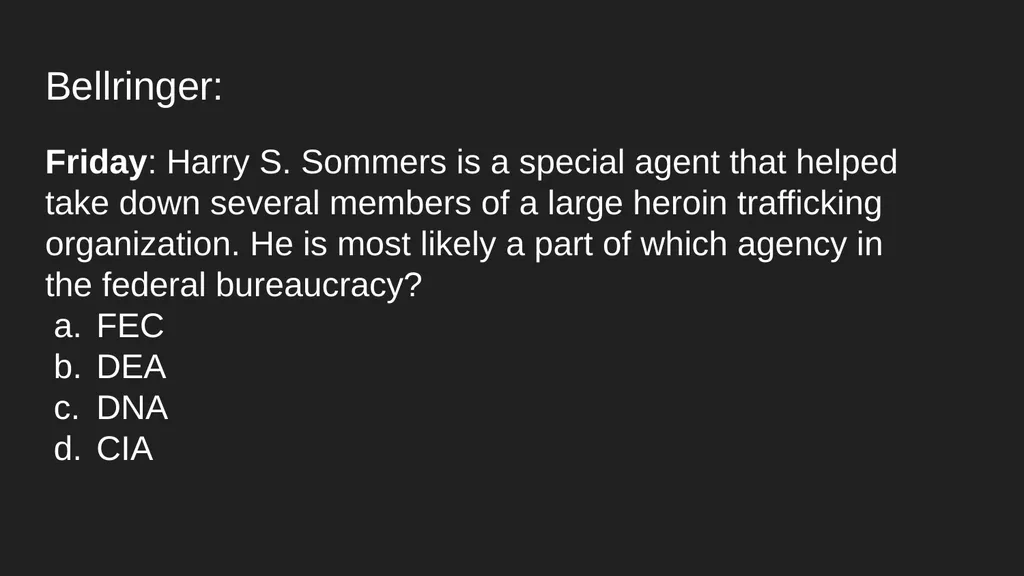
Bellringer: Friday: Harry S. Sommers is a special agent that helped take down several members of a large heroin trafficking organization. He is most likely a part of which agency in the federal bureaucracy?
FEC
DEA
DNA
CIA<br>
FEC
DEA
DNA
CIA<br>
30
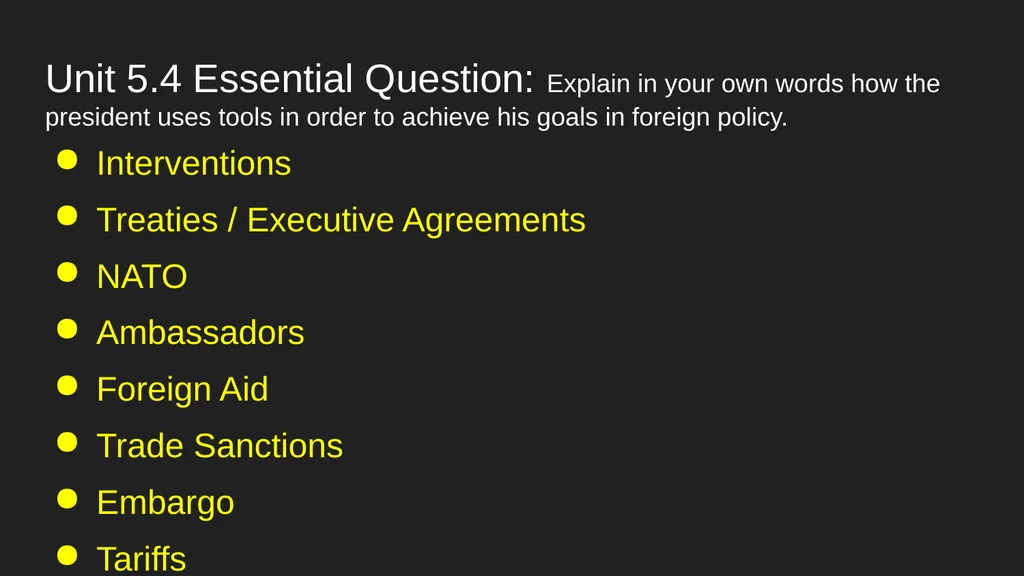
Unit 5.4 Essential Question: Explain in your own words how the president uses tools in order to achieve his goals in foreign policy. Interventions
Treaties / Executive Agreements
NATO
Ambassadors
Foreign Aid
Trade Sanctions
Embargo
Tariffs
NAFTA
WTO<br>
Treaties / Executive Agreements
NATO
Ambassadors
Foreign Aid
Trade Sanctions
Embargo
Tariffs
NAFTA
WTO<br>
31
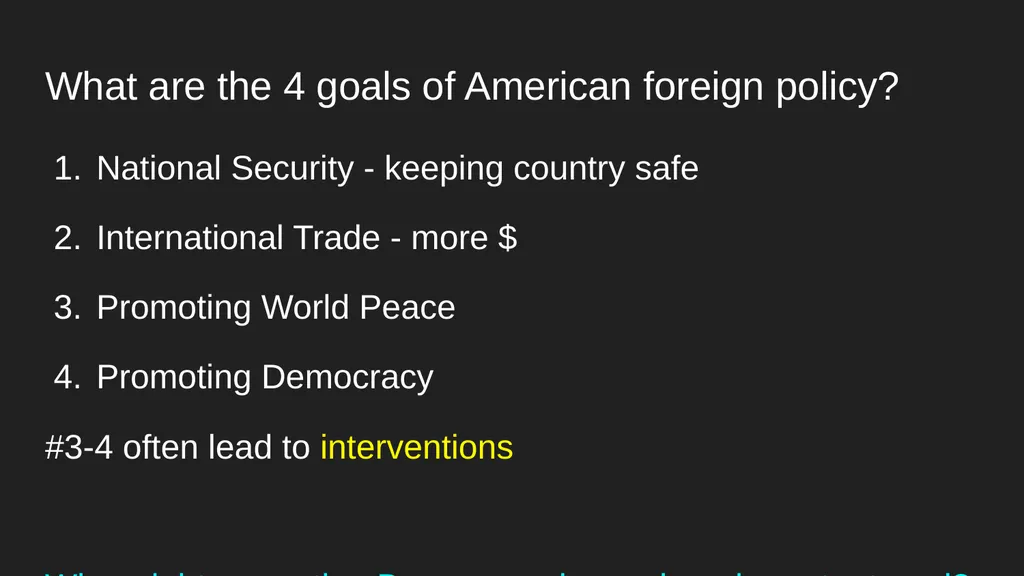
What are the 4 goals of American foreign policy? National Security - keeping country safe
International Trade - more $
Promoting World Peace
Promoting Democracy
#3-4 often lead to interventions
Why might promoting Democracy be such an important goal?<br>
International Trade - more $
Promoting World Peace
Promoting Democracy
#3-4 often lead to interventions
Why might promoting Democracy be such an important goal?<br>
32
What tools does the President have for his foreign policy? Treaties - formal agreements between govts of 2 or more countries
Executive Agreements - agreement between Pres and leader of another country
Example: NATO (North Atlantic Treaty Organization) is a mutual defense treaty between the US, Canada, and nations of Europe
How might NATO be an advantage for the US?<br>
Executive Agreements - agreement between Pres and leader of another country
Example: NATO (North Atlantic Treaty Organization) is a mutual defense treaty between the US, Canada, and nations of Europe
How might NATO be an advantage for the US?<br>
33
What tools does the President have for his foreign policy? Appointing Ambassadors
Official representative of a country’s government
Why do we need ambassadors?<br>
Official representative of a country’s government
Why do we need ambassadors?<br>
34
What tools does the President have for his foreign policy? Foreign Aid
Money, food, military assistance, supplies, etc
When have you seen the US use this tool?<br>
Money, food, military assistance, supplies, etc
When have you seen the US use this tool?<br>
35
What tools does the President have for his foreign policy? International Trade
Trade Sanctions - punish other nations by adding trade barriers
Embargo - prohibit trade entirely with a nation
Tariffs - taxes on imported goods
US is a member of trade groups like NAFTA (North Atlantic Free Trade Agreement) and the WTO (World Trade Organization)
What countries do you think the US might have trade sanctions on?<br>
Trade Sanctions - punish other nations by adding trade barriers
Embargo - prohibit trade entirely with a nation
Tariffs - taxes on imported goods
US is a member of trade groups like NAFTA (North Atlantic Free Trade Agreement) and the WTO (World Trade Organization)
What countries do you think the US might have trade sanctions on?<br>
36
What tools does the President have for his foreign policy? Military Force
Where have you seen the US using military force?<br>
Where have you seen the US using military force?<br>
37
Essential Question: Explain in your own words how the president uses tools in order to achieve his goals in foreign policy. Exit Ticket: Unit 5.4 Exit Ticket Turn in Box
Create a google slides presentation of the tools that a President uses in order to achieve his goals of foreign policy.
On each slide, there should be 2 examples of that tool being used.
Under each example, provide a 1-2 sentence caption describing what action is taking place there.<br>
Create a google slides presentation of the tools that a President uses in order to achieve his goals of foreign policy.
On each slide, there should be 2 examples of that tool being used.
Under each example, provide a 1-2 sentence caption describing what action is taking place there.<br>
38
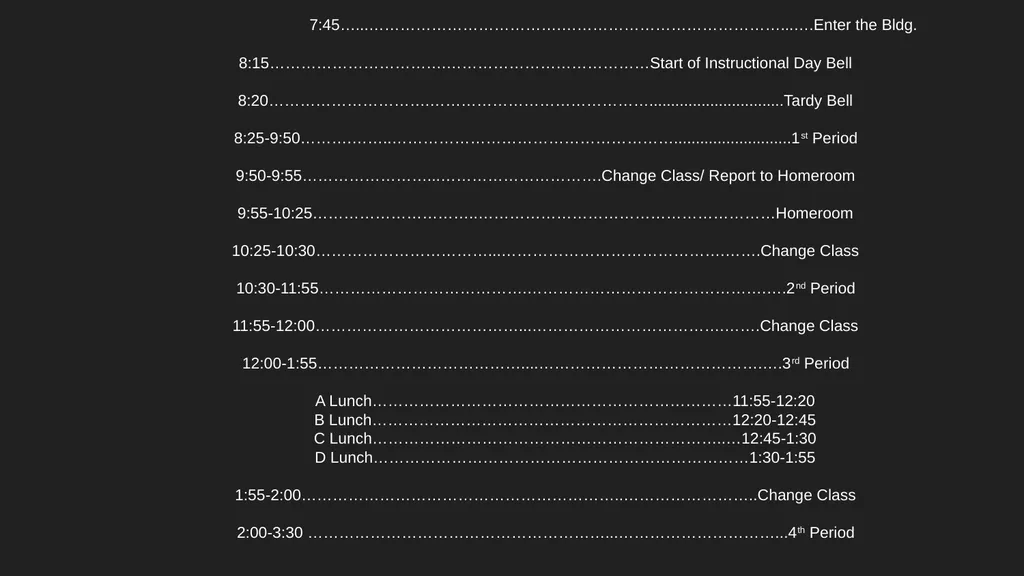
7:45…...……………………………….……………………………………...….Enter the Bldg.
8:15…………………………….…………………………………Start of Instructional Day Bell
8:20………………………….……………………………………...............................Tardy Bell
8:25-9:50……….……..………………………………………………...........................1st Period
9:50-9:55……………………...………………………….Change Class/ Report to Homeroom
9:55-10:25…………………………..…………………………………………………Homeroom
10:25-10:30……………………………...…………………………………….…….Change Class
10:30-11:55………………………………….……………………………………….….2nd Period
11:55-12:00…………………………………...……………………………….…….Change Class
12:00-1:55…………………………………....…………………………………….….3rd Period
A Lunch……………………………………………………………11:55-12:20
B Lunch……………………………………………………………12:20-12:45
C Lunch…………………………………………………………..…12:45-1:30
D Lunch………………………………………………………………1:30-1:55
1:55-2:00……………………………………………………..……………………..Change Class
2:00-3:30 …………………………………………………...…………………………...4th Period<br>
8:15…………………………….…………………………………Start of Instructional Day Bell
8:20………………………….……………………………………...............................Tardy Bell
8:25-9:50……….……..………………………………………………...........................1st Period
9:50-9:55……………………...………………………….Change Class/ Report to Homeroom
9:55-10:25…………………………..…………………………………………………Homeroom
10:25-10:30……………………………...…………………………………….…….Change Class
10:30-11:55………………………………….……………………………………….….2nd Period
11:55-12:00…………………………………...……………………………….…….Change Class
12:00-1:55…………………………………....…………………………………….….3rd Period
A Lunch……………………………………………………………11:55-12:20
B Lunch……………………………………………………………12:20-12:45
C Lunch…………………………………………………………..…12:45-1:30
D Lunch………………………………………………………………1:30-1:55
1:55-2:00……………………………………………………..……………………..Change Class
2:00-3:30 …………………………………………………...…………………………...4th Period<br>
39
George Washington’s Farewell Address “...The acceptance of, and continuance hitherto in, the office to which your suffrages have twice called me (2) have been a uniform sacrifice of inclination to the opinion of duty and to a deference for what appeared to be your desire. (3) I constantly hoped that it would have been much earlier in my power, consistently with motives which I was not at liberty to disregard, to return to that retirement from which I had been reluctantly drawn..."
Monday: Based on the quote below, why does George Washington believe someone should serve as President?
It is their duty
The person voted for themselves
To avoid retirement
To sacrifice for themselves<br>
Monday: Based on the quote below, why does George Washington believe someone should serve as President?
It is their duty
The person voted for themselves
To avoid retirement
To sacrifice for themselves<br>
40
The Executive Branch Unit 5
Unit 5 Essential Question: Is the Executive Branch of the U.S. government too powerful, not powerful enough, or just right? Support your argument with at least 3 sources.<br>
Unit 5 Essential Question: Is the Executive Branch of the U.S. government too powerful, not powerful enough, or just right? Support your argument with at least 3 sources.<br>