
ARTIFICIAL INTELLIGENCE Introduction How AI works


Description: ARTIFICIAL INTELLIGENCE Introduction How AI works AI in Apps and Games Dangers of AI Advice CONTENTS INTRODUCTION AI (Artificial Intelligence) relates to computers that can think for themselves Computers have had the ability to appear
Related Topics
Download Presentation
"ARTIFICIAL INTELLIGENCE Introduction How AI works" is the property of its rightful owner. Permission is granted to download and print the materials on this website for personal, non-commercial use only, and to display it on your personal computer provided you do not modify the materials and that you retain all copyright notices contained in the materials. By downloading content from our website, you accept the terms of this agreement.
Presentation Transcript
slide1. ARTIFICIAL INTELLIGENCE<br>
slide2. Introduction
How AI works
AI in Apps and Games
Dangers of AI
Advice CONTENTS<br>
slide3. INTRODUCTION<br>
slide4. AI (Artificial Intelligence) relates to computers that can ‘think’ for themselves
Computers have had the ability to appear intelligent for years because they have been programmed how to behave in given circumstances ARTIFICIAL INTELLIGENCE<br>
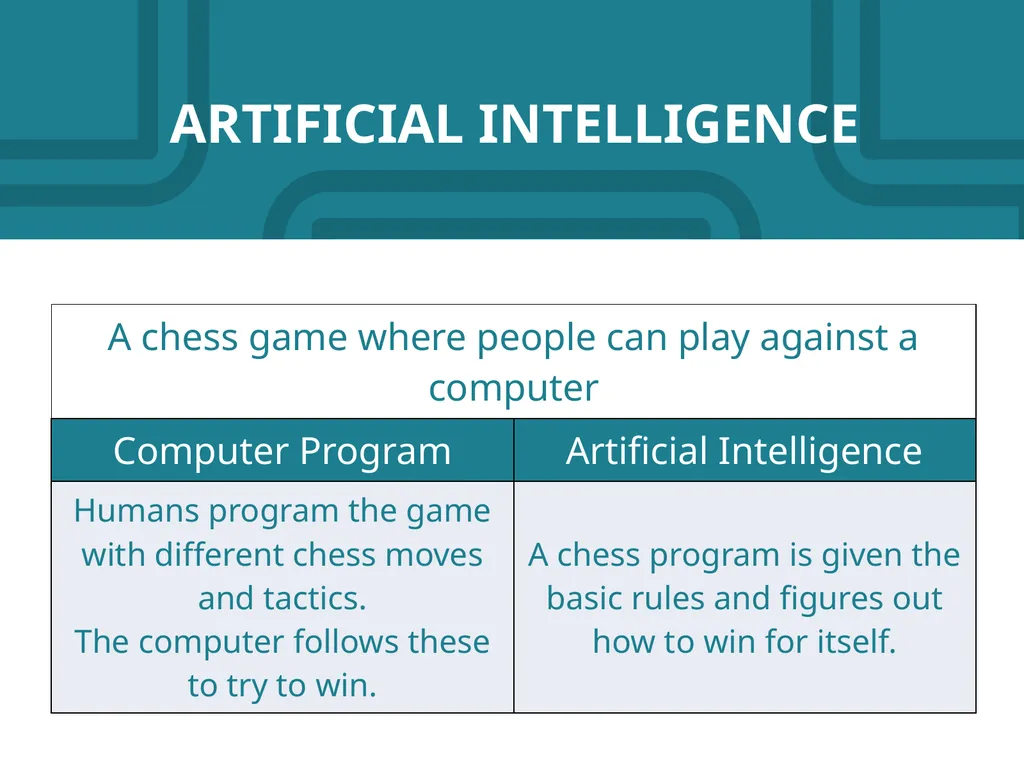
slide5. ARTIFICIAL INTELLIGENCE<br>
slide6. AI is the science and engineering of creating intelligent machines. These machines are designed to mimic human intelligence and behaviours, enabling them to learn from experience, adapt to new information, and perform tasks that traditionally required human cognitive capabilities. ARTIFICIAL INTELLIGENCE<br>
slide7. AI encompasses various technologies, including machine learning and natural language processing, and its applications are vast, ranging from autonomous vehicles to virtual assistants. ARTIFICIAL INTELLIGENCE<br>
slide8. HOW AI WORKS<br>
slide9. AI learns by looking at lots of examples, like how children learn from stories and practice.
It can recognize patterns and make guesses based on what it's seen.
Then, it uses this knowledge to do different tasks, just like how children use their learning to solve puzzles and play games.
The more it practices, the better it gets at helping, just like people get better at things they practice. HOW AI WORKS<br>
slide10. AI systems start by collecting massive amounts of data. This data can be text, images, videos, or any information that the AI system will learn from. 1. DATA COLLECTION<br>
slide11. The collected data is then used to train AI models. During this process, the AI system learns to recognize patterns and make predictions. It's like teaching a machine to understand the world. 2. TRAINING<br>
slide12. AI relies on sophisticated algorithms that process and analyse the data. These algorithms are like the instructions that guide the AI's decision-making process. 3. ALGORITHMS<br>
slide13. One key concept in AI is neural networks, which are inspired by the human brain. These networks consist of interconnected nodes (or "neurons") that process information in layers. 4. NEUTRAL NETWORKS<br>
slide14. Once the AI model is trained, it can make decisions or predictions based on new, unseen data. It uses the patterns it learned during training to provide answers or make recommendations. 5.DECISION MAKING<br>
slide15. AI IN APPS AND GAMES<br>
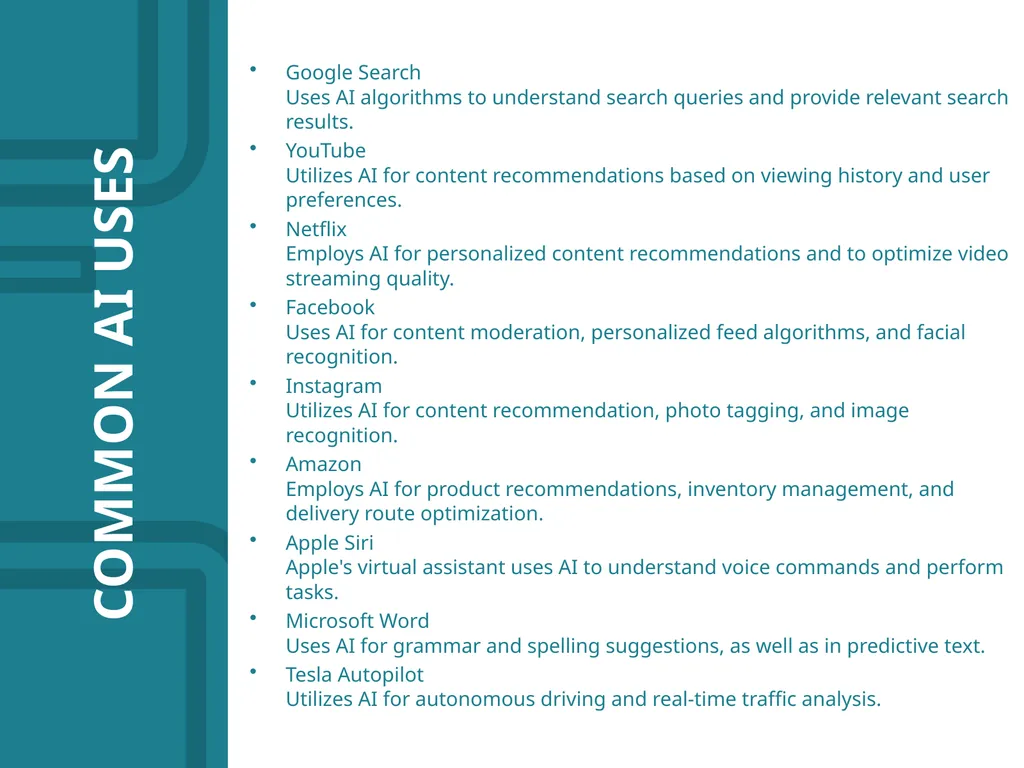
slide16. Google Search Uses AI algorithms to understand search queries and provide relevant search results.
YouTube Utilizes AI for content recommendations based on viewing history and user preferences.
Netflix Employs AI for personalized content recommendations and to optimize video streaming quality.
Facebook Uses AI for content moderation, personalized feed algorithms, and facial recognition.
Instagram Utilizes AI for content recommendation, photo tagging, and image recognition.
Amazon Employs AI for product recommendations, inventory management, and delivery route optimization.
Apple Siri Apple's virtual assistant uses AI to understand voice commands and perform tasks.
Microsoft Word Uses AI for grammar and spelling suggestions, as well as in predictive text.
Tesla Autopilot Utilizes AI for autonomous driving and real-time traffic analysis. COMMON AI USES<br>
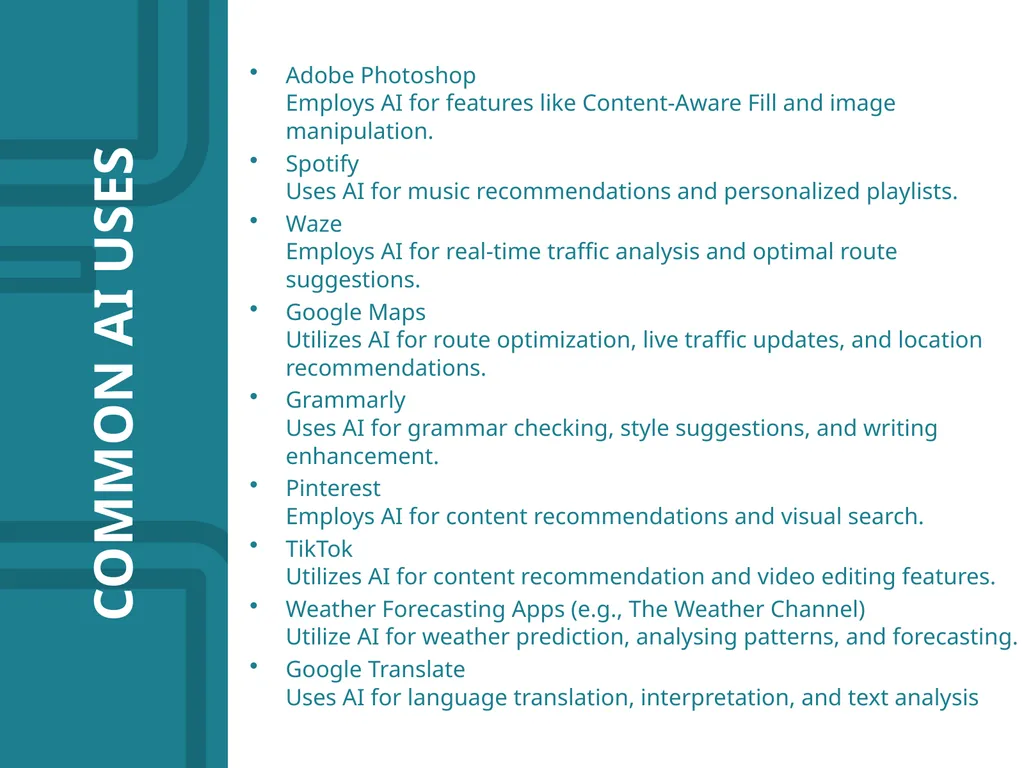
slide17. Adobe Photoshop Employs AI for features like Content-Aware Fill and image manipulation.
Spotify Uses AI for music recommendations and personalized playlists.
Waze Employs AI for real-time traffic analysis and optimal route suggestions.
Google Maps Utilizes AI for route optimization, live traffic updates, and location recommendations.
Grammarly Uses AI for grammar checking, style suggestions, and writing enhancement.
Pinterest Employs AI for content recommendations and visual search.
TikTok Utilizes AI for content recommendation and video editing features.
Weather Forecasting Apps (e.g., The Weather Channel) Utilize AI for weather prediction, analysing patterns, and forecasting.
Google Translate Uses AI for language translation, interpretation, and text analysis COMMON AI USES<br>
slide18. Powerful language generation model developed by OpenAI
Based on the GPT (generative pre-trained transformer) architecture
Capable of generating human-like text on a wide range of topics
It has ingested huge amounts of data
Able to respond to simple or detailed questions
Subsequent prompts can refine and enhance its responses CHAT GPT<br>
slide19. DANGERS OF AI<br>
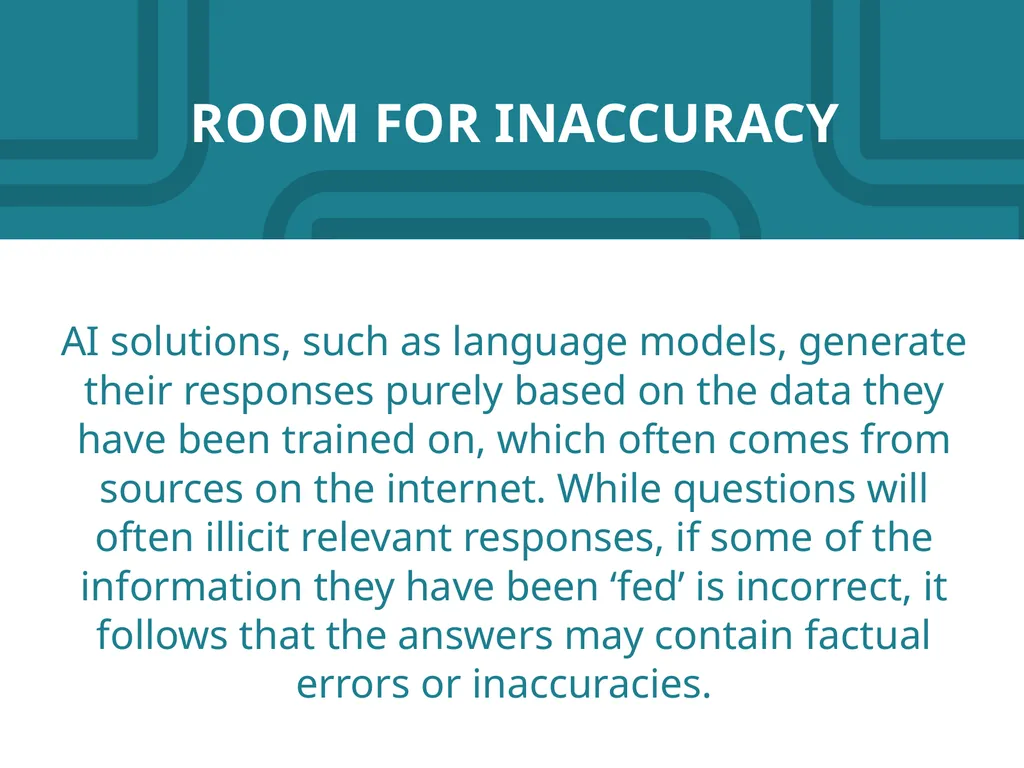
slide20. AI solutions, such as language models, generate their responses purely based on the data they have been trained on, which often comes from sources on the internet. While questions will often illicit relevant responses, if some of the information they have been ‘fed’ is incorrect, it follows that the answers may contain factual errors or inaccuracies. ROOM FOR INACCURACY<br>
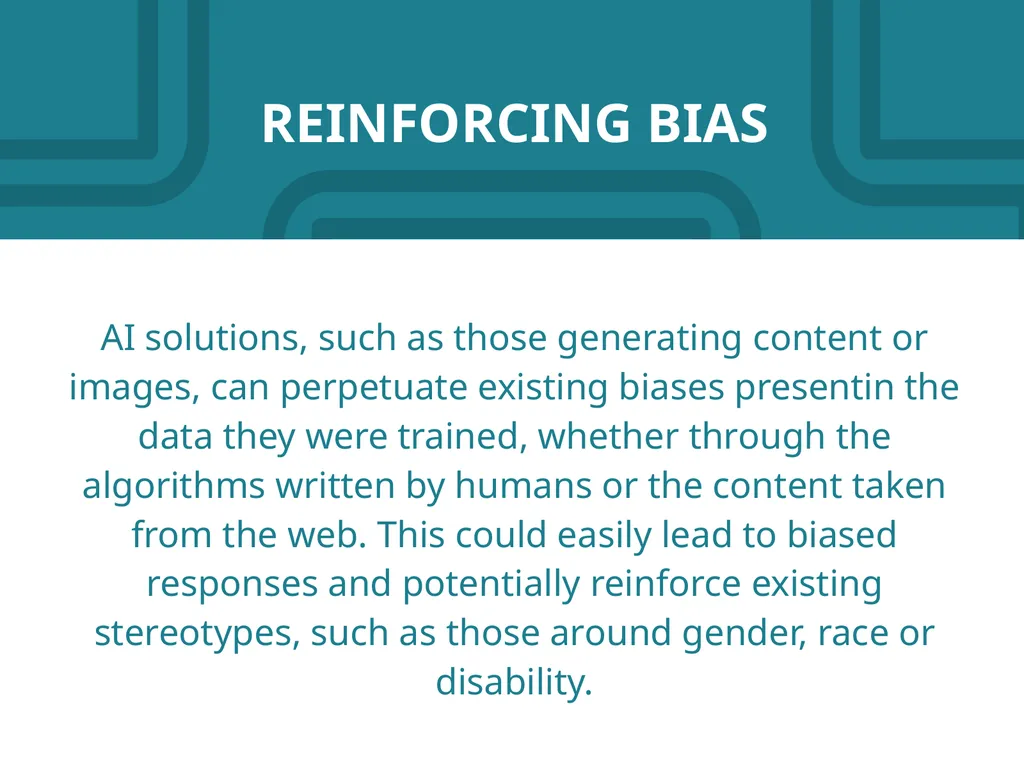
slide21. AI solutions, such as those generating content or images, can perpetuate existing biases presentin the data they were trained, whether through the algorithms written by humans or the content taken from the web. This could easily lead to biased responses and potentially reinforce existing stereotypes, such as those around gender, race or disability. REINFORCING BIAS<br>
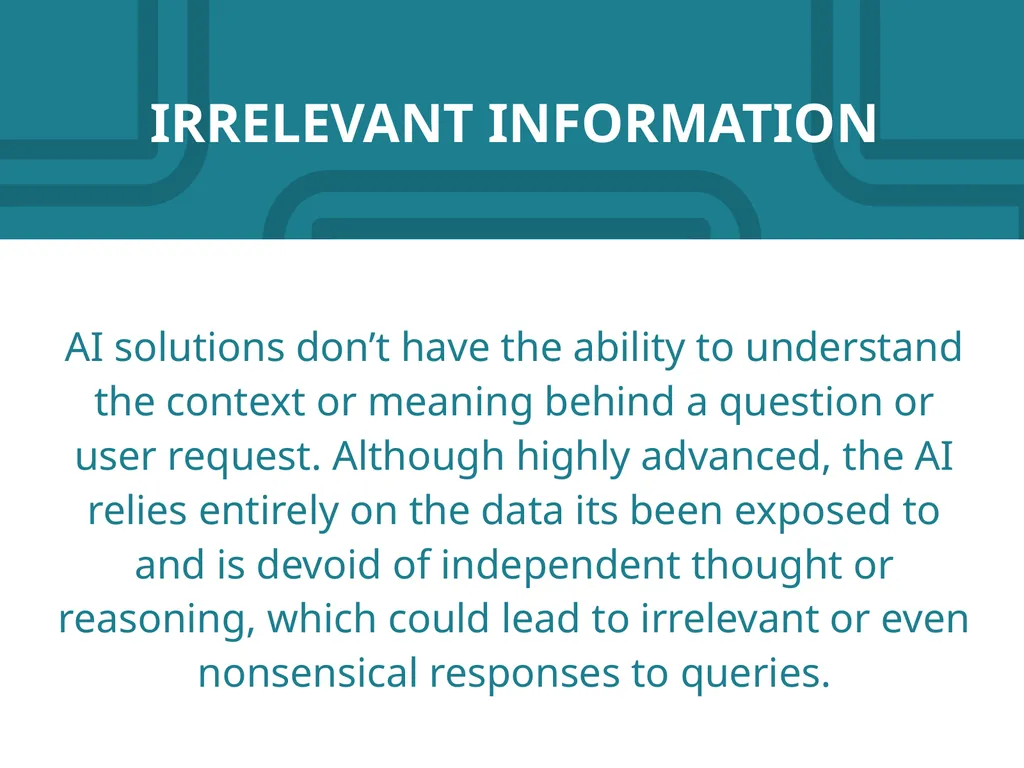
slide22. AI solutions don’t have the ability to understand the context or meaning behind a question or user request. Although highly advanced, the AI relies entirely on the data its been exposed to and is devoid of independent thought or reasoning, which could lead to irrelevant or even nonsensical responses to queries. IRRELEVANT INFORMATION<br>
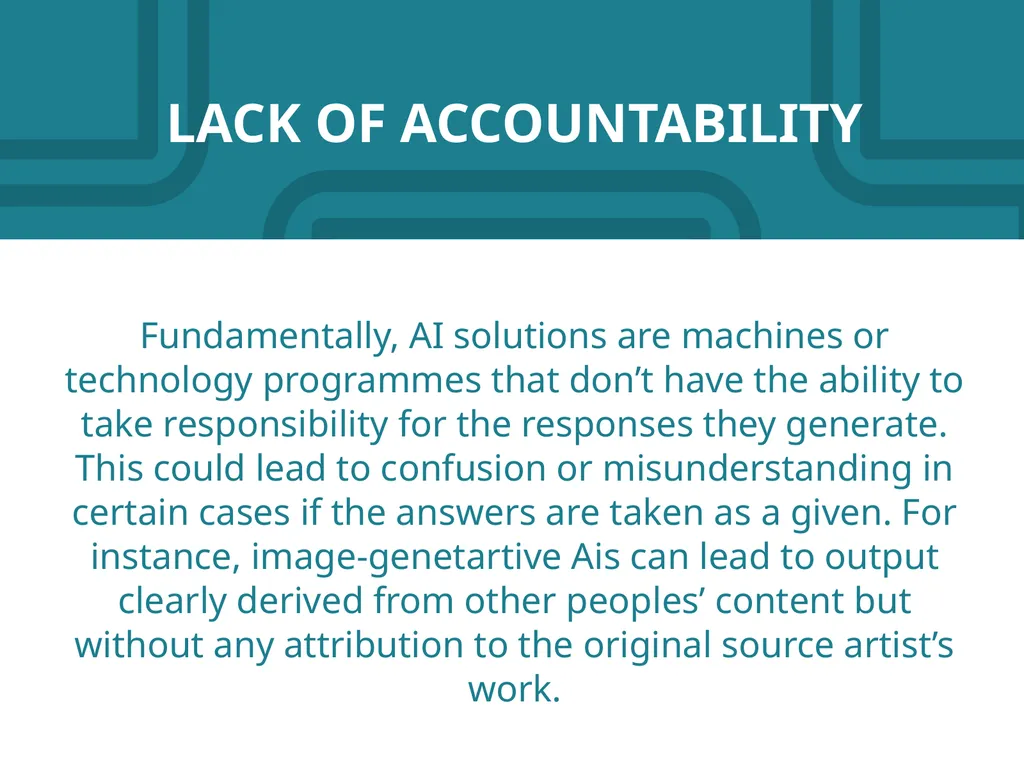
slide23. Fundamentally, AI solutions are machines or technology programmes that don’t have the ability to take responsibility for the responses they generate. This could lead to confusion or misunderstanding in certain cases if the answers are taken as a given. For instance, image-genetartive Ais can lead to output clearly derived from other peoples’ content but without any attribution to the original source artist’s work. LACK OF ACCOUNTABILITY<br>
slide24. One of the potential risks of children and young people continually using AI solutions for things (such as their homework) is that eventually they might become reliant on it. In the long term, this could potentially impact their development and hamper their ability to think creatively or solve problems independently without the aid of an AI tool. STIFILING CREATIVITY<br>
slide25. ADVICE<br>
slide26. If possible, try to be around when your child uses any type of AI solution and employ content filters to try to reduce the chance of profanity or age-inappropriate subjects appearing in responses. As with any kind of technology, it’s important to ensure that children are using AI solutions responsibly and to be there to enable opportunities to discuss their use as part of a safe environment. CREATE A SAFE ENVIRONMENT<br>
slide27. Explain to your child that AI solutions can be used as one of many tools to help them research and learn but that they shouldn’t simply accept the responses they receive as the truth. Encourage them to question, verify and think critically about the information they get back – all of which apply equally to any website platform they use. PROMOTE CRITICAL THINKING<br>
slide28. Not only should children supplement any use of software like AI with additional resources such as books and reputable internet sites, but they also should remember what they can learn from interaction with other people. Discussing things with teachers, relatives and friends isn’t just an important and often valuable aspect of learning – it's an essential part of life too. ENCOURAGE HUMAN INTERACTION<br>
slide29. Talk to your child about the potential biases that may be present in data that AI solutions are trained on, and how these viewpoints might find their way into the responses that AI generates. Again, with many things children might read online, it’s healthy for them to consider whether the information is factual and presented fairly. DISCUSS BIAS<br>
slide30. ACTIVITIES<br>
slide31. I have found different websites which either show how AI works or get children to use AI.
All of these are found on the internet and none require a subscription or logon information.
They have all been created with educating children in mind so are safe for them to use. ACTIVITIES<br>
slide32. This is a game built with machine learning. You draw, and a neural network tries to guess what you’re drawing.
It was made as an example of how machine learning can be used.
https://quickdraw.withgoogle.com/ QUICK DRAW<br>
slide33. In this game you have an AI helper that you have to train. It demonstrates AI supervised and reinforcement learning.
https://art-bot.net/game/ ARTBOT<br>
slide34. This is a set of word association games powered by machine learning. There are 2 games to play.
https://research.google.com/semantris/ SEMANTRIS<br>
slide35. This is a text based story creator. You choose a genre and it starts the story. It will then prompt you to think of what your character might do and continues writing it for you.
https://play.aidungeon.com/ AI DUNGEON<br>
slide36. This is another drawing game which shows machine learning.
You start to draw a given object and it will predict what your next step will be based on what other people did.
https://magenta.tensorflow.org/assets/sketch_rnn_demo/index.html SKETCH-RNN<br>
slide37. This is a website which allows children to create their own AI powered things.
https://machinelearningforkids.co.uk/
Code Club has step by step instructions on how to make things using it.
https://projects.raspberrypi.org/en/pathways/scratch-machine-learning MACHINE LEARNING FOR KIDS<br>
slide38. This AI system is linked to quickdraw. It allows you to make posters, using copyright free images. You draw what you want and select one of the images it suggests.
https://www.autodraw.com/ AUTODRAW<br>
slide39. Not a game, just an activity using AI.
Ask Siri the different questions and write down the responses. HEY SIRI<br>
slide40. It would really help me if you could complete the bounce survey. It helps make future sessions better. BOUNCE SURVEY<br>
slide41. THANK YOU!<br>
slide2. Introduction
How AI works
AI in Apps and Games
Dangers of AI
Advice CONTENTS<br>
slide3. INTRODUCTION<br>
slide4. AI (Artificial Intelligence) relates to computers that can ‘think’ for themselves
Computers have had the ability to appear intelligent for years because they have been programmed how to behave in given circumstances ARTIFICIAL INTELLIGENCE<br>
slide5. ARTIFICIAL INTELLIGENCE<br>
slide6. AI is the science and engineering of creating intelligent machines. These machines are designed to mimic human intelligence and behaviours, enabling them to learn from experience, adapt to new information, and perform tasks that traditionally required human cognitive capabilities. ARTIFICIAL INTELLIGENCE<br>
slide7. AI encompasses various technologies, including machine learning and natural language processing, and its applications are vast, ranging from autonomous vehicles to virtual assistants. ARTIFICIAL INTELLIGENCE<br>
slide8. HOW AI WORKS<br>
slide9. AI learns by looking at lots of examples, like how children learn from stories and practice.
It can recognize patterns and make guesses based on what it's seen.
Then, it uses this knowledge to do different tasks, just like how children use their learning to solve puzzles and play games.
The more it practices, the better it gets at helping, just like people get better at things they practice. HOW AI WORKS<br>
slide10. AI systems start by collecting massive amounts of data. This data can be text, images, videos, or any information that the AI system will learn from. 1. DATA COLLECTION<br>
slide11. The collected data is then used to train AI models. During this process, the AI system learns to recognize patterns and make predictions. It's like teaching a machine to understand the world. 2. TRAINING<br>
slide12. AI relies on sophisticated algorithms that process and analyse the data. These algorithms are like the instructions that guide the AI's decision-making process. 3. ALGORITHMS<br>
slide13. One key concept in AI is neural networks, which are inspired by the human brain. These networks consist of interconnected nodes (or "neurons") that process information in layers. 4. NEUTRAL NETWORKS<br>
slide14. Once the AI model is trained, it can make decisions or predictions based on new, unseen data. It uses the patterns it learned during training to provide answers or make recommendations. 5.DECISION MAKING<br>
slide15. AI IN APPS AND GAMES<br>
slide16. Google Search Uses AI algorithms to understand search queries and provide relevant search results.
YouTube Utilizes AI for content recommendations based on viewing history and user preferences.
Netflix Employs AI for personalized content recommendations and to optimize video streaming quality.
Facebook Uses AI for content moderation, personalized feed algorithms, and facial recognition.
Instagram Utilizes AI for content recommendation, photo tagging, and image recognition.
Amazon Employs AI for product recommendations, inventory management, and delivery route optimization.
Apple Siri Apple's virtual assistant uses AI to understand voice commands and perform tasks.
Microsoft Word Uses AI for grammar and spelling suggestions, as well as in predictive text.
Tesla Autopilot Utilizes AI for autonomous driving and real-time traffic analysis. COMMON AI USES<br>
slide17. Adobe Photoshop Employs AI for features like Content-Aware Fill and image manipulation.
Spotify Uses AI for music recommendations and personalized playlists.
Waze Employs AI for real-time traffic analysis and optimal route suggestions.
Google Maps Utilizes AI for route optimization, live traffic updates, and location recommendations.
Grammarly Uses AI for grammar checking, style suggestions, and writing enhancement.
Pinterest Employs AI for content recommendations and visual search.
TikTok Utilizes AI for content recommendation and video editing features.
Weather Forecasting Apps (e.g., The Weather Channel) Utilize AI for weather prediction, analysing patterns, and forecasting.
Google Translate Uses AI for language translation, interpretation, and text analysis COMMON AI USES<br>
slide18. Powerful language generation model developed by OpenAI
Based on the GPT (generative pre-trained transformer) architecture
Capable of generating human-like text on a wide range of topics
It has ingested huge amounts of data
Able to respond to simple or detailed questions
Subsequent prompts can refine and enhance its responses CHAT GPT<br>
slide19. DANGERS OF AI<br>
slide20. AI solutions, such as language models, generate their responses purely based on the data they have been trained on, which often comes from sources on the internet. While questions will often illicit relevant responses, if some of the information they have been ‘fed’ is incorrect, it follows that the answers may contain factual errors or inaccuracies. ROOM FOR INACCURACY<br>
slide21. AI solutions, such as those generating content or images, can perpetuate existing biases presentin the data they were trained, whether through the algorithms written by humans or the content taken from the web. This could easily lead to biased responses and potentially reinforce existing stereotypes, such as those around gender, race or disability. REINFORCING BIAS<br>
slide22. AI solutions don’t have the ability to understand the context or meaning behind a question or user request. Although highly advanced, the AI relies entirely on the data its been exposed to and is devoid of independent thought or reasoning, which could lead to irrelevant or even nonsensical responses to queries. IRRELEVANT INFORMATION<br>
slide23. Fundamentally, AI solutions are machines or technology programmes that don’t have the ability to take responsibility for the responses they generate. This could lead to confusion or misunderstanding in certain cases if the answers are taken as a given. For instance, image-genetartive Ais can lead to output clearly derived from other peoples’ content but without any attribution to the original source artist’s work. LACK OF ACCOUNTABILITY<br>
slide24. One of the potential risks of children and young people continually using AI solutions for things (such as their homework) is that eventually they might become reliant on it. In the long term, this could potentially impact their development and hamper their ability to think creatively or solve problems independently without the aid of an AI tool. STIFILING CREATIVITY<br>
slide25. ADVICE<br>
slide26. If possible, try to be around when your child uses any type of AI solution and employ content filters to try to reduce the chance of profanity or age-inappropriate subjects appearing in responses. As with any kind of technology, it’s important to ensure that children are using AI solutions responsibly and to be there to enable opportunities to discuss their use as part of a safe environment. CREATE A SAFE ENVIRONMENT<br>
slide27. Explain to your child that AI solutions can be used as one of many tools to help them research and learn but that they shouldn’t simply accept the responses they receive as the truth. Encourage them to question, verify and think critically about the information they get back – all of which apply equally to any website platform they use. PROMOTE CRITICAL THINKING<br>
slide28. Not only should children supplement any use of software like AI with additional resources such as books and reputable internet sites, but they also should remember what they can learn from interaction with other people. Discussing things with teachers, relatives and friends isn’t just an important and often valuable aspect of learning – it's an essential part of life too. ENCOURAGE HUMAN INTERACTION<br>
slide29. Talk to your child about the potential biases that may be present in data that AI solutions are trained on, and how these viewpoints might find their way into the responses that AI generates. Again, with many things children might read online, it’s healthy for them to consider whether the information is factual and presented fairly. DISCUSS BIAS<br>
slide30. ACTIVITIES<br>
slide31. I have found different websites which either show how AI works or get children to use AI.
All of these are found on the internet and none require a subscription or logon information.
They have all been created with educating children in mind so are safe for them to use. ACTIVITIES<br>
slide32. This is a game built with machine learning. You draw, and a neural network tries to guess what you’re drawing.
It was made as an example of how machine learning can be used.
https://quickdraw.withgoogle.com/ QUICK DRAW<br>
slide33. In this game you have an AI helper that you have to train. It demonstrates AI supervised and reinforcement learning.
https://art-bot.net/game/ ARTBOT<br>
slide34. This is a set of word association games powered by machine learning. There are 2 games to play.
https://research.google.com/semantris/ SEMANTRIS<br>
slide35. This is a text based story creator. You choose a genre and it starts the story. It will then prompt you to think of what your character might do and continues writing it for you.
https://play.aidungeon.com/ AI DUNGEON<br>
slide36. This is another drawing game which shows machine learning.
You start to draw a given object and it will predict what your next step will be based on what other people did.
https://magenta.tensorflow.org/assets/sketch_rnn_demo/index.html SKETCH-RNN<br>
slide37. This is a website which allows children to create their own AI powered things.
https://machinelearningforkids.co.uk/
Code Club has step by step instructions on how to make things using it.
https://projects.raspberrypi.org/en/pathways/scratch-machine-learning MACHINE LEARNING FOR KIDS<br>
slide38. This AI system is linked to quickdraw. It allows you to make posters, using copyright free images. You draw what you want and select one of the images it suggests.
https://www.autodraw.com/ AUTODRAW<br>
slide39. Not a game, just an activity using AI.
Ask Siri the different questions and write down the responses. HEY SIRI<br>
slide40. It would really help me if you could complete the bounce survey. It helps make future sessions better. BOUNCE SURVEY<br>
slide41. THANK YOU!<br>