ASD and Toe Walking Christina Lanzone, SPT UNC
Description: ASD and Toe Walking Christina Lanzone, SPT UNC Chapel Hill, DPT 2013 Toe walking definition Incidence in children with ASD Theories on cause of toe walking in children with ASD Possible outcomes of untreated toe walking Treatment options
Related Topics
Download Presentation
"ASD and Toe Walking Christina Lanzone, SPT UNC" is the property of its rightful owner. Permission is granted to download and print the materials on this website for personal, non-commercial use only, and to display it on your personal computer provided you do not modify the materials and that you retain all copyright notices contained in the materials. By downloading content from our website, you accept the terms of this agreement.
Presentation Transcript
slide1. ASD and Toe Walking Christina Lanzone, SPT
UNC Chapel Hill, DPT 2013<br>
slide2. Toe walking definition
Incidence in children with ASD
Theories on cause of toe walking in children with ASD
Possible outcomes of untreated toe walking
Treatment options for toe walking
Plan of action Presentation Outline<br>
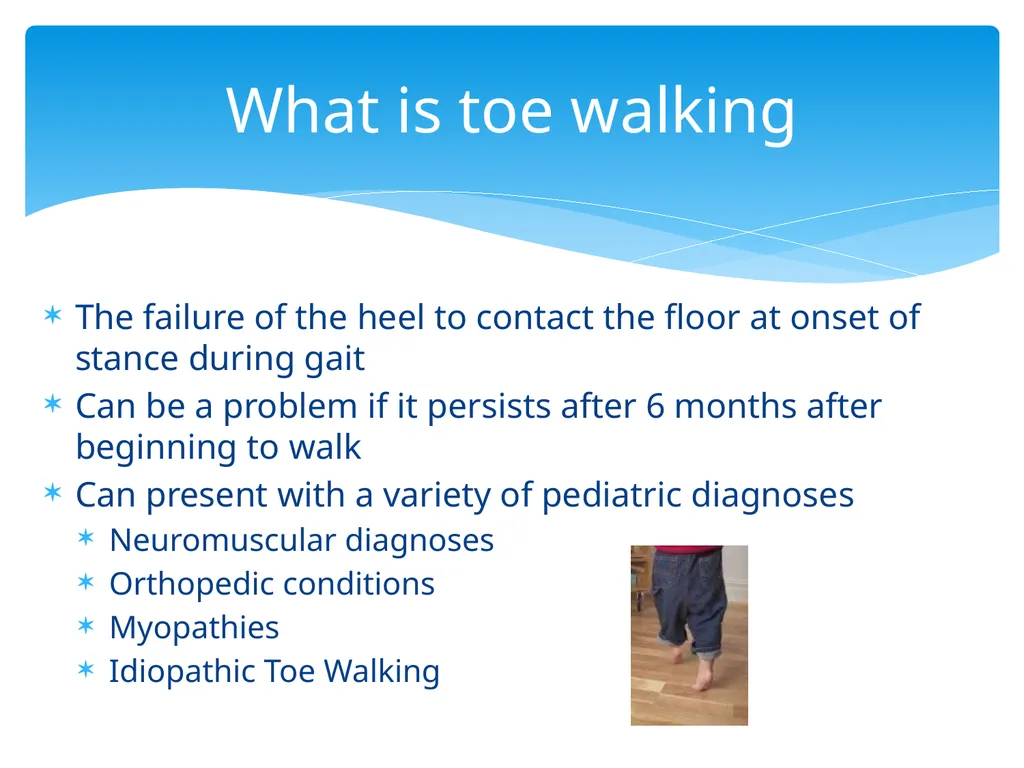
slide3. The failure of the heel to contact the floor at onset of stance during gait
Can be a problem if it persists after 6 months after beginning to walk
Can present with a variety of pediatric diagnoses
Neuromuscular diagnoses
Orthopedic conditions
Myopathies
Idiopathic Toe Walking What is toe walking<br>
slide4. Hypotonia
FM deficits
GM deficits
History of delayed motor milestones
Toe walking
Apraxia
Impaired balance
Impaired equilibrium reactions ASD: common motor deficits<br>
slide5. Incidence reported to be between 20-63%
Characteristics:
Bilateral
May be able to walk with heels down briefly when requested
May increase when barefooted
May increase when excited, tired…
May or may not have limited DF ROM Toe Walking and ASD<br>
slide6. Sensory issues
Decreased proprioception
Hypotonia
Vestibulo-visual issues Possible Causes of Toe Walking in Children with ASD<br>
slide7. Tactile hypersentivity
Tactile hyposensitivity
In sensory integration theory, proprioception is credited with being modulating, calming input Sensory Issues<br>
slide8. Toe walking increases proprioceptive input
Again, can be a modulating, calming input Decreased Proprioception<br>
slide9. Can cause ankle instability
Toe walking provides increased ankle stability Hypotonia<br>
slide10. Many children with autism have adequate focal vision, but impaired ambient vision
Theory that they have either tunnel vision or alternating vision
Results in difficulty seeing in three dimensions and correctly detecting the movement and distance of objects
toe walk to subconsciously increase their awareness of where they are in space to accommodate for these visual deficits Vestibulo-Visual Issues<br>
slide11. “When autistic people walk on their toes, it is because it provides a greater sense of feeling your body and knowing where it is in space” and “helps balance and feeling like you’re not going to tip over” and “helps relieve some dizziness if any occurs with vestibular problems”
Kristina DesJardins
author of Autism: Life in the Prism
creator of the website “Autism and its World” From their perspective<br>
slide12. Increased risk of falls
Foot and ankle deformities
Triceps surae contractures
Decreased function
Increased risk of ankle injury
Limited DF ROM leads to foot compensations which can cause foot and knee problems
Can require surgery Possible Issues of Untreated Toe Walking<br>
slide13. PT
OT
Therapeutic optometrist
Orthotics
Serial Casting
Surgery Treatments for toe walking in children with ASD<br>
slide14. PMH
Birth history
Medical history
Developmental history
GM skills
Balance concerns
Onset of toe walking
Family history of toe walking?
Review current and past therapy Physical Therapy Evaluation<br>
slide15. Systems Review
Pain assessment
Integumentary assessment
Speech and language screen
Sensory processing screen
Consider referring for screening for language delay and for autism spectrum disorders Physical Therapy Evaluation…<br>
slide16. Physical Assessment
Neurological exam
Musculoskeletal exam
Gait exam
Gross motor skills assessment Physical Therapy Evaluation…<br>
slide17. Can include:
Stretching the ankle plantarflexors
Strengthening the anterior tibialis and other LE and trunk muscles
Parent education and HEP
Orthotic intervention
Shoe modification
Gait training
Night splinting
Serial casting Physical Therapy Treatment<br>
slide18. Inserts
Braces
Day braces
Night braces
Shoe modifications Orthotics<br>
slide19. Can be accompanied by Botox injections Serial Casting<br>
slide20. Therapeutic brushing
Graded desensitization to tactile input
Providing other proprioceptive input:
Jumping on a trampoline
Stomping feet
Walking in the sand
Providing traction
Other activities that provide compression and traction Occupational Therapy Treatment<br>
slide21. Vision training program developed by Melvin Kaplan, OD
Uses ambient prism lenses “to actually alter perception in ways that cause patients to reorganize their visual processes”
Reports immediate short term effects, long term effects can take up to a year Therapeutic Optometrist<br>
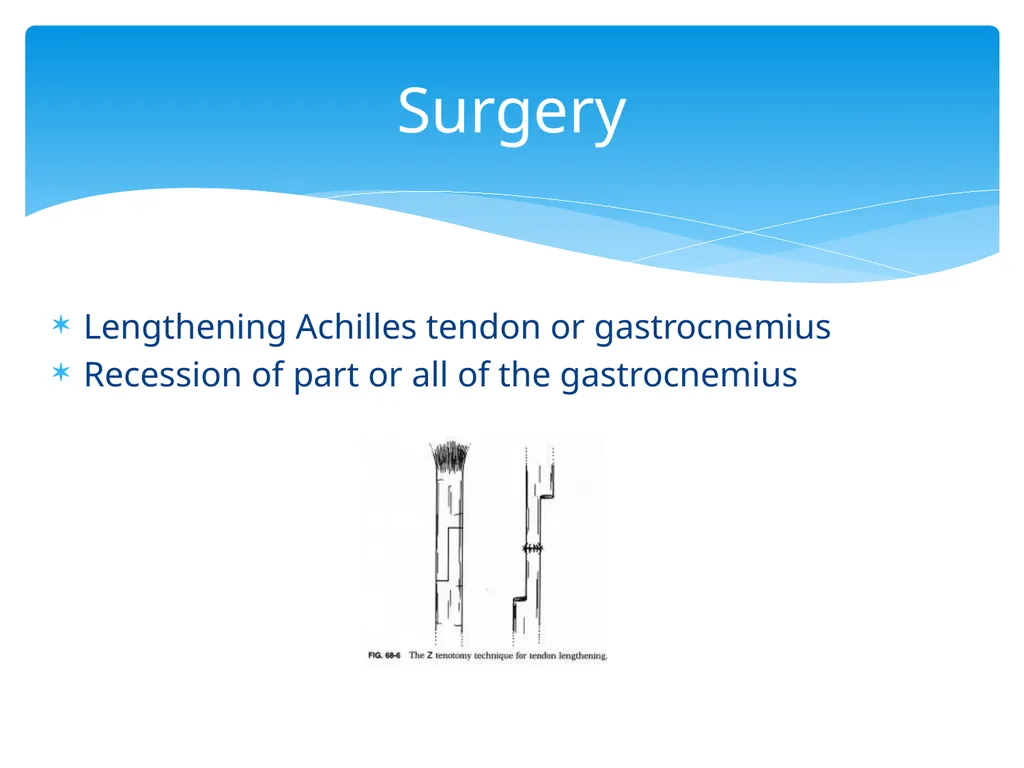
slide22. Lengthening Achilles tendon or gastrocnemius
Recession of part or all of the gastrocnemius Surgery<br>
slide23. Refer children who have been toe walking for more than 6 months after beginning to walk for physical therapy evaluation!
Consider apparent cause of toe walking
Work as a team to provide the best care
Thank you for your time! Plan of Action!<br>
slide24. Barrow, W. J., Jaworski, M., & Accardo, P. J. (2011). Persistent toe walking in autism. Journal of Child Neurology, 26(5), 619-21. doi: 10.1177/0883073810385344
Collmer, K. (2011, November 7). [Web log message]. Retrieved from http://community.advanceweb.com/blogs/ot_8/archive/2011/11/07/toe-walking-and-vision-unlikely-companions-that-we-need-to-see-to-believe.aspx
DesJardins, K. (2010, February 20). [Web log message]. Retrieved from http://chat1autism.wetpaint.com/page/Autism and tip-toeing..why?
Edelson, S. M. (2011). Toe walking. Autism Research Institute, Retrieved from http://www.autism.com/index.php/symptoms_toe_walking
Gregory, G. (2009, March 01). [Web log message]. Retrieved from http://www.helium.com/items/1360205-autism-and-toe-walking Works Cited<br>
slide25. Kaplan, M. (2006). Visual management: a physiological approach to rehabilitating autism spectrum disorders. Autism research review international, 20(2), 3. Retrieved from http://www.autisticvision.com/cvmUpdateInfo/articles/vismgt.PDF
Ming, X., Brimacombe, B., & Wagner, G. C. (2007). Prevalence of motor impairment in autism spectrum disorders. Brain Development, 29(9), 565-70. Retrieved from http://www.ncbi.nlm.nih.gov/pubmed/17467940
Le Cras S., Bouck J., Brausch S., Taylor-Haas A.; Cincinatti Children’s Hopsital Medical Center: Evidence-based clinical care guideline for Management of Idiopathic Toe Walking. Guideline 040, pages 1-17, February 15,2011 http://www.cincinattichildrens.org/service/j/anderson-center/evidence-based-care/occupational-therapy-physical-therapy/
Yoell, C. (2011, March 06). Toe walking in children with autism. Retrieved from http://ebookbrowse.com/toe-walking-handout-doc-d75647361
Zimbler, S. (2010). Idiopathic toe walking: current evaluation and management. Orthopedic Jounral at Harvard Medical School, Retrieved from http://www.orthojournalhms.org/volume9 Works Cited…<br>

slide26. Questions?<br>
UNC Chapel Hill, DPT 2013<br>
slide2. Toe walking definition
Incidence in children with ASD
Theories on cause of toe walking in children with ASD
Possible outcomes of untreated toe walking
Treatment options for toe walking
Plan of action Presentation Outline<br>
slide3. The failure of the heel to contact the floor at onset of stance during gait
Can be a problem if it persists after 6 months after beginning to walk
Can present with a variety of pediatric diagnoses
Neuromuscular diagnoses
Orthopedic conditions
Myopathies
Idiopathic Toe Walking What is toe walking<br>
slide4. Hypotonia
FM deficits
GM deficits
History of delayed motor milestones
Toe walking
Apraxia
Impaired balance
Impaired equilibrium reactions ASD: common motor deficits<br>
slide5. Incidence reported to be between 20-63%
Characteristics:
Bilateral
May be able to walk with heels down briefly when requested
May increase when barefooted
May increase when excited, tired…
May or may not have limited DF ROM Toe Walking and ASD<br>
slide6. Sensory issues
Decreased proprioception
Hypotonia
Vestibulo-visual issues Possible Causes of Toe Walking in Children with ASD<br>
slide7. Tactile hypersentivity
Tactile hyposensitivity
In sensory integration theory, proprioception is credited with being modulating, calming input Sensory Issues<br>
slide8. Toe walking increases proprioceptive input
Again, can be a modulating, calming input Decreased Proprioception<br>
slide9. Can cause ankle instability
Toe walking provides increased ankle stability Hypotonia<br>
slide10. Many children with autism have adequate focal vision, but impaired ambient vision
Theory that they have either tunnel vision or alternating vision
Results in difficulty seeing in three dimensions and correctly detecting the movement and distance of objects
toe walk to subconsciously increase their awareness of where they are in space to accommodate for these visual deficits Vestibulo-Visual Issues<br>
slide11. “When autistic people walk on their toes, it is because it provides a greater sense of feeling your body and knowing where it is in space” and “helps balance and feeling like you’re not going to tip over” and “helps relieve some dizziness if any occurs with vestibular problems”
Kristina DesJardins
author of Autism: Life in the Prism
creator of the website “Autism and its World” From their perspective<br>
slide12. Increased risk of falls
Foot and ankle deformities
Triceps surae contractures
Decreased function
Increased risk of ankle injury
Limited DF ROM leads to foot compensations which can cause foot and knee problems
Can require surgery Possible Issues of Untreated Toe Walking<br>
slide13. PT
OT
Therapeutic optometrist
Orthotics
Serial Casting
Surgery Treatments for toe walking in children with ASD<br>
slide14. PMH
Birth history
Medical history
Developmental history
GM skills
Balance concerns
Onset of toe walking
Family history of toe walking?
Review current and past therapy Physical Therapy Evaluation<br>
slide15. Systems Review
Pain assessment
Integumentary assessment
Speech and language screen
Sensory processing screen
Consider referring for screening for language delay and for autism spectrum disorders Physical Therapy Evaluation…<br>
slide16. Physical Assessment
Neurological exam
Musculoskeletal exam
Gait exam
Gross motor skills assessment Physical Therapy Evaluation…<br>
slide17. Can include:
Stretching the ankle plantarflexors
Strengthening the anterior tibialis and other LE and trunk muscles
Parent education and HEP
Orthotic intervention
Shoe modification
Gait training
Night splinting
Serial casting Physical Therapy Treatment<br>
slide18. Inserts
Braces
Day braces
Night braces
Shoe modifications Orthotics<br>
slide19. Can be accompanied by Botox injections Serial Casting<br>
slide20. Therapeutic brushing
Graded desensitization to tactile input
Providing other proprioceptive input:
Jumping on a trampoline
Stomping feet
Walking in the sand
Providing traction
Other activities that provide compression and traction Occupational Therapy Treatment<br>
slide21. Vision training program developed by Melvin Kaplan, OD
Uses ambient prism lenses “to actually alter perception in ways that cause patients to reorganize their visual processes”
Reports immediate short term effects, long term effects can take up to a year Therapeutic Optometrist<br>
slide22. Lengthening Achilles tendon or gastrocnemius
Recession of part or all of the gastrocnemius Surgery<br>
slide23. Refer children who have been toe walking for more than 6 months after beginning to walk for physical therapy evaluation!
Consider apparent cause of toe walking
Work as a team to provide the best care
Thank you for your time! Plan of Action!<br>
slide24. Barrow, W. J., Jaworski, M., & Accardo, P. J. (2011). Persistent toe walking in autism. Journal of Child Neurology, 26(5), 619-21. doi: 10.1177/0883073810385344
Collmer, K. (2011, November 7). [Web log message]. Retrieved from http://community.advanceweb.com/blogs/ot_8/archive/2011/11/07/toe-walking-and-vision-unlikely-companions-that-we-need-to-see-to-believe.aspx
DesJardins, K. (2010, February 20). [Web log message]. Retrieved from http://chat1autism.wetpaint.com/page/Autism and tip-toeing..why?
Edelson, S. M. (2011). Toe walking. Autism Research Institute, Retrieved from http://www.autism.com/index.php/symptoms_toe_walking
Gregory, G. (2009, March 01). [Web log message]. Retrieved from http://www.helium.com/items/1360205-autism-and-toe-walking Works Cited<br>
slide25. Kaplan, M. (2006). Visual management: a physiological approach to rehabilitating autism spectrum disorders. Autism research review international, 20(2), 3. Retrieved from http://www.autisticvision.com/cvmUpdateInfo/articles/vismgt.PDF
Ming, X., Brimacombe, B., & Wagner, G. C. (2007). Prevalence of motor impairment in autism spectrum disorders. Brain Development, 29(9), 565-70. Retrieved from http://www.ncbi.nlm.nih.gov/pubmed/17467940
Le Cras S., Bouck J., Brausch S., Taylor-Haas A.; Cincinatti Children’s Hopsital Medical Center: Evidence-based clinical care guideline for Management of Idiopathic Toe Walking. Guideline 040, pages 1-17, February 15,2011 http://www.cincinattichildrens.org/service/j/anderson-center/evidence-based-care/occupational-therapy-physical-therapy/
Yoell, C. (2011, March 06). Toe walking in children with autism. Retrieved from http://ebookbrowse.com/toe-walking-handout-doc-d75647361
Zimbler, S. (2010). Idiopathic toe walking: current evaluation and management. Orthopedic Jounral at Harvard Medical School, Retrieved from http://www.orthojournalhms.org/volume9 Works Cited…<br>
slide26. Questions?<br>