
ASSESS SUPERSTEP Unit IV ASSESS SUPERSTEP Data

Description: ASSESS SUPERSTEP Unit IV ASSESS SUPERSTEP Data quality problems result in a 20 decrease in worker productivity and explain why 40 of business initiatives fail to achieve set goals. Incorrect data can harm a reputation, misdirect
Related Topics
Download Presentation
"ASSESS SUPERSTEP Unit IV ASSESS SUPERSTEP Data" is the property of its rightful owner. Permission is granted to download and print the materials on this website for personal, non-commercial use only, and to display it on your personal computer provided you do not modify the materials and that you retain all copyright notices contained in the materials. By downloading content from our website, you accept the terms of this agreement.
Presentation Transcript
slide1. ASSESS SUPERSTEP Unit IV<br>
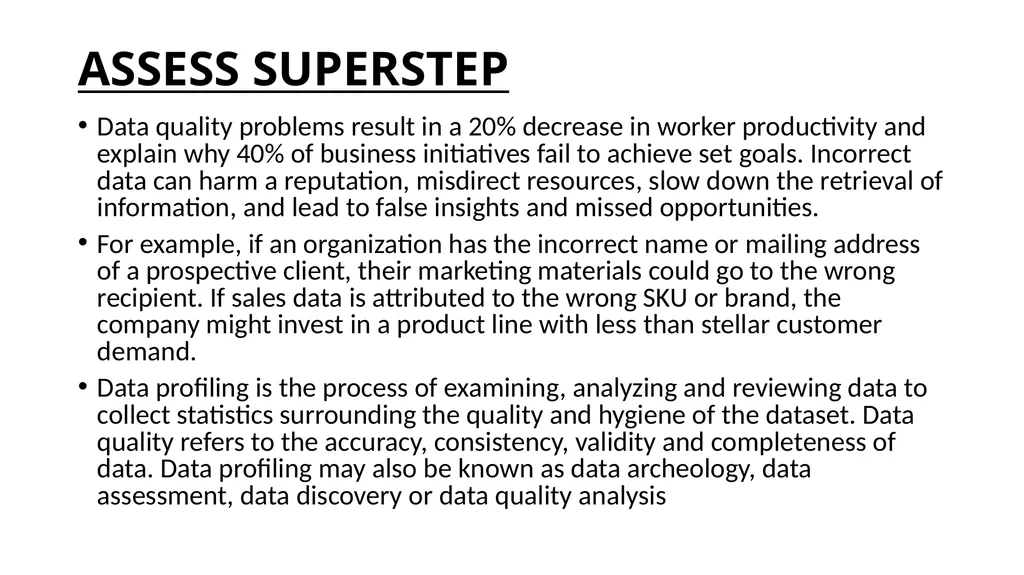
slide2. ASSESS SUPERSTEP Data quality problems result in a 20% decrease in worker productivity and explain why 40% of business initiatives fail to achieve set goals. Incorrect data can harm a reputation, misdirect resources, slow down the retrieval of information, and lead to false insights and missed opportunities.
For example, if an organization has the incorrect name or mailing address of a prospective client, their marketing materials could go to the wrong recipient. If sales data is attributed to the wrong SKU or brand, the company might invest in a product line with less than stellar customer demand.
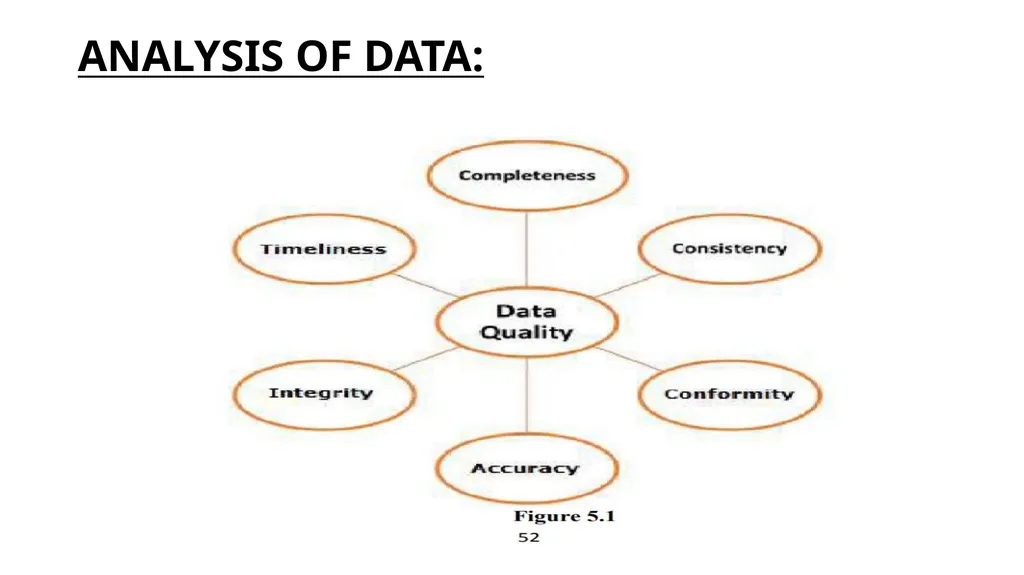
Data profiling is the process of examining, analyzing and reviewing data to collect statistics surrounding the quality and hygiene of the dataset. Data quality refers to the accuracy, consistency, validity and completeness of data. Data profiling may also be known as data archeology, data assessment, data discovery or data quality analysis<br>
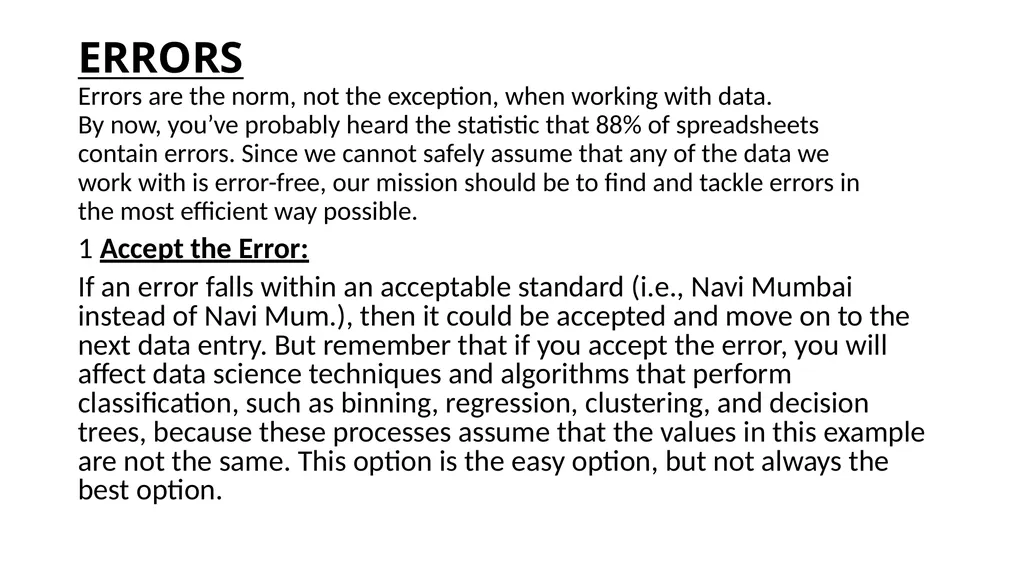
slide3. ERRORS Errors are the norm, not the exception, when working with data. By now, you’ve probably heard the statistic that 88% of spreadsheets contain errors. Since we cannot safely assume that any of the data we work with is error-free, our mission should be to find and tackle errors in the most efficient way possible. 1 Accept the Error:
If an error falls within an acceptable standard (i.e., Navi Mumbai instead of Navi Mum.), then it could be accepted and move on to the next data entry. But remember that if you accept the error, you will affect data science techniques and algorithms that perform classification, such as binning, regression, clustering, and decision trees, because these processes assume that the values in this example are not the same. This option is the easy option, but not always the best option.<br>
slide4. 2 Reject the Error:
Unless the nature of missing data is ‘Missing completely at random’, the best avoidable method in many cases is deletion. a. Listwise: In this case, rows containing missing variables are deleted.
Use reject the error option if you can afford to lose a bit of data. This is an option to be used only if the number of missing values is 2% of the whole dataset or less.
3 Correct the Error:
This is a option that a major part of the assess is dedicated to. Spelling mistakes in customers name, address, location are a common source of errors, which are methodically corrected.
If there are variations on a name, I recommend that you set one data source as the “master” and keep the data consolidated and correct across all the databases using that master as your primary source.<br>
slide5. 4 Create a Default Value:
NaN is the default missing value marker for reasons of computational speed and convenience. This is a sentinel value, in the sense that it is a dummy data or flag value that can be easily detected and worked with using functions in pandas.<br>
slide6. ANALYSIS OF DATA:<br>
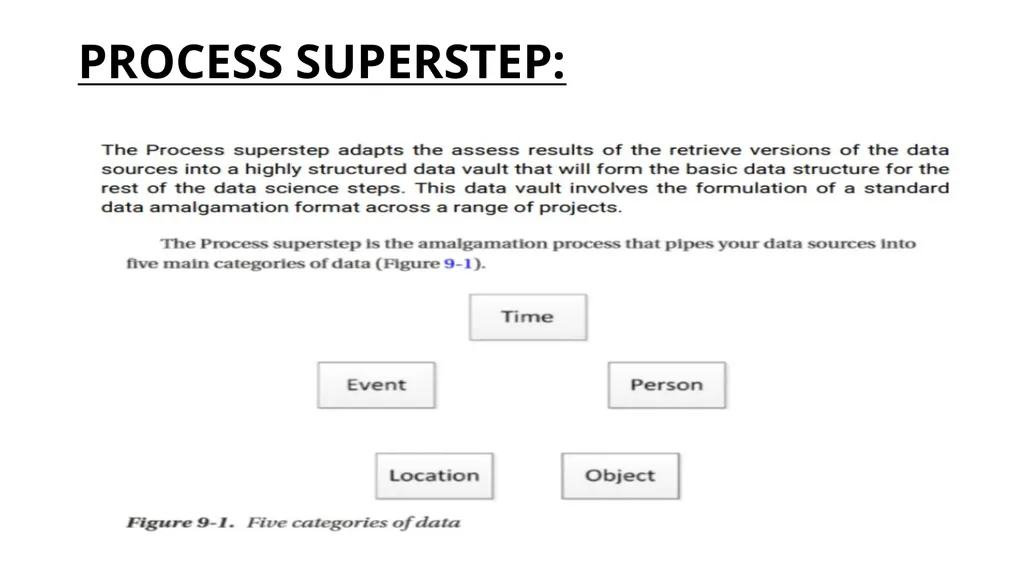
slide7. PROCESS SUPERSTEP:<br>
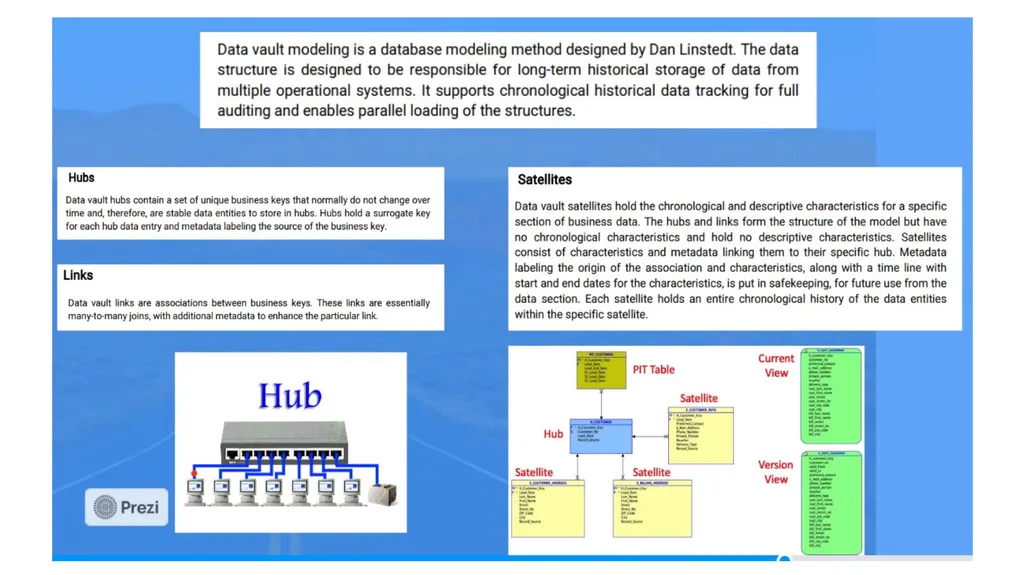
slide8. DATA VAULT<br>
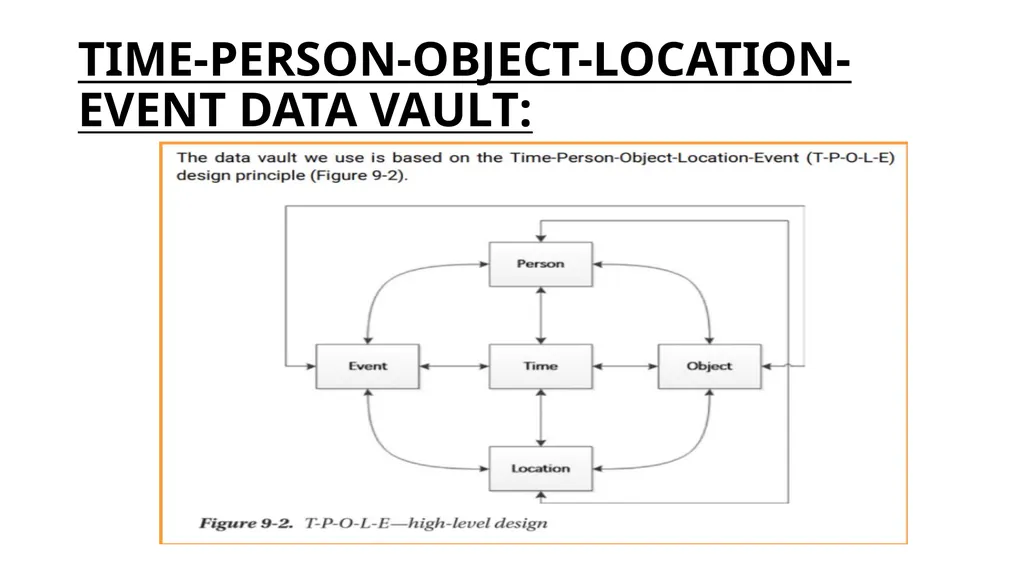
slide10. TIME-PERSON-OBJECT-LOCATION-EVENT DATA VAULT:<br>
slide2. ASSESS SUPERSTEP Data quality problems result in a 20% decrease in worker productivity and explain why 40% of business initiatives fail to achieve set goals. Incorrect data can harm a reputation, misdirect resources, slow down the retrieval of information, and lead to false insights and missed opportunities.
For example, if an organization has the incorrect name or mailing address of a prospective client, their marketing materials could go to the wrong recipient. If sales data is attributed to the wrong SKU or brand, the company might invest in a product line with less than stellar customer demand.
Data profiling is the process of examining, analyzing and reviewing data to collect statistics surrounding the quality and hygiene of the dataset. Data quality refers to the accuracy, consistency, validity and completeness of data. Data profiling may also be known as data archeology, data assessment, data discovery or data quality analysis<br>
slide3. ERRORS Errors are the norm, not the exception, when working with data. By now, you’ve probably heard the statistic that 88% of spreadsheets contain errors. Since we cannot safely assume that any of the data we work with is error-free, our mission should be to find and tackle errors in the most efficient way possible. 1 Accept the Error:
If an error falls within an acceptable standard (i.e., Navi Mumbai instead of Navi Mum.), then it could be accepted and move on to the next data entry. But remember that if you accept the error, you will affect data science techniques and algorithms that perform classification, such as binning, regression, clustering, and decision trees, because these processes assume that the values in this example are not the same. This option is the easy option, but not always the best option.<br>
slide4. 2 Reject the Error:
Unless the nature of missing data is ‘Missing completely at random’, the best avoidable method in many cases is deletion. a. Listwise: In this case, rows containing missing variables are deleted.
Use reject the error option if you can afford to lose a bit of data. This is an option to be used only if the number of missing values is 2% of the whole dataset or less.
3 Correct the Error:
This is a option that a major part of the assess is dedicated to. Spelling mistakes in customers name, address, location are a common source of errors, which are methodically corrected.
If there are variations on a name, I recommend that you set one data source as the “master” and keep the data consolidated and correct across all the databases using that master as your primary source.<br>
slide5. 4 Create a Default Value:
NaN is the default missing value marker for reasons of computational speed and convenience. This is a sentinel value, in the sense that it is a dummy data or flag value that can be easily detected and worked with using functions in pandas.<br>
slide6. ANALYSIS OF DATA:<br>
slide7. PROCESS SUPERSTEP:<br>
slide8. DATA VAULT<br>
slide10. TIME-PERSON-OBJECT-LOCATION-EVENT DATA VAULT:<br>