"Assessing Operational Gaps, Defining Requirements," is the property of its rightful owner. Permission is granted to
download and print the materials on this website for personal, non-commercial use only, and to display it
on your personal computer provided you do not modify the materials and that you retain all copyright
notices contained in the materials. By downloading content from our website, you accept the terms of this
agreement.
Presentation Transcript
01
Assessing Operational Gaps, Defining Requirements, Evaluating Solutions, and Planning Successful Deployment Comprehensive Business Analysis and Solution Implementation<br>
02
Comprehensive Business Analysis and Solution Implementation 03
04
05
06
07
08
09
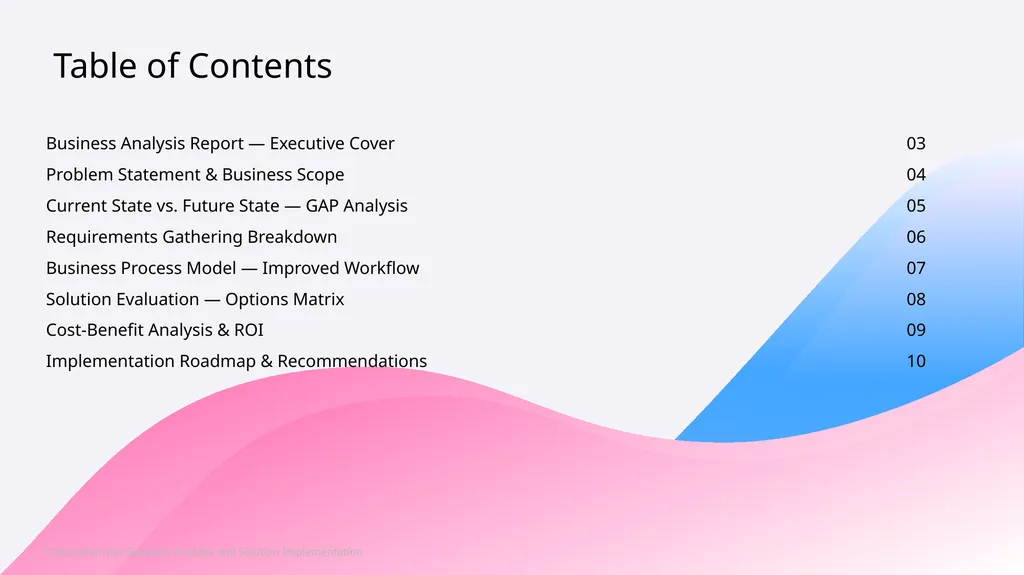
10 Business Analysis Report — Executive Cover
Problem Statement & Business Scope
Current State vs. Future State — GAP Analysis
Requirements Gathering Breakdown
Business Process Model — Improved Workflow
Solution Evaluation — Options Matrix
Cost-Benefit Analysis & ROI
Implementation Roadmap & Recommendations Table of Contents<br>
03
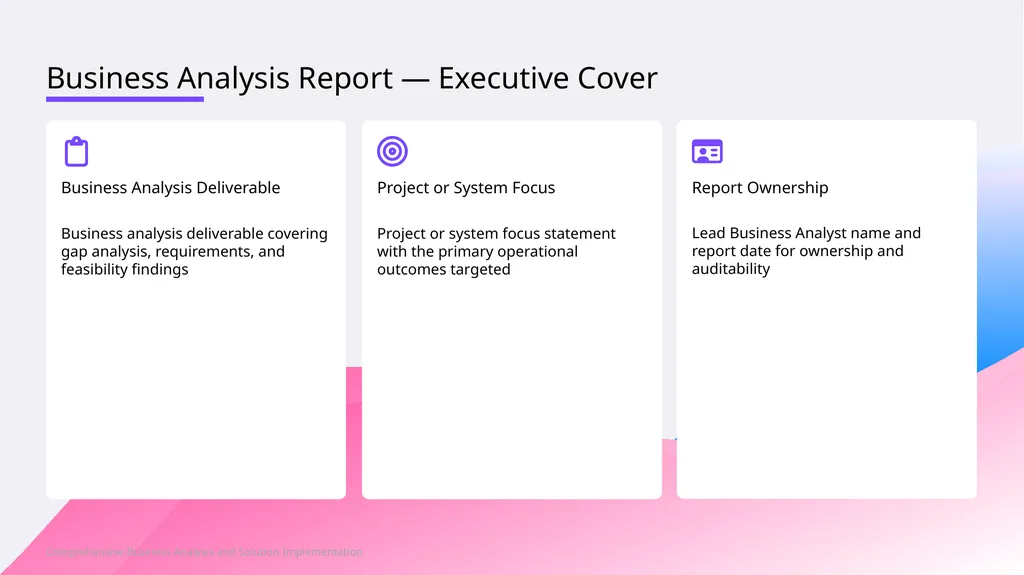
Comprehensive Business Analysis and Solution Implementation Business Analysis Report — Executive Cover Lead Business Analyst name and report date for ownership and auditability Report Ownership Project or system focus statement with the primary operational outcomes targeted Project or System Focus Business analysis deliverable covering gap analysis, requirements, and feasibility findings Business Analysis Deliverable<br>
04
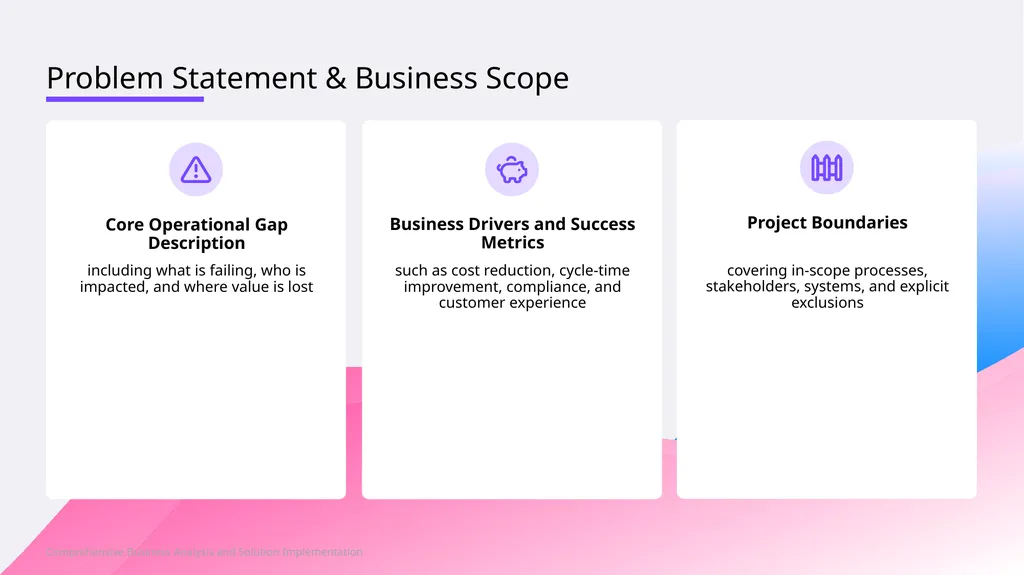
Comprehensive Business Analysis and Solution Implementation Problem Statement & Business Scope covering in-scope processes, stakeholders, systems, and explicit exclusions Project Boundaries such as cost reduction, cycle-time improvement, compliance, and customer experience Business Drivers and Success Metrics including what is failing, who is impacted, and where value is lost Core Operational Gap Description<br>
05
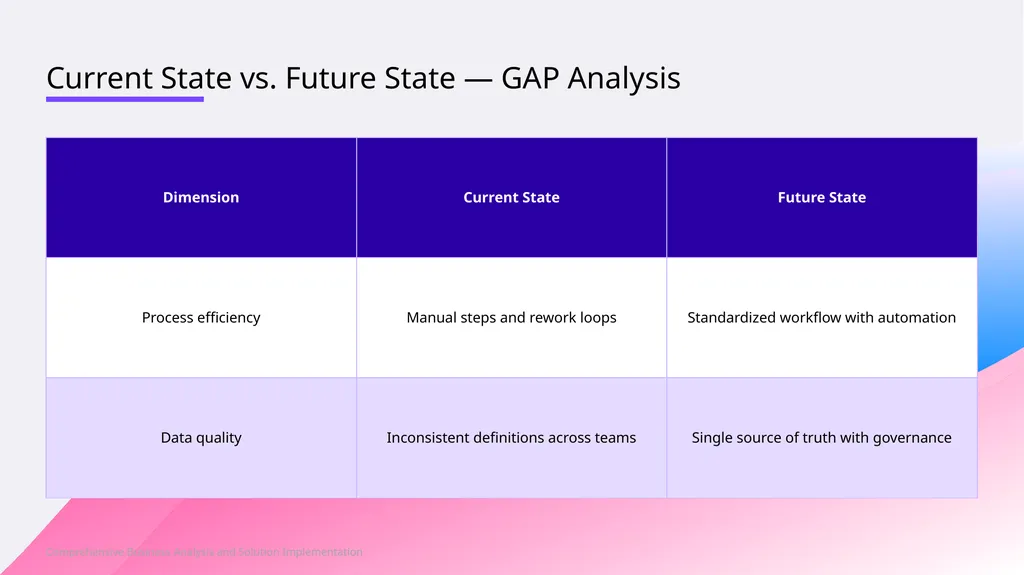
Comprehensive Business Analysis and Solution Implementation Current State vs. Future State — GAP Analysis<br>
06
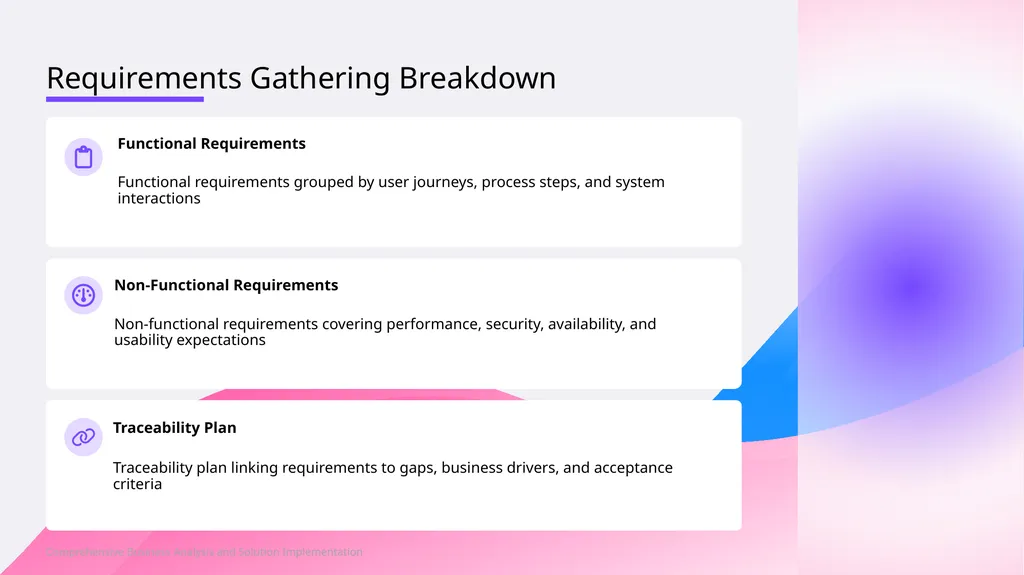
Comprehensive Business Analysis and Solution Implementation Requirements Gathering Breakdown Traceability plan linking requirements to gaps, business drivers, and acceptance criteria Traceability Plan Non-functional requirements covering performance, security, availability, and usability expectations Non-Functional Requirements Functional Requirements Functional requirements grouped by user journeys, process steps, and system interactions<br>
07
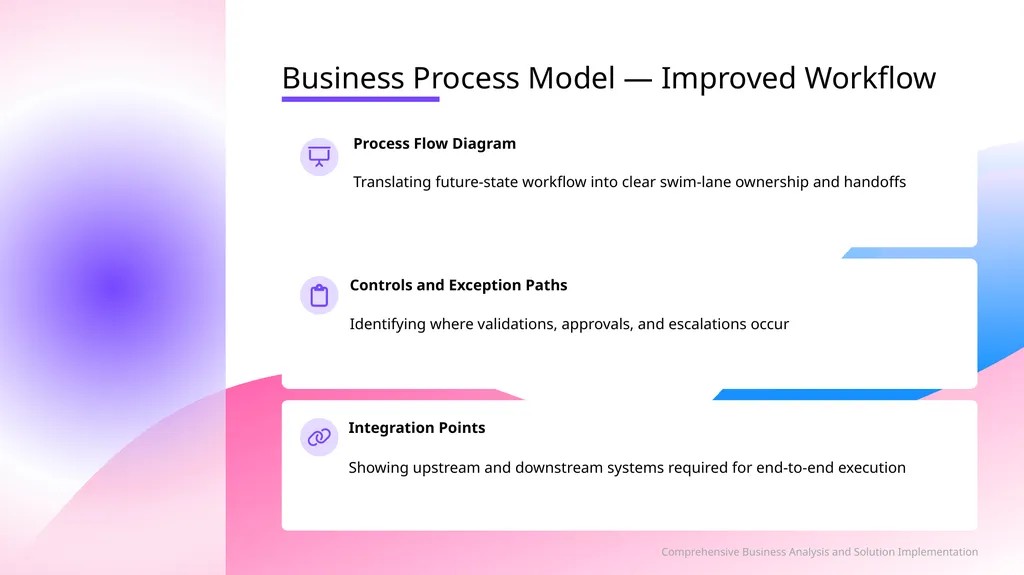
Comprehensive Business Analysis and Solution Implementation Business Process Model — Improved Workflow Showing upstream and downstream systems required for end-to-end execution Integration Points Identifying where validations, approvals, and escalations occur Controls and Exception Paths Process Flow Diagram Translating future-state workflow into clear swim-lane ownership and handoffs<br>
08
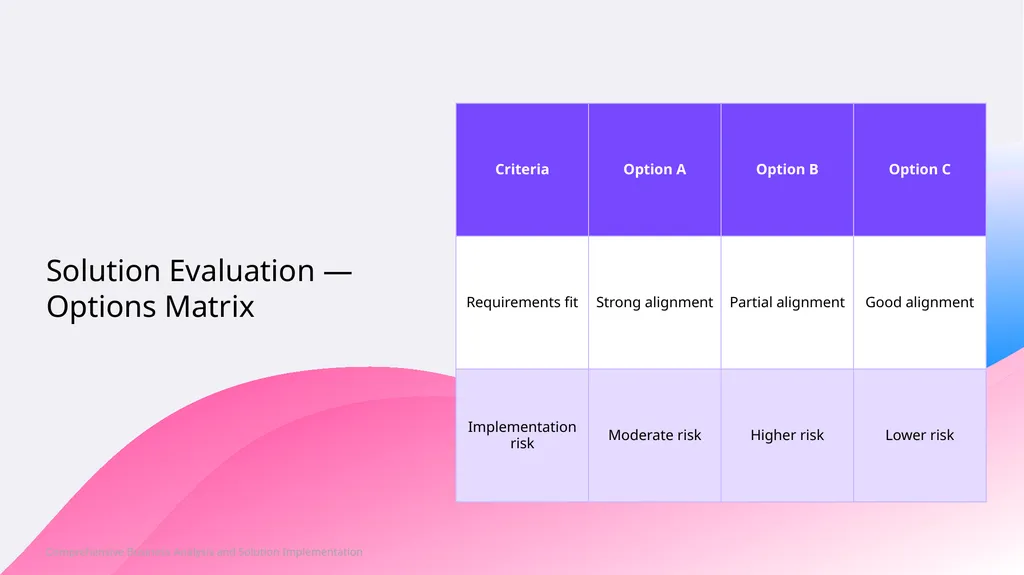
Comprehensive Business Analysis and Solution Implementation Solution Evaluation — Options Matrix<br>
09
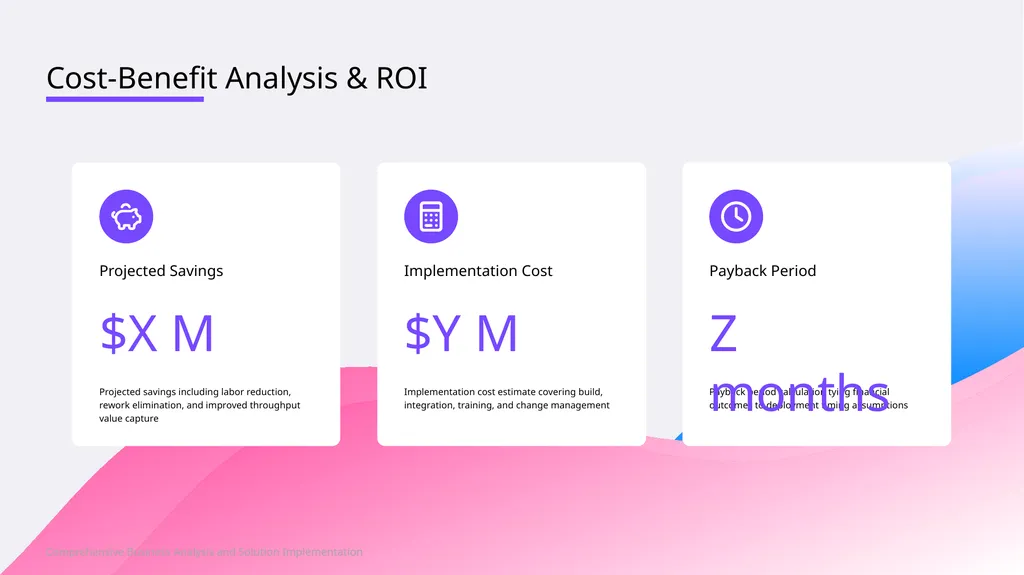
Comprehensive Business Analysis and Solution Implementation Cost-Benefit Analysis & ROI Payback period calculation tying financial outcomes to deployment timing assumptions Z months Payback Period Implementation cost estimate covering build, integration, training, and change management $Y M Implementation Cost Projected savings including labor reduction, rework elimination, and improved throughput value capture $X M Projected Savings<br>
10
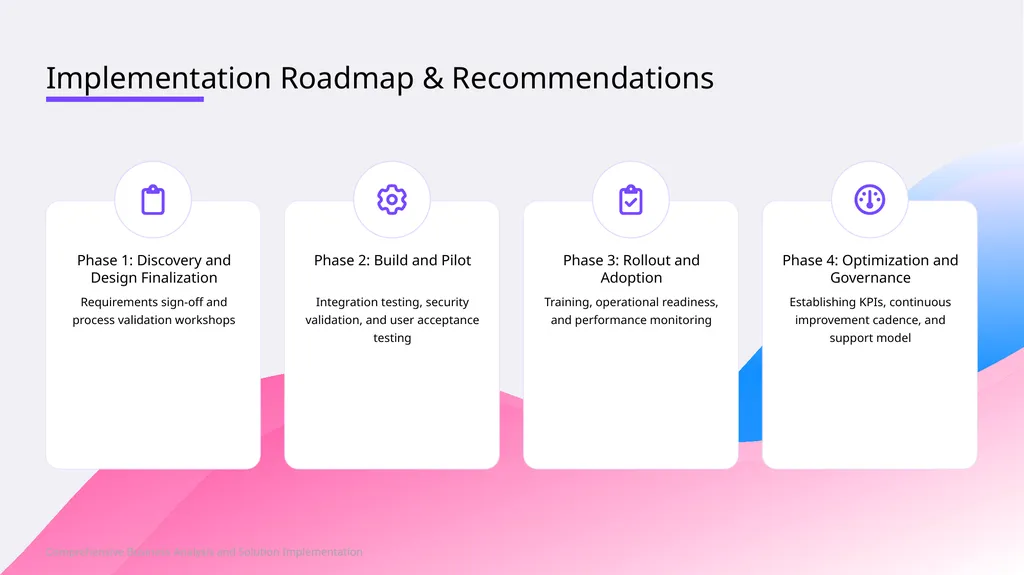
Comprehensive Business Analysis and Solution Implementation Implementation Roadmap & Recommendations Establishing KPIs, continuous improvement cadence, and support model Phase 4: Optimization and Governance Training, operational readiness, and performance monitoring Phase 3: Rollout and Adoption Integration testing, security validation, and user acceptance testing Phase 2: Build and Pilot Requirements sign-off and process validation workshops Phase 1: Discovery and Design Finalization<br>