Assessing WJEC AS Music Assessing evidence Understanding the assessment criteria Marking criteria generally take two forms: objective marking - generally for low tariff responses, where knowledge of objective information is being assessed
"Assessing WJEC AS Music Assessing evidence" is the property of its rightful owner. Permission is granted to
download and print the materials on this website for personal, non-commercial use only, and to display it
on your personal computer provided you do not modify the materials and that you retain all copyright
notices contained in the materials. By downloading content from our website, you accept the terms of this
agreement.
Presentation Transcript
01
Assessing WJEC AS Music<br>
02
Assessing evidence Understanding the assessment criteria
Marking criteria generally take two forms:
objective marking - generally for low tariff responses, where knowledge of objective information is being assessed
the exercising of academic judgement via:
an assessment grid setting out criteria for different levels of response
indicative content, that is, an indication of the kind of content responses may include.<br>
03
Assessing evidence Understanding the assessment criteria – objective marking
For questions assessing objective knowledge, the marking criteria should be applied precisely. Marks should be awarded as indicated and no further subdivision made.
Where the marking criteria list points which may be included in learners' answers, the list is not exhaustive and teachers should credit valid alternative responses which are not listed.
In general, credit should be given according to the accuracy and relevance of learners’ answers.
Unit 3 2019 question 1,3 and 5 are good examples of a points based marking scheme.<br>
04
Assessing evidence Understanding the assessment criteria – exercising academic judgement through levels of response marking schemes
First - identify the appropriate band a learner’s response falls into according to the criteria. Award a band where the learner’s response covers the majority of the criteria.
Second - award a mark in the centre of the band and then increase or decrease the mark depending on the quality of the answer, which may be reflected in the amount of indicative content covered.
If a response falls between two bands, consider whether there are more characteristics of the higher or lower of the two bands and award accordingly.
Indicative content is not exhaustive and other valid responses may be credited.
Unit 3 2019 question 2, 4 and 6 are good examples of a banded marking scheme<br>
05
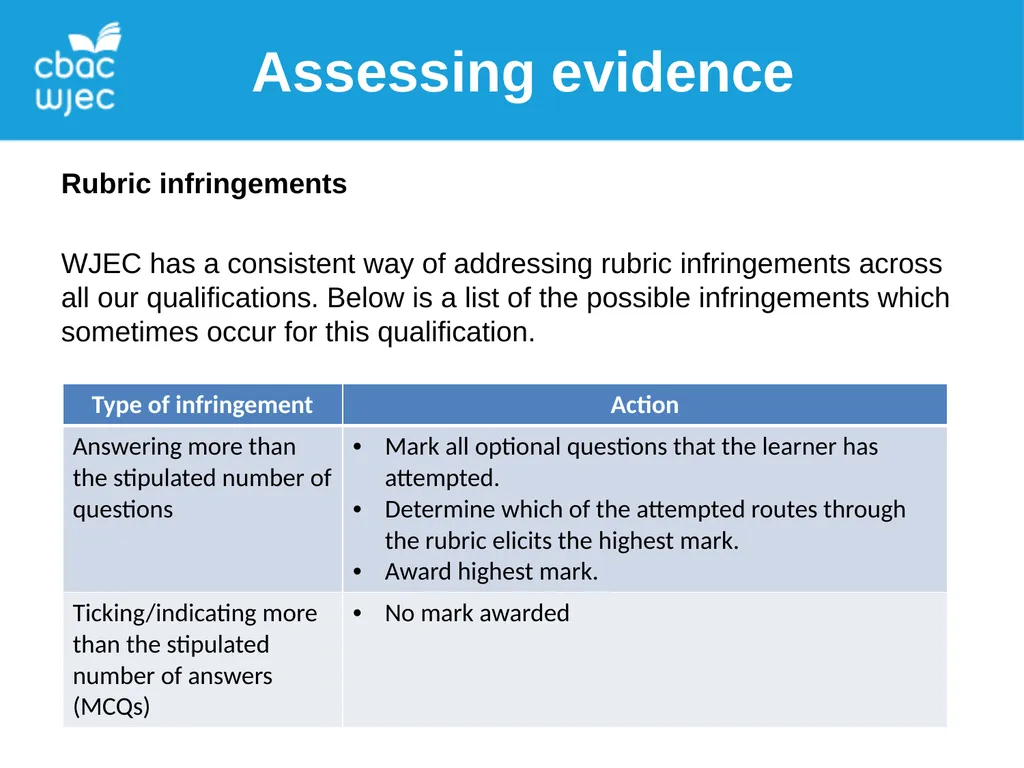
Assessing evidence Rubric infringements
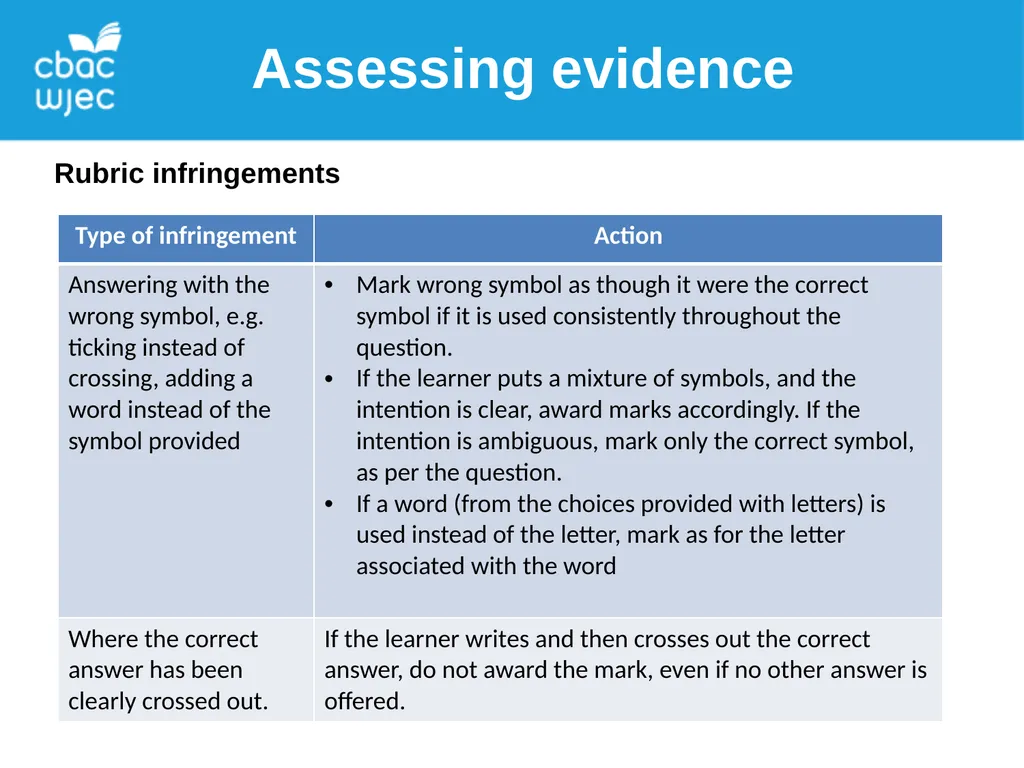
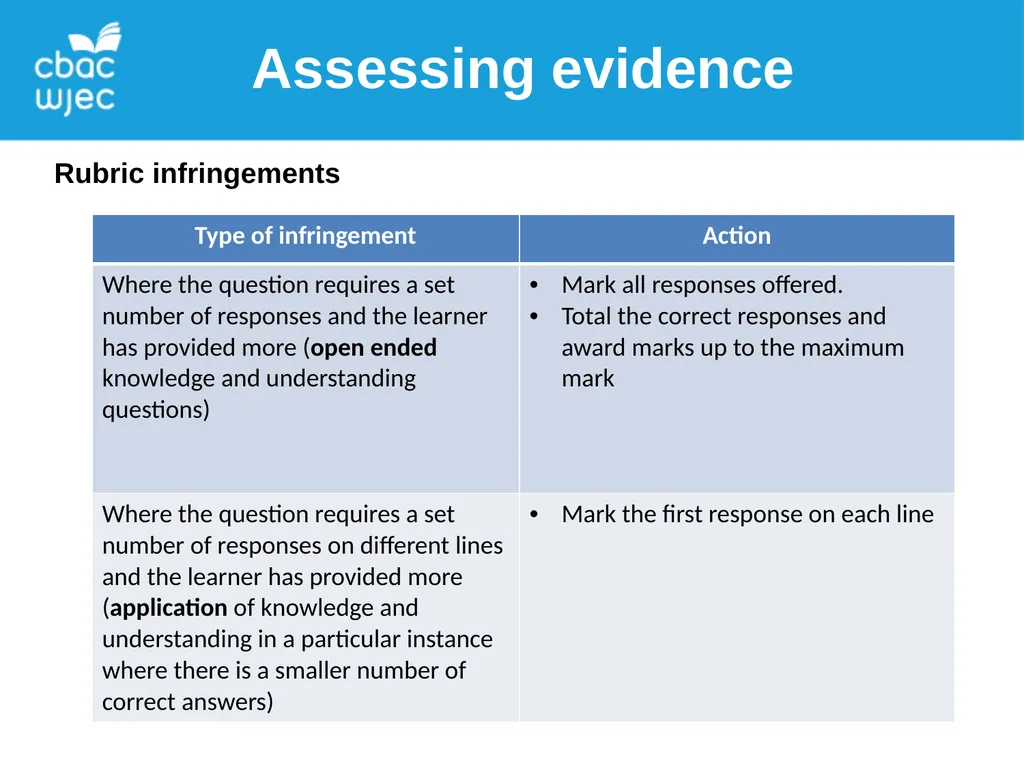
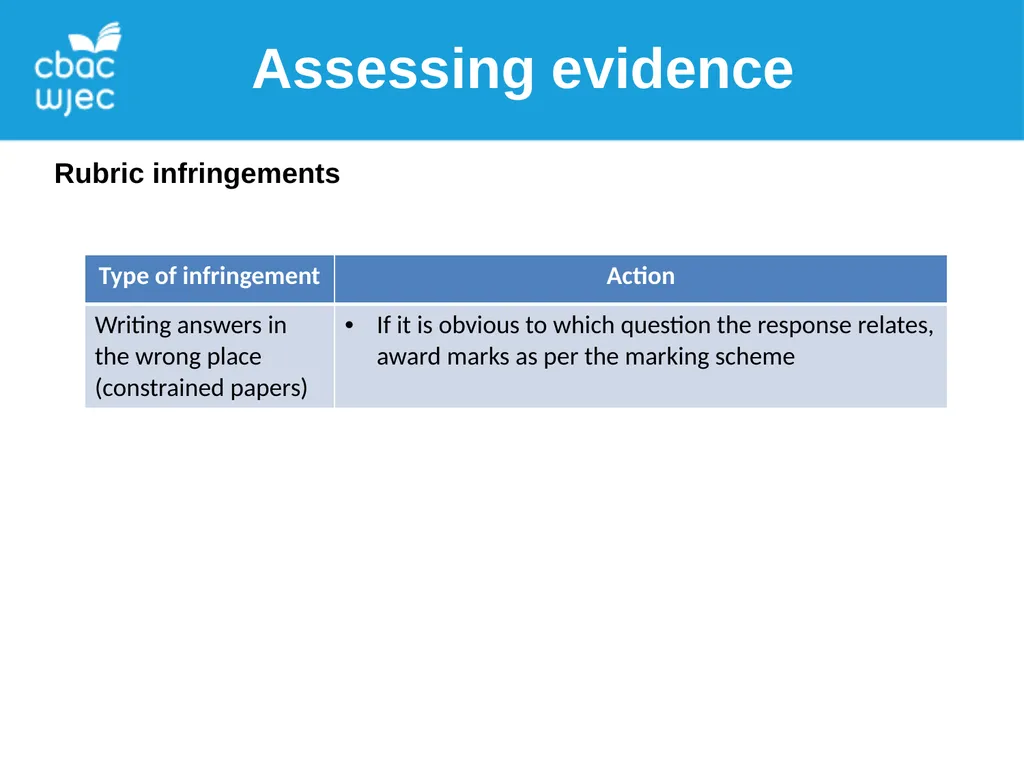
WJEC has a consistent way of addressing rubric infringements across all our qualifications. Below is a list of the possible infringements which sometimes occur for this qualification.<br>
06
Assessing evidence Rubric infringements<br>
07
Assessing evidence Rubric infringements<br>
08
Assessing evidence Rubric infringements<br>
09
Assessing evidence Assessment Criteria
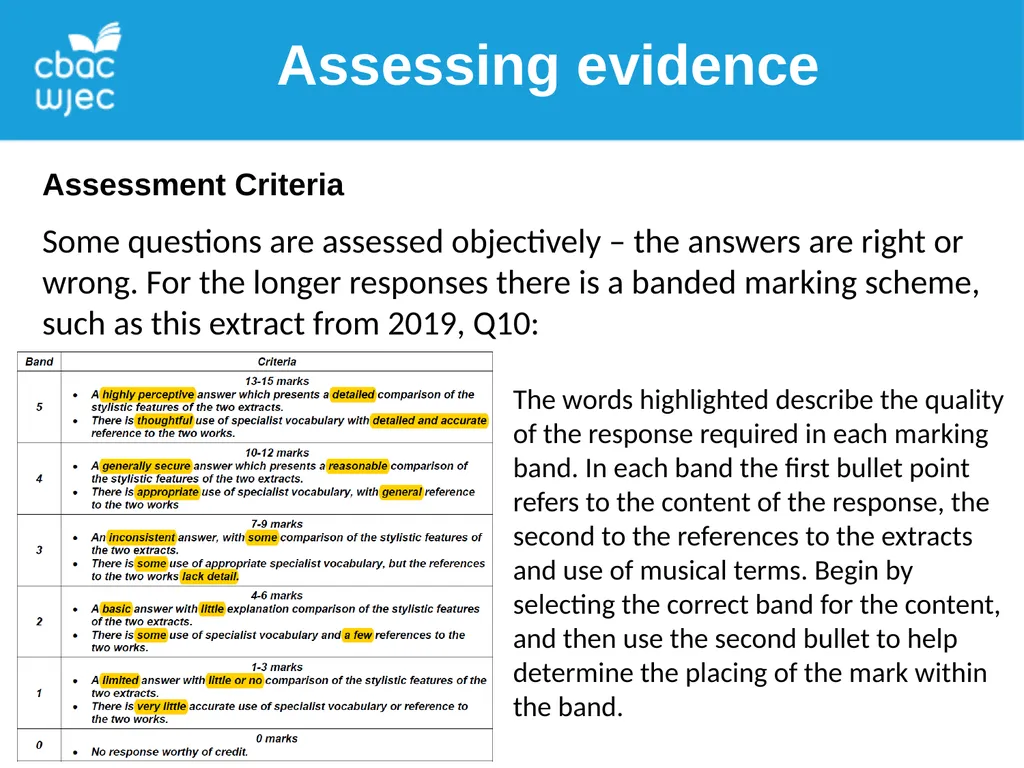
Some questions are assessed objectively – the answers are right or wrong. For the longer responses there is a banded marking scheme, such as this extract from 2019, Q10: The words highlighted describe the quality of the response required in each marking band. In each band the first bullet point refers to the content of the response, the second to the references to the extracts and use of musical terms. Begin by selecting the correct band for the content, and then use the second bullet to help determine the placing of the mark within the band.<br>
10
Assessing evidence Characteristics of a successful response
A successful response will contain a detailed comparison of the two extracts using correctly applied musical terminology and detailed reference to the stylistic features of the music heard.
The exemplar provided within the 2018 and 2019 CPD materials contains a range of annotated responses, including a highly perceptive and thorough response.
There is also an Exam Walk Through presentation which focuses on the longer answers and how these are assessed, available on the resources website.<br>
11
Assessing evidence Characteristics of a less successful response
A less successful response will contain little or no comparison of the two extracts with very little use of correct musical terminology or reference to the stylistic features of the music heard.
The exemplar provided within the 2018 and 2019 CPD materials contains a range of annotated responses, including a less successful response.
For further information please see the Principal Examiner’s reports.<br>
12
Any Questions? If you have any questions, contact our specialist subject officers and administrative support team for your subject with any queries. music@wjec.co.uk<br>