
Assessing Quality Assurance Programs and
TD
Published · 23 slides · 0 views
1 / 1
Description
Assessing Quality Assurance Programs and Addressing Corrective Actions Idaho Falls, ID September 2026 Quality Assurance Programs DOE-STD-1095-2025, clause 4.1 Quality Assurance Program (a) The program shall have a documented QAP
Related Topics
Share
Embed code
Download this presentation From Below
"Assessing Quality Assurance Programs and" is the property of its rightful owner. Permission is granted to download and print the materials on this website for personal, non-commercial use only, and to display it on your personal computer provided you do not modify the materials and that you retain all copyright notices contained in the materials. By downloading content from our website, you accept the terms of this agreement.
Presentation Transcript
01
Assessing Quality Assurance Programs and Addressing Corrective Actions Idaho Falls, ID
September 2026<br>
September 2026<br>
02
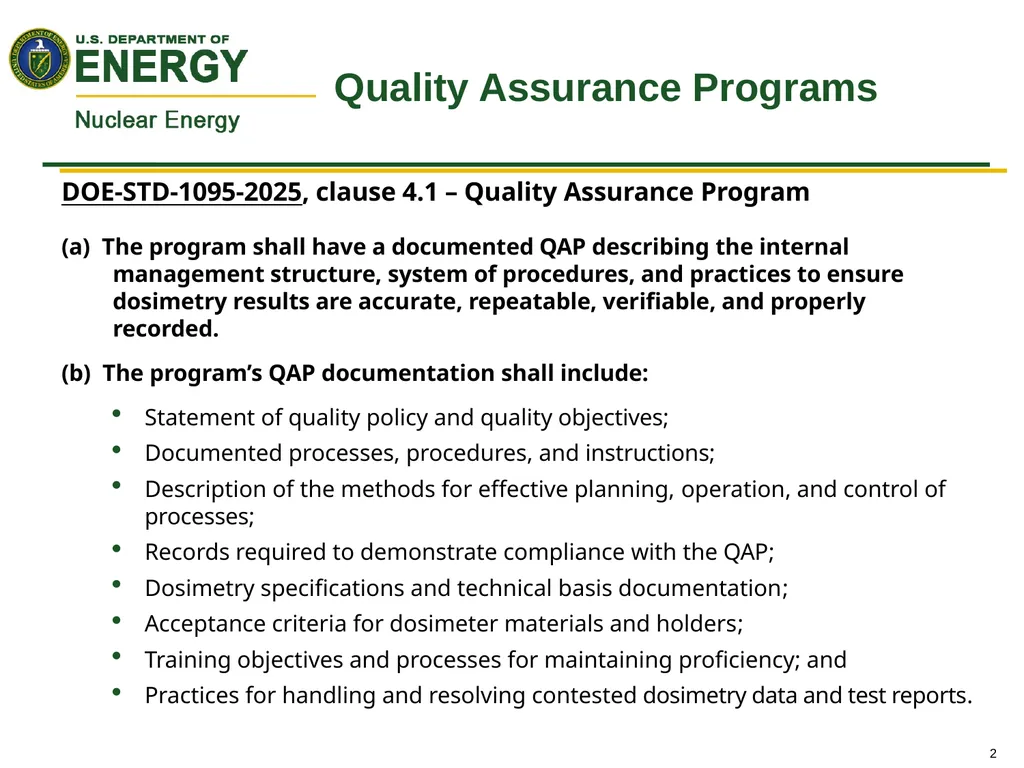
Quality Assurance Programs DOE-STD-1095-2025, clause 4.1 – Quality Assurance Program
(a) The program shall have a documented QAP describing the internal management structure, system of procedures, and practices to ensure dosimetry results are accurate, repeatable, verifiable, and properly recorded.
(b) The program’s QAP documentation shall include:
Statement of quality policy and quality objectives;
Documented processes, procedures, and instructions;
Description of the methods for effective planning, operation, and control of processes;
Records required to demonstrate compliance with the QAP;
Dosimetry specifications and technical basis documentation;
Acceptance criteria for dosimeter materials and holders;
Training objectives and processes for maintaining proficiency; and
Practices for handling and resolving contested dosimetry data and test reports.<br>
(a) The program shall have a documented QAP describing the internal management structure, system of procedures, and practices to ensure dosimetry results are accurate, repeatable, verifiable, and properly recorded.
(b) The program’s QAP documentation shall include:
Statement of quality policy and quality objectives;
Documented processes, procedures, and instructions;
Description of the methods for effective planning, operation, and control of processes;
Records required to demonstrate compliance with the QAP;
Dosimetry specifications and technical basis documentation;
Acceptance criteria for dosimeter materials and holders;
Training objectives and processes for maintaining proficiency; and
Practices for handling and resolving contested dosimetry data and test reports.<br>
03
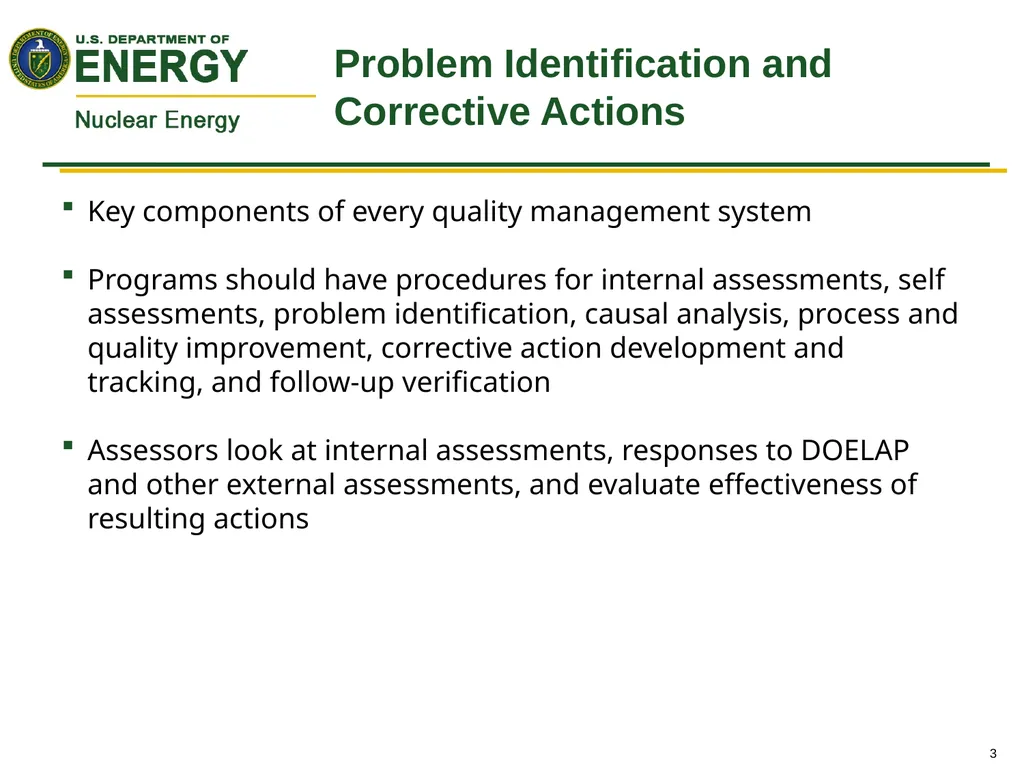
Problem Identification and Corrective Actions Key components of every quality management system
Programs should have procedures for internal assessments, self assessments, problem identification, causal analysis, process and quality improvement, corrective action development and tracking, and follow-up verification
Assessors look at internal assessments, responses to DOELAP and other external assessments, and evaluate effectiveness of resulting actions<br>
Programs should have procedures for internal assessments, self assessments, problem identification, causal analysis, process and quality improvement, corrective action development and tracking, and follow-up verification
Assessors look at internal assessments, responses to DOELAP and other external assessments, and evaluate effectiveness of resulting actions<br>
04
Problem Identification and Corrective Actions The DOE-STD-1095 standard does not explicitly use the phrase “causal analysis” or “root cause analysis (determination)”
Causal analysis is functionally required through corrective action, trend analysis, and system improvement expectations.
Other required actions that imply root‑cause investigation:
Corrective and preventive measures for non‑conformances
Evaluation of deficiency trends during management review
Review of performance testing failures and improvement of dosimetry systems
Vendor/subcontractor audit corrective actions before final assessment
Causal analysis and corrective action is where the rubber meets the road<br>
Causal analysis is functionally required through corrective action, trend analysis, and system improvement expectations.
Other required actions that imply root‑cause investigation:
Corrective and preventive measures for non‑conformances
Evaluation of deficiency trends during management review
Review of performance testing failures and improvement of dosimetry systems
Vendor/subcontractor audit corrective actions before final assessment
Causal analysis and corrective action is where the rubber meets the road<br>
05
Terminology Correction
Corrective Action (CA)
Root Cause
Root Cause Analysis (RCA)
Corrective Action Plan (CAP)<br>
Corrective Action (CA)
Root Cause
Root Cause Analysis (RCA)
Corrective Action Plan (CAP)<br>
06
Correction Action taken to remove or contain a detected nonconformity.
One-time action of fixing a problem that has already been detected or currently occurring (short-term fix)
Quick, on-the-spot fix to a problem; addresses the immediate issue by removing or containing the detected nonconformity (act of containment)
Does not address the underlying cause(s); no action taken to prevent recurrence
“Band-Aid” fix<br>
One-time action of fixing a problem that has already been detected or currently occurring (short-term fix)
Quick, on-the-spot fix to a problem; addresses the immediate issue by removing or containing the detected nonconformity (act of containment)
Does not address the underlying cause(s); no action taken to prevent recurrence
“Band-Aid” fix<br>
07
Corrective Action The action taken to eliminate the cause(s) of existing nonconformities to prevent recurrence.
A long-term, preventive fix
Involves causal analysis, implementing changes, and verifying effectiveness.
Corrective action process starts with a thorough causal analysis
Includes investigating, identifying, and understanding the root cause(s) of the nonconformity
Then, implementing a plan designed to eliminate the identified cause(s) of the nonconformity and preventing it from happening again (i.e., CAP).<br>
A long-term, preventive fix
Involves causal analysis, implementing changes, and verifying effectiveness.
Corrective action process starts with a thorough causal analysis
Includes investigating, identifying, and understanding the root cause(s) of the nonconformity
Then, implementing a plan designed to eliminate the identified cause(s) of the nonconformity and preventing it from happening again (i.e., CAP).<br>
08
Correction vs. Corrective Action Correction = dealing with the symptom (symptom-focused)
Immediate fix
Addresses the detected issue
Does not eliminate the cause
Example: taking ibuprofen for symptomatic relief from a headache
Corrective Action = eliminating the disease (cause-focused)
Long-term solution
Eliminates the root cause to prevent recurrence
Requires investigation and process change
Example: addressing the cause of the headache to prevent its recurrence
The elimination of the symptoms of a problem is not alone sufficient to address the problem and prevent its recurrence – it must be addressed at the source.<br>
Immediate fix
Addresses the detected issue
Does not eliminate the cause
Example: taking ibuprofen for symptomatic relief from a headache
Corrective Action = eliminating the disease (cause-focused)
Long-term solution
Eliminates the root cause to prevent recurrence
Requires investigation and process change
Example: addressing the cause of the headache to prevent its recurrence
The elimination of the symptoms of a problem is not alone sufficient to address the problem and prevent its recurrence – it must be addressed at the source.<br>
09
Root Cause A factor that caused a nonconformance and should be permanently eliminated through corrective action.
The root cause is the core issue – the highest-level cause – that sets in motion the entire cause-and-effect reaction that ultimately leads to the problem(s).
The term root cause implies there is a single cause for a problem.
Commonly, multiple causes interact and work together to trigger the problem
Some CAPs may identify more than one true root cause<br>
The root cause is the core issue – the highest-level cause – that sets in motion the entire cause-and-effect reaction that ultimately leads to the problem(s).
The term root cause implies there is a single cause for a problem.
Commonly, multiple causes interact and work together to trigger the problem
Some CAPs may identify more than one true root cause<br>
10
Root Cause Analysis (RCA) An investigation that involves implementing analytical, problem-solving techniques to identify all potential cause(s) for the nonconformity.
aka Root-Cause Determination or Causal Analysis
A collective term that describes a wide range of approaches, tools, and techniques used to uncover causes of problems.
Revolves around the process of identifying the source of a problem and looking for a solution in a way that the problem is treated at the root level.
Purpose of RCA is to identify the real reason the nonconformity occurred.
Results of RCA are then used to formulate a CAP.<br>
aka Root-Cause Determination or Causal Analysis
A collective term that describes a wide range of approaches, tools, and techniques used to uncover causes of problems.
Revolves around the process of identifying the source of a problem and looking for a solution in a way that the problem is treated at the root level.
Purpose of RCA is to identify the real reason the nonconformity occurred.
Results of RCA are then used to formulate a CAP.<br>
11
Correction vs. Corrective Action Difference between Correction and Corrective Action?
Root Cause Analysis<br>
Root Cause Analysis<br>
12
Corrective Action Plan (CAP) A documented plan of corrective action(s) designed to address and eliminate the identified root cause(s) of the nonconformity to improve processes and prevent recurrence.
CAPs may be a single plan of action or a step-by-step plan of action depending on the severity of the finding
CAPs should be commensurate with the magnitude and risk of the problem
Corrections as CAPs = Red Flags<br>
CAPs may be a single plan of action or a step-by-step plan of action depending on the severity of the finding
CAPs should be commensurate with the magnitude and risk of the problem
Corrections as CAPs = Red Flags<br>
13
Goal of Corrective Action Plans Identify and address the true root cause(s) of a problem
Permanently fix the problem and prevent its recurrence
Eliminate nonconformities
Improve processes or methods<br>
Permanently fix the problem and prevent its recurrence
Eliminate nonconformities
Improve processes or methods<br>
14
Key Components of a CAP Clear description of the nonconformity or failure
Correction (immediate containment/fix), where necessary
Documented causal analysis explaining why the nonconformity or failure occurred
Corrective action(s) that directly address the cause
Named individuals responsible for implementing the CAs
Committed timelines
Affected program elements
Tracking, closure, and documentation
Evidence of effectiveness<br>
Correction (immediate containment/fix), where necessary
Documented causal analysis explaining why the nonconformity or failure occurred
Corrective action(s) that directly address the cause
Named individuals responsible for implementing the CAs
Committed timelines
Affected program elements
Tracking, closure, and documentation
Evidence of effectiveness<br>
15
Effective Corrective Actions Adequately address the specific nonconformity
Provide evidence that a thorough RCA was performed
Addresses system or process failures (not blaming individuals)
Includes the ongoing assessment of the effectiveness of corrective actions
Ideally, the staff responsible for writing the CAP should be familiar with the processes or areas of noncompliance identified
CAP should be created with realistic corrective actions and timelines<br>
Provide evidence that a thorough RCA was performed
Addresses system or process failures (not blaming individuals)
Includes the ongoing assessment of the effectiveness of corrective actions
Ideally, the staff responsible for writing the CAP should be familiar with the processes or areas of noncompliance identified
CAP should be created with realistic corrective actions and timelines<br>
16
Examples of Poor Corrective Actions “Human error” without deeper analysis
“Staff didn’t follow procedure” with no explanation why
Guessing without data
Missing key components of CAP<br>
“Staff didn’t follow procedure” with no explanation why
Guessing without data
Missing key components of CAP<br>
17
Examples of Poor Corrective Actions People find one or more root causes, but they still can’t seem to fix the problem. So, they often revert to the three standard corrective actions to fix all problems.
Discipline: This starts with the common corrective action, “Counsel the employee to be more careful when…”
Training: One of the most used (and misused) corrective action.
Procedures: If you don’t have one, write one. If you already have one, make it longer. If the procedure hasn’t been reviewed, review it.
“Re” corrective actions
Re-train, Re-write, Re-mind, re-evaluate, re-qualify…
If it didn’t work the first time, then why will it work this time?
What caused the first training, procedure, part, rule, qualification, etc. to fail?<br>
Discipline: This starts with the common corrective action, “Counsel the employee to be more careful when…”
Training: One of the most used (and misused) corrective action.
Procedures: If you don’t have one, write one. If you already have one, make it longer. If the procedure hasn’t been reviewed, review it.
“Re” corrective actions
Re-train, Re-write, Re-mind, re-evaluate, re-qualify…
If it didn’t work the first time, then why will it work this time?
What caused the first training, procedure, part, rule, qualification, etc. to fail?<br>
18
Corrective Action Plans Good Practices:
Clear, concise problem statements
Data-driven investigation
Collaboration among affected personnel, groups, or departments
Documented evidence at every step
SMART corrective actions (Specific, Measurable, Achievable, Relevant, Time-bound)
Bad Practices:
Treating symptoms as causes
Jumping to solutions without investigation
Blaming individuals
Overly complex action plans
No follow-up or effectiveness checks<br>
Clear, concise problem statements
Data-driven investigation
Collaboration among affected personnel, groups, or departments
Documented evidence at every step
SMART corrective actions (Specific, Measurable, Achievable, Relevant, Time-bound)
Bad Practices:
Treating symptoms as causes
Jumping to solutions without investigation
Blaming individuals
Overly complex action plans
No follow-up or effectiveness checks<br>
19
Purpose of DOELAP Corrective Action Plan Accountability
Ensures the assessed program is held accountable for addressing their nonconformities and implementing corrective actions
The assessed program is expected to monitor or follow-up on implemented corrective actions, evaluate and document their effectiveness at correcting the problem and preventing recurrence.
Improve overall performance<br>
Ensures the assessed program is held accountable for addressing their nonconformities and implementing corrective actions
The assessed program is expected to monitor or follow-up on implemented corrective actions, evaluate and document their effectiveness at correcting the problem and preventing recurrence.
Improve overall performance<br>
20
DOELAP Corrective Action Plan CAP for DOELAP nonconformities should address the following:
What are the corrective actions?
Address the nonconformity
Who is responsible for the implementing the various aspects of the CAP?
Likely involves multiple personnel
When (date) is the corrective action planned to be completed?
Projected timelines, target dates, milestones for completing CA
How will ongoing compliance be maintained?
Follow ups
Monitor implemented CA
Evaluate results of implemented CA for effectiveness<br>
What are the corrective actions?
Address the nonconformity
Who is responsible for the implementing the various aspects of the CAP?
Likely involves multiple personnel
When (date) is the corrective action planned to be completed?
Projected timelines, target dates, milestones for completing CA
How will ongoing compliance be maintained?
Follow ups
Monitor implemented CA
Evaluate results of implemented CA for effectiveness<br>
21
Corrective Action Follow Up DOELAP Assessors
Check on status of CAs from previous assessments
Verify all CA’s have been effectively implemented as documented
Evidence of causal analysis
Verify the program is monitoring the results of implemented CA(s) for effectiveness and completeness
Verify all required documentation is provided and satisfactory
Note the closure of finding(s) in assessment report
If CA implemented differs from submitted CAP –– find out why
STM is available to assist and answer questions<br>
Check on status of CAs from previous assessments
Verify all CA’s have been effectively implemented as documented
Evidence of causal analysis
Verify the program is monitoring the results of implemented CA(s) for effectiveness and completeness
Verify all required documentation is provided and satisfactory
Note the closure of finding(s) in assessment report
If CA implemented differs from submitted CAP –– find out why
STM is available to assist and answer questions<br>
22
What To Look For Questions that may help to determine if the CAP appropriately addresses the problem:
Does the CAP address the root cause, or does it simply give correction to the problem?
Does it address the system?
Does it implement a change in the system or is it incident specific?
Is there one corrective action for each identified root cause?
Are the corrective actions realistic and measurable?
Does the CAP include timelines, owners, and resources?
Does data confirm that the problem is eliminated or alleviated by the corrective action?<br>
Does the CAP address the root cause, or does it simply give correction to the problem?
Does it address the system?
Does it implement a change in the system or is it incident specific?
Is there one corrective action for each identified root cause?
Are the corrective actions realistic and measurable?
Does the CAP include timelines, owners, and resources?
Does data confirm that the problem is eliminated or alleviated by the corrective action?<br>
23
Questions?<br>