
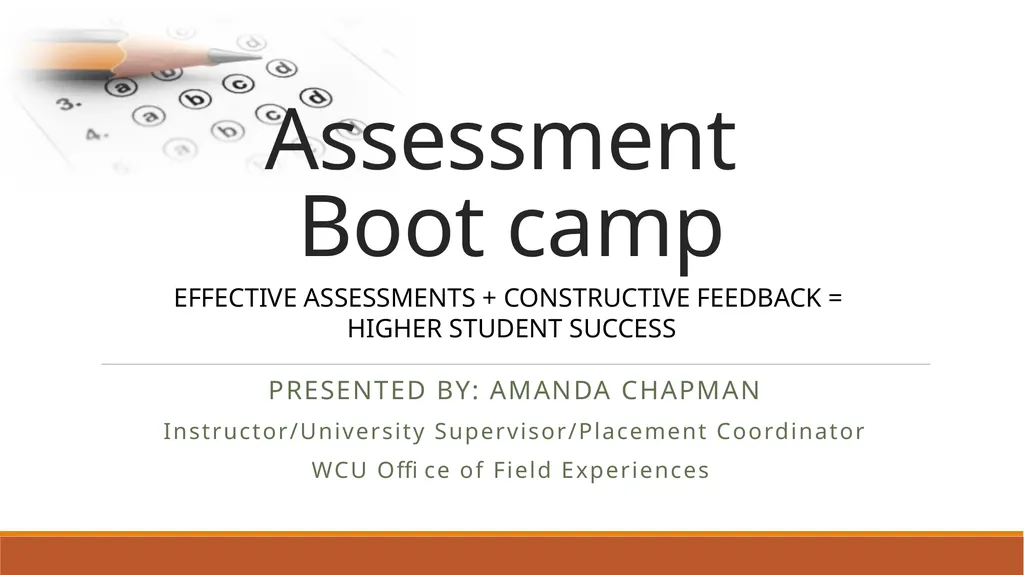
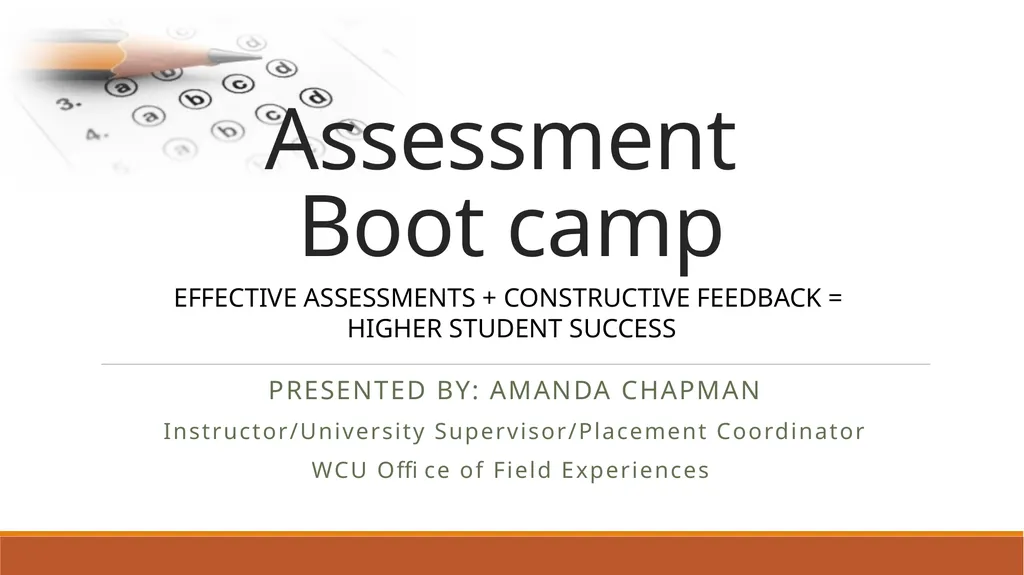
Assessment Boot camp Presented by: Amanda Chapman
MS
Published · 35 slides · 0 views
1 / 1


Description
Assessment Boot camp Presented by: Amanda Chapman InstructorUniversity SupervisorPlacement Coordinator WCU Office of Field Experiences EFFECTIVE ASSESSMENTS CONSTRUCTIVE FEEDBACK HIGHER STUDENT SUCCESS Overview How do we design
Related Topics
Share
Embed code
Download this presentation From Below
"Assessment Boot camp Presented by: Amanda Chapman" is the property of its rightful owner. Permission is granted to download and print the materials on this website for personal, non-commercial use only, and to display it on your personal computer provided you do not modify the materials and that you retain all copyright notices contained in the materials. By downloading content from our website, you accept the terms of this agreement.
Presentation Transcript
01
Assessment
Boot camp Presented by: Amanda Chapman
Instructor/University Supervisor/Placement Coordinator
WCU Office of Field Experiences EFFECTIVE ASSESSMENTS + CONSTRUCTIVE FEEDBACK =
HIGHER STUDENT SUCCESS<br>
Instructor/University Supervisor/Placement Coordinator
WCU Office of Field Experiences EFFECTIVE ASSESSMENTS + CONSTRUCTIVE FEEDBACK =
HIGHER STUDENT SUCCESS<br>
02
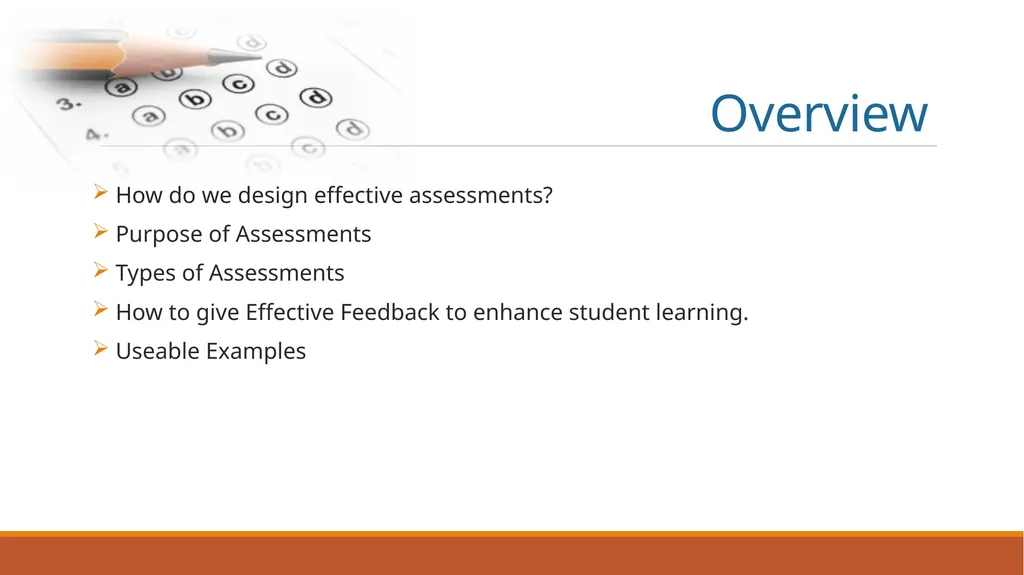
Overview How do we design effective assessments?
Purpose of Assessments
Types of Assessments
How to give Effective Feedback to enhance student learning.
Useable Examples<br>
Purpose of Assessments
Types of Assessments
How to give Effective Feedback to enhance student learning.
Useable Examples<br>
03
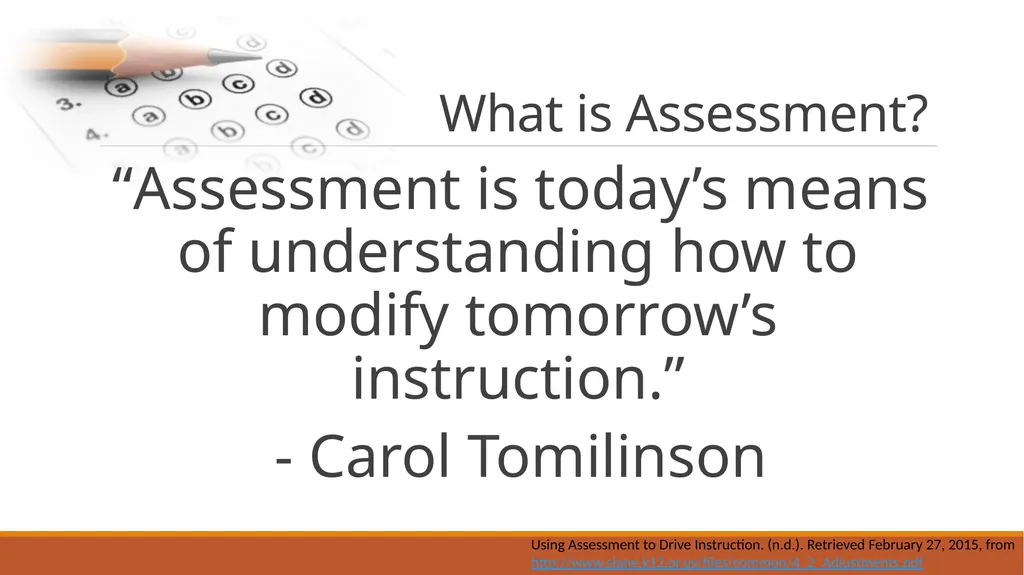
What is Assessment? “Assessment is today’s means of understanding how to modify tomorrow’s instruction.”
- Carol Tomilinson Using Assessment to Drive Instruction. (n.d.). Retrieved February 27, 2015, from http://www.slane.k12.or.us/files/common/4_2_Adjustments.pdf<br>
- Carol Tomilinson Using Assessment to Drive Instruction. (n.d.). Retrieved February 27, 2015, from http://www.slane.k12.or.us/files/common/4_2_Adjustments.pdf<br>
04
How to design effective assessments
101<br>
05
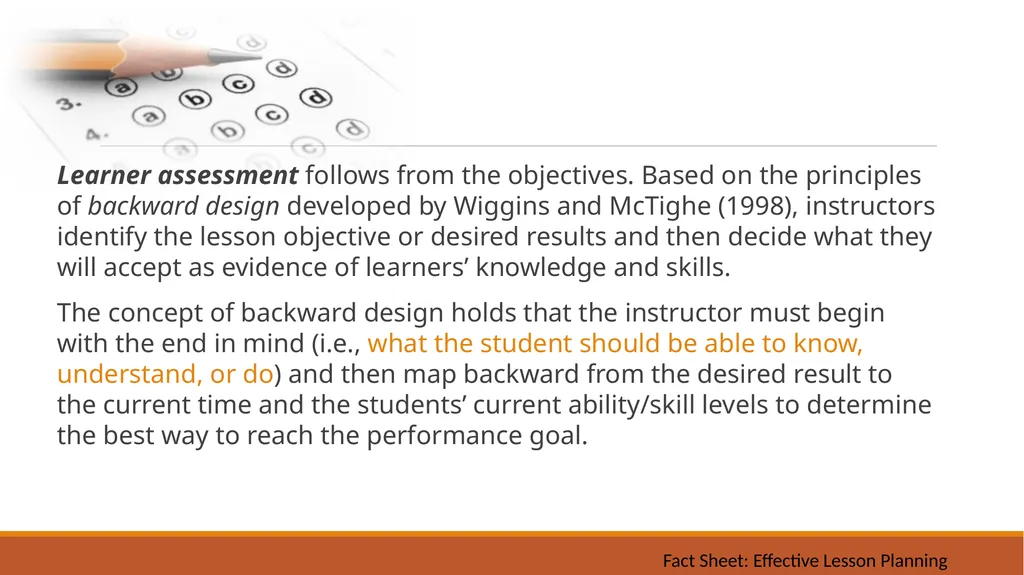
Learner assessment follows from the objectives. Based on the principles of backward design developed by Wiggins and McTighe (1998), instructors identify the lesson objective or desired results and then decide what they will accept as evidence of learners’ knowledge and skills.
The concept of backward design holds that the instructor must begin with the end in mind (i.e., what the student should be able to know, understand, or do) and then map backward from the desired result to the current time and the students’ current ability/skill levels to determine the best way to reach the performance goal. Fact Sheet: Effective Lesson Planning<br>
The concept of backward design holds that the instructor must begin with the end in mind (i.e., what the student should be able to know, understand, or do) and then map backward from the desired result to the current time and the students’ current ability/skill levels to determine the best way to reach the performance goal. Fact Sheet: Effective Lesson Planning<br>
06
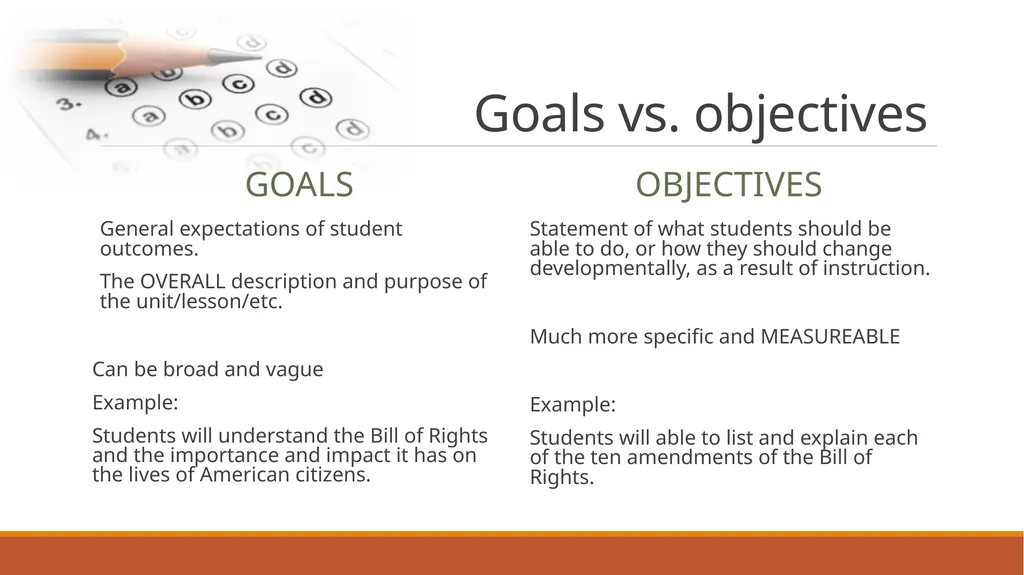
Goals vs. objectives Goals General expectations of student outcomes.
The OVERALL description and purpose of the unit/lesson/etc.
Can be broad and vague
Example:
Students will understand the Bill of Rights and the importance and impact it has on the lives of American citizens. objectives Statement of what students should be able to do, or how they should change developmentally, as a result of instruction.
Much more specific and MEASUREABLE
Example:
Students will able to list and explain each of the ten amendments of the Bill of Rights.<br>
The OVERALL description and purpose of the unit/lesson/etc.
Can be broad and vague
Example:
Students will understand the Bill of Rights and the importance and impact it has on the lives of American citizens. objectives Statement of what students should be able to do, or how they should change developmentally, as a result of instruction.
Much more specific and MEASUREABLE
Example:
Students will able to list and explain each of the ten amendments of the Bill of Rights.<br>
07
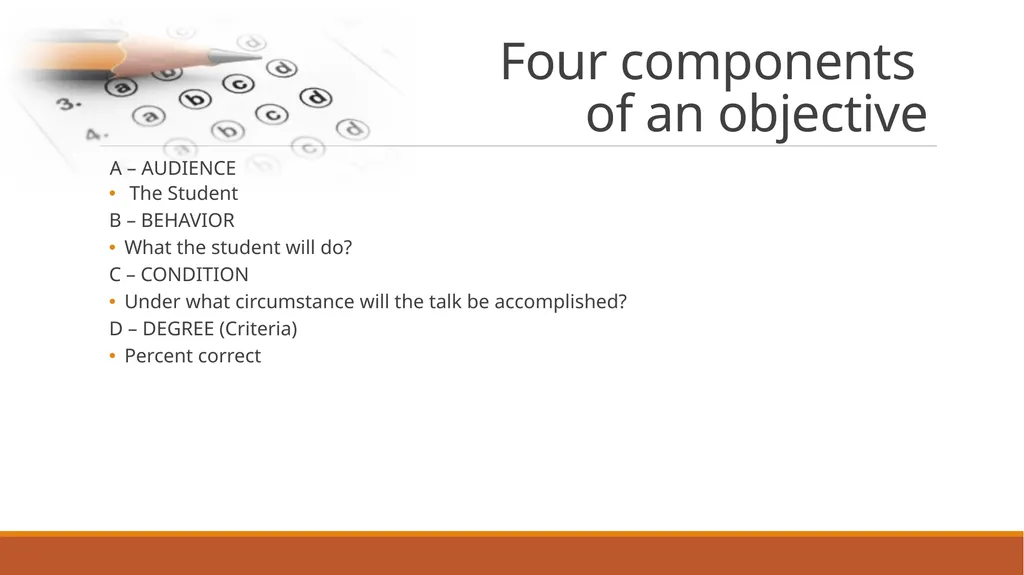
Four components
of an objective A – AUDIENCE
The Student
B – BEHAVIOR
What the student will do?
C – CONDITION
Under what circumstance will the talk be accomplished?
D – DEGREE (Criteria)
Percent correct<br>
The Student
B – BEHAVIOR
What the student will do?
C – CONDITION
Under what circumstance will the talk be accomplished?
D – DEGREE (Criteria)
Percent correct<br>
08
LEARNING OUTCOME
FORMAT STUDENTS SHOULD BE ABLE TO
<<ACTION VERB>> <<SOMETHING>><br>
<<ACTION VERB>> <<SOMETHING>><br>
09
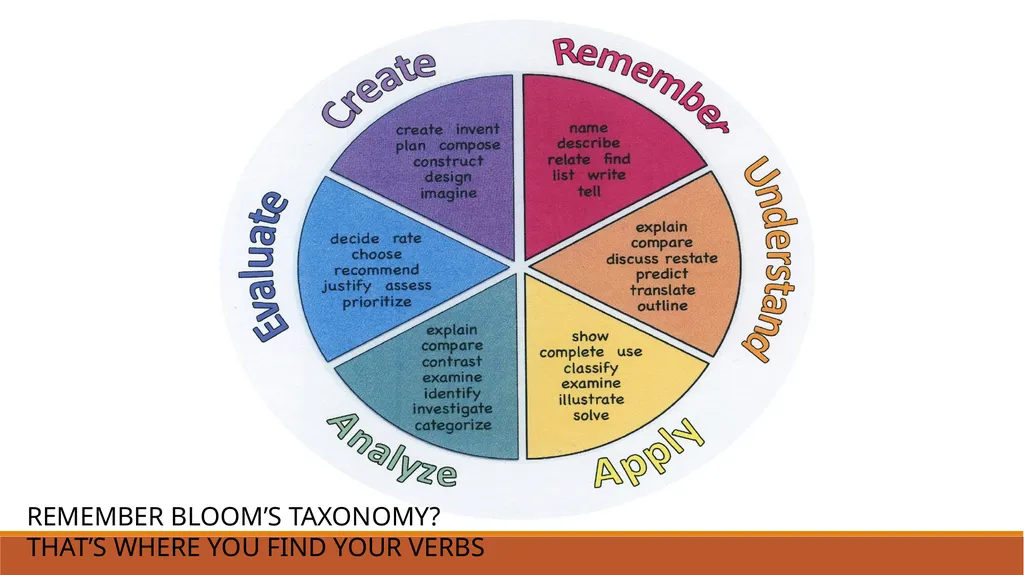
REMEMBER BLOOM’S TAXONOMY?
THAT’S WHERE YOU FIND YOUR VERBS<br>
THAT’S WHERE YOU FIND YOUR VERBS<br>
10
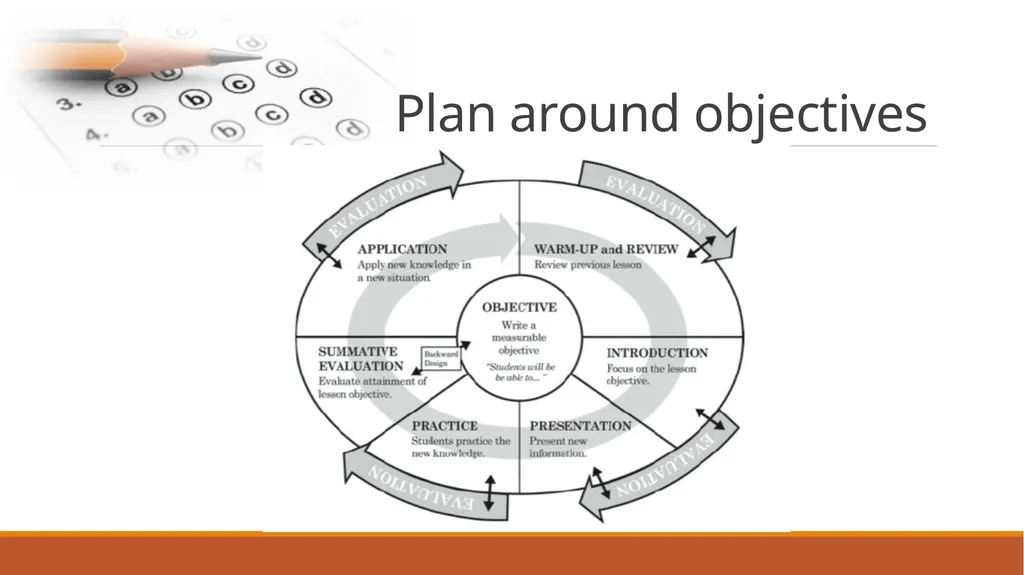
Plan around objectives<br>
11
Students will be able to… Look at the examples:
Which ones are well written and assessable objectives?
Which ones are not assessable?
How could you rewrite them to make them assessable?<br>
Which ones are well written and assessable objectives?
Which ones are not assessable?
How could you rewrite them to make them assessable?<br>
12
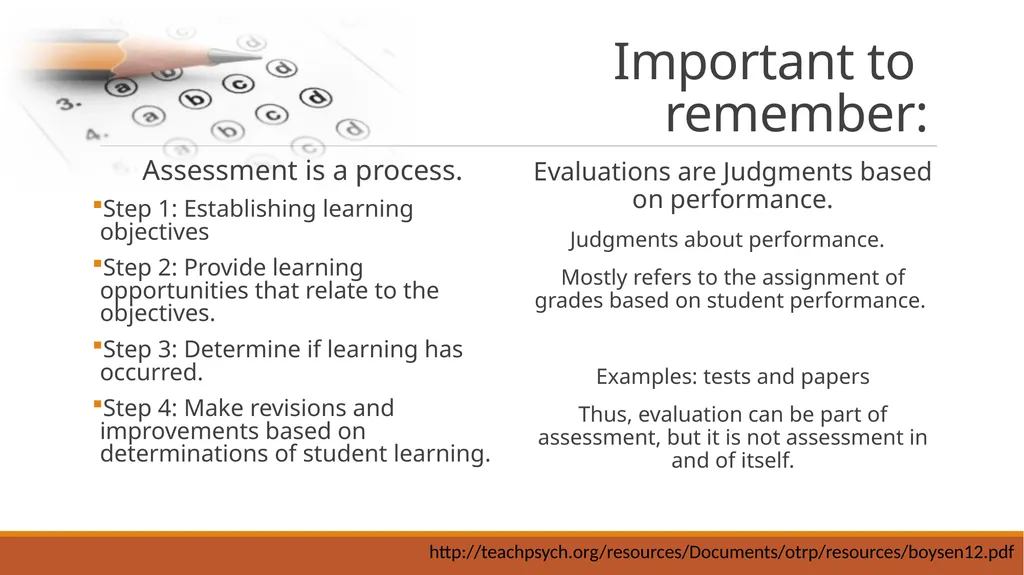
Important to
remember: Assessment is a process.
Step 1: Establishing learning objectives
Step 2: Provide learning opportunities that relate to the objectives.
Step 3: Determine if learning has occurred.
Step 4: Make revisions and improvements based on determinations of student learning. Evaluations are Judgments based on performance.
Judgments about performance.
Mostly refers to the assignment of grades based on student performance.
Examples: tests and papers
Thus, evaluation can be part of assessment, but it is not assessment in and of itself. http://teachpsych.org/resources/Documents/otrp/resources/boysen12.pdf<br>
Step 1: Establishing learning objectives
Step 2: Provide learning opportunities that relate to the objectives.
Step 3: Determine if learning has occurred.
Step 4: Make revisions and improvements based on determinations of student learning. Evaluations are Judgments based on performance.
Judgments about performance.
Mostly refers to the assignment of grades based on student performance.
Examples: tests and papers
Thus, evaluation can be part of assessment, but it is not assessment in and of itself. http://teachpsych.org/resources/Documents/otrp/resources/boysen12.pdf<br>
13
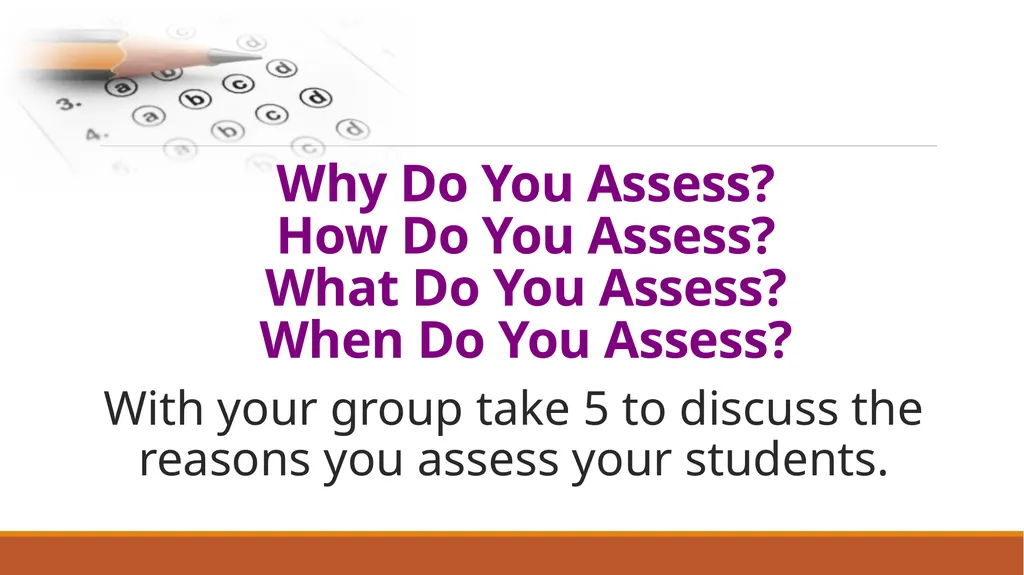
Why Do You Assess?
How Do You Assess?
What Do You Assess?
When Do You Assess? With your group take 5 to discuss the reasons you assess your students.<br>
14
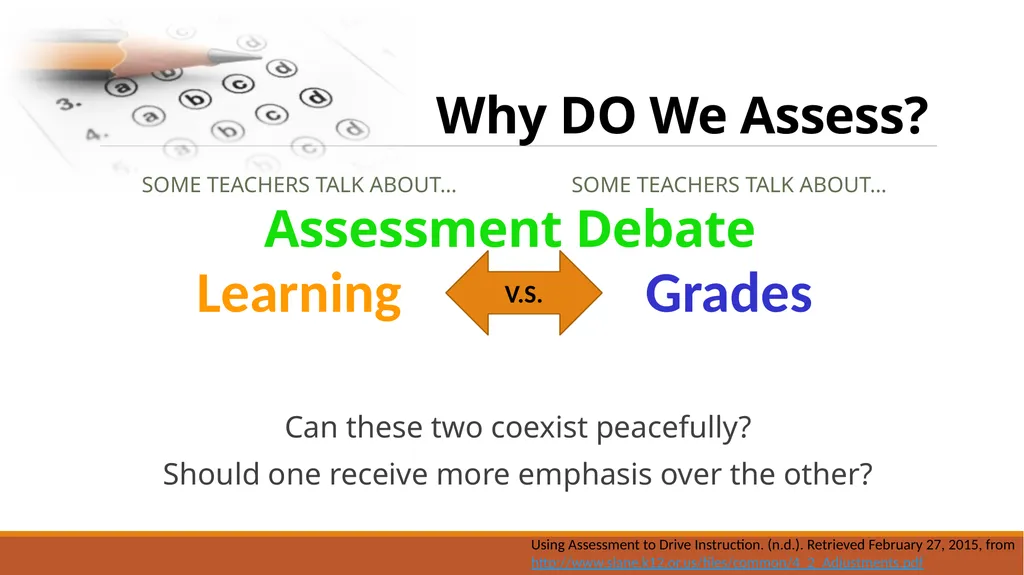
Why DO We Assess? Some teachers talk about… Can these two coexist peacefully?
Should one receive more emphasis over the other? Some teachers talk about… Learning Grades V.S. Assessment Debate Using Assessment to Drive Instruction. (n.d.). Retrieved February 27, 2015, from http://www.slane.k12.or.us/files/common/4_2_Adjustments.pdf<br>
Should one receive more emphasis over the other? Some teachers talk about… Learning Grades V.S. Assessment Debate Using Assessment to Drive Instruction. (n.d.). Retrieved February 27, 2015, from http://www.slane.k12.or.us/files/common/4_2_Adjustments.pdf<br>
15
Using Assessment to Drive Instruction. (n.d.). Retrieved February 27, 2015, from http://www.slane.k12.or.us/files/common/4_2_Adjustments.pdf<br>
16
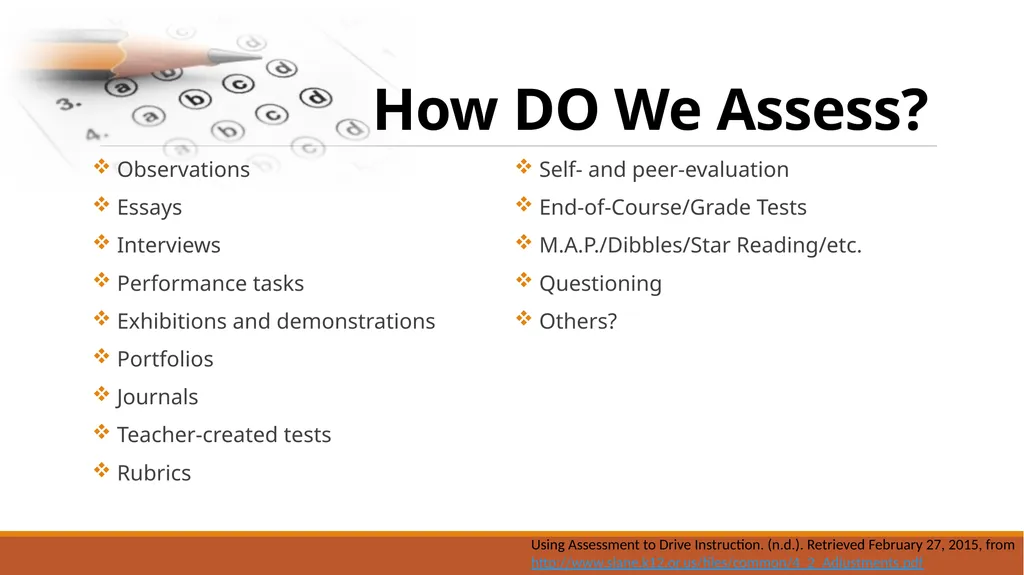
How DO We Assess? Observations
Essays
Interviews
Performance tasks
Exhibitions and demonstrations
Portfolios
Journals
Teacher-created tests
Rubrics
Self- and peer-evaluation
End-of-Course/Grade Tests
M.A.P./Dibbles/Star Reading/etc.
Questioning
Others? Using Assessment to Drive Instruction. (n.d.). Retrieved February 27, 2015, from http://www.slane.k12.or.us/files/common/4_2_Adjustments.pdf<br>
Essays
Interviews
Performance tasks
Exhibitions and demonstrations
Portfolios
Journals
Teacher-created tests
Rubrics
Self- and peer-evaluation
End-of-Course/Grade Tests
M.A.P./Dibbles/Star Reading/etc.
Questioning
Others? Using Assessment to Drive Instruction. (n.d.). Retrieved February 27, 2015, from http://www.slane.k12.or.us/files/common/4_2_Adjustments.pdf<br>
17
Using Assessment to Drive Instruction. (n.d.). Retrieved February 27, 2015, from http://www.slane.k12.or.us/files/common/4_2_Adjustments.pdf<br>
18
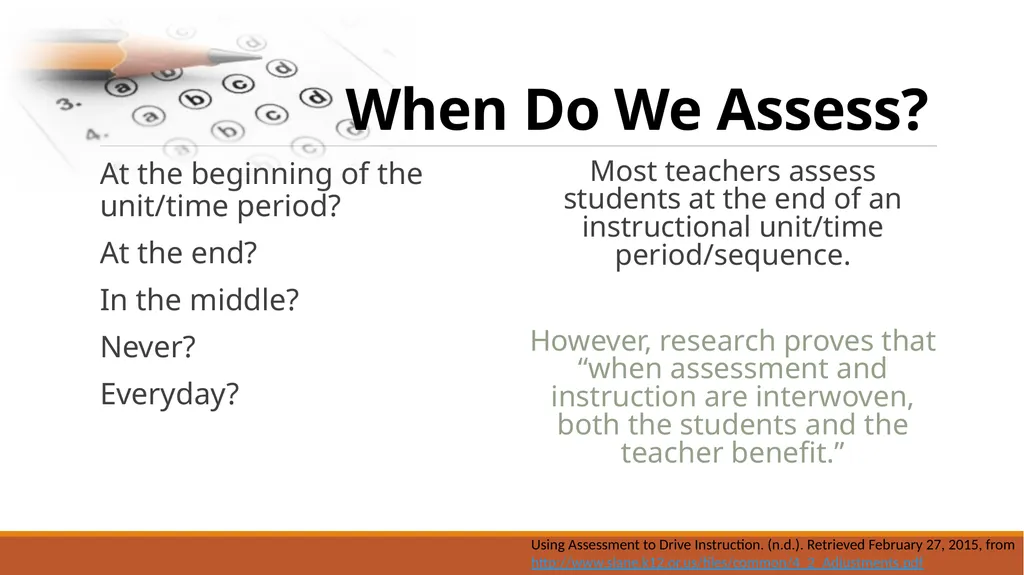
When Do We Assess? At the beginning of the unit/time period?
At the end?
In the middle?
Never?
Everyday? Most teachers assess students at the end of an instructional unit/time period/sequence.
However, research proves that “when assessment and instruction are interwoven, both the students and the teacher benefit.” Using Assessment to Drive Instruction. (n.d.). Retrieved February 27, 2015, from http://www.slane.k12.or.us/files/common/4_2_Adjustments.pdf<br>
At the end?
In the middle?
Never?
Everyday? Most teachers assess students at the end of an instructional unit/time period/sequence.
However, research proves that “when assessment and instruction are interwoven, both the students and the teacher benefit.” Using Assessment to Drive Instruction. (n.d.). Retrieved February 27, 2015, from http://www.slane.k12.or.us/files/common/4_2_Adjustments.pdf<br>
19
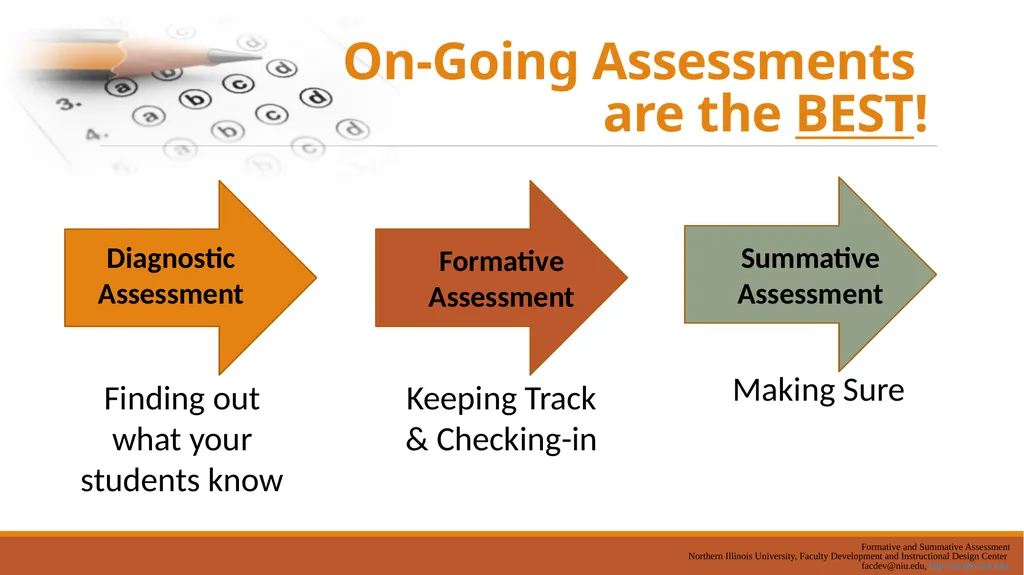
On-Going Assessments
are the BEST! Diagnostic Assessment Formative Assessment Summative Assessment Finding out what your students know Keeping Track & Checking-in Making Sure Formative and Summative Assessment
Northern Illinois University, Faculty Development and Instructional Design Center
facdev@niu.edu, http://facdev.niu.edu,<br>
Northern Illinois University, Faculty Development and Instructional Design Center
facdev@niu.edu, http://facdev.niu.edu,<br>
20
Diagnostic Assessments
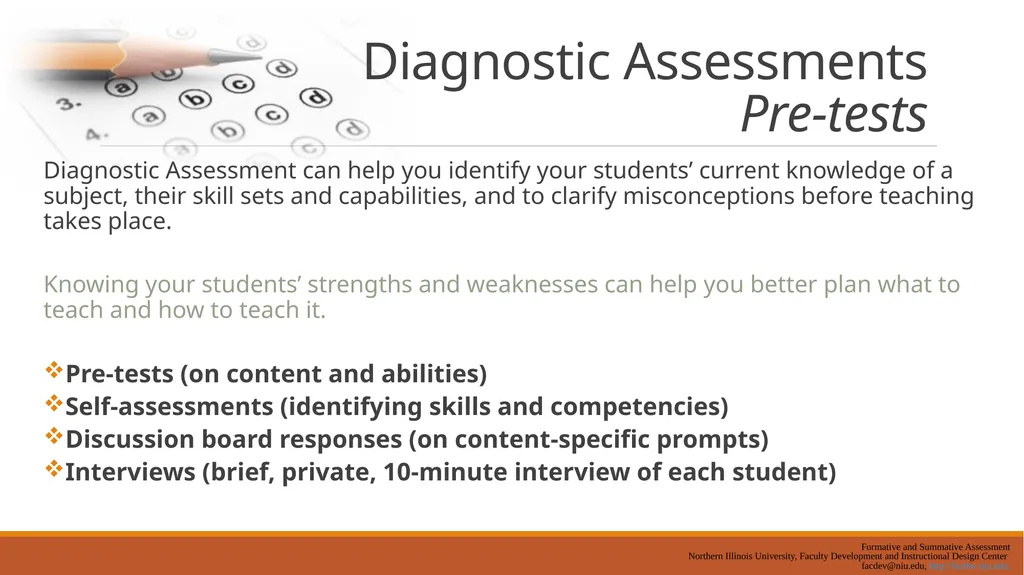
Pre-tests Diagnostic Assessment can help you identify your students’ current knowledge of a subject, their skill sets and capabilities, and to clarify misconceptions before teaching takes place.
Knowing your students’ strengths and weaknesses can help you better plan what to teach and how to teach it.
Pre-tests (on content and abilities)
Self-assessments (identifying skills and competencies)
Discussion board responses (on content-specific prompts)
Interviews (brief, private, 10-minute interview of each student) Formative and Summative Assessment
Northern Illinois University, Faculty Development and Instructional Design Center
facdev@niu.edu, http://facdev.niu.edu,<br>
Knowing your students’ strengths and weaknesses can help you better plan what to teach and how to teach it.
Pre-tests (on content and abilities)
Self-assessments (identifying skills and competencies)
Discussion board responses (on content-specific prompts)
Interviews (brief, private, 10-minute interview of each student) Formative and Summative Assessment
Northern Illinois University, Faculty Development and Instructional Design Center
facdev@niu.edu, http://facdev.niu.edu,<br>
21
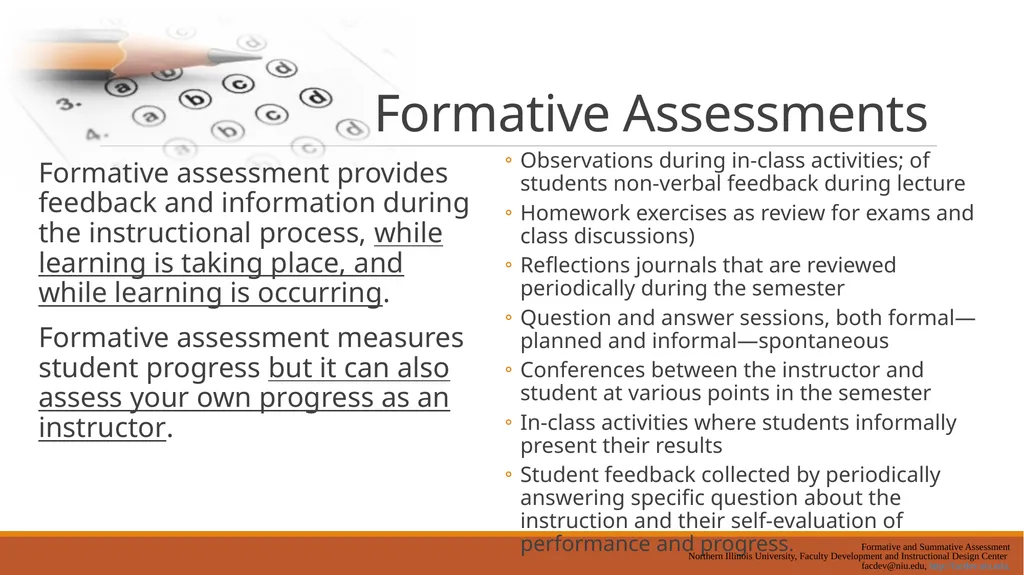
Formative Assessments Formative assessment provides feedback and information during the instructional process, while learning is taking place, and while learning is occurring.
Formative assessment measures student progress but it can also assess your own progress as an instructor. Observations during in-class activities; of students non-verbal feedback during lecture
Homework exercises as review for exams and class discussions)
Reflections journals that are reviewed periodically during the semester
Question and answer sessions, both formal—planned and informal—spontaneous
Conferences between the instructor and student at various points in the semester
In-class activities where students informally present their results
Student feedback collected by periodically answering specific question about the instruction and their self-evaluation of performance and progress. Formative and Summative Assessment
Northern Illinois University, Faculty Development and Instructional Design Center
facdev@niu.edu, http://facdev.niu.edu,<br>
Formative assessment measures student progress but it can also assess your own progress as an instructor. Observations during in-class activities; of students non-verbal feedback during lecture
Homework exercises as review for exams and class discussions)
Reflections journals that are reviewed periodically during the semester
Question and answer sessions, both formal—planned and informal—spontaneous
Conferences between the instructor and student at various points in the semester
In-class activities where students informally present their results
Student feedback collected by periodically answering specific question about the instruction and their self-evaluation of performance and progress. Formative and Summative Assessment
Northern Illinois University, Faculty Development and Instructional Design Center
facdev@niu.edu, http://facdev.niu.edu,<br>
22
Ongoing
Assessment
Strategies
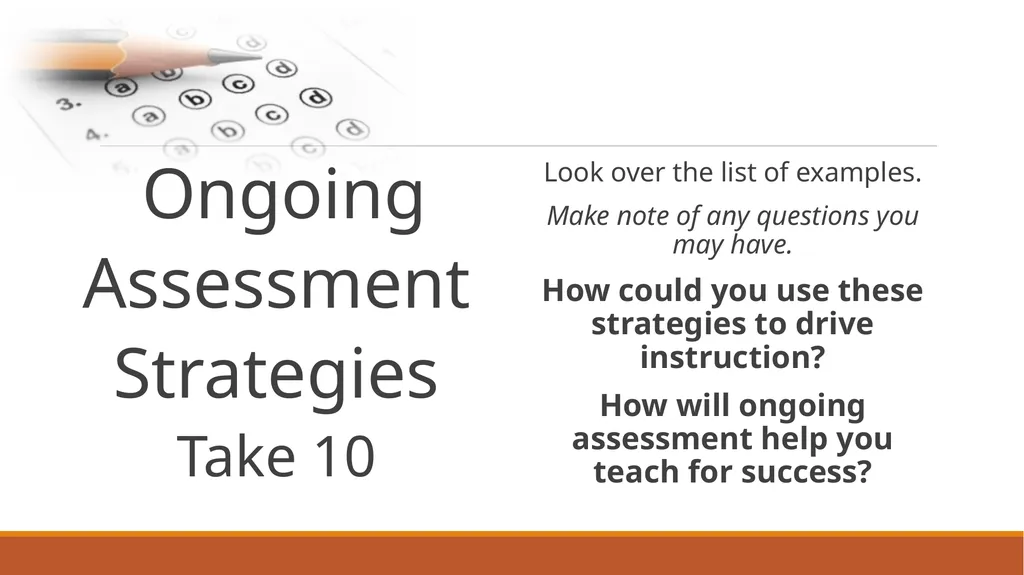
Take 10 Look over the list of examples.
Make note of any questions you may have.
How could you use these strategies to drive instruction?
How will ongoing assessment help you teach for success?<br>
Assessment
Strategies
Take 10 Look over the list of examples.
Make note of any questions you may have.
How could you use these strategies to drive instruction?
How will ongoing assessment help you teach for success?<br>
23
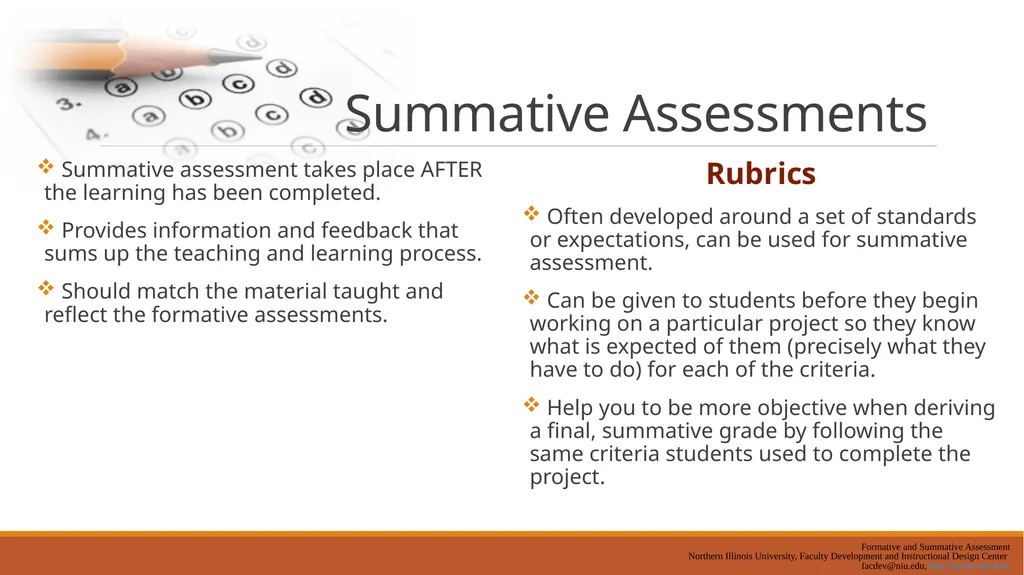
Summative Assessments Summative assessment takes place AFTER the learning has been completed.
Provides information and feedback that sums up the teaching and learning process.
Should match the material taught and reflect the formative assessments. Rubrics
Often developed around a set of standards or expectations, can be used for summative assessment.
Can be given to students before they begin working on a particular project so they know what is expected of them (precisely what they have to do) for each of the criteria.
Help you to be more objective when deriving a final, summative grade by following the same criteria students used to complete the project. Formative and Summative Assessment
Northern Illinois University, Faculty Development and Instructional Design Center
facdev@niu.edu, http://facdev.niu.edu,<br>
Provides information and feedback that sums up the teaching and learning process.
Should match the material taught and reflect the formative assessments. Rubrics
Often developed around a set of standards or expectations, can be used for summative assessment.
Can be given to students before they begin working on a particular project so they know what is expected of them (precisely what they have to do) for each of the criteria.
Help you to be more objective when deriving a final, summative grade by following the same criteria students used to complete the project. Formative and Summative Assessment
Northern Illinois University, Faculty Development and Instructional Design Center
facdev@niu.edu, http://facdev.niu.edu,<br>
24
Types of Summative
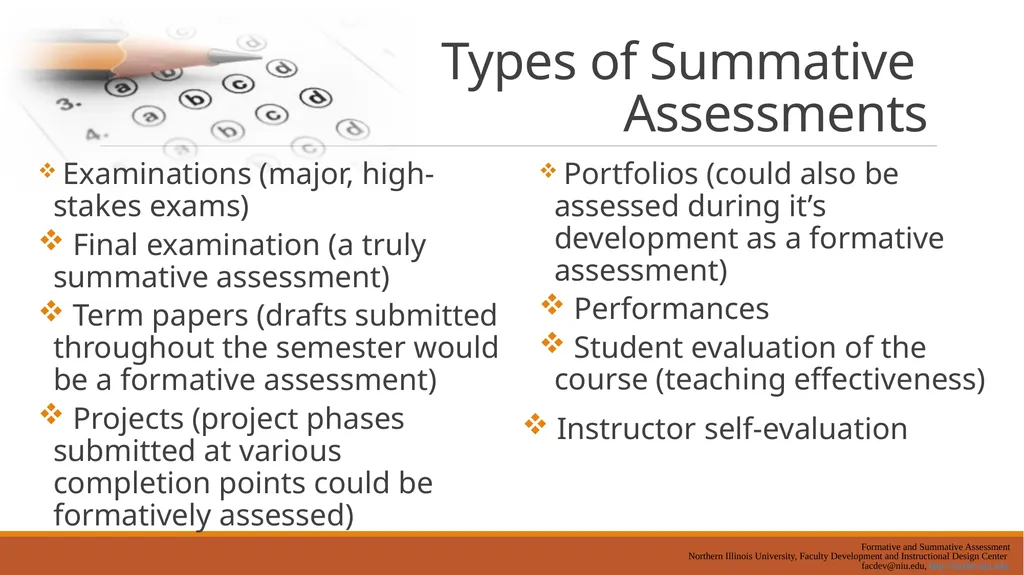
Assessments Examinations (major, high-stakes exams)
Final examination (a truly summative assessment)
Term papers (drafts submitted throughout the semester would be a formative assessment)
Projects (project phases submitted at various completion points could be formatively assessed) Portfolios (could also be assessed during it’s development as a formative assessment)
Performances
Student evaluation of the course (teaching effectiveness)
Instructor self-evaluation Formative and Summative Assessment
Northern Illinois University, Faculty Development and Instructional Design Center
facdev@niu.edu, http://facdev.niu.edu,<br>
Final examination (a truly summative assessment)
Term papers (drafts submitted throughout the semester would be a formative assessment)
Projects (project phases submitted at various completion points could be formatively assessed) Portfolios (could also be assessed during it’s development as a formative assessment)
Performances
Student evaluation of the course (teaching effectiveness)
Instructor self-evaluation Formative and Summative Assessment
Northern Illinois University, Faculty Development and Instructional Design Center
facdev@niu.edu, http://facdev.niu.edu,<br>
25
What is the Difference? “Summative assessment is more product-oriented and assesses the final product, whereas formative assessment focuses on the process toward completing the product. Once the project is completed, no further revisions can be made. If, however, students are allowed to make revisions, the assessment becomes formative, where students can take advantage of the opportunity to improve.” Formative and Summative Assessment
Northern Illinois University, Faculty Development and Instructional Design Center
facdev@niu.edu, http://facdev.niu.edu,<br>
Northern Illinois University, Faculty Development and Instructional Design Center
facdev@niu.edu, http://facdev.niu.edu,<br>
26
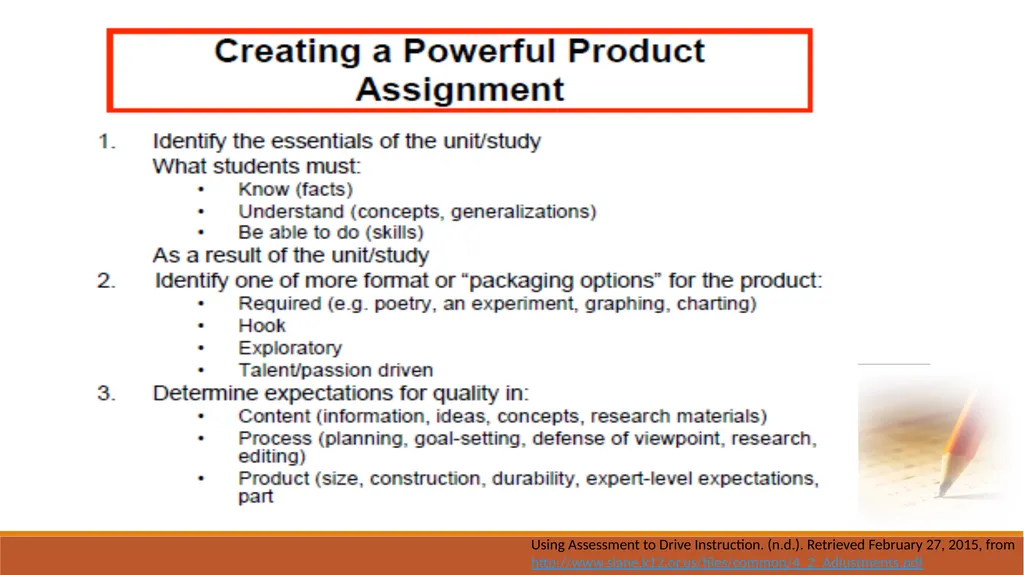
Using Assessment to Drive Instruction. (n.d.). Retrieved February 27, 2015, from http://www.slane.k12.or.us/files/common/4_2_Adjustments.pdf<br>
27
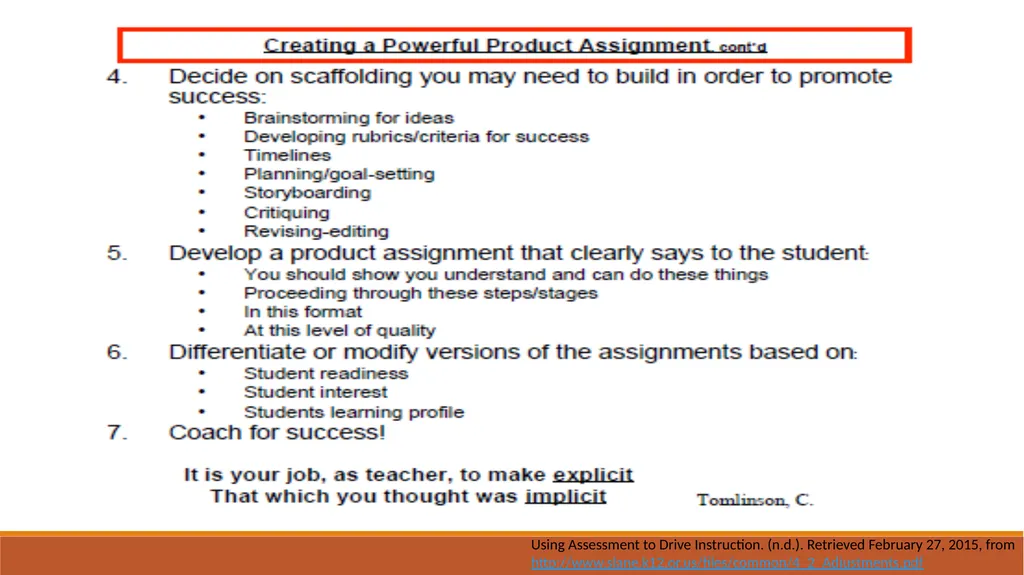
Using Assessment to Drive Instruction. (n.d.). Retrieved February 27, 2015, from http://www.slane.k12.or.us/files/common/4_2_Adjustments.pdf<br>
28
EFFECTIVE FEEBACK<br>
29
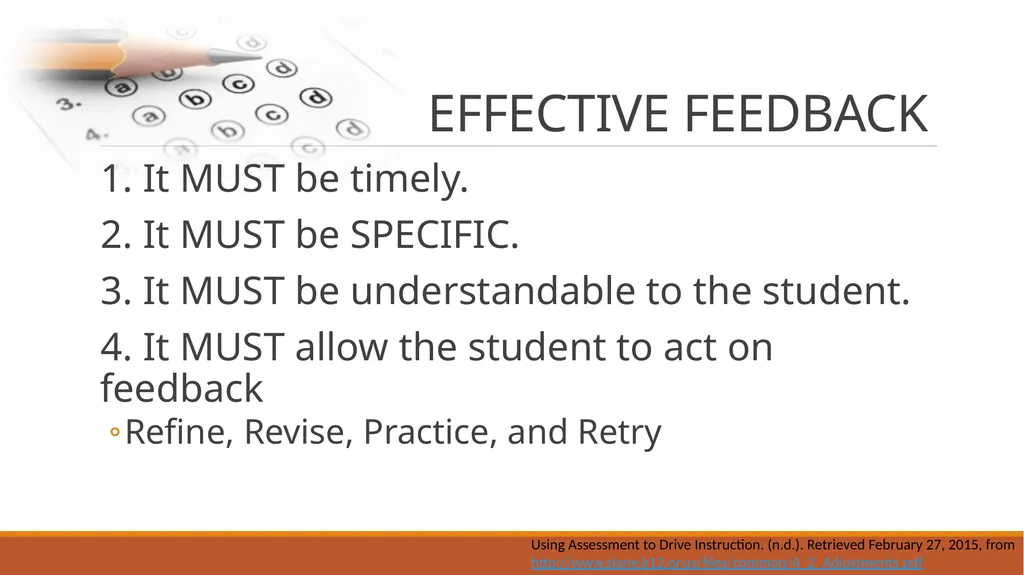
EFFECTIVE FEEDBACK 1. It MUST be timely.
2. It MUST be SPECIFIC.
3. It MUST be understandable to the student.
4. It MUST allow the student to act on feedback
Refine, Revise, Practice, and Retry Using Assessment to Drive Instruction. (n.d.). Retrieved February 27, 2015, from http://www.slane.k12.or.us/files/common/4_2_Adjustments.pdf<br>
2. It MUST be SPECIFIC.
3. It MUST be understandable to the student.
4. It MUST allow the student to act on feedback
Refine, Revise, Practice, and Retry Using Assessment to Drive Instruction. (n.d.). Retrieved February 27, 2015, from http://www.slane.k12.or.us/files/common/4_2_Adjustments.pdf<br>
30
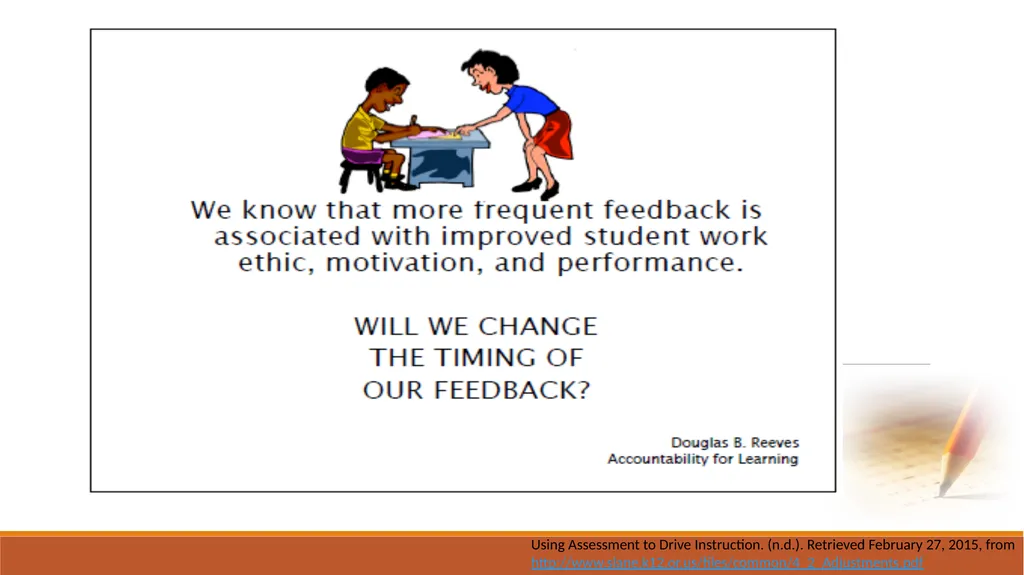
Using Assessment to Drive Instruction. (n.d.). Retrieved February 27, 2015, from http://www.slane.k12.or.us/files/common/4_2_Adjustments.pdf<br>
31
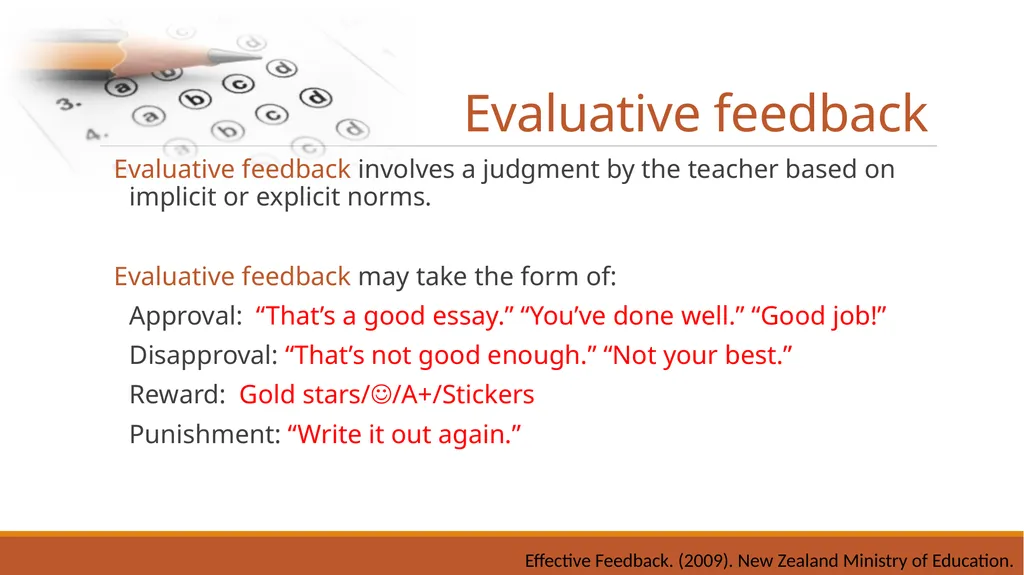
Evaluative feedback involves a judgment by the teacher based on implicit or explicit norms.
Evaluative feedback may take the form of:
Approval: “That’s a good essay.” “You’ve done well.” “Good job!”
Disapproval: “That’s not good enough.” “Not your best.”
Reward: Gold stars//A+/Stickers
Punishment: “Write it out again.” Evaluative feedback Effective Feedback. (2009). New Zealand Ministry of Education.<br>
Evaluative feedback may take the form of:
Approval: “That’s a good essay.” “You’ve done well.” “Good job!”
Disapproval: “That’s not good enough.” “Not your best.”
Reward: Gold stars//A+/Stickers
Punishment: “Write it out again.” Evaluative feedback Effective Feedback. (2009). New Zealand Ministry of Education.<br>
32
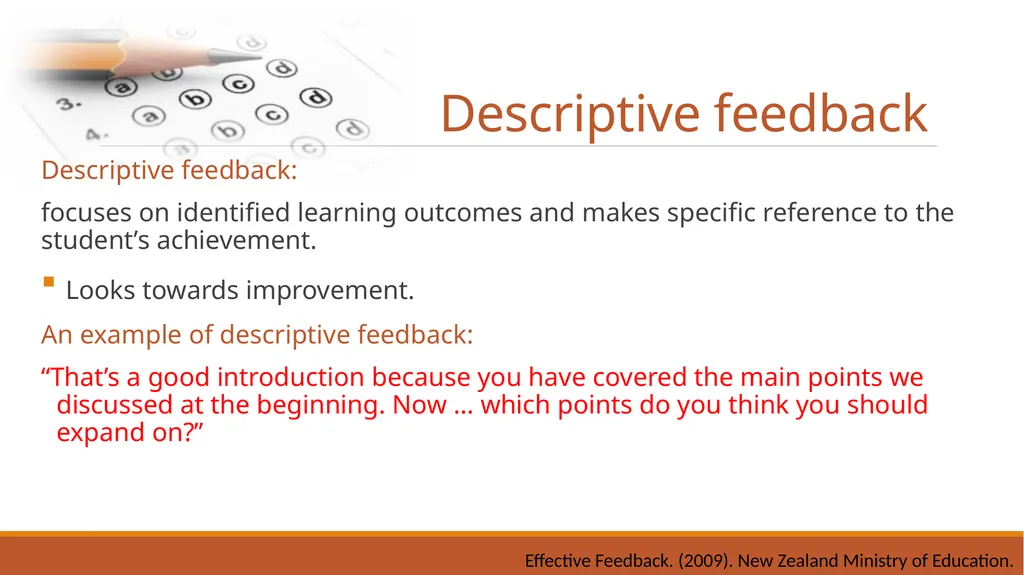
Descriptive feedback Descriptive feedback:
focuses on identified learning outcomes and makes specific reference to the student’s achievement.
Looks towards improvement.
An example of descriptive feedback:
“That’s a good introduction because you have covered the main points we discussed at the beginning. Now … which points do you think you should expand on?” Effective Feedback. (2009). New Zealand Ministry of Education.<br>
focuses on identified learning outcomes and makes specific reference to the student’s achievement.
Looks towards improvement.
An example of descriptive feedback:
“That’s a good introduction because you have covered the main points we discussed at the beginning. Now … which points do you think you should expand on?” Effective Feedback. (2009). New Zealand Ministry of Education.<br>
33
Summary Why do we Assess?
How should we Assess?
What are the THREE types of assessment?
What is the purpose of those three?
How can we make our formative assessments more effective and meaningful to our students?<br>
How should we Assess?
What are the THREE types of assessment?
What is the purpose of those three?
How can we make our formative assessments more effective and meaningful to our students?<br>
34
Questions? For further information or later questions please feel free to contact me at 828.227.3310 or abchapman@wcu.edu<br>
35
Works cited Boysen, G. (2012, January 1). A Guide to Writing Learning Objectives for Teachers of Psychology. Retrieved March 3, 2015, from http://teachpsych.org/resources/Documents/otrp/resources/boysen12.pdf
Tomlinson, C. (2001). How to differentiate instruction in mixed-ability classrooms (2nd ed.). Alexandria, Va.: Association for Supervision and Curriculum Development.
Effective Feedback. (2009). New Zealand Ministry of Education. Retrieved March 3, 2015, from http://www.google.com/url?sa=t&rct=j&q=&esrc=s&source=web&cd=1&sqi=2&ved=0CB4QFjAA&url=http://assessment.tki.org.nz/content/download/2520/19023/version/1/file/Effective+feedback.ppt&ei=6t31VJ7ULsWVNqPGg9AJ&usg=AFQjCNEJFBeWEf8kcSDG1HPHCIaa9bA5cw&bvm=bv.87269000,d.eXY
Fact Sheet: Effective Lesson Planning | Teaching Excellence in Adult Literacy (TEAL). (n.d.). Retrieved March 3, 2015, from https://teal.ed.gov/tealguide/lessonplanning
Kelly, M. (n.d.). How to Avoid Common Mistakes When Writing Learning Objectives. Retrieved March 3, 2015, from http://712educators.about.com/od/curriculumandlessonplans/tp/How-To-Avoid-Common-Mistakes-When-Writing-Learning-Objectives.htm
Using Assessment to Drive Instruction. (n.d.). Retrieved February 27, 2015, from http://www.slane.k12.or.us/files/common/4_2_Adjustments.pdf
Wees, D. (n.d.). 56 Different Examples of Formative Assessment. Retrieved March 3, 2015, from https://docs.google.com/presentation/d/1nzhdnyMQmio5lNT75ITB45rHyLISHEEHZlHTWJRqLmQ/pub?start=false&loop=false&delayms=3000&slide=id.p<br>
Tomlinson, C. (2001). How to differentiate instruction in mixed-ability classrooms (2nd ed.). Alexandria, Va.: Association for Supervision and Curriculum Development.
Effective Feedback. (2009). New Zealand Ministry of Education. Retrieved March 3, 2015, from http://www.google.com/url?sa=t&rct=j&q=&esrc=s&source=web&cd=1&sqi=2&ved=0CB4QFjAA&url=http://assessment.tki.org.nz/content/download/2520/19023/version/1/file/Effective+feedback.ppt&ei=6t31VJ7ULsWVNqPGg9AJ&usg=AFQjCNEJFBeWEf8kcSDG1HPHCIaa9bA5cw&bvm=bv.87269000,d.eXY
Fact Sheet: Effective Lesson Planning | Teaching Excellence in Adult Literacy (TEAL). (n.d.). Retrieved March 3, 2015, from https://teal.ed.gov/tealguide/lessonplanning
Kelly, M. (n.d.). How to Avoid Common Mistakes When Writing Learning Objectives. Retrieved March 3, 2015, from http://712educators.about.com/od/curriculumandlessonplans/tp/How-To-Avoid-Common-Mistakes-When-Writing-Learning-Objectives.htm
Using Assessment to Drive Instruction. (n.d.). Retrieved February 27, 2015, from http://www.slane.k12.or.us/files/common/4_2_Adjustments.pdf
Wees, D. (n.d.). 56 Different Examples of Formative Assessment. Retrieved March 3, 2015, from https://docs.google.com/presentation/d/1nzhdnyMQmio5lNT75ITB45rHyLISHEEHZlHTWJRqLmQ/pub?start=false&loop=false&delayms=3000&slide=id.p<br>