Assessment techniques for supporting ALARP demonstration for energy transition projects 7th November 2023 Space and Vacuum Management Non-Destructive Testing Materials Engineering Industrial Tribology and Tribology Safety Risk Good
"Assessment techniques for supporting ALARP" is the property of its rightful owner. Permission is granted to
download and print the materials on this website for personal, non-commercial use only, and to display it
on your personal computer provided you do not modify the materials and that you retain all copyright
notices contained in the materials. By downloading content from our website, you accept the terms of this
agreement.
Presentation Transcript
01
Assessment techniques for supporting ALARP demonstration for energy transition projects 7th November 2023 Space and Vacuum Management Non-Destructive Testing Materials Engineering Industrial Tribology and Tribology Safety & Risk Good Practice Richard Tiffin<br>
02
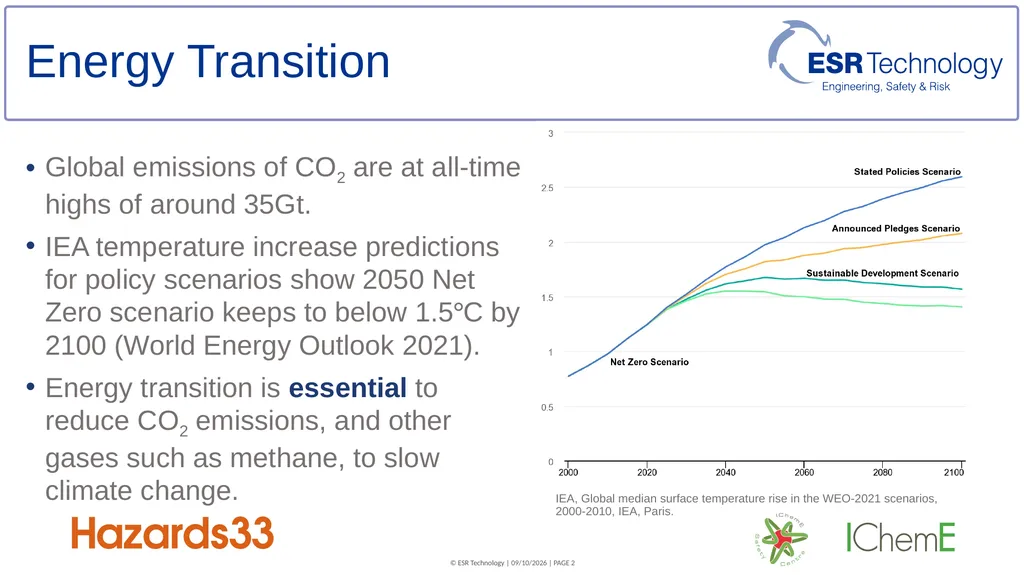
Energy Transition Global emissions of CO2 are at all-time highs of around 35Gt.
IEA temperature increase predictions for policy scenarios show 2050 Net Zero scenario keeps to below 1.5°C by 2100 (World Energy Outlook 2021).
Energy transition is essential to reduce CO2 emissions, and other gases such as methane, to slow climate change. IEA, Global median surface temperature rise in the WEO-2021 scenarios, 2000-2010, IEA, Paris.<br>
03
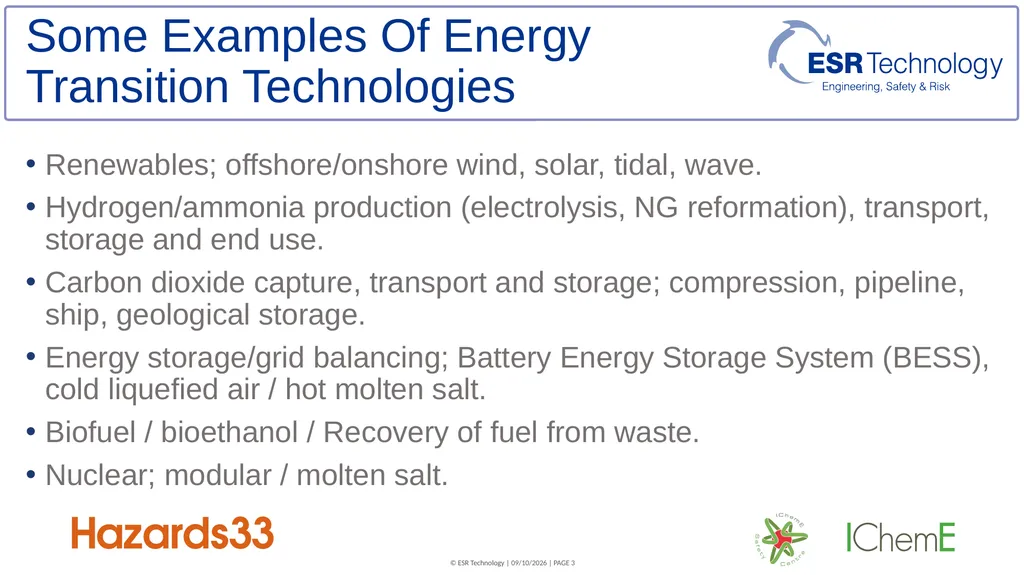
Some Examples Of Energy Transition Technologies Renewables; offshore/onshore wind, solar, tidal, wave.
Hydrogen/ammonia production (electrolysis, NG reformation), transport, storage and end use.
Carbon dioxide capture, transport and storage; compression, pipeline, ship, geological storage.
Energy storage/grid balancing; Battery Energy Storage System (BESS), cold liquefied air / hot molten salt.
Biofuel / bioethanol / Recovery of fuel from waste.
Nuclear; modular / molten salt.<br>
04
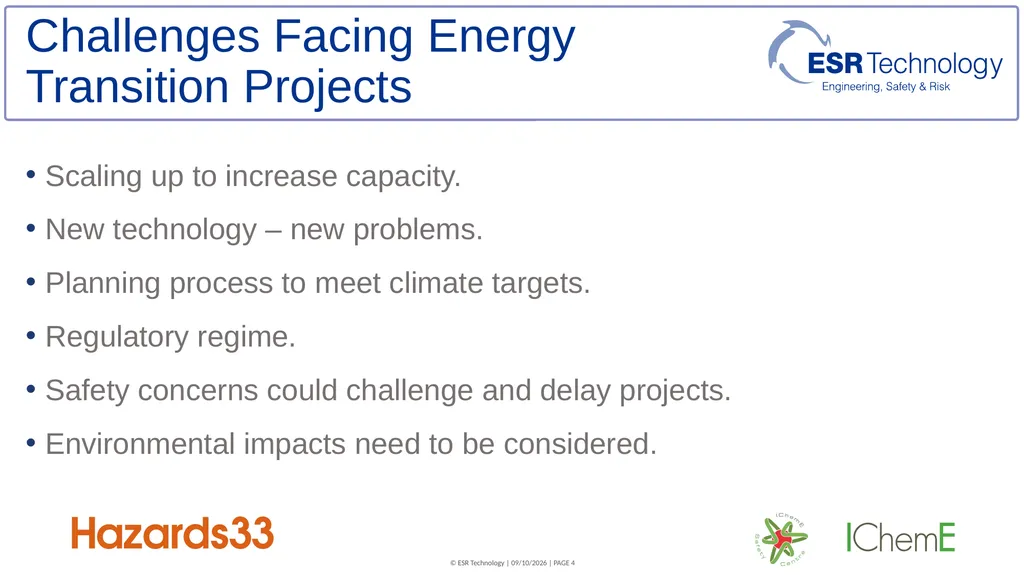
Challenges Facing Energy Transition Projects Scaling up to increase capacity.
New technology – new problems.
Planning process to meet climate targets.
Regulatory regime.
Safety concerns could challenge and delay projects.
Environmental impacts need to be considered.<br>
05
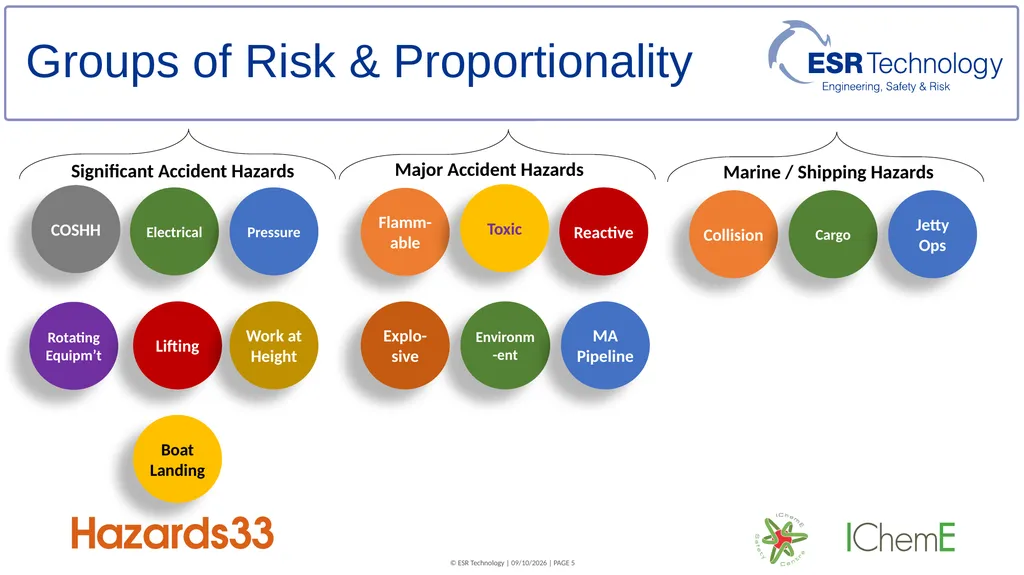
Groups of Risk & Proportionality Electrical Pressure Rotating Equipm’t Lifting Work at Height Flamm-able Environm-ent MA Pipeline Explo-sive Reactive COSHH Collision Cargo Jetty Ops Toxic Boat Landing<br>
06
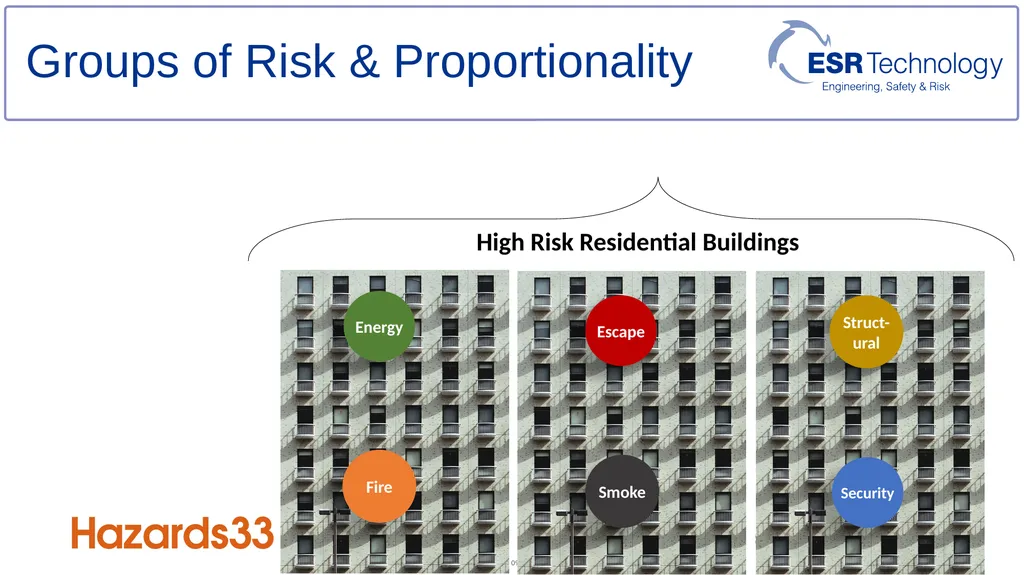
Groups of Risk & Proportionality Fire Escape Smoke Struct-ural Security Energy<br>
07
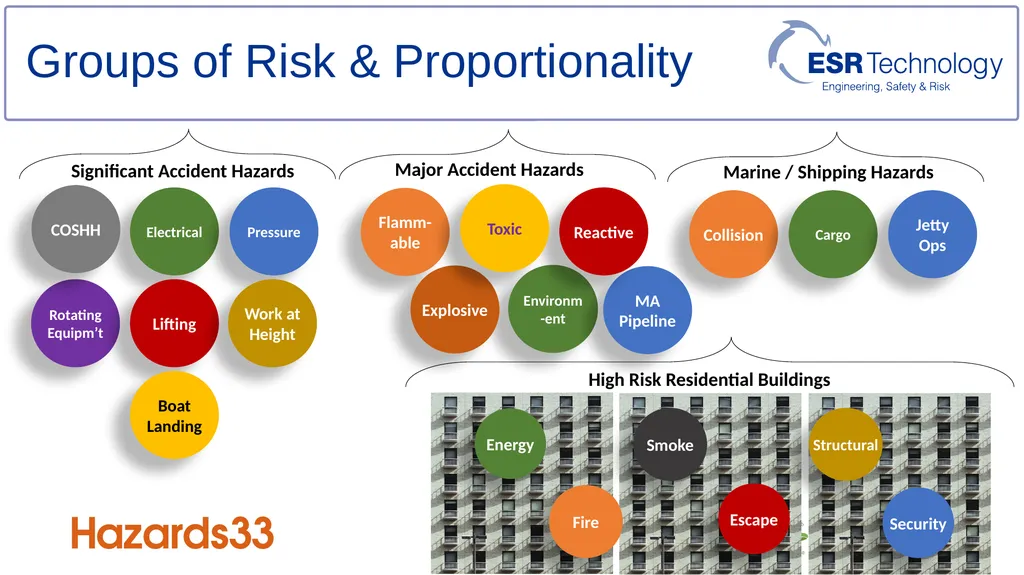
Groups of Risk & Proportionality Electrical Pressure Rotating Equipm’t Lifting Work at Height Flamm-able Environm-ent MA Pipeline Explosive Reactive COSHH Collision Cargo Jetty Ops Fire Escape Smoke Structural Security Energy Toxic Boat Landing<br>
08
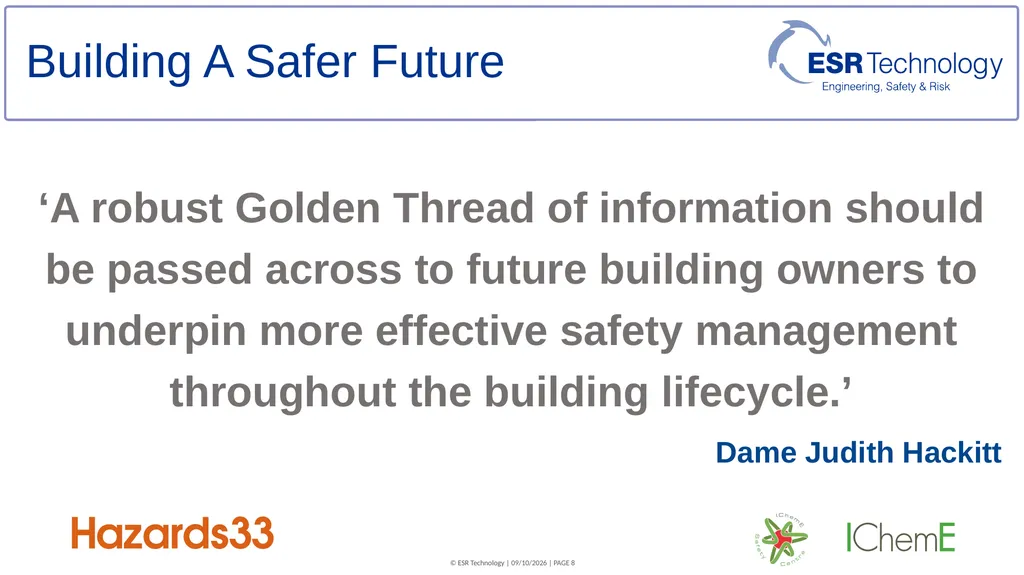
Building A Safer Future ‘A robust Golden Thread of information should be passed across to future building owners to underpin more effective safety management throughout the building lifecycle.’
Dame Judith Hackitt<br>
09
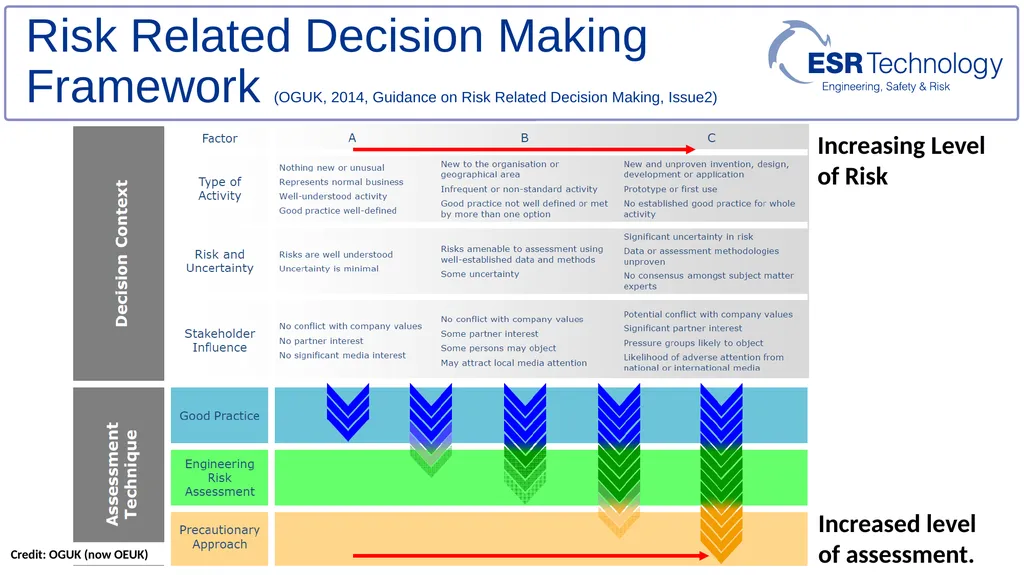
Risk Related Decision Making Framework (OGUK, 2014, Guidance on Risk Related Decision Making, Issue2) Increasing Level of Risk Increased level of assessment. Credit: OGUK (now OEUK)<br>
10
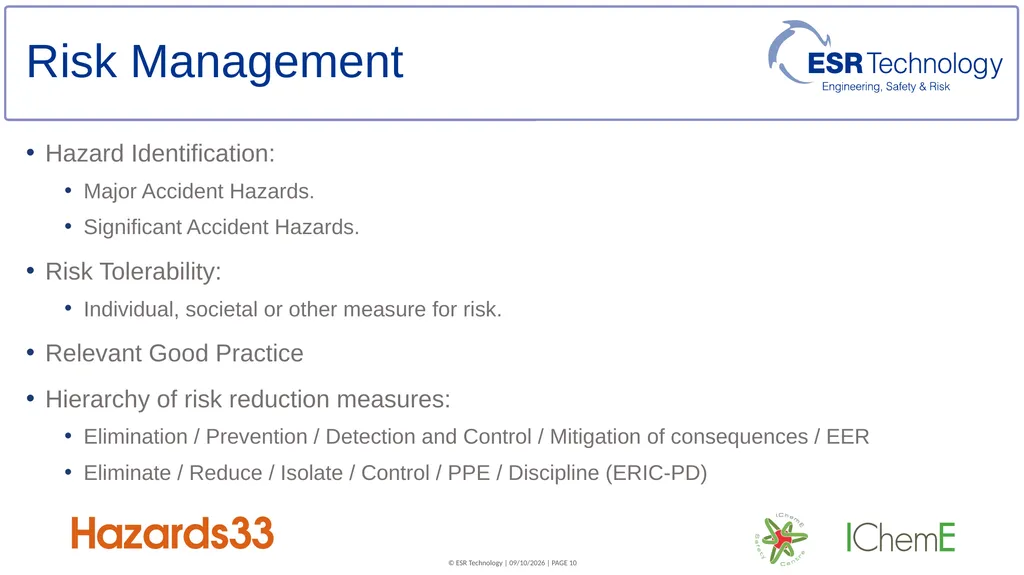
Risk Management Hazard Identification:
Major Accident Hazards.
Significant Accident Hazards.
Risk Tolerability:
Individual, societal or other measure for risk.
Relevant Good Practice
Hierarchy of risk reduction measures:
Elimination / Prevention / Detection and Control / Mitigation of consequences / EER
Eliminate / Reduce / Isolate / Control / PPE / Discipline (ERIC-PD)<br>
11
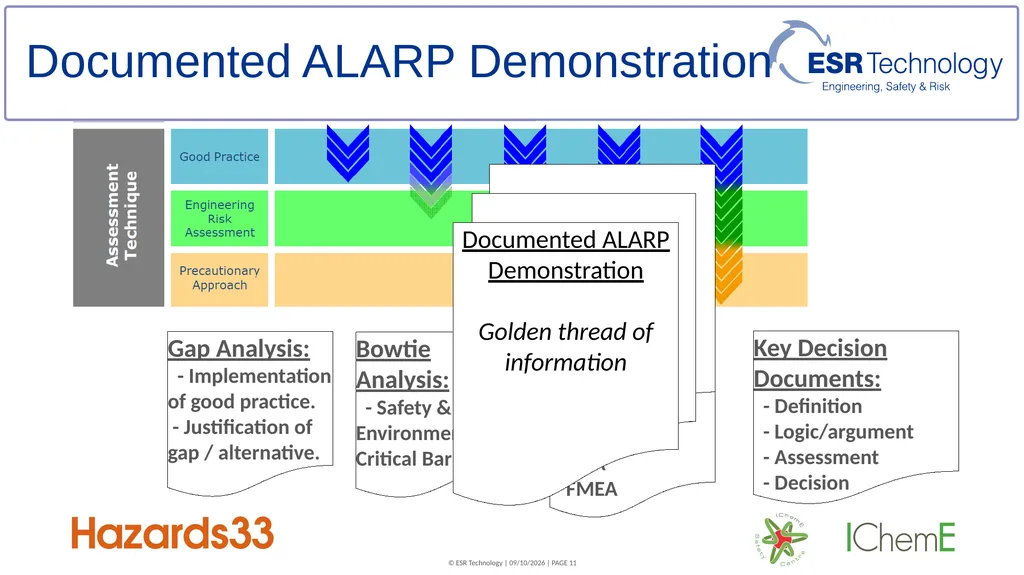
Documented ALARP Demonstration Bowtie Analysis:
- Safety & Environmental Critical Barriers Gap Analysis:
- Implementation of good practice.
- Justification of gap / alternative. Qualitative / Quantitative Assessments:
- LOPA
- QRA
- FMEA Documented ALARP Demonstration
Golden thread of information Key Decision Documents:
- Definition
- Logic/argument
- Assessment
- Decision<br>
12
Deep Water Offshore Wind Project used a process safety assurance process to demonstrate ALARP, including ‘Key Decision Sheets’ to present factual information and record the decision basis.
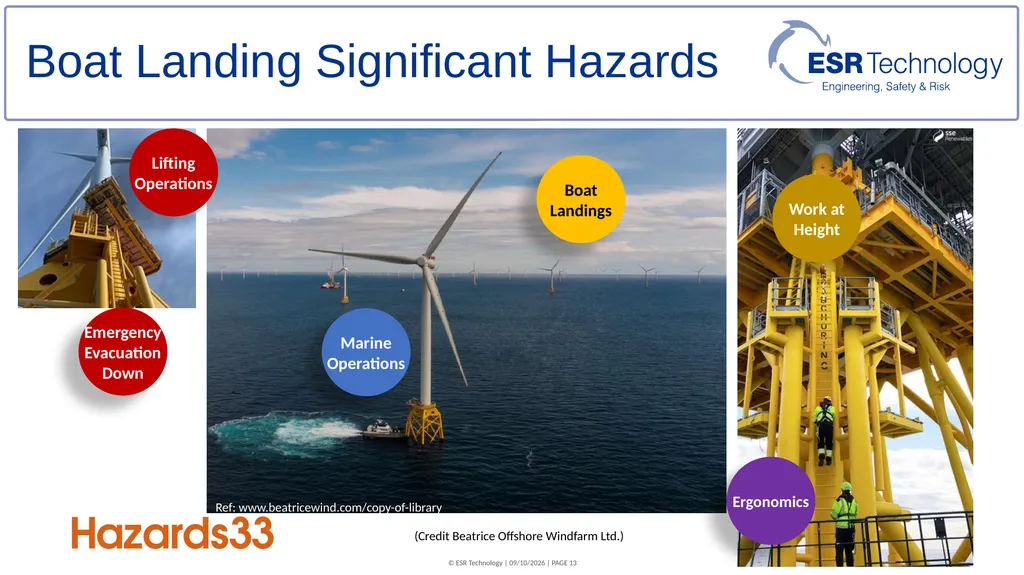
First offshore wind foundations for deep water (30m – 50m). 4-legged jacket with boat landing at 7degree incline. Industry norm was monopile with a vertical boat landing.
Significant challenge to the design by operations teams on grounds of safety and operability compared to a vertical design.
An approved design was required for the boat landing for FEED deadline. Key Decision Sheet provided the framework for the decision.<br>
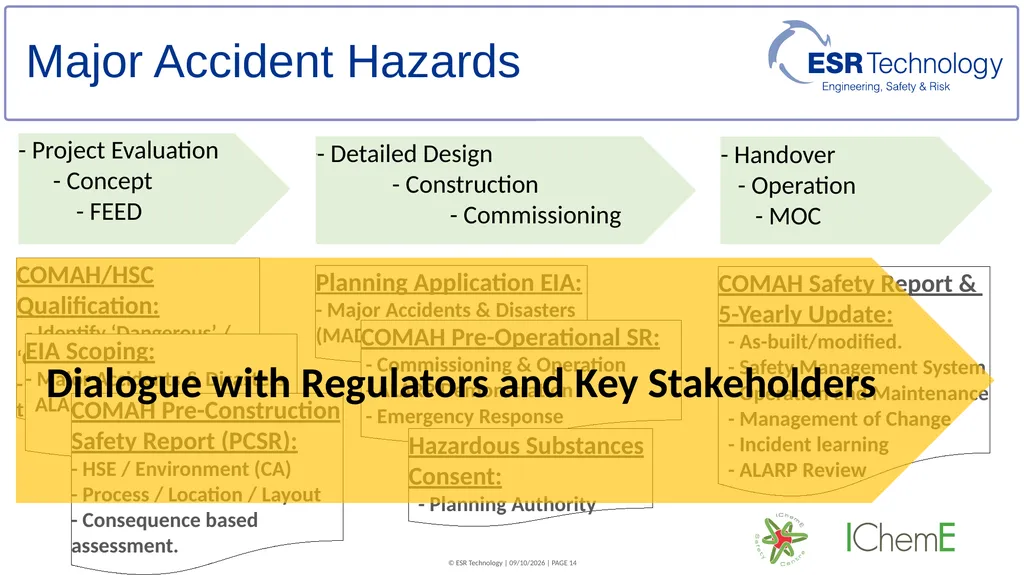
COMAH/HSC Qualification:
- Identify ‘Dangerous’ / ‘Controlled’ Substances.
- Compare quantities with thresholds. - Detailed Design
- Construction
- Commissioning Major Accident Hazards COMAH Safety Report & 5-Yearly Update:
- As-built/modified.
- Safety Management System
- Operation and Maintenance
- Management of Change
- Incident learning
- ALARP Review - Project Evaluation
- Concept
- FEED - Handover
- Operation
- MOC EIA Scoping:
- Major Accidents & Disasters
ALARP COMAH Pre-Construction Safety Report (PCSR):
- HSE / Environment (CA)
- Process / Location / Layout
- Consequence based assessment. Planning Application EIA:
- Major Accidents & Disasters (MAD) – ALARP COMAH Pre-Operational SR:
- Commissioning & Operation
- ALARP Demonstration
- Emergency Response Hazardous Substances Consent:
- Planning Authority - Detailed Design
- Construction
- Commissioning - Handover
- Operation
- MOC Dialogue with Regulators and Key Stakeholders<br>
15
Blue H2 & CCS Project Innovative project for H2 fuelled power generation with CCS commenced 2003.
EIA covered MAH criteria in evaluation of location options.
COMAH Pre-construction Safety Report (PCSR) was produced for FEED.
Issues addressed included:
Rationale for the project.
Selection of a location from alternatives nationally and locally.
Selection of the process technology (auto-thermal reformer) and layout.
Site-wide HAZID, and identification of representative scenarios.
Hazard from CO2 included in ALARP assessment despite not being a COMAH DS.
Conservative worst case consequences of representative scenarios.
Major Accident Prevention Policy (MAPP) and Safety Management System for design.<br>
16
Blue H2 & CCS Project Cross-country pipeline for CO2 export. Repurposed NG import pipeline to CO2 export.
Concurrent study of modification to offshore platform for CO2 receipt and well injection.
FEED COMAH PCSR submitted in 2005.
COMAH CA assessment concluded there were no serious deficiencies in the ALARP demonstration for FEED, and ALARP demonstration for detailed design would be submitted in the POSR.
All regulatory compliance boxes had been ticked that would have enabled the project to move to the next phase of detailed design.<br>
17
Conclusions A range of energy transition technologies are required to reduce global carbon emissions and mitigate the effects of climate change.
Project process safety assurance frameworks develop ALARP arguments that allow consensus, support planning processes and regulatory compliance.
Two examples have been given that show ways that safety assurance has supported decision making. Key factors include:
Identifies and manages key issues early, including Significant Accident Hazards (conventional safety) and Major Accident Hazards (COMAH dangerous substances).
Gains consensus on ALARP with key stakeholders e.g. designer, installer and operator.
Allows projects to proceed through design and construction phases with agreed ALARP demonstrations e.g. for the technology, location and layout.
Provides safety information that facilitates planning approval.
Facilitates due diligence, corporate approval and funding.<br>
18
Conclusions The safety assurance process delivers a documented ALARP argument which, together with other relevant documentation, provides a ‘Golden Thread Of Information’ which can be maintained throughout the lifetime of the project.
This gives the duty holders, at any given time, a line of sight between the hazards identified and the critical measures that have been put in place to ensure that the risks, to the safety of people and to the environment, are being managed to As Low As Reasonably Practicable.<br>