Asset classes 1 You will Learn about and identify examples of different asset classes and portfolio allocations using a sports team analogy. Learn the concept of diversification. Apply your knowledge of asset classes and diversification
"Asset classes 1 You will Learn about and identify" is the property of its rightful owner. Permission is granted to
download and print the materials on this website for personal, non-commercial use only, and to display it
on your personal computer provided you do not modify the materials and that you retain all copyright
notices contained in the materials. By downloading content from our website, you accept the terms of this
agreement.
Presentation Transcript
01
Asset classes 1<br>
02
You will Learn about and identify examples of different asset classes and portfolio allocations using a sports team analogy.
Learn the concept of diversification.
Apply your knowledge of asset classes and diversification using a sports team analogy. 2<br>
03
What do sports teams and investment portfolios have in common? Survey: What's your favourite sport? what types of investments and savings options do you know about? Think, pair, share: How is choosing investment and savings options for your financial portfolio like managers choosing players on a sports team, or directors and producers choosing various roles for a theater production? 3<br>
04
Watch the Money Gains “Asset classes” video and answer the following questions: How are asset classes in a portfolio like players on a sports team?
What three factors should be considered when choosing which asset classes to include in your portfolio?
What happens to most people’s risk tolerance as they get closer to retirement?
What are the three traditional asset classes?
Give five examples of alternative assets
What is a stock? How do you make money from a stock?
What is a bond? How do you make money on a bond?
Rank the following investments from least risky to most risky: stocks, bonds, cash.
What is a REIT?
What are some examples of commodities?
What are some examples of digital asset classes?
What is diversification, and why is it smart to “not put all your eggs in one basket”? 4<br>
05
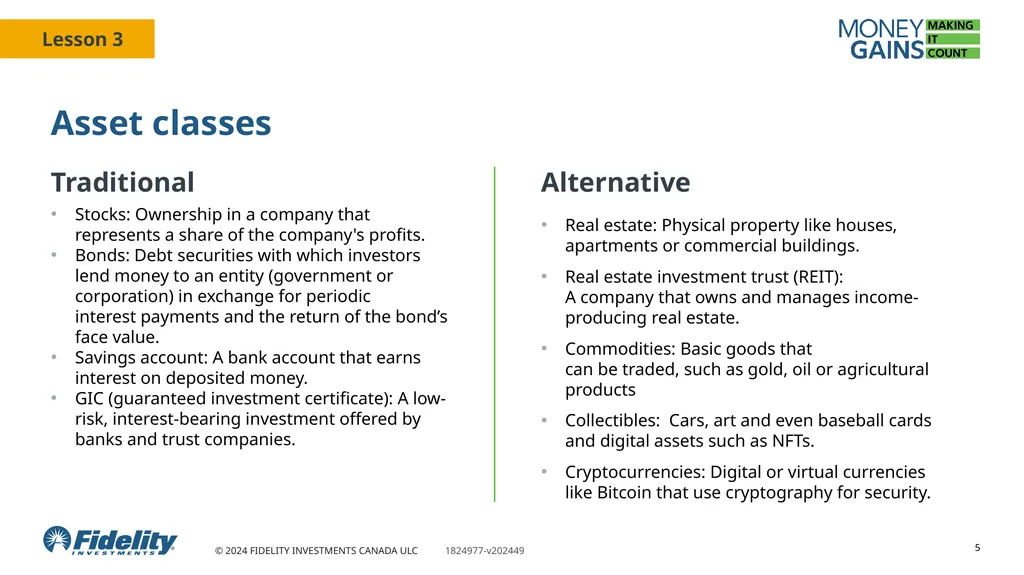
Asset classes Traditional
Stocks: Ownership in a company that represents a share of the company's profits.
Bonds: Debt securities with which investors lend money to an entity (government or corporation) in exchange for periodic interest payments and the return of the bond’s face value.
Savings account: A bank account that earns interest on deposited money.
GIC (guaranteed investment certificate): A low-risk, interest-bearing investment offered by banks and trust companies. 5 Alternative
Real estate: Physical property like houses, apartments or commercial buildings.
Real estate investment trust (REIT): A company that owns and manages income-producing real estate.
Commodities: Basic goods that can be traded, such as gold, oil or agricultural products
Collectibles: Cars, art and even baseball cards and digital assets such as NFTs.
Cryptocurrencies: Digital or virtual currencies like Bitcoin that use cryptography for security.<br>
06
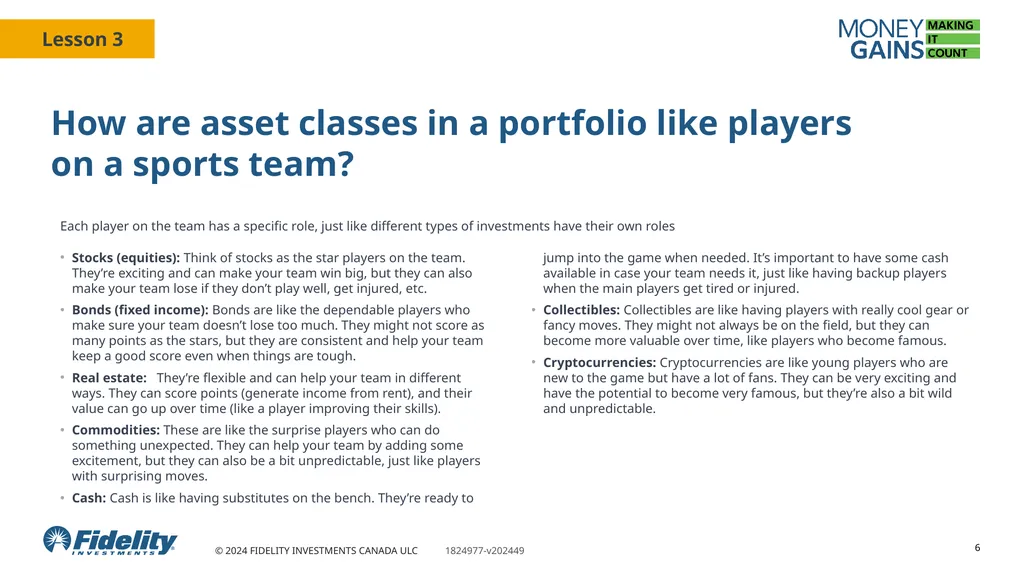
How are asset classes in a portfolio like players on a sports team? 6 Stocks (equities): Think of stocks as the star players on the team. They’re exciting and can make your team win big, but they can also make your team lose if they don’t play well, get injured, etc.
Bonds (fixed income): Bonds are like the dependable players who make sure your team doesn’t lose too much. They might not score as many points as the stars, but they are consistent and help your team keep a good score even when things are tough.
Real estate: They’re flexible and can help your team in different ways. They can score points (generate income from rent), and their value can go up over time (like a player improving their skills).
Commodities: These are like the surprise players who can do something unexpected. They can help your team by adding some excitement, but they can also be a bit unpredictable, just like players with surprising moves.
Cash: Cash is like having substitutes on the bench. They’re ready to jump into the game when needed. It’s important to have some cash available in case your team needs it, just like having backup players when the main players get tired or injured.
Collectibles: Collectibles are like having players with really cool gear or fancy moves. They might not always be on the field, but they can become more valuable over time, like players who become famous.
Cryptocurrencies: Cryptocurrencies are like young players who are new to the game but have a lot of fans. They can be very exciting and have the potential to become very famous, but they’re also a bit wild and unpredictable. Each player on the team has a specific role, just like different types of investments have their own roles<br>
07
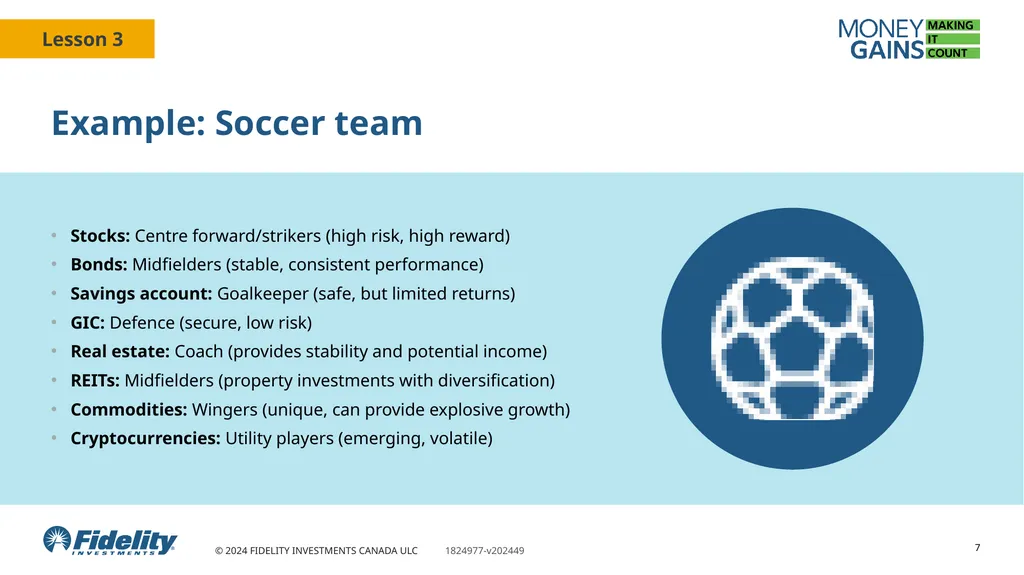
Example: Soccer team Stocks: Centre forward/strikers (high risk, high reward)
Bonds: Midfielders (stable, consistent performance)
Savings account: Goalkeeper (safe, but limited returns)
GIC: Defence (secure, low risk)
Real estate: Coach (provides stability and potential income)
REITs: Midfielders (property investments with diversification)
Commodities: Wingers (unique, can provide explosive growth)
Cryptocurrencies: Utility players (emerging, volatile) 7<br>
08
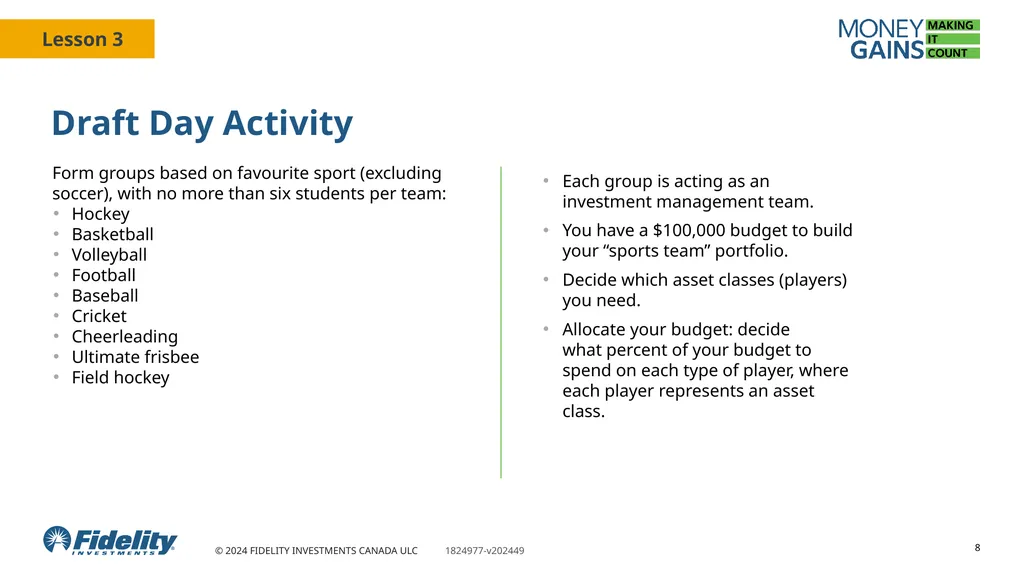
Draft Day Activity Form groups based on favourite sport (excluding soccer), with no more than six students per team:
Hockey
Basketball
Volleyball
Football
Baseball
Cricket
Cheerleading
Ultimate frisbee
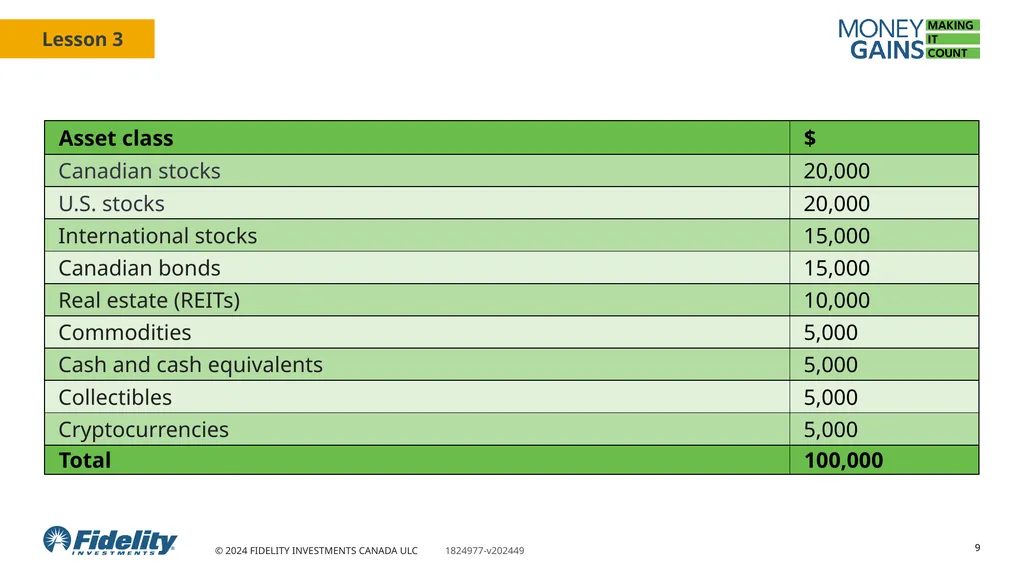
Field hockey 8 Each group is acting as an investment management team.
You have a $100,000 budget to build your “sports team” portfolio.
Decide which asset classes (players) you need.
Allocate your budget: decide what percent of your budget to spend on each type of player, where each player represents an asset class.<br>
09
9<br>
10
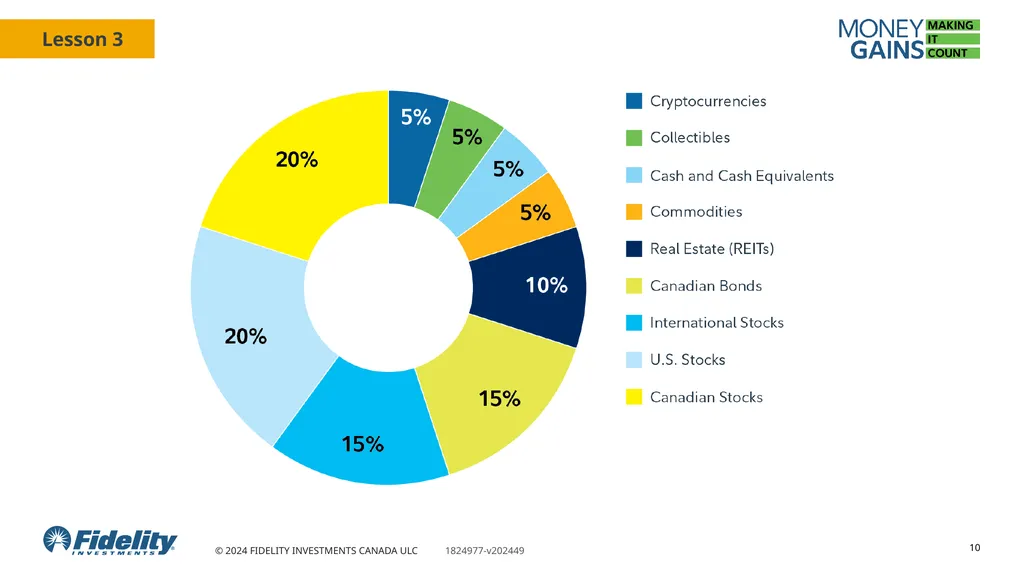
10<br>
11
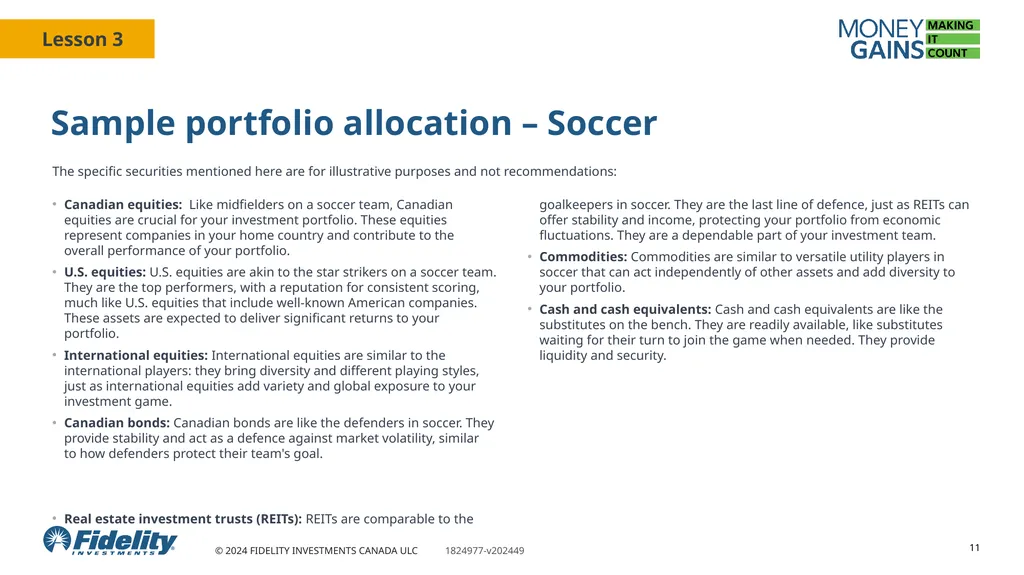
Sample portfolio allocation – Soccer Canadian equities: Like midfielders on a soccer team, Canadian equities are crucial for your investment portfolio. These equities represent companies in your home country and contribute to the overall performance of your portfolio.
U.S. equities: U.S. equities are akin to the star strikers on a soccer team. They are the top performers, with a reputation for consistent scoring, much like U.S. equities that include well-known American companies. These assets are expected to deliver significant returns to your portfolio.
International equities: International equities are similar to the international players: they bring diversity and different playing styles, just as international equities add variety and global exposure to your investment game.
Canadian bonds: Canadian bonds are like the defenders in soccer. They provide stability and act as a defence against market volatility, similar to how defenders protect their team's goal.
Real estate investment trusts (REITs): REITs are comparable to the goalkeepers in soccer. They are the last line of defence, just as REITs can offer stability and income, protecting your portfolio from economic fluctuations. They are a dependable part of your investment team.
Commodities: Commodities are similar to versatile utility players in soccer that can act independently of other assets and add diversity to your portfolio.
Cash and cash equivalents: Cash and cash equivalents are like the substitutes on the bench. They are readily available, like substitutes waiting for their turn to join the game when needed. They provide liquidity and security. The specific securities mentioned here are for illustrative purposes and not recommendations: 11<br>
12
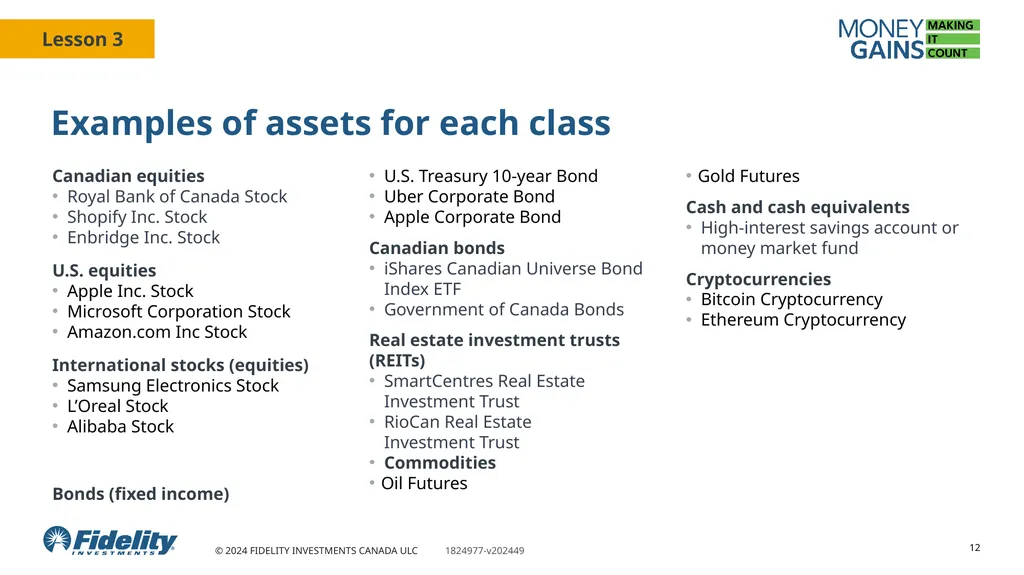
Examples of assets for each class Canadian equities
Royal Bank of Canada Stock
Shopify Inc. Stock
Enbridge Inc. Stock
U.S. equities
Apple Inc. Stock
Microsoft Corporation Stock
Amazon.com Inc Stock
International stocks (equities)
Samsung Electronics Stock
L’Oreal Stock
Alibaba Stock
Bonds (fixed income)
U.S. Treasury 10-year Bond
Uber Corporate Bond
Apple Corporate Bond
Canadian bonds
iShares Canadian Universe Bond Index ETF
Government of Canada Bonds
Real estate investment trusts (REITs)
SmartCentres Real Estate Investment Trust
RioCan Real Estate Investment Trust
Commodities
Oil Futures
Gold Futures
Cash and cash equivalents
High-interest savings account or money market fund
Cryptocurrencies
Bitcoin Cryptocurrency
Ethereum Cryptocurrency 12<br>
13
Portfolio presentation Each group presents their portfolio strategy, explaining the rationale for their choices and how it relates to the soccer team analogy. 13<br>
14
Debrief 14 Why was it important to diversify your portfolios (teams)?<br>