ATP What is it? Why is it important? How is

Published  . 0 views
↓ Download
ATP What is it? Why is it important? How is
1 / 1
ATP What is it? Why is it important? How is - slide 1 of 21 ATP What is it? Why is it important? How is - slide 2 of 21 ATP What is it? Why is it important? How is - slide 3 of 21 ATP What is it? Why is it important? How is - slide 4 of 21 ATP What is it? Why is it important? How is - slide 5 of 21 ATP What is it? Why is it important? How is - slide 6 of 21 ATP What is it? Why is it important? How is - slide 7 of 21 ATP What is it? Why is it important? How is - slide 8 of 21 ATP What is it? Why is it important? How is - slide 9 of 21 ATP What is it? Why is it important? How is - slide 10 of 21 ATP What is it? Why is it important? How is - slide 11 of 21 ATP What is it? Why is it important? How is - slide 12 of 21 ATP What is it? Why is it important? How is - slide 13 of 21 ATP What is it? Why is it important? How is - slide 14 of 21 ATP What is it? Why is it important? How is - slide 15 of 21 ATP What is it? Why is it important? How is - slide 16 of 21 ATP What is it? Why is it important? How is - slide 17 of 21 ATP What is it? Why is it important? How is - slide 18 of 21 ATP What is it? Why is it important? How is - slide 19 of 21 ATP What is it? Why is it important? How is - slide 20 of 21 ATP What is it? Why is it important? How is - slide 21 of 21
Description: ATP What is it? Why is it important? How is it made? Hodder Stoughton 2017 What is ATP? Its full name is adenosine triphosphate Each molecule of ATP contains: one molecule of the purine base, adenine one molecule of the pentose, ribose

Related Topics

Download Presentation

"ATP What is it? Why is it important? How is" is the property of its rightful owner. Permission is granted to download and print the materials on this website for personal, non-commercial use only, and to display it on your personal computer provided you do not modify the materials and that you retain all copyright notices contained in the materials. By downloading content from our website, you accept the terms of this agreement.

Presentation Transcript

slide1. ATP What is it?
Why is it important?
How is it made? Hodder & Stoughton © 2017<br>
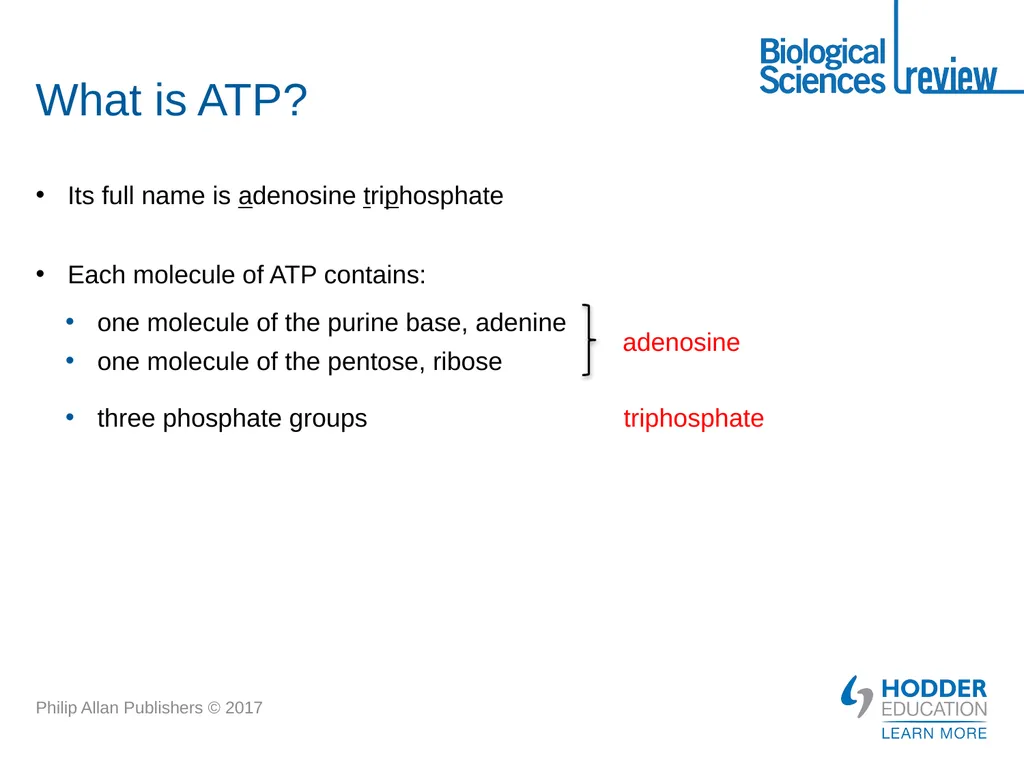
slide2. What is ATP? Its full name is adenosine triphosphate

Each molecule of ATP contains:
one molecule of the purine base, adenine
one molecule of the pentose, ribose
three phosphate groups triphosphate Philip Allan Publishers © 2017 adenosine<br>
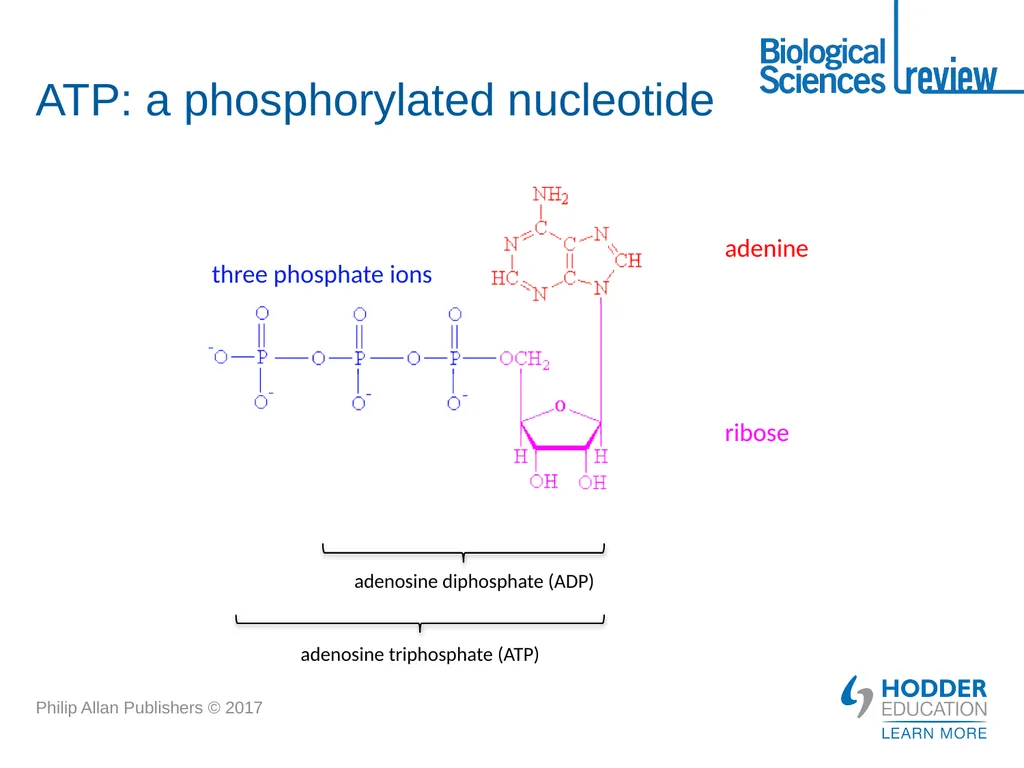
slide3. ATP: a phosphorylated nucleotide Philip Allan Publishers © 2017 adenine

ribose adenosine diphosphate (ADP)

adenosine triphosphate (ATP) three phosphate ions<br>
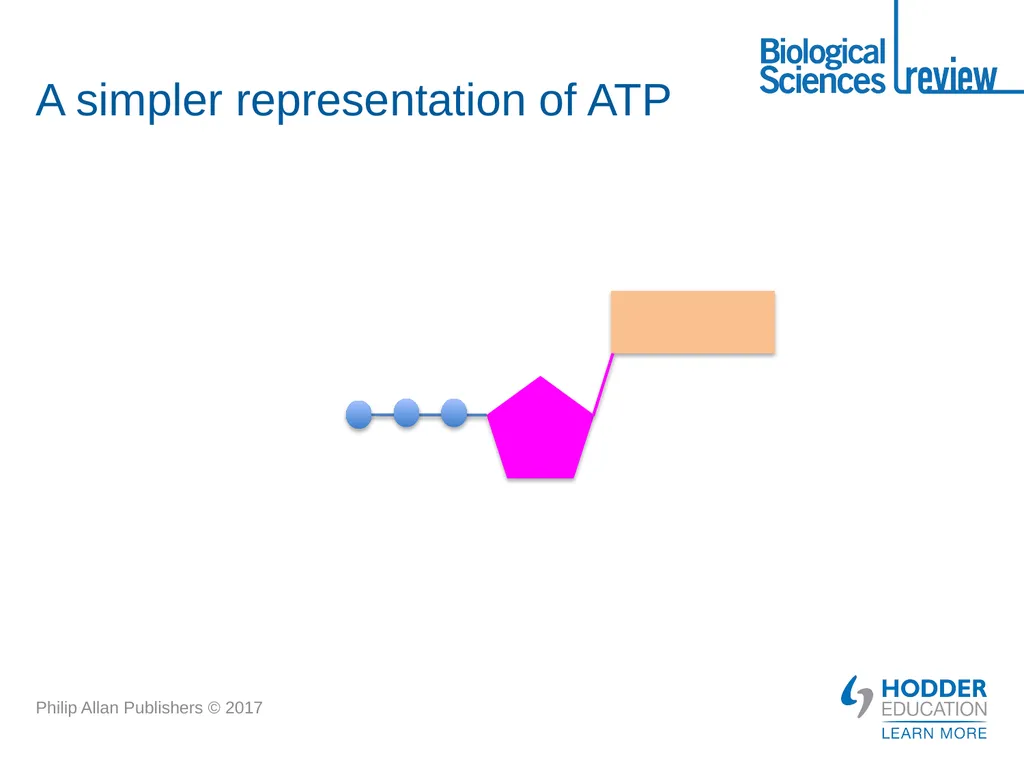
slide4. A simpler representation of ATP Philip Allan Publishers © 2017<br>
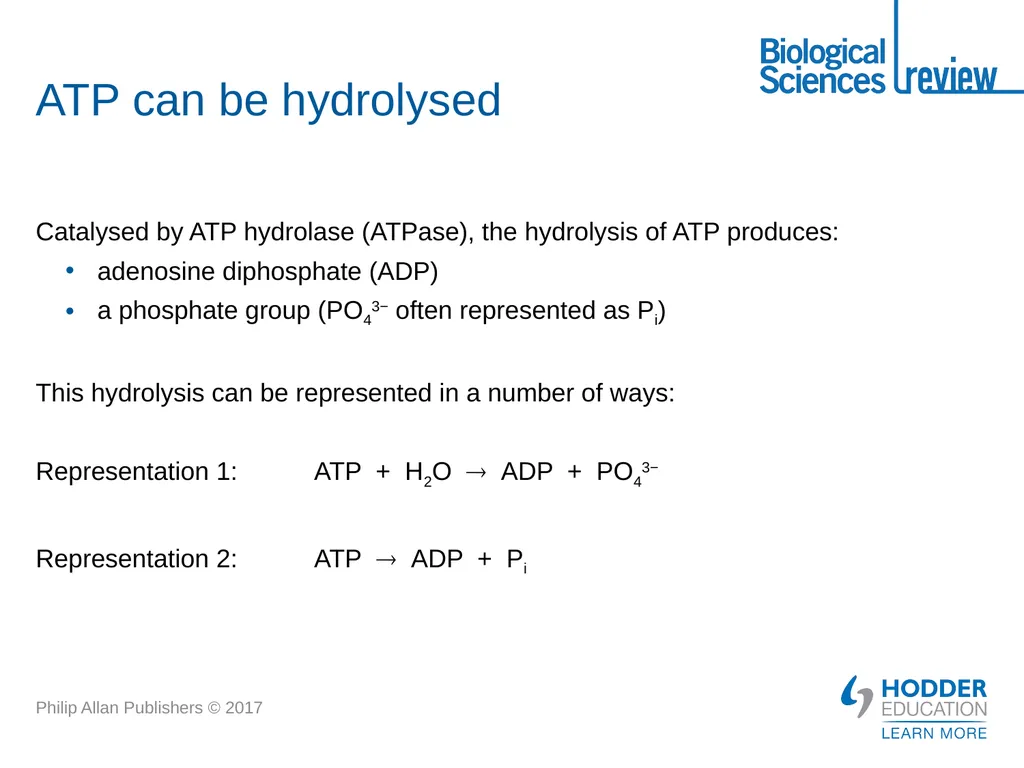
slide5. ATP can be hydrolysed Catalysed by ATP hydrolase (ATPase), the hydrolysis of ATP produces:
adenosine diphosphate (ADP)
a phosphate group (PO43− often represented as Pi)

This hydrolysis can be represented in a number of ways:

Representation 1: ATP + H2O  ADP + PO43−

Representation 2: ATP  ADP + Pi Philip Allan Publishers © 2017<br>
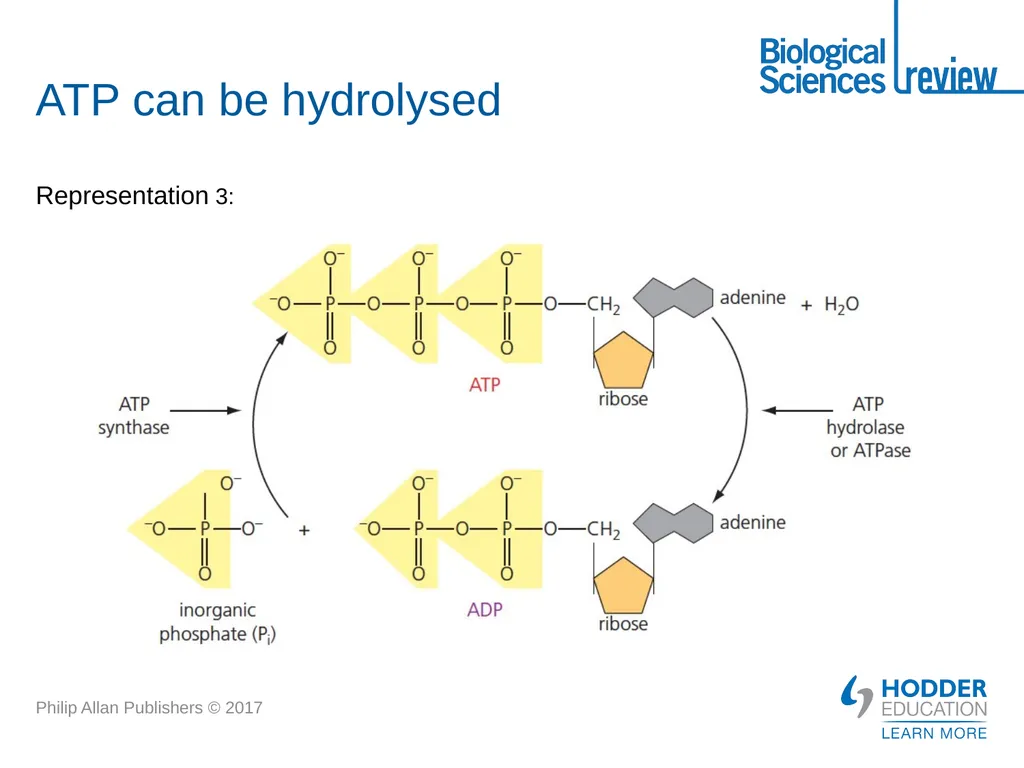
slide6. ATP can be hydrolysed Representation 3: Philip Allan Publishers © 2017<br>
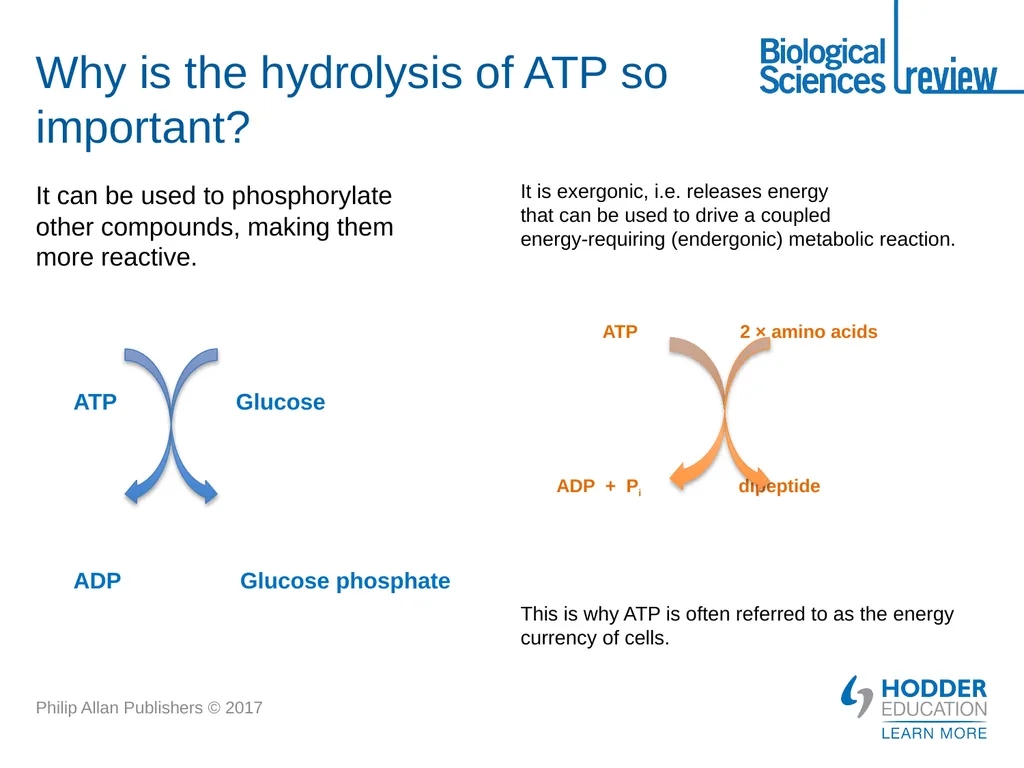
slide7. Why is the hydrolysis of ATP so important? It can be used to phosphorylate other compounds, making them more reactive.


ATP Glucose

ADP Glucose phosphate It is exergonic, i.e. releases energy that can be used to drive a coupled energy-requiring (endergonic) metabolic reaction.


ATP 2 × amino acids

ADP + Pi dipeptide

This is why ATP is often referred to as the energy currency of cells. Philip Allan Publishers © 2017<br>
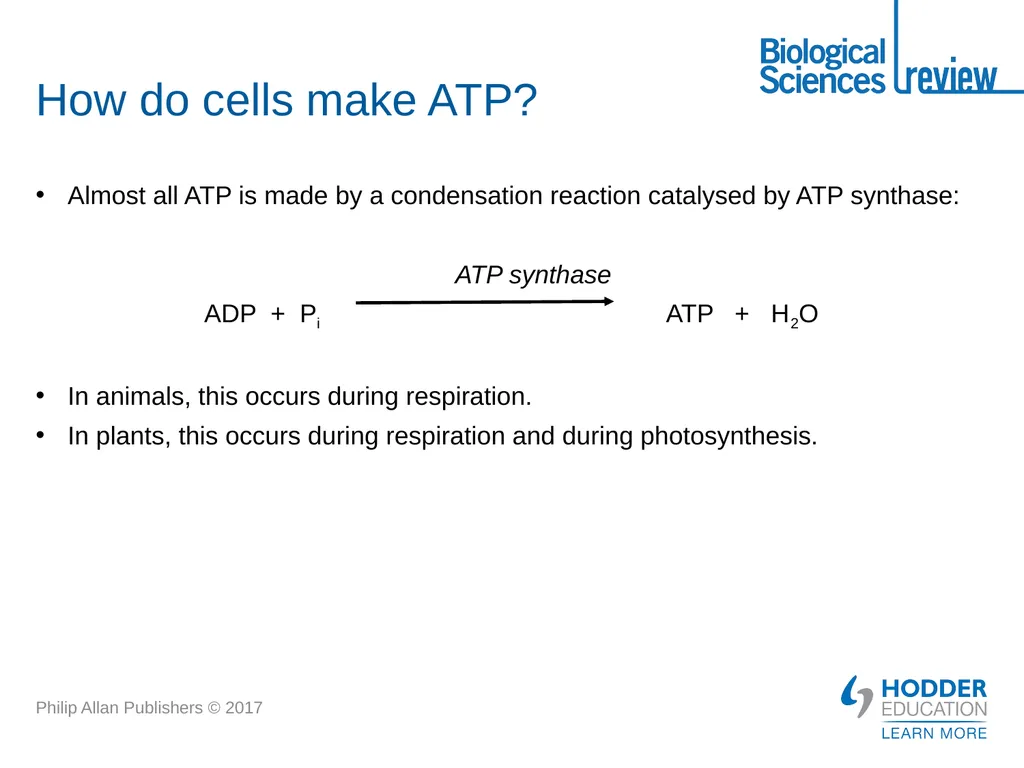
slide8. How do cells make ATP? Almost all ATP is made by a condensation reaction catalysed by ATP synthase:

ATP synthase
ADP + Pi ATP + H2O

In animals, this occurs during respiration.
In plants, this occurs during respiration and during photosynthesis. Philip Allan Publishers © 2017<br>
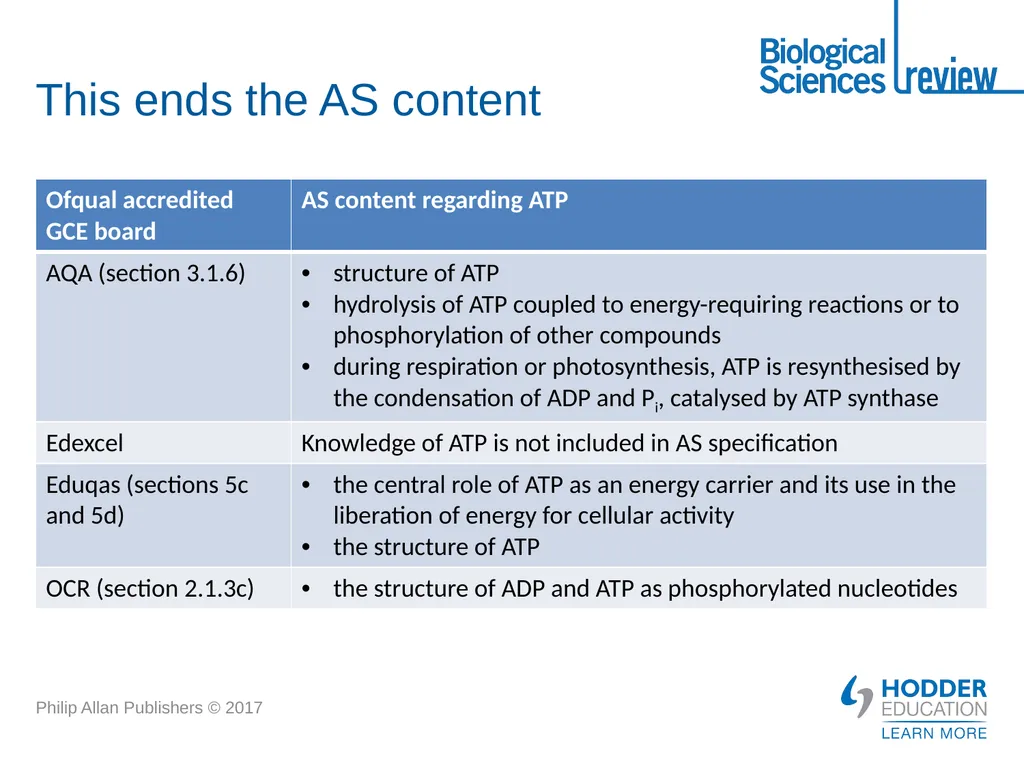
slide9. This ends the AS content Philip Allan Publishers © 2017<br>
slide10. ATP Philip Allan Publishers © 2017 A-level content
– all the AS content plus what follows<br>
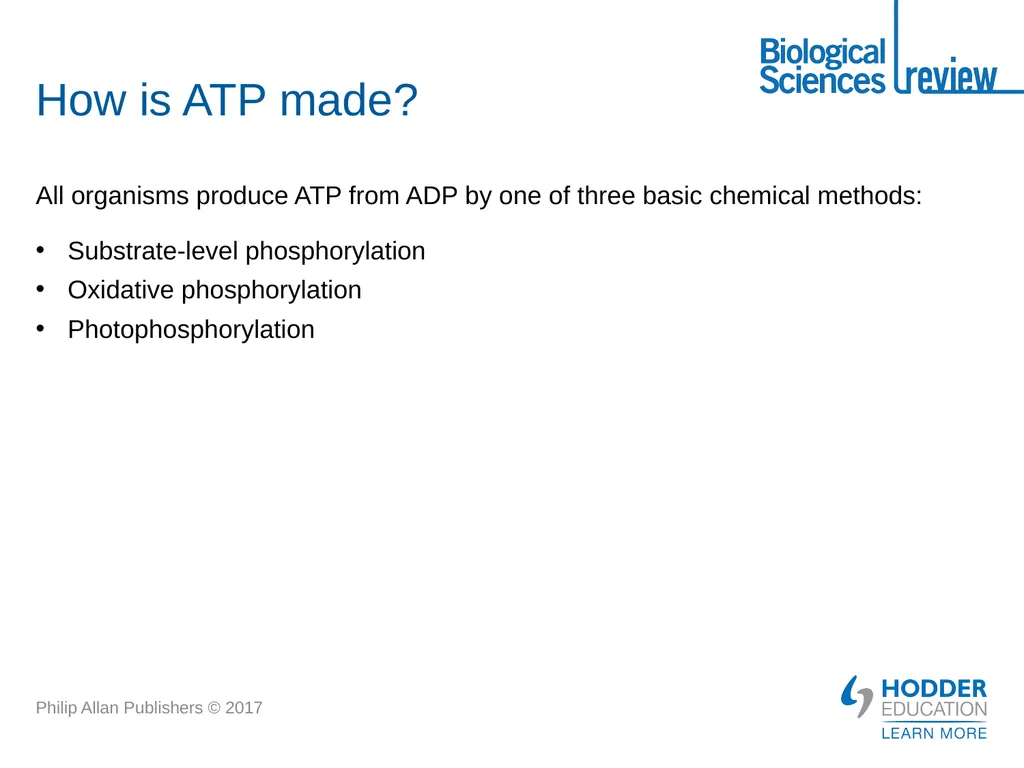
slide11. How is ATP made? All organisms produce ATP from ADP by one of three basic chemical methods:
Substrate-level phosphorylation
Oxidative phosphorylation
Photophosphorylation Philip Allan Publishers © 2017<br>
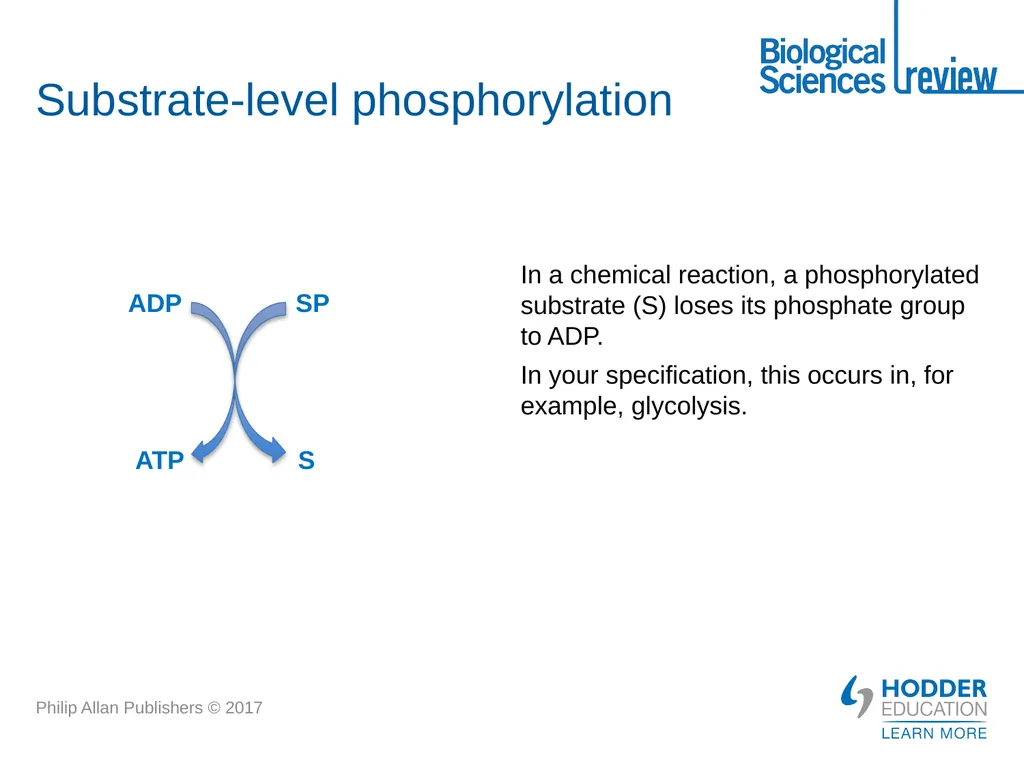
slide12. Substrate-level phosphorylation ADP SP

ATP S In a chemical reaction, a phosphorylated substrate (S) loses its phosphate group to ADP.
In your specification, this occurs in, for example, glycolysis. Philip Allan Publishers © 2017<br>
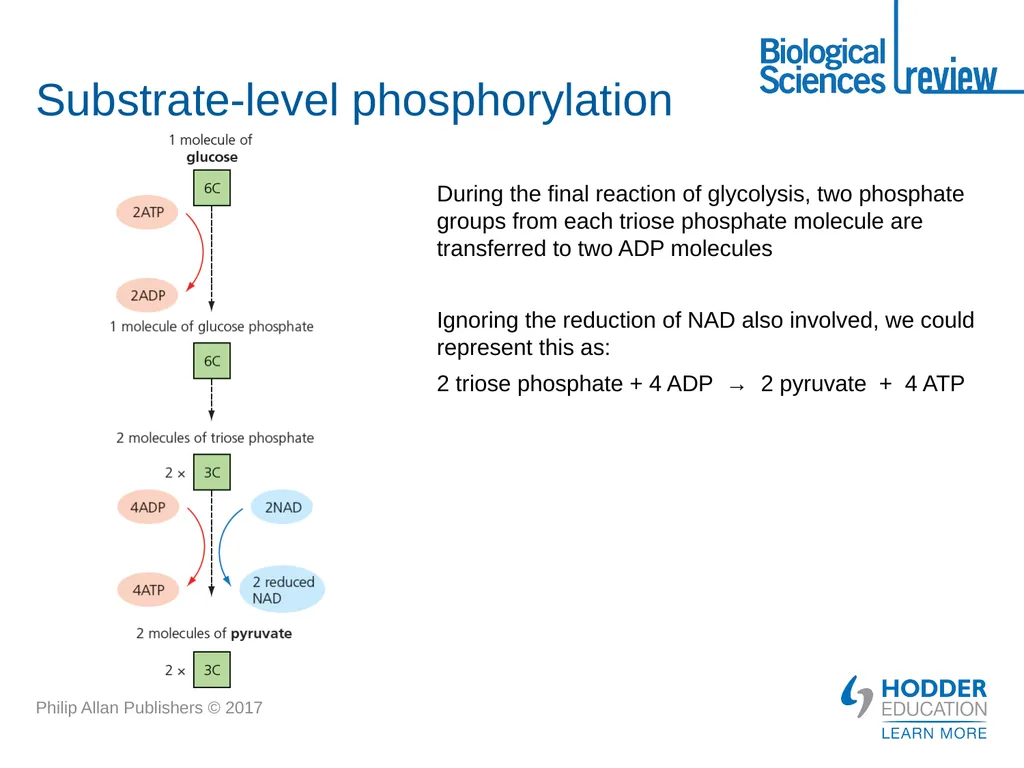
slide13. Substrate-level phosphorylation During the final reaction of glycolysis, two phosphate groups from each triose phosphate molecule are transferred to two ADP molecules

Ignoring the reduction of NAD also involved, we could represent this as:
2 triose phosphate + 4 ADP → 2 pyruvate + 4 ATP Philip Allan Publishers © 2017<br>
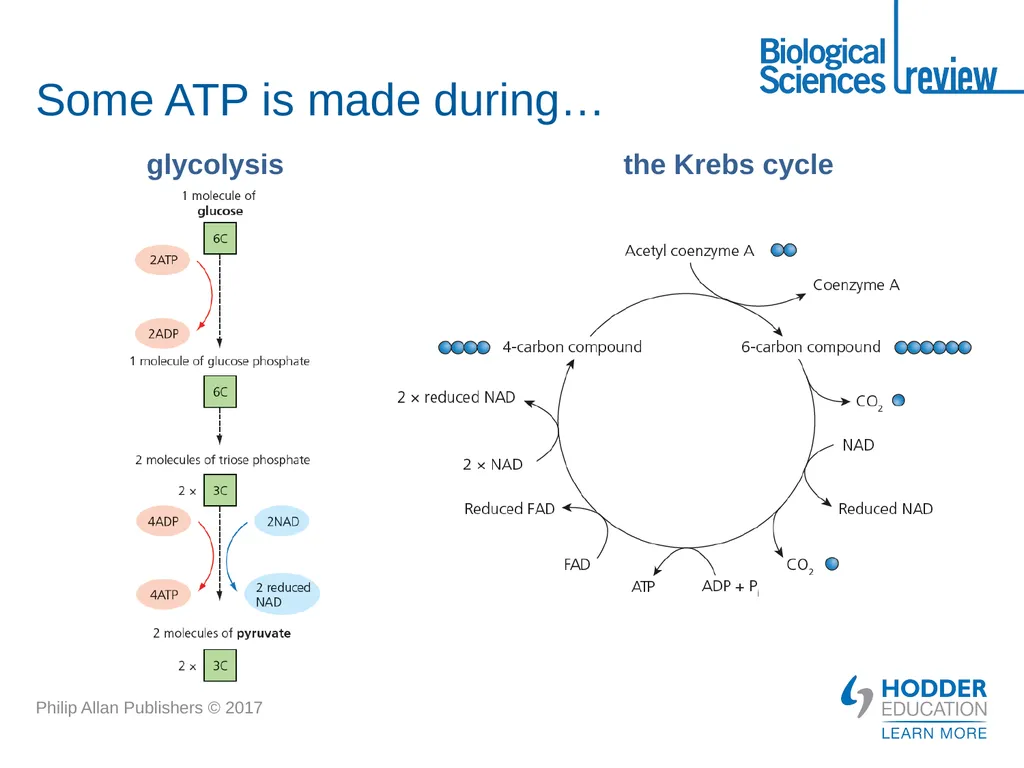
slide14. Some ATP is made during… glycolysis the Krebs cycle Philip Allan Publishers © 2017<br>
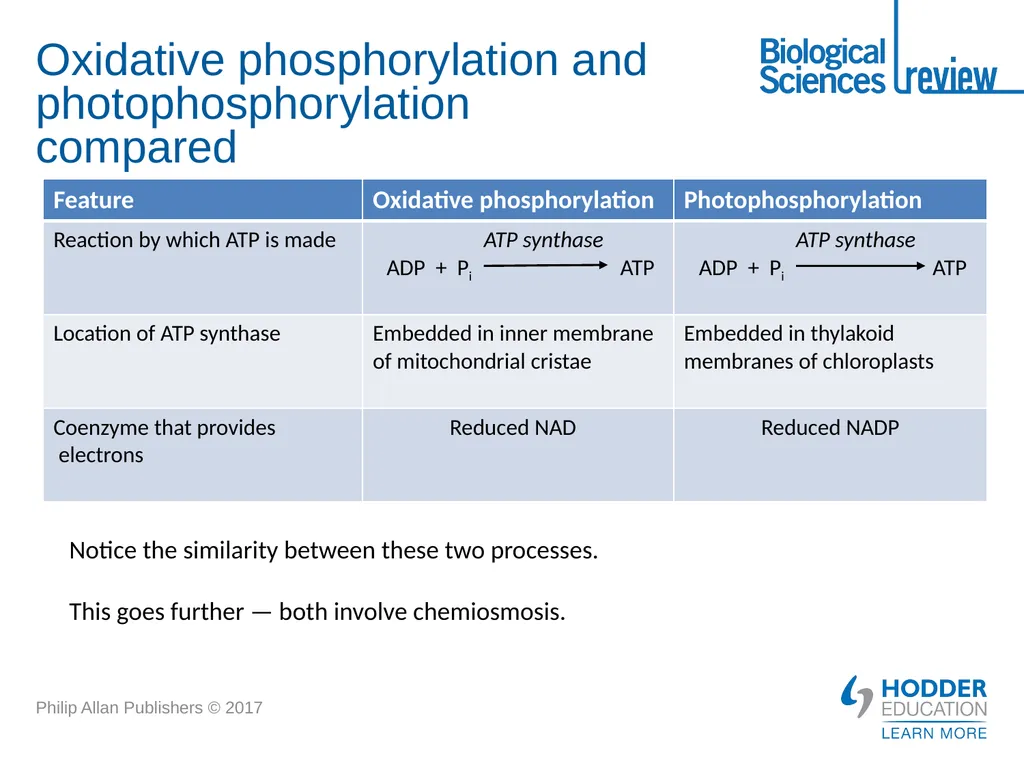
slide15. Oxidative phosphorylation Occurs during aerobic respiration.
Electrons from reduced coenzymes (mainly reduced NAD) enter the electron transfer chains in the cristae of mitochondria.
Passage of electrons down the electron transfer chains releases the energy that drives the production of ATP from ADP and inorganic phosphate (ADP + Pi  ATP).
The synthesis of ATP is catalysed by the enzyme ATP synthase, which is embedded in the inner membranes of the cristae. Philip Allan Publishers © 2017<br>
slide16. Photophosphorylation Occurs during the light-dependent reaction of photosynthesis.
Absorption of light by chlorophyll results in electrons leaving chlorophyll molecules and being taken up by molecules of coenzyme, NADP:
NADP + 2 e− → reduced NADP
Electrons from reduced NADP enter the electron transfer chain in the thylakoid membranes of chloroplasts.
Passage of electrons down the electron transfer chains releases the energy that drives the production of ATP from ADP and inorganic phosphate (ADP + Pi  ATP).
The synthesis of ATP is catalysed by the enzyme ATP synthase, which is embedded in the membranes of the thylakoids. Philip Allan Publishers © 2017<br>
slide17. Oxidative phosphorylation and photophosphorylation compared Philip Allan Publishers © 2017 Notice the similarity between these two processes.

This goes further — both involve chemiosmosis.<br>
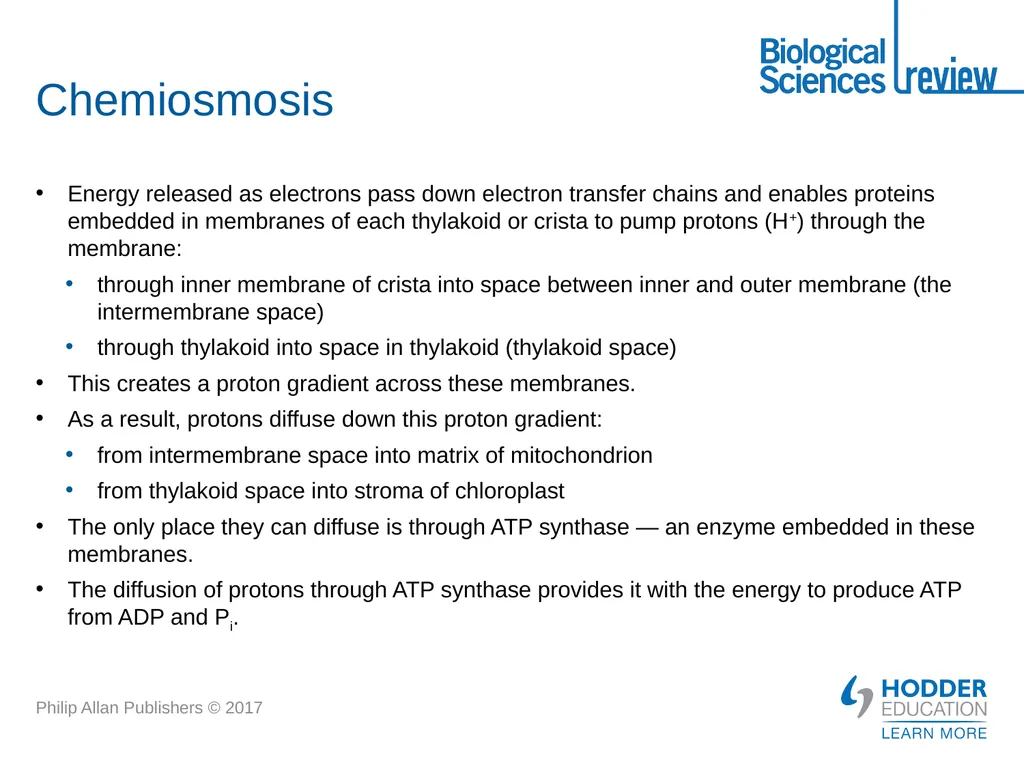
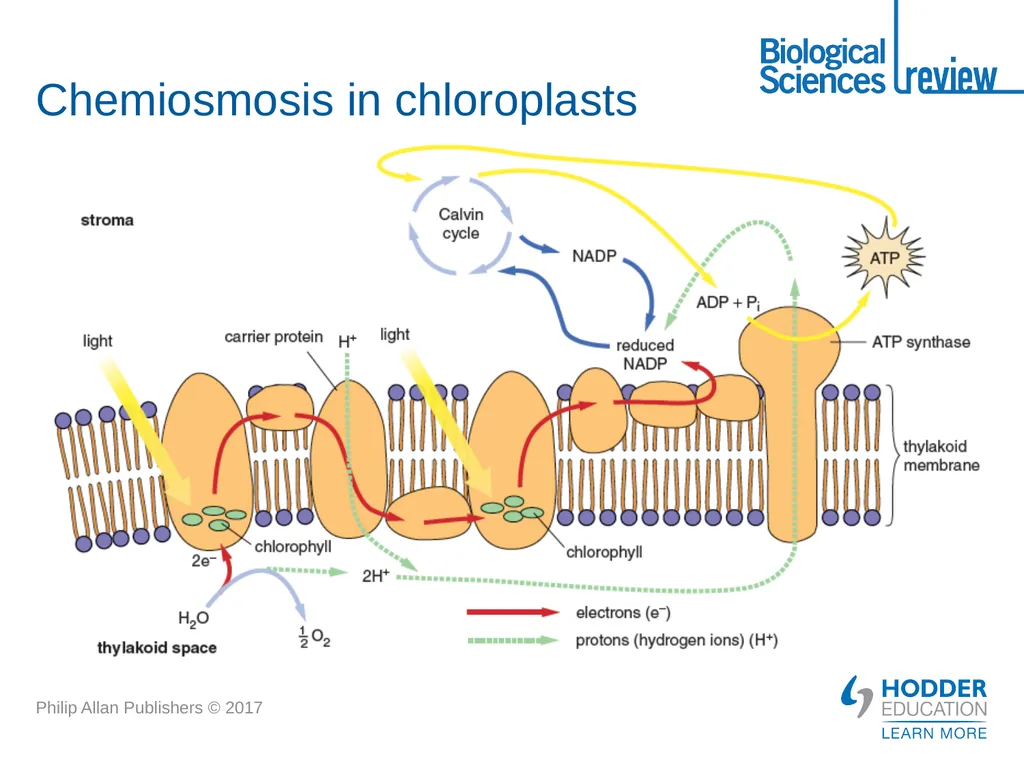
slide18. Chemiosmosis Energy released as electrons pass down electron transfer chains and enables proteins embedded in membranes of each thylakoid or crista to pump protons (H+) through the membrane:
through inner membrane of crista into space between inner and outer membrane (the intermembrane space)
through thylakoid into space in thylakoid (thylakoid space)
This creates a proton gradient across these membranes.
As a result, protons diffuse down this proton gradient:
from intermembrane space into matrix of mitochondrion
from thylakoid space into stroma of chloroplast
The only place they can diffuse is through ATP synthase — an enzyme embedded in these membranes.
The diffusion of protons through ATP synthase provides it with the energy to produce ATP from ADP and Pi. Philip Allan Publishers © 2017<br>
slide19. Chemiosmosis in mitochondria Philip Allan Publishers © 2017<br>
slide20. Chemiosmosis in chloroplasts Philip Allan Publishers © 2017<br>
slide21. Extension reading for A-level chemistry students Try the following accounts of respiration and photosynthesis from the Royal Society of Chemistry website:
http://www.rsc.org/Education/Teachers/Resources/cfb/respiration.htm
http://www.rsc.org/Education/Teachers/Resources/cfb/photosynthesis.htm
 
This resource is part of Biological Sciences Review, a magazine written for A-level students by subject experts. To subscribe to the full magazine go to www.hoddereducation.co.uk/biologicalsciencesreview Philip Allan Publishers © 2017<br>