
Attention-Deficit/Hyperactivity Disorder
NS
Published · 30 slides · 0 views
1 / 1

Description
Attention-DeficitHyperactivity Disorder Assessment and Diagnosis 2 Speaker: Molly P. Scharf, MD Student Health Center Rochester Institute of Technology The REACH Institute Faculty honoraria (per diem) Disclosures Goals and Objectives
Related Topics
Share
Embed code
Download this presentation From Below
"Attention-Deficit/Hyperactivity Disorder" is the property of its rightful owner. Permission is granted to download and print the materials on this website for personal, non-commercial use only, and to display it on your personal computer provided you do not modify the materials and that you retain all copyright notices contained in the materials. By downloading content from our website, you accept the terms of this agreement.
Presentation Transcript
01
Attention-Deficit/Hyperactivity Disorder
Assessment and Diagnosis<br>
02
2 Speaker: Molly P. Scharf, MD Student Health Center
Rochester Institute of Technology<br>
Rochester Institute of Technology<br>
03
The REACH Institute – Faculty honoraria (per diem) Disclosures<br>
04
Goals and Objectives Recognize the presenting symptoms of ADHD
Discuss the core concept and DSM 5 criteria for diagnosing ADHD
Describe the AAP endorsed process of assessing ADHD, including the use of rating scales<br>
Discuss the core concept and DSM 5 criteria for diagnosing ADHD
Describe the AAP endorsed process of assessing ADHD, including the use of rating scales<br>
05
2019 AAP ADHD Guidelines: What’s new? Changes in DSM 5 criteria
Onset <12 years old
5 symptoms for 17+
More emphasis on multimodal treatment, building the “team”
Highlights that ADHD is chronic -> use chronic care model
More emphasis on assessing for comorbidity
First line treatment for preschoolers is behavior management
Wolraich ML, Hagan JF, Allan C, et al. AAP SUBCOMMITTEE ON CHILDREN AND ADOLESCENTS WITH ATTENTION-DEFICIT/HYPERACTIVE DISORDER. Clinical Practice Guideline for the Diagnosis, Evaluation, and Treatment of Attention-Deficit/Hyperactivity Disorder in Children and Adolescents. Pediatrics. 2019;144(4): e20192528<br>
Onset <12 years old
5 symptoms for 17+
More emphasis on multimodal treatment, building the “team”
Highlights that ADHD is chronic -> use chronic care model
More emphasis on assessing for comorbidity
First line treatment for preschoolers is behavior management
Wolraich ML, Hagan JF, Allan C, et al. AAP SUBCOMMITTEE ON CHILDREN AND ADOLESCENTS WITH ATTENTION-DEFICIT/HYPERACTIVE DISORDER. Clinical Practice Guideline for the Diagnosis, Evaluation, and Treatment of Attention-Deficit/Hyperactivity Disorder in Children and Adolescents. Pediatrics. 2019;144(4): e20192528<br>
06
Your Patient: Bart 8 y.o. boy who you’ve known all his life
Intact, college-educated family who care about boy and “argue like everyone”
Early milestones unremarkable, early talker
Mom brings in after one month in 2nd grade; teacher reports “trouble paying attention”; as a result grades are fair-poor
Mom says he has always been really active, “just like his father”, preschool teacher said he was “handful”<br>
Intact, college-educated family who care about boy and “argue like everyone”
Early milestones unremarkable, early talker
Mom brings in after one month in 2nd grade; teacher reports “trouble paying attention”; as a result grades are fair-poor
Mom says he has always been really active, “just like his father”, preschool teacher said he was “handful”<br>
07
More on Bart With his sibs he often interrupts and “can’t wait for anything”
Easily distracted
Speaks up in class and disrupts frequently
Difficulty settling and falling asleep
“Good kid” and no physical aggression but have to watch him “all the time” or he can get hurt
Last year in school he struggled also but parents thought due to teacher who “yelled a lot”<br>
Easily distracted
Speaks up in class and disrupts frequently
Difficulty settling and falling asleep
“Good kid” and no physical aggression but have to watch him “all the time” or he can get hurt
Last year in school he struggled also but parents thought due to teacher who “yelled a lot”<br>
08
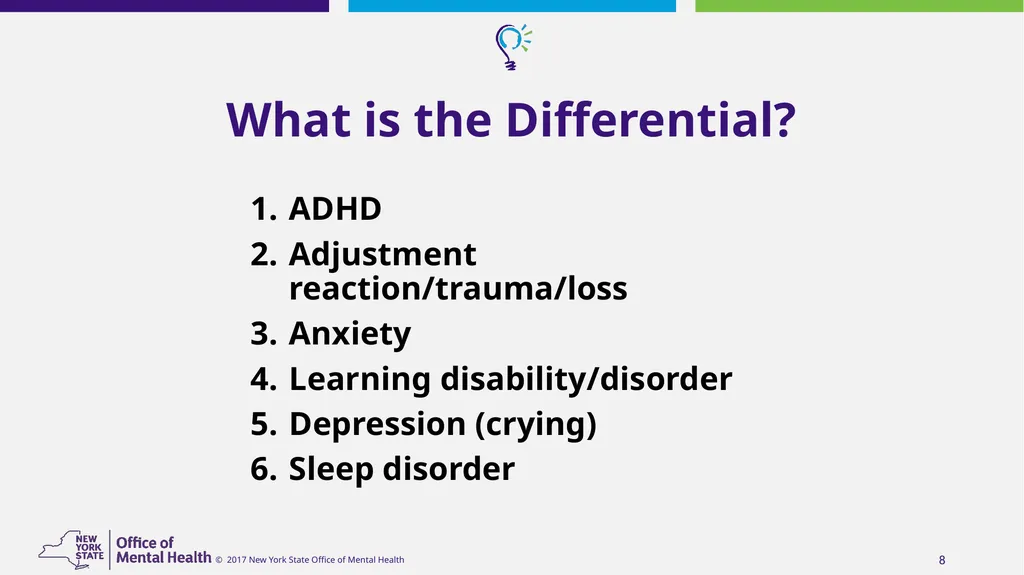
What is the Differential? ADHD
Adjustment reaction/trauma/loss
Anxiety
Learning disability/disorder
Depression (crying)
Sleep disorder<br>
Adjustment reaction/trauma/loss
Anxiety
Learning disability/disorder
Depression (crying)
Sleep disorder<br>
09
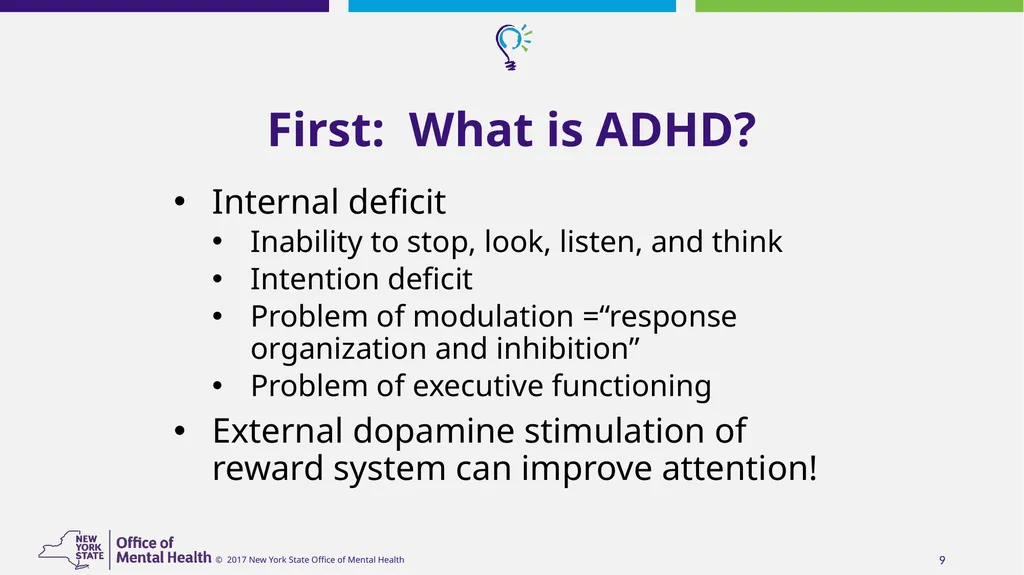
First: What is ADHD? Internal deficit
Inability to stop, look, listen, and think
Intention deficit
Problem of modulation =“response organization and inhibition”
Problem of executive functioning
External dopamine stimulation of reward system can improve attention!<br>
Inability to stop, look, listen, and think
Intention deficit
Problem of modulation =“response organization and inhibition”
Problem of executive functioning
External dopamine stimulation of reward system can improve attention!<br>
10
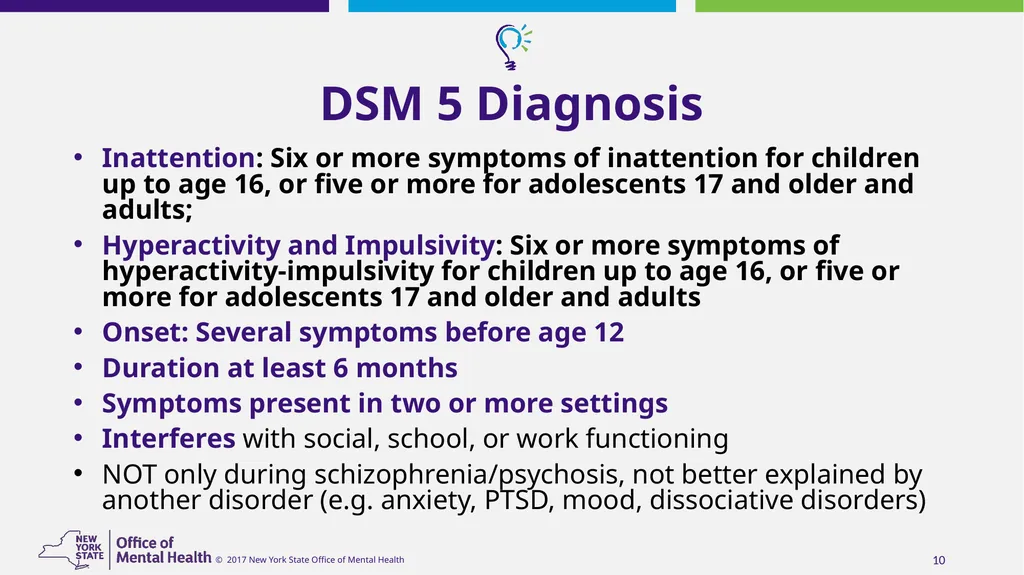
DSM 5 Diagnosis Inattention: Six or more symptoms of inattention for children up to age 16, or five or more for adolescents 17 and older and adults;
Hyperactivity and Impulsivity: Six or more symptoms of hyperactivity-impulsivity for children up to age 16, or five or more for adolescents 17 and older and adults
Onset: Several symptoms before age 12
Duration at least 6 months
Symptoms present in two or more settings
Interferes with social, school, or work functioning
NOT only during schizophrenia/psychosis, not better explained by another disorder (e.g. anxiety, PTSD, mood, dissociative disorders)<br>
Hyperactivity and Impulsivity: Six or more symptoms of hyperactivity-impulsivity for children up to age 16, or five or more for adolescents 17 and older and adults
Onset: Several symptoms before age 12
Duration at least 6 months
Symptoms present in two or more settings
Interferes with social, school, or work functioning
NOT only during schizophrenia/psychosis, not better explained by another disorder (e.g. anxiety, PTSD, mood, dissociative disorders)<br>
11
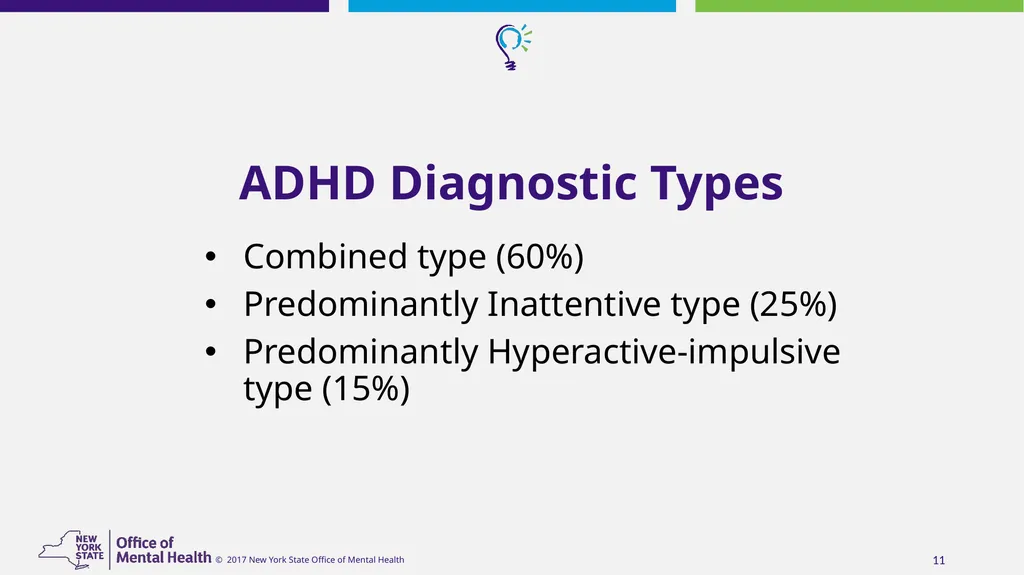
ADHD Diagnostic Types Combined type (60%)
Predominantly Inattentive type (25%)
Predominantly Hyperactive-impulsive type (15%)<br>
Predominantly Inattentive type (25%)
Predominantly Hyperactive-impulsive type (15%)<br>
12
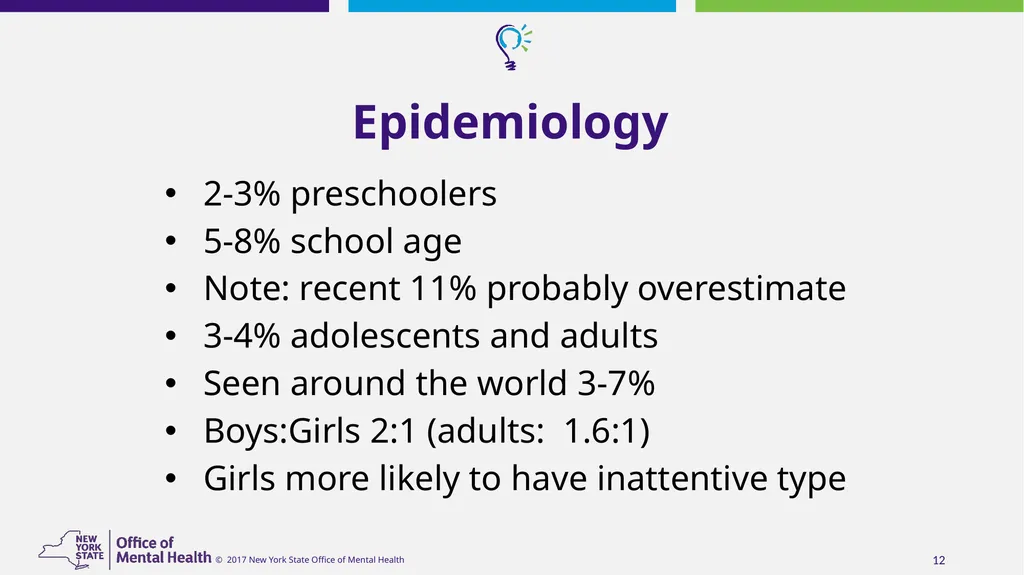
Epidemiology 2-3% preschoolers
5-8% school age
Note: recent 11% probably overestimate
3-4% adolescents and adults
Seen around the world 3-7%
Boys:Girls 2:1 (adults: 1.6:1)
Girls more likely to have inattentive type<br>
5-8% school age
Note: recent 11% probably overestimate
3-4% adolescents and adults
Seen around the world 3-7%
Boys:Girls 2:1 (adults: 1.6:1)
Girls more likely to have inattentive type<br>
13
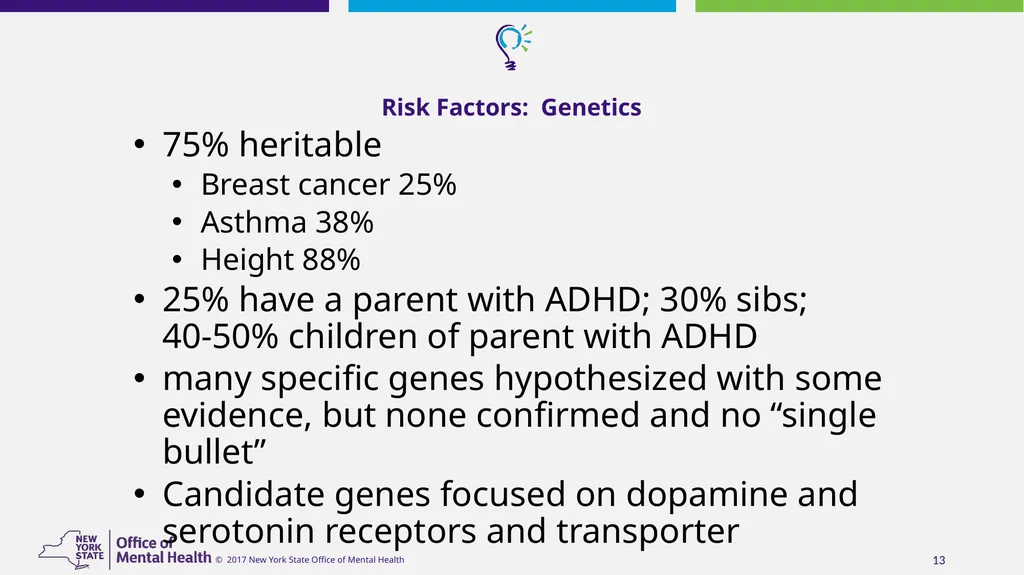
Risk Factors: Genetics 75% heritable
Breast cancer 25%
Asthma 38%
Height 88%
25% have a parent with ADHD; 30% sibs; 40-50% children of parent with ADHD
many specific genes hypothesized with some evidence, but none confirmed and no “single bullet”
Candidate genes focused on dopamine and serotonin receptors and transporter<br>
Breast cancer 25%
Asthma 38%
Height 88%
25% have a parent with ADHD; 30% sibs; 40-50% children of parent with ADHD
many specific genes hypothesized with some evidence, but none confirmed and no “single bullet”
Candidate genes focused on dopamine and serotonin receptors and transporter<br>
14
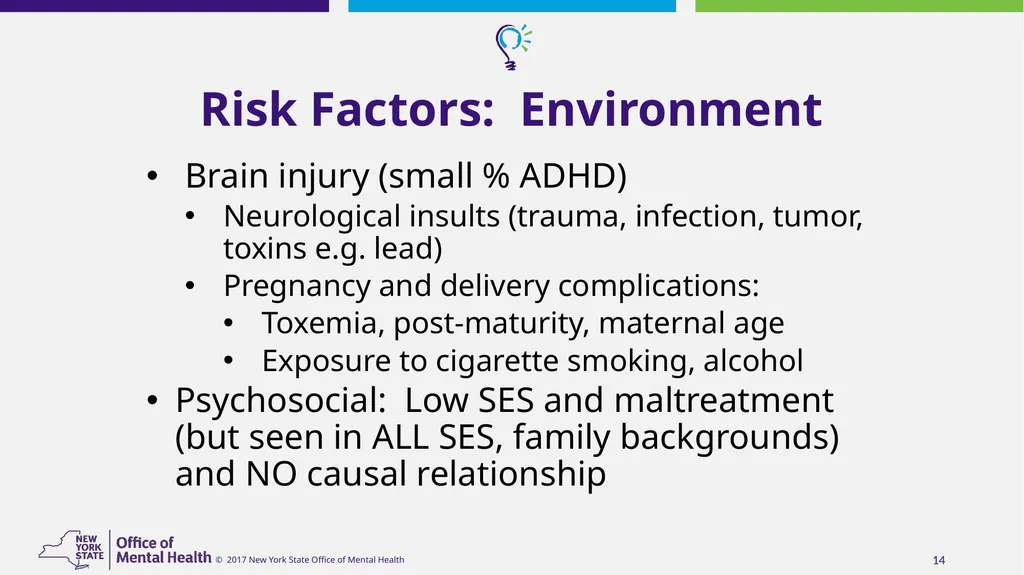
Risk Factors: Environment Brain injury (small % ADHD)
Neurological insults (trauma, infection, tumor, toxins e.g. lead)
Pregnancy and delivery complications:
Toxemia, post-maturity, maternal age
Exposure to cigarette smoking, alcohol
Psychosocial: Low SES and maltreatment (but seen in ALL SES, family backgrounds) and NO causal relationship<br>
Neurological insults (trauma, infection, tumor, toxins e.g. lead)
Pregnancy and delivery complications:
Toxemia, post-maturity, maternal age
Exposure to cigarette smoking, alcohol
Psychosocial: Low SES and maltreatment (but seen in ALL SES, family backgrounds) and NO causal relationship<br>
15
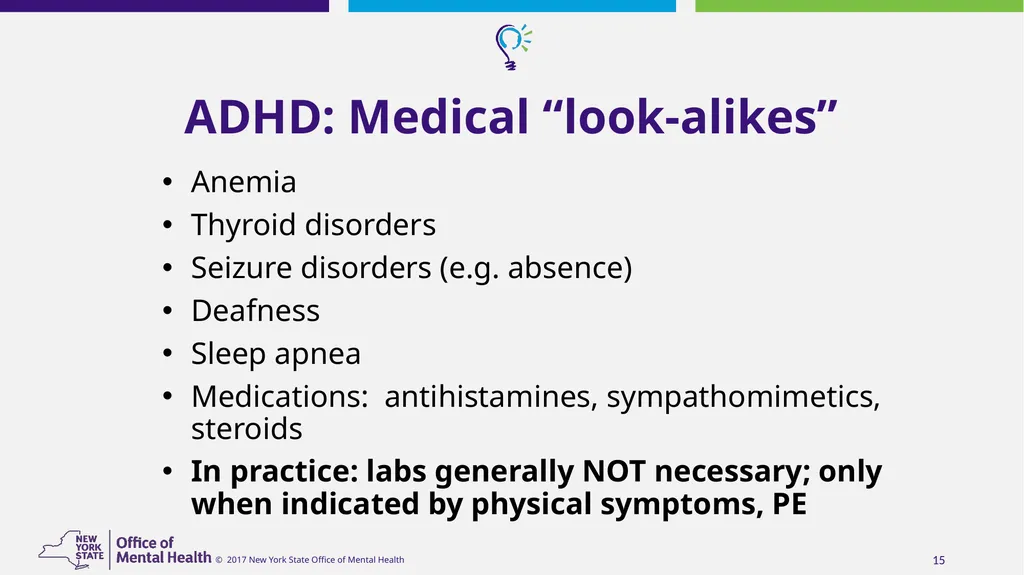
ADHD: Medical “look-alikes” Anemia
Thyroid disorders
Seizure disorders (e.g. absence)
Deafness
Sleep apnea
Medications: antihistamines, sympathomimetics, steroids
In practice: labs generally NOT necessary; only when indicated by physical symptoms, PE<br>
Thyroid disorders
Seizure disorders (e.g. absence)
Deafness
Sleep apnea
Medications: antihistamines, sympathomimetics, steroids
In practice: labs generally NOT necessary; only when indicated by physical symptoms, PE<br>
16
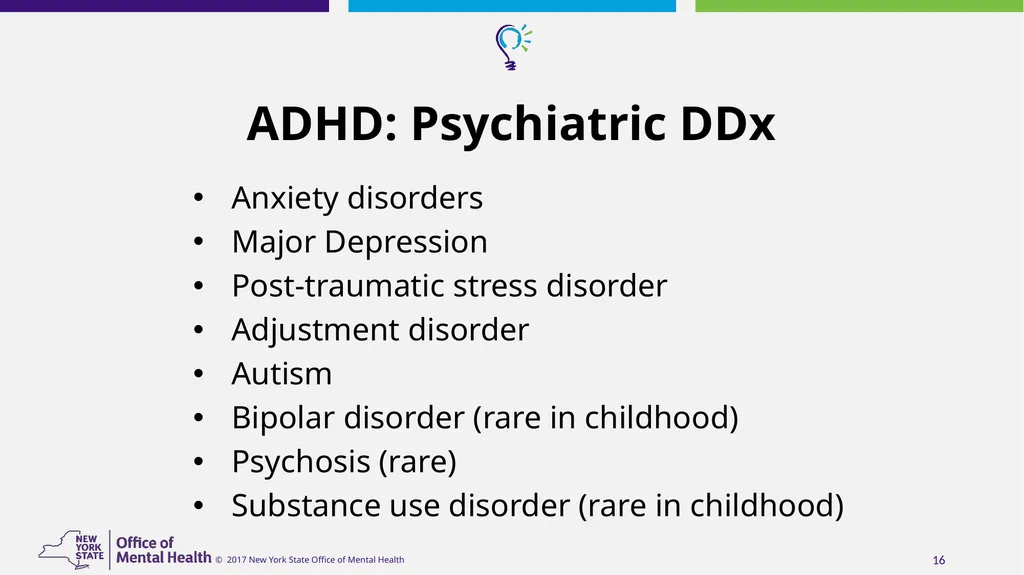
ADHD: Psychiatric DDx Anxiety disorders
Major Depression
Post-traumatic stress disorder
Adjustment disorder
Autism
Bipolar disorder (rare in childhood)
Psychosis (rare)
Substance use disorder (rare in childhood)<br>
Major Depression
Post-traumatic stress disorder
Adjustment disorder
Autism
Bipolar disorder (rare in childhood)
Psychosis (rare)
Substance use disorder (rare in childhood)<br>
17
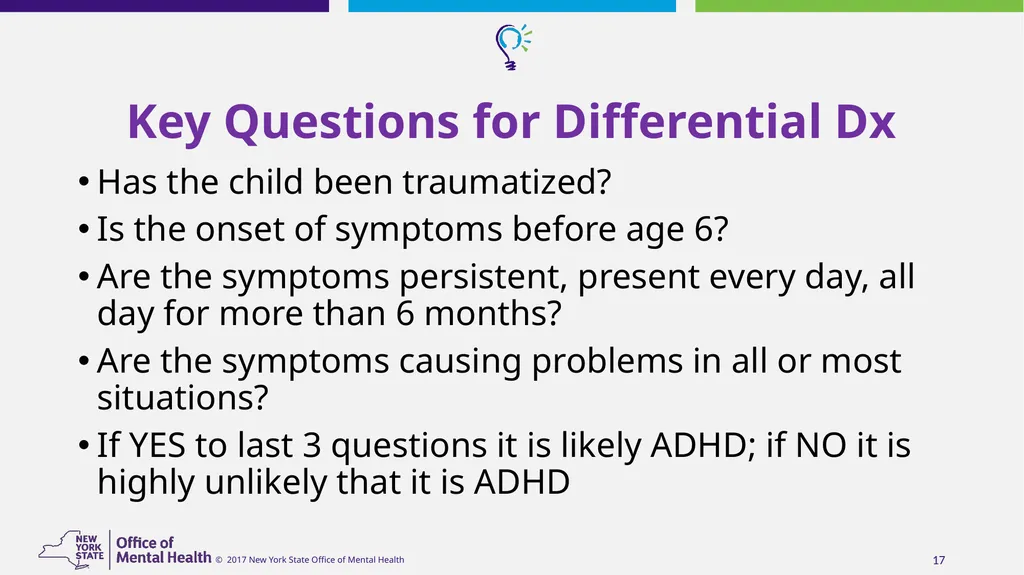
Key Questions for Differential Dx Has the child been traumatized?
Is the onset of symptoms before age 6?
Are the symptoms persistent, present every day, all day for more than 6 months?
Are the symptoms causing problems in all or most situations?
If YES to last 3 questions it is likely ADHD; if NO it is highly unlikely that it is ADHD<br>
Is the onset of symptoms before age 6?
Are the symptoms persistent, present every day, all day for more than 6 months?
Are the symptoms causing problems in all or most situations?
If YES to last 3 questions it is likely ADHD; if NO it is highly unlikely that it is ADHD<br>
18
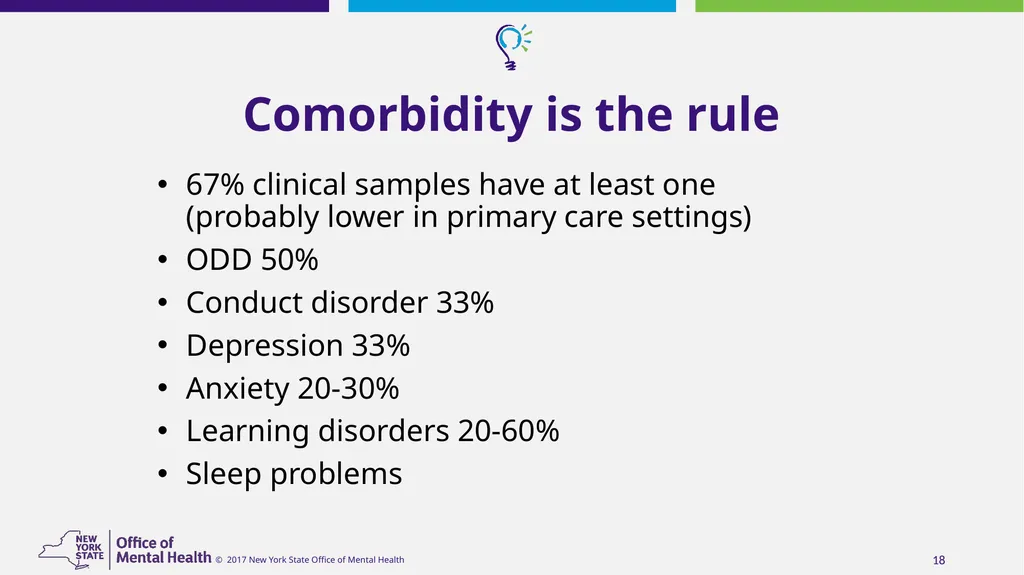
Comorbidity is the rule 67% clinical samples have at least one (probably lower in primary care settings)
ODD 50%
Conduct disorder 33%
Depression 33%
Anxiety 20-30%
Learning disorders 20-60%
Sleep problems<br>
ODD 50%
Conduct disorder 33%
Depression 33%
Anxiety 20-30%
Learning disorders 20-60%
Sleep problems<br>
19
Making the Diagnosis<br>
20
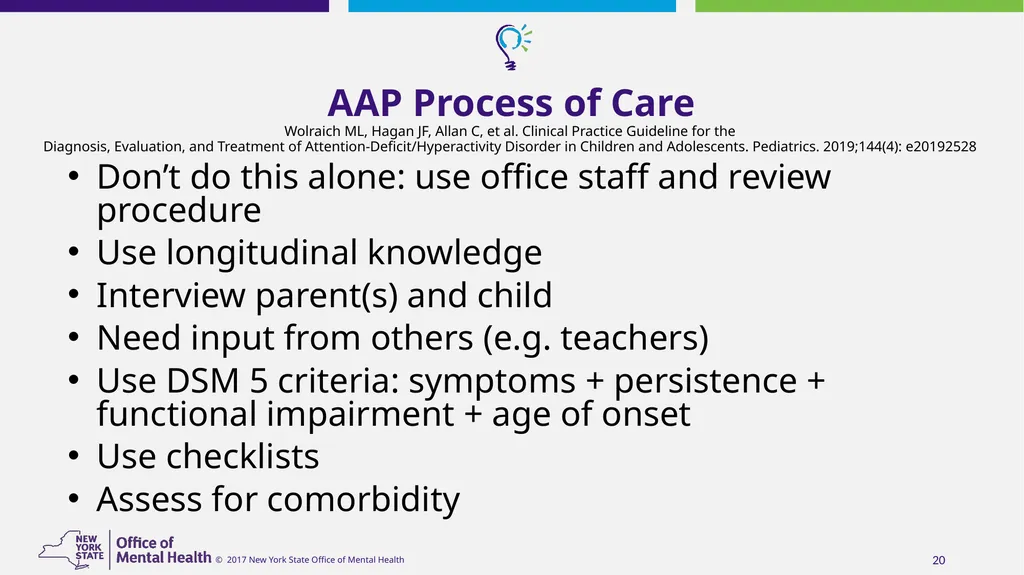
AAP Process of Care
Wolraich ML, Hagan JF, Allan C, et al. Clinical Practice Guideline for the
Diagnosis, Evaluation, and Treatment of Attention-Deficit/Hyperactivity Disorder in Children and Adolescents. Pediatrics. 2019;144(4): e20192528 Don’t do this alone: use office staff and review procedure
Use longitudinal knowledge
Interview parent(s) and child
Need input from others (e.g. teachers)
Use DSM 5 criteria: symptoms + persistence + functional impairment + age of onset
Use checklists
Assess for comorbidity<br>
Use longitudinal knowledge
Interview parent(s) and child
Need input from others (e.g. teachers)
Use DSM 5 criteria: symptoms + persistence + functional impairment + age of onset
Use checklists
Assess for comorbidity<br>
21
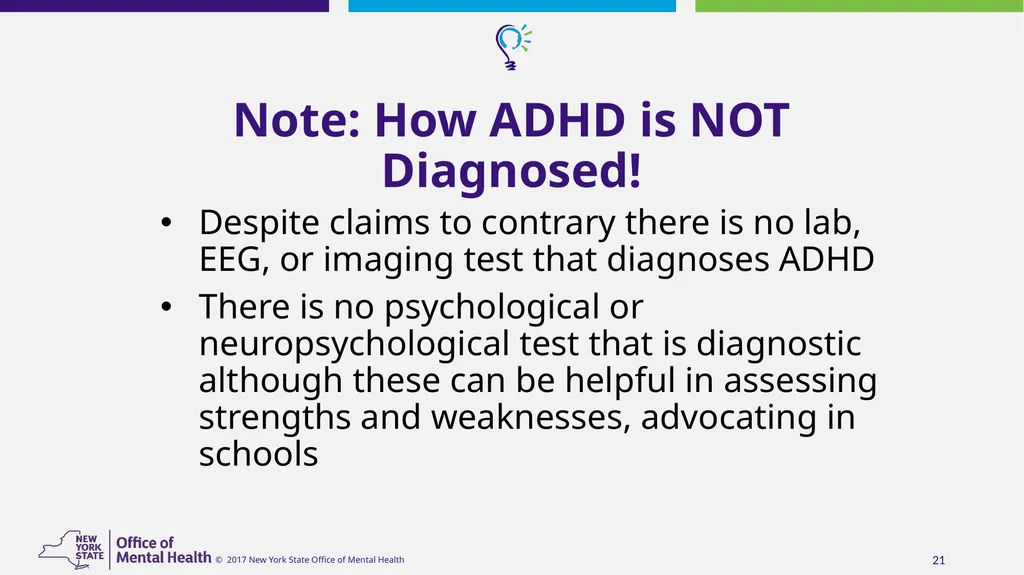
Note: How ADHD is NOT Diagnosed! Despite claims to contrary there is no lab, EEG, or imaging test that diagnoses ADHD
There is no psychological or neuropsychological test that is diagnostic although these can be helpful in assessing strengths and weaknesses, advocating in schools<br>
There is no psychological or neuropsychological test that is diagnostic although these can be helpful in assessing strengths and weaknesses, advocating in schools<br>
22
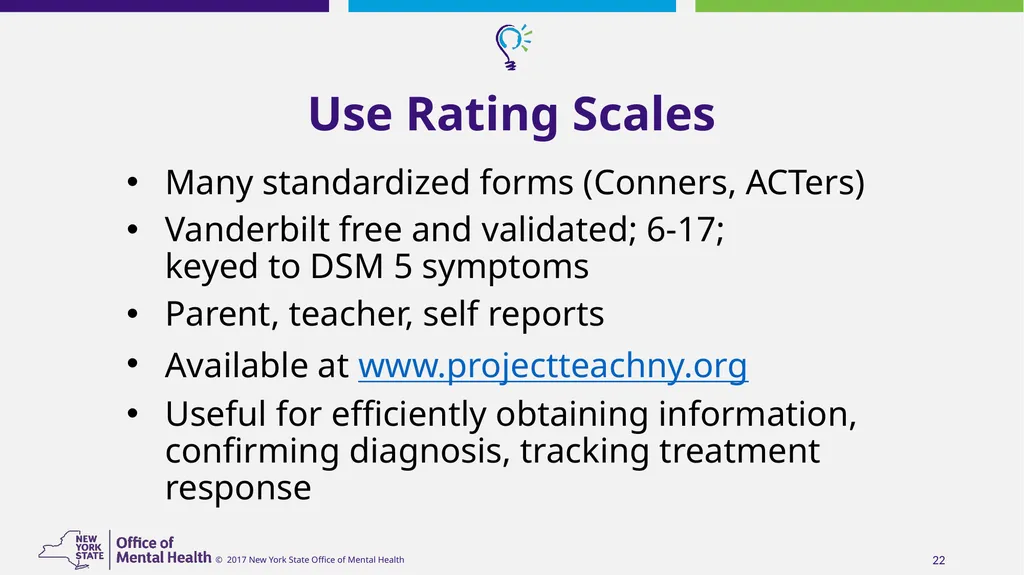
Use Rating Scales Many standardized forms (Conners, ACTers)
Vanderbilt free and validated; 6-17; keyed to DSM 5 symptoms
Parent, teacher, self reports
Available at www.projectteachny.org
Useful for efficiently obtaining information, confirming diagnosis, tracking treatment response<br>
Vanderbilt free and validated; 6-17; keyed to DSM 5 symptoms
Parent, teacher, self reports
Available at www.projectteachny.org
Useful for efficiently obtaining information, confirming diagnosis, tracking treatment response<br>
23
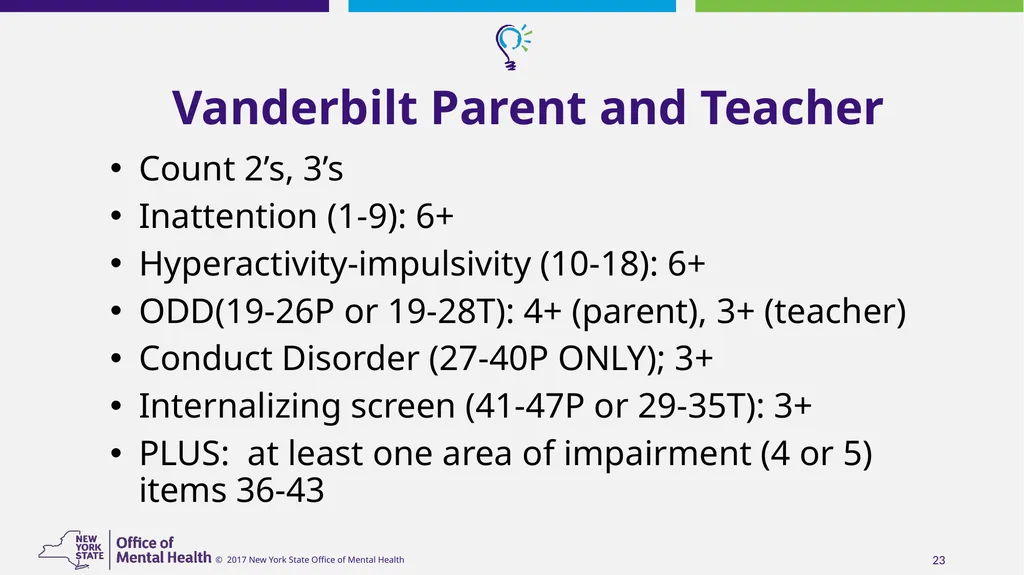
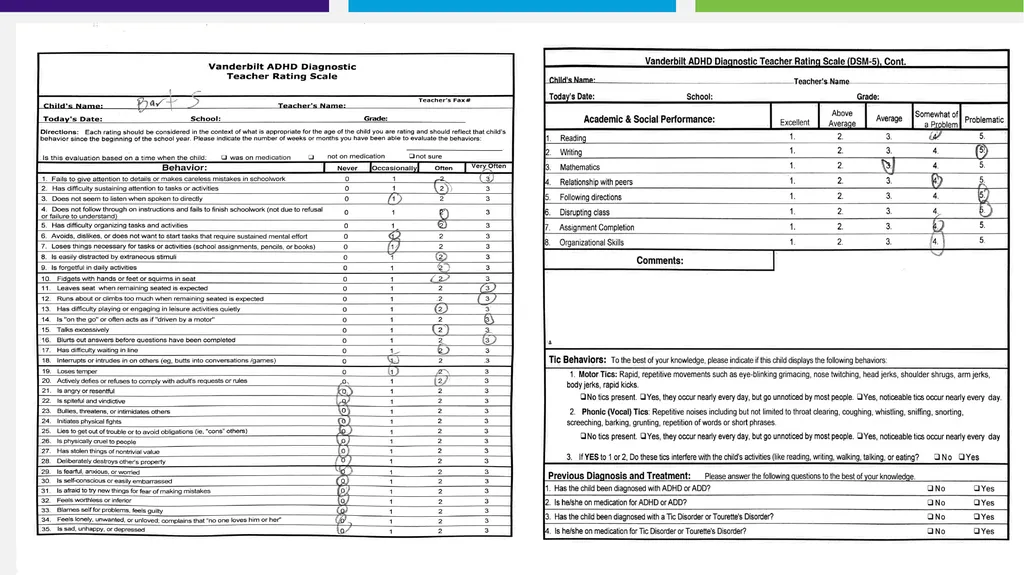
Vanderbilt Parent and Teacher Count 2’s, 3’s
Inattention (1-9): 6+
Hyperactivity-impulsivity (10-18): 6+
ODD(19-26P or 19-28T): 4+ (parent), 3+ (teacher)
Conduct Disorder (27-40P ONLY); 3+
Internalizing screen (41-47P or 29-35T): 3+
PLUS: at least one area of impairment (4 or 5) items 36-43<br>
Inattention (1-9): 6+
Hyperactivity-impulsivity (10-18): 6+
ODD(19-26P or 19-28T): 4+ (parent), 3+ (teacher)
Conduct Disorder (27-40P ONLY); 3+
Internalizing screen (41-47P or 29-35T): 3+
PLUS: at least one area of impairment (4 or 5) items 36-43<br>
24
Back to Bart…..<br>
25
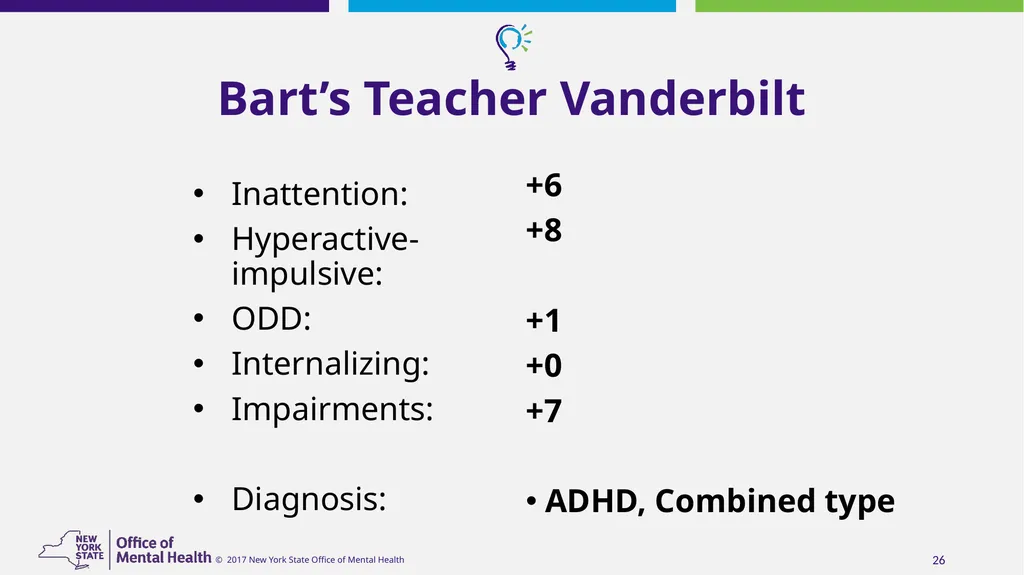
Bart’s Teacher Vanderbilt Inattention:
Hyperactive-impulsive:
ODD:
Internalizing:
Impairments:
Diagnosis: +6
+8
+1
+0
+7
ADHD, Combined type<br>
Hyperactive-impulsive:
ODD:
Internalizing:
Impairments:
Diagnosis: +6
+8
+1
+0
+7
ADHD, Combined type<br>
26
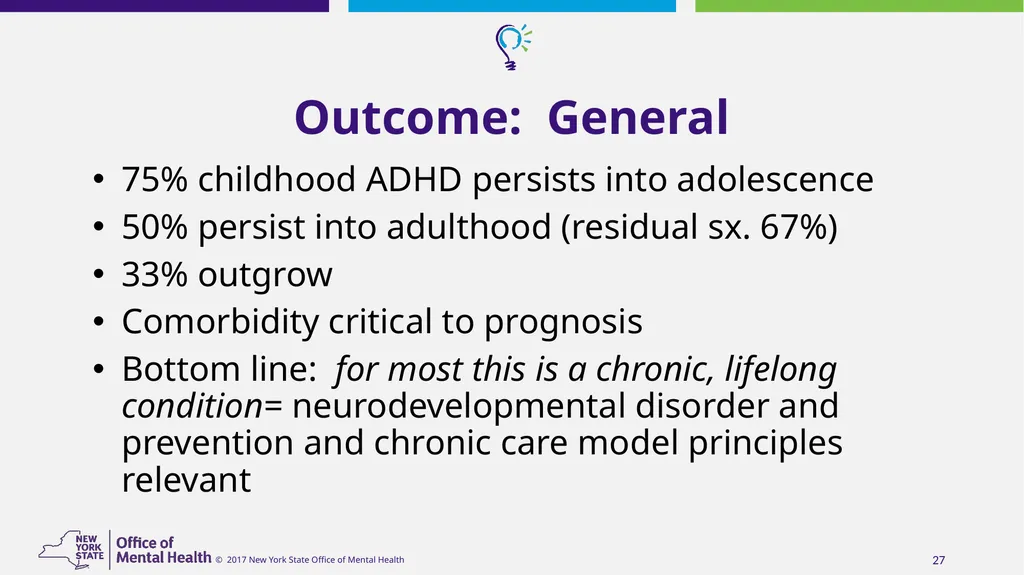
Outcome: General 75% childhood ADHD persists into adolescence
50% persist into adulthood (residual sx. 67%)
33% outgrow
Comorbidity critical to prognosis
Bottom line: for most this is a chronic, lifelong condition= neurodevelopmental disorder and prevention and chronic care model principles relevant<br>
50% persist into adulthood (residual sx. 67%)
33% outgrow
Comorbidity critical to prognosis
Bottom line: for most this is a chronic, lifelong condition= neurodevelopmental disorder and prevention and chronic care model principles relevant<br>
27
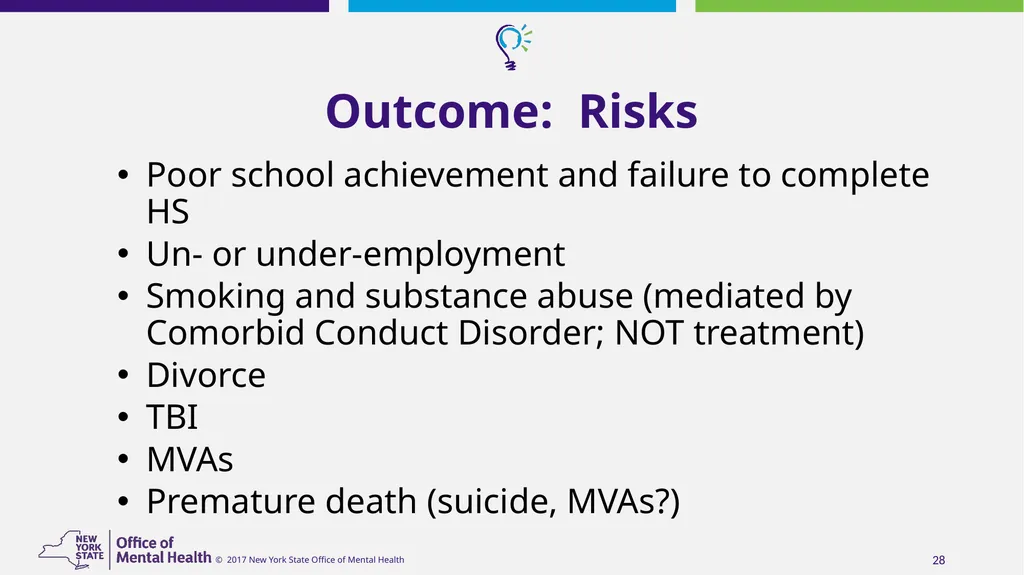
Outcome: Risks Poor school achievement and failure to complete HS
Un- or under-employment
Smoking and substance abuse (mediated by Comorbid Conduct Disorder; NOT treatment)
Divorce
TBI
MVAs
Premature death (suicide, MVAs?)<br>
Un- or under-employment
Smoking and substance abuse (mediated by Comorbid Conduct Disorder; NOT treatment)
Divorce
TBI
MVAs
Premature death (suicide, MVAs?)<br>
28
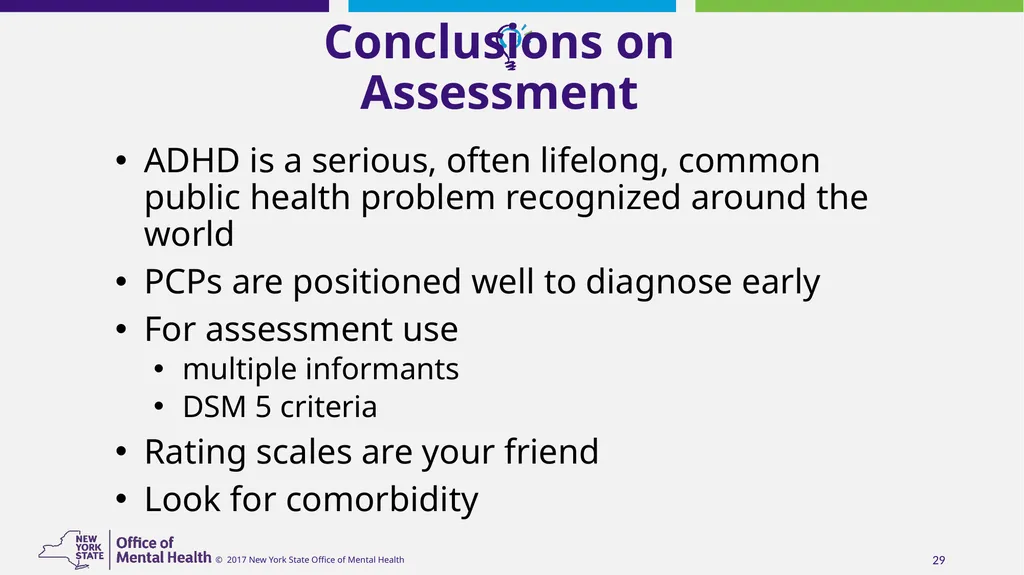
Conclusions on Assessment ADHD is a serious, often lifelong, common public health problem recognized around the world
PCPs are positioned well to diagnose early
For assessment use
multiple informants
DSM 5 criteria
Rating scales are your friend
Look for comorbidity<br>
PCPs are positioned well to diagnose early
For assessment use
multiple informants
DSM 5 criteria
Rating scales are your friend
Look for comorbidity<br>
29
Selected School Age ADHD Bibliography
Barbaresi WJ, Campbell L, Diekroger E, et al. Society for Developmental and Behavioral Pediatrics Clinical Practice Guideline for the Assessment and Treatment of Children and Adolescents with Complex Attention- Deficit/Hyperactivity Disorder. J Dev Behav Pediatr. 2020; 41:S35–S57
Cortese S, Asherson P, Sonuga-Barke E, et al, for the European ADHD Guidelines Group. ADHD management during the COVID-19 pandemic: guidance from the European ADHD Guidelines Group. Lancet Child Adolesc Health 2019; published online April 17. http://dx.doi.org/10.1016/S2352-4642(20)30110-3.
Cortese S, Holtmann M, Banaschewski T et al. Practitioner Review: Current best practice in the management of adverse events during treatment with ADHD medications in children and adolescents. Journal of Child Psychology and Psychiatry 54:3 (2013), pp 227–246
Goode AP, Coeytaux RR, Maslow GR, et al. Nonpharmacologic Treatments for Attention-Deficit/Hyperactivity Disorder: A Systematic Review. Pediatrics. 2018;141(6): e20180094
Posner J, Polaczyk G, Sonuga-Barke E. ADHD. Lancet 2020; 395: 450–62
*Wolraich ML, Hagan JF, Allan C, et al. AAP SUBCOMMITTEE ON CHILDREN AND ADOLESCENTS WITH ATTENTION-DEFICIT/HYPERACTIVE DISORDER. Clinical Practice Guideline for the Diagnosis, Evaluation, and Treatment of Attention-Deficit/Hyperactivity Disorder in Children and Adolescents. Pediatrics. 2019;144(4): e20192528<br>
Barbaresi WJ, Campbell L, Diekroger E, et al. Society for Developmental and Behavioral Pediatrics Clinical Practice Guideline for the Assessment and Treatment of Children and Adolescents with Complex Attention- Deficit/Hyperactivity Disorder. J Dev Behav Pediatr. 2020; 41:S35–S57
Cortese S, Asherson P, Sonuga-Barke E, et al, for the European ADHD Guidelines Group. ADHD management during the COVID-19 pandemic: guidance from the European ADHD Guidelines Group. Lancet Child Adolesc Health 2019; published online April 17. http://dx.doi.org/10.1016/S2352-4642(20)30110-3.
Cortese S, Holtmann M, Banaschewski T et al. Practitioner Review: Current best practice in the management of adverse events during treatment with ADHD medications in children and adolescents. Journal of Child Psychology and Psychiatry 54:3 (2013), pp 227–246
Goode AP, Coeytaux RR, Maslow GR, et al. Nonpharmacologic Treatments for Attention-Deficit/Hyperactivity Disorder: A Systematic Review. Pediatrics. 2018;141(6): e20180094
Posner J, Polaczyk G, Sonuga-Barke E. ADHD. Lancet 2020; 395: 450–62
*Wolraich ML, Hagan JF, Allan C, et al. AAP SUBCOMMITTEE ON CHILDREN AND ADOLESCENTS WITH ATTENTION-DEFICIT/HYPERACTIVE DISORDER. Clinical Practice Guideline for the Diagnosis, Evaluation, and Treatment of Attention-Deficit/Hyperactivity Disorder in Children and Adolescents. Pediatrics. 2019;144(4): e20192528<br>