Attention-Deficit Hyperactivity Disorder (ADHD) in Intercollegiate Athletics Attention-Deficit Hyperactivity Disorder (ADHD) Defined as: a disorder of chronic and impairing behavioral patterns that results in abnormal levels of
"Attention-Deficit / Hyperactivity Disorder (ADHD)" is the property of its rightful owner. Permission is granted to
download and print the materials on this website for personal, non-commercial use only, and to display it
on your personal computer provided you do not modify the materials and that you retain all copyright
notices contained in the materials. By downloading content from our website, you accept the terms of this
agreement.
Presentation Transcript
01
Attention-Deficit / Hyperactivity Disorder (ADHD) in Intercollegiate Athletics<br>
02
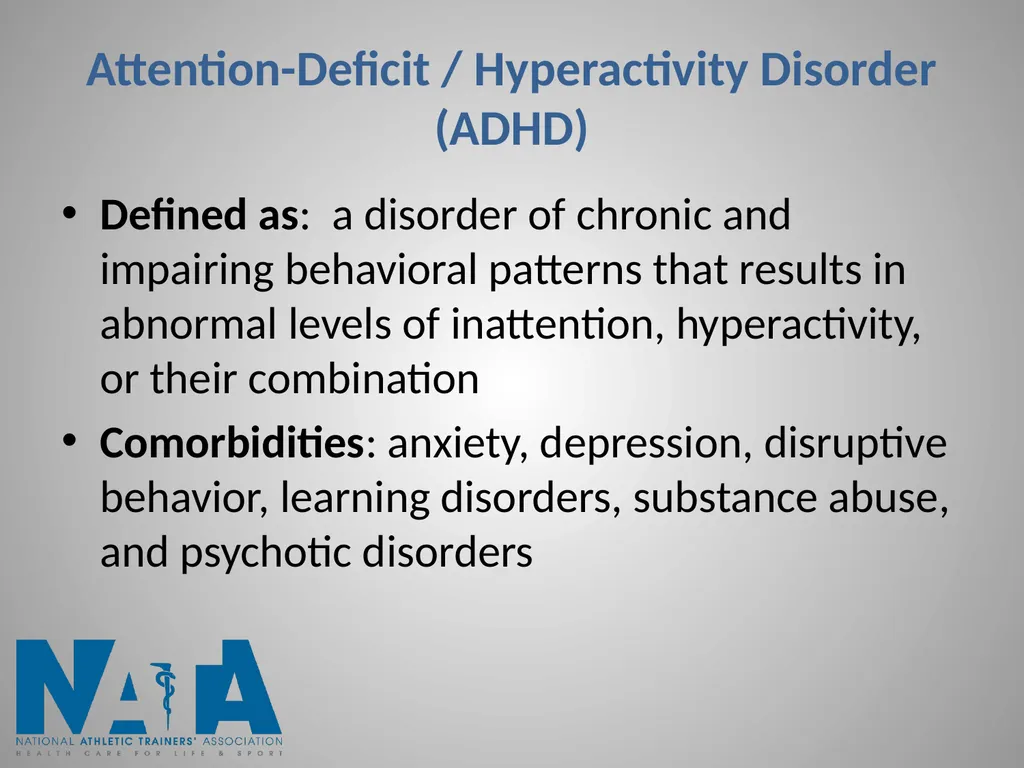
Attention-Deficit / Hyperactivity Disorder (ADHD) Defined as: a disorder of chronic and impairing behavioral patterns that results in abnormal levels of inattention, hyperactivity, or their combination
Comorbidities: anxiety, depression, disruptive behavior, learning disorders, substance abuse, and psychotic disorders<br>
03
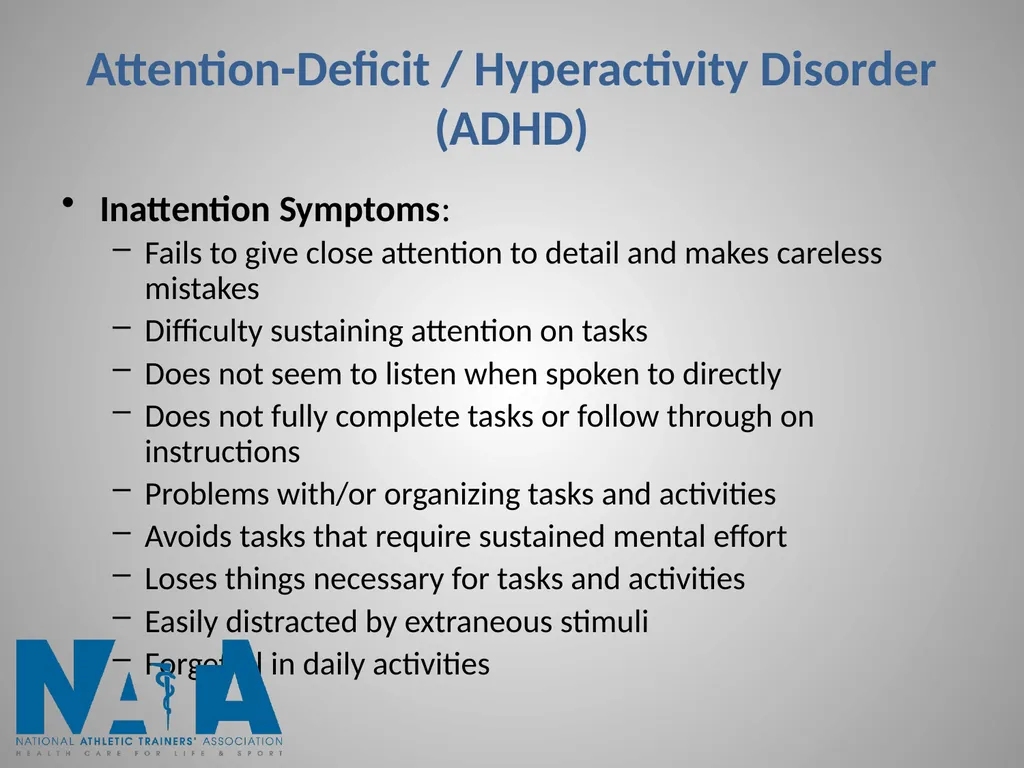
Attention-Deficit / Hyperactivity Disorder (ADHD) Inattention Symptoms:
Fails to give close attention to detail and makes careless mistakes
Difficulty sustaining attention on tasks
Does not seem to listen when spoken to directly
Does not fully complete tasks or follow through on instructions
Problems with/or organizing tasks and activities
Avoids tasks that require sustained mental effort
Loses things necessary for tasks and activities
Easily distracted by extraneous stimuli
Forgetful in daily activities<br>
04
Attention-Deficit / Hyperactivity Disorder (ADHD) Hyperactivity/Impulsivity Symptoms:
Fidgets with hands and feet
Leaves seat when it’s inappropriate
Excessively active and/or feelings of restlessness
Difficulty with engaging in leisure activities quietly
Talks excessively
Blurts things out while in conversation
Difficulty awaiting turn
Interrupts or intrudes on others activities<br>
05
Attention-Deficit / Hyperactivity Disorder (ADHD) Diagnosis
The American Psychiatric Association has defined consensus criteria for the diagnosis of ADHD, which are published in the Diagnostic and Statistical Manual of Mental Disorders, Fifth edition
Children less than 17 years of age requires equal to or greater than 6 symptoms of inattention or equal to or greater than 6 symptoms of hyperactivity/impulsivity
Adolescents equal to or greater than 17 and adults, requires equal or greater than 5 symptoms of inattention or equal to or greater than 5 symptoms of hyperactivity/impulsivity
These symptoms of inattention, hyperactivity/impulsivity must3
Occur often
Be present in more than one setting (i.e. school, home)
Persist for at least six months
Be present before the age of 12
Impair function in academic, social or occupational activities
Be excessive for the development of the child<br>
06
Attention-Deficit / Hyperactivity Disorder (ADHD) Myths:
Patients with ADHD can be cured with medication
ADHD is a behavior problem and not a disease/disorder
Patients with ADHD will outgrow their symptoms over time<br>
07
Attention-Deficit / Hyperactivity Disorder (ADHD) Facts:
Medication (pharmacological) treatment can be used to help correct any chemical imbalances that are causing ADHD symptoms, but medications are not a cure
In order for a patient to receive pharmacological treatment for their ADHD they must meet strict clinical guidelines which must be documented and prescribed by a physician
ADHD behaviors are signs and symptoms of a disorder and are not indicative of a behavior problem (e.g. rebelliousness, intentional disobedience, etc.)
Remember, patients with ADHD are born with this mental disorder and cannot help or reverse the fact that they have this disorder
HOWEVER, we as ATs can provide an environment and care plan that accommodates their symptoms in order for them to thrive in an environment that is not made for them
ADHD symptoms can be accommodated, controlled and lessened with various pharmacological, therapeutic and psychological/counseling interventions, but ADHD symptoms are permanent and are not outgrown<br>
08
Attention-Deficit / Hyperactivity Disorder (ADHD) Treatment: best treated with combination of behavior therapy and medication
Medications
Stimulants Ritalin and Adderall (methylphenidate and amphetamine compounds) are the primary pharmacologic treatments for ADHD in the general population and athletes
Help with improving attention and concentration
Side effects: increased heart rate and blood pressure, abdominal pain, headache, sleep impairment, weight loss, jitteriness, and eating disorders
Non-stimulant medications Strattera (atomoxetine) may be the most recommended medication for ADHD treatments.
Non-stimulant drugs have decreased dependency and abuse issues. among sports psychiatrists, due to the regulatory and safety drawbacks of stimulants
Side Effects: gastrointestinal discomfort, weight loss, sedation, acute liver injury and increased suicidality
Takes 3-6 weeks to get full pharmacological benefit<br>
09
Attention-Deficit / Hyperactivity Disorder (ADHD) The Collegiate Athlete and ADHD Medications
Athletes that are diagnosed with ADHD and prescribed medication must follow the NCAA and NAIA diagnosis and treatment documentation prior to activity
The athlete has undergone clinical evaluation to diagnose the disorder
Is being monitored routinely for use of the stimulant medication
Has a current prescription on file
This often requires documentation from outside or previous health care providers
If documentation is no longer available, a current comprehensive evaluation must be completed<br>
10
Attention-Deficit / Hyperactivity Disorder (ADHD) Sports Medicine Staff and Yearly Evaluation Documentation
The NCAA requires yearly clinical evaluation and documentation with the sports medicine staff and the athletic department
This documentation requires:
Description of the assessment, evaluation tools, or procedures
Statement of diagnosis
History of previous and current ADHD treatment
Statement that a non-banned ADHD alternative medication has been considered if a stimulant medication is prescribed
Plan for follow-up and monitoring visits<br>
11
Attention-Deficit / Hyperactivity Disorder (ADHD) ADHD and Negative Effect on Athletic Performance
Symptoms such as lack of focus and concentration, oppositional behavior, argumentative attitude, frustration, lowered self-esteem and mood swings found in ADHD may impair athletic performance
The neurocognitive symptoms of ADHD such as poor concentration and memory deficits, may cause academic challenges<br>
12
Attention-Deficit / Hyperactivity Disorder (ADHD) ADHD and Positive Effect on Athletic Performance
Common symptoms of ADHD may enhance athletic performance
Due to inherent impulsivity from ADHD, sports that have quick movements and reactive decision-making (baseball, softball, basketball) may see ADHD athletes excel
Another trait of ADHD athletes is “hyper-focus”
This hyper-focus trait can help athletes block out distractions during practice and competition, making activity enjoyable without being distracted by life’s stressors<br>
13
Attention-Deficit / Hyperactivity Disorder (ADHD) Concussion / Traumatic Brain Injury and ADHD
The cognitive symptoms of impaired attention and memory and the behavioral symptoms that arise after a concussion can mirror those of a patient with ADHD
The symptoms of ADHD can worsen, and it may be more difficult to treat ADHD after a concussion
ADHD athletes may need additional management and a multidisciplinary approach rather than a standard return-to-play protocol<br>
14
Attention-Deficit / Hyperactivity Disorder (ADHD) Conclusion
ATs are valuable healthcare assets to those with ADHD and we should incorporate specific care plans for these patients so that they receive the best patient-centered care possible
As healthcare providers, we need to accommodate these patients by altering our patient care and treatment environment<br>
15
References Board of Certification (2017)
https://bocatc.org/newsroom/what-ats-need-to-know-about-adhd?category_key=at
Sports Health (2014)
https://www.ncbi.nlm.nih.gov/pmc/articles/PMC3931335/
National Athletic Trainers’ Association (2015) https://www.nata.org/sites/default/files/psychologicalreferral.pdf
Ciacco, M. Attention Deficit Hyperactivity Disorder in Athletes. Clinical Sports Medicine 38(2019): 545-554.
Attention deficit hyperactivity disorder in adults: Epidemiology, pathogenesis, clinical features, course, assessment, and diagnosis - UpToDate<br>