
Audit Documentation / Other important Standards
DP
Published · 25 slides · 0 views
1 / 1


Description
Audit Documentation Other important Standards for SMEs perspective Contents About Small and Medium Enterprises Auditing Standards: Overall objective Audit Approach Audit Planning and Control (including risk assessment) Audit Program -
Related Topics
Share
Embed code
Download this presentation From Below
"Audit Documentation / Other important Standards" is the property of its rightful owner. Permission is granted to download and print the materials on this website for personal, non-commercial use only, and to display it on your personal computer provided you do not modify the materials and that you retain all copyright notices contained in the materials. By downloading content from our website, you accept the terms of this agreement.
Presentation Transcript
01
Audit Documentation / Other important Standards
for SMEs perspective<br>
02
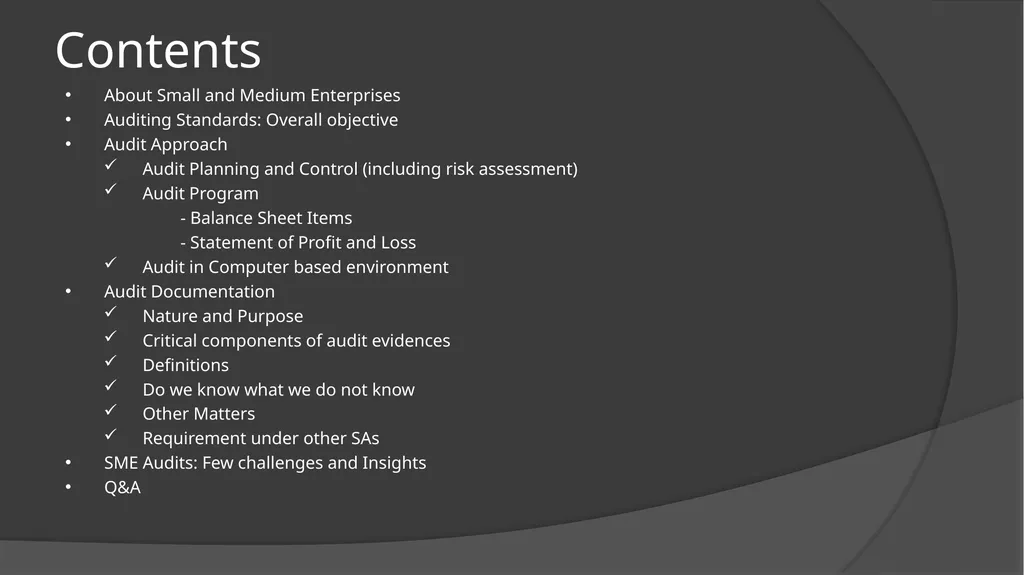
Contents About Small and Medium Enterprises
Auditing Standards: Overall objective
Audit Approach
Audit Planning and Control (including risk assessment)
Audit Program
- Balance Sheet Items
- Statement of Profit and Loss
Audit in Computer based environment
Audit Documentation
Nature and Purpose
Critical components of audit evidences
Definitions
Do we know what we do not know
Other Matters
Requirement under other SAs
SME Audits: Few challenges and Insights
Q&A<br>
Auditing Standards: Overall objective
Audit Approach
Audit Planning and Control (including risk assessment)
Audit Program
- Balance Sheet Items
- Statement of Profit and Loss
Audit in Computer based environment
Audit Documentation
Nature and Purpose
Critical components of audit evidences
Definitions
Do we know what we do not know
Other Matters
Requirement under other SAs
SME Audits: Few challenges and Insights
Q&A<br>
03
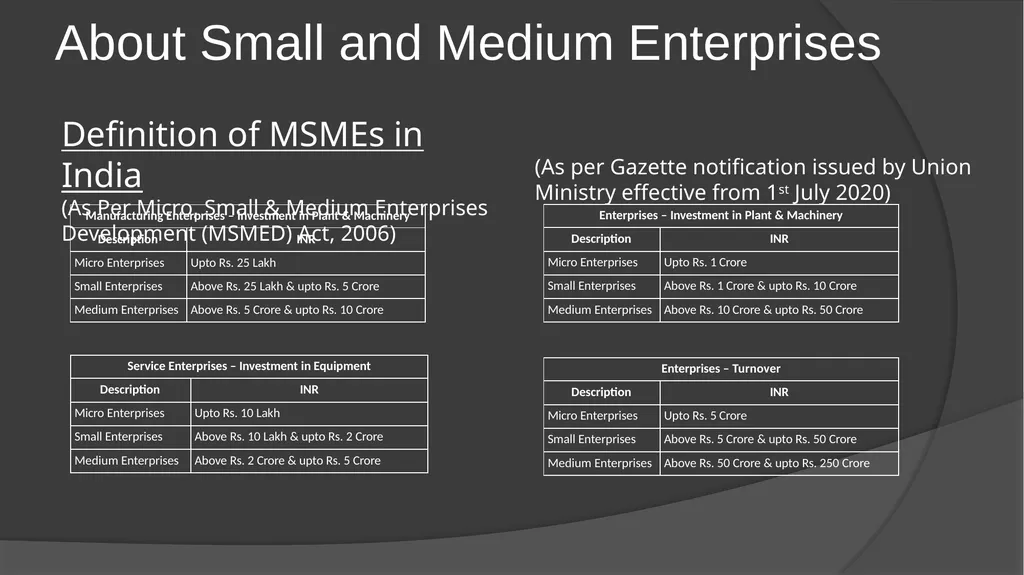
About Small and Medium Enterprises Definition of MSMEs in India
(As Per Micro, Small & Medium Enterprises Development (MSMED) Act, 2006) (As per Gazette notification issued by Union Ministry effective from 1st July 2020)<br>
(As Per Micro, Small & Medium Enterprises Development (MSMED) Act, 2006) (As per Gazette notification issued by Union Ministry effective from 1st July 2020)<br>
04
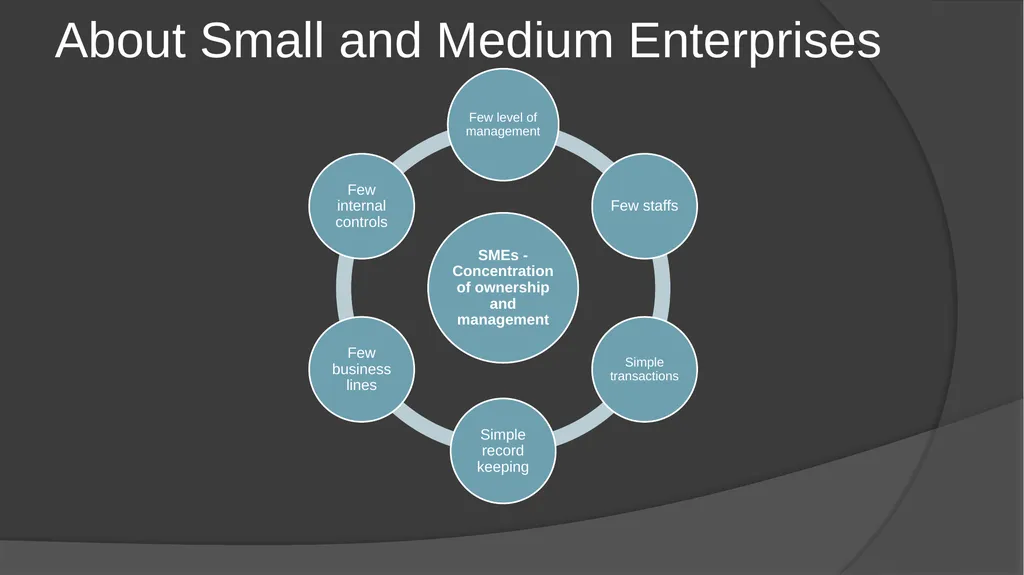
About Small and Medium Enterprises<br>
05
Auditing Standards: Overall objective
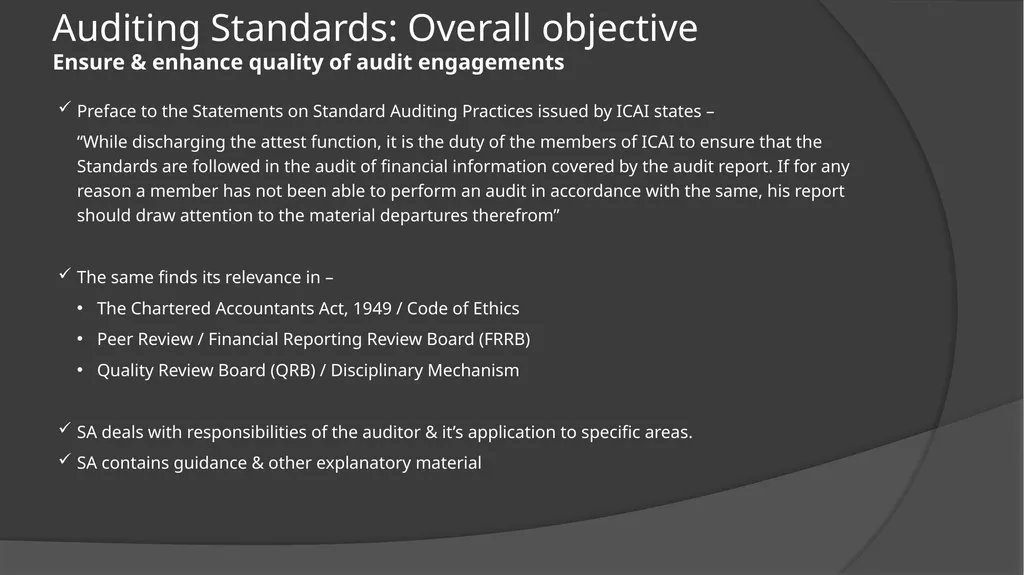
Ensure & enhance quality of audit engagements Preface to the Statements on Standard Auditing Practices issued by ICAI states –
“While discharging the attest function, it is the duty of the members of ICAI to ensure that the Standards are followed in the audit of financial information covered by the audit report. If for any reason a member has not been able to perform an audit in accordance with the same, his report should draw attention to the material departures therefrom”
The same finds its relevance in –
The Chartered Accountants Act, 1949 / Code of Ethics
Peer Review / Financial Reporting Review Board (FRRB)
Quality Review Board (QRB) / Disciplinary Mechanism
SA deals with responsibilities of the auditor & it’s application to specific areas.
SA contains guidance & other explanatory material<br>
“While discharging the attest function, it is the duty of the members of ICAI to ensure that the Standards are followed in the audit of financial information covered by the audit report. If for any reason a member has not been able to perform an audit in accordance with the same, his report should draw attention to the material departures therefrom”
The same finds its relevance in –
The Chartered Accountants Act, 1949 / Code of Ethics
Peer Review / Financial Reporting Review Board (FRRB)
Quality Review Board (QRB) / Disciplinary Mechanism
SA deals with responsibilities of the auditor & it’s application to specific areas.
SA contains guidance & other explanatory material<br>
06
Audit Approach
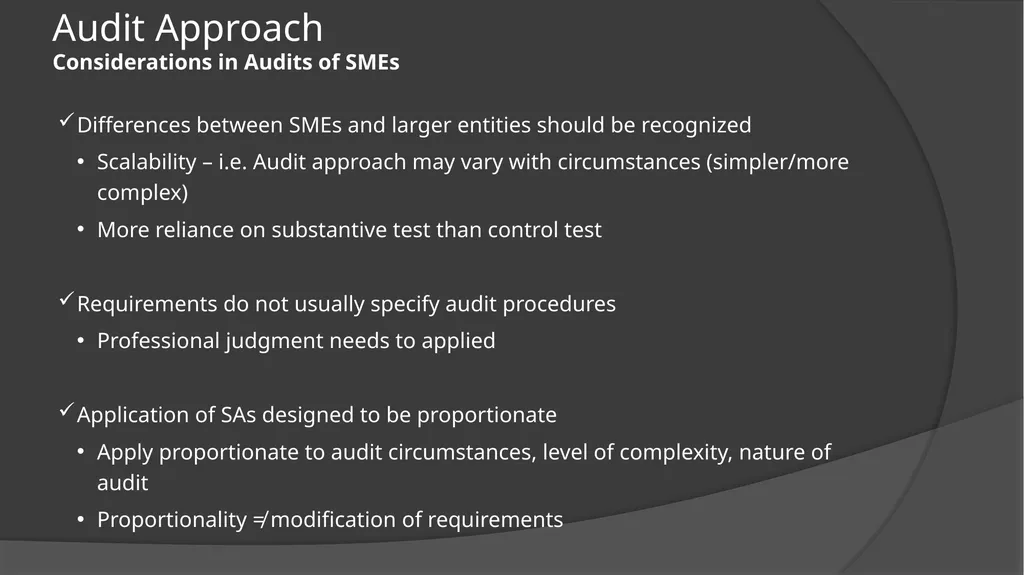
Considerations in Audits of SMEs Differences between SMEs and larger entities should be recognized
Scalability – i.e. Audit approach may vary with circumstances (simpler/more complex)
More reliance on substantive test than control test
Requirements do not usually specify audit procedures
Professional judgment needs to applied
Application of SAs designed to be proportionate
Apply proportionate to audit circumstances, level of complexity, nature of audit
Proportionality ≠ modification of requirements<br>
Scalability – i.e. Audit approach may vary with circumstances (simpler/more complex)
More reliance on substantive test than control test
Requirements do not usually specify audit procedures
Professional judgment needs to applied
Application of SAs designed to be proportionate
Apply proportionate to audit circumstances, level of complexity, nature of audit
Proportionality ≠ modification of requirements<br>
07
Audit Approach
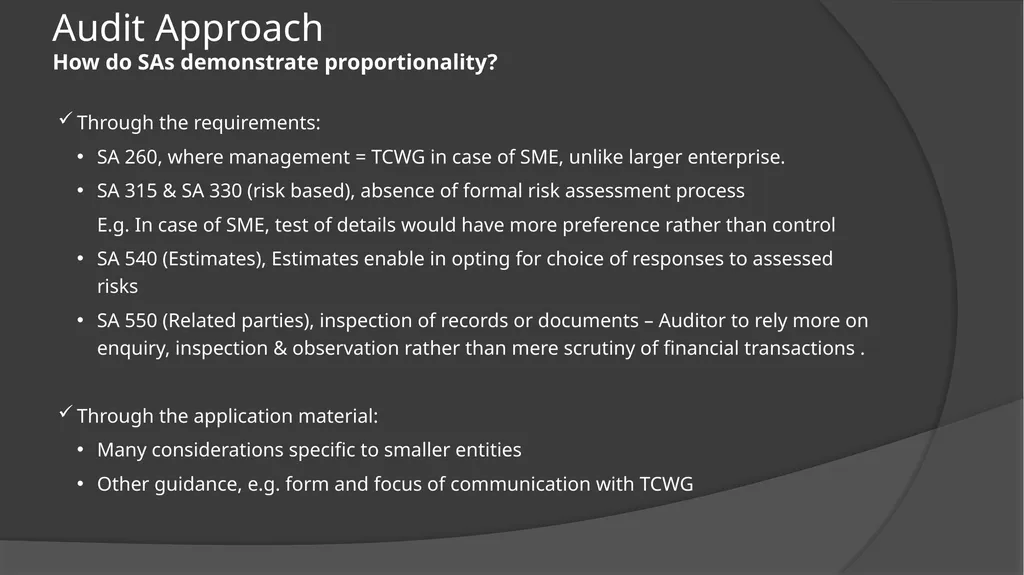
How do SAs demonstrate proportionality? Through the requirements:
SA 260, where management = TCWG in case of SME, unlike larger enterprise.
SA 315 & SA 330 (risk based), absence of formal risk assessment process
E.g. In case of SME, test of details would have more preference rather than control
SA 540 (Estimates), Estimates enable in opting for choice of responses to assessed risks
SA 550 (Related parties), inspection of records or documents – Auditor to rely more on enquiry, inspection & observation rather than mere scrutiny of financial transactions .
Through the application material:
Many considerations specific to smaller entities
Other guidance, e.g. form and focus of communication with TCWG<br>
SA 260, where management = TCWG in case of SME, unlike larger enterprise.
SA 315 & SA 330 (risk based), absence of formal risk assessment process
E.g. In case of SME, test of details would have more preference rather than control
SA 540 (Estimates), Estimates enable in opting for choice of responses to assessed risks
SA 550 (Related parties), inspection of records or documents – Auditor to rely more on enquiry, inspection & observation rather than mere scrutiny of financial transactions .
Through the application material:
Many considerations specific to smaller entities
Other guidance, e.g. form and focus of communication with TCWG<br>
08
Audit Approach
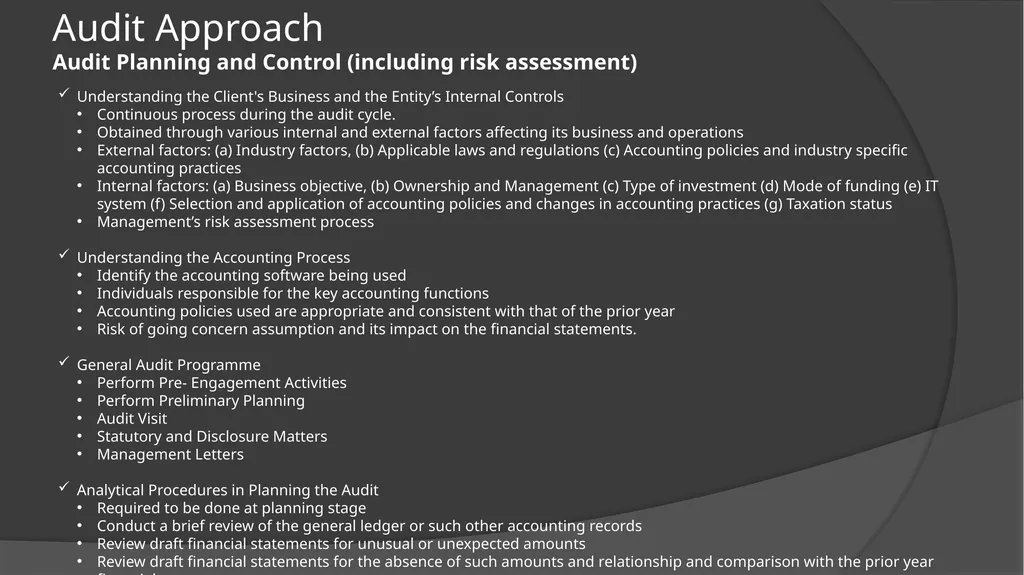
Audit Planning and Control (including risk assessment) Understanding the Client's Business and the Entity’s Internal Controls
Continuous process during the audit cycle.
Obtained through various internal and external factors affecting its business and operations
External factors: (a) Industry factors, (b) Applicable laws and regulations (c) Accounting policies and industry specific accounting practices
Internal factors: (a) Business objective, (b) Ownership and Management (c) Type of investment (d) Mode of funding (e) IT system (f) Selection and application of accounting policies and changes in accounting practices (g) Taxation status
Management’s risk assessment process
Understanding the Accounting Process
Identify the accounting software being used
Individuals responsible for the key accounting functions
Accounting policies used are appropriate and consistent with that of the prior year
Risk of going concern assumption and its impact on the financial statements.
General Audit Programme
Perform Pre- Engagement Activities
Perform Preliminary Planning
Audit Visit
Statutory and Disclosure Matters
Management Letters
Analytical Procedures in Planning the Audit
Required to be done at planning stage
Conduct a brief review of the general ledger or such other accounting records
Review draft financial statements for unusual or unexpected amounts
Review draft financial statements for the absence of such amounts and relationship and comparison with the prior year financials<br>
Continuous process during the audit cycle.
Obtained through various internal and external factors affecting its business and operations
External factors: (a) Industry factors, (b) Applicable laws and regulations (c) Accounting policies and industry specific accounting practices
Internal factors: (a) Business objective, (b) Ownership and Management (c) Type of investment (d) Mode of funding (e) IT system (f) Selection and application of accounting policies and changes in accounting practices (g) Taxation status
Management’s risk assessment process
Understanding the Accounting Process
Identify the accounting software being used
Individuals responsible for the key accounting functions
Accounting policies used are appropriate and consistent with that of the prior year
Risk of going concern assumption and its impact on the financial statements.
General Audit Programme
Perform Pre- Engagement Activities
Perform Preliminary Planning
Audit Visit
Statutory and Disclosure Matters
Management Letters
Analytical Procedures in Planning the Audit
Required to be done at planning stage
Conduct a brief review of the general ledger or such other accounting records
Review draft financial statements for unusual or unexpected amounts
Review draft financial statements for the absence of such amounts and relationship and comparison with the prior year financials<br>
09
Audit Approach
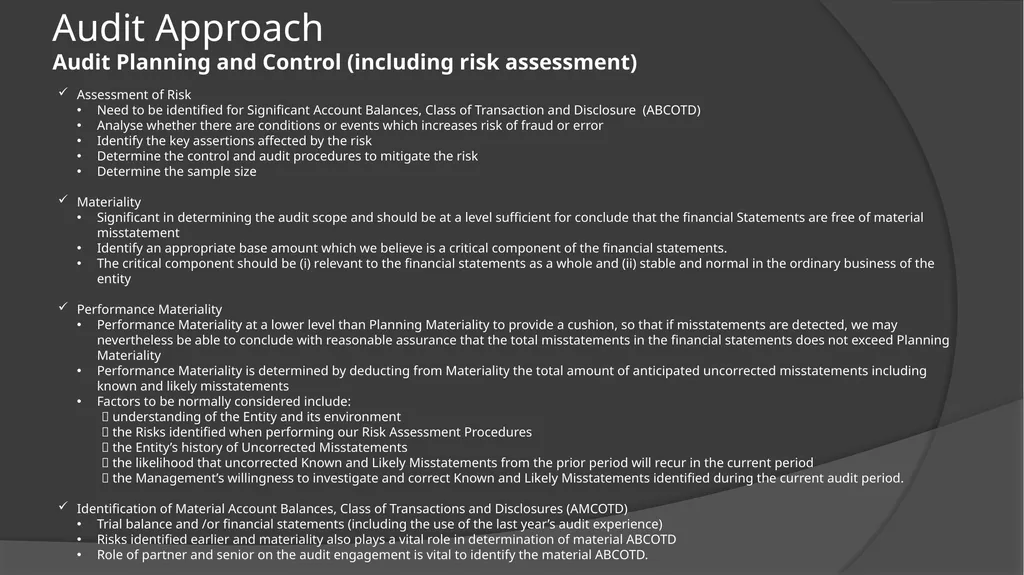
Audit Planning and Control (including risk assessment) Assessment of Risk
Need to be identified for Significant Account Balances, Class of Transaction and Disclosure (ABCOTD)
Analyse whether there are conditions or events which increases risk of fraud or error
Identify the key assertions affected by the risk
Determine the control and audit procedures to mitigate the risk
Determine the sample size
Materiality
Significant in determining the audit scope and should be at a level sufficient for conclude that the financial Statements are free of material misstatement
Identify an appropriate base amount which we believe is a critical component of the financial statements.
The critical component should be (i) relevant to the financial statements as a whole and (ii) stable and normal in the ordinary business of the entity
Performance Materiality
Performance Materiality at a lower level than Planning Materiality to provide a cushion, so that if misstatements are detected, we may nevertheless be able to conclude with reasonable assurance that the total misstatements in the financial statements does not exceed Planning Materiality
Performance Materiality is determined by deducting from Materiality the total amount of anticipated uncorrected misstatements including known and likely misstatements
Factors to be normally considered include:
understanding of the Entity and its environment
the Risks identified when performing our Risk Assessment Procedures
the Entity’s history of Uncorrected Misstatements
the likelihood that uncorrected Known and Likely Misstatements from the prior period will recur in the current period
the Management’s willingness to investigate and correct Known and Likely Misstatements identified during the current audit period.
Identification of Material Account Balances, Class of Transactions and Disclosures (AMCOTD)
Trial balance and /or financial statements (including the use of the last year’s audit experience)
Risks identified earlier and materiality also plays a vital role in determination of material ABCOTD
Role of partner and senior on the audit engagement is vital to identify the material ABCOTD.
Permanent File Update: Imperative for auditors to have a permanent file being prepared for future references as well for understanding significant client issues faced during the audit.<br>
Need to be identified for Significant Account Balances, Class of Transaction and Disclosure (ABCOTD)
Analyse whether there are conditions or events which increases risk of fraud or error
Identify the key assertions affected by the risk
Determine the control and audit procedures to mitigate the risk
Determine the sample size
Materiality
Significant in determining the audit scope and should be at a level sufficient for conclude that the financial Statements are free of material misstatement
Identify an appropriate base amount which we believe is a critical component of the financial statements.
The critical component should be (i) relevant to the financial statements as a whole and (ii) stable and normal in the ordinary business of the entity
Performance Materiality
Performance Materiality at a lower level than Planning Materiality to provide a cushion, so that if misstatements are detected, we may nevertheless be able to conclude with reasonable assurance that the total misstatements in the financial statements does not exceed Planning Materiality
Performance Materiality is determined by deducting from Materiality the total amount of anticipated uncorrected misstatements including known and likely misstatements
Factors to be normally considered include:
understanding of the Entity and its environment
the Risks identified when performing our Risk Assessment Procedures
the Entity’s history of Uncorrected Misstatements
the likelihood that uncorrected Known and Likely Misstatements from the prior period will recur in the current period
the Management’s willingness to investigate and correct Known and Likely Misstatements identified during the current audit period.
Identification of Material Account Balances, Class of Transactions and Disclosures (AMCOTD)
Trial balance and /or financial statements (including the use of the last year’s audit experience)
Risks identified earlier and materiality also plays a vital role in determination of material ABCOTD
Role of partner and senior on the audit engagement is vital to identify the material ABCOTD.
Permanent File Update: Imperative for auditors to have a permanent file being prepared for future references as well for understanding significant client issues faced during the audit.<br>
10
Audit Approach
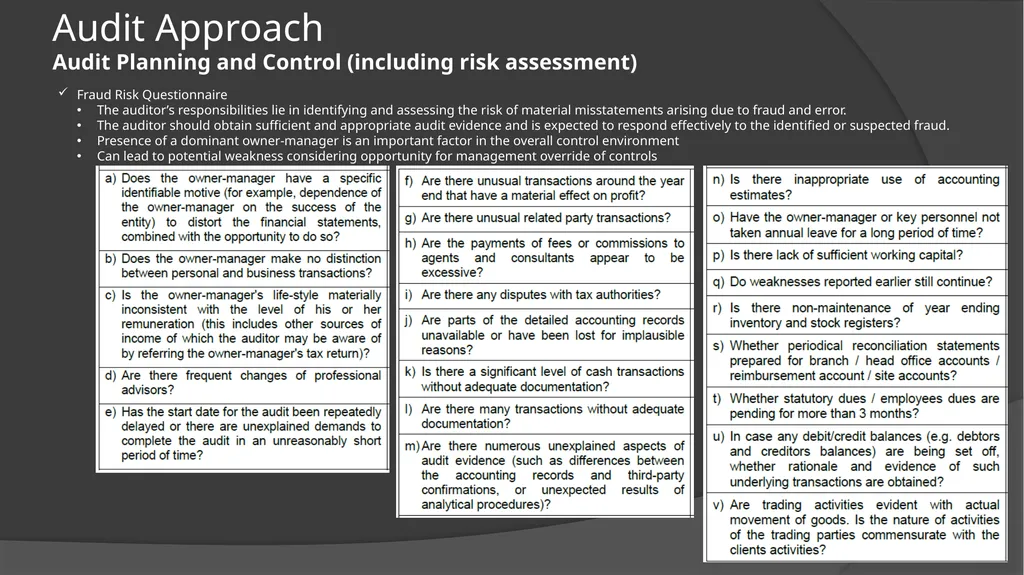
Audit Planning and Control (including risk assessment) Fraud Risk Questionnaire
The auditor’s responsibilities lie in identifying and assessing the risk of material misstatements arising due to fraud and error.
The auditor should obtain sufficient and appropriate audit evidence and is expected to respond effectively to the identified or suspected fraud.
Presence of a dominant owner-manager is an important factor in the overall control environment
Can lead to potential weakness considering opportunity for management override of controls<br>
The auditor’s responsibilities lie in identifying and assessing the risk of material misstatements arising due to fraud and error.
The auditor should obtain sufficient and appropriate audit evidence and is expected to respond effectively to the identified or suspected fraud.
Presence of a dominant owner-manager is an important factor in the overall control environment
Can lead to potential weakness considering opportunity for management override of controls<br>
11
Audit Approach
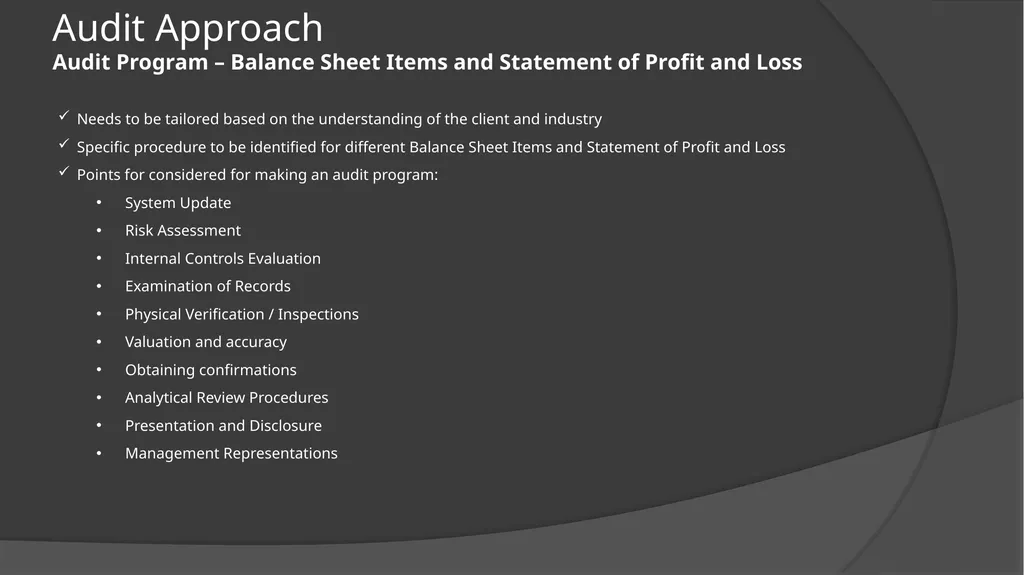
Audit Program – Balance Sheet Items and Statement of Profit and Loss Needs to be tailored based on the understanding of the client and industry
Specific procedure to be identified for different Balance Sheet Items and Statement of Profit and Loss
Points for considered for making an audit program:
System Update
Risk Assessment
Internal Controls Evaluation
Examination of Records
Physical Verification / Inspections
Valuation and accuracy
Obtaining confirmations
Analytical Review Procedures
Presentation and Disclosure
Management Representations<br>
Specific procedure to be identified for different Balance Sheet Items and Statement of Profit and Loss
Points for considered for making an audit program:
System Update
Risk Assessment
Internal Controls Evaluation
Examination of Records
Physical Verification / Inspections
Valuation and accuracy
Obtaining confirmations
Analytical Review Procedures
Presentation and Disclosure
Management Representations<br>
12
Audit Approach
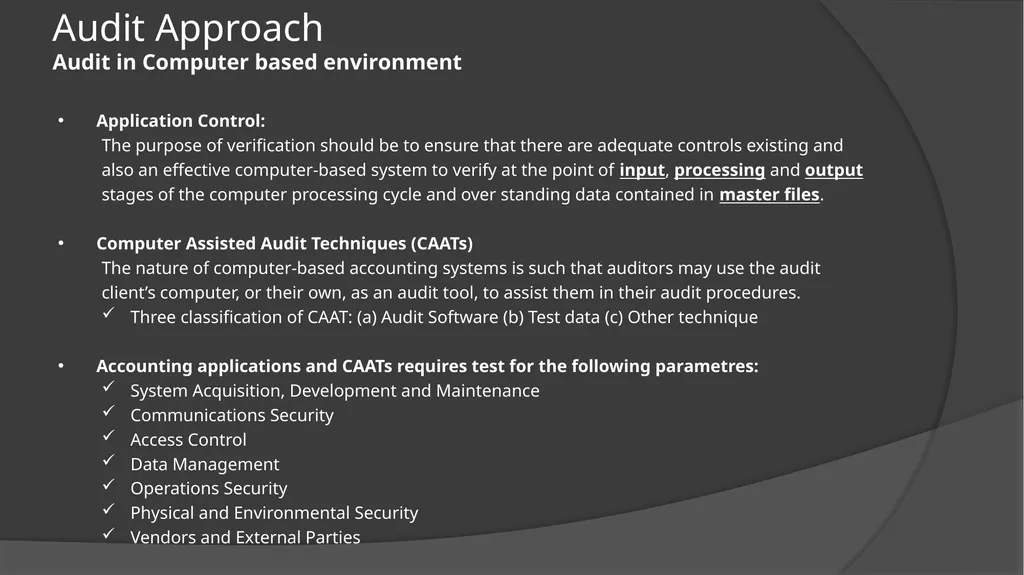
Audit in Computer based environment Application Control:
The purpose of verification should be to ensure that there are adequate controls existing and also an effective computer-based system to verify at the point of input, processing and output stages of the computer processing cycle and over standing data contained in master files.
Computer Assisted Audit Techniques (CAATs)
The nature of computer-based accounting systems is such that auditors may use the audit client’s computer, or their own, as an audit tool, to assist them in their audit procedures.
Three classification of CAAT: (a) Audit Software (b) Test data (c) Other technique
Accounting applications and CAATs requires test for the following parametres:
System Acquisition, Development and Maintenance
Communications Security
Access Control
Data Management
Operations Security
Physical and Environmental Security
Vendors and External Parties<br>
The purpose of verification should be to ensure that there are adequate controls existing and also an effective computer-based system to verify at the point of input, processing and output stages of the computer processing cycle and over standing data contained in master files.
Computer Assisted Audit Techniques (CAATs)
The nature of computer-based accounting systems is such that auditors may use the audit client’s computer, or their own, as an audit tool, to assist them in their audit procedures.
Three classification of CAAT: (a) Audit Software (b) Test data (c) Other technique
Accounting applications and CAATs requires test for the following parametres:
System Acquisition, Development and Maintenance
Communications Security
Access Control
Data Management
Operations Security
Physical and Environmental Security
Vendors and External Parties<br>
13
Audit Documentation
Nature and Purpose<br>
14
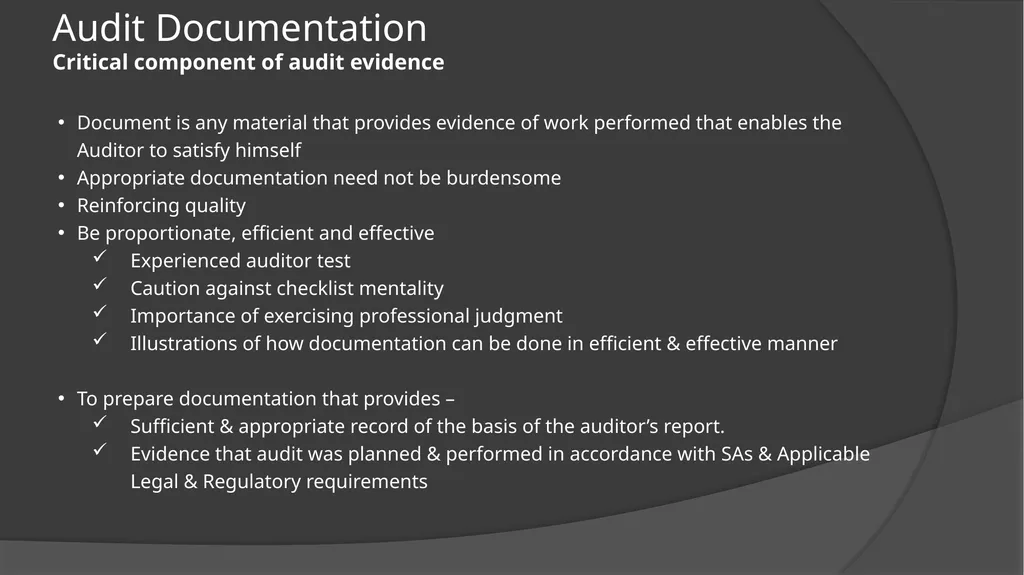
Document is any material that provides evidence of work performed that enables the Auditor to satisfy himself
Appropriate documentation need not be burdensome
Reinforcing quality
Be proportionate, efficient and effective
Experienced auditor test
Caution against checklist mentality
Importance of exercising professional judgment
Illustrations of how documentation can be done in efficient & effective manner
To prepare documentation that provides –
Sufficient & appropriate record of the basis of the auditor’s report.
Evidence that audit was planned & performed in accordance with SAs & Applicable Legal & Regulatory requirements Audit Documentation Critical component of audit evidence<br>
Appropriate documentation need not be burdensome
Reinforcing quality
Be proportionate, efficient and effective
Experienced auditor test
Caution against checklist mentality
Importance of exercising professional judgment
Illustrations of how documentation can be done in efficient & effective manner
To prepare documentation that provides –
Sufficient & appropriate record of the basis of the auditor’s report.
Evidence that audit was planned & performed in accordance with SAs & Applicable Legal & Regulatory requirements Audit Documentation Critical component of audit evidence<br>
15
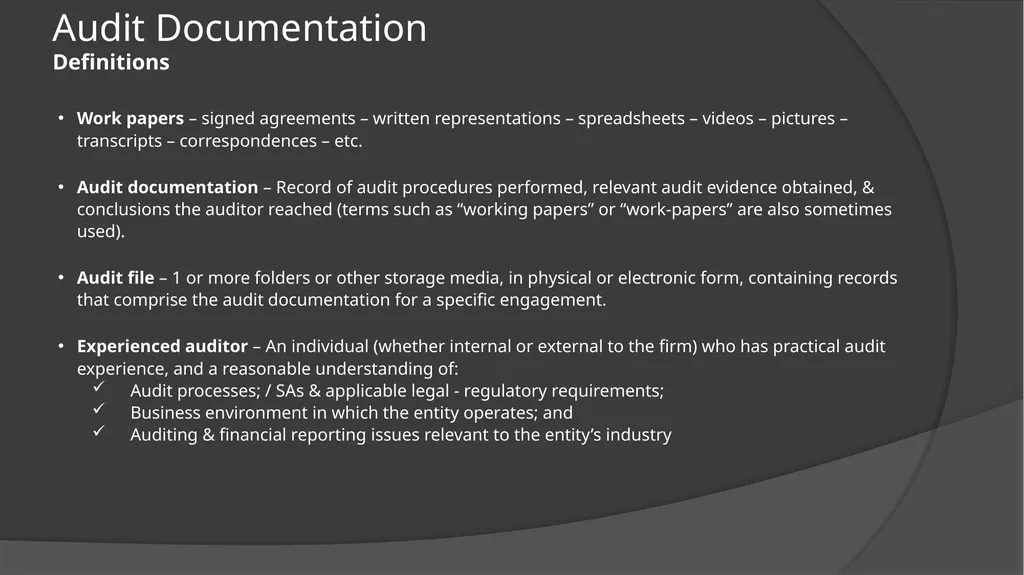
Work papers – signed agreements – written representations – spreadsheets – videos – pictures – transcripts – correspondences – etc.
Audit documentation – Record of audit procedures performed, relevant audit evidence obtained, & conclusions the auditor reached (terms such as “working papers” or “work-papers” are also sometimes used).
Audit file – 1 or more folders or other storage media, in physical or electronic form, containing records that comprise the audit documentation for a specific engagement.
Experienced auditor – An individual (whether internal or external to the firm) who has practical audit experience, and a reasonable understanding of:
Audit processes; / SAs & applicable legal - regulatory requirements;
Business environment in which the entity operates; and
Auditing & financial reporting issues relevant to the entity’s industry Audit Documentation Definitions<br>
Audit documentation – Record of audit procedures performed, relevant audit evidence obtained, & conclusions the auditor reached (terms such as “working papers” or “work-papers” are also sometimes used).
Audit file – 1 or more folders or other storage media, in physical or electronic form, containing records that comprise the audit documentation for a specific engagement.
Experienced auditor – An individual (whether internal or external to the firm) who has practical audit experience, and a reasonable understanding of:
Audit processes; / SAs & applicable legal - regulatory requirements;
Business environment in which the entity operates; and
Auditing & financial reporting issues relevant to the entity’s industry Audit Documentation Definitions<br>
16
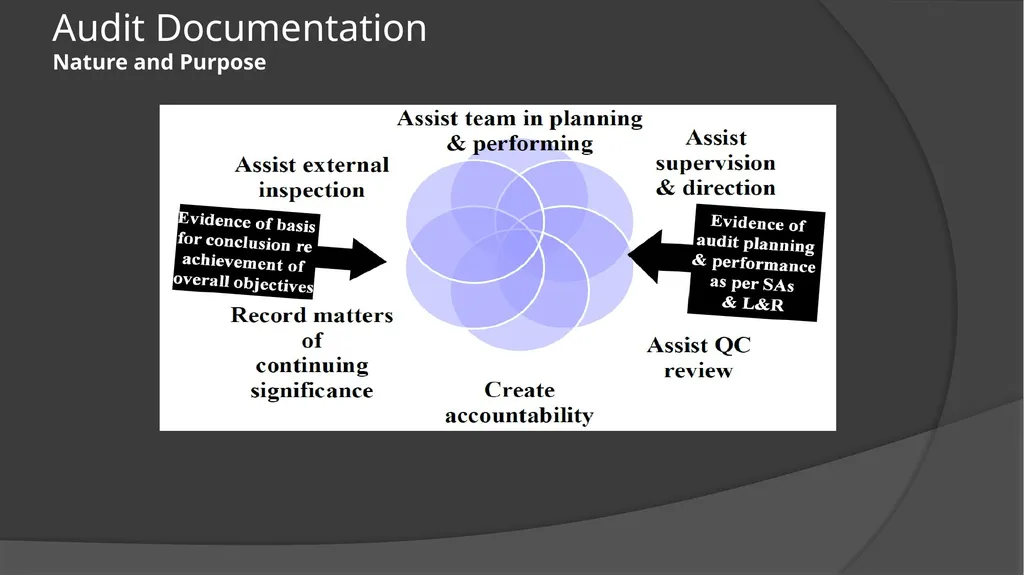
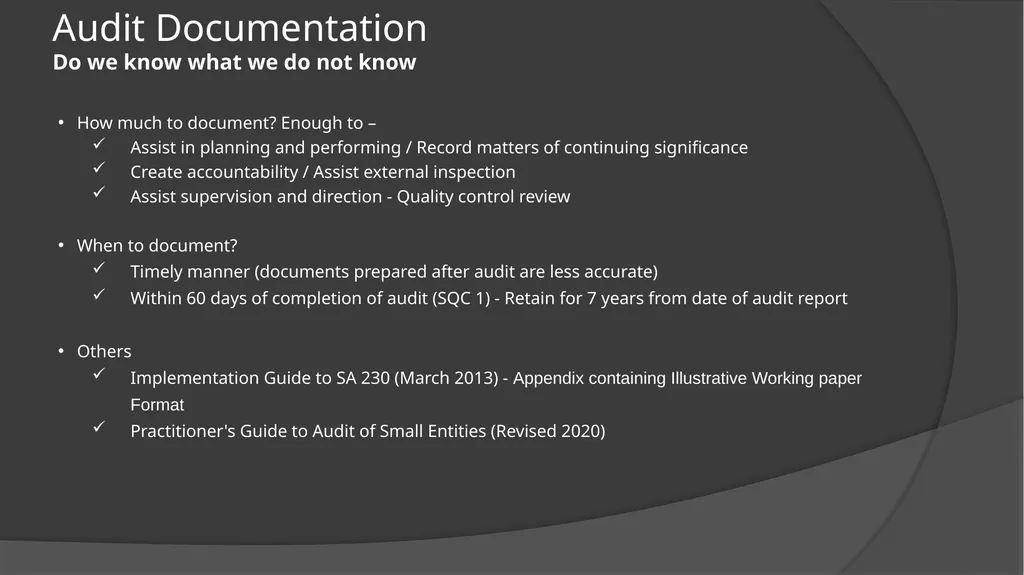
How much to document? Enough to –
Assist in planning and performing / Record matters of continuing significance
Create accountability / Assist external inspection
Assist supervision and direction - Quality control review
When to document?
Timely manner (documents prepared after audit are less accurate)
Within 60 days of completion of audit (SQC 1) - Retain for 7 years from date of audit report
Others
Implementation Guide to SA 230 (March 2013) - Appendix containing Illustrative Working paper Format
Practitioner's Guide to Audit of Small Entities (Revised 2020) Audit Documentation Do we know what we do not know<br>
Assist in planning and performing / Record matters of continuing significance
Create accountability / Assist external inspection
Assist supervision and direction - Quality control review
When to document?
Timely manner (documents prepared after audit are less accurate)
Within 60 days of completion of audit (SQC 1) - Retain for 7 years from date of audit report
Others
Implementation Guide to SA 230 (March 2013) - Appendix containing Illustrative Working paper Format
Practitioner's Guide to Audit of Small Entities (Revised 2020) Audit Documentation Do we know what we do not know<br>
17
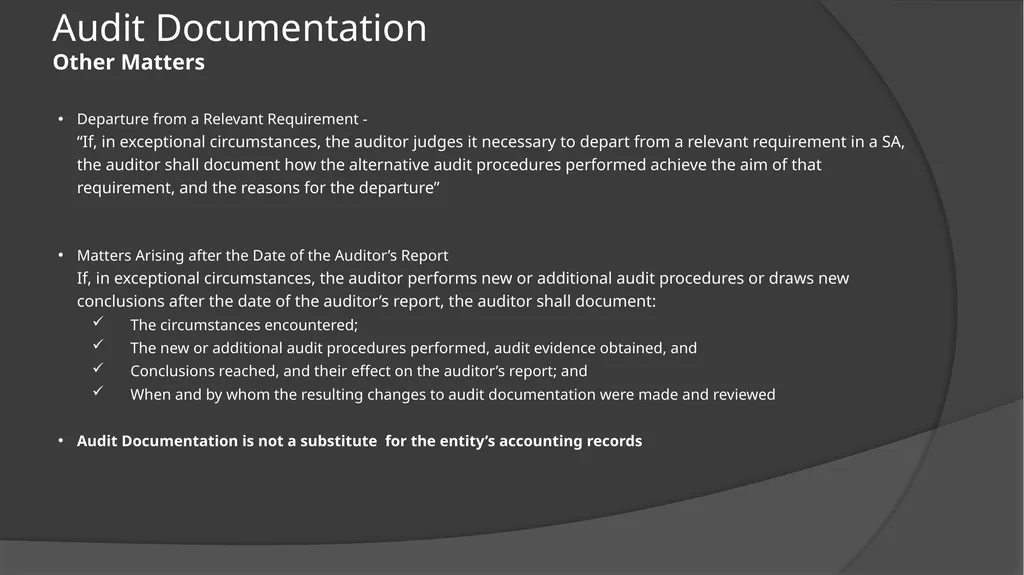
Departure from a Relevant Requirement -
“If, in exceptional circumstances, the auditor judges it necessary to depart from a relevant requirement in a SA, the auditor shall document how the alternative audit procedures performed achieve the aim of that requirement, and the reasons for the departure”
Matters Arising after the Date of the Auditor’s Report
If, in exceptional circumstances, the auditor performs new or additional audit procedures or draws new conclusions after the date of the auditor’s report, the auditor shall document:
The circumstances encountered;
The new or additional audit procedures performed, audit evidence obtained, and
Conclusions reached, and their effect on the auditor’s report; and
When and by whom the resulting changes to audit documentation were made and reviewed
Audit Documentation is not a substitute for the entity’s accounting records Audit Documentation Other Matters<br>
“If, in exceptional circumstances, the auditor judges it necessary to depart from a relevant requirement in a SA, the auditor shall document how the alternative audit procedures performed achieve the aim of that requirement, and the reasons for the departure”
Matters Arising after the Date of the Auditor’s Report
If, in exceptional circumstances, the auditor performs new or additional audit procedures or draws new conclusions after the date of the auditor’s report, the auditor shall document:
The circumstances encountered;
The new or additional audit procedures performed, audit evidence obtained, and
Conclusions reached, and their effect on the auditor’s report; and
When and by whom the resulting changes to audit documentation were made and reviewed
Audit Documentation is not a substitute for the entity’s accounting records Audit Documentation Other Matters<br>
18
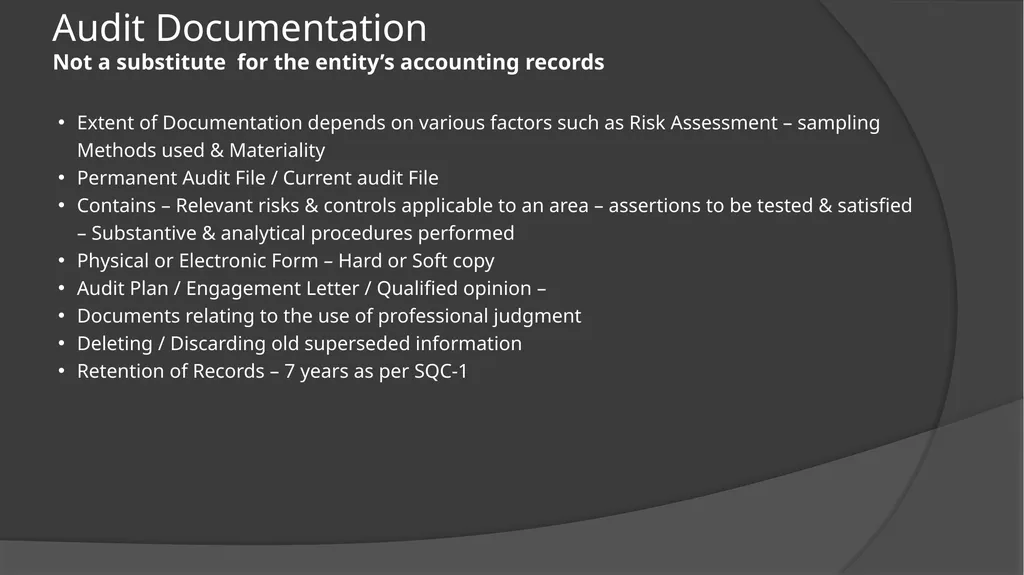
Extent of Documentation depends on various factors such as Risk Assessment – sampling Methods used & Materiality
Permanent Audit File / Current audit File
Contains – Relevant risks & controls applicable to an area – assertions to be tested & satisfied – Substantive & analytical procedures performed
Physical or Electronic Form – Hard or Soft copy
Audit Plan / Engagement Letter / Qualified opinion –
Documents relating to the use of professional judgment
Deleting / Discarding old superseded information
Retention of Records – 7 years as per SQC-1 Audit Documentation Not a substitute for the entity’s accounting records<br>
Permanent Audit File / Current audit File
Contains – Relevant risks & controls applicable to an area – assertions to be tested & satisfied – Substantive & analytical procedures performed
Physical or Electronic Form – Hard or Soft copy
Audit Plan / Engagement Letter / Qualified opinion –
Documents relating to the use of professional judgment
Deleting / Discarding old superseded information
Retention of Records – 7 years as per SQC-1 Audit Documentation Not a substitute for the entity’s accounting records<br>
19
Audit Documentation
Under other SAs<br>
20
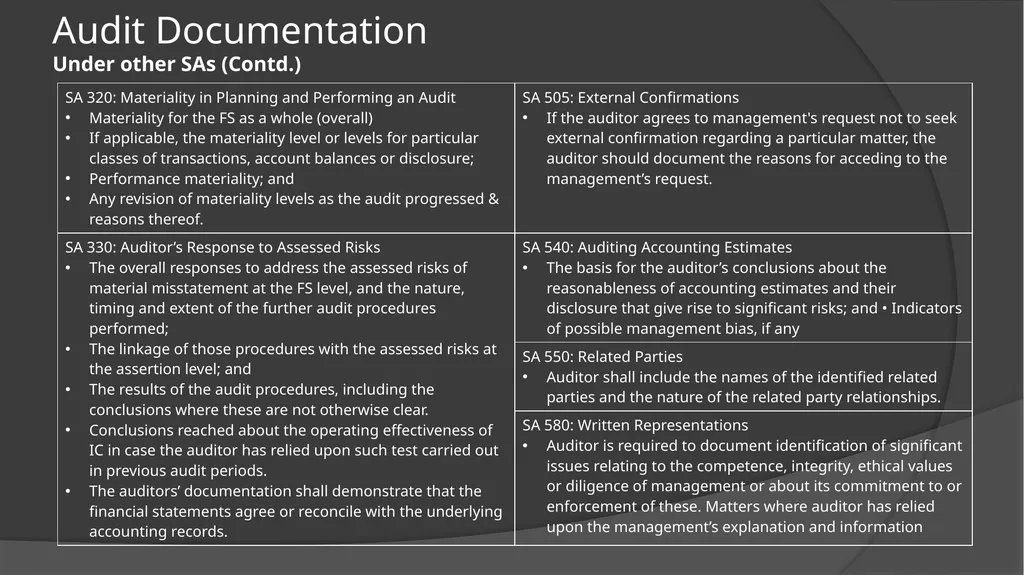
Audit Documentation
Under other SAs (Contd.)<br>
21
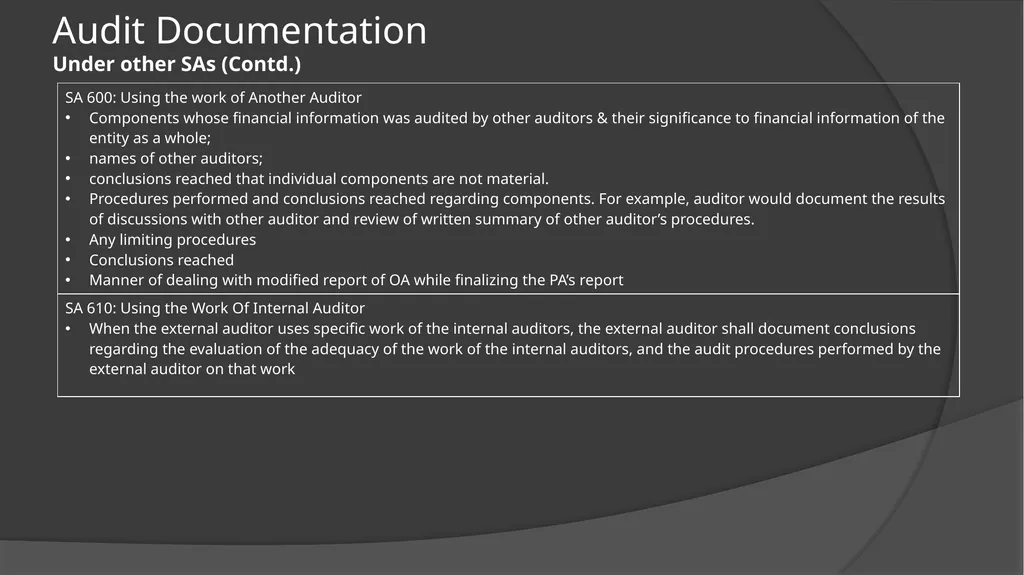
Audit Documentation
Under other SAs (Contd.)<br>
22
Audit Documentation
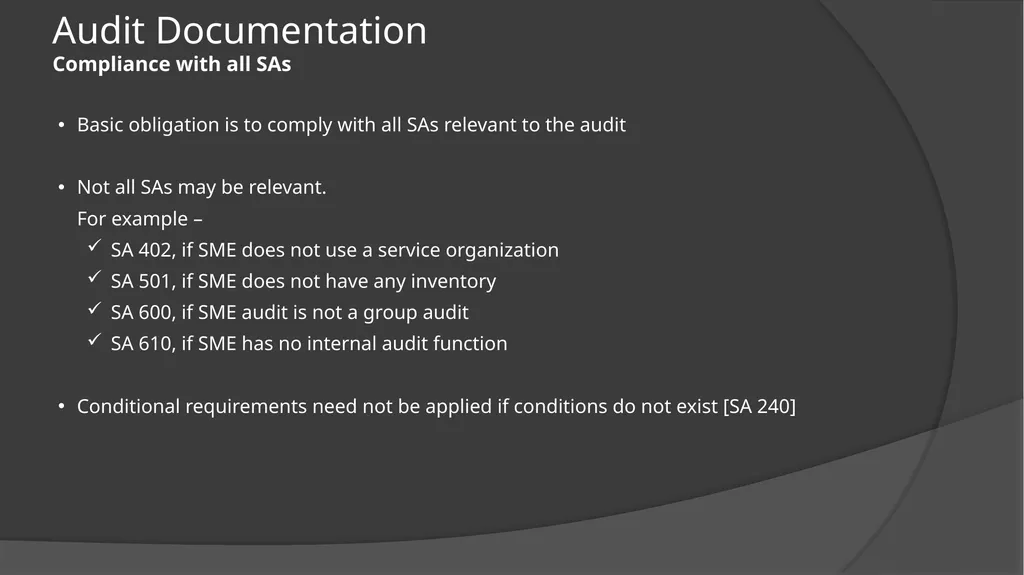
Compliance with all SAs Basic obligation is to comply with all SAs relevant to the audit
Not all SAs may be relevant.
For example –
SA 402, if SME does not use a service organization
SA 501, if SME does not have any inventory
SA 600, if SME audit is not a group audit
SA 610, if SME has no internal audit function
Conditional requirements need not be applied if conditions do not exist [SA 240]<br>
Not all SAs may be relevant.
For example –
SA 402, if SME does not use a service organization
SA 501, if SME does not have any inventory
SA 600, if SME audit is not a group audit
SA 610, if SME has no internal audit function
Conditional requirements need not be applied if conditions do not exist [SA 240]<br>
23
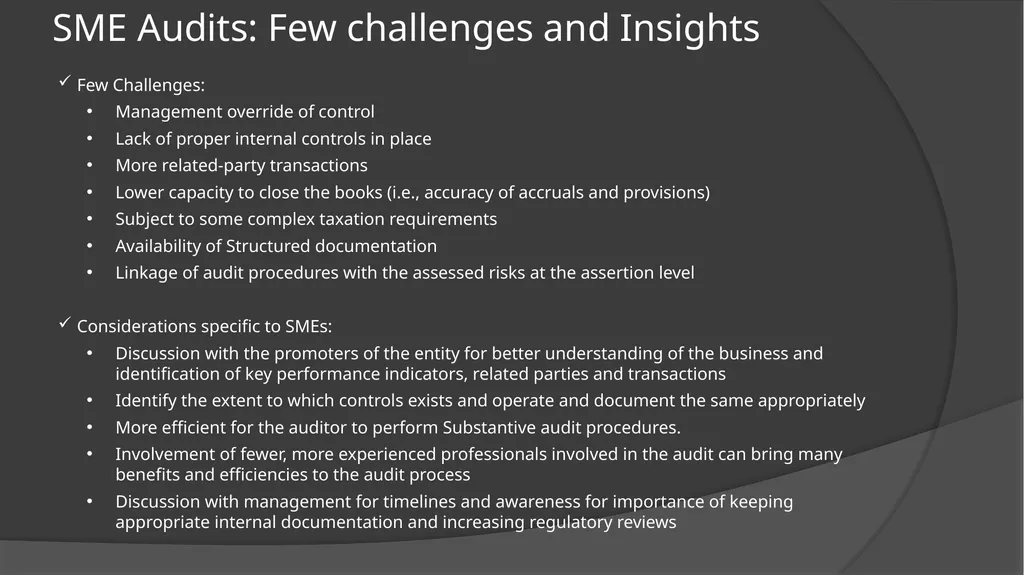
SME Audits: Few challenges and Insights Few Challenges:
Management override of control
Lack of proper internal controls in place
More related-party transactions
Lower capacity to close the books (i.e., accuracy of accruals and provisions)
Subject to some complex taxation requirements
Availability of Structured documentation
Linkage of audit procedures with the assessed risks at the assertion level
Considerations specific to SMEs:
Discussion with the promoters of the entity for better understanding of the business and identification of key performance indicators, related parties and transactions
Identify the extent to which controls exists and operate and document the same appropriately
More efficient for the auditor to perform Substantive audit procedures.
Involvement of fewer, more experienced professionals involved in the audit can bring many benefits and efficiencies to the audit process
Discussion with management for timelines and awareness for importance of keeping appropriate internal documentation and increasing regulatory reviews<br>
Management override of control
Lack of proper internal controls in place
More related-party transactions
Lower capacity to close the books (i.e., accuracy of accruals and provisions)
Subject to some complex taxation requirements
Availability of Structured documentation
Linkage of audit procedures with the assessed risks at the assertion level
Considerations specific to SMEs:
Discussion with the promoters of the entity for better understanding of the business and identification of key performance indicators, related parties and transactions
Identify the extent to which controls exists and operate and document the same appropriately
More efficient for the auditor to perform Substantive audit procedures.
Involvement of fewer, more experienced professionals involved in the audit can bring many benefits and efficiencies to the audit process
Discussion with management for timelines and awareness for importance of keeping appropriate internal documentation and increasing regulatory reviews<br>
24
Q&A<br>
25
Thank You<br>