
Auditory-Verbal Practice: An Auditory Approach to


Description: Auditory-Verbal Practice: An Auditory Approach to Spoken Language Development CHAPTER 16 Chapter Outline Description and overview of auditory verbal therapy (AVT) History (and terminology) of AVT Rationale for auditory learning of spoken
Related Topics
Download Presentation
"Auditory-Verbal Practice: An Auditory Approach to" is the property of its rightful owner. Permission is granted to download and print the materials on this website for personal, non-commercial use only, and to display it on your personal computer provided you do not modify the materials and that you retain all copyright notices contained in the materials. By downloading content from our website, you accept the terms of this agreement.
Presentation Transcript
slide1. Auditory-Verbal Practice: An Auditory Approach to Spoken Language Development CHAPTER 16<br>
slide2. Chapter Outline Description and overview of auditory verbal therapy (AVT)
History (and terminology) of AVT
Rationale for auditory learning of spoken language
Principles of auditory-verbal practice
Goals of auditory-verbal therapy
Planning AV intervention
Strategies for developing listening, speech and spoken language communication
Evidence supporting auditory-verbal practice
Becoming a listening and spoken language specialist<br>
slide3. Description and Overview of Auditory Verbal Therapy (AVT) Impact of newborn hearing screening
Impact of advances in hearing technologies
Role of AG Bell and the AG Bell Academy of Listening and Spoken Language<br>
slide4. What Is AVT? Family-centered, evidence-based approach for development of listening, speech, and spoken language in infants and children who are deaf/hard of hearing
Model of parent guidance and participation that maximizes audition, teaches spoken language through listening, addresses the whole child and prepares children for mainstream education
Parents/caregivers serve as the primary providers and language models.
Role of AV therapist is to guide, coach, and support parents.<br>
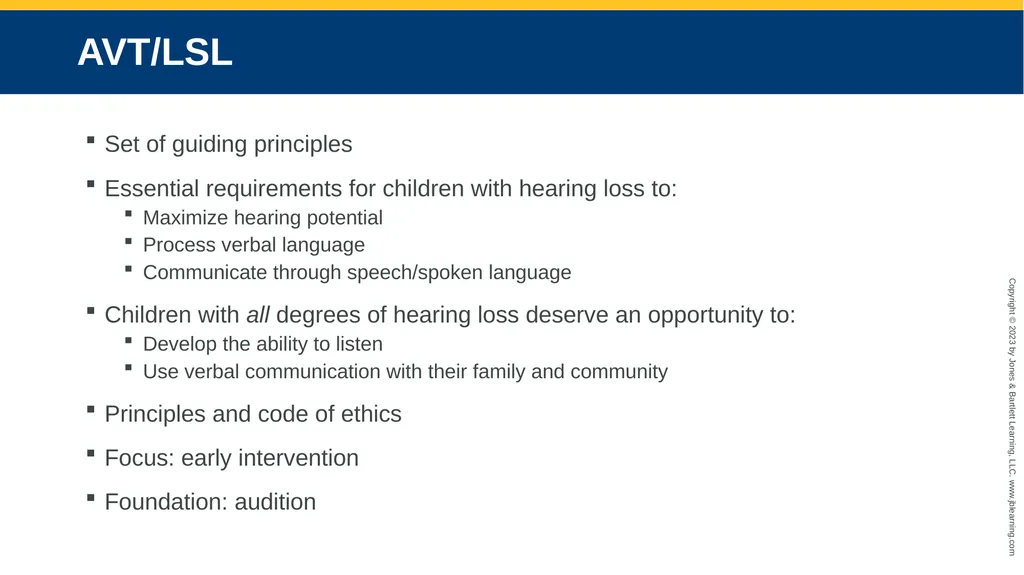
slide5. AVT/LSL Set of guiding principles
Essential requirements for children with hearing loss to:
Maximize hearing potential
Process verbal language
Communicate through speech/spoken language
Children with all degrees of hearing loss deserve an opportunity to:
Develop the ability to listen
Use verbal communication with their family and community
Principles and code of ethics
Focus: early intervention
Foundation: audition<br>
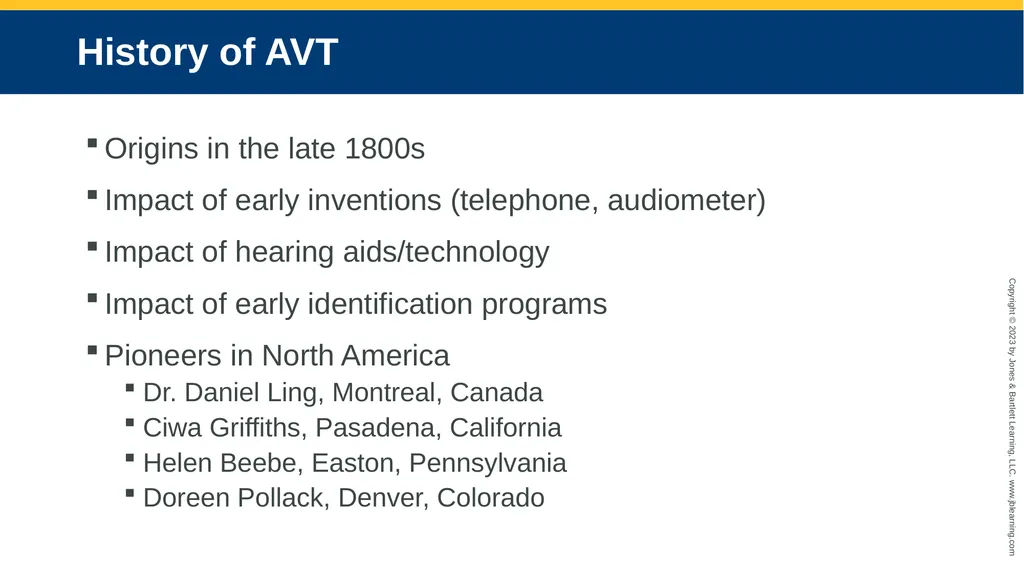
slide6. History of AVT Origins in the late 1800s
Impact of early inventions (telephone, audiometer)
Impact of hearing aids/technology
Impact of early identification programs
Pioneers in North America
Dr. Daniel Ling, Montreal, Canada
Ciwa Griffiths, Pasadena, California
Helen Beebe, Easton, Pennsylvania
Doreen Pollack, Denver, Colorado<br>
slide7. Terminology Auditory approach
Acoupedics
Auditory training
Aural habilitation
Unisensory approach
Auditory-based approaches
Auditory-verbal
Listening and spoken language<br>
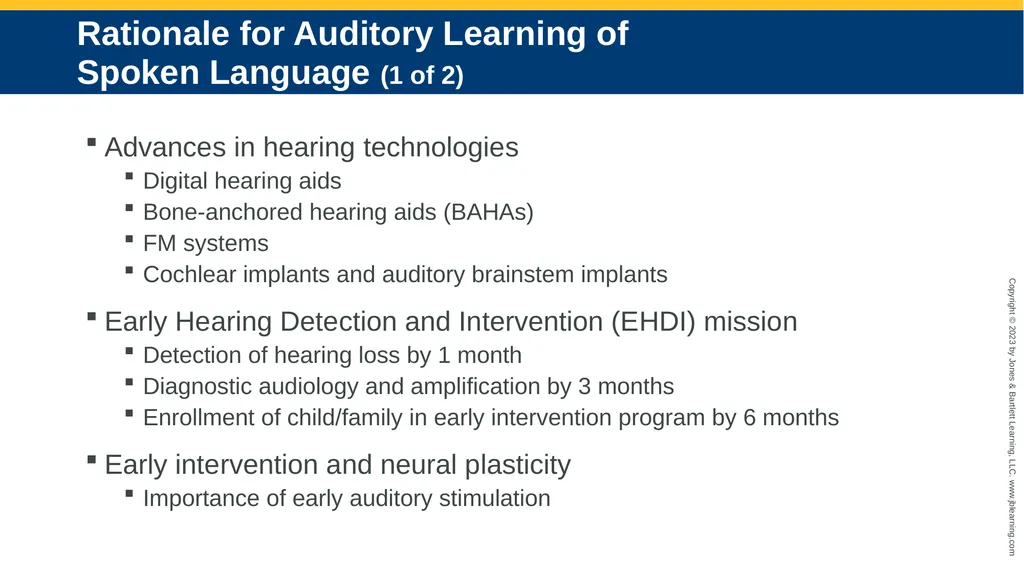
slide8. Rationale for Auditory Learning of Spoken Language (1 of 2) Advances in hearing technologies
Digital hearing aids
Bone-anchored hearing aids (BAHAs)
FM systems
Cochlear implants and auditory brainstem implants
Early Hearing Detection and Intervention (EHDI) mission
Detection of hearing loss by 1 month
Diagnostic audiology and amplification by 3 months
Enrollment of child/family in early intervention program by 6 months
Early intervention and neural plasticity
Importance of early auditory stimulation<br>
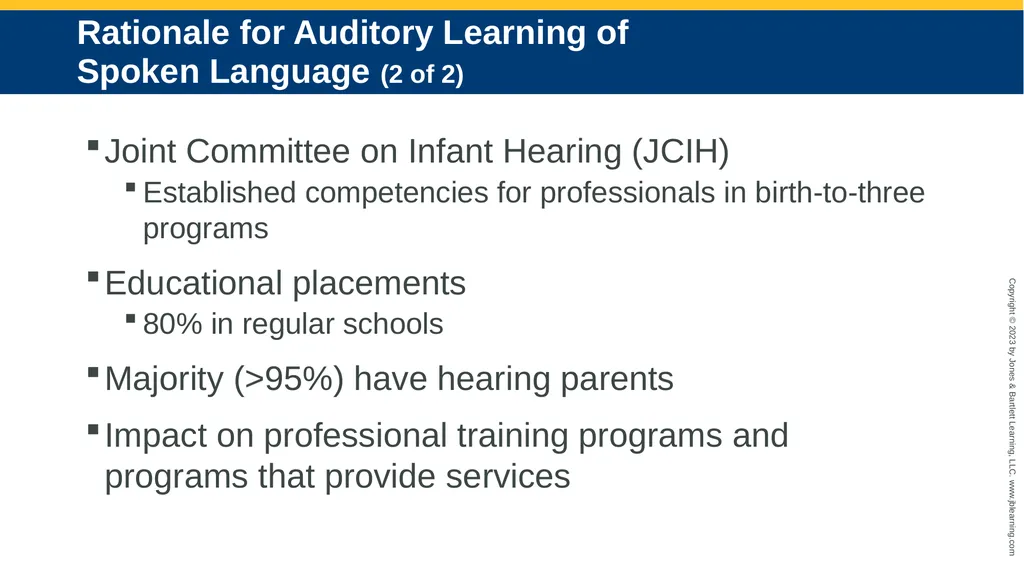
slide9. Rationale for Auditory Learning of Spoken Language (2 of 2) Joint Committee on Infant Hearing (JCIH)
Established competencies for professionals in birth-to-three programs
Educational placements
80% in regular schools
Majority (>95%) have hearing parents
Impact on professional training programs and programs that provide services<br>
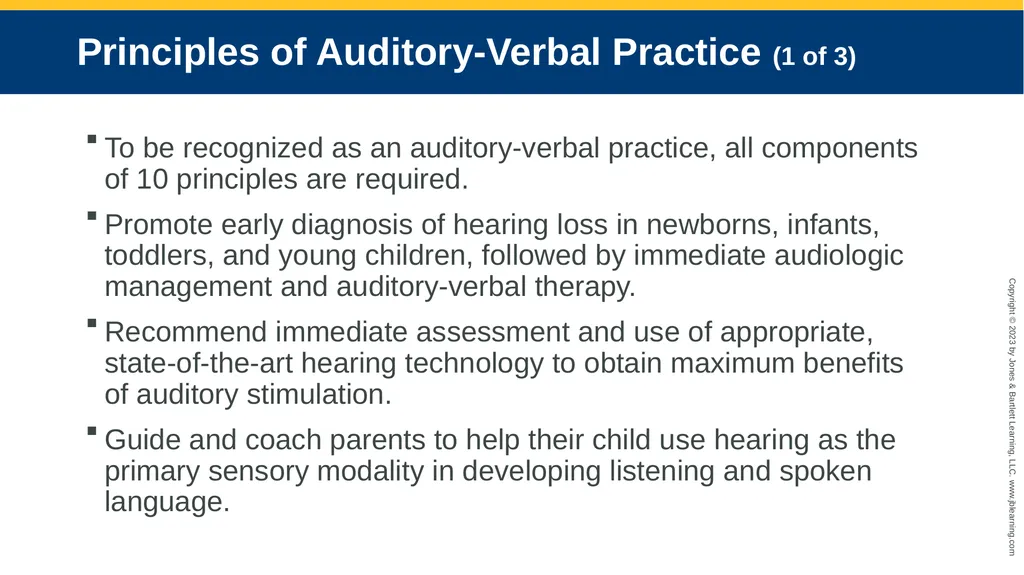
slide10. Principles of Auditory-Verbal Practice (1 of 3) To be recognized as an auditory-verbal practice, all components of 10 principles are required.
Promote early diagnosis of hearing loss in newborns, infants, toddlers, and young children, followed by immediate audiologic management and auditory-verbal therapy.
Recommend immediate assessment and use of appropriate, state-of-the-art hearing technology to obtain maximum benefits of auditory stimulation.
Guide and coach parents to help their child use hearing as the primary sensory modality in developing listening and spoken language.<br>
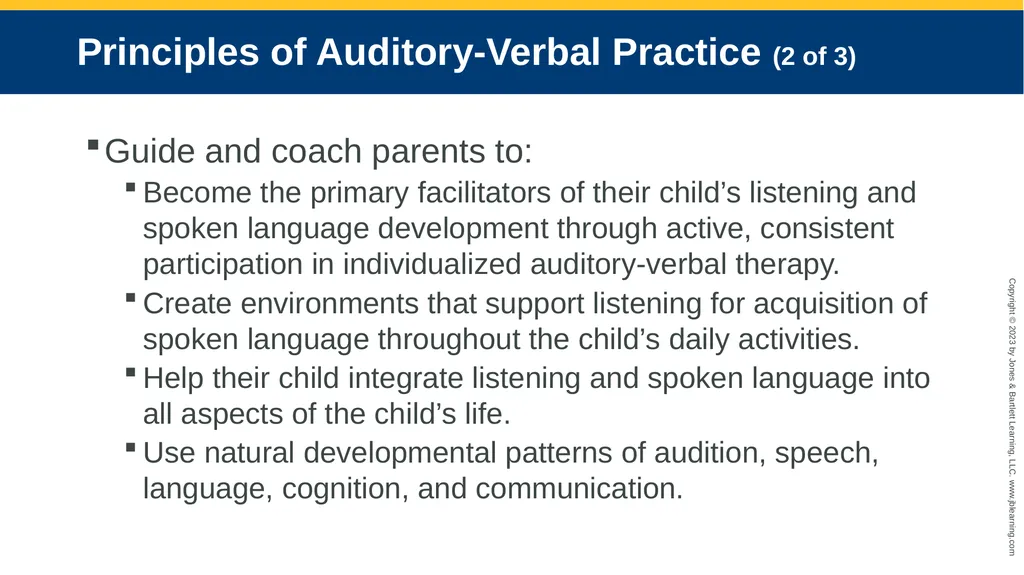
slide11. Principles of Auditory-Verbal Practice (2 of 3) Guide and coach parents to:
Become the primary facilitators of their child’s listening and spoken language development through active, consistent participation in individualized auditory-verbal therapy.
Create environments that support listening for acquisition of spoken language throughout the child’s daily activities.
Help their child integrate listening and spoken language into all aspects of the child’s life.
Use natural developmental patterns of audition, speech, language, cognition, and communication.<br>
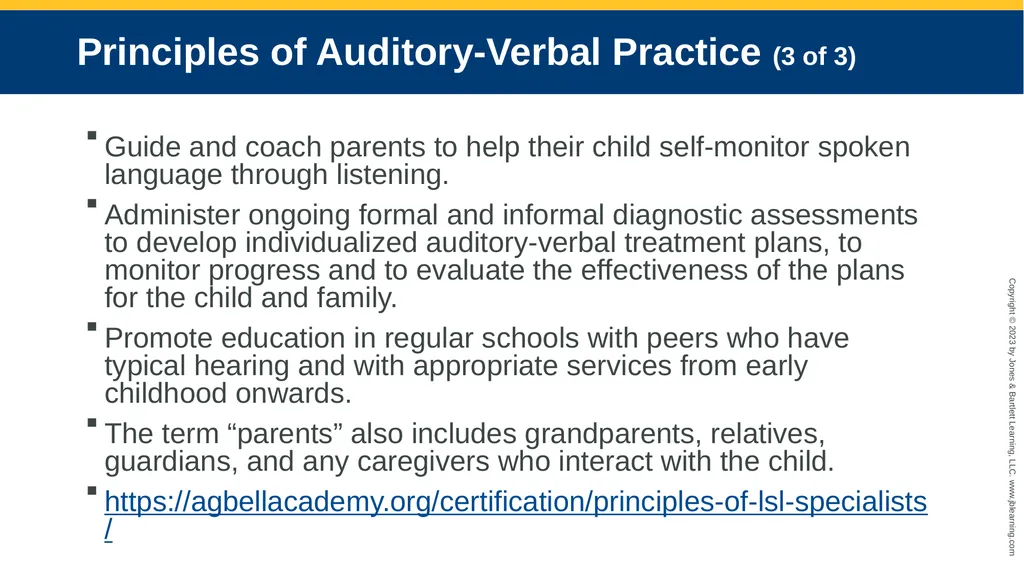
slide12. Principles of Auditory-Verbal Practice (3 of 3) Guide and coach parents to help their child self-monitor spoken language through listening.
Administer ongoing formal and informal diagnostic assessments to develop individualized auditory-verbal treatment plans, to monitor progress and to evaluate the effectiveness of the plans for the child and family.
Promote education in regular schools with peers who have typical hearing and with appropriate services from early childhood onwards.
The term “parents” also includes grandparents, relatives, guardians, and any caregivers who interact with the child.
https://agbellacademy.org/certification/principles-of-lsl-specialists/<br>
slide13. Well-PACED Intervention Parent participation
Audition
Communication
Expectations
Diagnostic<br>
slide14. Goals of Auditory-Verbal Therapy To have listening incorporated into the child’s total personality, so that it may provide the auditory foundation
Maximize their potential in all areas of development
Listening
Speech and spoken language
Overall communication abilities and social interactions
Independent thinking and cognitive functioning
Literacy and academics
Self-advocacy
Be educated in regular school settings with hearing peers
Become an independent, contributing member of mainstream society<br>
slide15. Teach with CLASS Develop goals
Cognition
Language
Audition
Speech
Social Skills<br>
slide16. Planning AV Intervention Long- and short-term objectives based on evaluation and observation
Age- and stage-appropriate strategies and materials
Learning environments
Home and environs
Clinic
School
Simulated home
Formal versus informal approaches<br>
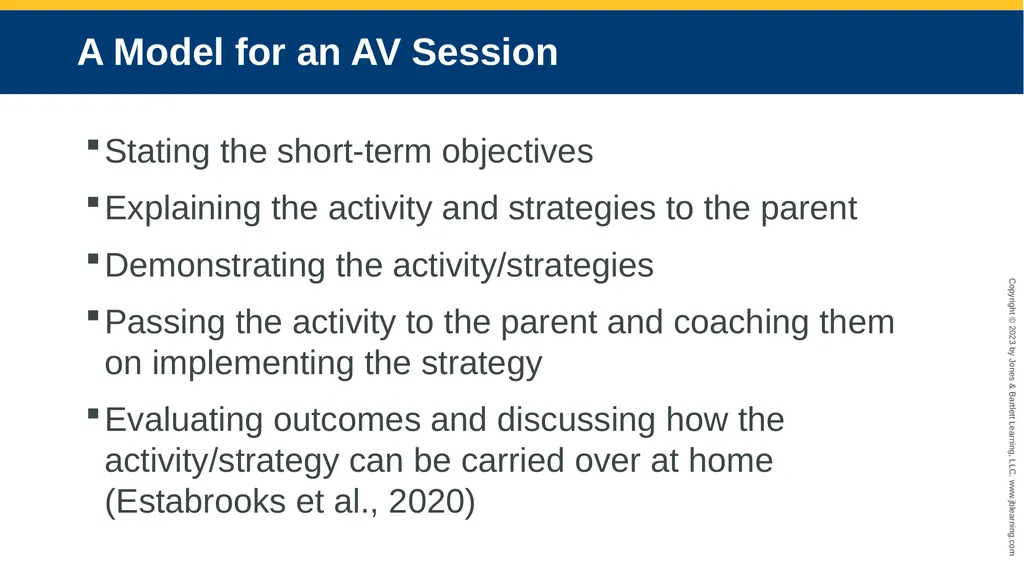
slide17. A Model for an AV Session Stating the short-term objectives
Explaining the activity and strategies to the parent
Demonstrating the activity/strategies
Passing the activity to the parent and coaching them on implementing the strategy
Evaluating outcomes and discussing how the activity/strategy can be carried over at home (Estabrooks et al., 2020)<br>
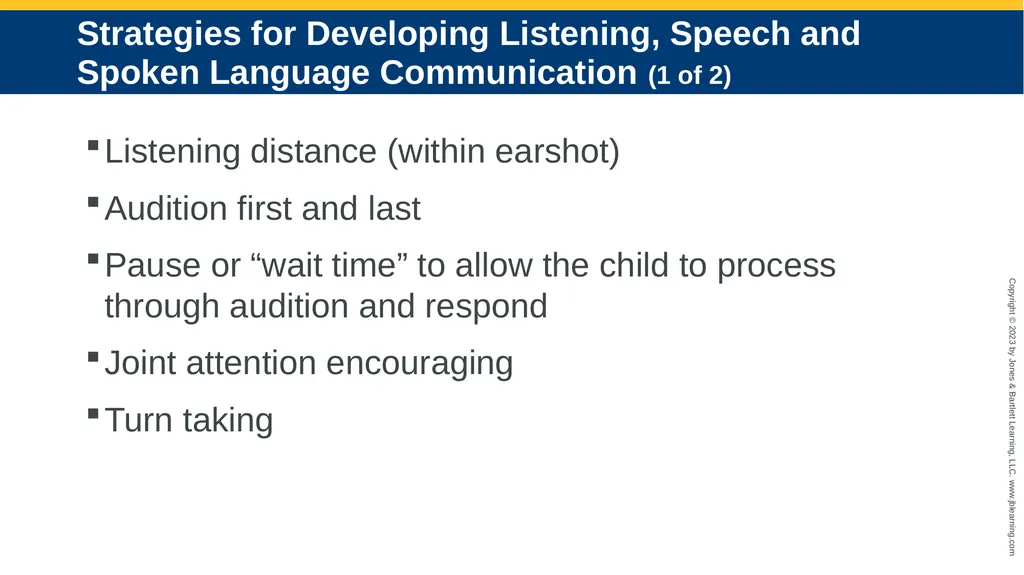
slide18. Strategies for Developing Listening, Speech and Spoken Language Communication (1 of 2) Listening distance (within earshot)
Audition first and last
Pause or “wait time” to allow the child to process through audition and respond
Joint attention encouraging
Turn taking<br>
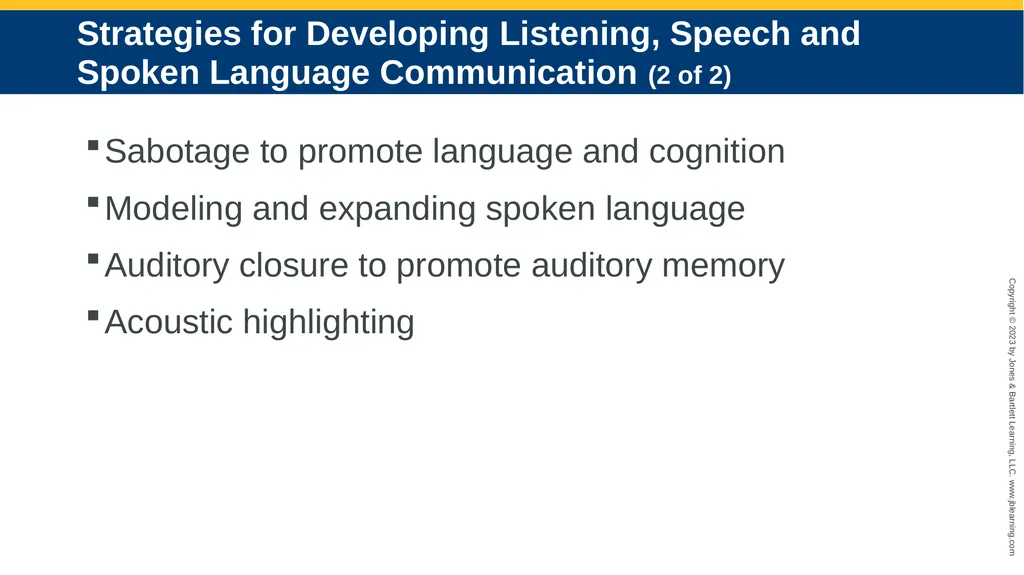
slide19. Strategies for Developing Listening, Speech and Spoken Language Communication (2 of 2) Sabotage to promote language and cognition
Modeling and expanding spoken language
Auditory closure to promote auditory memory
Acoustic highlighting<br>
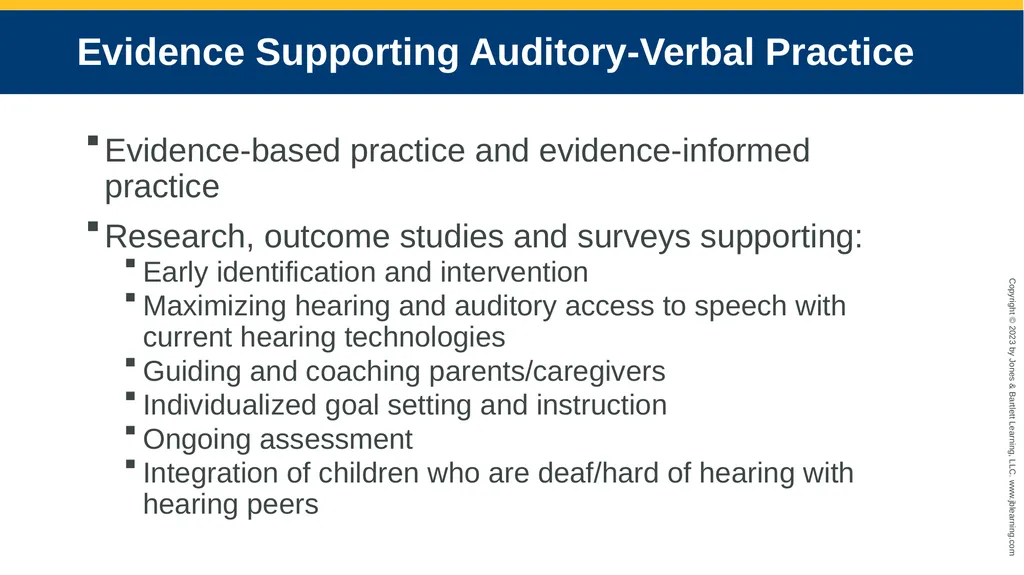
slide20. Evidence Supporting Auditory-Verbal Practice Evidence-based practice and evidence-informed practice
Research, outcome studies and surveys supporting:
Early identification and intervention
Maximizing hearing and auditory access to speech with current hearing technologies
Guiding and coaching parents/caregivers
Individualized goal setting and instruction
Ongoing assessment
Integration of children who are deaf/hard of hearing with hearing peers<br>
slide21. Becoming a Listening and Spoken Language Specialist (LSLS) Who can become a certified LSLS/AV therapist?
Speech-language pathologist
Audiologist
Teacher of the deaf
Why become a a certified LSLS/AV therapist?
Increased demand for early intervention specialists who know how to maximize hearing and develop spoken language<br>
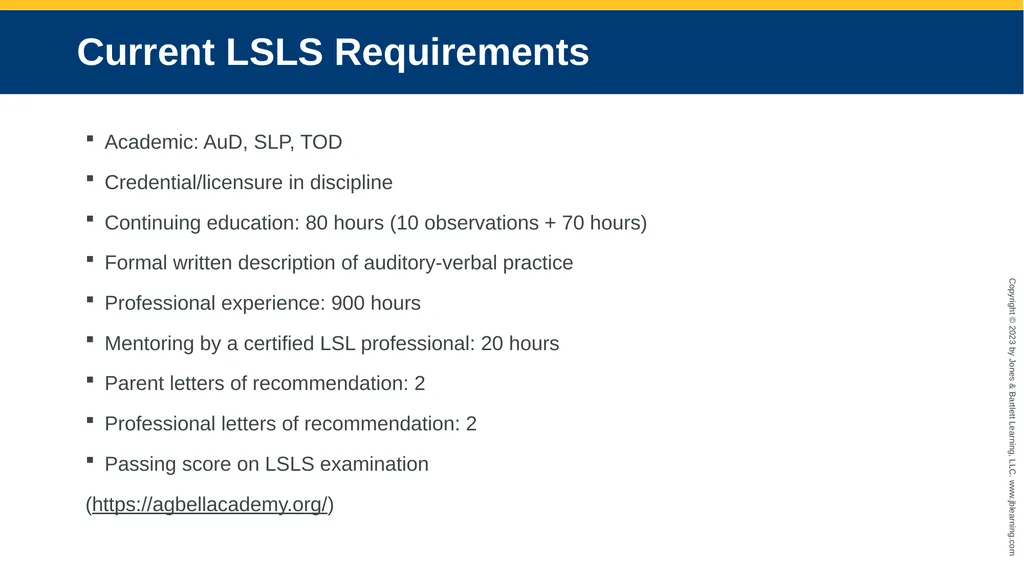
slide22. Current LSLS Requirements Academic: AuD, SLP, TOD
Credential/licensure in discipline
Continuing education: 80 hours (10 observations + 70 hours)
Formal written description of auditory-verbal practice
Professional experience: 900 hours
Mentoring by a certified LSL professional: 20 hours
Parent letters of recommendation: 2
Professional letters of recommendation: 2
Passing score on LSLS examination
(https://agbellacademy.org/)<br>
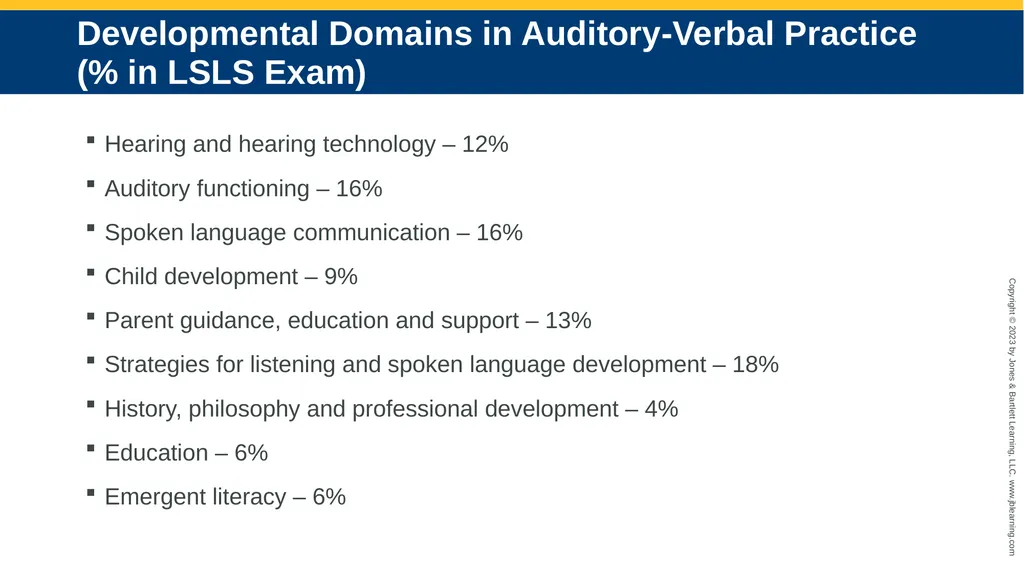
slide23. Developmental Domains in Auditory-Verbal Practice (% in LSLS Exam) Hearing and hearing technology – 12%
Auditory functioning – 16%
Spoken language communication – 16%
Child development – 9%
Parent guidance, education and support – 13%
Strategies for listening and spoken language development – 18%
History, philosophy and professional development – 4%
Education – 6%
Emergent literacy – 6%<br>
slide2. Chapter Outline Description and overview of auditory verbal therapy (AVT)
History (and terminology) of AVT
Rationale for auditory learning of spoken language
Principles of auditory-verbal practice
Goals of auditory-verbal therapy
Planning AV intervention
Strategies for developing listening, speech and spoken language communication
Evidence supporting auditory-verbal practice
Becoming a listening and spoken language specialist<br>
slide3. Description and Overview of Auditory Verbal Therapy (AVT) Impact of newborn hearing screening
Impact of advances in hearing technologies
Role of AG Bell and the AG Bell Academy of Listening and Spoken Language<br>
slide4. What Is AVT? Family-centered, evidence-based approach for development of listening, speech, and spoken language in infants and children who are deaf/hard of hearing
Model of parent guidance and participation that maximizes audition, teaches spoken language through listening, addresses the whole child and prepares children for mainstream education
Parents/caregivers serve as the primary providers and language models.
Role of AV therapist is to guide, coach, and support parents.<br>
slide5. AVT/LSL Set of guiding principles
Essential requirements for children with hearing loss to:
Maximize hearing potential
Process verbal language
Communicate through speech/spoken language
Children with all degrees of hearing loss deserve an opportunity to:
Develop the ability to listen
Use verbal communication with their family and community
Principles and code of ethics
Focus: early intervention
Foundation: audition<br>
slide6. History of AVT Origins in the late 1800s
Impact of early inventions (telephone, audiometer)
Impact of hearing aids/technology
Impact of early identification programs
Pioneers in North America
Dr. Daniel Ling, Montreal, Canada
Ciwa Griffiths, Pasadena, California
Helen Beebe, Easton, Pennsylvania
Doreen Pollack, Denver, Colorado<br>
slide7. Terminology Auditory approach
Acoupedics
Auditory training
Aural habilitation
Unisensory approach
Auditory-based approaches
Auditory-verbal
Listening and spoken language<br>
slide8. Rationale for Auditory Learning of Spoken Language (1 of 2) Advances in hearing technologies
Digital hearing aids
Bone-anchored hearing aids (BAHAs)
FM systems
Cochlear implants and auditory brainstem implants
Early Hearing Detection and Intervention (EHDI) mission
Detection of hearing loss by 1 month
Diagnostic audiology and amplification by 3 months
Enrollment of child/family in early intervention program by 6 months
Early intervention and neural plasticity
Importance of early auditory stimulation<br>
slide9. Rationale for Auditory Learning of Spoken Language (2 of 2) Joint Committee on Infant Hearing (JCIH)
Established competencies for professionals in birth-to-three programs
Educational placements
80% in regular schools
Majority (>95%) have hearing parents
Impact on professional training programs and programs that provide services<br>
slide10. Principles of Auditory-Verbal Practice (1 of 3) To be recognized as an auditory-verbal practice, all components of 10 principles are required.
Promote early diagnosis of hearing loss in newborns, infants, toddlers, and young children, followed by immediate audiologic management and auditory-verbal therapy.
Recommend immediate assessment and use of appropriate, state-of-the-art hearing technology to obtain maximum benefits of auditory stimulation.
Guide and coach parents to help their child use hearing as the primary sensory modality in developing listening and spoken language.<br>
slide11. Principles of Auditory-Verbal Practice (2 of 3) Guide and coach parents to:
Become the primary facilitators of their child’s listening and spoken language development through active, consistent participation in individualized auditory-verbal therapy.
Create environments that support listening for acquisition of spoken language throughout the child’s daily activities.
Help their child integrate listening and spoken language into all aspects of the child’s life.
Use natural developmental patterns of audition, speech, language, cognition, and communication.<br>
slide12. Principles of Auditory-Verbal Practice (3 of 3) Guide and coach parents to help their child self-monitor spoken language through listening.
Administer ongoing formal and informal diagnostic assessments to develop individualized auditory-verbal treatment plans, to monitor progress and to evaluate the effectiveness of the plans for the child and family.
Promote education in regular schools with peers who have typical hearing and with appropriate services from early childhood onwards.
The term “parents” also includes grandparents, relatives, guardians, and any caregivers who interact with the child.
https://agbellacademy.org/certification/principles-of-lsl-specialists/<br>
slide13. Well-PACED Intervention Parent participation
Audition
Communication
Expectations
Diagnostic<br>
slide14. Goals of Auditory-Verbal Therapy To have listening incorporated into the child’s total personality, so that it may provide the auditory foundation
Maximize their potential in all areas of development
Listening
Speech and spoken language
Overall communication abilities and social interactions
Independent thinking and cognitive functioning
Literacy and academics
Self-advocacy
Be educated in regular school settings with hearing peers
Become an independent, contributing member of mainstream society<br>
slide15. Teach with CLASS Develop goals
Cognition
Language
Audition
Speech
Social Skills<br>
slide16. Planning AV Intervention Long- and short-term objectives based on evaluation and observation
Age- and stage-appropriate strategies and materials
Learning environments
Home and environs
Clinic
School
Simulated home
Formal versus informal approaches<br>
slide17. A Model for an AV Session Stating the short-term objectives
Explaining the activity and strategies to the parent
Demonstrating the activity/strategies
Passing the activity to the parent and coaching them on implementing the strategy
Evaluating outcomes and discussing how the activity/strategy can be carried over at home (Estabrooks et al., 2020)<br>
slide18. Strategies for Developing Listening, Speech and Spoken Language Communication (1 of 2) Listening distance (within earshot)
Audition first and last
Pause or “wait time” to allow the child to process through audition and respond
Joint attention encouraging
Turn taking<br>
slide19. Strategies for Developing Listening, Speech and Spoken Language Communication (2 of 2) Sabotage to promote language and cognition
Modeling and expanding spoken language
Auditory closure to promote auditory memory
Acoustic highlighting<br>
slide20. Evidence Supporting Auditory-Verbal Practice Evidence-based practice and evidence-informed practice
Research, outcome studies and surveys supporting:
Early identification and intervention
Maximizing hearing and auditory access to speech with current hearing technologies
Guiding and coaching parents/caregivers
Individualized goal setting and instruction
Ongoing assessment
Integration of children who are deaf/hard of hearing with hearing peers<br>
slide21. Becoming a Listening and Spoken Language Specialist (LSLS) Who can become a certified LSLS/AV therapist?
Speech-language pathologist
Audiologist
Teacher of the deaf
Why become a a certified LSLS/AV therapist?
Increased demand for early intervention specialists who know how to maximize hearing and develop spoken language<br>
slide22. Current LSLS Requirements Academic: AuD, SLP, TOD
Credential/licensure in discipline
Continuing education: 80 hours (10 observations + 70 hours)
Formal written description of auditory-verbal practice
Professional experience: 900 hours
Mentoring by a certified LSL professional: 20 hours
Parent letters of recommendation: 2
Professional letters of recommendation: 2
Passing score on LSLS examination
(https://agbellacademy.org/)<br>
slide23. Developmental Domains in Auditory-Verbal Practice (% in LSLS Exam) Hearing and hearing technology – 12%
Auditory functioning – 16%
Spoken language communication – 16%
Child development – 9%
Parent guidance, education and support – 13%
Strategies for listening and spoken language development – 18%
History, philosophy and professional development – 4%
Education – 6%
Emergent literacy – 6%<br>