
Awareness on Performance Management System and















Description: Awareness on Performance Management System and Competency Mapping Jagath Karunathilaka Consultant Finance and HR Management of CSOs Need for PMS PMS is the system that ensures organizational objectives are achieved through individual
Related Topics
Download Presentation
"Awareness on Performance Management System and" is the property of its rightful owner. Permission is granted to download and print the materials on this website for personal, non-commercial use only, and to display it on your personal computer provided you do not modify the materials and that you retain all copyright notices contained in the materials. By downloading content from our website, you accept the terms of this agreement.
Presentation Transcript
slide1. Awareness on Performance Management System and Competency Mapping Jagath Karunathilaka
Consultant – Finance and HR Management of CSOs<br>
slide2. Need for PMS PMS is the system that ensures organizational objectives are achieved through individual contribution while they are being developed<br>
slide3. What is Performance Management? Continuous improvements in performance at individual, team and organizational levels in all aspects of performance<br>
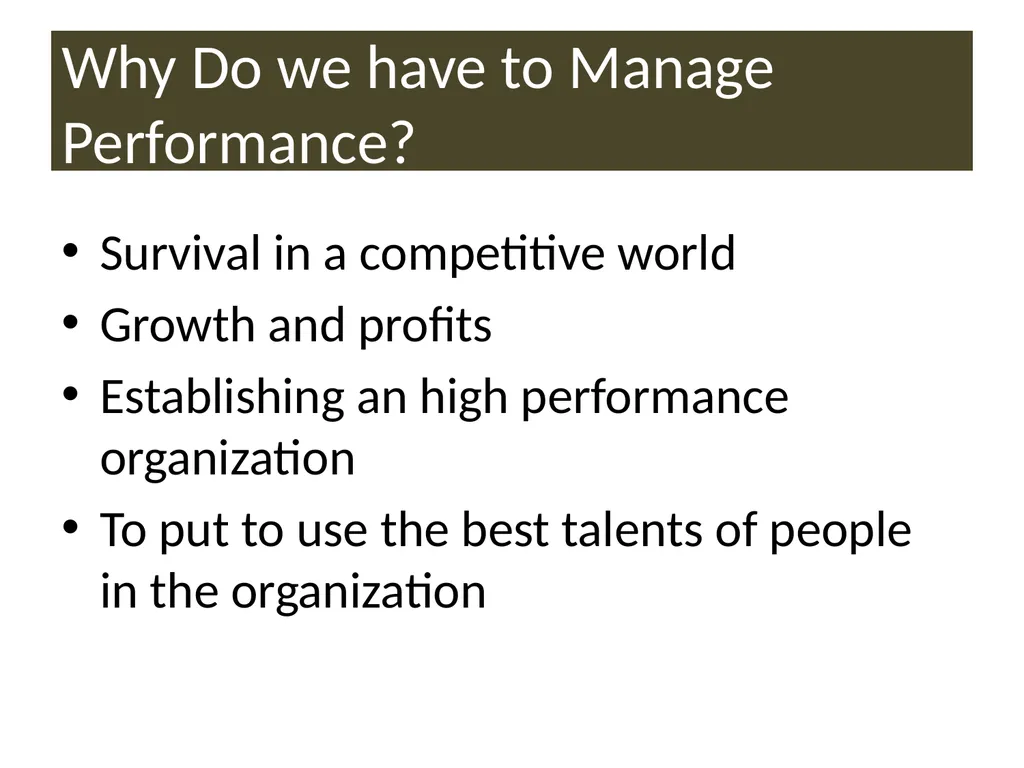
slide4. Why Do we have to Manage Performance? Survival in a competitive world
Growth and profits
Establishing an high performance organization
To put to use the best talents of people in the organization<br>
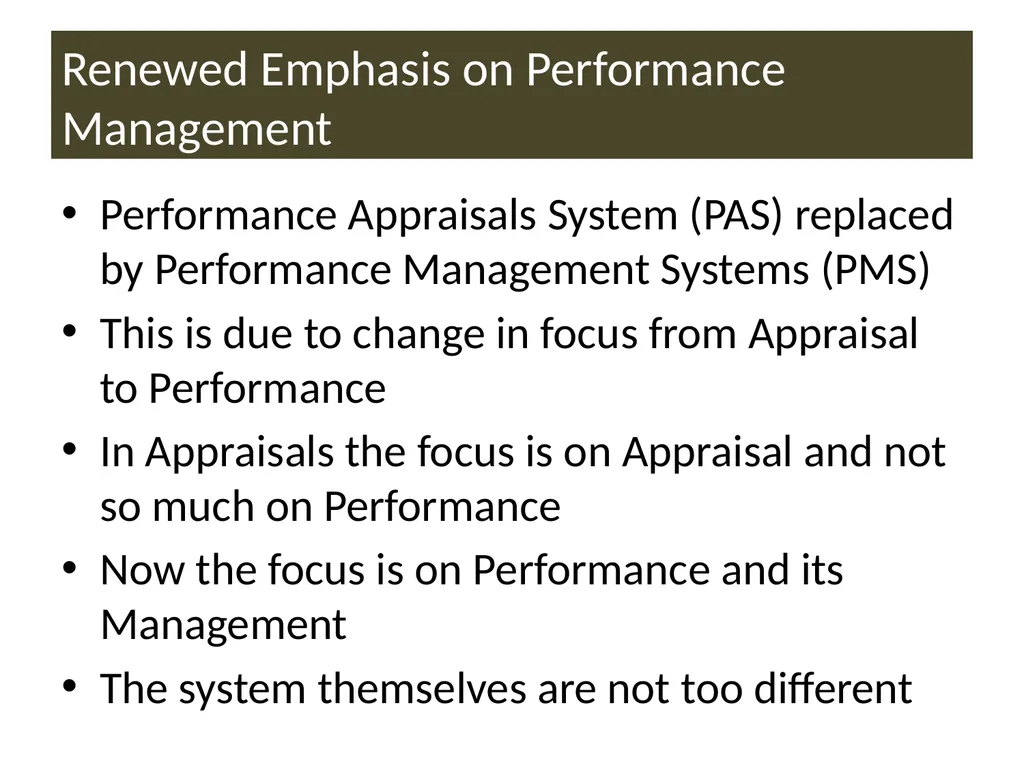
slide5. Renewed Emphasis on Performance Management Performance Appraisals System (PAS) replaced by Performance Management Systems (PMS)
This is due to change in focus from Appraisal to Performance
In Appraisals the focus is on Appraisal and not so much on Performance
Now the focus is on Performance and its Management
The system themselves are not too different<br>
slide6. Objectives of PMS Performance improvements
Role clarity
Identification of development needs
Competence building
Data base for rewards, promotions, recognition and motivation<br>
slide7. Performance Equation Individual Performance =
Ability X Motivation X Organizational Support<br>
slide8. How Do You Plan Performance ? Identify Key Performance Areas – KPA/KRA
Set goals : objectives
Specific (observable)
Measurable (quantitative –qualitative)
Ambitious (challenging)
Realistic
Time Bound
Assign weightages & time estimates<br>
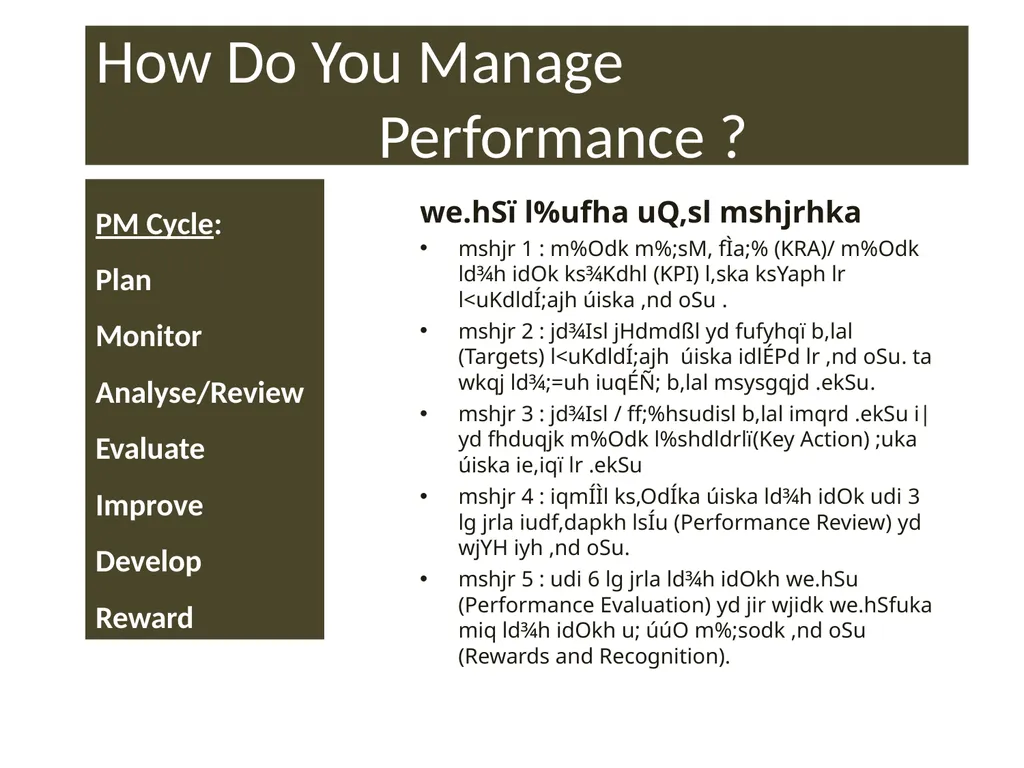
slide9. How Do You Manage Performance ? we.hSï l%ufha uQ,sl mshjrhka
mshjr 1 : m%Odk m%;sM, fÌa;% (KRA)/ m%Odk ld¾h idOk ks¾Kdhl (KPI) l,ska ksYaph lr l<uKdldÍ;ajh úiska ,nd oSu .
mshjr 2 : jd¾Isl jHdmdßl yd fufyhqï b,lal (Targets) l<uKdldÍ;ajh úiska idlÉPd lr ,nd oSu. ta wkqj ld¾;=uh iuqÉÑ; b,lal msysgqjd .ekSu.
mshjr 3 : jd¾Isl / ff;%hsudisl b,lal imqrd .ekSu i|yd fhduqjk m%Odk l%shdldrlï(Key Action) ;uka úiska ie,iqï lr .ekSu
mshjr 4 : iqmÍÌl ks,OdÍka úiska ld¾h idOk udi 3 lg jrla iudf,dapkh lsÍu (Performance Review) yd wjYH iyh ,nd oSu.
mshjr 5 : udi 6 lg jrla ld¾h idOkh we.hSu (Performance Evaluation) yd jir wjidk we.hSfuka miq ld¾h idOkh u; úúO m%;sodk ,nd oSu (Rewards and Recognition). PM Cycle:
Plan
Monitor
Analyse/Review
Evaluate
Improve
Develop
Reward<br>
slide10. Who Plans Performance ? Performer
With the help of his supervisor or seniors
In the context of organizational and unit plans
On the basis of previous performance
Using bench marks where possible<br>
slide11. How Frequently ? Depends on the needs and feasibility
Every day for self
Once a quarter with boss for review
Once a month or more with the department
Once every half yearly for appraisal<br>
slide12. Components of PMS KPAs, KRAs, KPI, Objectives, etc.
Attributes
Participative planning
Participative review
Performance analysis<br>
slide13. Components of PMS… What is KRA?
Key Result Area or KRA refers to general area of outputs or outcomes for which department’s role is responsible
KRA in simple terms may be defined as primary responsibilities of an individual, the core area which each person is accountable
KRA enables you to take ownership of your job and to accept responsibility for those area in which achieving results are you’re responsibly.<br>
slide14. Components of PMS… Importance of KRA
Set goals and objectives
Prioritize their activities, and therefore improve their time/work management
Clarify roles of department or individuals
Focus on results rather than activities
Align their roles to the organization’s business or strategic plan
Promote an environment of self-management<br>
slide15. Components of PMS… What is a KPI?
KPI stands for key performance indicator, a quantifiable measure of performance over time for a specific objective.
KPIs provide targets for teams to shoot for, milestones to gauge progress, and insights that help people across the organization make better decisions.
From finance and HR to production, marketing and sales, key performance indicators help every area of the business move forward at the strategic level.<br>
slide16. Components of PMS… Why Are KPIs Important?
KPIs are an important way to ensure your teams are supporting the overall goals of the organization. Here are some of the biggest reasons why you need key performance indicators.
Keep your teams aligned: Whether measuring project success or employee performance, KPIs keep teams moving in the same direction.
Provide a health check: Key performance indicators give you a realistic look at the health of your organization, from risk factors to financial indicators.
Make adjustments: KPIs help you clearly see your successes and failures so you can do more of what’s working, and less of what’s not.
Hold your teams accountable: Make sure everyone provides value with key performance indicators that help employees track their progress and help managers move things along.<br>
slide17. Components of PMS… Performance review discussion
Identification of development needs
Development actions
Ratings
Review by review teams for rewards etc
Documentation<br>
slide18. Types of PMS Systems Individual appraisals
Team appraisals
Upward appraisals
360 degree appraisals<br>
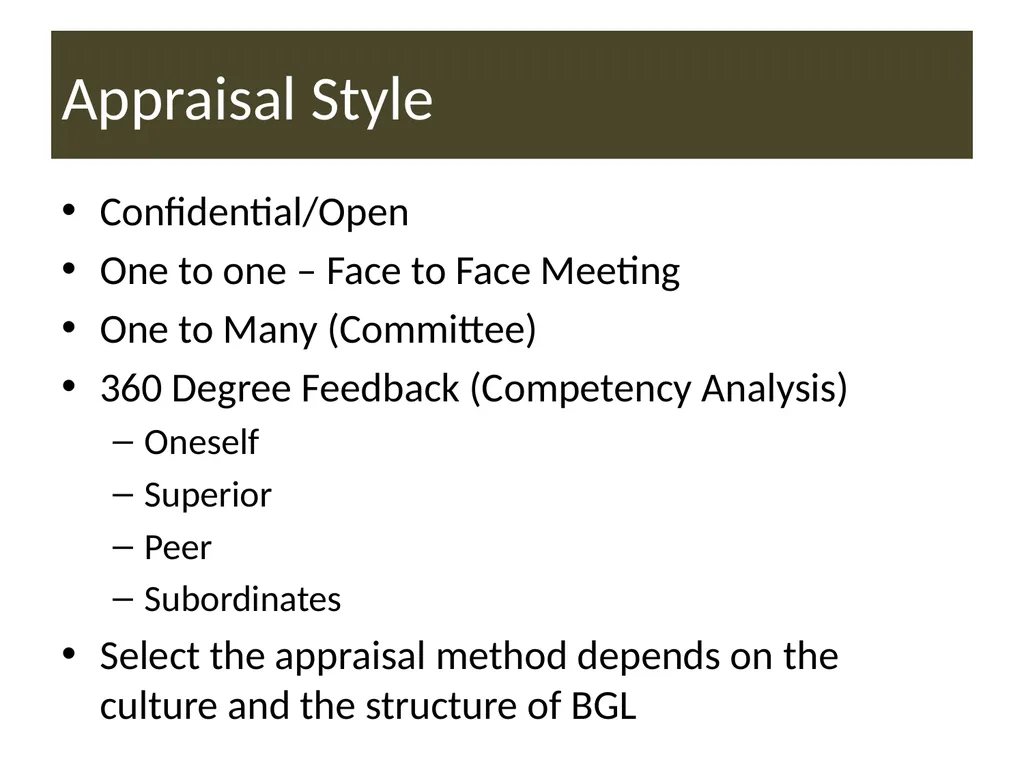
slide19. Appraisal Style Confidential/Open
One to one – Face to Face Meeting
One to Many (Committee)
360 Degree Feedback (Competency Analysis)
Oneself
Superior
Peer
Subordinates
Select the appraisal method depends on the culture and the structure of BGL<br>
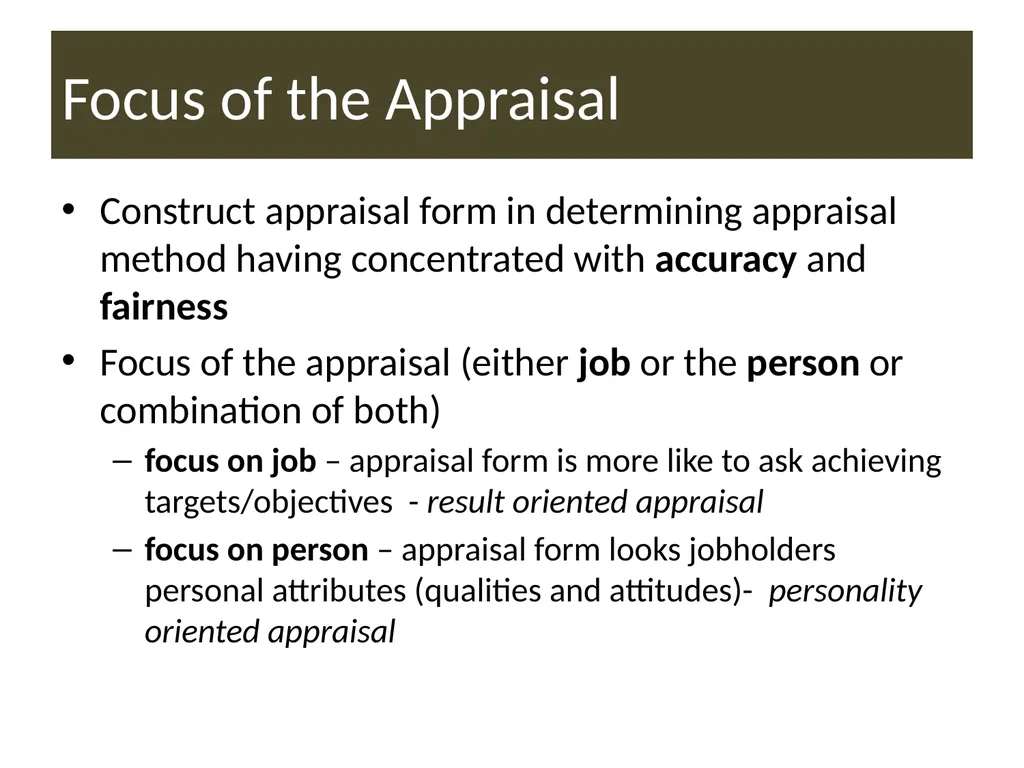
slide20. Focus of the Appraisal Construct appraisal form in determining appraisal method having concentrated with accuracy and fairness
Focus of the appraisal (either job or the person or combination of both)
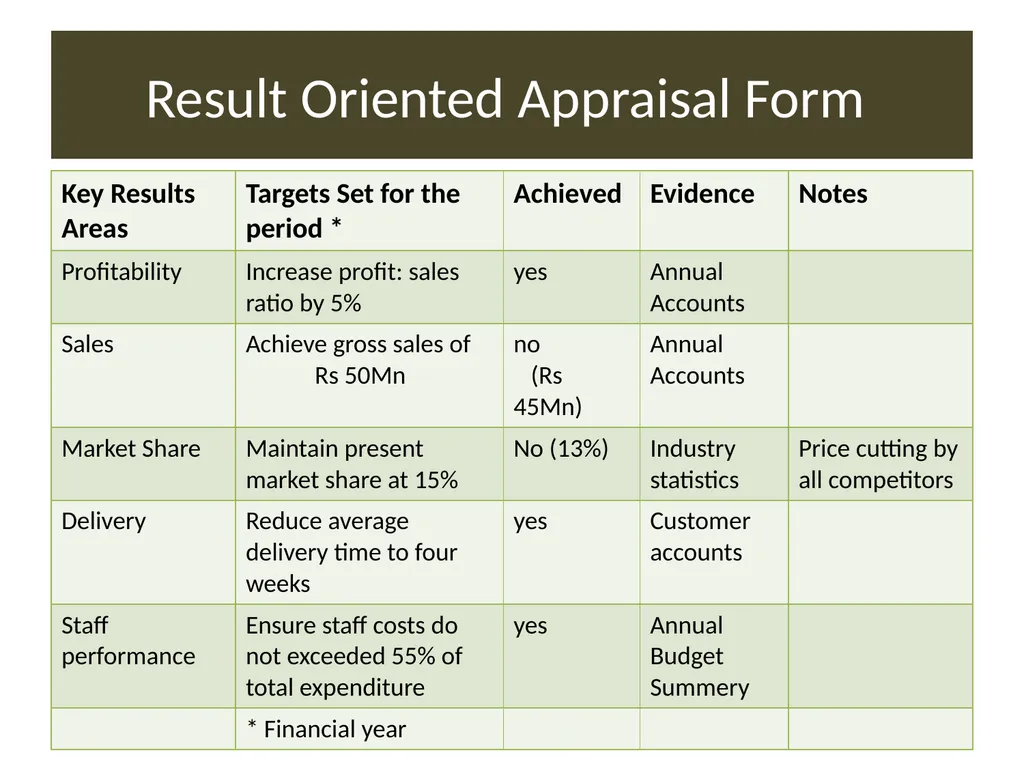
focus on job – appraisal form is more like to ask achieving targets/objectives - result oriented appraisal
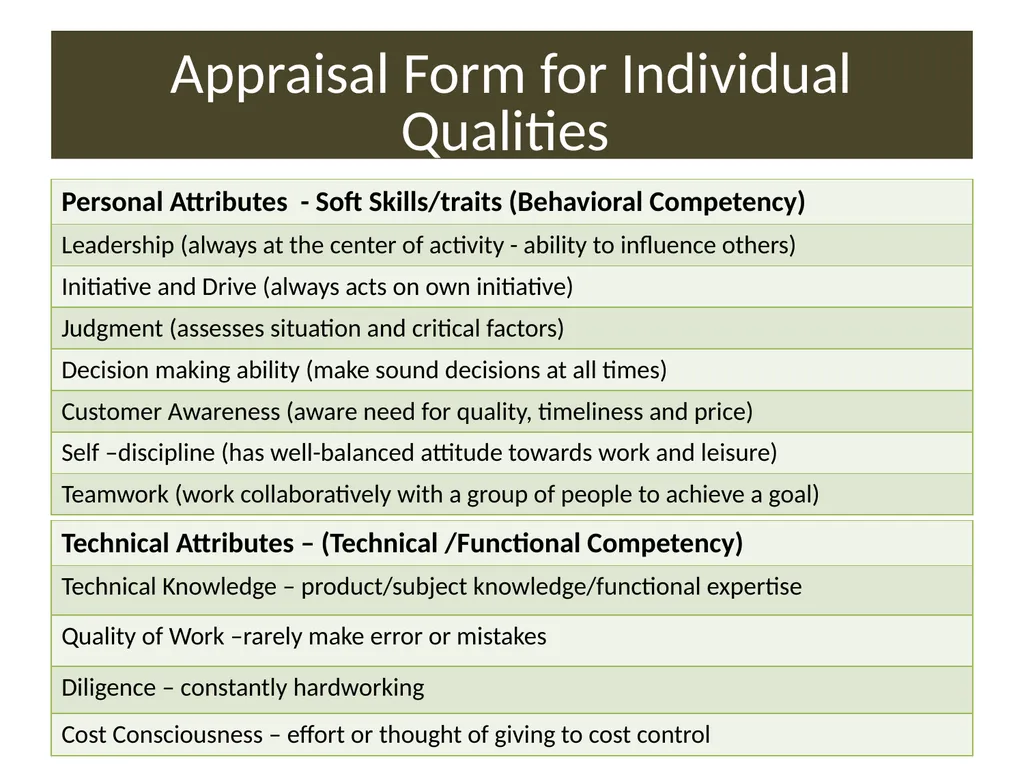
focus on person – appraisal form looks jobholders personal attributes (qualities and attitudes)- personality oriented appraisal<br>
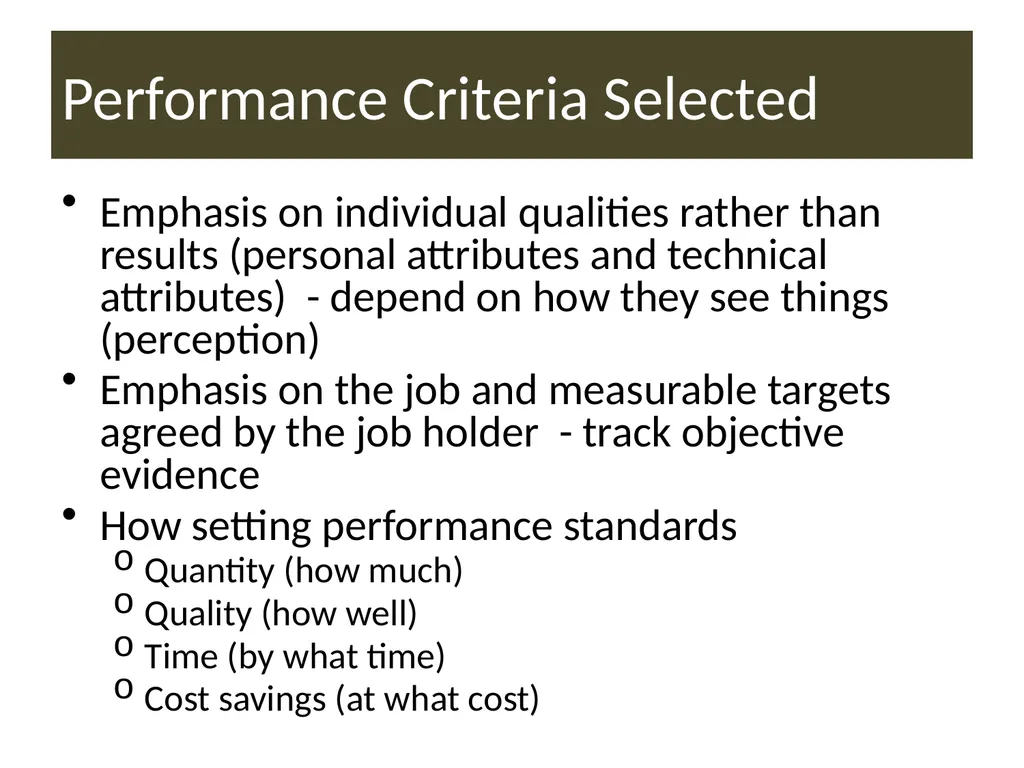
slide21. Performance Criteria Selected Emphasis on individual qualities rather than results (personal attributes and technical attributes) - depend on how they see things (perception)
Emphasis on the job and measurable targets agreed by the job holder - track objective evidence
How setting performance standards
Quantity (how much)
Quality (how well)
Time (by what time)
Cost savings (at what cost)<br>
slide22. Result Oriented Appraisal Form<br>
slide23. Appraisal Form for Individual Qualities<br>
slide24. Performance Rating Generally Used Appraisal criteria are generally personality oriented or result oriented, within each measure individual performance
Personality oriented – behavioural scale (box ticking describing performance)
Result oriented – Target Vs. Achievement
Free written reports – essay type
Questions set on the appraisal document<br>
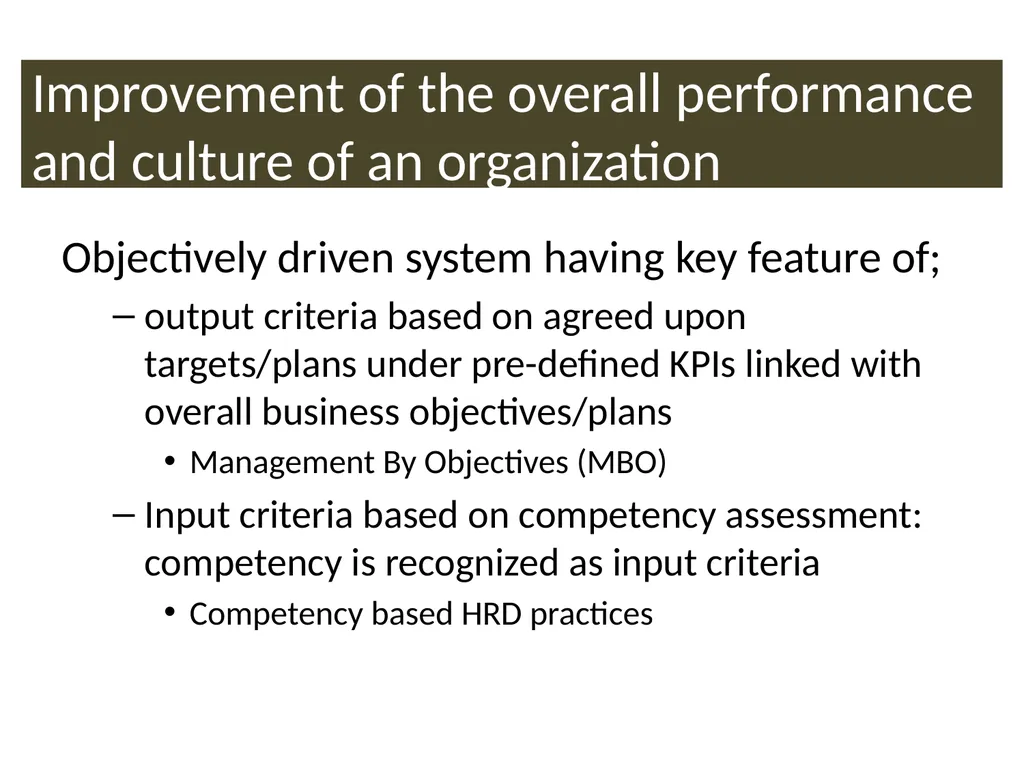
slide25. Improvement of the overall performance and culture of an organization Objectively driven system having key feature of;
output criteria based on agreed upon targets/plans under pre-defined KPIs linked with overall business objectives/plans
Management By Objectives (MBO)
Input criteria based on competency assessment: competency is recognized as input criteria
Competency based HRD practices<br>
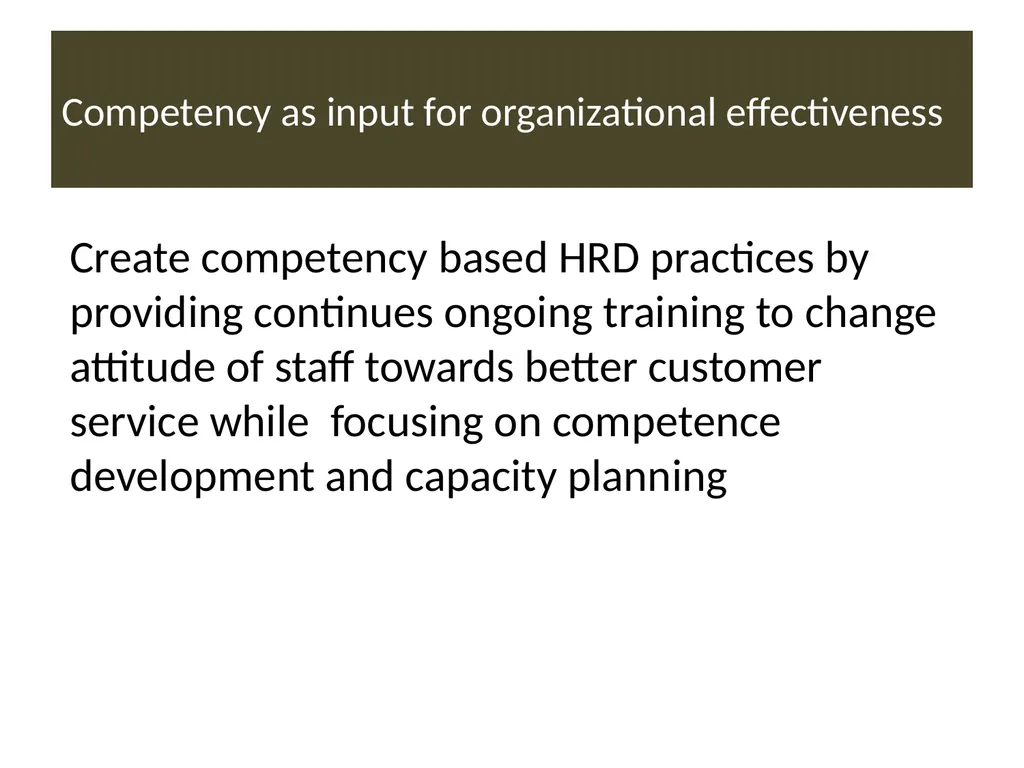
slide26. Competency as input for organizational effectiveness Create competency based HRD practices by providing continues ongoing training to change attitude of staff towards better customer service while focusing on competence development and capacity planning<br>
slide27. Competency and Effectiveness = Raw material & Output Output
(Effectiveness on the job) Raw material
(Competency)<br>
slide28. Raw material
(Competency) Output
(Effectiveness on the job) Competency and Effectiveness = Raw material & Output<br>
slide29. Competency A Competency is an underlying characteristic of a person which enables him/her to deliver superior performance in a given job, role or a situation.
Competencies are seen mainly as inputs.<br>
slide30. What is a competency? Competency may take the following forms
– Knowledge
– Skill
– Attitude
– Other characteristics of an individual
Motives
values
Self concept etc.<br>
slide31. Competency Models Competency models represent the most critical knowledge, skills and behaviors that drive successful performance with respect to a particular type of job or occupation.
They describe competencies in behavioral terms, using behavioral indicators, so employees can recognize the competencies when demonstrated.<br>
slide32. Competency Models Used as a human resource tool for
Selection
Training and development
Performance appraisal and
Succession planning.<br>
slide33. Framework - Core Competencies Typically, Company’s core competency profile refers set of characteristics that must be possessed by every employee regardless of their organizational level or the position.
Core competency profile of the Company is considered as its strategic strength to support the company’s overall mission<br>
slide34. Framework - Core Competencies Core competency profile – Examples
Core competencies or general professional competency profile is comprised with following characteristics
Dependability / Accountability - Completion of assignments on time & carries out instructions
Learning & Feedback - Attitude of continuous learning and provision of accurate feedback
Interpersonal Relations - Cooperative, considerate & tactful nature in dealing with others
Initiative & Leadership - Recommending & creating own work practices & procedures
Communication Skills - Expression of thoughts clearly & concisely in written & oral form
Facing Issues / Problem Solving - Manner of solving conflicting issues by constructive action<br>
slide35. Framework - Core Competencies… Core competency profile – Examples
Planning & Organization / Making an Impact - Ability to optimize time, meet deadlines, establish short & long term plans
Management Effectiveness / Drive & Resilience- Skill, involvement & effectiveness
Staff Development (For Managerial Staff) - Guidance & opportunities provided for the development of staff
Professionalism & Business Focus -High standards of integrity, competence & clear understanding of effective operational aspects
Delivering Quality Service - Monitors and upholds high quality of service and products to clients<br>
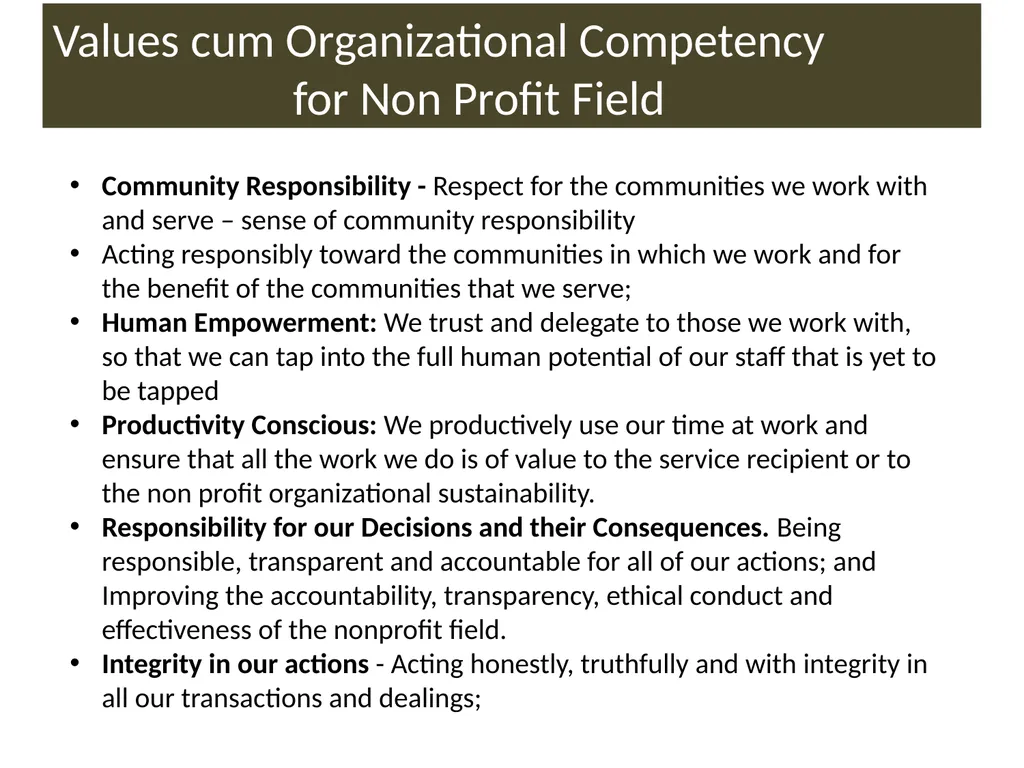
slide36. Values cum Organizational Competency for Non Profit Field Community Responsibility - Respect for the communities we work with and serve – sense of community responsibility
Acting responsibly toward the communities in which we work and for the benefit of the communities that we serve;
Human Empowerment: We trust and delegate to those we work with, so that we can tap into the full human potential of our staff that is yet to be tapped
Productivity Conscious: We productively use our time at work and ensure that all the work we do is of value to the service recipient or to the non profit organizational sustainability.
Responsibility for our Decisions and their Consequences. Being responsible, transparent and accountable for all of our actions; and Improving the accountability, transparency, ethical conduct and effectiveness of the nonprofit field.
Integrity in our actions - Acting honestly, truthfully and with integrity in all our transactions and dealings;<br>
slide37. Framework - Competency Mapping Company shall undertake the competency mapping exercise as a process of identifying the specific skills, knowledge, abilities, and behaviors required to operate job related tasks in the company.
Competency maps are referred as competency profiles or skills profiles of this exercise.<br>
slide38. Procedures - Role-Set Based Competency Mapping Identify Role Holder (key roles in the CSO as per the organizational structure)
Defining role relationship (reporting authority, subordinate, peers etc.)
Identify divisional KRA & KPI (where the role holder is located)
Identify the objectives of the functions or division where the role is located
Identify individual KPAs or KRAs and KPIs of the role holder
List of the tasks & activities as per the JD
List of the activities expected to be performed by the role holder
List of the actual KASOs (*) required to perform the job task effectively<br>
slide39. Procedures - Role-Set Based Competency Mapping… Four areas of competencies could be identified that are
Technical / functional competencies – KASOs associated with the technology or functional expertise required to perform the role
Managerial – KASOs required to plan, organize, mobilize and utilize various resources.
Human and behavioral – KASOs required to motivate, utilize and develop human resources
Conceptual – abilities to visualize the invisible, think at abstract levels and use the thinking to plan future business.<br>
slide40. Procedures - Role-Set Based Competency Mapping… KSAOs are commonly referred to as competencies. Four areas of competencies could be identified that are
Knowledge: Understanding acquired through learning. It is a body of information relevant to job performance. It is what people have to know to be able to perform a job, such as knowledge of policies and procedures for a recruitment process.
Attitude: your view point towards the job
Skills – Capabilities acquired through practice. It can be financial skill – budgeting, or a verbal skill; making a presentation<br>
slide41. Procedures - Role-Set Based Competency Mapping… KSAOs are commonly referred to as competencies. Four areas of competencies could be identified that are
Other characteristics of an individual includes
Motives: example - an affiliation oriented person constantly think about having friends, and achievement oriented person wants to accomplish unique things or wants to be better than before.
Values: example - honesty, openness, transparency, work values etc.
Traits: example- physical qualities like quick reaction time and good eyesight are required to drivers etc.
Self-concept: example- self-worth, confidence and attitudes to one’s self.<br>
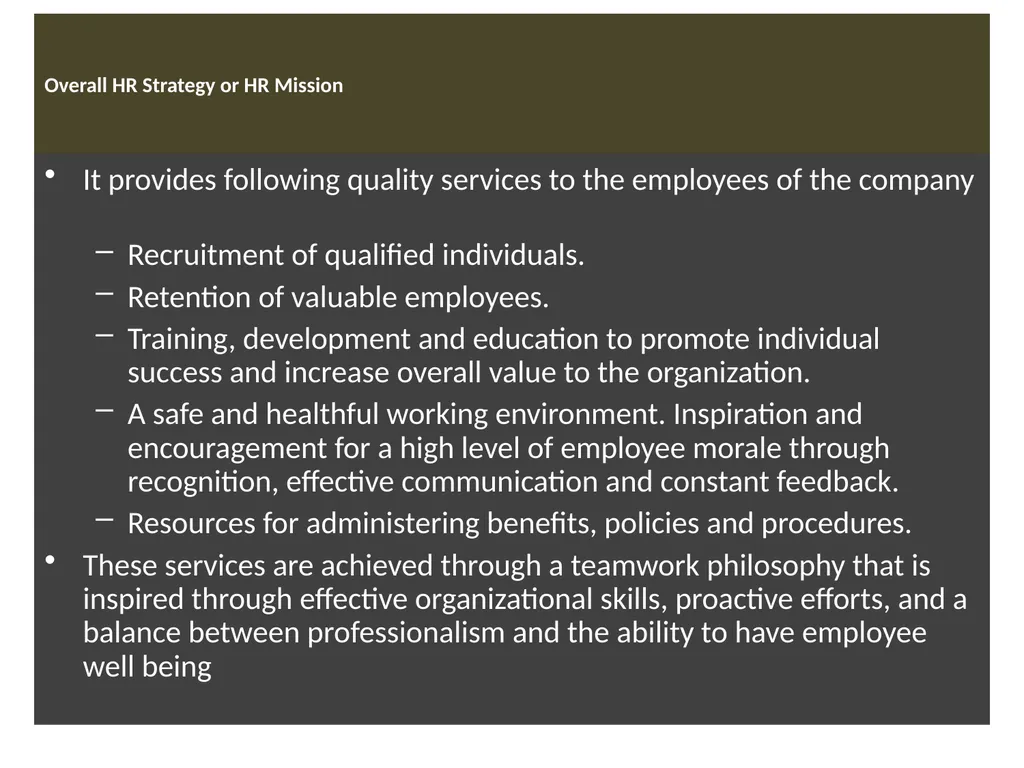
slide42. Overall HR Strategy or HR Mission It provides following quality services to the employees of the company
Recruitment of qualified individuals.
Retention of valuable employees.
Training, development and education to promote individual success and increase overall value to the organization.
A safe and healthful working environment. Inspiration and encouragement for a high level of employee morale through recognition, effective communication and constant feedback.
Resources for administering benefits, policies and procedures.
These services are achieved through a teamwork philosophy that is inspired through effective organizational skills, proactive efforts, and a balance between professionalism and the ability to have employee well being<br>
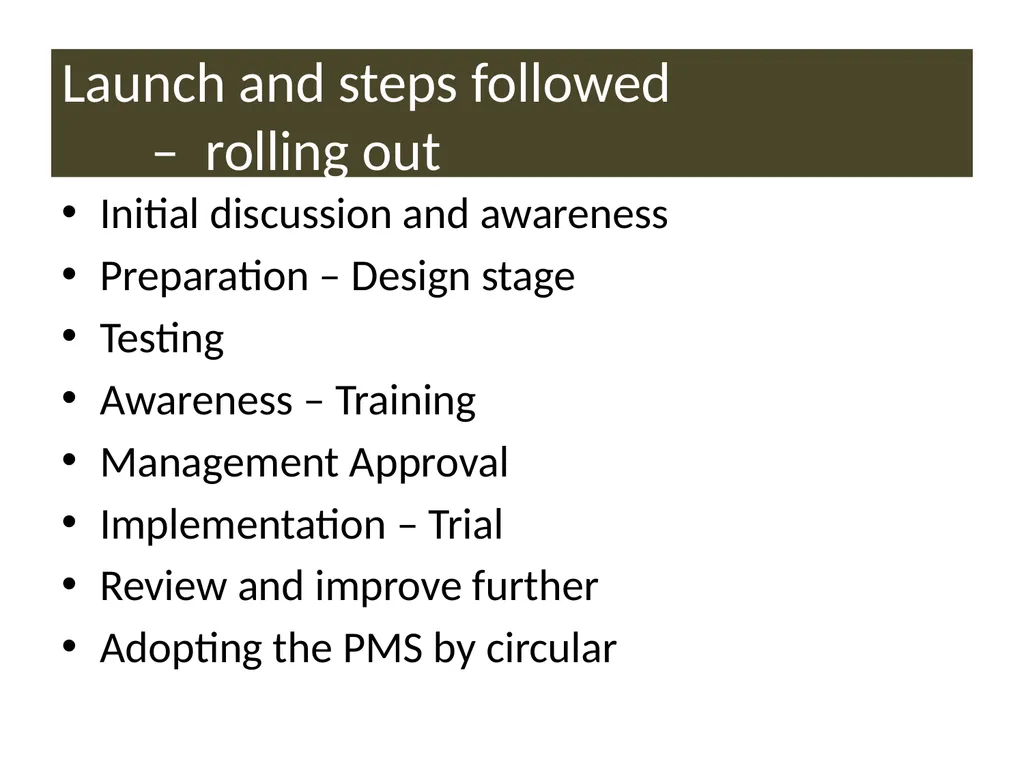
slide43. Launch and steps followed – rolling out Initial discussion and awareness
Preparation – Design stage
Testing
Awareness – Training
Management Approval
Implementation – Trial
Review and improve further
Adopting the PMS by circular<br>
slide44. Discussion and comments<br>
slide45. Thank for the Attention<br>
Consultant – Finance and HR Management of CSOs<br>
slide2. Need for PMS PMS is the system that ensures organizational objectives are achieved through individual contribution while they are being developed<br>
slide3. What is Performance Management? Continuous improvements in performance at individual, team and organizational levels in all aspects of performance<br>
slide4. Why Do we have to Manage Performance? Survival in a competitive world
Growth and profits
Establishing an high performance organization
To put to use the best talents of people in the organization<br>
slide5. Renewed Emphasis on Performance Management Performance Appraisals System (PAS) replaced by Performance Management Systems (PMS)
This is due to change in focus from Appraisal to Performance
In Appraisals the focus is on Appraisal and not so much on Performance
Now the focus is on Performance and its Management
The system themselves are not too different<br>
slide6. Objectives of PMS Performance improvements
Role clarity
Identification of development needs
Competence building
Data base for rewards, promotions, recognition and motivation<br>
slide7. Performance Equation Individual Performance =
Ability X Motivation X Organizational Support<br>
slide8. How Do You Plan Performance ? Identify Key Performance Areas – KPA/KRA
Set goals : objectives
Specific (observable)
Measurable (quantitative –qualitative)
Ambitious (challenging)
Realistic
Time Bound
Assign weightages & time estimates<br>
slide9. How Do You Manage Performance ? we.hSï l%ufha uQ,sl mshjrhka
mshjr 1 : m%Odk m%;sM, fÌa;% (KRA)/ m%Odk ld¾h idOk ks¾Kdhl (KPI) l,ska ksYaph lr l<uKdldÍ;ajh úiska ,nd oSu .
mshjr 2 : jd¾Isl jHdmdßl yd fufyhqï b,lal (Targets) l<uKdldÍ;ajh úiska idlÉPd lr ,nd oSu. ta wkqj ld¾;=uh iuqÉÑ; b,lal msysgqjd .ekSu.
mshjr 3 : jd¾Isl / ff;%hsudisl b,lal imqrd .ekSu i|yd fhduqjk m%Odk l%shdldrlï(Key Action) ;uka úiska ie,iqï lr .ekSu
mshjr 4 : iqmÍÌl ks,OdÍka úiska ld¾h idOk udi 3 lg jrla iudf,dapkh lsÍu (Performance Review) yd wjYH iyh ,nd oSu.
mshjr 5 : udi 6 lg jrla ld¾h idOkh we.hSu (Performance Evaluation) yd jir wjidk we.hSfuka miq ld¾h idOkh u; úúO m%;sodk ,nd oSu (Rewards and Recognition). PM Cycle:
Plan
Monitor
Analyse/Review
Evaluate
Improve
Develop
Reward<br>
slide10. Who Plans Performance ? Performer
With the help of his supervisor or seniors
In the context of organizational and unit plans
On the basis of previous performance
Using bench marks where possible<br>
slide11. How Frequently ? Depends on the needs and feasibility
Every day for self
Once a quarter with boss for review
Once a month or more with the department
Once every half yearly for appraisal<br>
slide12. Components of PMS KPAs, KRAs, KPI, Objectives, etc.
Attributes
Participative planning
Participative review
Performance analysis<br>
slide13. Components of PMS… What is KRA?
Key Result Area or KRA refers to general area of outputs or outcomes for which department’s role is responsible
KRA in simple terms may be defined as primary responsibilities of an individual, the core area which each person is accountable
KRA enables you to take ownership of your job and to accept responsibility for those area in which achieving results are you’re responsibly.<br>
slide14. Components of PMS… Importance of KRA
Set goals and objectives
Prioritize their activities, and therefore improve their time/work management
Clarify roles of department or individuals
Focus on results rather than activities
Align their roles to the organization’s business or strategic plan
Promote an environment of self-management<br>
slide15. Components of PMS… What is a KPI?
KPI stands for key performance indicator, a quantifiable measure of performance over time for a specific objective.
KPIs provide targets for teams to shoot for, milestones to gauge progress, and insights that help people across the organization make better decisions.
From finance and HR to production, marketing and sales, key performance indicators help every area of the business move forward at the strategic level.<br>
slide16. Components of PMS… Why Are KPIs Important?
KPIs are an important way to ensure your teams are supporting the overall goals of the organization. Here are some of the biggest reasons why you need key performance indicators.
Keep your teams aligned: Whether measuring project success or employee performance, KPIs keep teams moving in the same direction.
Provide a health check: Key performance indicators give you a realistic look at the health of your organization, from risk factors to financial indicators.
Make adjustments: KPIs help you clearly see your successes and failures so you can do more of what’s working, and less of what’s not.
Hold your teams accountable: Make sure everyone provides value with key performance indicators that help employees track their progress and help managers move things along.<br>
slide17. Components of PMS… Performance review discussion
Identification of development needs
Development actions
Ratings
Review by review teams for rewards etc
Documentation<br>
slide18. Types of PMS Systems Individual appraisals
Team appraisals
Upward appraisals
360 degree appraisals<br>
slide19. Appraisal Style Confidential/Open
One to one – Face to Face Meeting
One to Many (Committee)
360 Degree Feedback (Competency Analysis)
Oneself
Superior
Peer
Subordinates
Select the appraisal method depends on the culture and the structure of BGL<br>
slide20. Focus of the Appraisal Construct appraisal form in determining appraisal method having concentrated with accuracy and fairness
Focus of the appraisal (either job or the person or combination of both)
focus on job – appraisal form is more like to ask achieving targets/objectives - result oriented appraisal
focus on person – appraisal form looks jobholders personal attributes (qualities and attitudes)- personality oriented appraisal<br>
slide21. Performance Criteria Selected Emphasis on individual qualities rather than results (personal attributes and technical attributes) - depend on how they see things (perception)
Emphasis on the job and measurable targets agreed by the job holder - track objective evidence
How setting performance standards
Quantity (how much)
Quality (how well)
Time (by what time)
Cost savings (at what cost)<br>
slide22. Result Oriented Appraisal Form<br>
slide23. Appraisal Form for Individual Qualities<br>
slide24. Performance Rating Generally Used Appraisal criteria are generally personality oriented or result oriented, within each measure individual performance
Personality oriented – behavioural scale (box ticking describing performance)
Result oriented – Target Vs. Achievement
Free written reports – essay type
Questions set on the appraisal document<br>
slide25. Improvement of the overall performance and culture of an organization Objectively driven system having key feature of;
output criteria based on agreed upon targets/plans under pre-defined KPIs linked with overall business objectives/plans
Management By Objectives (MBO)
Input criteria based on competency assessment: competency is recognized as input criteria
Competency based HRD practices<br>
slide26. Competency as input for organizational effectiveness Create competency based HRD practices by providing continues ongoing training to change attitude of staff towards better customer service while focusing on competence development and capacity planning<br>
slide27. Competency and Effectiveness = Raw material & Output Output
(Effectiveness on the job) Raw material
(Competency)<br>
slide28. Raw material
(Competency) Output
(Effectiveness on the job) Competency and Effectiveness = Raw material & Output<br>
slide29. Competency A Competency is an underlying characteristic of a person which enables him/her to deliver superior performance in a given job, role or a situation.
Competencies are seen mainly as inputs.<br>
slide30. What is a competency? Competency may take the following forms
– Knowledge
– Skill
– Attitude
– Other characteristics of an individual
Motives
values
Self concept etc.<br>
slide31. Competency Models Competency models represent the most critical knowledge, skills and behaviors that drive successful performance with respect to a particular type of job or occupation.
They describe competencies in behavioral terms, using behavioral indicators, so employees can recognize the competencies when demonstrated.<br>
slide32. Competency Models Used as a human resource tool for
Selection
Training and development
Performance appraisal and
Succession planning.<br>
slide33. Framework - Core Competencies Typically, Company’s core competency profile refers set of characteristics that must be possessed by every employee regardless of their organizational level or the position.
Core competency profile of the Company is considered as its strategic strength to support the company’s overall mission<br>
slide34. Framework - Core Competencies Core competency profile – Examples
Core competencies or general professional competency profile is comprised with following characteristics
Dependability / Accountability - Completion of assignments on time & carries out instructions
Learning & Feedback - Attitude of continuous learning and provision of accurate feedback
Interpersonal Relations - Cooperative, considerate & tactful nature in dealing with others
Initiative & Leadership - Recommending & creating own work practices & procedures
Communication Skills - Expression of thoughts clearly & concisely in written & oral form
Facing Issues / Problem Solving - Manner of solving conflicting issues by constructive action<br>
slide35. Framework - Core Competencies… Core competency profile – Examples
Planning & Organization / Making an Impact - Ability to optimize time, meet deadlines, establish short & long term plans
Management Effectiveness / Drive & Resilience- Skill, involvement & effectiveness
Staff Development (For Managerial Staff) - Guidance & opportunities provided for the development of staff
Professionalism & Business Focus -High standards of integrity, competence & clear understanding of effective operational aspects
Delivering Quality Service - Monitors and upholds high quality of service and products to clients<br>
slide36. Values cum Organizational Competency for Non Profit Field Community Responsibility - Respect for the communities we work with and serve – sense of community responsibility
Acting responsibly toward the communities in which we work and for the benefit of the communities that we serve;
Human Empowerment: We trust and delegate to those we work with, so that we can tap into the full human potential of our staff that is yet to be tapped
Productivity Conscious: We productively use our time at work and ensure that all the work we do is of value to the service recipient or to the non profit organizational sustainability.
Responsibility for our Decisions and their Consequences. Being responsible, transparent and accountable for all of our actions; and Improving the accountability, transparency, ethical conduct and effectiveness of the nonprofit field.
Integrity in our actions - Acting honestly, truthfully and with integrity in all our transactions and dealings;<br>
slide37. Framework - Competency Mapping Company shall undertake the competency mapping exercise as a process of identifying the specific skills, knowledge, abilities, and behaviors required to operate job related tasks in the company.
Competency maps are referred as competency profiles or skills profiles of this exercise.<br>
slide38. Procedures - Role-Set Based Competency Mapping Identify Role Holder (key roles in the CSO as per the organizational structure)
Defining role relationship (reporting authority, subordinate, peers etc.)
Identify divisional KRA & KPI (where the role holder is located)
Identify the objectives of the functions or division where the role is located
Identify individual KPAs or KRAs and KPIs of the role holder
List of the tasks & activities as per the JD
List of the activities expected to be performed by the role holder
List of the actual KASOs (*) required to perform the job task effectively<br>
slide39. Procedures - Role-Set Based Competency Mapping… Four areas of competencies could be identified that are
Technical / functional competencies – KASOs associated with the technology or functional expertise required to perform the role
Managerial – KASOs required to plan, organize, mobilize and utilize various resources.
Human and behavioral – KASOs required to motivate, utilize and develop human resources
Conceptual – abilities to visualize the invisible, think at abstract levels and use the thinking to plan future business.<br>
slide40. Procedures - Role-Set Based Competency Mapping… KSAOs are commonly referred to as competencies. Four areas of competencies could be identified that are
Knowledge: Understanding acquired through learning. It is a body of information relevant to job performance. It is what people have to know to be able to perform a job, such as knowledge of policies and procedures for a recruitment process.
Attitude: your view point towards the job
Skills – Capabilities acquired through practice. It can be financial skill – budgeting, or a verbal skill; making a presentation<br>
slide41. Procedures - Role-Set Based Competency Mapping… KSAOs are commonly referred to as competencies. Four areas of competencies could be identified that are
Other characteristics of an individual includes
Motives: example - an affiliation oriented person constantly think about having friends, and achievement oriented person wants to accomplish unique things or wants to be better than before.
Values: example - honesty, openness, transparency, work values etc.
Traits: example- physical qualities like quick reaction time and good eyesight are required to drivers etc.
Self-concept: example- self-worth, confidence and attitudes to one’s self.<br>
slide42. Overall HR Strategy or HR Mission It provides following quality services to the employees of the company
Recruitment of qualified individuals.
Retention of valuable employees.
Training, development and education to promote individual success and increase overall value to the organization.
A safe and healthful working environment. Inspiration and encouragement for a high level of employee morale through recognition, effective communication and constant feedback.
Resources for administering benefits, policies and procedures.
These services are achieved through a teamwork philosophy that is inspired through effective organizational skills, proactive efforts, and a balance between professionalism and the ability to have employee well being<br>
slide43. Launch and steps followed – rolling out Initial discussion and awareness
Preparation – Design stage
Testing
Awareness – Training
Management Approval
Implementation – Trial
Review and improve further
Adopting the PMS by circular<br>
slide44. Discussion and comments<br>
slide45. Thank for the Attention<br>