
Aztec Gallery 4 THE AZTECS: The Aztec civilization
BR
Published · 14 slides · 0 views

1 / 1

Description
Aztec Gallery 4 THE AZTECS: The Aztec civilization centered around Lake Texcoco in the central valley of Mexico in what is now Mexico City. The Aztec civilization began in 1300 AD and ended with the Spanish conquest in 1535. AZTEC SOCIETY:
Related Topics
Share
Embed code
Download this presentation From Below
"Aztec Gallery 4 THE AZTECS: The Aztec civilization" is the property of its rightful owner. Permission is granted to download and print the materials on this website for personal, non-commercial use only, and to display it on your personal computer provided you do not modify the materials and that you retain all copyright notices contained in the materials. By downloading content from our website, you accept the terms of this agreement.
Presentation Transcript
01
Aztec Gallery<br>
02
4 THE AZTECS:
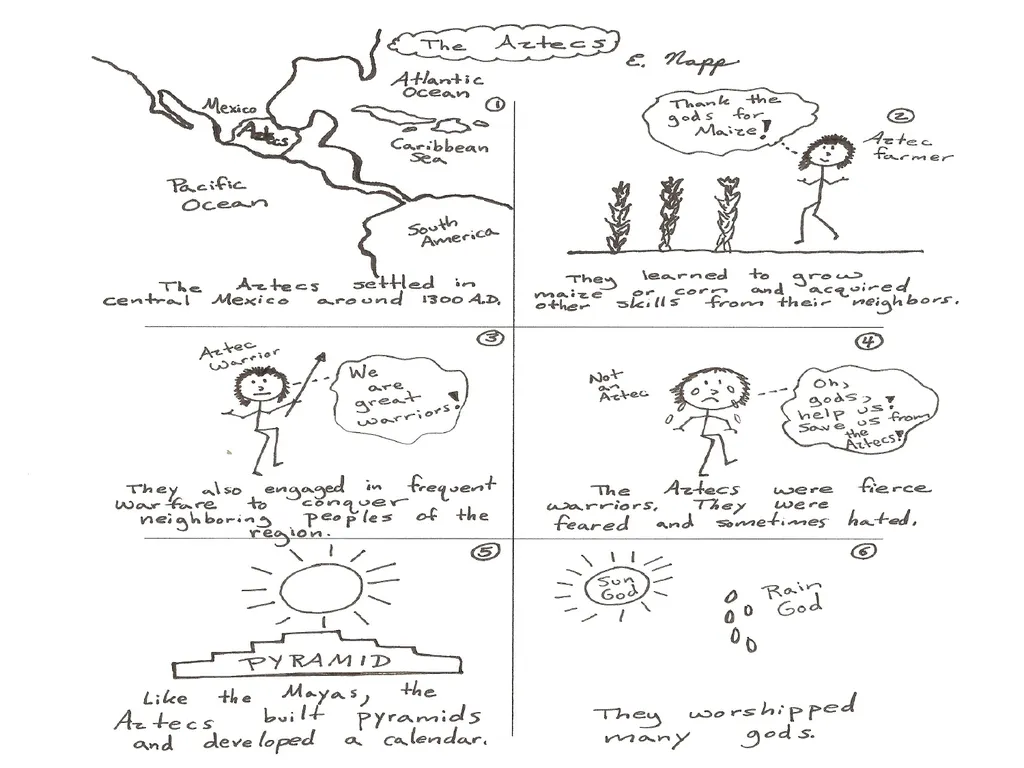
The Aztec civilization centered around Lake Texcoco in the central valley of Mexico in what is now Mexico City. The Aztec civilization began in 1300 AD and ended with the Spanish conquest in 1535.
AZTEC SOCIETY:
The Aztecs had a highly developed social structure made up of three classes. Each class was then broken down into groups according to their occupations. The three classes were the upper class, the middle class, and the lower class. The lower class or commoners made up the majority of the population. Nobles, high priests, military officers, and government leaders were considered to be upper class. The Aztec ruler, called the Great Speaker, or Tlatoani, was chosen from a select group of princes. Farmers, laborers, craftspeople, servants, and vendors were members of the middle class. The lower class was made up of those who worked the fields of the upper or middle classes and those who worked for wages. There were also some slaves, but their status was mostly temporary; most were paying off debts or serving a sentence for a crime.
Families lived together in either nuclear families or extended families. A nuclear family is a family that is made up of the mother, father, and children. An extended family is a family that is made up of the nuclear family and other relatives such as grandparents, aunts, uncles, and cousins. The upper class lived in or near the cities. Members of the middle class and specialists clustered where there was work or the potential for income. The serfs lived on the farmland surrounding the urban centers. Slaves were used for cheap labor, and for sacrifices. All non-noble men of the upper and middle classes had to serve in the military for several years. All classes with property or income had to pay taxes.
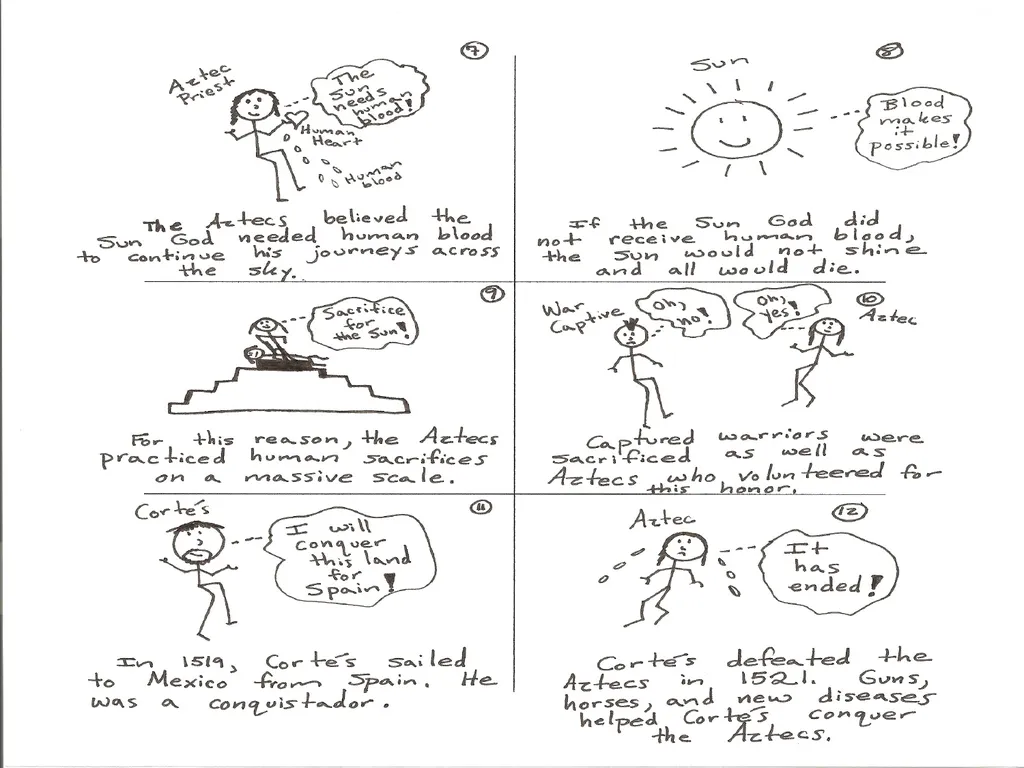
Montezuma (1466-1520), the ninth Aztec emperor of Mexico, ruled over 11 million people. He ruled for 18 years and commanded the army through organized expeditions of conquest. He was strongly influenced by his belief in the god Huitzilopochtli. Montezuma also believed that at some point in the future, a white, bearded god would return to the land of the Aztecs and rule over the empire. When the white, bearded Spanish explorer Hernando Cortes arrived, he took advantage of this belief and Montezuma’s fear. The Aztec ruler tried to buy off Cortes with large quantities of gold and other tributes, but he was captured and imprisoned. When Montezuma showed submission to the Spanish, his people lost their respect for him. While attempting to speak with his subjects, he was attacked with stones and arrows by his own people. Montezuma died three days later from his wounds.<br>
The Aztec civilization centered around Lake Texcoco in the central valley of Mexico in what is now Mexico City. The Aztec civilization began in 1300 AD and ended with the Spanish conquest in 1535.
AZTEC SOCIETY:
The Aztecs had a highly developed social structure made up of three classes. Each class was then broken down into groups according to their occupations. The three classes were the upper class, the middle class, and the lower class. The lower class or commoners made up the majority of the population. Nobles, high priests, military officers, and government leaders were considered to be upper class. The Aztec ruler, called the Great Speaker, or Tlatoani, was chosen from a select group of princes. Farmers, laborers, craftspeople, servants, and vendors were members of the middle class. The lower class was made up of those who worked the fields of the upper or middle classes and those who worked for wages. There were also some slaves, but their status was mostly temporary; most were paying off debts or serving a sentence for a crime.
Families lived together in either nuclear families or extended families. A nuclear family is a family that is made up of the mother, father, and children. An extended family is a family that is made up of the nuclear family and other relatives such as grandparents, aunts, uncles, and cousins. The upper class lived in or near the cities. Members of the middle class and specialists clustered where there was work or the potential for income. The serfs lived on the farmland surrounding the urban centers. Slaves were used for cheap labor, and for sacrifices. All non-noble men of the upper and middle classes had to serve in the military for several years. All classes with property or income had to pay taxes.
Montezuma (1466-1520), the ninth Aztec emperor of Mexico, ruled over 11 million people. He ruled for 18 years and commanded the army through organized expeditions of conquest. He was strongly influenced by his belief in the god Huitzilopochtli. Montezuma also believed that at some point in the future, a white, bearded god would return to the land of the Aztecs and rule over the empire. When the white, bearded Spanish explorer Hernando Cortes arrived, he took advantage of this belief and Montezuma’s fear. The Aztec ruler tried to buy off Cortes with large quantities of gold and other tributes, but he was captured and imprisoned. When Montezuma showed submission to the Spanish, his people lost their respect for him. While attempting to speak with his subjects, he was attacked with stones and arrows by his own people. Montezuma died three days later from his wounds.<br>
03
5 AZTEC CITIES:
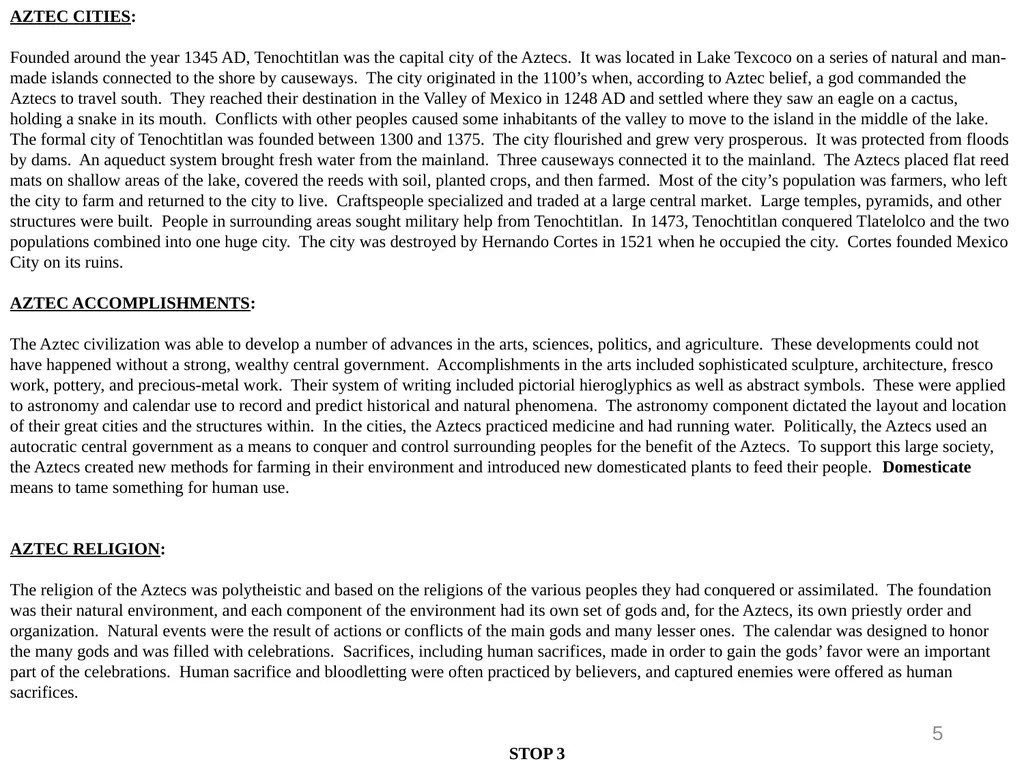
Founded around the year 1345 AD, Tenochtitlan was the capital city of the Aztecs. It was located in Lake Texcoco on a series of natural and man-made islands connected to the shore by causeways. The city originated in the 1100’s when, according to Aztec belief, a god commanded the Aztecs to travel south. They reached their destination in the Valley of Mexico in 1248 AD and settled where they saw an eagle on a cactus, holding a snake in its mouth. Conflicts with other peoples caused some inhabitants of the valley to move to the island in the middle of the lake. The formal city of Tenochtitlan was founded between 1300 and 1375. The city flourished and grew very prosperous. It was protected from floods by dams. An aqueduct system brought fresh water from the mainland. Three causeways connected it to the mainland. The Aztecs placed flat reed mats on shallow areas of the lake, covered the reeds with soil, planted crops, and then farmed. Most of the city’s population was farmers, who left the city to farm and returned to the city to live. Craftspeople specialized and traded at a large central market. Large temples, pyramids, and other structures were built. People in surrounding areas sought military help from Tenochtitlan. In 1473, Tenochtitlan conquered Tlatelolco and the two populations combined into one huge city. The city was destroyed by Hernando Cortes in 1521 when he occupied the city. Cortes founded Mexico City on its ruins.
AZTEC ACCOMPLISHMENTS:
The Aztec civilization was able to develop a number of advances in the arts, sciences, politics, and agriculture. These developments could not have happened without a strong, wealthy central government. Accomplishments in the arts included sophisticated sculpture, architecture, fresco work, pottery, and precious-metal work. Their system of writing included pictorial hieroglyphics as well as abstract symbols. These were applied to astronomy and calendar use to record and predict historical and natural phenomena. The astronomy component dictated the layout and location of their great cities and the structures within. In the cities, the Aztecs practiced medicine and had running water. Politically, the Aztecs used an autocratic central government as a means to conquer and control surrounding peoples for the benefit of the Aztecs. To support this large society, the Aztecs created new methods for farming in their environment and introduced new domesticated plants to feed their people. Domesticate means to tame something for human use.
AZTEC RELIGION:
The religion of the Aztecs was polytheistic and based on the religions of the various peoples they had conquered or assimilated. The foundation was their natural environment, and each component of the environment had its own set of gods and, for the Aztecs, its own priestly order and organization. Natural events were the result of actions or conflicts of the main gods and many lesser ones. The calendar was designed to honor the many gods and was filled with celebrations. Sacrifices, including human sacrifices, made in order to gain the gods’ favor were an important part of the celebrations. Human sacrifice and bloodletting were often practiced by believers, and captured enemies were offered as human sacrifices.
STOP 3<br>
Founded around the year 1345 AD, Tenochtitlan was the capital city of the Aztecs. It was located in Lake Texcoco on a series of natural and man-made islands connected to the shore by causeways. The city originated in the 1100’s when, according to Aztec belief, a god commanded the Aztecs to travel south. They reached their destination in the Valley of Mexico in 1248 AD and settled where they saw an eagle on a cactus, holding a snake in its mouth. Conflicts with other peoples caused some inhabitants of the valley to move to the island in the middle of the lake. The formal city of Tenochtitlan was founded between 1300 and 1375. The city flourished and grew very prosperous. It was protected from floods by dams. An aqueduct system brought fresh water from the mainland. Three causeways connected it to the mainland. The Aztecs placed flat reed mats on shallow areas of the lake, covered the reeds with soil, planted crops, and then farmed. Most of the city’s population was farmers, who left the city to farm and returned to the city to live. Craftspeople specialized and traded at a large central market. Large temples, pyramids, and other structures were built. People in surrounding areas sought military help from Tenochtitlan. In 1473, Tenochtitlan conquered Tlatelolco and the two populations combined into one huge city. The city was destroyed by Hernando Cortes in 1521 when he occupied the city. Cortes founded Mexico City on its ruins.
AZTEC ACCOMPLISHMENTS:
The Aztec civilization was able to develop a number of advances in the arts, sciences, politics, and agriculture. These developments could not have happened without a strong, wealthy central government. Accomplishments in the arts included sophisticated sculpture, architecture, fresco work, pottery, and precious-metal work. Their system of writing included pictorial hieroglyphics as well as abstract symbols. These were applied to astronomy and calendar use to record and predict historical and natural phenomena. The astronomy component dictated the layout and location of their great cities and the structures within. In the cities, the Aztecs practiced medicine and had running water. Politically, the Aztecs used an autocratic central government as a means to conquer and control surrounding peoples for the benefit of the Aztecs. To support this large society, the Aztecs created new methods for farming in their environment and introduced new domesticated plants to feed their people. Domesticate means to tame something for human use.
AZTEC RELIGION:
The religion of the Aztecs was polytheistic and based on the religions of the various peoples they had conquered or assimilated. The foundation was their natural environment, and each component of the environment had its own set of gods and, for the Aztecs, its own priestly order and organization. Natural events were the result of actions or conflicts of the main gods and many lesser ones. The calendar was designed to honor the many gods and was filled with celebrations. Sacrifices, including human sacrifices, made in order to gain the gods’ favor were an important part of the celebrations. Human sacrifice and bloodletting were often practiced by believers, and captured enemies were offered as human sacrifices.
STOP 3<br>
04
Inca Gallery<br>
05
9 THE INCAS:
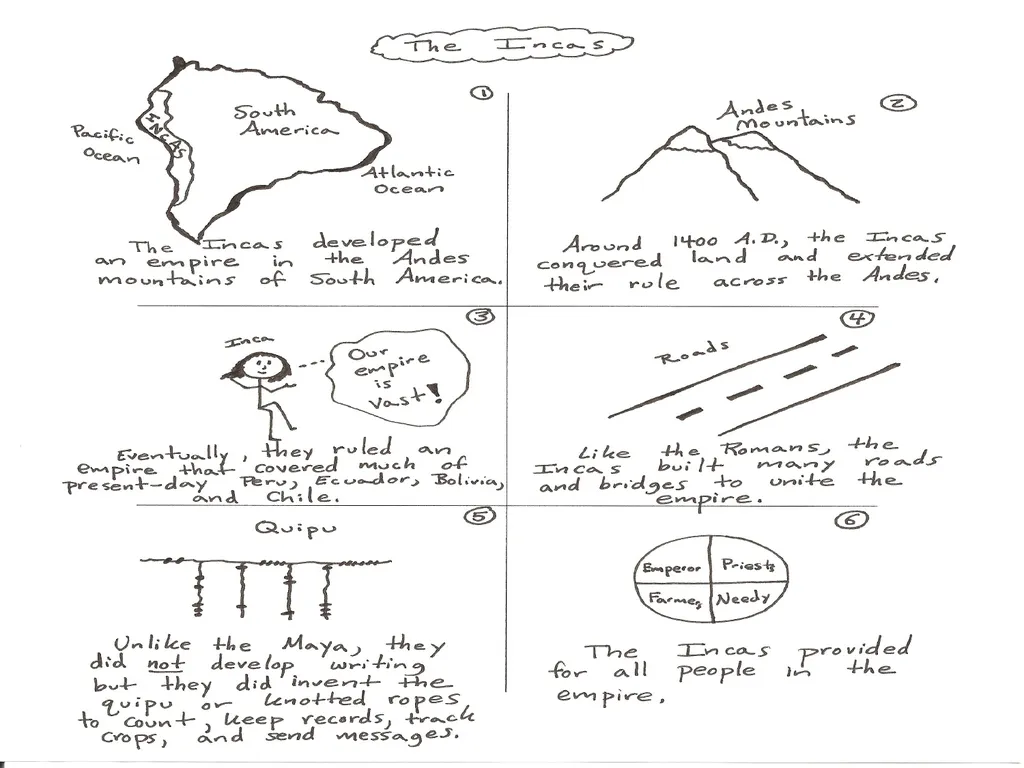
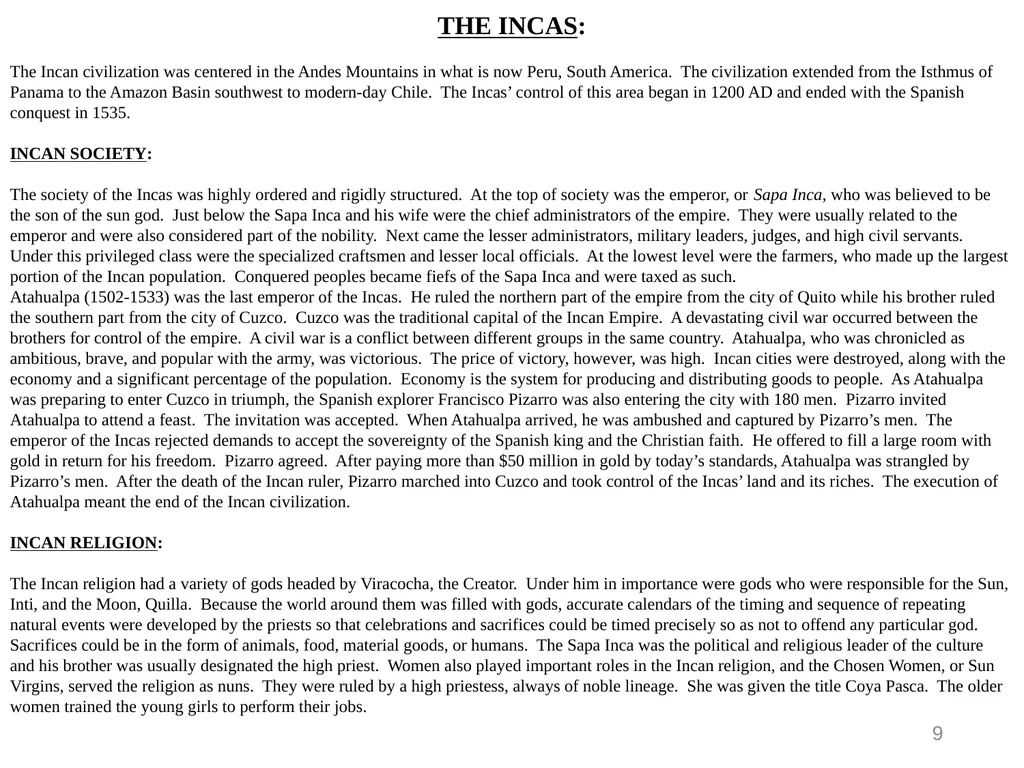
The Incan civilization was centered in the Andes Mountains in what is now Peru, South America. The civilization extended from the Isthmus of Panama to the Amazon Basin southwest to modern-day Chile. The Incas’ control of this area began in 1200 AD and ended with the Spanish conquest in 1535.
INCAN SOCIETY:
The society of the Incas was highly ordered and rigidly structured. At the top of society was the emperor, or Sapa Inca, who was believed to be the son of the sun god. Just below the Sapa Inca and his wife were the chief administrators of the empire. They were usually related to the emperor and were also considered part of the nobility. Next came the lesser administrators, military leaders, judges, and high civil servants. Under this privileged class were the specialized craftsmen and lesser local officials. At the lowest level were the farmers, who made up the largest portion of the Incan population. Conquered peoples became fiefs of the Sapa Inca and were taxed as such.
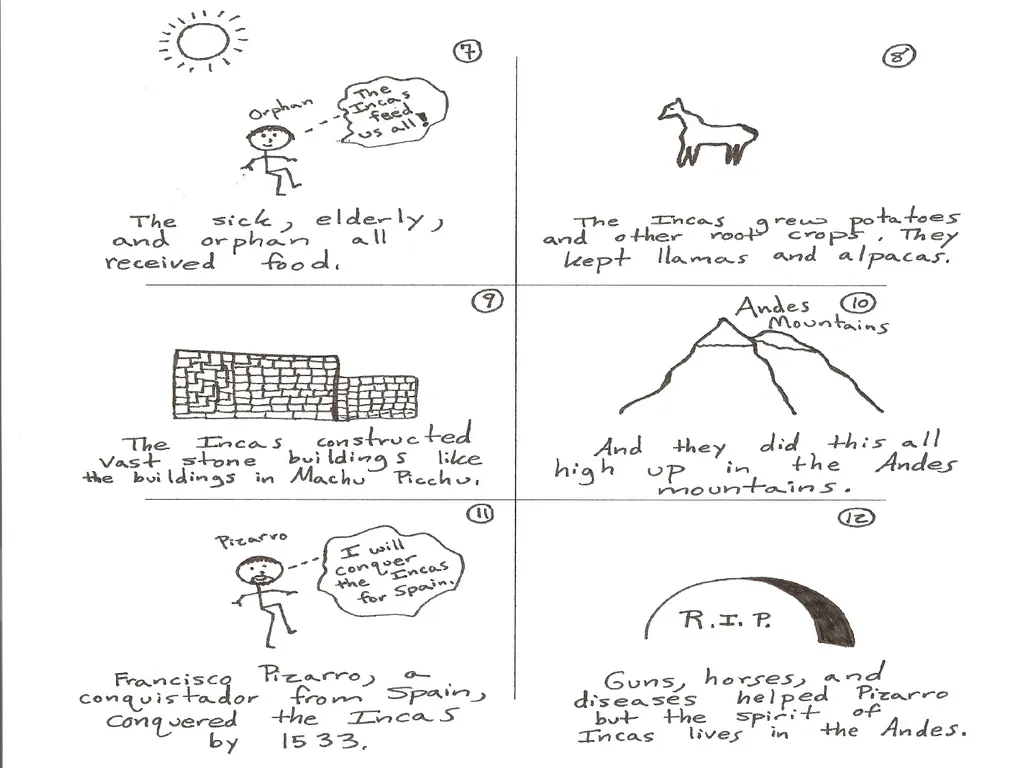
Atahualpa (1502-1533) was the last emperor of the Incas. He ruled the northern part of the empire from the city of Quito while his brother ruled the southern part from the city of Cuzco. Cuzco was the traditional capital of the Incan Empire. A devastating civil war occurred between the brothers for control of the empire. A civil war is a conflict between different groups in the same country. Atahualpa, who was chronicled as ambitious, brave, and popular with the army, was victorious. The price of victory, however, was high. Incan cities were destroyed, along with the economy and a significant percentage of the population. Economy is the system for producing and distributing goods to people. As Atahualpa was preparing to enter Cuzco in triumph, the Spanish explorer Francisco Pizarro was also entering the city with 180 men. Pizarro invited Atahualpa to attend a feast. The invitation was accepted. When Atahualpa arrived, he was ambushed and captured by Pizarro’s men. The emperor of the Incas rejected demands to accept the sovereignty of the Spanish king and the Christian faith. He offered to fill a large room with gold in return for his freedom. Pizarro agreed. After paying more than $50 million in gold by today’s standards, Atahualpa was strangled by Pizarro’s men. After the death of the Incan ruler, Pizarro marched into Cuzco and took control of the Incas’ land and its riches. The execution of Atahualpa meant the end of the Incan civilization.
INCAN RELIGION:
The Incan religion had a variety of gods headed by Viracocha, the Creator. Under him in importance were gods who were responsible for the Sun, Inti, and the Moon, Quilla. Because the world around them was filled with gods, accurate calendars of the timing and sequence of repeating natural events were developed by the priests so that celebrations and sacrifices could be timed precisely so as not to offend any particular god. Sacrifices could be in the form of animals, food, material goods, or humans. The Sapa Inca was the political and religious leader of the culture and his brother was usually designated the high priest. Women also played important roles in the Incan religion, and the Chosen Women, or Sun Virgins, served the religion as nuns. They were ruled by a high priestess, always of noble lineage. She was given the title Coya Pasca. The older women trained the young girls to perform their jobs.<br>
The Incan civilization was centered in the Andes Mountains in what is now Peru, South America. The civilization extended from the Isthmus of Panama to the Amazon Basin southwest to modern-day Chile. The Incas’ control of this area began in 1200 AD and ended with the Spanish conquest in 1535.
INCAN SOCIETY:
The society of the Incas was highly ordered and rigidly structured. At the top of society was the emperor, or Sapa Inca, who was believed to be the son of the sun god. Just below the Sapa Inca and his wife were the chief administrators of the empire. They were usually related to the emperor and were also considered part of the nobility. Next came the lesser administrators, military leaders, judges, and high civil servants. Under this privileged class were the specialized craftsmen and lesser local officials. At the lowest level were the farmers, who made up the largest portion of the Incan population. Conquered peoples became fiefs of the Sapa Inca and were taxed as such.
Atahualpa (1502-1533) was the last emperor of the Incas. He ruled the northern part of the empire from the city of Quito while his brother ruled the southern part from the city of Cuzco. Cuzco was the traditional capital of the Incan Empire. A devastating civil war occurred between the brothers for control of the empire. A civil war is a conflict between different groups in the same country. Atahualpa, who was chronicled as ambitious, brave, and popular with the army, was victorious. The price of victory, however, was high. Incan cities were destroyed, along with the economy and a significant percentage of the population. Economy is the system for producing and distributing goods to people. As Atahualpa was preparing to enter Cuzco in triumph, the Spanish explorer Francisco Pizarro was also entering the city with 180 men. Pizarro invited Atahualpa to attend a feast. The invitation was accepted. When Atahualpa arrived, he was ambushed and captured by Pizarro’s men. The emperor of the Incas rejected demands to accept the sovereignty of the Spanish king and the Christian faith. He offered to fill a large room with gold in return for his freedom. Pizarro agreed. After paying more than $50 million in gold by today’s standards, Atahualpa was strangled by Pizarro’s men. After the death of the Incan ruler, Pizarro marched into Cuzco and took control of the Incas’ land and its riches. The execution of Atahualpa meant the end of the Incan civilization.
INCAN RELIGION:
The Incan religion had a variety of gods headed by Viracocha, the Creator. Under him in importance were gods who were responsible for the Sun, Inti, and the Moon, Quilla. Because the world around them was filled with gods, accurate calendars of the timing and sequence of repeating natural events were developed by the priests so that celebrations and sacrifices could be timed precisely so as not to offend any particular god. Sacrifices could be in the form of animals, food, material goods, or humans. The Sapa Inca was the political and religious leader of the culture and his brother was usually designated the high priest. Women also played important roles in the Incan religion, and the Chosen Women, or Sun Virgins, served the religion as nuns. They were ruled by a high priestess, always of noble lineage. She was given the title Coya Pasca. The older women trained the young girls to perform their jobs.<br>
06
10 INCAN ACCOMPLISHMENTS:
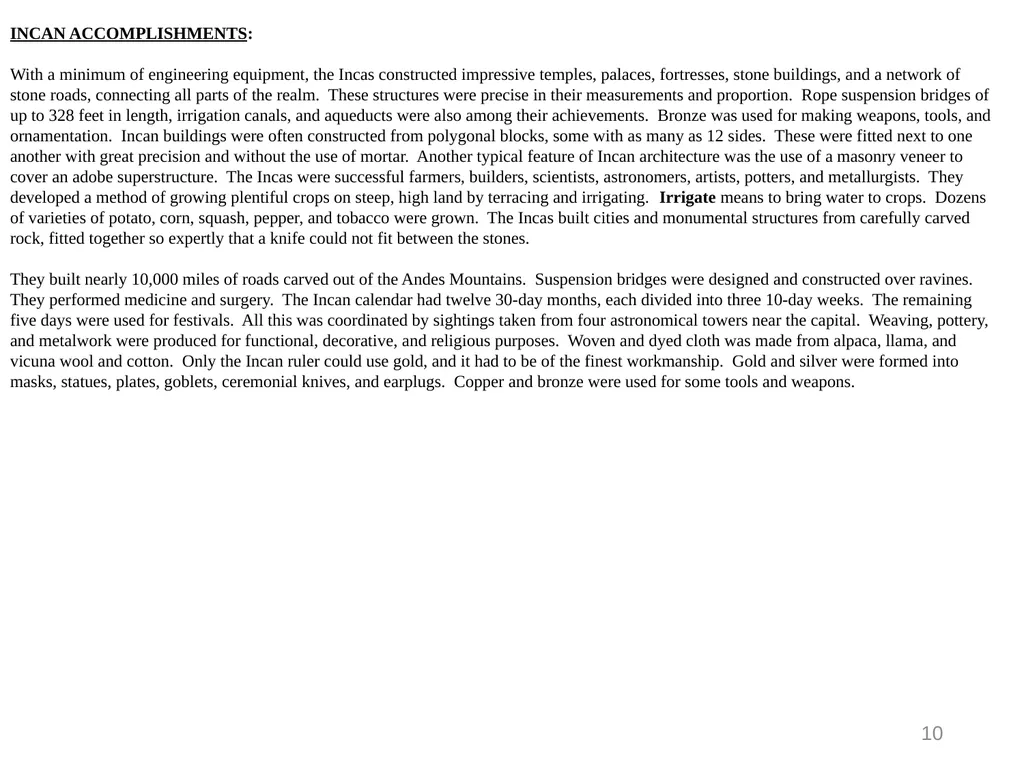
With a minimum of engineering equipment, the Incas constructed impressive temples, palaces, fortresses, stone buildings, and a network of stone roads, connecting all parts of the realm. These structures were precise in their measurements and proportion. Rope suspension bridges of up to 328 feet in length, irrigation canals, and aqueducts were also among their achievements. Bronze was used for making weapons, tools, and ornamentation. Incan buildings were often constructed from polygonal blocks, some with as many as 12 sides. These were fitted next to one another with great precision and without the use of mortar. Another typical feature of Incan architecture was the use of a masonry veneer to cover an adobe superstructure. The Incas were successful farmers, builders, scientists, astronomers, artists, potters, and metallurgists. They developed a method of growing plentiful crops on steep, high land by terracing and irrigating. Irrigate means to bring water to crops. Dozens of varieties of potato, corn, squash, pepper, and tobacco were grown. The Incas built cities and monumental structures from carefully carved rock, fitted together so expertly that a knife could not fit between the stones.
They built nearly 10,000 miles of roads carved out of the Andes Mountains. Suspension bridges were designed and constructed over ravines. They performed medicine and surgery. The Incan calendar had twelve 30-day months, each divided into three 10-day weeks. The remaining five days were used for festivals. All this was coordinated by sightings taken from four astronomical towers near the capital. Weaving, pottery, and metalwork were produced for functional, decorative, and religious purposes. Woven and dyed cloth was made from alpaca, llama, and vicuna wool and cotton. Only the Incan ruler could use gold, and it had to be of the finest workmanship. Gold and silver were formed into masks, statues, plates, goblets, ceremonial knives, and earplugs. Copper and bronze were used for some tools and weapons.<br>
With a minimum of engineering equipment, the Incas constructed impressive temples, palaces, fortresses, stone buildings, and a network of stone roads, connecting all parts of the realm. These structures were precise in their measurements and proportion. Rope suspension bridges of up to 328 feet in length, irrigation canals, and aqueducts were also among their achievements. Bronze was used for making weapons, tools, and ornamentation. Incan buildings were often constructed from polygonal blocks, some with as many as 12 sides. These were fitted next to one another with great precision and without the use of mortar. Another typical feature of Incan architecture was the use of a masonry veneer to cover an adobe superstructure. The Incas were successful farmers, builders, scientists, astronomers, artists, potters, and metallurgists. They developed a method of growing plentiful crops on steep, high land by terracing and irrigating. Irrigate means to bring water to crops. Dozens of varieties of potato, corn, squash, pepper, and tobacco were grown. The Incas built cities and monumental structures from carefully carved rock, fitted together so expertly that a knife could not fit between the stones.
They built nearly 10,000 miles of roads carved out of the Andes Mountains. Suspension bridges were designed and constructed over ravines. They performed medicine and surgery. The Incan calendar had twelve 30-day months, each divided into three 10-day weeks. The remaining five days were used for festivals. All this was coordinated by sightings taken from four astronomical towers near the capital. Weaving, pottery, and metalwork were produced for functional, decorative, and religious purposes. Woven and dyed cloth was made from alpaca, llama, and vicuna wool and cotton. Only the Incan ruler could use gold, and it had to be of the finest workmanship. Gold and silver were formed into masks, statues, plates, goblets, ceremonial knives, and earplugs. Copper and bronze were used for some tools and weapons.<br>
07
Mayan Gallery<br>
08
14 THE MAYANS:
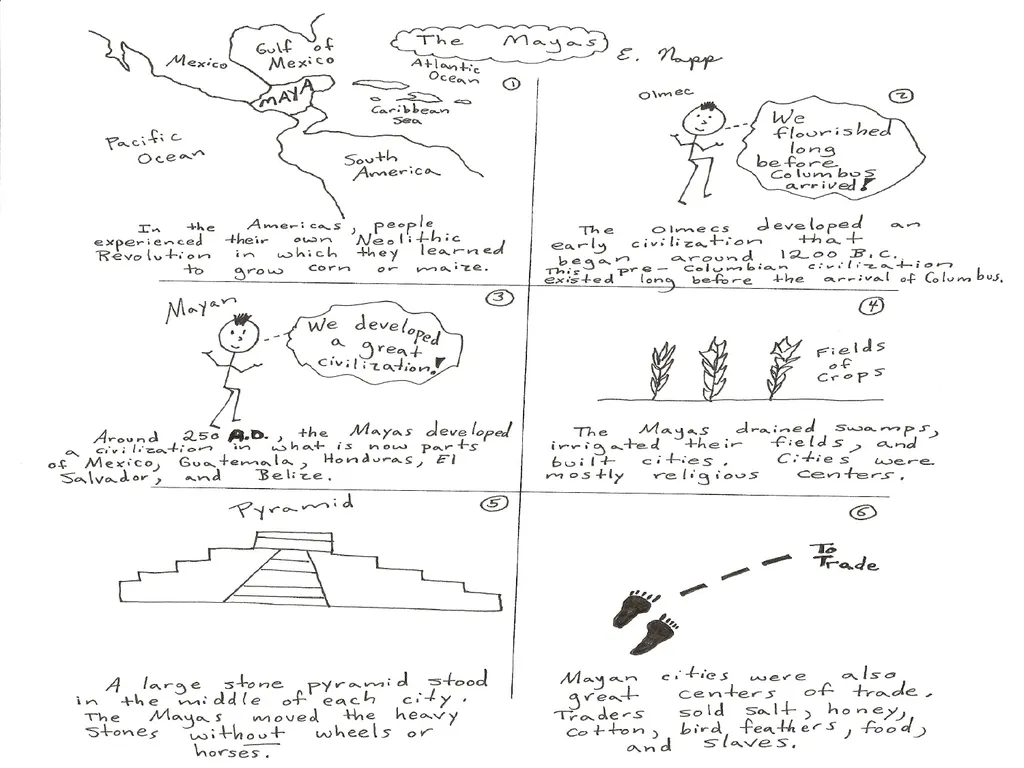
The Mayan civilization was the earliest of the three early American civilizations. The Mayan culture emerged around 50 BC. The Mayans created their empire starting around 200 AD. The empire lasted until around 900 AD. At this time, the Mayan civilization began to decline.
The Mayans were a peaceful, agricultural people. They lived in parts of present-day Mexico, El Salvador, Honduras, and Guatemala, and Belize. The Mayans continued to flourish in many areas until the mid-1500’s, when they were conquered by the Spanish.
MAYAN SOCIAL STRUCTURE:
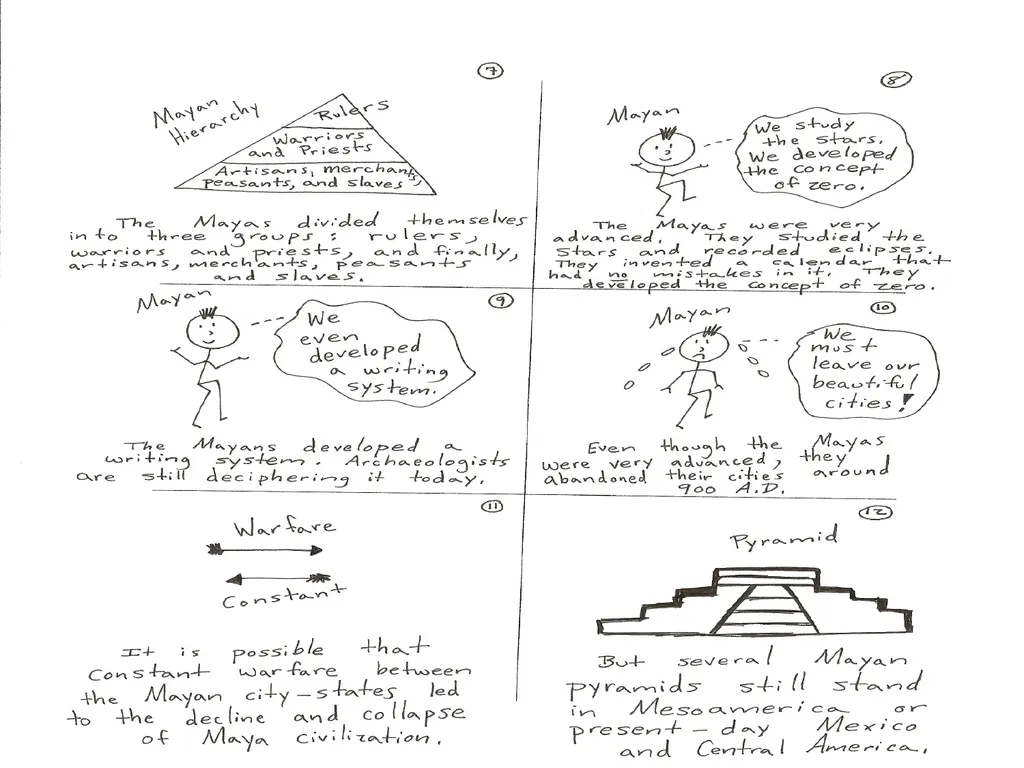
Mayan society was divided into social classes which consisted of the following: the king, nobles and priests, warriors, merchants, artisans, and farmers. At the bottom of society were the slaves. People became slaves by being captured in war, by being born into slavery, or by being orphaned. The king, who was a monarch, ruled the empire. A monarchy is a system of government in which a king or queen holds power. A slave is a person who is the property of another and under their control.
MAYAN RELIGION:
The Mayan had a nature-based, polytheistic religion. A polytheistic religion is a religion in which there are more than one god. A monotheistic religion is a religion in which there is only one god. They believed that all things in the universe had a spiritual component. The many gods were connected by a spiritual force, which meant that the gods were both many and one at the same time. People needed the gods, and the gods needed people in order to survive and prosper. To ensure that the gods would be good to the people, honor and sacrifice had to be made in the form of celebrations, bloodletting, and offerings of food or human life.
MAYAN CITIES:
Tikal was the primary city and trading center of the Mayan for about 400 years. At its height it was home to an estimated 50,000 inhabitants. Tikal was one of the world’s leading cities at a time when London and Paris were still small towns. The population lived mainly in and around the cities. Family compounds were too close together to permit much in the way of large-scale farming near the urban center.
MAYAN ACCOMPLISHMENTS:
The Mayan civilization contributed outstanding examples of architecture, city design, art, sculpture, pottery, carving, precious stone jewelry, painting, writing, books, math, calendars, and astronomy. The Maya created the first writing system in the Americas and wrote their hieroglyphs on buildings, bones, pottery, stone, and even in books. They also made great discoveries in mathematics. They created a system for counting using a base of twenty; it used a symbol for zero along with dots and lines. Time was extremely important to the Maya and they invented complex and accurate calendars. The Maya used astronomy to influence the design, relationship, and placement of their cities and buildings to reflect the happenings in the heavens over the solar year.
STOP 1<br>
The Mayan civilization was the earliest of the three early American civilizations. The Mayan culture emerged around 50 BC. The Mayans created their empire starting around 200 AD. The empire lasted until around 900 AD. At this time, the Mayan civilization began to decline.
The Mayans were a peaceful, agricultural people. They lived in parts of present-day Mexico, El Salvador, Honduras, and Guatemala, and Belize. The Mayans continued to flourish in many areas until the mid-1500’s, when they were conquered by the Spanish.
MAYAN SOCIAL STRUCTURE:
Mayan society was divided into social classes which consisted of the following: the king, nobles and priests, warriors, merchants, artisans, and farmers. At the bottom of society were the slaves. People became slaves by being captured in war, by being born into slavery, or by being orphaned. The king, who was a monarch, ruled the empire. A monarchy is a system of government in which a king or queen holds power. A slave is a person who is the property of another and under their control.
MAYAN RELIGION:
The Mayan had a nature-based, polytheistic religion. A polytheistic religion is a religion in which there are more than one god. A monotheistic religion is a religion in which there is only one god. They believed that all things in the universe had a spiritual component. The many gods were connected by a spiritual force, which meant that the gods were both many and one at the same time. People needed the gods, and the gods needed people in order to survive and prosper. To ensure that the gods would be good to the people, honor and sacrifice had to be made in the form of celebrations, bloodletting, and offerings of food or human life.
MAYAN CITIES:
Tikal was the primary city and trading center of the Mayan for about 400 years. At its height it was home to an estimated 50,000 inhabitants. Tikal was one of the world’s leading cities at a time when London and Paris were still small towns. The population lived mainly in and around the cities. Family compounds were too close together to permit much in the way of large-scale farming near the urban center.
MAYAN ACCOMPLISHMENTS:
The Mayan civilization contributed outstanding examples of architecture, city design, art, sculpture, pottery, carving, precious stone jewelry, painting, writing, books, math, calendars, and astronomy. The Maya created the first writing system in the Americas and wrote their hieroglyphs on buildings, bones, pottery, stone, and even in books. They also made great discoveries in mathematics. They created a system for counting using a base of twenty; it used a symbol for zero along with dots and lines. Time was extremely important to the Maya and they invented complex and accurate calendars. The Maya used astronomy to influence the design, relationship, and placement of their cities and buildings to reflect the happenings in the heavens over the solar year.
STOP 1<br>