01
BACKGROUND
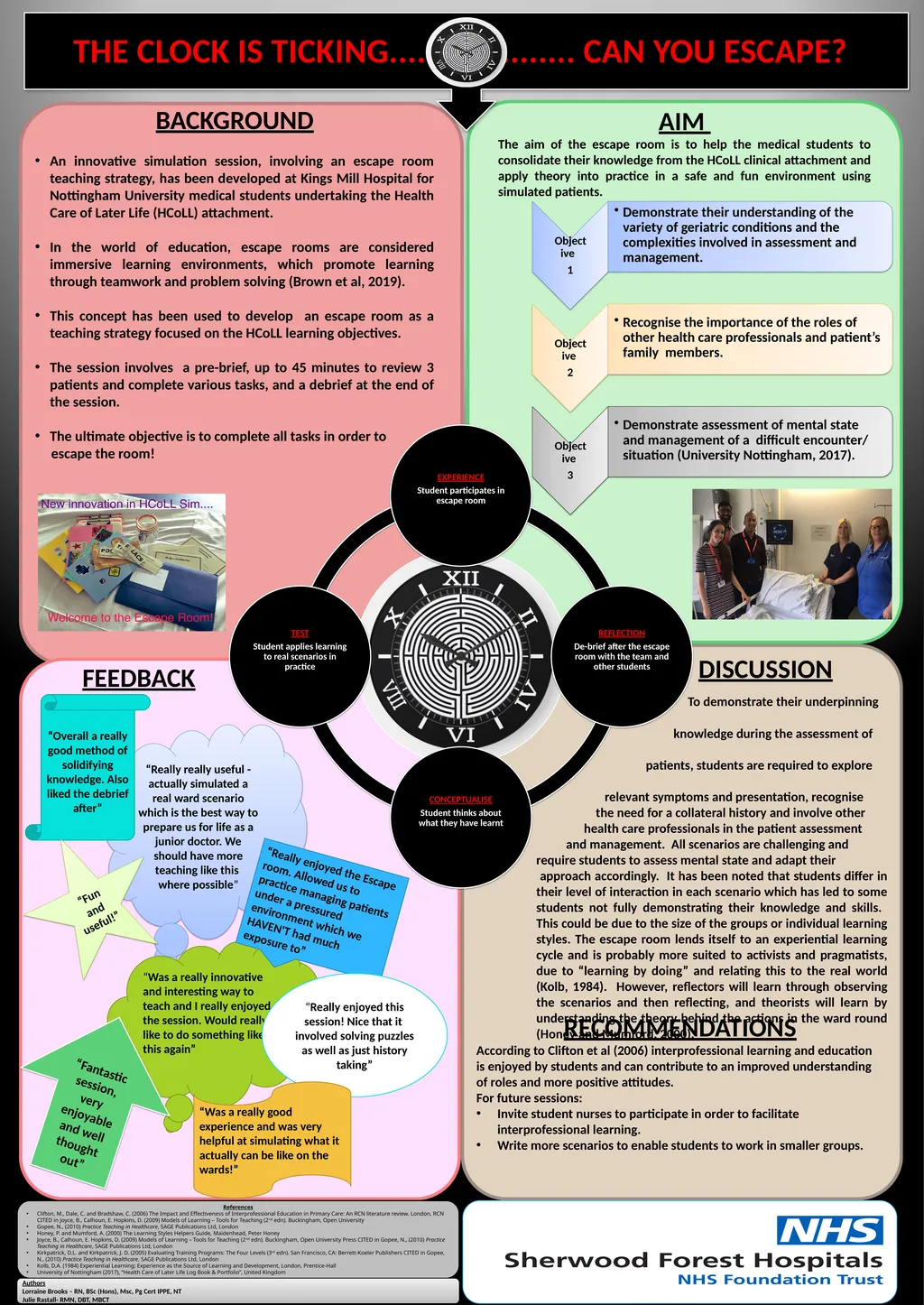
An innovative simulation session, involving an escape room teaching strategy, has been developed at Kings Mill Hospital for Nottingham University medical students undertaking the Health Care of Later Life (HCoLL) attachment.
In the world of education, escape rooms are considered immersive learning environments, which promote learning through teamwork and problem solving (Brown et al, 2019).
This concept has been used to develop an escape room as a teaching strategy focused on the HCoLL learning objectives.
The session involves a pre-brief, up to 45 minutes to review 3 patients and complete various tasks, and a debrief at the end of the session.
The ultimate objective is to complete all tasks in order to
escape the room! FEEDBACK “Really really useful - actually simulated a real ward scenario which is the best way to prepare us for life as a junior doctor. We should have more teaching like this
where possible” To demonstrate their underpinning
knowledge during the assessment of
patients, students are required to explore
relevant symptoms and presentation, recognise
the need for a collateral history and involve other
health care professionals in the patient assessment
and management. All scenarios are challenging and
require students to assess mental state and adapt their
approach accordingly. It has been noted that students differ in their level of interaction in each scenario which has led to some students not fully demonstrating their knowledge and skills. This could be due to the size of the groups or individual learning styles. The escape room lends itself to an experiential learning cycle and is probably more suited to activists and pragmatists, due to “learning by doing” and relating this to the real world (Kolb, 1984). However, reflectors will learn through observing the scenarios and then reflecting, and theorists will learn by understanding the theory behind the actions in the ward round (Honey and Mumford, 2000). DISCUSSION RECOMMENDATIONS
According to Clifton et al (2006) interprofessional learning and education is enjoyed by students and can contribute to an improved understanding of roles and more positive attitudes.
For future sessions:
Invite student nurses to participate in order to facilitate interprofessional learning.
Write more scenarios to enable students to work in smaller groups. References
Clifton, M., Dale, C. and Bradshaw, C. (2006) The Impact and Effectiveness of Interprofessional Education in Primary Care: An RCN literature review. London, RCN CITED in Joyce, B., Calhoun, E. Hopkins, D. (2009) Models of Learning – Tools for Teaching (2nd edn). Buckingham, Open University
Gopee, N., (2010) Practice Teaching in Healthcare, SAGE Publications Ltd, London
Honey, P. and Mumford, A. (2000) The Learning Styles Helpers Guide, Maidenhead, Peter Honey
Joyce, B., Calhoun, E. Hopkins, D. (2009) Models of Learning – Tools for Teaching (2nd edn). Buckingham, Open University Press CITED in Gopee, N., (2010) Practice Teaching in Healthcare, SAGE Publications Ltd, London
Kirkpatrick, D.L. and Kirkpatrick, J. D. (2005) Evaluating Training Programs: The Four Levels (3rd edn). San Francisco, CA: Berrett-Koeler Publishers CITED in Gopee, N., (2010) Practice Teaching in Healthcare, SAGE Publications Ltd, London
Kolb, D.A. (1984) Experiential Learning: Experience as the Source of Learning and Development, London, Prentice-Hall
University of Nottingham (2017), “Health Care of Later Life Log Book & Portfolio”, United Kingdom “Overall a really good method of solidifying knowledge. Also liked the debrief after” “Fun and useful!” “Was a really innovative and interesting way to teach and I really enjoyed the session. Would really like to do something like this again” “Really enjoyed the Escape room. Allowed us to practice managing patients under a pressured environment which we HAVEN'T had much exposure to” “Really enjoyed this session! Nice that it
involved solving puzzles as well as just history taking” Authors
Lorraine Brooks – RN, BSc (Hons), Msc, Pg Cert IPPE, NT
Julie Rastall- RMN, DBT, MBCT “Fantastic session, very enjoyable and well thought out” THE CLOCK IS TICKING.................... CAN YOU ESCAPE? “Was a really good
experience and was very
helpful at simulating what it actually can be like on the wards!” AIM
The aim of the escape room is to help the medical students to consolidate their knowledge from the HCoLL clinical attachment and apply theory into practice in a safe and fun environment using simulated patients.<br>