Badrish Chandramouli, Jonathan Goldstein, Mike Barnett, Rob DeLine, Danyel Fisher, John C. Platt, James F. Terwilliger, John Wernsing Microsoft Research Contact: badrishcmicrosoft.com Twitter: badrishc Current affiliation: Google. This
"Badrish Chandramouli, Jonathan Goldstein, Mike" is the property of its rightful owner. Permission is granted to
download and print the materials on this website for personal, non-commercial use only, and to display it
on your personal computer provided you do not modify the materials and that you retain all copyright
notices contained in the materials. By downloading content from our website, you accept the terms of this
agreement.
Share
Embed code
Presentation Transcript
01
Badrish Chandramouli, Jonathan Goldstein, Mike Barnett, Rob DeLine,
Danyel Fisher, John C. Platt*, James F. Terwilliger, John Wernsing
*Current affiliation: Google. This work was performed at Microsoft Research. Trill: A High-Performance Incremental Query Processor for Diverse Analytics<br>
02
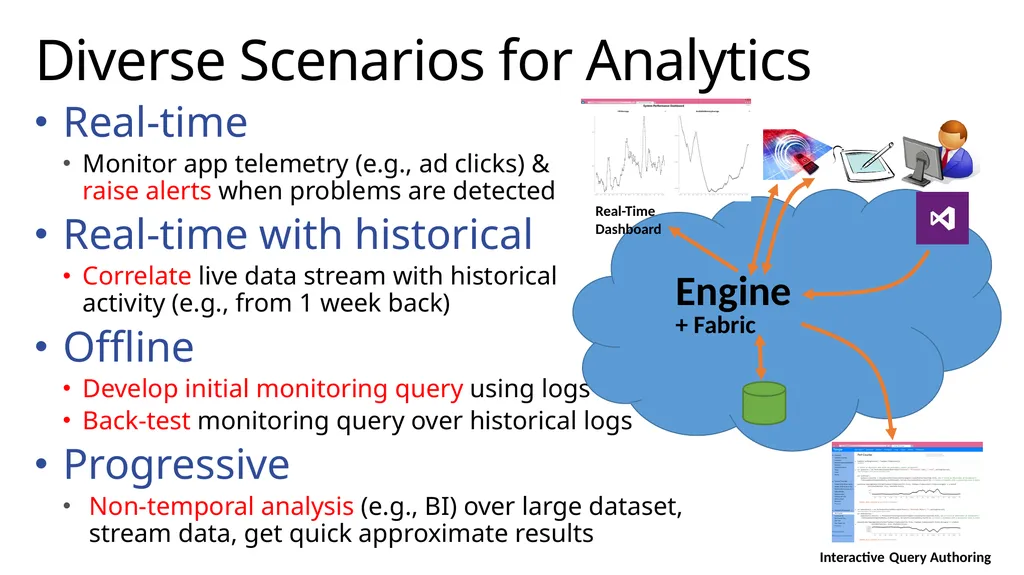
Real-time
Monitor app telemetry (e.g., ad clicks) & raise alerts when problems are detected
Real-time with historical
Correlate live data stream with historical activity (e.g., from 1 week back)
Offline
Develop initial monitoring query using logs
Back-test monitoring query over historical logs
Progressive
Non-temporal analysis (e.g., BI) over large dataset, stream data, get quick approximate results Diverse Scenarios for Analytics Engine
+ Fabric Interactive Query Authoring Real-Time Dashboard<br>
03
Performance
High throughput: critical for large offline datasets
Low latency & overhead: Important for real time monitoring
Fabric & language integration
Cloud app/service acts as driver, uses the analytics engine
Need rich data-types, integrate custom logic seamlessly
Query model
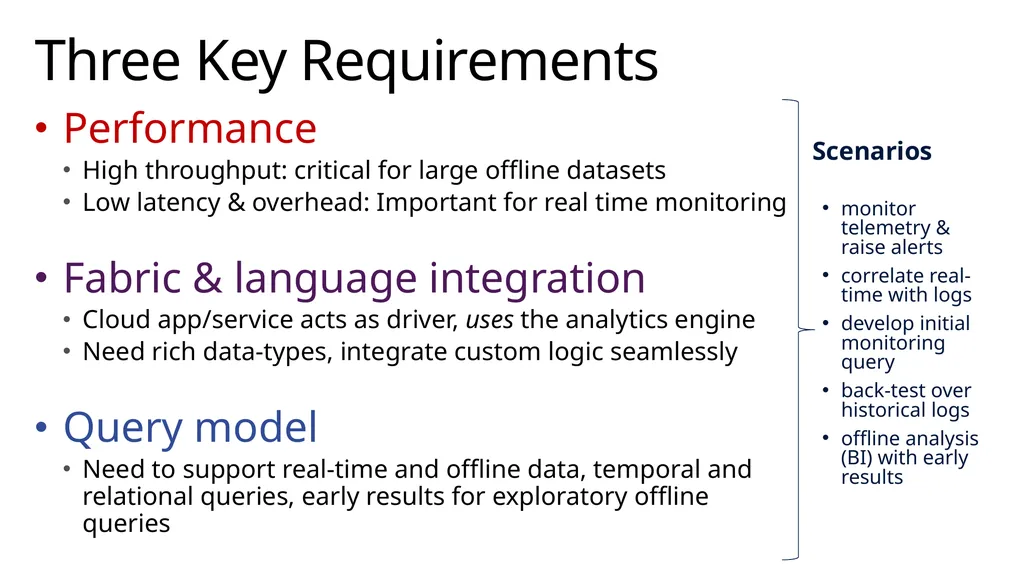
Need to support real-time and offline data, temporal and relational queries, early results for exploratory offline queries Three Key Requirements Scenarios monitor telemetry & raise alerts
correlate real-time with logs
develop initial monitoring query
back-test over historical logs
offline analysis (BI) with early results<br>
04
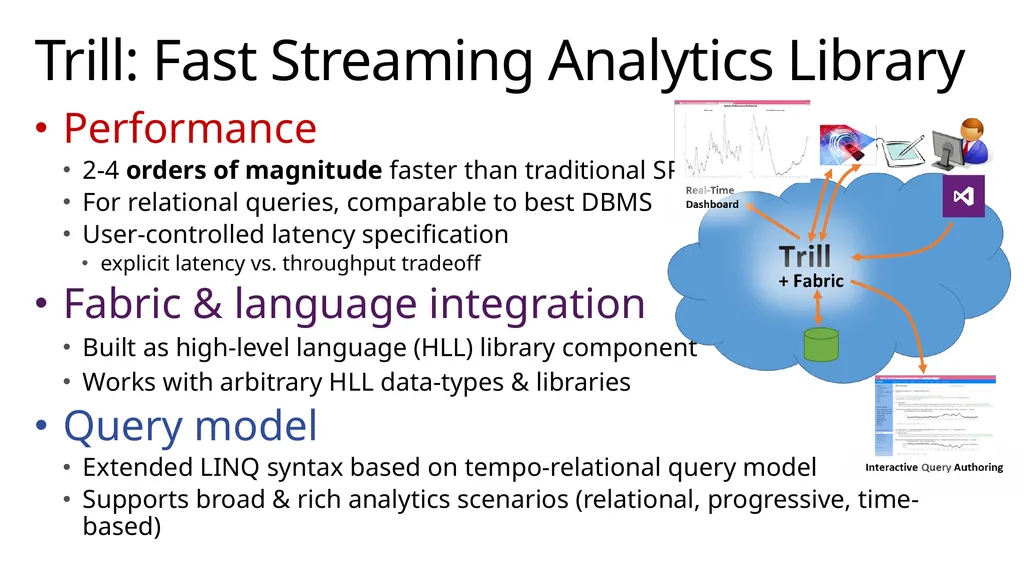
Performance
2-4 orders of magnitude faster than traditional SPEs
For relational queries, comparable to best DBMS
User-controlled latency specification
explicit latency vs. throughput tradeoff
Fabric & language integration
Built as high-level language (HLL) library component
Works with arbitrary HLL data-types & libraries
Query model
Extended LINQ syntax based on tempo-relational query model
Supports broad & rich analytics scenarios (relational, progressive, time-based) Trill: Fast Streaming Analytics Library<br>
05
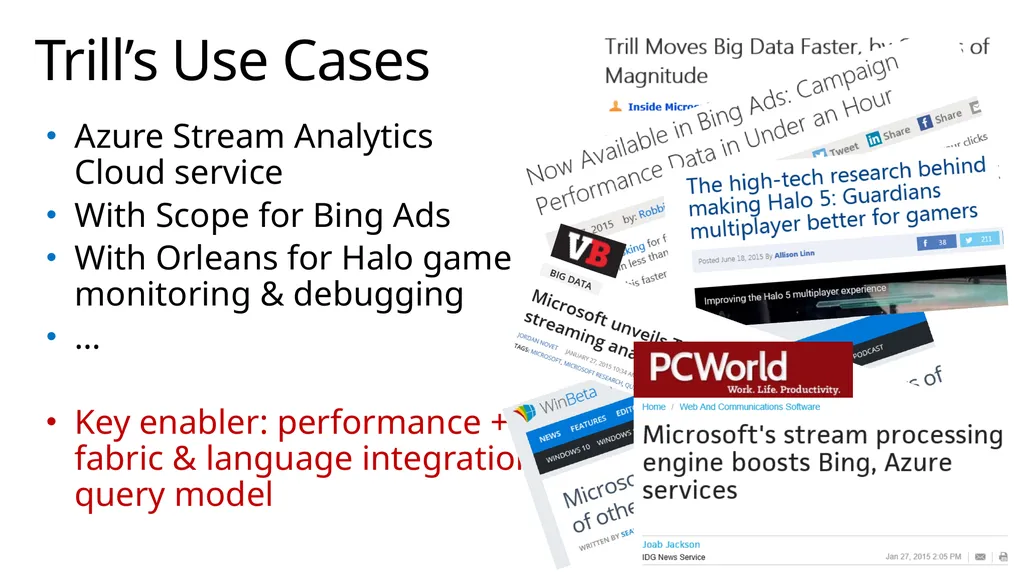
Azure Stream Analytics Cloud service
With Scope for Bing Ads
With Orleans for Halo game monitoring & debugging
…
Key enabler: performance + fabric & language integration + query model Trill’s Use Cases<br>
06
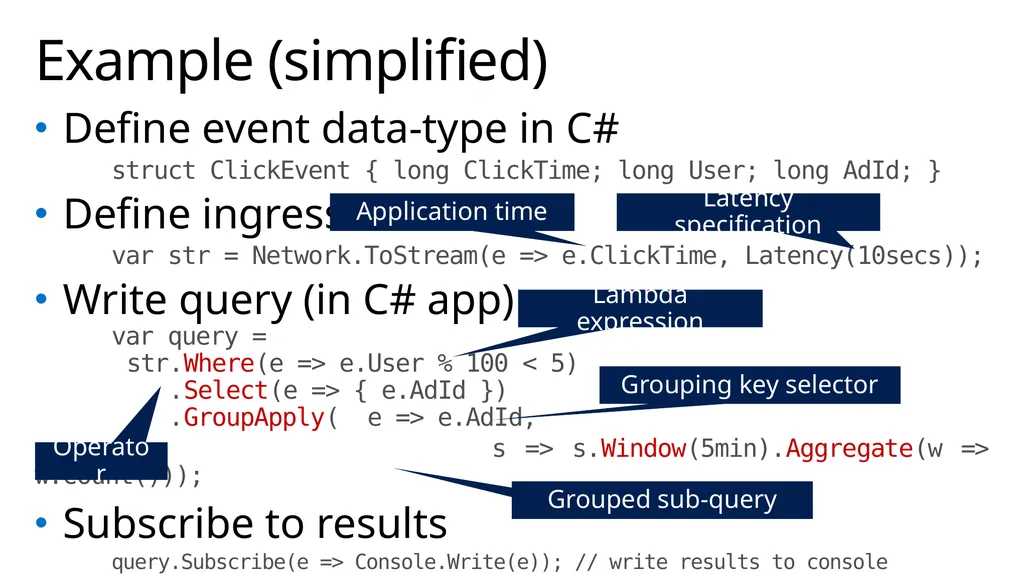
Define event data-type in C#
struct ClickEvent { long ClickTime; long User; long AdId; }
Define ingress
var str = Network.ToStream(e => e.ClickTime, Latency(10secs));
Write query (in C# app)
var query =
str.Where(e => e.User % 100 < 5)
.Select(e => { e.AdId })
.GroupApply( e => e.AdId,
s => s.Window(5min).Aggregate(w => w.Count()));
Subscribe to results
query.Subscribe(e => Console.Write(e)); // write results to console Example (simplified) Lambda expression Operator Grouping key selector Grouped sub-query Application time Latency specification<br>
07
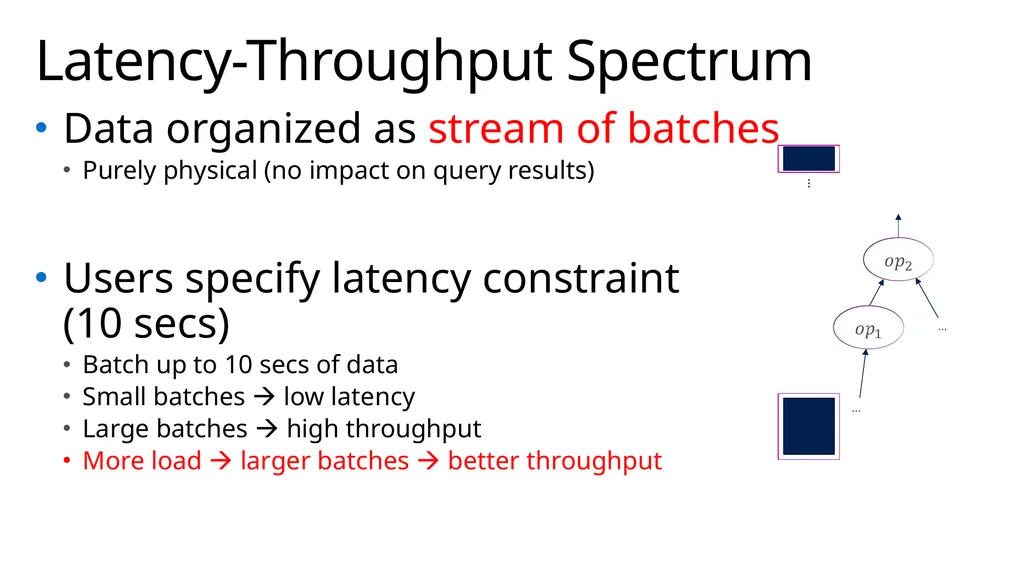
Data organized as stream of batches
Purely physical (no impact on query results)
Users specify latency constraint (10 secs)
Batch up to 10 secs of data
Small batches low latency
Large batches high throughput
More load larger batches better throughput Latency-Throughput Spectrum … … …<br>
08
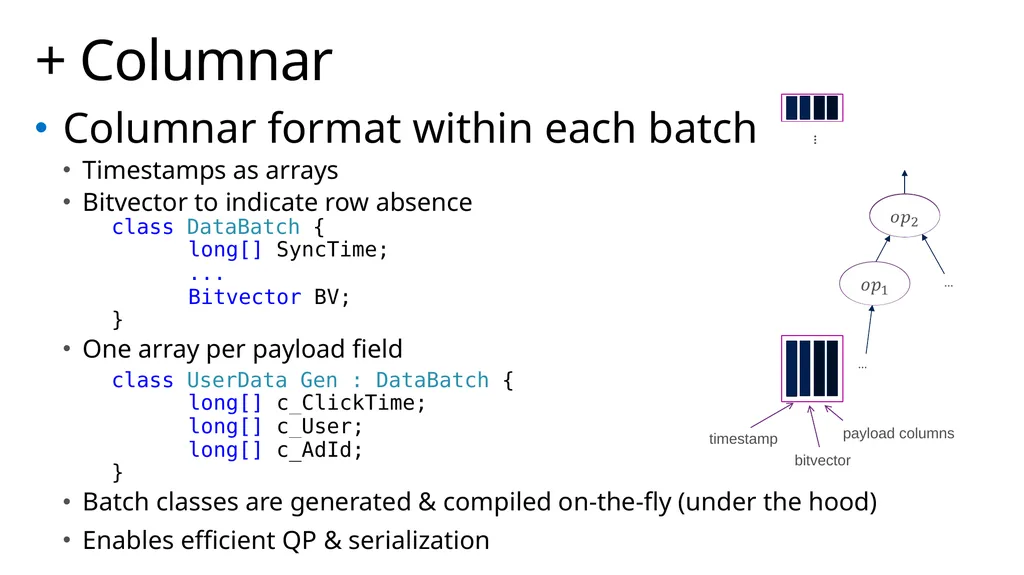
Columnar format within each batch
Timestamps as arrays
Bitvector to indicate row absence
class DataBatch {
long[] SyncTime;
...
Bitvector BV;
}
One array per payload field
class UserData_Gen : DataBatch {
long[] c_ClickTime;
long[] c_User;
long[] c_AdId;
}
Batch classes are generated & compiled on-the-fly (under the hood)
Enables efficient QP & serialization + Columnar … … …<br>
09
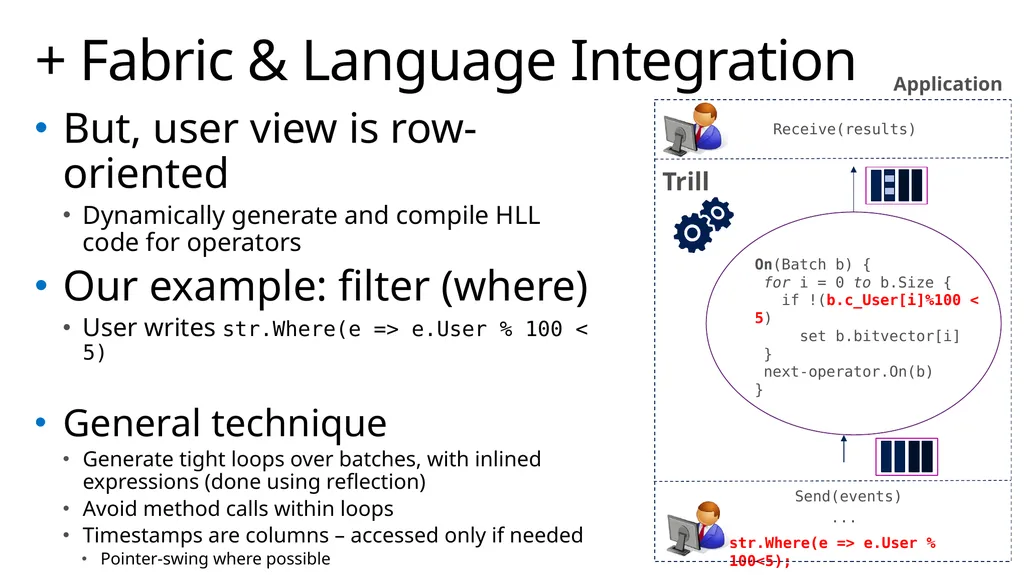
But, user view is row-oriented
Dynamically generate and compile HLL code for operators
Our example: filter (where)
User writes str.Where(e => e.User % 100 < 5)
General technique
Generate tight loops over batches, with inlined expressions (done using reflection)
Avoid method calls within loops
Timestamps are columns – accessed only if needed
Pointer-swing where possible + Fabric & Language Integration<br>
10
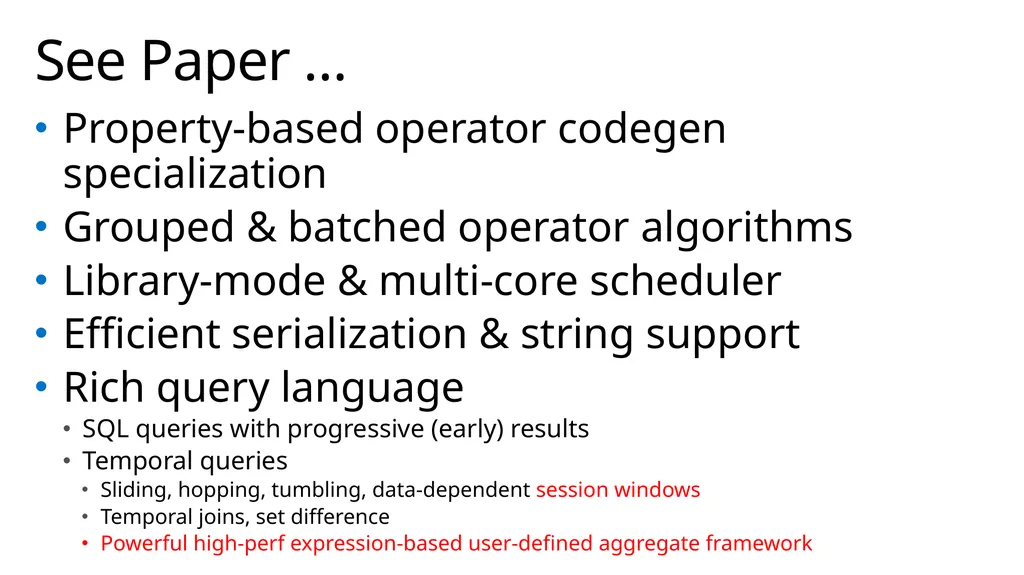
Property-based operator codegen specialization
Grouped & batched operator algorithms
Library-mode & multi-core scheduler
Efficient serialization & string support
Rich query language
SQL queries with progressive (early) results
Temporal queries
Sliding, hopping, tumbling, data-dependent session windows
Temporal joins, set difference
Powerful high-perf expression-based user-defined aggregate framework See Paper …<br>
11
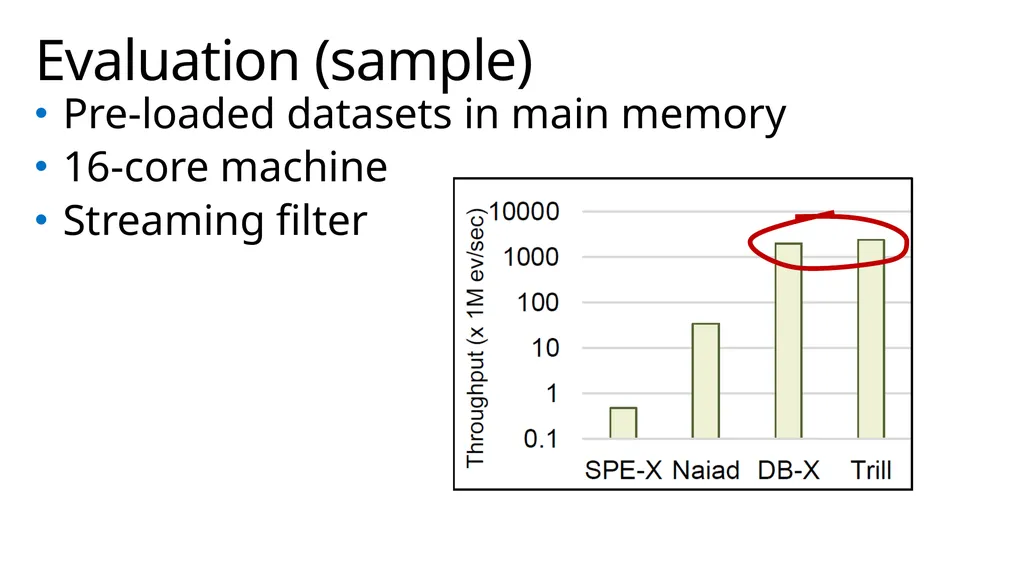
Pre-loaded datasets in main memory
16-core machine
Streaming filter Evaluation (sample)<br>
12
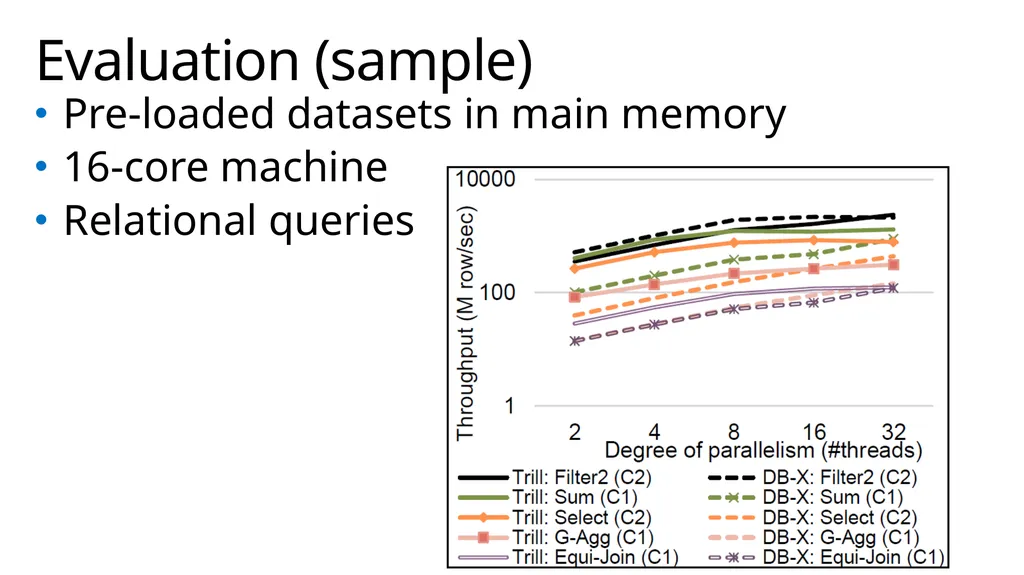
Pre-loaded datasets in main memory
16-core machine
Relational queries Evaluation (sample)<br>
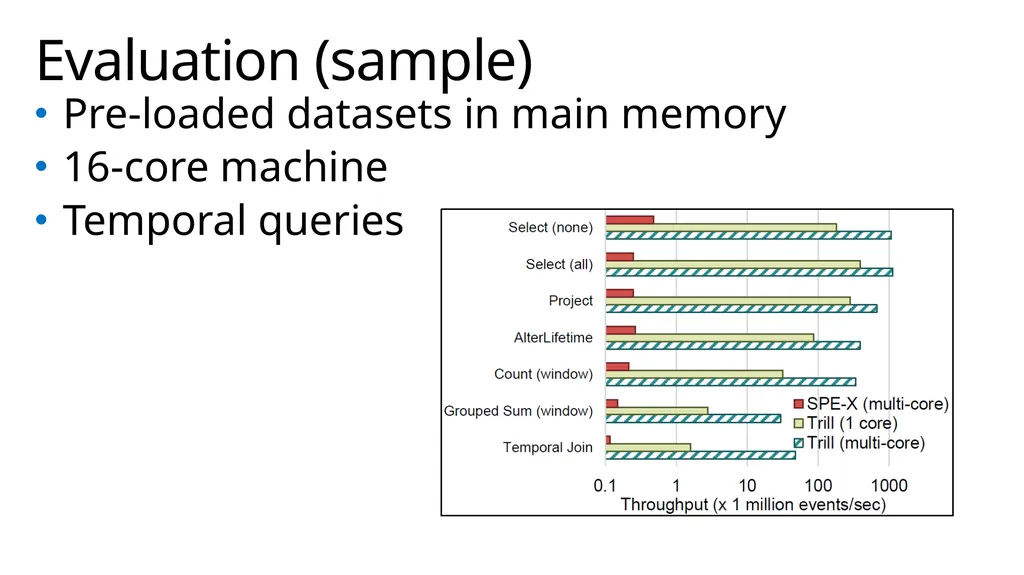
13
Pre-loaded datasets in main memory
16-core machine
Temporal queries Evaluation (sample)<br>
14
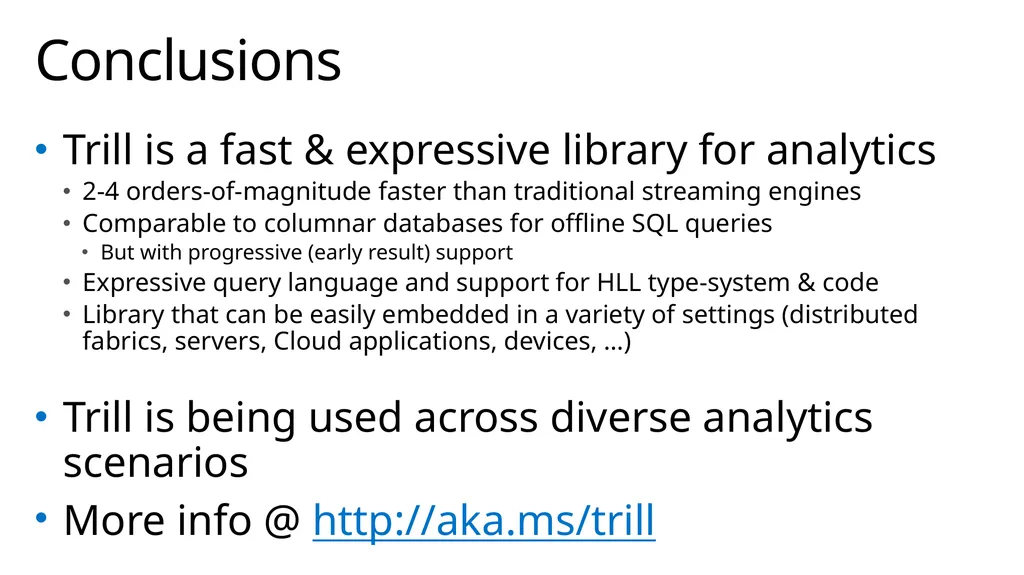
Trill is a fast & expressive library for analytics
2-4 orders-of-magnitude faster than traditional streaming engines
Comparable to columnar databases for offline SQL queries
But with progressive (early result) support
Expressive query language and support for HLL type-system & code
Library that can be easily embedded in a variety of settings (distributed fabrics, servers, Cloud applications, devices, …)
Trill is being used across diverse analytics scenarios
More info @ http://aka.ms/trill Conclusions<br>