Banking Finance - 1 Chapter 2 Commercial Banking Banks in Public sector - Nationalization of Banks The Government in the interest of the public, nationalized banks to put control on the banks as they have the publics money. Every
"Banking & Finance - 1 Chapter – 2 Commercial" is the property of its rightful owner. Permission is granted to
download and print the materials on this website for personal, non-commercial use only, and to display it
on your personal computer provided you do not modify the materials and that you retain all copyright
notices contained in the materials. By downloading content from our website, you accept the terms of this
agreement.
Banks in Public sector - Nationalization of Banks – The Government in the interest of the public, nationalized banks to put control on the banks as they have the public’s money.
Every bank has to change it BOD in such a way that 51% of it’s directors having special knowledge in the field of banking, agriculture, Co-operation small scale and rural economy.
Each commercial bank should name a full time chairman having experience and knowledge in field of banking.<br>
03
The power to appoint and dismiss the chairman is given to the Reserve bank of India.
According to Sec. 36 of the Act the following are unlawful –
To obstruct any person from entering or leaving the bank for carrying on business.
To act in a manner calculated to undermine the interest of the depositors of the bank.
Demonstrations which are violent or are calculated to prevent normal transaction of business.<br>
04
Other reasons for nationalization –
Social control over banks
Regional Imbalance
Credit to priority sector
Banking habits
Expansion of banking sector
Social justice<br>
05
Progress of Banks after Nationalization Expansion of branches : Growth in branches of commercial Bank after nationalization
Branch opening in rural areas : After nationalization, banks are moving towards rural and less developed areas.
Credit to priority sector : Commercial banks have been successful in lending to priority sector
Deposit mobilization : There has been substantial rise in rate of deposit mobilization.<br>
06
State Bank of India State bank of India is the largest and oldest bank in India.
In terms of Balance sheet size, Market capitalization and number of branches.
SBI has Tie up pension funds, General insurance, Custodial services, mobile banking etc.
State bank is also providing whole sale banking facilities to large corporates.<br>
07
SBI Progress :
22,000 Branches
8500 ATMs
82 Foreign offices
Branches of Associate Banks – 5100
Other value added services – Internet banking, Debit cards, Credit cards, mobile banks.<br>
08
Regional Rural Banks (RRB) RRBs are those banks which provide credit to weaker sections
Group under Narasimham Comittee was appointed to study the rural area credit needs
They recommended the establishment of RRBs
RBI then introduced RRB Act 1976
They cater to the needs of Rural area for credit needs better than commercial banks and Co-operative banks<br>
09
Banks in Private sector The small size and regional focus, they were not nationalized in 1969 and 1980 phase of nationalization.
In 1993 when Banking regulation Act were amended for new economic reform.
This permitted new private sector banks to come into the picture<br>
10
Foreign Banks Foreign banks are banks which incorporated abroad
They have their head office abroad
They also have branches in India.
They form an important segment of banking system in India.
They provide the typical facilities provided by commercial Banks<br>
11
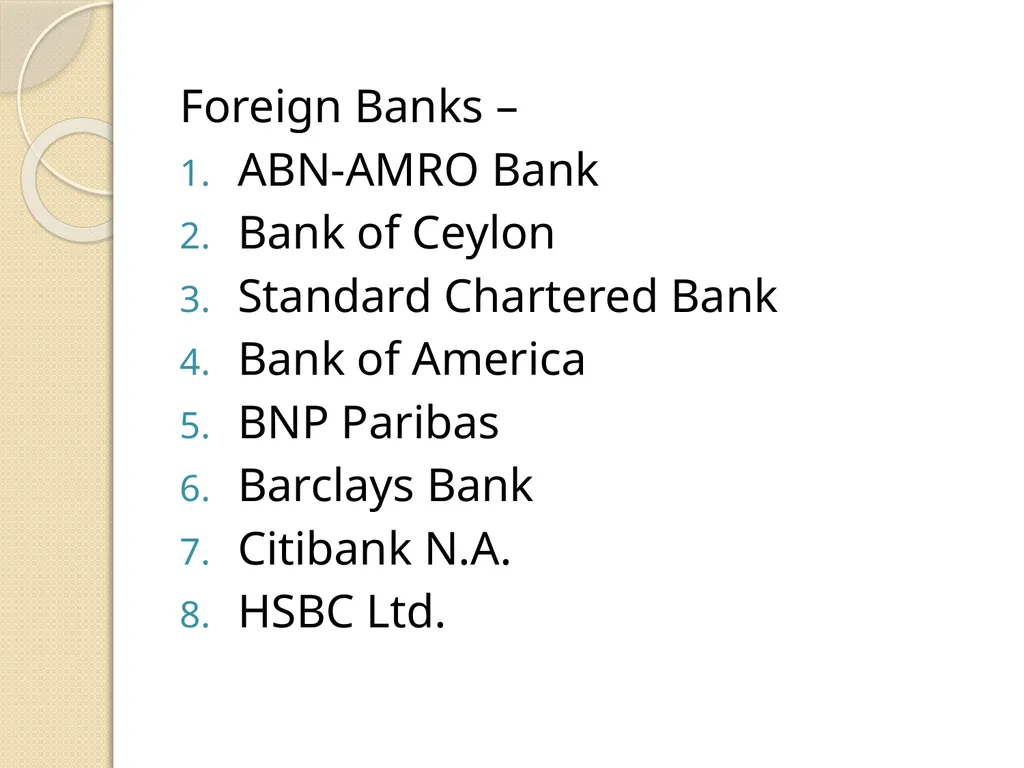
Foreign Banks –
ABN-AMRO Bank
Bank of Ceylon
Standard Chartered Bank
Bank of America
BNP Paribas
Barclays Bank
Citibank N.A.
HSBC Ltd.<br>