
Bare Bone Board Basics - for the Private Company
PC
Published · 45 slides · 0 views

1 / 1


Description
Bare Bone Board Basics - for the Private Company Episode 5 Committees of a Board Work Between Board Meetings April 27, 2022 Panelists Jonathan Friedland Allan Grafman Lori Marcus Elaine Eisenman About the Episode - Divide Conquer
Related Topics
Share
Embed code
Download this presentation From Below
"Bare Bone Board Basics - for the Private Company" is the property of its rightful owner. Permission is granted to download and print the materials on this website for personal, non-commercial use only, and to display it on your personal computer provided you do not modify the materials and that you retain all copyright notices contained in the materials. By downloading content from our website, you accept the terms of this agreement.
Presentation Transcript
01
Bare Bone Board Basics - for the Private Company
Episode #5 – Committees of a Board & Work Between Board Meetings
April 27, 2022
Panelists
Jonathan Friedland • Allan Grafman
Lori Marcus • Elaine Eisenman<br>
Episode #5 – Committees of a Board & Work Between Board Meetings
April 27, 2022
Panelists
Jonathan Friedland • Allan Grafman
Lori Marcus • Elaine Eisenman<br>
02
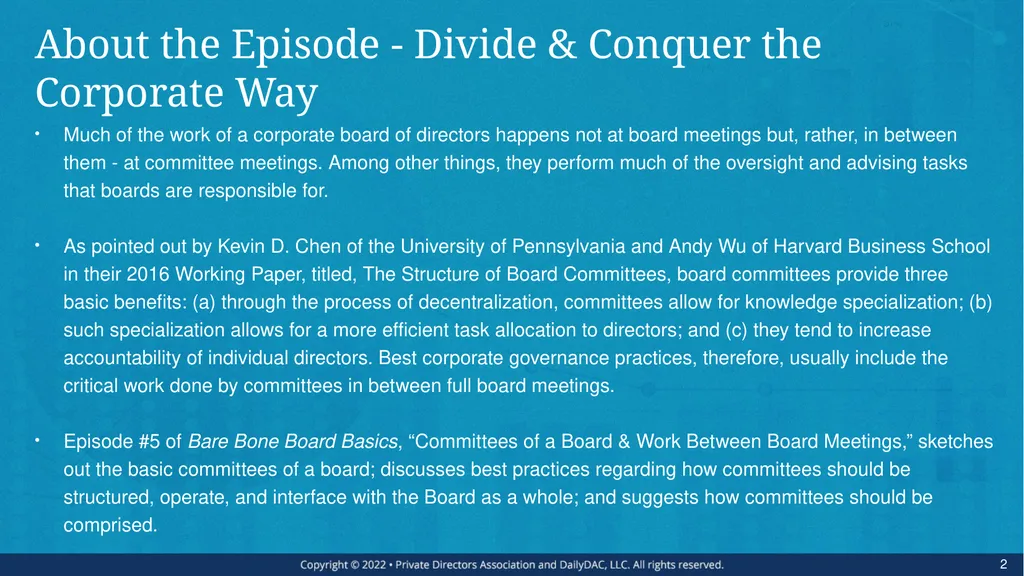
About the Episode - Divide & Conquer the Corporate Way Much of the work of a corporate board of directors happens not at board meetings but, rather, in between them - at committee meetings. Among other things, they perform much of the oversight and advising tasks that boards are responsible for.
As pointed out by Kevin D. Chen of the University of Pennsylvania and Andy Wu of Harvard Business School in their 2016 Working Paper, titled, The Structure of Board Committees, board committees provide three basic benefits: (a) through the process of decentralization, committees allow for knowledge specialization; (b) such specialization allows for a more efficient task allocation to directors; and (c) they tend to increase accountability of individual directors. Best corporate governance practices, therefore, usually include the critical work done by committees in between full board meetings.
Episode #5 of Bare Bone Board Basics, “Committees of a Board & Work Between Board Meetings,” sketches out the basic committees of a board; discusses best practices regarding how committees should be structured, operate, and interface with the Board as a whole; and suggests how committees should be comprised. 2<br>
As pointed out by Kevin D. Chen of the University of Pennsylvania and Andy Wu of Harvard Business School in their 2016 Working Paper, titled, The Structure of Board Committees, board committees provide three basic benefits: (a) through the process of decentralization, committees allow for knowledge specialization; (b) such specialization allows for a more efficient task allocation to directors; and (c) they tend to increase accountability of individual directors. Best corporate governance practices, therefore, usually include the critical work done by committees in between full board meetings.
Episode #5 of Bare Bone Board Basics, “Committees of a Board & Work Between Board Meetings,” sketches out the basic committees of a board; discusses best practices regarding how committees should be structured, operate, and interface with the Board as a whole; and suggests how committees should be comprised. 2<br>
03
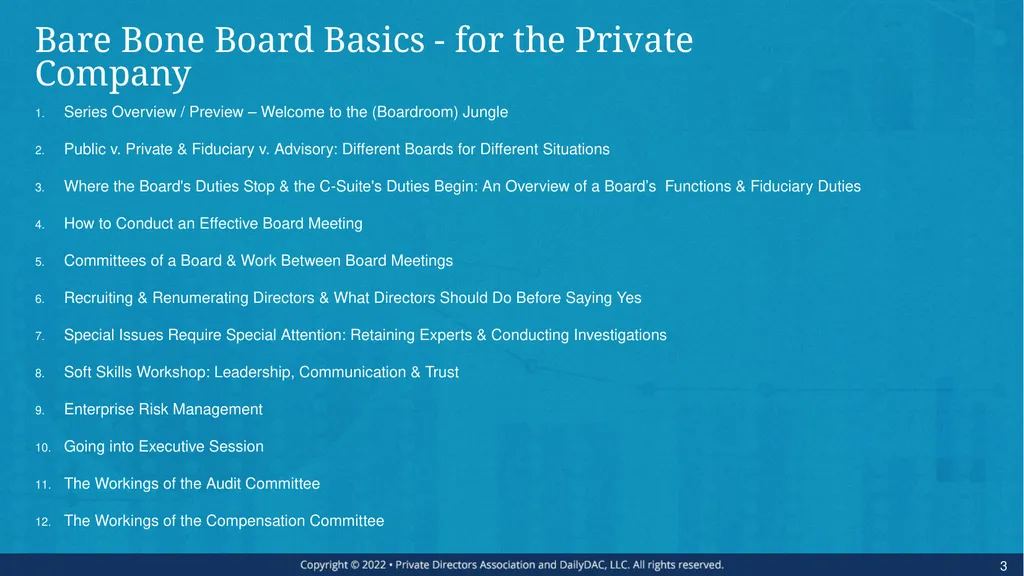
Bare Bone Board Basics - for the Private Company Series Overview / Preview – Welcome to the (Boardroom) Jungle
Public v. Private & Fiduciary v. Advisory: Different Boards for Different Situations
Where the Board's Duties Stop & the C-Suite's Duties Begin: An Overview of a Board’s Functions & Fiduciary Duties
How to Conduct an Effective Board Meeting
Committees of a Board & Work Between Board Meetings
Recruiting & Renumerating Directors & What Directors Should Do Before Saying Yes
Special Issues Require Special Attention: Retaining Experts & Conducting Investigations
Soft Skills Workshop: Leadership, Communication & Trust
Enterprise Risk Management
Going into Executive Session
The Workings of the Audit Committee
The Workings of the Compensation Committee 3<br>
Public v. Private & Fiduciary v. Advisory: Different Boards for Different Situations
Where the Board's Duties Stop & the C-Suite's Duties Begin: An Overview of a Board’s Functions & Fiduciary Duties
How to Conduct an Effective Board Meeting
Committees of a Board & Work Between Board Meetings
Recruiting & Renumerating Directors & What Directors Should Do Before Saying Yes
Special Issues Require Special Attention: Retaining Experts & Conducting Investigations
Soft Skills Workshop: Leadership, Communication & Trust
Enterprise Risk Management
Going into Executive Session
The Workings of the Audit Committee
The Workings of the Compensation Committee 3<br>
04
Disclaimer The material in this webinar is for informational purposes only. It should not be considered
legal, financial or other professional advice. You should consult with an attorney or other
appropriate professional to determine what may be best for your individual needs. While the
webinar producers and speakers take reasonable steps to ensure that information presented
is accurate, they make no guaranty in this (or any) regard. 4<br>
legal, financial or other professional advice. You should consult with an attorney or other
appropriate professional to determine what may be best for your individual needs. While the
webinar producers and speakers take reasonable steps to ensure that information presented
is accurate, they make no guaranty in this (or any) regard. 4<br>
05
Webinar Faculty Jonathan Friedland
Allan Grafman
Elaine Eisenman
Lori Marcus 5<br>
Allan Grafman
Elaine Eisenman
Lori Marcus 5<br>
06
Part I: The Basics of Board Committees 6<br>
07
Recap: Board Responsibilities Board’s work falls under three major buckets:
Governance
Management
Operations
You can learn more about the Board’s responsibilities and duties in Episode #3 of this series, located HERE 7<br>
Governance
Management
Operations
You can learn more about the Board’s responsibilities and duties in Episode #3 of this series, located HERE 7<br>
08
How do Boards get work done? Full Board meetings
By committees, in between full Board meetings
In between full Board meetings but not by committees 8<br>
By committees, in between full Board meetings
In between full Board meetings but not by committees 8<br>
09
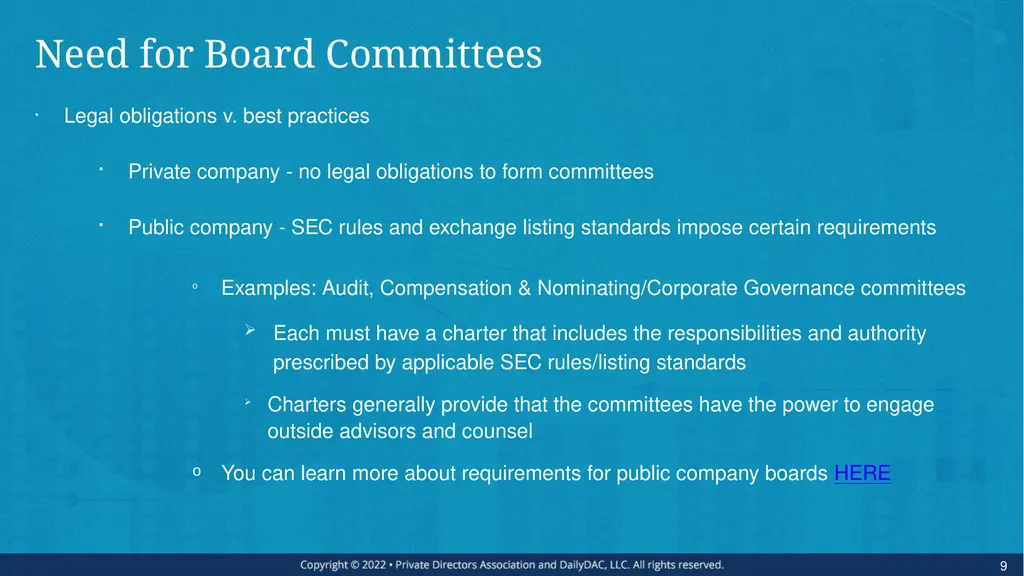
Need for Board Committees Legal obligations v. best practices
Private company - no legal obligations to form committees
Public company - SEC rules and exchange listing standards impose certain requirements
Examples: Audit, Compensation & Nominating/Corporate Governance committees
Each must have a charter that includes the responsibilities and authority prescribed by applicable SEC rules/listing standards
Charters generally provide that the committees have the power to engage outside advisors and counsel
You can learn more about requirements for public company boards HERE 9<br>
Private company - no legal obligations to form committees
Public company - SEC rules and exchange listing standards impose certain requirements
Examples: Audit, Compensation & Nominating/Corporate Governance committees
Each must have a charter that includes the responsibilities and authority prescribed by applicable SEC rules/listing standards
Charters generally provide that the committees have the power to engage outside advisors and counsel
You can learn more about requirements for public company boards HERE 9<br>
10
Committees often serve several different functions, including:
Governance
Coordination
Research and recommendations 10 Need for Board Committees (cont’d)<br>
Governance
Coordination
Research and recommendations 10 Need for Board Committees (cont’d)<br>
11
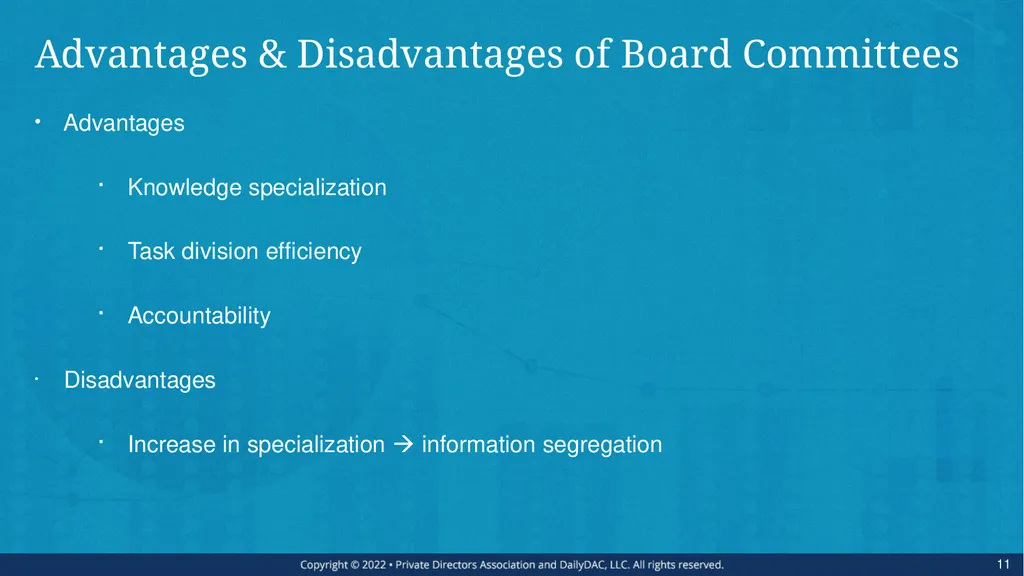
Advantages & Disadvantages of Board Committees Advantages
Knowledge specialization
Task division efficiency
Accountability
Disadvantages
Increase in specialization information segregation 11<br>
Knowledge specialization
Task division efficiency
Accountability
Disadvantages
Increase in specialization information segregation 11<br>
12
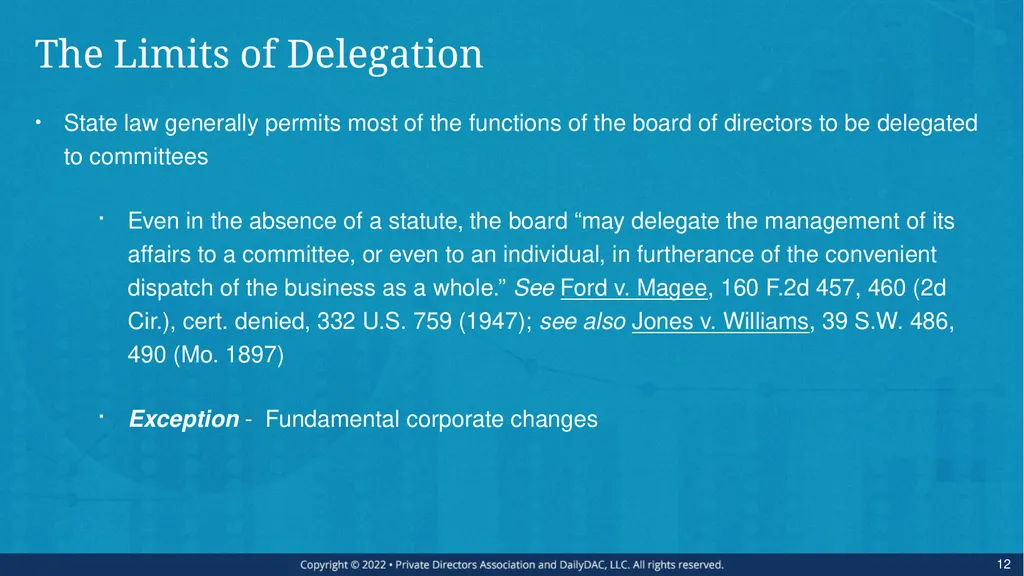
The Limits of Delegation State law generally permits most of the functions of the board of directors to be delegated to committees
Even in the absence of a statute, the board “may delegate the management of its affairs to a committee, or even to an individual, in furtherance of the convenient dispatch of the business as a whole.” See Ford v. Magee, 160 F.2d 457, 460 (2d Cir.), cert. denied, 332 U.S. 759 (1947); see also Jones v. Williams, 39 S.W. 486, 490 (Mo. 1897)
Exception - Fundamental corporate changes 12<br>
Even in the absence of a statute, the board “may delegate the management of its affairs to a committee, or even to an individual, in furtherance of the convenient dispatch of the business as a whole.” See Ford v. Magee, 160 F.2d 457, 460 (2d Cir.), cert. denied, 332 U.S. 759 (1947); see also Jones v. Williams, 39 S.W. 486, 490 (Mo. 1897)
Exception - Fundamental corporate changes 12<br>
13
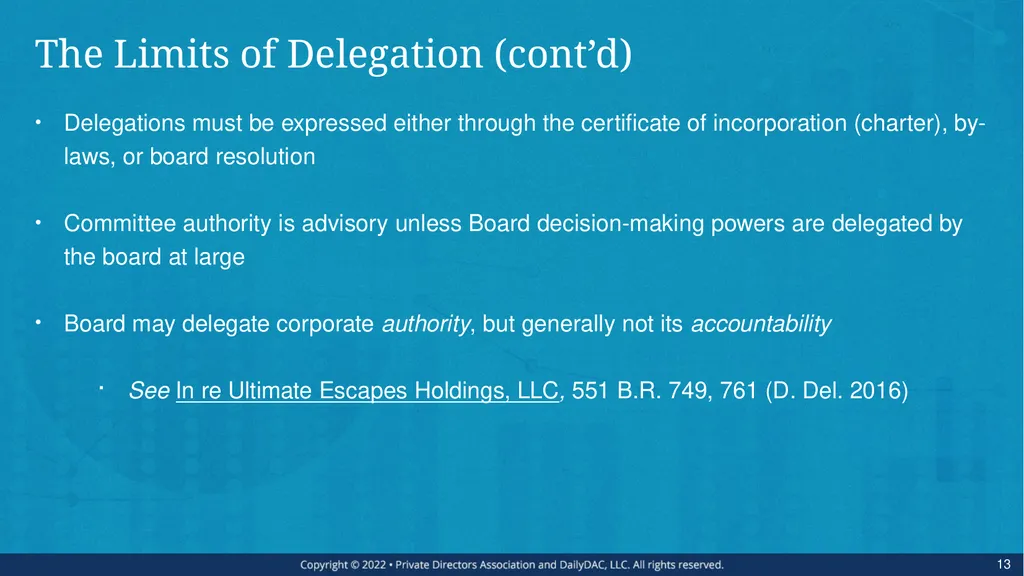
The Limits of Delegation (cont’d) Delegations must be expressed either through the certificate of incorporation (charter), by-laws, or board resolution
Committee authority is advisory unless Board decision-making powers are delegated by the board at large
Board may delegate corporate authority, but generally not its accountability
See In re Ultimate Escapes Holdings, LLC, 551 B.R. 749, 761 (D. Del. 2016) 13<br>
Committee authority is advisory unless Board decision-making powers are delegated by the board at large
Board may delegate corporate authority, but generally not its accountability
See In re Ultimate Escapes Holdings, LLC, 551 B.R. 749, 761 (D. Del. 2016) 13<br>
14
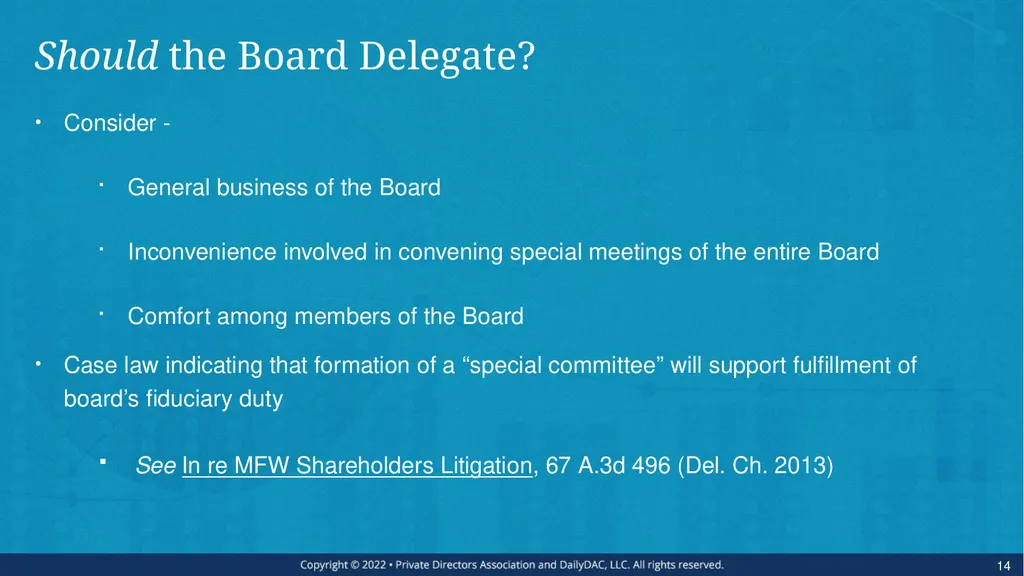
Should the Board Delegate? Consider -
General business of the Board
Inconvenience involved in convening special meetings of the entire Board
Comfort among members of the Board
Case law indicating that formation of a “special committee” will support fulfillment of board’s fiduciary duty
See In re MFW Shareholders Litigation, 67 A.3d 496 (Del. Ch. 2013) 14<br>
General business of the Board
Inconvenience involved in convening special meetings of the entire Board
Comfort among members of the Board
Case law indicating that formation of a “special committee” will support fulfillment of board’s fiduciary duty
See In re MFW Shareholders Litigation, 67 A.3d 496 (Del. Ch. 2013) 14<br>
15
Must the Board Delegate? Special committees to deal with conflict issues
See Weinberger v. UOP Inc., 457 A.2d 701 (Del. 1983); see also Kahn v. M&F Worldwide Corp., 88 A.3d 635 (Del. 2014) 15<br>
See Weinberger v. UOP Inc., 457 A.2d 701 (Del. 1983); see also Kahn v. M&F Worldwide Corp., 88 A.3d 635 (Del. 2014) 15<br>
16
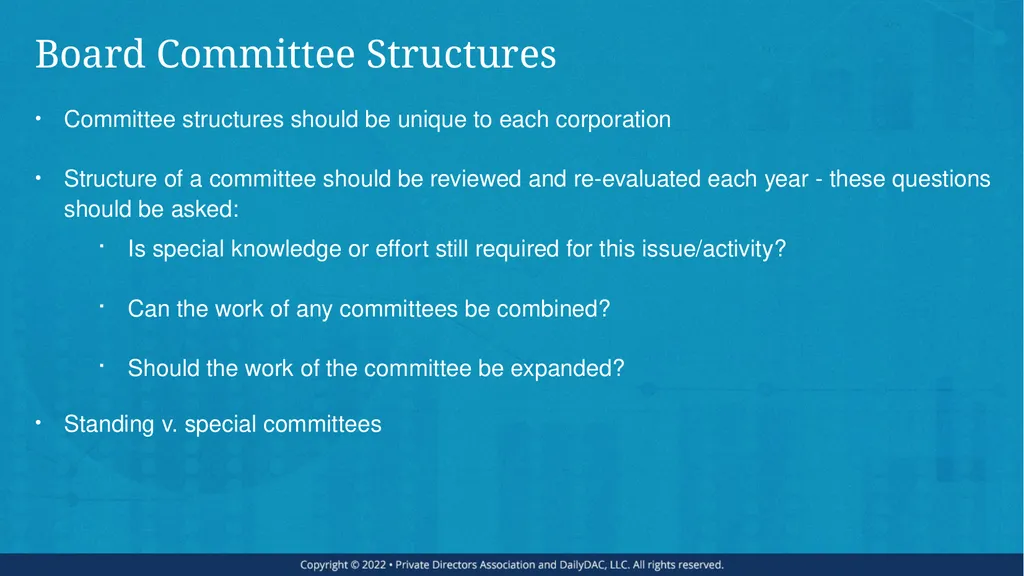
Board Committee Structures Committee structures should be unique to each corporation
Structure of a committee should be reviewed and re-evaluated each year - these questions should be asked:
Is special knowledge or effort still required for this issue/activity?
Can the work of any committees be combined?
Should the work of the committee be expanded?
Standing v. special committees<br>
Structure of a committee should be reviewed and re-evaluated each year - these questions should be asked:
Is special knowledge or effort still required for this issue/activity?
Can the work of any committees be combined?
Should the work of the committee be expanded?
Standing v. special committees<br>
17
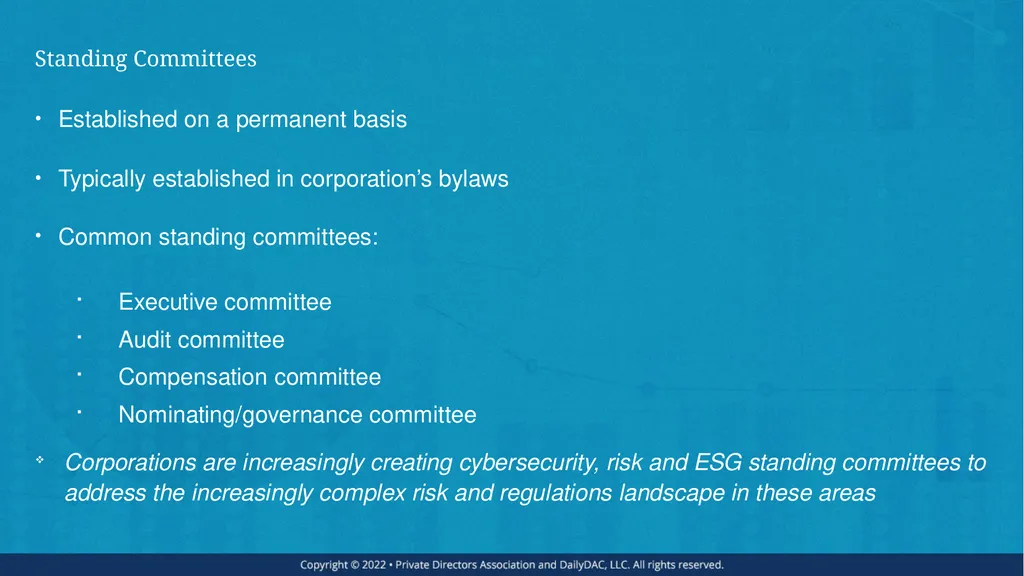
Standing Committees Established on a permanent basis
Typically established in corporation’s bylaws
Common standing committees:
Executive committee
Audit committee
Compensation committee
Nominating/governance committee
Corporations are increasingly creating cybersecurity, risk and ESG standing committees to address the increasingly complex risk and regulations landscape in these areas<br>
Typically established in corporation’s bylaws
Common standing committees:
Executive committee
Audit committee
Compensation committee
Nominating/governance committee
Corporations are increasingly creating cybersecurity, risk and ESG standing committees to address the increasingly complex risk and regulations landscape in these areas<br>
18
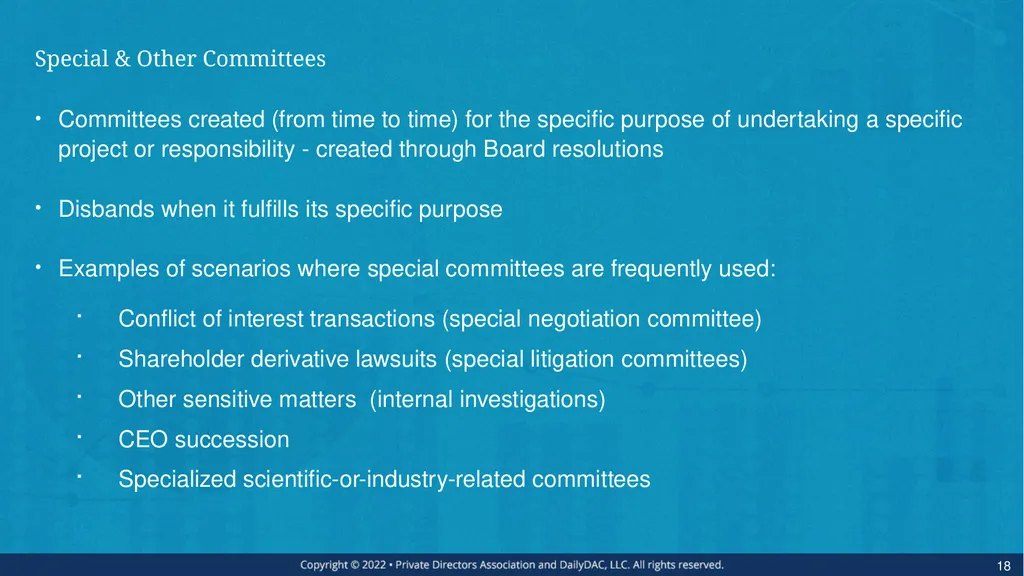
Special & Other Committees Committees created (from time to time) for the specific purpose of undertaking a specific project or responsibility - created through Board resolutions
Disbands when it fulfills its specific purpose
Examples of scenarios where special committees are frequently used:
Conflict of interest transactions (special negotiation committee)
Shareholder derivative lawsuits (special litigation committees)
Other sensitive matters (internal investigations)
CEO succession
Specialized scientific-or-industry-related committees 18<br>
Disbands when it fulfills its specific purpose
Examples of scenarios where special committees are frequently used:
Conflict of interest transactions (special negotiation committee)
Shareholder derivative lawsuits (special litigation committees)
Other sensitive matters (internal investigations)
CEO succession
Specialized scientific-or-industry-related committees 18<br>
19
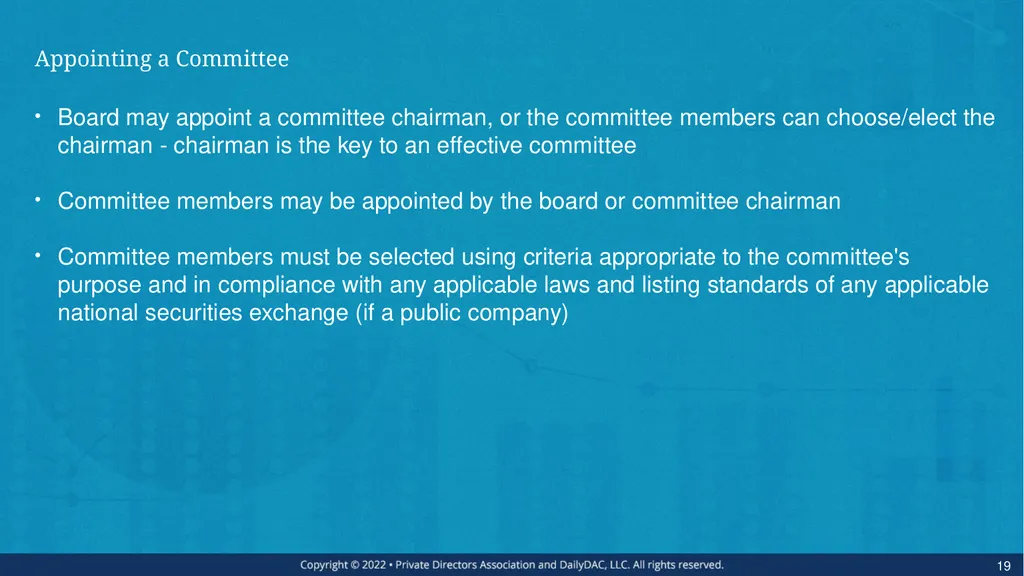
Appointing a Committee Board may appoint a committee chairman, or the committee members can choose/elect the chairman - chairman is the key to an effective committee
Committee members may be appointed by the board or committee chairman
Committee members must be selected using criteria appropriate to the committee's purpose and in compliance with any applicable laws and listing standards of any applicable national securities exchange (if a public company) 19<br>
Committee members may be appointed by the board or committee chairman
Committee members must be selected using criteria appropriate to the committee's purpose and in compliance with any applicable laws and listing standards of any applicable national securities exchange (if a public company) 19<br>
20
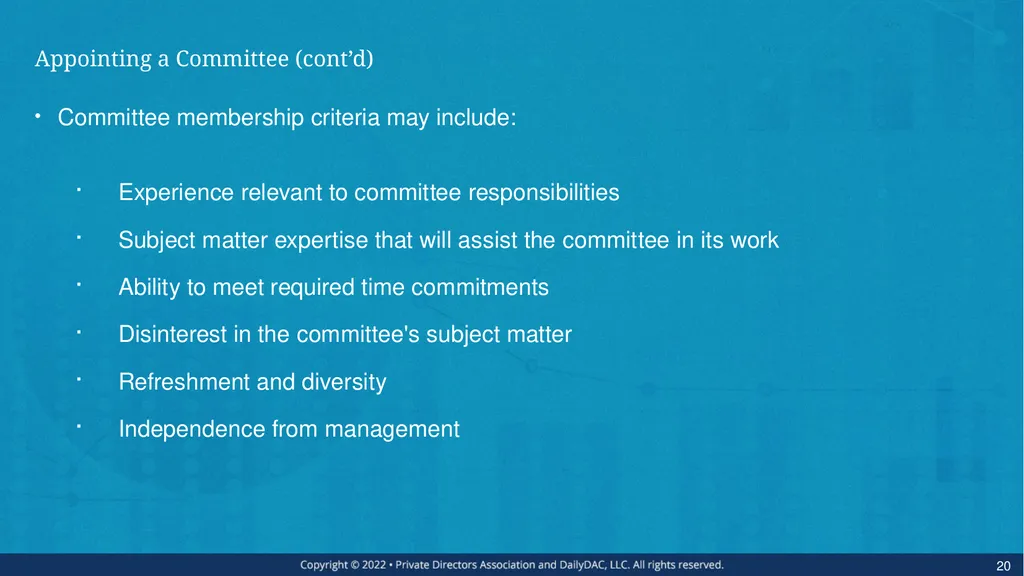
Appointing a Committee (cont’d) Committee membership criteria may include:
Experience relevant to committee responsibilities
Subject matter expertise that will assist the committee in its work
Ability to meet required time commitments
Disinterest in the committee's subject matter
Refreshment and diversity
Independence from management 20<br>
Experience relevant to committee responsibilities
Subject matter expertise that will assist the committee in its work
Ability to meet required time commitments
Disinterest in the committee's subject matter
Refreshment and diversity
Independence from management 20<br>
21
Committee Interface with Board Reporting to the Board
Standing committees should provide reports at regularly scheduled board meetings and make available to all directors committee agendas, minutes, and written reports
Periodic review by the Board
Committee self-assessment 21<br>
Standing committees should provide reports at regularly scheduled board meetings and make available to all directors committee agendas, minutes, and written reports
Periodic review by the Board
Committee self-assessment 21<br>
22
Committee Charter A committee charter is a written founding document that helps committees deliver and uphold effective governance
Submitted to the Board for approval (similar to mission statement - acts as blueprint for committee’s work)
Should be revised by Board as appropriate
Committee charter should clearly articulate the roles and responsibilities, as well as the mission, composition, responsibilities, and standard protocols of a committee 22<br>
Submitted to the Board for approval (similar to mission statement - acts as blueprint for committee’s work)
Should be revised by Board as appropriate
Committee charter should clearly articulate the roles and responsibilities, as well as the mission, composition, responsibilities, and standard protocols of a committee 22<br>
23
How Committees Function Minutes / agenda
Establish committee agenda + agenda for every committee meeting
Minutes
Minutes need to reflect the process to get to those decisions and not the decisions themselves
Minutes should at minimum cover:
The date and location of the meeting
Who is in attendance and what their titles are (while also reflecting when people leave or join)
If the meeting or any participants were in-person or on the phone
The presentations made
Summary of areas of questions that were asked and answered and notes that a discussion and deliberations occurred
A clear indication of actions taken and opposing or abstaining members (if relevant) 23<br>
Establish committee agenda + agenda for every committee meeting
Minutes
Minutes need to reflect the process to get to those decisions and not the decisions themselves
Minutes should at minimum cover:
The date and location of the meeting
Who is in attendance and what their titles are (while also reflecting when people leave or join)
If the meeting or any participants were in-person or on the phone
The presentations made
Summary of areas of questions that were asked and answered and notes that a discussion and deliberations occurred
A clear indication of actions taken and opposing or abstaining members (if relevant) 23<br>
24
Frequency of Meetings/Committee Annual Calendars Meet more regularly than full Board
Board might meet once a month (if that) 24<br>
Board might meet once a month (if that) 24<br>
25
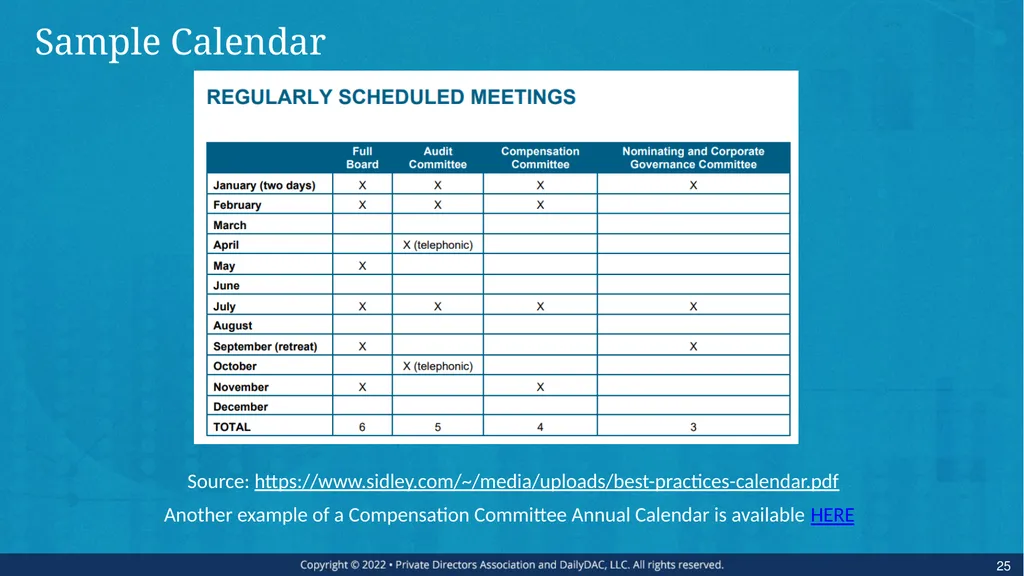
Sample Calendar 25 Source: https://www.sidley.com/~/media/uploads/best-practices-calendar.pdf Another example of a Compensation Committee Annual Calendar is available HERE<br>
26
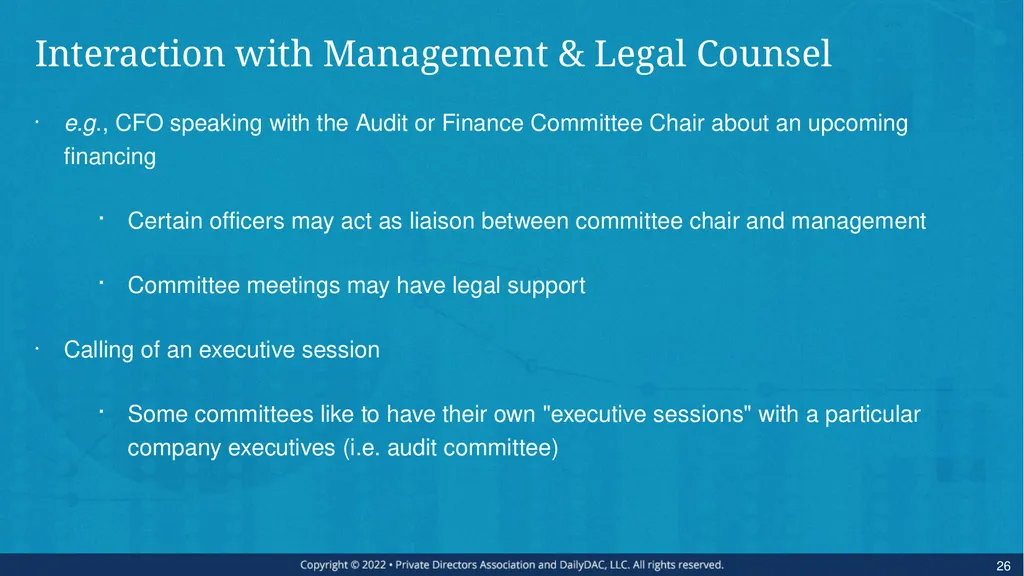
Interaction with Management & Legal Counsel e.g., CFO speaking with the Audit or Finance Committee Chair about an upcoming financing
Certain officers may act as liaison between committee chair and management
Committee meetings may have legal support
Calling of an executive session
Some committees like to have their own "executive sessions" with a particular company executives (i.e. audit committee) 26<br>
Certain officers may act as liaison between committee chair and management
Committee meetings may have legal support
Calling of an executive session
Some committees like to have their own "executive sessions" with a particular company executives (i.e. audit committee) 26<br>
27
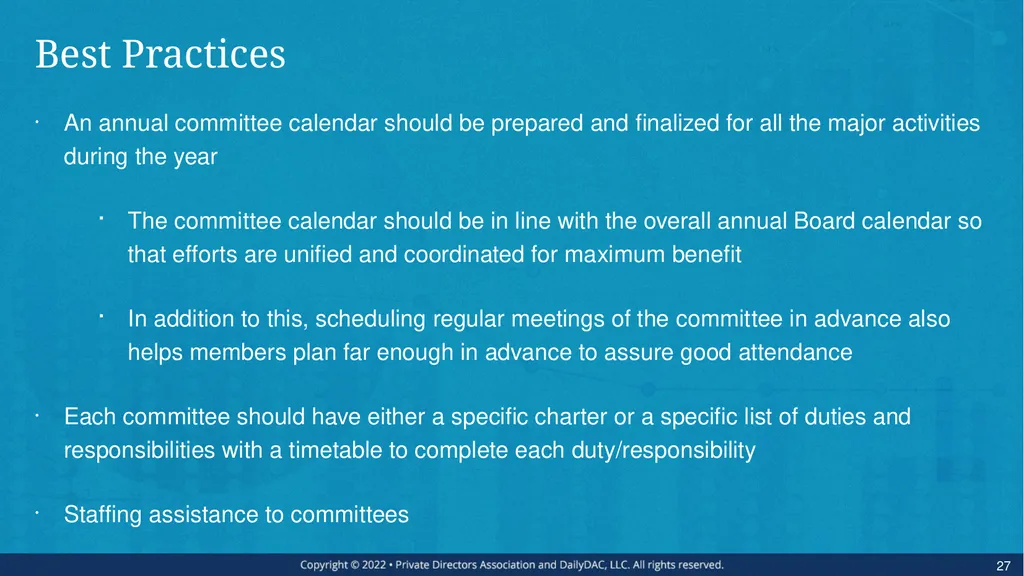
Best Practices An annual committee calendar should be prepared and finalized for all the major activities during the year
The committee calendar should be in line with the overall annual Board calendar so that efforts are unified and coordinated for maximum benefit
In addition to this, scheduling regular meetings of the committee in advance also helps members plan far enough in advance to assure good attendance
Each committee should have either a specific charter or a specific list of duties and responsibilities with a timetable to complete each duty/responsibility
Staffing assistance to committees 27<br>
The committee calendar should be in line with the overall annual Board calendar so that efforts are unified and coordinated for maximum benefit
In addition to this, scheduling regular meetings of the committee in advance also helps members plan far enough in advance to assure good attendance
Each committee should have either a specific charter or a specific list of duties and responsibilities with a timetable to complete each duty/responsibility
Staffing assistance to committees 27<br>
28
Part II: Summary Information about Specific Committees 28<br>
29
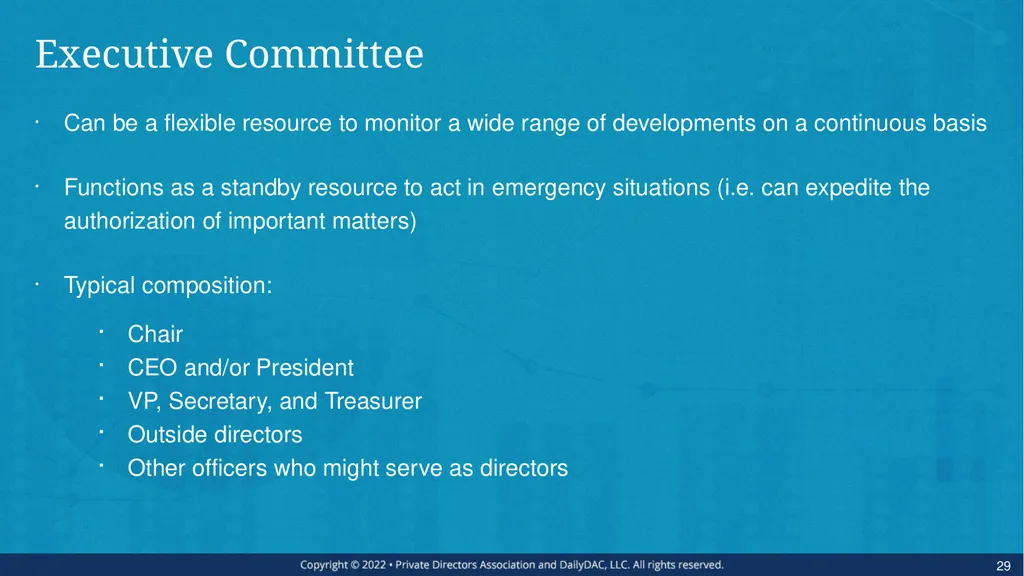
Executive Committee Can be a flexible resource to monitor a wide range of developments on a continuous basis
Functions as a standby resource to act in emergency situations (i.e. can expedite the authorization of important matters)
Typical composition:
Chair
CEO and/or President
VP, Secretary, and Treasurer
Outside directors
Other officers who might serve as directors 29<br>
Functions as a standby resource to act in emergency situations (i.e. can expedite the authorization of important matters)
Typical composition:
Chair
CEO and/or President
VP, Secretary, and Treasurer
Outside directors
Other officers who might serve as directors 29<br>
30
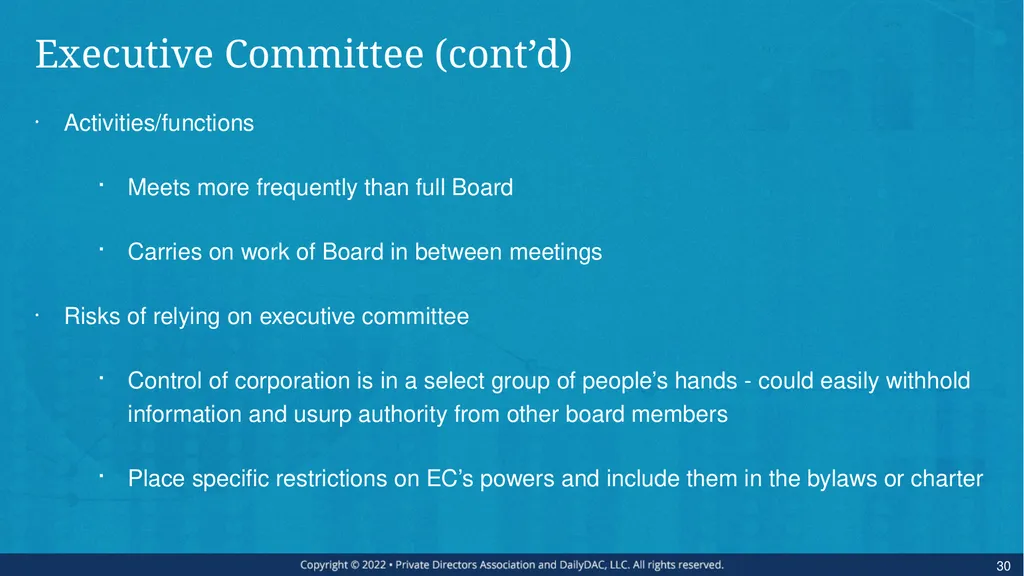
Executive Committee (cont’d) Activities/functions
Meets more frequently than full Board
Carries on work of Board in between meetings
Risks of relying on executive committee
Control of corporation is in a select group of people’s hands - could easily withhold information and usurp authority from other board members
Place specific restrictions on EC’s powers and include them in the bylaws or charter 30<br>
Meets more frequently than full Board
Carries on work of Board in between meetings
Risks of relying on executive committee
Control of corporation is in a select group of people’s hands - could easily withhold information and usurp authority from other board members
Place specific restrictions on EC’s powers and include them in the bylaws or charter 30<br>
31
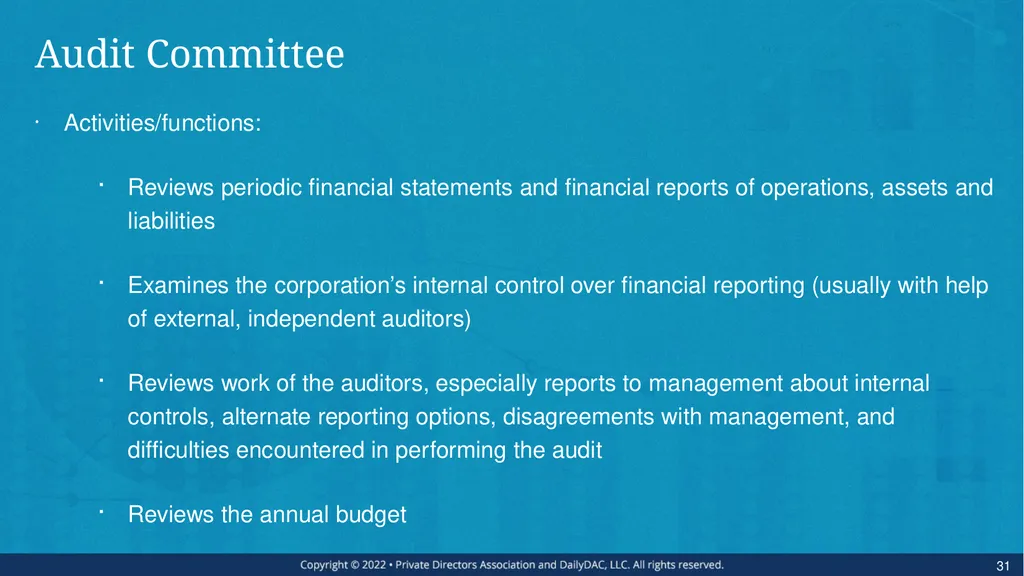
Audit Committee Activities/functions:
Reviews periodic financial statements and financial reports of operations, assets and liabilities
Examines the corporation’s internal control over financial reporting (usually with help of external, independent auditors)
Reviews work of the auditors, especially reports to management about internal controls, alternate reporting options, disagreements with management, and difficulties encountered in performing the audit
Reviews the annual budget 31<br>
Reviews periodic financial statements and financial reports of operations, assets and liabilities
Examines the corporation’s internal control over financial reporting (usually with help of external, independent auditors)
Reviews work of the auditors, especially reports to management about internal controls, alternate reporting options, disagreements with management, and difficulties encountered in performing the audit
Reviews the annual budget 31<br>
32
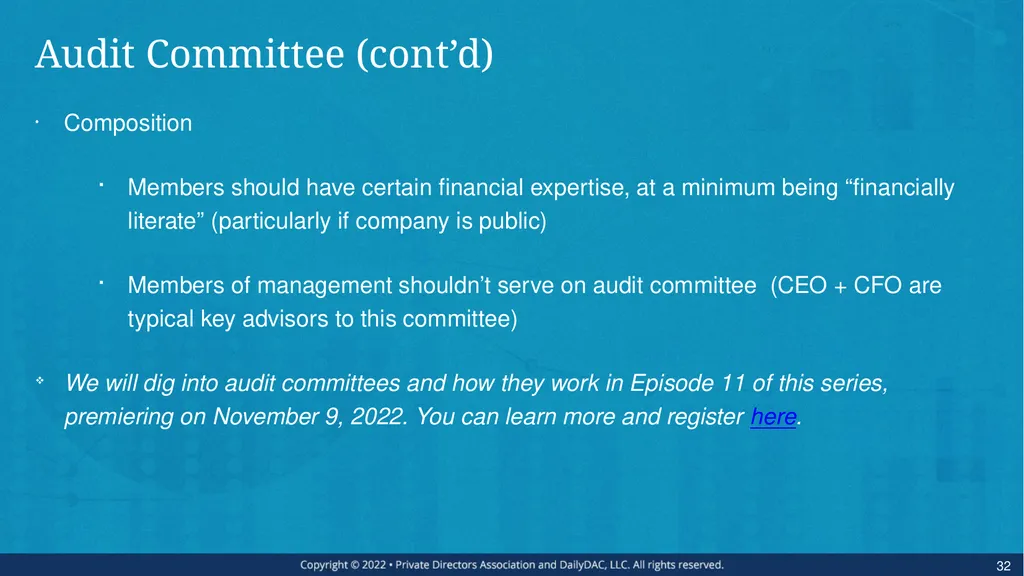
Audit Committee (cont’d) Composition
Members should have certain financial expertise, at a minimum being “financially literate” (particularly if company is public)
Members of management shouldn’t serve on audit committee (CEO + CFO are typical key advisors to this committee)
We will dig into audit committees and how they work in Episode 11 of this series, premiering on November 9, 2022. You can learn more and register here. 32<br>
Members should have certain financial expertise, at a minimum being “financially literate” (particularly if company is public)
Members of management shouldn’t serve on audit committee (CEO + CFO are typical key advisors to this committee)
We will dig into audit committees and how they work in Episode 11 of this series, premiering on November 9, 2022. You can learn more and register here. 32<br>
33
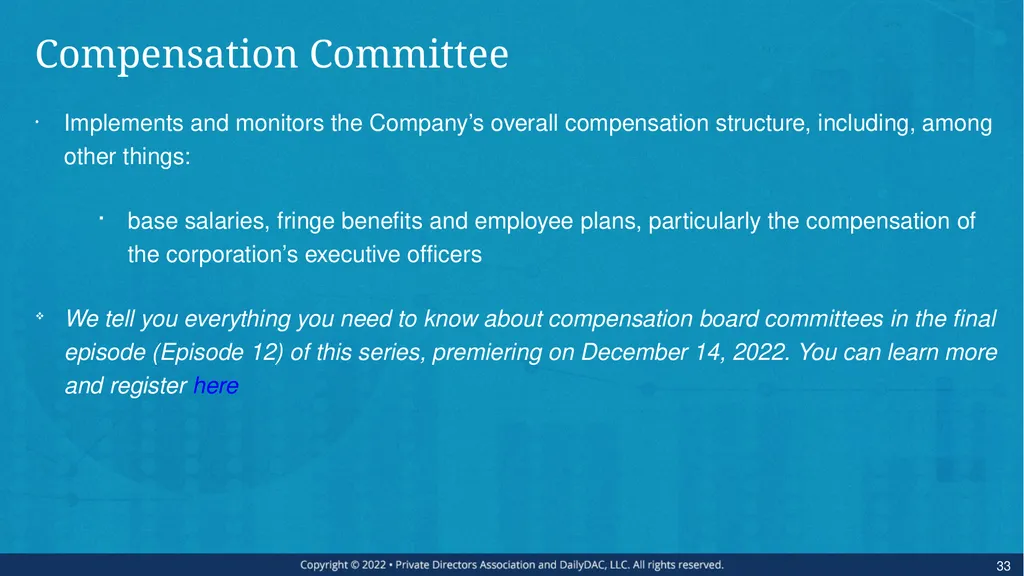
Compensation Committee Implements and monitors the Company’s overall compensation structure, including, among other things:
base salaries, fringe benefits and employee plans, particularly the compensation of the corporation’s executive officers
We tell you everything you need to know about compensation board committees in the final episode (Episode 12) of this series, premiering on December 14, 2022. You can learn more and register here 33<br>
base salaries, fringe benefits and employee plans, particularly the compensation of the corporation’s executive officers
We tell you everything you need to know about compensation board committees in the final episode (Episode 12) of this series, premiering on December 14, 2022. You can learn more and register here 33<br>
34
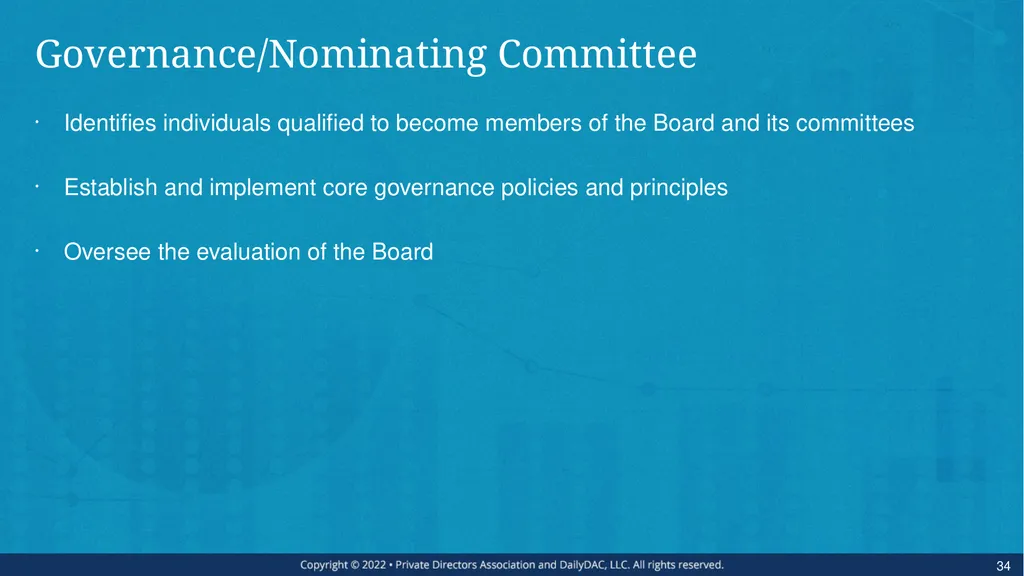
Governance/Nominating Committee Identifies individuals qualified to become members of the Board and its committees
Establish and implement core governance policies and principles
Oversee the evaluation of the Board 34<br>
Establish and implement core governance policies and principles
Oversee the evaluation of the Board 34<br>
35
About the Faculty 35<br>
36
Elaine Eisenman Elaine has served on public, private, PE, non-profit, start-up, family and advisory boards for over 20 years. She is an independent director of DBI (NYSE), a vertically integrated shoe manufacturer and retailer, chairs the Compensation Committee and is a member of the Audit Committee.
She is Managing Director of Saeje Advisors, providing strategic advisory services to private companies, and a faculty member at Entrepreneurship Policy Advisors, developing entrepreneurial ecosystems through growing and scaling companies. She was a senior executive for several global public companies, and a Professor and Dean of Executive and Enterprise Education at Babson College.
She is the coauthor of Betrayed: A Survival Guide To Lying, Cheating, And Double-dealing, and of I Didn't See It Coming: The Only Book You'll Ever Need to Avoid Being Blindsided in Business. More information here. 36<br>
She is Managing Director of Saeje Advisors, providing strategic advisory services to private companies, and a faculty member at Entrepreneurship Policy Advisors, developing entrepreneurial ecosystems through growing and scaling companies. She was a senior executive for several global public companies, and a Professor and Dean of Executive and Enterprise Education at Babson College.
She is the coauthor of Betrayed: A Survival Guide To Lying, Cheating, And Double-dealing, and of I Didn't See It Coming: The Only Book You'll Ever Need to Avoid Being Blindsided in Business. More information here. 36<br>
37
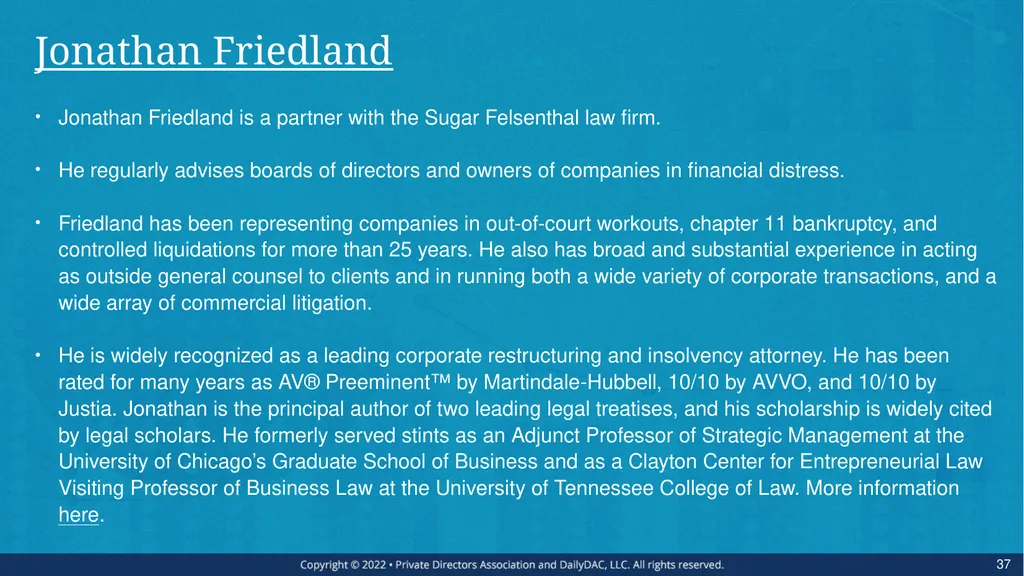
Jonathan Friedland Jonathan Friedland is a partner with the Sugar Felsenthal law firm.
He regularly advises boards of directors and owners of companies in financial distress.
Friedland has been representing companies in out-of-court workouts, chapter 11 bankruptcy, and controlled liquidations for more than 25 years. He also has broad and substantial experience in acting as outside general counsel to clients and in running both a wide variety of corporate transactions, and a wide array of commercial litigation.
He is widely recognized as a leading corporate restructuring and insolvency attorney. He has been rated for many years as AV® Preeminent™ by Martindale-Hubbell, 10/10 by AVVO, and 10/10 by Justia. Jonathan is the principal author of two leading legal treatises, and his scholarship is widely cited by legal scholars. He formerly served stints as an Adjunct Professor of Strategic Management at the University of Chicago’s Graduate School of Business and as a Clayton Center for Entrepreneurial Law Visiting Professor of Business Law at the University of Tennessee College of Law. More information here. 37<br>
He regularly advises boards of directors and owners of companies in financial distress.
Friedland has been representing companies in out-of-court workouts, chapter 11 bankruptcy, and controlled liquidations for more than 25 years. He also has broad and substantial experience in acting as outside general counsel to clients and in running both a wide variety of corporate transactions, and a wide array of commercial litigation.
He is widely recognized as a leading corporate restructuring and insolvency attorney. He has been rated for many years as AV® Preeminent™ by Martindale-Hubbell, 10/10 by AVVO, and 10/10 by Justia. Jonathan is the principal author of two leading legal treatises, and his scholarship is widely cited by legal scholars. He formerly served stints as an Adjunct Professor of Strategic Management at the University of Chicago’s Graduate School of Business and as a Clayton Center for Entrepreneurial Law Visiting Professor of Business Law at the University of Tennessee College of Law. More information here. 37<br>
38
Allan Grafman Allan Grafman has served on 12 boards, including 4 public, 4 private equity-owned and 4 venture-sponsored. He is currently Chair of the Audit Committee of a public company (IDW) and also Audit Committee member for a REIT, and has served on Compensation and Governance Committees as well.
Specific past experience includes serving as the Chairman of the Board of a Nasdaq listed video game company and other entertainment, media and consumer focused entities. He is currently a licensed investment banker raising capital for companies.
Allan comes to board service building on executive roles at All Media Ventures, Archie Comics, Hallmark, Tribune, ABC and Disney. He received his BA from Indiana University (PBK), Masters (Fellow) and MBA from Columbia (BGS). More information here. 38<br>
Specific past experience includes serving as the Chairman of the Board of a Nasdaq listed video game company and other entertainment, media and consumer focused entities. He is currently a licensed investment banker raising capital for companies.
Allan comes to board service building on executive roles at All Media Ventures, Archie Comics, Hallmark, Tribune, ABC and Disney. He received his BA from Indiana University (PBK), Masters (Fellow) and MBA from Columbia (BGS). More information here. 38<br>
39
Lori Marcus Ms. Marcus serves as an independent board director on public and private company boards -- Fresh Del Monte Produce, Inc. (NYSE: FDP) and 24 Hour Fitness.
Until recently she also served on the boards of Golub Corporation (d.b.a Price Chopper/Market 32 grocery stores), Phunware (NASDAQ: PHUN), DDC (DNA Diagnostics Center), and Talalay Global.
She is also a board member for SHARE Cancer Support and Vice Chair of the Board for the MMRF (Multiple Myeloma Research Foundation).
She comes to board work after a long career as a c-suite operating executive in leading consumer companies -- PepsiCo, The Children’s Place Retail Stores, Keurig Green Mountain, and Peloton Interactive.
Ms. Marcus earned her BS degree in Marketing from the Wharton School of Business, University of Pennsylvania. More information here. 39<br>
Until recently she also served on the boards of Golub Corporation (d.b.a Price Chopper/Market 32 grocery stores), Phunware (NASDAQ: PHUN), DDC (DNA Diagnostics Center), and Talalay Global.
She is also a board member for SHARE Cancer Support and Vice Chair of the Board for the MMRF (Multiple Myeloma Research Foundation).
She comes to board work after a long career as a c-suite operating executive in leading consumer companies -- PepsiCo, The Children’s Place Retail Stores, Keurig Green Mountain, and Peloton Interactive.
Ms. Marcus earned her BS degree in Marketing from the Wharton School of Business, University of Pennsylvania. More information here. 39<br>
40
About the Co-Producers This is the fifth episode in a series of webinars produced by:
Certain chapters of the Private Directors Association®
Financial Poise™
Executive Forum™
Vistage®
Private Director Symposium™
ChamberWise™ 40<br>
Certain chapters of the Private Directors Association®
Financial Poise™
Executive Forum™
Vistage®
Private Director Symposium™
ChamberWise™ 40<br>
41
About Private Directors Association® The Private Directors Association® (PDA) is an independent 501(c)(6) founded in 2014 and headquartered in Chicago, IL. PDA is the only national association dedicated to improving private companies' growth and sustainability through governance that adds value.
Our close to 3,000 members include current and qualified future board members, private company owners, and C-level executives of family-owned businesses, ESOPs, private equity owned, early stage, and start-up organizations.
The PDA’s mission is to:
Advocate for and teach board formation and governance
Enhance private company value through high-performing boards
Advocate for the value of diverse and inclusive boards
Create a national alliance of directors, executives, and private company owners interested in board service to learn, network, and identify and attract exceptional board members 41<br>
Our close to 3,000 members include current and qualified future board members, private company owners, and C-level executives of family-owned businesses, ESOPs, private equity owned, early stage, and start-up organizations.
The PDA’s mission is to:
Advocate for and teach board formation and governance
Enhance private company value through high-performing boards
Advocate for the value of diverse and inclusive boards
Create a national alliance of directors, executives, and private company owners interested in board service to learn, network, and identify and attract exceptional board members 41<br>
42
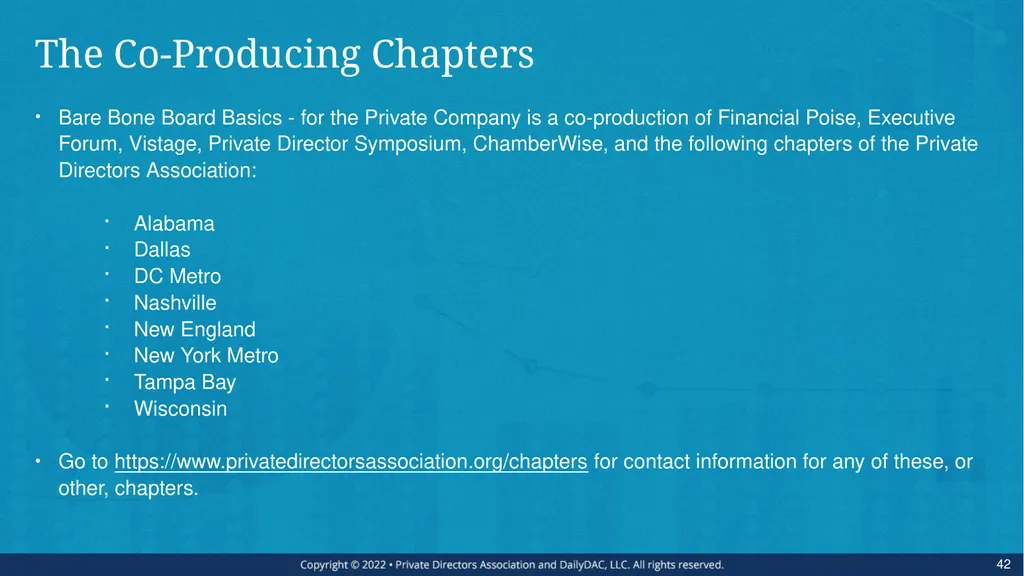
The Co-Producing Chapters Bare Bone Board Basics - for the Private Company is a co-production of Financial Poise, Executive Forum, Vistage, Private Director Symposium, ChamberWise, and the following chapters of the Private Directors Association:
Alabama
Dallas
DC Metro
Nashville
New England
New York Metro
Tampa Bay
Wisconsin
Go to https://www.privatedirectorsassociation.org/chapters for contact information for any of these, or other, chapters. 42<br>
Alabama
Dallas
DC Metro
Nashville
New England
New York Metro
Tampa Bay
Wisconsin
Go to https://www.privatedirectorsassociation.org/chapters for contact information for any of these, or other, chapters. 42<br>
43
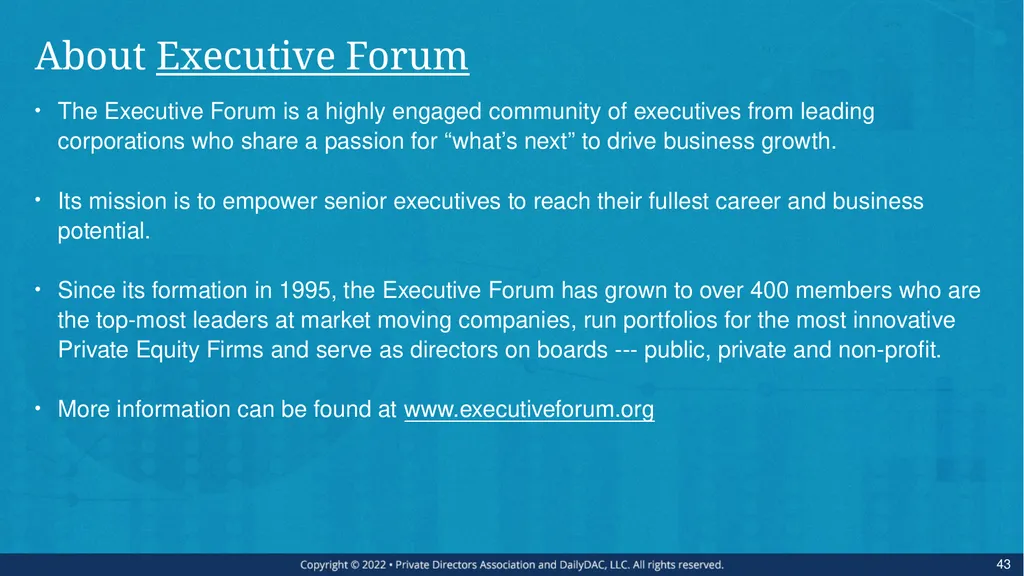
About Executive Forum The Executive Forum is a highly engaged community of executives from leading corporations who share a passion for “what’s next” to drive business growth.
Its mission is to empower senior executives to reach their fullest career and business potential.
Since its formation in 1995, the Executive Forum has grown to over 400 members who are the top-most leaders at market moving companies, run portfolios for the most innovative Private Equity Firms and serve as directors on boards --- public, private and non-profit.
More information can be found at www.executiveforum.org 43<br>
Its mission is to empower senior executives to reach their fullest career and business potential.
Since its formation in 1995, the Executive Forum has grown to over 400 members who are the top-most leaders at market moving companies, run portfolios for the most innovative Private Equity Firms and serve as directors on boards --- public, private and non-profit.
More information can be found at www.executiveforum.org 43<br>
44
About Financial Poise™ The primary mission of Financial Poise™ is to provide reliable plain English business, financial, and legal education to individual investors, entrepreneurs, business owners, and executives, and to help trusted advisors do the same.
Sign up for our free weekly e-newsletter here*.
Learn how to write or speak for Financial Poise here. The antithesis of “pay-to-play.”
Check out our other webinars here.
Send any other inquiry to info@financialpoise.com
*Newsletter subscribers are offered a free webinar weekly. Subscribers never receive more than one email per week and their information is never shared. 44<br>
Sign up for our free weekly e-newsletter here*.
Learn how to write or speak for Financial Poise here. The antithesis of “pay-to-play.”
Check out our other webinars here.
Send any other inquiry to info@financialpoise.com
*Newsletter subscribers are offered a free webinar weekly. Subscribers never receive more than one email per week and their information is never shared. 44<br>
45
Additional Information & Resources For more information about this series and to access the PowerPoints and case law referenced in past webinar episodes, visit www.privatedirectorsymposium.org 45<br>