Basic Electricity Basic electrical concepts Except where otherwise noted these materials are licensed Creative Commons Attribution 4.0 (CC BY) Objectives The objective of this unit is to present the student with some basic terms relating to
"Basic Electricity Basic electrical concepts Except" is the property of its rightful owner. Permission is granted to
download and print the materials on this website for personal, non-commercial use only, and to display it
on your personal computer provided you do not modify the materials and that you retain all copyright
notices contained in the materials. By downloading content from our website, you accept the terms of this
agreement.
Presentation Transcript
01
Basic Electricity Basic electrical concepts Except where otherwise noted these materials are licensed Creative Commons Attribution 4.0 (CC BY)<br>
02
Objectives The objective of this unit is to present the student with some basic terms relating to electricity. Upon completion, the student will have an understanding of the following:
Basic atom structure
Key terms and definitions
Basic circuit analysis and recognition of differences
Basic notations and conversions
For any calculations made, it is critical to carry proper units. An answer is incorrect if it is not identified properly.<br>
03
The importance of the atom Atom Structure
Made up of electrons, protons, and neutrons
The nucleus contains the protons and neutrons.
The shell contains the electrons, which orbit the nucleus.
The building blocks of matter
The atomic structure of a material will help to determine the ease of current flow
Atoms can be charged.
Positive
Negative
Neutral
Law of Charges: Like charges repel each other, and unlike charges attract each other.
A material that has an excess of electrons will take on a negative charge.
A material that has fewer electrons than protons will have a net positive charge.<br>
04
Electrical Materials & Photons Electrical materials used
Insulators: Materials that inhibit the flow of free electrons; this material has only a few free electrons
Conductor: Materials that readily allow for the flow of free electrons and have many free electrons
Semi-conductors: A material that has more free electrons than an insulator but fewer free electrons than a conductor
Photons
The basic unit of light energy
Light can be considered to consist of a stream of tiny particles of energy called photons.
This is used in Solar Photovoltaics and helps with the creation of electricity.
P-N Junction could be considered the heart of the solar cell.<br>
05
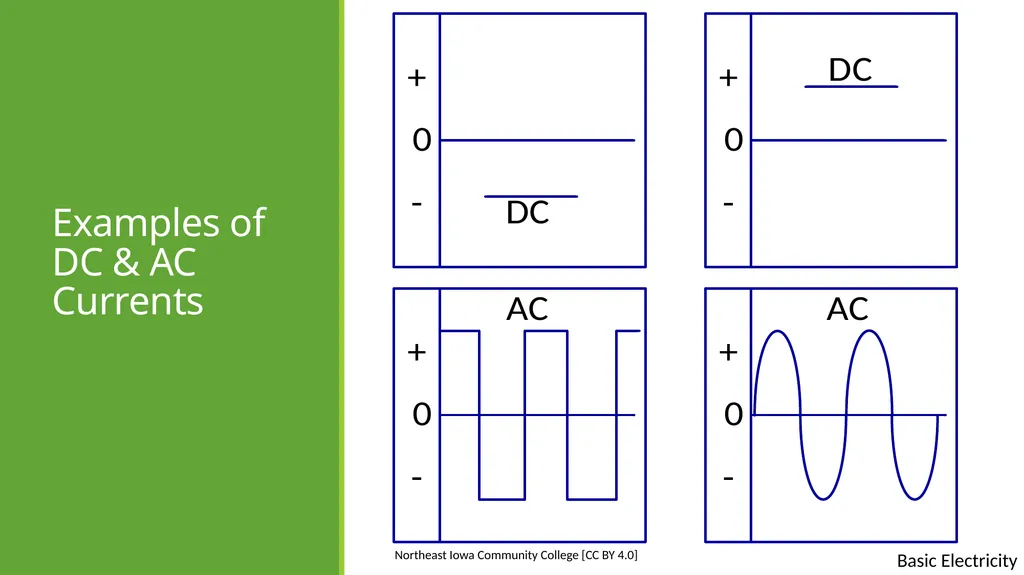
Electricity for Renewables Direct Current-DC
Current flows in one direction only.
Car Battery
Photovoltaic cells
Alternating Current-AC
Current flows in one direction, then the other, and alternates back and forth.
This is what is used in one’s home single phase.
Can be transformed<br>
06
Examples of DC & AC Currents Northeast Iowa Community College [CC BY 4.0]<br>
07
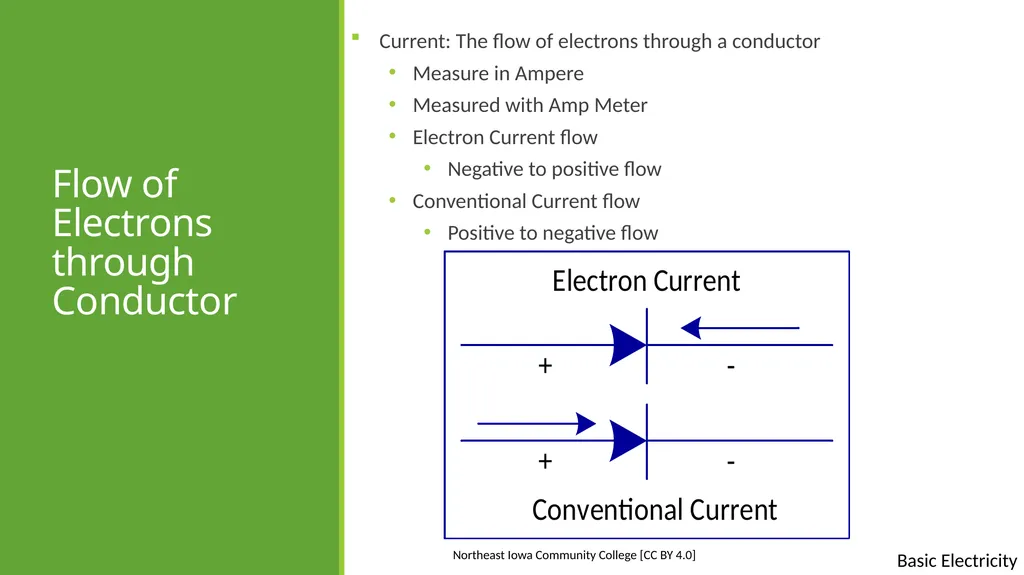
Flow of Electrons through Conductor Current: The flow of electrons through a conductor
Measure in Ampere
Measured with Amp Meter
Electron Current flow
Negative to positive flow
Conventional Current flow
Positive to negative flow Northeast Iowa Community College [CC BY 4.0]<br>
08
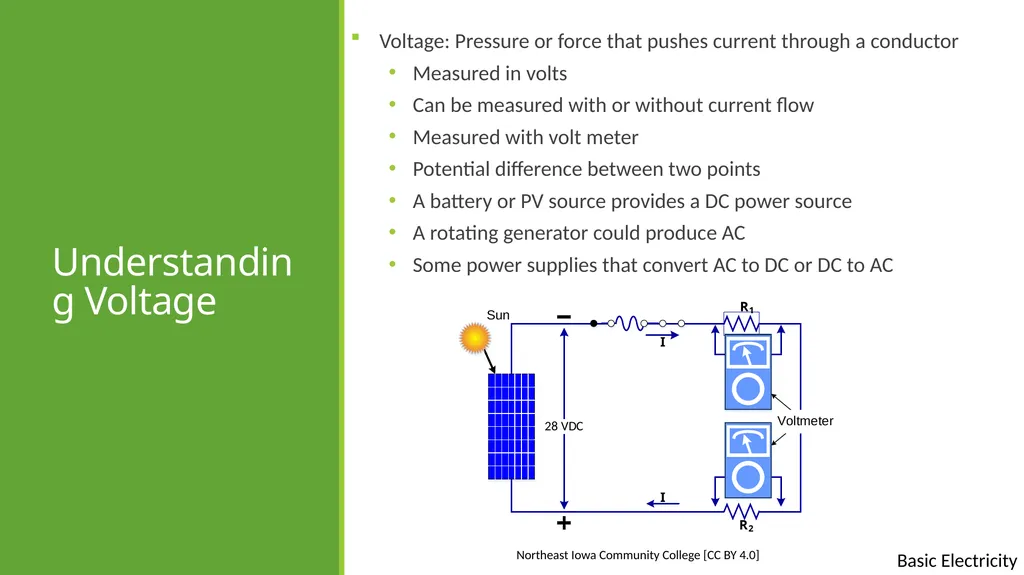
Understanding Voltage Voltage: Pressure or force that pushes current through a conductor
Measured in volts
Can be measured with or without current flow
Measured with volt meter
Potential difference between two points
A battery or PV source provides a DC power source
A rotating generator could produce AC
Some power supplies that convert AC to DC or DC to AC Northeast Iowa Community College [CC BY 4.0]<br>
09
Electricity for Renewables Resistance: Opposition to current flow
Measured in ohms
Measured with ohmmeter
Power: The rate of work or energy consumption
Measured in watts
Measures the rate at which energy is used in a circuit<br>
10
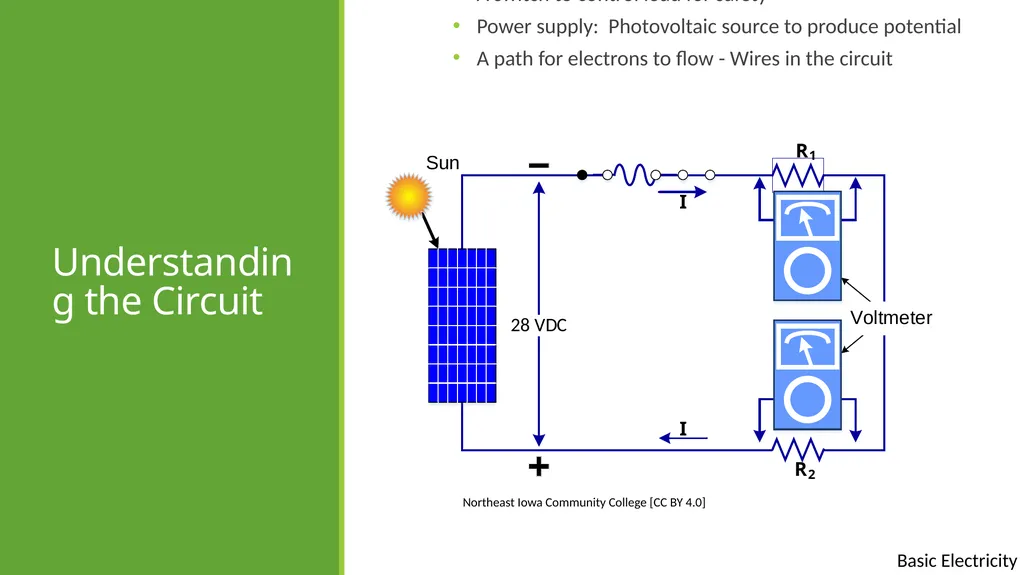
Understanding the Circuit A practical circuit contains the four following characteristics:
Load: A load consumes power
A switch to control load for safety
Power supply: Photovoltaic source to produce potential
A path for electrons to flow - Wires in the circuit Northeast Iowa Community College [CC BY 4.0]<br>
11
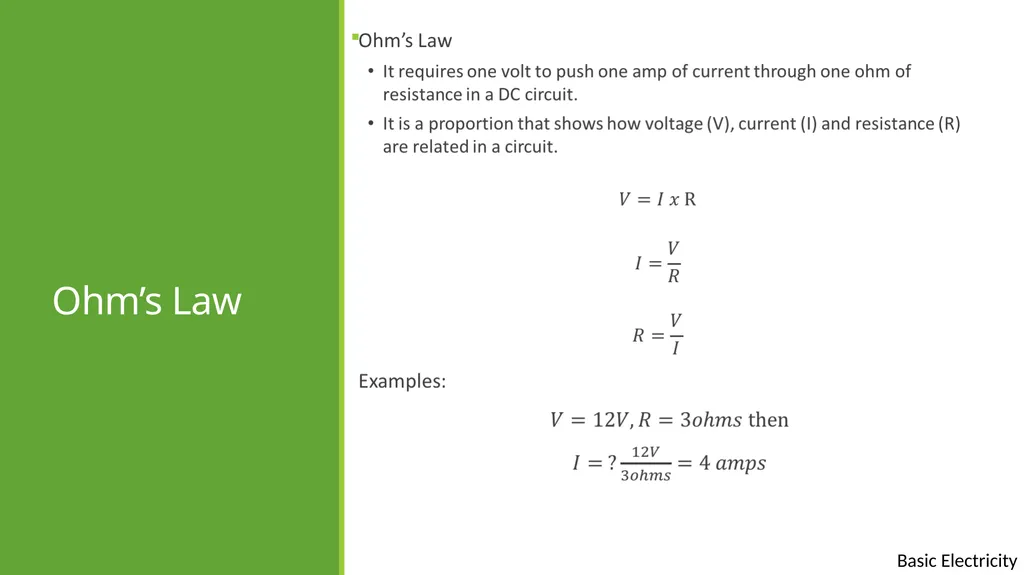
Ohm’s Law<br>
12
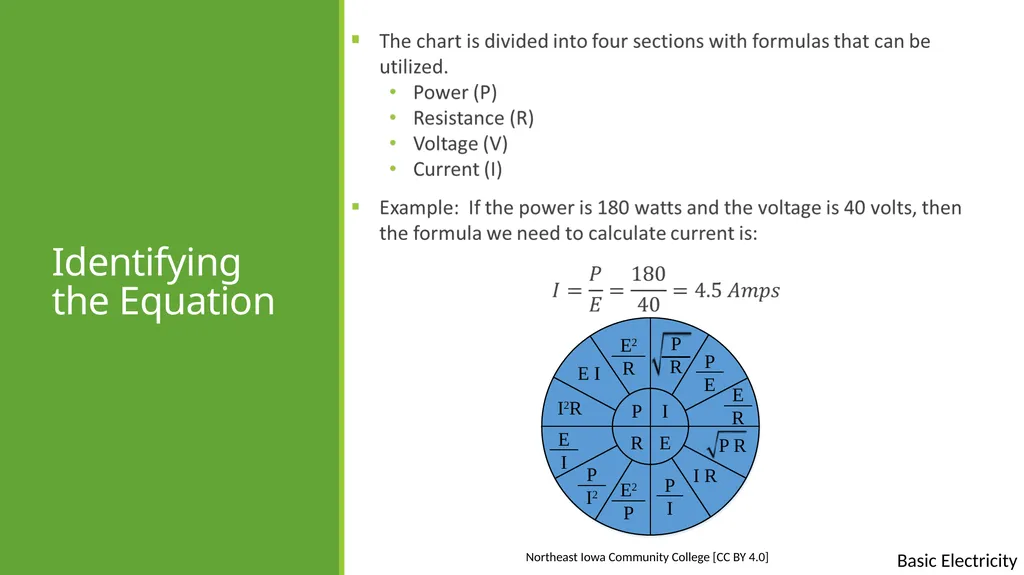
Identifying the Equation Northeast Iowa Community College [CC BY 4.0]<br>
13
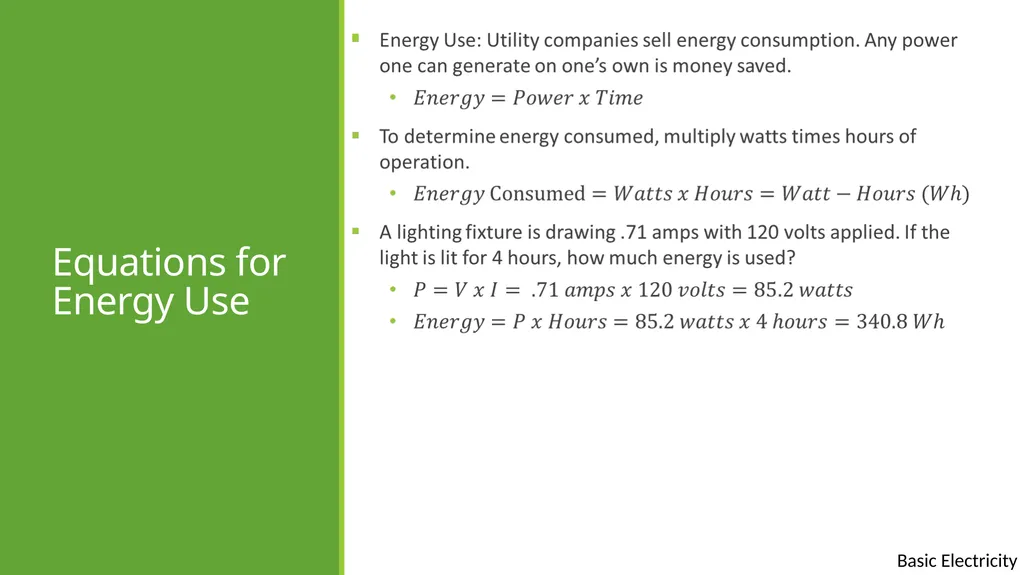
Equations for Energy Use<br>
14
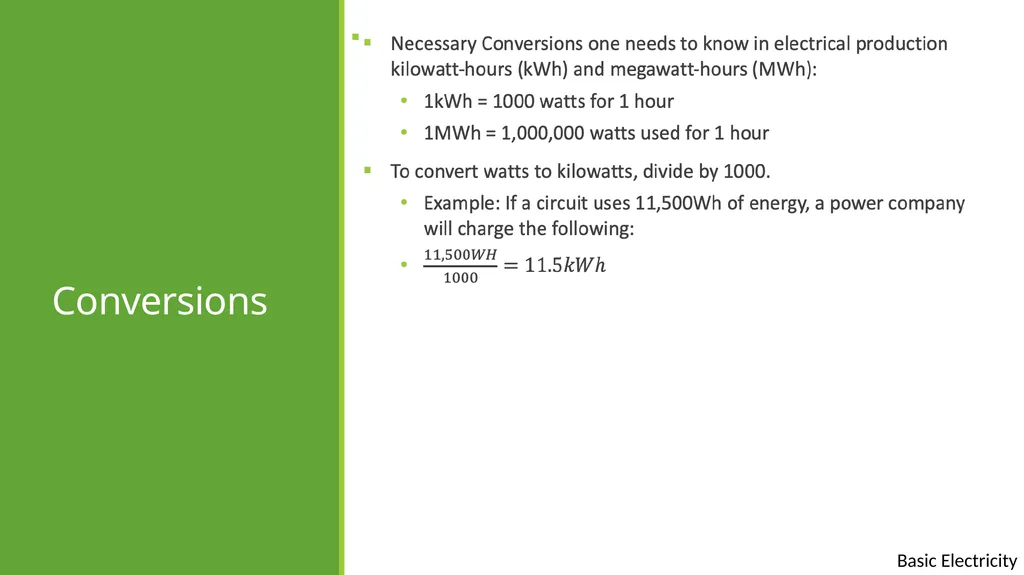
Conversions<br>
15
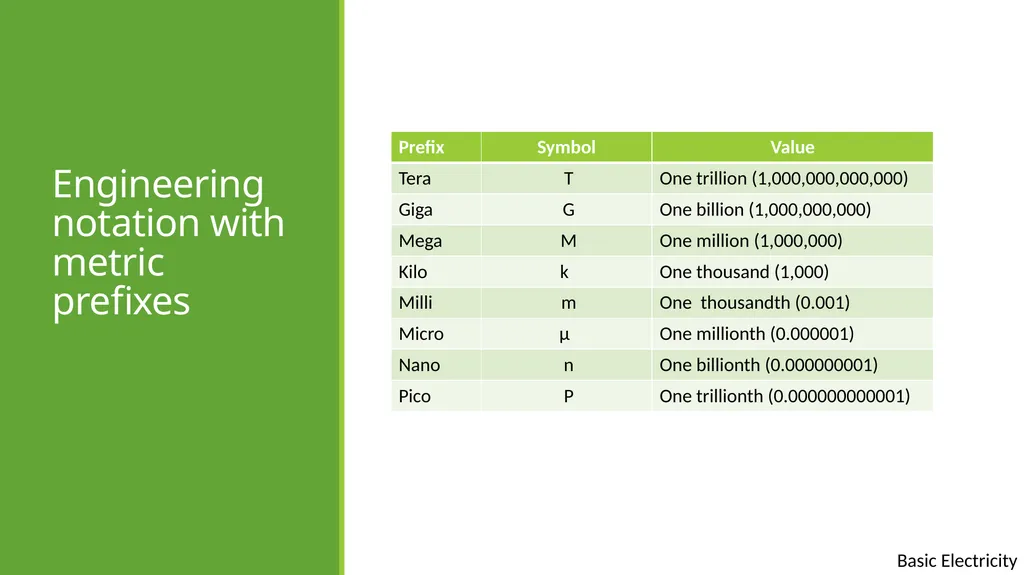
Engineering notation with metric prefixes<br>
16
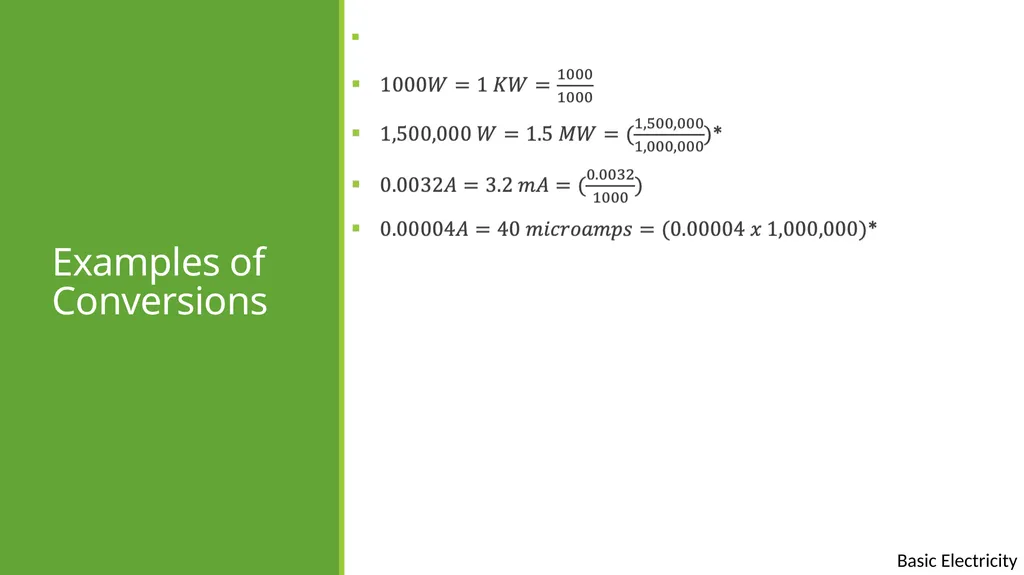
Examples of Conversions<br>
17
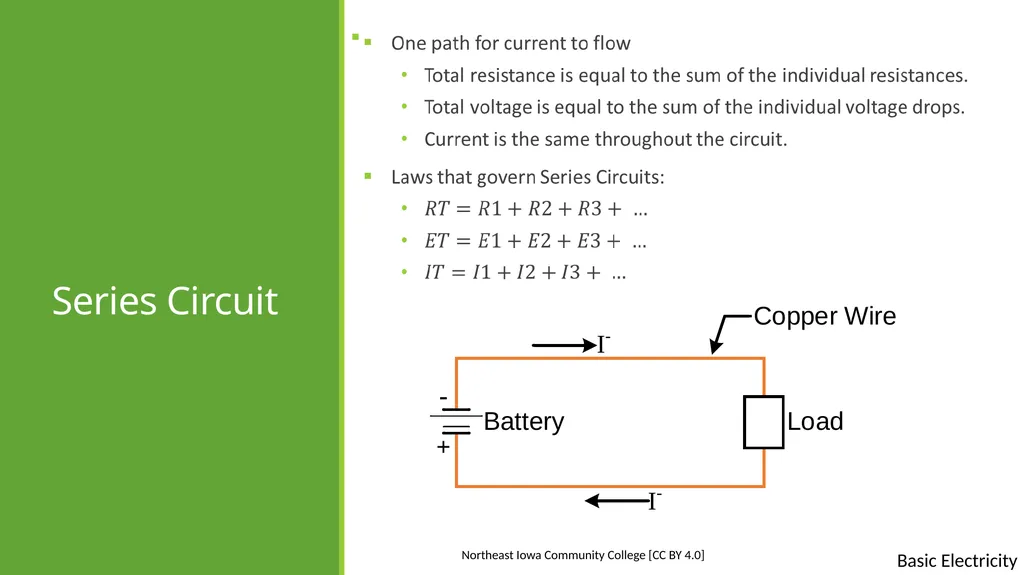
Series Circuit Northeast Iowa Community College [CC BY 4.0]<br>
18
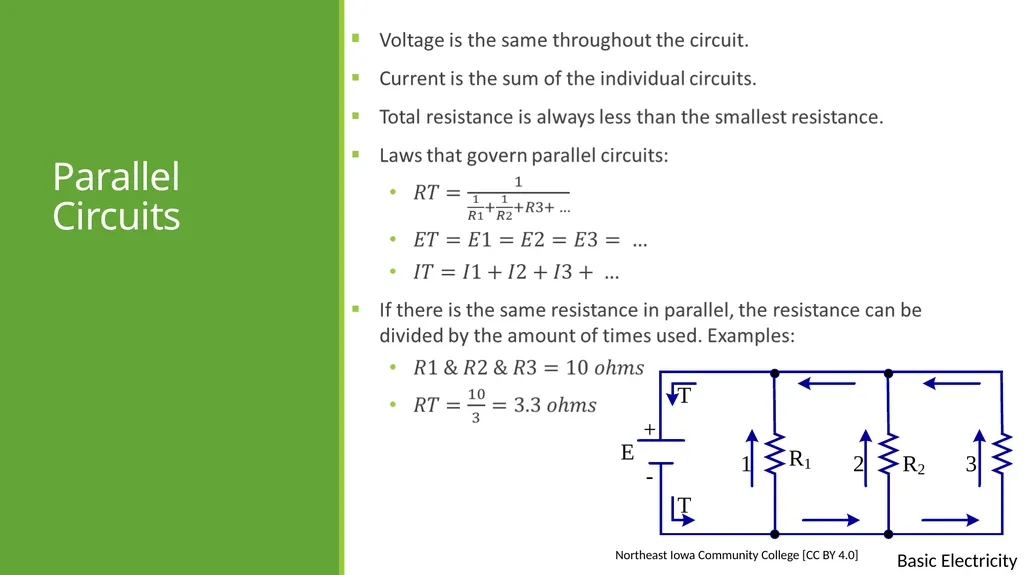
Parallel Circuits Northeast Iowa Community College [CC BY 4.0]<br>
19
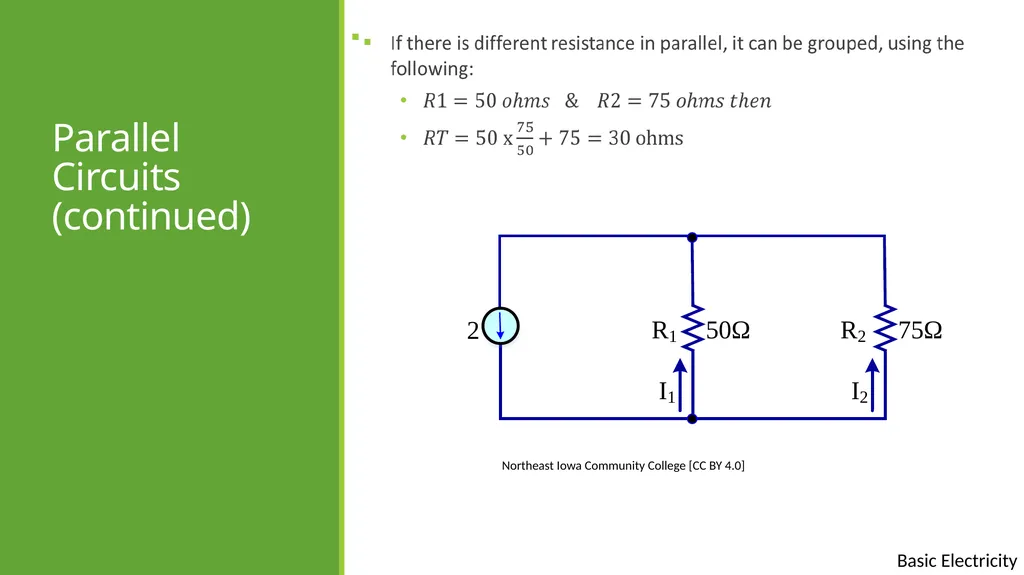
Parallel Circuits (continued) Northeast Iowa Community College [CC BY 4.0]<br>
20
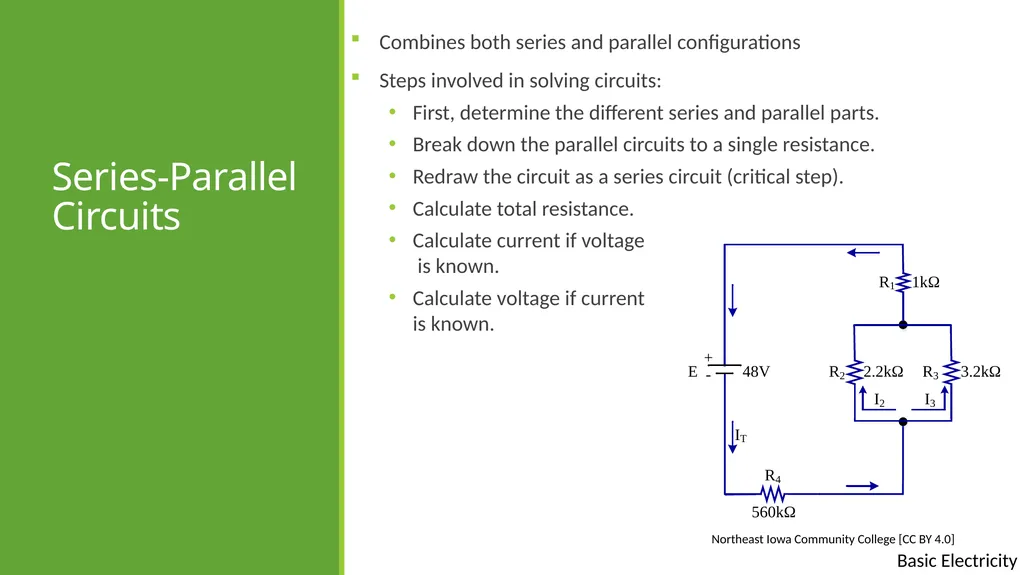
Series-Parallel Circuits Combines both series and parallel configurations
Steps involved in solving circuits:
First, determine the different series and parallel parts.
Break down the parallel circuits to a single resistance.
Redraw the circuit as a series circuit (critical step).
Calculate total resistance.
Calculate current if voltage is known.
Calculate voltage if current is known. Northeast Iowa Community College [CC BY 4.0]<br>
21
Conclusions Upon completion of this unit, students should be able to
Protons and neutrons do not move from atom to atom.
Current is the movement of electrons from one atom to another.
Insulators inhibit the flow of electrons while conductors allow for free flow of electrons. Semi- conductors are somewhere in the middle and will become critical in PV cell design.
Photons are energy particles from the sun used in the production of electricity in a PV module.
Voltage, current, and resistance are all related and used in circuit calculations by incorporating ohms law.
Energy consumed will be expressed in watt-hours, which is a calculation to use in determining a PV system and its requirements.
An electrical circuit has four requirements, including switch, load, power supply and conductors.
Any circuit contains only two different items: a switch to pass power or a load to consume power.
Circuits can be series, parallel, or series-parallel. Formulas exist to determine amounts.
When working with formulas, the answer is wrong if units are not identified. “This presentation was prepared by Northeast Iowa Community College under award EG-17-004 from the Iowa Energy Center. Any opinions, findings, and conclusions or recommendations expressed in this material are those of the author(s) and do not necessarily reflect the views of the Iowa Energy Center.”<br>