
Basic HIV Course for Health Professionals Session
DP
Published · 59 slides · 0 views
1 / 1









Description
Basic HIV Course for Health Professionals Session 3b: WHO Clinical Staging Learning Objectives By the end of this session participants should be able to: Describe the WHO staging system for HIV Overview of WHO Clinical Staging (1) HIV
Related Topics
Share
Embed code
Download this presentation From Below
"Basic HIV Course for Health Professionals Session" is the property of its rightful owner. Permission is granted to download and print the materials on this website for personal, non-commercial use only, and to display it on your personal computer provided you do not modify the materials and that you retain all copyright notices contained in the materials. By downloading content from our website, you accept the terms of this agreement.
Presentation Transcript
01
Basic HIV Course for Health Professionals Session 3b: WHO Clinical Staging<br>
02
Learning Objectives By the end of this session participants should be able to:
Describe the WHO staging system for HIV<br>
Describe the WHO staging system for HIV<br>
03
Overview of WHO Clinical Staging (1) HIV infection is classified by a staging system for tracking and monitoring the HIV epidemic and for providing clinicians and patients with important information about HIV disease stage and clinical management
South Africa uses the WHO staging system This Photo by Unknown Author is licensed under CC BY-NC-SA<br>
South Africa uses the WHO staging system This Photo by Unknown Author is licensed under CC BY-NC-SA<br>
04
Overview of WHO Clinical Staging (2) Four stages (1 – 4) using clinical criteria, once HIV infection confirmed
WHO staging used to determine:
Baseline evaluation
Eligibility for Co-trimoxazole
Disease progression
Treatment failure in absence of or in addition to lab findings<br>
WHO staging used to determine:
Baseline evaluation
Eligibility for Co-trimoxazole
Disease progression
Treatment failure in absence of or in addition to lab findings<br>
05
Stage 1 – Symptoms Asymptomatic
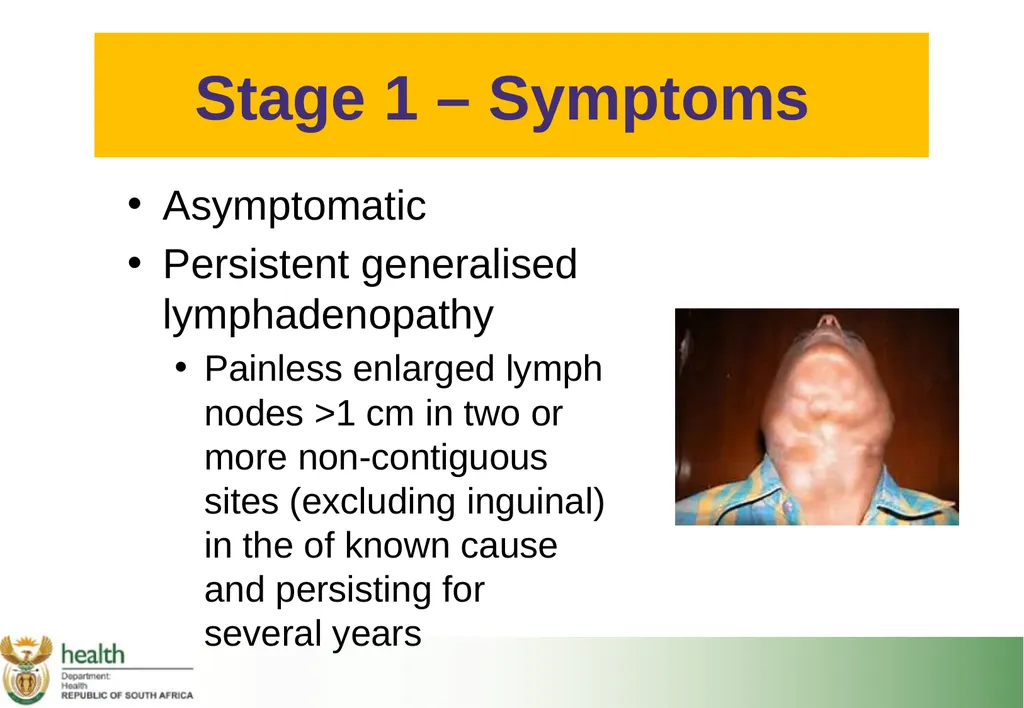
Persistent generalised lymphadenopathy
Painless enlarged lymph nodes >1 cm in two or more non-contiguous sites (excluding inguinal) in the of known cause and persisting for several years<br>
Persistent generalised lymphadenopathy
Painless enlarged lymph nodes >1 cm in two or more non-contiguous sites (excluding inguinal) in the of known cause and persisting for several years<br>
06
When Should Enlarged Lymph Nodes Be Investigated Further? Investigate further if lymph node is:
growing rapidly
painful/tender
large >2cm
matted
fluctuant
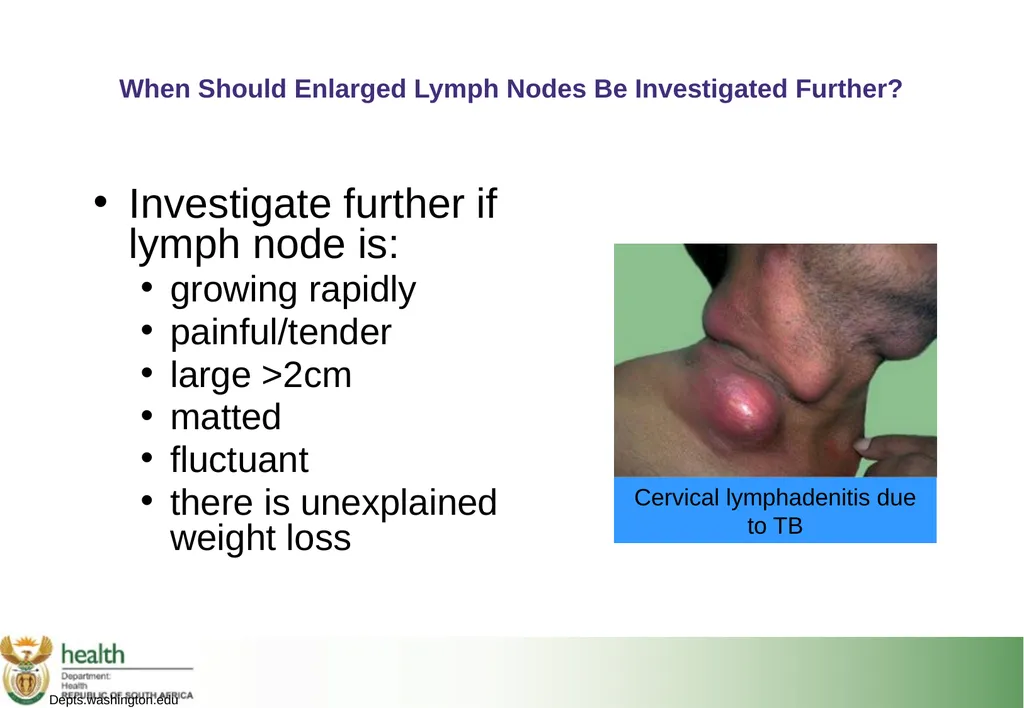
there is unexplained weight loss Cervical lymphadenitis due to TB Depts.washington.edu<br>
growing rapidly
painful/tender
large >2cm
matted
fluctuant
there is unexplained weight loss Cervical lymphadenitis due to TB Depts.washington.edu<br>
07
Stage 2– Symptoms Unexplained weight loss (<10% of presumed or measured weight)
Herpes zoster
Papular pruritic eruption
Angular cheilitis
Seborrhoeic dermatitis
Recurrent upper respiratory tract infections
Fungal nail infections
Recurrent oral ulceration<br>
Herpes zoster
Papular pruritic eruption
Angular cheilitis
Seborrhoeic dermatitis
Recurrent upper respiratory tract infections
Fungal nail infections
Recurrent oral ulceration<br>
08
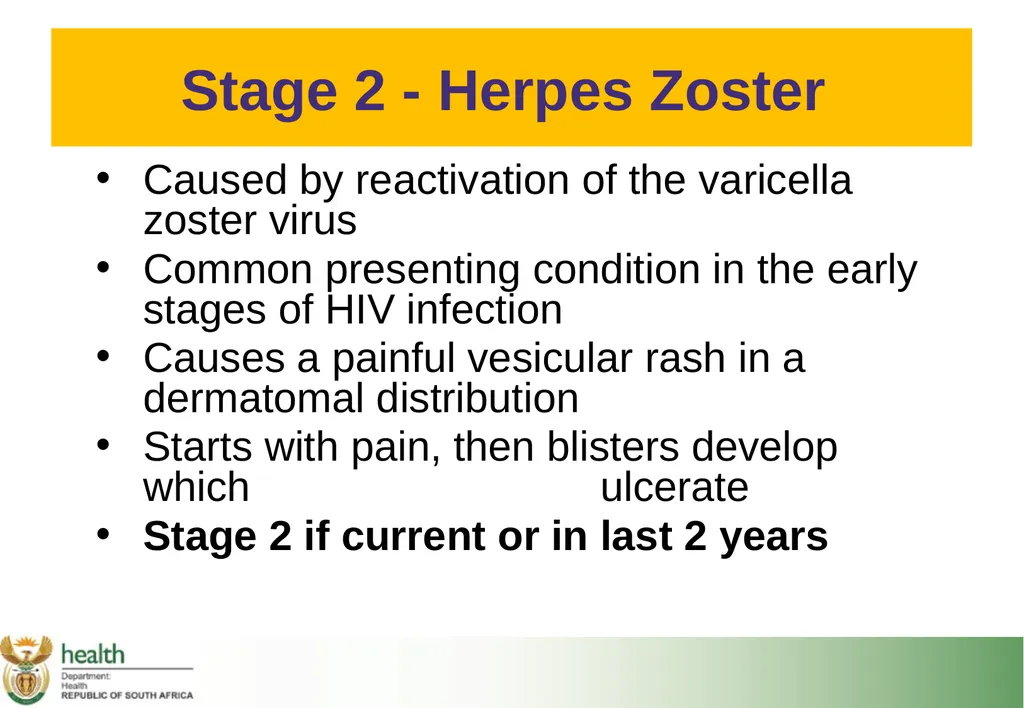
Stage 2 - Herpes Zoster Caused by reactivation of the varicella zoster virus
Common presenting condition in the early stages of HIV infection
Causes a painful vesicular rash in a dermatomal distribution
Starts with pain, then blisters develop which ulcerate
Stage 2 if current or in last 2 years<br>
Common presenting condition in the early stages of HIV infection
Causes a painful vesicular rash in a dermatomal distribution
Starts with pain, then blisters develop which ulcerate
Stage 2 if current or in last 2 years<br>
09
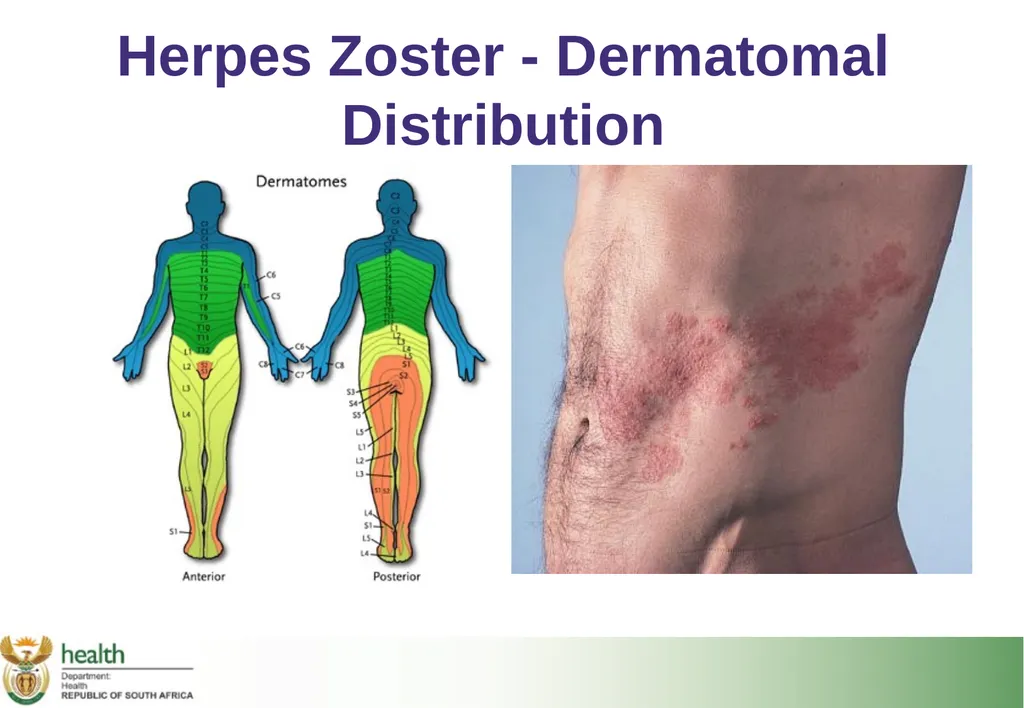
Herpes Zoster - Dermatomal Distribution<br>
10
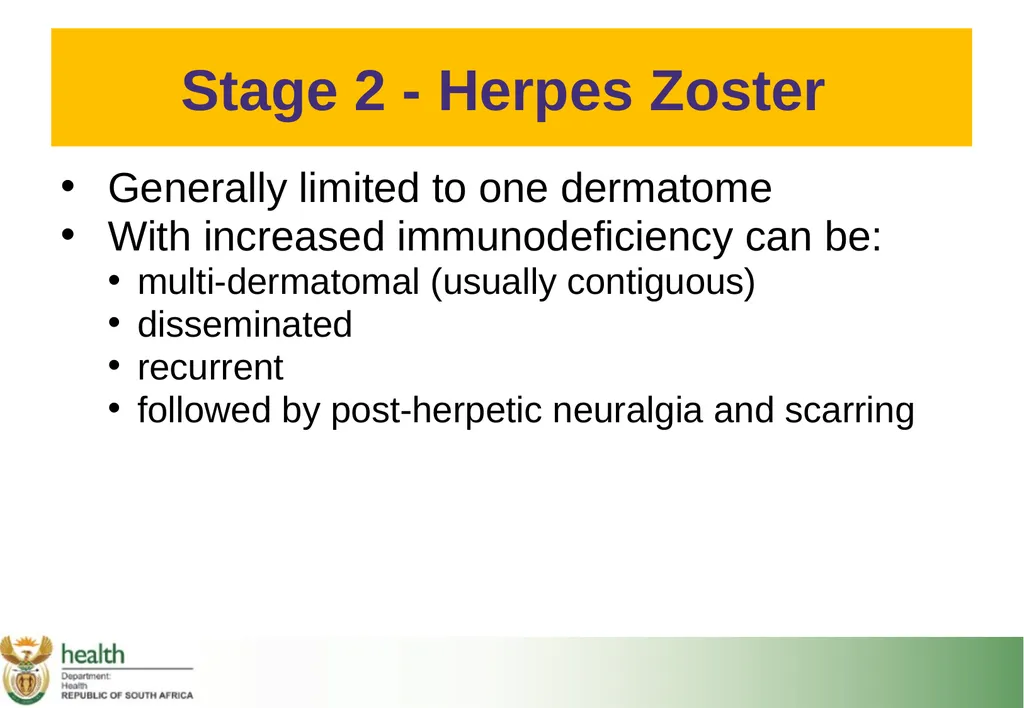
Stage 2 - Herpes Zoster Generally limited to one dermatome
With increased immunodeficiency can be:
multi-dermatomal (usually contiguous)
disseminated
recurrent
followed by post-herpetic neuralgia and scarring<br>
With increased immunodeficiency can be:
multi-dermatomal (usually contiguous)
disseminated
recurrent
followed by post-herpetic neuralgia and scarring<br>
11
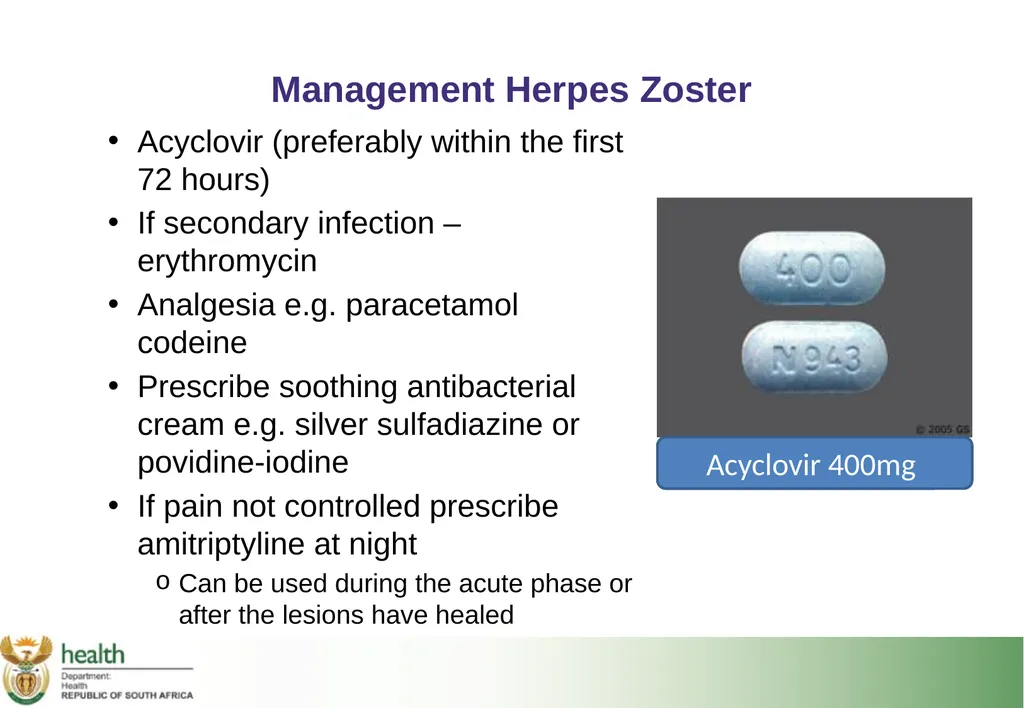
Management Herpes Zoster Acyclovir (preferably within the first 72 hours)
If secondary infection – erythromycin
Analgesia e.g. paracetamol codeine
Prescribe soothing antibacterial cream e.g. silver sulfadiazine or povidine-iodine
If pain not controlled prescribe amitriptyline at night
Can be used during the acute phase or after the lesions have healed Acyclovir 400mg<br>
If secondary infection – erythromycin
Analgesia e.g. paracetamol codeine
Prescribe soothing antibacterial cream e.g. silver sulfadiazine or povidine-iodine
If pain not controlled prescribe amitriptyline at night
Can be used during the acute phase or after the lesions have healed Acyclovir 400mg<br>
12
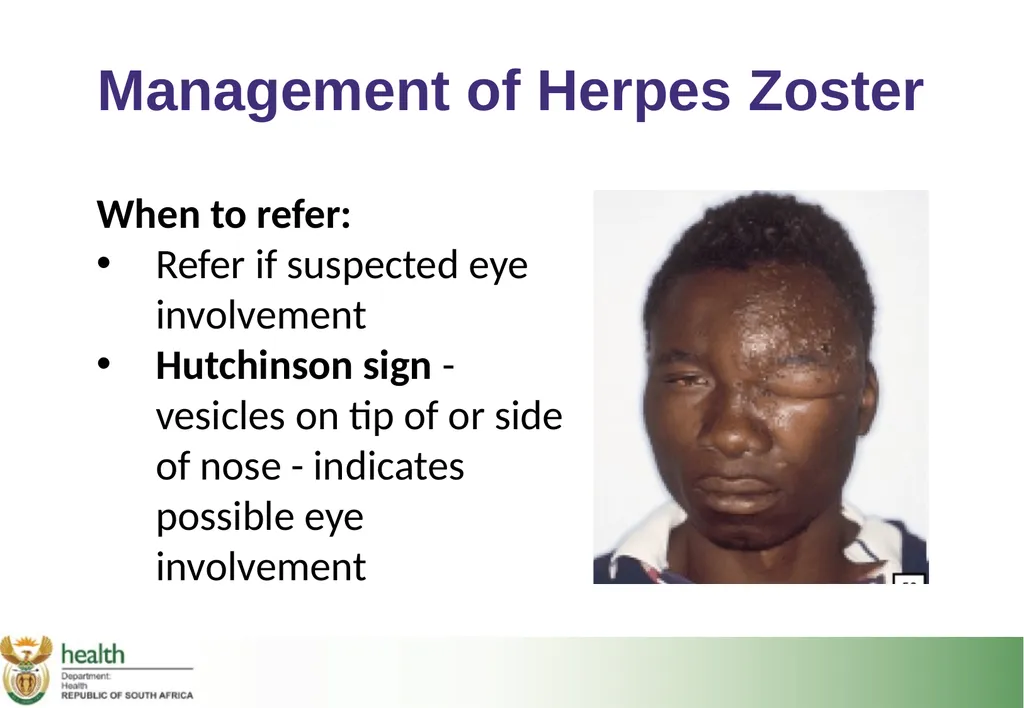
Management of Herpes Zoster When to refer:
Refer if suspected eye involvement
Hutchinson sign - vesicles on tip of or side of nose - indicates possible eye involvement<br>
Refer if suspected eye involvement
Hutchinson sign - vesicles on tip of or side of nose - indicates possible eye involvement<br>
13
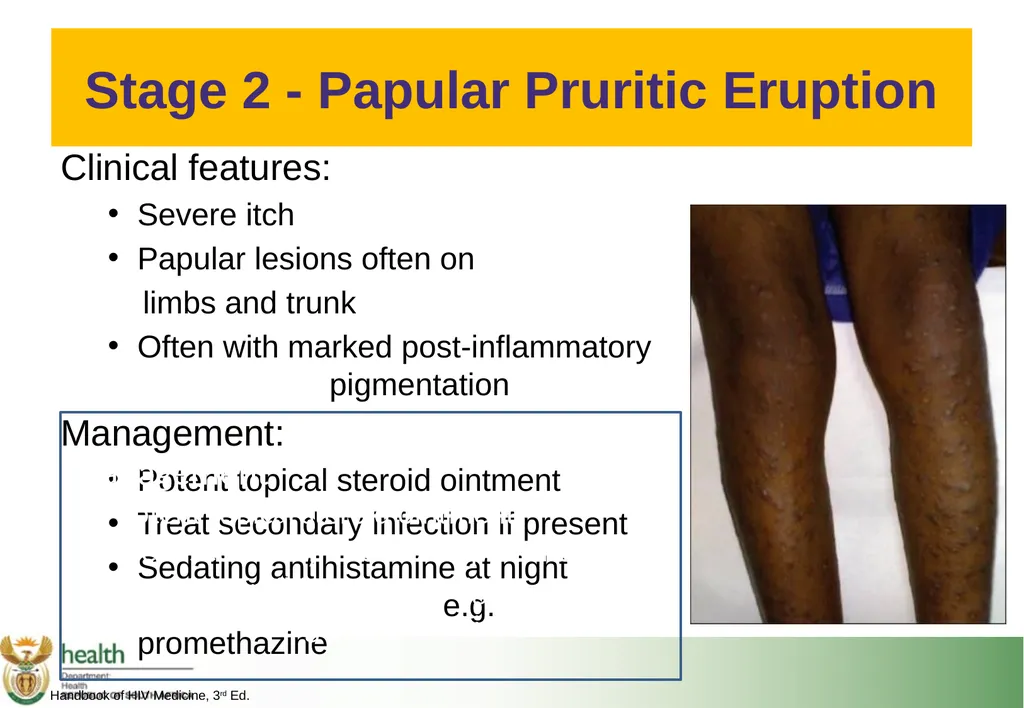
Stage 2 - Papular Pruritic Eruption Clinical features:
Severe itch
Papular lesions often on
limbs and trunk
Often with marked post-inflammatory pigmentation
Management:
Potent topical steroid ointment
Treat secondary infection if present
Sedating antihistamine at night e.g. promethazine Handbook of HIV Medicine, 3rd Ed. Management:
Potent topical steroid ointment
Treat secondary infection if present
Sedating antihistamine at night e.g. promethazine<br>
Severe itch
Papular lesions often on
limbs and trunk
Often with marked post-inflammatory pigmentation
Management:
Potent topical steroid ointment
Treat secondary infection if present
Sedating antihistamine at night e.g. promethazine Handbook of HIV Medicine, 3rd Ed. Management:
Potent topical steroid ointment
Treat secondary infection if present
Sedating antihistamine at night e.g. promethazine<br>
14
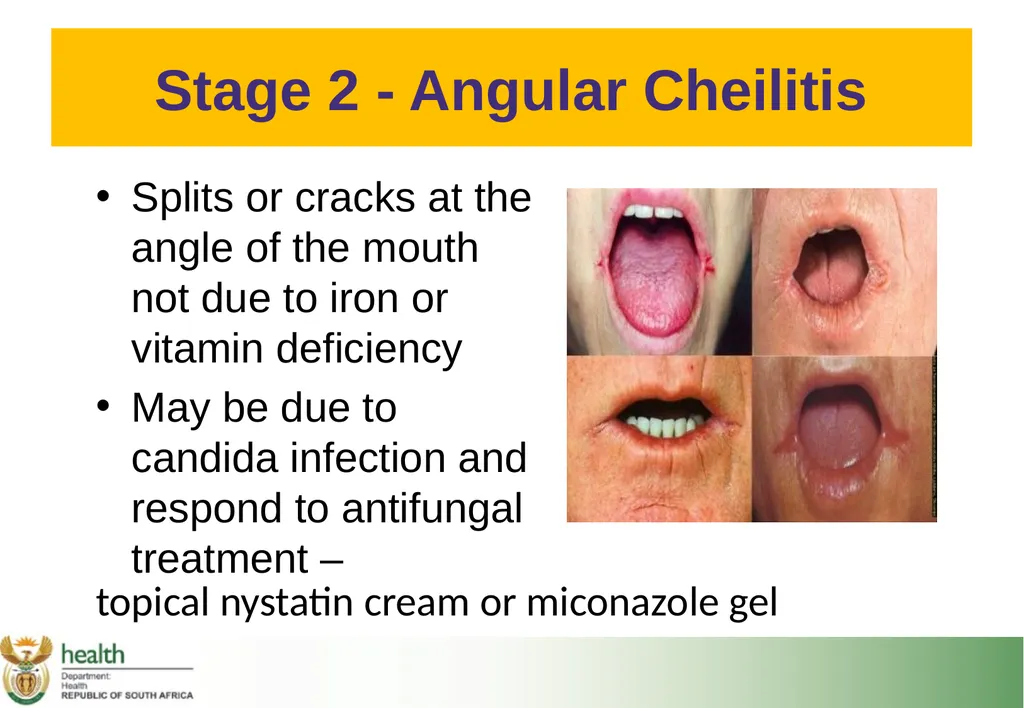
Stage 2 - Angular Cheilitis Splits or cracks at the angle of the mouth not due to iron or vitamin deficiency
May be due to candida infection and respond to antifungal treatment – topical nystatin cream or miconazole gel<br>
May be due to candida infection and respond to antifungal treatment – topical nystatin cream or miconazole gel<br>
15
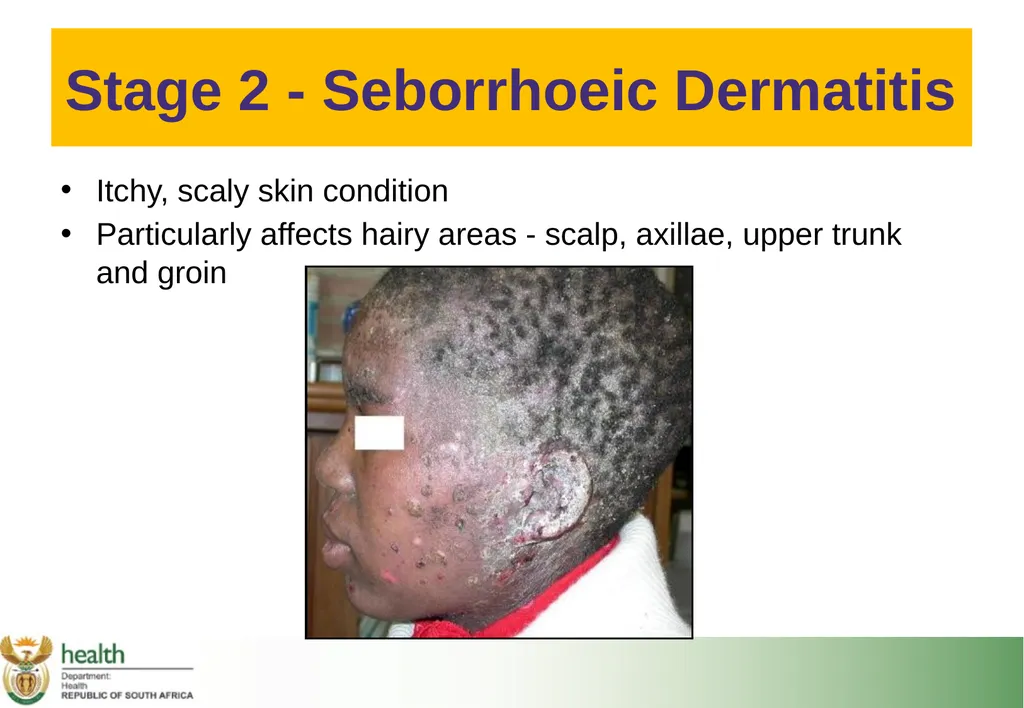
Stage 2 - Seborrhoeic Dermatitis Itchy, scaly skin condition
Particularly affects hairy areas - scalp, axillae, upper trunk and groin<br>
Particularly affects hairy areas - scalp, axillae, upper trunk and groin<br>
16
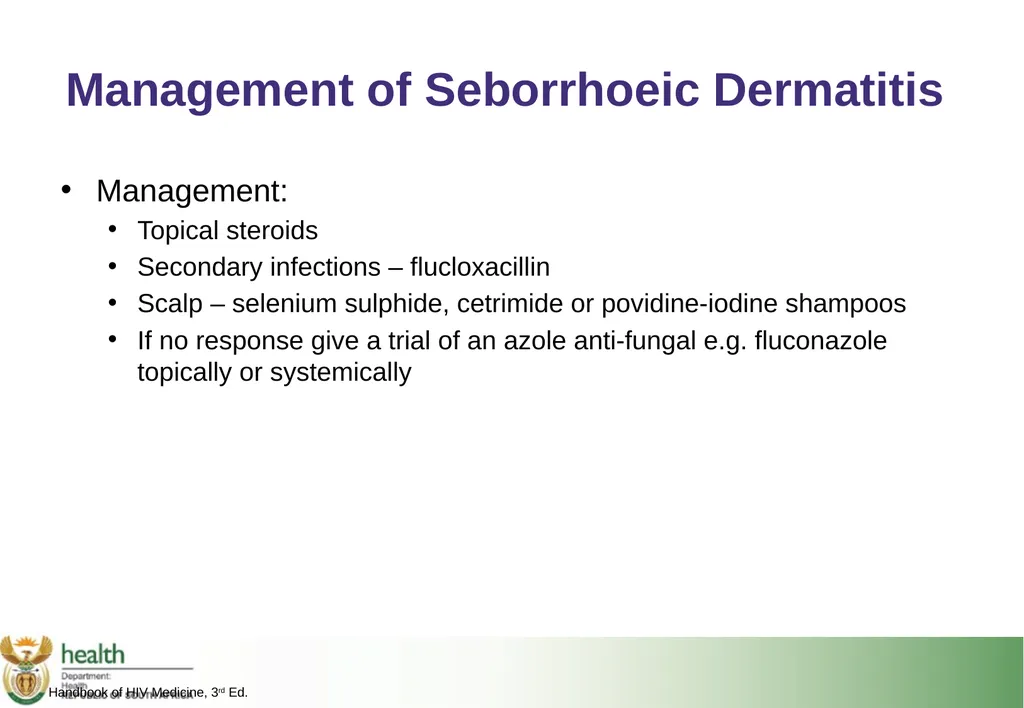
Management of Seborrhoeic Dermatitis Management:
Topical steroids
Secondary infections – flucloxacillin
Scalp – selenium sulphide, cetrimide or povidine-iodine shampoos
If no response give a trial of an azole anti-fungal e.g. fluconazole topically or systemically Handbook of HIV Medicine, 3rd Ed.<br>
Topical steroids
Secondary infections – flucloxacillin
Scalp – selenium sulphide, cetrimide or povidine-iodine shampoos
If no response give a trial of an azole anti-fungal e.g. fluconazole topically or systemically Handbook of HIV Medicine, 3rd Ed.<br>
17
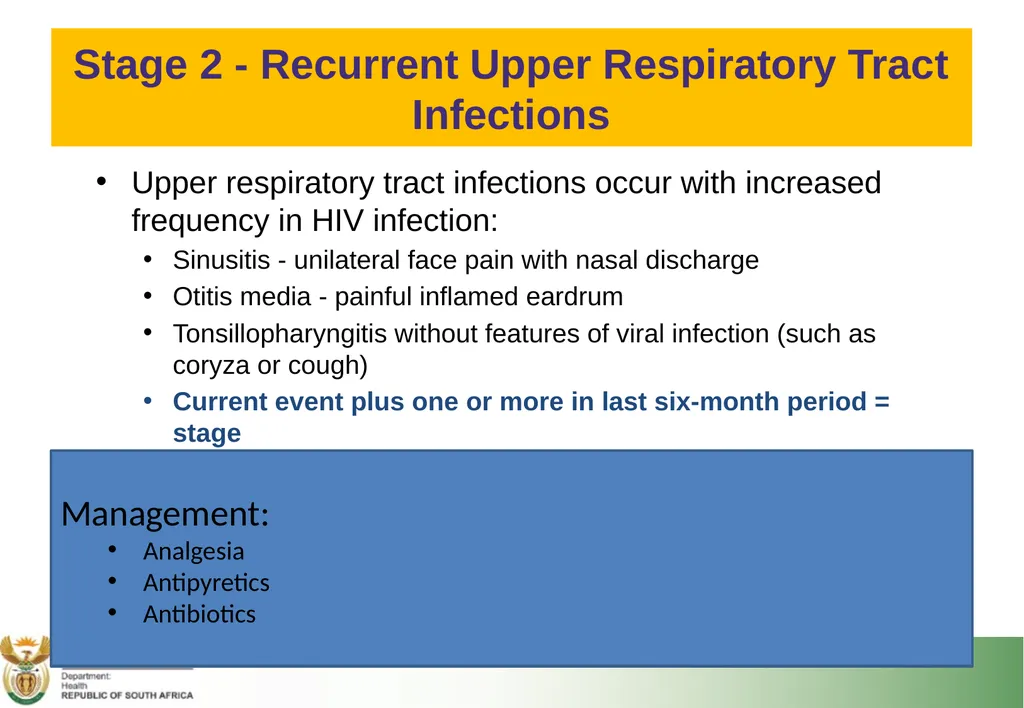
Stage 2 - Recurrent Upper Respiratory Tract Infections Upper respiratory tract infections occur with increased frequency in HIV infection:
Sinusitis - unilateral face pain with nasal discharge
Otitis media - painful inflamed eardrum
Tonsillopharyngitis without features of viral infection (such as coryza or cough)
Current event plus one or more in last six-month period = stage Management:
Analgesia
Antipyretics
Antibiotics<br>
Sinusitis - unilateral face pain with nasal discharge
Otitis media - painful inflamed eardrum
Tonsillopharyngitis without features of viral infection (such as coryza or cough)
Current event plus one or more in last six-month period = stage Management:
Analgesia
Antipyretics
Antibiotics<br>
18
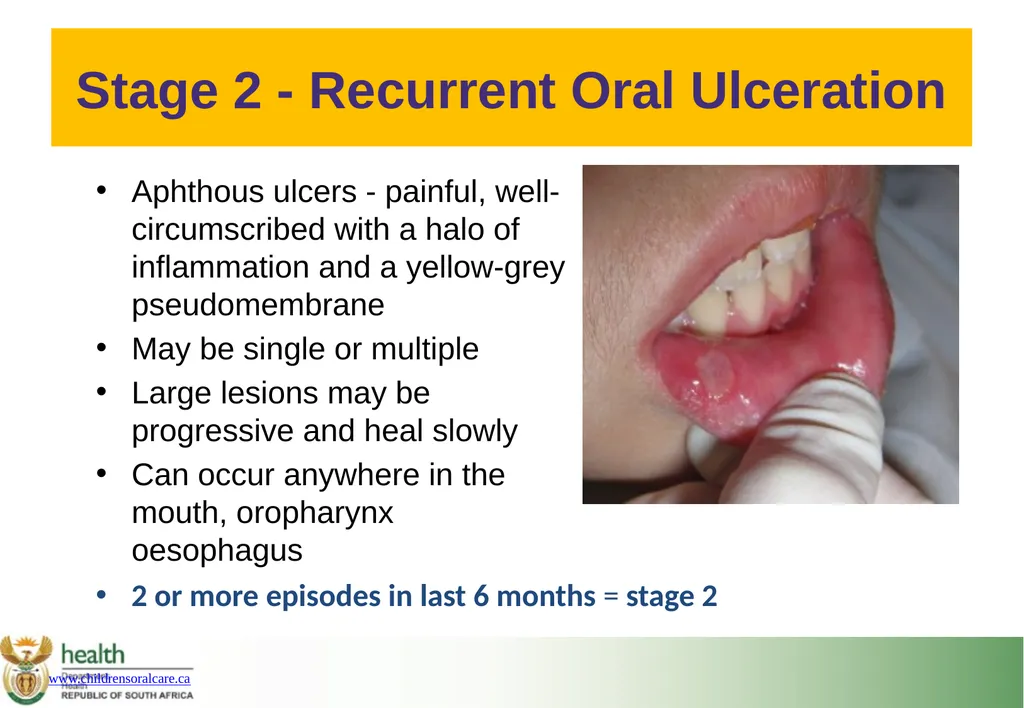
Stage 2 - Recurrent Oral Ulceration Aphthous ulcers - painful, well-circumscribed with a halo of inflammation and a yellow-grey pseudomembrane
May be single or multiple
Large lesions may be progressive and heal slowly
Can occur anywhere in the mouth, oropharynx oesophagus www.childrensoralcare.ca 2 or more episodes in last 6 months = stage 2<br>
May be single or multiple
Large lesions may be progressive and heal slowly
Can occur anywhere in the mouth, oropharynx oesophagus www.childrensoralcare.ca 2 or more episodes in last 6 months = stage 2<br>
19
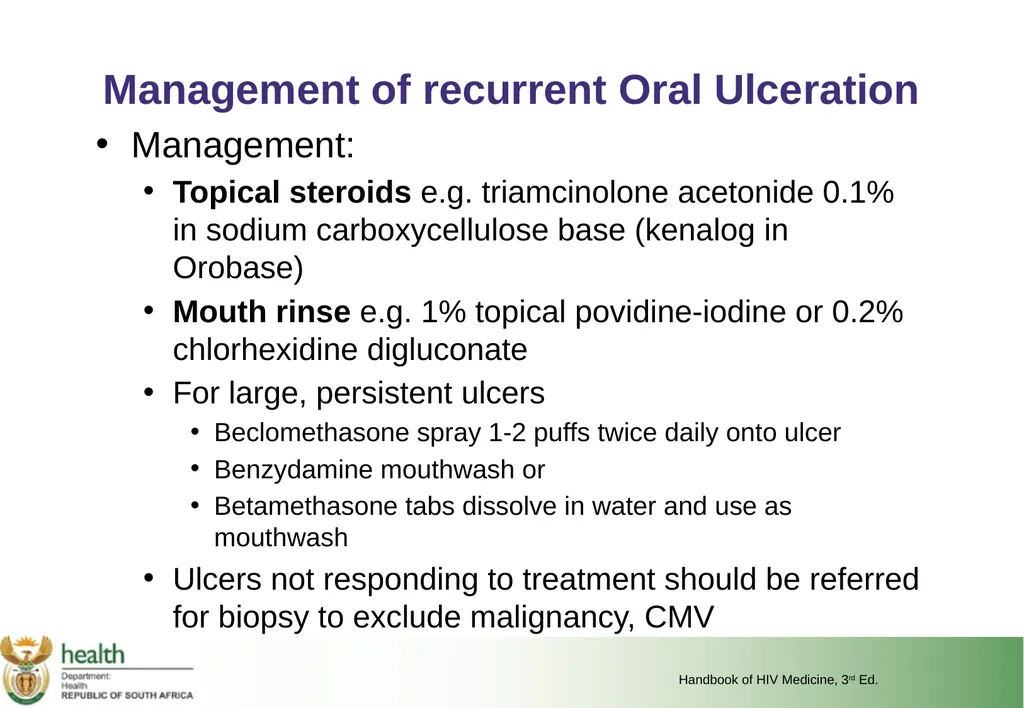
Management of recurrent Oral Ulceration Management:
Topical steroids e.g. triamcinolone acetonide 0.1% in sodium carboxycellulose base (kenalog in Orobase)
Mouth rinse e.g. 1% topical povidine-iodine or 0.2% chlorhexidine digluconate
For large, persistent ulcers
Beclomethasone spray 1-2 puffs twice daily onto ulcer
Benzydamine mouthwash or
Betamethasone tabs dissolve in water and use as mouthwash
Ulcers not responding to treatment should be referred for biopsy to exclude malignancy, CMV Handbook of HIV Medicine, 3rd Ed.<br>
Topical steroids e.g. triamcinolone acetonide 0.1% in sodium carboxycellulose base (kenalog in Orobase)
Mouth rinse e.g. 1% topical povidine-iodine or 0.2% chlorhexidine digluconate
For large, persistent ulcers
Beclomethasone spray 1-2 puffs twice daily onto ulcer
Benzydamine mouthwash or
Betamethasone tabs dissolve in water and use as mouthwash
Ulcers not responding to treatment should be referred for biopsy to exclude malignancy, CMV Handbook of HIV Medicine, 3rd Ed.<br>
20
Stage 3- Symptoms Chronic diarrhoea
Persistent fever
Persistent oral candidiasis
Oral hairy leukoplakia
Severe bacterial infections
Gingival and periodontal lesions
Haematological lesions<br>
Persistent fever
Persistent oral candidiasis
Oral hairy leukoplakia
Severe bacterial infections
Gingival and periodontal lesions
Haematological lesions<br>
21
Stage 3 - Unexplained Severe Weight Loss Severe unexplained weight loss (>10% of presumed or measured body weight)
Visible thinning of face, waist and extremities with obvious wasting or body mass index <18.5 kg/m2
In pregnancy, the weight loss may be masked
If seeing a patient for the first time, how would you determine that they have lost weight?<br>
Visible thinning of face, waist and extremities with obvious wasting or body mass index <18.5 kg/m2
In pregnancy, the weight loss may be masked
If seeing a patient for the first time, how would you determine that they have lost weight?<br>
22
Stage 3 – Chronic Diarrhoea Unexplained chronic diarrhoea for >1month
Loose or watery stools three or more times daily
Reported for longer than one month
2 or more stool tests reveal no pathogens<br>
Loose or watery stools three or more times daily
Reported for longer than one month
2 or more stool tests reveal no pathogens<br>
23
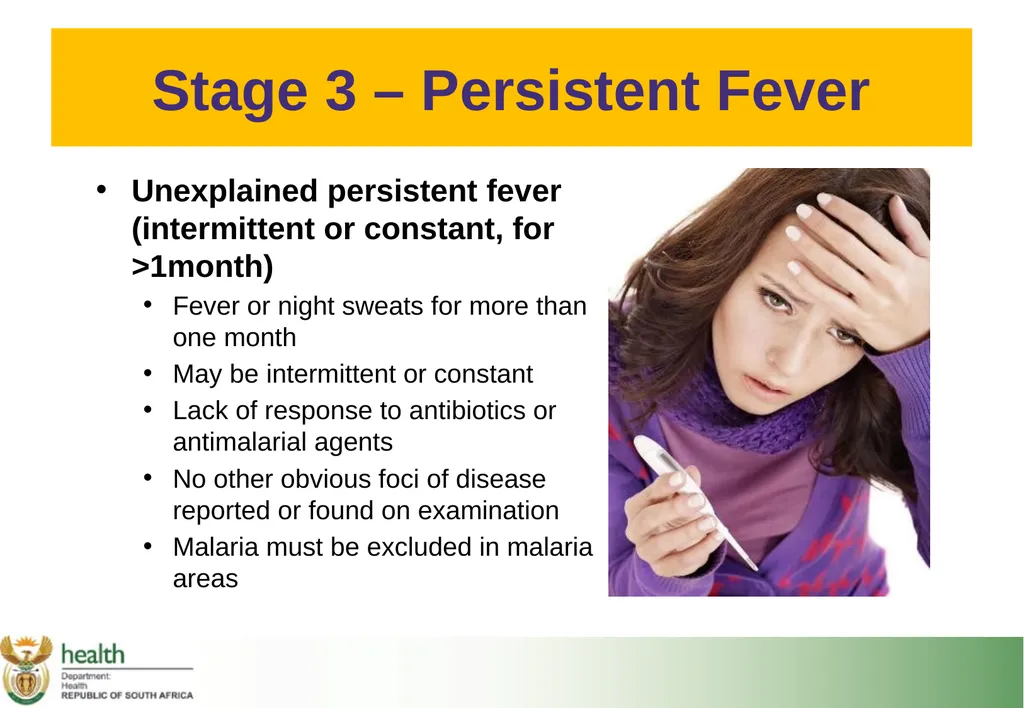
Stage 3 – Persistent Fever Unexplained persistent fever (intermittent or constant, for >1month)
Fever or night sweats for more than one month
May be intermittent or constant
Lack of response to antibiotics or antimalarial agents
No other obvious foci of disease reported or found on examination
Malaria must be excluded in malaria areas<br>
Fever or night sweats for more than one month
May be intermittent or constant
Lack of response to antibiotics or antimalarial agents
No other obvious foci of disease reported or found on examination
Malaria must be excluded in malaria areas<br>
24
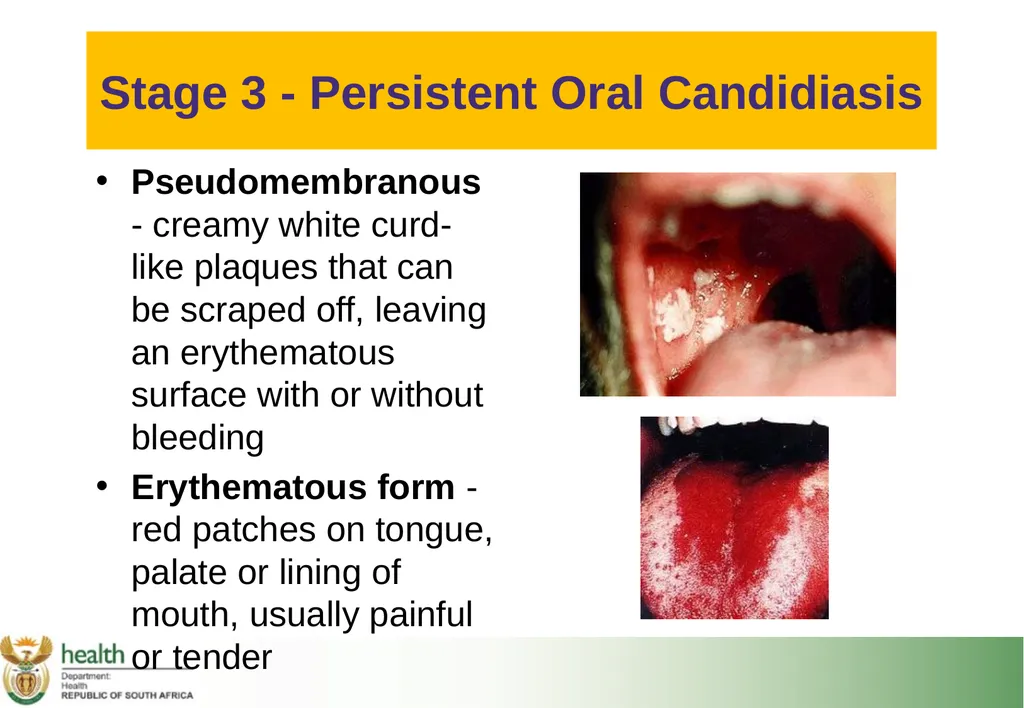
Stage 3 - Persistent Oral Candidiasis Pseudomembranous - creamy white curd-like plaques that can be scraped off, leaving an erythematous surface with or without bleeding
Erythematous form - red patches on tongue, palate or lining of mouth, usually painful or tender<br>
Erythematous form - red patches on tongue, palate or lining of mouth, usually painful or tender<br>
25
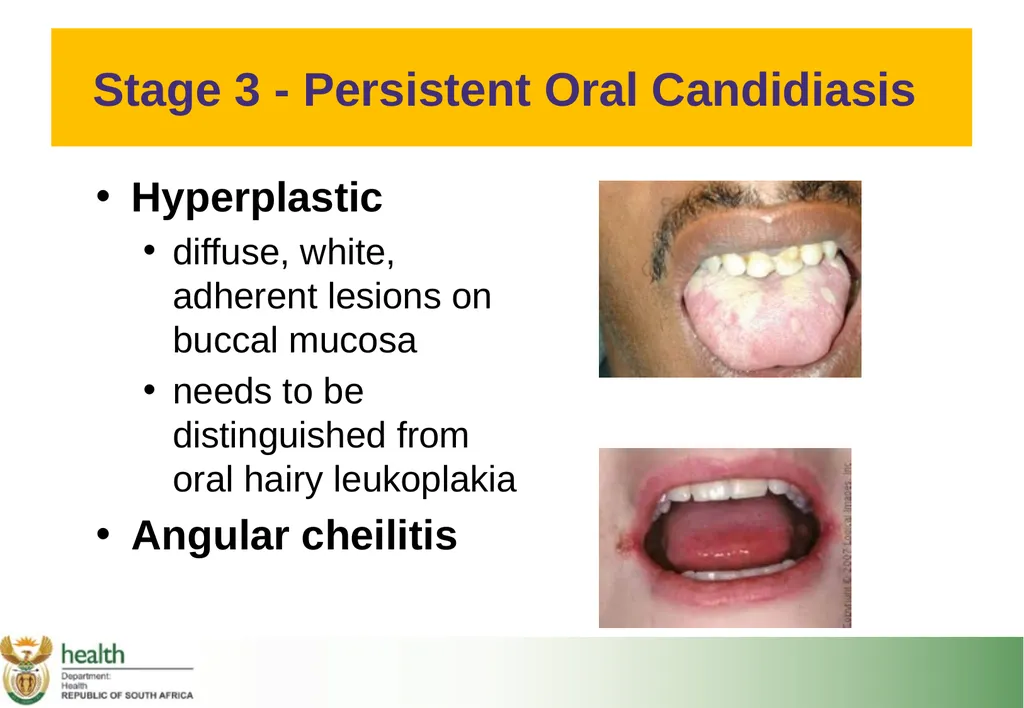
Stage 3 - Persistent Oral Candidiasis Hyperplastic
diffuse, white, adherent lesions on buccal mucosa
needs to be distinguished from oral hairy leukoplakia
Angular cheilitis<br>
diffuse, white, adherent lesions on buccal mucosa
needs to be distinguished from oral hairy leukoplakia
Angular cheilitis<br>
26
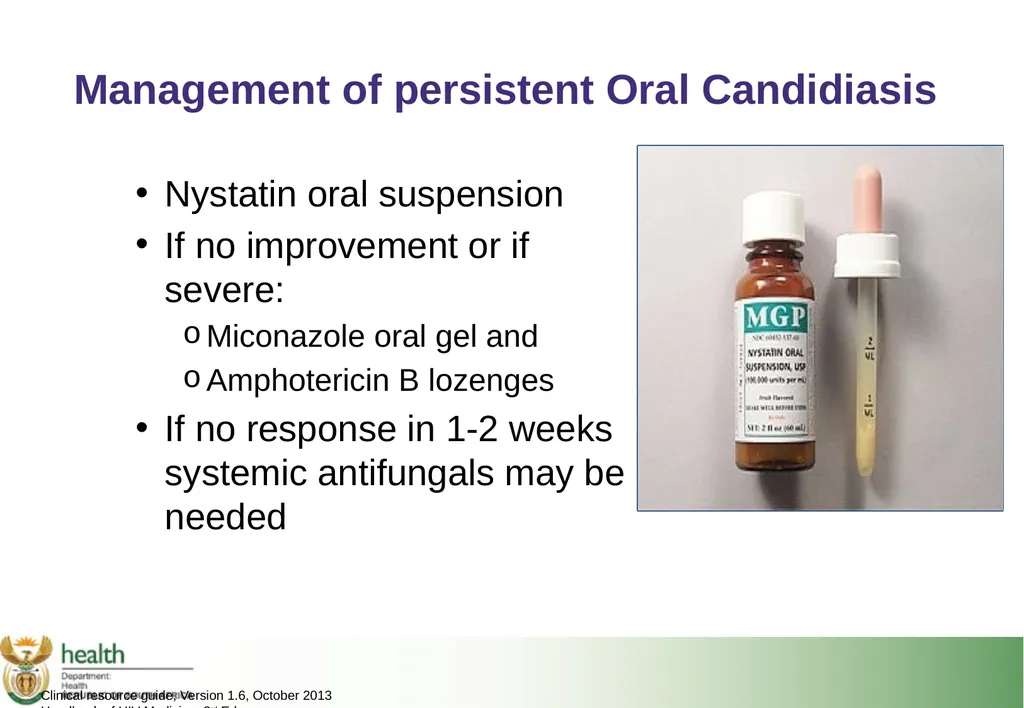
Management of persistent Oral Candidiasis Nystatin oral suspension
If no improvement or if severe:
Miconazole oral gel and
Amphotericin B lozenges
If no response in 1-2 weeks systemic antifungals may be needed Clinical resource guide, Version 1.6, October 2013
Handbook of HIV Medicine, 3rd Ed.<br>
If no improvement or if severe:
Miconazole oral gel and
Amphotericin B lozenges
If no response in 1-2 weeks systemic antifungals may be needed Clinical resource guide, Version 1.6, October 2013
Handbook of HIV Medicine, 3rd Ed.<br>
27
Stage 3 - Oral Hairy Leukoplakia May be unilateral or bilateral
Cannot be removed
Asymptomatic
Does not require specific treatment
May resolve with ART Clinical resource guide, Version 1.6, October 2013 Whitish-grey corrugated lesions
Occur on lateral borders of the tongue<br>
Cannot be removed
Asymptomatic
Does not require specific treatment
May resolve with ART Clinical resource guide, Version 1.6, October 2013 Whitish-grey corrugated lesions
Occur on lateral borders of the tongue<br>
28
Oral Hairy Leukoplakia How is Oral Hairy Leukoplakia Differentiated from Oral Candida?
Oral hairy leukoplakia cannot be scraped off and does not bleed
Oral candida can be scraped off with a spatula and may bleed<br>
Oral hairy leukoplakia cannot be scraped off and does not bleed
Oral candida can be scraped off with a spatula and may bleed<br>
29
Stage 3- Symptoms Examples:
Pneumonia
Empyema
Pyomyositis
Bone or joint infection
Meningitis
Bacteraemia
Severe pelvic inflammatory disease<br>
Pneumonia
Empyema
Pyomyositis
Bone or joint infection
Meningitis
Bacteraemia
Severe pelvic inflammatory disease<br>
30
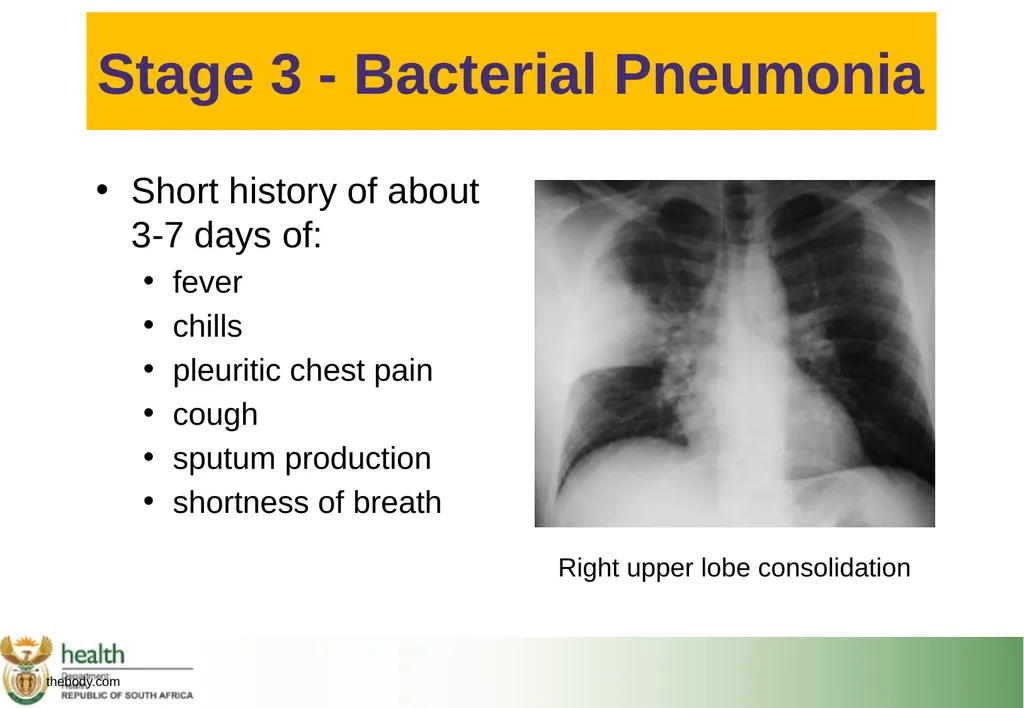
Stage 3 - Bacterial Pneumonia Short history of about 3-7 days of:
fever
chills
pleuritic chest pain
cough
sputum production
shortness of breath Right upper lobe consolidation thebody.com<br>
fever
chills
pleuritic chest pain
cough
sputum production
shortness of breath Right upper lobe consolidation thebody.com<br>
31
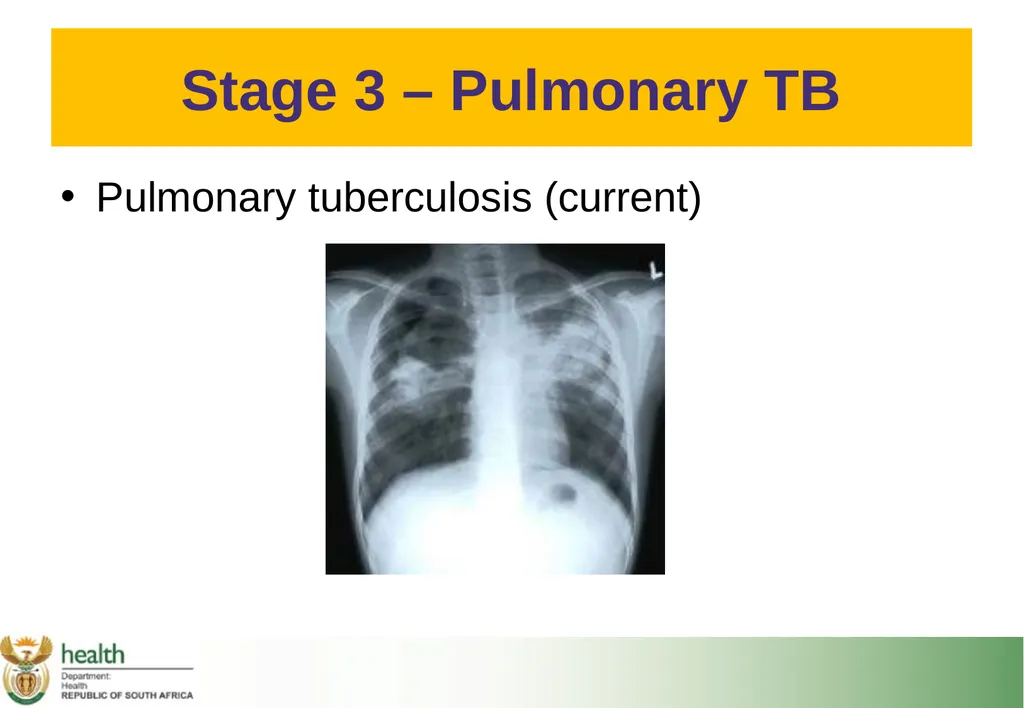
Stage 3 – Pulmonary TB Pulmonary tuberculosis (current)<br>
32
Management of Bacterial Pneumonia Uncomplicated, non-severe bacterial pneumonia:
Amoxicillin or amoxicillin/clavulanic acid
Slow or incomplete resolution despite treatment – refer to the doctor
Refer the following patients to hospital:
Confusion
Blood urea >7mmol/l
Respiratory rate >30/min
BP <90 systolic or <60 diastolic
Give 1g Ceftriaxone IV stat at outpatient facility and refer<br>
Amoxicillin or amoxicillin/clavulanic acid
Slow or incomplete resolution despite treatment – refer to the doctor
Refer the following patients to hospital:
Confusion
Blood urea >7mmol/l
Respiratory rate >30/min
BP <90 systolic or <60 diastolic
Give 1g Ceftriaxone IV stat at outpatient facility and refer<br>
33
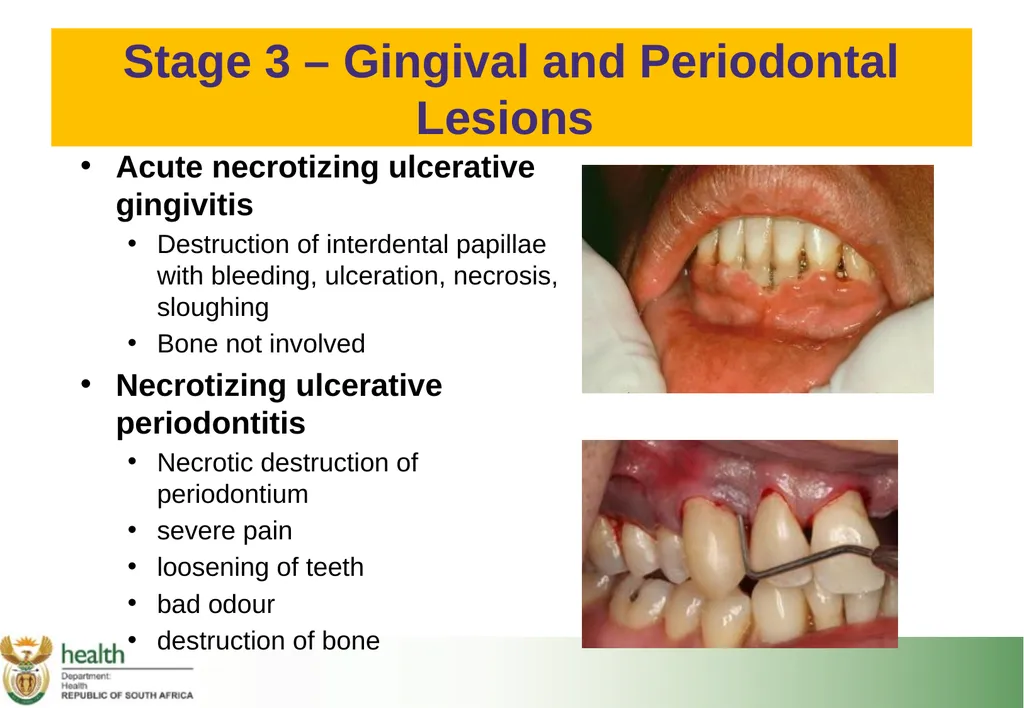
Stage 3 – Gingival and Periodontal Lesions Acute necrotizing ulcerative gingivitis
Destruction of interdental papillae with bleeding, ulceration, necrosis, sloughing
Bone not involved
Necrotizing ulcerative periodontitis
Necrotic destruction of periodontium
severe pain
loosening of teeth
bad odour
destruction of bone<br>
Destruction of interdental papillae with bleeding, ulceration, necrosis, sloughing
Bone not involved
Necrotizing ulcerative periodontitis
Necrotic destruction of periodontium
severe pain
loosening of teeth
bad odour
destruction of bone<br>
34
Management of Gingival and Periodontal Lesions Encourage oral health – brushing and flossing
Dental referral
Debridement
Topical antiseptics
If severe, systemic antibiotics e.g. metronidazole Handbook of HIV Medicine, 3rd Ed.<br>
Dental referral
Debridement
Topical antiseptics
If severe, systemic antibiotics e.g. metronidazole Handbook of HIV Medicine, 3rd Ed.<br>
35
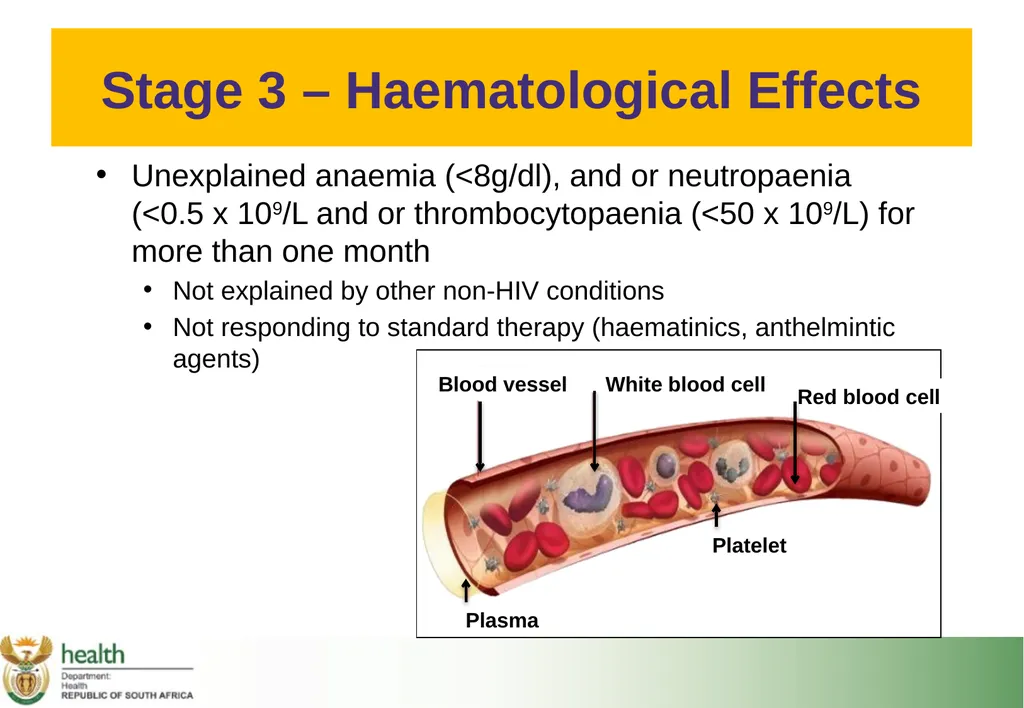
Stage 3 – Haematological Effects Unexplained anaemia (<8g/dl), and or neutropaenia (<0.5 x 10⁹/L and or thrombocytopaenia (<50 x 109/L) for more than one month
Not explained by other non-HIV conditions
Not responding to standard therapy (haematinics, anthelmintic agents)<br>
Not explained by other non-HIV conditions
Not responding to standard therapy (haematinics, anthelmintic agents)<br>
36
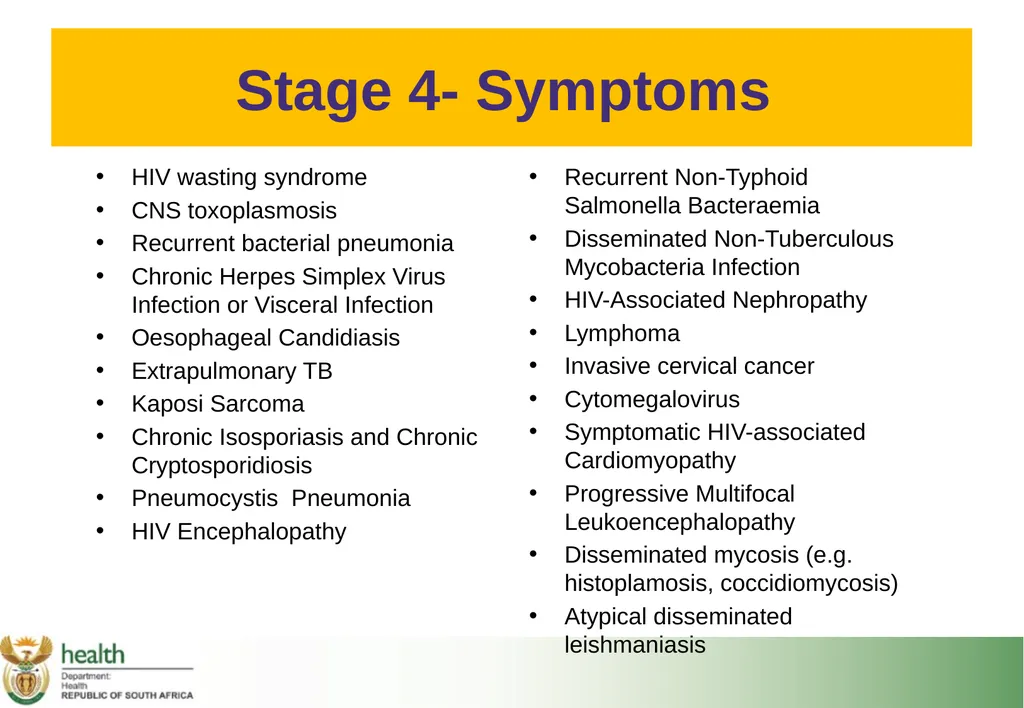
Stage 4- Symptoms HIV wasting syndrome
CNS toxoplasmosis
Recurrent bacterial pneumonia
Chronic Herpes Simplex Virus Infection or Visceral Infection
Oesophageal Candidiasis
Extrapulmonary TB
Kaposi Sarcoma
Chronic Isosporiasis and Chronic Cryptosporidiosis
Pneumocystis Pneumonia
HIV Encephalopathy Recurrent Non-Typhoid Salmonella Bacteraemia
Disseminated Non-Tuberculous Mycobacteria Infection
HIV-Associated Nephropathy
Lymphoma
Invasive cervical cancer
Cytomegalovirus
Symptomatic HIV-associated Cardiomyopathy
Progressive Multifocal Leukoencephalopathy
Disseminated mycosis (e.g. histoplamosis, coccidiomycosis)
Atypical disseminated leishmaniasis<br>
CNS toxoplasmosis
Recurrent bacterial pneumonia
Chronic Herpes Simplex Virus Infection or Visceral Infection
Oesophageal Candidiasis
Extrapulmonary TB
Kaposi Sarcoma
Chronic Isosporiasis and Chronic Cryptosporidiosis
Pneumocystis Pneumonia
HIV Encephalopathy Recurrent Non-Typhoid Salmonella Bacteraemia
Disseminated Non-Tuberculous Mycobacteria Infection
HIV-Associated Nephropathy
Lymphoma
Invasive cervical cancer
Cytomegalovirus
Symptomatic HIV-associated Cardiomyopathy
Progressive Multifocal Leukoencephalopathy
Disseminated mycosis (e.g. histoplamosis, coccidiomycosis)
Atypical disseminated leishmaniasis<br>
37
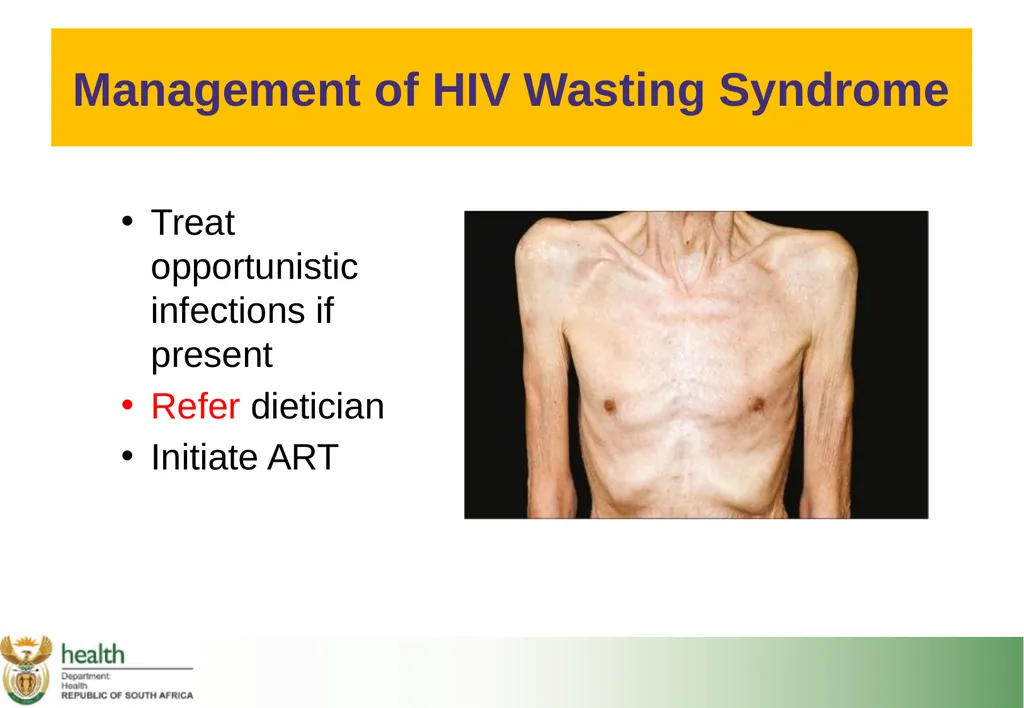
Stage 4 - HIV Wasting Syndrome Unexplained involuntary weight loss (>10% baseline body weight), with obvious wasting or body mass index <18.5
PLUS EITHER
Unexplained chronic diarrhoea (loose or watery stools three or more times daily) reported >1 month
OR
reports of fever or night sweats for >1 month without other cause and lack of response to antibiotics<br>
PLUS EITHER
Unexplained chronic diarrhoea (loose or watery stools three or more times daily) reported >1 month
OR
reports of fever or night sweats for >1 month without other cause and lack of response to antibiotics<br>
38
Management of HIV Wasting Syndrome Treat opportunistic infections if present
Refer dietician
Initiate ART<br>
Refer dietician
Initiate ART<br>
39
Stage 4 – CNS Toxoplasmosis Rare if CD4 count >200 cells/mm3 or on CPT
Clinical features:
Focal neurological signs or
Decreased level of consciousness
Diagnosis:
Toxoplasma serology IgG positive
Multiple mass lesions on CT/ MRI Transmission of toxoplasmosis www.parasitesinhumans.org<br>
Clinical features:
Focal neurological signs or
Decreased level of consciousness
Diagnosis:
Toxoplasma serology IgG positive
Multiple mass lesions on CT/ MRI Transmission of toxoplasmosis www.parasitesinhumans.org<br>
40
Management of CNS Toxoplasmosis Cotrimoxazole
Relapse is common
Continue secondary cotrimoxazole prophylaxis thereafter Handbook of HIV Medicine, 3rd Ed.<br>
Relapse is common
Continue secondary cotrimoxazole prophylaxis thereafter Handbook of HIV Medicine, 3rd Ed.<br>
41
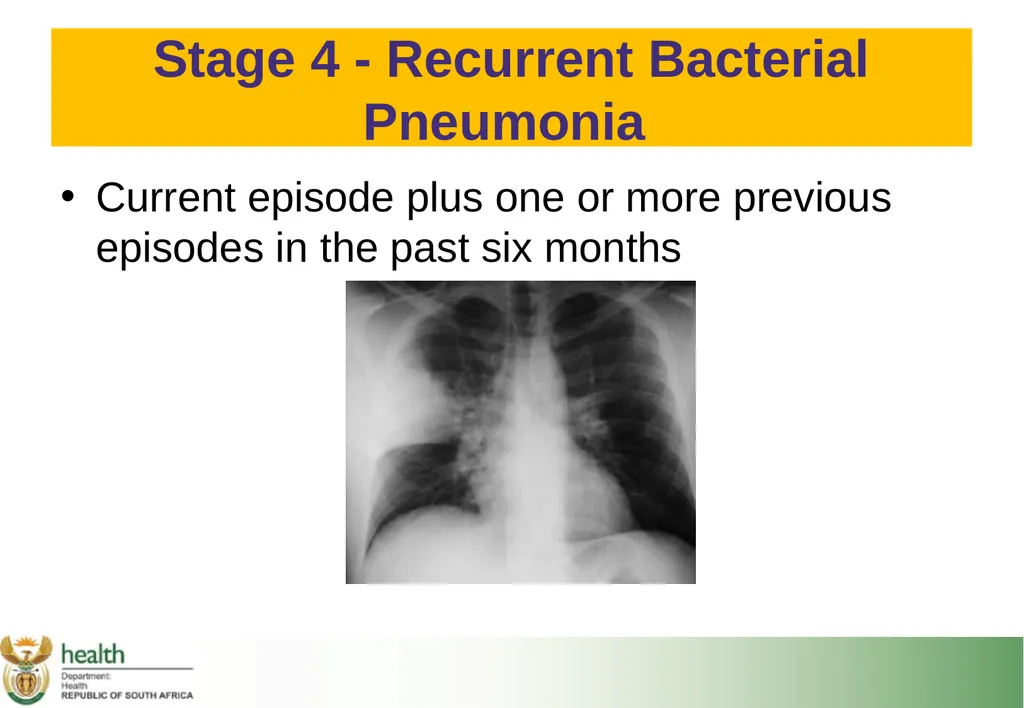
Stage 4 - Recurrent Bacterial Pneumonia Current episode plus one or more previous episodes in the past six months<br>
42
Stage 4 - Chronic Herpes Simplex Virus Infection or Visceral Infection Herpes simplex lesions begin with grouped vesicles on an inflamed base, followed by erosions, crusting and healing
In the early stages of HIV, this classical picture is followed, with healing in 1-2 weeks without treatment Classical picture - Grouped vesicles on an inflamed base<br>
In the early stages of HIV, this classical picture is followed, with healing in 1-2 weeks without treatment Classical picture - Grouped vesicles on an inflamed base<br>
43
Stage 4 - Chronic Herpes Simplex Virus Infection or Visceral Infection Chronic herpes simplex lesions<br>
44
Management of Chronic Herpes Simplex Virus Infection or Visceral Infection Condom use and partner notification
Apply antibacterial cream
Oral acyclovir
Paracetamol as needed for pain
If severe, refractory or disseminated – IV acyclovir may be required Clinical resource guide, Version 1.6, October 2013<br>
Apply antibacterial cream
Oral acyclovir
Paracetamol as needed for pain
If severe, refractory or disseminated – IV acyclovir may be required Clinical resource guide, Version 1.6, October 2013<br>
45
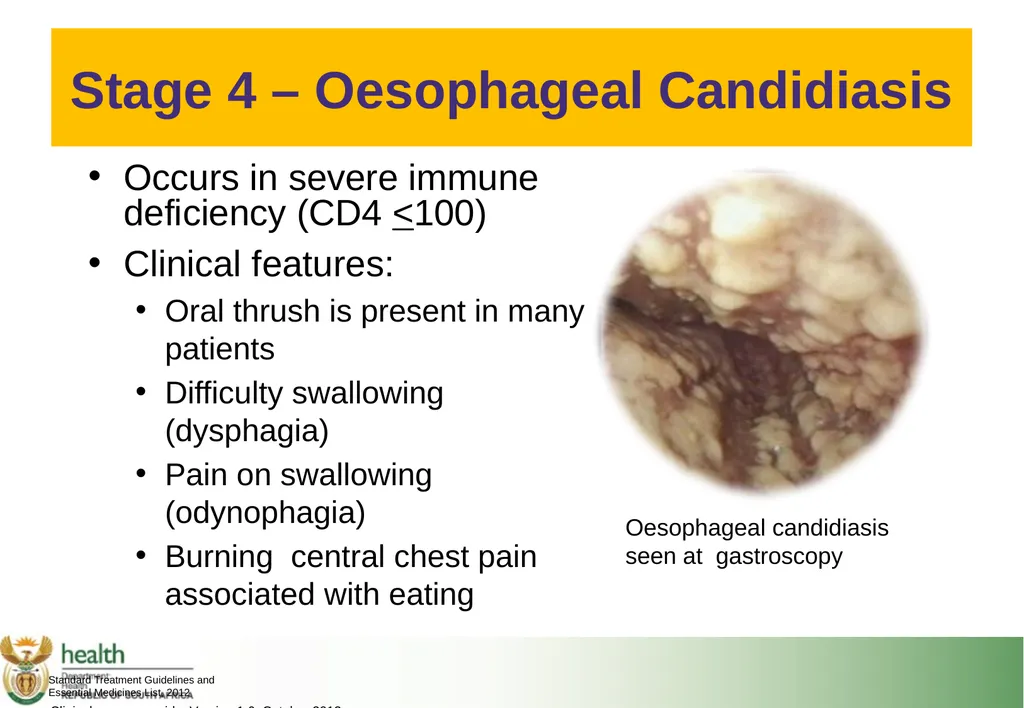
Stage 4 – Oesophageal Candidiasis Occurs in severe immune deficiency (CD4 <100)
Clinical features:
Oral thrush is present in many patients
Difficulty swallowing (dysphagia)
Pain on swallowing (odynophagia)
Burning central chest pain associated with eating Standard Treatment Guidelines and Essential Medicines List, 2012 Clinical resource guide, Version 1.6, October 2013 Oesophageal candidiasis seen at gastroscopy<br>
Clinical features:
Oral thrush is present in many patients
Difficulty swallowing (dysphagia)
Pain on swallowing (odynophagia)
Burning central chest pain associated with eating Standard Treatment Guidelines and Essential Medicines List, 2012 Clinical resource guide, Version 1.6, October 2013 Oesophageal candidiasis seen at gastroscopy<br>
46
Management of Oesophageal Candidiasis Ensure adequate hydration
Oral fluconazole (IV if patient unable to swallow)<br>
Oral fluconazole (IV if patient unable to swallow)<br>
47
Stage 4 - Extrapulmonary TB TB that occurs in any site other than the lungs
Common types include:
TB lymphadenitis
Abdominal TB
TB meningitis
Pleural TB
Spinal TB
TB pericarditis
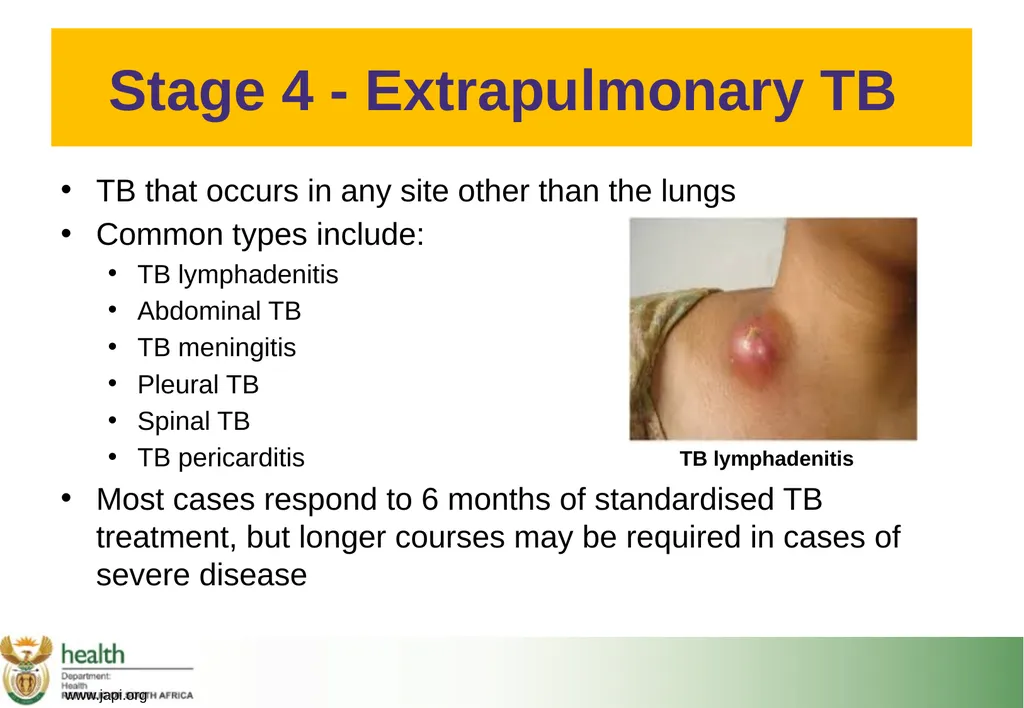
Most cases respond to 6 months of standardised TB treatment, but longer courses may be required in cases of severe disease TB lymphadenitis www.japi.org<br>
Common types include:
TB lymphadenitis
Abdominal TB
TB meningitis
Pleural TB
Spinal TB
TB pericarditis
Most cases respond to 6 months of standardised TB treatment, but longer courses may be required in cases of severe disease TB lymphadenitis www.japi.org<br>
48
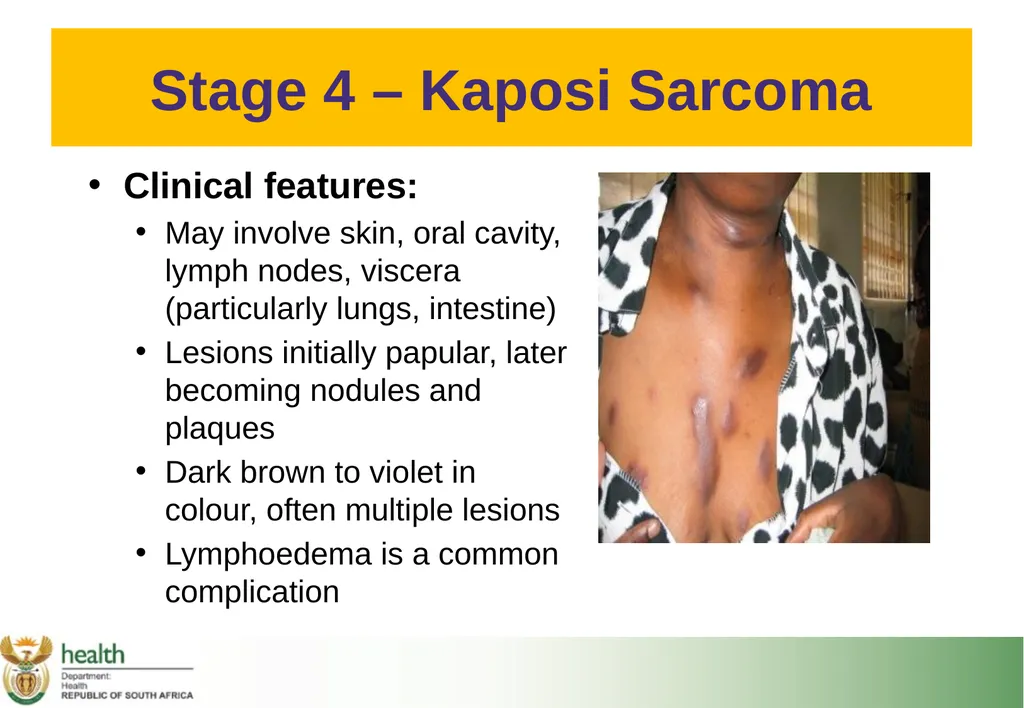
Stage 4 – Kaposi Sarcoma Clinical features:
May involve skin, oral cavity, lymph nodes, viscera (particularly lungs, intestine)
Lesions initially papular, later becoming nodules and plaques
Dark brown to violet in colour, often multiple lesions
Lymphoedema is a common complication<br>
May involve skin, oral cavity, lymph nodes, viscera (particularly lungs, intestine)
Lesions initially papular, later becoming nodules and plaques
Dark brown to violet in colour, often multiple lesions
Lymphoedema is a common complication<br>
49
Diagnosis of Kaposi Sarcoma Most are diagnosed based on typical macroscopic appearance
Biopsy needed for atypical lesions or if chemotherapy considered<br>
Biopsy needed for atypical lesions or if chemotherapy considered<br>
50
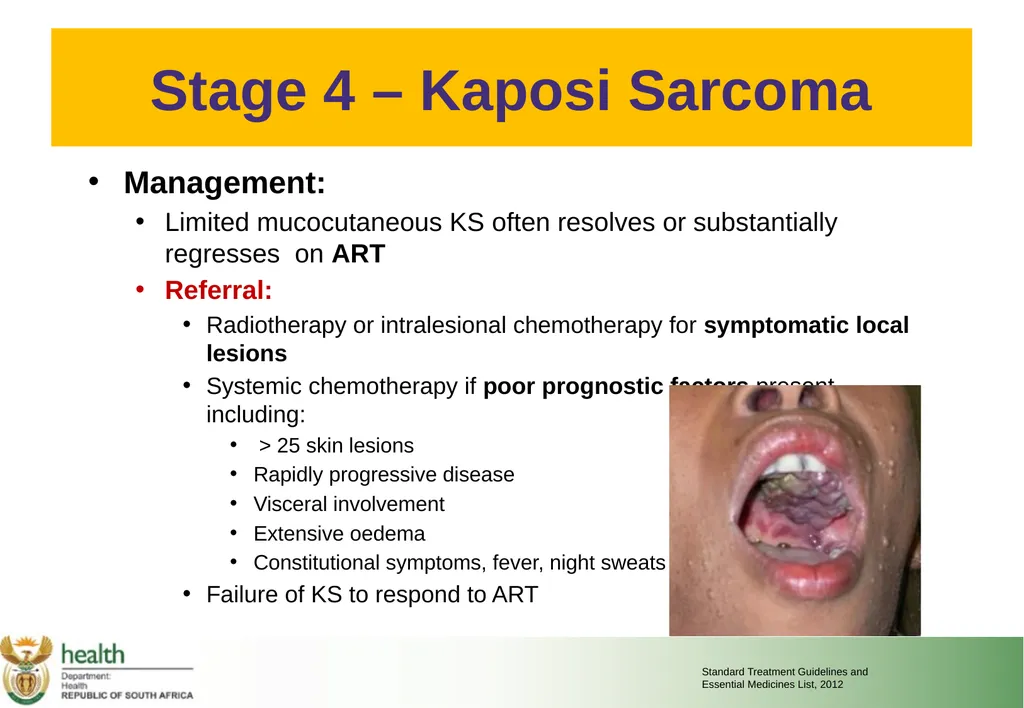
Stage 4 – Kaposi Sarcoma Management:
Limited mucocutaneous KS often resolves or substantially regresses on ART
Referral:
Radiotherapy or intralesional chemotherapy for symptomatic local lesions
Systemic chemotherapy if poor prognostic factors present, including:
> 25 skin lesions
Rapidly progressive disease
Visceral involvement
Extensive oedema
Constitutional symptoms, fever, night sweats
Failure of KS to respond to ART Standard Treatment Guidelines and Essential Medicines List, 2012<br>
Limited mucocutaneous KS often resolves or substantially regresses on ART
Referral:
Radiotherapy or intralesional chemotherapy for symptomatic local lesions
Systemic chemotherapy if poor prognostic factors present, including:
> 25 skin lesions
Rapidly progressive disease
Visceral involvement
Extensive oedema
Constitutional symptoms, fever, night sweats
Failure of KS to respond to ART Standard Treatment Guidelines and Essential Medicines List, 2012<br>
51
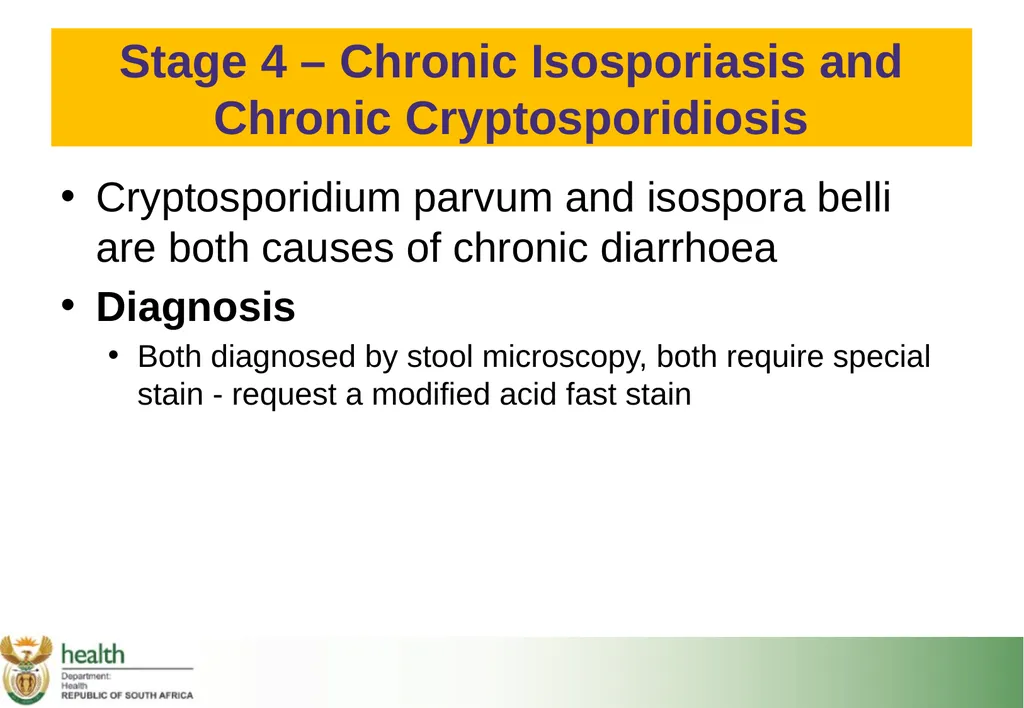
Stage 4 – Chronic Isosporiasis and Chronic Cryptosporidiosis Cryptosporidium parvum and isospora belli are both causes of chronic diarrhoea
Diagnosis
Both diagnosed by stool microscopy, both require special stain - request a modified acid fast stain<br>
Diagnosis
Both diagnosed by stool microscopy, both require special stain - request a modified acid fast stain<br>
52
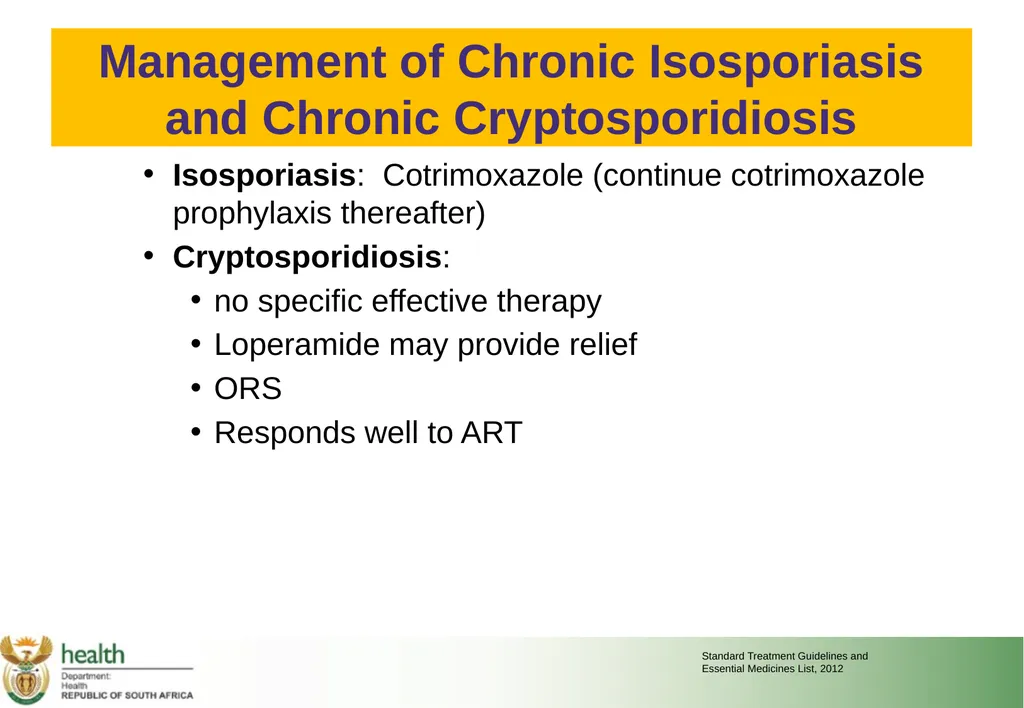
Management of Chronic Isosporiasis and Chronic Cryptosporidiosis Isosporiasis: Cotrimoxazole (continue cotrimoxazole prophylaxis thereafter)
Cryptosporidiosis:
no specific effective therapy
Loperamide may provide relief
ORS
Responds well to ART Standard Treatment Guidelines and Essential Medicines List, 2012<br>
Cryptosporidiosis:
no specific effective therapy
Loperamide may provide relief
ORS
Responds well to ART Standard Treatment Guidelines and Essential Medicines List, 2012<br>
53
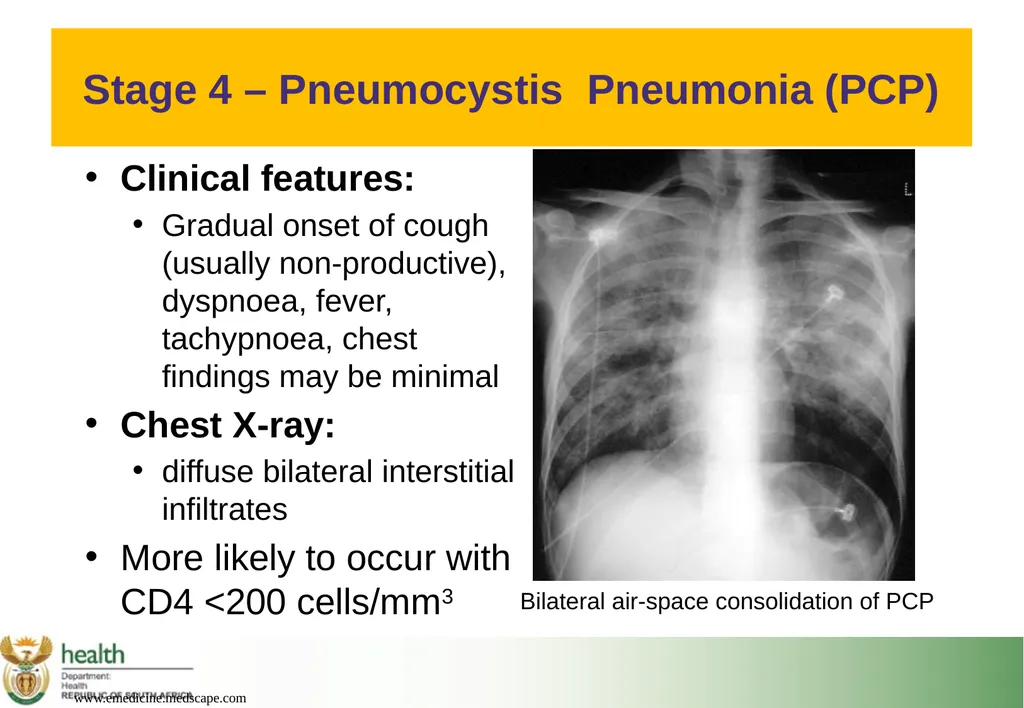
Stage 4 – Pneumocystis Pneumonia (PCP) Clinical features:
Gradual onset of cough (usually non-productive), dyspnoea, fever, tachypnoea, chest findings may be minimal
Chest X-ray:
diffuse bilateral interstitial infiltrates
More likely to occur with CD4 <200 cells/mm3 Bilateral air-space consolidation of PCP www.emedicine.medscape.com<br>
Gradual onset of cough (usually non-productive), dyspnoea, fever, tachypnoea, chest findings may be minimal
Chest X-ray:
diffuse bilateral interstitial infiltrates
More likely to occur with CD4 <200 cells/mm3 Bilateral air-space consolidation of PCP www.emedicine.medscape.com<br>
54
Management of PCP If severe, refer to hospital
Oxygen as necessary
If hypoxic steroids – prednisone
Cotrimoxazole oral (IV if vomiting)
Continue with secondary cotrimoxazole prophylaxis thereafter Standard Treatment Guidelines and Essential Medicines List, 2012<br>
Oxygen as necessary
If hypoxic steroids – prednisone
Cotrimoxazole oral (IV if vomiting)
Continue with secondary cotrimoxazole prophylaxis thereafter Standard Treatment Guidelines and Essential Medicines List, 2012<br>
55
Stage 4 – HIV Encephalopathy Clinical features include:
Cognitive changes
Poor attention span
Impaired recall
Slowed mental processes
Altered behaviour
Social withdrawal, low mood, apathy
Motor dysfunction
Difficulty with tandem gait, poor fine finger movements<br>
Cognitive changes
Poor attention span
Impaired recall
Slowed mental processes
Altered behaviour
Social withdrawal, low mood, apathy
Motor dysfunction
Difficulty with tandem gait, poor fine finger movements<br>
56
Stage 4 – HIV Encephalopathy Progressive over weeks or months, end-stage disease – global dementia, rigidity, tremor, paraparesis, incontinence
Diagnosis:
Diagnosis of exclusion
Management
ART – response may be impressive
Try to include drugs that penetrate the CSF e.g. AZT Handbook of HIV Medicine, 3rd Ed.<br>
Diagnosis:
Diagnosis of exclusion
Management
ART – response may be impressive
Try to include drugs that penetrate the CSF e.g. AZT Handbook of HIV Medicine, 3rd Ed.<br>
57
Practical Tips for Staging When seeing a patient, examine and check the following:
Weight: record at every visit
Mouth: look for thrush, ulcers, Kaposi’s sarcoma lesions
Skin: look for rashes, scars of healed rashes, Kaposi’s sarcoma lesions
History: ask about illness episodes, hospital discharge letters
Current problems: do symptoms fit with one of the conditions described in the staging?<br>
Weight: record at every visit
Mouth: look for thrush, ulcers, Kaposi’s sarcoma lesions
Skin: look for rashes, scars of healed rashes, Kaposi’s sarcoma lesions
History: ask about illness episodes, hospital discharge letters
Current problems: do symptoms fit with one of the conditions described in the staging?<br>
58
Case Studies This Photo by Unknown Author is licensed under CC BY-SA<br>
59
Any Questions? Thank you!<br>