
Basic info about the project: Dates, consortium,
TG
Published · 8 slides · 0 views
1 / 1
Description
Basic info about the project: Dates, consortium, coordinator etc e-IRG: a strategic advisory body to facilitate integration in the area of EU e-Infrastructures and connected services, within and between member states, at the European level
Related Topics
Share
Embed code
Download this presentation From Below
"Basic info about the project: Dates, consortium," is the property of its rightful owner. Permission is granted to download and print the materials on this website for personal, non-commercial use only, and to display it on your personal computer provided you do not modify the materials and that you retain all copyright notices contained in the materials. By downloading content from our website, you accept the terms of this agreement.
Presentation Transcript
01
Basic info about the project: Dates, consortium, coordinator etc
e-IRG: a strategic advisory body to facilitate integration in the area of EU e-Infrastructures and connected services, within and between member states, at the European level and globally
The mission of e-IRG is to support both coherent, innovative and strategic European e-Infrastructure policymaking and the development of convergent and sustainable e-Infrastructure services. The focal point of e-IRG is thus e-Infrastructures as a whole (including connectivity, HPC and other e-Infrastructure areas, e.g. Data Spaces), and not only EOSC.
e-IRGSP7 project is supporting e-IRG in all its activities and one area is the policy support in the area of e-Infrastructures, which is related to the development of independent and cross-disciplinary policy papers towards contributing to the implementation and better coordination of e-Infrastructures and related services in Europe, within and across MS/ACs, as well as between thematic (vertical or domain specific) and the generic (horizontal or domain-agnostic) e- Infrastructures, towards the realisation of the e-Infrastructure Commons.
Project information: 01.04.2022-31.09.2023 (18 months), Partners: Innov-Acts (coord), Leibniz Universität Hannover, Aristotelio Panepistimio Thessalonikis, Technische Universität Wien e-Infrastructure Reflection Group Support Programme 7 (e-IRGSP7) ‹#› In a Nutshell 16 | 06 | 2023 by Fotis Karayannis and Jan Wiebelitz<br>
02
e-IRGSP7 is the seventh implementation of the support project to e-IRG
Partners: Innov-Acts, Leibniz Univ. of Hannover, Aristotle Univ. of Thessaloniki, Technical Univ. of Wien
Duration: 01.04.2022 – 30.09.2023 (18 months)
Funding: 302.259,00 Euro
Overall objective: Assist e-IRG in achieving its goals providing its core operational services
Objective 1: To support e-IRG and its governing structures with secretarial services
Objective 2: To support e-IRG with its policy papers towards better coordination of EU e-Infrastructures/services
within and across MS/ACs, including GÉANT, EOSC and EuroHPC, between thematic (domain-specific) and the generic (domain-agnostic)) e-Infrastructures, towards the realisation of the e-Infrastructure Commons
Objective 3: To develop/implement the e-IRG communications/liaison strategy to disseminate the e-IRG and e-IRGSP7 results to the ERA in-line with Open Science principles e-Infrastructure Reflection Group Support Programme 7 (e-IRGSP7) ‹#› In a Nutshell 16 | 06 | 2023 by Fotis Karayannis and Jan Wiebelitz<br>
03
e-Infrastructure Reflection Group (e-IRG)
Leading advisory body on e-Infrastructure policy in Europe, founded in 2003 - 20 years anniversary (after first e-IRG workshop in June 2003!)
Composed of 68 national delegates from Member States and Associated Countries (Science/Ministry), EC (DG CNECT, RTD), and observer from ESFRI
Vision: to facilitate integration in the area of European e-Infrastructures and connected services, within and between member states, at the European level and globally
Mission: to support both coherent, innovative and strategic European e-Infrastructure policy-making and the development of convergent and sustainable e-Infrastructure services
Disclaimer: Opinions raised in this presentation are of e-IRGSP7, not necessarily of e-IRG e-Infrastructure Reflection Group Support Programme 7 (e-IRGSP7) ‹#› In a Nutshell 16 | 06 | 2023 by Fotis Karayannis and Jan Wiebelitz<br>
04
e-IRGSP7 is supporting e-IRG in its mission towards the implementation of the e-Infrastructure Commons.
The e-Infrastructure Commons is the political, technological, and administrative framework for an easy and cost-effective shared use of distributed electronic resources across Europe.
The e-Infrastructure Commons can be defined as an integrated living ecosystem of resources and services that is open, user friendly and accessible to European researchers and scientists, and continuously adapts to the changing requirements of research and science.
Indirectly, harmonization of policies across countries via e-IRG delegates meetings and relevant discussions.
In the policy area, providing recommendations with the different e-IRG papers. E.g. coordination inside countries, coordination across e-Infrastructures (GÉANT, EOSC, EuroHPC, EU Data Spaces), coordination between thematic (domain specific) and horizontal (domain agnostic) e-Infrastructures/Research Infrastructures, etc.
https://e-irg.eu/e-infrastructure-commons/ Key Contributions to EOSC SRIA ‹#› Contribution of e-IRGSP7 16 | 06 | 2023 by Fotis Karayannis and Jan Wiebelitz<br>
05
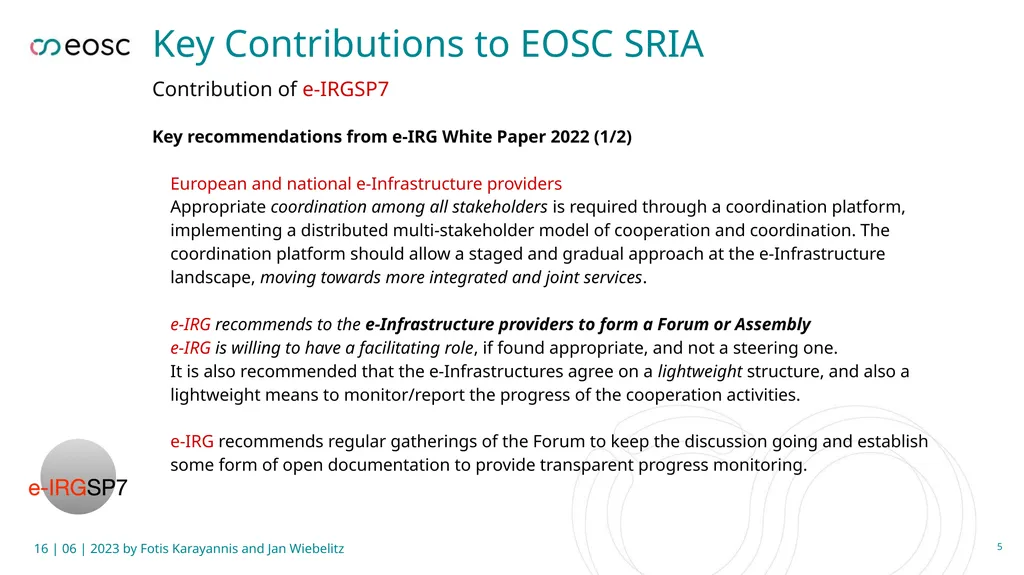
Key recommendations from e-IRG White Paper 2022 (1/2)
European and national e-Infrastructure providers
Appropriate coordination among all stakeholders is required through a coordination platform, implementing a distributed multi-stakeholder model of cooperation and coordination. The coordination platform should allow a staged and gradual approach at the e-Infrastructure landscape, moving towards more integrated and joint services.
e-IRG recommends to the e-Infrastructure providers to form a Forum or Assembly
e-IRG is willing to have a facilitating role, if found appropriate, and not a steering one.
It is also recommended that the e-Infrastructures agree on a lightweight structure, and also a lightweight means to monitor/report the progress of the cooperation activities.
e-IRG recommends regular gatherings of the Forum to keep the discussion going and establish some form of open documentation to provide transparent progress monitoring. Key Contributions to EOSC SRIA ‹#› Contribution of e-IRGSP7 16 | 06 | 2023 by Fotis Karayannis and Jan Wiebelitz<br>
06
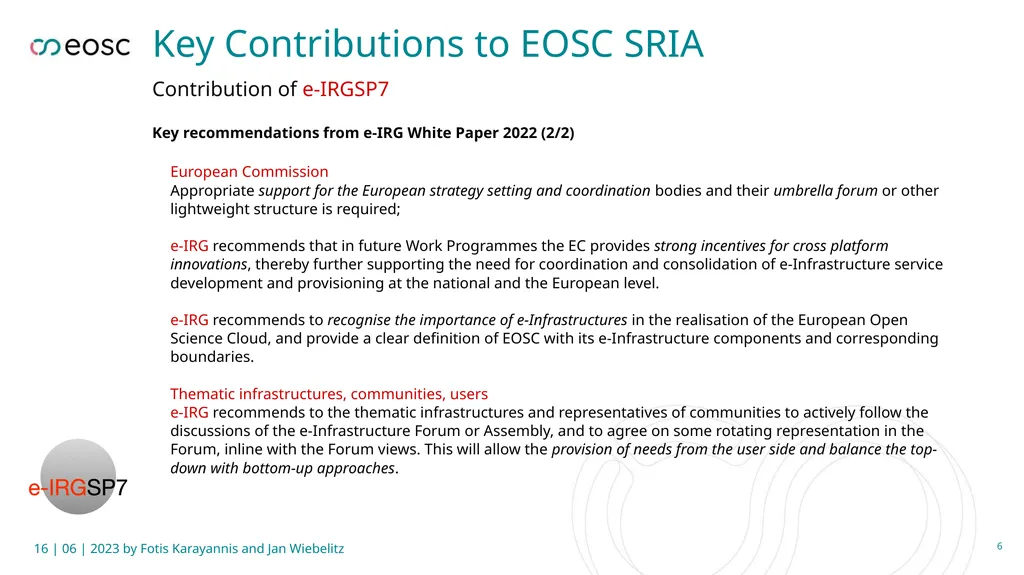
Key recommendations from e-IRG White Paper 2022 (2/2)
European Commission
Appropriate support for the European strategy setting and coordination bodies and their umbrella forum or other lightweight structure is required;
e-IRG recommends that in future Work Programmes the EC provides strong incentives for cross platform innovations, thereby further supporting the need for coordination and consolidation of e-Infrastructure service development and provisioning at the national and the European level.
e-IRG recommends to recognise the importance of e-Infrastructures in the realisation of the European Open Science Cloud, and provide a clear definition of EOSC with its e-Infrastructure components and corresponding boundaries.
Thematic infrastructures, communities, users
e-IRG recommends to the thematic infrastructures and representatives of communities to actively follow the discussions of the e-Infrastructure Forum or Assembly, and to agree on some rotating representation in the Forum, inline with the Forum views. This will allow the provision of needs from the user side and balance the top-down with bottom-up approaches. Key Contributions to EOSC SRIA ‹#› Contribution of e-IRGSP7 16 | 06 | 2023 by Fotis Karayannis and Jan Wiebelitz<br>
07
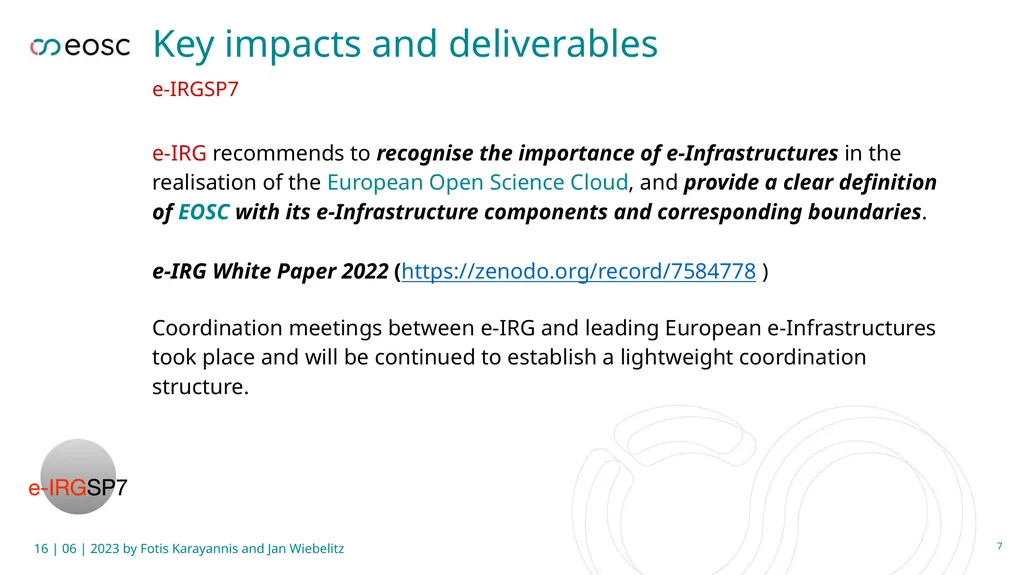
e-IRG recommends to recognise the importance of e-Infrastructures in the realisation of the European Open Science Cloud, and provide a clear definition of EOSC with its e-Infrastructure components and corresponding boundaries.
e-IRG White Paper 2022 (https://zenodo.org/record/7584778 )
Coordination meetings between e-IRG and leading European e-Infrastructures took place and will be continued to establish a lightweight coordination structure. Key impacts and deliverables ‹#› e-IRGSP7 16 | 06 | 2023 by Fotis Karayannis and Jan Wiebelitz<br>
08
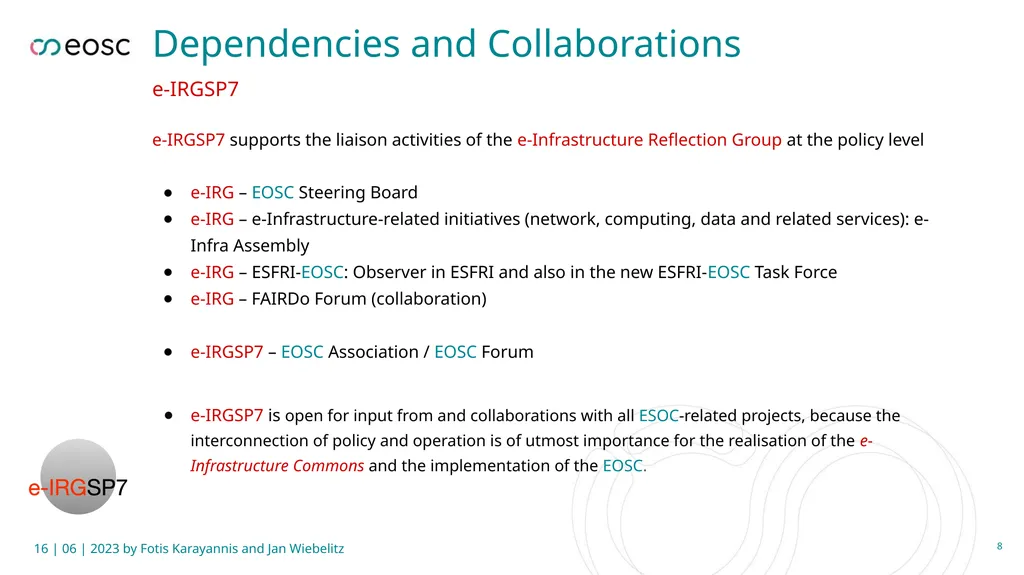
e-IRGSP7 supports the liaison activities of the e-Infrastructure Reflection Group at the policy level
e-IRG – EOSC Steering Board
e-IRG – e-Infrastructure-related initiatives (network, computing, data and related services): e-Infra Assembly
e-IRG – ESFRI-EOSC: Observer in ESFRI and also in the new ESFRI-EOSC Task Force
e-IRG – FAIRDo Forum (collaboration)
e-IRGSP7 – EOSC Association / EOSC Forum
e-IRGSP7 is open for input from and collaborations with all ESOC-related projects, because the interconnection of policy and operation is of utmost importance for the realisation of the e-Infrastructure Commons and the implementation of the EOSC. Dependencies and Collaborations ‹#› e-IRGSP7 16 | 06 | 2023 by Fotis Karayannis and Jan Wiebelitz<br>
09
On the policy level
EOSC – e-Infrastructures
A mix of federated and integrated services across countries, regions, EU e-Infrastructures (EOSC-EuroHPC-EU Data Spaces) and across thematic communities
EOSC – EuroHPC interaction
further the interaction between EOSC and EuroHPC by selected pilots
showcasing the benefits for potential users
EOSC – Data Spaces interaction
open the way for cooperation and gradually interoperability among EOSC, all e-Infrastructures and the EU thematic Data Spaces
Ultimately lead towards federation among e-Infrastructures for the benefit of the end users
Note: thematic use cases are not a focus in the e-IRG work. Your vision ‹#› e-IRGSP7 16 | 06 | 2023 by Fotis Karayannis and Jan Wiebelitz<br>