
Behaviour Change: Engaging patients in improving




Description: Behaviour Change: Engaging patients in improving their health Presenter name, position, trust Date 2 Acknowledgements We would like to thank: Dr Sheila Hardy, Education Fellow at UCLPartners, and author of these materials. The expert
Related Topics
Download Presentation
"Behaviour Change: Engaging patients in improving" is the property of its rightful owner. Permission is granted to download and print the materials on this website for personal, non-commercial use only, and to display it on your personal computer provided you do not modify the materials and that you retain all copyright notices contained in the materials. By downloading content from our website, you accept the terms of this agreement.
Presentation Transcript
slide1. Behaviour Change: Engaging patients in improving their health
Presenter name, position, trust
Date<br>
slide2. 2 Acknowledgements We would like to thank:
Dr Sheila Hardy, Education Fellow at UCLPartners, and author of these materials.
The expert reference group, steering group and project team:<br>
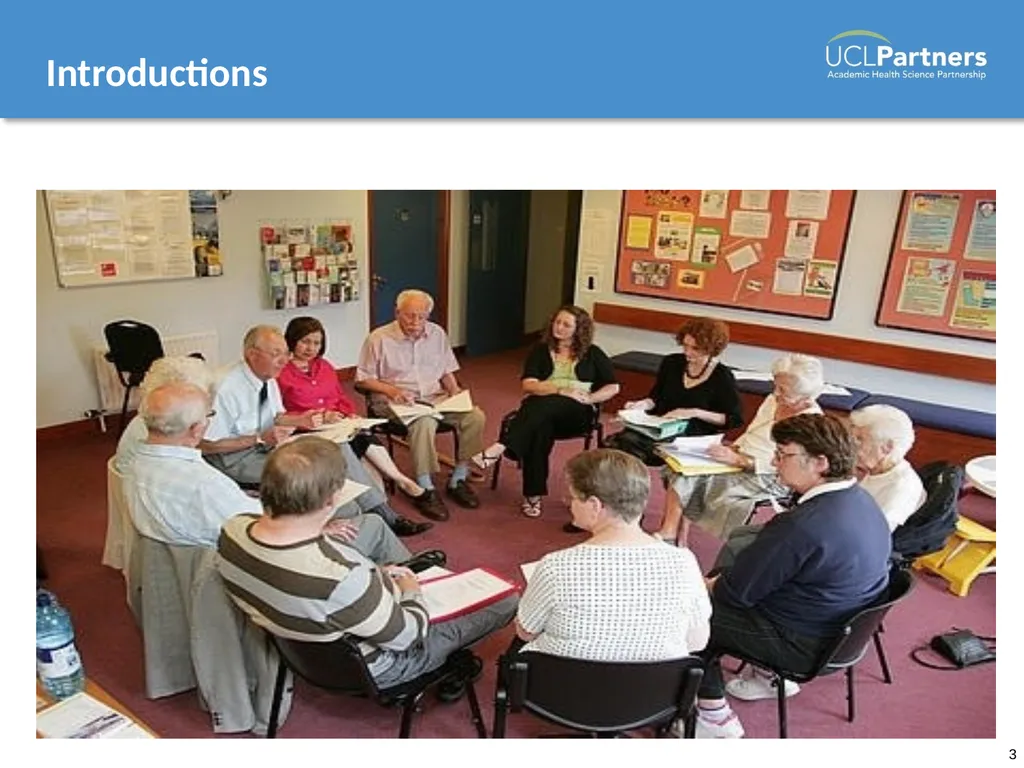
slide3. Introductions 3<br>
slide4. 4 Learning objectives Following this training you should:
Know how changing behaviour can affect the individual and others
Be aware of the types of behaviour practice nurses may be in a position to help patients change
Understand which patients are ready to change
Be confident in responding to patients to ensure engagement now and in the future
Know how to set a target behaviour
Be competent in helping a patient plan their action
Understand why the patient should record their action
Be confident in reviewing a patient’s progress
Know how to give positive feedback even when the patient has relapsed
Be competent in supporting a patient who has relapsed<br>
slide5. What sort of behaviour do we want to change? Once only change
e.g. having plastic surgery or a major operation
Repeated change with an endpoint
e.g. a course of travel vaccinations or treatment for an illness
Lifestyle change
e.g. stopping smoking, switching to healthy eating, increasing physical activity, reducing consumption of alcohol/drugs, starting to take medication as prescribed, avoiding working too hard, reducing gambling
Situational change
e.g. practising safe sex, checking blood glucose before driving 5<br>
slide6. Why would we want to change our patients’ behaviour? Ensure optimum health and happiness
Prevention of harm, disease, significant events (e.g. heart attack, stroke, depression, suicide, accidents, debt, conflict)
Save money – less use of NHS resources 6<br>
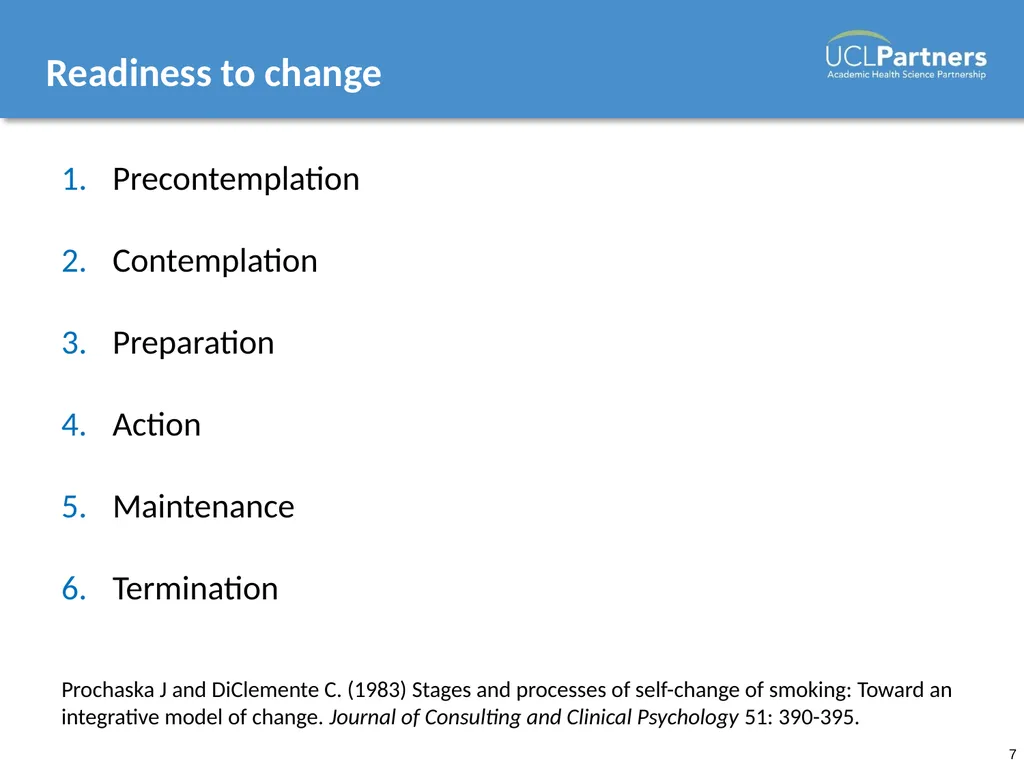
slide7. Readiness to change Precontemplation
Contemplation
Preparation
Action
Maintenance
Termination
Prochaska J and DiClemente C. (1983) Stages and processes of self-change of smoking: Toward an integrative model of change. Journal of Consulting and Clinical Psychology 51: 390-395. 7<br>
slide8. How do we go about it? Brief Motivational Interviewing (MI):
Listen actively and express empathy
Ask open questions
Avoid conflict
Support self-efficacy 8<br>
slide9. 9 How do we go about it? When using a brief MI approach:
The patient does more than 50% of the talking
You focus on listening
The majority of your interventions are summarising, with a few open-ended questions.
Avoid getting ahead of the patient’s level of readiness<br>
slide10. How do we go about it? Be empathic
Build confidence that change is possible
If they don’t want to change at this point in time – do not judge
Let them know you are available to help at any time (this gives them the opportunity to come back when they are ready)<br>
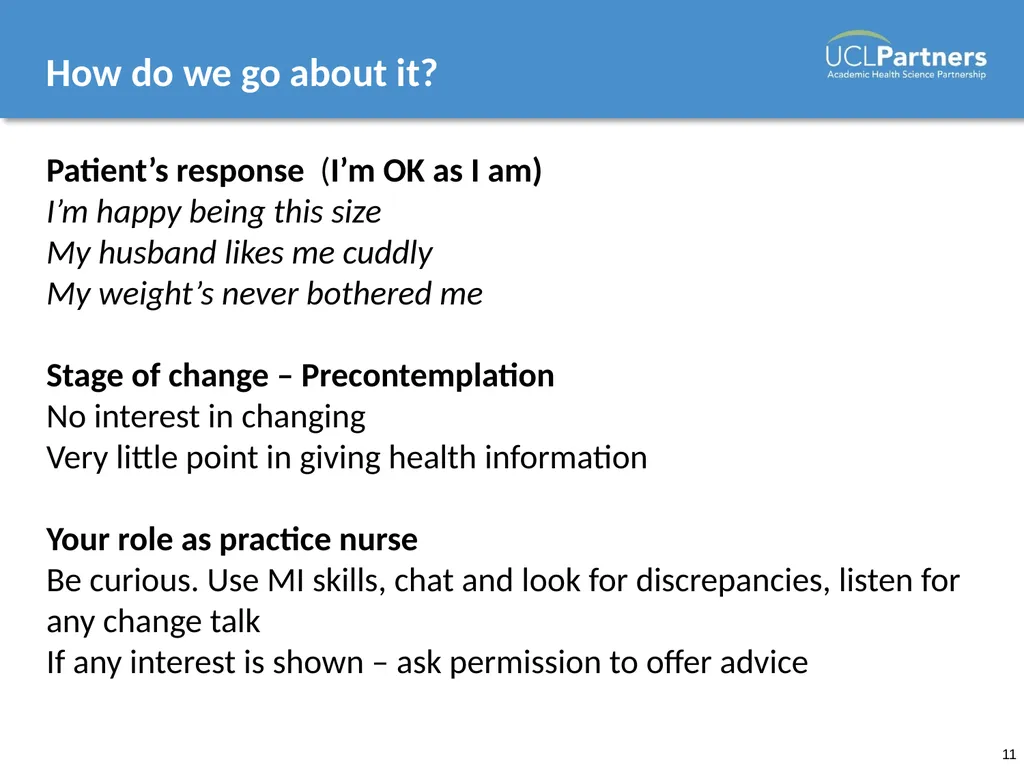
slide11. 11 How do we go about it? Patient’s response (I’m OK as I am)
I’m happy being this size
My husband likes me cuddly
My weight’s never bothered me
Stage of change – Precontemplation
No interest in changing
Very little point in giving health information
Your role as practice nurse
Be curious. Use MI skills, chat and look for discrepancies, listen for any change talk
If any interest is shown – ask permission to offer advice<br>
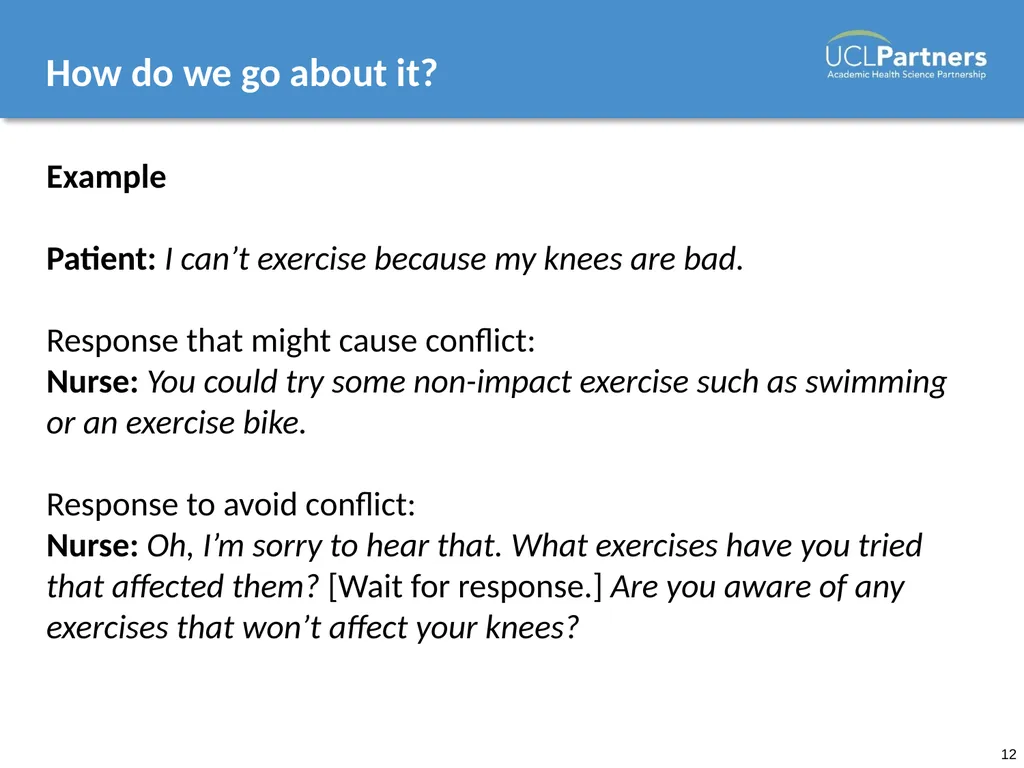
slide12. 12 How do we go about it? Example
Patient: I can’t exercise because my knees are bad.
Response that might cause conflict:
Nurse: You could try some non-impact exercise such as swimming or an exercise bike.
Response to avoid conflict:
Nurse: Oh, I’m sorry to hear that. What exercises have you tried that affected them? [Wait for response.] Are you aware of any exercises that won’t affect your knees?<br>
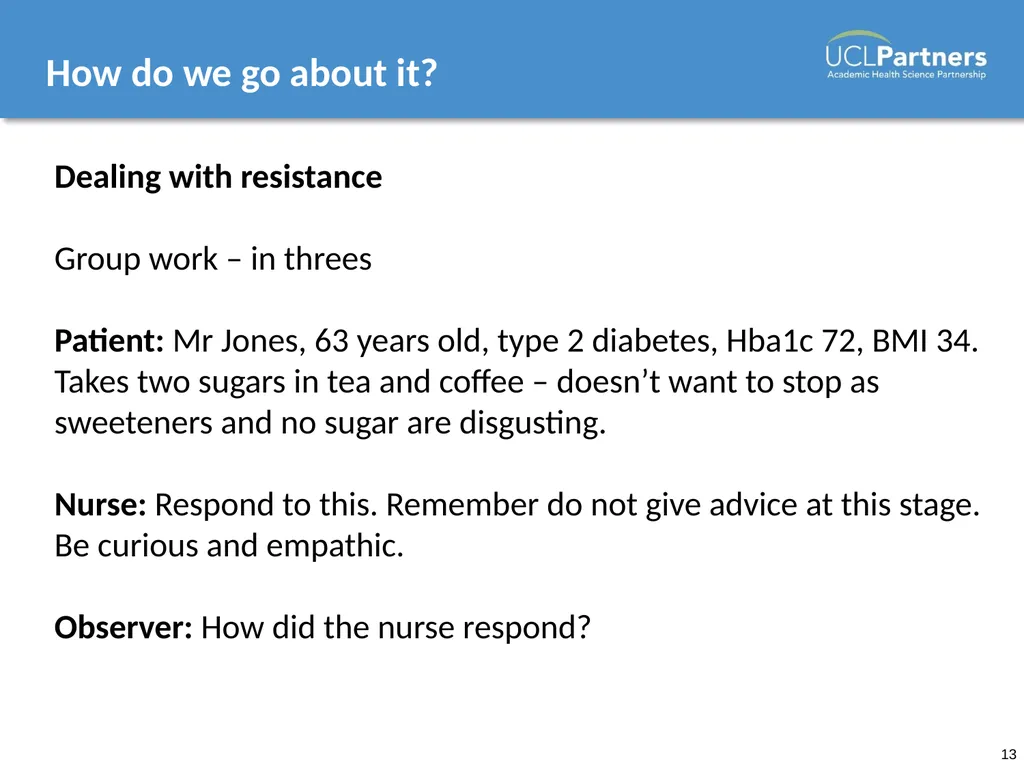
slide13. How do we go about it? Dealing with resistance
Group work – in threes
Patient: Mr Jones, 63 years old, type 2 diabetes, Hba1c 72, BMI 34. Takes two sugars in tea and coffee – doesn’t want to stop as sweeteners and no sugar are disgusting.
Nurse: Respond to this. Remember do not give advice at this stage. Be curious and empathic.
Observer: How did the nurse respond? 13<br>
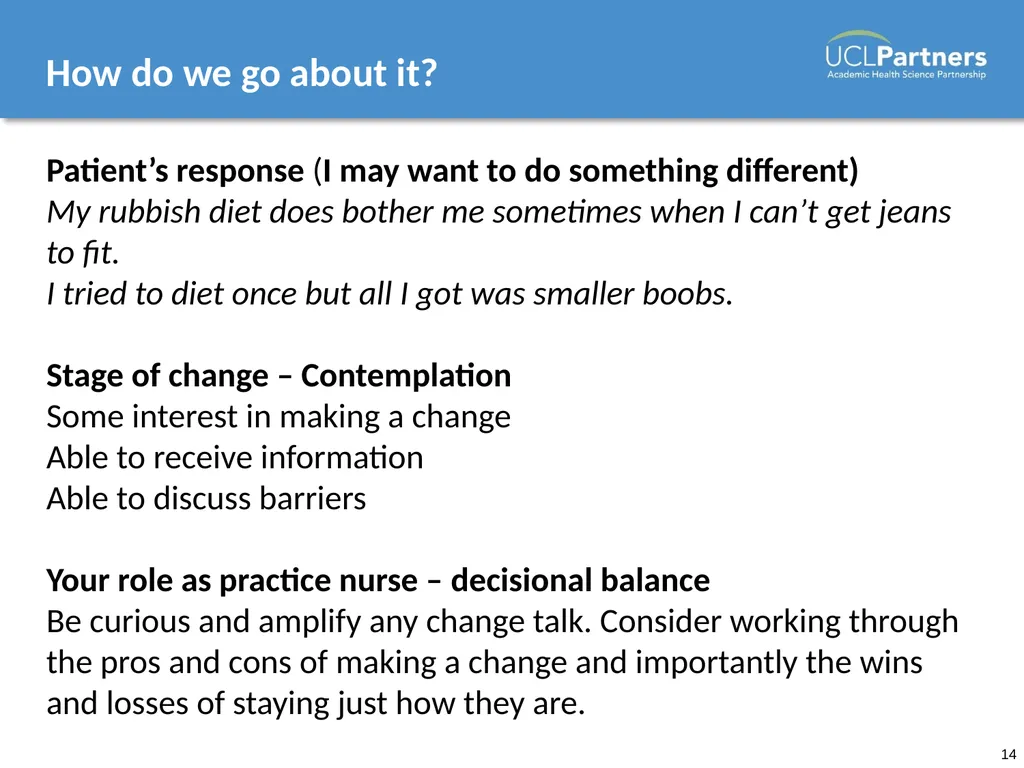
slide14. 14 How do we go about it? Patient’s response (I may want to do something different)
My rubbish diet does bother me sometimes when I can’t get jeans to fit.
I tried to diet once but all I got was smaller boobs.
Stage of change – Contemplation
Some interest in making a change
Able to receive information
Able to discuss barriers
Your role as practice nurse – decisional balance
Be curious and amplify any change talk. Consider working through the pros and cons of making a change and importantly the wins and losses of staying just how they are.<br>
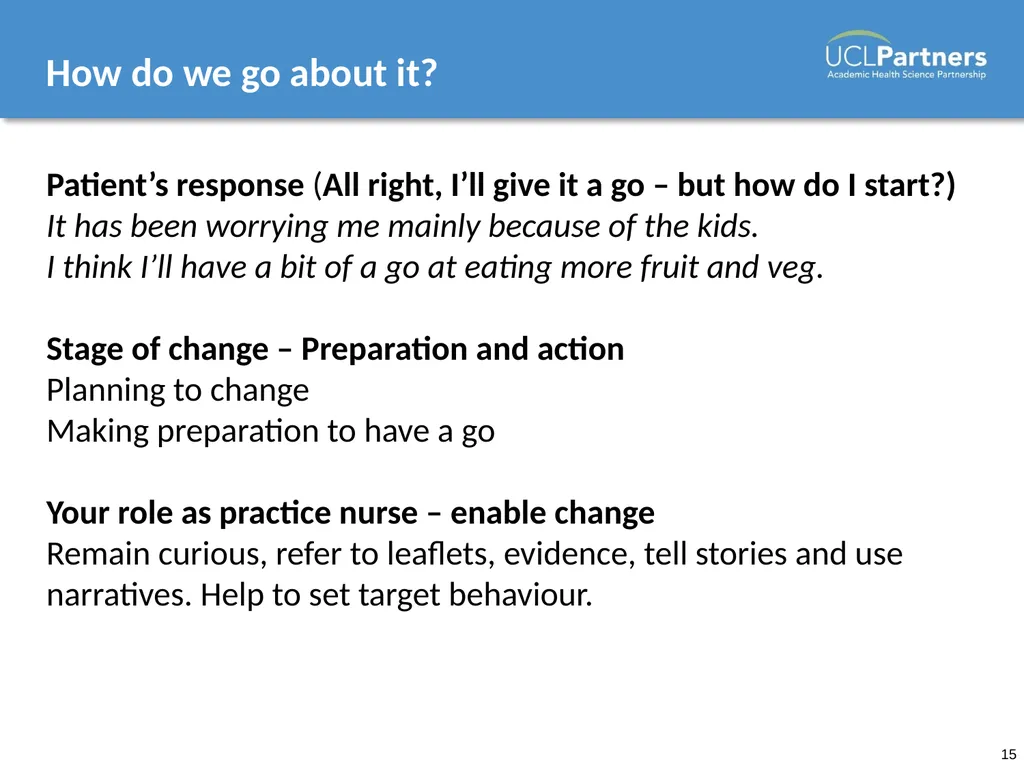
slide15. 15 How do we go about it? Patient’s response (All right, I’ll give it a go – but how do I start?)
It has been worrying me mainly because of the kids.
I think I’ll have a bit of a go at eating more fruit and veg.
Stage of change – Preparation and action
Planning to change
Making preparation to have a go
Your role as practice nurse – enable change
Remain curious, refer to leaflets, evidence, tell stories and use narratives. Help to set target behaviour.<br>
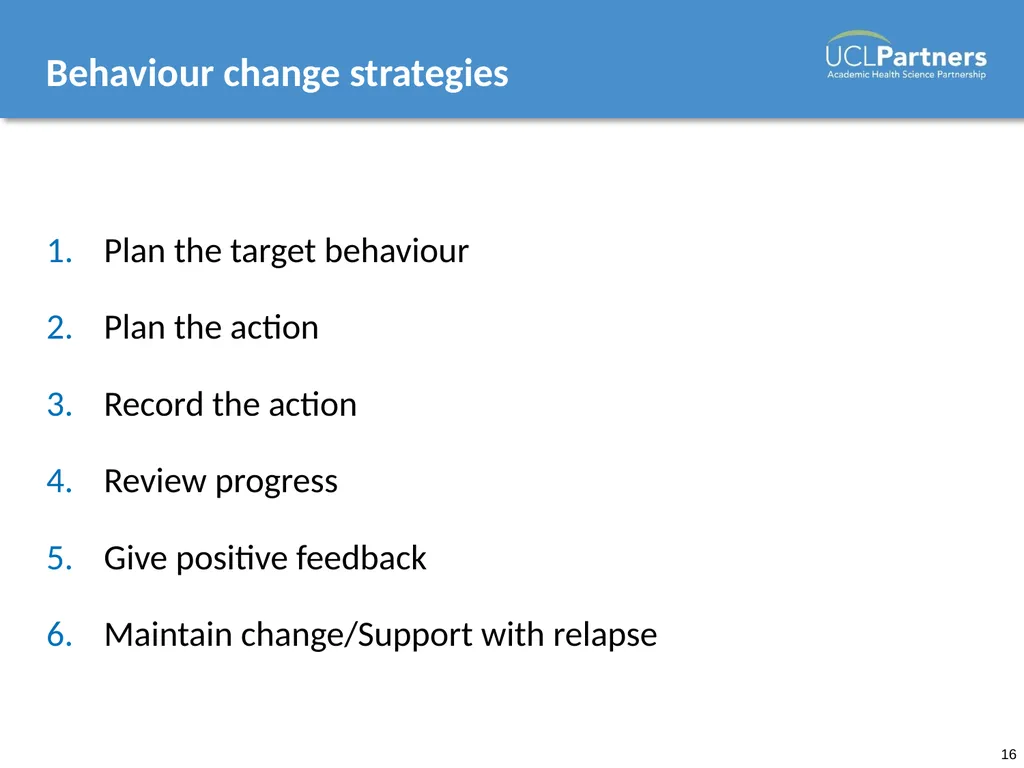
slide16. Behaviour change strategies Plan the target behaviour
Plan the action
Record the action
Review progress
Give positive feedback
Maintain change/Support with relapse 16<br>
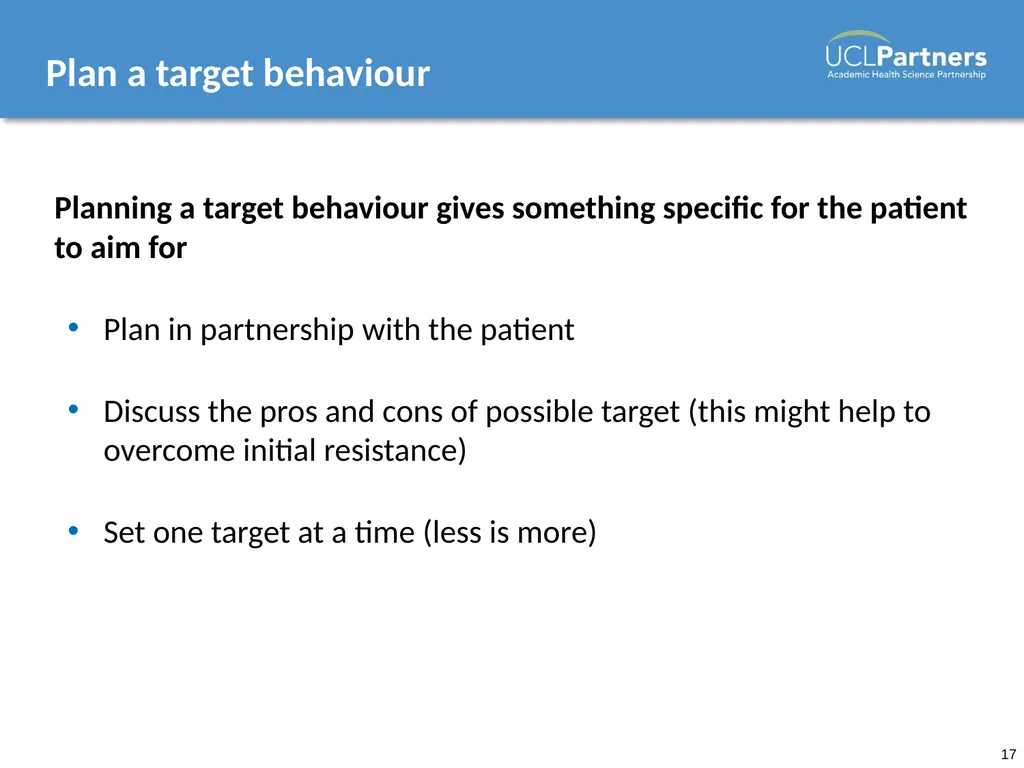
slide17. Planning a target behaviour gives something specific for the patient to aim for
Plan in partnership with the patient
Discuss the pros and cons of possible target (this might help to overcome initial resistance)
Set one target at a time (less is more) 17 Plan a target behaviour<br>
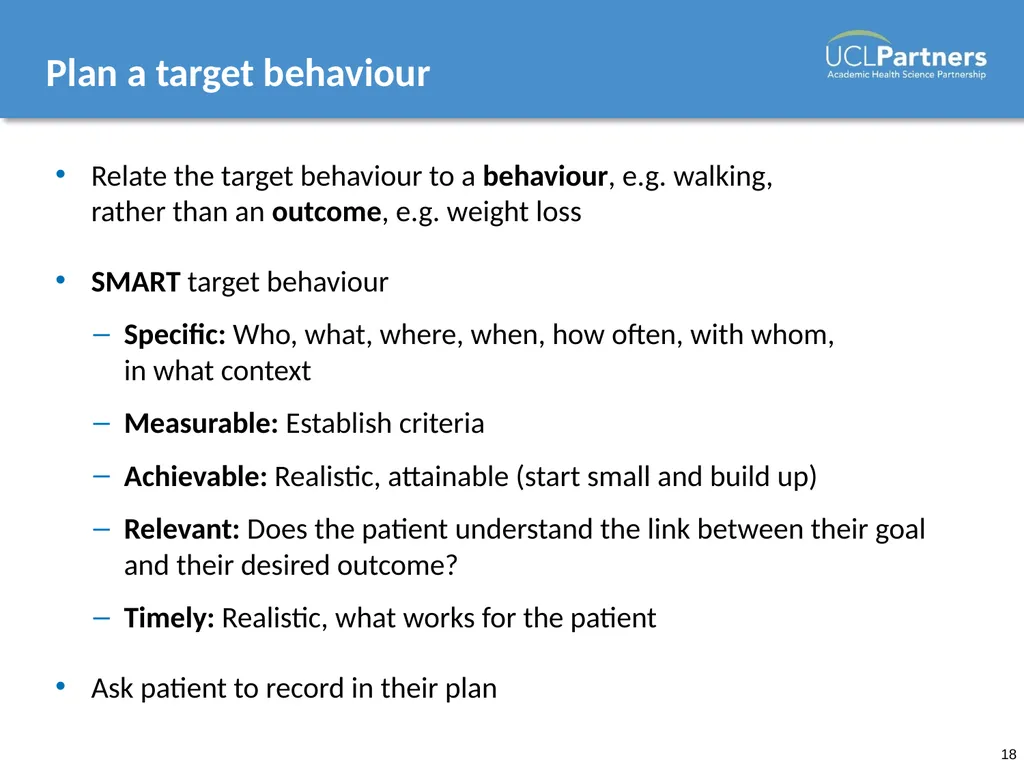
slide18. Relate the target behaviour to a behaviour, e.g. walking, rather than an outcome, e.g. weight loss
SMART target behaviour
Specific: Who, what, where, when, how often, with whom, in what context
Measurable: Establish criteria
Achievable: Realistic, attainable (start small and build up)
Relevant: Does the patient understand the link between their goal and their desired outcome?
Timely: Realistic, what works for the patient
Ask patient to record in their plan 18 Plan a target behaviour<br>
slide19. 19 Plan a target behaviour Example:
Outcome: Lose two stone (12.7 kg)
Possible behaviours that the patient can choose to lose weight are increase physical activity, change diet.
Target behaviour = the level reached of the chosen behaviour before the next review (e.g. in two weeks will be walking for 10 minutes, four times a week, at a gentle pace, or in two weeks will have only one packet of crisps a day)<br>
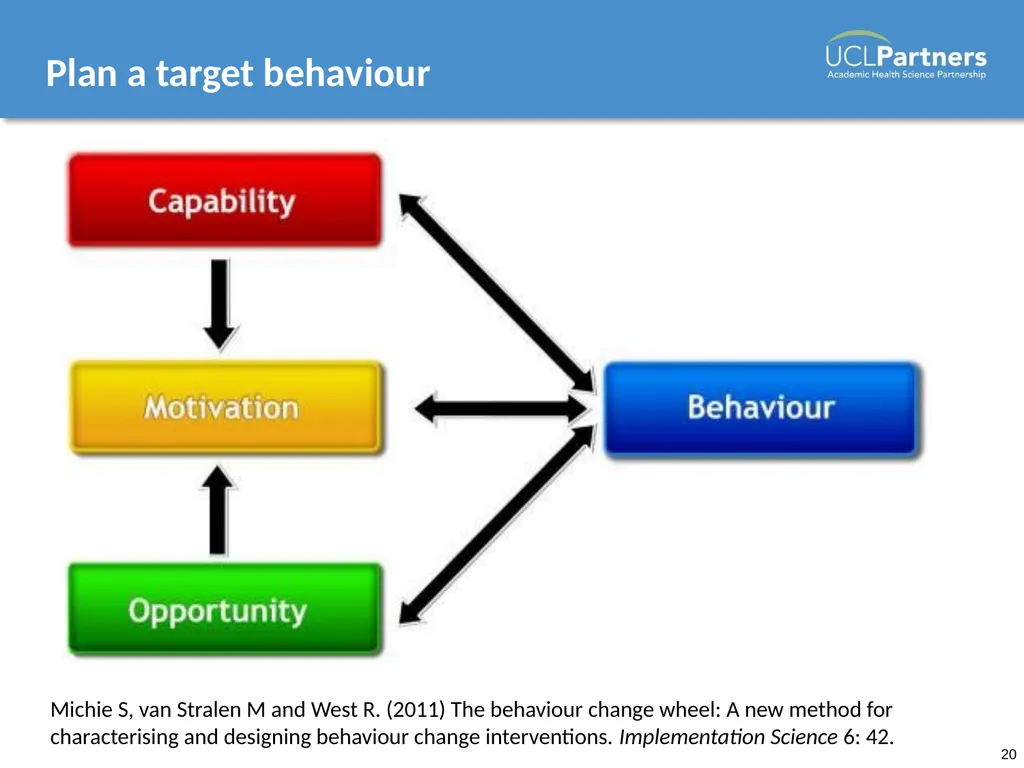
slide20. 20 Plan a target behaviour Michie et al (2011) Implementation Science Michie S, van Stralen M and West R. (2011) The behaviour change wheel: A new method for characterising and designing behaviour change interventions. Implementation Science 6: 42.<br>
slide21. Identifying a target behaviour
Group work – in threes (nurse, patient, observer) – swap roles
Mr Jones (again) wants to lose weight. Diet poor, does no exercise.
Nurse: Help Mr Jones to choose which behaviour (diet or exercise) he might want to tackle, then assist him to plan his target behaviour (where, when for how long, by) – what are the pros and cons of his chosen target behaviour? 21 Plan a target behaviour<br>
slide22. 22 Tea break!<br>
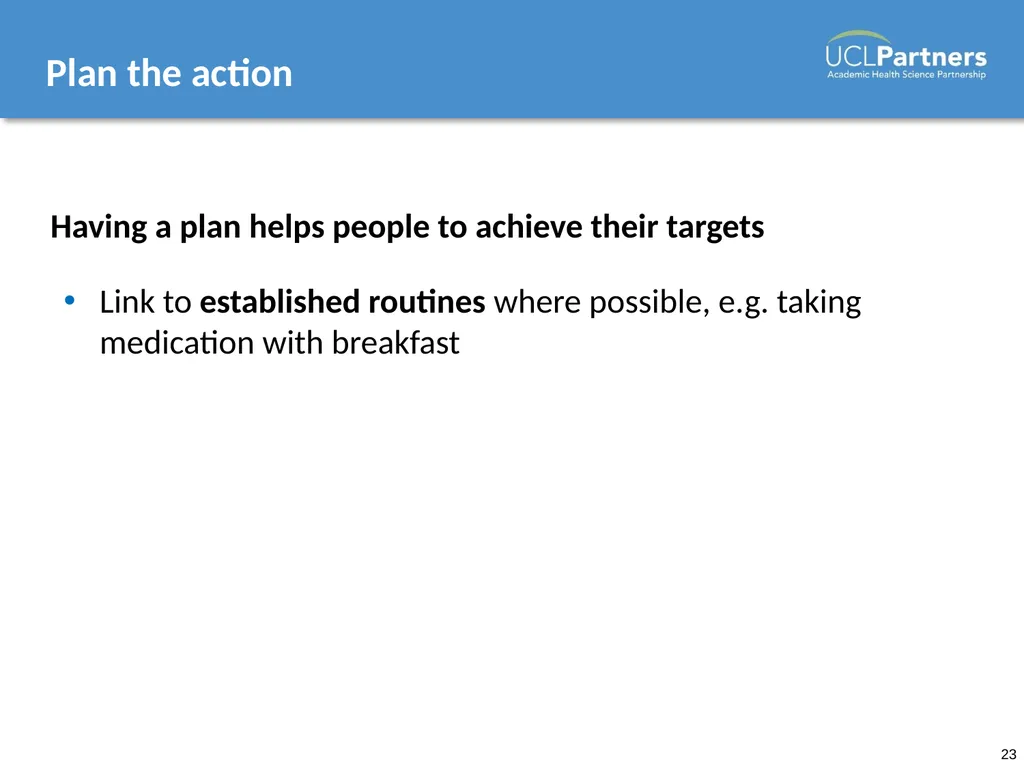
slide23. Plan the action Having a plan helps people to achieve their targets
Link to established routines where possible, e.g. taking medication with breakfast 23<br>
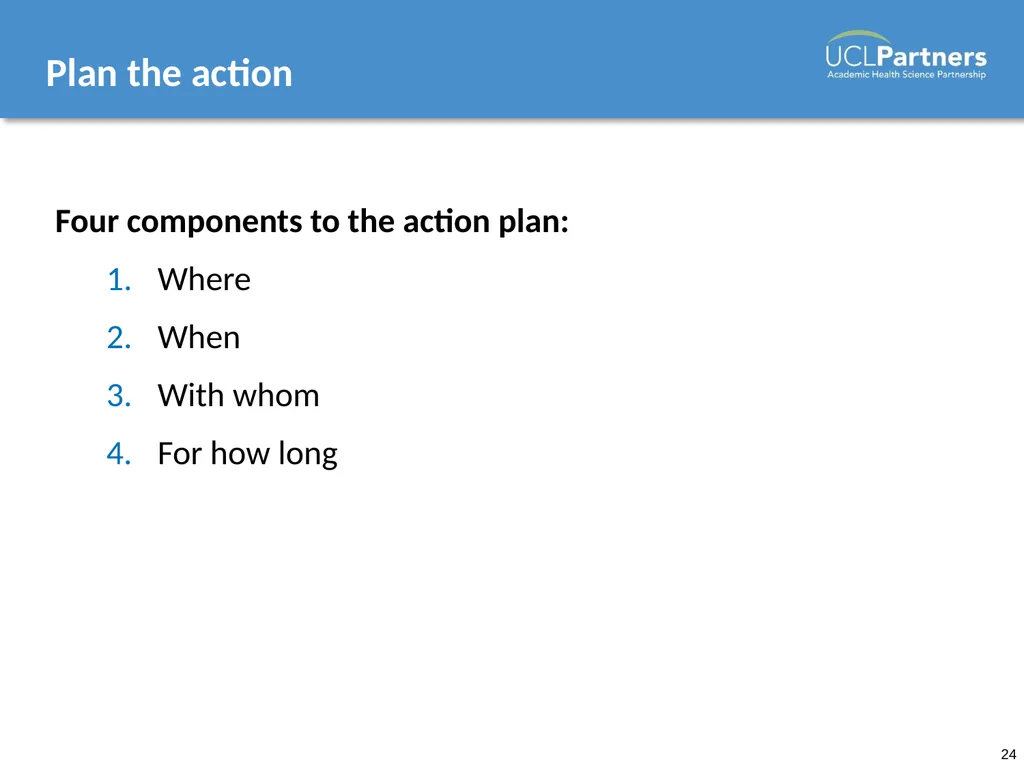
slide24. Plan the action Four components to the action plan:
Where
When
With whom
For how long 24<br>
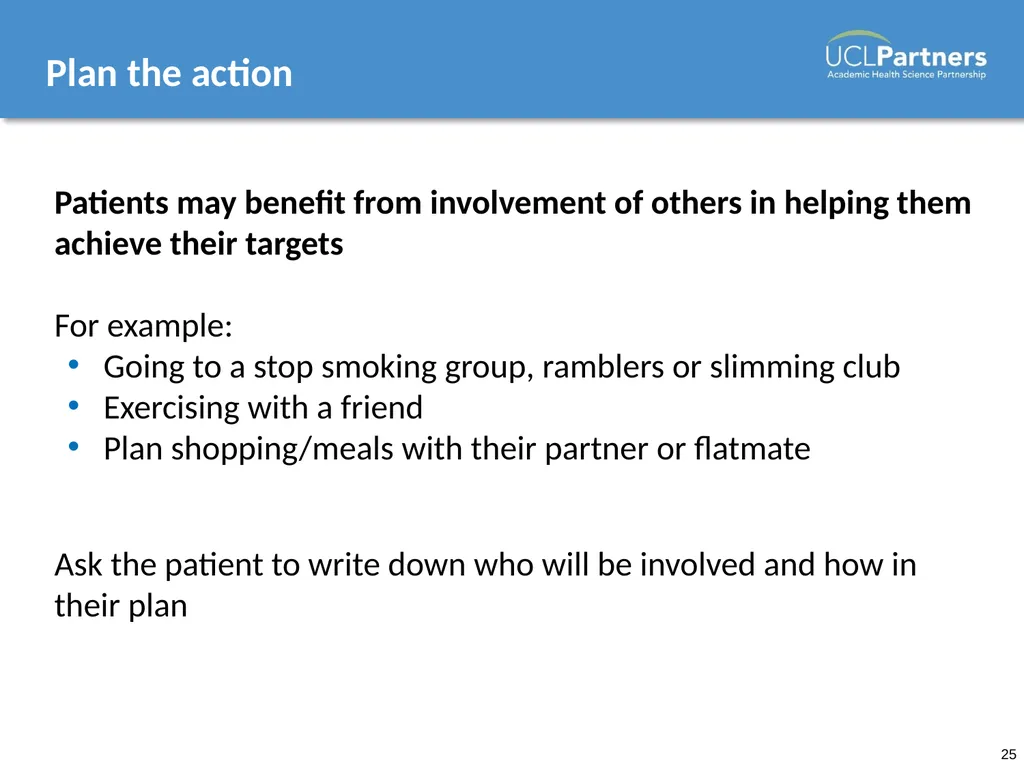
slide25. Patients may benefit from involvement of others in helping them achieve their targets
For example:
Going to a stop smoking group, ramblers or slimming club
Exercising with a friend
Plan shopping/meals with their partner or flatmate
Ask the patient to write down who will be involved and how in their plan 25 Plan the action<br>
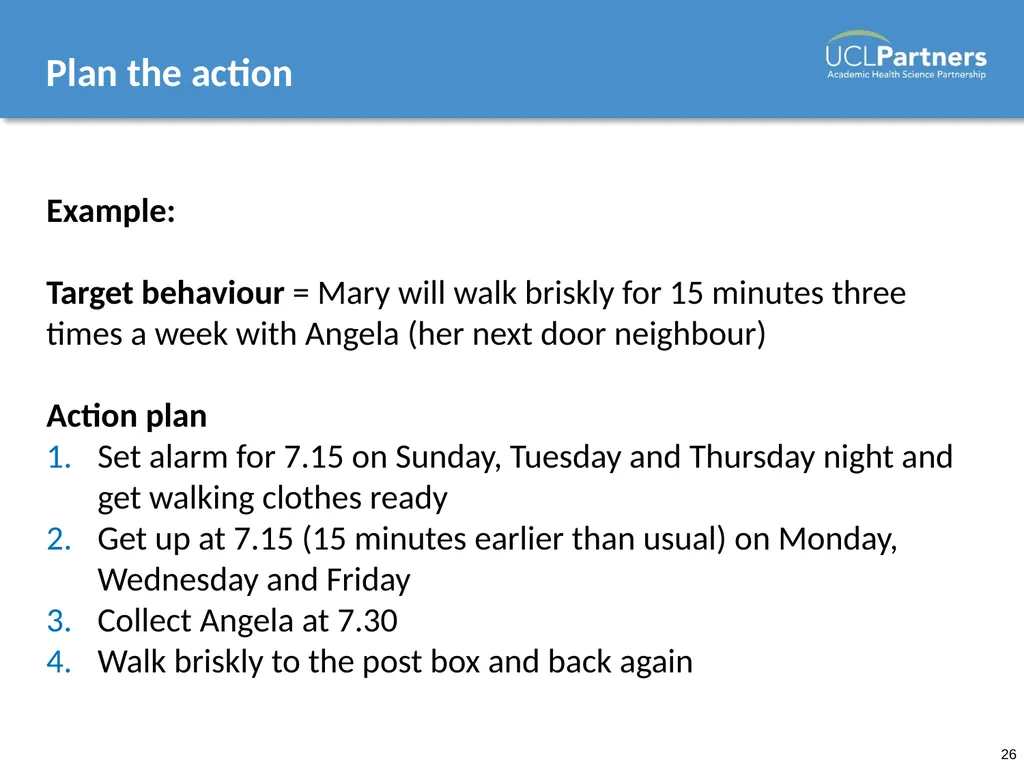
slide26. 26 Plan the action Example:
Target behaviour = Mary will walk briskly for 15 minutes three times a week with Angela (her next door neighbour)
Action plan
Set alarm for 7.15 on Sunday, Tuesday and Thursday night and get walking clothes ready
Get up at 7.15 (15 minutes earlier than usual) on Monday, Wednesday and Friday
Collect Angela at 7.30
Walk briskly to the post box and back again<br>
slide27. Group work – maintain roles
Plan the action for Mr Jones 27 Plan the action<br>
slide28. Record the action Gives the patient a realistic picture of progress (avoids over- or under-estimation)
Increases motivation on seeing evidence of success
Identifies problems in achieving a target 28<br>
slide29. Record the action Decide with the patient how the chosen behaviour might be measured
Ask the patient to record this in their plan
Encourage the patient to write comments to record progress in more detail
Make the patient an appointment to review their progress 29<br>
slide30. 30 Record the action Group work
Patient to record the action taken – others to advise<br>
slide31. Review progress Ask open questions to start, e.g. ‘How did you get on last week?’
Use the patient’s plan as the starting point for reviewing progress 31<br>
slide32. Review progress If the patient has achieved their target behaviour:
Praise the patient for their achievement
Keep the same goal to make sure the change that has been achieved is stable, or
If appropriate set a new target behaviour
If the patient has partly achieved their target behaviour:
Congratulate them on their progress and identify anything learned from the experience 32<br>
slide33. Review progress If the patient has not achieved their target behaviour:
Praise them for any effort made towards achieving their target
Identify anything learned from the experience
Discuss other possible actions to achieve the target behaviour
If other actions cannot be identified, set a new target behaviour 33<br>
slide34. Give positive feedback Giving the patient positive feedback promotes engagement and motivation to continue with their plan
General positive feedback:
‘It’s great to see you’ or ‘Well done on last week’
Providing positive feedback on a target behaviour:
Behaviour: ‘You’ve managed an extra walk this week, that’s great’
Effort: ‘Well done – getting up earlier seems to be helping you get those walks in’
Outcome: ‘That’s great, you’ve nearly reached your fitness target!’ 34<br>
slide35. Give positive feedback Group work in threes – swap roles
Mr Jones has partly achieved his target behaviour 35<br>
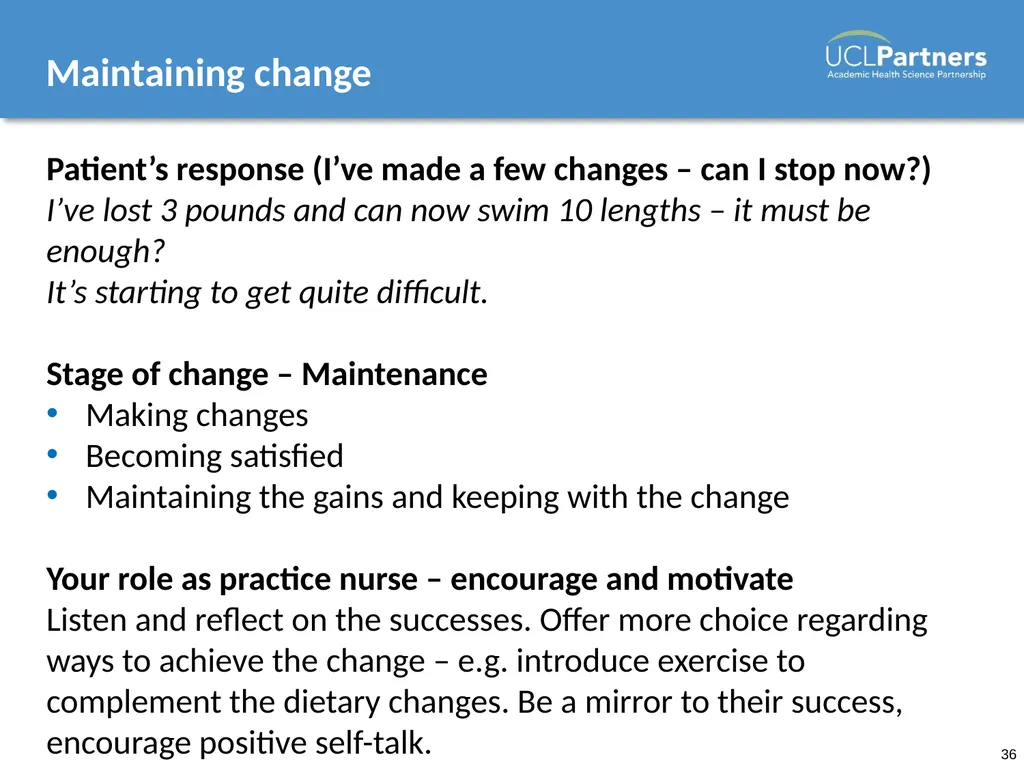
slide36. 36 Maintaining change Patient’s response (I’ve made a few changes – can I stop now?)
I’ve lost 3 pounds and can now swim 10 lengths – it must be enough?
It’s starting to get quite difficult.
Stage of change – Maintenance
Making changes
Becoming satisfied
Maintaining the gains and keeping with the change
Your role as practice nurse – encourage and motivate
Listen and reflect on the successes. Offer more choice regarding ways to achieve the change – e.g. introduce exercise to complement the dietary changes. Be a mirror to their success, encourage positive self-talk.<br>
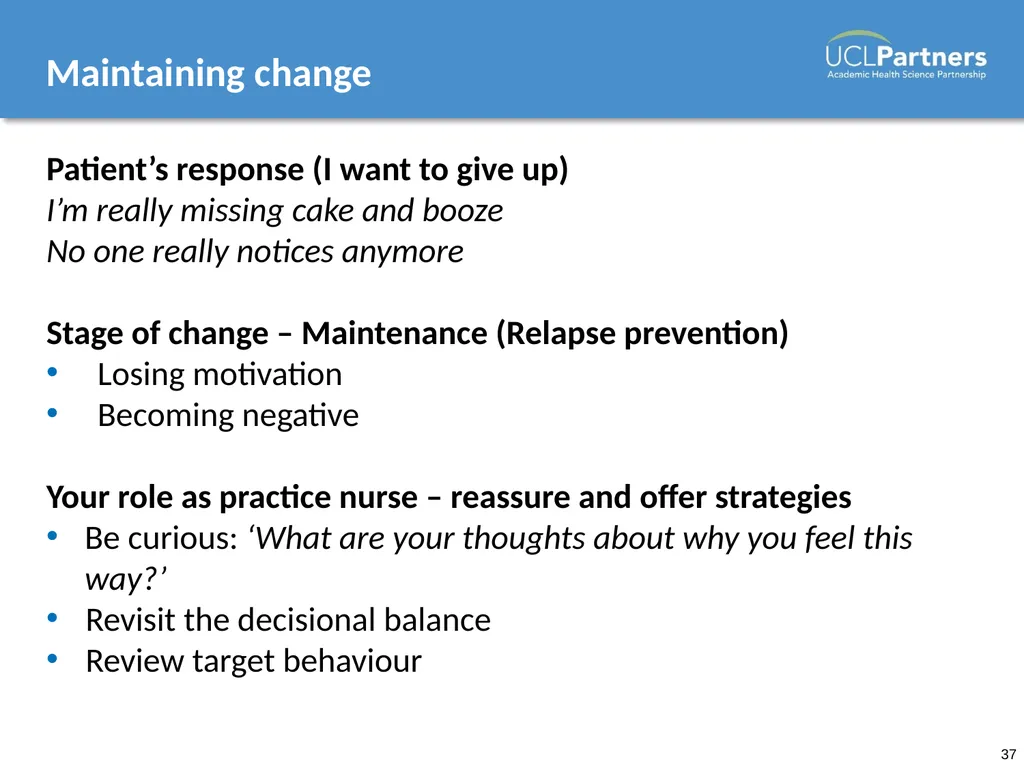
slide37. 37 Maintaining change Patient’s response (I want to give up)
I’m really missing cake and booze
No one really notices anymore
Stage of change – Maintenance (Relapse prevention)
Losing motivation
Becoming negative
Your role as practice nurse – reassure and offer strategies
Be curious: ‘What are your thoughts about why you feel this way?’
Revisit the decisional balance
Review target behaviour<br>
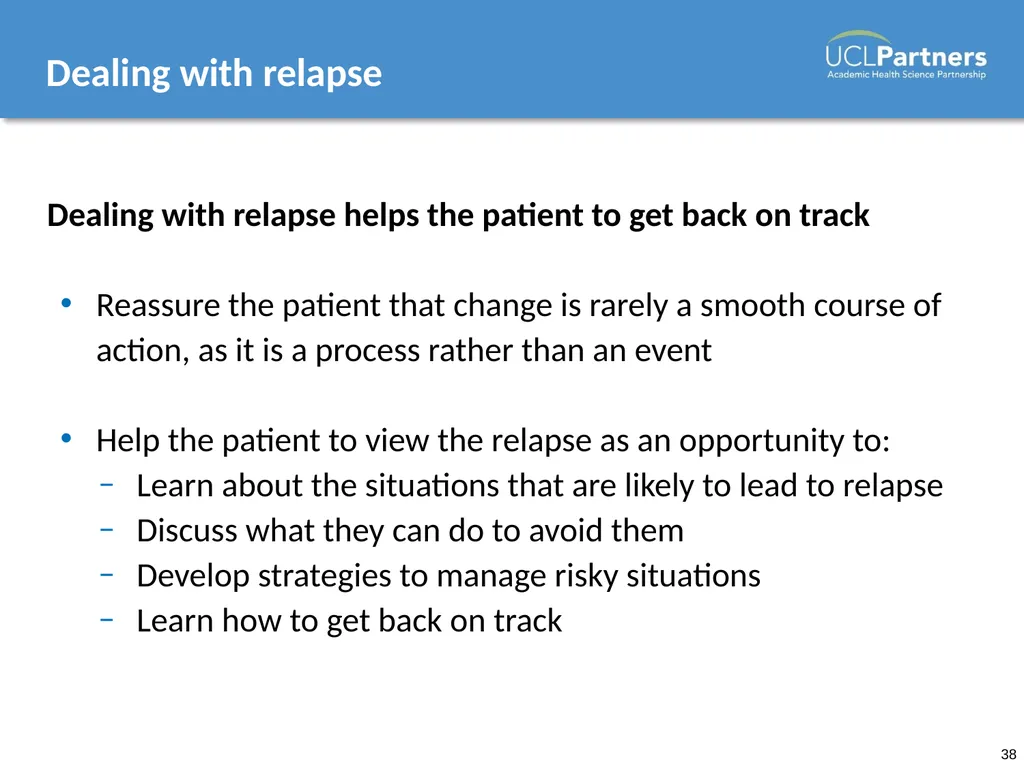
slide38. Dealing with relapse Dealing with relapse helps the patient to get back on track
Reassure the patient that change is rarely a smooth course of action, as it is a process rather than an event
Help the patient to view the relapse as an opportunity to:
Learn about the situations that are likely to lead to relapse
Discuss what they can do to avoid them
Develop strategies to manage risky situations
Learn how to get back on track 38<br>
slide39. 39 Dealing with relapse Group work
Mr Jones has now relapsed
Nurse: How will you manage this consultation?<br>
slide40. 40 Discussion Any questions?<br>
Presenter name, position, trust
Date<br>
slide2. 2 Acknowledgements We would like to thank:
Dr Sheila Hardy, Education Fellow at UCLPartners, and author of these materials.
The expert reference group, steering group and project team:<br>
slide3. Introductions 3<br>
slide4. 4 Learning objectives Following this training you should:
Know how changing behaviour can affect the individual and others
Be aware of the types of behaviour practice nurses may be in a position to help patients change
Understand which patients are ready to change
Be confident in responding to patients to ensure engagement now and in the future
Know how to set a target behaviour
Be competent in helping a patient plan their action
Understand why the patient should record their action
Be confident in reviewing a patient’s progress
Know how to give positive feedback even when the patient has relapsed
Be competent in supporting a patient who has relapsed<br>
slide5. What sort of behaviour do we want to change? Once only change
e.g. having plastic surgery or a major operation
Repeated change with an endpoint
e.g. a course of travel vaccinations or treatment for an illness
Lifestyle change
e.g. stopping smoking, switching to healthy eating, increasing physical activity, reducing consumption of alcohol/drugs, starting to take medication as prescribed, avoiding working too hard, reducing gambling
Situational change
e.g. practising safe sex, checking blood glucose before driving 5<br>
slide6. Why would we want to change our patients’ behaviour? Ensure optimum health and happiness
Prevention of harm, disease, significant events (e.g. heart attack, stroke, depression, suicide, accidents, debt, conflict)
Save money – less use of NHS resources 6<br>
slide7. Readiness to change Precontemplation
Contemplation
Preparation
Action
Maintenance
Termination
Prochaska J and DiClemente C. (1983) Stages and processes of self-change of smoking: Toward an integrative model of change. Journal of Consulting and Clinical Psychology 51: 390-395. 7<br>
slide8. How do we go about it? Brief Motivational Interviewing (MI):
Listen actively and express empathy
Ask open questions
Avoid conflict
Support self-efficacy 8<br>
slide9. 9 How do we go about it? When using a brief MI approach:
The patient does more than 50% of the talking
You focus on listening
The majority of your interventions are summarising, with a few open-ended questions.
Avoid getting ahead of the patient’s level of readiness<br>
slide10. How do we go about it? Be empathic
Build confidence that change is possible
If they don’t want to change at this point in time – do not judge
Let them know you are available to help at any time (this gives them the opportunity to come back when they are ready)<br>
slide11. 11 How do we go about it? Patient’s response (I’m OK as I am)
I’m happy being this size
My husband likes me cuddly
My weight’s never bothered me
Stage of change – Precontemplation
No interest in changing
Very little point in giving health information
Your role as practice nurse
Be curious. Use MI skills, chat and look for discrepancies, listen for any change talk
If any interest is shown – ask permission to offer advice<br>
slide12. 12 How do we go about it? Example
Patient: I can’t exercise because my knees are bad.
Response that might cause conflict:
Nurse: You could try some non-impact exercise such as swimming or an exercise bike.
Response to avoid conflict:
Nurse: Oh, I’m sorry to hear that. What exercises have you tried that affected them? [Wait for response.] Are you aware of any exercises that won’t affect your knees?<br>
slide13. How do we go about it? Dealing with resistance
Group work – in threes
Patient: Mr Jones, 63 years old, type 2 diabetes, Hba1c 72, BMI 34. Takes two sugars in tea and coffee – doesn’t want to stop as sweeteners and no sugar are disgusting.
Nurse: Respond to this. Remember do not give advice at this stage. Be curious and empathic.
Observer: How did the nurse respond? 13<br>
slide14. 14 How do we go about it? Patient’s response (I may want to do something different)
My rubbish diet does bother me sometimes when I can’t get jeans to fit.
I tried to diet once but all I got was smaller boobs.
Stage of change – Contemplation
Some interest in making a change
Able to receive information
Able to discuss barriers
Your role as practice nurse – decisional balance
Be curious and amplify any change talk. Consider working through the pros and cons of making a change and importantly the wins and losses of staying just how they are.<br>
slide15. 15 How do we go about it? Patient’s response (All right, I’ll give it a go – but how do I start?)
It has been worrying me mainly because of the kids.
I think I’ll have a bit of a go at eating more fruit and veg.
Stage of change – Preparation and action
Planning to change
Making preparation to have a go
Your role as practice nurse – enable change
Remain curious, refer to leaflets, evidence, tell stories and use narratives. Help to set target behaviour.<br>
slide16. Behaviour change strategies Plan the target behaviour
Plan the action
Record the action
Review progress
Give positive feedback
Maintain change/Support with relapse 16<br>
slide17. Planning a target behaviour gives something specific for the patient to aim for
Plan in partnership with the patient
Discuss the pros and cons of possible target (this might help to overcome initial resistance)
Set one target at a time (less is more) 17 Plan a target behaviour<br>
slide18. Relate the target behaviour to a behaviour, e.g. walking, rather than an outcome, e.g. weight loss
SMART target behaviour
Specific: Who, what, where, when, how often, with whom, in what context
Measurable: Establish criteria
Achievable: Realistic, attainable (start small and build up)
Relevant: Does the patient understand the link between their goal and their desired outcome?
Timely: Realistic, what works for the patient
Ask patient to record in their plan 18 Plan a target behaviour<br>
slide19. 19 Plan a target behaviour Example:
Outcome: Lose two stone (12.7 kg)
Possible behaviours that the patient can choose to lose weight are increase physical activity, change diet.
Target behaviour = the level reached of the chosen behaviour before the next review (e.g. in two weeks will be walking for 10 minutes, four times a week, at a gentle pace, or in two weeks will have only one packet of crisps a day)<br>
slide20. 20 Plan a target behaviour Michie et al (2011) Implementation Science Michie S, van Stralen M and West R. (2011) The behaviour change wheel: A new method for characterising and designing behaviour change interventions. Implementation Science 6: 42.<br>
slide21. Identifying a target behaviour
Group work – in threes (nurse, patient, observer) – swap roles
Mr Jones (again) wants to lose weight. Diet poor, does no exercise.
Nurse: Help Mr Jones to choose which behaviour (diet or exercise) he might want to tackle, then assist him to plan his target behaviour (where, when for how long, by) – what are the pros and cons of his chosen target behaviour? 21 Plan a target behaviour<br>
slide22. 22 Tea break!<br>
slide23. Plan the action Having a plan helps people to achieve their targets
Link to established routines where possible, e.g. taking medication with breakfast 23<br>
slide24. Plan the action Four components to the action plan:
Where
When
With whom
For how long 24<br>
slide25. Patients may benefit from involvement of others in helping them achieve their targets
For example:
Going to a stop smoking group, ramblers or slimming club
Exercising with a friend
Plan shopping/meals with their partner or flatmate
Ask the patient to write down who will be involved and how in their plan 25 Plan the action<br>
slide26. 26 Plan the action Example:
Target behaviour = Mary will walk briskly for 15 minutes three times a week with Angela (her next door neighbour)
Action plan
Set alarm for 7.15 on Sunday, Tuesday and Thursday night and get walking clothes ready
Get up at 7.15 (15 minutes earlier than usual) on Monday, Wednesday and Friday
Collect Angela at 7.30
Walk briskly to the post box and back again<br>
slide27. Group work – maintain roles
Plan the action for Mr Jones 27 Plan the action<br>
slide28. Record the action Gives the patient a realistic picture of progress (avoids over- or under-estimation)
Increases motivation on seeing evidence of success
Identifies problems in achieving a target 28<br>
slide29. Record the action Decide with the patient how the chosen behaviour might be measured
Ask the patient to record this in their plan
Encourage the patient to write comments to record progress in more detail
Make the patient an appointment to review their progress 29<br>
slide30. 30 Record the action Group work
Patient to record the action taken – others to advise<br>
slide31. Review progress Ask open questions to start, e.g. ‘How did you get on last week?’
Use the patient’s plan as the starting point for reviewing progress 31<br>
slide32. Review progress If the patient has achieved their target behaviour:
Praise the patient for their achievement
Keep the same goal to make sure the change that has been achieved is stable, or
If appropriate set a new target behaviour
If the patient has partly achieved their target behaviour:
Congratulate them on their progress and identify anything learned from the experience 32<br>
slide33. Review progress If the patient has not achieved their target behaviour:
Praise them for any effort made towards achieving their target
Identify anything learned from the experience
Discuss other possible actions to achieve the target behaviour
If other actions cannot be identified, set a new target behaviour 33<br>
slide34. Give positive feedback Giving the patient positive feedback promotes engagement and motivation to continue with their plan
General positive feedback:
‘It’s great to see you’ or ‘Well done on last week’
Providing positive feedback on a target behaviour:
Behaviour: ‘You’ve managed an extra walk this week, that’s great’
Effort: ‘Well done – getting up earlier seems to be helping you get those walks in’
Outcome: ‘That’s great, you’ve nearly reached your fitness target!’ 34<br>
slide35. Give positive feedback Group work in threes – swap roles
Mr Jones has partly achieved his target behaviour 35<br>
slide36. 36 Maintaining change Patient’s response (I’ve made a few changes – can I stop now?)
I’ve lost 3 pounds and can now swim 10 lengths – it must be enough?
It’s starting to get quite difficult.
Stage of change – Maintenance
Making changes
Becoming satisfied
Maintaining the gains and keeping with the change
Your role as practice nurse – encourage and motivate
Listen and reflect on the successes. Offer more choice regarding ways to achieve the change – e.g. introduce exercise to complement the dietary changes. Be a mirror to their success, encourage positive self-talk.<br>
slide37. 37 Maintaining change Patient’s response (I want to give up)
I’m really missing cake and booze
No one really notices anymore
Stage of change – Maintenance (Relapse prevention)
Losing motivation
Becoming negative
Your role as practice nurse – reassure and offer strategies
Be curious: ‘What are your thoughts about why you feel this way?’
Revisit the decisional balance
Review target behaviour<br>
slide38. Dealing with relapse Dealing with relapse helps the patient to get back on track
Reassure the patient that change is rarely a smooth course of action, as it is a process rather than an event
Help the patient to view the relapse as an opportunity to:
Learn about the situations that are likely to lead to relapse
Discuss what they can do to avoid them
Develop strategies to manage risky situations
Learn how to get back on track 38<br>
slide39. 39 Dealing with relapse Group work
Mr Jones has now relapsed
Nurse: How will you manage this consultation?<br>
slide40. 40 Discussion Any questions?<br>