04
As You Read… Keep these four ideas in mind as the epic unfolds. HERO What earns admiration? MONSTER What does the society fear? LOYALTY Who deserves allegiance? GLORY What is fame worth? At the end: Which statement would you answer differently — and why? BEOWULF • THE ANGLO-SAXON EPIC 04<br>
05
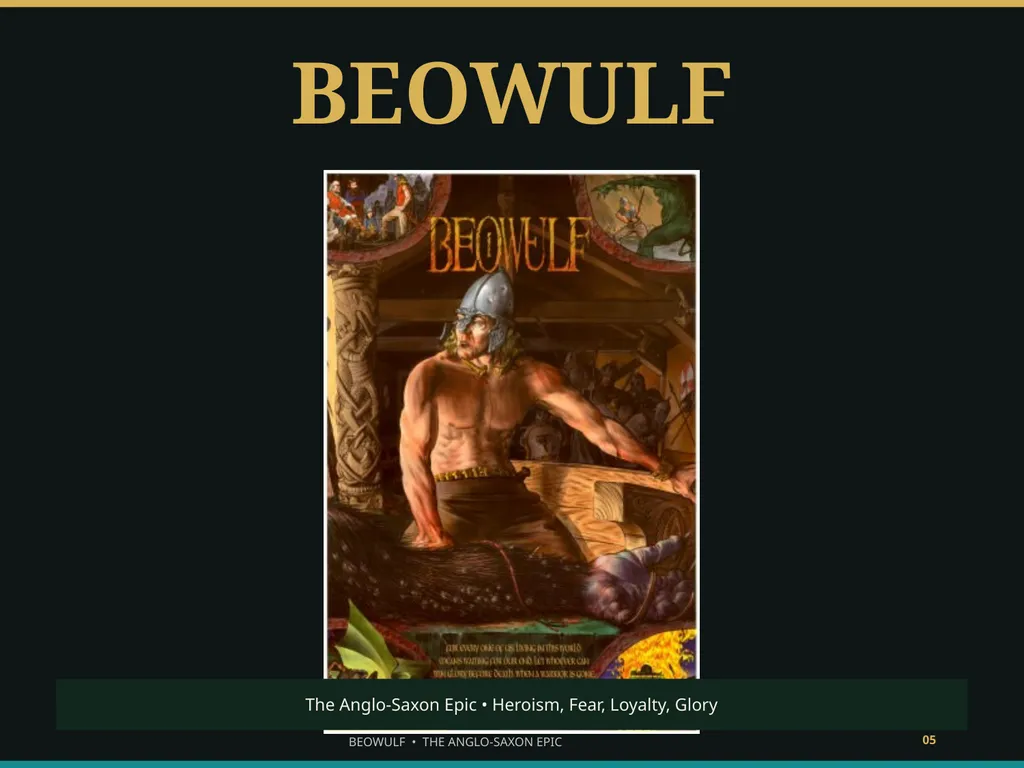
BEOWULF The Anglo-Saxon Epic • Heroism, Fear, Loyalty, Glory BEOWULF • THE ANGLO-SAXON EPIC 05<br>
06
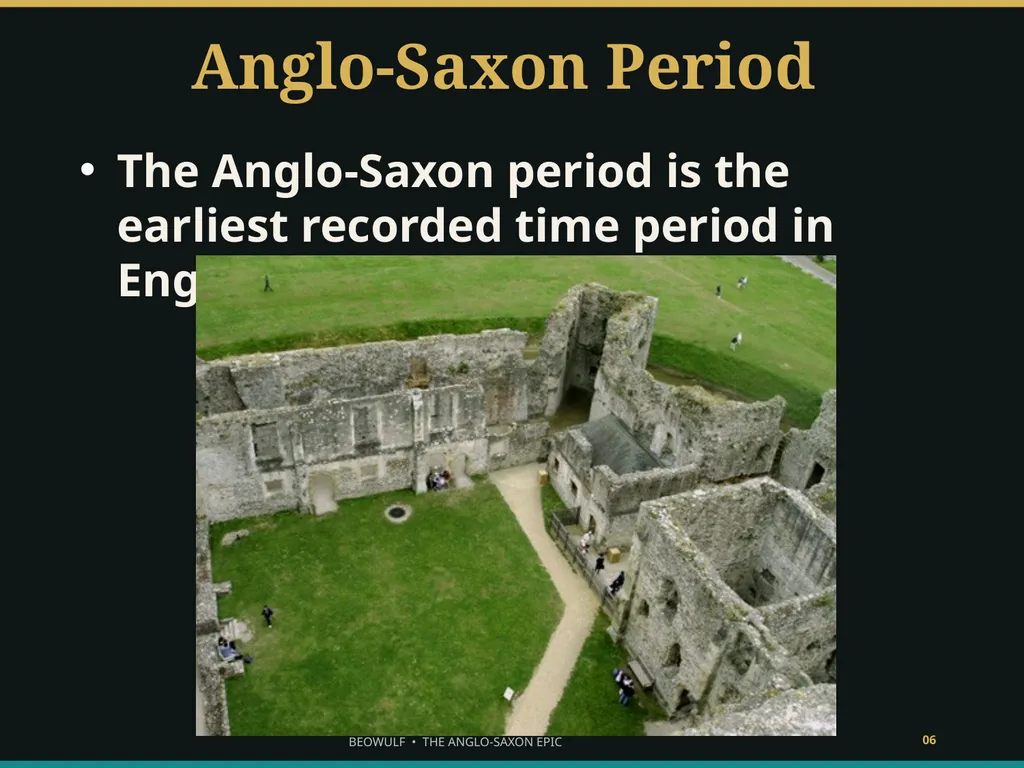
Anglo-Saxon Period The Anglo-Saxon period is the earliest recorded time period in English history. BEOWULF • THE ANGLO-SAXON EPIC 06<br>
07
The Anglo-Saxon period ranges from 449-1066.
It ends with the Battle of Hastings where the French, under the leadership of William the Conqueror invaded England. BEOWULF • THE ANGLO-SAXON EPIC 07<br>
08
Anglo-Saxon Literature Few people read in this period
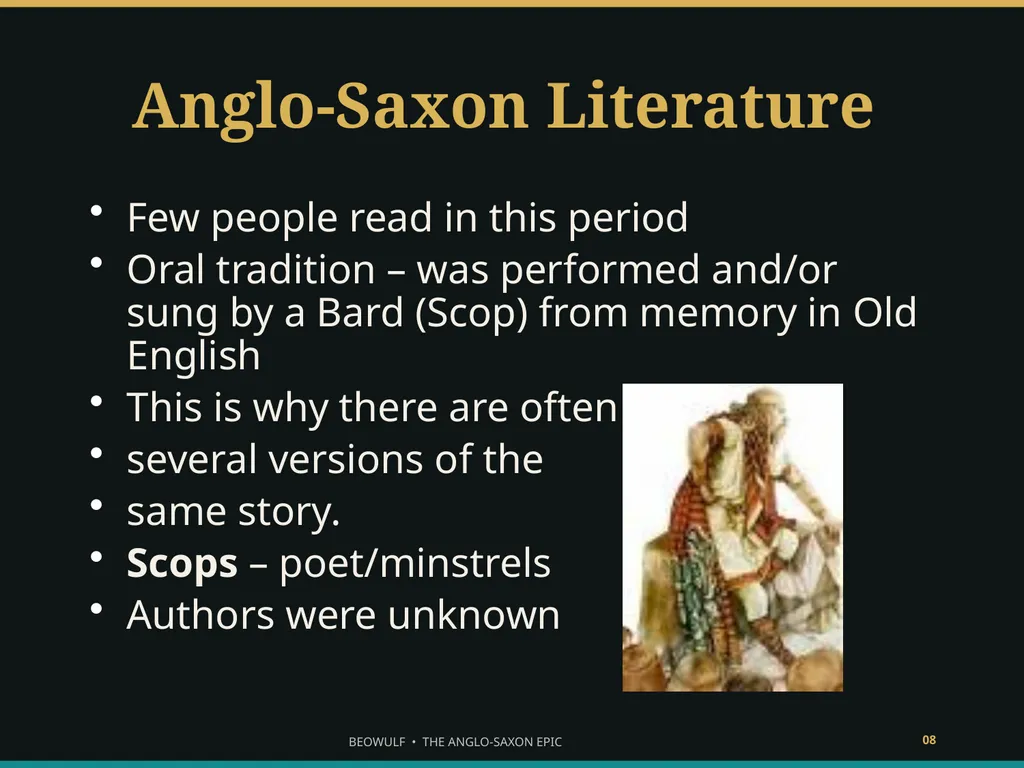
Oral tradition – was performed and/or sung by a Bard (Scop) from memory in Old English
This is why there are often
several versions of the
same story.
Scops – poet/minstrels
Authors were unknown BEOWULF • THE ANGLO-SAXON EPIC 08<br>
09
THE STORY OF BEOWULF Beowulf marks the beginning of English literature
Beowulf is one of the earliest known pieces of literature known in the English language; written in Old English BEOWULF • THE ANGLO-SAXON EPIC 09<br>
10
Contains specific Motifs Motifs – a motif is a recurring theme or image in a work of literature
Biblical and Christian Allusions
Pagan Customs
Social Customs
Traits of the Warrior
Beowulf Boasts BEOWULF • THE ANGLO-SAXON EPIC 10<br>
11
The story of Beowulf wasn’t written down until about 700 AD by “The Beowulf Poet” who is unknown. He wrote down the poem which for many years had been only sung or spoken. BEOWULF • THE ANGLO-SAXON EPIC 11<br>
12
Scholars believe “The Beowulf Poet” was most likely a Christian monk, thus adding a Christian perspective. BEOWULF • THE ANGLO-SAXON EPIC 12<br>
13
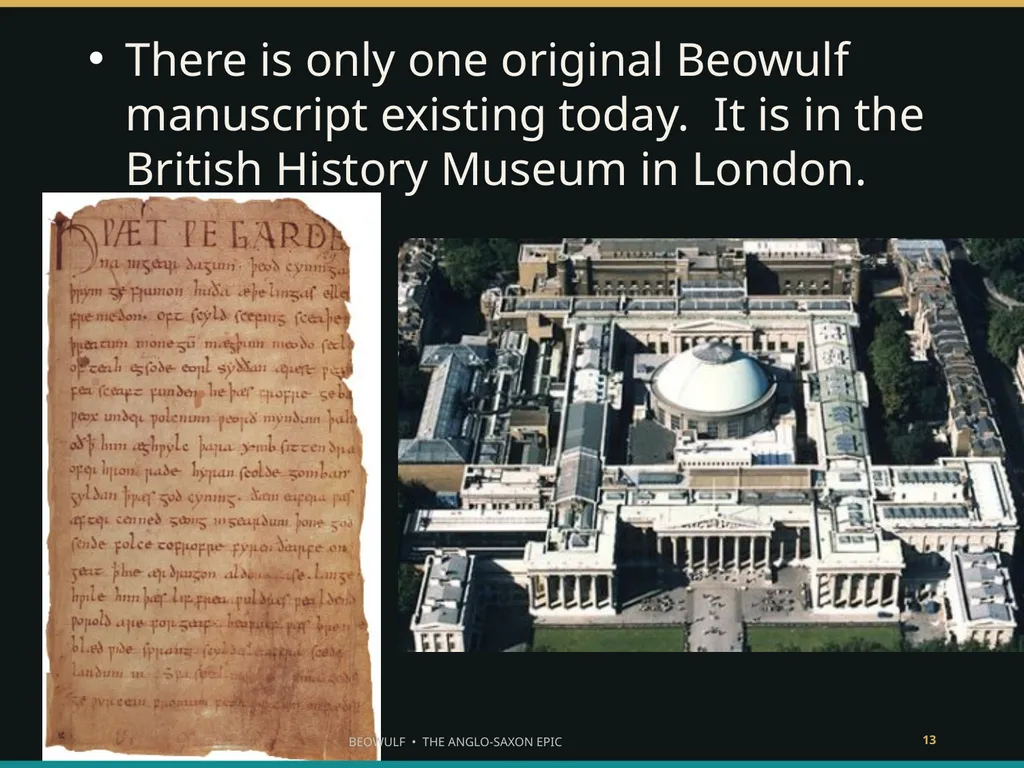
There is only one original Beowulf manuscript existing today. It is in the British History Museum in London. BEOWULF • THE ANGLO-SAXON EPIC 13<br>
14
BEOWULF is an EPIC poem. EPIC – a long, narrative poem that relates the great deeds of a larger-than-life hero who embodies the values of a particular society. BEOWULF • THE ANGLO-SAXON EPIC 14<br>
15
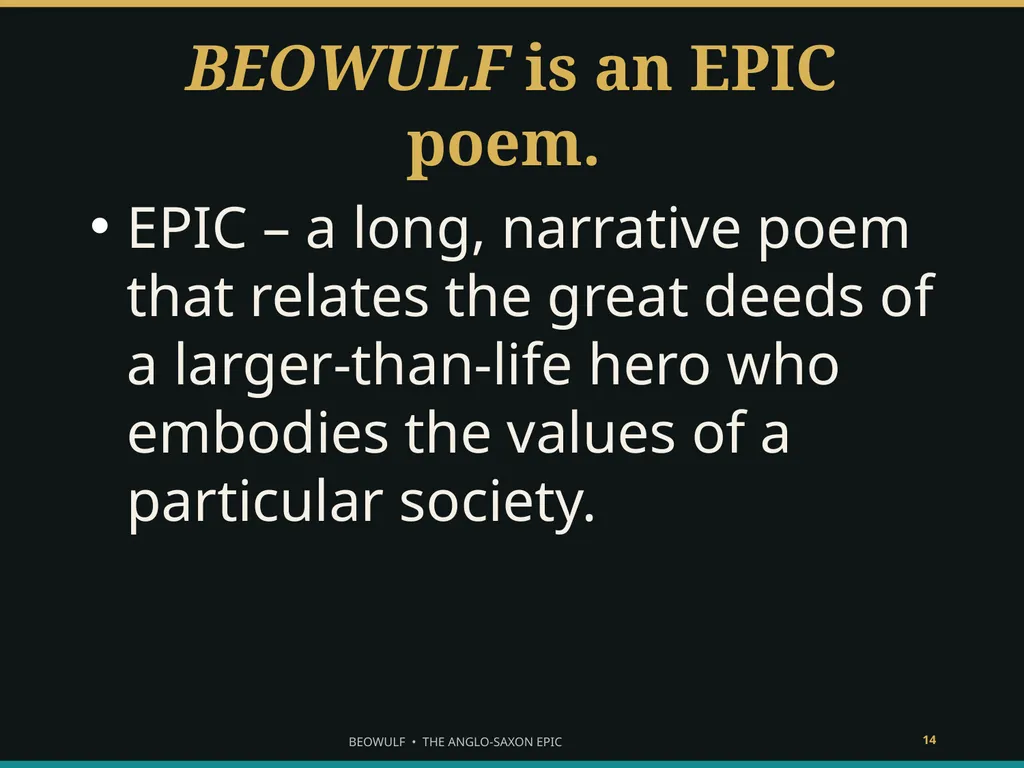
Examples of other EPICS are… Greek “Illiad” and
“Odyssey” – Homer BEOWULF • THE ANGLO-SAXON EPIC 15<br>
16
The Hobbit and Lord of the Rings – Tolkien BEOWULF • THE ANGLO-SAXON EPIC 16<br>
17
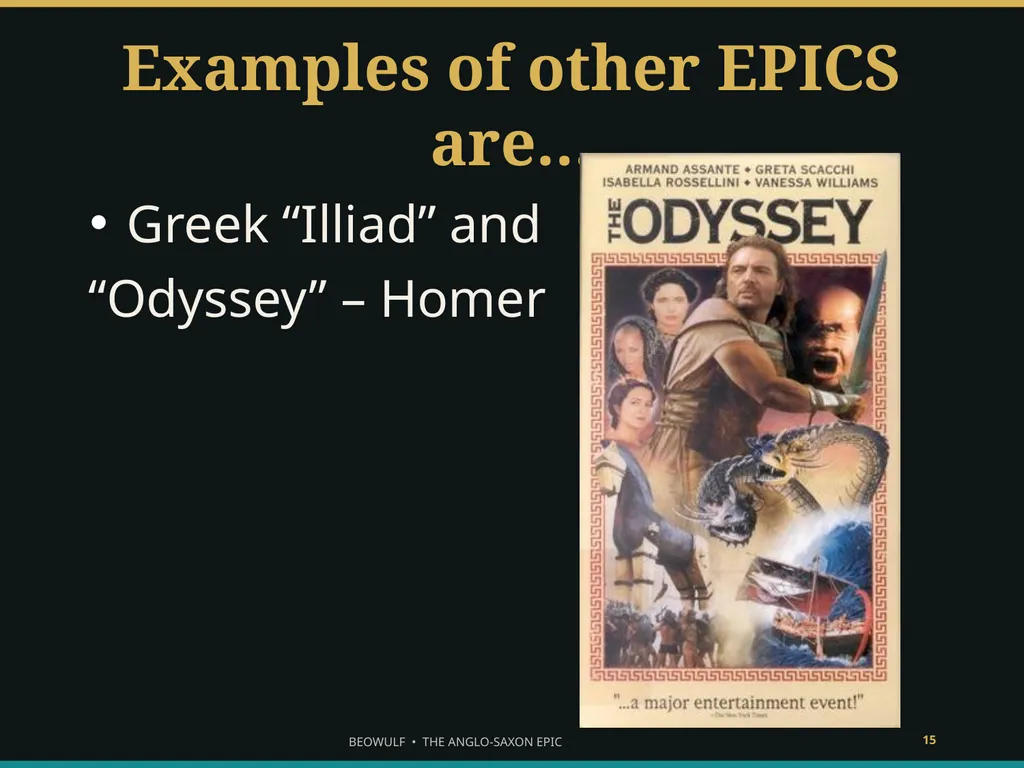
And of course there’s the EPIC HERO!!!! EPIC HERO – must undertake a quest to achieve something of tremendous value to himself and his society BEOWULF • THE ANGLO-SAXON EPIC 17<br>
18
SUMMARY OF EPIC FEATURES: A long narrative poem
Larger than life hero; often with super-human characteristics
Concerns eternal human problems like the struggle between good and evil
Presented in a serious manner using elevated (poetic) language
Hero represents widespread national, cultural, or religious values BEOWULF • THE ANGLO-SAXON EPIC 18<br>
19
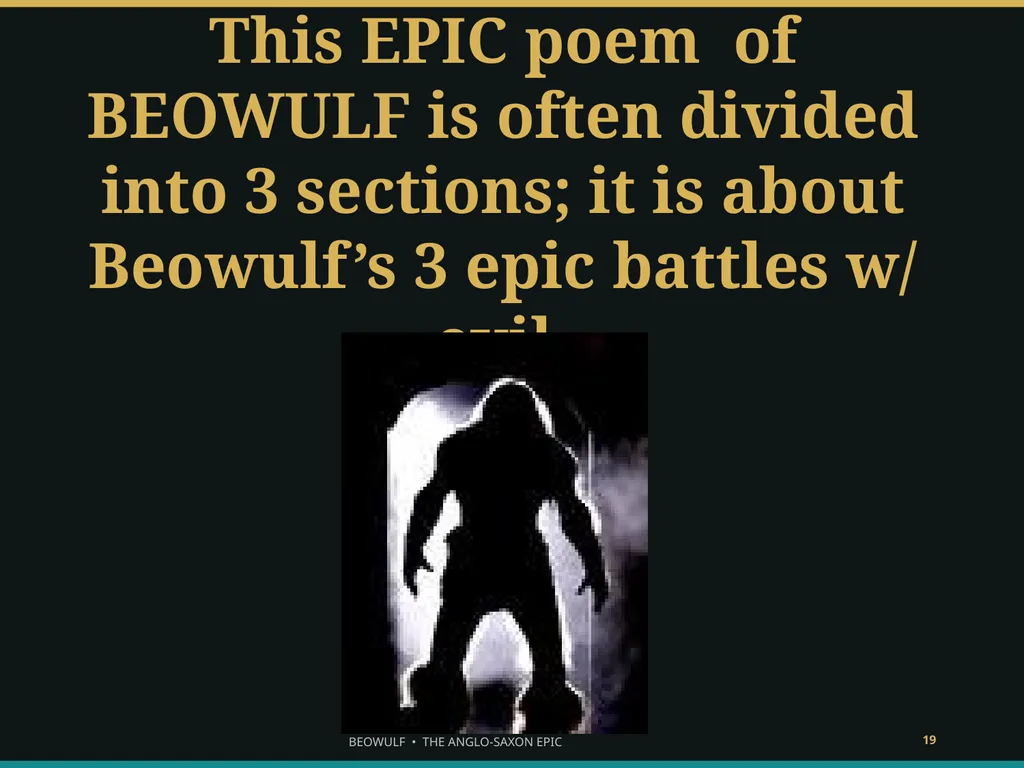
This EPIC poem of BEOWULF is often divided into 3 sections; it is about Beowulf’s 3 epic battles w/ evil. BEOWULF • THE ANGLO-SAXON EPIC 19<br>
20
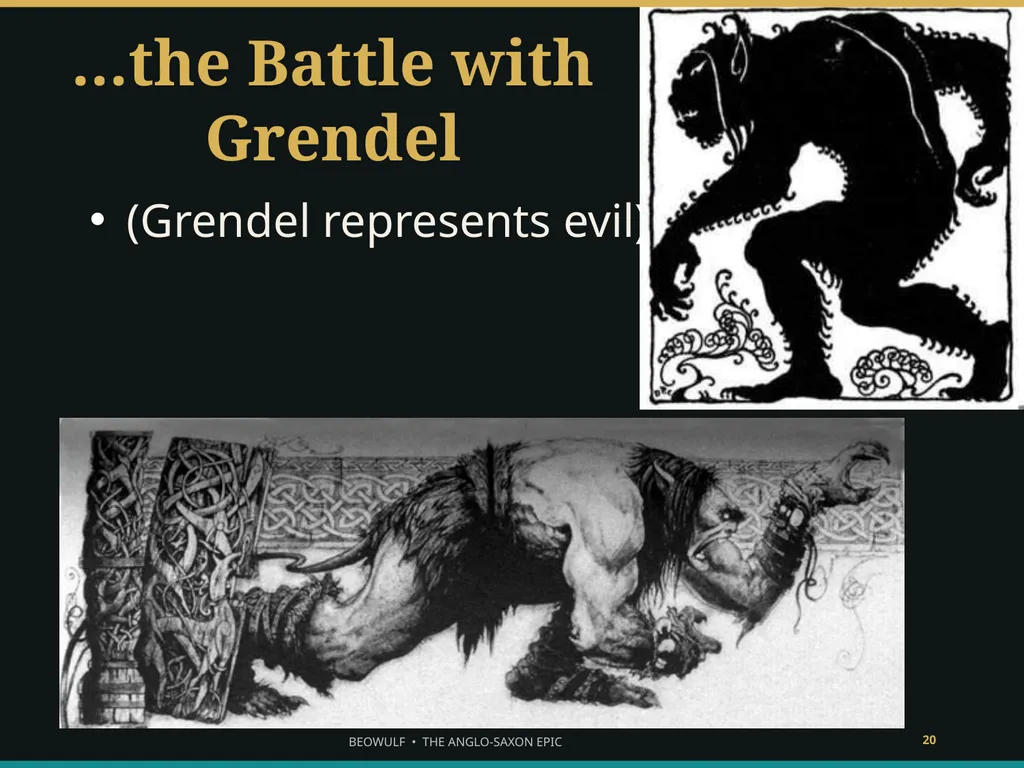
…the Battle with �Grendel (Grendel represents evil) BEOWULF • THE ANGLO-SAXON EPIC 20<br>
21
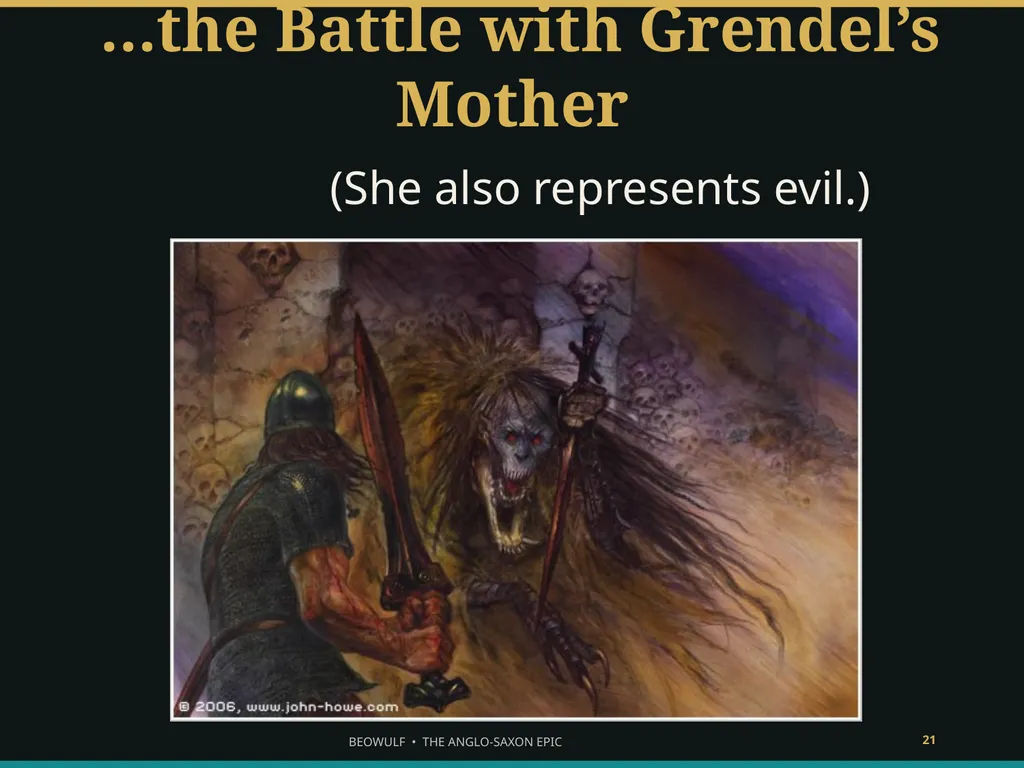
…the Battle with Grendel’s Mother (She also represents evil.) BEOWULF • THE ANGLO-SAXON EPIC 21<br>
22
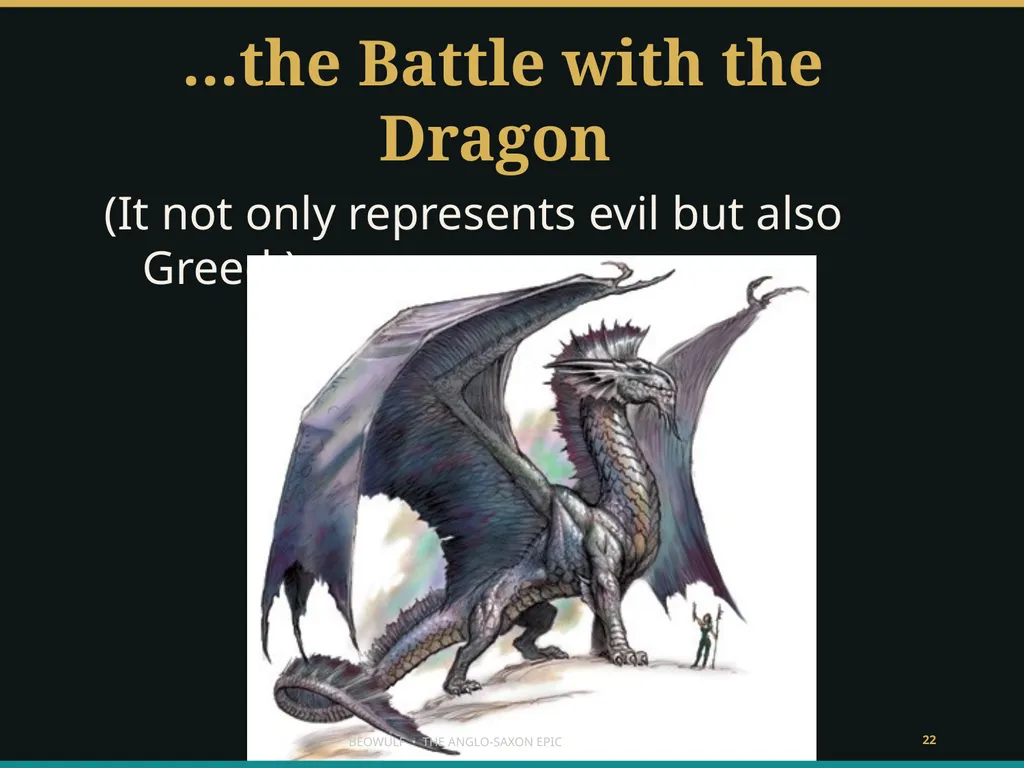
…the Battle with the Dragon (It not only represents evil but also Greed.) BEOWULF • THE ANGLO-SAXON EPIC 22<br>
23
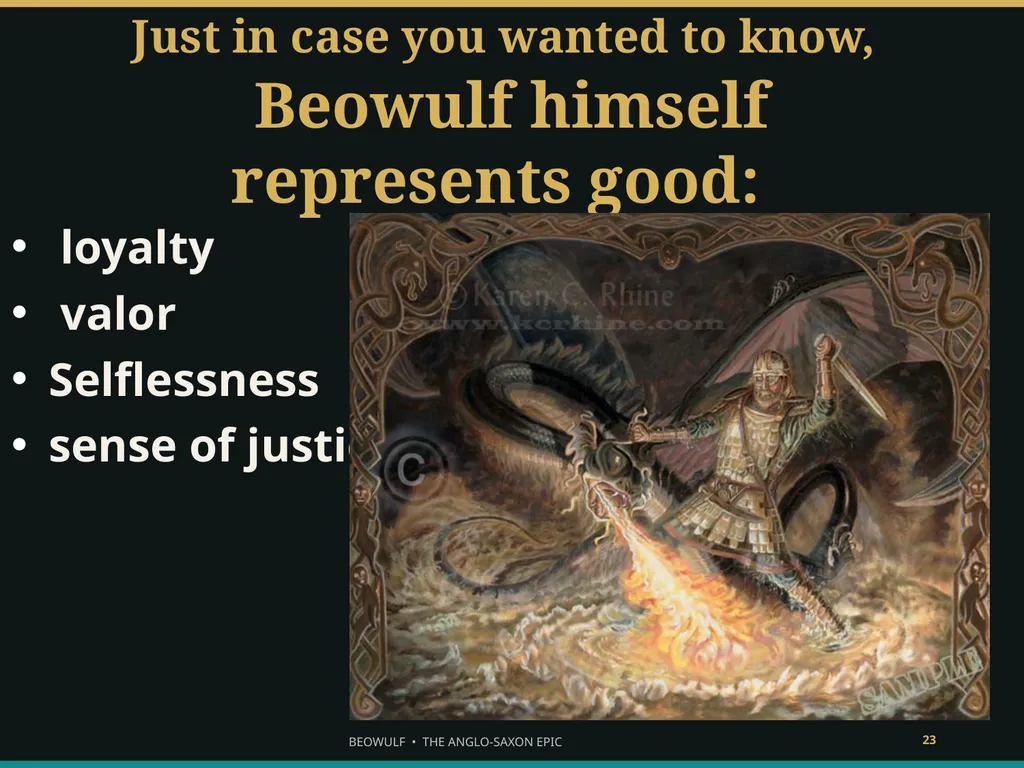
Just in case you wanted to know, �Beowulf himself represents good: loyalty
valor
Selflessness
sense of justice BEOWULF • THE ANGLO-SAXON EPIC 23<br>
24
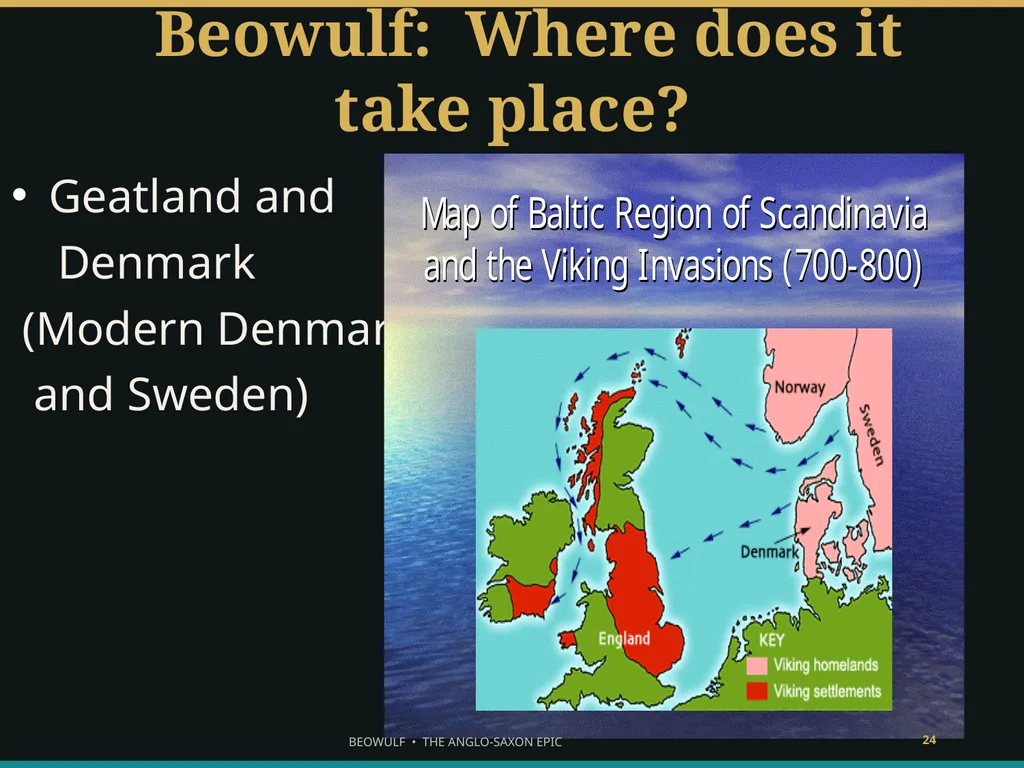
Beowulf: Where does it take place? Geatland and
Denmark
(Modern Denmark
and Sweden) BEOWULF • THE ANGLO-SAXON EPIC 24<br>
25
Note:
None of the action takes place in England!!! BEOWULF • THE ANGLO-SAXON EPIC 25<br>
26
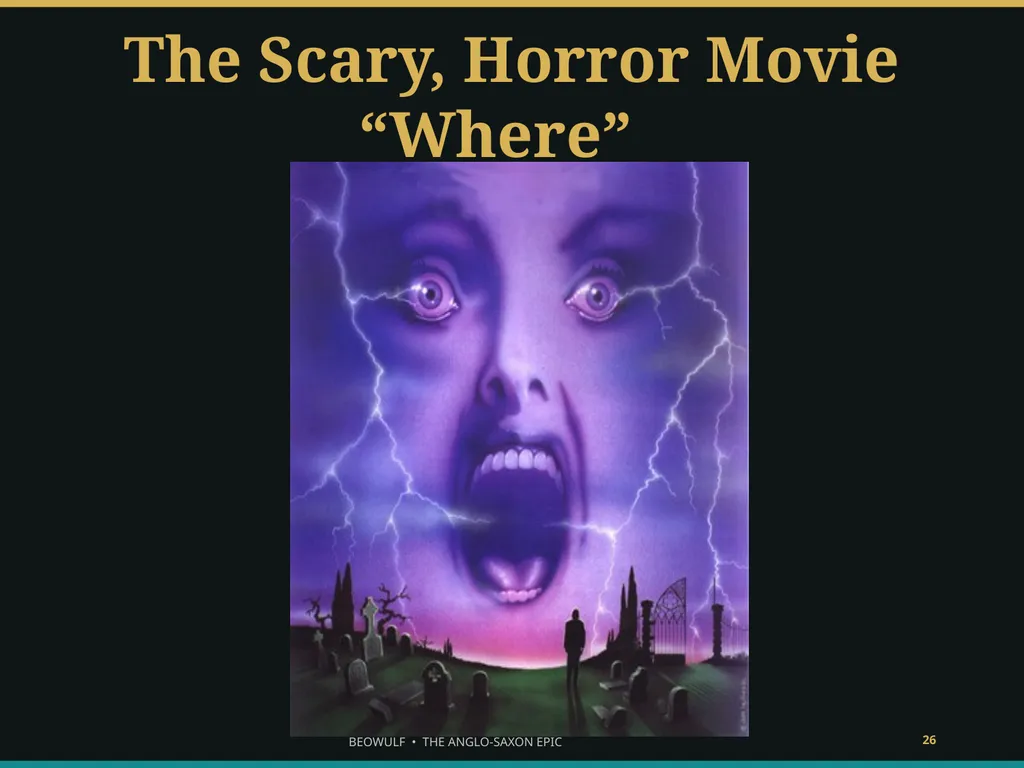
The Scary, Horror Movie “Where” BEOWULF • THE ANGLO-SAXON EPIC 26<br>
27
More specifically…�
Beowulf takes place in a “once upon a time world” which taps into “three archetypal sites of fear.” BEOWULF • THE ANGLO-SAXON EPIC 27<br>
28
1. The barricaded night house / Mead Hall (Grendel) BEOWULF • THE ANGLO-SAXON EPIC 28<br>
29
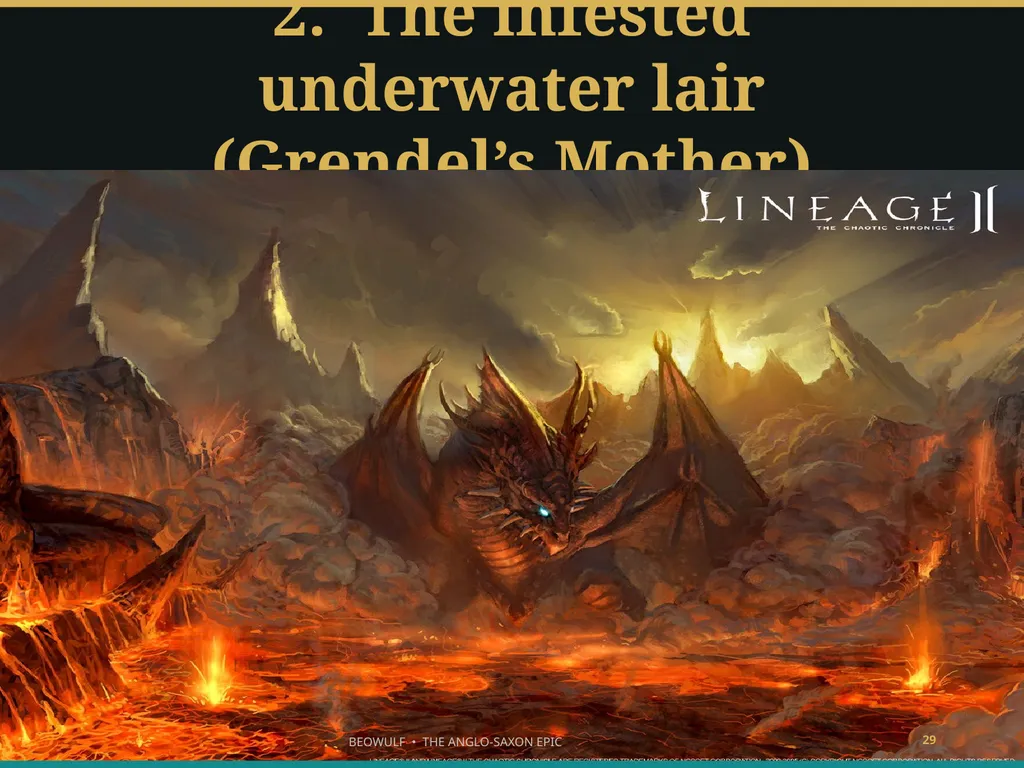
2. The infested underwater lair (Grendel’s Mother) BEOWULF • THE ANGLO-SAXON EPIC 29<br>
30
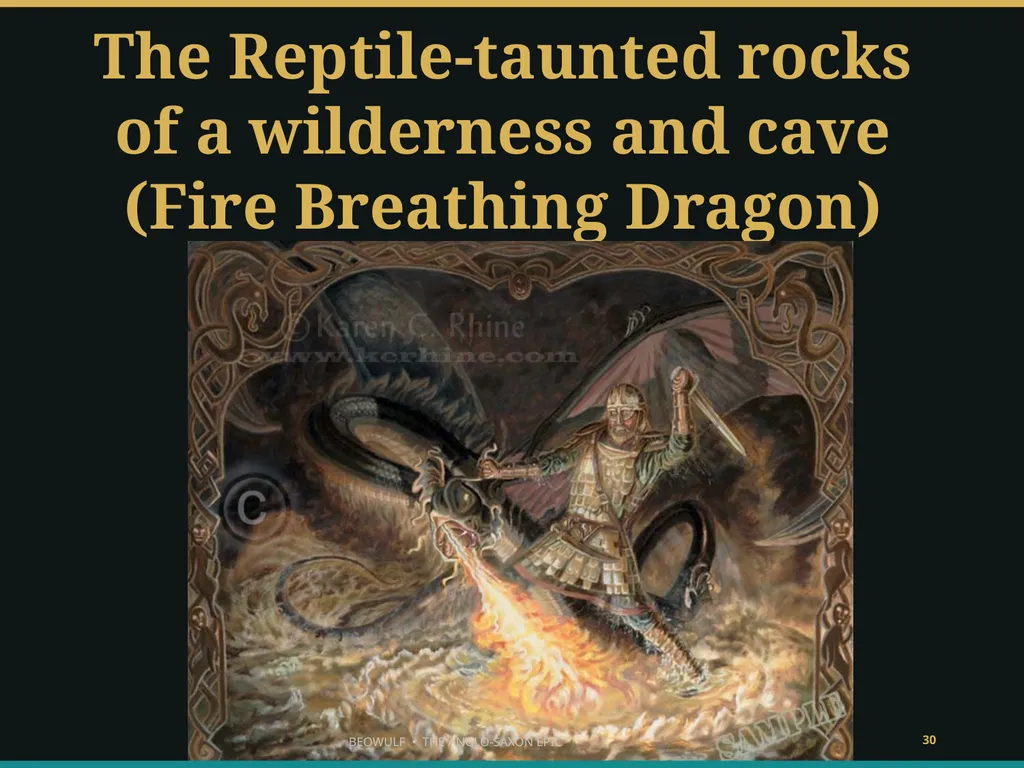
The Reptile-taunted rocks of a wilderness and cave (Fire Breathing Dragon) BEOWULF • THE ANGLO-SAXON EPIC 30<br>
31
I like to think of them this way, in terms which may mean more to your or my generation: BEOWULF • THE ANGLO-SAXON EPIC 31<br>
32
Our bed on a story night when we are alone in the house (where we should feel safe.) BEOWULF • THE ANGLO-SAXON EPIC 32<br>
33
A murky lake or a beach where Jaws takes place. BEOWULF • THE ANGLO-SAXON EPIC 33<br>
34
The dark recesses of the earth: a cave, or even your own dark basement!!! BEOWULF • THE ANGLO-SAXON EPIC 34<br>
35
WHY? �Why do we read Beowulf? It’s a very creative, imaginative, poetic masterpiece.
It gives us insight into the origins of the British people, the culture, who, through seafaring conquests, founded the world we currently live in.
It gives us insight into the origins of our language. BEOWULF • THE ANGLO-SAXON EPIC 35<br>
36
Why do we read it? It gives us insight into all people everywhere and throughout time (time, birth, death, fame/success/glory, honor, friendship, conflict, home, country, adventure, spirituality – all of these things transcend English literature and matter to all people)
It’s challenging and we love a good challenge!!! BEOWULF • THE ANGLO-SAXON EPIC 36<br>
37
Why do we read it? It’s scary and gets us to think about our own worst fears
It’s a VERY important piece of literature historically (This is the “because we have to” reason!!) BEOWULF • THE ANGLO-SAXON EPIC 37<br>
38
Characteristic features of Anglo-Saxon Literature Alliteration
Kennings
Caesura BEOWULF • THE ANGLO-SAXON EPIC 38<br>
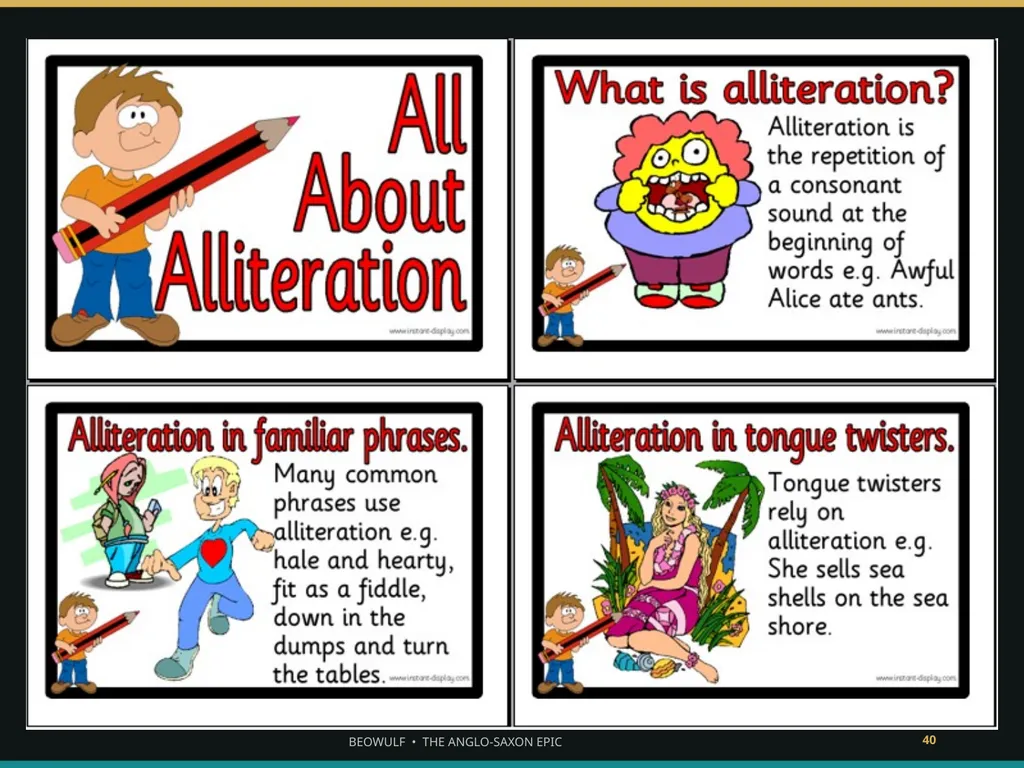
39
Alliteration The repetition
of beginning
consonant sounds
in lines of poetry BEOWULF • THE ANGLO-SAXON EPIC 39<br>
40
BEOWULF • THE ANGLO-SAXON EPIC 40<br>
41
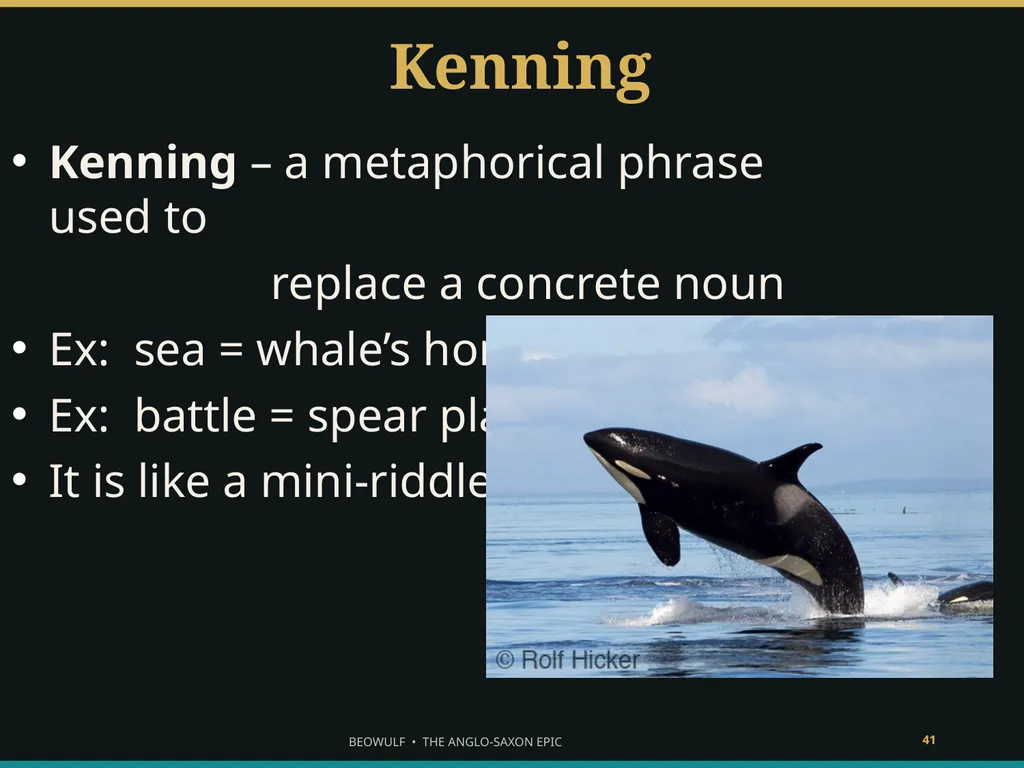
Kenning Kenning – a metaphorical phrase used to
replace a concrete noun
Ex: sea = whale’s home
Ex: battle = spear play
It is like a mini-riddle BEOWULF • THE ANGLO-SAXON EPIC 41<br>
42
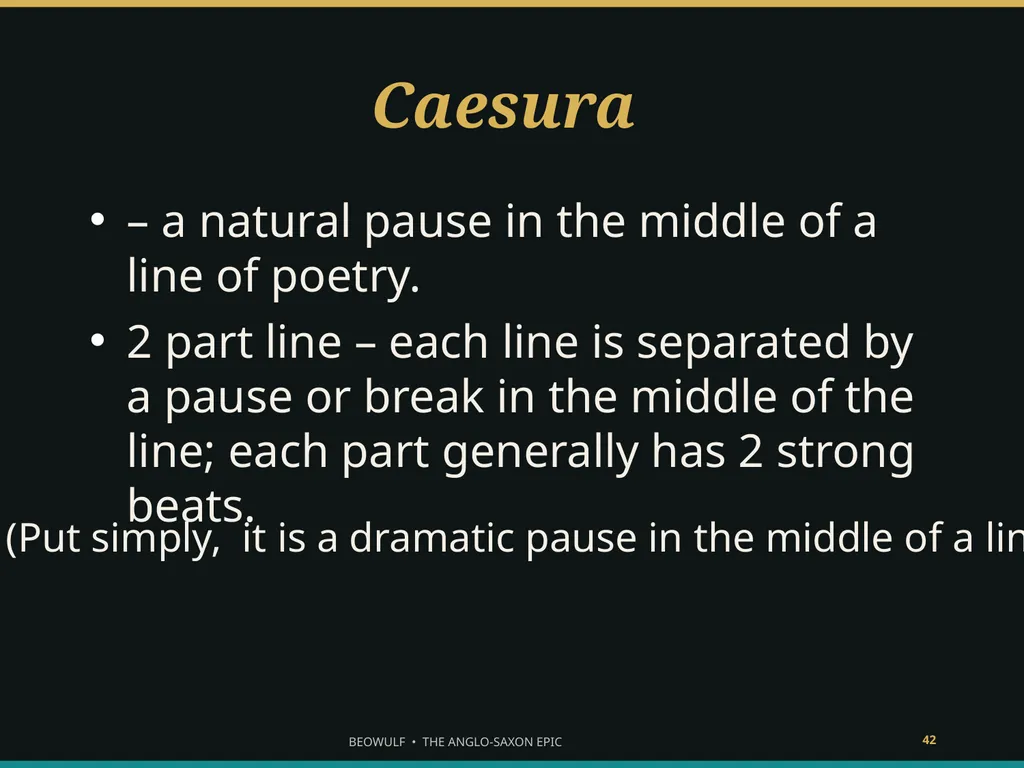
Caesura – a natural pause in the middle of a line of poetry.
2 part line – each line is separated by a pause or break in the middle of the line; each part generally has 2 strong beats. (Put simply, it is a dramatic pause in the middle of a line.) BEOWULF • THE ANGLO-SAXON EPIC 42<br>
43
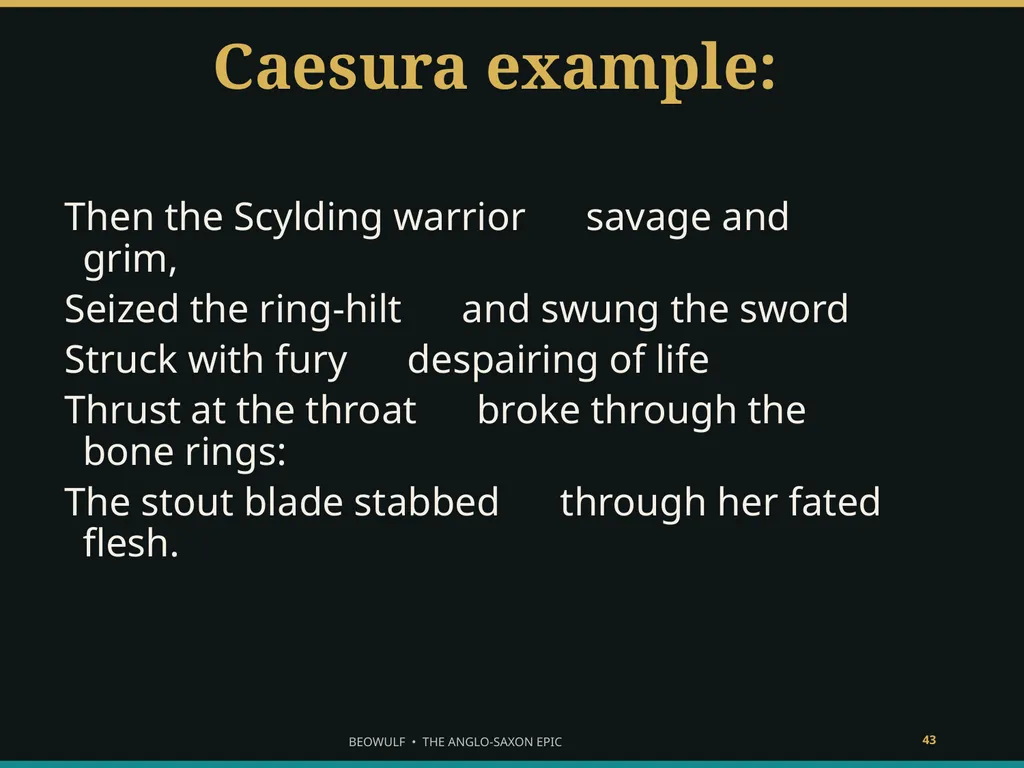
Caesura example: Then the Scylding warrior savage and grim,
Seized the ring-hilt and swung the sword
Struck with fury despairing of life
Thrust at the throat broke through the bone rings:
The stout blade stabbed through her fated flesh. BEOWULF • THE ANGLO-SAXON EPIC 43<br>