
BEYOND THE MOLECULE: Theory Evidence Biological
DP
Published · 45 slides · 0 views

1 / 1





Description
BEYOND THE MOLECULE: Theory Evidence Biological Physical Structure Action Supramolecular Chemistry and Homeopathy ACTION Clathrate Model H2O 1 oxygen, 2 hydrogen atoms ELECTRONS OXYGEN ATOM HYDROGEN ATOM HYDROGEN ATOM ELECTRONS Shared
Related Topics
Share
Embed code
Download this presentation From Below
"BEYOND THE MOLECULE: Theory Evidence Biological" is the property of its rightful owner. Permission is granted to download and print the materials on this website for personal, non-commercial use only, and to display it on your personal computer provided you do not modify the materials and that you retain all copyright notices contained in the materials. By downloading content from our website, you accept the terms of this agreement.
Presentation Transcript
01
BEYOND THE MOLECULE: Theory Evidence Biological Physical Structure Action Supramolecular Chemistry and Homeopathy ACTION<br>
02
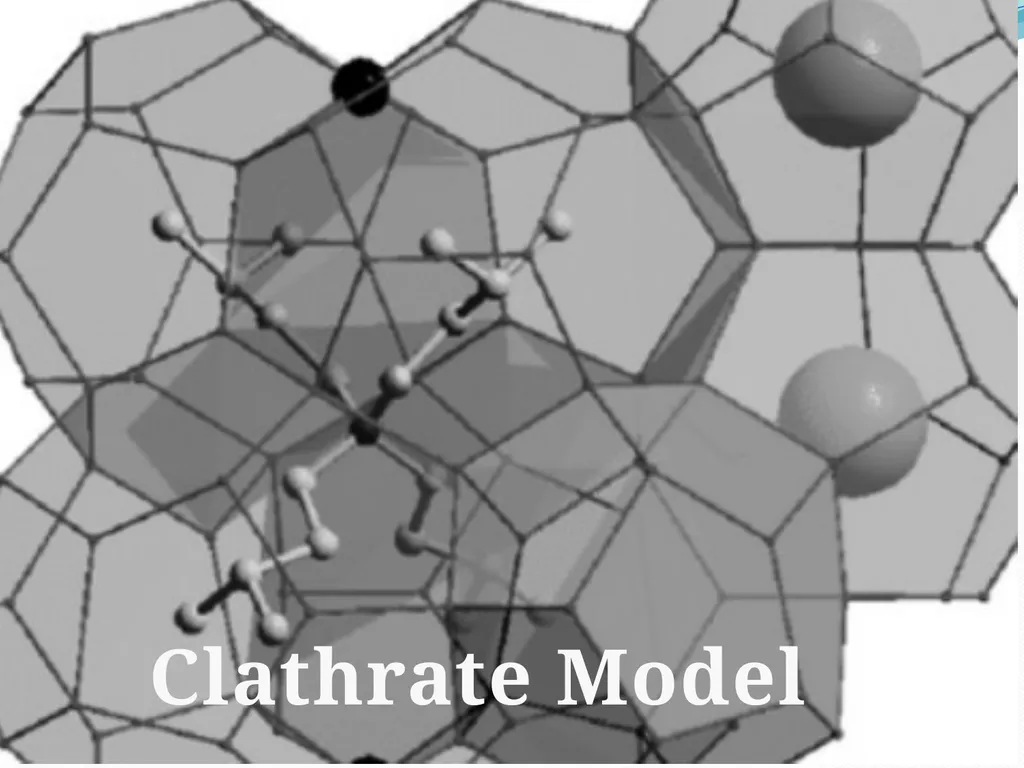
Clathrate Model<br>
03
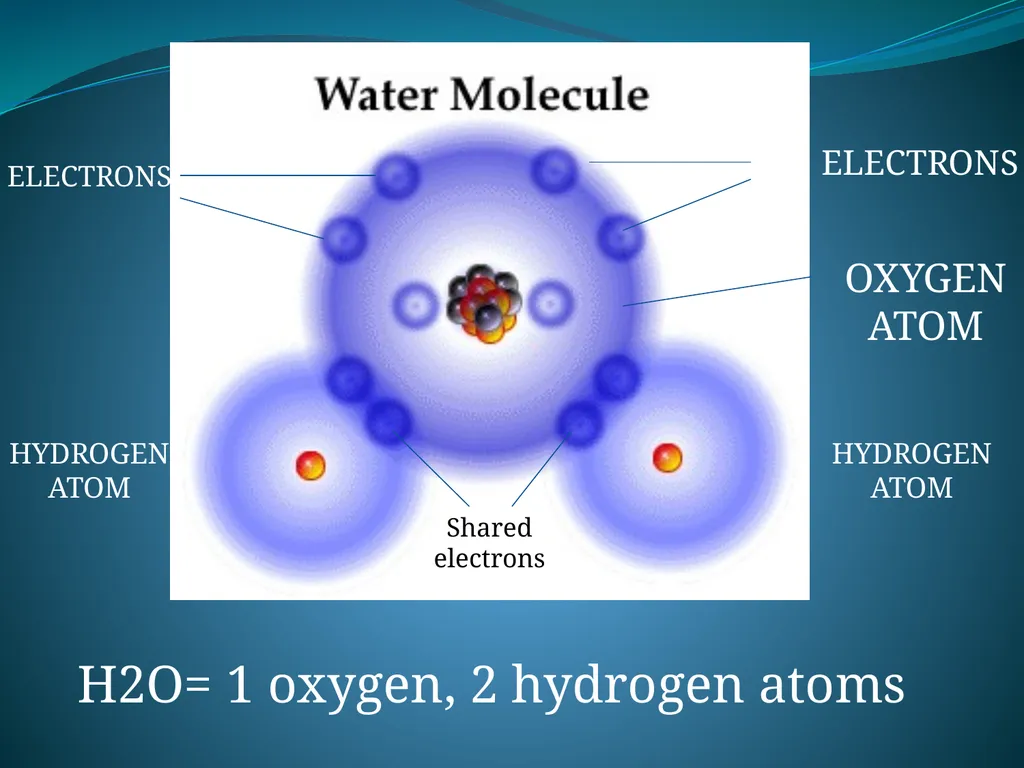
H2O= 1 oxygen, 2 hydrogen atoms ELECTRONS OXYGEN
ATOM HYDROGEN
ATOM HYDROGEN
ATOM ELECTRONS Shared
electrons<br>
ATOM HYDROGEN
ATOM HYDROGEN
ATOM ELECTRONS Shared
electrons<br>
04
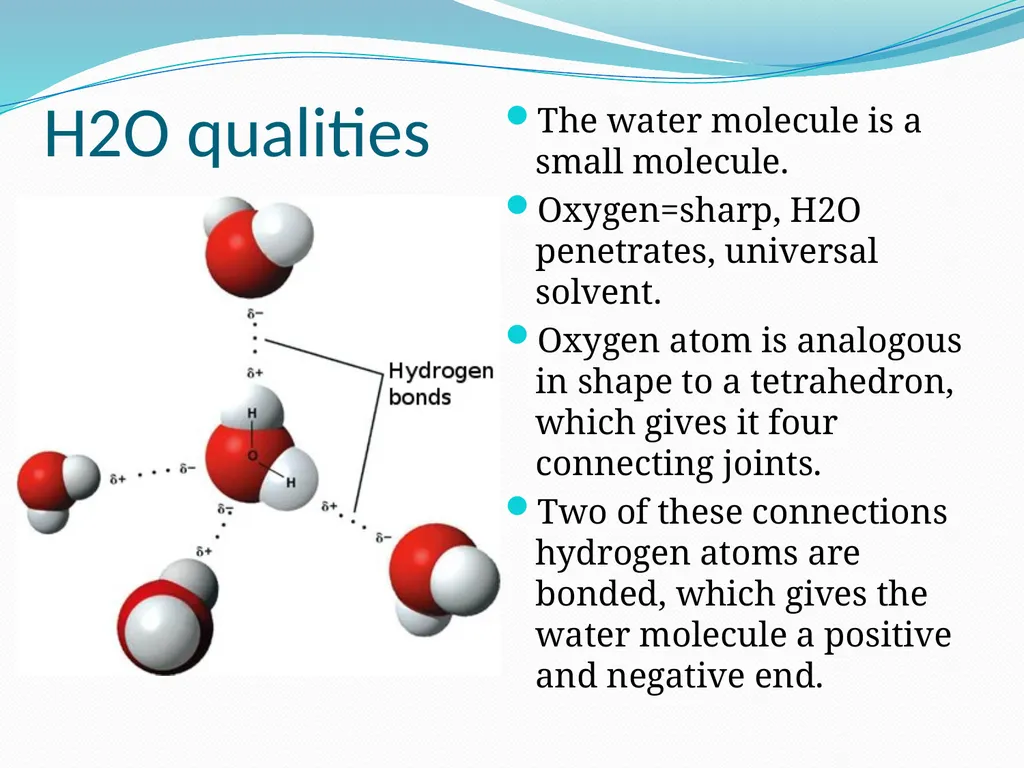
H2O qualities The water molecule is a small molecule.
Oxygen=sharp, H2O penetrates, universal solvent.
Oxygen atom is analogous in shape to a tetrahedron, which gives it four connecting joints.
Two of these connections hydrogen atoms are bonded, which gives the water molecule a positive and negative end.<br>
Oxygen=sharp, H2O penetrates, universal solvent.
Oxygen atom is analogous in shape to a tetrahedron, which gives it four connecting joints.
Two of these connections hydrogen atoms are bonded, which gives the water molecule a positive and negative end.<br>
05
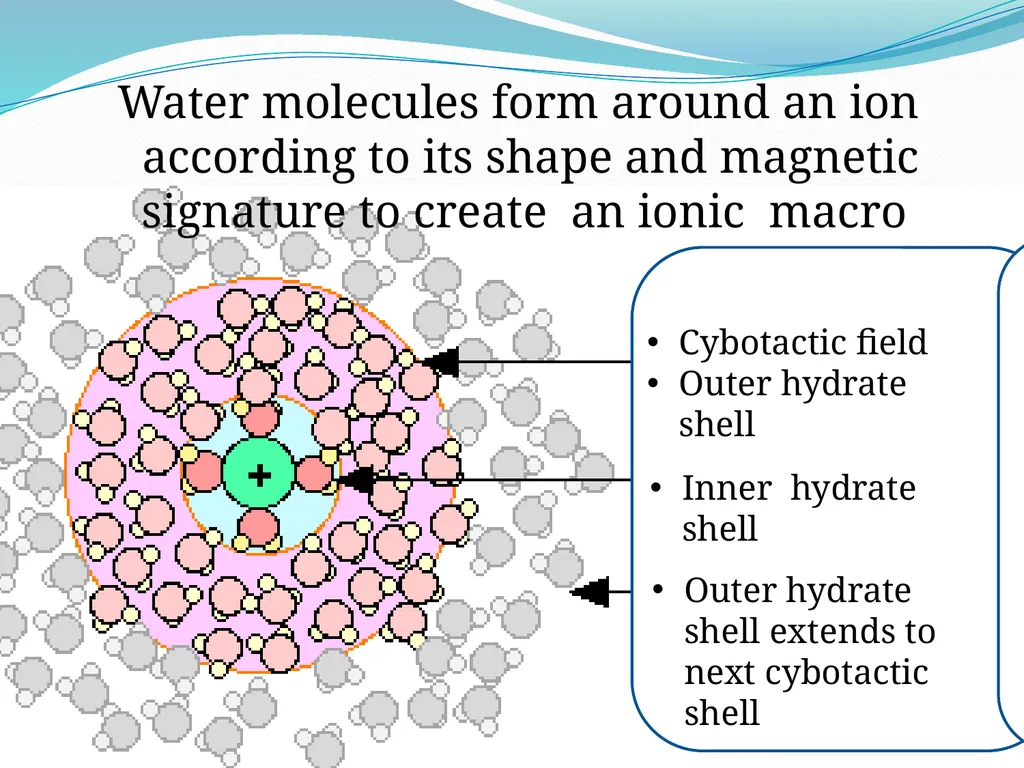
How water structures Water molecules form around an ion according to its shape and magnetic signature to create an ionic macro Cybotactic field
Outer hydrate shell Inner hydrate shell Outer hydrate shell extends to next cybotactic shell Aqueous macros<br>
Outer hydrate shell Inner hydrate shell Outer hydrate shell extends to next cybotactic shell Aqueous macros<br>
06
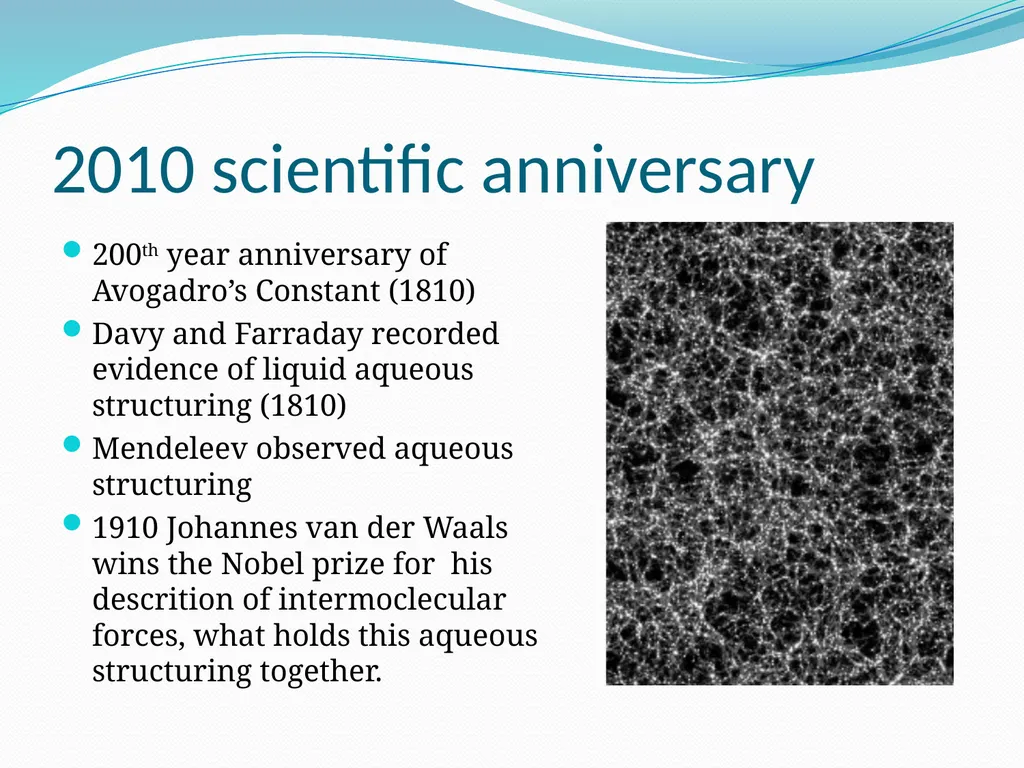
2010 scientific anniversary 200th year anniversary of Avogadro’s Constant (1810)
Davy and Farraday recorded evidence of liquid aqueous structuring (1810)
Mendeleev observed aqueous structuring
1910 Johannes van der Waals wins the Nobel prize for his descrition of intermoclecular forces, what holds this aqueous structuring together.<br>
Davy and Farraday recorded evidence of liquid aqueous structuring (1810)
Mendeleev observed aqueous structuring
1910 Johannes van der Waals wins the Nobel prize for his descrition of intermoclecular forces, what holds this aqueous structuring together.<br>
07
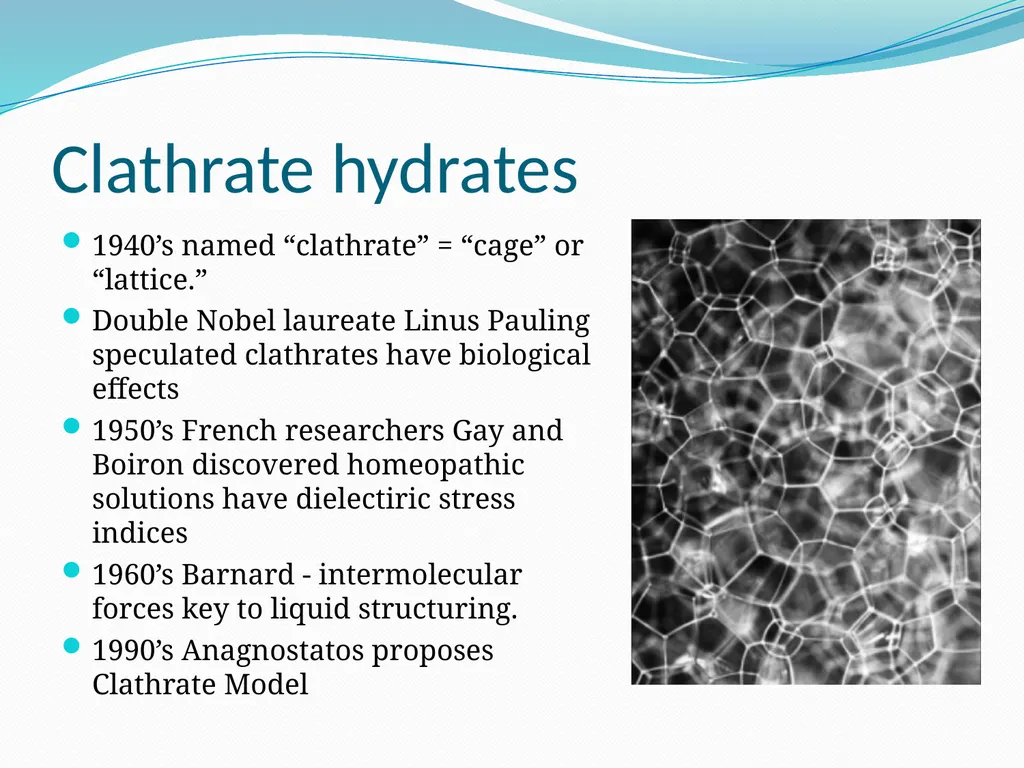
Clathrate hydrates 1940’s named “clathrate” = “cage” or “lattice.”
Double Nobel laureate Linus Pauling speculated clathrates have biological effects
1950’s French researchers Gay and Boiron discovered homeopathic solutions have dielectiric stress indices
1960’s Barnard - intermolecular forces key to liquid structuring.
1990’s Anagnostatos proposes Clathrate Model<br>
Double Nobel laureate Linus Pauling speculated clathrates have biological effects
1950’s French researchers Gay and Boiron discovered homeopathic solutions have dielectiric stress indices
1960’s Barnard - intermolecular forces key to liquid structuring.
1990’s Anagnostatos proposes Clathrate Model<br>
08
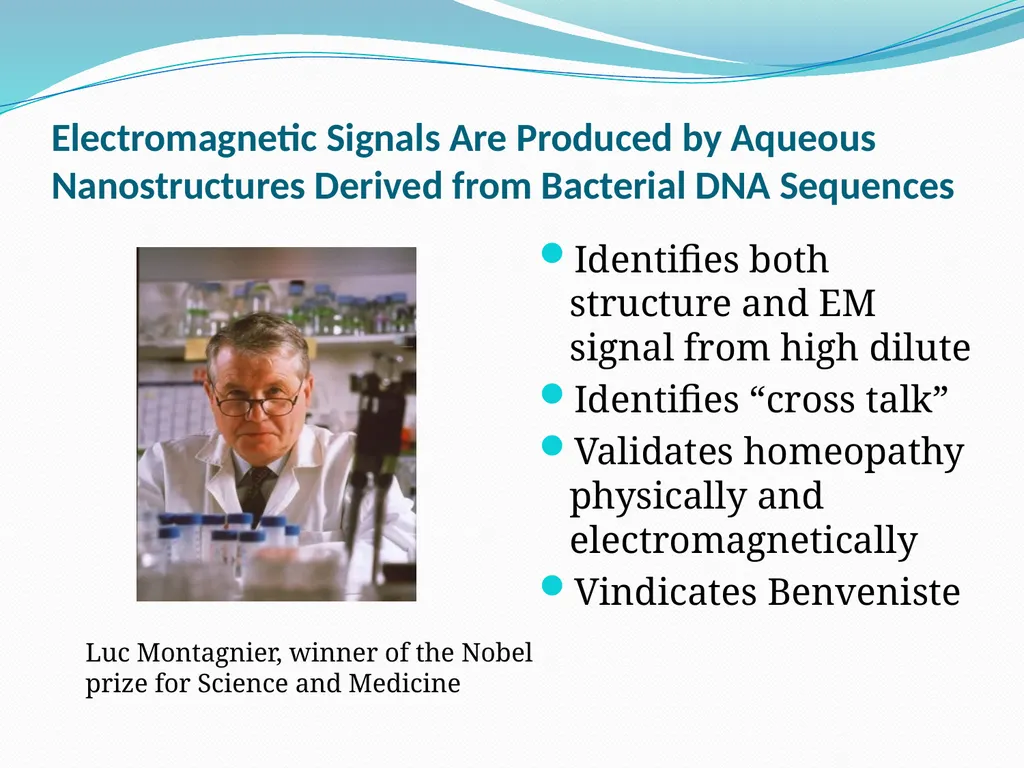
Electromagnetic Signals Are Produced by Aqueous Nanostructures Derived from Bacterial DNA Sequences Identifies both structure and EM signal from high dilute
Identifies “cross talk”
Validates homeopathy physically and electromagnetically
Vindicates Benveniste Luc Montagnier, winner of the Nobel prize for Science and Medicine<br>
Identifies “cross talk”
Validates homeopathy physically and electromagnetically
Vindicates Benveniste Luc Montagnier, winner of the Nobel prize for Science and Medicine<br>
09
Electromagnetic Signals Are Produced by Aqueous Nanostructures Derived from Bacterial DNA Sequences Abstract: A novel property of DNA is described: the capacity of some bacterial DNA sequences to induce electromagnetic waves at high aqueous dilutions. It appears to be a resonance phenomenon triggered by the ambient electromagnetic background of very low frequency waves. The genomic DNA of most pathogenic bacteria contains sequences which are able to generate such signals. This opens the way to the development of highly sensitive detection system for chronic bacterial infections in human and animal diseases.<br>
10
Electromagnetic Signals Are Produced by Aqueous Nanostructures Derived from Bacterial DNA Sequences Signal producing dilutions usually ranged from 10-8 to 10-12, with profiles upon Fourier transformation
In one experiment, some very high dilutions were found positive, ranging from 10-9 to 10-18.
Filtration demonstrated aqueous structures had a size greater than 20 nM and lower than 100 nM.
Why were the lower dilutions “silent?”
Silent low dilutions maybe self-inhibitory from interference of multiple sources emitting same wave length or slightly out of phase, like radio jamming . . or the abundance of nanostructures can form a gel in water and therefore are prevented to vibrate.<br>
In one experiment, some very high dilutions were found positive, ranging from 10-9 to 10-18.
Filtration demonstrated aqueous structures had a size greater than 20 nM and lower than 100 nM.
Why were the lower dilutions “silent?”
Silent low dilutions maybe self-inhibitory from interference of multiple sources emitting same wave length or slightly out of phase, like radio jamming . . or the abundance of nanostructures can form a gel in water and therefore are prevented to vibrate.<br>
11
Evidence for homologous “cross talk” between dilutions Is it possible wave transfer to generate new signal-emitting structures from tube to tube?
A tube of a low “silent” dilution of E. Coli (10-3) was placed side by side close to a receiver tube of the positive “loud” highest dilution of the same preparation (10-9). Both tubes were placed in a mumetal box for 24 hours at room temperature, so that the tubes were not exposed to external electromagnetic noise, and only exposed to the signals generated by the structures present in the tubes themselves.
Tubes were read again by the signal detecting device: the donor tube was still silent, however the receiver tube became also silent.<br>
A tube of a low “silent” dilution of E. Coli (10-3) was placed side by side close to a receiver tube of the positive “loud” highest dilution of the same preparation (10-9). Both tubes were placed in a mumetal box for 24 hours at room temperature, so that the tubes were not exposed to external electromagnetic noise, and only exposed to the signals generated by the structures present in the tubes themselves.
Tubes were read again by the signal detecting device: the donor tube was still silent, however the receiver tube became also silent.<br>
12
#2 Evidence for homologous “cross talk” between dilutions When further dilutions were made from the receiver tube (10-10, 10-11, 10-12), these dilutions had became positive. These results suggest that the receiver tube was made silent by formation of an excess of new nanostructures, which could emit signals upon further dilution.
Surprisingly, the range of positive dilutions were not strictly dependent on the initial concentration of E. Coli cells, being roughly the same from 109 cells down to 10 cells, suggesting that the same final number of nanostructures was reached at all concentrations. Thus, paradoxically, 10 cells are giving the same signals than 109 cells.<br>
Surprisingly, the range of positive dilutions were not strictly dependent on the initial concentration of E. Coli cells, being roughly the same from 109 cells down to 10 cells, suggesting that the same final number of nanostructures was reached at all concentrations. Thus, paradoxically, 10 cells are giving the same signals than 109 cells.<br>
13
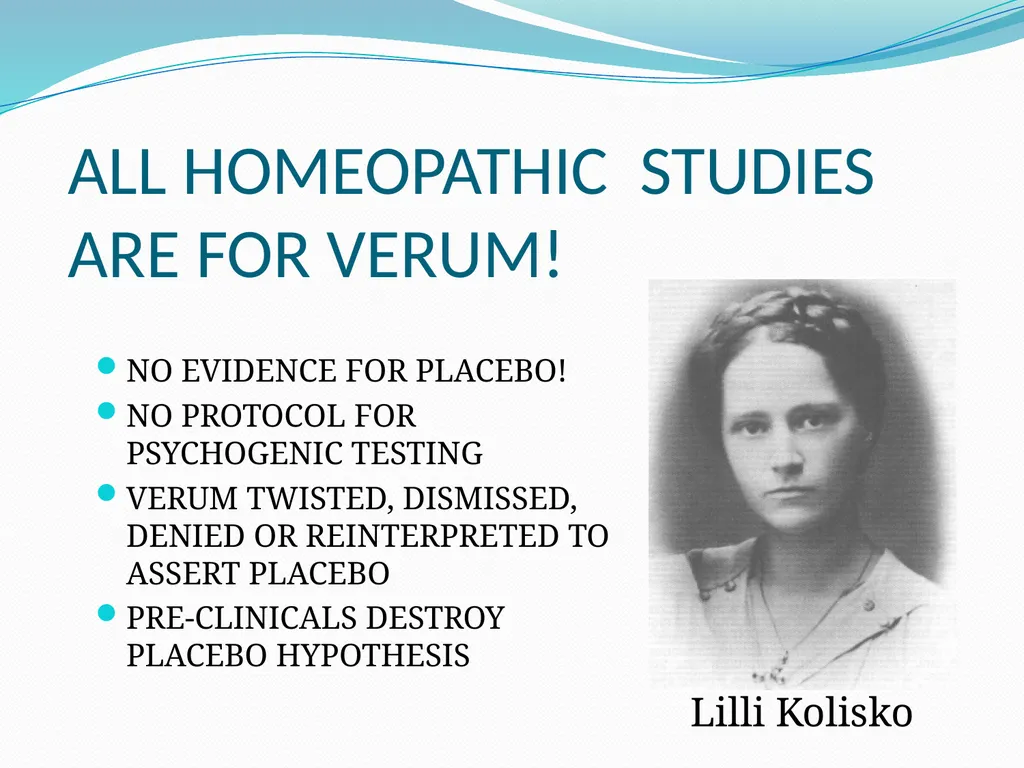
ALL HOMEOPATHIC STUDIES
ARE FOR VERUM! NO EVIDENCE FOR PLACEBO!
NO PROTOCOL FOR PSYCHOGENIC TESTING
VERUM TWISTED, DISMISSED, DENIED OR REINTERPRETED TO ASSERT PLACEBO
PRE-CLINICALS DESTROY PLACEBO HYPOTHESIS Lilli Kolisko<br>
NO PROTOCOL FOR PSYCHOGENIC TESTING
VERUM TWISTED, DISMISSED, DENIED OR REINTERPRETED TO ASSERT PLACEBO
PRE-CLINICALS DESTROY PLACEBO HYPOTHESIS Lilli Kolisko<br>
14
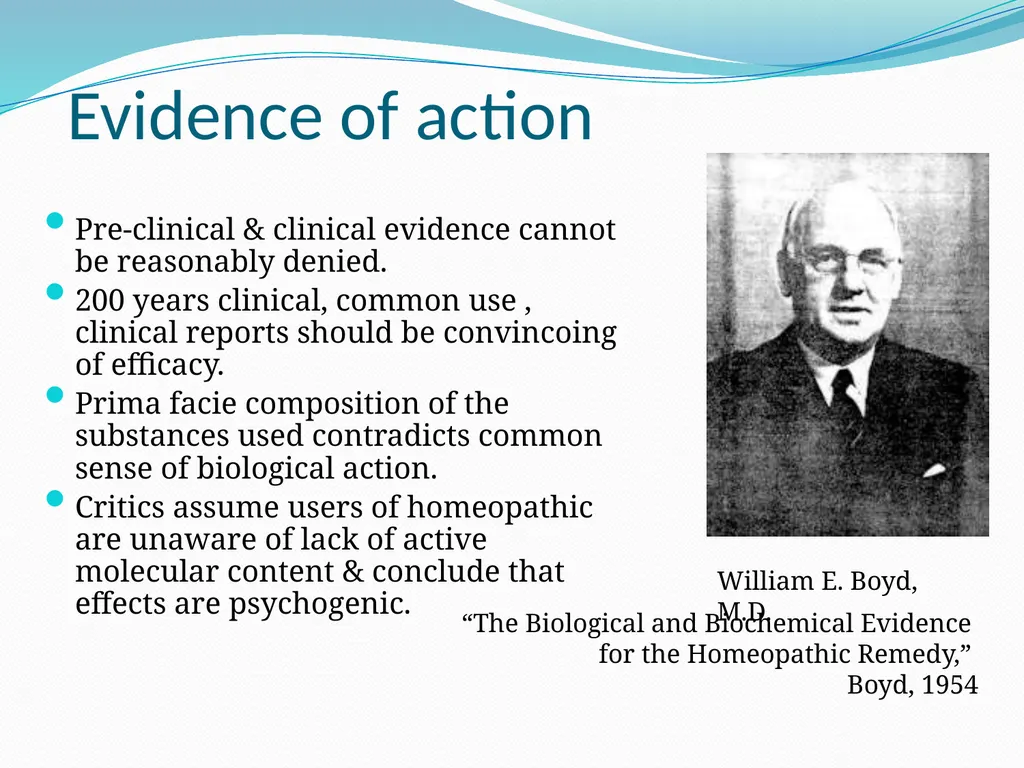
Evidence of action Pre-clinical & clinical evidence cannot be reasonably denied.
200 years clinical, common use , clinical reports should be convincoing of efficacy.
Prima facie composition of the substances used contradicts common sense of biological action.
Critics assume users of homeopathic are unaware of lack of active molecular content & conclude that effects are psychogenic. William E. Boyd, M.D. “The Biological and Biochemical Evidence
for the Homeopathic Remedy,”
Boyd, 1954<br>
200 years clinical, common use , clinical reports should be convincoing of efficacy.
Prima facie composition of the substances used contradicts common sense of biological action.
Critics assume users of homeopathic are unaware of lack of active molecular content & conclude that effects are psychogenic. William E. Boyd, M.D. “The Biological and Biochemical Evidence
for the Homeopathic Remedy,”
Boyd, 1954<br>
15
Homeopathic myths “There is no science to back up homeopathy.”
“There are no double blind trials for homeopathy.”
“Homeopathy is fraud”
“Homeopathy doesn’t work.”
“Liquid water can’t structure”
When there aren’t molecules of the active agent left in solution there can’t be biological effects. (Ennis)
Homeopathy is a placebo”<br>
“There are no double blind trials for homeopathy.”
“Homeopathy is fraud”
“Homeopathy doesn’t work.”
“Liquid water can’t structure”
When there aren’t molecules of the active agent left in solution there can’t be biological effects. (Ennis)
Homeopathy is a placebo”<br>
16
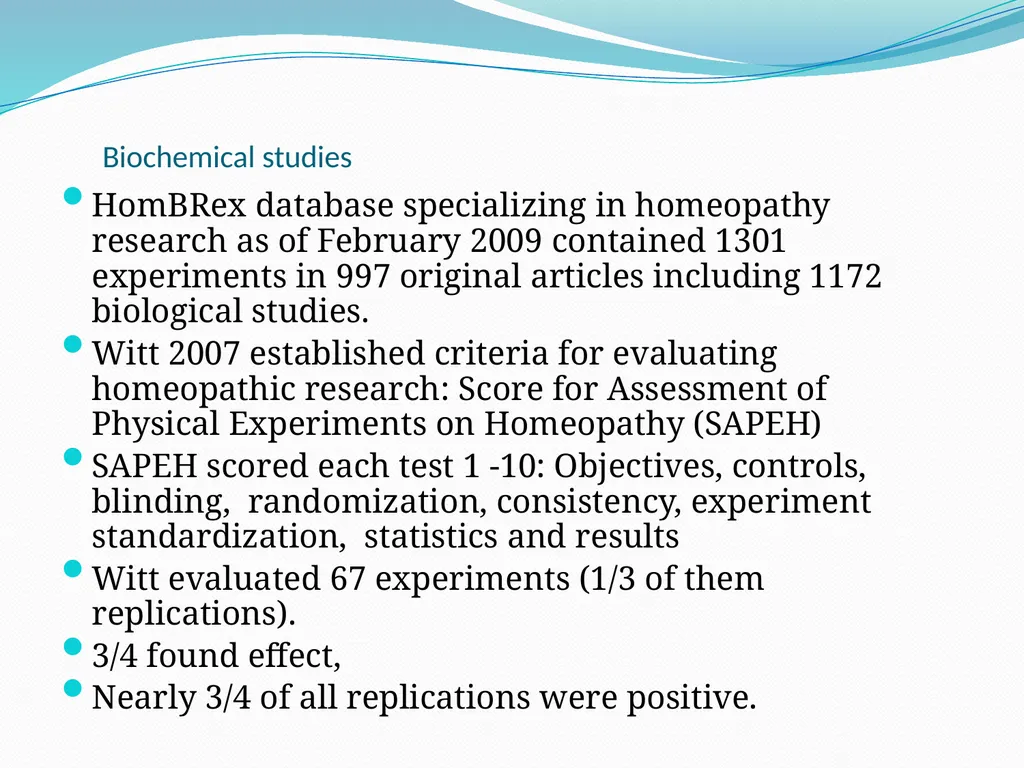
Biochemical studies HomBRex database specializing in homeopathy research as of February 2009 contained 1301 experiments in 997 original articles including 1172 biological studies.
Witt 2007 established criteria for evaluating homeopathic research: Score for Assessment of Physical Experiments on Homeopathy (SAPEH)
SAPEH scored each test 1 -10: Objectives, controls, blinding, randomization, consistency, experiment standardization, statistics and results
Witt evaluated 67 experiments (1/3 of them replications).
3/4 found effect,
Nearly 3/4 of all replications were positive.<br>
Witt 2007 established criteria for evaluating homeopathic research: Score for Assessment of Physical Experiments on Homeopathy (SAPEH)
SAPEH scored each test 1 -10: Objectives, controls, blinding, randomization, consistency, experiment standardization, statistics and results
Witt evaluated 67 experiments (1/3 of them replications).
3/4 found effect,
Nearly 3/4 of all replications were positive.<br>
17
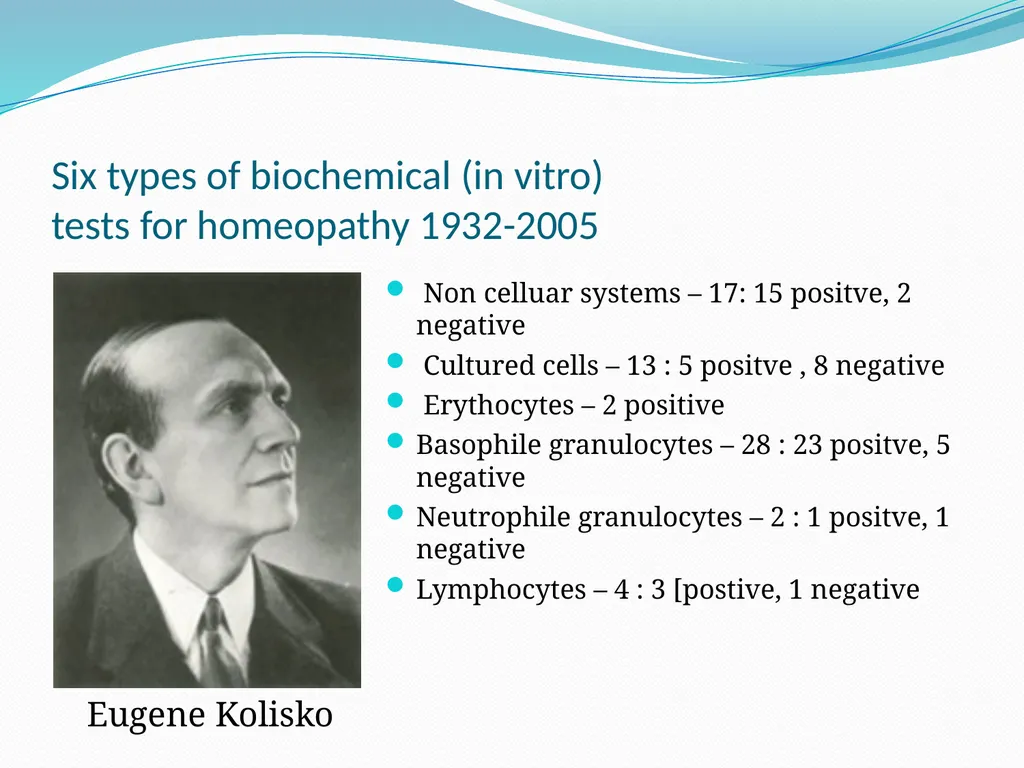
Six types of biochemical (in vitro)
tests for homeopathy 1932-2005 Non celluar systems – 17: 15 positve, 2 negative
Cultured cells – 13 : 5 positve , 8 negative
Erythocytes – 2 positive
Basophile granulocytes – 28 : 23 positve, 5 negative
Neutrophile granulocytes – 2 : 1 positve, 1 negative
Lymphocytes – 4 : 3 [postive, 1 negative Eugene Kolisko<br>
Cultured cells – 13 : 5 positve , 8 negative
Erythocytes – 2 positive
Basophile granulocytes – 28 : 23 positve, 5 negative
Neutrophile granulocytes – 2 : 1 positve, 1 negative
Lymphocytes – 4 : 3 [postive, 1 negative Eugene Kolisko<br>
18
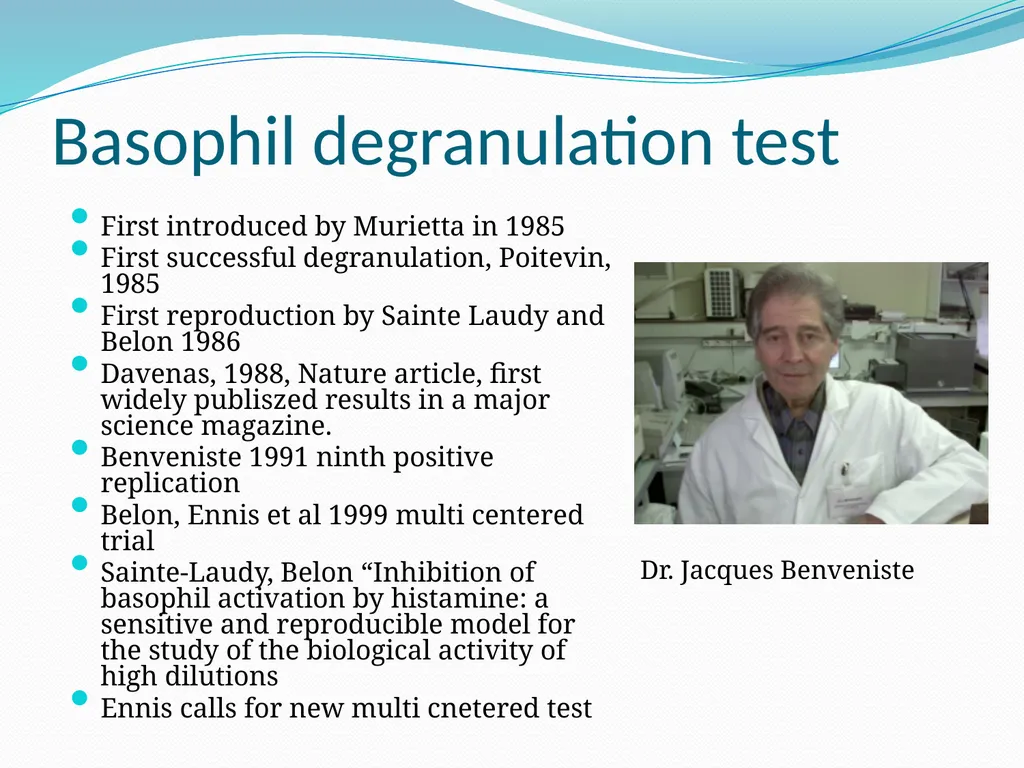
Basophil degranulation test First introduced by Murietta in 1985
First successful degranulation, Poitevin, 1985
First reproduction by Sainte Laudy and Belon 1986
Davenas, 1988, Nature article, first widely publiszed results in a major science magazine.
Benveniste 1991 ninth positive replication
Belon, Ennis et al 1999 multi centered trial
Sainte-Laudy, Belon “Inhibition of basophil activation by histamine: a sensitive and reproducible model for the study of the biological activity of high dilutions
Ennis calls for new multi cnetered test<br>
First successful degranulation, Poitevin, 1985
First reproduction by Sainte Laudy and Belon 1986
Davenas, 1988, Nature article, first widely publiszed results in a major science magazine.
Benveniste 1991 ninth positive replication
Belon, Ennis et al 1999 multi centered trial
Sainte-Laudy, Belon “Inhibition of basophil activation by histamine: a sensitive and reproducible model for the study of the biological activity of high dilutions
Ennis calls for new multi cnetered test<br>
19
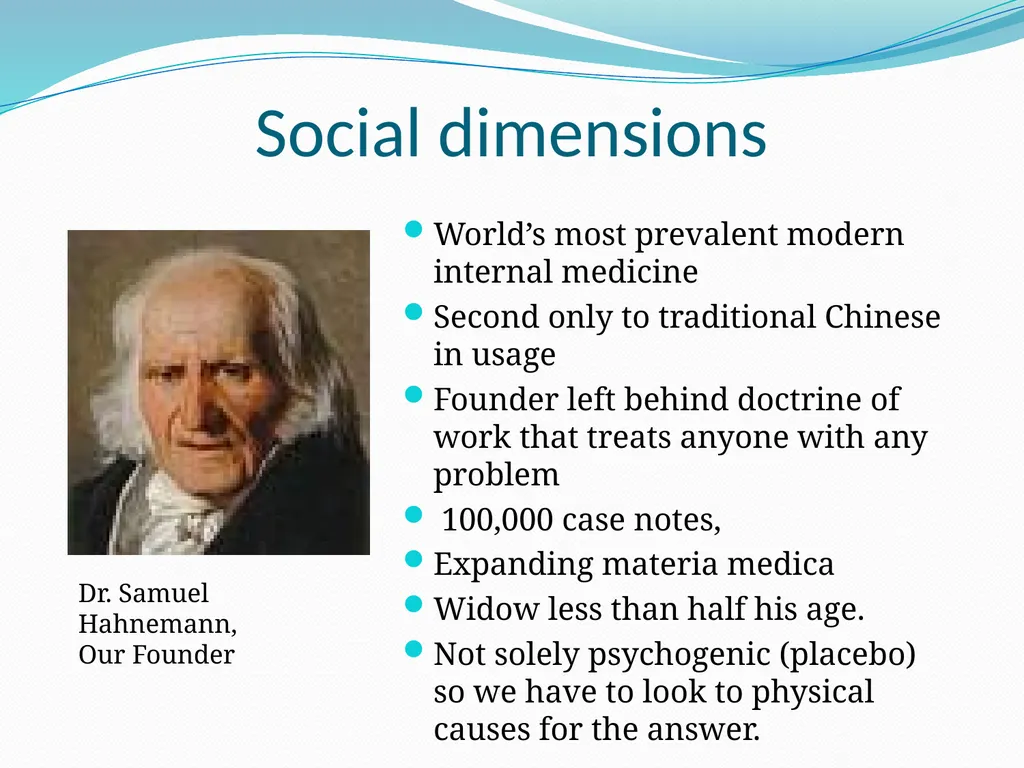
Social dimensions World’s most prevalent modern internal medicine
Second only to traditional Chinese in usage
Founder left behind doctrine of work that treats anyone with any problem
100,000 case notes,
Expanding materia medica
Widow less than half his age.
Not solely psychogenic (placebo) so we have to look to physical causes for the answer. Dr. Samuel Hahnemann,
Our Founder<br>
Second only to traditional Chinese in usage
Founder left behind doctrine of work that treats anyone with any problem
100,000 case notes,
Expanding materia medica
Widow less than half his age.
Not solely psychogenic (placebo) so we have to look to physical causes for the answer. Dr. Samuel Hahnemann,
Our Founder<br>
20
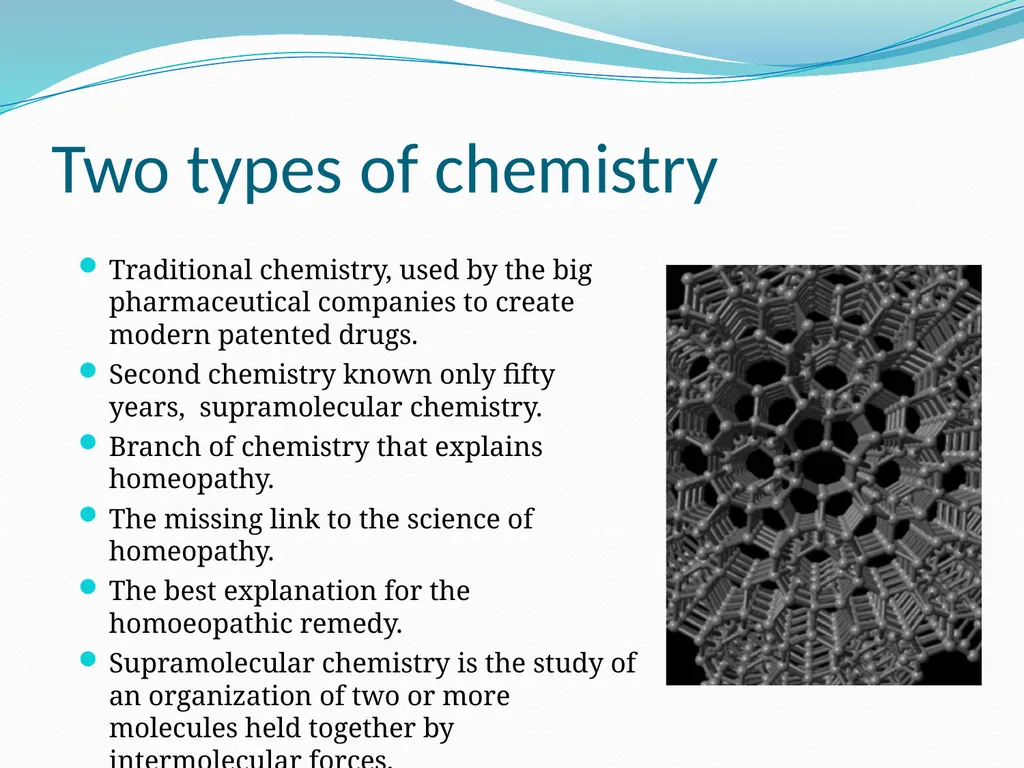
Two types of chemistry Traditional chemistry, used by the big pharmaceutical companies to create modern patented drugs.
Second chemistry known only fifty years, supramolecular chemistry.
Branch of chemistry that explains homeopathy.
The missing link to the science of homeopathy.
The best explanation for the homoeopathic remedy.
Supramolecular chemistry is the study of an organization of two or more molecules held together by intermolecular forces.<br>
Second chemistry known only fifty years, supramolecular chemistry.
Branch of chemistry that explains homeopathy.
The missing link to the science of homeopathy.
The best explanation for the homoeopathic remedy.
Supramolecular chemistry is the study of an organization of two or more molecules held together by intermolecular forces.<br>
21
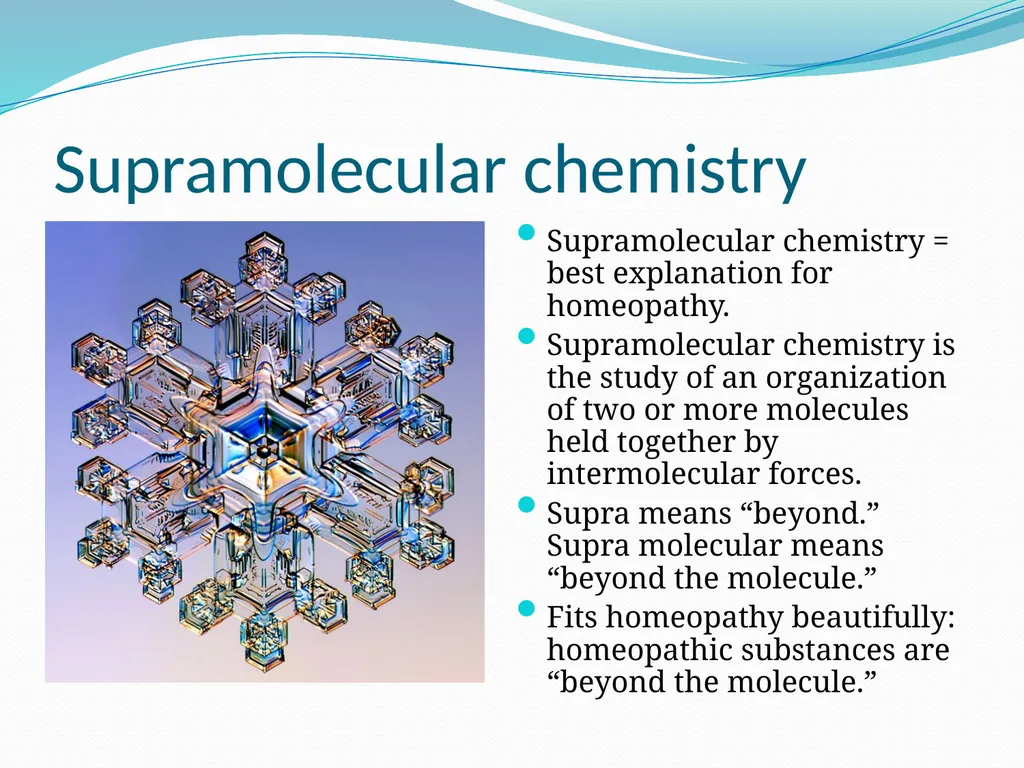
Supramolecular chemistry Supramolecular chemistry = best explanation for homeopathy.
Supramolecular chemistry is the study of an organization of two or more molecules held together by intermolecular forces.
Supra means “beyond.” Supra molecular means “beyond the molecule.”
Fits homeopathy beautifully: homeopathic substances are “beyond the molecule.”<br>
Supramolecular chemistry is the study of an organization of two or more molecules held together by intermolecular forces.
Supra means “beyond.” Supra molecular means “beyond the molecule.”
Fits homeopathy beautifully: homeopathic substances are “beyond the molecule.”<br>
22
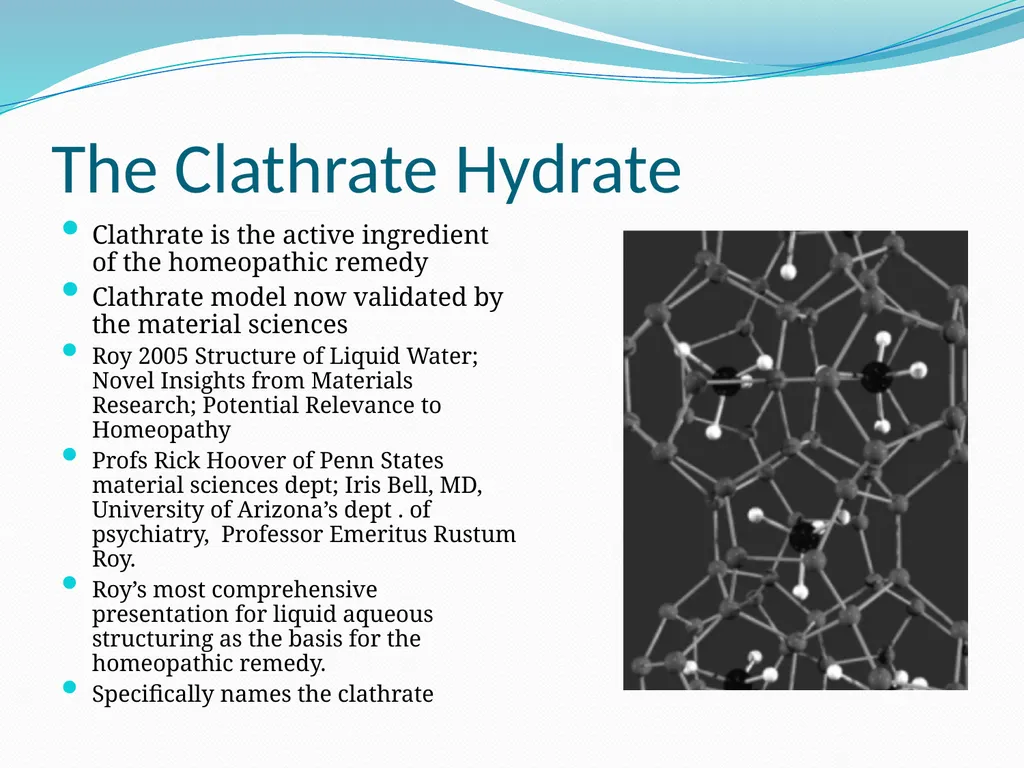
The Clathrate Hydrate Clathrate is the active ingredient of the homeopathic remedy
Clathrate model now validated by the material sciences
Roy 2005 Structure of Liquid Water; Novel Insights from Materials Research; Potential Relevance to Homeopathy
Profs Rick Hoover of Penn States material sciences dept; Iris Bell, MD, University of Arizona’s dept . of psychiatry, Professor Emeritus Rustum Roy.
Roy’s most comprehensive presentation for liquid aqueous structuring as the basis for the homeopathic remedy.
Specifically names the clathrate<br>
Clathrate model now validated by the material sciences
Roy 2005 Structure of Liquid Water; Novel Insights from Materials Research; Potential Relevance to Homeopathy
Profs Rick Hoover of Penn States material sciences dept; Iris Bell, MD, University of Arizona’s dept . of psychiatry, Professor Emeritus Rustum Roy.
Roy’s most comprehensive presentation for liquid aqueous structuring as the basis for the homeopathic remedy.
Specifically names the clathrate<br>
23
Clathrates go by many names Clathrate hydrates are also called gas clathrates or gas hydrates, inclusion molecules or cage molecules.
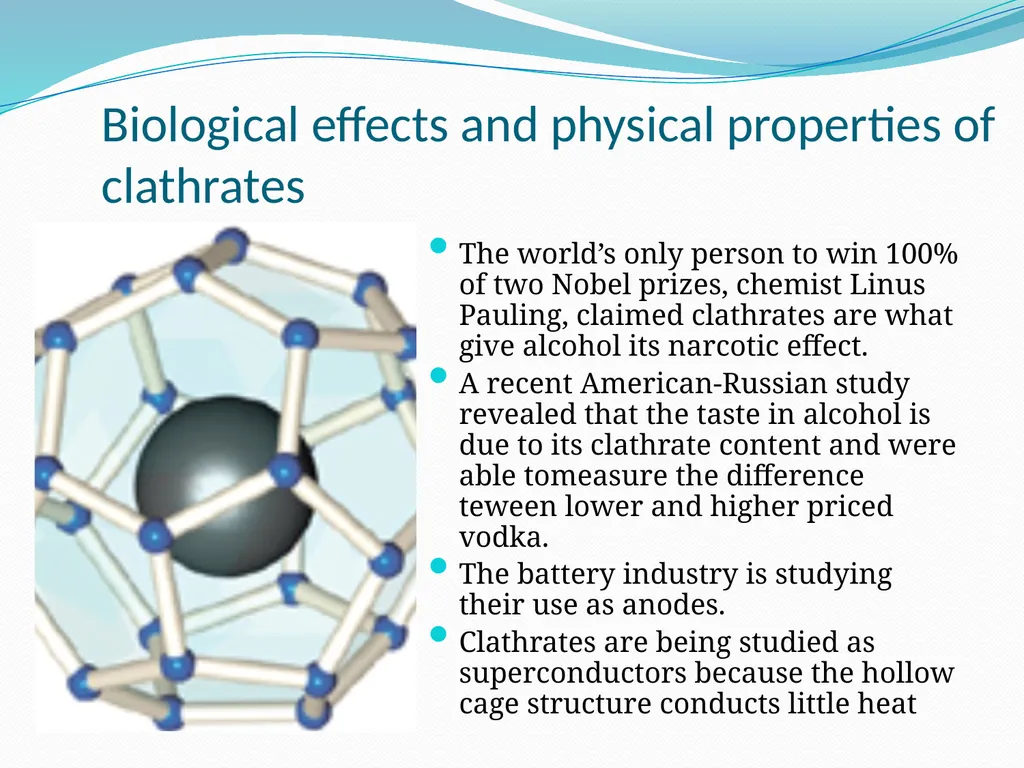
Clathrates are forms of structured water, crystalline water based solids that look like polyhedral ice crystals. Molecules trapped inside hydrogen bonded crystalline water cages
Formed through host guest process TREE OF LIFE Chakras<br>
Clathrates are forms of structured water, crystalline water based solids that look like polyhedral ice crystals. Molecules trapped inside hydrogen bonded crystalline water cages
Formed through host guest process TREE OF LIFE Chakras<br>
24
Biological effects and physical properties of clathrates The world’s only person to win 100% of two Nobel prizes, chemist Linus Pauling, claimed clathrates are what give alcohol its narcotic effect.
A recent American-Russian study revealed that the taste in alcohol is due to its clathrate content and were able tomeasure the difference teween lower and higher priced vodka.
The battery industry is studying their use as anodes.
Clathrates are being studied as superconductors because the hollow cage structure conducts little heat<br>
A recent American-Russian study revealed that the taste in alcohol is due to its clathrate content and were able tomeasure the difference teween lower and higher priced vodka.
The battery industry is studying their use as anodes.
Clathrates are being studied as superconductors because the hollow cage structure conducts little heat<br>
25
Traditional vs. supramolecular chemistry Traditional chemistry focuses on covalent bonded material
Covalent bond, atoms share electron, locks atoms together to become molecules
Patent medicine uses covalent bond to synthesize petro chemicals for medicine
Homeopathic medicine uses hydrogen bond to create the substances it uses as medicine
Supramolecular replaces covalent bond with intermolecular forces, i.e. hydrogen bond
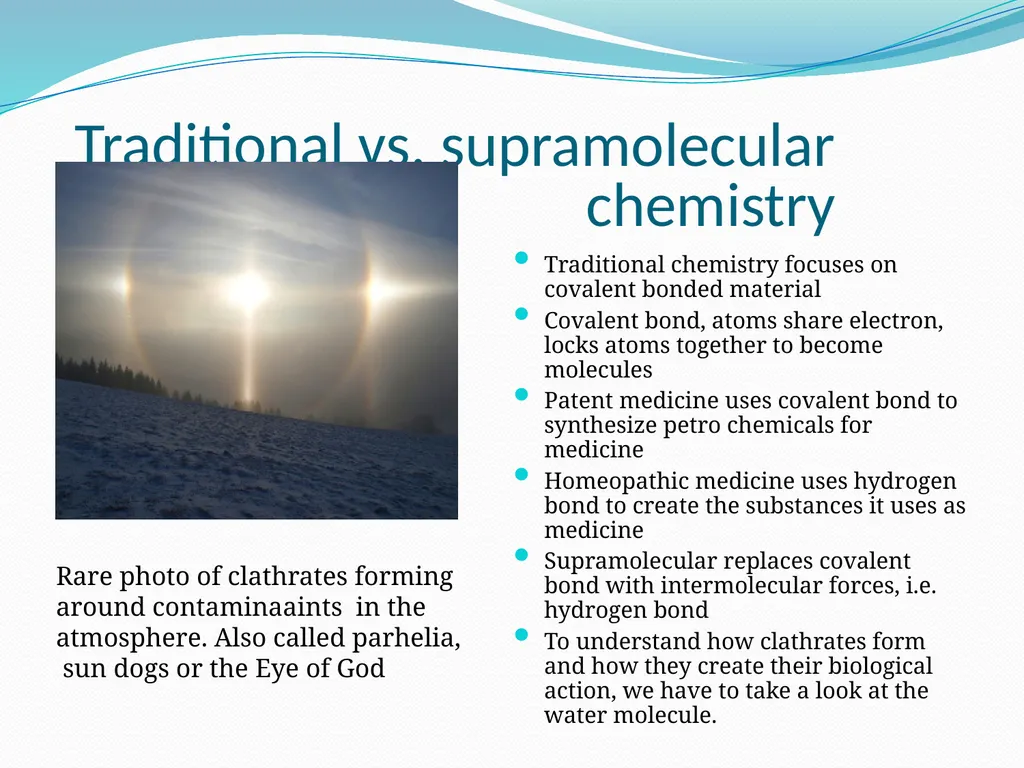
To understand how clathrates form and how they create their biological action, we have to take a look at the water molecule. Rare photo of clathrates forming around contaminaaints in the atmosphere. Also called parhelia, sun dogs or the Eye of God<br>
Covalent bond, atoms share electron, locks atoms together to become molecules
Patent medicine uses covalent bond to synthesize petro chemicals for medicine
Homeopathic medicine uses hydrogen bond to create the substances it uses as medicine
Supramolecular replaces covalent bond with intermolecular forces, i.e. hydrogen bond
To understand how clathrates form and how they create their biological action, we have to take a look at the water molecule. Rare photo of clathrates forming around contaminaaints in the atmosphere. Also called parhelia, sun dogs or the Eye of God<br>
26
The Hydrogen Bond
Ionic Structuring
The Host/Guest Process
Clathrate Hydrates
The Nanobubble - Air Nucleation & Mimicry How Water Structures<br>
Ionic Structuring
The Host/Guest Process
Clathrate Hydrates
The Nanobubble - Air Nucleation & Mimicry How Water Structures<br>
27
Theory supported by 200 years of direct observation by science We know liquid aqueous structuring exists from 200 years of direct observation (Davy, Farraday, Mendeleev, Sukul, Rao, Roy, Tiller, Montagnier et al et al)
The tetrahedral shape and dipolar charge make H2O molecular self-assembly inevitable. Water has to structure.
The strength of the hydrogen bond can be seen in surface tension, strong enough to float a paper clip.
H2O structuring will conform to exogenic forces
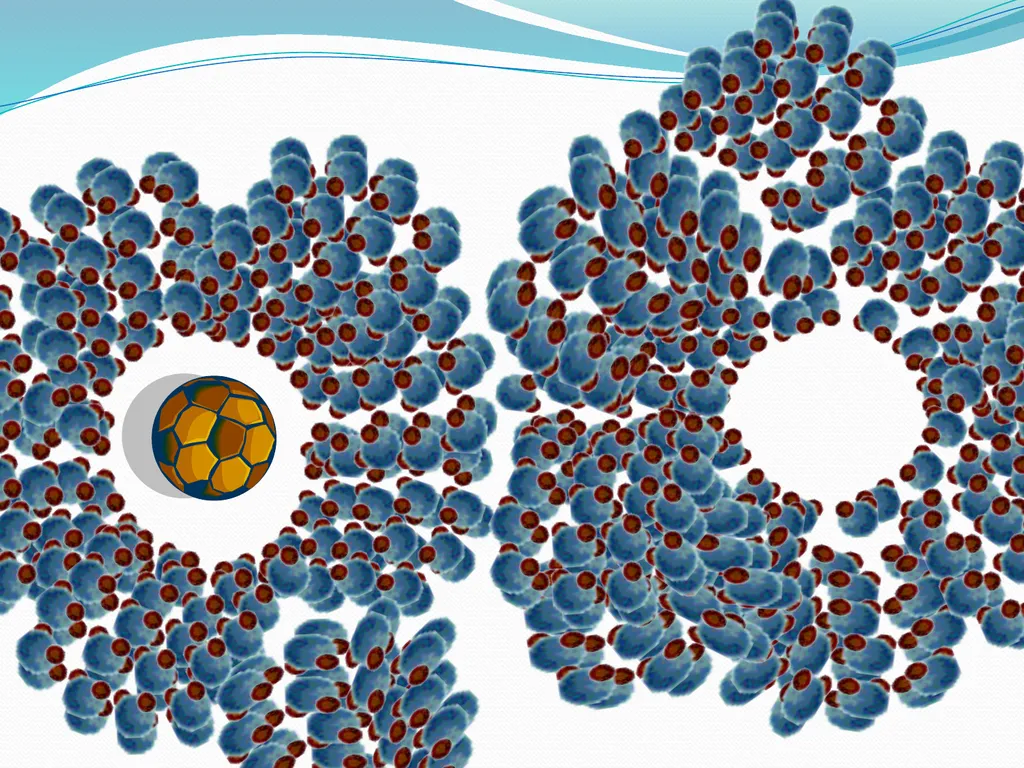
Ionic contamination, in the host guest process, concentrates H2O into clathrate hydrates, crystalline structures that gridlock around ions, imitative of their charge and structure.
Ionic nucleation is replaced by air nucleation, what Roy calls "nanobubbles." Sir Humphry Davy, first described the clathrate in 1810<br>
The tetrahedral shape and dipolar charge make H2O molecular self-assembly inevitable. Water has to structure.
The strength of the hydrogen bond can be seen in surface tension, strong enough to float a paper clip.
H2O structuring will conform to exogenic forces
Ionic contamination, in the host guest process, concentrates H2O into clathrate hydrates, crystalline structures that gridlock around ions, imitative of their charge and structure.
Ionic nucleation is replaced by air nucleation, what Roy calls "nanobubbles." Sir Humphry Davy, first described the clathrate in 1810<br>
28
HOMEOPATHY FOR FARM AND FARM AND GARDEN by Vaikunthanath das Kaviraj HOMEOPHYTOPATHOLOGY: The use of homeopathics for plants THE GREAT PROVING<br>
29
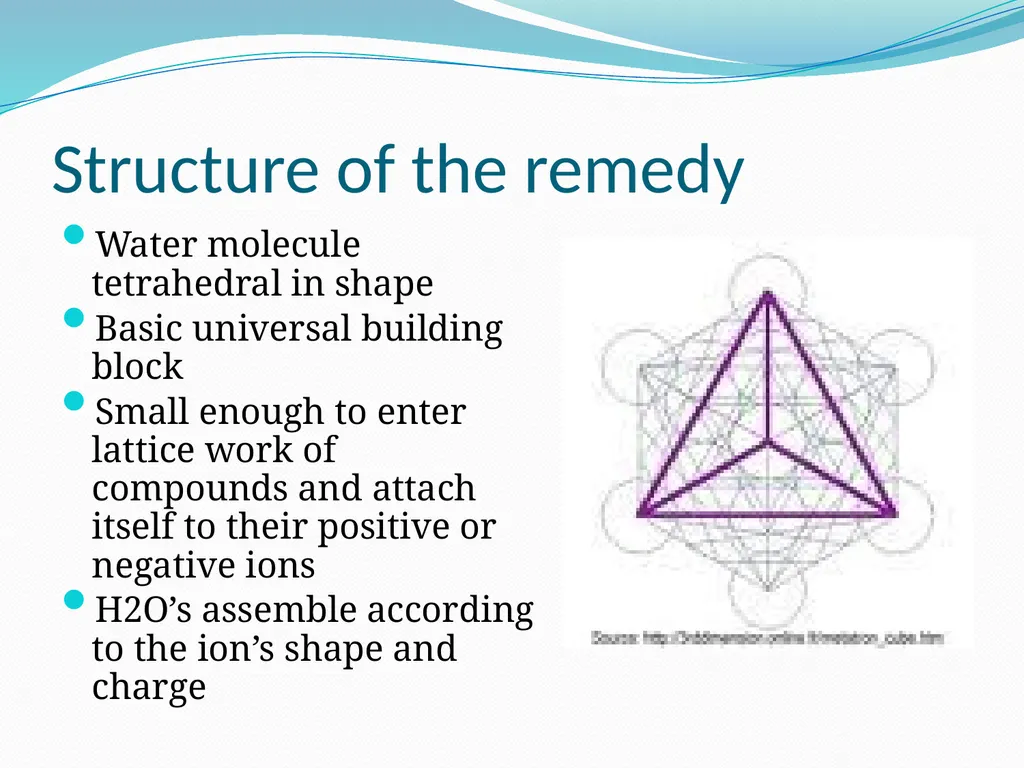
Structure of the remedy Water molecule tetrahedral in shape
Basic universal building block
Small enough to enter lattice work of compounds and attach itself to their positive or negative ions
H2O’s assemble according to the ion’s shape and charge<br>
Basic universal building block
Small enough to enter lattice work of compounds and attach itself to their positive or negative ions
H2O’s assemble according to the ion’s shape and charge<br>
30
Structural gridlock Water structures are made via the hydrogen bond, not the covalent bond.
Hydrogen bond = 9 nanoseconds
Opponents say, liquid aqueous structuring then, can last only briefly
BUT . . What is the duration of separation? Structure is gridlocked!
Where does the connection go next? IT SIMPLY RETURNS!
Liquid aqueous structures are vibrating.<br>
Hydrogen bond = 9 nanoseconds
Opponents say, liquid aqueous structuring then, can last only briefly
BUT . . What is the duration of separation? Structure is gridlocked!
Where does the connection go next? IT SIMPLY RETURNS!
Liquid aqueous structures are vibrating.<br>
31
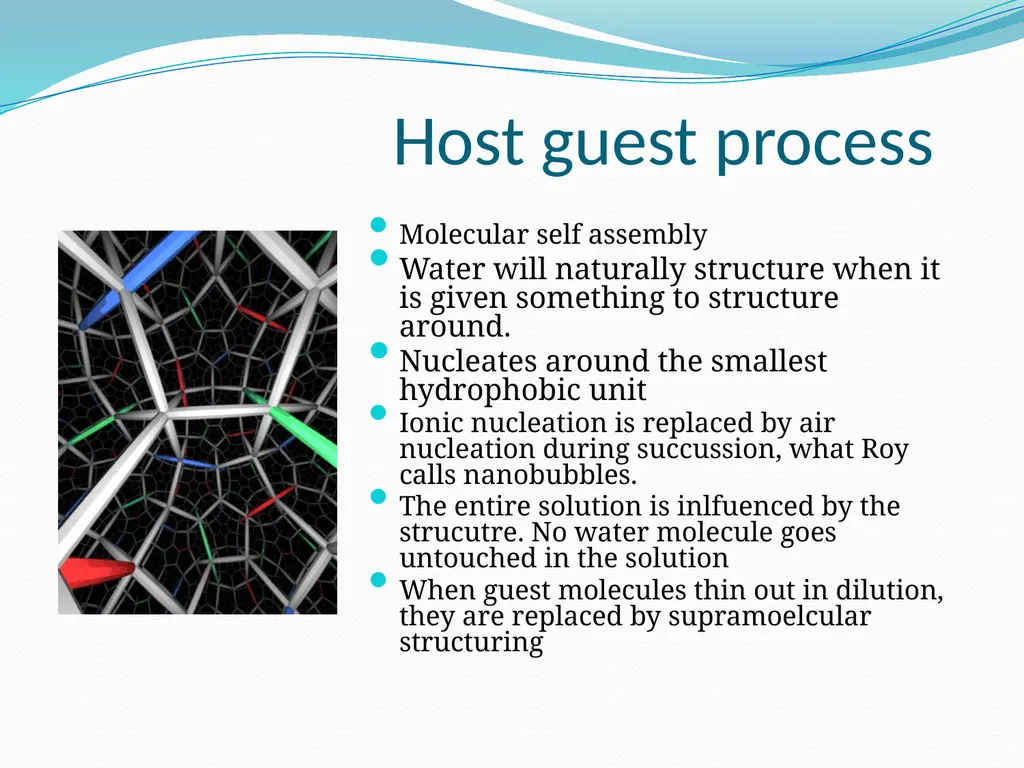
Host guest process Molecular self assembly
Water will naturally structure when it is given something to structure around.
Nucleates around the smallest hydrophobic unit
Ionic nucleation is replaced by air nucleation during succussion, what Roy calls nanobubbles.
The entire solution is inlfuenced by the strucutre. No water molecule goes untouched in the solution
When guest molecules thin out in dilution, they are replaced by supramoelcular structuring<br>
Water will naturally structure when it is given something to structure around.
Nucleates around the smallest hydrophobic unit
Ionic nucleation is replaced by air nucleation during succussion, what Roy calls nanobubbles.
The entire solution is inlfuenced by the strucutre. No water molecule goes untouched in the solution
When guest molecules thin out in dilution, they are replaced by supramoelcular structuring<br>
32
How Nat Mur is made - dilution When salt is added to water, the smaller H2O molecules seep into the lattice work of the compound
Negative poles of H2O molecules are attracted to the positve charge d Na+ ion, and the positive poles to the negative charged Cl- atom to form the inner hydration shell
A second organized field of organization, the cybotactic region, forms around the inner hydration shell
Organization continues outward to the closest magnetosphere<br>
Negative poles of H2O molecules are attracted to the positve charge d Na+ ion, and the positive poles to the negative charged Cl- atom to form the inner hydration shell
A second organized field of organization, the cybotactic region, forms around the inner hydration shell
Organization continues outward to the closest magnetosphere<br>
33
How Nat Mur is made - succussion During succussion, atmosphere is introduced into the solution and pressurized
Hydrogen bonds intensify around atmosphere
Surface tension in water from hydrogen bonding strong enough to float a paper clip<br>
Hydrogen bonds intensify around atmosphere
Surface tension in water from hydrogen bonding strong enough to float a paper clip<br>
34
Transitional nucleation The five transitional states, from quintessence (ether) to fire, from fire to gas, from gas to liquid, from liquid to solid matter and back, is continuous - Johannes van der Waals, Nobel prize for intermoelcular forces, 1910
Intermolecular forces control the material characteristics of all phases of matter.
In the homeopathic supramolecular solution, ionic particle nucleation is replaced by a ionic air nucleation<br>
Intermolecular forces control the material characteristics of all phases of matter.
In the homeopathic supramolecular solution, ionic particle nucleation is replaced by a ionic air nucleation<br>
35
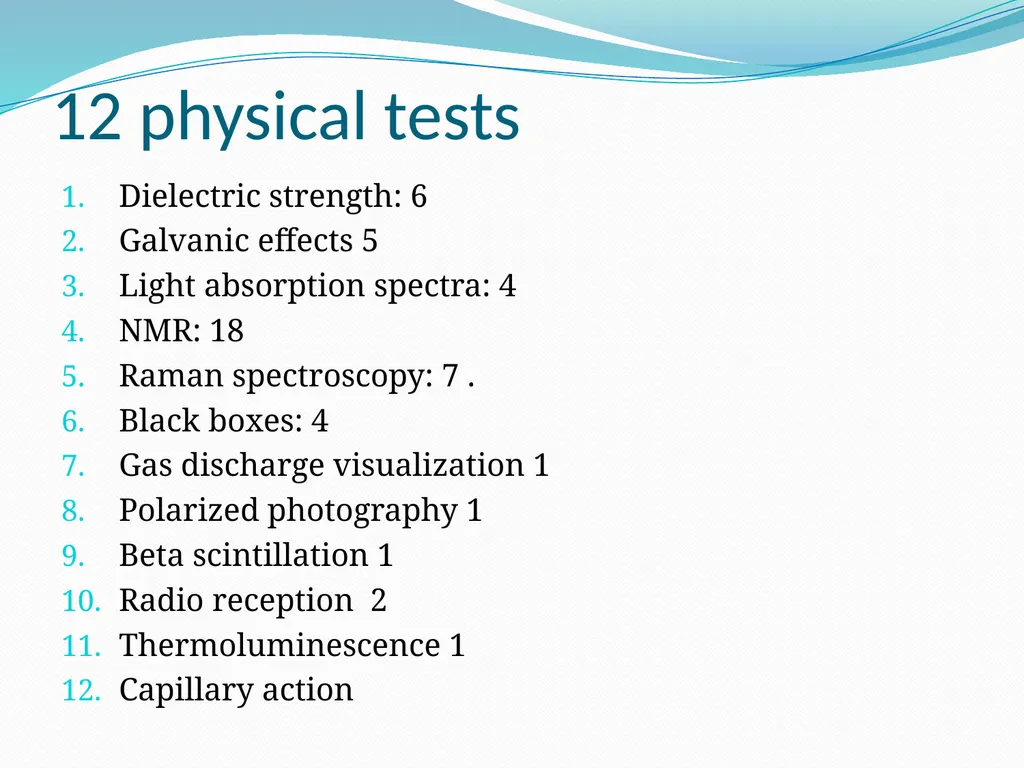
12 physical tests Dielectric strength: 6
Galvanic effects 5
Light absorption spectra: 4
NMR: 18
Raman spectroscopy: 7 .
Black boxes: 4
Gas discharge visualization 1
Polarized photography 1
Beta scintillation 1
Radio reception 2
Thermoluminescence 1
Capillary action<br>
Galvanic effects 5
Light absorption spectra: 4
NMR: 18
Raman spectroscopy: 7 .
Black boxes: 4
Gas discharge visualization 1
Polarized photography 1
Beta scintillation 1
Radio reception 2
Thermoluminescence 1
Capillary action<br>
36
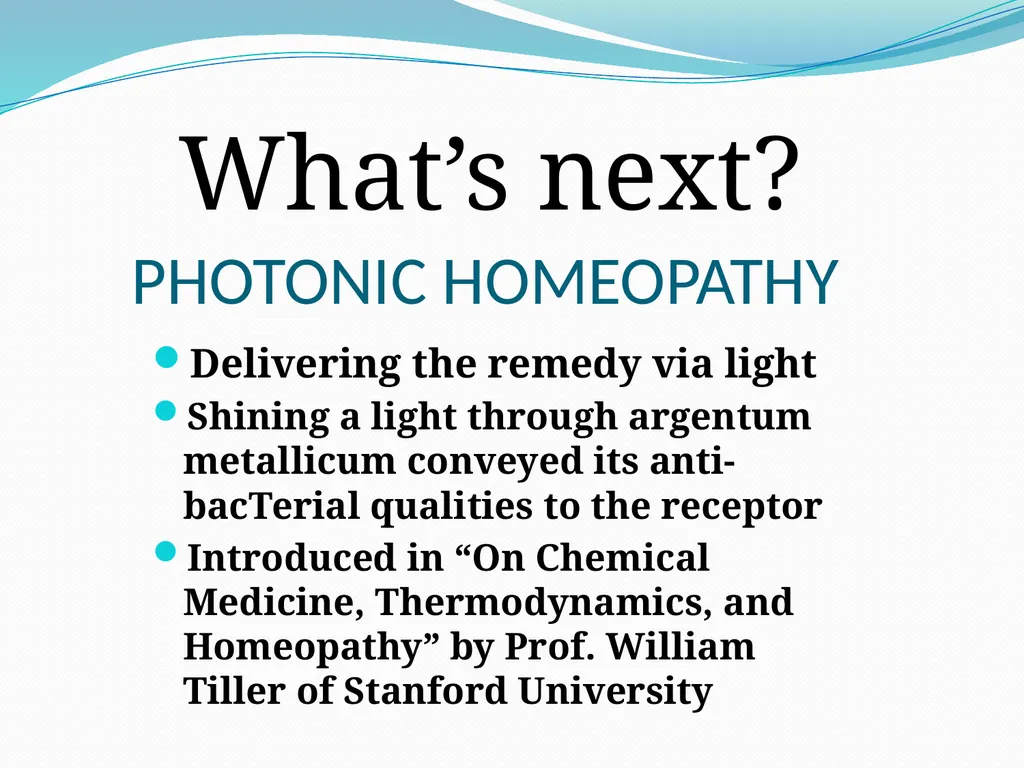
PHOTONIC HOMEOPATHY Delivering the remedy via light
Shining a light through argentum metallicum conveyed its anti-bacTerial qualities to the receptor
Introduced in “On Chemical Medicine, Thermodynamics, and Homeopathy” by Prof. William Tiller of Stanford University What’s next?<br>
Shining a light through argentum metallicum conveyed its anti-bacTerial qualities to the receptor
Introduced in “On Chemical Medicine, Thermodynamics, and Homeopathy” by Prof. William Tiller of Stanford University What’s next?<br>
37
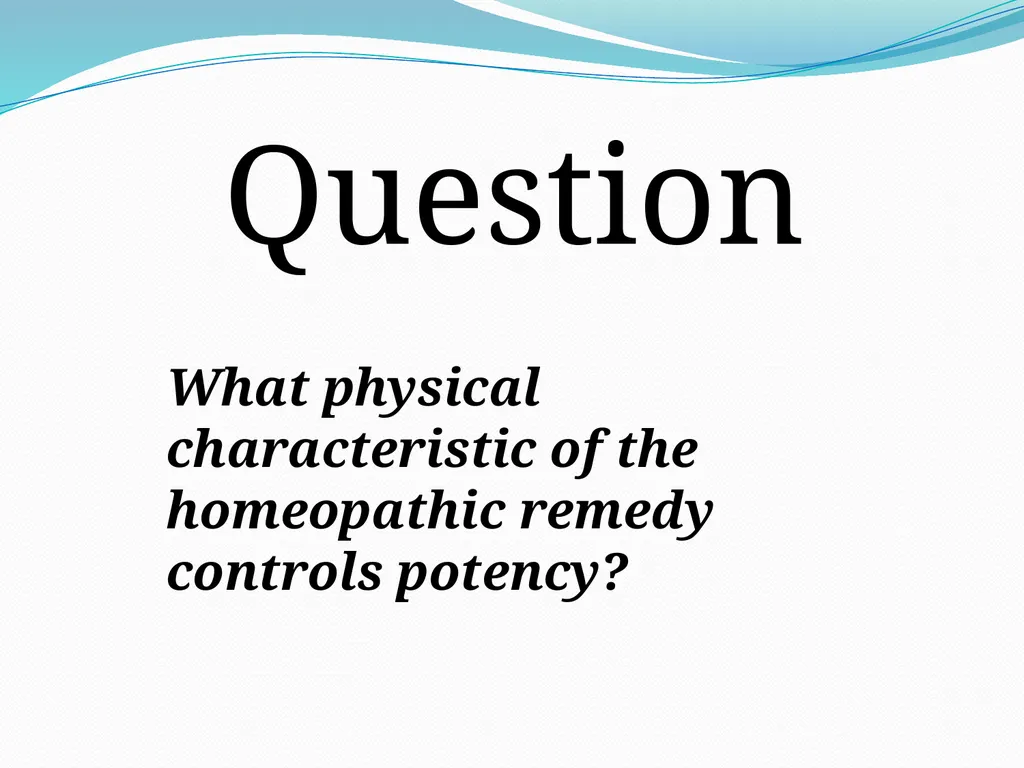
Question What physical characteristic of the homeopathic remedy controls potency?<br>
38
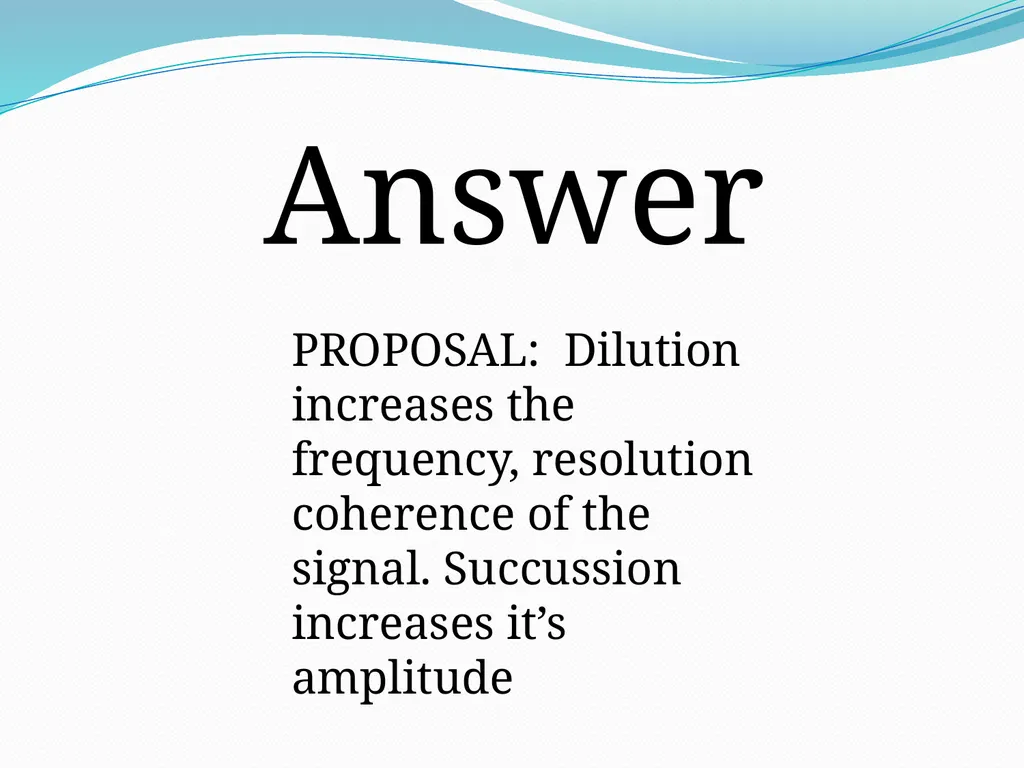
Answer PROPOSAL: Dilution increases the frequency, resolution coherence of the signal. Succussion increases it’s amplitude<br>
39
What gives the homeopathic remedy its biological action? Question<br>
40
Answer Answer: The electromagnetic signal.
Propsoal: Lower frequency signals from covalent bonded matter have a shorter broadcast range and talk to the system on a localized basis. The disease state arises from trying to act on a localized basis. The lower signals drown out the higher source signals. In the homeopathic remedy the lower source signals have been removed by dilution, and the higher signals of the source replicated and amplified,. The body recognizes the disease state systemically from the higher signal<br>
Propsoal: Lower frequency signals from covalent bonded matter have a shorter broadcast range and talk to the system on a localized basis. The disease state arises from trying to act on a localized basis. The lower signals drown out the higher source signals. In the homeopathic remedy the lower source signals have been removed by dilution, and the higher signals of the source replicated and amplified,. The body recognizes the disease state systemically from the higher signal<br>
41
Question If a skeleton comes to you to be cured of alcoholism, what remedy do you give him?<br>
42
Answer Pulsatilla and a mop.<br>
43
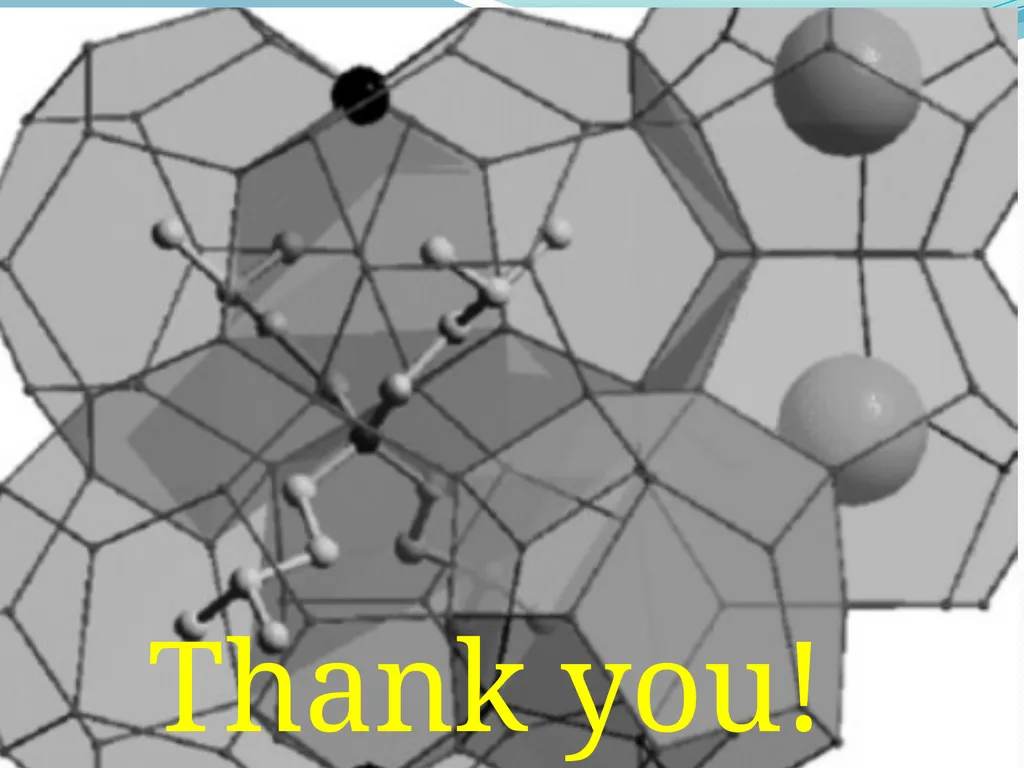
Thank you!<br>
44
Special thanks to Dr. Shashi Sharma and the Hahnemann College of Homeopathy Beyond the Molecule 2010
with John Benneth<br>