04
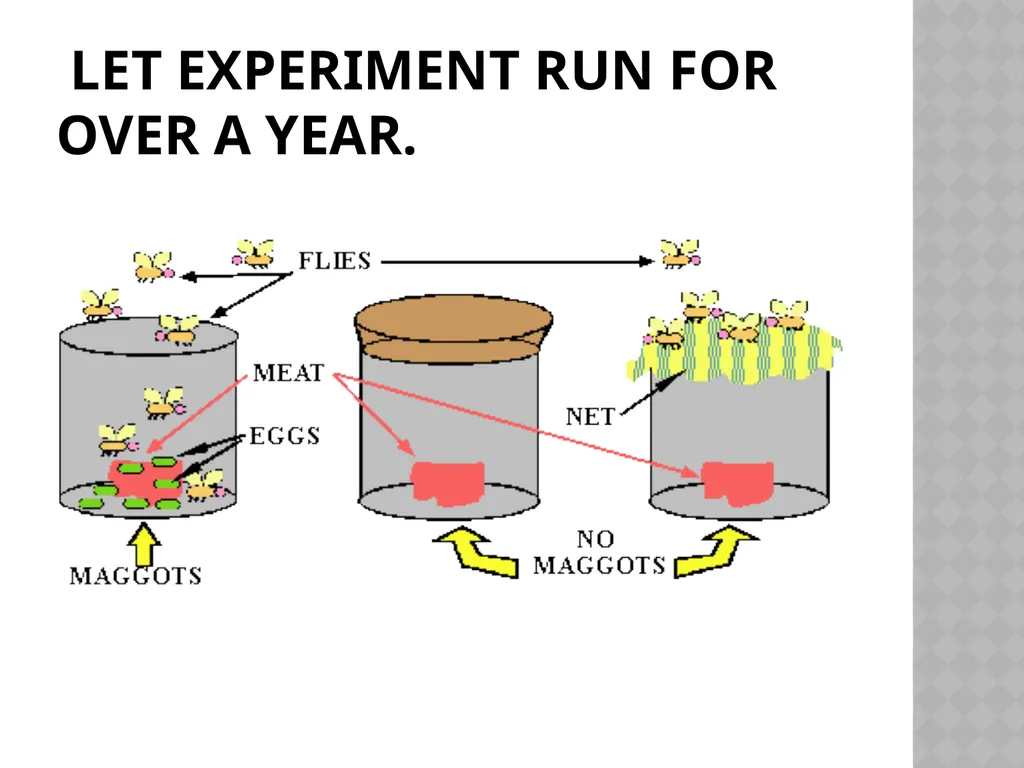
let experiment Run for over a year.<br>
05
Debating Spontaneous Generation In 1675, microorganisms were discovered.
This reopened the debate on spontaneous generation.
In 1864, Louis Pasteur finally developed an experiment to end the debate.
At this time, air was considered to be an essential ingredient necessary for spontaneous generation.
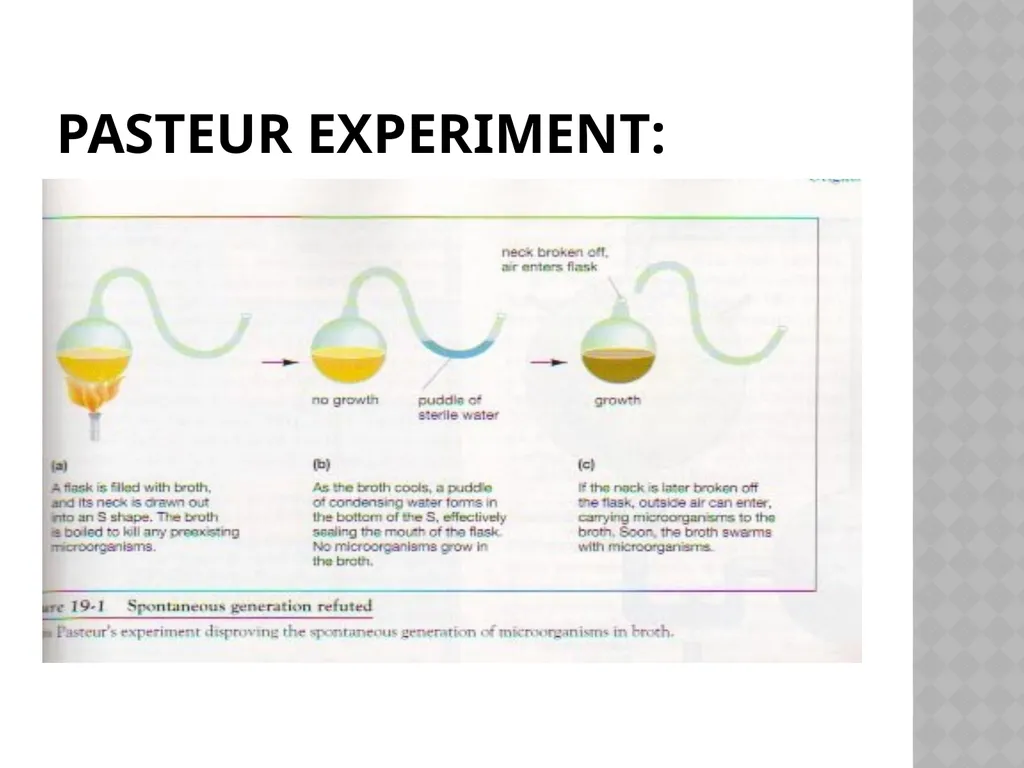
He conducted experiment in which air was allowed to enter a flask of nutrient broth.<br>
06
Pasteur Experiment:<br>
07
Pasteur’s Experiment: Was the precursor for today’s pasteurization process.
His experiment led to a major biological theory: Theory of Biogenesis
At the present time and under present conditions on Earth, all organisms are produced from other organisms.
Fits in well with the cell theory discussed earlier.<br>
08
Reproduction of body cells Cell reproduction occurs when parent cells divide.
Two daughter cells are the result.
Contributes to overall growth of an organism.
Also helps repair damaged tissue, replace cells that are lost from outer surfaces (skin), and helps us to resist disease.
Smaller is better: SA to volume ratio we studied in lab.<br>
09
The Cell Cycle Most cells are in a non-reproducing phase called interphase.
Cell spends most of its life in this stage.
Stage length varies with type of cell.
Interphase begins when cell reproduction is completed.
Cell carries out normal cell activities during this phase.<br>
11
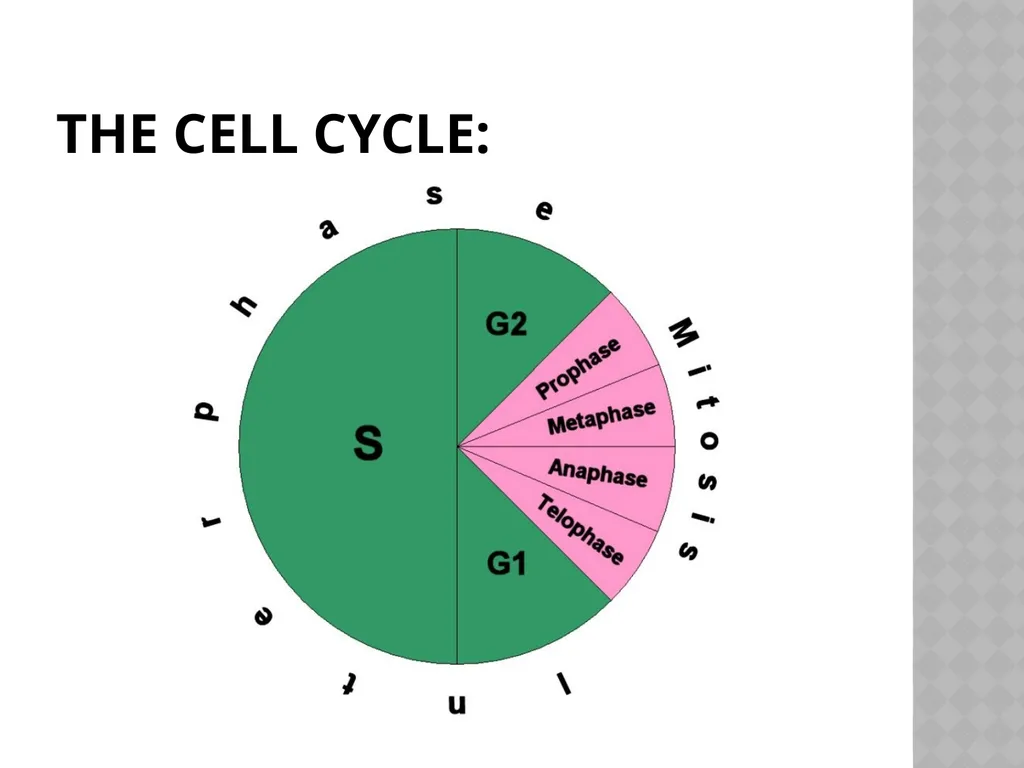
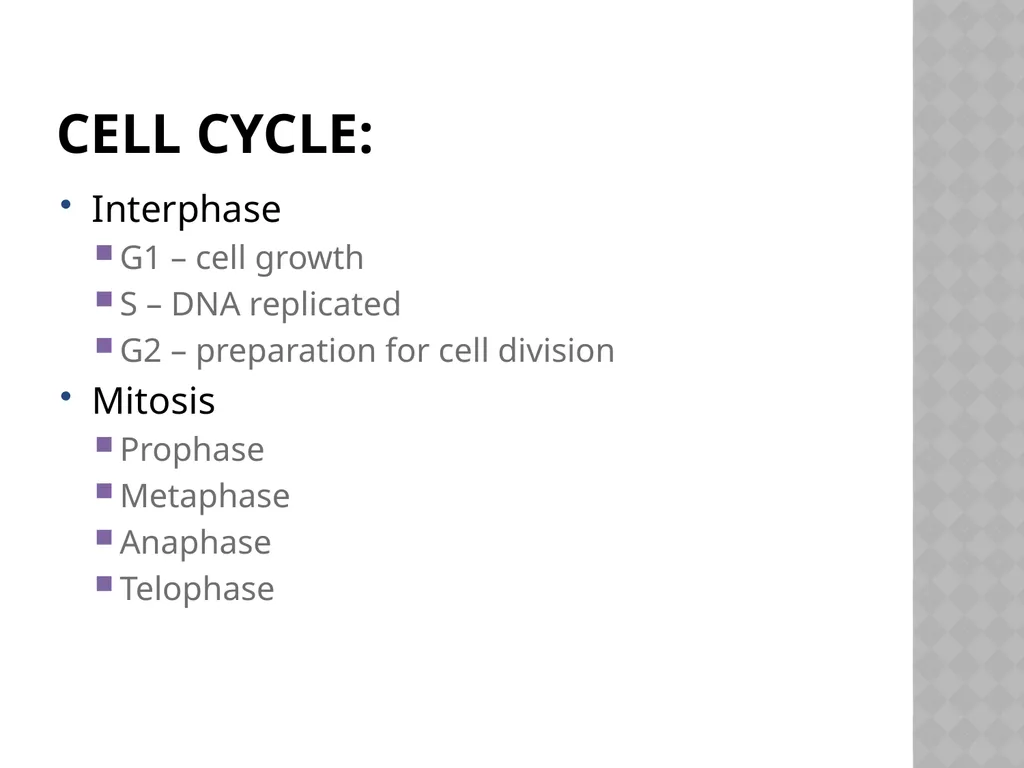
Cell Cycle: Interphase
G1 – cell growth
S – DNA replicated
G2 – preparation for cell division
Mitosis
Prophase
Metaphase
Anaphase
Telophase<br>
12
Prophase Chromatin begins to coil up into structures known as chromatids. Two identical chromatids are attached at the center in a location called the centromere.
A chromosome is this double stranded structure attached at the centromere.
Spindle also forms during prophase. It is a football-shaped band of fibers that originate from two centrioles.
Centrioles have migrated to opposite ends of the cell.<br>
13
Prophase Nuclear membrane disintegrates as well:<br>
14
Metaphase Chromosomes attach to the spindle fibers.
They then meet in the middle of the cell.<br>
15
Anaphase The chromosomes separate into sister chromatids again by being pulled apart at the centromere by the spindles.
Chromatids move away from the middle.<br>
16
Telophase Plasma membranes in animal cells begin to pinch together.
Basically propase in reverse: nuclear membrane reforms, chromatids relax back into chromatin form, two sets of identical chromatin now located at each end of the cell.
Result of Mitosis: One 2n cell becomes two 2n daughter cells.<br>
17
Telophase – animal and Plant diagram Cell plate<br>
18
Control of the cell cycle Cells grow at different rates depending on needs.
Red blood cells and skin cells multiply rapidly.
Some muscle and nerve cells remain in interphase their whole lives.
Liver cells only divide when repairs need to be made.<br>
19
Uncontrollable cell growth If cells begin to grow rapidly and growth is not stopped, cancerous areas can occur.
Cancer is an example of uncontrollable cell growth.
Over time, this growth can outcompete vital cells and tissues for nutrients and space.<br>
20
Cell Cycle regulation One way cells regulate growth is by coming into contact with other cells.
When this occurs, cells stop reproducing.
Controlled by proteins in the cell.
As scientists figure out what triggers cell growth, information could be used to cure cancers, replace damaged tissues, etc.<br>
21
Cell reproduction in prokaryotes Have single chromosome (circular).
Don’t really have a cell cycle.
Reproduce by binary fission.
Chromosome attaches to cell membrane
Cell elongates.
Chromosome is replicated.
Cell divides into 2 with 1 chromosome in each.<br>
22
7.2 Production of Reproductive cells Objectives:
Sequence the series of events by which reproductive cells are produced in complex plants and animals.
Analyze the significance of meiosis with respect to adaptation and evolution.<br>
23
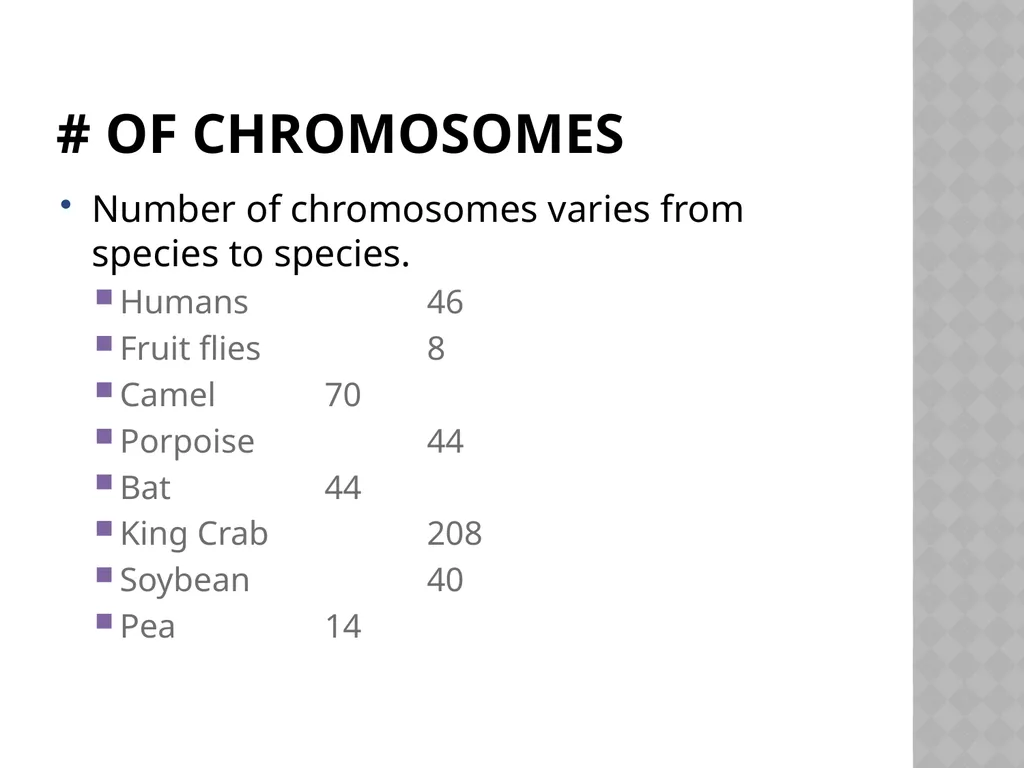
# of chromosomes Number of chromosomes varies from species to species.
Humans 46
Fruit flies 8
Camel 70
Porpoise 44
Bat 44
King Crab 208
Soybean 40
Pea 14<br>
24
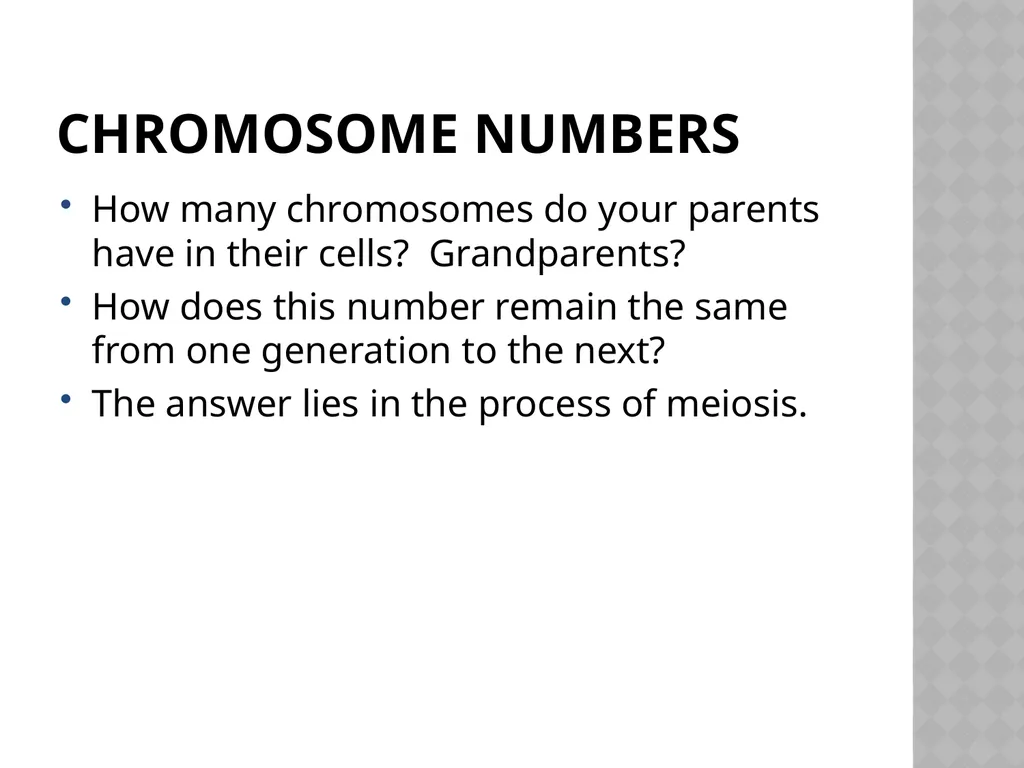
Chromosome Numbers How many chromosomes do your parents have in their cells? Grandparents?
How does this number remain the same from one generation to the next?
The answer lies in the process of meiosis.<br>
25
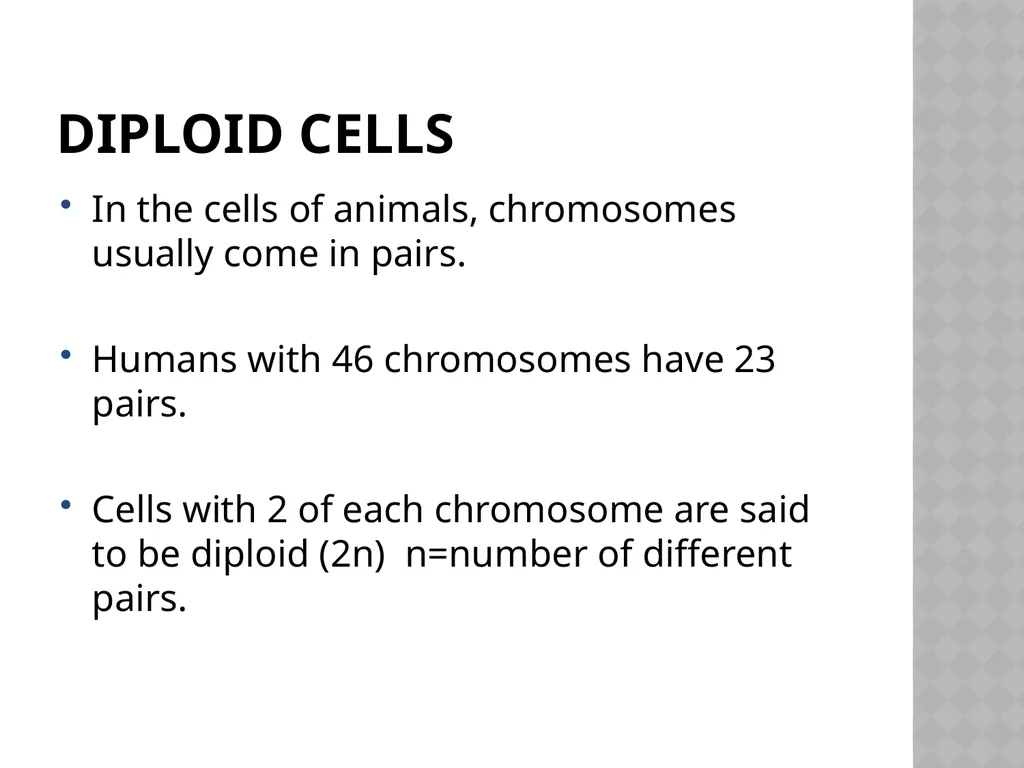
Diploid cells In the cells of animals, chromosomes usually come in pairs.
Humans with 46 chromosomes have 23 pairs.
Cells with 2 of each chromosome are said to be diploid (2n) n=number of different pairs.<br>
26
Homologues The two members of each pair are referred to as homologous chromosomes, or homologues.
The DNA for each homologue carries the information for the same traits, although the exact information may differ.
Example: Eye color: One may carry info for brown eyes and one may carry info for blue eyes.<br>
27
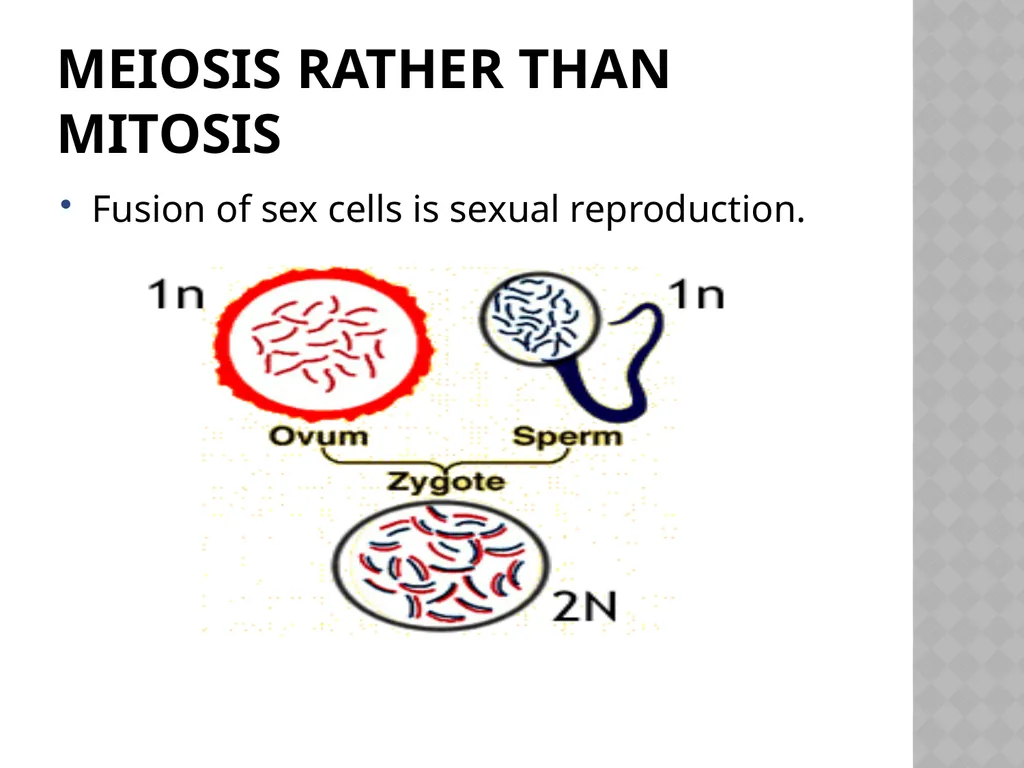
Meiosis rather than Mitosis When two parent organisms mate to produce single cell, the single fertilized egg is called a zygote.
A zygote results from the union of two different kinds of gametes, which are the sex cells (eggs and sperm).
The fusion of the egg and sperm is called fertilization.
Eggs and sperm are haploid (n) cells. They have one set of the chromosome pairs, so they have 23 chromosomes in humans.<br>
28
Meiosis rather than mitosis Fusion of sex cells is sexual reproduction.<br>
29
Haploid from Diploid Haploid cells cannot be produced by mitosis.
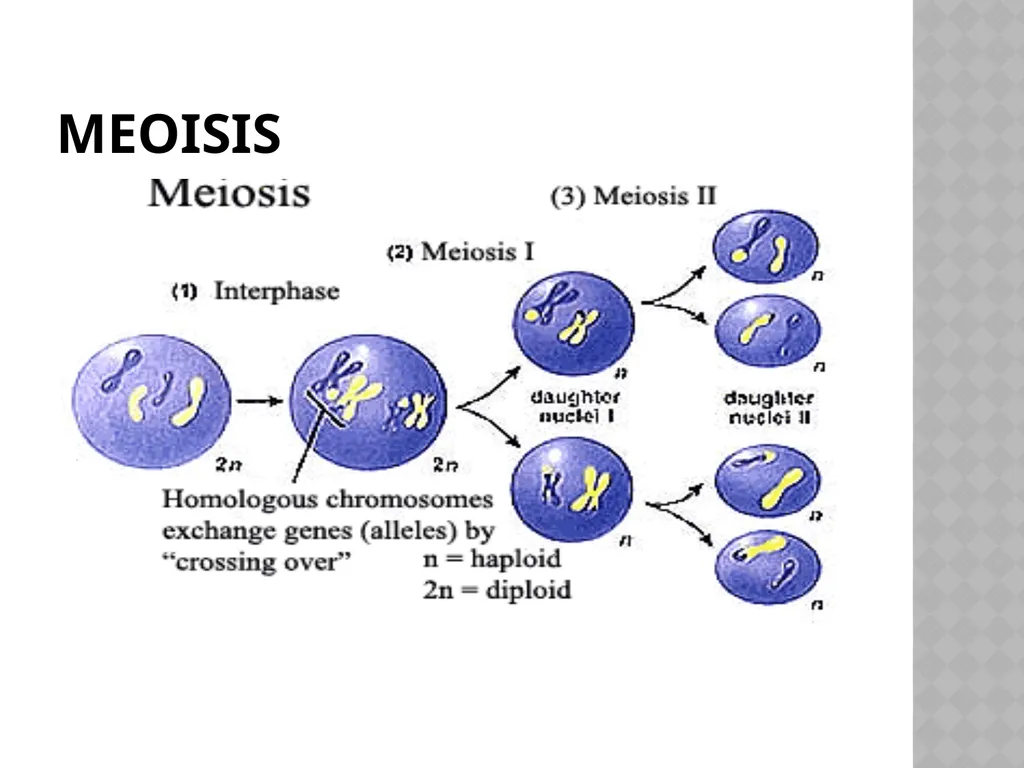
Meiosis – the process by which haploid cells are formed from diploid cells.
Not limited to animal cells. Happens in plant cells also. Haploid cells are called spores instead of gametes.<br>
30
Meiosis – need to get from 2n to n Prophase I
Metaphase I
Anaphase I
Telophase I
Prophase II
Metaphase II
Anaphase II
Telophase II<br>
33
Meiosis in Females Interesting differences:
Meiosis I begins before birth, then process stops.
At sexual maturity, several cells continue on with the process.
Usually result is only one egg instead of 4.
Why is this an advantage?<br>
34
Variation Advantage Crossing over provides for genetic variation.
Provides for a better chance at survival for the species as a whole.
The reshuffling of chromosomes and the genetic information they carry is one of the mechanisms for what is called genetic recombination.
This allows for inheritable variation.<br>