
BIOMECHANICS KINESIS – Movement + Logous – Study
KB
Published · 45 slides · 0 views

1 / 1









Description
BIOMECHANICS KINESIS Movement Logous Study of Scientific study of body movement is called Kinesiology . The study of mechanics in the human body is referred as biomechanics . Mechanics - it is a science dealing with the motion of the
Related Topics
Share
Embed code
Download this presentation From Below
"BIOMECHANICS KINESIS – Movement + Logous – Study" is the property of its rightful owner. Permission is granted to download and print the materials on this website for personal, non-commercial use only, and to display it on your personal computer provided you do not modify the materials and that you retain all copyright notices contained in the materials. By downloading content from our website, you accept the terms of this agreement.
Presentation Transcript
01
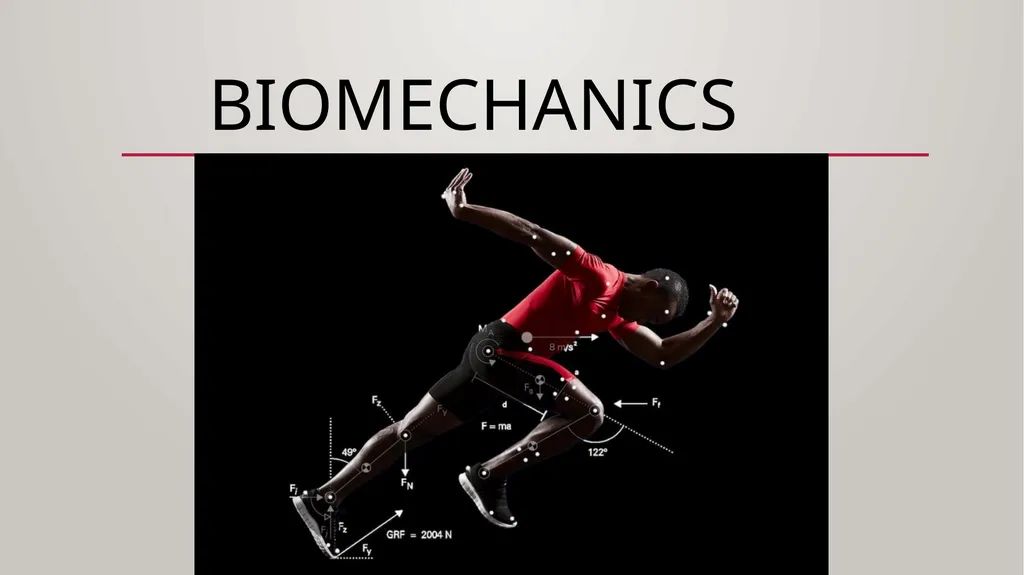
BIOMECHANICS<br>
02
KINESIS – Movement + Logous – Study of
Scientific study of body movement is called Kinesiology .
The study of mechanics in the human body is referred as biomechanics .
Mechanics - it is a science dealing with the motion of the body .
Kinesiology is also referred as biomechanics, which deals with the mechanical aspect of biological system .
Kinesiology is broadly divided into two parts -
1. Kinetics
2. Kinematics<br>
Scientific study of body movement is called Kinesiology .
The study of mechanics in the human body is referred as biomechanics .
Mechanics - it is a science dealing with the motion of the body .
Kinesiology is also referred as biomechanics, which deals with the mechanical aspect of biological system .
Kinesiology is broadly divided into two parts -
1. Kinetics
2. Kinematics<br>
03
KINEMATICS - it is area of biomechanics that include description of motion without regard for the forces producing the motion .
Kinematics variable- kinematics variable for a given movement may include -
Type of motion i.e. Occurring – Rotatory , translatoy etc.
Location of the movement
Direction of the motion
Magnitude of the motion
The rate or duration of the motion<br>
Kinematics variable- kinematics variable for a given movement may include -
Type of motion i.e. Occurring – Rotatory , translatoy etc.
Location of the movement
Direction of the motion
Magnitude of the motion
The rate or duration of the motion<br>
04
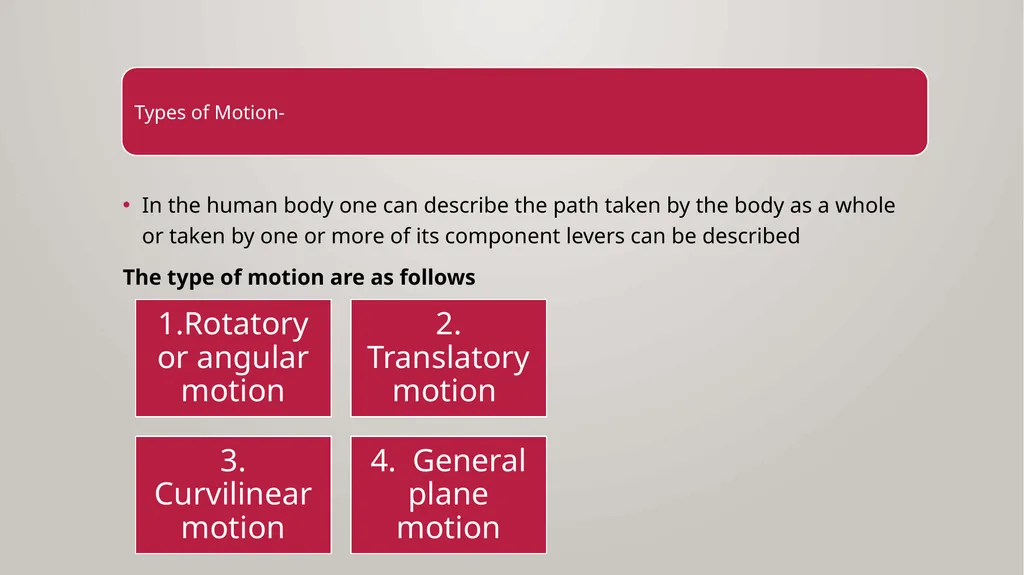
In the human body one can describe the path taken by the body as a whole or taken by one or more of its component levers can be described
The type of motion are as follows<br>
The type of motion are as follows<br>
05
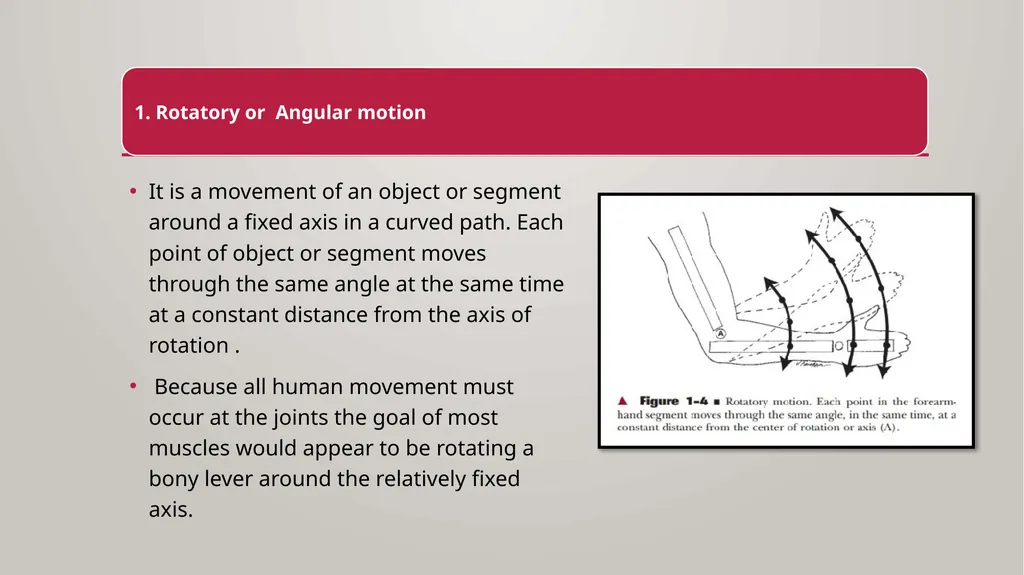
It is a movement of an object or segment around a fixed axis in a curved path. Each point of object or segment moves through the same angle at the same time at a constant distance from the axis of rotation .
Because all human movement must occur at the joints the goal of most muscles would appear to be rotating a bony lever around the relatively fixed axis.<br>
Because all human movement must occur at the joints the goal of most muscles would appear to be rotating a bony lever around the relatively fixed axis.<br>
06
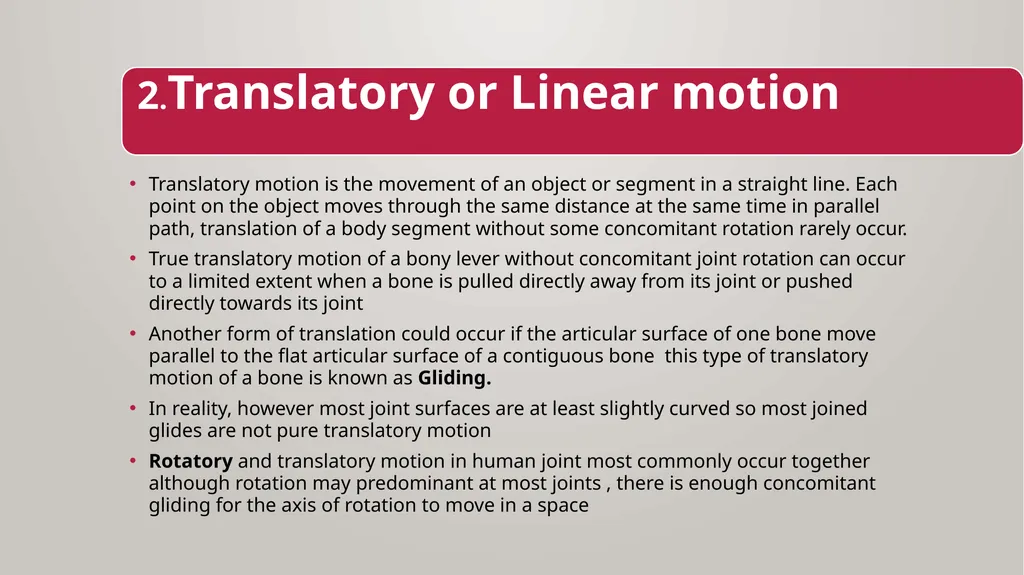
Translatory motion is the movement of an object or segment in a straight line. Each point on the object moves through the same distance at the same time in parallel path, translation of a body segment without some concomitant rotation rarely occur.
True translatory motion of a bony lever without concomitant joint rotation can occur to a limited extent when a bone is pulled directly away from its joint or pushed directly towards its joint
Another form of translation could occur if the articular surface of one bone move parallel to the flat articular surface of a contiguous bone this type of translatory motion of a bone is known as Gliding.
In reality, however most joint surfaces are at least slightly curved so most joined glides are not pure translatory motion
Rotatory and translatory motion in human joint most commonly occur together although rotation may predominant at most joints , there is enough concomitant gliding for the axis of rotation to move in a space<br>
True translatory motion of a bony lever without concomitant joint rotation can occur to a limited extent when a bone is pulled directly away from its joint or pushed directly towards its joint
Another form of translation could occur if the articular surface of one bone move parallel to the flat articular surface of a contiguous bone this type of translatory motion of a bone is known as Gliding.
In reality, however most joint surfaces are at least slightly curved so most joined glides are not pure translatory motion
Rotatory and translatory motion in human joint most commonly occur together although rotation may predominant at most joints , there is enough concomitant gliding for the axis of rotation to move in a space<br>
07
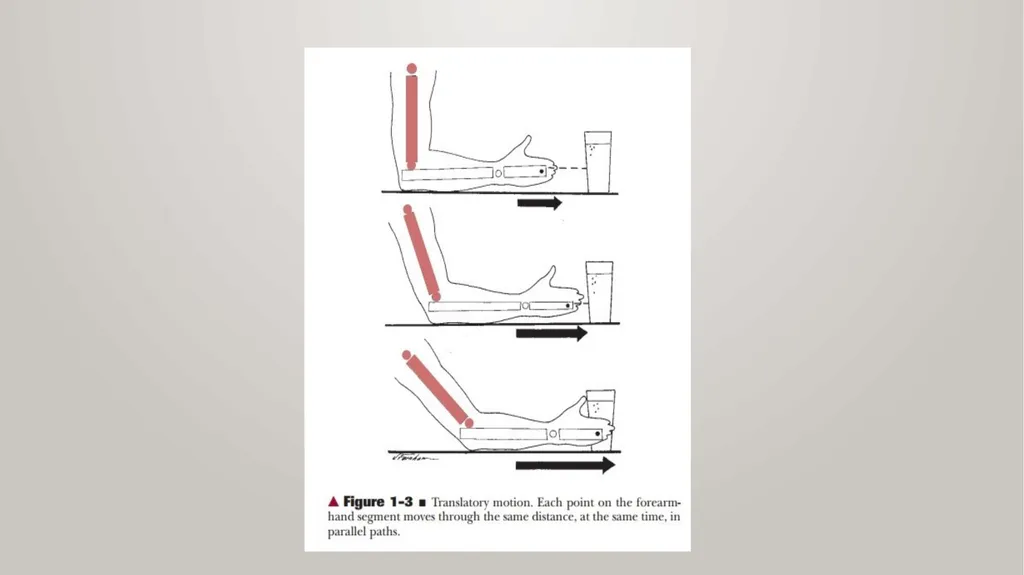
When an object rotates about an axis and moves through a space at the same time the object describes a third pathway known as curvilinear motion.
For example - A thrown ball where the ball moves through a space and rotates on its own axis concomitantly .<br>
For example - A thrown ball where the ball moves through a space and rotates on its own axis concomitantly .<br>
08
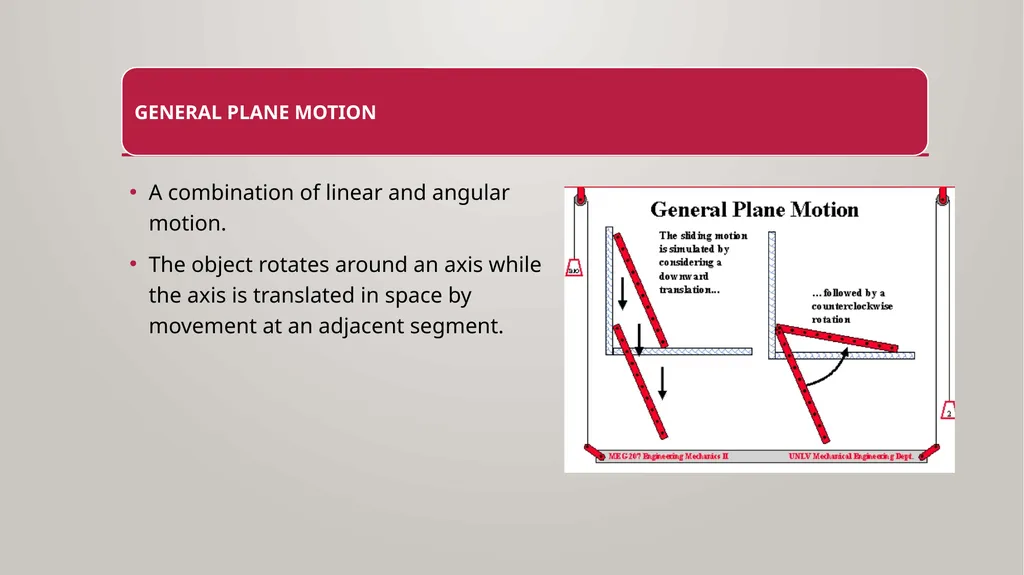
A combination of linear and angular motion.
The object rotates around an axis while the axis is translated in space by movement at an adjacent segment.<br>
The object rotates around an axis while the axis is translated in space by movement at an adjacent segment.<br>
09
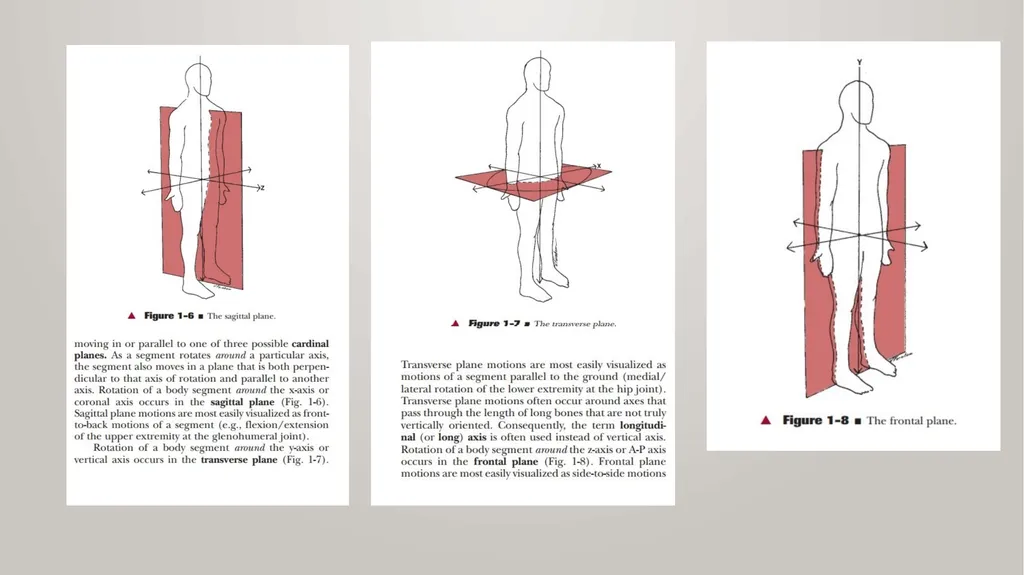
Motion at a joint may be described as occurring in the transverse or horizontal, frontal and coronal or sagittal or anterior posterior planes. Motion in any one of these planes means that a body segment is being rotated about its axis or translated in such a way that the segment is moving through a path that is parallel to one of the three cardinal planes.
It is traditional to refer to motions as if they were occurring with the person standing in anatomical position.<br>
It is traditional to refer to motions as if they were occurring with the person standing in anatomical position.<br>
10
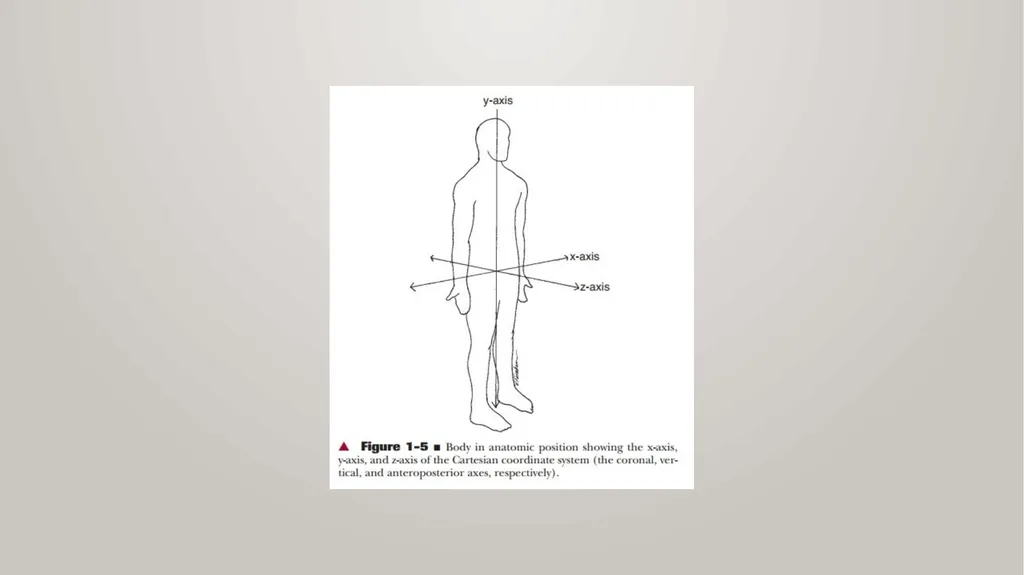
In an anatomical position, a person stands, looking forward, with the palms of the hands facing forward.
Transverse plane-this plane divides the body into upper and lower halves. Movements in the transverse plane occur parallel to the ground. Example in rotation of the head.
Rotatory motion in the transverse plane occur around a vertical or longitudinal axis of motion.
The term longitudinal axis is used when the axes of motion passes through the length of a long bone.
The axis of any cardinal plane moment is always found perpendicular to its corresponding plane.<br>
Transverse plane-this plane divides the body into upper and lower halves. Movements in the transverse plane occur parallel to the ground. Example in rotation of the head.
Rotatory motion in the transverse plane occur around a vertical or longitudinal axis of motion.
The term longitudinal axis is used when the axes of motion passes through the length of a long bone.
The axis of any cardinal plane moment is always found perpendicular to its corresponding plane.<br>
11
Frontal plane divides the body into front and back halves. Movements in this plane occurs as side to side movements such as bringing the head to each of the shoulders. Rotatory motion in frontal plane occurs around an anterior-posterior axis.
Sagittal plane and divides the body into right and left half movements in this planes include forward and backward motion such as nodding of head. Rotatory motion in the sagittal plane occurs around a coronal axis.<br>
Sagittal plane and divides the body into right and left half movements in this planes include forward and backward motion such as nodding of head. Rotatory motion in the sagittal plane occurs around a coronal axis.<br>
12
For rotatory motion, the direction of movements of a lever around an axis can be described as occurring in a clockwise or counter-clockwise direction. However these terms are dependent on the prospective of the lever. Positive and negative signs are traditionally assigned to clockwise to counter clockwise movement.
Anatomic terms describing human movement are independent on perspective and therefore more useful to us.
flexion – it refers to the rotation of one or more bony lever around the joint axis so that Ventral surfaces are being approximated.
Flexion and extension generally occur in sagittal plane and coronal axis although exceptions exist-
Rotation in the same plane in the opposite direction (approximation of dorsal surfaces) is termed as extension.
Exception- carpometacarpal flexion and extension of thumb moves away from the midline of the body.
Abduction is rotation of one or both segments of a joint around an axis so that the distal segment moves away from the midline of the body .<br>
Anatomic terms describing human movement are independent on perspective and therefore more useful to us.
flexion – it refers to the rotation of one or more bony lever around the joint axis so that Ventral surfaces are being approximated.
Flexion and extension generally occur in sagittal plane and coronal axis although exceptions exist-
Rotation in the same plane in the opposite direction (approximation of dorsal surfaces) is termed as extension.
Exception- carpometacarpal flexion and extension of thumb moves away from the midline of the body.
Abduction is rotation of one or both segments of a joint around an axis so that the distal segment moves away from the midline of the body .<br>
13
Adduction occurs in the same plane but in opposite direction (moment of the distal lever of joint occurs towards the midline of the body).
When segment that is moving part of the midline of the body example- the trunk and head , the moment termed as lateral flexion
Abduction / adduction and lateral flexion generally occurs in the frontal plane around an anteroposterior axis / sagittal axis although again some exceptions exist (carpometacarpal abduction and adduction of the thumb.
ROTATION- medial or internal rotation refers to the rotation towards the body is midline
Lateral rotation - lateral or external rotation refers to the opposite motion that is rotation away from the body’s midline. The moment is simply called rotation to the right or rotation to the left.<br>
When segment that is moving part of the midline of the body example- the trunk and head , the moment termed as lateral flexion
Abduction / adduction and lateral flexion generally occurs in the frontal plane around an anteroposterior axis / sagittal axis although again some exceptions exist (carpometacarpal abduction and adduction of the thumb.
ROTATION- medial or internal rotation refers to the rotation towards the body is midline
Lateral rotation - lateral or external rotation refers to the opposite motion that is rotation away from the body’s midline. The moment is simply called rotation to the right or rotation to the left.<br>
14
Motions that are up or to the right are given positive values.
Motions down or to the left are given negative values.
Translatory movement of a segment towards its joint is referred as compression.
Whereas translatory motion of a segment away from the joint can be termed as distraction.<br>
Motions down or to the left are given negative values.
Translatory movement of a segment towards its joint is referred as compression.
Whereas translatory motion of a segment away from the joint can be termed as distraction.<br>
15
The magnitude or quantity of rotatory motion can be given either in degree or in radians. If a segment describe a complete circle it has moved 360 degree of 6.28 radian
Radian is the ratio of an Arc to the radius in its circle
One radian equals 57.3 degree
One degree equals 0.01745 radian
Magnitude of the motion may also be given as the number of degrees through which an object rotates per second that is angular speed or rate.
When angular speed is given a designated direction it becomes the vector quantity velocity.
Translatory motions are quantified by the linear distance through which the object of segment has moved.
Displacement per unit time with the direction is referred as velocity of without direction speed may also be consider as a description of magnitude of motion.<br>
Radian is the ratio of an Arc to the radius in its circle
One radian equals 57.3 degree
One degree equals 0.01745 radian
Magnitude of the motion may also be given as the number of degrees through which an object rotates per second that is angular speed or rate.
When angular speed is given a designated direction it becomes the vector quantity velocity.
Translatory motions are quantified by the linear distance through which the object of segment has moved.
Displacement per unit time with the direction is referred as velocity of without direction speed may also be consider as a description of magnitude of motion.<br>
16
kinetics is the area of biomechanics concerned with the forces producing motion or maintaining equilibrium.
Force
Force is a push or pull exerted by one material, object or substance on another object.
Types
External forces - these are push or pull on the body that arises from the source outside the body example gravity, wind, water and other person etc.
Internal forces - these are forces that acts on the body arise from source within the human body example muscle pull ,bones, ligament etc.
There are some forces such as friction and atmospheric pressure which can act as both external and within the body.<br>
Force
Force is a push or pull exerted by one material, object or substance on another object.
Types
External forces - these are push or pull on the body that arises from the source outside the body example gravity, wind, water and other person etc.
Internal forces - these are forces that acts on the body arise from source within the human body example muscle pull ,bones, ligament etc.
There are some forces such as friction and atmospheric pressure which can act as both external and within the body.<br>
17
Force vector-
All forces despite the source objects acted on, are vector quantities and can be described by-
A point of application on the object being acted on.
An action line and direction indicating a pull away from source or a push away from the source.
A magnitude, that is quantity of force being exerted.
A vector is traditionally represented by an arrow, so force is represented by an arrow that-
I. has a base on the object being acted on point of application
II. Has a shaft and arrow head in the direction of the force being exerted
has a length drawn to represent the amount of force being exerted.
(magnitude).<br>
All forces despite the source objects acted on, are vector quantities and can be described by-
A point of application on the object being acted on.
An action line and direction indicating a pull away from source or a push away from the source.
A magnitude, that is quantity of force being exerted.
A vector is traditionally represented by an arrow, so force is represented by an arrow that-
I. has a base on the object being acted on point of application
II. Has a shaft and arrow head in the direction of the force being exerted
has a length drawn to represent the amount of force being exerted.
(magnitude).<br>
18
Naming convention of an object on object is used to identify the forces. The first object name will always be the source of the force the second object name will always be the object being acted on. This means the object to which the force is applied will always be the last name of the for
The action and direction line will be the towards the force in case of pull or away from the source in case of push.<br>
The action and direction line will be the towards the force in case of pull or away from the source in case of push.<br>
19
It is the attraction of the mass of the earth for the mass of other object and on earth has a magnitude of 32 feet per second square
The force of gravity on an object with weight is equal to the mass into 32 feet per second square unit equal to mass = kg<br>
The force of gravity on an object with weight is equal to the mass into 32 feet per second square unit equal to mass = kg<br>
20
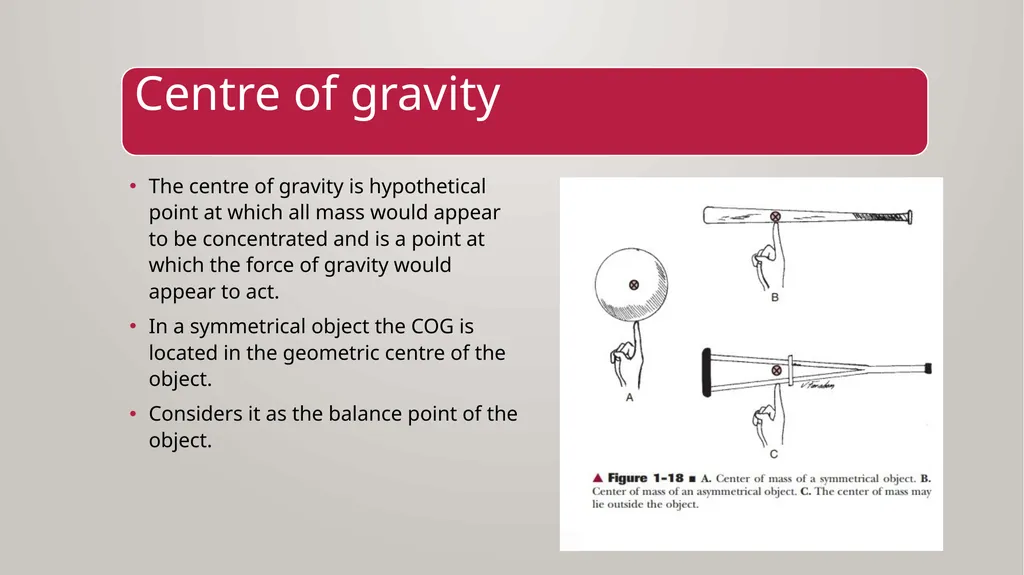
The centre of gravity is hypothetical point at which all mass would appear to be concentrated and is a point at which the force of gravity would appear to act.
In a symmetrical object the COG is located in the geometric centre of the object.
Considers it as the balance point of the object.<br>
In a symmetrical object the COG is located in the geometric centre of the object.
Considers it as the balance point of the object.<br>
21
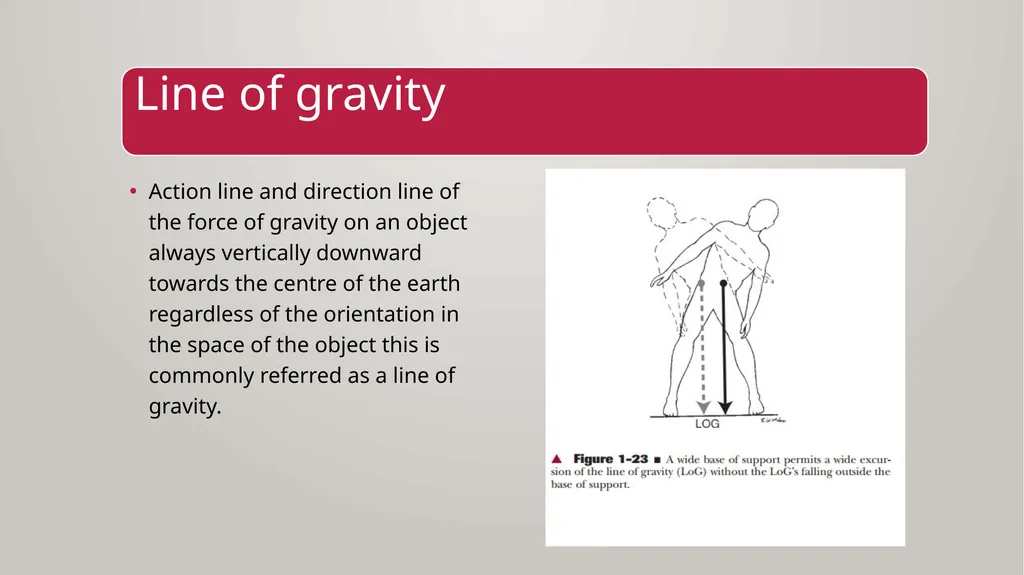
Action line and direction line of the force of gravity on an object always vertically downward towards the centre of the earth regardless of the orientation in the space of the object this is commonly referred as a line of gravity.<br>
22
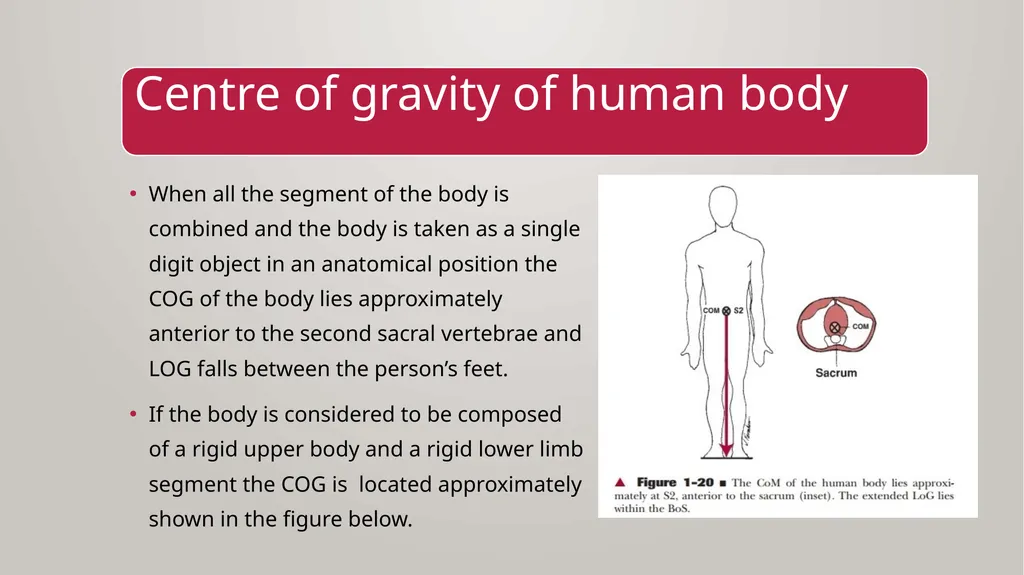
When all the segment of the body is combined and the body is taken as a single digit object in an anatomical position the COG of the body lies approximately anterior to the second sacral vertebrae and LOG falls between the person’s feet.
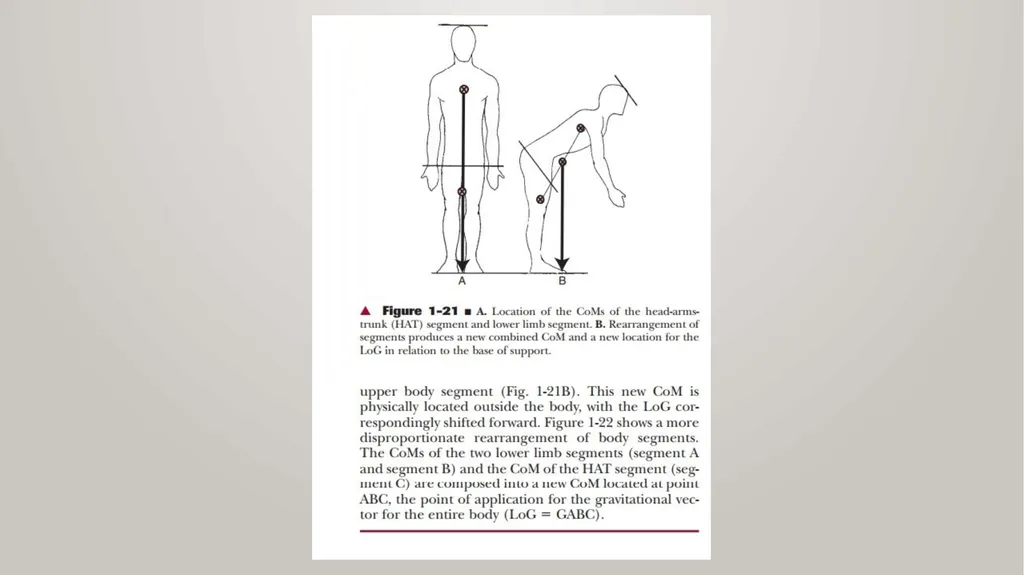
If the body is considered to be composed of a rigid upper body and a rigid lower limb segment the COG is located approximately shown in the figure below.<br>
If the body is considered to be composed of a rigid upper body and a rigid lower limb segment the COG is located approximately shown in the figure below.<br>
23
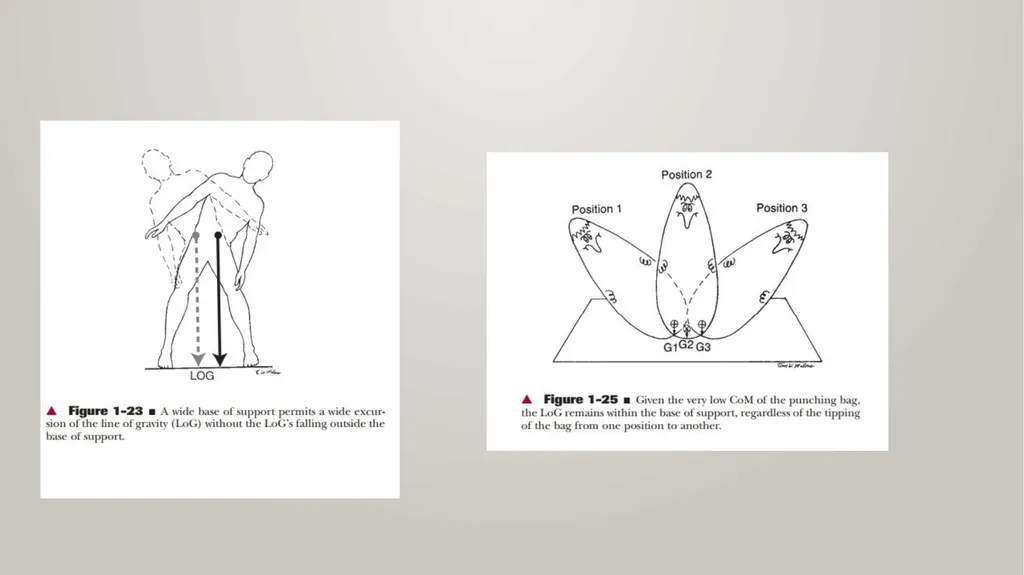
For an object to be stable the LOG must form within the BOS. When the LOG falls outside the base of support the object will fall, when the BOS of the support of the object is large LOG have more freedom to move without passing beyond the limits of BOS.
When a person stands with the legs spread apart the base of support is larger and the trunk can move a good deal in that plane without the displacing the LOG from the BOS
When a person grasps or leans on another object, that object can become part of the BOS.
The longer the LOG means higher the COG, less stable object.
The shorter the LOG means lower the COG, more stable object.<br>
When a person stands with the legs spread apart the base of support is larger and the trunk can move a good deal in that plane without the displacing the LOG from the BOS
When a person grasps or leans on another object, that object can become part of the BOS.
The longer the LOG means higher the COG, less stable object.
The shorter the LOG means lower the COG, more stable object.<br>
24
When stability of an object or the human body is considered-
The larger the BOS of an object the greater the stability of the object
The closer the COG of the object is to the be BOS the most stable the object
An object cannot be stable unless its LOG falls within the BOS.<br>
The larger the BOS of an object the greater the stability of the object
The closer the COG of the object is to the be BOS the most stable the object
An object cannot be stable unless its LOG falls within the BOS.<br>
25
Newton’s law of reaction or Newton’s 3rd law
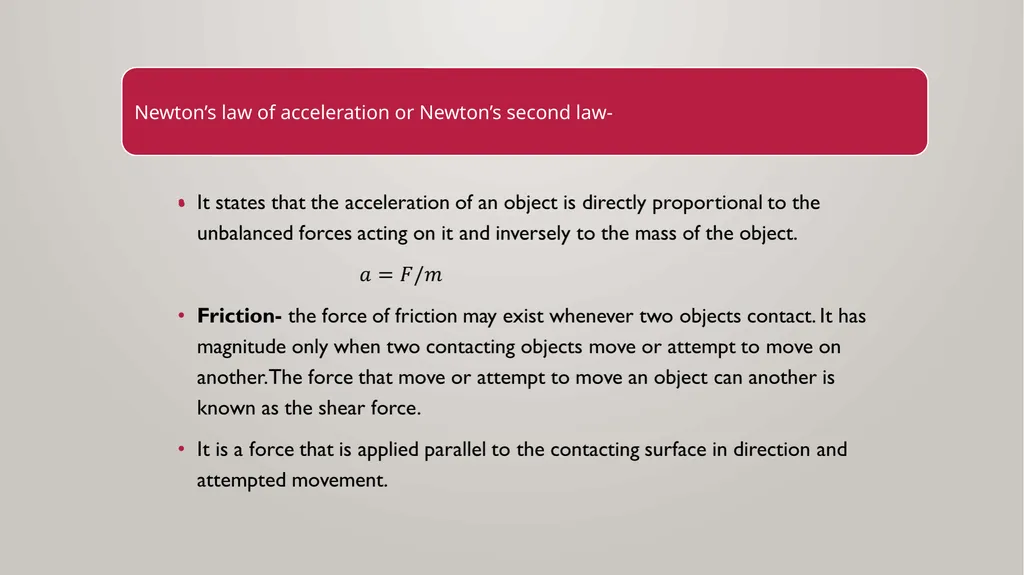
It stated that “for every action there is an equal and opposite reaction” in other words we can say when an object apply the force to the second object the second object must be simultaneously apply a force equal in magnitude and opposite direction to the first object.
These two forces on the two contacting object constitute and interaction pair or action reaction forces.
for example if object A is touching the hand object A must exert a force on the hand and hand also on the object.
Thus, we can say that anything that touches object will exit a force on the object and object on that particular thing.<br>
It stated that “for every action there is an equal and opposite reaction” in other words we can say when an object apply the force to the second object the second object must be simultaneously apply a force equal in magnitude and opposite direction to the first object.
These two forces on the two contacting object constitute and interaction pair or action reaction forces.
for example if object A is touching the hand object A must exert a force on the hand and hand also on the object.
Thus, we can say that anything that touches object will exit a force on the object and object on that particular thing.<br>
26
Newton’s noted this phenomenon and concluded that all the forces come in pair that are equal in magnitude and opposite direction , so this action reaction pair can also be referred as contact forces.
Example a book is resting on a table.
It is important to note that in any interaction pair to the point of application are on different.
The following points must be considered in case of forces on an object
Force on an object are extended by things that touch the object
Gravity exert force on all object
When two object touch they exert a force on each other.<br>
Example a book is resting on a table.
It is important to note that in any interaction pair to the point of application are on different.
The following points must be considered in case of forces on an object
Force on an object are extended by things that touch the object
Gravity exert force on all object
When two object touch they exert a force on each other.<br>
27
This state that an object will remain at rest or in uniform motion unless acted on by an unbalanced force. It is also called as law equilibrium can be restated “for an object to be in equilibrium the sum of all the forces applied to that object must equal to zero” that is ∑F = 0.
Inertia it is a property of an object that resist the both initiation of motion and change in motion.<br>
Inertia it is a property of an object that resist the both initiation of motion and change in motion.<br>
28
A linear for system exist whenever two or more forces acts on the same object and in the same line.
Vector in the same linear force system will overlap if the vector lines are extended.
Vectors that overlap but applied on different object cannot be the part of the linear system.
Linear force system produce translatory motion, the magnitude is given sign using the convention for translatory forces so the force applied up or the right is positive, whereas applied down or to the left are negative.
Resultant of linear for system is determined by finding the arithmetic sum of the magnitude office of the forces in the same force system.<br>
Vector in the same linear force system will overlap if the vector lines are extended.
Vectors that overlap but applied on different object cannot be the part of the linear system.
Linear force system produce translatory motion, the magnitude is given sign using the convention for translatory forces so the force applied up or the right is positive, whereas applied down or to the left are negative.
Resultant of linear for system is determined by finding the arithmetic sum of the magnitude office of the forces in the same force system.<br>
29
A force acting in a direction parallel to the surface or to the planar cross section of the body, as for the example the pressure along the front of an airplane wing.
shear forces often result in shear strain. Resistance to such forces in fluids is linked to it’s viscosity.<br>
shear forces often result in shear strain. Resistance to such forces in fluids is linked to it’s viscosity.<br>
30
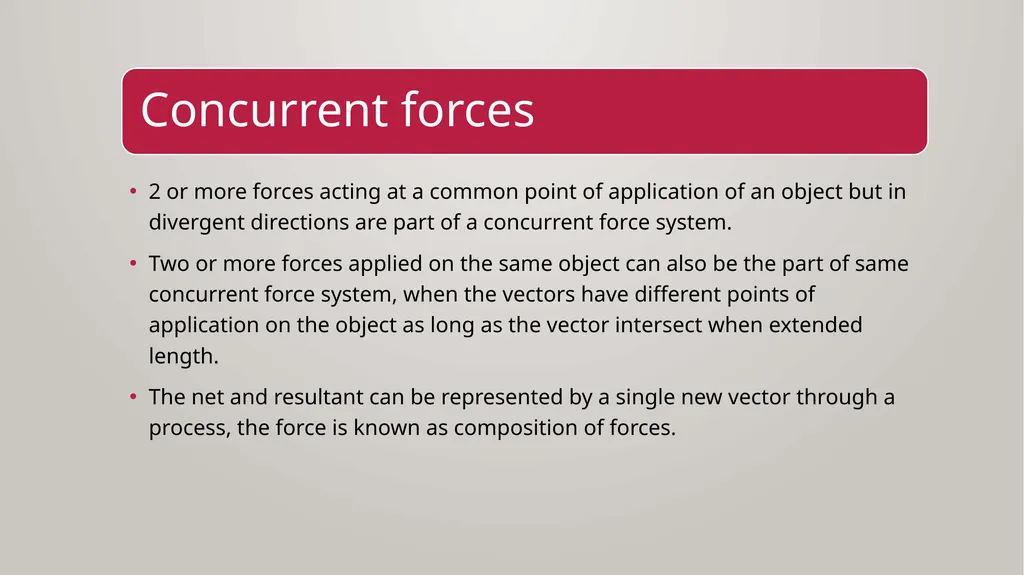
2 or more forces acting at a common point of application of an object but in divergent directions are part of a concurrent force system.
Two or more forces applied on the same object can also be the part of same concurrent force system, when the vectors have different points of application on the object as long as the vector intersect when extended length.
The net and resultant can be represented by a single new vector through a process, the force is known as composition of forces.<br>
Two or more forces applied on the same object can also be the part of same concurrent force system, when the vectors have different points of application on the object as long as the vector intersect when extended length.
The net and resultant can be represented by a single new vector through a process, the force is known as composition of forces.<br>
31
2 men pulling the rock at the right angle to each other<br>
32
The action line of Man on a block AB man B on block BB are in different direction but are commonly applied through the COG of the block.
The net effect or resultant actions of effect of the 2 pull will be in the line that lies between the men which can be shown by the Polygon method . Vector AB and BB are drawn to the scale with the common point of application maintaining the 90 degree angle between them.
Line AB is then drawn parallel to AB from the end of BB, line BB is drawn parallel to BB from the end of AB forming a polygon. The resultant force vector R is always diagonal to the Polygon formed by the original 2 vectors<br>
The net effect or resultant actions of effect of the 2 pull will be in the line that lies between the men which can be shown by the Polygon method . Vector AB and BB are drawn to the scale with the common point of application maintaining the 90 degree angle between them.
Line AB is then drawn parallel to AB from the end of BB, line BB is drawn parallel to BB from the end of AB forming a polygon. The resultant force vector R is always diagonal to the Polygon formed by the original 2 vectors<br>
33
Every muscle pulls on each of its end every time the muscle exert force therefore every muscle creates a minimum of 2 forces vector one on each bone to which muscle is attached .
Movement created by a muscle depends on the net force acting on each of the following levers and not on origin insertion
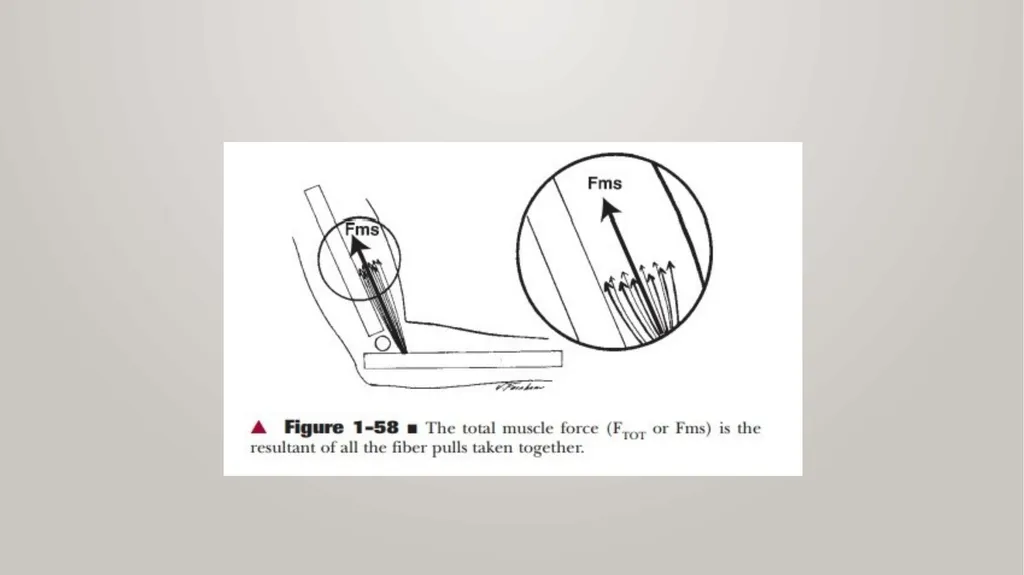
the force applied by a muscle to bone segment is actually the resultant of pool because its muscle fibre can be represented as vector, the fibre taken together for concurrent system with a resultant that is total muscle force vector Fms.
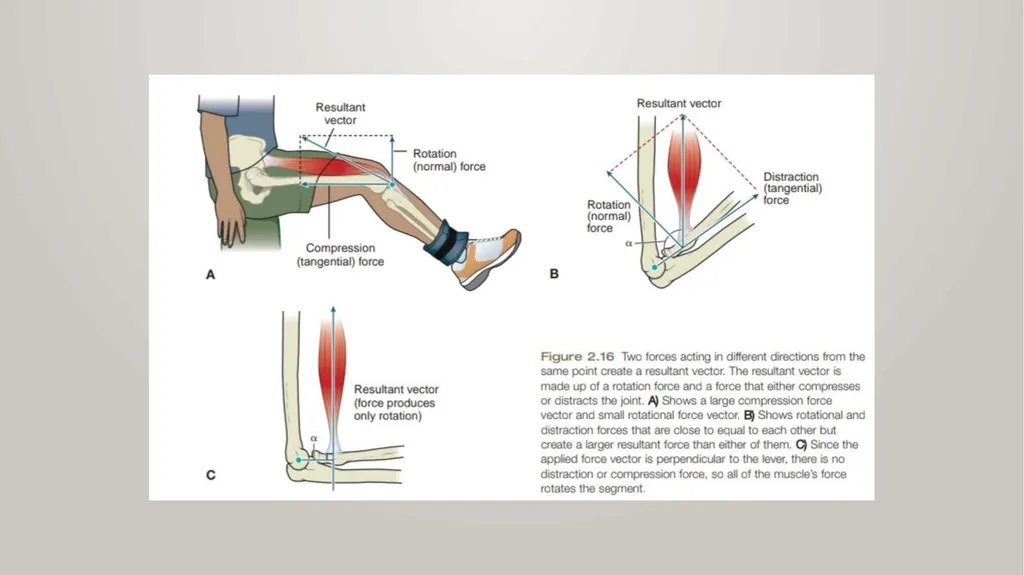
Fms as a point of application at attachment of Muscle and action line that is in the direction of the resultant pull of all the muscle fibres, which is towards the centre of the muscle.<br>
Movement created by a muscle depends on the net force acting on each of the following levers and not on origin insertion
the force applied by a muscle to bone segment is actually the resultant of pool because its muscle fibre can be represented as vector, the fibre taken together for concurrent system with a resultant that is total muscle force vector Fms.
Fms as a point of application at attachment of Muscle and action line that is in the direction of the resultant pull of all the muscle fibres, which is towards the centre of the muscle.<br>
34
THANKYOU<br>