BIOMEDICAL WASTE MANAGEMENT PRESENTED BY: PROF.,DR. TUKARAM B. ZAGADE M.SC. PhD N. PGDMLS KRISHNA INSTITUTE OF NURSING SCIENCES KVVDU, KARAD BIOMEDICAL HEALTH CARE WASTE IS RISK FOR ALL ALL PTS, VISITORS, MEDICAL STAFF, HEALTH WORKERS,
"BIOMEDICAL WASTE MANAGEMENT PRESENTED BY:" is the property of its rightful owner. Permission is granted to
download and print the materials on this website for personal, non-commercial use only, and to display it
on your personal computer provided you do not modify the materials and that you retain all copyright
notices contained in the materials. By downloading content from our website, you accept the terms of this
agreement.
Presentation Transcript
01
BIOMEDICAL WASTE MANAGEMENT PRESENTED BY:
PROF.,DR. TUKARAM B. ZAGADE M.SC. PhD N. PGDMLS
KRISHNA INSTITUTE OF NURSING SCIENCES
KVVDU, KARAD<br>
02
BIOMEDICAL / HEALTH CARE WASTE IS RISK FOR ALL ALL PTS, VISITORS, MEDICAL STAFF, HEALTH WORKERS, WASTE PICKERS, ALL RURAL& URBAN PUBLIC, BMW GENERATORS, BMWM OPERATORS BMW AFFECTS US IN DIFFERENT WAYS- 1. AIR,WATER, SOIL POLLUTION 2. INFECTIONS LIKE HIV/AIDS, TB,HEPATITIS, TETANUS AND HOSPITAL AQUIRED INFECTIONS 3. UNTREATED HOSPITAL WASTE WATER/LIQUID 4. RAGPICKERS AND ANIMALS.<br>
03
Let the waste of the “sick” not contaminate the lives of “The Healthy” K.PARK<br>
04
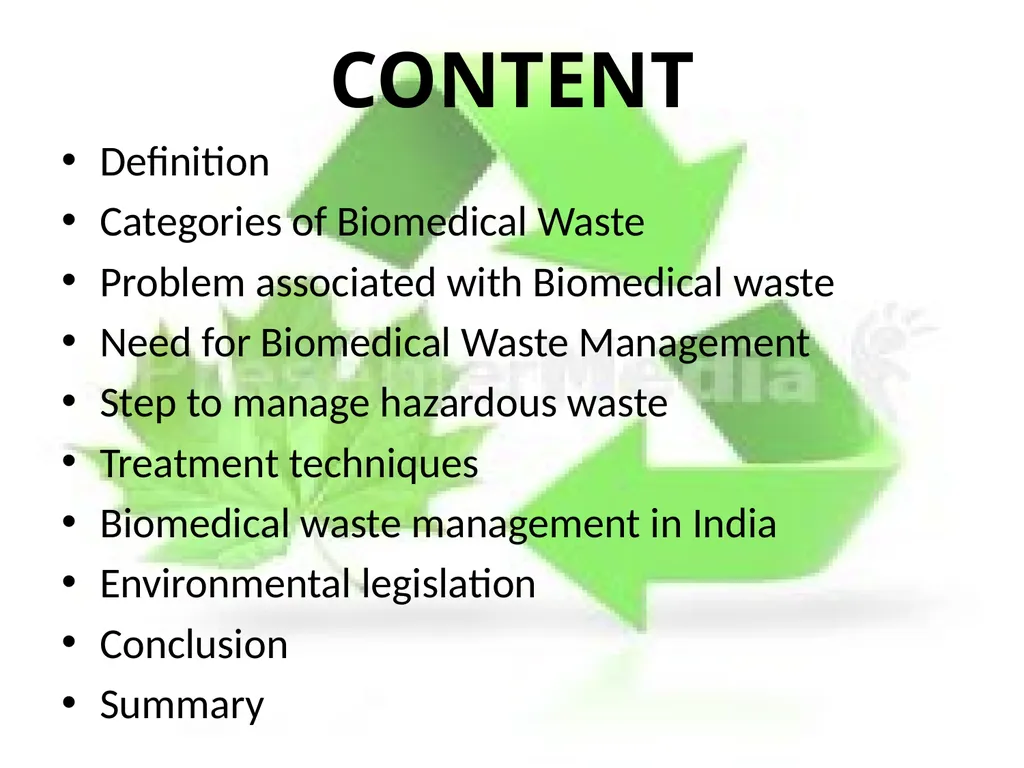
CONTENT Definition
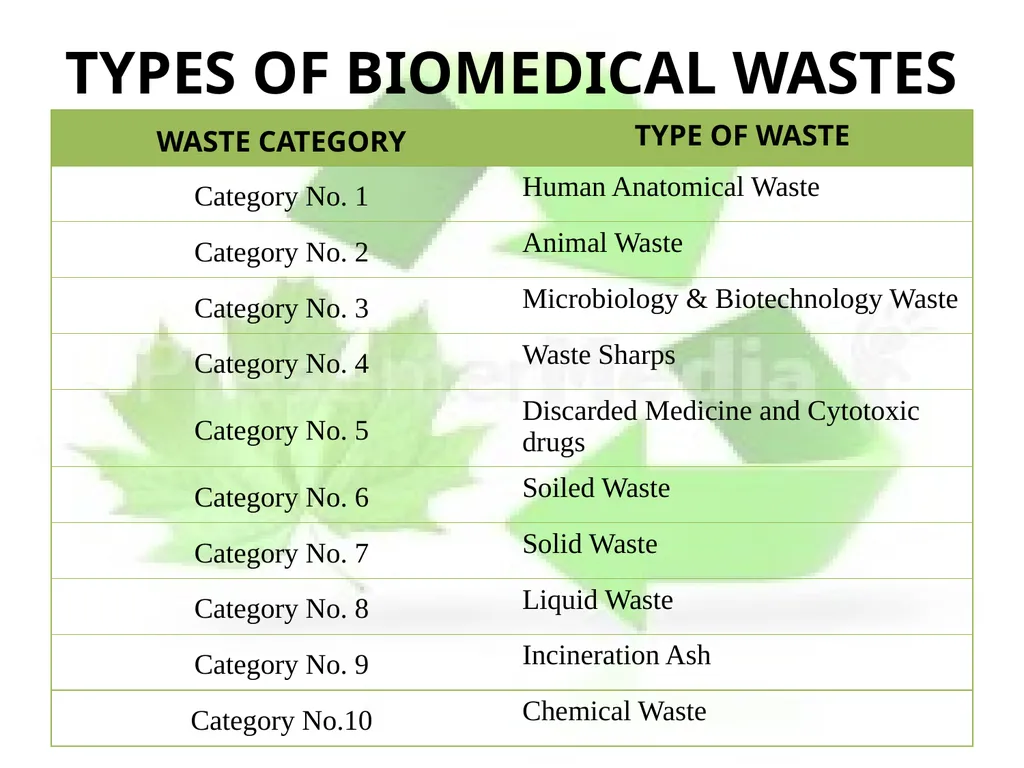
Categories of Biomedical Waste
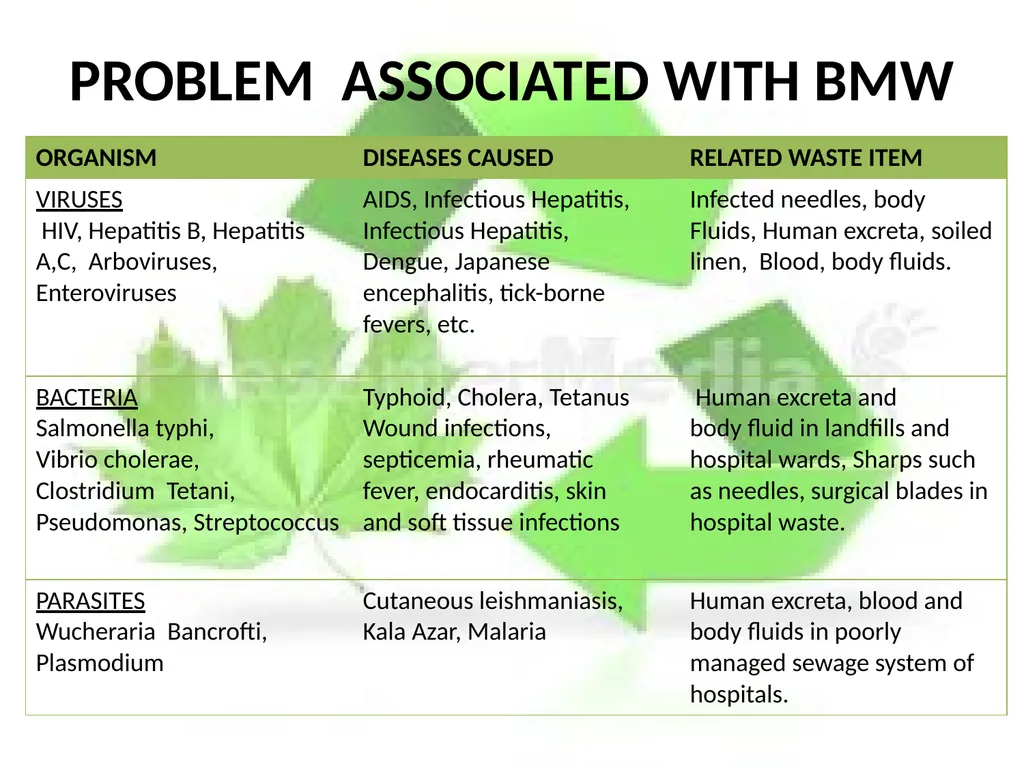
Problem associated with Biomedical waste
Need for Biomedical Waste Management
Step to manage hazardous waste
Treatment techniques
Biomedical waste management in India
Environmental legislation
Conclusion
Summary<br>
05
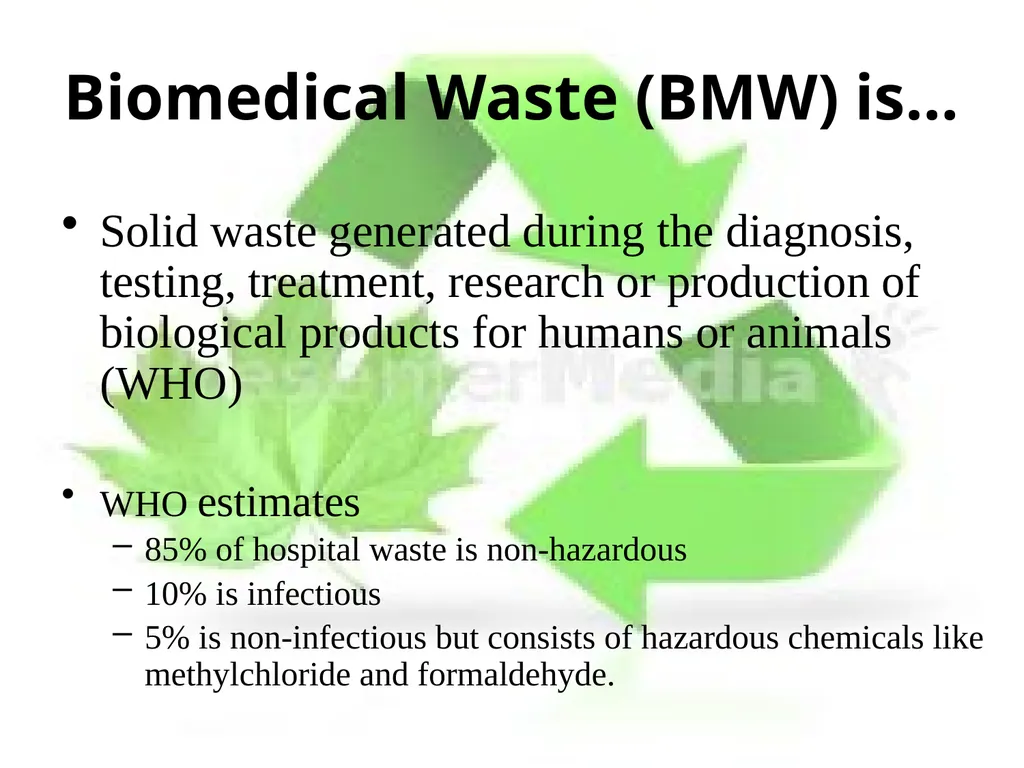
Biomedical Waste (BMW) is… Solid waste generated during the diagnosis, testing, treatment, research or production of biological products for humans or animals (WHO)
WHO estimates
85% of hospital waste is non-hazardous
10% is infectious
5% is non-infectious but consists of hazardous chemicals like methylchloride and formaldehyde.<br>
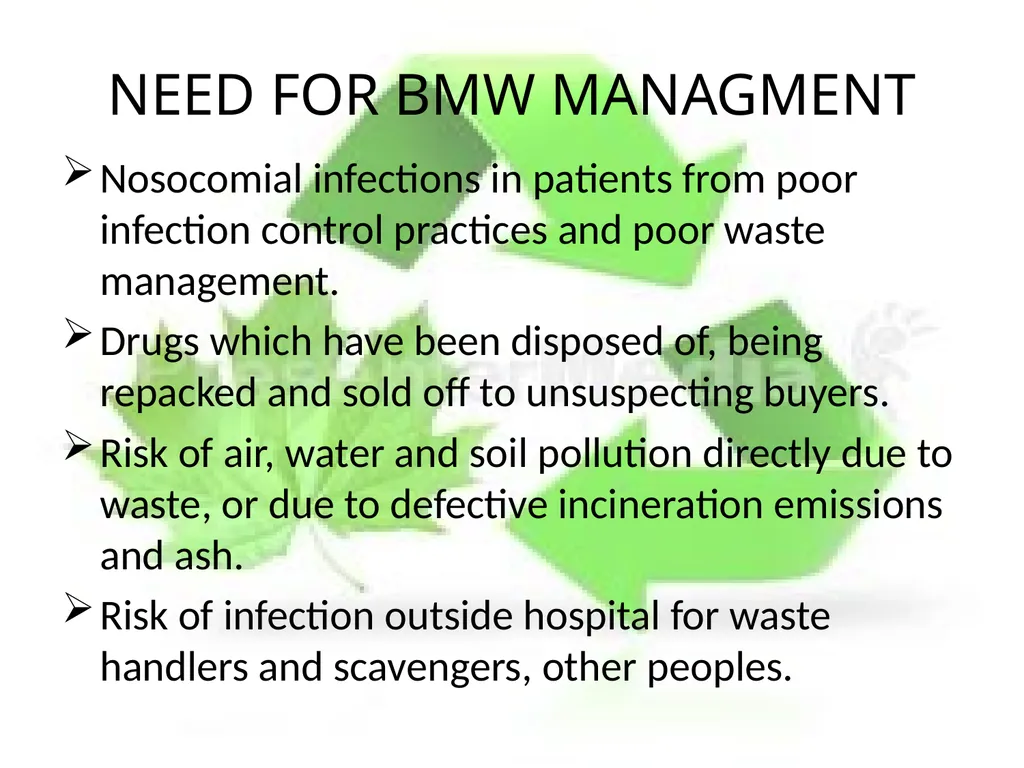
NEED FOR BMW MANAGMENT Nosocomial infections in patients from poor infection control practices and poor waste management.
Drugs which have been disposed of, being repacked and sold off to unsuspecting buyers.
Risk of air, water and soil pollution directly due to waste, or due to defective incineration emissions and ash.
Risk of infection outside hospital for waste handlers and scavengers, other peoples.<br>
10
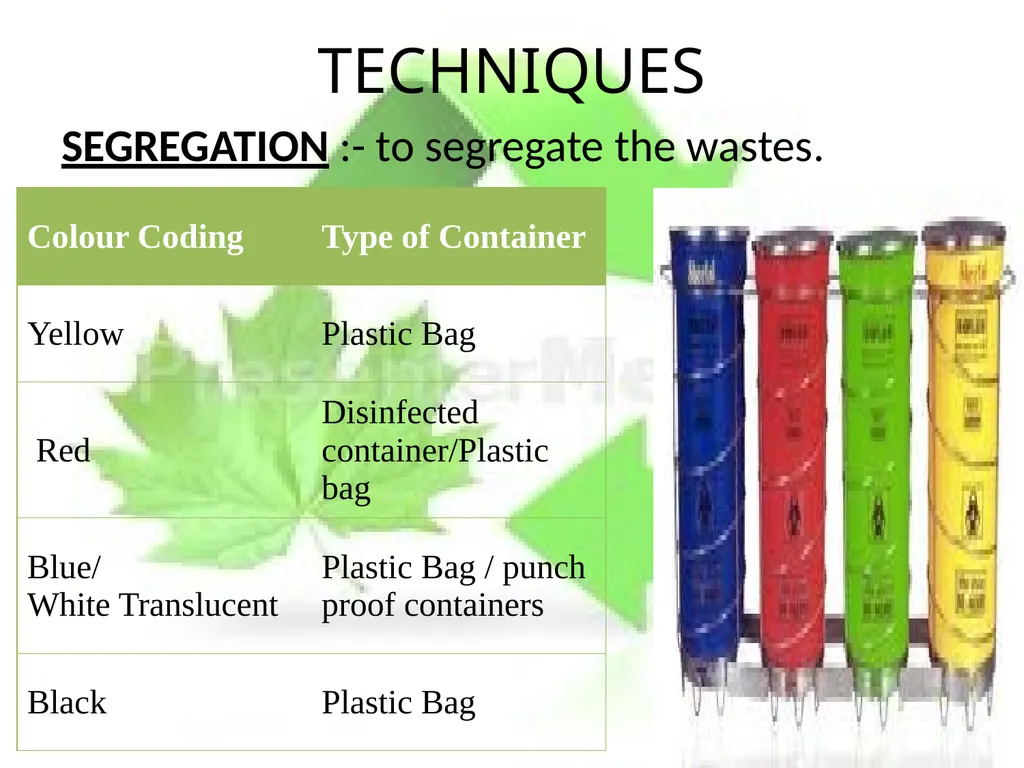
TECHNIQUES SEGREGATION :- to segregate the wastes.<br>
11
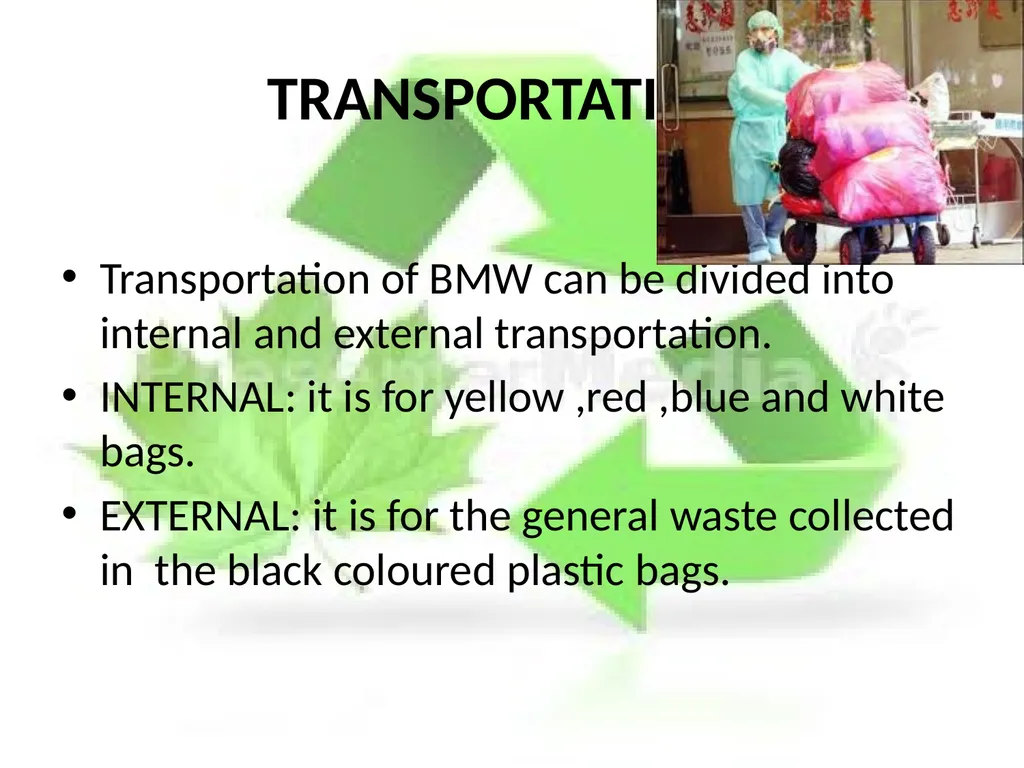
TRANSPORTATION Transportation of BMW can be divided into internal and external transportation.
INTERNAL: it is for yellow ,red ,blue and white bags.
EXTERNAL: it is for the general waste collected in the black coloured plastic bags.<br>
12
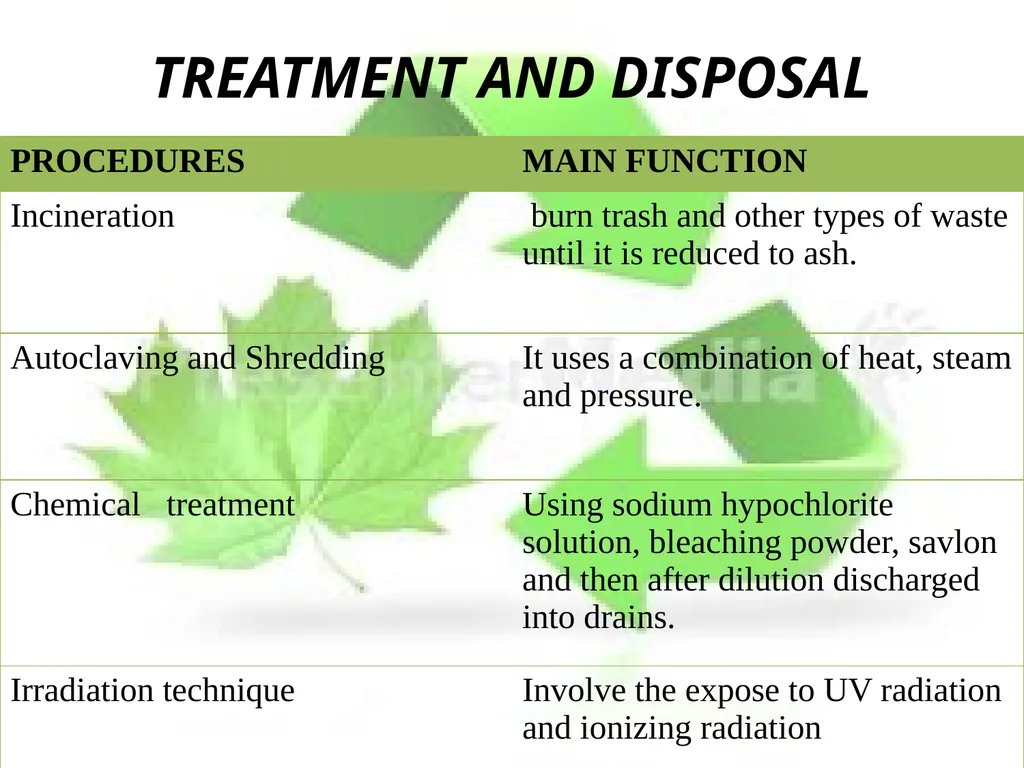
TREATMENT AND DISPOSAL<br>
13
Bio medical waste management in India Biomedical waste (management and handling) rule 1998, prescribed by The Ministry of Environment and Forests, Govt of India, came into force on 20th July 1998.
This rule applies to those who generate, collect, receive, store, dispose, treat or handle bio medical waste in any manner.
Thus bio medical waste should be segregated into containers/bags at the point of generation of waste. Thus Colour Coding & type of containers used for disposal of waste is came into existence which is shown as follows. 13<br>
14
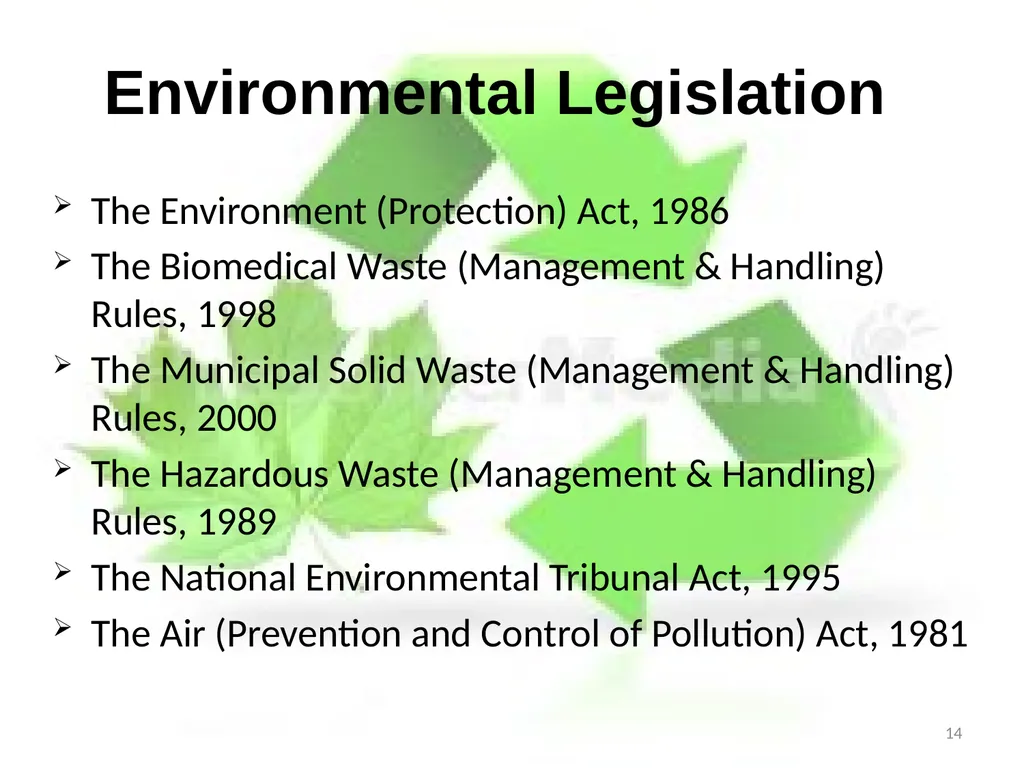
14 Environmental Legislation The Environment (Protection) Act, 1986
The Biomedical Waste (Management & Handling) Rules, 1998
The Municipal Solid Waste (Management & Handling) Rules, 2000
The Hazardous Waste (Management & Handling) Rules, 1989
The National Environmental Tribunal Act, 1995
The Air (Prevention and Control of Pollution) Act, 1981<br>
15
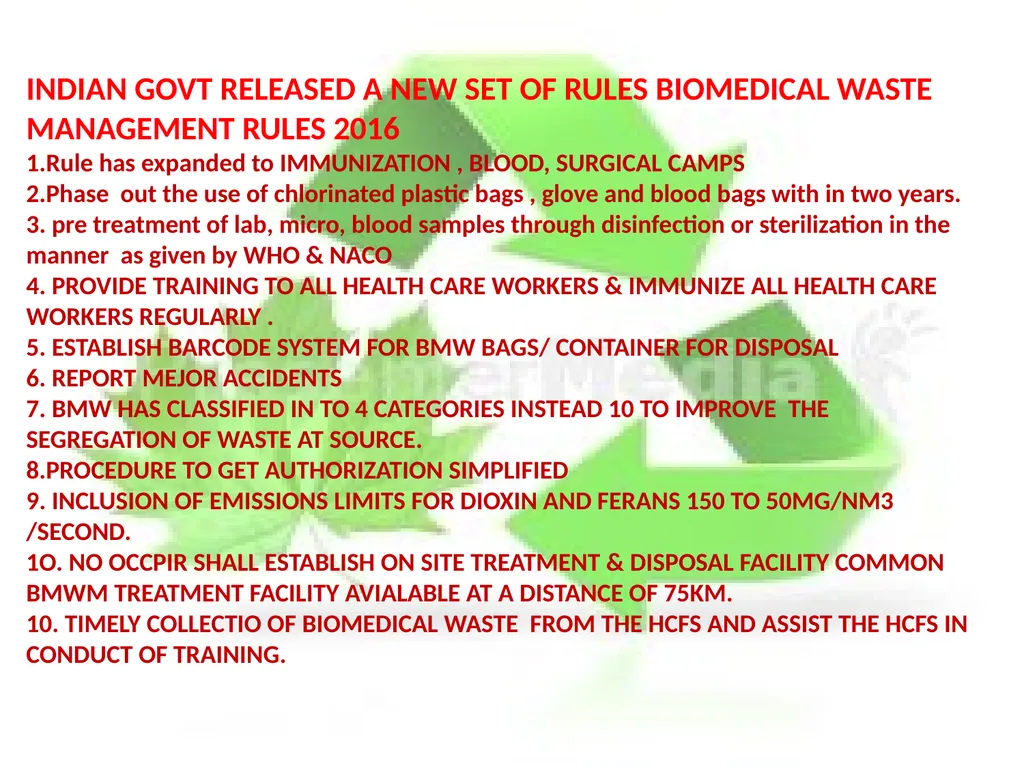
INDIAN GOVT RELEASED A NEW SET OF RULES BIOMEDICAL WASTE MANAGEMENT RULES 2016 1.Rule has expanded to IMMUNIZATION , BLOOD, SURGICAL CAMPS 2.Phase out the use of chlorinated plastic bags , glove and blood bags with in two years. 3. pre treatment of lab, micro, blood samples through disinfection or sterilization in the manner as given by WHO & NACO 4. PROVIDE TRAINING TO ALL HEALTH CARE WORKERS & IMMUNIZE ALL HEALTH CARE WORKERS REGULARLY . 5. ESTABLISH BARCODE SYSTEM FOR BMW BAGS/ CONTAINER FOR DISPOSAL 6. REPORT MEJOR ACCIDENTS 7. BMW HAS CLASSIFIED IN TO 4 CATEGORIES INSTEAD 10 TO IMPROVE THE SEGREGATION OF WASTE AT SOURCE. 8.PROCEDURE TO GET AUTHORIZATION SIMPLIFIED 9. INCLUSION OF EMISSIONS LIMITS FOR DIOXIN AND FERANS 150 TO 50MG/NM3 /SECOND. 1O. NO OCCPIR SHALL ESTABLISH ON SITE TREATMENT & DISPOSAL FACILITY COMMON BMWM TREATMENT FACILITY AVIALABLE AT A DISTANCE OF 75KM. 10. TIMELY COLLECTIO OF BIOMEDICAL WASTE FROM THE HCFS AND ASSIST THE HCFS IN CONDUCT OF TRAINING.<br>
16
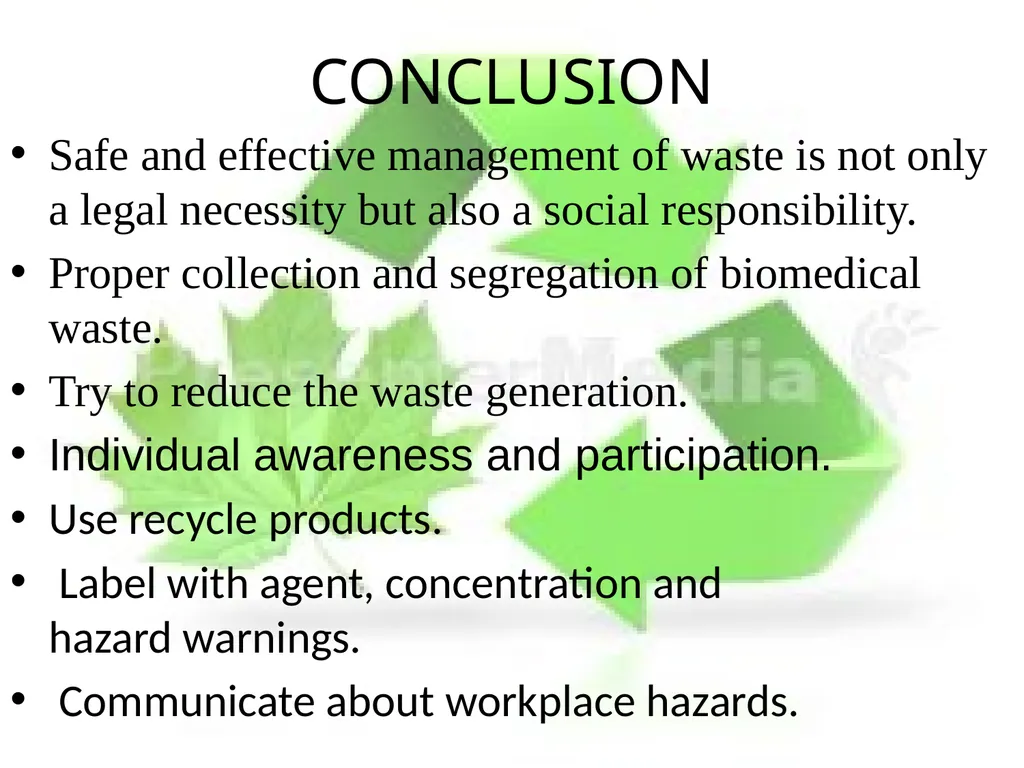
CONCLUSION Safe and effective management of waste is not only a legal necessity but also a social responsibility.
Proper collection and segregation of biomedical waste.
Try to reduce the waste generation.
Individual awareness and participation.
Use recycle products.
Label with agent, concentration and hazard warnings.
Communicate about workplace hazards.<br>