Biosecurity General Biosecurity Concepts Adapted
Description: Biosecurity General Biosecurity Concepts Adapted from the FAD PRePNAHEMS Guidelines: Biosecurity (2016) Importance of biosecurity Routes of exposure to disease Steps in developing a biosecurity plan Introduction to 3 levels of biosecurity
Related Topics
Download Presentation
"Biosecurity General Biosecurity Concepts Adapted" is the property of its rightful owner. Permission is granted to download and print the materials on this website for personal, non-commercial use only, and to display it on your personal computer provided you do not modify the materials and that you retain all copyright notices contained in the materials. By downloading content from our website, you accept the terms of this agreement.
Presentation Transcript
slide1. Biosecurity General Biosecurity Concepts Adapted from the FAD PReP/NAHEMS Guidelines: Biosecurity (2016)<br>
slide2. Importance of biosecurity
Routes of exposure to disease
Steps in developing a biosecurity plan
Introduction to 3 levels of biosecurity
Conceptual
Structural
Operational USDA APHIS and CFSPH FAD PReP/NAHEMS Guidelines: Biosecurity - Concepts This Presentation<br>
slide3. Collection of management practices
Prevent introduction/spread of disease
Routine and emergency measures
Avert severe, negative impacts of a foreign animal disease (FAD)
Strategic decisions and adequate investment in management practices USDA APHIS and CFSPH FAD PReP/NAHEMS Guidelines: Biosecurity - Concepts Importance of Biosecurity<br>
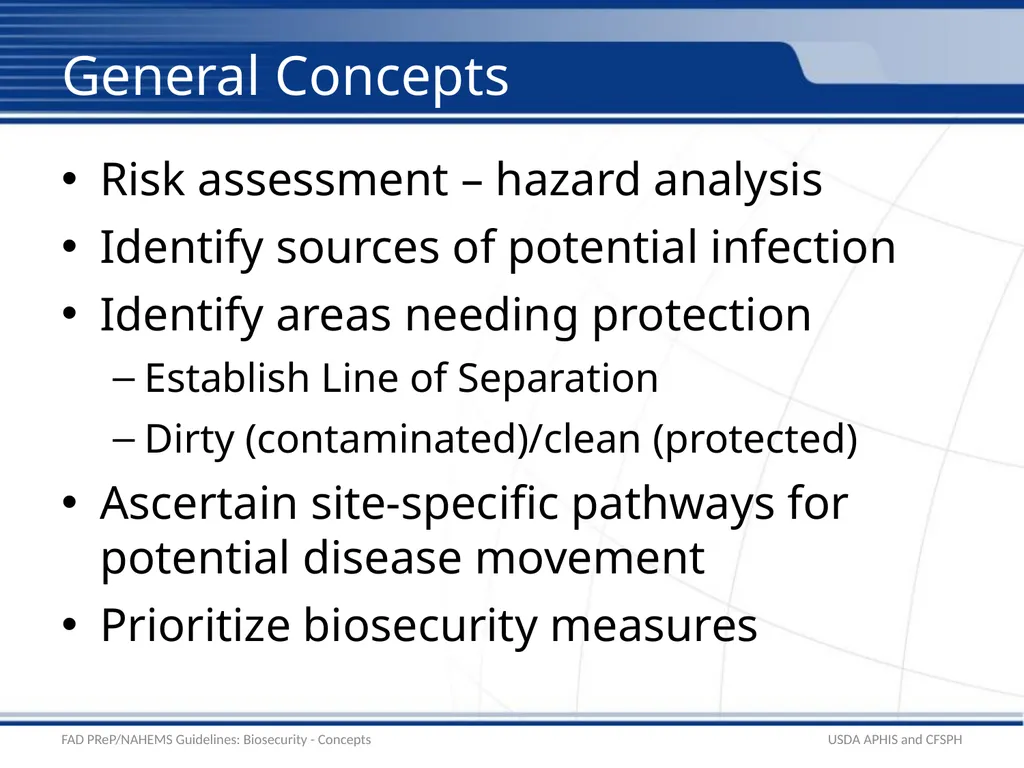
slide4. Risk assessment – hazard analysis
Identify sources of potential infection
Identify areas needing protection
Establish Line of Separation
Dirty (contaminated)/clean (protected)
Ascertain site-specific pathways for potential disease movement
Prioritize biosecurity measures USDA APHIS and CFSPH FAD PReP/NAHEMS Guidelines: Biosecurity - Concepts General Concepts<br>
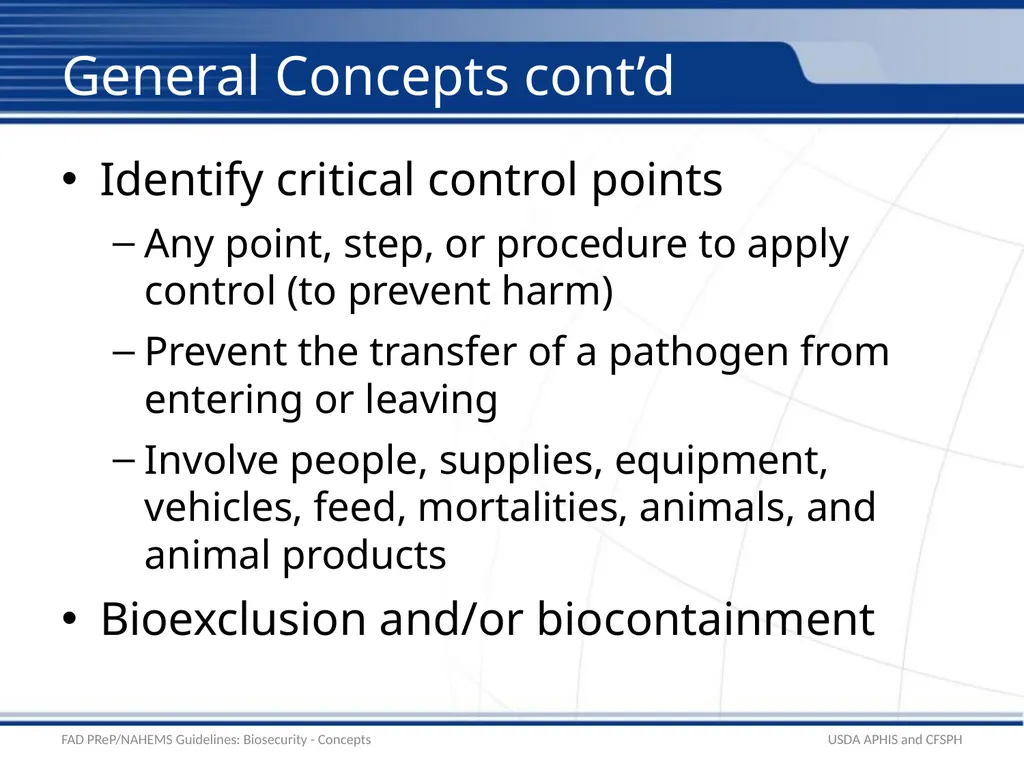
slide5. Identify critical control points
Any point, step, or procedure to apply control (to prevent harm)
Prevent the transfer of a pathogen from entering or leaving
Involve people, supplies, equipment, vehicles, feed, mortalities, animals, and animal products
Bioexclusion and/or biocontainment USDA APHIS and CFSPH FAD PReP/NAHEMS Guidelines: Biosecurity - Concepts General Concepts cont’d<br>
slide6. Routes of Exposure to Disease USDA APHIS and CFSPH FAD PReP/NAHEMS Guidelines: Biosecurity - Concepts<br>
slide7. Direct Contact
Direct transfer
Skin, mucous membranes, and open wounds
Rubbing, biting, licking, or contact with body fluids (nose-to-nose)
Aerosol
Inhalation
Infectious droplets USDA APHIS and CFSPH FAD PReP/NAHEMS Guidelines: Biosecurity - Concepts Exposure – Direct, Aerosol<br>
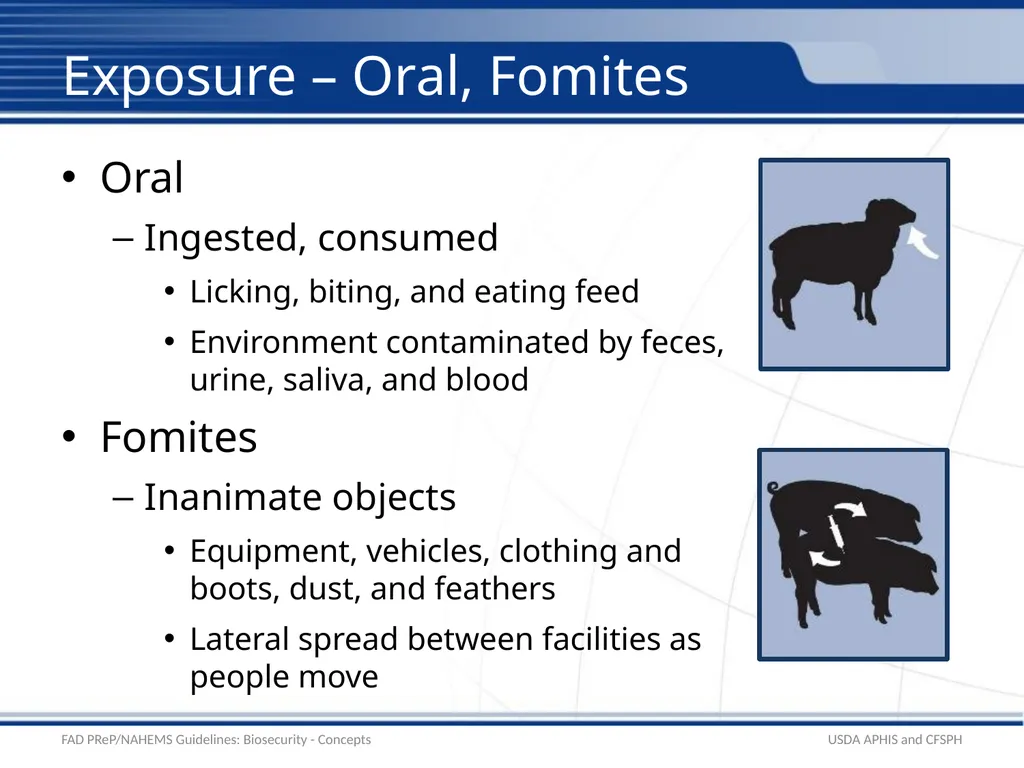
slide8. Oral
Ingested, consumed
Licking, biting, and eating feed
Environment contaminated by feces, urine, saliva, and blood
Fomites
Inanimate objects
Equipment, vehicles, clothing and boots, dust, and feathers
Lateral spread between facilities as people move USDA APHIS and CFSPH FAD PReP/NAHEMS Guidelines: Biosecurity - Concepts Exposure – Oral, Fomites<br>
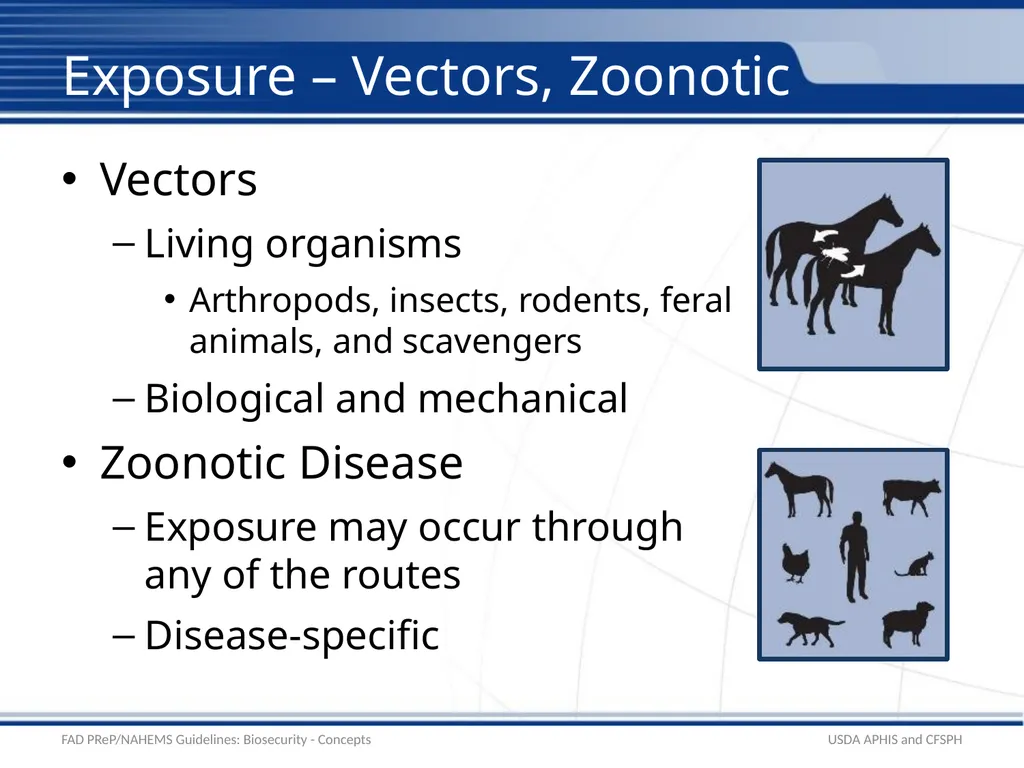
slide9. Vectors
Living organisms
Arthropods, insects, rodents, feral animals, and scavengers
Biological and mechanical
Zoonotic Disease
Exposure may occur through any of the routes
Disease-specific USDA APHIS and CFSPH FAD PReP/NAHEMS Guidelines: Biosecurity - Concepts Exposure – Vectors, Zoonotic<br>
slide10. Developing a Biosecurity Plan USDA APHIS and CFSPH FAD PReP/NAHEMS Guidelines: Biosecurity - Concepts<br>
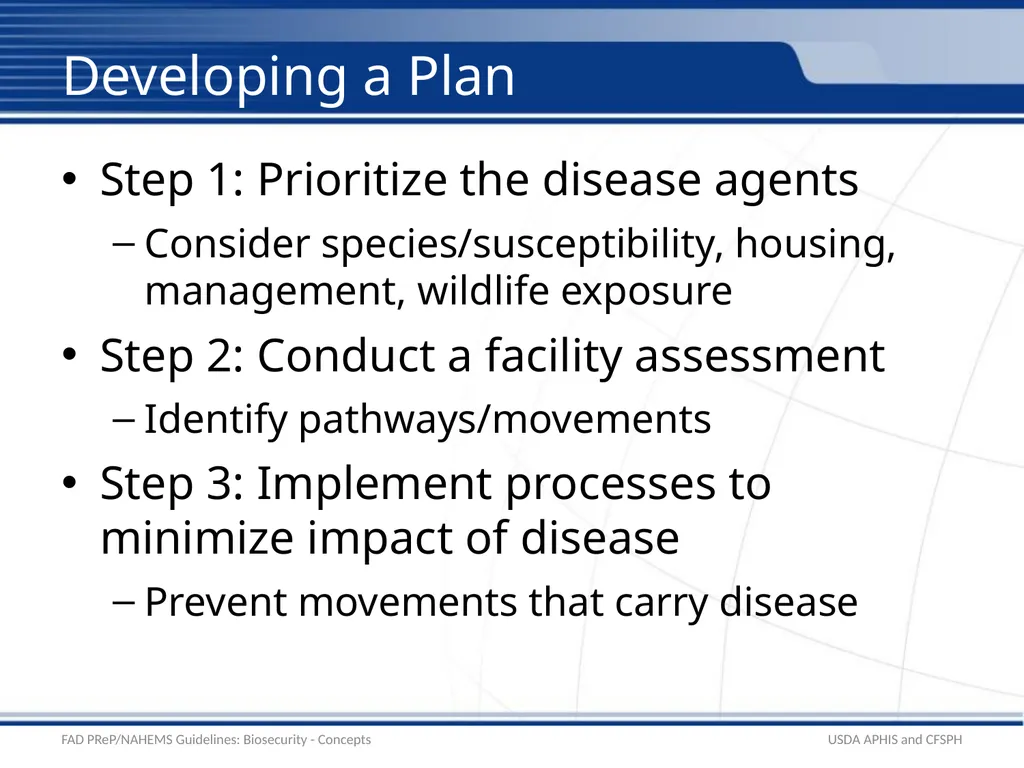
slide11. Step 1: Prioritize the disease agents
Consider species/susceptibility, housing, management, wildlife exposure
Step 2: Conduct a facility assessment
Identify pathways/movements
Step 3: Implement processes to minimize impact of disease
Prevent movements that carry disease USDA APHIS and CFSPH FAD PReP/NAHEMS Guidelines: Biosecurity - Concepts Developing a Plan<br>
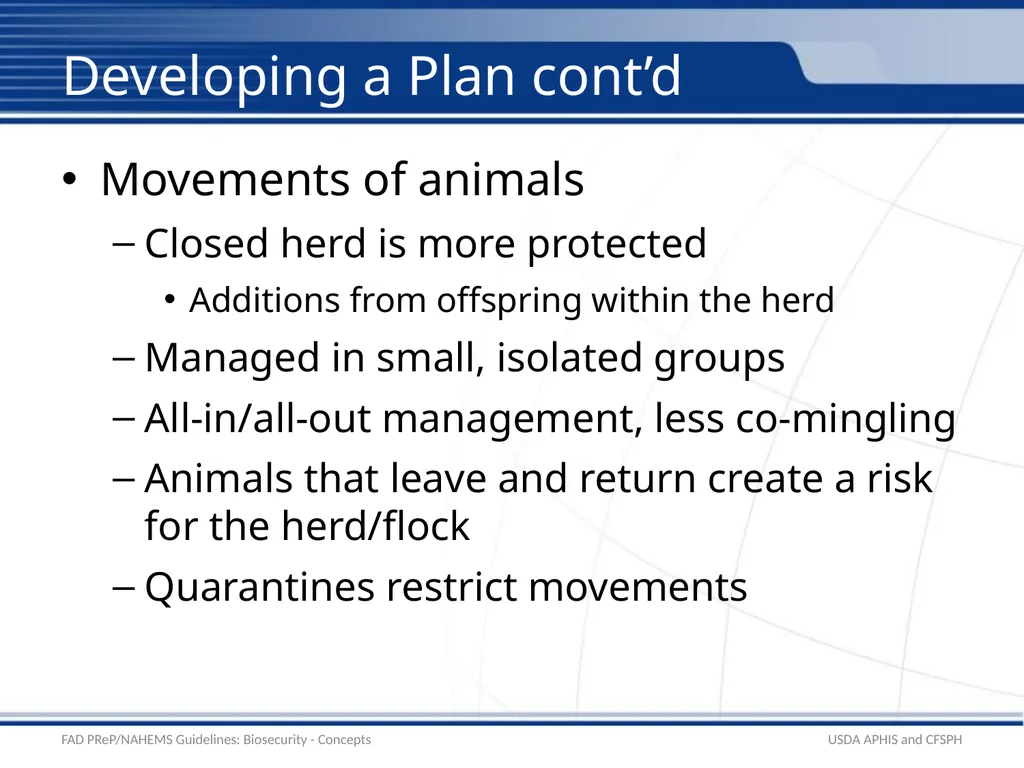
slide12. Movements of animals
Closed herd is more protected
Additions from offspring within the herd
Managed in small, isolated groups
All-in/all-out management, less co-mingling
Animals that leave and return create a risk for the herd/flock
Quarantines restrict movements USDA APHIS and CFSPH FAD PReP/NAHEMS Guidelines: Biosecurity - Concepts Developing a Plan cont’d<br>
slide13. Levels of Biosecurity - Preventing Exposure to Disease USDA APHIS and CFSPH FAD PReP/NAHEMS Guidelines: Biosecurity - Concepts<br>
slide14. Producers are responsible
Effective day-to-day procedures
Biosecurity is an investment
Protocols are specific
Species/mixture of species
Diseases, susceptibility to disease
Intended purpose, economic value
Practicality, facility lay-out USDA APHIS and CFSPH FAD PReP/NAHEMS Guidelines: Biosecurity - Concepts Prevent Exposure to Disease<br>
slide15. Farm density
Animal movement
Traffic on and off the premises
Human activity
Equipment sharing
Access by wildlife
Housing difficult to clean
Mortality disposal near animal housing USDA APHIS and CFSPH FAD PReP/NAHEMS Guidelines: Biosecurity - Concepts Increased Risk of Exposure<br>
slide16. Conceptual
Location, geospatial siting, orientation of the facility
Structural
Capital investment, construction, to prevent disease spread
Operational
Processes, management practices, standard operating procedures to exclude or contain disease USDA APHIS and CFSPH FAD PReP/NAHEMS Guidelines: Biosecurity - Concepts Three Levels of Biosecurity<br>
slide17. Facility location, geospatial siting, orientation, scope, size
Higher risk
Greater farm density, close to wildlife areas, large groups managed as one population
Best practices
Separation, isolation
Small biosecure units
Distance to wildlife habitats and roads USDA APHIS and CFSPH FAD PReP/NAHEMS Guidelines: Biosecurity - Concepts Conceptual Biosecurity<br>
slide18. Evaluate existing facility
Mitigate/compensate for vulnerabilities:
Eliminate (make less attractive) wildlife habitat
Reroute traffic away from animal areas
Create smaller biosecure groups USDA APHIS and CFSPH FAD PReP/NAHEMS Guidelines: Biosecurity - Concepts Conceptual Biosecurity cont’d<br>
slide19. Construction, capital investment
Physical design and maintenance
Paved parking away from barns
Fences, barriers leading to entrances to conduct biosecurity protocols
Locations for cleaning/disinfecting
On-site laundry for outerwear
Specialized anteroom at entry USDA APHIS and CFSPH FAD PReP/NAHEMS Guidelines: Biosecurity - Concepts Structural Biosecurity<br>
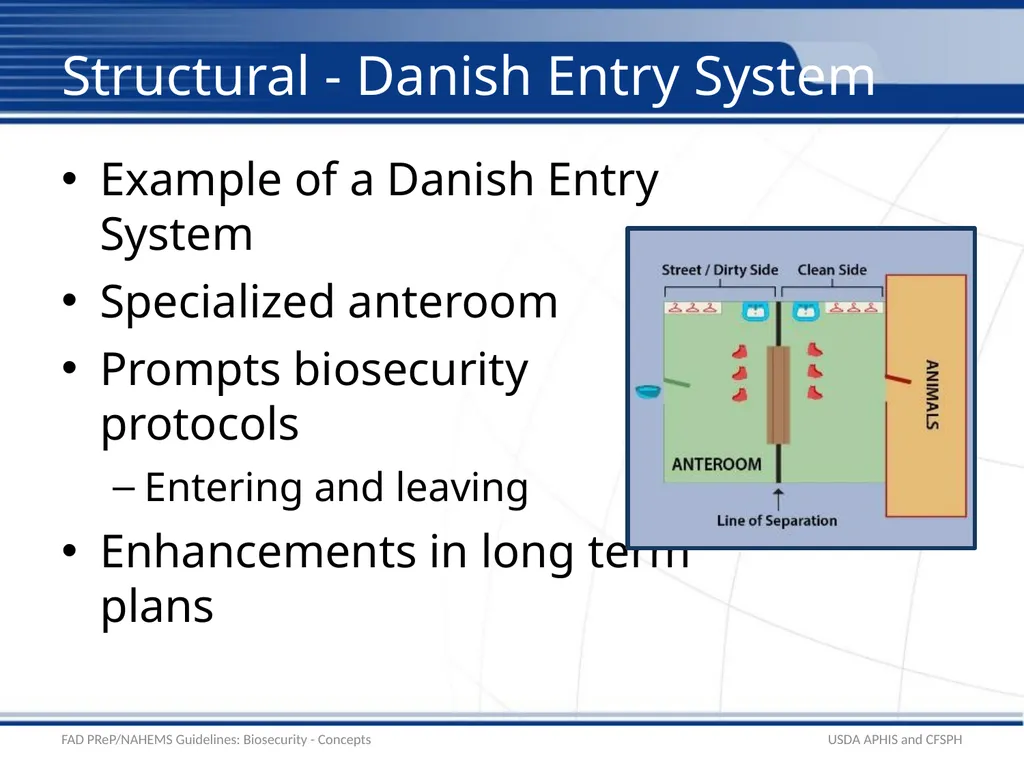
slide20. Example of a Danish Entry System
Specialized anteroom
Prompts biosecurity protocols
Entering and leaving
Enhancements in long term plans USDA APHIS and CFSPH FAD PReP/NAHEMS Guidelines: Biosecurity - Concepts Structural - Danish Entry System<br>
slide21. Processes, management practices, standard operating procedures to exclude or contain disease
On-farm movements and managements
People, animals, supplies, equipment, vehicles, and other items
Based on specific risk assessments
Mitigation of conceptual and structural vulnerabilities, and known disease USDA APHIS and CFSPH FAD PReP/NAHEMS Guidelines: Biosecurity - Concepts Operational Biosecurity<br>
slide22. Apply strategic actions at critical control points
Focus on inputs and outputs
Entrances and exits
Work paths
Processes
Clearly identify separation of clean/dirty USDA APHIS and CFSPH FAD PReP/NAHEMS Guidelines: Biosecurity - Concepts Operational Biosecurity cont’d<br>
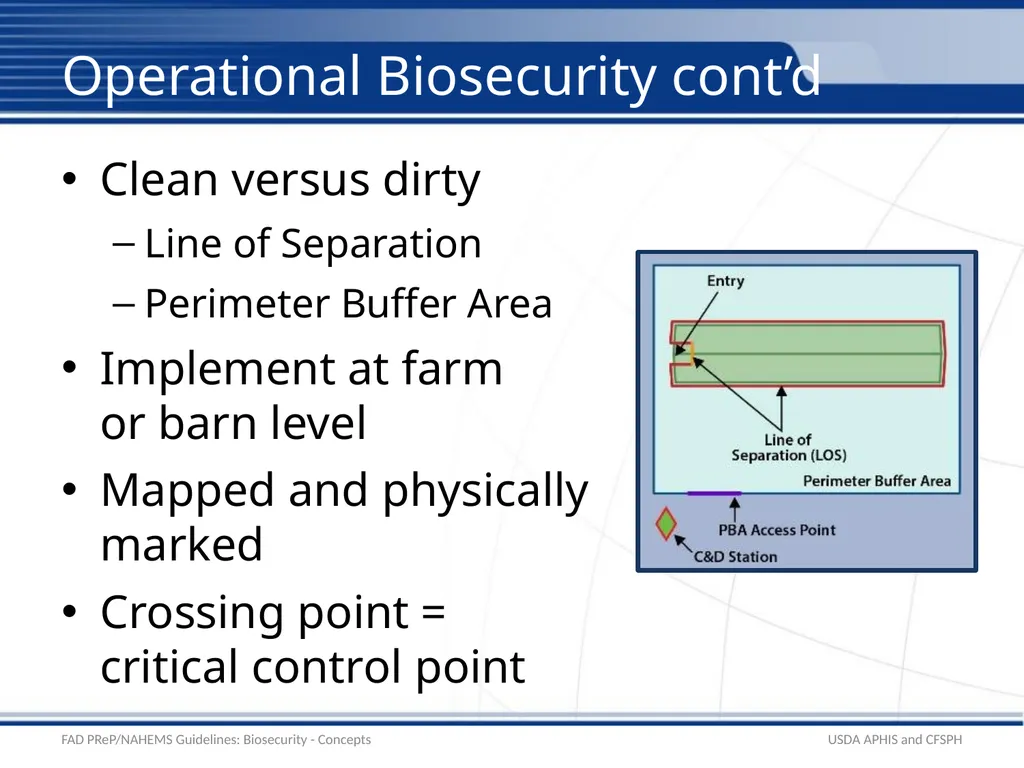
slide23. Clean versus dirty
Line of Separation
Perimeter Buffer Area
Implement at farm or barn level
Mapped and physically marked
Crossing point = critical control point USDA APHIS and CFSPH FAD PReP/NAHEMS Guidelines: Biosecurity - Concepts Operational Biosecurity cont’d<br>
slide24. Cleaning/disinfection and biosecurity attire/PPE
People, equipment, vehicles
Vectors
Carcass disposal
Manure/litter management
Water sources
Delivery/storage of feed and bedding
Maintenance and security USDA APHIS and CFSPH FAD PReP/NAHEMS Guidelines: Biosecurity - Concepts Operational Biosecurity cont’d<br>
slide25. Biosecurity protects animal health
Develop a site-specific biosecurity plan
Consider disease characteristics such as routes of exposure
Incorporate 3 levels of biosecurity: conceptual, structural, operational USDA APHIS and CFSPH FAD PReP/NAHEMS Guidelines: Biosecurity - Concepts Conclusion<br>
slide26. USDA APHIS and CFSPH FAD PReP/NAHEMS Guidelines: Biosecurity - Concepts For More Information FAD PReP/NAHEMS Guidelines & SOP: Biosecurity (2016)
http://www.aphis.usda.gov/fadprep
Biosecurity web-based training module: http://naherc.sws.iastate.edu/<br>
slide27. Authors (CFSPH)
Janice P. Mogan, DVM
Heather Allen, PhD, MPA
Kristen Bretz, MS
Reviewers (USDA)
Jonathan T. Zack, DVM
James A. Roth, DVM, PhD, DACVM USDA APHIS and CFSPH FAD PReP/NAHEMS Guidelines: Biosecurity - Concepts Guidelines Content<br>
slide28. Acknowledgments Development of this presentation was by the Center for Food Security and Public Health at Iowa State University through funding from the USDA APHIS Veterinary Services PPT Authors: Janice P. Mogan, DVM; Logan Kilburn Reviewer: Kristen Bretz, MS<br>
slide2. Importance of biosecurity
Routes of exposure to disease
Steps in developing a biosecurity plan
Introduction to 3 levels of biosecurity
Conceptual
Structural
Operational USDA APHIS and CFSPH FAD PReP/NAHEMS Guidelines: Biosecurity - Concepts This Presentation<br>
slide3. Collection of management practices
Prevent introduction/spread of disease
Routine and emergency measures
Avert severe, negative impacts of a foreign animal disease (FAD)
Strategic decisions and adequate investment in management practices USDA APHIS and CFSPH FAD PReP/NAHEMS Guidelines: Biosecurity - Concepts Importance of Biosecurity<br>
slide4. Risk assessment – hazard analysis
Identify sources of potential infection
Identify areas needing protection
Establish Line of Separation
Dirty (contaminated)/clean (protected)
Ascertain site-specific pathways for potential disease movement
Prioritize biosecurity measures USDA APHIS and CFSPH FAD PReP/NAHEMS Guidelines: Biosecurity - Concepts General Concepts<br>
slide5. Identify critical control points
Any point, step, or procedure to apply control (to prevent harm)
Prevent the transfer of a pathogen from entering or leaving
Involve people, supplies, equipment, vehicles, feed, mortalities, animals, and animal products
Bioexclusion and/or biocontainment USDA APHIS and CFSPH FAD PReP/NAHEMS Guidelines: Biosecurity - Concepts General Concepts cont’d<br>
slide6. Routes of Exposure to Disease USDA APHIS and CFSPH FAD PReP/NAHEMS Guidelines: Biosecurity - Concepts<br>
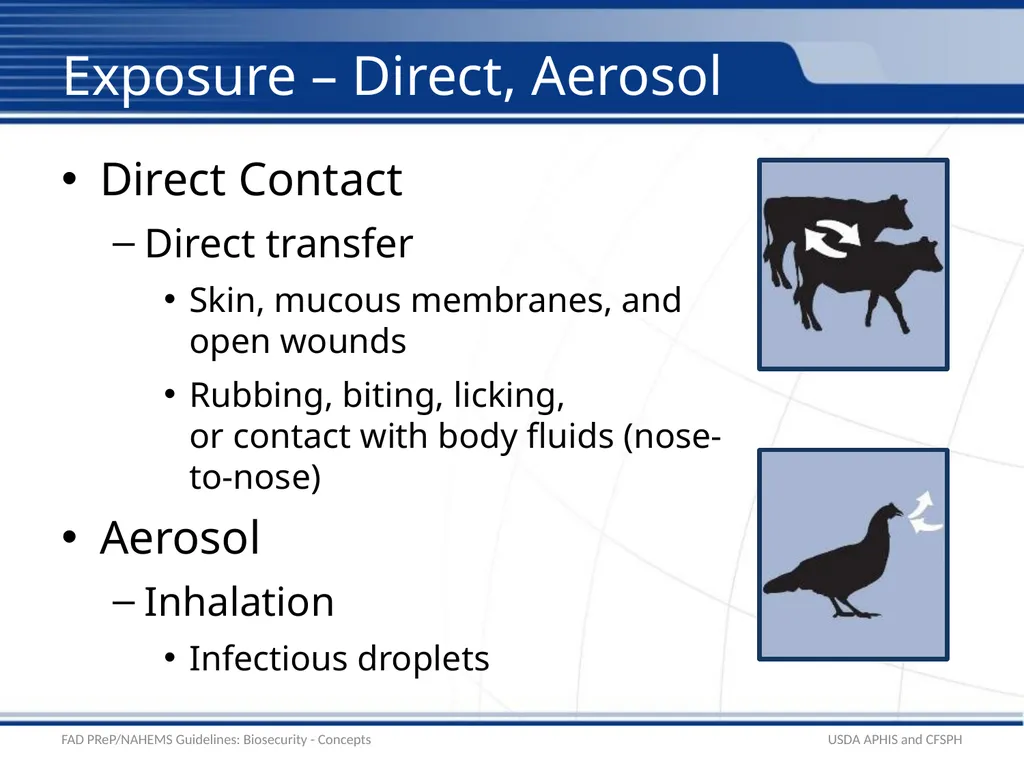
slide7. Direct Contact
Direct transfer
Skin, mucous membranes, and open wounds
Rubbing, biting, licking, or contact with body fluids (nose-to-nose)
Aerosol
Inhalation
Infectious droplets USDA APHIS and CFSPH FAD PReP/NAHEMS Guidelines: Biosecurity - Concepts Exposure – Direct, Aerosol<br>
slide8. Oral
Ingested, consumed
Licking, biting, and eating feed
Environment contaminated by feces, urine, saliva, and blood
Fomites
Inanimate objects
Equipment, vehicles, clothing and boots, dust, and feathers
Lateral spread between facilities as people move USDA APHIS and CFSPH FAD PReP/NAHEMS Guidelines: Biosecurity - Concepts Exposure – Oral, Fomites<br>
slide9. Vectors
Living organisms
Arthropods, insects, rodents, feral animals, and scavengers
Biological and mechanical
Zoonotic Disease
Exposure may occur through any of the routes
Disease-specific USDA APHIS and CFSPH FAD PReP/NAHEMS Guidelines: Biosecurity - Concepts Exposure – Vectors, Zoonotic<br>
slide10. Developing a Biosecurity Plan USDA APHIS and CFSPH FAD PReP/NAHEMS Guidelines: Biosecurity - Concepts<br>
slide11. Step 1: Prioritize the disease agents
Consider species/susceptibility, housing, management, wildlife exposure
Step 2: Conduct a facility assessment
Identify pathways/movements
Step 3: Implement processes to minimize impact of disease
Prevent movements that carry disease USDA APHIS and CFSPH FAD PReP/NAHEMS Guidelines: Biosecurity - Concepts Developing a Plan<br>
slide12. Movements of animals
Closed herd is more protected
Additions from offspring within the herd
Managed in small, isolated groups
All-in/all-out management, less co-mingling
Animals that leave and return create a risk for the herd/flock
Quarantines restrict movements USDA APHIS and CFSPH FAD PReP/NAHEMS Guidelines: Biosecurity - Concepts Developing a Plan cont’d<br>
slide13. Levels of Biosecurity - Preventing Exposure to Disease USDA APHIS and CFSPH FAD PReP/NAHEMS Guidelines: Biosecurity - Concepts<br>
slide14. Producers are responsible
Effective day-to-day procedures
Biosecurity is an investment
Protocols are specific
Species/mixture of species
Diseases, susceptibility to disease
Intended purpose, economic value
Practicality, facility lay-out USDA APHIS and CFSPH FAD PReP/NAHEMS Guidelines: Biosecurity - Concepts Prevent Exposure to Disease<br>
slide15. Farm density
Animal movement
Traffic on and off the premises
Human activity
Equipment sharing
Access by wildlife
Housing difficult to clean
Mortality disposal near animal housing USDA APHIS and CFSPH FAD PReP/NAHEMS Guidelines: Biosecurity - Concepts Increased Risk of Exposure<br>
slide16. Conceptual
Location, geospatial siting, orientation of the facility
Structural
Capital investment, construction, to prevent disease spread
Operational
Processes, management practices, standard operating procedures to exclude or contain disease USDA APHIS and CFSPH FAD PReP/NAHEMS Guidelines: Biosecurity - Concepts Three Levels of Biosecurity<br>
slide17. Facility location, geospatial siting, orientation, scope, size
Higher risk
Greater farm density, close to wildlife areas, large groups managed as one population
Best practices
Separation, isolation
Small biosecure units
Distance to wildlife habitats and roads USDA APHIS and CFSPH FAD PReP/NAHEMS Guidelines: Biosecurity - Concepts Conceptual Biosecurity<br>
slide18. Evaluate existing facility
Mitigate/compensate for vulnerabilities:
Eliminate (make less attractive) wildlife habitat
Reroute traffic away from animal areas
Create smaller biosecure groups USDA APHIS and CFSPH FAD PReP/NAHEMS Guidelines: Biosecurity - Concepts Conceptual Biosecurity cont’d<br>
slide19. Construction, capital investment
Physical design and maintenance
Paved parking away from barns
Fences, barriers leading to entrances to conduct biosecurity protocols
Locations for cleaning/disinfecting
On-site laundry for outerwear
Specialized anteroom at entry USDA APHIS and CFSPH FAD PReP/NAHEMS Guidelines: Biosecurity - Concepts Structural Biosecurity<br>
slide20. Example of a Danish Entry System
Specialized anteroom
Prompts biosecurity protocols
Entering and leaving
Enhancements in long term plans USDA APHIS and CFSPH FAD PReP/NAHEMS Guidelines: Biosecurity - Concepts Structural - Danish Entry System<br>
slide21. Processes, management practices, standard operating procedures to exclude or contain disease
On-farm movements and managements
People, animals, supplies, equipment, vehicles, and other items
Based on specific risk assessments
Mitigation of conceptual and structural vulnerabilities, and known disease USDA APHIS and CFSPH FAD PReP/NAHEMS Guidelines: Biosecurity - Concepts Operational Biosecurity<br>
slide22. Apply strategic actions at critical control points
Focus on inputs and outputs
Entrances and exits
Work paths
Processes
Clearly identify separation of clean/dirty USDA APHIS and CFSPH FAD PReP/NAHEMS Guidelines: Biosecurity - Concepts Operational Biosecurity cont’d<br>
slide23. Clean versus dirty
Line of Separation
Perimeter Buffer Area
Implement at farm or barn level
Mapped and physically marked
Crossing point = critical control point USDA APHIS and CFSPH FAD PReP/NAHEMS Guidelines: Biosecurity - Concepts Operational Biosecurity cont’d<br>
slide24. Cleaning/disinfection and biosecurity attire/PPE
People, equipment, vehicles
Vectors
Carcass disposal
Manure/litter management
Water sources
Delivery/storage of feed and bedding
Maintenance and security USDA APHIS and CFSPH FAD PReP/NAHEMS Guidelines: Biosecurity - Concepts Operational Biosecurity cont’d<br>
slide25. Biosecurity protects animal health
Develop a site-specific biosecurity plan
Consider disease characteristics such as routes of exposure
Incorporate 3 levels of biosecurity: conceptual, structural, operational USDA APHIS and CFSPH FAD PReP/NAHEMS Guidelines: Biosecurity - Concepts Conclusion<br>
slide26. USDA APHIS and CFSPH FAD PReP/NAHEMS Guidelines: Biosecurity - Concepts For More Information FAD PReP/NAHEMS Guidelines & SOP: Biosecurity (2016)
http://www.aphis.usda.gov/fadprep
Biosecurity web-based training module: http://naherc.sws.iastate.edu/<br>
slide27. Authors (CFSPH)
Janice P. Mogan, DVM
Heather Allen, PhD, MPA
Kristen Bretz, MS
Reviewers (USDA)
Jonathan T. Zack, DVM
James A. Roth, DVM, PhD, DACVM USDA APHIS and CFSPH FAD PReP/NAHEMS Guidelines: Biosecurity - Concepts Guidelines Content<br>
slide28. Acknowledgments Development of this presentation was by the Center for Food Security and Public Health at Iowa State University through funding from the USDA APHIS Veterinary Services PPT Authors: Janice P. Mogan, DVM; Logan Kilburn Reviewer: Kristen Bretz, MS<br>